RingCentral vs Nextiva: Which Business Phone System Fits Your Team in 2026?
Turn this article into takeaways for your work.


Each assistant summarizes the article only for you and suggests best practices for your work.
Updated August 2026
If you're an IT director, operations manager, or head of support shopping for a business phone system in 2026, RingCentral and Nextiva are probably the two names your shortlist keeps circling back to. Both sell cloud calling with meetings, team messaging, and business SMS built in. Both sell an AI layer on top. Both sell a bigger CX or contact center tier for when phone support outgrows a basic queue. Read the marketing pages side by side and they sound like the same product wearing two logos.
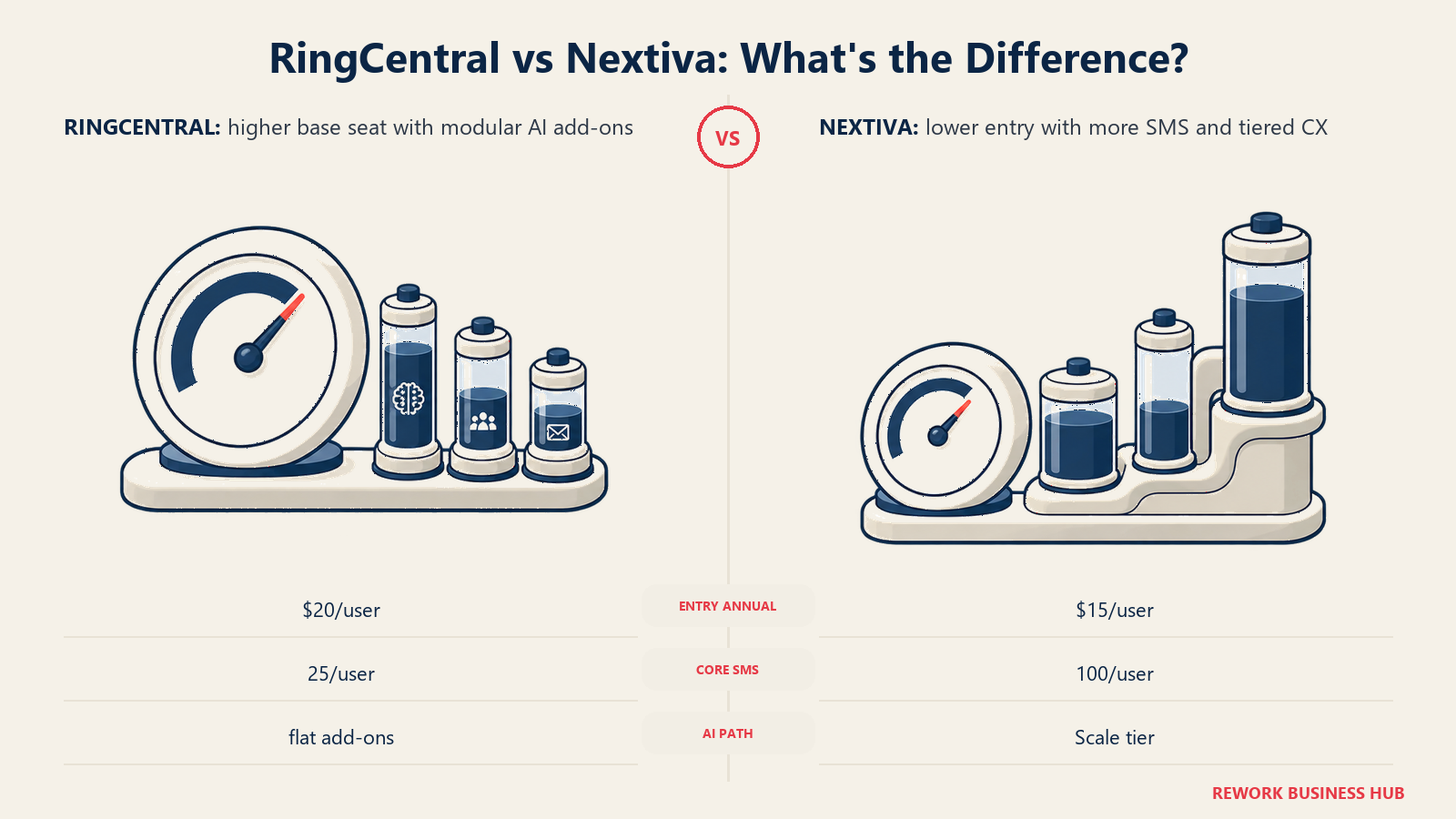
The pricing pages tell a different story, and it's the story that actually decides your bill. RingCentral keeps its core seat price a little higher and folds meetings, messaging, and a real chunk of AI capability into the plan, then sells the rest of the AI layer (a receptionist, call summaries, extra SMS) as separate line items that start small and add up. Nextiva starts cheaper per seat, includes more SMS out of the box, and then asks you to jump a much bigger gap in price the moment you need the CX layer, with nothing between its middle tier and its top tier. Neither approach is a trick. They're just different bets on how you'd rather pay: RingCentral bets you'll add pieces as you need them, Nextiva bets you'll buy the tier that already has what you need. This comparison walks through both bets with real numbers, so you can tell which one fits your team before you're on a call with a sales rep. For the wider field first, see our best business phone system roundup for 2026.
TL;DR
| RingCentral RingEX | Nextiva | |
|---|---|---|
| Entry price | Core: $20/user/mo annual, $30/user/mo monthly | Core: $15/user/mo annual, $23/user/mo monthly |
| Included SMS | 25/user/mo (Core), 100 (Advanced), 200 (Ultra) | 100/user/mo (Core), 500 (Engage), unlimited (Scale) |
| Meetings included | Yes, on every tier, HD up to 300 participants on Core | Yes, video included from Core |
| AI receptionist | Add-on, from $39/mo | Not sold as a standalone add-on on the small-business lineup |
| Call/conversation intelligence | Add-on, Conversational Intelligence from $60/mo | Included AI transcription and summary on Scale ($75/user/mo) |
| Middle tier | Advanced, $25/user/mo annual, adds CRM integrations and reporting | Engage, $25/user/mo annual, adds inbound call center, live chat, chatbot |
| Top small-business tier | Ultra, $35/user/mo annual, webinar, unlimited storage | Scale, $75/user/mo annual, full CX platform, unlimited SMS |
| Contact center upsell | Customer Engagement Bundle, contact for pricing | Separate Enterprise contact centre line, Essential from $75/agent/mo |
| Best for | Teams that want meetings, messaging, and voice bundled tight, then bolt on AI piece by piece | Teams that text customers heavily and want more SMS and AI baked into fewer tiers |
Key Facts
- Gartner's newly published 2026 Magic Quadrant for Unified Communications as a Service revised its 2028 forecast for organizations running enterprise calling through existing cloud office or collaboration tools down to 70%, a twenty-point retreat from the 90% it predicted a year earlier, according to UC Today's coverage of the report. That slower shift is exactly why standalone platforms like RingCentral and Nextiva still have a market to sell into.
- In EZ Texting's 2026 Consumer Texting Behavior Report, a survey of 959 U.S. consumers fielded in January 2026, text already surpasses phone as a preferred contact method: 46% of consumers say they always or mostly prefer text, against 43% for phone and 55% for email.
- Voice hasn't gone away just because AI has arrived. Metrigy's 2026 CX MetriCast research, cited by RingCentral's own coverage of the study, found that 82% of all customer interactions still go through voice, either as the first channel or as an escalation point after another channel fails.
- A 30-day study of 85 small businesses across 58 industries by 411 Locals found only 37.8% of inbound calls were answered live, with the rest going to voicemail or getting no response at all. It's an older study (2016) but it's the one real dataset behind the widely repeated "businesses miss most of their calls" claim, and it's the reason an AI receptionist add-on exists as a product category at all.
Who Each Platform Is Built For
Read RingCentral's RingEX pricing page and you'll notice it doesn't sell "phone" and "meetings" as separate products. Core, Advanced, and Ultra each bundle unlimited domestic calling, HD video meetings, and team messaging together, and the ladder between them is mostly about toll-free minutes, SMS allowance, reporting depth, and storage. RingCentral's bet is that a growing team wants one bill for all its real-time communication, and that AI capability (a receptionist, call summaries, coaching insights) is a separate purchase decision from the core seat.
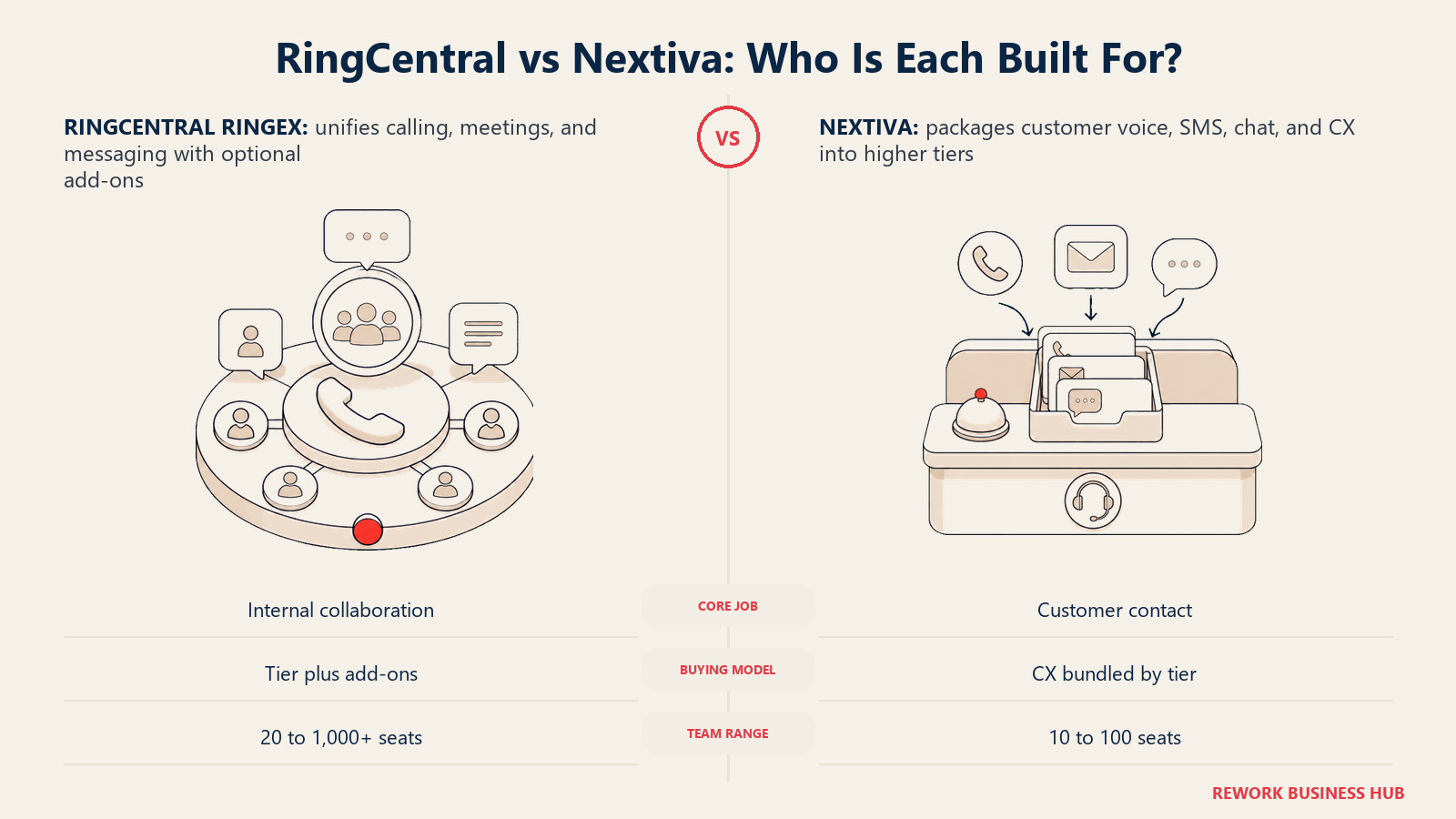
Nextiva's small-business lineup, Core, Engage, and Scale, is built around a different question: how much of the customer-facing layer do you want baked in from day one? Core is voice, SMS, video, call routing, and team chat. Engage adds an inbound call center, live chat, and a chatbot at the second tier rather than the third. Scale, the top tier, is described on Nextiva's own pricing page as a full CX platform with AI transcription and summary, skills-based routing, and journey orchestration built in rather than sold as add-ons. Nextiva's bet is that a texting-heavy, support-heavy team would rather buy the tier that already includes CX behavior than assemble it from a menu.
| RingCentral RingEX | Nextiva | |
|---|---|---|
| Sweet-spot team size | 20 to 1,000+ seats, especially teams already using RingCentral for meetings | 10 to 100 seats on the small-business lineup; larger teams route to the separate Enterprise contact centre line |
| Buying motion | Pick a seat tier, add AI and CX pieces as needed | Pick the tier that already contains the CX behavior you need |
| Primary use case | Unified calling, meetings, and messaging as one system of record | Voice plus customer-facing SMS and chat, with an AI-forward top tier |
| Who champions the purchase | IT director or head of ops replacing a legacy PBX or juggling separate meeting and calling vendors | Head of support or COO who wants texting and chat with customers, not just internal messaging |
| Failure mode if you pick wrong | You pay for meetings and messaging capacity nobody outside sales and ops actually touches | You outgrow Engage's SMS and support features and face a jump straight to $75/user Scale |
Team fit follows the same split. RingCentral's meeting-heavy bundle makes sense for teams where sales, ops, and leadership all live in video calls and phone calls interchangeably. Nextiva's structure makes more sense when the phone system's real job is customer contact, not internal collaboration.
| Team | RingCentral RingEX | Nextiva |
|---|---|---|
| Sales | Strong. Advanced tier adds CRM integrations and core reporting at $25/user/mo annual for call activity tied to deals | Solid on Core, stronger on Engage where inbound routing and live chat catch inbound leads |
| Support | Handles queues and routing, but the deeper CX behavior sits behind the Customer Engagement Bundle | Built in from Engage onward: inbound call center, live chat, chatbot |
| Ops and IT | Multi-site management and reporting on Advanced and up | Advanced reporting on Engage, journey orchestration on Scale |
| Leadership and cross-team | Meetings up to 300 participants on every RingEX tier, including Core | Video included from Core, though not the article's focus |
If neither shape fits and texting-heavy support is the dominant workload, our live chat software roundup and help desk software roundup cover the specialists that go deeper on that single layer than either phone vendor does.
Core Calling, Meetings, and Messaging
Strip away the AI and the CX upsell, and both vendors cover the basics well. The differences show up in what's included at the entry tier versus what waits for a later one.
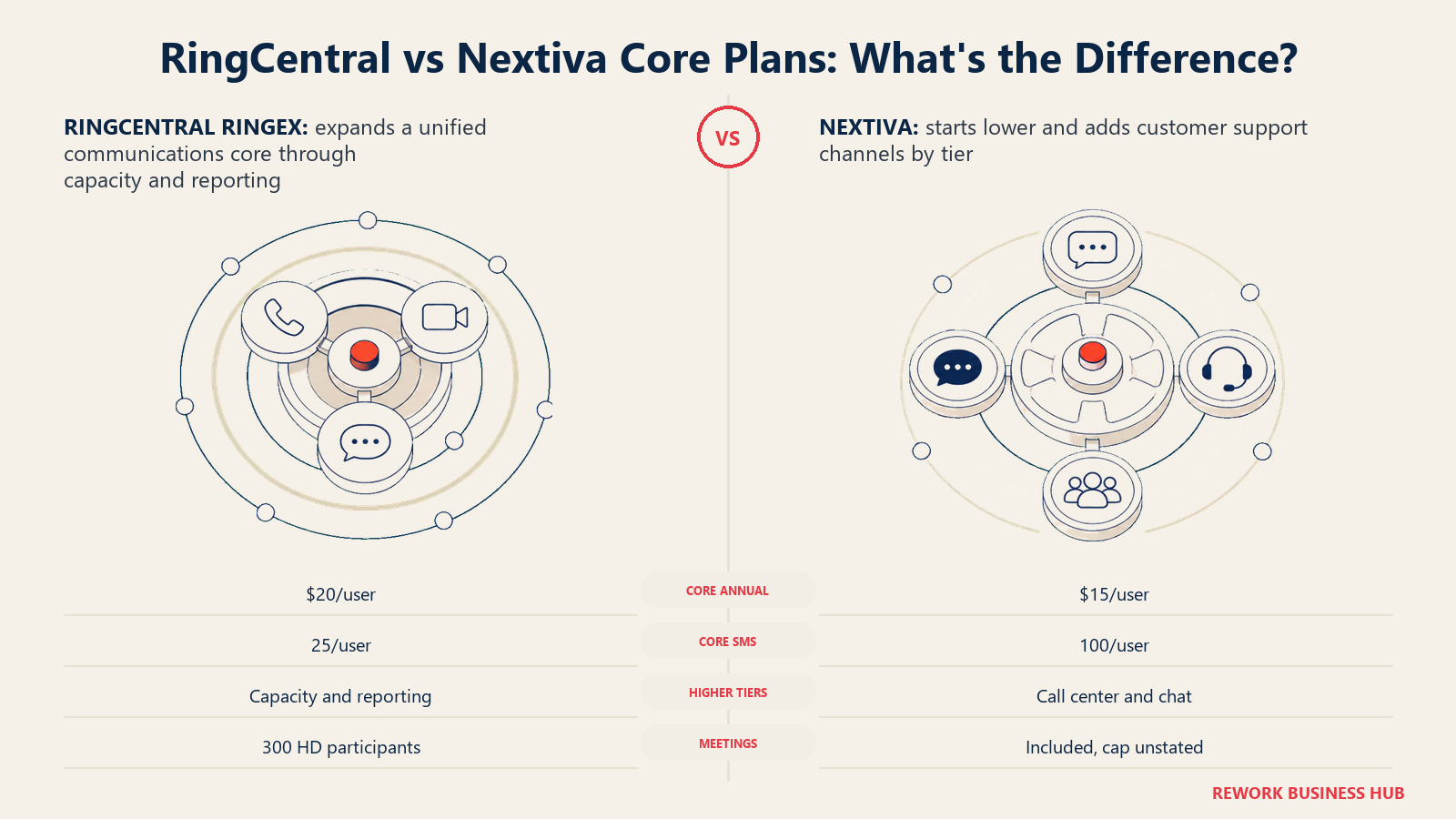
RingCentral RingEX Core, at $20/user/mo annual or $30/user/mo monthly, includes unlimited domestic calling, on-demand call recording, 100 toll-free minutes, 25 SMS per user per month, and HD meetings for up to 300 participants. That meeting capacity at the entry tier is worth noting on its own: a lot of buyers assume 300-participant HD video is a premium feature, and on RingEX it isn't. Advanced, at $25/user/mo annual, adds CRM integrations, multi-site management, core reporting, 1,000 toll-free minutes, and 100 SMS per user per month. Ultra, at $35/user/mo annual, pushes toll-free minutes to 10,000, SMS to 200 per user per month, adds RingCentral Webinar, unlimited storage, and device analytics.
Nextiva Core, at $15/user/mo annual or $23/user/mo monthly, includes voice, business SMS at 100 per user per month, video, call routing, and team chat. Engage, at $25/user/mo annual or $50/user/mo monthly, adds customer-to-team SMS at 500 per user per month, a toll-free number with up to 2,000 minutes, advanced reporting, an inbound call center, live chat, and a chatbot. Scale, at $75/user/mo annual, is the full jump: unlimited SMS, up to 10,000 toll-free minutes, AI transcription and summary, skills-based routing, and journey orchestration.
| Capability | RingCentral RingEX Core | RingCentral Advanced | RingCentral Ultra | Nextiva Core | Nextiva Engage | Nextiva Scale |
|---|---|---|---|---|---|---|
| Annual price/user/mo | $20 | $25 | $35 | $15 | $25 | $75 |
| Monthly price/user/mo | $30 | $35 | $45 | $23 | $50 | not shown |
| Unlimited domestic calling | Yes | Yes | Yes | Yes | Yes | Yes |
| HD meeting capacity | 300 participants | 300 participants | 300 participants | Included, not tiered by size on the sheet | Included | Included |
| Toll-free minutes | 100 | 1,000 | 10,000 | Not itemized at this tier | Up to 2,000 | Up to 10,000 |
| Team messaging | Yes | Yes | Yes | Yes | Yes | Yes |
| Inbound call center | Not at this tier | Not at this tier | Not at this tier | Not at this tier | Yes | Yes, expanded |
| Live chat and chatbot | Not at this tier | Not at this tier | Not at this tier | Not at this tier | Yes | Yes |
| Call recording | On-demand | On-demand | On-demand | Not itemized at this tier | Not itemized at this tier | Not itemized at this tier |
The read here is straightforward once you set AI and SMS aside: RingCentral's ladder is about capacity and reporting depth on a calling-and-meetings product. Nextiva's ladder is about when the customer-facing layer (call center, chat, chatbot) switches on. If your team's core need is "reliable calling and meetings for internal use," RingCentral's Core tier is already generous. If your core need is "a phone system that also fields inbound customer contact," Nextiva reaches that at Engage, one tier up from the bottom, while RingCentral doesn't reach the equivalent until the separate Customer Engagement Bundle.
AI Add-Ons: Where the Real Bill Lives
This is the section that changes the real bill, and it's the section where the two vendors diverge hardest in structure, not just in price.
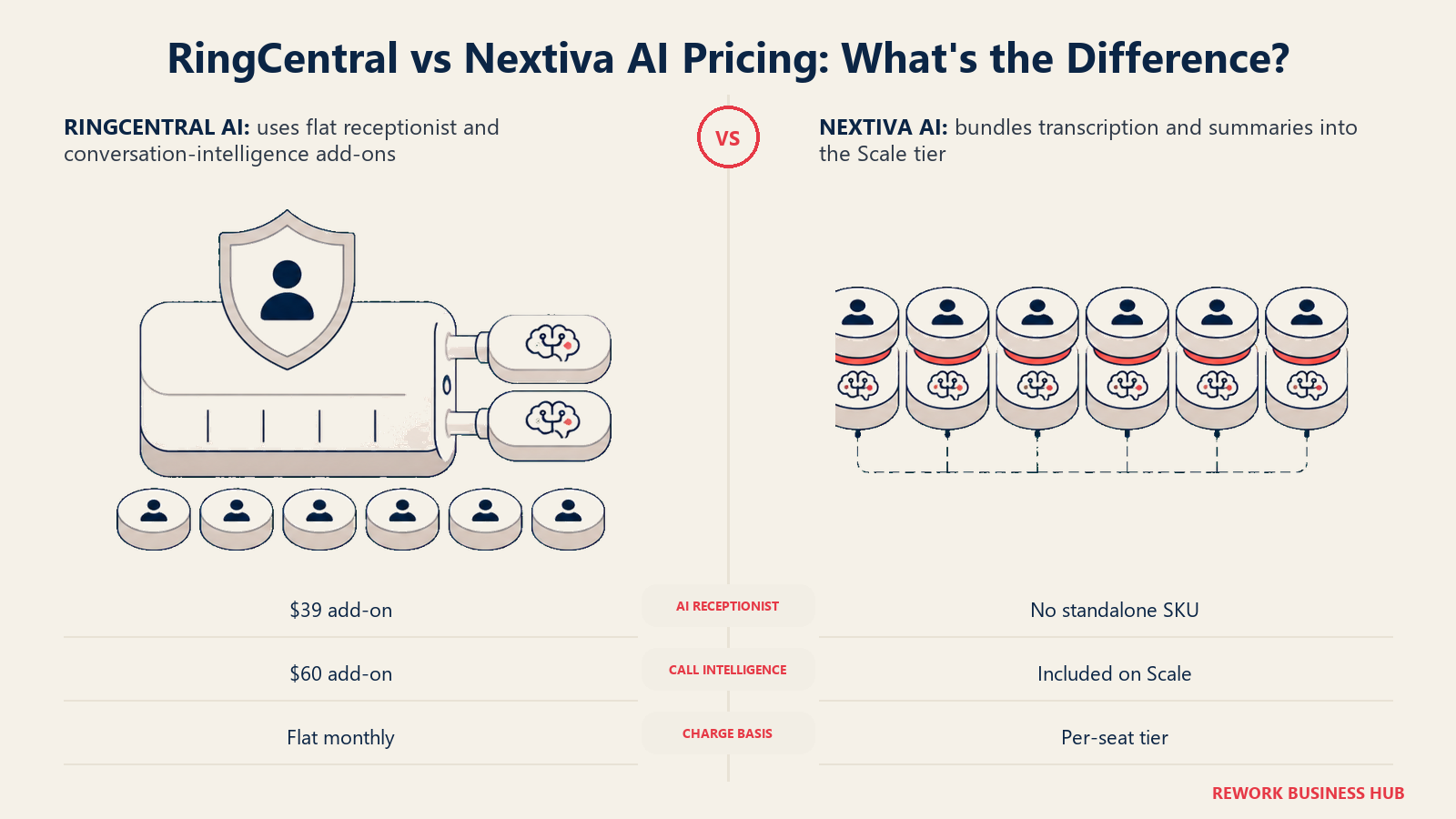
RingCentral sells its AI layer as a menu of add-ons, priced the same regardless of whether you're a 5-seat team or a 100-seat one. AI Receptionist starts from $39/mo. Conversational Intelligence, which analyzes calls for coaching and sentiment, starts from $60/mo. A Call Queues Booster is $35/mo and a Business SMS Booster is $25/mo. The price sheet states these figures are identical across the 1-5, 6-100, and 100-plus user bands, which means they read as flat account-level or line-level fees rather than per-seat charges. That has a real consequence for the math: the same $39 AI Receptionist add-on is a bigger percentage of the bill for a small team than a large one.
Nextiva doesn't sell an equivalent standalone AI add-on menu on its small-business lineup. Instead, AI transcription and summary arrive built into Scale at $75/user/mo, alongside skills-based routing and journey orchestration. There's no $39 AI Receptionist you can bolt onto Nextiva Core to get a lighter version of that capability. You either don't have it, or you're paying the full $75 seat price for the tier that has it.
| AI capability | RingCentral RingEX | Nextiva |
|---|---|---|
| AI receptionist / auto-attendant with AI | Add-on, AI Receptionist from $39/mo, flat across user bands | Not sold as a standalone SKU on the small-business lineup |
| Call/conversation intelligence (coaching, sentiment) | Add-on, Conversational Intelligence from $60/mo, flat across user bands | Included in Scale ($75/user/mo) as AI transcription and summary |
| Extra queue capacity via AI/automation | Call Queues Booster, $35/mo flat | Included in Engage's inbound call center and Scale's skills-based routing |
| How it's priced | Flat monthly add-on fees, same price regardless of team size | Folded into a per-seat tier price, so it scales directly with headcount |
| Where it shows up on the bill | A separate line item next to your seat subscription | Inside the Scale subscription itself |
Run the flat-fee math and the size of your team decides how much this matters. A 25-seat team on RingEX Core paying $500/mo for seats, then adding AI Receptionist ($39) and Conversational Intelligence ($60), takes on $99/mo in flat AI fees, roughly 20% on top of the seat bill. The same $99/mo of AI add-ons on a 100-seat team paying $2,000/mo for Core seats is under 5% of the bill. RingCentral's AI pricing rewards scale. Nextiva's Scale tier does the opposite: the $75/user/mo AI capability costs exactly the same percentage uplift over Core ($15) whether you have 25 seats or 100, because it's priced per seat from the start.
The practical takeaway: if you're a smaller team that wants AI receptionist behavior without upgrading your whole seat price, RingCentral's flat add-on is the cheaper path in absolute dollars, even though it's a bigger percentage of a small bill. If you're a larger team and you want AI transcription and coaching insight across every seat, Nextiva's per-seat Scale tier and RingCentral's flat Conversational Intelligence add-on end up closer than you'd expect once you do the per-seat math, so get both quotes in writing before assuming either is cheaper.
Business SMS: The Number That Decides This Comparison First
Before you get to features, get to this number. If your team texts customers, appointment reminders, delivery updates, or support follow-ups at any real volume, the included SMS allowance decides the winner faster than any feature checklist, because it's the one line item that turns into an overage conversation or a forced upgrade the first month you actually use the product.
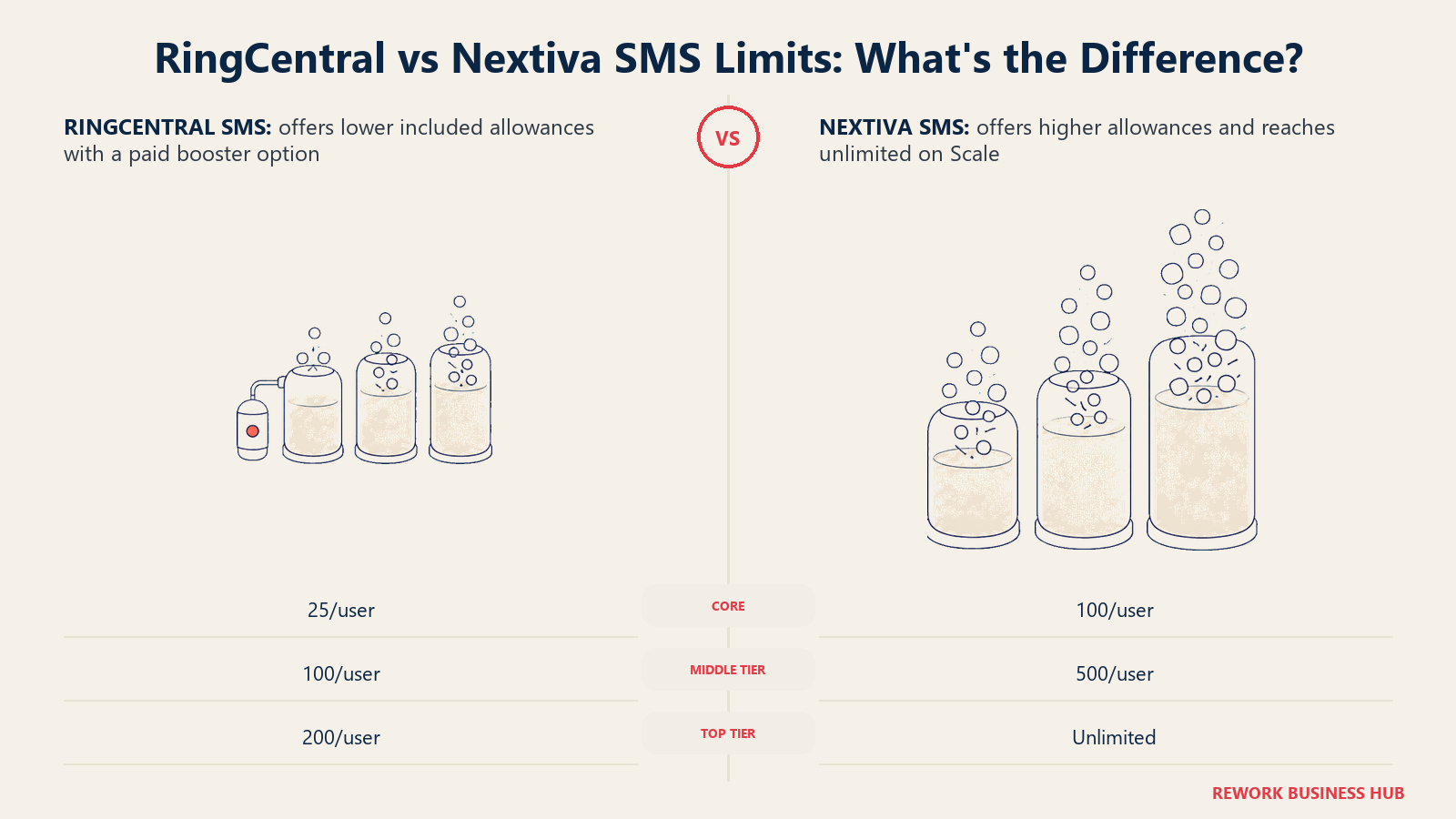
| Tier | RingCentral RingEX | Nextiva |
|---|---|---|
| Entry tier | Core: 25 SMS/user/mo | Core: 100 SMS/user/mo |
| Middle tier | Advanced: 100 SMS/user/mo | Engage: 500 SMS/user/mo (customer-to-team SMS) |
| Top tier | Ultra: 200 SMS/user/mo | Scale: unlimited SMS |
| Add-on for more | Business SMS Booster, $25/mo flat | No booster needed once you're on Engage or Scale |
Nextiva's entry tier includes four times the SMS of RingCentral's entry tier. That gap doesn't close until RingCentral's top tier, Ultra at 200 SMS/user/mo, still below Nextiva's middle tier of 500. If your team runs appointment reminders, delivery confirmations, or two-way customer texting, EZ Texting's 2026 research puts text ahead of phone as a preferred contact channel for the first time (46% always-or-mostly prefer text versus 43% phone), which means SMS volume isn't a nice-to-have anymore, it's load-bearing.
Work the numbers for a concrete team. Say a 25-person sales and support team averages 80 texts per user per month, appointment confirmations, follow-ups, and quick customer replies combined. On RingCentral, that blows past Core's 25/user allowance almost immediately and lands short of Advanced's 100, so the real choice is Advanced at $25/user/mo annual, or Core plus the $25/mo flat Business SMS Booster if the booster's added allotment covers the gap (the sheet doesn't publish how much SMS the booster adds, so confirm that number with a RingCentral rep before you commit to it as the cheaper path). On Nextiva, that same 80-texts-per-user average sits comfortably inside Core's 100/user/mo allowance, meaning the $15/user/mo entry tier is enough, no upgrade, no booster, no add-on conversation.
That's the concrete version of this comparison's core tension. A texting-light team that mostly makes calls and joins meetings will barely notice the SMS gap and should compare the two on meetings, AI, and price alone. A texting-heavy team, retail, home services, healthcare scheduling, anything appointment-driven, will find Nextiva's entry tier does what RingCentral needs a $25/user/mo upgrade or a flat add-on to match.
The Contact Center Upsell
Both vendors eventually route you to a bigger, pricier tier once phone support turns into a real contact center operation. They just build the ramp differently.
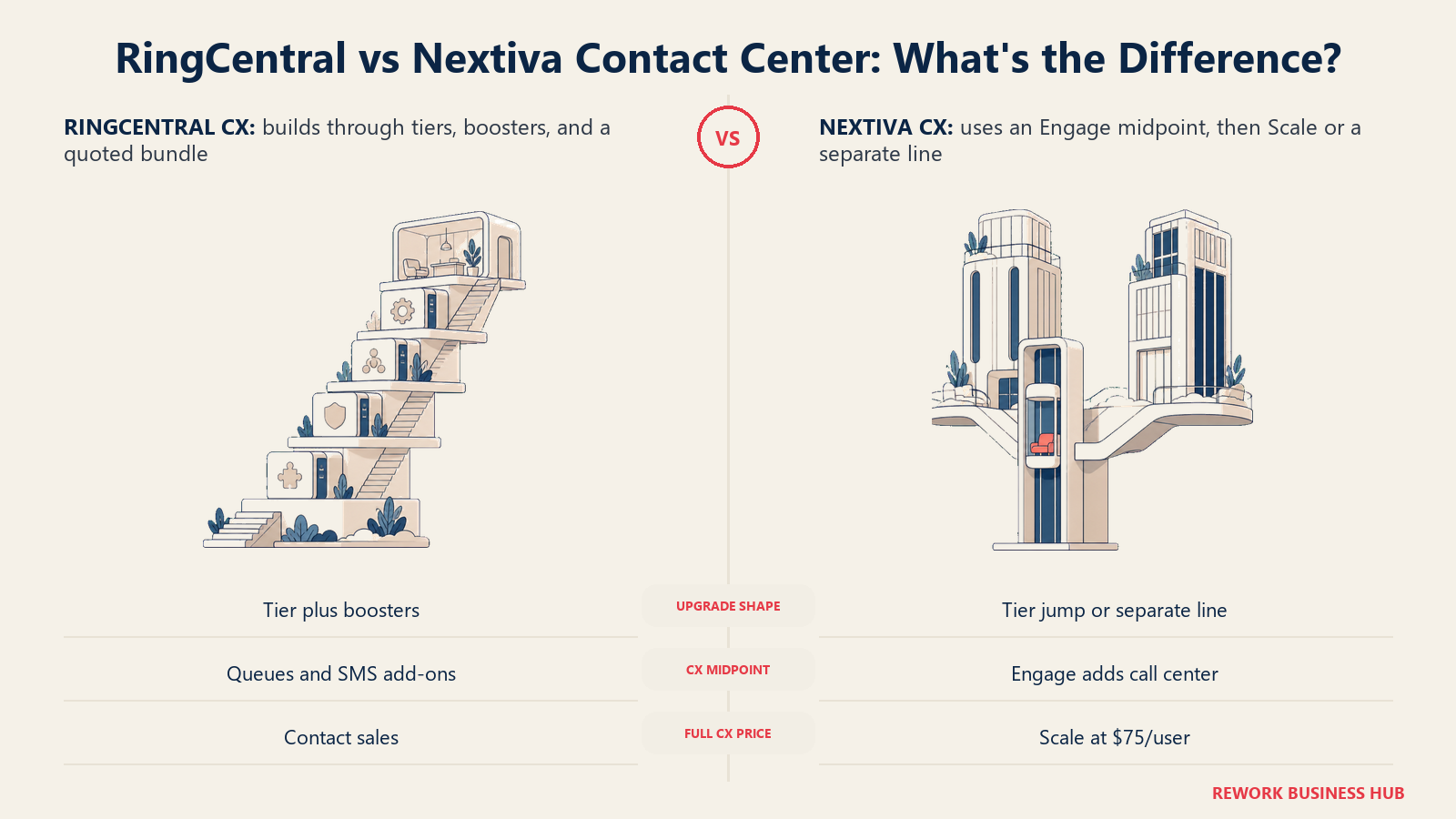
RingCentral's path is additive. Get to Ultra, the top RingEX tier at $35/user/mo annual, then layer on the Business SMS Booster and Call Queues Booster if you need more, and if that's still not enough, there's a Customer Engagement Bundle that packages everything in Ultra plus those two boosters, priced as "contact for pricing." It's the same ladder logic as the AI add-ons: keep adding pieces until you've assembled a contact center.
Nextiva's path is a fork. The small-business Scale tier at $75/user/mo annual is the top of the Core/Engage/Scale ladder and already includes AI transcription, skills-based routing, and journey orchestration. But Nextiva also runs a separate Enterprise contact centre line with its own Essential tier starting from $75/agent/mo, and Professional and Premium above that are both "Contact Sales" with no published rate. That's worth being precise about, because Scale and Enterprise Essential are not the same product despite landing at a similar headline price: Scale is Nextiva's top small-business seat tier, Enterprise Essential is the entry point to a distinct contact-center product line aimed at dedicated agent teams. If you're evaluating Nextiva for a real contact center, ask explicitly which line your quote is coming from.
| RingCentral | Nextiva | |
|---|---|---|
| Path to contact center | Ultra tier, then boosters, then Customer Engagement Bundle | Either Scale (top of the small-business ladder) or a separate Enterprise contact centre line |
| Named entry price for that upsell | Customer Engagement Bundle: contact for pricing | Scale: $75/user/mo annual. Enterprise Essential: from $75/agent/mo, a different product |
| Where the jump happens | Gradual, one add-on at a time from Advanced upward | Steep, single jump from Engage ($25) to Scale ($75), nothing in between |
| Best for | Teams that want to build up contact-center capability incrementally and track each cost separately | Teams that know upfront they need the full CX platform and would rather buy one tier than assemble one |
That "nothing in between" gap on Nextiva's small-business ladder is worth planning around. Engage at $25/user/mo annual gives you an inbound call center, live chat, and a chatbot already, which covers a lot of support needs. The jump to Scale at $75/user/mo is a three-times increase for AI transcription, unlimited SMS, and journey orchestration specifically, not for basic support functionality you don't already have. Confirm which of those three things you actually need before signing up for the full jump. If you're building out a dedicated support desk rather than folding it into your phone system, our help desk software roundup and our guide to choosing help desk software cover the specialists built for that job specifically.
Integrations
Integration depth is where vendor pricing pages get vague on both sides, so here's what's actually confirmed rather than what's implied.
RingCentral names CRM integrations explicitly as a feature of its Advanced tier at $25/user/mo annual, alongside multi-site management and core reporting. That's a deliberate gate: if syncing call activity into your CRM matters, Core alone doesn't get you there, and you're paying the Advanced price whether or not you need the multi-site management that comes bundled with it.
Nextiva's tier notes don't name specific integration partners at any level on the small-business lineup. That's not evidence Nextiva lacks integrations, its Engage and Scale tiers describe advanced reporting and journey orchestration that typically depend on connected systems, but it does mean you shouldn't assume parity with RingCentral's named CRM sync. If a specific integration (your CRM, your helpdesk, your calendar system) is a hard requirement, ask both vendors to confirm it by name in writing rather than trusting a general "integrates with your stack" line on either pricing page.
| RingCentral RingEX | Nextiva | |
|---|---|---|
| CRM integration | Named feature, gated to Advanced tier ($25/user/mo) and up | Not named at a specific tier on the small-business lineup |
| Reporting depth by tier | Core reporting on Advanced, deeper analytics implied on Ultra | Advanced reporting named on Engage ($25/user/mo) |
| Where to verify specifics | RingCentral's app gallery/marketplace, confirmed with your rep | Nextiva's integration marketplace, confirmed with your rep |
Neither vendor's pricing page is the place to finalize an integration requirement. Treat both tables above as a starting filter, then get the specific connector confirmed live in a demo before you sign.
Pricing at 25, 50, and 100 Seats
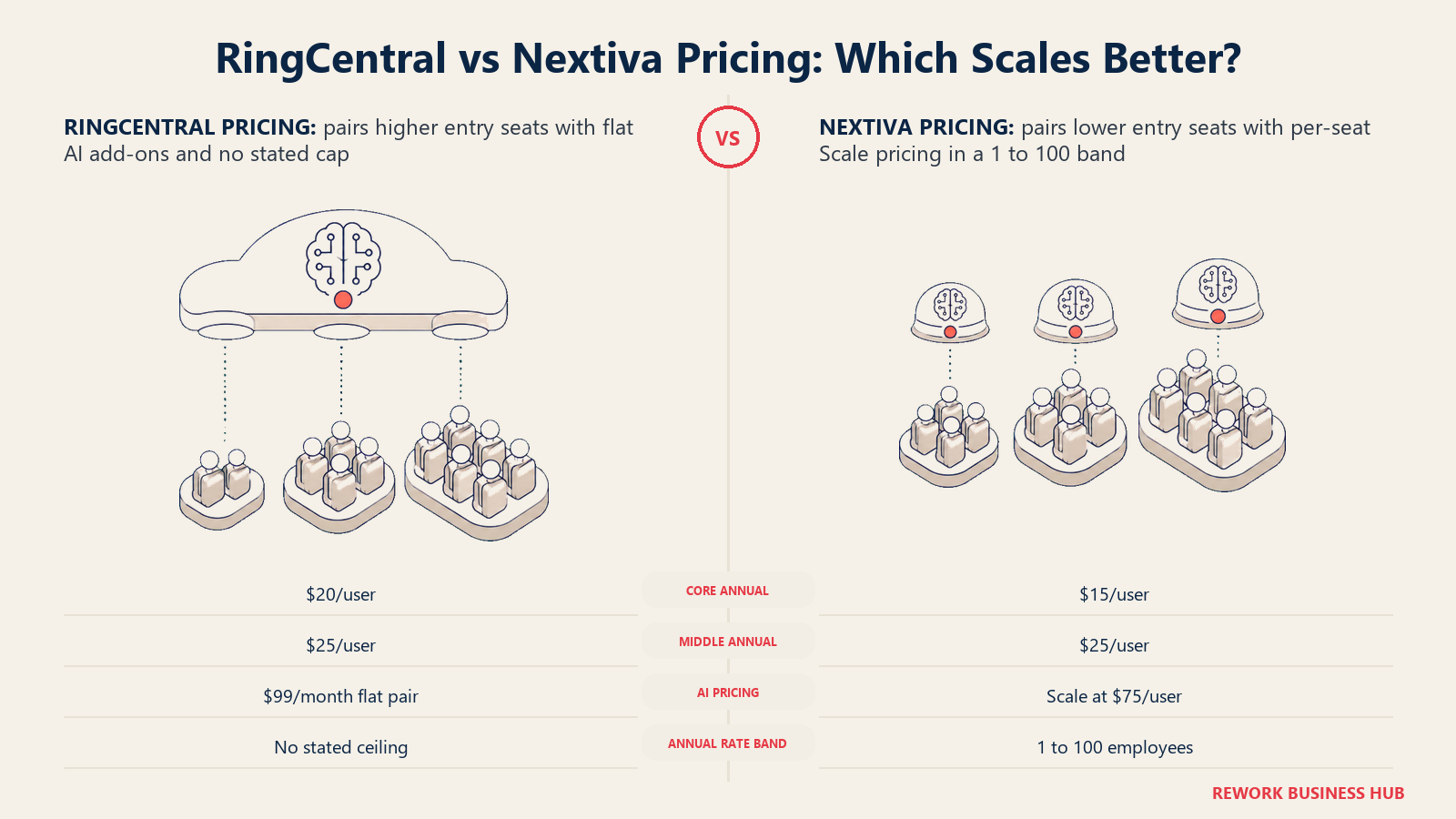
Before the math, one scoping detail that changes who these numbers apply to. Nextiva's annual small-business pricing is explicitly scoped to new customers with 1-100 employees on a 12-month or longer term. A 25 or 50-seat buyer is comfortably inside that band. A 100-seat buyer is sitting right at the edge of it, and a company with more than 100 employees isn't eligible for the published small-business annual rate at all and should expect to be routed to a different sales motion with custom pricing. RingCentral's published RingEX pricing carries no equivalent headcount ceiling on the sheet.
Entry tier: RingCentral Core vs Nextiva Core
| Seats | RingCentral Core, annual ($20/user/mo) | RingCentral Core, monthly ($30/user/mo) | Nextiva Core, annual ($15/user/mo) | Nextiva Core, monthly ($23/user/mo) |
|---|---|---|---|---|
| 25 | $6,000/yr | $9,000/yr | $4,500/yr | $6,900/yr |
| 50 | $12,000/yr | $18,000/yr | $9,000/yr | $13,800/yr |
| 100 | $24,000/yr | $36,000/yr | $18,000/yr (at the edge of Nextiva's 1-100 employee annual band) | $27,600/yr |
At the entry tier, Nextiva is cheaper at every seat count on both annual and monthly billing, by 25% on annual pricing specifically. That's before factoring in that Nextiva Core already includes 100 SMS/user/mo against RingCentral Core's 25.
Middle tier: RingCentral Advanced vs Nextiva Engage
| Seats | RingCentral Advanced, annual ($25/user/mo) | RingCentral Advanced, monthly ($35/user/mo) | Nextiva Engage, annual ($25/user/mo) | Nextiva Engage, monthly ($50/user/mo) |
|---|---|---|---|---|
| 25 | $7,500/yr | $10,500/yr | $7,500/yr | $15,000/yr |
| 50 | $15,000/yr | $21,000/yr | $15,000/yr | $30,000/yr |
| 100 | $30,000/yr | $42,000/yr | $30,000/yr (at the edge of the annual eligibility band) | $60,000/yr |
The middle tier is where the annual prices land exactly even, $25/user/mo on both sides. What you get for that $25 differs: RingCentral Advanced adds CRM integrations, multi-site management, and core reporting. Nextiva Engage adds an inbound call center, live chat, and a chatbot, plus 500 SMS/user/mo against RingCentral's 100. On monthly billing without an annual commitment, RingCentral is meaningfully cheaper at this tier, $35 against $50 per user.
Top tier and AI-inclusive comparison
Comparing RingCentral Ultra against Nextiva Scale isn't quite apples to apples, so read the caveat before the numbers. Nextiva Scale bundles AI transcription and summary, unlimited SMS, and skills-based routing into the seat price. RingCentral Ultra doesn't include AI Receptionist or Conversational Intelligence at any price, those stay separate add-ons even at the top tier, and Ultra also doesn't include Nextiva's inbound call center, live chat, or chatbot, which stay behind RingCentral's separate Customer Engagement Bundle.
| Seats | RingCentral Ultra, annual seats only ($35/user/mo) | + AI Receptionist and Conversational Intelligence ($99/mo flat) | RingCentral Ultra total | Nextiva Scale, annual ($75/user/mo) |
|---|---|---|---|---|
| 25 | $10,500/yr | $1,188/yr | $11,688/yr | $22,500/yr |
| 50 | $21,000/yr | $1,188/yr | $22,188/yr | $45,000/yr |
| 100 | $30,000/yr | $1,188/yr | $43,188/yr | $90,000/yr |
RingCentral Ultra plus its two AI add-ons comes in well under half of Nextiva Scale at every seat count in this table, and the gap widens with headcount because RingCentral's AI fees are flat while Nextiva's are per seat. But that comparison only covers AI transcription and coaching insight. It doesn't cover Nextiva Scale's unlimited SMS, skills-based routing, journey orchestration, or built-in inbound call center, live chat, and chatbot, none of which RingCentral Ultra includes without moving to the separate, unpriced Customer Engagement Bundle. If your team needs the full CX platform, not just the AI transcription piece, get a real quote for RingCentral's Customer Engagement Bundle before assuming the Ultra-plus-add-ons number above is the honest comparison point.
| What you're actually buying | Cheaper on RingCentral | Cheaper on Nextiva |
|---|---|---|
| Base seat, texting-light team, calling and meetings only | No | Yes, 25% cheaper on Core |
| Base seat, texting-heavy team (SMS allowance matters) | No, Advanced upgrade or booster needed sooner | Yes, Core's 100 SMS/user/mo often removes the need to upgrade at all |
| AI transcription and coaching insight only, no CX platform | Yes, Ultra plus add-ons beats Scale by a wide margin | No |
| Full CX platform: chat, chatbot, inbound call center, unlimited SMS | Only via the unpriced Customer Engagement Bundle | Yes, Scale has a published price for all of it |
| 100+ employee team wanting the published annual rate | Yes, no headcount ceiling on the RingEX sheet | No, outside the 1-100 employee annual eligibility band |
That last row matters more than it looks. If you're a 120-employee company, RingCentral's published annual pricing still applies to you directly. Nextiva's published small-business annual rate doesn't, and you'd need a custom quote to know your real number, which makes a clean side-by-side harder to do honestly above roughly 100 employees.
Implementation and Time to Value
Neither vendor's pricing page publishes implementation fees, onboarding timelines, or contract minimums in a way this article can quote with a real number, so treat the row below as what to ask for in writing rather than a verified figure.
| RingCentral | Nextiva | |
|---|---|---|
| Core setup complexity | Higher if you're bundling meetings and messaging migration alongside calling, since RingEX handles all three | Lower if you're primarily replacing a phone system, since chat and video are secondary to voice on Core |
| Where complexity concentrates | Number porting plus meeting/messaging rollout to non-phone teams | Number porting plus training reps on the inbound call center and chat features once you're on Engage or above |
| AI add-on rollout | Each add-on (AI Receptionist, Conversational Intelligence, boosters) is a separate activation, ask about setup time for each | Scale's AI transcription and routing come with the tier, so there's one activation rather than several |
| What to confirm before signing | Implementation fees, contract minimum, and whether AI add-ons require a separate contract term | Confirm the 12-month-or-longer term requirement for annual pricing and any onboarding fee for the CX features in Engage or Scale |
| Who needs training first | Admins configuring queues and call handling rules, then anyone using meetings and messaging | Admins configuring routing, then anyone answering inbound chat or SMS once Engage or Scale is live |
The practical difference: RingCentral's rollout risk is spread across three product surfaces (calling, meetings, messaging) that might already be partly covered by other tools you own, so ask directly whether you're paying for meeting and messaging capacity you'll actually use. Nextiva's rollout risk concentrates in the customer-facing layer, chat and inbound call center, which only pays off if reps are actually trained to work it, not just have it turned on.
When Nextiva Is the Right Call
- You text customers at real volume. Core alone includes 100 SMS/user/mo, four times RingCentral Core's 25. If appointment reminders, delivery updates, or two-way customer texting are part of daily work, Nextiva's entry tier likely covers it without an upgrade.
- You want the customer-facing layer switched on early, not assembled later. Engage, at $25/user/mo annual, the same price as RingCentral's Advanced tier, already includes an inbound call center, live chat, and a chatbot. RingCentral doesn't reach equivalent CX functionality until the separate, unpriced Customer Engagement Bundle.
- You're under 100 employees and want a straightforward annual quote. Nextiva's published small-business annual pricing applies cleanly to teams inside the 1-100 employee band.
- You want AI transcription and routing bundled into one tier rather than shopped separately. Scale folds AI summary, unlimited SMS, and skills-based routing into a single $75/user/mo line, which is simpler to budget than RingCentral's stack of flat add-on fees even if the per-seat total runs higher.
When RingCentral Is the Right Call
- Meetings and messaging matter as much as calling. RingEX Core includes HD meetings for up to 300 participants at the entry tier. If you're currently paying for a separate meetings vendor on top of a phone system, RingCentral folding both in at $20/user/mo annual is a real consolidation, not just a phone upgrade.
- You want AI capability without upgrading your whole seat price. AI Receptionist starts from $39/mo and Conversational Intelligence from $60/mo, both flat regardless of team size. For a team that just wants a receptionist and call coaching, that's a smaller absolute cost than jumping to Nextiva's $75/user/mo Scale tier.
- You're over 100 employees. RingCentral's published RingEX pricing carries no headcount ceiling, while Nextiva's small-business annual rate is scoped to 1-100 employees on a 12-month or longer term.
- Your team texts lightly but calls and meets constantly. If SMS volume is genuinely low, RingCentral's smaller included SMS allowance costs you nothing in practice, and its meeting capacity and CRM-integrated Advanced tier become the deciding factors instead.
Decision Framework
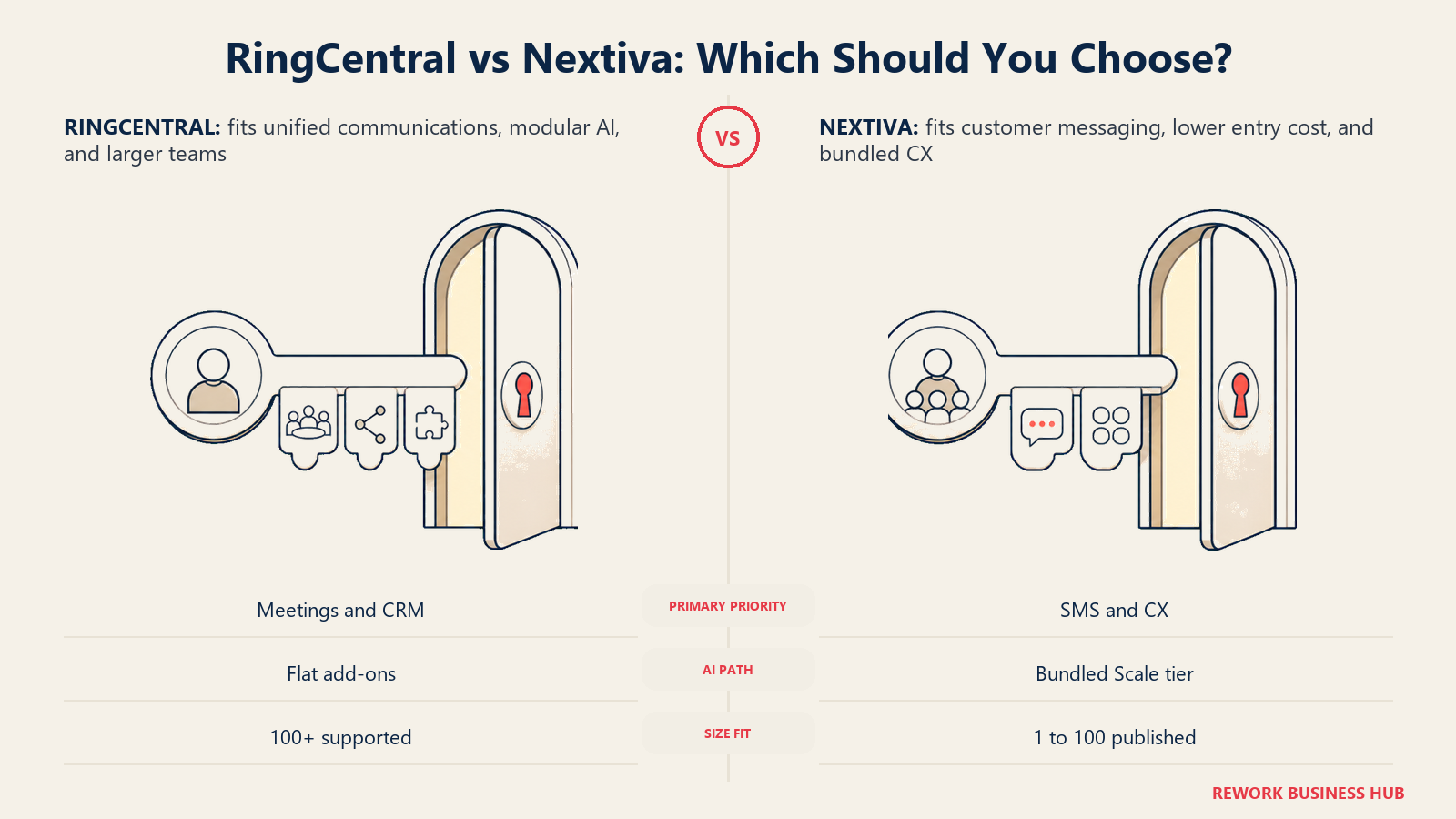
Use your dominant workload to break the tie. RingCentral favors meeting-heavy teams, flat AI add-ons, explicit CRM integration, and larger headcounts, while Nextiva favors high-volume SMS and a bundled customer-facing CX stack.
| If this is your situation | Pick |
|---|---|
| Your team texts customers heavily, appointments, reminders, or two-way support | Nextiva, Core alone includes 4x RingCentral Core's SMS allowance |
| Meetings and team messaging need to be bundled tightly with calling | RingCentral, 300-participant HD meetings on every RingEX tier including Core |
| You want AI receptionist and call coaching without a big seat-price jump | RingCentral, flat add-ons from $39 and $60 per month |
| You want the full CX platform (chat, chatbot, call center, unlimited SMS) at one published price | Nextiva Scale, $75/user/mo |
| You're over 100 employees and want a clean published annual rate | RingCentral, no headcount ceiling on the RingEX sheet |
| You're under 100 employees and want the lowest entry price | Nextiva Core, $15/user/mo annual against RingCentral Core's $20 |
| CRM integration at the entry-to-mid tier is a hard requirement | RingCentral Advanced, CRM integrations named explicitly at $25/user/mo |
| Neither shape fits and you want to see the rest of the field | Best business phone system in 2026 |
Frequently Asked Questions about RingCentral vs Nextiva
Is RingCentral or Nextiva cheaper?
At the entry tier, Nextiva is cheaper: $15/user/mo annual against RingCentral's $20, both billed annually. At the middle tier the annual prices land exactly even at $25/user/mo, though what's included differs. At the top tier it depends entirely on what you need: RingCentral Ultra plus its AI add-ons is far cheaper than Nextiva Scale if you only want AI transcription and coaching, but Nextiva Scale is the only one of the two with a published price for the full CX platform, chat, chatbot, and inbound call center included.
How much SMS does each plan include?
RingCentral RingEX includes 25 SMS per user per month on Core, 100 on Advanced, and 200 on Ultra, with a Business SMS Booster add-on at $25/mo flat if you need more. Nextiva includes 100 SMS per user per month on Core, 500 on Engage, and unlimited on Scale. Nextiva's entry tier alone includes four times RingCentral's entry tier allowance.
Does RingCentral include an AI receptionist?
Not on any RingEX seat tier by default. AI Receptionist is a separate add-on starting from $39 per month, and the price sheet lists that figure as flat regardless of whether you have 5, 50, or 500 users. Nextiva doesn't sell an equivalent standalone AI receptionist SKU on its small-business lineup; AI capability there arrives bundled into the top Scale tier at $75/user/mo.
What's the difference between Nextiva's Scale tier and its Enterprise contact centre Essential tier?
They're different products that happen to share a similar headline number. Scale, at $75/user/mo annual, is the top of Nextiva's Core, Engage, Scale small-business ladder. Enterprise contact centre Essential, from $75/agent/mo, is the entry point to a separate contact-center product line, with Professional and Premium above it both quoted as "Contact Sales." If a rep quotes you $75, confirm which product line that quote is actually for.
Can a 100-seat company use Nextiva's published annual pricing?
Right at the edge of it. Nextiva's annual small-business pricing is scoped to new customers with 1-100 employees on a 12-month or longer term, so a 100-employee buyer is still inside the band. Anyone above 100 employees isn't eligible for that published rate and should expect a custom quote instead.
Does RingCentral or Nextiva have a headcount limit on published pricing?
RingCentral's RingEX pricing sheet carries no stated headcount ceiling. Nextiva's small-business annual pricing is explicitly limited to companies with 1-100 employees on a 12-month or longer term, which matters directly if your company is near or above that size.
Which one is better for a texting-heavy team like retail or home services?
Nextiva, mainly on SMS volume alone. Its Core tier's 100 SMS per user per month already covers what RingCentral's Advanced tier ($25/user/mo) provides, and Engage's 500 per user per month covers volume RingCentral doesn't reach until you add a booster on top of its top Ultra tier.
Do both vendors offer meetings and video as part of the phone plan?
Yes, both include video meetings on every published tier. RingCentral is more specific about capacity, naming HD meetings for up to 300 participants on every RingEX tier including Core. Nextiva includes video from Core as well but doesn't publish a specific participant cap on its pricing page notes.
What to Do Next
- Pull your last three months of SMS volume, or estimate it honestly. Count texts per user per month across your team, not just your busiest rep. If that number is over 25, RingCentral Core's allowance won't cover you and you're really pricing Advanced or a booster. If it's over 100, you're pricing RingCentral Ultra against Nextiva's included allowance at every tier.
- Decide whether you need AI transcription and a receptionist, or the full CX platform. Those are different purchases. RingCentral's flat add-ons are the cheaper way to get AI transcription and a receptionist alone. Nextiva Scale or RingCentral's Customer Engagement Bundle are what you actually need if chat, chatbot, and inbound call routing matter too, and only one of those two has a published price.
- Check your headcount against Nextiva's 1-100 employee annual eligibility band before you build a budget around its published rate. If you're near or above 100 employees, get a written quote rather than assuming the Core, Engage, or Scale numbers in this article apply to you.
- Get both quotes itemized, not bundled. Ask each vendor to break seat price, SMS allowance and overage cost, and any AI or CX add-on into separate line items. That's the only way to compare RingCentral's additive pricing against Nextiva's tiered pricing honestly.
- Still comparing options? See our best RingCentral alternatives and best Nextiva alternatives guides if either platform turns out not to fit once you've run your real numbers.
Related Resources:

Principal Product Marketing Strategist
On this page
- TL;DR
- Key Facts
- Who Each Platform Is Built For
- Core Calling, Meetings, and Messaging
- AI Add-Ons: Where the Real Bill Lives
- Business SMS: The Number That Decides This Comparison First
- The Contact Center Upsell
- Integrations
- Pricing at 25, 50, and 100 Seats
- Entry tier: RingCentral Core vs Nextiva Core
- Middle tier: RingCentral Advanced vs Nextiva Engage
- Top tier and AI-inclusive comparison
- Implementation and Time to Value
- When Nextiva Is the Right Call
- When RingCentral Is the Right Call
- Decision Framework
- What to Do Next