Best Dialpad Alternatives in 2026: 13 Business Phone Systems Compared
Turn this article into takeaways for your work.


Each assistant summarizes the article only for you and suggests best practices for your work.
Updated August 2026
Dialpad is the cheapest full unified-communications entry point among the major vendors in this category. Connect Standard runs $15 per user per month on an annual plan, and Dialpad's own documentation describes platform-native AI as included across pricing tiers, so live transcription, call summaries and meeting recaps land on the entry plan instead of arriving as a $39 monthly add-on the way they do at RingCentral. Gartner placed Dialpad in the Visionary quadrant of its 2026 UCaaS Magic Quadrant, a genuine position in a field that shrank from 11 rated vendors to 9 that year. If your team wants voice with AI notes attached and can commit to a twelve-month term, Dialpad is a defensible first choice, and plenty of teams stay.
The reason people go shopping is usually one of three invoices. The first is the annual-versus-monthly gap: skip the commitment and $15 becomes $27 per user per month, an 80% premium for the flexibility of not signing a year up front. The second is a distinction Dialpad's own reputation blurs. Platform-native AI, meaning transcripts, summaries and recaps, is included in Connect. The autonomous Dialpad AI Agent, the product that answers a call and executes an action on its own, is not included. It is a separate, credit-metered purchase, and the footnote on Dialpad's pricing page puts the Essential tier at $200 a month for 500 sessions, before a single seat licence. The third is the jump between product lines. Connect is the phone system. The moment a team needs real outbound sales tooling or a contact center, the number moves to Sell Essentials at $39 per user per month or Support Essentials at $80.
Below are 13 alternatives ranked by how well each one answers a specific complaint about Dialpad, not alphabetically. Every price here was checked against the vendor's own pricing page in August 2026, and where a vendor publishes no price at all, this guide says so plainly rather than guessing a number. For the closest head to head, see Dialpad vs RingCentral. For the whole field including Dialpad itself, see the best business phone systems for 2026 roundup.
Key Facts
- Gartner's 2026 UCaaS Magic Quadrant put Dialpad in the Visionary quadrant rather than the Leader quadrant, where Cisco, Microsoft, RingCentral and Zoom sit, and the rated field narrowed from 11 vendors to 9 as Google and Sangoma dropped out; Gartner's write-up credits Dialpad with call-queue failover and automatic meeting translation while noting it "still lacks an AI receptionist product" (UC Today's report on the 2026 Magic Quadrant).
- The global UCaaS market reached $23.0 billion in 2025, up 6.1% year over year, with Microsoft, Cisco, Zoom and RingCentral together holding 53% of the total market, which is why the biggest names on this list are also the ones most likely to still be here at renewal (Metrigy, Global UCaaS Market press release).
- Metrigy's 2026 UCaaS MetriStar program drew on 1,437 participating companies globally and set the average customer sentiment score across all UCaaS providers at 8.28; the six Top Provider awards went to 8x8, Cisco, Intermedia, RingCentral, Verizon and Zoom, with Microsoft and Nextiva taking Top Business Success (Metrigy, 2026 UCaaS MetriStar awards).
- 68% of consumers say they prefer reaching a business by phone over email, in-person, live chat or a chatbot, and 87% say a phone conversation makes them more confident about a high-consideration purchase, which is the structural reason a phone platform still anchors most sales and support stacks (Invoca contact center research).
- Gartner predicts 40% of enterprise applications will feature task-specific AI agents by the end of 2026, up from less than 5% in 2025, which is exactly why agent usage is turning into a metered line item rather than a bundled feature across this category (Gartner press release, August 2025).
Quick Comparison Table
| Tool | Best For | Starting Price | Key Strength | Key Limitation |
|---|---|---|---|---|
| RingCentral RingEX | The closest like-for-like full UCaaS swap | Core $20/user/mo annual, $30/user/mo monthly | 300-participant HD meetings, unlimited domestic calling, eleven straight years as a Gartner Leader | AI Receptionist and Conversational Intelligence are separate add-ons from $39 and $60 a month |
| Quo (formerly OpenPhone) | Small teams that want one number per person plus a bundled AI agent | Starter $15/user/mo annual ($180/yr), $19/user/mo monthly | Matches Dialpad's entry price with the Sona AI agent and automation credits included | "Unlimited" calling and messaging is qualified by a fair-usage policy |
| Nextiva | Buyers who need contact center features without a $80/seat jump | Core $15/user/mo annual, $23/user/mo monthly | Engage at $25/user/mo annual bundles inbound call center, live chat and a chatbot | Scale publishes no annual rate, and enterprise tiers are quote-only |
| Aircall | Sales and support desks that live inside a CRM | Essentials $30/licence/mo billed annually, 3-licence minimum | 250+ integrations, deep CTI, and 50 free AI Voice Agent minutes per account each month | The 3-licence floor makes the real entry cost $90/month billed annually |
| JustCall | Teams that want AI voice agents with a published price tag | Team $29/user/mo billed annually, 2-licence minimum | AI Voice Agent sold openly at $0.99/minute, $99/mo or $249/mo instead of session credits | No month-to-month seat rate is published, and Business tier needs 10 licences |
| CloudTalk | Distributed teams calling across many countries | Starter $25/user/mo billed annually, USD | Numbers in 160+ countries with IVR and a call flow builder from the entry tier | Starter's unlimited calling covers US and Canada only, or 500 outbound EU/UK calls |
| Microsoft Teams Phone | Companies already paying for Microsoft 365 | Teams Phone Standard $10.00/user/mo paid yearly (add-on, no minutes) | Adds calling to an app the whole company already opens daily | The $10 SKU carries zero minutes and requires a separate Teams licence |
| Zoom Phone | Teams standardized on Zoom Meetings | Not published; page repeats "contact sales for pricing" | One client and one admin console for meetings, chat and phone | No public per-user rate to shortlist against before a sales call |
| Vonage Business Communications | Lean teams wanting a low floor with video included | Mobile $13.99/line/mo on a 12-month plan, $19.99/line/mo month to month | Premium adds desk phones, 200-participant video, Team Messaging and SSO | Entry Mobile tier has no desk phone support, and all rates carry taxes and fees |
| Ooma Office | Teams that refuse to play annual-versus-monthly games | Essentials $19.95/user/mo flat, no contract necessary | One flat rate at every tier with no annual discount to chase | AI transcription, AI insights and CRM integration are Pro Plus only |
| Google Voice | Small Google Workspace shops | Starter $10/user/mo, up to 10 users, Workspace subscription required | The cheapest published entry rate in this comparison | Starter caps at 10 users and needs a separate Workspace licence on top |
| GoTo Connect | Buyers who want simple rollout and accept a sales call | No published price on any of the four plans | Phone, CX and contact center packages from one vendor | Every package routes to a sales representative with no rate shown |
| 8x8 | Multinational rollouts with country-specific requirements | No published price anywhere on the pricing page | MetriStar Top Provider in 2026 with deep global carrier coverage | Six separate "Request a Quote" calls to action and zero dollar figures |
What Dialpad Actually Costs: Connect, Sell, Support and AI Agent Credits
Dialpad publishes three separate product lines, and a reader who only ever sees the $15 Connect Standard figure is looking at one ninth of the price card. Here is the whole published ladder as it reads in August 2026.
| Product and plan | Annual | Monthly |
|---|---|---|
| Connect Standard | $15/user/mo | $27/user/mo |
| Connect Pro | $25/user/mo | $35/user/mo |
| Connect Enterprise | Custom, contact sales | Not published |
| Sell Essentials | $39/user/mo | $49/user/mo |
| Sell Advanced | $95/user/mo | $110/user/mo |
| Sell Premium | $150/user/mo | $170/user/mo |
| Support Essentials | $80/user/mo | $95/user/mo |
| Support Advanced | $115/user/mo | $135/user/mo |
| Support Premium | $150/user/mo | $170/user/mo |
The gap between Connect Pro at $25 and Support Essentials at $80 is the single largest step change on this page, and it catches teams that started with a phone system and grew into a support queue.
The Dialpad AI Distinction Worth Getting Right
Dialpad is famous for "AI in every plan," and that reputation is half accurate, which is the most expensive kind of half. What Connect Standard genuinely includes is platform-native AI: real-time transcription, call summaries, voicemail transcripts and meeting recaps. Dialpad's own documentation describes platform-native AI as included across pricing tiers, and that claim holds up.
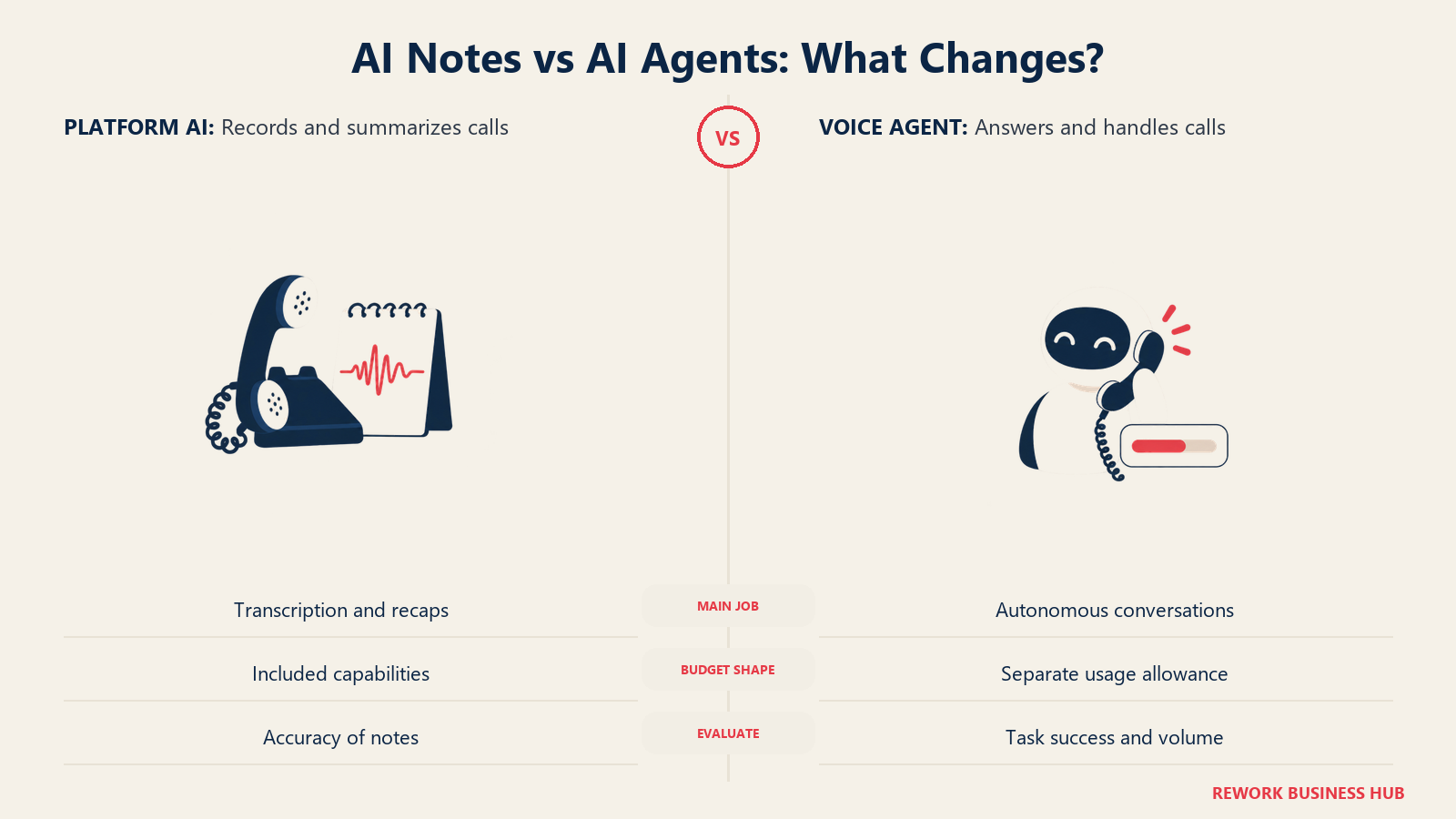
What is not included is Dialpad AI Agent, the autonomous product that answers a call, retrieves information and executes an action without a human on the line. That one is sold on conversation-based credits, and Dialpad's own framing is that you buy a pool of AI Agent Credits, with a conversation billed only when the AI actually retrieves information or performs a real action. The footnote on the pricing page reads as follows.
| Dialpad AI Agent tier | What the pricing page states |
|---|---|
| Essential | Starts at $200/mo for 500 sessions |
| Advanced | 2,000 sessions per month included |
| Platinum | 5,000 sessions per month included |
So a ten-person team that read "AI included" and budgeted $150 a month is looking at $350 the moment it wants the agent that actually answers calls. Here is the same team modelled against the tiers it might realistically land on.
| Line item (10 users) | Monthly cost |
|---|---|
| Connect Standard, annual, $15/user/mo x 10 | $150 |
| Connect Standard, month to month, $27/user/mo x 10 | $270 |
| Connect Pro, annual, $25/user/mo x 10 | $250 |
| Dialpad AI Agent, Essential tier, from $200/mo for 500 sessions | $200 |
| Connect Standard annual plus AI Agent Essential | $350 |
| Sell Essentials, annual, $39/user/mo x 10 | $390 |
| Support Essentials, annual, $80/user/mo x 10 | $800 |
None of this makes Dialpad expensive by category standards. Connect Standard is still the lowest full-UCaaS annual entry rate on this page. It just means the honest comparison is not "$15 with AI included" against "$20 plus add-ons." It is a per-seat price plus a metered agent budget against a per-seat price plus a flat agent add-on, and which one wins depends entirely on your call volume. If conversation intelligence is the actual feature driving the evaluation rather than the phone system underneath it, the guide to choosing conversation intelligence software covers what to test before you sign. If it is the autonomous agent, compare Dialpad's session credits against the dedicated field in the best AI voice agents guide, where per-minute and flat-monthly pricing are both common.
Who Should Stay on Dialpad
Switching costs are real: number porting, retraining, rebuilding call flows and re-integrating a CRM take weeks, not an afternoon. Three profiles should probably stay put.
Teams whose AI need is genuinely note-taking rather than autonomous answering get the whole value of Dialpad on the $15 annual plan and would pay more for the same capability almost anywhere else. Teams already running Dialpad Sell or Support with tuned routing and coaching workflows have sunk real configuration into a product that does that job well. And teams that just signed an annual term should finish it, then use the numbers in this guide as renewal leverage rather than as a reason to eat a termination cost.
Everyone else is reading this because a specific line item stopped making sense. The sections below are ordered by which line item.
How These 13 Alternatives Fit by Company Size and Stage
Not every alternative scales the same way Dialpad does. The matrix below rates fit at four company sizes, where Strong means the product is built for that size, Good means it works well with minor compromises, Workable means it functions but you are paying for the wrong shape, and Weak means look elsewhere.
| Tool | Startup (1-10) | Growing (10-50) | Scaling (50-200) | Enterprise (200+) |
|---|---|---|---|---|
| RingCentral RingEX | Good | Strong | Strong | Strong |
| Quo (formerly OpenPhone) | Strong | Strong | Good | Workable |
| Nextiva | Good | Strong | Strong | Good |
| Aircall | Workable | Strong | Strong | Good |
| JustCall | Workable | Strong | Good | Workable |
| CloudTalk | Good | Strong | Strong | Good |
| Microsoft Teams Phone | Workable | Good | Strong | Strong |
| Zoom Phone | Good | Good | Strong | Strong |
| Vonage Business Communications | Strong | Good | Good | Workable |
| Ooma Office | Strong | Good | Workable | Weak |
| Google Voice | Strong | Workable | Weak | Weak |
| GoTo Connect | Good | Good | Good | Workable |
| 8x8 | Weak | Workable | Good | Strong |
Company size is only half the question. The other half is who inside the company is actually driving the purchase, because a CFO chasing a lower run rate and a head of support chasing queue depth will shortlist completely different products from the same list.
| If your buyer is... | Typical team size | Best-fit picks | Why |
|---|---|---|---|
| A founder or office manager buying the first real phone system | 1-10 | Quo, Ooma Office, Google Voice | Published flat rates, no licence minimums to work around, fast self-serve setup |
| A CFO trying to cut the run rate without losing features | 10-50 | Nextiva, Vonage, Ooma Office | Lower published entry rates, and Ooma removes the annual-versus-monthly penalty entirely |
| A head of sales who needs dialers and CRM writeback | 10-100 | Aircall, JustCall, CloudTalk | Power dialers, CTI depth and AI agents priced per minute or per month rather than per session |
| A head of support building a real queue | 25-200 | Nextiva, CloudTalk, 8x8 | Inbound routing, IVR and analytics without stepping into an $80-per-seat contact center tier |
| An IT director consolidating vendors | 50-500 | Microsoft Teams Phone, Zoom Phone, RingCentral | One identity provider, one admin console, one renewal conversation |
| A COO running multi-country operations | 100+ | 8x8, CloudTalk, RingCentral | Global carrier coverage, local numbers and country-specific compliance handling |
1. RingCentral - The Full-Suite Swap With a Different AI Bill
RingCentral is the vendor most Dialpad shoppers benchmark against, and the trade is specific: you pay more per seat and get more platform, then decide whether RingCentral's flat AI add-ons beat Dialpad's per-session credits for your call volume.
RingEX Core is $20 per user per month on an annual plan or $30 month to month, against Dialpad Connect Standard's $15 and $27. Core includes unlimited domestic calling, on-demand call recording, 100 toll-free minutes, 25 SMS per user per month and HD video for up to 300 participants, which is meaningfully more meeting capacity than Dialpad markets. Advanced at $25 annual lifts toll-free minutes to 1,000 and SMS to 100. Ultra at $35 annual reaches 10,000 toll-free minutes and 200 SMS. RingCentral has held a Leader position in Gartner's UCaaS Magic Quadrant for eleven consecutive years, which matters if procurement asks you to justify a switch away from a Visionary-quadrant vendor.
The AI math is where this gets interesting. RingCentral sells AI Receptionist from $39 a month and Conversational Intelligence from $60 a month as flat rates that do not scale with seat count, and Gartner's 2026 write-up specifically flagged that Dialpad has no AI receptionist product. For a 50-person team, a flat $39 receptionist is dramatically cheaper per head than a session-metered agent. For a 5-person team with light volume, it is not. Run your own numbers rather than assuming either direction.
| Pros | Cons |
|---|---|
| 300-participant HD meetings and unlimited domestic calling on the entry tier | $20 annual entry is a third more than Dialpad Connect Standard |
| Flat AI add-on pricing that does not scale with headcount | Call Queues Booster at $35 and Business SMS Booster at $25 stack on top |
| Eleven consecutive years as a Gartner UCaaS Leader | Core caps SMS at 25 messages per user per month before overage |
Pricing: Core is $20/user/mo annual, $30/user/mo monthly. Advanced is $25 annual, $35 monthly. Ultra is $35 annual, $45 monthly. AI Receptionist starts at $39/mo flat, Conversational Intelligence at $60/mo flat. The Customer Engagement Bundle is contact-for-pricing. Rates shown are for the 6 to 100 user band.
Best for: Teams that want more platform than Dialpad Connect provides and have enough seats that flat-rate AI add-ons beat per-session credits. See the Dialpad vs RingCentral head-to-head for the direct comparison, and the RingCentral alternatives guide if RingCentral's own add-on stack is what puts you off.
2. Quo (formerly OpenPhone) - Same Entry Price, AI Agent Included
Quo is the sharpest direct answer to the Dialpad AI Agent question, because it matches Dialpad's $15 annual entry rate and bundles an AI agent called Sona into that tier rather than metering it separately.
If the name is new to you, that is recent history rather than a new company. OpenPhone renamed to Quo on 23 September 2025 alongside $105 million in growth financing, and openphone.com/pricing now redirects to quo.com/pricing. Same product, same team, repositioned around the AI agent instead of around the number-per-person pitch.
Starter at $15 per user per month annually, billed at $180 a year, gives each user a number, calling and messaging to US and Canadian numbers, voicemail transcripts, the Sona AI agent and 1,000 automation credits. Business at $23 annual adds AI call summaries, group calling, call transfers and native HubSpot and Salesforce integrations, which is where Quo closes the CRM gap that Dialpad puts behind Connect Pro. Scale at $35 annual adds AI call tags, dedicated onboarding and priority support. There is no published user minimum.
One caveat to carry into the evaluation: every tier advertises unlimited calling and messaging to the US and Canada with an asterisk pointing at a fair-usage policy. Treat it as generous rather than genuinely unmetered, especially for outbound-heavy teams.
| Pros | Cons |
|---|---|
| Matches Dialpad Connect Standard at $15/user/mo annual with the Sona AI agent included | "Unlimited" calling and messaging is subject to a fair-usage policy |
| HubSpot and Salesforce integrations arrive at $23 rather than Dialpad's $25 Pro tier | Fewer enterprise governance and compliance controls than RingCentral or 8x8 |
| No published seat minimum, so a two-person team pays for two seats | Meetings and webinar capacity are not part of the product's focus |
Pricing: Starter is $15/user/mo annual ($180/yr) or $19/user/mo monthly. Business is $23/user/mo annual ($276/yr) or $33/user/mo monthly. Scale is $35/user/mo annual ($420/yr) or $47/user/mo monthly.
Best for: Small and growing teams that liked Dialpad's price and AI positioning but do not want an agent budget metered by session. If Quo itself is not quite the shape you need, the OpenPhone alternatives guide covers who else competes for that same job.
3. Nextiva - Contact Center Features Without the $80 Jump
Nextiva is the answer for the specific Dialpad problem where a team outgrows Connect and discovers that the next stop is Support Essentials at $80 per user per month.
Nextiva's ladder is Core, Engage and Scale. Core at $15 per user per month annual or $23 monthly matches Dialpad Connect Standard on price and covers voice, business SMS at 100 messages per user, video and call routing. Engage at $25 annual, the tier that matters here, adds customer-to-team SMS at 500 per user, a toll-free number with up to 2,000 minutes, advanced reporting, an inbound call center, live chat and a chatbot. That is contact center capability at under a third of Dialpad Support Essentials, which is the single strongest argument on this page for a support-led buyer. Scale at $75 per user per month adds unlimited SMS, up to 10,000 toll-free minutes, AI transcription and summary, and skills-based routing.
The catch is transparency at the top. Scale publishes no separate annual rate, the Enterprise contact center track starts at $75 per agent per month for Essential, and Professional and Premium are Contact Sales. Nextiva also took a Metrigy Top Business Success award in the 2026 UCaaS MetriStar program, which is a customer-outcome signal rather than a feature claim.
| Pros | Cons |
|---|---|
| Engage bundles inbound call center, live chat and a chatbot at $25/user/mo annual | Scale shows $75/user/mo with no separate annual rate published |
| Core matches Dialpad Connect Standard at $15/user/mo annual | Enterprise contact center tiers are Contact Sales only |
| Metrigy Top Business Success award in the 2026 UCaaS MetriStar program | Monthly rates step up hard, from $23 on Core to $50 on Engage |
Pricing: Core is $15/user/mo annual, $23/user/mo monthly. Engage is $25/user/mo annual, $50/user/mo monthly. Scale is $75/user/mo with no annual rate published. Enterprise Essential starts from $75/agent/mo, with Professional and Premium quote-only.
Best for: Teams that need real inbound queue, chat and routing features and cannot justify Dialpad's Support tier for it. The Nextiva alternatives guide covers the rest of that field if Nextiva's own tier jumps are the sticking point.
4. Aircall - CRM-Native Calling With Free AI Minutes Built In
Aircall is not trying to be the phone system for every desk in the company. It is built for the specific seats where the CRM and the phone need to behave as one tool, which is exactly the job Dialpad Sell charges $39 per user per month to do.
Essentials is $30 per licence per month billed annually, and Aircall's own page states the entry cost plainly as three licences for $90 a month billed annually. Professional is $50 per licence per month billed annually, quoted the same way at $150 a month for three licences. Custom pricing requires 25 licences. The page's default view is the annual rate and it does not display a month-to-month figure, so treat any monthly Aircall number you see elsewhere with suspicion.
The AI detail worth noting against Dialpad: every Aircall tier includes 50 free AI Voice Agent minutes per account per month, plus 100 additional minutes at sign-up. That is a small allowance, but it is a free trial of the exact capability Dialpad prices from $200 a month, and it lets you measure real volume before committing to any agent budget. Aircall's 250-plus integrations and its CTI depth for Salesforce and HubSpot are the reason sales and support leaders push for it specifically.
| Pros | Cons |
|---|---|
| 250+ integrations with deep CTI for Salesforce, HubSpot and similar CRMs | 3-licence minimum makes the real entry cost $90/month billed annually |
| 50 free AI Voice Agent minutes per account each month on every tier | No month-to-month rate published, so annual commitment is the default |
| Power dialer and queue callback on Professional built for outbound teams | Custom tier requires a 25-licence commitment |
Pricing: Essentials is $30/licence/mo billed annually, with a 3-licence minimum quoted as $90/month. Professional is $50/licence/mo billed annually, quoted as $150/month for three licences. Custom is quote-only with a 25-licence minimum. All tiers include 50 free AI Voice Agent minutes per account per month.
Best for: Sales and support desks that were evaluating Dialpad Sell and care more about CRM writeback than about a company-wide phone system. The Aircall alternatives guide covers who else fits that shape.
5. JustCall - AI Voice Agents With a Price You Can Forecast
JustCall is the closest thing on this list to a like-for-like trade for Dialpad Sell, and it is the clearest example of a vendor pricing AI agents in a way a finance team can model in a spreadsheet.
Seats run $29 per user per month for Team, $49 for Pro and $89 for Pro Plus, all billed annually with a two-licence minimum. Business and SalesPro are custom, with Business requiring ten licences. Monthly non-annual seat rates are not separately published, so build the model on annual figures.
The AI story is the reason JustCall belongs above several bigger names here. JustCall prices its AI Voice Agent three ways in public: pay as you go at $0.99 per minute, Agent Lite at $99 a month, or Agent Max at $249 a month. Compare that to Dialpad AI Agent Essential starting at $200 a month for 500 sessions. A session and a minute are not the same unit, so the comparison takes a little arithmetic, but the point is that JustCall lets you pick the unit that matches how your team actually works. A support team with many short automated confirmations prices very differently from a sales team with long qualification calls, and a per-minute option protects the first while a flat monthly protects the second.
| Pros | Cons |
|---|---|
| AI Voice Agent published three ways: $0.99/min, $99/mo or $249/mo | Only annual seat rates are published, with a 2-licence minimum |
| Team tier at $29/user/mo undercuts Dialpad Sell Essentials by $10 | Business tier requires a 10-licence commitment |
| Sales-focused dialers and workflows without a full contact center contract | Smaller ecosystem and brand footprint than RingCentral or Zoom |
Pricing: Team is $29/user/mo billed annually, Pro is $49, Pro Plus is $89, all with a 2-licence minimum. Business and SalesPro are custom pricing, with Business requiring 10 licences. AI Voice Agent is separate: $0.99/minute pay as you go, $99/month for Agent Lite, $249/month for Agent Max.
Best for: Outbound sales teams that want Dialpad Sell's capability with an AI agent priced in units they can forecast. If calling is one channel inside a wider outbound motion, the sales engagement platforms roundup covers the layer above the dialer.
6. CloudTalk - Country Coverage and Routing From the Entry Tier
CloudTalk is built for teams whose phone problem is geography. If your reps call across borders and Dialpad's plan shape keeps forcing you to think about which country a number lives in, CloudTalk starts from the opposite assumption.
Starter is $25 per user per month billed annually in USD, with a one-user minimum. It includes numbers in more than 160 countries, IVR, smart routing and a call flow builder, features that several competitors reserve for a mid or top tier. Essential at $29 adds unlimited domestic calling across the EU and UK. Expert at $49 adds dialers, real-time analytics and Salesforce integration, with a three-user minimum. Custom is contact-for-pricing.
State the currency when you compare this one. CloudTalk's pricing page carries a currency switcher, and the EUR view shows a different ladder including a EUR-only Lite tier and monthly rates alongside, so an unlabelled CloudTalk number from a third-party listicle is genuinely ambiguous. The figures above are the USD, billed-annually view. Read the calling allowance carefully too: Starter covers unlimited calls to the US and Canada, or 500 outbound domestic calls across the EU, UK, Iceland and Norway, which is not the same as blanket unlimited calling.
| Pros | Cons |
|---|---|
| Numbers in 160+ countries with IVR and a call flow builder on the entry tier | Starter's unlimited calling covers US and Canada only, or 500 EU/UK outbound calls |
| One-user minimum on Starter and Essential, no licence floor to work around | Salesforce integration and real-time analytics require the $49 Expert tier |
| Purpose-built for distributed sales and support teams calling internationally | Pricing differs between the USD and EUR views of the same page |
Pricing: Starter is $25/user/mo billed annually, USD. Essential is $29/user/mo billed annually. Expert is $49/user/mo billed annually with a 3-user minimum. Custom is contact-for-pricing.
Best for: Distributed sales and support teams making high call volumes across many countries, where per-country number coverage matters more than meeting capacity.
7. Microsoft Teams Phone - Calling Bolted Onto Software You Already Buy
If every employee already lives in Teams, the cheapest phone system is often the one that does not introduce a new app. Teams Phone is a consolidation play rather than a feature-parity play, and it beats Dialpad on exactly one axis: you are not adding a vendor.
The number that gets misquoted constantly is the $10 figure. Teams Phone Standard is $10.00 per user per month paid yearly, and it is a calling-capability add-on that carries no calling minutes at all. It also requires a separate Microsoft Teams licence as a prerequisite. To actually place calls you add a calling plan: Teams Phone with Calling Plan for domestic US is $17.00 per user per month paid yearly and includes 3,000 outbound domestic minutes, while Teams Phone with Domestic and International Calling is $34.00 per user per month paid yearly and covers 3,000 domestic or 600 international minutes. Every SKU is an annual subscription that auto-renews.
So the honest comparison against Dialpad Connect Standard at $15 is $17, not $10, and that $17 buys a metered minute bucket rather than unlimited domestic calling. What it also buys is one identity provider, one admin center and one renewal conversation, which is why IT directors keep choosing it anyway.
| Pros | Cons |
|---|---|
| No new client to roll out for a company already standardized on Teams | The $10 Standard SKU includes zero calling minutes on its own |
| Single admin center and identity provider for the whole communications stack | Requires a separate Microsoft Teams licence as a prerequisite |
| Predictable annual per-user rates across three published calling SKUs | Weaker native call center routing and analytics than dedicated UCaaS vendors |
Pricing: Teams Phone Standard is $10.00/user/mo paid yearly, add-on with no minutes included. Teams Phone with Calling Plan (domestic US) is $17.00/user/mo paid yearly with 3,000 outbound domestic minutes. Teams Phone with Domestic and International Calling is $34.00/user/mo paid yearly. All are annual subscriptions that auto-renew, and all require a separate Teams licence.
Best for: IT-led consolidation inside an existing Microsoft 365 investment, where one fewer vendor is worth more than deeper call routing. The Teams Phone vs CloudTalk vs Vonage comparison puts those three side by side in detail.
8. Zoom Phone - The Same Consolidation Logic, a Different Ecosystem
Zoom Phone is the Teams Phone argument for companies that standardized on Zoom instead of Microsoft. Same client, same admin console, a phone number layered onto software the team already opens every day.
Zoom names its plans publicly, US and CA Unlimited, Pro Plus and Business Plus, and Zoom took a Metrigy MetriStar Top Provider award in 2026 alongside a Gartner Leader placement, so the product's standing is not in question. What is missing is the price. The Zoom Phone product page repeats that plans start at a figure and then routes you to contact sales, and no per-user rate appears on the page. For a buyer trying to build a shortlist before a sales call, that is a real gap: you can compare plan names against Dialpad's $15 and $25, not dollar figures.
The practical read is that Zoom Phone belongs on the shortlist if you are already a Zoom shop and off it if you are not, because the ecosystem argument is the whole argument and you cannot evaluate the rest without a quote.
| Pros | Cons |
|---|---|
| Zero learning curve for a company already running Zoom Meetings daily | No published per-user rate anywhere on the pricing page |
| One admin console for meetings, chat and phone | Every evaluation starts with a sales conversation |
| Gartner UCaaS Leader and a 2026 Metrigy MetriStar Top Provider | Hard to build an apples-to-apples budget against vendors that publish rates |
Pricing: Not published. Zoom names US and CA Unlimited, Pro Plus and Business Plus publicly, but the product page shows no per-user rate and directs buyers to contact sales.
Best for: Zoom-centric organizations that value one unified client over a transparent rate card. The Zoom Phone vs GoTo Connect vs Dialpad Connect comparison walks through those three directly.
9. Vonage Business Communications - A Low Floor, Read the Promotion
Vonage's pitch against Dialpad is a lower per-line entry price with video folded in earlier, and it comes with the one pricing footnote on this page that gets misquoted most often.
The Mobile tier lists at $19.99 per month per line, and a 12-month promotion currently on the page takes 30% off to reach $13.99. Premium lists at $29.99 and currently runs $20.99. Advanced lists at $39.99 and currently runs $27.99. All three carry taxes and fees on top. That $13.99 is a time-boxed promotional rate against a list price, not an annual rate against a monthly one, and the difference matters enormously in year two. Model the list price when you build the three-year number.
Feature-wise, Mobile has no desk phone support, which rules it out for any office with hardware phones. Premium adds desk phones, unlimited video meetings for up to 200 participants, Team Messaging, the VBC App Center and SSO. Advanced adds on-demand call recording capped at 15 hours a month, visual voicemail with transcription, and call groups. Against Dialpad, the trade is clear: cheaper entry, more video capacity at Premium, but transcription sits at the top tier rather than the bottom.
| Pros | Cons |
|---|---|
| Premium bundles 200-participant video, Team Messaging and SSO | Mobile tier has no desk phone support at all |
| Lower entry price than Dialpad Connect Standard once the promotion applies | $13.99 is a 30% off 12-month promotion, not a standing rate |
| Clear three-tier ladder with predictable capability step-ups | Visual voicemail transcription requires the Advanced tier |
Pricing: Mobile is $13.99/line/mo on a 12-month plan, $19.99/line/mo month to month. Premium is $20.99/line/mo on a 12-month plan, $29.99/line/mo month to month. Advanced is $27.99/line/mo on a 12-month plan, $39.99/line/mo month to month. All plus taxes and fees.
Best for: Lean teams that want the lowest published per-line floor with video included, and that will actually remember to renegotiate when the twelve-month promotion ends.
10. Ooma Office - Flat Rates, No Annual Commitment to Trade Away
Ooma answers the first Dialpad complaint directly. There is no annual-versus-monthly gap to navigate, because Ooma's rates do not move with contract length.
Essentials is $19.95 per user per month, Pro is $24.95 and Pro Plus is $29.95, all flat, all with no contract necessary. Compare that against Dialpad Connect Standard's $15 annual versus $27 monthly spread: if you were going to pay month to month anyway, Ooma Essentials is cheaper than Dialpad and carries no commitment at all. If you were going to sign the year, Dialpad is cheaper. That is the entire decision.
Essentials covers unlimited calling, a virtual receptionist, a free toll-free number and digital fax. Pro adds the desktop app, 250 texts a month and video for up to 25 participants. Pro Plus raises texts to 1,000 and video to 100, and adds team chat, hot desking and call queuing. The important caveat for a Dialpad refugee is that AI transcription, AI insights and CRM integration are Pro Plus only, so the feature you probably valued most about Dialpad lands at $29.95 rather than at the entry tier. Enterprise is custom.
| Pros | Cons |
|---|---|
| Flat rate at every tier with no contract necessary and no annual discount to chase | AI transcription, AI insights and CRM integration are gated to Pro Plus |
| Essentials is cheaper than Dialpad's month-to-month rate with no commitment | Video capacity trails most competitors at 25 on Pro and 100 on Pro Plus |
| Virtual receptionist and a free toll-free number included from the entry tier | Enterprise features are custom-quote only |
Pricing: Essentials is $19.95/user/mo, Pro is $24.95/user/mo, Pro Plus is $29.95/user/mo, all flat with no contract necessary. Enterprise is custom.
Best for: Teams that specifically want to avoid annual lock-in, and small offices where a flat, predictable line item beats a discounted one with a commitment attached.
11. Google Voice - Cheapest Line Item, With a Second Line Item Attached
Google Voice publishes the lowest per-user rate in this comparison, and the most-missed fact about it is that the rate is not the whole bill.
Starter is $10 per user per month for up to 10 users. Standard is $20 per user per month with no user cap and adds on-demand call recording and unlimited regional billing locations. Premier is $30 per user per month, removes the billing-location limits and adds automatic call recording plus advanced reporting.
Here is the part third-party listicles skip: a Google Workspace subscription is required in addition to the Voice licence. The standalone $10 Starter option is US-only and covers a single user. So for a real ten-person team, the honest comparison against Dialpad Connect Standard at $15 per user is $10 for Voice plus whatever Workspace tier that company already pays for, and if they are already on Workspace, the marginal cost really is $10. If they are not, Google Voice is not the cheap option at all.
Feature depth is the other trade. Voice is calling, voicemail transcription and recording. It is not a contact center, and the AI capability that made Dialpad interesting has no real equivalent here.
| Pros | Cons |
|---|---|
| Lowest published per-user rate in this comparison at $10/user/mo | A Google Workspace subscription is required on top of the Voice licence |
| No separate app to learn for teams already living in Gmail and Calendar | Starter caps at 10 users, and the standalone option is US-only, single user |
| Standard and Premier add call recording and advanced reporting cleanly | No AI agent or conversation intelligence story to replace Dialpad's |
Pricing: Starter is $10/user/mo for up to 10 users. Standard is $20/user/mo, unlimited users. Premier is $30/user/mo with international billing locations. A Google Workspace subscription is required in addition to the Voice licence.
Best for: Small teams already paying for Google Workspace that need straightforward calling and were never going to use Dialpad's AI features anyway.
12. GoTo Connect - Easy Rollout, No Published Rate
GoTo Connect built its reputation on being the least painful phone system to actually deploy: one vendor, a short setup, no drawn-out IT project. That reputation for simplicity still holds. The pricing transparency that used to travel with it does not.
As the page reads in August 2026, GoTo Connect lists four plans, Phone System, Customer Experience (CX), CX Complete and Contact Center, and shows no rate on any of them. The page asks you to pick a plan and talk to a sales representative. This is a live product with an active roadmap, not a retired one, so the absence is a packaging decision rather than a discontinuation, but it does mean you cannot benchmark GoTo against Dialpad's published $15 without booking a call first.
If you see a per-user GoTo Connect figure quoted in a comparison article, check the date and the source. Any number circulating now is a third-party report, not something GoTo publishes, and reported ranges for this vendor have been inconsistent enough that they are not worth building a budget on.
| Pros | Cons |
|---|---|
| Genuinely straightforward setup relative to enterprise-grade UCaaS suites | No per-user rate published on any of the four plans |
| Phone, CX and contact center packages available from a single vendor | Every evaluation begins with a sales conversation |
| Long track record with small and mid-market buyers | Cannot be shortlisted on price against vendors that do publish rates |
Pricing: Not published. All four plans, Phone System, Customer Experience, CX Complete and Contact Center, direct buyers to talk to a sales representative with no rate shown.
Best for: Smaller teams that weight rollout simplicity above price transparency and do not mind a short sales call. The GoTo Connect alternatives guide covers who else competes on that same easy-deployment promise.
13. 8x8 - Global Depth Behind a Quote Wall
8x8 sits last here not because the product is weak but because it is the least accessible to the buyer this article is written for. If you are a 15-person team wondering whether Dialpad's AI credits are worth it, 8x8 is not the next call.
The credentials are real. 8x8 took a Metrigy MetriStar Top Provider award in 2026, clearing the same customer sentiment bar as Cisco, RingCentral, Verizon and Zoom, and it carries deep global carrier coverage and compliance handling for multi-country deployments. Where it competes hardest is the scenario Dialpad handles least gracefully: a company placing regulated calls in a dozen countries under different retention rules.
What 8x8 does not have is a price you can read. Its plans and pricing page contains no dollar figures at all and carries six separate calls to action asking you to request a quote or contact sales. The X2, X4, X6 and X8 tier rates that older comparison articles still quote are gone from the site entirely, so treat any published 8x8 per-user figure as stale.
| Pros | Cons |
|---|---|
| Metrigy MetriStar Top Provider in 2026 with deep global carrier coverage | No published price anywhere on the plans and pricing page |
| Mix-and-match packaging fits unusual multi-country requirements | Six separate quote-request calls to action and zero dollar figures |
| Strong compliance and international calling depth for regulated industries | The previously published X-series tier rates no longer exist |
Pricing: Not published. The 8x8 plans and pricing page shows no per-user rate and routes every path to a quote request.
Best for: Multinational organizations with country-specific compliance requirements that were always going to run a formal procurement process anyway. The 8x8 alternatives guide covers that field in more depth.
How to Choose: Decision Framework
Start from the line item that made you open this page. Almost every switch out of Dialpad traces back to one of six constraints: the annual-versus-monthly gap, the AI Agent credit meter, a jump into Sell or Support pricing, a missing CRM integration, an international calling requirement, or a mandate to consolidate vendors. The table below maps each constraint to the strongest answer on this list.
| If you need... | Choose |
|---|---|
| The deepest feature set and a vendor that has been a Gartner Leader for over a decade | RingCentral |
| Dialpad's $15 entry price with an AI agent bundled instead of metered by session | Quo (formerly OpenPhone) |
| Inbound call center, live chat and a chatbot without a jump to $80 per seat | Nextiva |
| A phone system that behaves like an extension of Salesforce or HubSpot | Aircall |
| AI voice agents priced per minute or per flat month rather than per session credit | JustCall |
| Local numbers and routing across many countries from the entry tier | CloudTalk |
| Calling added to a Microsoft 365 investment you are already paying for | Microsoft Teams Phone |
| One client for meetings, chat and phone in a Zoom-standardized company | Zoom Phone |
| The lowest published per-line entry point with video bundled in | Vonage Business Communications |
| Flat pricing with no annual commitment and no month-to-month penalty | Ooma Office |
| The cheapest possible calling layer for a small Google Workspace team | Google Voice |
| Phone, CX and contact center from one vendor and you accept a sales call | GoTo Connect |
| Multinational coverage with country-specific compliance requirements | 8x8 |
Frequently Asked Questions about Dialpad Alternatives
Is Dialpad's AI really included in every plan?
Partly. Platform-native AI, meaning live transcription, call summaries, voicemail transcripts and meeting recaps, is included across Connect tiers starting at Connect Standard, and Dialpad's own documentation says so. The autonomous Dialpad AI Agent is a separate product sold on conversation credits, and the footnote on Dialpad's pricing page puts the Essential tier at $200 a month for 500 sessions. Budget for both if you want an AI that answers calls rather than one that takes notes.
What does Dialpad actually cost for a ten-person team?
Connect Standard is $15 per user per month on an annual plan, so $150 a month for ten users, or $270 a month if you pay month to month at $27 per user. Connect Pro is $250 a month for the same ten users on an annual plan. Add the AI Agent Essential tier and you are at $350 a month before any Sell or Support seats, which start at $39 and $80 per user per month respectively.
Which Dialpad alternative is cheapest?
On published rates, Google Voice Starter at $10 per user per month is the lowest number here, but it caps at 10 users and requires a separate Google Workspace subscription on top, so the real cost is two line items rather than one. Among full-featured options with no user ceiling, Quo Starter and Nextiva Core both match Dialpad Connect Standard at $15 per user per month on annual terms.
Which alternative includes an AI agent without metering it by session?
Quo includes its Sona AI agent and automation credits from the $15 Starter tier. Aircall gives every account 50 free AI Voice Agent minutes per month plus 100 additional minutes at sign-up, then bills beyond that. JustCall sells its AI Voice Agent openly at $0.99 per minute, $99 a month for Agent Lite or $249 a month for Agent Max, which is easier to forecast than session credits if you know your call volume.
Why do 8x8, GoTo Connect and Zoom Phone not show any pricing?
All three have moved off published per-user rates. 8x8's plans and pricing page carries no dollar figures at all and routes every option to a quote request. GoTo Connect lists four plans, Phone System, Customer Experience, CX Complete and Contact Center, and invites you to pick one and talk to a sales representative. Zoom Phone names its plans publicly but repeats "contact sales for pricing" instead of showing a rate. Add sales-cycle time to your evaluation for any of the three.
Is Vonage's $13.99 the real price?
No, that is a promotional rate. Vonage lists Mobile at $19.99 per line per month as the list price, with a 12-month promotion currently taking 30% off to reach $13.99. Premium is $20.99/line/mo on a 12-month plan, $29.99/line/mo month to month, and Advanced is $27.99/line/mo on a 12-month plan, $39.99/line/mo month to month. All three carry taxes and fees on top, and the promotion is time-boxed to twelve months, so model year two at the list price.
Do I lose call transcription if I leave Dialpad?
Not necessarily, but check the tier. Quo includes voicemail transcripts from Starter and AI call summaries from Business. Ooma Office gates AI transcription and AI insights to Pro Plus at $29.95 per user per month. RingCentral sells Conversational Intelligence as an add-on starting at $60 a month flat, which is cheaper than per-seat AI once a team passes a certain size. Map your seat count against both shapes before assuming a per-seat bundle is the better deal.
Does switching mean losing my phone numbers?
No. US number porting is a regulated process and every vendor on this list supports it, though timelines run from a few days for simple wireless ports to several weeks for multi-location business numbers. Keep the old service active until the port completes, and port a test number first if you run a single main line that revenue depends on.
What to Do Next
Write down the one line item that sent you looking. If it is the AI Agent credit meter, pull three months of call logs and count how many conversations would actually be agent-handled, then price that volume against Dialpad's session tiers and against a per-minute vendor like JustCall or Aircall before you assume the alternative is cheaper. If it is the annual-versus-monthly gap, Ooma Office removes the question entirely and Nextiva narrows it. If it is the jump into Sell or Support pricing, price Nextiva Engage at $25 per user per month against Dialpad Support Essentials at $80 for the same queue.
Then get written quotes for your exact headcount from your top two, including year-two pricing after any promotion expires, and run a 30-day pilot with real users rather than a demo account. Watch three things specifically: call quality on your actual network, whether the CRM integration you need is included or another line item, and how the AI features bill once a real week of call volume runs through them.

Principal Product Marketing Strategist
On this page
- Key Facts
- Quick Comparison Table
- What Dialpad Actually Costs: Connect, Sell, Support and AI Agent Credits
- The Dialpad AI Distinction Worth Getting Right
- Who Should Stay on Dialpad
- How These 13 Alternatives Fit by Company Size and Stage
- 1. RingCentral - The Full-Suite Swap With a Different AI Bill
- 2. Quo (formerly OpenPhone) - Same Entry Price, AI Agent Included
- 3. Nextiva - Contact Center Features Without the $80 Jump
- 4. Aircall - CRM-Native Calling With Free AI Minutes Built In
- 5. JustCall - AI Voice Agents With a Price You Can Forecast
- 6. CloudTalk - Country Coverage and Routing From the Entry Tier
- 7. Microsoft Teams Phone - Calling Bolted Onto Software You Already Buy
- 8. Zoom Phone - The Same Consolidation Logic, a Different Ecosystem
- 9. Vonage Business Communications - A Low Floor, Read the Promotion
- 10. Ooma Office - Flat Rates, No Annual Commitment to Trade Away
- 11. Google Voice - Cheapest Line Item, With a Second Line Item Attached
- 12. GoTo Connect - Easy Rollout, No Published Rate
- 13. 8x8 - Global Depth Behind a Quote Wall
- How to Choose: Decision Framework
- What to Do Next