Best Vonage Alternatives in 2026: 13 Business Phone Systems Compared
Turn this article into takeaways for your work.


Each assistant summarizes the article only for you and suggests best practices for your work.
Updated August 2026
If you're shopping Vonage Business Communications alternatives, the shortest useful answer is this: Nextiva is the closest full-suite trade at a published rate that doesn't expire, Dialpad Connect wins if bundled AI is what Vonage lacks, Ooma Office wins if you want a flat rate and no contract at all, and Microsoft Teams Phone or Google Voice win if you're already paying for the ecosystem. Every price below comes from the vendor's own pricing page, checked in August 2026, and each entry states whether the number is a term-commitment rate, a month-to-month rate, or quote-only.
Start with the number everyone quotes. Vonage's famous $13.99 is $13.99 per line per month on a 12-month plan, and $19.99 per line per month month to month, plus taxes and fees. Both numbers are real and Vonage states both. Vonage's own pricing page presents the lower one under a "12-MONTH PROMOTION" banner reading "SAVE 30%", so the discount is tied to a 12-month window rather than shown as a permanent rate. Premium is $20.99 on the 12-month plan or $29.99 month to month; Advanced is $27.99 or $39.99. So the real question a Vonage shopper needs answered isn't "what does month one cost", it's "what does month thirteen cost", and that's the question this guide is built around. For the wider field, see the best business phone systems for 2026 roundup.
Key Facts
- Gartner's 2026 UCaaS Magic Quadrant rates Vonage a Niche Player, naming VBC Lite for Teams as its differentiator while describing its "AI capabilities as behind the market" and its collaboration feature set as thinner than meetings-focused rivals, per UC Today's read of the report. The four Leaders are Cisco, Microsoft, RingCentral and Zoom.
- The FCC's Universal Service Fund contribution factor, the charge providers pass through on the interstate and international portion of end-user telecom revenue, hit a record 38.8% in Q3 2026, up from 37.0% in Q2, according to USAC's published contribution factors. That is the single biggest reason "plus taxes & fees" changes a phone bill.
- Gartner cut its forecast for cloud-based enterprise calling from 90% of organizations by 2028 down to 70%, a twenty-point revision in a single year, and projects AI and consumption-based UCaaS to grow from 5% of category spend in 2026 to 30% by 2029, per the same UC Today coverage.
- 82% of all contact center interactions still route through voice, either as the first channel or as an escalation point, according to Metrigy's 2026 CX research cited on RingCentral's blog.
- 68% of consumers prefer reaching a business by phone, ahead of email at 55%, in person at 40%, live chat at 33% and chatbots at 13%, per Invoca's contact center research.
Quick Comparison Table
| Tool | Best For | Starting Price | Key Strength | Key Limitation |
|---|---|---|---|---|
| Nextiva Core | The closest full-suite trade with published, non-expiring rates | $15/user/mo annual, $23/user/mo monthly | Voice, SMS, video and call routing in one Core plan | Scale tier jumps to $75/user/mo with no annual rate shown |
| RingCentral RingEX Core | Buyers who want the category benchmark and a Gartner Leader | $20/user/mo annual, $30/user/mo monthly | Deepest all-round UCaaS feature set at this price band | AI Receptionist and Conversational Intelligence are add-ons from $39 and $60/mo |
| Dialpad Connect Standard | Teams whose complaint is that Vonage's AI lags | $15/user/mo annual, $27/user/mo monthly | Native AI transcripts, summaries and recaps in the entry plan | Autonomous AI Agents are a separate credit-metered purchase |
| Quo (formerly OpenPhone) Starter | Small teams wanting one number per person, fast | $15/user/mo annual ($180/yr), $19/user/mo monthly | Lean, quick to deploy, AI features from the entry tier | "Unlimited" calling and messaging is subject to a fair usage policy |
| Ooma Office Essentials | Anyone who never wants to price a renewal again | $19.95/user/mo flat, no contract necessary | One flat rate on every tier, no annual term, nothing to renegotiate | AI transcription, AI insights and CRM integration are Pro Plus only |
| Microsoft Teams Phone | Microsoft 365 shops consolidating vendors | $10/user/mo paid yearly for Teams Phone Standard (no minutes) | Native to Teams, no new client to roll out | Needs a separate Teams license, and the $10 SKU includes zero calling minutes |
| Google Voice Starter | Small Google Workspace teams with simple calling needs | $10/user/mo, up to 10 users | Lowest published entry rate in this comparison | A Google Workspace subscription is required on top of the Voice licence |
| Aircall Essentials | Sales and support desks that live inside a CRM | $30/licence/mo billed annually, 3-licence minimum | Deep CTI and a large integration catalog | The 3-licence floor makes $90/month the real entry cost |
| CloudTalk Starter | Distributed teams calling across many countries | $25/user/mo billed annually (USD) | Call flow builder, IVR and international numbers from the entry tier | Starter's unlimited calling covers US and Canada only |
| JustCall Team | Outbound teams that want a voice AI agent option | $29/user/mo billed annually, 2-licence minimum | Dialers plus separately priced AI Voice Agent tiers | AI Voice Agent is a separate purchase from $99/month |
| Zoom Phone | Companies already standardized on Zoom Meetings | Not published; "contact sales for pricing" | Same client and admin console as Zoom Meetings | No public per-user rate to shortlist against before a sales call |
| 8x8 | Multinational buyers who need a custom quote anyway | Not published; every plan routes to a quote request | Global carrier reach and compliance depth | Zero dollar figures anywhere on the pricing page |
| GoTo Connect | Small teams that value fast, low-friction setup | Not published; all four plans say contact sales | Phone, meetings and CX packages from one vendor | The "transparent pricing" reputation no longer matches the page |
What Vonage Actually Costs: Both Rates, Side by Side
Vonage prices per line rather than per generic seat, and every tier carries two legitimate prices: a discounted 12-month plan rate and a higher month-to-month rate. Quote only the lower one and you understate what a team on flexible billing pays. Quote only the higher one and you understate what a team on a term commitment pays. Both belong in the same sentence, and both are on Vonage's own pricing page.
| Vonage plan | 12-month plan | Month to month | What the tier adds |
|---|---|---|---|
| Mobile (BASIC) | $13.99/line/mo | $19.99/line/mo | Desktop and mobile apps, unlimited domestic calling, SMS and MMS, voicemail. No desk phone support. |
| Premium (MOST POPULAR) | $20.99/line/mo | $29.99/line/mo | Adds desk phones, unlimited video meetings for up to 200 participants, Team Messaging, the VBC App Center and SSO |
| Advanced (BEST VALUE) | $27.99/line/mo | $39.99/line/mo | Adds on-demand call recording (15 hours per month), Visual Voicemail with transcription, and Call Groups |
All three rates are stated plus taxes and fees. The gap between the two columns is exactly 30% on every tier, and here's the detail worth pausing on: Vonage's pricing page presents that 30% discount under a "12-MONTH PROMOTION" banner rather than as a standing annual rate. So the discount is attached to a 12-month window, and the honest question before you sign is whether month thirteen renews at $13.99 or steps up to $19.99. Get that answer in writing, because the difference is large.
| Vonage plan, 10 lines | At the 12-month plan rate | At the month-to-month rate | Gap |
|---|---|---|---|
| Mobile | $139.90/mo, $1,678.80/yr | $199.90/mo, $2,398.80/yr | $720/yr, 43% higher |
| Premium | $209.90/mo, $2,518.80/yr | $299.90/mo, $3,598.80/yr | $1,080/yr, 43% higher |
| Advanced | $279.90/mo, $3,358.80/yr | $399.90/mo, $4,798.80/yr | $1,440/yr, 43% higher |
Neither column includes taxes and fees, and that caveat carries real weight in 2026. The FCC's Universal Service Fund contribution factor, which providers recover through a line item on business phone bills, reached a record 38.8% of assessable end-user telecom revenue in Q3 2026. It applies to the interstate and international portion of your service rather than the whole invoice, so it doesn't multiply your bill by 1.388, but combined with E911 charges and state surcharges it's why the number on the pricing page is a floor rather than a total. Vonage also sells several capabilities through the VBC App Center rather than bundling them, so features like structured call queue routing and always-on call recording arrive as separate line items. Our Microsoft Teams Phone vs CloudTalk vs Vonage comparison walks through the add-on catalog and the fee schedule in more detail.
Term Rate vs Standing Rate: What Each Alternative Charges in Year Two
This is the table most roundups skip, and it's the one that matters if you're leaving Vonage over the renewal. A discount tied to a term and a discount tied to a promotional window look identical on a comparison chart, and they can behave very differently twelve months in.
| Vendor and entry plan | Discounted rate | Standing or month-to-month rate | What happens in year two |
|---|---|---|---|
| Vonage Mobile | $13.99/line/mo on a 12-month plan | $19.99/line/mo month to month, plus taxes and fees | The 30% discount is shown as a 12-month promotion, so confirm the renewal rate in writing |
| Nextiva Core | $15/user/mo annual | $23/user/mo monthly | $15/user/mo on the same annual term |
| Dialpad Connect Standard | $15/user/mo annual | $27/user/mo monthly | $15/user/mo on the same annual term |
| Quo Starter | $15/user/mo annual ($180/yr) | $19/user/mo monthly | $15/user/mo on the same annual term |
| RingCentral RingEX Core | $20/user/mo annual | $30/user/mo monthly | $20/user/mo on the same annual term |
| Ooma Office Essentials | No discount offered | $19.95/user/mo flat | $19.95/user/mo, the same number, no contract necessary |
| Google Voice Starter | No term discount published | $10/user/mo, up to 10 users | $10/user/mo plus the required Google Workspace subscription |
| Teams Phone Standard | $10.00/user/mo paid yearly | Not separately published | Annual subscription auto-renews, plus a Teams license and a calling plan |
| Aircall Essentials | $30/licence/mo billed annually | Not displayed on the pricing page | $30/licence/mo with a 3-licence minimum, so $90/mo |
| CloudTalk Starter | $25/user/mo billed annually (USD) | Not shown in the USD annual view | $25/user/mo |
| JustCall Team | $29/user/mo billed annually | Not separately published | $29/user/mo with a 2-licence minimum, so $58/mo |
| Zoom Phone, 8x8, GoTo Connect | Not published | Not published | Whatever your contract says, so ask for year-two pricing in writing |
The pattern is worth naming out loud. Most vendors here discount for a term commitment and keep that rate as long as you keep renewing the term. Vonage offers the same 30% shape but labels it a 12-month promotion on its own page, which is a different promise from a standing annual rate even when the number is identical. A spreadsheet that puts $13.99 next to $15.00 without checking what renews is comparing two things that may not be the same kind of price at all.
Stage Fit: What Breaks First at Each Size
| Company stage | What tends to break first | Strongest fits here |
|---|---|---|
| 1 to 5 people | Nothing breaks; you're overpaying for platform you don't use | Google Voice Starter, Quo Starter, Ooma Office Essentials |
| 5 to 25 people | Desk phone support, shared numbers, basic routing | Nextiva Core, Ooma Office Pro, Quo Business, Dialpad Connect Standard |
| 25 to 100 people | Call queues, reporting, CRM sync, recording retention | Nextiva Engage, Dialpad Connect Pro, Aircall Professional, RingCentral Advanced |
| 100 to 250 people | SSO and provisioning, contact center routing, SLA terms | RingCentral Ultra, Nextiva Scale, CloudTalk Expert, 8x8 |
| 250+ people | Multi-country numbering, compliance, carrier redundancy | 8x8, Microsoft Teams Phone with Direct Routing, RingCentral, Zoom Phone |
Buyer Persona and Sizing Table
| If you are... | Team size | What you're optimizing for | Start with |
|---|---|---|---|
| An office manager who inherited the phone bill | 5 to 30 | A number that doesn't change at renewal | Ooma Office, Nextiva |
| An IT director inside a Microsoft shop | 50 to 500 | Fewer vendors, one identity system | Microsoft Teams Phone |
| A head of sales running outbound | 5 to 50 reps | Dialer, CRM sync, call coaching | Aircall, JustCall, Dialpad |
| A head of support with a queue problem | 10 to 100 agents | Routing, IVR, wait-time reporting | CloudTalk, Nextiva Engage |
| A founder or ops lead at a startup | 2 to 20 | Speed to deploy, per-person numbers | Quo, Google Voice |
| A COO consolidating a multi-country footprint | 200+ | Numbering coverage, compliance, SLA | 8x8, RingCentral, Zoom Phone |
| A budget owner who hates surprise renewals | Any | Flat pricing and no term games | Ooma Office |
1. Nextiva - The Closest Full-Suite Trade With Pricing That Stays Put
Nextiva is the most direct swap for a Vonage buyer who liked the shape of the product and disliked the renewal. Same general idea (voice plus messaging plus video plus routing from one vendor), a lower published entry rate, and a rate structure that behaves like a committed term rather than an expiring offer.
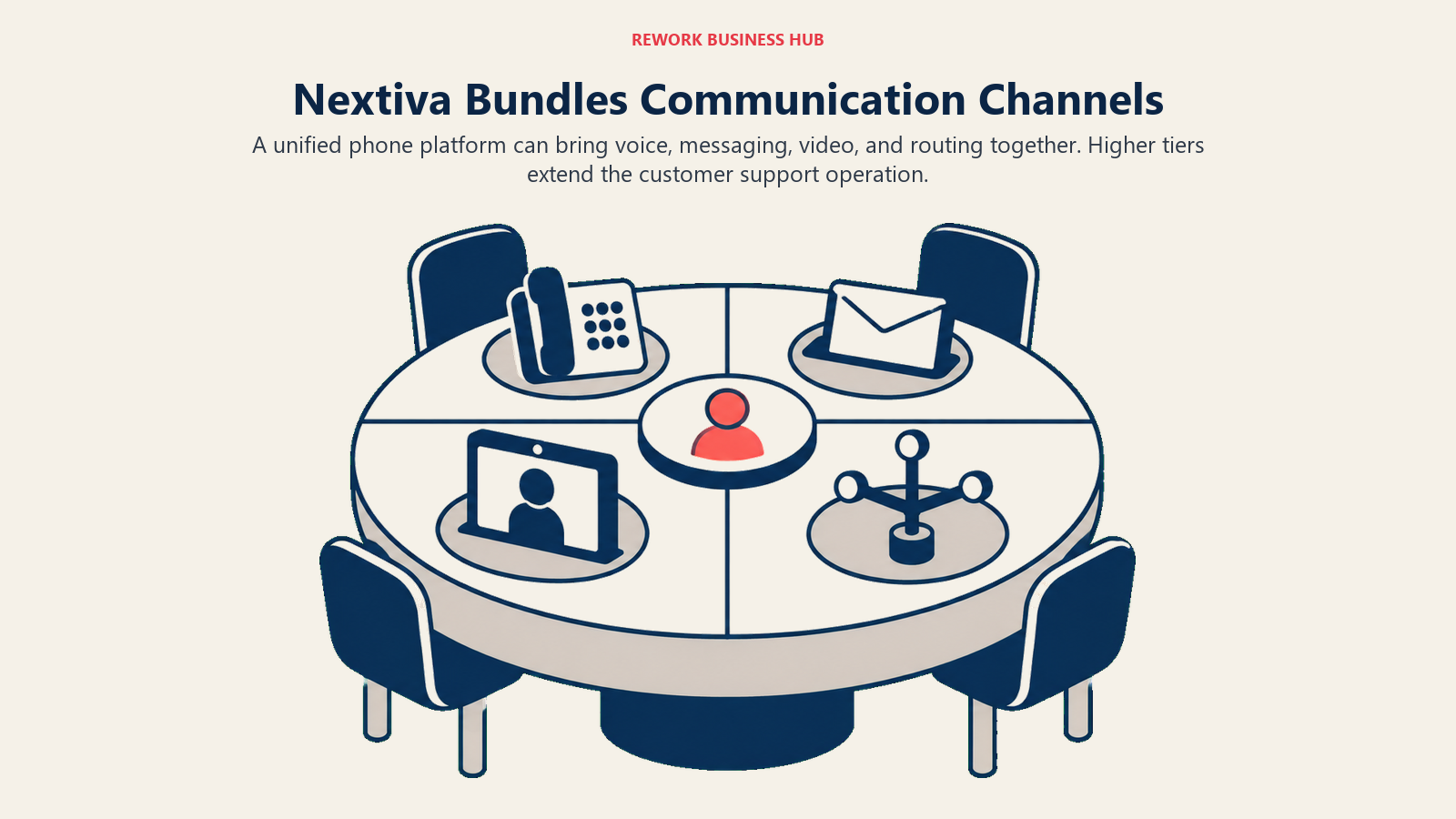
Nextiva's current lineup is Core, Engage and Scale. Core covers voice, business SMS, video and call routing, which lines up closely with what Vonage Premium delivers, at roughly half Vonage Premium's $29.99 month-to-month rate. Engage adds an inbound call center, live chat, a chatbot and advanced reporting, capabilities Vonage tends to route through the App Center as separate purchases. Scale is the full CX platform with unlimited SMS, AI transcription and summary, and skills-based routing. The annual small-business rates apply to new customers with 1 to 100 employees on a 12-month-plus term.
| Pros | Cons |
|---|---|
| Core at $15/user/mo annual undercuts Vonage Mobile's $19.99 month-to-month rate while including more | Scale shows a $75/user/mo figure with no separate annual rate |
| Live chat and chatbot come inside Engage rather than as App Center add-ons | The annual small-business rate is capped at 1 to 100 employees |
| The annual rate is a term discount, so renewal holds rather than reverting | Enterprise contact center tiers (Professional, Premium) are contact sales |
Pricing: Core is $15/user/mo annual, $23/user/mo monthly. Engage is $25/user/mo annual, $50/user/mo monthly. Scale is $75/user/mo with no annual rate published. A separate Enterprise contact center track starts from $75/agent/mo for Essential.
Best for: Teams that want Vonage's breadth without pricing a renewal cliff into next year's budget. If Nextiva itself isn't the fit, the Nextiva alternatives guide covers who else competes on that shape.
2. RingCentral RingEX - The Benchmark, and What That Costs
RingCentral is what most buyers benchmark the category against, and Gartner has kept it in the UCaaS Leaders quadrant while placing Vonage among Niche Players. If your reason for leaving Vonage is that its feature depth stopped keeping up, RingCentral is the straightforward upgrade rather than a lateral move.
RingEX Core runs $20/user/mo on an annual plan and $30/user/mo month to month, for the 6 to 100 user band. Core includes 100 toll-free minutes and 25 SMS per user per month; Advanced at $25 annual raises that to 1,000 toll-free minutes and 100 SMS; Ultra at $35 annual goes to 10,000 toll-free minutes and 200 SMS. Watch the AI line items, because they're where RingCentral's structure resembles Vonage's App Center: AI Receptionist starts at $39 a month and Conversational Intelligence at $60 a month, both flat rates on top of seats, and Call Queues Booster ($35) and Business SMS Booster ($25) sit alongside them.
| Pros | Cons |
|---|---|
| Gartner Leader placement and the deepest all-round feature set in this comparison | AI Receptionist and Conversational Intelligence cost more than a small team's base plan |
| Clear published rates across three tiers with a stated annual and monthly price | Core's 25 SMS per user per month runs out fast for any texting workflow |
| Toll-free minute and SMS allowances scale visibly with each tier | The Customer Engagement Bundle is quote-only |
Pricing: Core is $20/user/mo annual, $30/user/mo monthly. Advanced is $25 annual, $35 monthly. Ultra is $35 annual, $45 monthly. The Customer Engagement Bundle is contact us for pricing. Add-ons are flat monthly charges on top.
Best for: Buyers upgrading rather than downgrading, who accept a higher seat price for a Leader-tier platform. If RingCentral's add-on math is the sticking point, the RingCentral alternatives guide covers the same field from that angle.
3. Dialpad Connect - The Answer to "Vonage's AI Is Behind"
Gartner's specific criticism of Vonage in the 2026 Magic Quadrant was that its AI capabilities sit behind the market. Dialpad is the vendor built to make that criticism the whole sales pitch, and it's usually the first name a Vonage leaver hears from a peer.
Connect Standard runs $15/user/mo annual, $27/user/mo monthly, and includes Dialpad's platform-native AI: live transcription, call summaries and post-call recaps, no separate purchase. Pro at $25 annual, $35 monthly adds CRM integrations and multi-office management. Enterprise is custom. One distinction to get right before you build a business case on it: the native AI in Connect is transcription and summarization, while Dialpad's autonomous AI Agents product is a separate, credit-metered purchase. Dialpad's own pricing footnote puts the Essential AI Agents tier at $200/month for 500 sessions, with Advanced including 2,000 sessions a month and Platinum 5,000. So "AI included in every plan" is true of the assistive AI and not true of the autonomous agent.
| Pros | Cons |
|---|---|
| Native transcription, summaries and recaps included at $15/user/mo annual | Autonomous AI Agents are credit-metered and start around $200/month |
| Undercuts Vonage Mobile's $19.99 month-to-month rate while including far more capability | CRM integrations and multi-office management need the Pro tier |
| Separate Sell and Support product lines if calling is a revenue or ticket workflow | Enterprise governance features are contact-sales only |
Pricing: Connect Standard is $15/user/mo annual, $27/user/mo monthly. Connect Pro is $25 annual, $35 monthly. Connect Enterprise is custom. Dialpad Sell starts at $39/user/mo annual; Dialpad Support starts at $80/user/mo annual.
Best for: Teams whose Vonage complaint is specifically the AI gap, as long as they price assistive AI and autonomous agents separately. The Dialpad alternatives guide is worth a read if you want to check Dialpad against its own challengers first.
4. Quo (formerly OpenPhone) - Lean Numbers Per Person, Nothing You Won't Use
Vonage prices per line, which suits a company with a mix of desk-bound and mobile staff. Quo takes that same per-person idea and strips out everything a small team doesn't touch. If Vonage Mobile felt like the right size but the wrong renewal, Quo is the closest replacement.
OpenPhone renamed to Quo in September 2025 alongside $105 million in growth financing, and openphone.com/pricing now redirects to quo.com/pricing. Same product, same team, new name. Starter at $15/user/mo annual ($180 a year) gives each user a number, calling and messaging to US and Canadian numbers, and voicemail transcripts. Business at $23/user/mo annual adds AI call summaries, group calling and native HubSpot and Salesforce integrations. Scale at $35/user/mo annual layers on more automation and support. One caveat to write down: every tier advertises "Unlimited*" calling and messaging with an asterisk pointing at a Fair Usage Policy, so it isn't an unqualified flat rate.
| Pros | Cons |
|---|---|
| Fast to deploy, with a number per person rather than a PBX to configure | "Unlimited" is qualified by a fair usage policy |
| No published seat minimum, so a two-person team is a real customer | Lighter enterprise governance and reporting than Vonage or 8x8 |
| Native HubSpot and Salesforce integrations arrive at the mid tier | Not built for desk phones or large meeting capacity |
Pricing: Starter is $15/user/mo annual ($180/yr), $19/user/mo monthly. Business is $23/user/mo annual ($276/yr), $33/user/mo monthly. Scale is $35/user/mo annual ($420/yr), $47/user/mo monthly.
Best for: Small and fast-growing teams that want a number per person and no platform overhead. See the OpenPhone alternatives guide if you want the field around that shape.
5. Ooma Office - Flat Rates, No Contract, No Renewal Math
Ooma Office is the single most direct answer to the specific problem this article is about. Its rates don't move with contract length and there's no banner counting down twelve months, because there's no discount to expire. Every tier is one flat rate marked "No Contract Necessary".
Essentials is $19.95/user/mo, Pro is $24.95/user/mo, Pro Plus is $29.95/user/mo. Compare that against Vonage's structure honestly: Essentials at $19.95 sits a few cents under Vonage Mobile's $19.99 month-to-month rate and $6 above its $13.99 12-month plan rate. So you pay more than a Vonage customer on a term commitment and slightly less than one on flexible billing, and you never have to price a renewal. That's the whole trade. Pro adds the desktop app, 250 texts a month and video up to 25 participants. Pro Plus raises texts to 1,000 and video to 100, and adds team chat, hot desking and call queuing, plus the AI features: AI transcription, AI insights and CRM integration are all Pro Plus only.
| Pros | Cons |
|---|---|
| One flat rate per tier, with no term commitment and nothing to renegotiate | Costs more than Vonage Mobile's $13.99 12-month plan rate |
| Essentials undercuts Vonage Mobile's $19.99 month-to-month rate and adds a virtual receptionist | AI transcription, AI insights and CRM integration are gated to Pro Plus |
| No contract required at any published tier | Video capacity trails the 200 participants Vonage bundles at Premium |
Pricing: Essentials is $19.95/user/mo. Pro is $24.95/user/mo. Pro Plus is $29.95/user/mo. All flat, no contract necessary. Enterprise is custom.
Best for: Budget owners who would rather pay a few dollars more per seat than re-negotiate every twelve months. If your last three renewals all involved a phone call with a retention team, this is the corner of the market you want.
6. Microsoft Teams Phone - If You Already Pay Microsoft, Do the Licensing Math
Gartner's 2026 note on Vonage singled out VBC Lite for Teams, a way to place calls inside Microsoft Teams without a separate Microsoft Phone licence. That's a tell about where this market is going: if your company lives in Teams, the phone system question becomes a Microsoft licensing question.
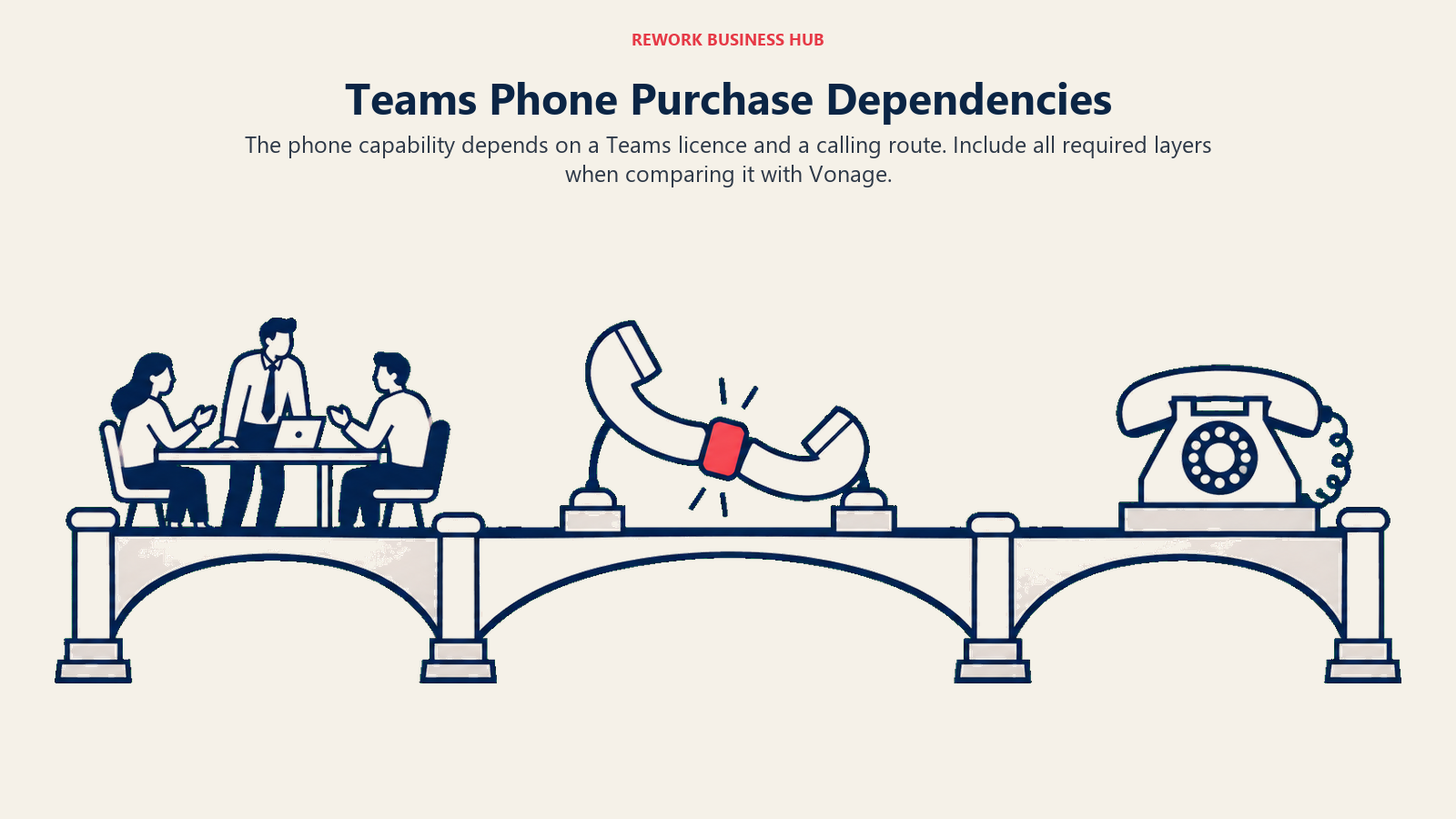
Microsoft publishes three relevant SKUs, all annual subscriptions that auto-renew, all requiring a separate Microsoft Teams license underneath. Teams Phone Standard is $10.00 per user per month paid yearly and is a calling capability only: it carries no calling minutes at all. Teams Phone with Calling Plan (domestic US) is $17.00 per user per month paid yearly and includes 3,000 outbound domestic minutes. Teams Phone with Domestic and International Calling is $34.00 per user per month paid yearly, covering 3,000 domestic or 600 international minutes. The $10 figure is the most misquoted price in this whole category, so treat $17 as the realistic comparison point against Vonage Premium.
| Pros | Cons |
|---|---|
| No new client to deploy for a company already standardized on Teams | The $10 SKU has zero minutes and cannot place a call on its own |
| One identity, one admin center, one vendor relationship | Requires a separate Teams license as a prerequisite |
| Direct Routing and Operator Connect let you shop carriers separately | Native contact center routing is thinner than dedicated UCaaS platforms |
Pricing: Teams Phone Standard is $10.00/user/mo paid yearly (add-on, no minutes). With Calling Plan (domestic US) is $17.00/user/mo paid yearly. With Domestic and International Calling is $34.00/user/mo paid yearly. A separate Microsoft Teams license is required for every SKU.
Best for: IT teams consolidating around an existing Microsoft 365 investment. The Teams Phone vs CloudTalk vs Vonage comparison breaks down the four different routes to a dial tone inside Teams and what each does to the real per-seat cost.
7. Google Voice - Cheapest Line Item, With a Second Line Item
Google Voice has the lowest published rate in this comparison at $10 per user per month for Starter, and it's the entry that gets quoted most carelessly. A Google Workspace subscription is required in addition to the Voice licence. The standalone $10 Starter is US-only and single-user. Quote the $10 without the Workspace line and you've understated the cost of every business deployment.
Starter is $10/user/mo and caps at 10 users. Standard is $20/user/mo with no user cap, adding on-demand call recording and unlimited regional billing locations. Premier is $30/user/mo, adding automatic call recording, advanced reporting and international billing locations. For a Workspace shop that needs dial tone and voicemail rather than routing and queues, the total can still land well under Vonage Mobile on either of its two rates. For anyone who needs an IVR tree, this isn't the product.
| Pros | Cons |
|---|---|
| Lowest published per-user rate in this comparison | Requires a Google Workspace subscription on top of the Voice licence |
| Nothing new to learn for teams already in Gmail and Calendar | Starter caps at 10 users, so growth forces a plan change |
| Automatic recording and BigQuery-grade reporting available at Premier | Far lighter routing and call center capability than Vonage or Nextiva |
Pricing: Starter is $10/user/mo, up to 10 users. Standard is $20/user/mo, unlimited users. Premier is $30/user/mo, unlimited users with international billing locations. A Google Workspace subscription is required in every case.
Best for: Small Google Workspace teams that need reliable calling, not a contact center.
8. Aircall - When the Phone Needs to Live Inside the CRM
If the person pushing to leave Vonage is a sales or support leader rather than IT, the complaint is usually integration depth rather than price. Aircall is built for exactly those desks: a phone system designed to be operated from inside Salesforce or HubSpot rather than beside them.
Essentials is $30 per licence per month billed annually, and Aircall states the entry cost plainly on its own page as "3 licenses for $90/month, billed annually". That 3-licence floor is the number to plan around, because a per-user comparison against Vonage's per-line rate misleads at small headcounts. Professional is $50 per licence per month billed annually ("3 licenses for $150/month"), adding queue callback, live monitoring and advanced analytics. Custom requires 25 licences. Every tier includes 50 free AI Voice Agent minutes per account per month, with 100 additional minutes at sign-up.
| Pros | Cons |
|---|---|
| Deep CTI and a large integration catalog for CRM-centric teams | 3-licence minimum makes $90/month the real entry price |
| Queue callback, live monitoring and analytics built for team leads | Aircall's page shows annual rates only, with no month-to-month rate displayed |
| AI Voice Agent minutes included on every tier, small but real | Custom tier requires a 25-licence commitment |
Pricing: Essentials is $30/licence/mo billed annually, 3-licence minimum ($90/month). Professional is $50/licence/mo billed annually, 3-licence minimum ($150/month). Custom is quote-only with a 25-licence minimum.
Best for: Sales and support teams whose phone system must be an extension of the CRM. The Aircall alternatives guide covers the rest of that field.
9. CloudTalk - Routing and Numbering for Distributed Teams
CloudTalk sits where Vonage's per-line simplicity starts to strain: a support or sales team calling across borders, needing an IVR tree, smart routing and local numbers in a lot of countries. It's a call center tool that happens to work as a phone system, rather than the other way round.
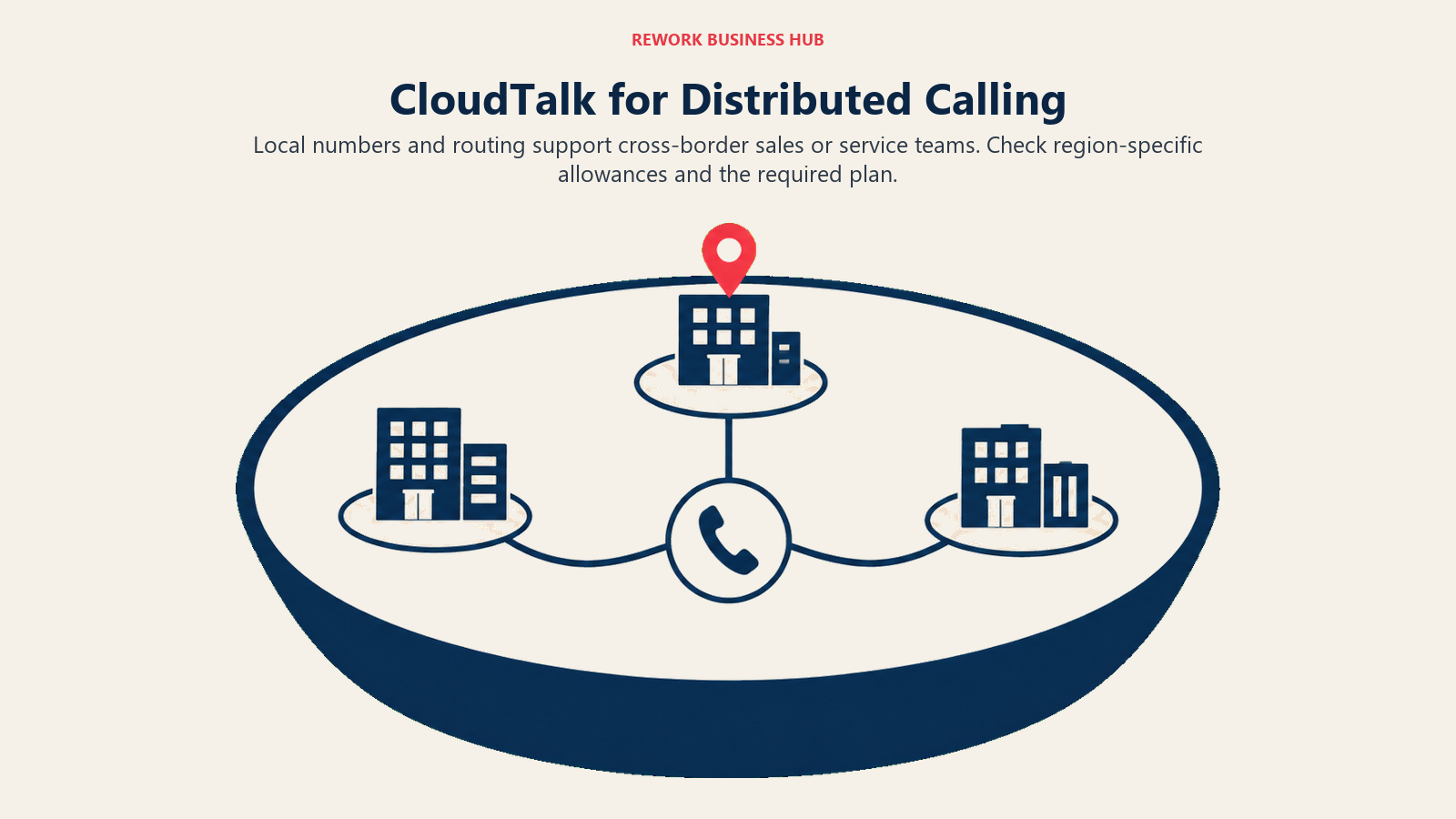
In the USD view of CloudTalk's pricing page, Starter is $25 per user per month billed annually, Essential is $29, and Expert is $49 with a 3-user minimum. State the currency when you compare, because the EUR view of the same page shows a different ladder including a EUR-only Lite tier. Starter's calling allowance is worth reading closely too: it's unlimited calls to the US and Canada or 500 outbound domestic calls across the EU, UK, Iceland and Norway, not a blanket unlimited. Expert is where dialers, real-time analytics and Salesforce integration arrive.
| Pros | Cons |
|---|---|
| Call flow builder, IVR and smart routing available from the entry tier | Starter's unlimited allowance covers US and Canada only |
| Local numbers across a wide set of countries for distributed teams | Dialers and Salesforce integration require the Expert tier |
| Only a 1-user minimum on Starter and Essential | Pricing differs between the USD and EUR views of the same page |
Pricing: Starter is $25/user/mo billed annually (USD). Essential is $29/user/mo billed annually. Expert is $49/user/mo billed annually with a 3-user minimum. Custom is contact us for pricing.
Best for: Distributed sales and support teams making high call volumes across several countries. Pair it with the help desk software roundup if ticketing sits next to the phone queue.
10. JustCall - Outbound Dialing With a Priced Voice Agent Path
JustCall targets the same outbound and support desks as Aircall, with a clearer published path into voice AI. For a Vonage buyer whose real ambition is an AI agent answering or qualifying calls, JustCall is one of the few vendors here that puts a number next to that capability instead of routing it to sales.
Team is $29 per user per month billed annually with a 2-licence minimum. Pro is $49 and Pro Plus is $89, both on the same 2-licence floor. Business and SalesPro are custom, with Business requiring 10 licences. The AI Voice Agent is priced separately and openly: pay-as-you-go at $0.99 per minute, Agent Lite at $99 a month, Agent Max at $249 a month. JustCall doesn't separately publish month-to-month seat rates, so build your comparison on the annual figures.
| Pros | Cons |
|---|---|
| Voice AI agent tiers carry published prices rather than a quote request | Entry seat price sits well above Vonage Mobile on either of its two rates |
| Dialers and outbound workflows are core to the product, not an upsell | 2-licence minimum on every published seat tier |
| Clear tier ladder from Team through Pro Plus before hitting custom pricing | Month-to-month seat rates are not published |
Pricing: Team is $29/user/mo billed annually (2-licence minimum). Pro is $49/user/mo. Pro Plus is $89/user/mo. Business (10-licence minimum) and SalesPro are custom pricing. AI Voice Agent is $0.99/minute pay-as-you-go, $99/month for Agent Lite, or $249/month for Agent Max.
Best for: Outbound-heavy teams that want dialer depth and a budgetable voice AI path. If the AI agent is the actual driver, compare the dedicated field in the best AI voice agents guide.
11. Zoom Phone - Familiar Client, Unpublished Rate
Zoom Phone is the obvious move for a company already running Zoom Meetings everywhere: the same client, the same admin console, a phone number layered onto software the team already opens daily. For a Vonage shop where the meetings tool is Zoom and the phone is Vonage, consolidating removes a vendor.
The catch is the same one Vonage buyers should now be sensitive to, in a different form. Zoom names its plans publicly (US and CA Unlimited, Pro Plus, Business Plus) but the product page repeats "contact sales for pricing" rather than showing a per-user rate. You can shortlist Zoom Phone on capability, not on price, which means you can't run the year-two math this article is about until you're already in a sales conversation. Ask for the renewal rate in the same email as the first-year quote.
| Pros | Cons |
|---|---|
| Zero learning curve for organizations already standardized on Zoom | No published per-user rate anywhere on the product page |
| One admin console for meetings, chat and phone | Every evaluation starts with a sales conversation |
| Gartner Leader placement in the 2026 UCaaS Magic Quadrant | You cannot compare year-two cost before you're in the funnel |
Pricing: Not published. Zoom names its plan tiers (US and CA Unlimited, Pro Plus, Business Plus) and directs buyers to contact sales for the rate.
Best for: Zoom-centric organizations that value one client over a public rate card. The Zoom Phone vs GoTo Connect vs Dialpad Connect comparison goes deeper on how those three actually differ in practice.
12. 8x8 - Global Depth Behind a Quote Wall
8x8 has a genuine claim to global UCaaS credibility: carrier reach, compliance coverage, and a long run near the top of analyst rankings. What it doesn't have, as of this check in August 2026, is a published price. We read the full rendered pricing page: zero dollar figures, six separate "Request a Quote" or "Contact Sales" calls to action.
That matters for a Vonage buyer in a specific way. If you're leaving because of pricing structure, moving to a vendor that publishes nothing is a lateral move on transparency even if it's an upgrade on capability. If you were always going to need a custom quote (multi-country numbering, unusual compliance requirements, a mixed UCaaS and contact center deployment), the missing rate card costs you nothing.
| Pros | Cons |
|---|---|
| Global carrier network and compliance depth few challengers match | No published per-user rate anywhere on the pricing page |
| Mix-and-match packaging suits unusual multi-country requirements | Every evaluation begins with a sales conversation |
| Combined UCaaS and contact center under one vendor | Any starting price you find elsewhere is third-party, not vendor-confirmed |
Pricing: Not published. 8x8's plans and pricing page contains no dollar figures and routes every plan to a quote request.
Best for: Multinational organizations with country-specific requirements that were always headed for a custom quote. The 8x8 alternatives guide covers the same comparison from the other direction.
13. GoTo Connect - Easy Setup, Reputation Ahead of the Page
GoTo Connect built its name on being the simple option: phone, meetings and CX from one vendor, live in days rather than months. That reputation still holds on setup. The "simple, transparent pricing" half of it no longer matches what the page shows.
All four packages (Phone System, Customer Experience, CX Complete and Contact Center) list no rate at all. The page reads "Pick a plan below to talk to a sales representative today about GoTo Connect." If you see a GoTo Connect per-user figure in a comparison article, it came from a third party rather than from GoTo, and it should be labelled that way. Treat GoTo the same way as 8x8 and Zoom Phone: shortlist on fit, then get pricing in writing including year two.
| Pros | Cons |
|---|---|
| Genuinely fast, low-friction rollout compared with enterprise UCaaS suites | No per-user rate on any of the four packages |
| Phone, meetings and CX add-ons from a single vendor and one invoice | The transparent-pricing reputation is now out of date |
| Well-established in the small and mid-market segment | Harder to benchmark against vendors that publish rates |
Pricing: Not published. All four GoTo Connect packages direct buyers to talk to a sales representative.
Best for: Smaller teams that prioritize a fast rollout and don't mind a short sales call. The GoTo Connect alternatives guide covers who else fits that low-friction brief.
How to Choose: Decision Framework
Work backwards from the reason you started looking. Most Vonage evaluations begin with one of six triggers, and each points somewhere different.
| If you need... | Choose | Why |
|---|---|---|
| A rate that reads the same in year two as year one | Ooma Office | Flat per-tier pricing, no contract, no term or promotional window to track |
| Vonage's breadth at a lower published rate | Nextiva Core | Voice, SMS, video and routing in one plan at $15/user/mo annual |
| AI that isn't behind the market | Dialpad Connect | Native transcription, summaries and recaps in the $15 entry plan |
| Desk phones without stepping up a whole tier | Nextiva or Ooma Office | Vonage gates desk phone support behind Premium; both of these don't |
| To stop paying two vendors for one workflow | Microsoft Teams Phone or Google Voice | Both ride an ecosystem licence you're likely already buying |
| The phone to work inside your CRM | Aircall or JustCall | Purpose-built CTI, dialers and integration depth for sales and support desks |
| Local numbers and routing across many countries | CloudTalk or 8x8 | Wide numbering coverage plus IVR and smart routing built in |
| A lean per-person system with no PBX overhead | Quo (formerly OpenPhone) | A number per user, deployable the same day, at $15/user/mo annual |
| The category benchmark and you'll pay for it | RingCentral RingEX | Gartner Leader placement and the deepest all-round feature set here |
Two rules make any of these comparisons honest. First, always compare like terms: a 12-month plan rate against another vendor's annual rate, and a month-to-month rate against another month-to-month rate. Second, ask every vendor for the year-two number in writing before you sign, including any minimum licence count and the expected taxes and fees on your specific mix of interstate and in-state usage. A vendor that won't put renewal pricing in writing has told you something useful.
What to Do Next
Pull your last Vonage invoice and find two things: your per-line rate today, and your contract end date. Then ask your rep one question in writing: what does the same plan cost the day after that date? Multiply that answer by your line count, add the taxes and fees line from the same invoice, and that total is what belongs at the top of a comparison sheet. Not the number on the pricing page.
Then pick the two alternatives that match your actual trigger from the framework above and request written quotes for your exact headcount, explicitly asking for year-two pricing and any minimum licence count. Run a 30-day pilot with a real team rather than a demo account, and watch three things: call quality on your worst network, whether the integrations you need are included or another line item, and how many features you assumed were bundled turn out to sit in an add-on catalog.

Principal Product Marketing Strategist
On this page
- Key Facts
- Quick Comparison Table
- What Vonage Actually Costs: Both Rates, Side by Side
- Term Rate vs Standing Rate: What Each Alternative Charges in Year Two
- Stage Fit: What Breaks First at Each Size
- Buyer Persona and Sizing Table
- 1. Nextiva - The Closest Full-Suite Trade With Pricing That Stays Put
- 2. RingCentral RingEX - The Benchmark, and What That Costs
- 3. Dialpad Connect - The Answer to "Vonage's AI Is Behind"
- 4. Quo (formerly OpenPhone) - Lean Numbers Per Person, Nothing You Won't Use
- 5. Ooma Office - Flat Rates, No Contract, No Renewal Math
- 6. Microsoft Teams Phone - If You Already Pay Microsoft, Do the Licensing Math
- 7. Google Voice - Cheapest Line Item, With a Second Line Item
- 8. Aircall - When the Phone Needs to Live Inside the CRM
- 9. CloudTalk - Routing and Numbering for Distributed Teams
- 10. JustCall - Outbound Dialing With a Priced Voice Agent Path
- 11. Zoom Phone - Familiar Client, Unpublished Rate
- 12. 8x8 - Global Depth Behind a Quote Wall
- 13. GoTo Connect - Easy Setup, Reputation Ahead of the Page
- How to Choose: Decision Framework
- What to Do Next