Descript vs Opus Clip vs ElevenLabs: Which One Fits Your Content Workflow in 2026
Turn this article into takeaways for your work.


Each assistant summarizes the article only for you and suggests best practices for your work.
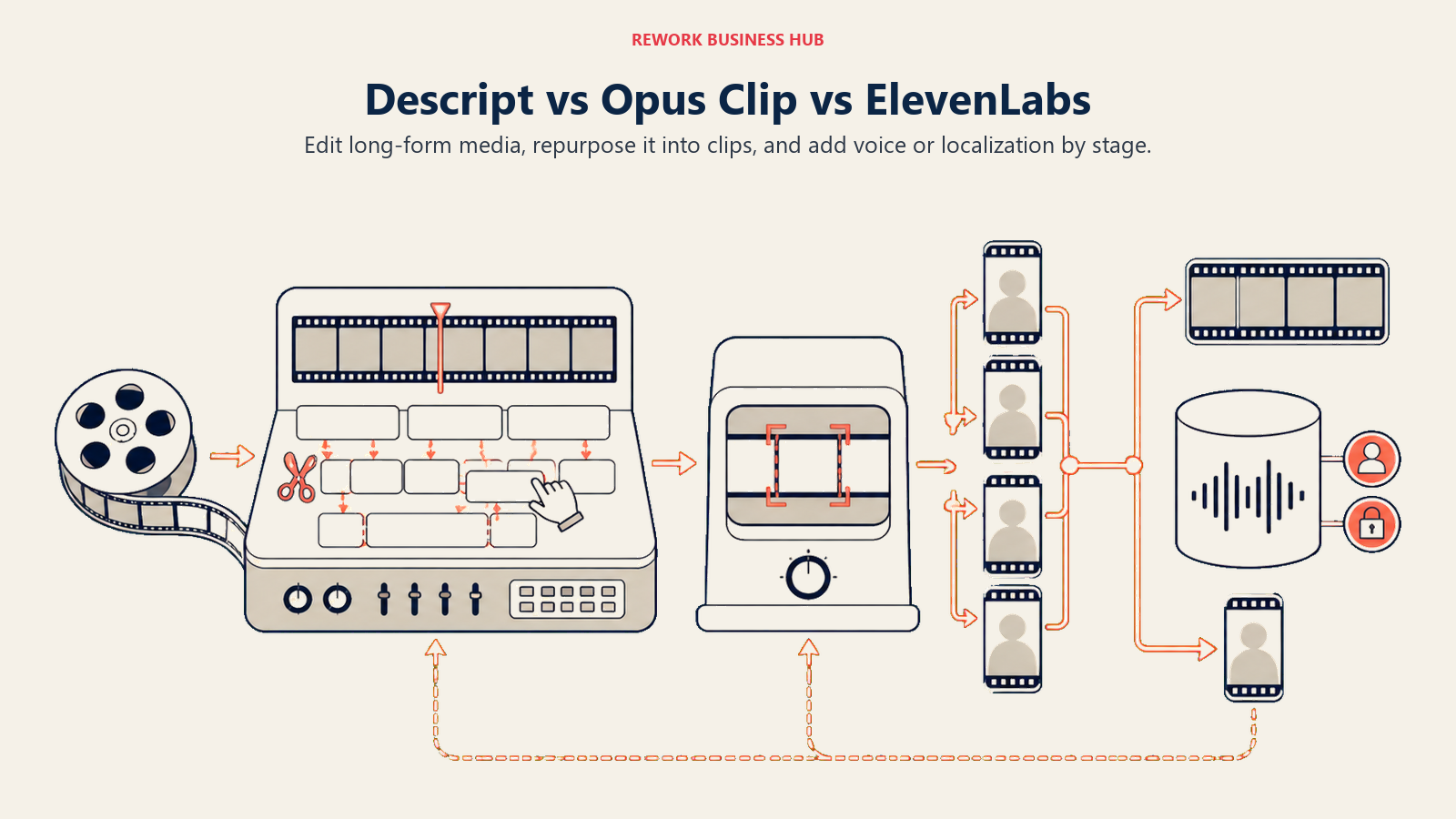
You are not choosing one tool here. You are staffing three different jobs, and the most common mistake a content team makes is assuming one subscription should cover all of them.
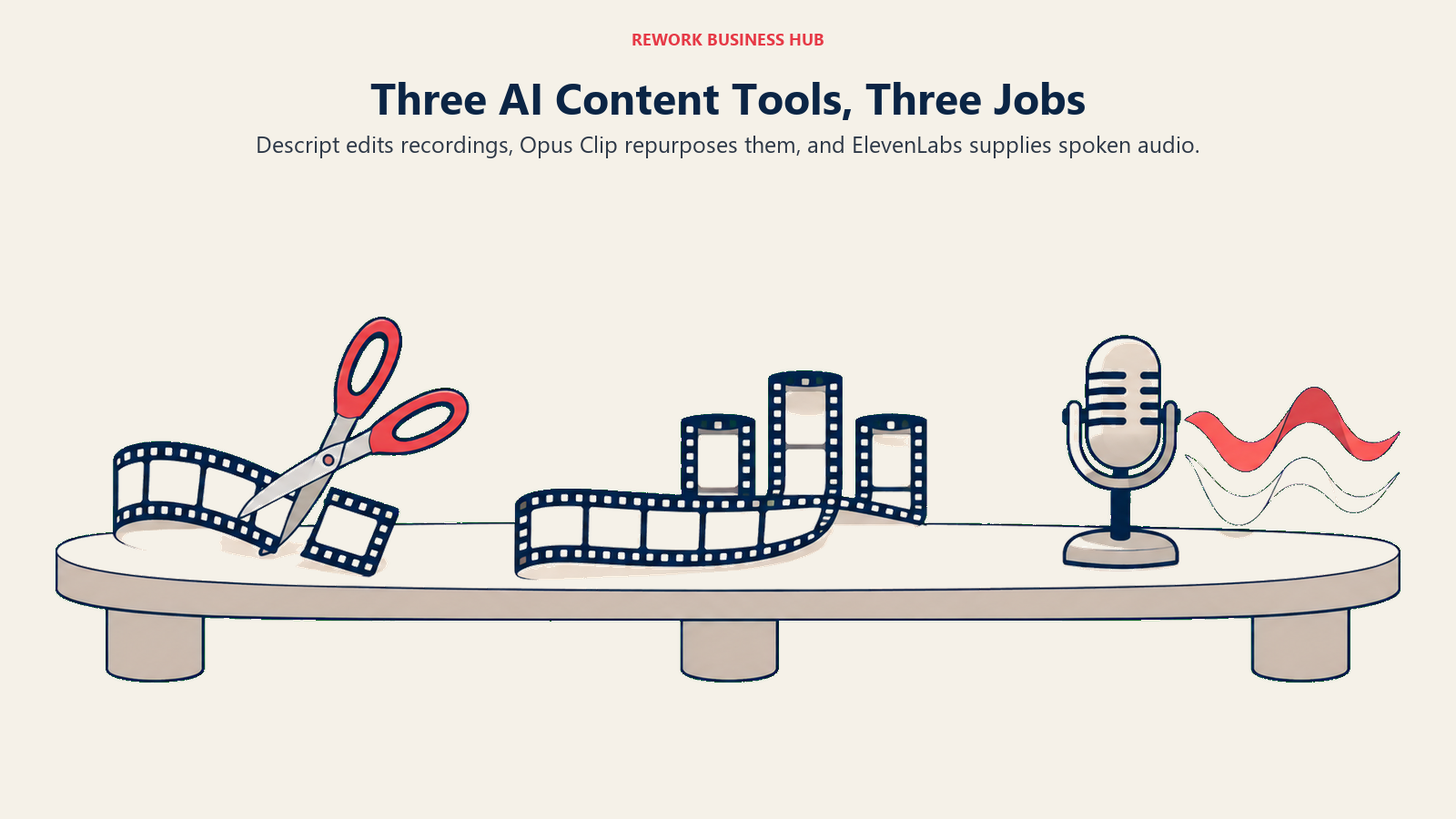
Descript records and edits. Opus Clip takes a finished long-form recording and cuts it into short clips for social. ElevenLabs generates and clones voices, for narration, dubbing, and increasingly for voice agents that have nothing to do with publishing content at all. A podcast producer, a growth marketer running a clipping pipeline, and someone localizing training video into a dozen languages are three different buyers, even inside the same company. If your team touches more than one of those jobs, you may genuinely need two of these tools, sometimes all three, running side by side rather than picking a single winner.
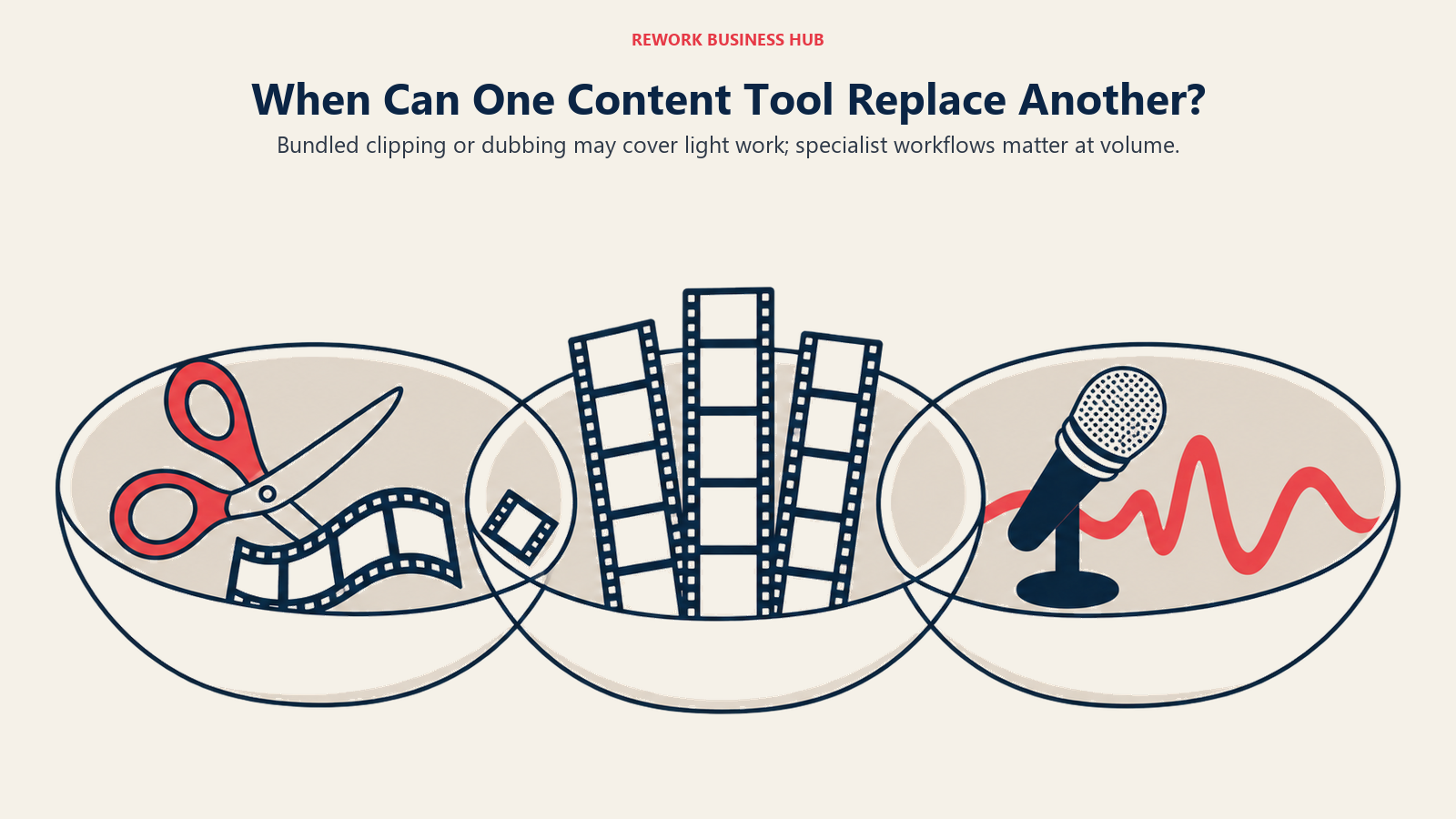
All three have also quietly built features into each other's territory over the past year. Descript now ships its own auto-clip tools, Opus Clip added AI voiceover and dubbing, and ElevenLabs expanded from a voice API into video generation and conversational agents. So the useful question is not just which one is best. It is where the overlap actually lets you drop a subscription, and where it is just a checkbox feature not good enough to replace the specialist. That is what this comparison answers, along with the part consumer reviews tend to skip: what commercial usage rights and voice-cloning consent actually look like once you are a business, not a hobbyist.
Key Facts
- ElevenLabs closed a $500 million Series D in early 2026, pushing its valuation to $11 billion, according to the company's own announcement.
- 1 in 10 Americans say they have already received a message from an AI-cloned voice, and 77% of the people targeted lost money as a result, according to McAfee's 2026 State of the Scamiverse report.
- Tennessee's ELVIS Act was the first state law to explicitly ban unauthorized commercial use of a cloned voice, and by 2026 similar consent statutes have spread to California, New York, and Illinois, according to Recording Law's state-by-state tracker.
TL;DR
| Dimension | Descript | Opus Clip | ElevenLabs |
|---|---|---|---|
| Core job | Record, transcript-edit, and clean up audio and video | Turn one long recording into many short social clips | Generate, clone, and dub voices |
| Workflow stage | Stage 1: capture and edit | Stage 2: repurpose into short-form | Cross-cutting: any stage that needs spoken audio |
| Starting price | Free; paid from $16/mo (annual) | Free; paid from $15/mo | Free; paid from $6/mo (annual $5/mo) |
| Free tier commercial use | Not confirmed as an explicit license; free exports carry a watermark | No, paid plans only, per Opus Clip's own terms | No, paid plans only, per ElevenLabs' own terms |
| Voice cloning scope | Overdub clones only your own voice, by design | Dubbing clones your own voice into new languages | Clones any voice you are authorized to use, with a verification step on Professional cloning |
| Where it overlaps with the others | Built-in AI clip generator competes lightly with Opus Clip; a stock voice library competes lightly with ElevenLabs | AI voiceover and dubbing (Pro plan) compete lightly with ElevenLabs for simple jobs | Video and image generation, not repurposing; does not compete with Opus Clip's clipping job |
| Ideal buyer | Podcast producer, video editor, course creator | Social media manager, growth marketer | Localization lead, audio producer, voice AI builder |
What Each Tool Is Actually Built For
Descript: Recording and Transcript-Based Editing
Descript's product bet has not changed in years: transcribe the recording, then let the editor work like a word processor. Delete a sentence in the transcript and the matching audio or video disappears from the timeline. Studio Sound cleans up room noise, filler-word removal strips "um" and "uh" automatically, and Overdub fixes a flubbed line by typing the correction instead of re-recording. For a podcast, webinar, or course, that transcript-first workflow remains the fastest way for a non-editor to produce a clean cut. If transcript accuracy alone is the job, best AI transcription software covers that narrower category directly.
Opus Clip: Long-Form Into Short-Form
Opus Clip does one job and builds everything around doing it well: take a long recording, a podcast, webinar, or interview, and find the 30 to 90 second moments most likely to perform as standalone clips. Its AI virality scoring ranks candidate clips, speaker detection keeps framing tight when multiple people are on camera, and multi-platform auto-posting pushes finished clips to YouTube Shorts, TikTok, and Instagram Reels without a manual export-and-upload step for each one.
ElevenLabs: Voice, Cloning, and Dubbing
ElevenLabs owns the audio layer underneath both of the other tools. Text-to-speech, instant and professional voice cloning, dubbing across dozens of languages, and a conversational AI voice agent product all live in the same account. Whether the job is narrating a training video, cloning a founder's voice for localized marketing, or dubbing an episode into five languages while keeping the host's vocal character intact, ElevenLabs is the layer most other tools here, Descript and Opus Clip included, eventually connect to for anything beyond their own basic voice features.
For the broader multi-format content stack these three sit inside, best AI tools for content creation maps text, image, video, and audio tools together, and for the full recording-through-distribution pipeline, best AI podcast tools covers where Riverside, Auphonic, and other specialists fit around these same three.
Where the Three Actually Overlap
| Overlap | What It Means | Good Enough to Drop the Specialist? |
|---|---|---|
| Descript's AI clip generator vs Opus Clip | Descript can cut Reels, TikTok clips, and highlight reels from inside your edit | Partially. Fine for light, occasional posting; Opus Clip's virality scoring and auto-posting still lead for growth-focused teams |
| Descript's Overdub and stock voices vs ElevenLabs | Overdub fixes a flubbed line in your own voice; a stock voice library covers basic narration | No. Overdub is limited to your own voice, and neither feature clones someone else's voice, dubs into dozens of languages, or runs a voice agent |
| Opus Clip's AI voiceover and dubbing vs ElevenLabs | Opus Clip's Pro plan clones your own voice into 20 or more languages for the clips it cuts | Partially. Good enough if dubbing your own clips is the only voice job you have; not a substitute for standalone narration or cloning someone else's voice |
| ElevenLabs' video, image, and agent products vs Descript or Opus Clip | ElevenLabs now generates video and images and runs conversational voice agents | No. This is ElevenLabs expanding across the media stack generally, not into editing footage or repurposing it into clips |
Descript shipped its own AI clip generator, built to spot highlight moments and export them as Reels or TikTok cuts without leaving the editor. For a solo creator posting a clip or two a week, that is genuinely enough. It is not what a team whose growth strategy runs through short-form video should rely on: Opus Clip's virality scoring, speaker tracking on multi-guest video, and native multi-platform auto-posting still lead on accuracy and publishing workflow. For the wider editing category around Descript, see best AI video editing tools.
Descript's voice side is narrower than it looks. Overdub fixes a flubbed line by regenerating it in your own cloned voice, and Descript has been explicit that this is a deliberate limit, not a technical one: it only clones your own voice. A separate stock voice library covers generic narration, but neither feature lets you clone a guest, a co-host, or a brand voice the way ElevenLabs does. If any part of your workflow needs a voice that is not yours, budget for ElevenLabs regardless of which editor you use.
Opus Clip's answer is more useful than Descript's. On the Pro plan, its dubbing feature clones your own voice and translates a finished clip into 20 or more languages in a few clicks, a real, bundled substitute for turning your own short clips multilingual without leaving the repurposing tool. It stops being a substitute once you need to narrate something that is not a clip of you talking, clone a voice belonging to someone else with proper consent tracking, or run a voice agent, all squarely ElevenLabs territory, covered further in best AI voice generators.
ElevenLabs, for its part, has stopped being just a voice API. It now generates and edits video and images and runs conversational voice agents across phone, chat, and messaging, none of which reaches back into Descript's editing job or Opus Clip's clipping job. It is ElevenLabs building outward across the audio and media stack, not inward on either specialist's territory, and the video and image generation piece sits closer to best AI video generators than to a repurposing tool like Opus Clip.
Decision by Business Goal
| Business Goal | Best Fit | Why |
|---|---|---|
| Record and edit a podcast or webinar without hiring an editor | Descript | Transcript editing removes the bottleneck of scrubbing a timeline to cut dead air and mistakes |
| Turn one long recording into a week of social clips | Opus Clip | Purpose-built virality scoring and auto-posting beat a generalist editor's built-in clip tool |
| Localize video or training content into many languages | ElevenLabs | Dedicated dubbing studio with the widest language and voice coverage of the three |
| Fix a mistake in your own narration without re-recording | Descript | Overdub does this natively, well below what ElevenLabs' Creator tier costs |
| Clone a colleague's, client's, or brand voice for narration | ElevenLabs | The only one built for cloning a voice that is not your own, with a consent verification step |
| Grow a show or channel through short-form distribution | Opus Clip | Multi-platform auto-posting and speaker tracking are the actual growth lever, not just the cut |
| Keep the subscription count to one for a two-person team | Descript | Broadest single-tool coverage of recording, editing, and light repurposing, though it will not match either specialist at volume |
| Build a voice AI agent, not publish content | ElevenLabs | Neither Descript nor Opus Clip has a conversational-agent product; this is ElevenLabs alone |
Team and Role Fit
| Role | Recommended Tool | Primary Use Case |
|---|---|---|
| Podcast Producer | Descript | End-to-end recording, transcript editing, cleanup |
| Video Editor / Course Creator | Descript | Transcript-based editing for talking-head content |
| Social Media Manager | Opus Clip | Turning long recordings into a posting calendar of clips |
| Growth Marketer | Opus Clip | Short-form distribution volume without a dedicated editor |
| Localization Lead | ElevenLabs | Dubbing and multilingual voice consistency |
| Head of L&D / Training | ElevenLabs | Narration for training content at scale |
| Audio Producer | ElevenLabs | Voice cloning and sound design beyond basic narration |
| Founder / Solo Creator | Descript plus Opus Clip | The two-tool combination that covers record, edit, and repurpose without ElevenLabs' added cost |
| Head of Content | All three, coordinated | Owns the full pipeline and decides which stage needs which tool |
If your channel strategy runs through YouTube specifically, best AI tools for YouTube covers the SEO, scripting, and thumbnail tools that sit around this same repurposing job. And because a clip is only useful once it is actually published, pairing Opus Clip with a scheduler from best AI tools for social media closes the loop from cut to post.
Commercial Usage Rights and Voice Cloning Consent
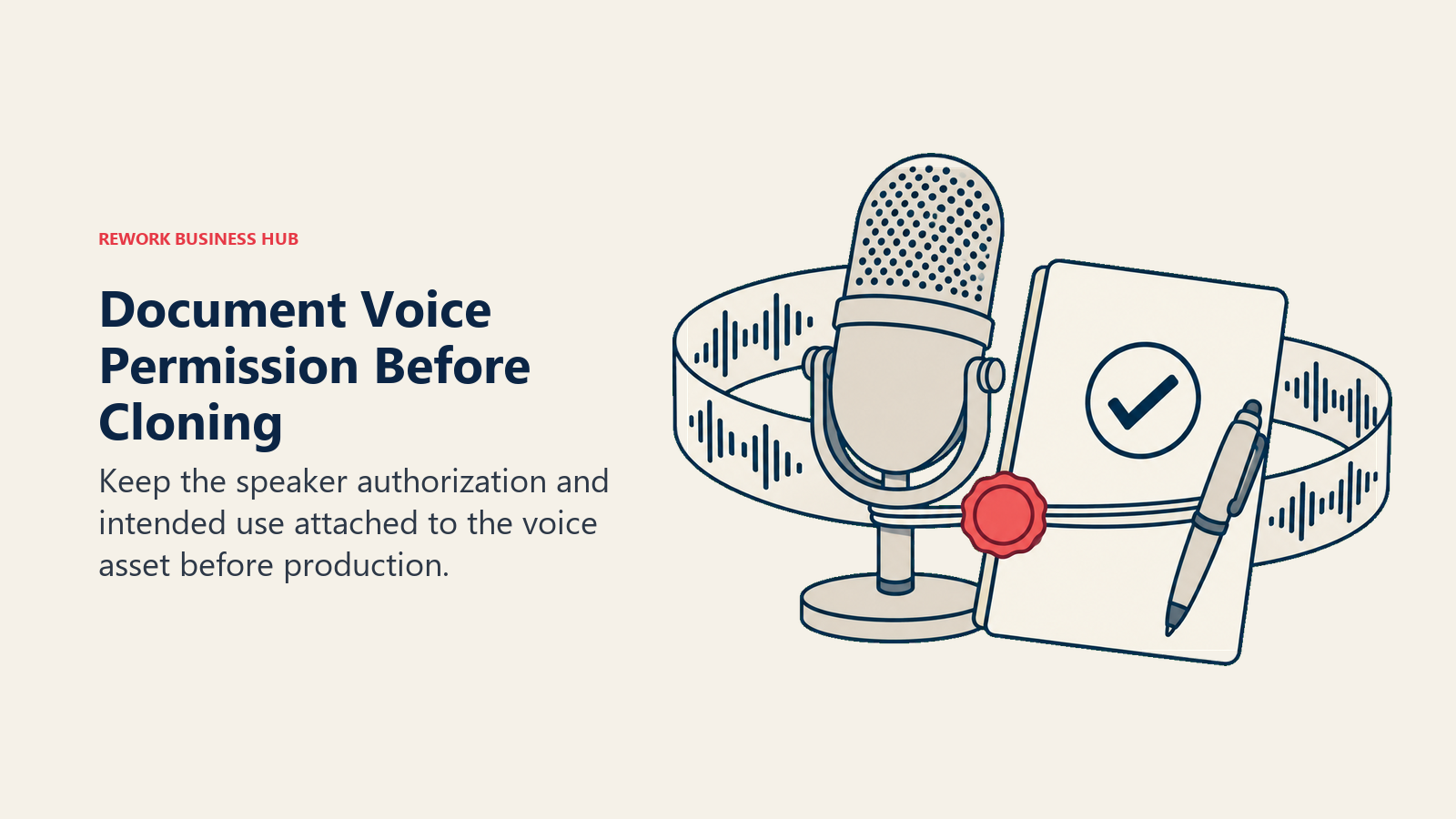
This is the part a consumer-focused review usually skips, and the part that actually creates risk for a business: whether you are legally allowed to use the output commercially, and whether you had the right to clone the voice in the first place.
Commercial use by plan tier. ElevenLabs' own terms of use state that a "Free User... may only use the Services for non-commercial purposes," while paid subscribers are licensed for commercial use subject to its Prohibited Use Policy. Opus Clip's terms of service draw a similar line: free-tier use is restricted to "internal, personal, non-commercial use," while a user of Paid Services "is licensed to use the Services for commercial uses... to the fullest extent possible under applicable law." Descript does not state an equivalent commercial-license clause as clearly in its public pricing or product copy. The practical gate on its free tier is a watermark on every export rather than a stated licensing restriction, so treat Descript's free-tier commercial status as not confirmed and verify directly with Descript before publishing free-tier output for a client or a paid campaign.
Whose voice you can actually clone. Here the three tools take genuinely different approaches, and the difference matters more than the pricing does.
- Descript's Overdub is scoped to your own voice only, a deliberate product limit, not a technical one. It will not let you clone a co-host, guest, or client without a workaround, which structurally limits consent exposure: there is no third-party voice to get consent for.
- Opus Clip's dubbing feature works the same way, cloning the voice already in your own footage into 20 or more languages per its own changelog announcement, again keeping exposure to your own voice and footage.
- ElevenLabs is built for the opposite case. Its terms require any voice you upload be your own or one you are "authorized to share," and Professional Voice Cloning adds a verification step before an account can create a professional clone. That makes it the only one of the three actually designed to clone someone else's voice, and the reason it also carries the real compliance burden: you attest to consent, not the platform.
Why this is a real legal issue now. Tennessee's ELVIS Act made unauthorized commercial voice cloning a civil and criminal offense, and California, New York, and Illinois have since passed comparable consent laws, several with a private right of action letting the cloned person sue directly. The FTC's Impersonation Rule already bans using a cloned voice to sell something without the real person's consent, and the risk is not abstract: 1 in 10 Americans say they have already received a message from an AI-cloned voice, and 77% of the people targeted lost money, per the McAfee research cited above. If any workflow in your stack clones a real person who is not the one running the software, get written consent before the first clone, not after a client asks where the recording came from.
| Question | Descript | Opus Clip | ElevenLabs |
|---|---|---|---|
| Free tier permits commercial use | Not confirmed; watermark is the practical limit | No, per Opus Clip's terms of service | No, per ElevenLabs' terms of use |
| Paid tier permits commercial use | Implied by watermark removal; not stated as an explicit license | Yes, stated explicitly in its terms | Yes, from the Starter tier up |
| Can clone a voice that is not your own | No, Overdub is limited to your own voice by design | No, dubbing applies to your own footage's voice | Yes, with a consent attestation and, for Professional cloning, a verification step |
| Vendor's own consent language | Requires explicit authorization from the speaker whose voice is cloned | Prohibits use of an individual's name, photograph, voice, or likeness without proper authorization | Requires the input voice be one you are authorized to share, verified for Professional Voice Cloning |
Pricing at 1, 5, and 25 Seats
Pricing headlines are single-seat numbers. Team pricing is where the real decision happens, and where each vendor's packaging quietly stops being linear. All prices below come from each vendor's own pricing page.
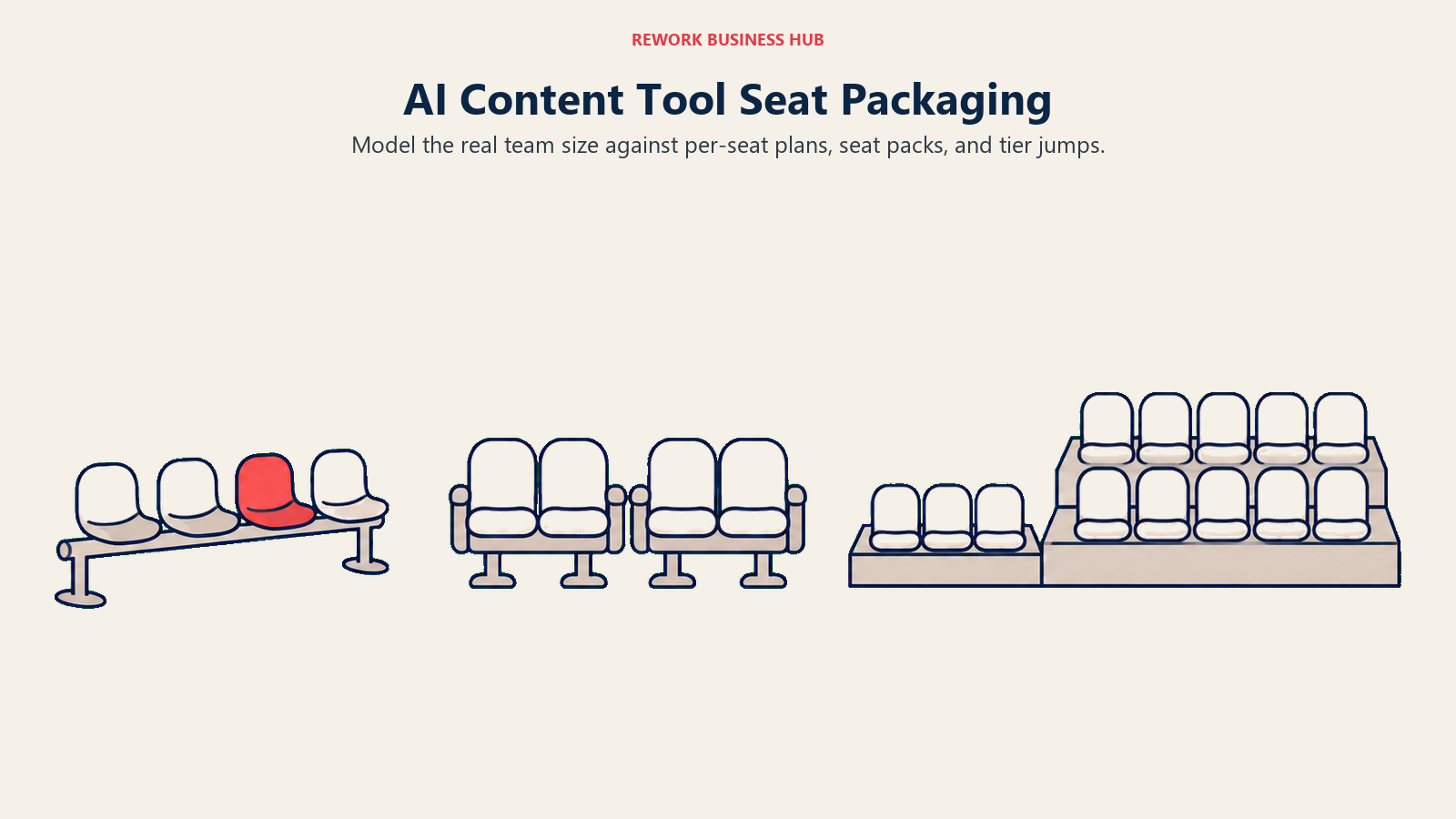
Descript prices per seat with a hard cap before Enterprise: Business runs $50 per seat per month billed annually ($65 month-to-month) and explicitly scales to a team of 5 at that same rate. Opus Clip bundles seats in pairs: one Pro subscription is $29 a month for 2 seats, and a second pack adds 2 more for 4 seats at $58 a month, the practical ceiling on self-serve. ElevenLabs jumps rather than scales: Scale includes 3 seats for $299 a month ($249.17 annually), Business includes 10 for $990 a month ($825 annually), and nothing published sits between them. Each vendor requires a custom Enterprise or Business quote past its published cap.
| Seats | Descript | Opus Clip | ElevenLabs |
|---|---|---|---|
| 1 seat | Creator, $24/mo annual ($35/mo monthly) | Pro, $29/mo (no annual discount published) | Creator, $18.33/mo annual ($22/mo monthly) |
| 5 seats | Business, 5 seats, $250/mo annual ($325/mo monthly) | No exact fit: 2 Pro packs cover 4 seats at $58/mo; a true 5th seat requires Business, custom, not published | No exact fit: Business, 10 seats, $825/mo annual ($990/mo monthly), is the smallest plan that actually covers 5 |
| 25 seats | Enterprise, custom, not published | Business, custom, not published | Enterprise, custom, not published |
At 1 seat, running all three together costs roughly $71 a month ($24 plus $29 plus $18.33), about $856 a year, for one person who genuinely needs recording, repurposing, and voice cloning at once. At 5 seats, the honest combined floor is at least $1,133 a month: $250 for Descript, $58 for the closest Opus Clip fit (still one seat short), and $825 for ElevenLabs Business, which hands you 5 spare seats you did not ask for. That gap is worth negotiating rather than accepting at face value: ask Opus Clip for an actual 5-seat quote instead of rounding up to its next self-serve tier, and ask ElevenLabs whether Scale can add 2 seats a la carte before defaulting to Business. At 25 seats, all three vendors move to custom pricing, so there is no honest published combined number to give here; budget conservatively and get every quote before committing.
Descript is the only one of the three with clean, linear, published per-seat pricing up to its cap. Opus Clip's pairing means an odd-numbered team always rounds up and pays for a seat it will not use. ElevenLabs' gap between 3 and 10 seats means any team of 4 to 9 people is either overpaying for headroom or waiting on a sales call. Model your real headcount against these before assuming the sticker price scales the way you would expect.
Implementation and Change Management
| Factor | Descript | Opus Clip | ElevenLabs |
|---|---|---|---|
| Time to first useful output | Same day; a recording is editable the moment the transcript lands | Same day; upload a long video and clips generate automatically | Same day for text-to-speech; longer for a verified Professional Voice Clone |
| Learning curve | Low for transcript editing; moderate for advanced timeline features | Low; built around one workflow | Low for text-to-speech; moderate for dubbing and agent setup |
| Who needs training | Whoever currently edits, shifting from timeline to text | Whoever exports and schedules clips | Whoever owns narration, localization, or voice-agent scripts |
| Integration with existing stack | Standard video export; no deep API needed for most teams | Exports directly to social platforms; API on paid tiers | Deep API, commonly the voice layer inside other tools |
| Governance setup | Minimal below Enterprise | Minimal below Business | A consent documentation process should exist before the first non-self clone |
Risk and Governance
| Risk Dimension | Descript | Opus Clip | ElevenLabs |
|---|---|---|---|
| Vendor concentration risk | Independent; output is standard video and audio, so switching cost is mostly re-learning the workflow | Independent; exported clips are standard video files | Independent; cloned voice models are tied to the platform, raising real switching cost once a workflow depends on one |
| Consent and impersonation liability | Low by design; Overdub cannot clone a third party | Low by design; dubbing applies only to your own footage | Higher; built to clone any authorized voice, so your team owns the consent-tracking burden |
| Enterprise controls (SSO, admin console, audit logs) | Available on Enterprise; confirm current scope directly | Available on Business; confirm current scope directly | Available on Business and Enterprise; confirm current scope directly |
| Data handling for uploaded source material | Confirm training and retention policy before uploading confidential recordings | Confirm training and retention policy before uploading confidential video | States paid users retain rights to their own generated audio; confirm training opt-outs for your tier |
| Regulatory exposure | Standard SaaS content-handling risk | Same, plus its own copyright policy on uploaded source video | Voice-specific: state consent laws such as Tennessee's ELVIS Act apply directly |
When Descript Is the Right Call
- Your bottleneck is editing time on spoken-word content: podcasts, webinars, course video, talking-head recordings
- You want to fix your own mistakes without re-recording, and Overdub's own-voice-only limit is a feature, not a gap, for your use case
- One tool covering recording, editing, cleanup, and light repurposing beats best-in-class on any single job
- You are not routinely cloning anyone else's voice, so ElevenLabs' broader, pricier capability is not needed on top
When Opus Clip Is the Right Call
- Short-form distribution volume is your actual growth lever, not an afterthought
- You produce long-form content elsewhere (Descript, Riverside, or a camera) and need repurposing to be its own stage
- Multi-guest video needs reliable speaker tracking to keep framing tight in vertical clips
- You want dubbing for your own clips into a handful of languages bundled into the same subscription
When ElevenLabs Is the Right Call
- You need to clone a voice that is not your own, with proper consent tracking, whether a brand voice, a client's voice, or a colleague's with sign-off
- Localization at real scale, more than a handful of languages or ongoing multilingual production, is a standing part of your workflow
- You are building a voice AI agent or an IVR-style product, which neither Descript nor Opus Clip has any equivalent for
- Voice quality and language breadth matter more than editing or clipping convenience for your use case
Decision Framework
| Pick This | If This Describes Your Situation |
|---|---|
| Descript | Your bottleneck is editing spoken-word content, and light, occasional clips are enough |
| Descript plus Opus Clip | You produce regularly and short-form distribution volume matters, but nobody's voice except your own needs cloning |
| Opus Clip | You already have a finished long-form asset from elsewhere and just need the repurposing stage |
| ElevenLabs | Any part of the workflow needs to clone someone else's voice, dub at real scale, or run a voice agent |
| All three, coordinated by stage | You run a media or content team producing scripted, multilingual, or high-volume output across every stage |
What to Do Next
Map your actual workflow before buying anything. Write down every stage your content passes through (record, edit, clip, voice, dub) and mark which tool already covers it. Most teams find they only need two of the three.
If recording and editing is the gap, start a free Descript project with your next real recording and see whether the transcript-based workflow actually saves the time it claims to. If repurposing is the gap, run one finished episode through Opus Clip's free tier first; the watermark and processing cap are enough to judge output quality. If voice cloning or dubbing is the gap, test on ElevenLabs' free tier, but budget for Creator or above before anything touches a client or a paid campaign, since the free tier is non-commercial by its own terms.
Whatever you clone that is not your own voice, get consent in writing before the first generation, not after someone asks where the recording came from. And before buying team seats anywhere, model your real headcount against the seat tables above: every vendor's packaging has a gap somewhere between 1 seat and Enterprise, and finding which gap applies to you before you commit is worth the extra week.
For the rest of the production stack around these three tools, from scripting to thumbnails to distribution scheduling, best AI tools for content creators maps the full stage-by-stage lineup.
Frequently Asked Questions about Descript, Opus Clip, and ElevenLabs
What is the actual difference between Descript, Opus Clip, and ElevenLabs?
Descript records and edits long-form audio and video. Opus Clip turns a finished long-form recording into short social clips. ElevenLabs generates, clones, and dubs voices, a job that cuts across every stage rather than owning one of its own.
Can Descript replace Opus Clip for repurposing?
Only partially. Descript's built-in AI clip generator suits a solo creator posting occasionally, but Opus Clip's virality scoring, speaker tracking, and multi-platform auto-posting still lead wherever short-form performance is the actual growth strategy.
Can Opus Clip or Descript replace ElevenLabs for voice cloning?
Not for most business use cases. Descript's Overdub clones only your own voice by design, and Opus Clip's dubbing clones your own voice into other languages for your own clips. Neither lets you clone a colleague's, guest's, or client's voice the way ElevenLabs does, with a verification step for its Professional Voice Cloning.
Is it legal to clone a co-host's or colleague's voice?
Only with their explicit consent, and skipping that step is getting riskier. Tennessee's ELVIS Act made unauthorized commercial voice cloning a civil and criminal offense, and California, New York, and Illinois have passed similar laws, several allowing the cloned person to sue directly.
How much does it cost to run all three tools together?
For one person on a realistic working tier (Descript Creator, Opus Clip Pro, ElevenLabs Creator), combined cost runs roughly $71 a month, about $856 a year. At 5 seats, none of the three has a clean published fit, and the honest combined floor is upward of $1,133 a month once you account for the seat-bundling gaps.
Do I actually need all three tools?
Most teams need two. If nobody clones a voice that is not their own, Descript plus Opus Clip covers recording, editing, and repurposing without ElevenLabs' added cost. Add ElevenLabs once dubbing, third-party voice cloning, or a voice agent becomes a real, standing part of the workflow.
Senior Customer Retention Strategist
On this page
- Key Facts
- TL;DR
- What Each Tool Is Actually Built For
- Descript: Recording and Transcript-Based Editing
- Opus Clip: Long-Form Into Short-Form
- ElevenLabs: Voice, Cloning, and Dubbing
- Where the Three Actually Overlap
- Decision by Business Goal
- Team and Role Fit
- Commercial Usage Rights and Voice Cloning Consent
- Pricing at 1, 5, and 25 Seats
- Implementation and Change Management
- Risk and Governance
- When Descript Is the Right Call
- When Opus Clip Is the Right Call
- When ElevenLabs Is the Right Call
- Decision Framework
- What to Do Next