StackAdapt vs The Trade Desk: Self-Serve DSP or Sales-Led Scale in 2026
Turn this article into takeaways for your work.


Each assistant summarizes the article only for you and suggests best practices for your work.
Updated August 2026
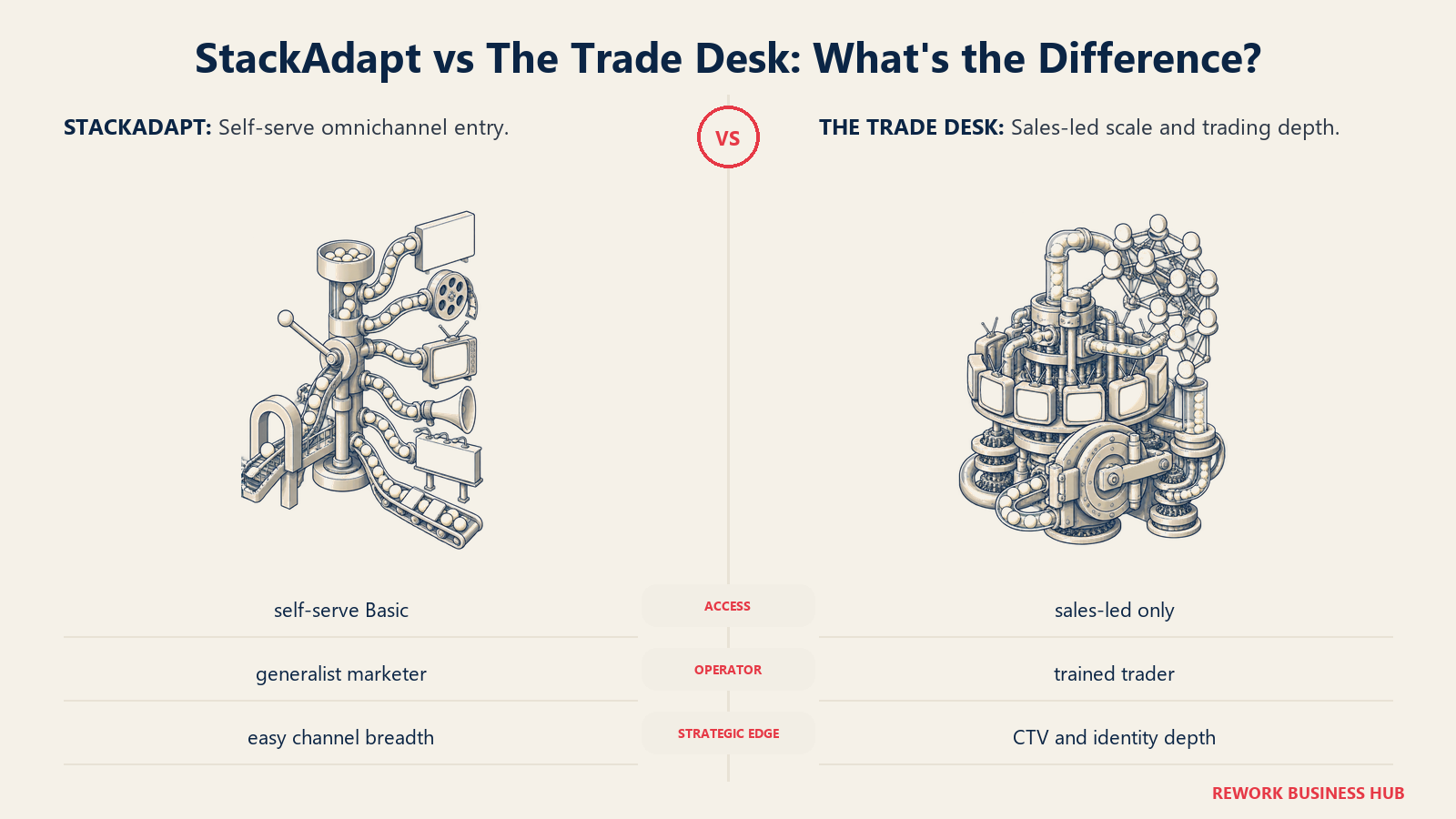
Both StackAdapt and The Trade Desk are demand-side platforms, software for buying programmatic ad inventory directly instead of routing every dollar through Meta or Google. Search "stackadapt vs the trade desk" and most pages you'll find line up feature lists side by side: native, display, video, CTV, audio, identity graphs, reporting dashboards. The lists mostly agree with each other, which is exactly why they miss the point. The two platforms don't really compete on what they can buy. They compete on who gets to walk in the door.
If you're a growth lead, media buyer, or marketing director evaluating a DSP for the first time, or an in-house team ready to diversify beyond Meta and Google, the question that actually decides this isn't which platform has the longer spec sheet. It's whether you can sign up today and start testing on a modest budget, or whether you need programmatic trading experience, a sales conversation, and a spend commitment large enough to justify a dedicated account team before you place a single impression. That access gap, not a channel checklist, is the real decision covered here.
TL;DR
| StackAdapt | The Trade Desk | |
|---|---|---|
| What it is | Self-serve omnichannel DSP: native, display, video, CTV, audio, DOOH | Independent, agency-oriented DSP built around the Kokai buying platform |
| Access model | Basic tier is genuine self-serve signup, no demo required | No public self-serve option; onboarding runs through a sales conversation |
| Published pricing | None; no dollar figures anywhere on the public pricing page | None; no public rate card, and thetradedesk.com is not reachable for outside verification |
| Stated minimum spend | None stated on StackAdapt's own site | Not published by The Trade Desk |
| Built for | In-house marketers and growth teams wanting a self-serve entry point, plus agencies | Agencies, trading desks, and enterprise brands with dedicated programmatic traders already on staff |
| Connected TV | A standard, established channel | The company's current growth bet, via the Ventura ecosystem |
| Identity approach | Uses industry identity partners rather than a proprietary framework | Built and promotes its own open-source standard, Unified ID 2.0 |
| Best for | A team that wants to start today and learn the platform hands-on | A team that already has programmatic trading skill and wants scale and supply depth |
Who Each Platform Is Actually Built For
StackAdapt was founded in 2014 in Toronto and has grown into a well-funded challenger: it raised $235 million in February 2025 at a roughly $2.5 billion valuation, per TechCrunch, bringing its total funding to $537 million. The platform is built to be operated by the person running the campaign, not handed off to a trading desk. Its Plans and Packages page lists five tiers, Basic, Grow, Scale, Accelerate, and Enterprise, and Basic is a real self-serve product: create an account, load a budget, and launch without talking to anyone.
The Trade Desk was founded in 2009 by Jeff Green and Dave Pickles, is headquartered in Ventura, California, and is publicly traded on Nasdaq under the ticker TTD. It's widely described in ad tech coverage as the largest independent demand-side platform still standing outside a walled-garden ecosystem like Meta or Google, and it built that position by selling almost exclusively to agency trading desks and enterprise brands. There has never been a self-serve signup path. Every account starts through a sales conversation, whether that's an agency's holding-company relationship or a brand's own programmatic team negotiating direct.
| StackAdapt | The Trade Desk | |
|---|---|---|
| Founded | 2014, Toronto, Canada | 2009, Ventura, California |
| Company status | Private, valued at roughly $2.5 billion (2025) | Public, Nasdaq: TTD |
| Core buying platform | StackAdapt's own DSP dashboard | Kokai |
| Primary buyer | In-house marketers, growth teams, agencies wanting self-serve | Agency trading desks, enterprise brands, holding-company media teams |
| Self-serve entry point | Yes, the Basic tier | No, none published or offered |
| Where it's a stretch | An enterprise brand needing a dedicated strategist embedded day one | A five-person team with no programmatic experience and a five-figure test budget |
The Access Model: Self-Serve Signup vs Sales-Led Onboarding
This is the spine of the whole comparison, so it's worth being precise about what each vendor actually publishes rather than repeating the reputation each one has earned.
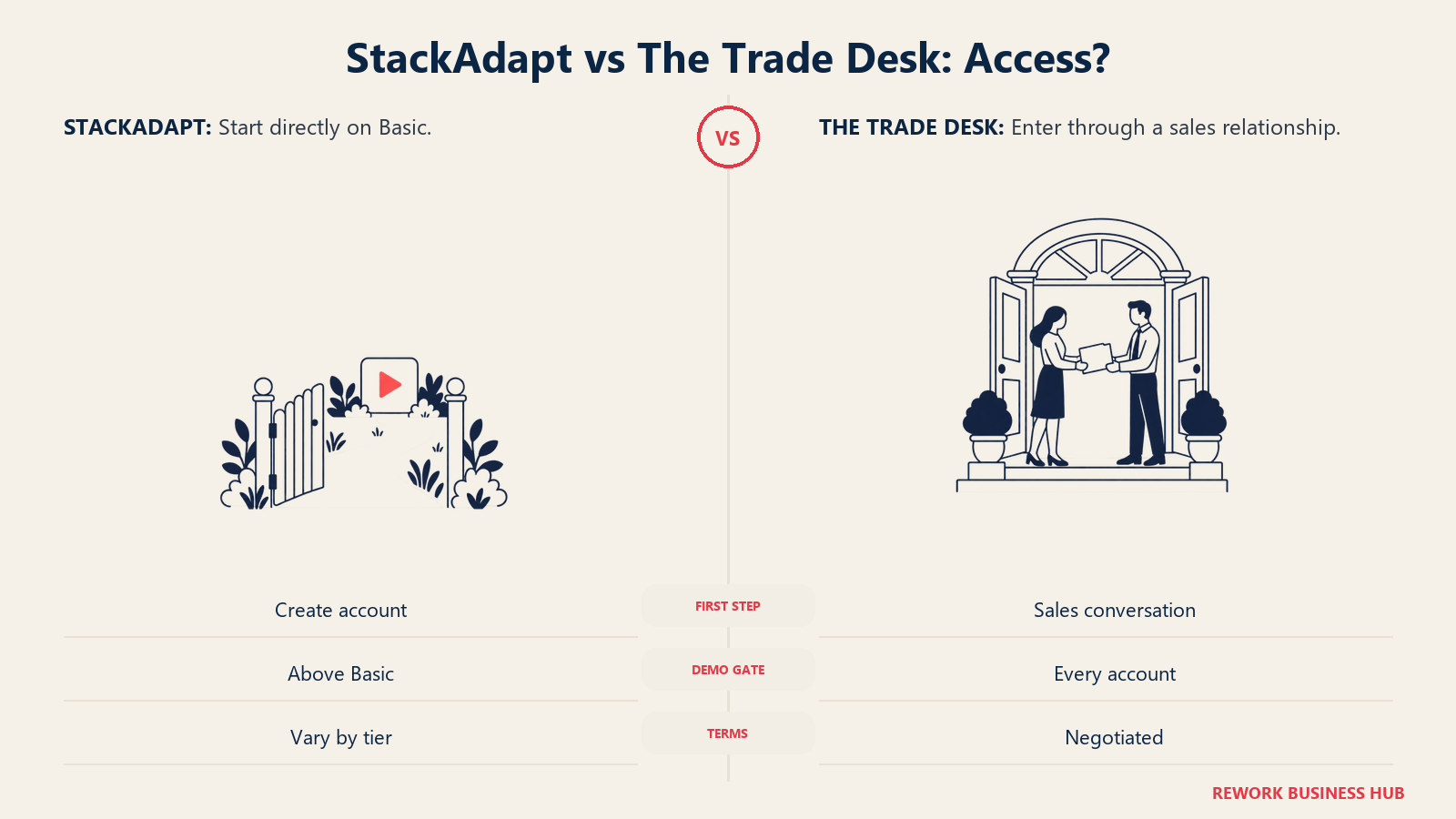
StackAdapt states on its pricing page that "most DSPs charge a percentage of media spend as a platform fee" and that at StackAdapt "there are no hidden tech fees." Read that phrasing carefully: it's a claim about fees that aren't disclosed upfront, not a claim that StackAdapt charges no platform fee at all. No dollar figures, percentages, or minimum spend appear anywhere on the public page for any of the five tiers. What is clear is the access split: Basic requires no demo and no sales call, while Grow, Scale, Accelerate, and Enterprise all route through a demo request, presumably in exchange for more managed support, dedicated strategist time, and custom contract terms as spend grows.
The Trade Desk publishes nothing comparable, and not because we chose not to look. thetradedesk.com refused every attempt to fetch it directly while researching this article, a pattern consistent with a platform that has never needed a public rate card because it doesn't sell to walk-in customers. A blocked page isn't the same as an absent price, so the honest statement is this: The Trade Desk publishes no public pricing, and there's no way to verify a rate card because there isn't one to find. Reported third-party figures for platform fees or minimum spend commitments circulate in industry commentary, but none of them are confirmed on The Trade Desk's own site, so none of them belong in a comparison that claims to quote what the vendor actually says.
| StackAdapt | The Trade Desk | |
|---|---|---|
| Entry path | Basic: create an account, load a budget, launch | Sales conversation, always |
| Demo required | Only above Basic (Grow, Scale, Accelerate, Enterprise) | Yes, for every account |
| Published minimum spend | None stated | None published |
| Contract terms | Net Terms on lower tiers, Custom Terms higher up, per the plans page | Negotiated per account |
| Who can start an account | Any marketer with a budget and a website | Someone with an existing agency relationship or a sales-qualified enterprise deal |
Trading Skill and Team Maturity
Buying programmatic inventory well takes more than clicking launch, and this is where the two platforms genuinely diverge on who they're built for, not just how you sign up.
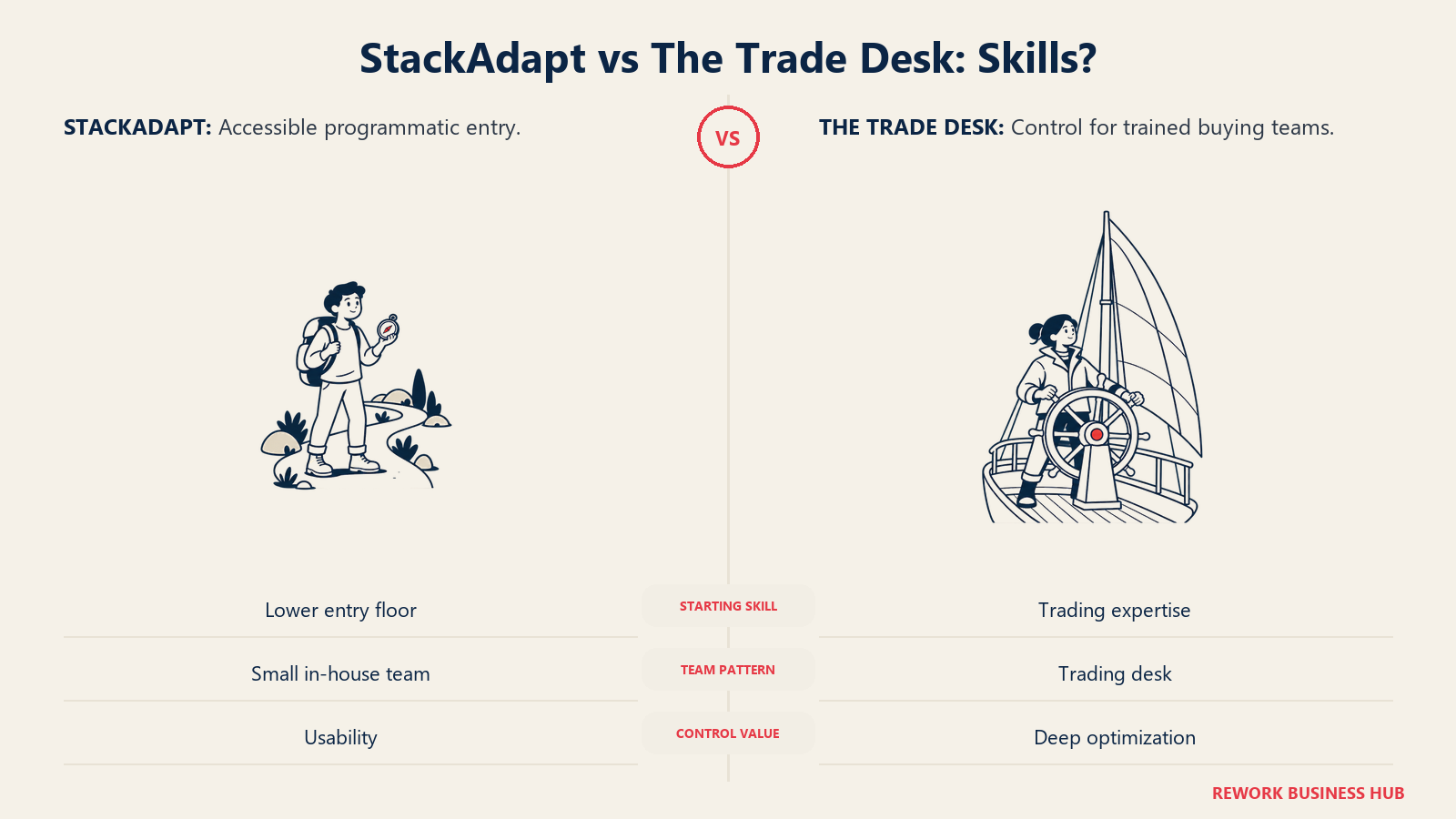
StackAdapt's Basic tier is designed to be a reasonable first programmatic buy for a marketer who has never run one: the interface, targeting options, and reporting are built to be usable without a dedicated trader on staff. That's a deliberate tradeoff. It lowers the skill floor to get started, and StackAdapt was named a Strong Performer in The Forrester Wave: Omnichannel Advertising Platforms, Q1 2026, scoring the highest possible marks specifically for self-serve capability, onboarding, and pricing transparency, the categories that matter most to a buyer without in-house trading experience.
The Trade Desk assumes the opposite starting point. Most large agency trading desks already have staff trained on the platform through The Trade Desk's own Edge Academy, which issues certifications like Programmatic Principles and Trading Essentials to planners, buyers, and traders. That existing bench of certified talent is a real advantage for an agency already staffed for it, and a real barrier for a team that isn't. Kokai, the platform's current buying interface, is built around deep control over bidding strategy, audience modeling, and supply-path decisions, tools that reward someone who already understands real-time bidding mechanics rather than someone learning them for the first time.
| Team profile | Better starting point | Why |
|---|---|---|
| Solo marketer or small in-house team, new to programmatic | StackAdapt Basic | Self-serve signup, no trading background assumed |
| Growth team without a dedicated programmatic hire | StackAdapt (Basic or Grow) | Managed support is available without an enterprise contract |
| Agency with staff already Edge Academy certified | The Trade Desk | Existing trained talent removes the ramp-up cost |
| Enterprise brand building an in-house trading desk | Either, depending on scale | Both offer enterprise tiers; the deciding factor is existing staff skill |
| Team optimizing Meta and Google spend, not buying new inventory | Neither; see Smartly vs Madgicx vs StackAdapt | That's a campaign-optimization question, a different job from DSP media buying |
Inventory, Channel Reach, and Connected TV
Both platforms buy across native, display, video, connected TV, and audio, so the surface-level channel list looks similar on paper. The real difference shows up in depth and strategic focus, especially on CTV, the fastest-growing part of both companies' businesses right now.
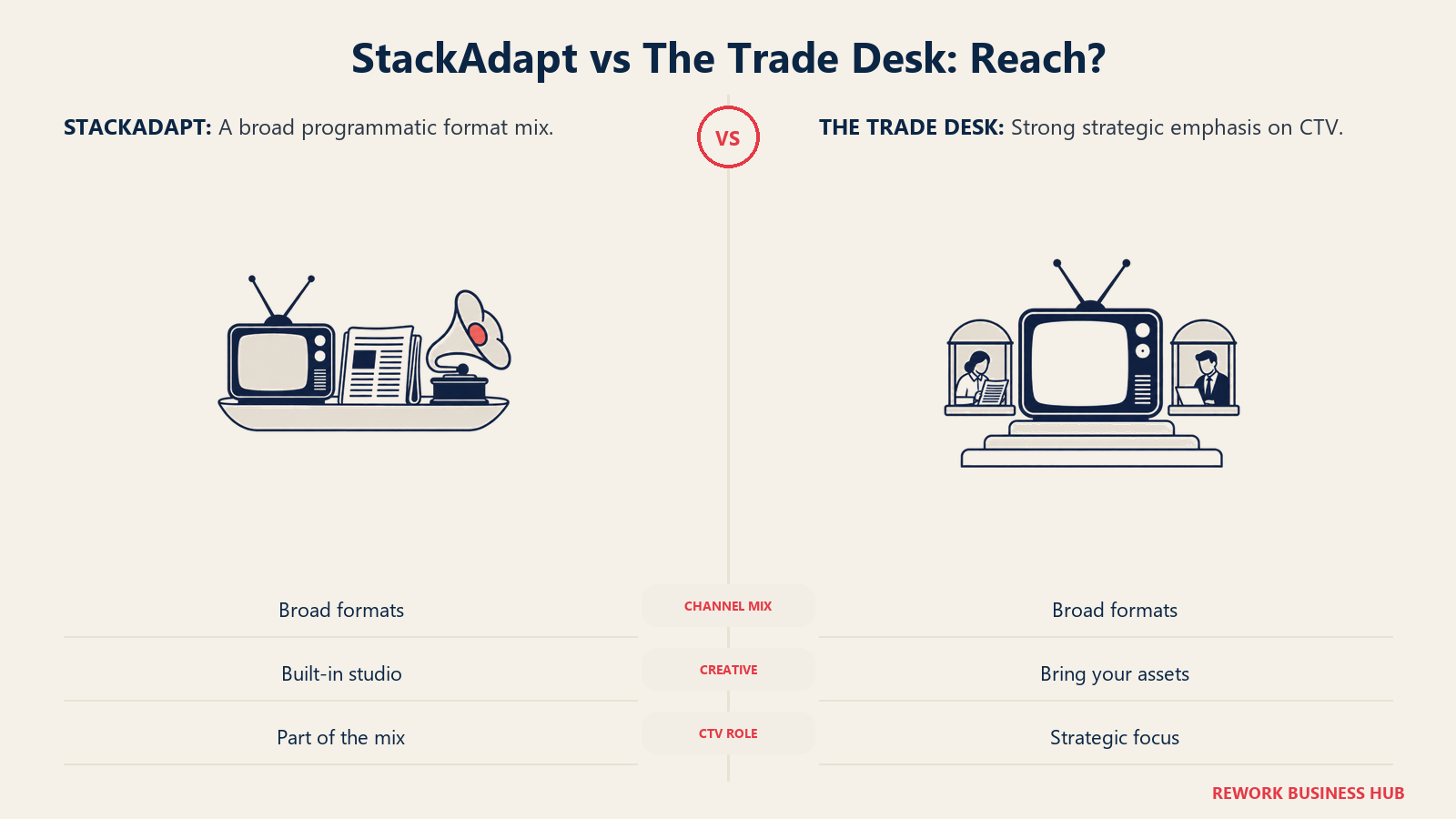
US CTV ad spending is projected to climb 14.5% in 2026 to $37.95 billion, per eMarketer, and both vendors are chasing that growth from different angles. StackAdapt treats CTV as one established format among several, alongside native, audio, and digital out-of-home, plus an in-house creative studio for building assets across formats. The Trade Desk has made CTV its central strategic bet: the Ventura ecosystem, a connected-TV operating system the company is building with device and platform partners including VIDAA and Nexxen, is meant to give The Trade Desk a foothold at the hardware and software layer of streaming TV, not just the ad-buying layer on top of it. That's a materially bigger swing than a feature addition, and it's the clearest sign of where The Trade Desk expects the next phase of programmatic growth to come from.
| StackAdapt | The Trade Desk | |
|---|---|---|
| Connected TV | Standard channel alongside native, video, audio | Strategic priority, via the Ventura CTV operating system |
| Native and display | Yes, a core format | Yes |
| Digital audio | Yes | Yes |
| Digital out-of-home | Yes | Limited compared to core formats |
| In-house creative tools | Yes, a built-in creative studio | Not a core focus; buyers typically bring their own creative |
| Where reach is deepest | A broad format mix for a single self-serve account | CTV and open-web inventory at agency and enterprise scale |
For context on how differently self-serve and sales-led DSPs can split even within retargeting specifically, AdRoll vs Criteo covers a similar access divide in a narrower corner of the same programmatic category.
Identity Infrastructure and Measurement
Cookies never went away in Chrome the way the industry expected. Google reversed its planned phase-out and retired the remaining Privacy Sandbox APIs in 2025 instead, so neither vendor is under the deadline pressure "cookieless" headlines implied for years. That hasn't stopped both companies from investing heavily in identity infrastructure anyway, because first-party and probabilistic identity still outperform cookie-based targeting for a meaningful share of inventory.
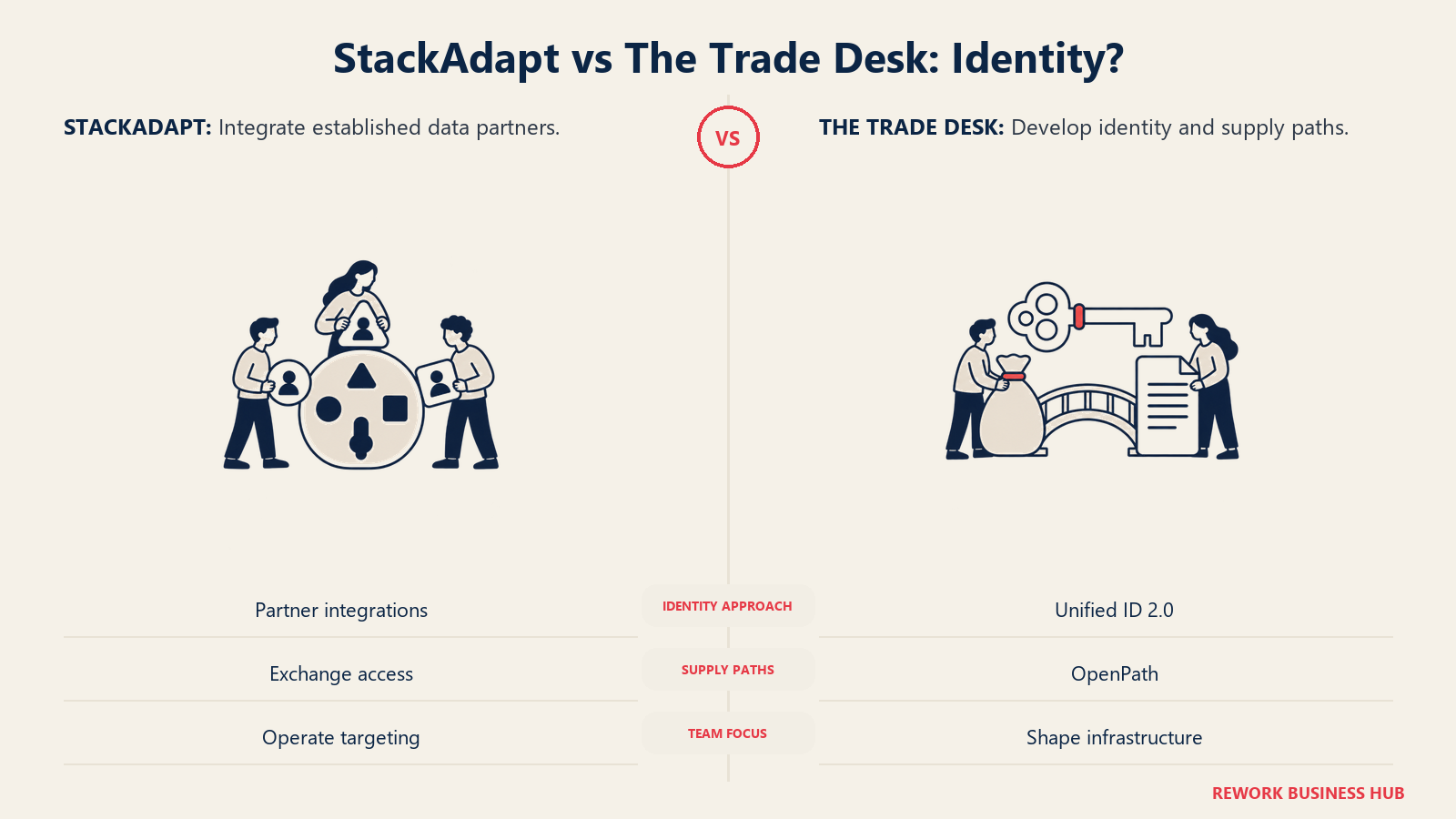
The Trade Desk built and continues to promote Unified ID 2.0, an open-source identity framework meant to be an industry-wide alternative to both cookies and closed walled-garden identifiers. It's paired with OpenPath, a supply-path tool that connects buyers more directly to publisher inventory, cutting out some of the intermediary layers that add cost and reduce transparency in a typical programmatic transaction. Together they're less a feature and more an attempt to set the identity standard the rest of the open internet builds around, a genuinely different level of ambition than a DSP feature checklist. StackAdapt doesn't run a comparable identity initiative of its own. It integrates with industry-standard identity partners and first-party data sources rather than building or promoting a proprietary framework, which is a reasonable choice for a platform focused on being easy to operate rather than setting infrastructure standards for the open web.
| StackAdapt | The Trade Desk | |
|---|---|---|
| Proprietary identity framework | No | Yes, Unified ID 2.0 |
| Supply-path tooling | Standard exchange integrations | OpenPath, direct publisher connections |
| Approach to cookie deprecation | Relies on standard industry identity partners | Built infrastructure meant to outlast the cookie debate either way |
| Best fit | A team that wants working targeting without managing identity strategy | A team that wants to influence, or at least track closely, where identity standards are heading |
Managed vs Self-Serve Support
Support is where the access-model story becomes an everyday operational reality rather than a signup-page detail.
StackAdapt's Basic tier leans on self-serve documentation and standard support channels, consistent with a product built for someone to run without a dedicated rep. The higher tiers, Grow through Enterprise, add progressively more account and strategist support as spend and complexity grow, so the support model scales with the plan rather than being all-or-nothing. That structure lets a team start lean and add support later instead of paying for an account team from day one.
The Trade Desk's support model doesn't really have a self-serve tier to compare against, because there isn't one. Every account, whether it belongs to an agency trading desk or an enterprise brand, is paired with account support as part of the sales relationship. That's a genuine advantage if the account is large enough to get real attention: a dedicated contact who knows the account's history beats a documentation search every time. It's also the reason The Trade Desk isn't a realistic option for a team that wants to test a small budget without first justifying a sales conversation.
| StackAdapt | The Trade Desk | |
|---|---|---|
| Support on entry tier | Self-serve documentation and standard channels | Not applicable; no entry tier exists without an account relationship |
| Support as spend grows | Increasing strategist and account support, tier by tier | Consistent account-team model regardless of scale |
| Best for a hands-off buyer | Less ideal on Basic; better once you're on a higher tier | A strong fit, provided the account already cleared a sales conversation |
| Best for a hands-on buyer who wants control | Basic tier, by design | Kokai still requires a trained operator even with account support present |
Contract, Transparency, and What Neither Vendor Will Tell You Upfront
Here's the part of this comparison that's easy to get backwards: neither platform is being unusually secretive. Both are simply consistent with how their category has always priced.
Programmatic advertising is on track to reach 90.0% penetration of worldwide display ad spending in 2026, per eMarketer, and a market that consolidated that fast consolidated around negotiated, not published, pricing almost everywhere except the smallest self-serve tiers. That consolidation has real casualties: Microsoft shut down its Invest DSP (formerly Xandr, formerly AppNexus) on February 28, 2026, telling clients the traditional DSP pricing model no longer fit its AI-driven advertising strategy, per PPC Land. That's one fewer DSP a buyer moving off StackAdapt's Basic tier, or negotiating with The Trade Desk, could have compared prices against, and it's a reminder that the number of vendors willing to publish a rate card at all keeps shrinking, not growing.
Within that context, StackAdapt's contract terms are genuinely lighter at the entry point: no minimum spend stated, Net Terms available on lower tiers, and a signup flow that doesn't require a commitment before you've seen results. The Trade Desk's contracts are negotiated per account, consistent with a platform that has never sold to a walk-in customer and doesn't need to compete on entry-level accessibility. Neither approach is dishonest. They're built for buyers at genuinely different stages, and the mistake is assuming either page will hand you a number the vendor hasn't decided to publish.
| StackAdapt | The Trade Desk | |
|---|---|---|
| Contract required to start | None on Basic | Yes, always |
| Rate card published | No | No |
| Verifiable from outside research | Yes, the pricing page loads and states its terms plainly | No; the site could not be fetched for independent verification |
| Where the honesty gap opens | Once you move past Basic into demo-gated tiers | From the very first conversation |
| What that means for a buyer | You can evaluate fit before committing to a sales process | Budget time for a sales cycle before you'll see a number at all |
When StackAdapt Is the Right Call
- You want to test programmatic buying today, on a modest budget, without a sales call or a signed contract.
- Your team doesn't have a dedicated programmatic trader and needs a platform built to be operated by a generalist marketer.
- You're diversifying beyond Meta and Google into native, CTV, audio, or DOOH, and want one dashboard covering all of them.
- You value seeing the terms of the deal, tiers, contract type, support level, before you commit any spend.
- You're an agency running client accounts at a range of budget sizes and want a platform whose entry tier fits your smallest clients too.
When The Trade Desk Is the Right Call
- Your agency or trading desk already has staff certified through Edge Academy and fluent in Kokai's bidding controls.
- You're running enterprise-scale spend where a dedicated account team, not self-serve documentation, is the support model you actually want.
- Connected TV is a strategic priority, not just another channel, and you want exposure to where The Trade Desk is placing its biggest bets through Ventura.
- You want influence over, or at least alignment with, identity infrastructure that's meant to outlast the cookie debate, via Unified ID 2.0 and OpenPath.
- You're prepared for a sales-led relationship and negotiated terms in exchange for the deepest supply-path and identity tooling in the category.
Decision Framework
| If you are... | Pick |
|---|---|
| Starting your first programmatic buy with no trading experience on staff | StackAdapt |
| Running an agency trading desk already staffed and certified on Kokai | The Trade Desk |
| Testing a modest budget and want to see terms before committing | StackAdapt |
| Making connected TV a strategic priority, not just a channel | The Trade Desk |
| Diversifying beyond Meta and Google without hiring a media buyer | StackAdapt |
| Managing enterprise-scale spend that justifies a dedicated account team | The Trade Desk |
| Still comparing the wider category before narrowing down | See our best ad management software roundup |
The verdict: if you can't yet justify a sales conversation, or you simply don't have anyone in-house who's traded programmatic before, StackAdapt's Basic tier is built to let you start today and learn as you go, with genuine channel breadth once you're ready to expand. If your team already has trading skill, especially staff trained through The Trade Desk's own certification program, and the budget to justify an account team, The Trade Desk's supply depth, CTV ambitions through Ventura, and identity infrastructure through Unified ID 2.0 are hard to replicate anywhere else. The two rarely compete for the same first dollar. They compete for the same budget only once a team has grown past the point where self-serve was ever going to be enough.
What to Do Next
Start by being honest about who would actually run the account day to day. If that's a generalist marketer without programmatic trading experience, sign up for StackAdapt's Basic tier and test a real budget before booking any demo. If that's an agency trading desk or an in-house team already fluent in real-time bidding, request a Trade Desk conversation and ask directly about minimum commitments and account-team structure before assuming a number you've seen elsewhere applies to your account.
Still narrowing down the wider category first? Best Ad Management Software in 2026 covers the full field, best StackAdapt alternatives is the landscape view if StackAdapt itself turns out to be the wrong shape, and best AdRoll alternatives, best Criteo alternatives, and best Madgicx alternatives cover the retargeting and Meta-optimization corners this article skips. If the real gap is campaign optimization on top of Meta and Google rather than new DSP inventory, Smartly vs Madgicx, best Smartly alternatives, and best Optmyzr alternatives are the more relevant comparisons.
Frequently Asked Questions about StackAdapt vs The Trade Desk
Is StackAdapt or The Trade Desk cheaper?
Neither publishes a rate card, so there's no honest dollar comparison to make. StackAdapt's Basic tier states no minimum spend and requires no sales call, which makes it accessible at a small budget even without a published price. The Trade Desk publishes nothing at all and requires a sales conversation for every account, so its cost only becomes clear once you're negotiating.
Does StackAdapt really have no minimum spend?
StackAdapt's own pricing page states no minimum spend for its self-serve Basic tier. It also says there are no hidden tech fees, which is a claim about undisclosed fees rather than a claim that StackAdapt charges no platform fee at all. Read both claims narrowly rather than assuming the platform is entirely free of cost beyond media spend.
Can I sign up for The Trade Desk without a sales call?
No. The Trade Desk has never offered a self-serve signup path. Every account starts through a sales conversation, whether that's an existing agency trading-desk relationship or a brand negotiating an enterprise deal directly.
What is Ventura, and why does The Trade Desk keep mentioning it?
Ventura is The Trade Desk's connected TV operating system, built with device and platform partners including VIDAA and Nexxen. It's a strategic bet on owning part of the CTV hardware and software layer, not just the ad-buying layer, and it's the clearest signal of where the company expects its next phase of growth to come from.
Do I need programmatic trading experience to use either platform?
Not for StackAdapt's Basic tier, which is built for a generalist marketer to operate without a dedicated trader. The Trade Desk assumes more trading skill going in; many agency staff are certified through its own Edge Academy program before they ever touch a live account.
Which platform has better connected TV reach?
They approach CTV differently rather than one simply having "more" of it. StackAdapt treats CTV as one established format among several in a broad self-serve dashboard. The Trade Desk has made CTV a central strategic priority through the Ventura ecosystem, aiming at deeper structural involvement in streaming TV than a feature addition would represent.

Principal Product Marketing Strategist
On this page
- TL;DR
- Who Each Platform Is Actually Built For
- The Access Model: Self-Serve Signup vs Sales-Led Onboarding
- Trading Skill and Team Maturity
- Inventory, Channel Reach, and Connected TV
- Identity Infrastructure and Measurement
- Managed vs Self-Serve Support
- Contract, Transparency, and What Neither Vendor Will Tell You Upfront
- When StackAdapt Is the Right Call
- When The Trade Desk Is the Right Call
- Decision Framework
- What to Do Next