Best Madgicx Alternatives in 2026: 12 Paid Social Automation Tools for Ecommerce Teams
Turn this article into takeaways for your work.


Each assistant summarizes the article only for you and suggests best practices for your work.
Updated August 2026
Birch (formerly Revealbot), Smartly, and Meta's own Advantage+ tools inside Ads Manager lead this list for ecommerce teams outgrowing Madgicx, alongside AdCreative.ai and Hunch if the real complaint is creative volume rather than campaign rules. This guide covers 12 alternatives split across three different jobs, automating paid social campaigns, generating ad creative, and running programmatic or retargeting media, plus two attribution platforms ecommerce teams often pair with whichever tool they pick. Pricing is checked against each vendor's own pricing page as of August 2026.
Madgicx earns its reputation honestly. One plan, Madgicx Pro Complete with AI, bundles rules-based campaign automation and AI creative tools that most competitors sell as two separate products, and Madgicx's own academy page puts the entry at $99 a month. But that single-plan simplicity cuts both ways: price climbs steeply as spend grows (to a reported $329 a month at $20,000 to $30,000 in monthly ad spend, with anything above that not published at all), the free trial is a short 7 days, and Tracking Pro, the attribution add-on, costs another $49 a month rather than coming bundled in. For the wider category, see Best Ad Management Software in 2026.
Key Facts
- Social networks will claim 27.7% of US ad spending in 2026, even though they account for just 12.5% of the time people actually spend with media, a gap that keeps ecommerce ad budgets concentrated on Meta and Instagram. (eMarketer)
- Over 8 million advertisers were using at least one of Meta's AI ad creative tools by Q1 2026, up from 4 million at the end of 2024, roughly doubling in about four months, per Meta's own earnings disclosures. (PPC Land)
- In a large-scale Meta test, advertisers who used its AI video-generation ad tool saw a 3% lift in conversion rate over those who didn't, a Meta-reported figure worth reading as a vendor benchmark rather than independent research. (PPC Land)
- The global AdTech market is projected to reach $1.58 trillion by 2030, growing at a 14.4% compound annual rate, a sign of how much software competition is chasing the same ad automation budget Madgicx competes for. (Grand View Research, via PR Newswire)
- A Forrester Total Economic Impact study commissioned by Superside found a composite AI-powered creative production customer achieved a 94% return on investment over three years with payback in under six months, a vendor-commissioned study worth reading alongside independent data. (Forrester TEI)
Quick Comparison Table
Starting prices below pair the dollar figure with the ad-spend band it applies to wherever the vendor prices that way, since a bare number means little without it. "Reported" marks a figure that isn't on the vendor's own pricing page.
| Tool | Group | Best For | Starting Price (spend band) | Key Strength | Key Limitation |
|---|---|---|---|---|---|
| Birch (formerly Revealbot) | Paid social automation | Cross-platform rules-based bidding | $49/mo Essential, up to $10K spend ($45/mo annual) | Automation rules across Meta, Google, Snapchat, TikTok | No built-in AI creative generation |
| AdEspresso by Hootsuite | Paid social automation | Simple Meta/Instagram ad creation | $49/mo Starter, up to $1,000/mo spend | Low entry price, easy A/B testing | Facebook and Instagram only, no Google Ads |
| Smartly | Paid social automation + creative | Enterprise DTC brands at scale | Platform fee roughly 2-4% of managed spend, $4,000-$5,000/mo minimum (reported) | Cross-channel creative automation at real scale | Minimum fees price out sub-six-figure spenders |
| AdCreative.ai | Creative generation | AI-generated ad creative at volume | $39/mo Starter, 10 credits, 1 brand | Fast AI creative and banner generation | Doesn't manage or launch campaigns itself |
| Hunch | Creative generation and testing | Automated creative variant testing | Demo only, no published price | Data-feed-driven dynamic creative testing | No transparent self-serve pricing |
| Meta Ads Manager with Advantage+ | Paid social, native | The free baseline every Meta advertiser has | Free (media spend separate) | Meta's own AI targeting and creative tools | Meta-only, no cross-platform dashboard |
| Optmyzr | PPC/search, plus Meta and LinkedIn | PPC-first teams adding social | $299/mo Essentials, up to $25K spend ($209/mo annual) | Rules engine built for search, extends to social | Meta/LinkedIn tools are a bolt-on, not the core product |
| Adzooma | PPC/search, plus basic social | Budget-conscious small ecommerce | Free tier; Silver $69/mo | Free tier plus low-cost paid tiers | Lighter automation depth than Madgicx at scale |
| Triple Whale | Attribution and analytics | Unified ecommerce analytics layer | Free plan; Foundation from $219/mo (reported) | Broad ecommerce data hub, GMV-based pricing | Doesn't run or optimize campaigns |
| Northbeam | Attribution and analytics | Deterministic multi-touch attribution | $1,500/mo Starter, under $1.5M annual spend | Detailed touchpoint-level attribution | Highest entry price on this list |
| AdRoll | Programmatic/retargeting DSP | Retargeting and prospecting display | Pay-as-you-go CPM, no platform fee | No minimum spend commitment | Not a paid-social creative/automation tool |
| StackAdapt | Programmatic DSP | Display, native, CTV, audio reach | Negotiated % of media spend, no published rate | Broadest programmatic inventory mix | No self-serve pricing transparency |
Ad Management Is Three Different Jobs, Plus a Measurement Layer
"Ad management software" search results mix three genuinely different products, and shopping for a Madgicx alternative without separating them is how a team ends up buying the wrong tool. PPC and search campaign management, Google Ads and Microsoft Ads bid and budget automation, is one job. Paid social creative and automation, the group Madgicx itself competes in, is a second: generating or testing ad creative, and automating budgets, bids, and audiences across Meta, TikTok, and Snapchat. Programmatic and retargeting DSPs, buying display, native, and connected TV inventory across the open web, are a third.
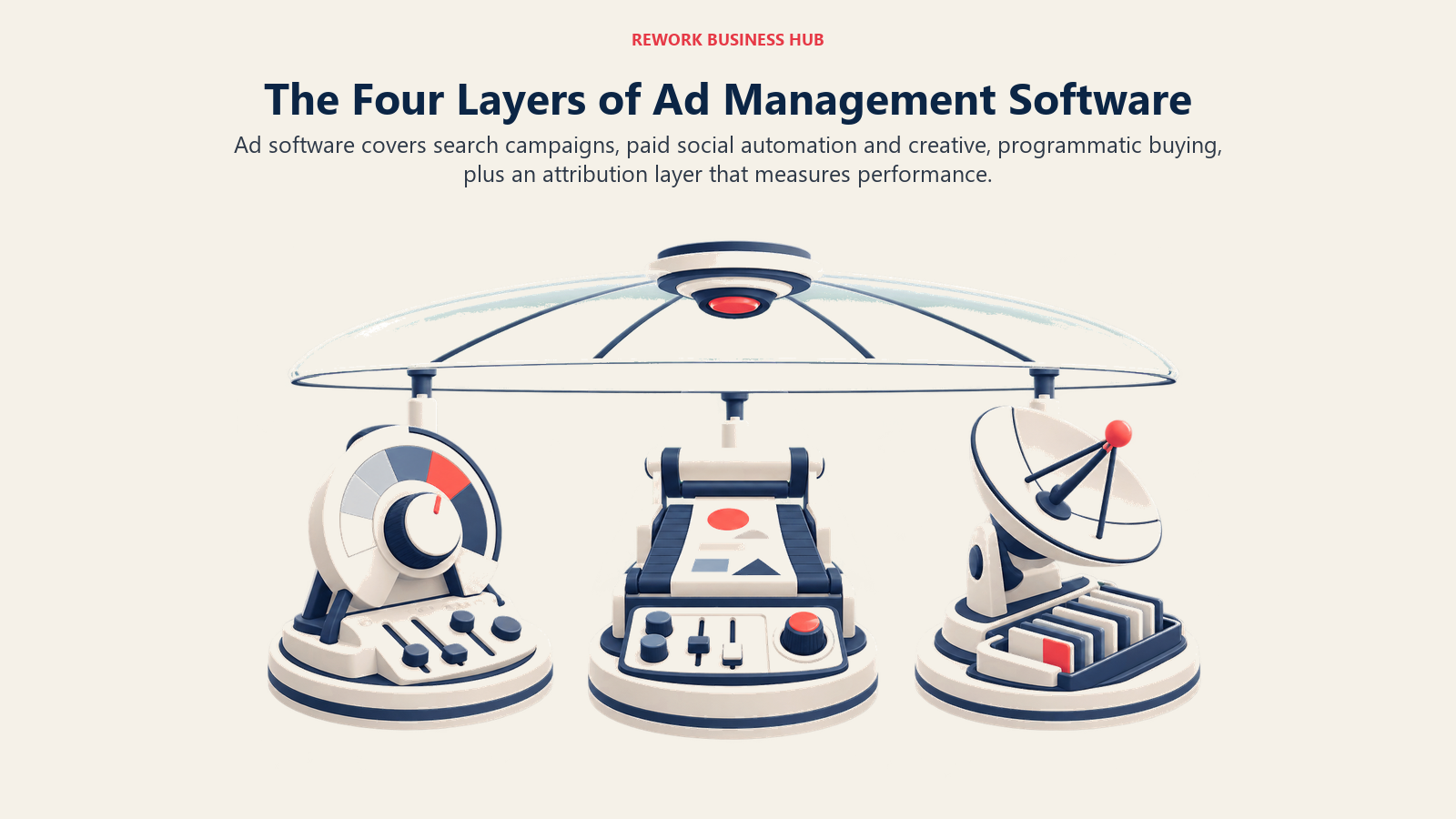
Madgicx bundles campaign automation and creative generation into one plan. Most of the tools below do only one of those two jobs, which is worth knowing before comparing a $99-a-month Madgicx plan against a $39-a-month creative-only tool that never touches your campaigns at all.
Two more tools here, Triple Whale and Northbeam, don't fit any of the three groups above. They're attribution and analytics platforms: they measure what a campaign tool like Madgicx, Meta Ads Manager, or Birch is actually doing, rather than running or generating ads themselves. Ecommerce teams often run one of them alongside whichever campaign tool they pick, feeding decisions back into it. For more on how teams reconcile channel-level numbers like these, see attribution models both marketing and sales trust.
| Tool | Group | Automates Campaigns | Generates Creative |
|---|---|---|---|
| Madgicx (for reference) | Paid social automation + creative | Yes | Yes |
| Birch (formerly Revealbot) | Paid social automation | Yes | No |
| AdEspresso by Hootsuite | Paid social automation | Yes (Meta/Instagram only) | No |
| Smartly | Paid social automation + creative | Yes | Yes |
| AdCreative.ai | Creative generation | No | Yes |
| Hunch | Creative generation and testing | No | Yes |
| Meta Ads Manager with Advantage+ | Paid social, native | Yes | Yes (Meta's own tools) |
| Optmyzr | PPC/search, plus Meta and LinkedIn | Yes | No |
| Adzooma | PPC/search, plus basic social | Yes | No |
| Triple Whale | Attribution and analytics | No | No |
| Northbeam | Attribution and analytics | No | No |
| AdRoll | Programmatic/retargeting DSP | Yes | Limited (dynamic retargeting creative) |
| StackAdapt | Programmatic DSP | Yes | No |
1. Birch (formerly Revealbot): Rules-Based Automation Across Four Platforms
Birch is the direct swap for a team that likes Madgicx's automation engine but wants it running across more than Meta. It's the same brand as Revealbot: revealbot.com now redirects to bir.ch, and the pricing page itself reads "Birch (Revealbot)." The product is rules-based, not AI-first: you write conditions ("pause any ad set with CPA over $40 after 500 impressions") and Birch executes them across Meta, Google, Snapchat, and TikTok in one place, a wider platform footprint than Madgicx, which is Meta-focused. What it doesn't do is generate creative. If AI-written ad copy or auto-generated banners are part of why you use Madgicx, Birch won't replace that half of the job.
Team size fit: 1-10 on Essential, 10-50 scaling into 50-200 on Pro and Enterprise as ad spend and account count grow.
| What you get | What you don't |
|---|---|
| Rules-based automation across Meta, Google, Snapchat, TikTok | AI creative generation of any kind |
| A 14-day free trial, no card required | Madgicx's single bundled plan simplicity |
| Annual billing at 12 months for the price of 10 | Essential tier once spend passes $150K/month |
| No overage fees on annual billing | Overage protection on monthly billing |
Pricing: Priced by monthly ad spend. Essential: $49/mo at up to $10K spend, $149/mo at up to $30K, $299/mo at up to $75K, $499/mo at up to $150K (annual saves roughly 8-9%, billed as 12 months for the price of 10). Essential tops out at $150K spend; above that only Pro is sold: $99 to $1,799/mo across the same spend bands, up to $500K. Enterprise custom above $500K. 14-day trial, no card required. Best for: Ecommerce teams wanting cross-platform rules-based bid and budget automation without paying for a creative generator they won't use. Not ideal for: Teams that specifically want AI-generated creative bundled with automation, that's Madgicx's and Smartly's pitch, not Birch's.
2. AdEspresso by Hootsuite: The Low-Cost Meta-Only Entry Point
AdEspresso is thinner than it once was, not dead. It's still sold and still priced, built specifically for Facebook and Instagram ad creation, split testing, and reporting, with a genuinely low entry price and a straightforward interface that a small team can pick up in an afternoon. What's fair to say is that the pricing page lists Facebook and Instagram only (no Google Ads) and the product has seen limited visible development lately, not that Hootsuite quietly killed it. For the broader Hootsuite ecosystem, see Best Hootsuite Alternatives, and for social scheduling more generally, Best Social Media Management Software.
Team size fit: 1-10, scaling to 10-50 on Plus and Enterprise as spend and seats grow.
| What you get | What you don't |
|---|---|
| Low entry price, $49/month | Google Ads support of any kind |
| Unlimited ad accounts, even on Starter | Madgicx's AI-driven optimization depth |
| 14-day free trial on every plan | Recent, visible product development |
| Up to 15 seats and white label on Plus | Multi-channel automation past Meta |
Pricing: Starter $49/mo, capped at $1,000/mo ad spend, unlimited ad accounts. Plus $99/mo, unlimited spend, up to 15 seats, white label, campaign approval. Enterprise from $259/mo, unlimited seats, API access, Salesforce contact sync. 14-day trial on every tier. Best for: Small ecommerce teams wanting simple Meta and Instagram ad creation and split testing at a low entry price. Not ideal for: Multi-channel advertisers, since Google Ads isn't supported, or anyone wanting Madgicx-level AI optimization.
3. Smartly: The Only Other Bundle at Enterprise Scale
Smartly is the closest thing to a like-for-like Madgicx swap on the feature side, cross-channel campaign automation plus creative automation in one platform, just built for a completely different budget tier. It covers Meta, Google, TikTok, Snapchat, and Pinterest from one dashboard, with dynamic creative generation baked in rather than bolted on. Smartly publishes no pricing page and no self-serve signup at all; every figure below comes from third-party sources, since the vendor won't confirm dollar amounts directly. G2's pricing data shows no free tier and no free trial, and third-party analyses put the platform fee at roughly 2% to 4% of managed ad spend with a minimum monthly fee in the $4,000 to $5,000 range.
Team size fit: 50-200, effectively enterprise and large-agency only given the reported minimum fees.
| What you get | What you don't |
|---|---|
| Cross-channel campaign automation and creative in one tool | A free trial or self-serve signup |
| Dynamic creative automation across five ad platforms | Any figure Smartly will confirm directly |
| The only other bundle on this list matching Madgicx's job | A price point anyone under six figures can use |
| A median reported annual contract around $90,000 | Transparent, published tiers |
Pricing: No published pricing. Reported (G2, third-party pricing analyses): no free tier or trial, platform fee approximately 2-4% of managed ad spend with a $4,000-$5,000/mo minimum, median annual contract around $90,000. Best for: Large ecommerce and DTC brands or agencies spending well into six or seven figures monthly that want the same automation-plus-creative bundle Madgicx offers, at enterprise depth. Not ideal for: Small or mid-size advertisers. Smartly's minimum fees price out anyone spending under roughly $100K a month.
Because Smartly is the step most teams weigh when they outgrow Madgicx, it gets its own treatment: Smartly.io vs Madgicx runs the two side by side, and best Smartly.io alternatives covers what to do if Smartly turns out to be too big a jump.
4. AdCreative.ai: Volume AI Creative, No Campaign Management
AdCreative.ai does one half of Madgicx's job and does it fast: feed it a brand and a product, and it generates ad creative variations, banners, and copy at a pace no human design team matches. What it doesn't do is launch or manage a single campaign; you still need Meta Ads Manager, Birch, or another tool to actually run the ads it generates. The site runs near-continuous promotional discounts on longer terms, worth flagging since the regular monthly rate and the promotional annual rate can look like two different products if you don't read closely. For a wider view of this category, see Best AI Ad Creative Tools.
Team size fit: 1-10 on Starter and Professional, 10-50 on Ultimate, Enterprise scaling further.
| What you get | What you don't |
|---|---|
| Fast AI-generated ad creative and banners at volume | Any campaign management or launch capability |
| A 7-day free trial | A flat, promo-free price (discounts run near-continuously) |
| Multi-brand support starting on Professional | Bidding, budget, or audience automation |
| Custom credit volumes on Enterprise | A tool that replaces Madgicx outright on its own |
Pricing: Starter $39/mo (10 credits, 1 brand); Professional $249/mo (50 credits, 10 brands); Ultimate $999/mo (100 credits, 25 brands); Enterprise custom. The live promotion as of August 2026 puts the same tiers at roughly $20/$125/$500 per month billed yearly, or $29/$185/$749 billed quarterly, so confirm which rate is quoted before budgeting. 7-day trial. Best for: Teams wanting AI-generated ad creative at volume, paired with a separate tool that actually runs the campaigns. Not ideal for: Teams wanting one tool that both builds and manages campaigns; that bundled pitch belongs to Madgicx and Smartly, not AdCreative.ai.
5. Hunch: Dynamic Creative Testing Off Your Product Feed
Hunch's angle is automated creative variation driven by your own data feed: product images, prices, and availability flow in, and Hunch assembles and tests creative combinations against them, useful for ecommerce catalogs with hundreds of SKUs where hand-building ad variants doesn't scale. It's a creative and testing tool, not a bidding or budget-automation tool, so it pairs with whatever platform actually buys the media. Hunch publishes no pricing anywhere; every path on its site leads to a demo request, which is the single biggest practical difference from Madgicx's transparent, on-page rate card.
Team size fit: 10-50 for most direct-to-consumer brands, extending to 50-200 for larger catalogs and agencies.
| What you get | What you don't |
|---|---|
| Automated creative testing driven by your product feed | Any published pricing to budget against upfront |
| Built for large, frequently changing SKU catalogs | Campaign bidding or budget automation |
| A dedicated fit for ecommerce catalog advertising | A self-serve signup; every path leads to a demo |
| Dynamic creative assembly at scale | Madgicx's one-plan simplicity |
Pricing: No published pricing. Demo request only. Best for: Ecommerce brands with large, fast-changing product catalogs wanting automated creative variant generation and testing. Not ideal for: Teams wanting transparent self-serve pricing without a sales conversation first.
6. Meta Ads Manager with Advantage+: The Free Layer Underneath Everything Else
Every tool on this list, including Madgicx, ultimately runs on Meta Ads Manager. The honest question isn't whether to use it, you already do, it's whether you need a third-party layer on top of it. Meta's own Advantage+ automation has closed a real amount of ground: adoption of Advantage+ shopping campaigns has grown fast as Meta made it the default flow for new campaigns, and Meta's generative AI ad tools now count well over 8 million advertisers, so a smaller ecommerce store running a handful of campaigns may find the native tools genuinely sufficient without Madgicx or a competitor on top. For background on running Meta and Instagram campaigns well, see Facebook and Instagram Ads.
Team size fit: every size, from a 1-person store to a 200-plus person enterprise team, since it's the mandatory underlying platform either way.
| What you get | What you don't |
|---|---|
| Free, first-party, built into every Meta ad account | Cross-platform management (Google, TikTok, Snap) |
| Meta's own AI targeting and creative generation tools | Rules-based automation logic you fully control |
| No separate subscription or contract | Multi-account or agency-grade reporting |
| Direct access to every new feature on day one | A single dashboard if you also run other channels |
Pricing: Free. Included with any Meta ad account; media spend is separate and billed by Meta directly. Best for: Any ecommerce advertiser as the baseline layer, and a real option on its own for smaller stores running only Meta and Instagram campaigns. Not ideal for: Teams managing multiple channels who need one dashboard, or agencies needing rules-based automation and reporting across many client accounts.
7. Optmyzr: A PPC Rules Engine That Also Covers Meta and LinkedIn
Optmyzr's core identity is Google Ads and Microsoft Ads management; its Meta and LinkedIn tools are an extension of that same rules engine rather than a ground-up paid-social product. For a team whose primary spend is still search, that's an advantage: one automation platform, one reporting layer, one login, covering PPC and the social channels that support it. For a team whose primary spend is paid social, the reverse is true, Optmyzr's social tools are the add-on, not the specialty, and won't match Madgicx's depth there. See Best Optmyzr Alternatives if PPC automation itself, not the social add-on, is the actual shopping trigger.
Team size fit: 10-50 on Essentials, 50-200 on Premium and Enterprise as spend and account count scale.
| What you get | What you don't |
|---|---|
| One rules engine spanning search and social | Madgicx-level depth specifically in paid social |
| Meta and LinkedIn tools included on both paid plans | A social-first feature roadmap |
| A 14-day free trial, no card required | A budget entry point for social-only advertisers |
| Setup services and Enterprise SSO available | Google-only or Meta-only simplicity |
Pricing: Priced by monthly ad spend. Essentials $299/mo at up to $25K spend ($209/mo billed annually); Premium $389/mo at the same band ($272/mo annually). Rates rise with spend through $959/mo (Essentials) and $899/mo (Premium) at up to $500K, with custom Enterprise pricing above that. Meta and LinkedIn tools included on both paid tiers. 14-day trial, no card required. Best for: PPC-first teams wanting their Meta and LinkedIn spend folded into the same rules engine and reporting they already use for search. Not ideal for: Ecommerce brands whose primary channel is paid social; Optmyzr's social tools are a bolt-on, not the deep, social-specific feature set Madgicx offers.
8. Adzooma: A Free Tier, Then a Low-Cost Path Up
Adzooma's whole pitch is accessibility: a free tier that connects unlimited ad accounts across Google, Microsoft, and Facebook Ads, then two low-cost paid tiers for teams wanting more frequent reports and more optimization opportunities surfaced. It's worth naming the persistent myth directly: search results still claim Adzooma went "free for all," and that's not accurate, the free tier is real and useful, but Silver and Gold are still paid, published tiers, not a marketing gimmick that quietly disappeared.
Team size fit: 1-10, a fit for solo operators and very small ecommerce teams specifically.
| What you get | What you don't |
|---|---|
| A genuinely useful free tier, unlimited ad accounts | Madgicx's depth of automation at any tier |
| Silver and Gold at $69 and $179/month | AI creative generation |
| 20% savings on annual billing | A fit for spend much past small-business scale |
| SEO and PPC opportunities surfaced automatically | Dedicated ecommerce-specific features |
Pricing: Free: 1 user, monthly reports, limited opportunities, 1 SEO profile, 3 PPC alerts. Silver $69/mo ($700/yr): unlimited users, weekly reports, 5 SEO profiles, 10 alerts. Gold $179/mo ($1,800/yr): daily reports, unlimited profiles and alerts. Enterprise custom. Annual billing saves 20%. Best for: Small ecommerce businesses or freelancers wanting free or low-cost automated optimization suggestions without Madgicx's AI-heavy, spend-scaled pricing. Not ideal for: Teams wanting deep AI creative generation or the automation depth Madgicx and Smartly offer at higher ad spend.
9. Triple Whale: The Ecommerce Data Hub, Not a Campaign Tool
Triple Whale doesn't run or optimize a single campaign. It's an analytics and attribution layer that pulls ad, store, and customer data into one dashboard so a team can see what's actually driving revenue before deciding where to push spend, a job Madgicx only partly covers with its own attribution view. Pricing scales with your store's GMV rather than a flat number, and the vendor's own pricing page blocks automated retrieval, so the figures below are cross-checked third-party estimates rather than a direct vendor quote.
Team size fit: 1-10 on Free and Foundation, 10-50 on Automate as GMV and data needs grow.
| What you get | What you don't |
|---|---|
| A free plan: 10 users, 12 months of data retention | Any campaign management or bid automation |
| GMV-based pricing that starts low for small stores | A confirmed vendor price (page blocks automated fetch) |
| Compass on Enterprise: MTA, MMM, and incrementality in one | A flat price; cost scales with revenue, not just seats |
| A 12-month subscription with two months free annually | Transparency at higher GMV tiers without a quote |
Pricing: Free plan: 10 users, 12 months data retention, real-time refresh, basic reporting. Paid tiers scale by GMV; at the lowest band (reported, cross-checked across usermaven.com and wetracked.io), Foundation starts at $219/mo and Automate at $749/mo, rising at higher GMV bands. Enterprise (Compass suite: MTA, MMM, incrementality) is custom. Add-ons: Retention $19/mo, Conversion $79/mo. Annual billing includes two free months. Best for: Ecommerce brands wanting a unified analytics and attribution layer feeding decisions back into whichever tool actually runs the ads, Madgicx, Meta Ads Manager, or Birch. See Best Business Intelligence Tools for the wider analytics category. Not ideal for: Teams looking for a tool that manages or optimizes campaigns directly; Triple Whale measures, it doesn't buy media.
10. Northbeam: Deterministic Attribution for Bigger Spenders
Northbeam is the more expensive, more precise sibling to Triple Whale's analytics layer, built around deterministic, multi-touch attribution rather than modeled estimates, with pricing that's confirmed directly on Northbeam's own site rather than reported through third parties. It's aimed squarely at brands spending enough that a wrong attribution read costs real money: the entry tier alone starts at $1,500 a month, well above anything else in this roster, and pricing is usage-based on top of that, calculated by data volume. For how ecommerce teams reconcile channel numbers like these across functions, see attribution models both marketing and sales trust; Northbeam's multi-platform view also extends to channels like Amazon Advertising alongside Meta and Google.
Team size fit: 50-200 on Professional, 200-plus on Enterprise, with a lower Starter tier for smaller Shopify brands under $1.5M in annual ad spend.
| What you get | What you don't |
|---|---|
| Deterministic, touchpoint-level multi-touch attribution | Any campaign management or ad-buying function |
| Vendor-confirmed pricing, not third-party estimates | An entry price under four figures a month |
| A dedicated Media Strategist on Professional and up | Month-to-month billing above the Starter tier |
| Up to $200K in ad credits at the Enterprise tier | A fit for brands spending under roughly $1.5M/year |
Pricing: Starter $1,500/mo, for brands under $1.5M in annual ad spend, month-to-month for Shopify brands. Professional $3,500/mo, for spend up to $500K/month, annual term, unlimited users and integrations. Enterprise custom, for spend over $500K/month. Growth (agency-partner tier for seven-figure brands under $200K/month) is quote-only. On top of the tier price, Northbeam also bills by data volume (pageviews). Best for: Larger ecommerce brands wanting deterministic attribution precise enough to validate what a tool like Madgicx is actually crediting to itself. Not ideal for: Small teams; the entry price starts well above any campaign or creative tool in this roster.
11. AdRoll: Retargeting Without a Platform Fee
AdRoll solves a different problem than Madgicx entirely: instead of optimizing campaigns you're already running on Meta, it re-engages shoppers who left your site without buying, across display, native ads, and email, using its own dynamic CPM pricing rather than a subscription. There's no platform fee and no minimum spend commitment on the self-serve Ads product, just a small minimum daily spend to launch, which makes it one of the few tools here with essentially no barrier to trying. See Best AdRoll Alternatives for a deeper look at the retargeting and programmatic category, and retargeting and remarketing for the strategy behind it.
Team size fit: 1-10 on self-serve, 10-50 and up once managed services and the Advanced Package (annual commitment) enter the picture.
| What you get | What you don't |
|---|---|
| No platform fee, no minimum spend commitment | Any paid-social creative or campaign automation |
| Pay-as-you-go dynamic CPM pricing | A subscription price to compare against Madgicx directly |
| A minimum daily spend as low as $5 to launch | Meta/Instagram-specific optimization tools |
| Managed services and an ABM product for larger teams | Transparency on managed-service pricing without a quote |
Pricing: No subscription price. Self-serve Ads runs on dynamic CPM with no platform fee and no minimum spend commitment; minimum daily spend of $5 and minimum daily budget of $10 to launch a campaign. Managed services are tied to monthly spend, starting in the $5,000-$10,000/month band; the Advanced Package requires an annual commitment. AdRoll ABM is quoted separately, media cost only. Best for: Ecommerce brands wanting retargeting and prospecting display across the open web and email, a different channel than Madgicx's Meta-first focus. Not ideal for: Teams whose whole budget lives in paid social; AdRoll is a display and retargeting layer, not a Meta or Instagram optimization tool.
12. StackAdapt: Programmatic Reach Beyond Social
StackAdapt is the widest-reach option on this list and the least like Madgicx: a full programmatic DSP spanning display, native, connected TV, digital audio, and in-game inventory, for teams that have concluded paid social alone can't reach every customer they want. It publishes no pricing at all, negotiating fees as a percentage of media spend directly with each advertiser, so there's nothing to quote here beyond that structure.
Team size fit: 10-50 for smaller programmatic buys, 200-plus for brands running significant CTV or cross-channel programmatic budgets.
| What you get | What you don't |
|---|---|
| The broadest inventory mix here: display, native, CTV, audio | Any published pricing or self-serve rate card |
| Fees negotiated as a percentage of media spend | Meta or Instagram-specific automation |
| A genuine option beyond social-only reach | A quick, no-conversation way to start spending |
| Access to inventory Madgicx and other social tools can't reach | Transparency before a sales conversation |
Pricing: No published pricing. Fees are negotiated as a percentage of media spend; the site offers Request a Demo or Sign Up only, with no dollar figures shown. Best for: Ecommerce brands wanting programmatic display, native, CTV, or audio reach beyond what Meta, Google, and social platforms alone can deliver. Not ideal for: Teams whose actual need is Meta and Instagram campaign automation, that's Madgicx's core job, not StackAdapt's.
Stage-Fit Matrix
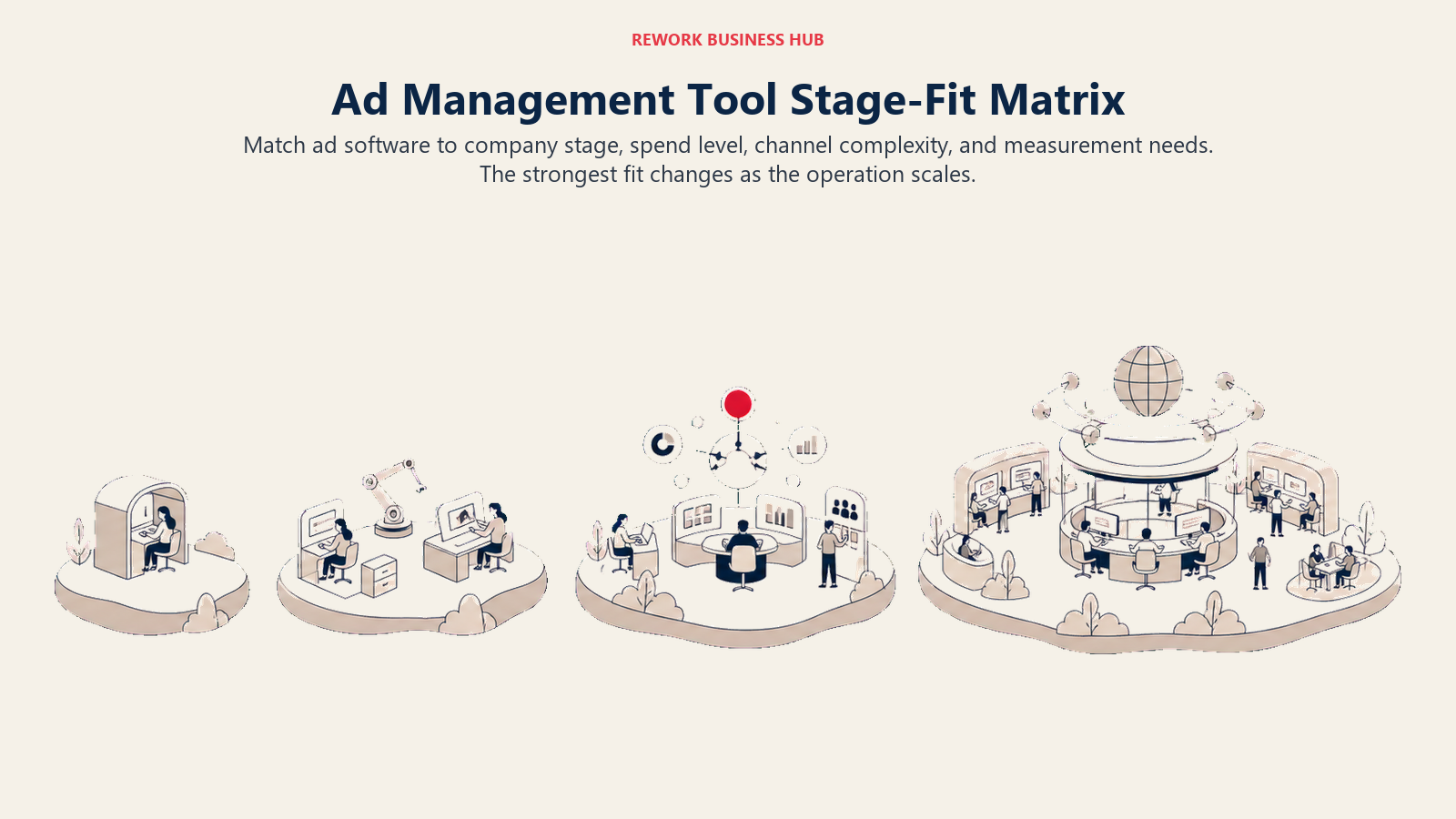
A useful shortlist changes with company stage because budget, channel complexity, and measurement needs rise at different rates.
| Tool | Startup / Bootstrapped | Growing SMB | Mid-Market | Enterprise |
|---|---|---|---|---|
| Birch (formerly Revealbot) | Workable | Good fit | Good fit | Workable |
| AdEspresso by Hootsuite | Good fit | Good fit | Workable | Not ideal |
| Smartly | Not ideal | Not ideal | Workable | Good fit |
| AdCreative.ai | Good fit | Good fit | Workable | Workable |
| Hunch | Not ideal | Workable | Good fit | Good fit |
| Meta Ads Manager with Advantage+ | Good fit | Good fit | Good fit | Workable |
| Optmyzr | Workable | Good fit | Good fit | Workable |
| Adzooma | Good fit | Good fit | Not ideal | Not ideal |
| Triple Whale | Good fit | Good fit | Workable | Not ideal |
| Northbeam | Not ideal | Workable | Good fit | Good fit |
| AdRoll | Good fit | Good fit | Workable | Workable |
| StackAdapt | Not ideal | Workable | Good fit | Good fit |
Sizing and Persona Table
| Tool | Team Size Sweet Spot | Primary Persona | Spend-Band Pricing |
|---|---|---|---|
| Birch (formerly Revealbot) | 10-50 | Performance marketer running rules-based automation | Yes |
| AdEspresso by Hootsuite | 1-10 | Small ecommerce owner or solo marketer | No (flat plus spend cap) |
| Smartly | 50-200 | Enterprise DTC growth or media team | No (percentage of spend) |
| AdCreative.ai | 1-10 | Marketer needing creative volume, not campaign control | No (credit-based) |
| Hunch | 10-50 | Ecommerce brand with a large product catalog | No (custom quote) |
| Meta Ads Manager with Advantage+ | Any | Every Meta advertiser, by default | N/A (free) |
| Optmyzr | 10-50 | PPC-first performance marketer | Yes |
| Adzooma | 1-10 | Solo operator or very small ecommerce team | No (flat tiers) |
| Triple Whale | 1-10 | Ecommerce founder or growth analyst | Yes (GMV-based) |
| Northbeam | 50-200 | Attribution-focused growth or data lead | No (flat plus usage) |
| AdRoll | 1-10 | Ecommerce marketer running retargeting | N/A (dynamic CPM) |
| StackAdapt | 50-200 | Media buyer needing programmatic reach | No (percentage of spend) |
Why Teams Leave Madgicx
Madgicx's reputation as cheap, all-in-one AI for small ecommerce accounts is fair. The current lineup is a single plan, Madgicx Pro Complete with AI, priced by monthly ad spend rather than by seat or feature tier, and it's genuinely the cheapest bundled automation-plus-creative option on this list at the low end.
| What you want to know | What Madgicx actually publishes |
|---|---|
| Entry price | "Madgicx Pro Complete plans start from $99/month", per Madgicx's own academy page |
| How the price scales | By monthly Meta ad spend, across seven bands from under $1,000 to over $30,000 |
| Price for your band | Not published. The pricing page shows the band selector and "See price inside the app" |
| Top of the published ladder | The $20,000 to $30,000 band, widely reported at $329/month |
| Above $30,000 in spend | Nothing published at all |
| Extra ad accounts | $9 per ad account per month |
| Attribution add-on | Tracking Pro at $49/month, the only fixed figure on the pricing page |
| Annual and quarterly billing | Discounted, but the discount rate is not published |
| Free trial | 7 days |
Worth being precise about that table, because it is the thing most roundups get wrong: the $49/month Tracking Pro add-on is the only price Madgicx prints on its pricing page, and it is an add-on, not the plan. Every other figure either comes from the academy page or from inside the app after you sign up.
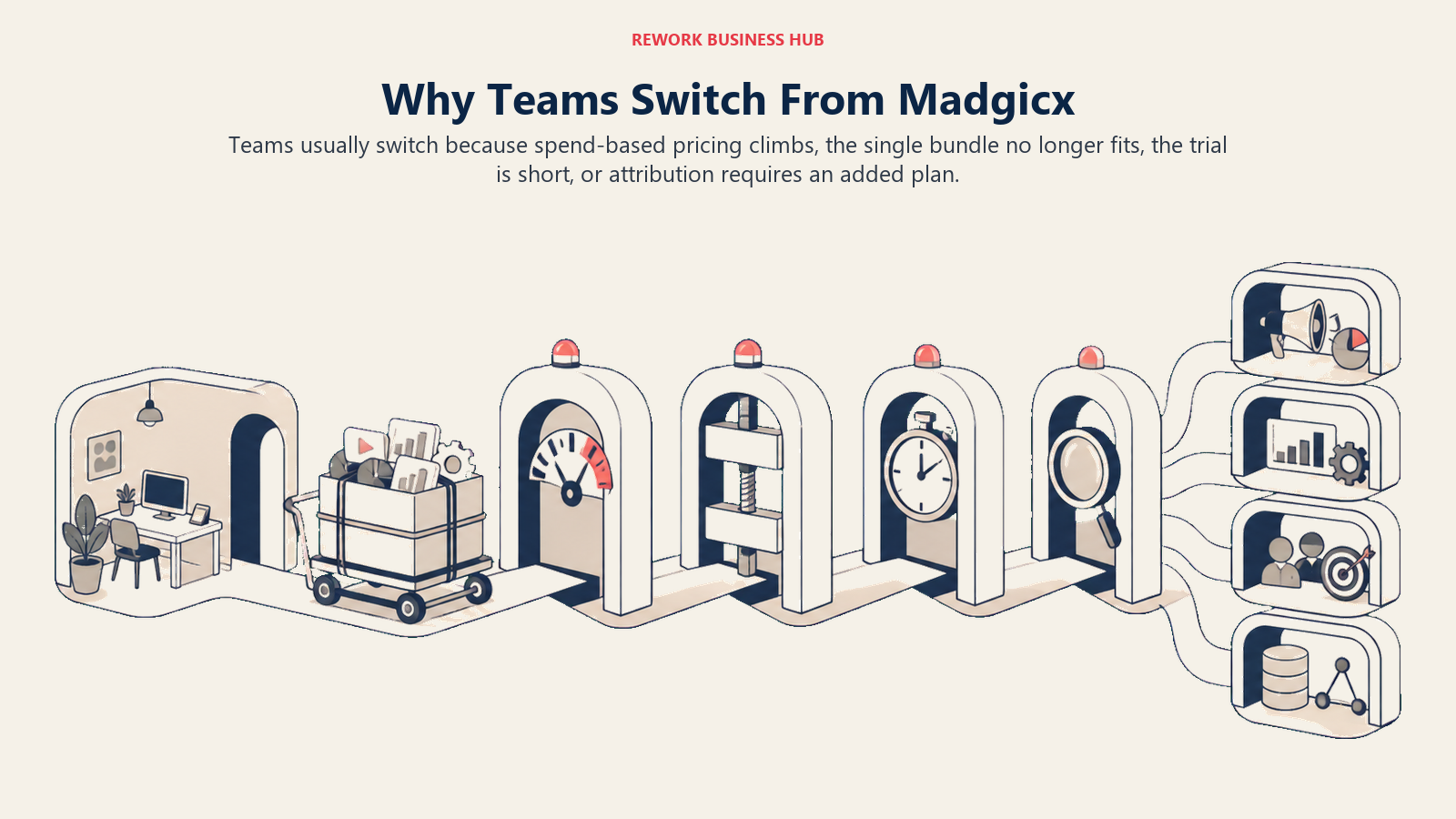
The reasons teams start comparing alternatives anyway:
Price climbs steeply as spend grows. Going from the $99 entry to the reported $329 at $20,000-$30,000 in monthly spend more than triples the bill, and that's before Tracking Pro's $49/month add-on. A team scaling past $30,000 in spend can't see the next price point at all; the page directs them to check inside the app instead.
One plan means one set of tradeoffs. There's no lighter tier for a team that only wants automation rules, and no way to skip the creative tools if you already use AdCreative.ai or Hunch for that half of the job. Birch, by contrast, sells rules-based automation on its own without bundling in creative generation you may not need.
The trial is short. 7 days is enough to poke around, not enough to run a real optimization cycle against live campaigns. Birch, AdEspresso, Optmyzr, and Adzooma all give 14 days; Northbeam's Starter tier is month-to-month with no trial required to walk away.
Tracking Pro is an add-on, not a feature. A previous cluster shipped a comparison that assumed Madgicx's attribution tooling was fully included at every tier; it isn't. Budget the extra $49/month if attribution matters to your evaluation.
None of this erases what Madgicx does well: bundling AI creative tools and rules-based campaign automation in one login, at a price a small ecommerce store can actually afford, is a genuinely rare combination on this list. Only Smartly matches that bundle, and only at enterprise pricing. The reason to shop the alternatives isn't that Madgicx is bad, it's that most teams eventually want either more automation depth on one platform (Birch), more creative volume (AdCreative.ai, Hunch), or a price that doesn't scale as fast with ad spend.
How to Choose: Decision Framework
Start with the ad job your team needs to improve, then shortlist only the tools built to run, create, measure, or extend that work.
| If you need... | Best pick |
|---|---|
| Madgicx's exact mix of automation and AI creative, at enterprise scale | Smartly |
| Rules-based bid and budget automation across Meta, Google, Snapchat, and TikTok | Birch (formerly Revealbot) |
| AI-generated ad creative at volume, paired with your own campaign tool | AdCreative.ai |
| Automated creative variant testing driven by a product feed | Hunch |
| The free baseline layer every Meta advertiser already has | Meta Ads Manager with Advantage+ |
| A PPC-first rules engine that also covers Meta and LinkedIn | Optmyzr |
| Free or low-cost optimization suggestions without Madgicx's AI-heavy pricing | Adzooma |
| A unified ecommerce analytics layer, priced by GMV | Triple Whale |
| Deterministic, touchpoint-level attribution at bigger spend | Northbeam |
| Retargeting and prospecting display with no platform fee | AdRoll |
| Programmatic reach across CTV, audio, and native beyond social | StackAdapt |
| Simple Meta and Instagram ad creation at a low entry price | AdEspresso by Hootsuite |
Outgrowing more than just ad management? Best AI Marketing Tools covers the wider marketing-automation stack these platforms often sit inside.
Frequently Asked Questions about Madgicx Alternatives
Why do teams look for Madgicx alternatives?
The main reasons are price scaling steeply with ad spend (from $99/month at entry to a reported $329/month at $20,000-$30,000), a single plan with no lighter or heavier tier option, a short 7-day trial, and Tracking Pro being a $49/month add-on rather than a bundled feature.
Does Madgicx still have just one plan?
Yes, one plan, Madgicx Pro Complete with AI, priced by monthly ad spend. Madgicx's academy page puts the entry at $99/month, rising to a reported $329/month at $20,000 to $30,000. The pricing page itself publishes no per-band figure, and nothing at all above $30,000.
Is Revealbot still called Revealbot?
No. Revealbot rebranded to Bïrch in 2026, and revealbot.com now redirects to bir.ch. It's fair to write it as Birch (formerly Revealbot) on first mention.
Which Madgicx alternative is cheapest for a very small ecommerce store?
Adzooma's free tier costs nothing, and AdEspresso's $49/month Starter plan (capped at $1,000/month in ad spend) undercuts Madgicx's $99/month entry by half at that spend level.
Which alternative actually generates ad creative the way Madgicx does?
AdCreative.ai and Hunch both generate creative, but neither manages campaigns directly. Only Smartly and Meta's own Advantage+ tools inside Ads Manager bundle campaign automation and creative generation the way Madgicx does.
What's the difference between Triple Whale or Northbeam and Madgicx?
Triple Whale and Northbeam measure attribution and analytics; they don't run or optimize campaigns. Ecommerce teams typically pair one of them with a campaign tool like Madgicx, Birch, or Meta Ads Manager rather than choosing between them.
Is Meta Ads Manager with Advantage+ a real Madgicx alternative or just the underlying platform?
Both. Every Madgicx customer already runs on Ads Manager underneath, and Meta's own Advantage+ automation has closed enough of the gap that some smaller advertisers running only Meta and Instagram campaigns skip a third-party layer entirely.
How long is Madgicx's free trial compared to the alternatives?
7 days. Birch, AdEspresso, Optmyzr, and Adzooma all offer 14-day trials, and AdCreative.ai matches Madgicx's 7 days.
What to Do Next
Decide first whether the actual complaint is price at scale, feature depth in one direction, or wanting to split automation from creative, then pick two finalists based on that answer rather than starting from a generic top-10 list. Match the alternative's ad-spend band to your own before comparing prices; a $299/month Optmyzr quote at $25,000 in spend isn't a fair comparison against a $99/month Madgicx quote at $2,500. Run a genuine two-week trial with your real accounts connected on your top two picks, since rules-based automation and AI creative generation both only prove themselves against live campaign data, not a demo environment.

Principal Product Marketing Strategist
On this page
- Key Facts
- Quick Comparison Table
- Ad Management Is Three Different Jobs, Plus a Measurement Layer
- 1. Birch (formerly Revealbot): Rules-Based Automation Across Four Platforms
- 2. AdEspresso by Hootsuite: The Low-Cost Meta-Only Entry Point
- 3. Smartly: The Only Other Bundle at Enterprise Scale
- 4. AdCreative.ai: Volume AI Creative, No Campaign Management
- 5. Hunch: Dynamic Creative Testing Off Your Product Feed
- 6. Meta Ads Manager with Advantage+: The Free Layer Underneath Everything Else
- 7. Optmyzr: A PPC Rules Engine That Also Covers Meta and LinkedIn
- 8. Adzooma: A Free Tier, Then a Low-Cost Path Up
- 9. Triple Whale: The Ecommerce Data Hub, Not a Campaign Tool
- 10. Northbeam: Deterministic Attribution for Bigger Spenders
- 11. AdRoll: Retargeting Without a Platform Fee
- 12. StackAdapt: Programmatic Reach Beyond Social
- Stage-Fit Matrix
- Sizing and Persona Table
- Why Teams Leave Madgicx
- How to Choose: Decision Framework
- What to Do Next