Portões de Aprovação de AI e Revisão de Fornecedores: Um Framework Escalável para CIOs
Turn this article into takeaways for your work.


Each assistant summarizes the article only for you and suggests best practices for your work.
Uma nova solicitação de ferramenta de AI chega à sua caixa de entrada toda semana. Sua equipe de vendas quer um gravador de chamadas com AI. Finanças quer um categorizador de despesas com AI. Marketing quer uma ferramenta de conteúdo de AI que requer acesso OAuth ao seu banco de dados de clientes. E sua auditoria de TI do mês passado encontrou seis ferramentas que os funcionários já estão usando sem que ninguém tenha analisado.
O instinto de um CIO é apertar os controles: exigir revisão de segurança para tudo, adicionar mais aprovações, desacelerar o processo. Esse instinto é compreensível e errado. Um processo de revisão lento demais para ser concluído produz shadow AI. Os engenheiros usarão a ferramenta de qualquer maneira. Apenas irão escondê-la.
O objetivo não é dizer não para tudo. É construir um processo de aprovação rápido e confiável que os funcionários realmente sigam. A pesquisa da Gartner descobriu que organizações sem catálogos de ferramentas pré-aprovadas experimentam taxas de adoção de shadow AI de 3 a 5 vezes maiores, que é exatamente o resultado que um processo de revisão lento e opaco produz. Este artigo é o complemento operacional para Criando Sua Política de Uso de AI, que define as regras de limite que os portões de aprovação aplicam.
Por que a revisão de fornecedores de AI é diferente do procurement tradicional de SaaS
Fatos Essenciais: Risco de Fornecedores de AI e Shadow AI
- Organizações sem catálogos de ferramentas pré-aprovadas experimentam taxas de adoção de shadow AI de 3 a 5 vezes maiores, segundo pesquisa da Gartner; o processo de aprovação lento demais para usar leva os funcionários a contorná-lo completamente (Gartner, 2025)
- 78% dos trabalhadores do conhecimento usam ferramentas de AI pessoais no trabalho sem aprovação explícita do empregador; a maioria dessas ferramentas não tem DPAs empresariais (Microsoft Work Trend Index, 2024)
- A Gartner prevê que mais de 40% dos projetos de AI agêntica serão cancelados até o final de 2027, com falhas de frameworks de governança, não falhas técnicas, como a principal causa (Gartner, 2025)
O procurement tradicional de SaaS pergunta: esta ferramenta faz o que afirma? Quanto custa? Ela se integra ao nosso stack? O fornecedor tem SOC 2?
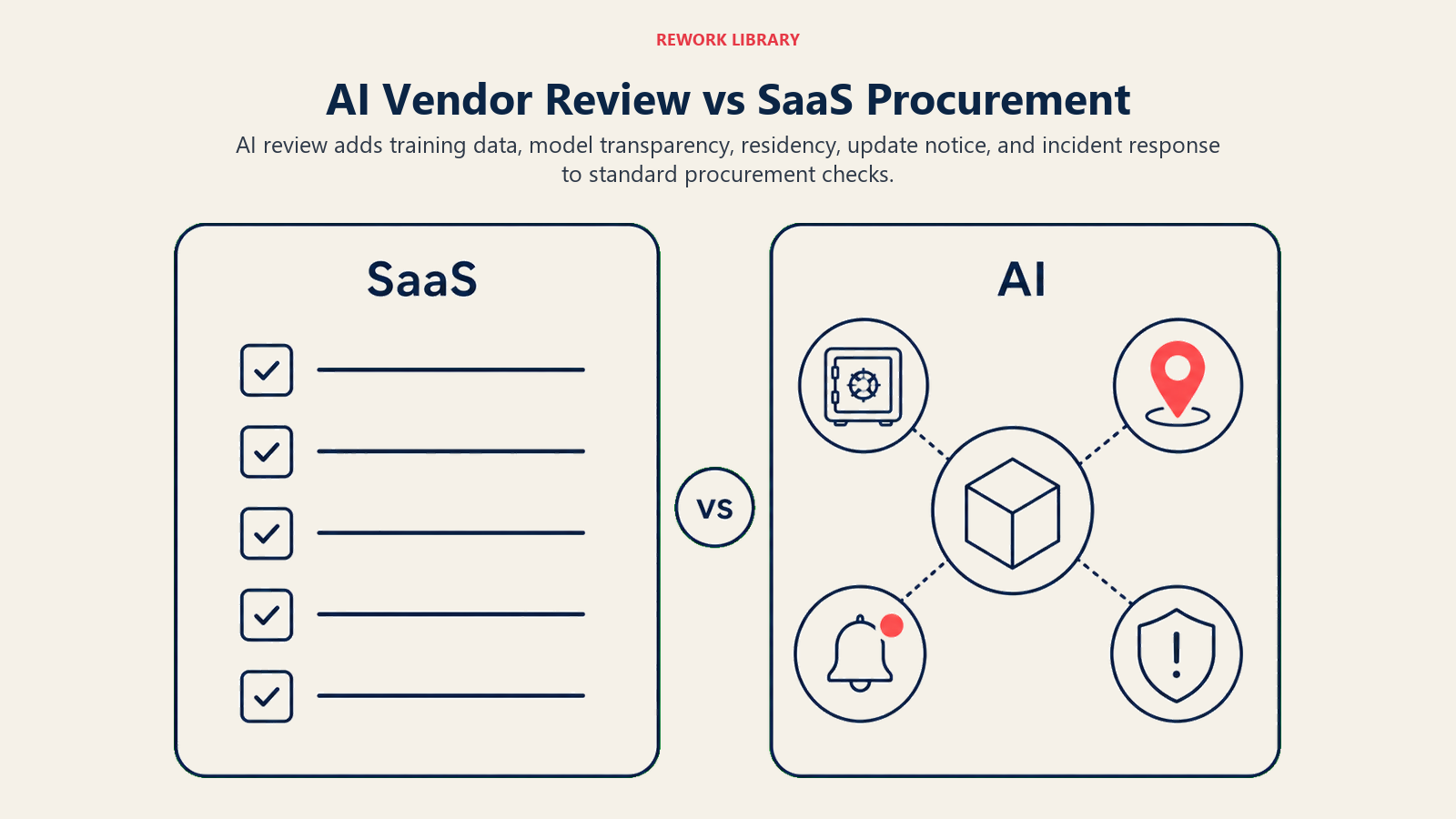
A revisão de fornecedores de AI tem cinco perguntas adicionais que o procurement tradicional de SaaS não cobre.
Práticas de dados de treinamento. Este fornecedor usa os inputs dos seus funcionários, os dados dos seus clientes ou o seu conteúdo proprietário para treinar ou ajustar seus modelos? Isso importa enormemente. Um fornecedor que melhora seus modelos com seus dados está extraindo valor que você não precificou no negócio, potencialmente vazando informações competitivas para pesos de modelo compartilhados e criando exposição ao GDPR se qualquer um desses dados incluir informações pessoais sobre seus clientes.
Transparência do modelo. Qual modelo está por trás desta ferramenta? É um modelo proprietário, um ajuste de código aberto ou um wrapper em torno do GPT-4o ou Claude? Isso afeta sua capacidade de obter outputs consistentes, sua trilha de auditoria para decisões e sua exposição se o modelo subjacente for descontinuado.
Residência de dados. Para onde os dados vão quando um funcionário envia um prompt? Muitas ferramentas de AI processam dados por meio de infraestrutura de nuvem nos EUA, mesmo quando você opera na Alemanha ou na Austrália. Isso pode conflitar com seus requisitos de residência de dados, especialmente em saúde ou serviços financeiros.
Notificação de atualização de modelo. Quando o fornecedor atualiza seu modelo, você recebe notificação? Uma mudança de comportamento em uma ferramenta de AI que afeta os outputs voltados ao cliente ou as decisões de scoring é uma mudança material na sua operação. Você precisa saber quando isso acontece.
SLA de resposta a incidentes. Se a ferramenta de AI enviar informações incorretas aos seus clientes, tomar uma decisão discriminatória ou expor dados protegidos, qual é a obrigação contratual do fornecedor? Qual é o prazo de notificação? Que remediação eles devem a você?
Nenhuma dessas perguntas aparece em um questionário de segurança padrão de fornecedor. E nenhuma delas é opcional.
O Questionário de Segurança de Fornecedores de AI
O questionário transforma a revisão de fornecedores em uma etapa consistente de coleta de evidências, em vez de uma série de conversas de segurança ad hoc.
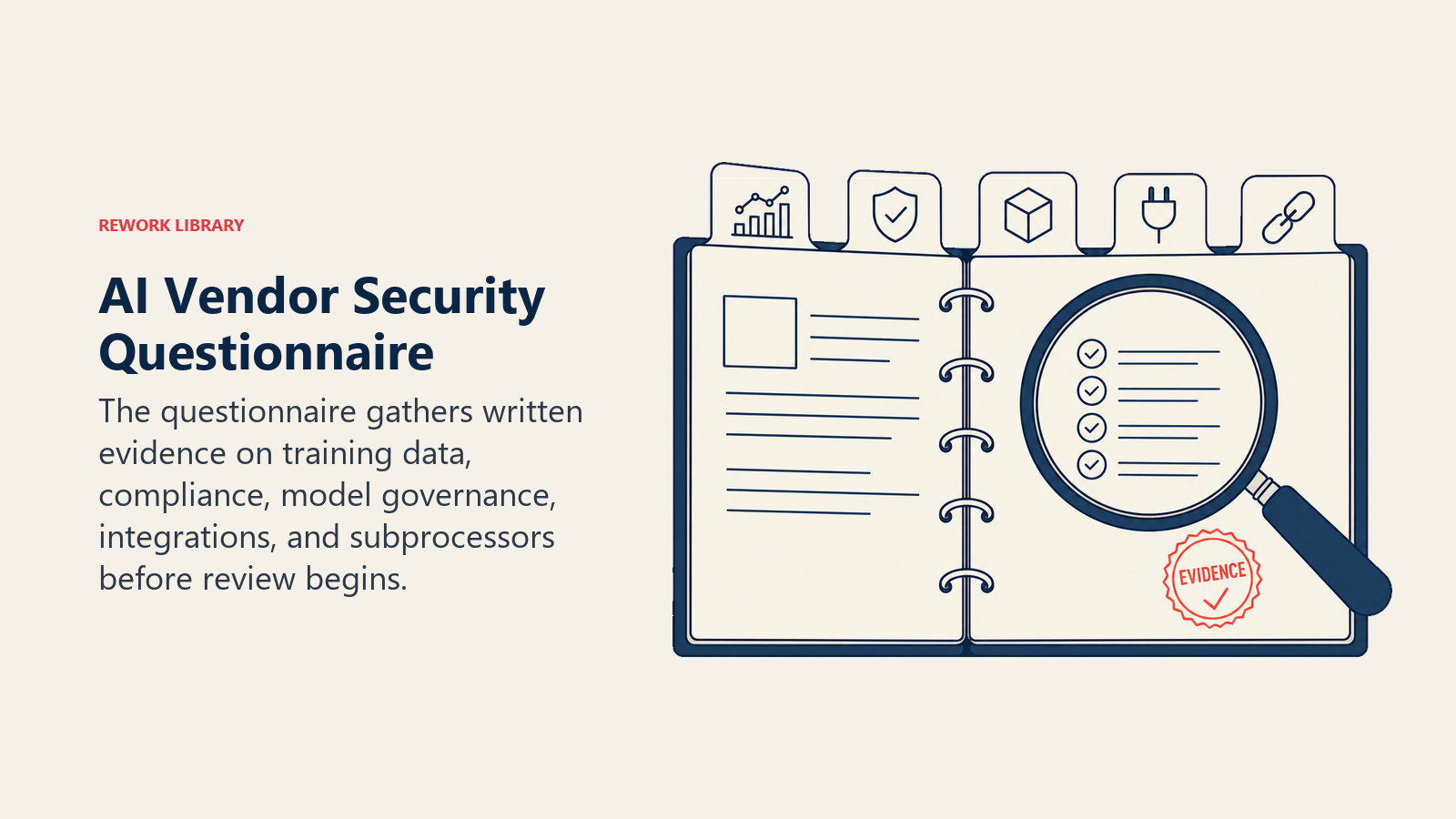
Antes de encaminhar qualquer ferramenta de AI para revisão formal, exija que o fornecedor preencha um questionário escrito. Isso cria uma trilha de papel, acelera a revisão técnica e garante que procurement, jurídico e segurança estejam avaliando as mesmas informações.
Perguntas-chave a incluir:
Dados e treinamento
- Este produto usa dados enviados por clientes (prompts, documentos ou outputs) para treinar ou melhorar o modelo subjacente? Se sim, os clientes podem recusar?
- Descreva seu pipeline de processamento de dados. Onde os dados são armazenados durante e após a inferência?
- Qual é sua política de retenção de dados para inputs e outputs de clientes?
Segurança e conformidade
- Qual escopo de SOC 2 Tipo II seu relatório mais recente cobre? Quando foi concluída a última auditoria?
- Você tem um Business Associate Agreement (BAA) HIPAA disponível? Um Data Processing Agreement (DPA) do GDPR disponível?
- Descreva seus controles de acesso para acesso de funcionários aos dados de clientes mantidos em seus sistemas.
Governança de modelos
- Como você notifica os clientes quando o modelo subjacente é atualizado de uma forma que pode afetar os outputs?
- Qual é seu SLA de divulgação de vulnerabilidades e resposta a incidentes?
- Você pode fornecer model cards ou documentação sobre avaliações de viés conhecidas?
Integração e fluxo de dados
- Quais permissões de API ou escopos OAuth esta ferramenta exige?
- Esta ferramenta armazena chaves de API, tokens ou credenciais na sua infraestrutura ou na deles?
- Para quais sub-processadores de terceiros esta ferramenta envia dados?
Solicite essas respostas por escrito antes de agendar qualquer demonstração. Fornecedores que não conseguem respondê-las por escrito não estão prontos para implantação empresarial.
"Um processo de avaliação de fornecedores que leva três meses não previne shadow AI. Ele produz shadow AI. O objetivo não é dizer não para tudo. É construir um processo rápido o suficiente para que os funcionários prefiram usá-lo a contorná-lo." (Rework)
O Portão de Aprovação de AI de 3 Camadas
Um framework de revisão em camadas que corresponde a profundidade da revisão de segurança ao nível de risco da ferramenta de AI, prevenindo gargalos de governança enquanto mantém responsabilidade. Camada 3 (Auto-Aprovação): ferramentas pré-analisadas no registro aprovado sem integração de sistema e sem capacidade voltada ao cliente; os funcionários se autoatendem. Camada 2 (Aprovação do Líder de Departamento): ferramentas com integração de sistema, acesso a dados da Camada 2 ou capacidade Generate revisada externamente; prazo de revisão de duas semanas com envolvimento da segurança de TI. Camada 1 (Revisão Completa de Segurança): ferramentas com acesso a PII de clientes, capacidade Execute voltada ao cliente, tratamento de dados regulados ou capacidade de agente autônomo; revisão de quatro a seis semanas com aprovação do CIO, jurídico e CISO. O Portão de 3 Camadas garante que um plugin de edição de texto não passe seis semanas na mesma fila de revisão que um sistema de AI que pode enviar comunicações a clientes de forma autônoma.
O framework de aprovação em 3 camadas
Nem todas as ferramentas de AI carregam o mesmo risco. Um plugin de edição de texto para documentos internos tem um perfil de risco categoricamente diferente de um sistema de AI que pode executar ações no seu CRM ou gerar comunicações voltadas ao cliente. Tratá-los de forma idêntica desperdiça sua capacidade de revisão em ferramentas de baixo risco enquanto cria a ilusão de governança.
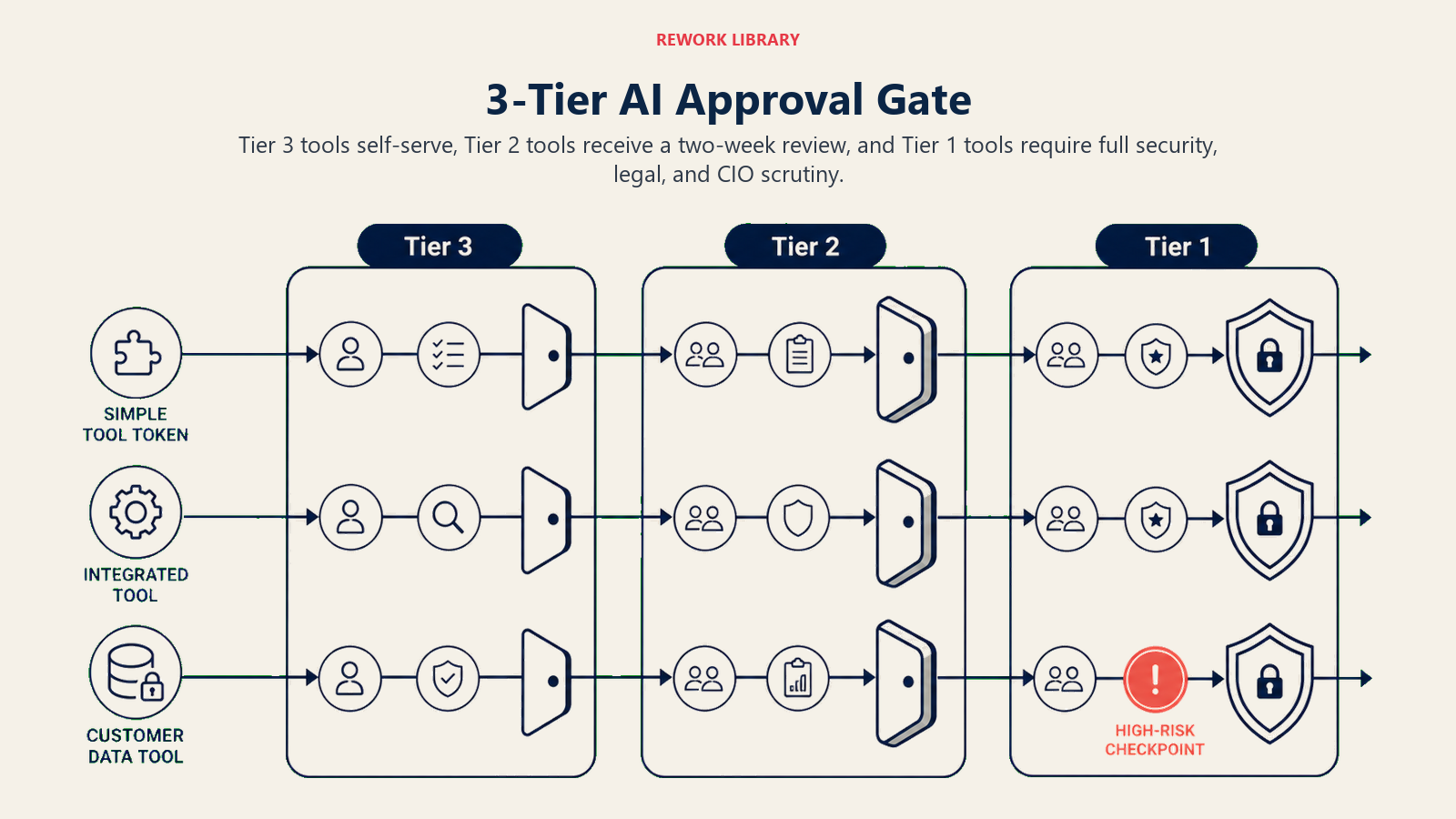
A solução é um sistema em camadas onde o nível de risco determina a profundidade da revisão e o tempo necessário.
Camada 3: Auto-aprovação (ferramentas pré-analisadas na lista aprovada)
São ferramentas que sua equipe já analisou e aprovou. Qualquer funcionário pode usar qualquer ferramenta da Camada 3 sem solicitar uma revisão.
O registro de ferramentas aprovadas (mais sobre isso abaixo) é sua lista da Camada 3. A atualização trimestral garante que permaneça atual.
Ferramentas típicas da Camada 3: ferramentas de AI de produtividade sem integração a sistemas da empresa, assistentes de escrita usados apenas para elaboração pessoal, ferramentas de apresentação que não acessam dados da empresa.
Critérios para a Camada 3: sem integração a sistemas internos, sem acesso a dados de clientes, sem capacidade de output voltado ao cliente, sem capacidade Execute.
Camada 2: Aprovação do líder de departamento (revisão padrão, duas semanas)
Um líder de departamento mais um contato de segurança de TI designado podem aprovar isso sem envolvimento total do CIO.
Critérios para a Camada 2: usa dados da Camada 2 (dados operacionais internos, dados não pessoais de funcionários), OU tem integração de sistema sem acesso a dados de clientes, OU usa capacidade Generate que os funcionários revisam antes de compartilhar externamente.
O prazo de duas semanas existe porque a revisão de segurança de uma integração de sistema requer avaliação técnica real. Não pode ser feita em dois dias de forma responsável.
O que a revisão cobre: respostas ao questionário do fornecedor, diagrama de fluxo de dados, revisão do escopo OAuth, revisão do DPA se dados pessoais da UE estiverem envolvidos, avaliação em relação ao seu framework de classificação de dados.
Camada 1: Revisão completa de segurança (quatro a seis semanas, CIO mais segurança)
São as ferramentas com o perfil de risco mais alto. O prazo mais longo reflete a profundidade da revisão necessária, não atraso burocrático.
Critérios para a Camada 1: acessa dados pessoais de clientes ou dados confidenciais, tem capacidade Execute voltada ao cliente (pode enviar comunicações, emitir reembolsos, tomar decisões que afetam clientes), lida com dados regulados (informações de saúde protegidas [PHI], PII em contexto financeiro, comunicações advogado-cliente), tem capacidade de agente autônomo ou loop agêntico. A fronteira entre Generate e Execute é o ponto de decisão primário para se uma ferramenta se enquadra na Camada 1 ou na Camada 2.
A revisão inclui todos os requisitos da Camada 2 mais: revisão jurídica do DPA e BAA (se aplicável), teste de penetração ou revisão dos resultados de pentest mais recentes do fornecedor, chamadas de referência com clientes empresariais existentes, cláusulas contratuais explícitas sobre notificação de atualização de modelo e SLA de incidentes, aprovação do seu CISO ou assessoria jurídica.
Nota de alinhamento com o NIST AI RMF: esta estrutura de três camadas mapeia diretamente para as funções Govern e Map do NIST AI Risk Management Framework. A Camada 1 corresponde aos usos de AI de "alto impacto" do NIST; a Camada 3 corresponde aos usos de "risco mínimo". O framework NIST recomenda que as organizações "estabeleçam processos e mecanismos para manter a confiabilidade dos sistemas de AI". Um portão de aprovação em camadas é a implementação operacional desse princípio.
Construindo o registro de ferramentas aprovadas
O registro é o artefato operacional que mantém as aprovações de ferramentas de AI visíveis depois que a revisão inicial é concluída.
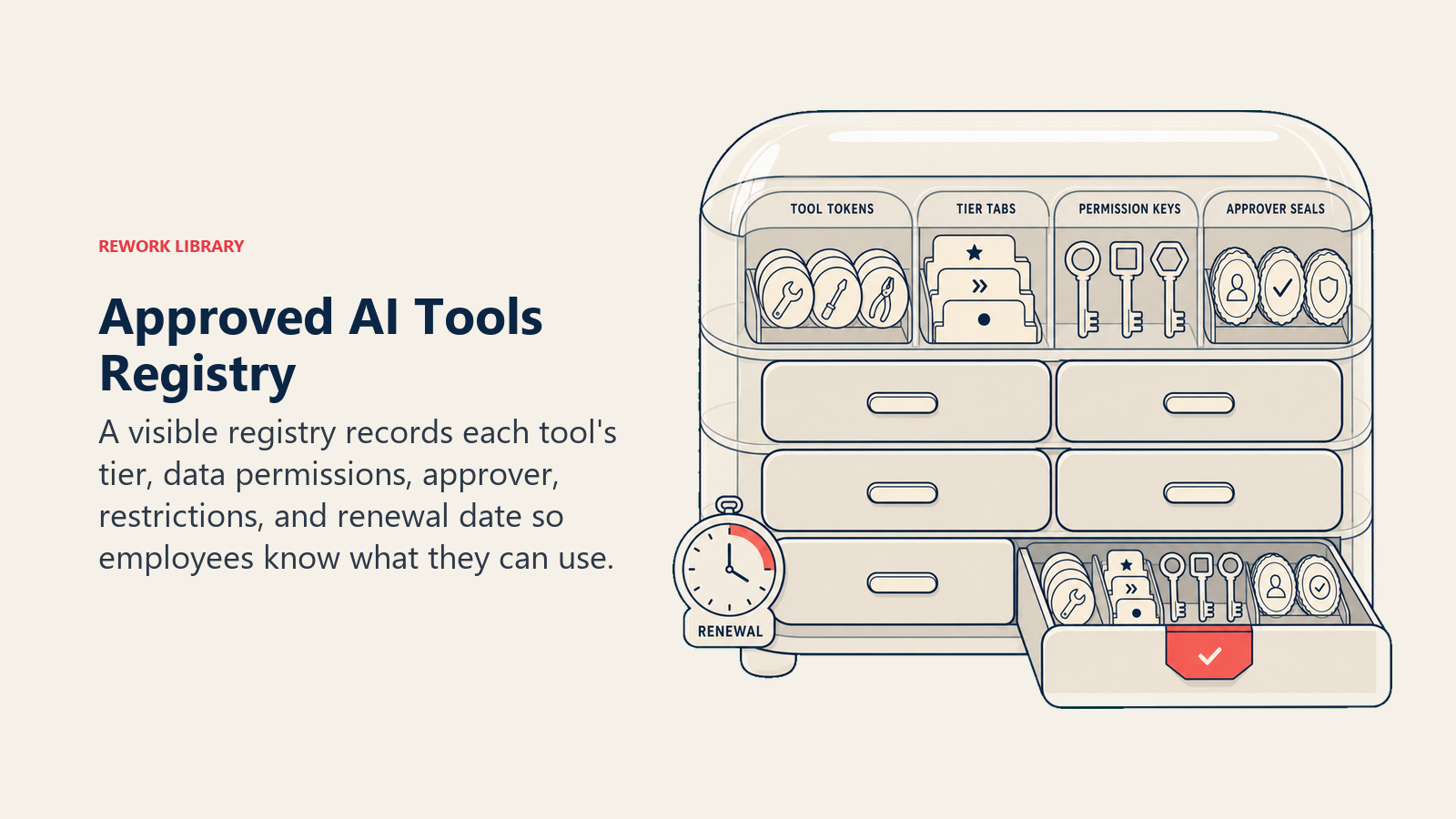
O registro de ferramentas aprovadas é uma lista viva de cada ferramenta de AI que foi analisada e aprovada, junto com as condições dessa aprovação.
Cada entrada no registro deve incluir:
- Nome da ferramenta e fornecedor
- Data de aprovação e data de expiração (atualização trimestral)
- Atribuição de camada
- Permissões de camada de dados aprovadas (quais categorias de dados esta ferramenta está aprovada para acessar)
- Quem aprovou (nome e função)
- Condições ou restrições conhecidas (por exemplo, "aprovado apenas para uso interno, não para processar PII de clientes")
- Data de lembrete de renovação (três semanas antes da expiração, acionar uma notificação automática para o aprovador)
O registro deve ser acessível a todos os funcionários. Quando alguém quiser usar uma ferramenta de AI, seu primeiro passo deve ser verificar o registro. Se a ferramenta estiver nele, podem prosseguir. Se não estiver, eles sabem onde enviar uma solicitação de revisão.
A atualização trimestral não significa reanalisar cada ferramenta do zero. Significa confirmar que: o fornecedor não mudou materialmente suas práticas de dados, nenhum incidente de segurança significativo ocorreu e o acesso a dados da ferramenta ainda é adequado para seu uso atual.
O que fazer com ferramentas não aprovadas já em uso
Se sua auditoria de shadow AI encontrou ferramentas que os funcionários já estão usando sem aprovação, você tem duas opções. Pode tratar como uma falha de conformidade e exigir cessação imediata. Ou pode tratar como um sinal de priorização: estas são as ferramentas que sua equipe quis o suficiente para usar sem perguntar.
O segundo enquadramento é mais útil.
Um funcionário que usou uma ferramenta de AI não aprovada por três meses está dizendo que o processo de aprovação foi lento demais ou pouco claro para seu caso de uso. Resolva isso primeiro. Depois execute a ferramenta pelo processo de revisão normal adequado à camada.
Para ferramentas da Camada 1 de alto risco já em uso ativo, restrições temporárias de uso podem ser adequadas enquanto a revisão formal é executada. Mas para ferramentas das Camadas 2 ou 3 já em uso sem incidentes aparentes, a abordagem pragmática é executar a revisão e retroativamente completar a aprovação em vez de criar dinâmicas adversariais que prejudicam a confiança da equipe no processo de governança.
O objetivo é um processo que os funcionários usam voluntariamente porque é mais rápido e claro do que trabalhar sem ele. Se o processo é mais lento do que fazer sem perguntar, os funcionários sempre encontrarão uma maneira de contorná-lo.
Como isso se mapeia para a construção da sua política de uso de AI
O framework de portões de aprovação responde à pergunta: "Qual é o processo para aprovar uma nova ferramenta de AI?" Mas assume que você já respondeu a uma pergunta anterior: "O que os funcionários têm permissão de fazer com ferramentas de AI?"
Essa pergunta anterior é sua política de uso de AI. A política de uso define o que está no escopo, o que requer aprovação e o que é proibido completamente. O framework de portões de aprovação é o mecanismo operacional que aplica a política de uso para novas ferramentas.
Da mesma forma, o framework de avaliação de fornecedores aprofunda como avaliar um fornecedor específico depois que o questionário foi preenchido. E o registro de risco de AI é onde as ferramentas aprovadas são rastreadas em relação aos riscos identificados durante a revisão.
O AI Pattern Vendor Landscape Map pode ajudá-lo a entender quais fornecedores servem quais padrões do ACE Framework, para que você possa construir uma lista racional de ferramentas aprovadas em vez de aprovar solicitações ad-hoc sem entender o panorama completo.
O teste de gargalo
Qualquer processo de aprovação deve ser avaliado em relação a uma pergunta: o processo é rápido o suficiente para que os funcionários prefiram usá-lo a contorná-lo?
Se a auto-aprovação da Camada 3 não está sendo usada porque os funcionários não sabem que o registro existe, corrija as comunicações, não o processo.
Se as revisões da Camada 2 estão levando quatro semanas em vez de duas, encontre o gargalo. Geralmente é a equipe de segurança com muitas revisões simultâneas ou o questionário do fornecedor não sendo preenchido antecipadamente. Corrija o processo, não a meta de prazo.
Se as revisões da Camada 1 estão levando três meses, algo está errado com o escopo. Revise apenas ferramentas da Camada 1 nesse processo. Não deixe solicitações da Camada 2 se acumularem na fila da Camada 1 porque alguém não tem certeza da classificação.
A estrutura de três camadas só funciona se a atribuição de camada for consistente e rápida. Essa atribuição deve acontecer em dois dias úteis após o recebimento de uma solicitação, antes que a revisão real comece. Os funcionários devem saber em 48 horas qual camada se aplica e qual é o prazo esperado.
Comece com o registro
Se você está construindo esse processo do zero, comece com o registro de ferramentas aprovadas, não com o questionário. Obtenha uma lista de cada ferramenta de AI que já está em uso na sua organização. Classifique cada uma por camada com base em seu acesso a dados e capacidade Execute. Marque as que passam em uma inspeção básica como provisionalmente aprovadas. Depois construa o questionário e o processo de revisão formal em torno das lacunas.
Um registro de 40 ferramentas aprovadas com classificação de dados adequada, disponível para todos os funcionários, faz mais para reduzir o shadow AI do que um processo de revisão de segurança de três meses que ninguém consegue realmente seguir.
Gargalos impulsionam adoção de shadow. Velocidade e clareza são suas principais ferramentas de governança.
Mas aprovar uma ferramenta é apenas metade do trabalho. Quando um sistema de AI está em produção e tomando ações, a pergunta se torna: o que acontece quando faz algo errado, e você tem os logs para provar o que realmente ocorreu?
Análise Rework: Com base em padrões de governança de AI corporativa, o Portão de Aprovação de AI de 3 Camadas falha com mais frequência na etapa de atribuição de camada, não na própria etapa de revisão. Solicitações da Camada 2 se acumulam na fila da Camada 1 porque a pessoa que recebe a solicitação não tem certeza de como classificá-la. A correção é uma decisão de atribuição de camada em 48 horas (antes da revisão começar) com uma árvore de decisão simples: A ferramenta acessa PII de clientes ou dados regulados? Ela tem capacidade Execute voltada ao cliente? Se sim para qualquer um, é Camada 1. Se não, continue para a próxima pergunta. Uma árvore de decisão de uma página, visível para todos os solicitantes e revisores, resolve a maioria das ambiguidades de classificação sem exigir escalada.
Perguntas Frequentes
O que é o Portão de Aprovação de AI de 3 Camadas?
O Portão de Aprovação de AI de 3 Camadas é um framework de revisão com base em risco que corresponde a profundidade da revisão de segurança ao perfil de risco real da ferramenta de AI. Ferramentas da Camada 3 (sem integração de sistema, sem capacidade voltada ao cliente) são auto-aprovadas por meio de um registro pré-analisado. Ferramentas da Camada 2 (integração de sistema ou acesso a dados externos) exigem revisão do líder de departamento e segurança de TI em duas semanas. Ferramentas da Camada 1 (acesso a PII de clientes, capacidade Execute voltada ao cliente, dados regulados ou capacidade agêntica) exigem revisão completa de segurança com aprovação do CIO, jurídico e CISO em quatro a seis semanas.
Como a revisão de fornecedores de AI difere do procurement padrão de SaaS?
A revisão de fornecedores de AI adiciona cinco perguntas que o procurement tradicional de SaaS não cobre: (1) Este fornecedor treina com seus inputs? (2) Qual modelo subjacente é usado e como é versionado? (3) Para onde os dados vão (requisitos de residência de dados)? (4) Como o fornecedor notifica você quando o modelo atualiza? (5) Qual é o SLA de resposta a incidentes do fornecedor? Nenhuma dessas perguntas aparece em um questionário de segurança padrão de fornecedor, e nenhuma delas é opcional para implantações de ferramentas de AI em produção.
Por que os processos de aprovação de AI criam shadow AI?
Quando o processo de aprovação leva mais tempo do que os funcionários estão dispostos a esperar, eles usam a ferramenta sem aprovação. A Gartner descobriu que organizações sem catálogos de ferramentas pré-aprovadas experimentam taxas de adoção de shadow AI de 3 a 5 vezes maiores. A solução é um processo em camadas com um registro de ferramentas aprovadas acessível publicamente (para autoatendimento da Camada 3), atribuição de camada rápida em 48 horas de qualquer solicitação e prazos transparentes para que os funcionários saibam o que esperar. Um processo em que os funcionários confiam e usam supera um processo minucioso que os funcionários contornam.
Quais perguntas um questionário de segurança de fornecedores de AI deve incluir?
As perguntas-chave cobrem três áreas. Dados e treinamento: Este produto treina com inputs de clientes? Onde os dados são armazenados e por quanto tempo? Segurança e conformidade: Qual escopo de SOC 2 é coberto? Um DPA GDPR ou BAA HIPAA está disponível? Governança de modelos: Como os clientes são notificados de atualizações de modelos? Qual é o SLA de resposta a incidentes? Integração e fluxo de dados: Quais permissões de API ou escopos OAuth esta ferramenta exige? Quais sub-processadores de terceiros recebem dados? Exija respostas por escrito antes de agendar qualquer demonstração de produto.
Veja também:
- Classificação de Dados para Regras de Acesso de AI: o framework de 4 camadas que determina qual camada de dados uma ferramenta pode lidar
- Trilhas de Auditoria para Ações Execute de AI: qual logging é necessário depois que uma ferramenta da Camada 1 é aprovada e implantada
- Registro de Risco de AI: O Que Rastrear: onde os riscos de ferramentas aprovadas são rastreados após o portão de aprovação
- Por Que Maioria das Transformações de AI Falha: como o problema de shadow AI descrito aqui se liga à falha de governança como causa raiz de transformação

Co-Founder, Rework.com
On this page
- Por que a revisão de fornecedores de AI é diferente do procurement tradicional de SaaS
- O Questionário de Segurança de Fornecedores de AI
- O Portão de Aprovação de AI de 3 Camadas
- O framework de aprovação em 3 camadas
- Camada 3: Auto-aprovação (ferramentas pré-analisadas na lista aprovada)
- Camada 2: Aprovação do líder de departamento (revisão padrão, duas semanas)
- Camada 1: Revisão completa de segurança (quatro a seis semanas, CIO mais segurança)
- Construindo o registro de ferramentas aprovadas
- O que fazer com ferramentas não aprovadas já em uso
- Como isso se mapeia para a construção da sua política de uso de AI
- O teste de gargalo
- Comece com o registro