Vendor Evaluation Framework para Ferramentas de IA: O Scorecard de 7 Dimensões do CIO

Turn this article into takeaways for your work.


Each assistant summarizes the article only for you and suggests best practices for your work.
Fornecedores de IA estão se multiplicando mais rápido do que o procurement consegue processar. Em 2025, havia mais de 4.200 ferramentas de IA listadas no G2 em todas as principais categorias de software. O comprador médio de software empresarial recebe de 15 a 20 pitches de fornecedores de IA por mês.
A maioria dos processos de procurement não foi construída para este volume. A avaliação de software tradicional pressupõe que você está escolhendo entre 2 ou 3 fornecedores em uma categoria que você entende, com cronogramas de procurement de 6 a 12 semanas e critérios claros de RFP (request for proposal). A pesquisa de Plataformas de Desenvolvimento de Aplicações com IA da Gartner rastreia como os fornecedores são avaliados quanto à Capacidade de Execução e Completude de Visão, um enquadramento inicial útil para entender onde diferentes fornecedores se situam em termos de maturidade de produção versus ambição.
A seleção de fornecedores de IA é diferente em três aspectos que o procurement padrão não lida bem.
Primeiro, o perfil de risco é mais alto. Um fornecedor de IA não entrega apenas funcionalidade de software. Entrega um sistema que acessará seus dados, influenciará suas decisões e potencialmente agirá de forma autônoma nos seus fluxos de trabalho. Escolher o fornecedor de IA errado não é apenas uma compra ruim. Pode ser uma violação de dados esperando para acontecer, uma responsabilidade de compliance ou uma dependência de fluxo de trabalho cara e dolorosa de desfazer.
Segundo, as afirmações dos fornecedores são mais difíceis de avaliar. Todo fornecedor de IA afirma "transformar" algo. O vocabulário é inflado. Uma funcionalidade chamada "automação inteligente" significa algo completamente diferente em três fornecedores diferentes, e as respostas padrão de RFP não vão te dizer o quê.
Terceiro, o custo de troca é alto e concentrado no início. Sua equipe vai configurar a ferramenta, integrá-la com sua stack, treiná-la e construir fluxos de trabalho ao redor dela. O custo de trocar depois que esse investimento aconteceu é significativamente maior do que o custo de acertar a seleção no início.
Este artigo oferece um framework de avaliação estruturado em 7 dimensões e um processo de sprint de 4 semanas para decisões de seleção de fornecedores que você pode defender para o conselho.
A Etapa de Mapeamento de Capacidade ACE (Faça Isso Primeiro)
Fatos Relevantes: Avaliação de Fornecedores de IA
- O comprador médio de software empresarial recebe de 15 a 20 pitches de fornecedores de IA por mês, porém 94% das organizações relatam preocupação com lock-in de fornecedor de IA após a seleção. (Parallels 2026 Cloud Survey)
- 47% dos líderes empresariais dizem que uma função de negócio importante pararia se seu principal provedor de IA ficasse fora do ar, e apenas 6% dizem que poderiam trocar sem interrupção. (Zapier)
- 57% dos líderes de TI gastaram mais de $1 milhão em migrações de plataforma no último ano, com reconstrução de integrações, reformatação de dados e revalidação de fluxos de trabalho como principais fatores de custo. (Kellton)
Antes de avaliar qualquer fornecedor, você precisa saber para que está avaliando. A maioria das avaliações de fornecedores de IA falha porque as equipes de procurement não têm uma definição precisa das capacidades de que precisam.
O ACE Framework (Ingest, Analyze, Predict, Generate, Execute) oferece essa precisão. Mapeie o caso de uso que você está avaliando para as cinco capacidades. Em seguida, examine as afirmações do fornecedor e mapeie-as para as mesmas cinco capacidades.
Um fornecedor que afirma "insights de vendas com IA" pode estar fazendo Ingest (puxando dados do CRM) mais Analyze (resumindo padrões de negócio) mais Generate (redigindo talking points). Ou pode estar fazendo todos os cinco. Ou pode estar fazendo apenas Generate (escrevendo templates de e-mail com base em uma biblioteca de templates, sem aprendizado real de IA acontecendo). O mapeamento ACE força a precisão que os demos de fornecedores não têm.
Faça a qualquer fornecedor esta pergunta direta: "Explique-me seu produto em termos de quais dados ele ingere, como analisa esses dados, o que prevê se for o caso, o que gera e o que executa de forma autônoma." Se eles não conseguirem responder a essa pergunta, não conhecem bem o próprio produto para implantá-lo no seu ambiente.
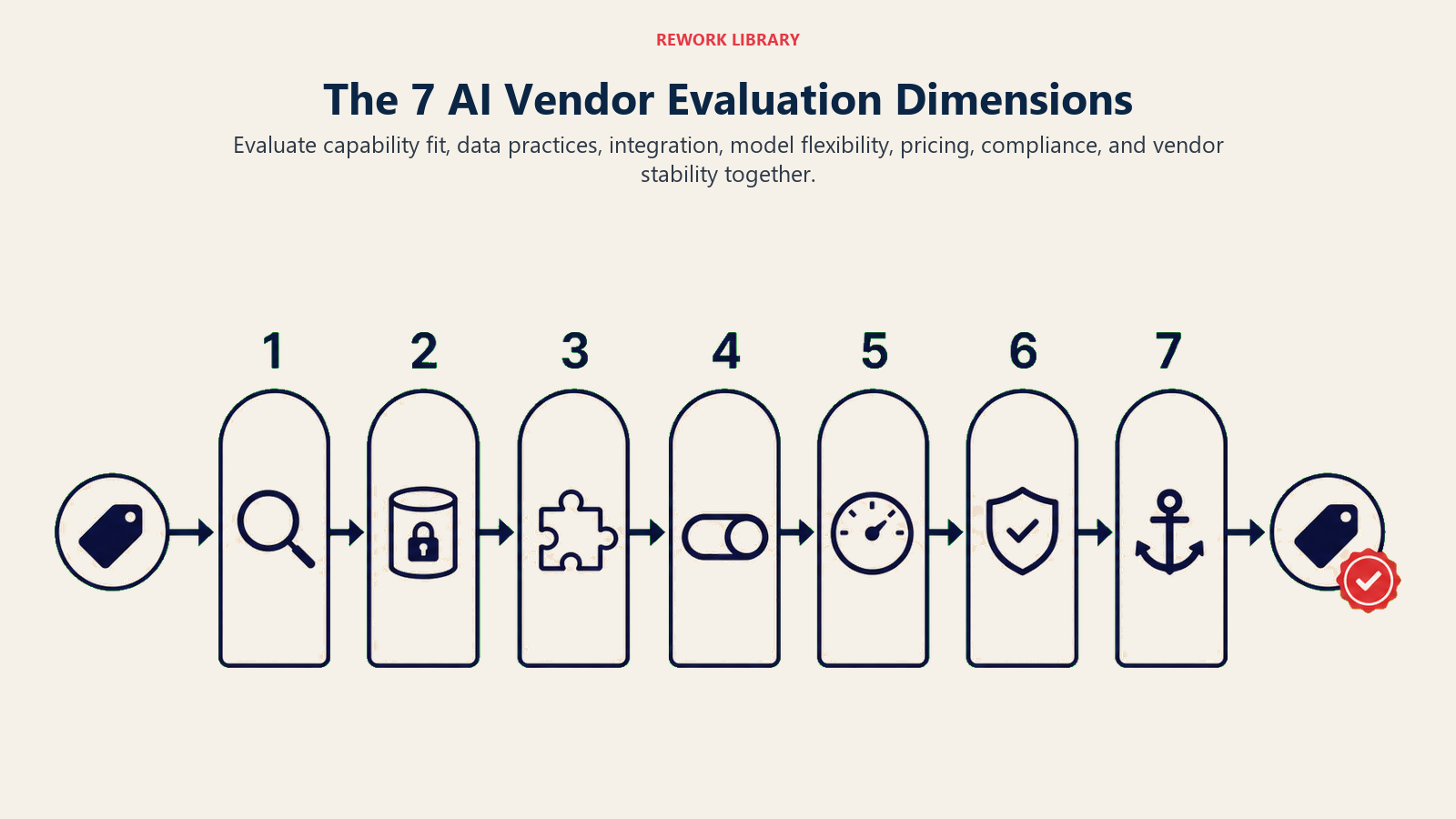
As 7 Dimensões de Avaliação
Avalie todo fornecedor de IA em todas as sete dimensões. Não faça shortlist apenas com base em adequação de capacidade. A ferramenta de IA mais capaz com práticas de dados inadequadas ou documentação de compliance insuficiente não é uma opção viável para a maioria das organizações reguladas.
Dimensão 1: Adequação de Capacidade
A ferramenta faz o mix de capacidades ACE de que você realmente precisa? Este é o requisito mínimo viável, mas precisa ser avaliado com precisão, não com base em materiais de marketing.
Para cada capacidade necessária:
- Como o fornecedor a implementa? Quais modelos, quais dados de treinamento, qual arquitetura de inferência?
- Onde a precisão ou confiabilidade da capacidade se situa em ambientes de produção? Peça dados de precisão de produção, não precisão de demo.
- Qual é o modo de falha quando a capacidade está errada? Como o sistema se comporta quando gera um output incorreto ou faz uma previsão errada?
Red flags: fornecedores que não conseguem distinguir entre suas capacidades de Generate e de Predict, fornecedores que descrevem sua IA como "inteligente" sem especificar quais capacidades estão ativas e fornecedores que oferecem apenas dados de desempenho em ambiente de demo. O artigo AI Pattern Vendor Landscape oferece uma visão de mercado sobre quais fornecedores se especializam em qual mix de capacidades, para que você saiba antes do demo o que deveria estar vendo.
Rubrica de pontuação: 1 = capacidades necessárias ausentes; 2 = cobre capacidades necessárias parcialmente; 3 = cobre capacidades necessárias adequadamente; 4 = cobre capacidades necessárias com precisão de produção validada; 5 = supera capacidades necessárias com tratamento documentado de modos de falha.
Dimensão 2: Práticas de Dados
Esta é a dimensão mais subestimada na maioria das avaliações de fornecedores de IA e a que tem maior potencial de risco. Três perguntas governam a avaliação de práticas de dados.
O fornecedor treina com seus dados? Muitos fornecedores de IA melhoram seus modelos usando dados de entradas de clientes. Se os prompts dos seus funcionários e os dados que incluem estão indo para o pipeline de treinamento do fornecedor, você está contribuindo para um modelo que pode mais tarde produzir outputs influenciados pelas suas informações proprietárias. Os contratos corporativos normalmente permitem que você opte por não participar, mas a configuração padrão importa.
Onde seus dados são processados e armazenados? A residência de dados determina se o GDPR (General Data Protection Regulation), o CCPA (California Consumer Privacy Act) e regulamentações específicas do setor se aplicam. Um fornecedor que processa dados de clientes da UE em infraestrutura dos EUA sem um acordo de processamento de dados da UE é um problema de compliance.
Qual é a política de retenção de dados? Por quanto tempo o fornecedor retém entradas de prompts, logs de output e dados de interação? Quem tem acesso? Você pode solicitar a exclusão?
Red flags: fornecedores que dão respostas vagas sobre uso de dados de treinamento ("podemos usar dados para melhorar o serviço"), fornecedores que não podem produzir um acordo de processamento de dados mediante solicitação, fornecedores que armazenam dados em regiões que violam seus requisitos regulatórios e fornecedores que não têm um processo claro de exclusão de dados.
Rubrica de pontuação: 1 = sem transparência sobre práticas de dados; 2 = documentação vaga; 3 = práticas de dados documentadas com DPA disponível; 4 = compromisso explícito de não treinamento, retenção documentada, processamento de dados regional; 5 = acesso a trilha de auditoria, políticas de dados controladas pelo cliente.
Dimensão 3: Profundidade de Integração
Ferramentas de IA que não conseguem se integrar com a sua stack existente criam novos silos em vez de melhorar os fluxos de trabalho. A avaliação de profundidade de integração cobre três camadas.
Conectores nativos: O fornecedor tem integrações pré-construídas com os sistemas que você usa? Uma ferramenta de IA para vendas que se conecta nativamente ao seu CRM (plataforma de gestão de relacionamento com o cliente) é dramaticamente mais fácil de implantar e manter do que uma que requer uma integração de API personalizada.
Qualidade da API: Se você está construindo integrações personalizadas, avalie a documentação da API, os rate limits, o tratamento de erros e o suporte ao desenvolvedor. Um design de API ruim é um fator determinante para trabalho de engenharia personalizado caro que precisará ser mantido indefinidamente.
Suporte a webhook e eventos: O sistema do fornecedor pode enviar eventos para seus sistemas, ou seu sistema precisa fazer polling? As integrações baseadas em push são significativamente mais confiáveis e de menor latência para fluxos de trabalho de produção.
Red flags: conectores nativos listados no site mas que requerem serviços profissionais para ativar, documentação de API incompleta ou desatualizada, rate limits inadequados para o uso esperado e nenhum ambiente sandbox para testar integrações.
Dimensão 4: Flexibilidade de Modelo
O LLM (large language model) subjacente que alimenta uma ferramenta de IA mudará ao longo do tempo. Os modelos são descontinuados. Modelos melhores são lançados. Os preços mudam. Se você está preso a um fornecedor que está preso a um modelo específico, você não tem capacidade de responder a essas mudanças.
Pergunte diretamente aos fornecedores:
- Quais LLMs ou modelos alimentam seu produto?
- Se você trocar o modelo subjacente (de GPT-4 da OpenAI para Claude ou Gemini, por exemplo), o que muda na experiência do produto?
- Qual é a política deles sobre atualizações de modelos e notificação ao cliente?
- Os clientes corporativos podem fixar em uma versão específica de modelo, e por quanto tempo?
Red flags: fornecedores que não divulgam quais modelos usam, fornecedores que não conseguem descrever o que mudaria se trocassem de modelos e fornecedores sem controle de versão de modelo ou política de notificação.
Esta dimensão se conecta diretamente ao AI Vendor Lock-In: Mitigation Strategies. Quanto mais fortemente um fornecedor está acoplado a um único modelo, maior é o risco de lock-in.
Dimensão 5: Modelo de Precificação
O modelo de precificação determina não apenas o custo atual, mas a trajetória de custo à medida que o uso escala. Três estruturas de precificação dominam os mercados de fornecedores de IA.
A precificação por assento é previsível e fácil de orçar, mas pode criar incentivos perversos. As equipes podem limitar o uso para evitar adicionar assentos, o que compromete os objetivos de adoção.
A precificação por token ou por chamada de API escala diretamente com o uso. É eficiente para casos de uso de baixo volume, mas pode criar risco significativo de estouro de custo para aplicações de alto volume ou always-on. Em escala, a precificação por token pode ser ordens de magnitude mais cara do que alternativas de taxa fixa.
A precificação por resultado ou baseada em sucesso (por exemplo, por lead verificado, por ticket resolvido) alinha os incentivos do fornecedor ao valor do cliente, mas cria complexidade de medição e incentivo para jogar com a definição da métrica.
Avalie a precificação em relação ao seu modelo de uso esperado. Obtenha cenários de custo no pior caso. Pergunte ao fornecedor exemplos de clientes que tiveram estouros de custo inesperados e o que os causou. Um fornecedor que não pode dar esse exemplo ou nunca o experimentou (improvável) ou não está disposto a compartilhá-lo (informação relevante).
Red flags: precificação que requer uma estimativa de uso que você não pode fazer com precisão, precificação de taxa fixa que inclui taxas de excedente nas letras miúdas, precificação que muda substancialmente na renovação do contrato e precificação por token sem ferramentas de monitoramento e alertas de uso.
Dimensão 6: Certificações de Compliance e Segurança
Os requisitos mínimos de compliance dependem do seu setor e dos dados envolvidos. As regras de classificação para sistemas de IA de alto risco do EU AI Act estão cada vez mais informando os requisitos de procurement empresarial: um fornecedor cuja IA cai na categoria de alto risco para o seu caso de uso precisa demonstrar avaliações de conformidade e documentação. As certificações mais comuns a verificar:
SOC 2 Type II: Não apenas Type I (avaliação pontual). O Type II requer monitoramento contínuo ao longo de um período, tipicamente de 6 a 12 meses. Um fornecedor com apenas SOC 2 Type I nunca foi testado para compliance sustentado.
ISO 27001: Padrão internacional de gestão de segurança da informação. Frequentemente necessário para procurement empresarial em serviços financeiros e saúde fora dos EUA. Para sistemas de gestão específicos de IA, ISO/IEC 42001 é o padrão emergente de sistema de gestão de IA que os fornecedores empresariais estão cada vez mais sendo esperados a cumprir, cobrindo gestão de risco de IA, transparência e governança de IA responsável.
GDPR Data Processing Agreement: Necessário se você processa dados pessoais da UE usando os sistemas do fornecedor. O DPA deve cobrir os propósitos específicos, períodos de retenção e direitos dos titulares de dados.
HIPAA Business Associate Agreement: Necessário para qualquer fornecedor que lide com informações de saúde protegidas (PHI). Muitos fornecedores de IA em categorias adjacentes (anotações, agendamento, produtividade) não têm BAAs disponíveis e não são elegíveis para HIPAA.
Específico do setor: FINRA (Financial Industry Regulatory Authority) para serviços financeiros, FedRAMP para clientes do governo federal dos EUA, PCI DSS (Payment Card Industry Data Security Standard) para manuseio de dados de cartão de pagamento.
Red flags: apenas SOC 2 Type I, incapacidade de produzir documentação de DPA dentro de uma janela padrão de procurement, afirmações de compliance com HIPAA sem oferta de BAA e certificações listadas no site mas expiradas ou "em andamento".
Dimensão 7: Estabilidade do Fornecedor
Uma ferramenta de IA que você implanta hoje será parte da sua infraestrutura por no mínimo 2 a 3 anos. Um fornecedor que é adquirido, muda de foco ou fica sem dinheiro durante essa janela cria interrupção operacional na melhor das hipóteses e um problema de acesso a dados na pior.
Avalie a estabilidade do fornecedor em três dimensões:
Financiamento: Quanto runway o fornecedor tem? Fornecedores de IA em estágio de semente com 18 meses de runway e planos de contratação agressivos têm um perfil de risco diferente do que fornecedores em Série B ou C com 36 meses de runway e um caminho para lucratividade.
Base de clientes: Clientes de referência no seu setor, no seu tamanho, usando o produto para o seu caso de uso. Peça referências diretamente e realmente ligue para elas.
Equipe executiva: Equipes executivas estáveis com experiência no setor. Alta rotatividade executiva em um fornecedor em estágio inicial frequentemente sinaliza incerteza estratégica sobre a direção do produto.
Red flags: fornecedores que não compartilham informações de financiamento em um contexto de procurement empresarial, nenhum cliente de referência no seu setor, equipe fundadora sem experiência no domínio do caso de uso que estão abordando e sinais públicos de pivô estratégico (vagas de emprego que sugerem uma direção de produto diferente, rumores de aquisição).
O Scorecard de Fornecedores de IA de 7 Dimensões
O Scorecard de Fornecedores de IA de 7 Dimensões é uma ferramenta estruturada de procurement para avaliar ferramentas de IA nas sete dimensões que os frameworks padrão de avaliação de software não cobrem: Adequação de Capacidade (precisão do mapeamento ACE), Práticas de Dados (treinamento, residência, retenção), Profundidade de Integração (conectores nativos, qualidade da API, webhooks), Flexibilidade de Modelo (divulgação do modelo subjacente, política de descontinuação), Modelo de Precificação (trajetória de custo em escala, risco de excedente), Certificações de Compliance e Segurança (SOC 2 Type II, GDPR DPA, ISO/IEC 42001) e Estabilidade do Fornecedor (runway de financiamento, clientes de referência, continuidade executiva). Cada dimensão usa uma rubrica de pontuação de 1 a 5. Os totais ponderados produzem um racional de seleção defensável que pode resistir à revisão de procurement, jurídico ou do conselho.
Citável: "45% das empresas dizem que o lock-in de fornecedores de IA já prejudicou sua capacidade de adotar ferramentas melhores, e 67% das organizações visam evitar alta dependência de um único provedor. O melhor momento para gerenciar o lock-in é durante a avaliação, antes que o trabalho de integração aconteça."
Citável: "Pergunte a qualquer fornecedor de IA: 'Explique-me seu produto em termos de quais dados ele ingere, como analisa esses dados, o que prevê se for o caso, o que gera e o que executa de forma autônoma.' Se eles não conseguirem responder claramente, não conhecem bem o próprio produto para implantá-lo no seu ambiente."
Citável: "Os custos de IA subiram 108% em 2025, com 78% dos líderes de TI experimentando cobranças inesperadas relacionadas ao uso de IA. Avaliar a trajetória do modelo de precificação e os cenários de custo no pior caso antes de assinar é tão importante quanto avaliar a adequação de capacidade." (StackAI)
| Dimensão | Peso (Org. Regulada) | Peso (SaaS em Estágio Inicial) | Principal Red Flag |
|---|---|---|---|
| Adequação de Capacidade | 15% | 30% | Apenas precisão em demo, sem dados de produção |
| Práticas de Dados | 20% | 15% | Linguagem vaga sobre dados de treinamento, sem DPA |
| Profundidade de Integração | 15% | 20% | Conectores listados que precisam de serviços profissionais |
| Flexibilidade de Modelo | 5% | 5% | Modelo subjacente não divulgado |
| Modelo de Precificação | 10% | 25% | Por token sem monitoramento de uso |
| Compliance / Segurança | 25% | 3% | Apenas SOC 2 Type I, certificações expiradas |
| Estabilidade do Fornecedor | 10% | 2% | Sem referências no seu setor |
Análise Rework: Com base em padrões de procurement de IA empresarial, organizações que ponderam adequadamente práticas de dados e certificações de compliance antes da seleção têm significativamente menos probabilidade de enfrentar uma troca forçada de fornecedor devido a uma lacuna de compliance descoberta após a integração. A decisão de fornecedor mais cara não é escolher o fornecedor errado. É escolher o fornecedor errado e depois descobrir o problema após três meses de trabalho de integração.
Red Flags que Devem Interromper a Avaliação
Algumas respostas devem encerrar a avaliação independentemente de como o fornecedor pontua em outras dimensões.
Sem certificação SOC 2 Type II para um produto que lida com dados sensíveis. Respostas vagas ou evasivas sobre uso de dados de treinamento. Atualizações de modelo enviadas sem notificação ao cliente ou opção de exclusão. Precificação empresarial que requer um contrato personalizado antes de o fornecedor fornecer informações básicas de capacidade ou compliance. Um demo que usa dados sintéticos sem divulgação quando você pediu para ver exemplos de casos de uso reais.
Essas não são posições de negociação. São indicadores estruturais de governança imatura ou disposição de enganar clientes. Nenhuma delas é compatível com um relacionamento empresarial de longo prazo.
O Formato da Matriz de Decisão
Pontue cada fornecedor em todas as 7 dimensões usando a rubrica de 1 a 5 acima. Em seguida, pondere cada dimensão pela prioridade organizacional.
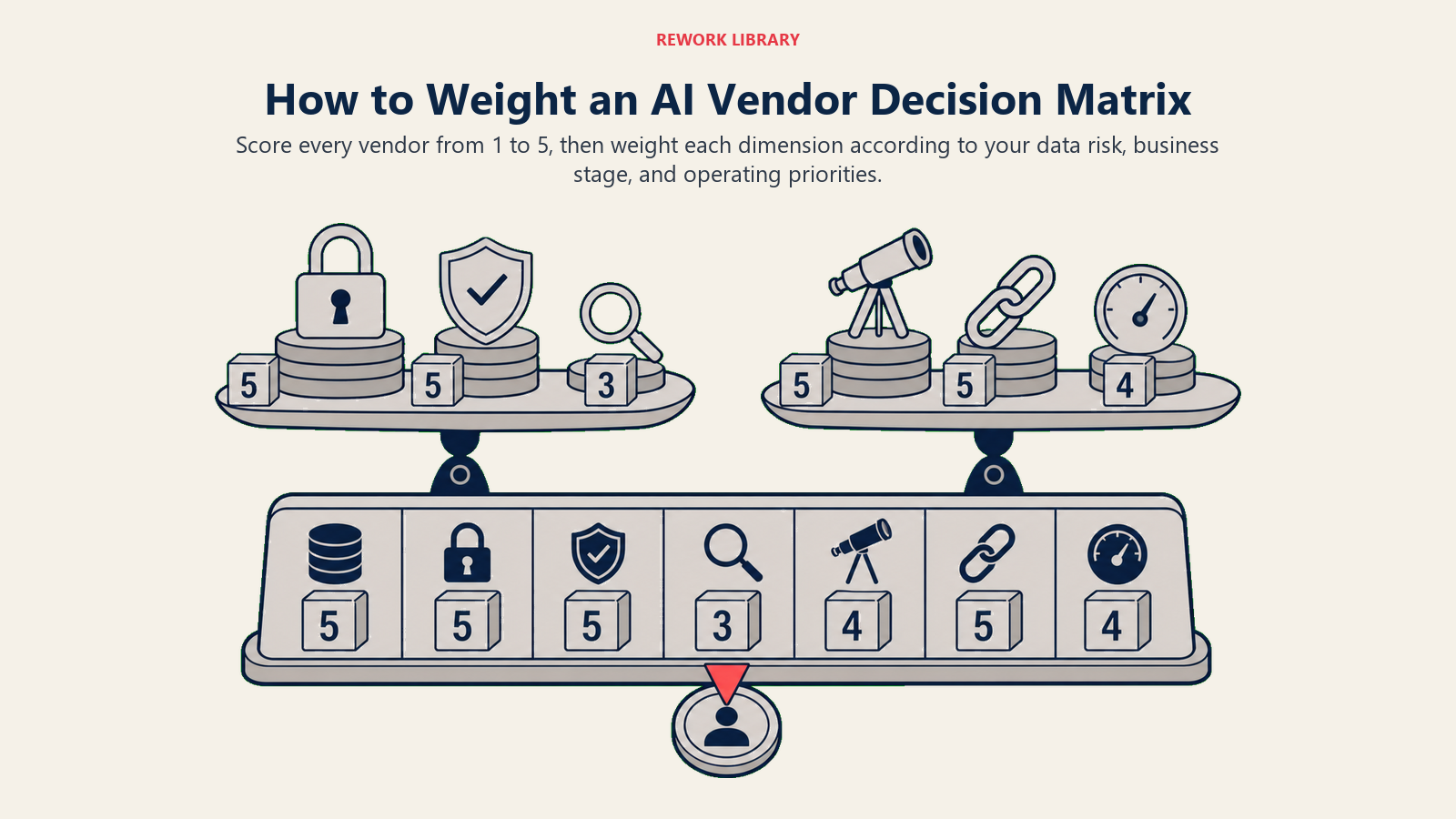
Para uma organização de serviços financeiros regulada com dados sensíveis de clientes, Compliance (peso 25%) e Práticas de Dados (peso 20%) podem dominar a ponderação. O framework Data Classification for AI Access ajuda a determinar quais categorias de dados estão no escopo antes de atribuir pesos a essas dimensões. Adequação de Capacidade (15%), Profundidade de Integração (15%), Precificação (10%), Estabilidade do Fornecedor (10%) e Flexibilidade de Modelo (5%) completam o restante.
Para uma empresa SaaS em estágio inicial escolhendo uma ferramenta de IA de produtividade sem dados sensíveis, Adequação de Capacidade (30%), Precificação (25%) e Profundidade de Integração (20%) podem dominar, com Práticas de Dados (15%), Flexibilidade de Modelo (5%), Compliance (3%) e Estabilidade do Fornecedor (2%) ponderados mais baixo.
Pontuação total ponderada = soma de (pontuação da dimensão x peso da dimensão) para cada fornecedor. Isso produz um racional de seleção defensável que não depende do julgamento de nenhum avaliador individual e pode ser apresentado ao procurement, jurídico ou um comitê do conselho como um processo documentado.
O Sprint de Avaliação de 4 Semanas
O formato de sprint cria estrutura suficiente para chegar a uma decisão defensável sobre o fornecedor sem deixar a avaliação se alongar indefinidamente.
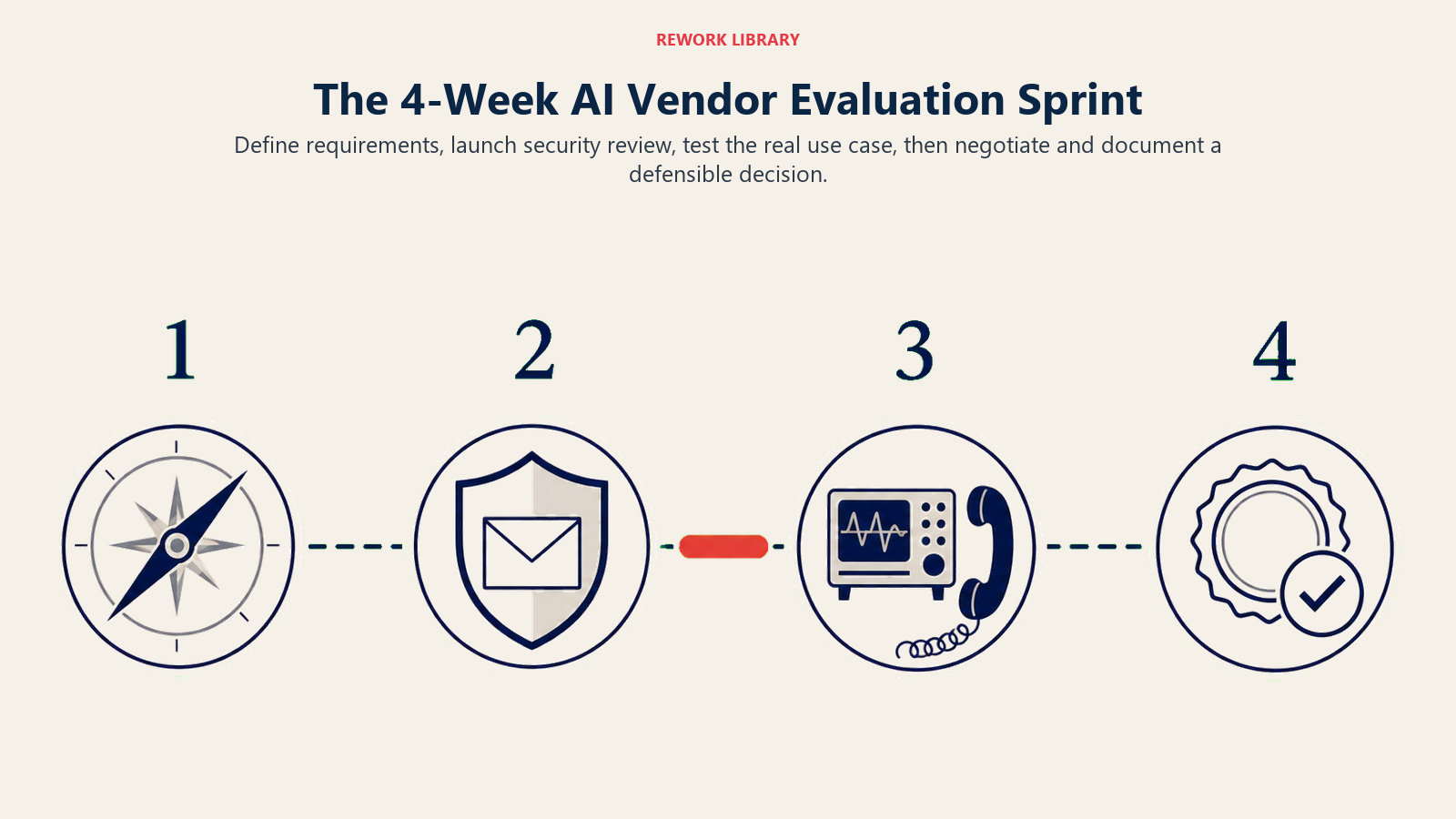
A maioria das avaliações de fornecedores de IA leva de 3 a 6 meses porque não têm uma estrutura. Um sprint de 4 semanas com responsabilidade clara e entregáveis por semana leva você a uma decisão que pode defender.
Semana 1: Requisitos e shortlist. Defina o caso de uso em termos ACE. Identifique os 3 a 5 fornecedores a avaliar. Atribua responsabilidade de avaliação por dimensão (CIO possui adequação de capacidade, CISO possui práticas de dados e compliance, líder de engenharia possui profundidade de integração).
Semana 2: RFP e início da revisão de segurança. Envie um RFP estruturado que inclua as perguntas das 7 dimensões. Inicie o processo de revisão de segurança para seus 2 principais fornecedores. As revisões de segurança levam mais de 4 semanas para uma avaliação completa, mas você pode identificar problemas desqualificantes nas primeiras duas semanas de um questionário padrão.
Semana 3: Avaliação técnica e ligações de referência. Execute uma prova de conceito técnica no seu caso de uso real, não um demo fornecido pelo fornecedor. Complete ligações de referência com clientes existentes. Avalie a profundidade de integração no seu ambiente real.
Semana 4: Termos comerciais e decisão. Negocie termos comerciais e disposições contratuais-chave. Finalize a pontuação da matriz de decisão. Documente o racional de seleção para procurement e jurídico.
Observe que este sprint aborda as duas primeiras semanas de uma revisão de segurança, não a revisão completa. Para sistemas de alto risco sob GDPR ou EU AI Act, você precisará de uma revisão de segurança completa antes de assinar. O sprint leva você a um shortlist de um fornecedor em que você tem confiança, que então prossegue para revisão de segurança completa enquanto você negocia os termos.
Aplicando Isso a Vendas e IA Operacional
Para organizações que avaliam IA para operações de vendas e fluxos de trabalho de CRM especificamente, o mercado de fornecedores inclui plataformas de propósito específico em vários preços.
No extremo SMB e mid-market, plataformas de IA de vendas de propósito específico como o Revenue Engine do Rework ($159/mês com cobrança anual, com 5 assentos de marketing e 5 de vendas) oferecem uma opção de Buy que cobre o CRM, sequências, automação e caixa de entrada multicanal como um bundle. Equipes que só precisam do CRM podem começar no Sales Engine a $69/mês com cobrança anual para 5 assentos de vendas. O framework de avaliação acima ainda se aplica, particularmente as dimensões 1, 2 e 6.
Para organizações maiores que escolhem entre IA de vendas de propósito específico e CRM empresarial com add-ons de IA, o framework de avaliação é o mesmo, mas a pontuação em profundidade de integração e estabilidade do fornecedor provavelmente favorecerá fornecedores estabelecidos, enquanto precificação e flexibilidade de modelo provavelmente favorecerão ferramentas mais novas de propósito específico. O framework Build vs. Buy vs. Integrate Decision cobre como o estágio de maturidade da sua organização deve influenciar esse trade-off.
Antes de finalizar qualquer seleção de fornecedor, o AI Risk Register: What to Track já deve incluir uma entrada para o novo fornecedor como risco pendente. O processo de avaliação informa a coluna de mitigação; os termos do contrato informam o status. E se o fornecedor que você está avaliando é aquele sobre o qual mais se preocupa em relação ao lock-in, AI Vendor Lock-In: Mitigation Strategies cobre as disposições contratuais específicas e as decisões arquiteturais que protegem você independentemente do fornecedor que você selecionar.
O vendor evaluation framework não é uma garantia de uma boa seleção. É uma garantia de que quando a seleção não funcionar conforme o esperado, você tem documentação do que avaliou, o que o fornecedor representou e por que tomou a decisão que tomou. Em um ambiente regulatório que está se tornando mais rigoroso, essa documentação importa tanto quanto a própria ferramenta.
Perguntas Frequentes
Quais são as 7 dimensões de avaliação de fornecedores de IA?
As 7 dimensões são: Adequação de Capacidade (faz o que você realmente precisa em produção?), Práticas de Dados (uso de dados de treinamento, residência, retenção), Profundidade de Integração (conectores nativos, qualidade de API, webhooks), Flexibilidade de Modelo (divulgação do modelo subjacente, política de descontinuação, controle de versão), Modelo de Precificação (trajetória de custo em escala, risco de excedente, cenários de pior caso), Certificações de Compliance e Segurança (SOC 2 Type II, GDPR DPA, ISO/IEC 42001) e Estabilidade do Fornecedor (runway de financiamento, clientes de referência, continuidade executiva).
Qual é o primeiro passo antes de avaliar qualquer fornecedor de IA?
Mapeie seu caso de uso para as capacidades ACE antes de qualquer avaliação de fornecedor começar. Identifique quais das cinco capacidades (Ingest, Analyze, Predict, Generate, Execute) seu caso de uso requer, e em qual profundidade. Em seguida, mapeie o produto de cada fornecedor para essas mesmas capacidades usando perguntas precisas, não materiais de marketing. Um fornecedor que não consegue explicar seu produto em termos de quais dados ingere, analisa, prevê, gera e executa não conhece bem o próprio produto para implantá-lo no seu ambiente.
Quais red flags de fornecedores de IA devem interromper a avaliação?
Red flags que devem encerrar a avaliação independentemente de outras pontuações: sem certificação SOC 2 Type II para um produto que lida com dados sensíveis, respostas vagas ou evasivas sobre se seus dados treinam os modelos deles, atualizações de modelo enviadas sem notificação ao cliente ou opção de exclusão, precificação empresarial exigindo um contrato personalizado antes de fornecer informações básicas de capacidade ou compliance e apenas dados de precisão em ambiente de demo sem benchmarks de ambiente de produção.
Como a precificação de fornecedores de IA deve ser avaliada?
Avalie a precificação em relação ao seu modelo de uso esperado e obtenha cenários de custo no pior caso. Pergunte especificamente sobre clientes que experimentaram estouros de custo inesperados e o que os causou. Os custos de IA subiram 108% em 2025, com 78% dos líderes de TI experimentando cobranças inesperadas. A precificação por token ou por chamada de API pode tornar-se ordens de magnitude mais cara do que alternativas de taxa fixa em escala. A precificação deve ser testada sob estresse, não aceita ao valor de face do demo.
Quais certificações de compliance um fornecedor de IA deve ter?
Os requisitos mínimos dependem do seu setor e dos tipos de dados. Requisitos principais: SOC 2 Type II (não Type I), GDPR Data Processing Agreement se processar dados pessoais da UE e HIPAA Business Associate Agreement se lidar com informações de saúde protegidas. Padrão emergente: ISO/IEC 42001 para sistemas de gestão de IA. Adições específicas do setor: FINRA para serviços financeiros, FedRAMP para clientes do governo dos EUA, PCI DSS para dados de cartão de pagamento. Certificações listadas como "em andamento" ou expiradas não são compliance.
Como você conduz um sprint de avaliação de fornecedor de IA de 4 semanas?
Semana 1: defina o caso de uso em termos ACE, identifique 3 a 5 fornecedores, atribua responsabilidade por dimensão. Semana 2: envie RFP estruturado cobrindo todas as 7 dimensões, inicie revisão de segurança para os 2 principais fornecedores. Semana 3: execute prova de conceito técnica no seu caso de uso real (não demo do fornecedor), complete ligações de referência. Semana 4: negocie termos comerciais, finalize pontuações da matriz de decisão, documente o racional de seleção. O sprint produz um shortlist de um fornecedor em que você tem confiança, que então prossegue para revisão de segurança completa enquanto você negocia os termos.

Co-Founder, Rework.com
On this page
- A Etapa de Mapeamento de Capacidade ACE (Faça Isso Primeiro)
- As 7 Dimensões de Avaliação
- Dimensão 1: Adequação de Capacidade
- Dimensão 2: Práticas de Dados
- Dimensão 3: Profundidade de Integração
- Dimensão 4: Flexibilidade de Modelo
- Dimensão 5: Modelo de Precificação
- Dimensão 6: Certificações de Compliance e Segurança
- Dimensão 7: Estabilidade do Fornecedor
- O Scorecard de Fornecedores de IA de 7 Dimensões
- Red Flags que Devem Interromper a Avaliação
- O Formato da Matriz de Decisão
- O Sprint de Avaliação de 4 Semanas
- Aplicando Isso a Vendas e IA Operacional