IP e Direitos Autorais em Outputs de IA: O que CEOs e Equipes Jurídicas Precisam Saber em 2026
 Sua equipe de marketing gera 200 peças de conteúdo por mês com assistência de IA. Seus desenvolvedores usam o GitHub Copilot para escrever código de produção. Sua equipe jurídica rascunha cláusulas contratuais usando o Claude. Sua equipe de produto gera copy de UI com um fluxo de trabalho de IA personalizado.
Turn this article into takeaways for your work.


Each assistant summarizes the article only for you and suggests best practices for your work.
Sua política de IP foi escrita em 2019. Não menciona nada sobre IA.
Essa lacuna existe na maioria das organizações, e ela cria três categorias de exposição que o general counsel e os CEOs precisam entender. O ACE Framework (Ingest, Analyze, Predict, Generate, Execute) é contexto útil aqui: a capacidade Generate cria o maior volume de questões de IP porque produz artefatos em escala, enquanto a capacidade Execute cria as mais consequentes porque as ações de IA podem acionar direitos de terceiros sem revisão humana.
Você pode não possuir o que sua IA produz. Você pode reproduzir involuntariamente conteúdo que não tem o direito de reproduzir. E quando seus clientes fazem upload de dados para seus sistemas de IA, a questão de quem possui os outputs derivados pode não ser respondida a seu favor.
Nenhum desses riscos é totalmente resolvido pela lei existente. O cenário jurídico para IA e propriedade intelectual (IP) está sendo ativamente contestado em 2026, com vários casos importantes em descoberta ou apelação nos EUA, na UE e no Reino Unido. Mas existem posições defensáveis, e as organizações que estabelecem essas posições claramente em seus contratos e políticas agora estarão melhor posicionadas do que aquelas que esperam a lei se estabilizar.
Este artigo não é aconselhamento jurídico. É um framework para CEOs, general counsels (GCs) e CIOs entenderem as dimensões de exposição, avaliarem sua postura atual e identificarem as lacunas de política e contrato que vale a pena abordar.
A Questão de Titularidade: Status Jurídico Atual
Fatos Relevantes: Direitos Autorais e IP de IA
- Mais de 70 processos de infração foram movidos por titulares de direitos autorais contra empresas de IA, com o acordo Bartz v. Anthropic em 2025 produzindo um pagamento de $1,5 bilhão, o maior na história dos direitos autorais dos EUA. (Copyright Alliance)
- O Supremo Tribunal dos EUA negou certiorari em março de 2026, reafirmando a autoria humana como requisito fundamental da lei de direitos autorais dos EUA e encerrando o argumento de que os outputs de IA podem receber proteção independente de direitos autorais.
- 72% das empresas do S&P 500 divulgaram pelo menos um risco material de IA em 2025, ante 12% em 2023, com exposição de IP e direitos autorais entre as categorias divulgadas com mais frequência. (Harvard Law School Forum)
A questão fundamental é simples: se uma IA gera uma peça de conteúdo, quem a possui?
Nos Estados Unidos, o Copyright Office declarou claramente que obras geradas inteiramente por IA sem autoria humana não são elegíveis para proteção por direitos autorais sob a lei existente. A Lei de Direitos Autorais protege obras originais de autoria criadas por autores humanos. A IA não é um autor legal.
A orientação de IA do US Copyright Office e seu Relatório de Copyrightabilidade Parte 2 (janeiro de 2025) esclarecem essa posição: conteúdo gerado por IA com "autoria humana suficiente" pode receber proteção de direitos autorais, mas o Copyright Office avalia as reivindicações de autoria humana caso a caso. Quanto mais um humano criou a expressão específica (não apenas forneceu um prompt genérico), mais forte é a reivindicação. O Office também exige que os requerentes divulguem conteúdo gerado por IA nas solicitações de registro e expliquem as contribuições específicas do autor humano.
O que isso significa na prática: se seu funcionário escreve um prompt que diz "escreva um post de blog sobre interrupções na cadeia de suprimentos", o conteúdo resultante pode não ser protegível por direitos autorais. Se seu funcionário escreve um briefing criativo detalhado, edita substancialmente o rascunho da IA, adiciona análise original e faz escolhas expressivas específicas ao longo do processo de revisão, o trabalho resultante tem uma reivindicação mais forte de autoria humana. A lei não traça uma linha clara, e tribunais diferentes podem traçá-la de forma diferente.
O caso Thaler v. Perlmutter (2023) confirmou que obras totalmente geradas por IA sem autoria humana não podem receber direitos autorais. O tribunal descobriu que o Registro de Direitos Autorais estava correto ao recusar direitos autorais para uma imagem gerada por um sistema de IA sem contribuição criativa humana significativa. Esse caso abordou o cenário apenas-IA. O cenário parcialmente-autorado-por-humano ainda está sendo desenvolvido.
Na União Europeia, a situação é semelhante em princípio, mas complicada pelo EU AI Act. O framework de direitos autorais da UE requer autoria humana para proteção. O EU AI Act não resolve diretamente a titularidade dos direitos autorais, mas impõe requisitos de transparência sobre conteúdo gerado por IA, particularmente exigindo divulgação quando a IA gera conteúdo que poderia enganar os consumidores sobre sua origem humana.
A lei da UE fornece um direito vizinho para criadores de bancos de dados e alguns direitos relacionados adicionais que podem se aplicar a compilações assistidas por IA, mas a questão de titularidade para conteúdo expressivo gerado por IA é substancialmente a mesma que nos EUA.
No Reino Unido, a Lei de Direitos Autorais, Projetos e Patentes de 1988 inclui uma disposição para "obras geradas por computador" que pode permitir direitos autorais para outputs de IA onde não há autor humano, com a proteção recaindo na pessoa "por quem os arranjos necessários para a criação da obra são empreendidos." Se essa disposição se estende aos outputs modernos de IA generativa é não testado, e os tribunais do Reino Unido não se pronunciaram sobre ela até 2026.
A implicação prática para o seu negócio: Se sua IA gera conteúdo que é inteiramente ou substancialmente gerado por IA com contribuição criativa humana mínima, você pode não possuí-lo no sentido tradicional de direitos autorais. Concorrentes poderiam reproduzir seus posts de blog gerados por IA, copy de marketing ou descrições de produtos sem infringir seus direitos autorais.
Isso não significa que o conteúdo gerado por IA seja sem valor ou desprotegível. A proteção de segredo comercial pode se aplicar aos seus prompts e fluxos de trabalho. Os direitos de banco de dados podem se aplicar a compilações. As proteções contratuais podem restringir a reprodução independentemente dos direitos autorais. Mas a suposição simples de que "nós fizemos, nós possuímos" pode não se sustentar para outputs totalmente gerados por IA.
Documentação como Mitigação de Risco
A ação individual mais forte que as organizações podem tomar para proteger o trabalho assistido por IA é documentar a contribuição criativa humana a esse trabalho.
Isso significa:
- Manter registros das decisões editoriais humanas, não apenas o output final
- Documentar os prompts, revisões e escolhas de seleção humana que moldaram o trabalho final
- Garantir que a criação de conteúdo assistida por IA envolva revisão e modificação humana significativa, não apenas aceitação do output de IA
- Manter histórico de versões que mostra onde os humanos fizeram escolhas expressivas distintas da geração original da IA
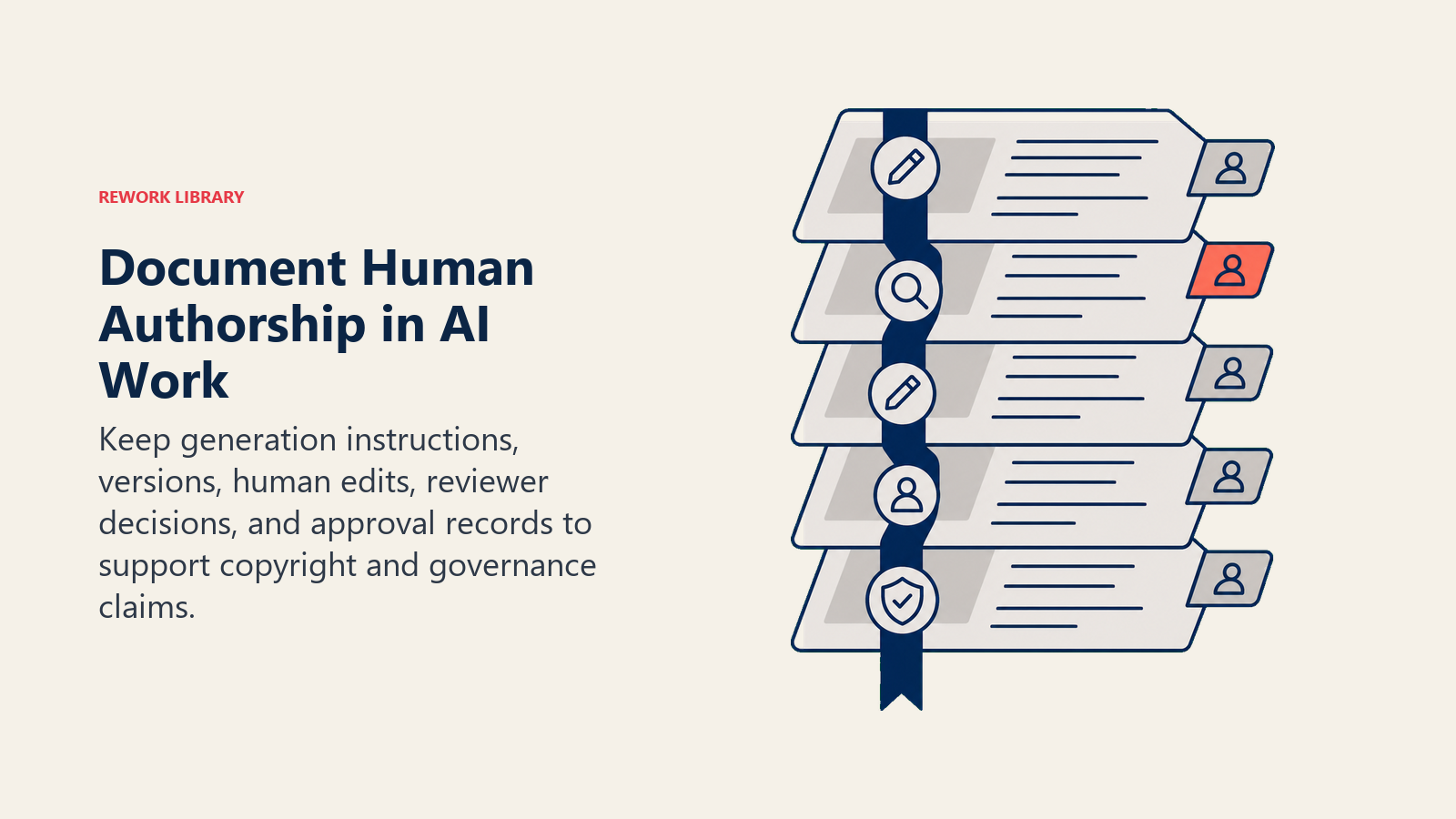
Essa documentação serve a dois propósitos. Fortalece as reivindicações de direitos autorais em jurisdições que exigem autoria humana. E estabelece um registro de envolvimento humano que pode se tornar relevante em contextos contratuais ou regulatórios.
O ônus da documentação não é grande. Um log simples de: prompt usado, edições humanas feitas, revisor que aprovou e data cria uma trilha de registro significativamente mais forte do que nenhuma documentação. O artigo Building Your AI Use Policy oferece o framework de política que torna essa documentação uma parte padrão dos fluxos de trabalho assistidos por IA, em vez de uma prática ad-hoc que apenas alguns funcionários seguem.
As 3 Perguntas Jurídicas sobre Outputs de IA
As 3 Perguntas Jurídicas sobre Outputs de IA é um framework de decisão para avaliar a exposição de IP e direitos autorais em qualquer fluxo de trabalho de conteúdo gerado por IA: (1) Nós possuímos? (Há autoria humana documentada suficiente para reivindicar direitos autorais nesta jurisdição?), (2) Infringe? (O output de IA reproduz dados de treinamento que o fornecedor não tinha o direito de usar, e estamos na cadeia de responsabilidade?), e (3) Nossos contratos cobrem? (Tanto os contratos de fornecedores quanto os contratos de clientes abordam explicitamente a titularidade de outputs de IA, o não uso de dados de treinamento e o escopo de indenização?). Cada pergunta requer uma avaliação diferente e um conjunto diferente de mitigações.
Citável: "O Supremo Tribunal dos EUA negou certiorari em março de 2026, reafirmando a autoria humana como requisito fundamental da lei de direitos autorais dos EUA. Se sua IA gera conteúdo com contribuição criativa humana mínima, você pode não possuí-lo no sentido tradicional de direitos autorais, e concorrentes poderiam reproduzi-lo sem infringir seus direitos."
Citável: "O acordo Bartz v. Anthropic produziu um pagamento de $1,5 bilhão em 2025, o maior na história dos direitos autorais dos EUA. As cláusulas de indenização de IP em contratos corporativos de IA têm valor real, mas não testado. 'O fornecedor fez isso' não é uma defesa completa." (Copyright Alliance)
Citável: "A maioria das políticas de IP corporativas foi escrita para um mundo pré-IA. Se sua política não menciona nada sobre IA, ela não responde quem possui o relatório derivado de IA gerado a partir de dados de clientes, se o post de blog que sua equipe de marketing produziu este mês é protegível por direitos autorais, ou o que seus funcionários estão autorizados a colar em ferramentas externas de IA."
| Tipo de Exposição | Quem é Responsável | Principal Mitigação | Cobertura Contratual |
|---|---|---|---|
| Lacuna de titularidade do output | Sua organização (sem direitos autorais para trabalho apenas-IA) | Documentar contribuições e decisões de revisão de autoria humana | Concessão explícita de titularidade de output pelo fornecedor |
| Infração de dados de treinamento | Principalmente o fornecedor; sua org na cadeia de reprodução | Usar contratos corporativos com indenização de IP; evitar categorias de conteúdo de alto risco | Cláusula de indenização de IP com limite mínimo de cobertura |
| Ambiguidade de IP de dados de clientes | Não resolvida sem termos explícitos do contrato do cliente | Atualizar termos SaaS para abordar titularidade de output derivado de IA | Cláusula do contrato do cliente sobre titularidade de output de IA e não uso de dados |
| Exposição de dados de funcionários | Sua organização | Política de uso de IA com regras de classificação de dados; lista de ferramentas aprovadas | Contrato corporativo com fornecedor com disposição de não treinamento de dados |
Análise Rework: Com base em padrões de exposição jurídica em 2025 a 2026, as organizações com as posições de IP de IA mais defensáveis compartilham três características: mantêm históricos de versões que documentam onde as decisões editoriais humanas foram tomadas de forma distinta da geração de IA, têm acordos corporativos atuais revisados pelo jurídico (não apenas aceitos por meio de termos padrão de clique), e sua política de IP nomeia explicitamente o conteúdo gerado por IA como uma categoria que requer documentação e revisão antes da publicação.
Risco de Contaminação de Dados de Treinamento
A segunda dimensão de exposição é sobre o que foi para os modelos de IA que você está usando. Se um modelo de fundação foi treinado em material protegido por direitos autorais, e o modelo reproduz esse material de perto, você (como usuário) pode estar na cadeia de responsabilidade por essa reprodução.
Este é o núcleo dos principais casos de litígio atualmente em andamento.
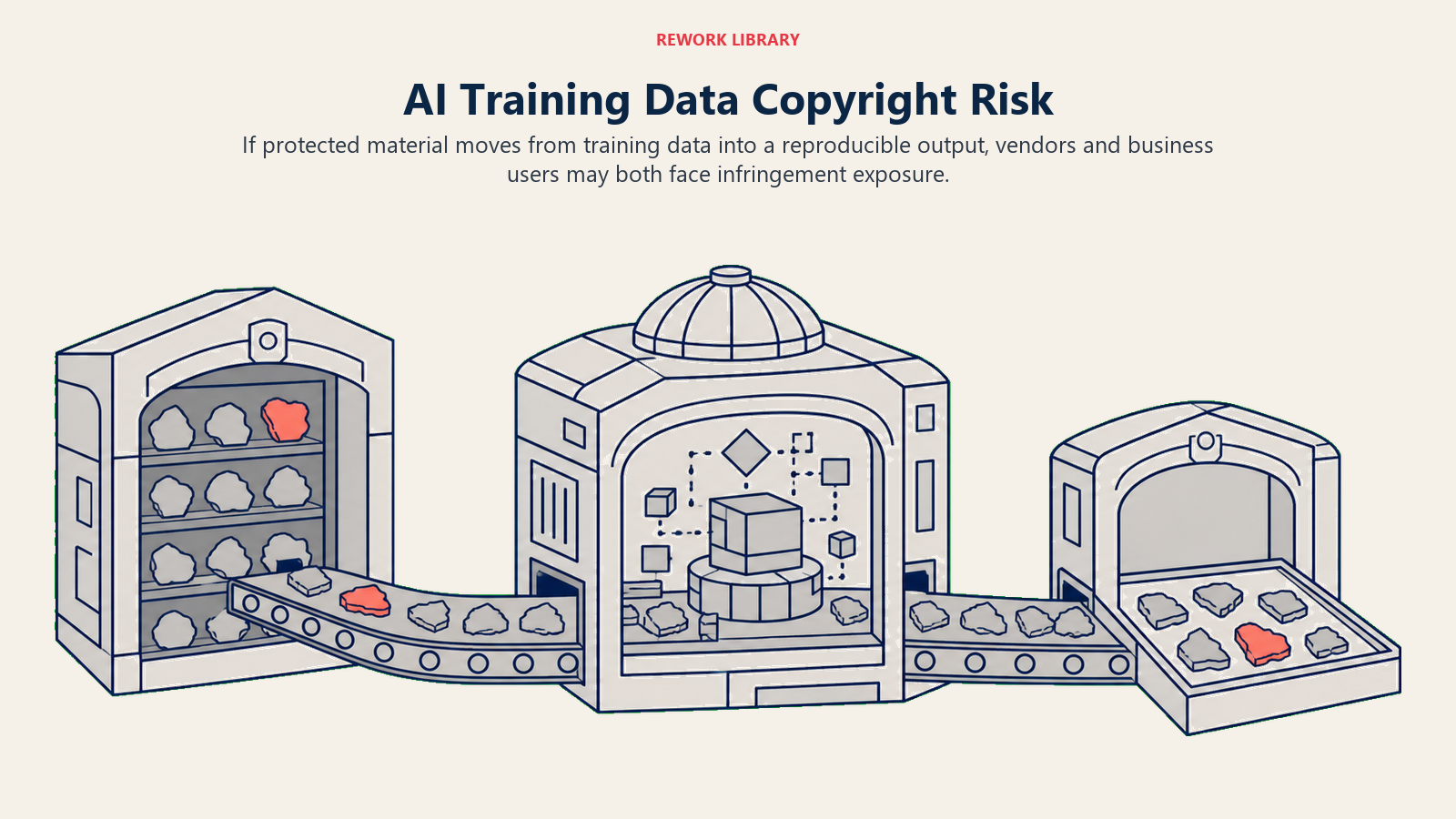
The New York Times v. Microsoft Corporation (1:23-cv-11195), movido em dezembro de 2023, alega que os modelos GPT foram treinados em milhões de artigos do Times sem permissão e que os modelos podem reproduzir conteúdo do Times literalmente em resposta a prompts. O caso está em litígio ativo em 2026, com a moção da OpenAI para rejeição parcialmente negada em abril de 2025.
A Getty Images moveu ação contra a Stability AI em várias jurisdições, alegando que o Stable Diffusion foi treinado na biblioteca de imagens licenciadas da Getty sem permissão e que o modelo pode gerar imagens que se assemelham estreitamente aos originais da Getty, incluindo suas marcas d'água.
A Authors Guild moveu uma ação coletiva em nome de autores cujos livros foram alegadamente usados em dados de treinamento de LLM (large language model) sem consentimento.
Esses casos ainda não produziram resultados definitivos, mas estão criando quatro tipos de risco de negócio:
Exposição a infração direta: Se os modelos de IA que você usa produzem conteúdo que reproduz estreitamente obras protegidas por direitos autorais, você está potencialmente na cadeia de reprodução. A questão de se você ou seu fornecedor é a parte primária responsável está sendo contestada, mas "o fornecedor fez isso" não é uma defesa completa. O Vendor Evaluation Framework for AI Tools inclui a indenização de IP como uma dimensão pontuada na avaliação de práticas de dados, que é onde você deve revelar essa exposição antes de assinar qualquer contrato corporativo de IA.
Incerteza de valor de indenização: A maioria dos fornecedores de IA oferece alguma forma de indenização de IP em seus acordos corporativos. Mas o escopo, os limites e a executoriedade dessas cláusulas de indenização são não testados nos principais casos. Até que os casos se resolvam, o valor da indenização é especulativo.
Obrigações de transparência de dados de treinamento: O EU AI Act (eficaz para muitas disposições em 2025 e 2026) exige que provedores de modelos de IA de propósito geral publiquem resumos dos dados de treinamento usados. Essa é principalmente uma obrigação sobre os provedores de IA, não sobre os implantadores. Mas cria pressão por visibilidade sobre o que entrou nos modelos que você está implantando.
Exposição específica do setor: O risco de dados de treinamento é maior em algumas categorias de conteúdo do que em outras. Os sistemas de IA que geram código (litígio do GitHub Copilot), arte visual (litígio da Midjourney, Stability AI) e conteúdo adjacente ao jornalismo (NYT v. OpenAI) são os mais ativamente contestados. Se os seus outputs de IA se enquadram nessas categorias, o risco de dados de treinamento é mais agudo.
O que os Contratos de Fornecedores Realmente Dizem
Os contratos corporativos de fornecedores de IA variam substancialmente nas disposições de IP. Revisar a linguagem real do contrato é essencial; os materiais de marketing dos fornecedores sobre IP não são confiáveis.
Cláusulas principais a procurar e negociar:
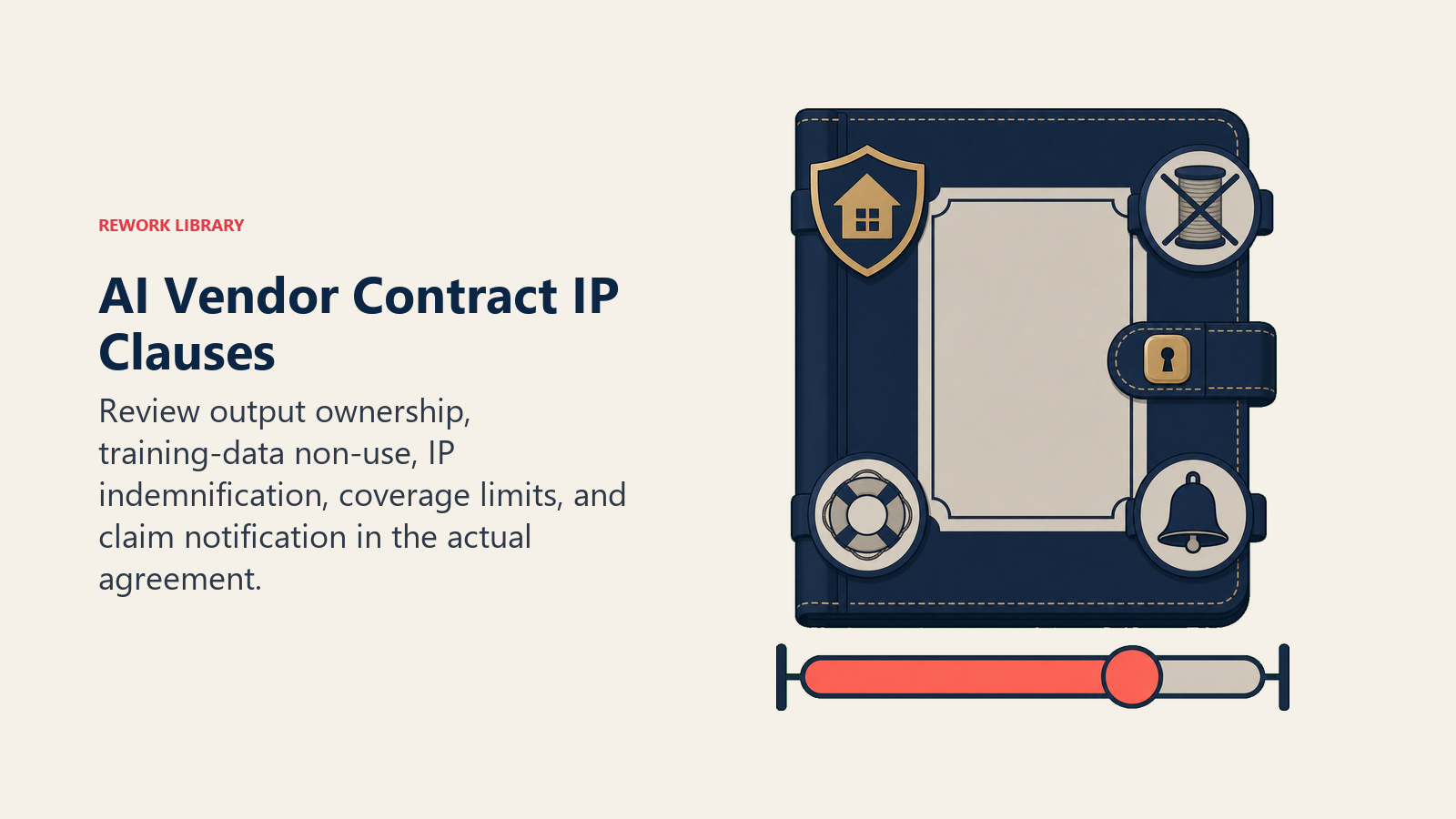
Concessão de titularidade de IP: O fornecedor concede explicitamente a você a titularidade dos outputs gerados usando o serviço? Os termos corporativos da OpenAI declaram que o cliente possui as entradas e os outputs. Os termos comerciais da Anthropic também concedem a titularidade do output ao cliente. Mas "titularidade" em uma jurisdição que pode não reconhecer direitos autorais gerados por IA é titularidade de menos do que você pensa.
Não uso de dados de treinamento: Os acordos corporativos dos principais provedores tipicamente proíbem o uso de suas entradas para treinamento de modelos. Confirme que isso está no seu contrato específico, e que se aplica tanto aos seus prompts quanto a quaisquer dados de usuário que esses prompts incluam.
Indenização de IP: O fornecedor te indeniza contra reivindicações de IP de terceiros decorrentes dos outputs de IA? Quais são os limites, exclusões e condições? A OpenAI e a Microsoft ofereceram programas de indenização de IP; a Anthropic tem disposições semelhantes nos termos corporativos. Mas as cláusulas de "indenização" têm carve-outs, limites em reivindicações cobertas e condições que as tornam menos abrangentes do que parecem. Peça ao jurídico que revise a linguagem específica.
Transparência sobre dados de treinamento: O contrato corporativo fornece informações sobre o que o modelo foi treinado? Isso raramente está disponível nos termos padrão, mas é relevante para due diligence, especialmente para setores regulados.
Disposições contratuais que você deve negociar se ainda não estiverem presentes:
- Concessão explícita de titularidade de output
- Não uso de dados de treinamento com direitos de auditoria
- Indenização de IP com limite mínimo de cobertura
- Obrigação de notificá-lo se o fornecedor receber uma reivindicação que afete o uso dos outputs
A Questão de IP do Cliente
Se o seu produto usa IA e seus clientes fazem upload de dados para o seu sistema de IA, você tem uma terceira dimensão de exposição: quem possui os insights derivados dos dados dos clientes?
Essa questão se aplica a:
- Produtos SaaS (software-as-a-service) que usam IA para analisar dados carregados pelos clientes
- Funcionalidades de IA que geram relatórios, resumos ou recomendações a partir de dados dos clientes
- Fluxos de trabalho de automação que processam informações dos clientes para produzir outputs assistidos por IA
As respostas precisam estar nos seus contratos com clientes, não ser descobertas por meio de litígios.
Seus contratos com clientes devem abordar:
- Quem possui os outputs derivados de IA que são gerados a partir de dados dos clientes
- Se você pode usar dados dos clientes para melhorar seus sistemas de IA (a maioria dos clientes corporativos dirá que não)
- Como os outputs de IA dos dados dos clientes serão tratados após o encerramento do contrato
- O que os clientes podem e não podem fazer com os insights gerados por IA da sua plataforma
O framework Data Classification for AI Access ajuda a mapear quais categorias de dados dos clientes fluem para quais sistemas de IA, para que seus contratos possam ser específicos sobre tipos de dados em vez de usar linguagem genérica abrangente.
Se os seus termos SaaS atuais não abordam especificamente os outputs derivados de IA, você provavelmente tem disposições escritas para uma arquitetura pré-IA que não se aplicam de forma limpa. A frase "os dados que você faz upload permanecem seus dados" não responde quem possui o relatório de insight que sua IA gerou a partir desses dados.
O que Sua Política de IP Precisa Dizer sobre IA
A maioria das políticas de IP corporativas foi escrita para um mundo onde a criação de IP era impulsionada por humanos. Uma política atualizada precisa abordar três questões específicas de IA.
Reivindicações de titularidade de output de IA e requisitos de documentação. A política deve especificar: qual nível de contribuição humana é necessário antes de sua organização reivindicar direitos autorais no trabalho assistido por IA, qual documentação os funcionários devem manter para suportar essas reivindicações e qual processo de revisão se aplica antes que o conteúdo gerado por IA seja publicado, arquivado ou vendido.
Restrições sobre upload de conteúdo de terceiros para ferramentas de IA. Os funcionários que usam ferramentas de IA regularmente copiam e colam conteúdo de terceiros em prompts (conteúdo de concorrentes para análise, artigos de notícias para resumo, documentos externos para revisão). Sua política de IP precisa abordar: qual conteúdo de terceiros pode ser incluído em prompts de IA, qual é a restrição sobre reproduzir outputs de IA originados de dados de treinamento em trabalho voltado ao público e qual é o processo de escalada quando os funcionários estão incertos.
Tratamento de dados de clientes para outputs derivados de IA. Para organizações com produtos de IA, a política deve estar alinhada com suas disposições de contrato de cliente: quais dados de clientes fluem para sistemas de IA, quem possui os outputs e qual é o processo de governança para mudanças no tratamento de dados de IA.
A política também precisa de um responsável. Questões de política de IA e IP surgirão regularmente e precisarão de respostas tempestivas. Se a política está escrita, mas não há uma pessoa nomeada responsável por responder perguntas de política e escalar situações novas, a política não funciona.
A Posição Honesta para 2026
O enquadramento honesto para este tópico: estamos em um período de incerteza jurídica. Os casos principais não se resolverão nos próximos 12 a 18 meses. Jurisdições diferentes estão se movendo em direções diferentes a velocidades diferentes. Os requisitos regulatórios sobre provedores de IA estão se tornando mais rigorosos, o que pode fornecer melhor visibilidade sobre dados de treinamento no futuro, mas essa transparência não está disponível hoje.
Nesse ambiente, o objetivo não é certeza jurídica. É posicionamento defensável e consciência clara de risco.
Posicionamento defensável: documentar a contribuição humana, negociar contratos de fornecedores com disposições de IP revisadas pelo jurídico e atualizar sua política de IP para abordar a IA explicitamente.
Consciência clara de risco: entender quais dos seus outputs gerados por IA estão em categorias de alto risco (código, arte visual, conteúdo adjacente ao jornalismo), saber quais casos de fornecedores estão em andamento e quais reivindicações fazem, e ter seu general counsel informado sobre a exposição.
Para a entrada do risk register que corresponde ao risco de IP e direitos autorais, AI Risk Register: What to Track oferece o formato de pontuação e rastreamento. Building Your AI Use Policy cobre o framework de política mais amplo do qual essa seção de IP é um componente. E a dimensão de práticas de dados do Vendor Evaluation Framework for AI Tools é onde o risco de IP surge no processo de procurement.
A lacuna entre organizações que fizeram esse trabalho de gestão e aquelas que não fizeram ficará visível quando as primeiras ações de aplicação seguirem os casos pendentes até suas conclusões.
Perguntas Frequentes
Quem possui o conteúdo gerado por IA?
Nos Estados Unidos, o Copyright Office confirmou que obras geradas inteiramente por IA sem autoria humana não são elegíveis para proteção por direitos autorais. O Supremo Tribunal dos EUA reafirmou a autoria humana como fundamental em março de 2026. Se sua IA gera conteúdo com contribuição criativa humana mínima, você pode não possuí-lo sob a lei de direitos autorais, e concorrentes poderiam reproduzi-lo sem infração. Conteúdo assistido por IA com autoria humana substancial documentada tem uma reivindicação mais forte.
Os outputs de IA podem infringir direitos autorais?
Sim. Se o modelo de fundação que você está usando foi treinado com material protegido por direitos autorais sem permissão, e o modelo reproduz esse material de perto, você pode estar na cadeia de responsabilidade por essa reprodução. Mais de 70 processos de infração foram movidos contra empresas de IA em 2026. O acordo Bartz v. Anthropic pagou $1,5 bilhão em 2025. A maioria dos fornecedores de IA corporativos oferece indenização de IP, mas essas cláusulas não foram totalmente testadas nos tribunais e têm limites, carve-outs e condições que requerem revisão jurídica.
Qual documentação de autoria humana é necessária para conteúdo assistido por IA?
Documente: os prompts usados, as decisões editoriais humanas específicas e revisões feitas, quem revisou e aprovou o output, a data e o histórico de versões mostrando onde os humanos fizeram escolhas expressivas distintas da geração da IA. Essa documentação serve a dois propósitos: fortalece as reivindicações de direitos autorais e estabelece um registro de revisão humana que pode ser relevante em contextos contratuais ou regulatórios. O ônus da documentação é baixo. Um log simples cria proteção significativamente mais forte do que nenhuma documentação.
Quais cláusulas de contrato de IP devem estar em todo acordo corporativo de IA?
Quatro cláusulas são essenciais: (1) Concessão explícita de titularidade de output para sua organização. (2) Disposição de não uso de dados de treinamento confirmando que suas entradas não são usadas para treinar os modelos do fornecedor, com direitos de auditoria. (3) Indenização de IP contra reivindicações de terceiros de outputs de IA, com um limite mínimo de cobertura. (4) Obrigação do fornecedor de notificá-lo se receber uma reivindicação que afete o uso dos outputs. "Titularidade" nos termos padrão de clique é menos do que parece quando os direitos autorais subjacentes são incertos.
Quem possui os insights derivados de IA a partir de dados de clientes?
Isso depende inteiramente do que dizem seus contratos com clientes. A maioria dos termos SaaS escritos antes de 2024 não aborda especificamente os outputs derivados de IA. A frase "os dados que você faz upload permanecem seus dados" não responde quem possui o resumo ou análise gerado pela IA a partir desses dados. Os contratos com clientes devem abordar explicitamente: quem possui os outputs derivados de IA a partir de dados dos clientes, se você pode usar dados dos clientes para melhorar seus sistemas de IA, como os outputs de IA são tratados após o encerramento do contrato e o que os clientes podem fazer com os insights gerados por IA da sua plataforma.
O que uma política de IP de IA deve incluir?
Três requisitos específicos de IA: (1) Padrões de documentação de contribuição humana, especificando qual nível de envolvimento criativo humano é necessário antes de sua organização reivindicar direitos autorais no trabalho assistido por IA e quais registros os funcionários devem manter. (2) Restrições sobre conteúdo de terceiros em prompts de IA, especificando quais categorias de conteúdo (materiais de concorrentes, conteúdo licenciado de terceiros, dados confidenciais de clientes) não podem ser incluídos em prompts de ferramentas externas de IA. (3) Regras de tratamento de dados de clientes para outputs derivados de IA, alinhadas com suas disposições de contrato de cliente. A política também precisa de um responsável nomeado que responda perguntas e escale situações novas em tempo real.

Co-Founder, Rework.com
On this page
- A Questão de Titularidade: Status Jurídico Atual
- Documentação como Mitigação de Risco
- As 3 Perguntas Jurídicas sobre Outputs de IA
- Risco de Contaminação de Dados de Treinamento
- O que os Contratos de Fornecedores Realmente Dizem
- A Questão de IP do Cliente
- O que Sua Política de IP Precisa Dizer sobre IA
- A Posição Honesta para 2026