AI CoE vs. Embedded vs. Federated: Como Escolher o Modelo Organizacional Certo

Turn this article into takeaways for your work.


Each assistant summarizes the article only for you and suggests best practices for your work.
Você decidiu construir capacidade de IA na sua organização. Agora vem a pergunta que ninguém parece responder com clareza: onde essa capacidade realmente fica?
A resposta depende muito do estágio em que sua organização está nos 5 Estágios de Maturidade em IA, e o ACE Framework (Ingest, Analyze, Predict, Generate, Execute) ajuda a esclarecer quais capacidades você precisa construir antes de decidir onde abrigá-las.
A IA fica em uma equipe centralizada para a qual as unidades de negócio submetem projetos? A empresa embarca talentos de IA dentro de vendas, finanças, marketing e operações? Existe algum modelo híbrido que captura os benefícios de ambos sem os problemas de nenhum?
A resposta não é "aquele que parece melhor". Ela depende do seu estágio de maturidade, estrutura organizacional, talentos disponíveis e onde você quer estar em três a cinco anos. O custo de mudança entre modelos é alto o suficiente para que escolher o modelo errado agora signifique uma reorganização cara e perturbadora no futuro.
Este artigo oferece a CIOs, COOs e líderes de transformação os três modelos organizacionais com seus trade-offs, o guia de adequação por estágio de maturidade e a realidade dos custos de transição que a maioria das discussões sobre modelos ignora.
Modelo 1: AI Center of Excellence (CoE) Centralizado
Fatos Relevantes: Modelo Organizacional de IA
- Organizações que implantaram plataformas formais de governança de IA têm 3,4x mais probabilidade de alcançar alta eficácia na governança de IA do que aquelas sem uma. (Knostic AI)
- Pesquisas da McKinsey confirmam que gestão de riscos, compliance e governança de dados para IA são mais frequentemente tratados por meio de um modelo CoE totalmente centralizado, enquanto implantação e adoção são mais eficazes por meio de uma estrutura federada hub-and-spoke.
- 45% das organizações com alta maturidade em IA sustentam suas iniciativas por pelo menos três anos, em comparação com apenas 20% entre pares de menor maturidade. (Knostic AI)
Definição: Uma equipe dedicada de IA com um modelo de serviços compartilhados. As unidades de negócio submetem solicitações; o CoE possui a estratégia, constrói capacidades e entrega projetos em toda a organização. Uma equipe, um orçamento, uma estrutura de governança.
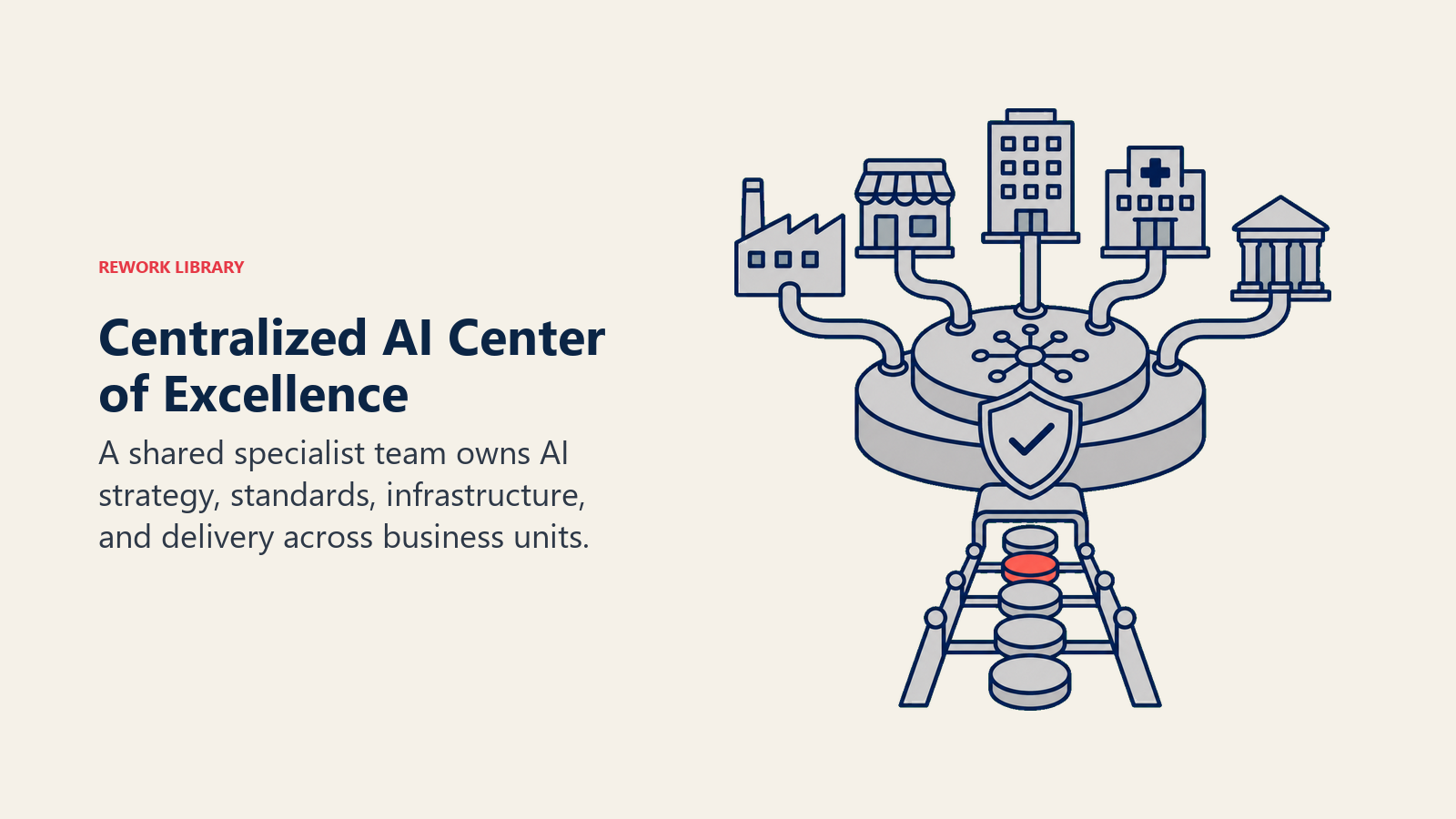
Como funciona na prática: O CoE tipicamente contém 5 a 15 pessoas em empresas de médio porte: engenheiros de AI/ML, cientistas de dados, um gerente de programas e um líder técnico subordinado ao CTO ou CIO. Solicitações das unidades de negócio chegam como projetos. O CoE avalia, prioriza e constrói. Governança, padrões e gestão de fornecedores são centralizados.
Pontos fortes:
Consistência é o benefício principal. Quando uma única equipe é responsável pela implantação de IA em toda a organização, você obtém governança consistente, práticas de dados consistentes, padrões de segurança consistentes e um inventário único de ferramentas de IA em vez de uma proliferação de shadow IT. Setores regulados (serviços financeiros, saúde, jurídico) valorizam isso por permitir que o compliance seja gerenciado centralmente em vez de ser auditado em cada unidade de negócio separadamente.
Concentração de talentos especializados é o segundo benefício. Construir uma equipe pequena e profunda de engenheiros de IA é mais fácil do que construir uma versão diluída em cada unidade de negócio. O CoE pode desenvolver conhecimento institucional e capacidade sofisticada que modelos fragmentados não conseguem alcançar.
Sem duplicação de infraestrutura. Um banco de dados vetorial, uma estrutura de avaliação de modelos, uma stack de monitoramento. Nos estágios iniciais de maturidade, isso importa mais do que agilidade.
Pontos fracos:
O modelo CoE tem um modo de falha fundamental: o gargalo. Quando todas as necessidades de IA das unidades de negócio precisam passar por uma equipe central com capacidade finita, as unidades que mais precisam de IA ficam esperando na fila. A equipe de vendas quer um modelo de lead scoring no segundo trimestre; ela está na fila atrás de três outros projetos. O CoE não tem o contexto de negócio para entender a urgência. As unidades de negócio não têm o contexto técnico para fornecer especificações úteis. A sobrecarga de comunicação cresce.
O segundo modo de falha é o distanciamento do contexto de negócio. Um engenheiro de IA que não trabalha no processo de vendas não entende instintivamente o que torna um modelo de lead scoring útil para um vendedor. Soluções tecnicamente corretas que não se encaixam no fluxo de trabalho são comuns em modelos centralizados. A unidade de negócio diz que o modelo não funciona. O CoE diz que o modelo funciona bem. Ambos estão certos. A lacuna é contexto.
O risco de "torre de marfim" é a versão nomeada disso: um CoE que constrói soluções impressionantes e tecnicamente sofisticadas que ninguém usa porque foram projetadas por pessoas que não estão próximas do trabalho diário.
Ideal para: Organizações no Estágio 2 a 3. Empresas com talentos limitados de IA que não conseguem realisticamente contratar especialistas embarcados em todo lugar. Setores fortemente regulados onde a centralização da governança é um requisito de compliance. Organizações onde a autonomia das unidades de negócio é baixa (cultura de tomada de decisão mais centralizada em geral).
Liderança: Tipicamente um VP de IA ou Head de AI Engineering subordinado ao CTO. Em empresas maiores com um cargo de Chief AI Officer (CAIO), o CoE se reporta a esse cargo.
Modelo 2: Especialistas Embarcados
Definição: Os talentos de IA e ciência de dados ficam dentro das unidades de negócio, não em uma equipe central. Vendas tem seu próprio analista de IA. Finanças tem um cientista de dados. Marketing tem um especialista em IA. Coordenação leve entre eles; sem função central de IA.
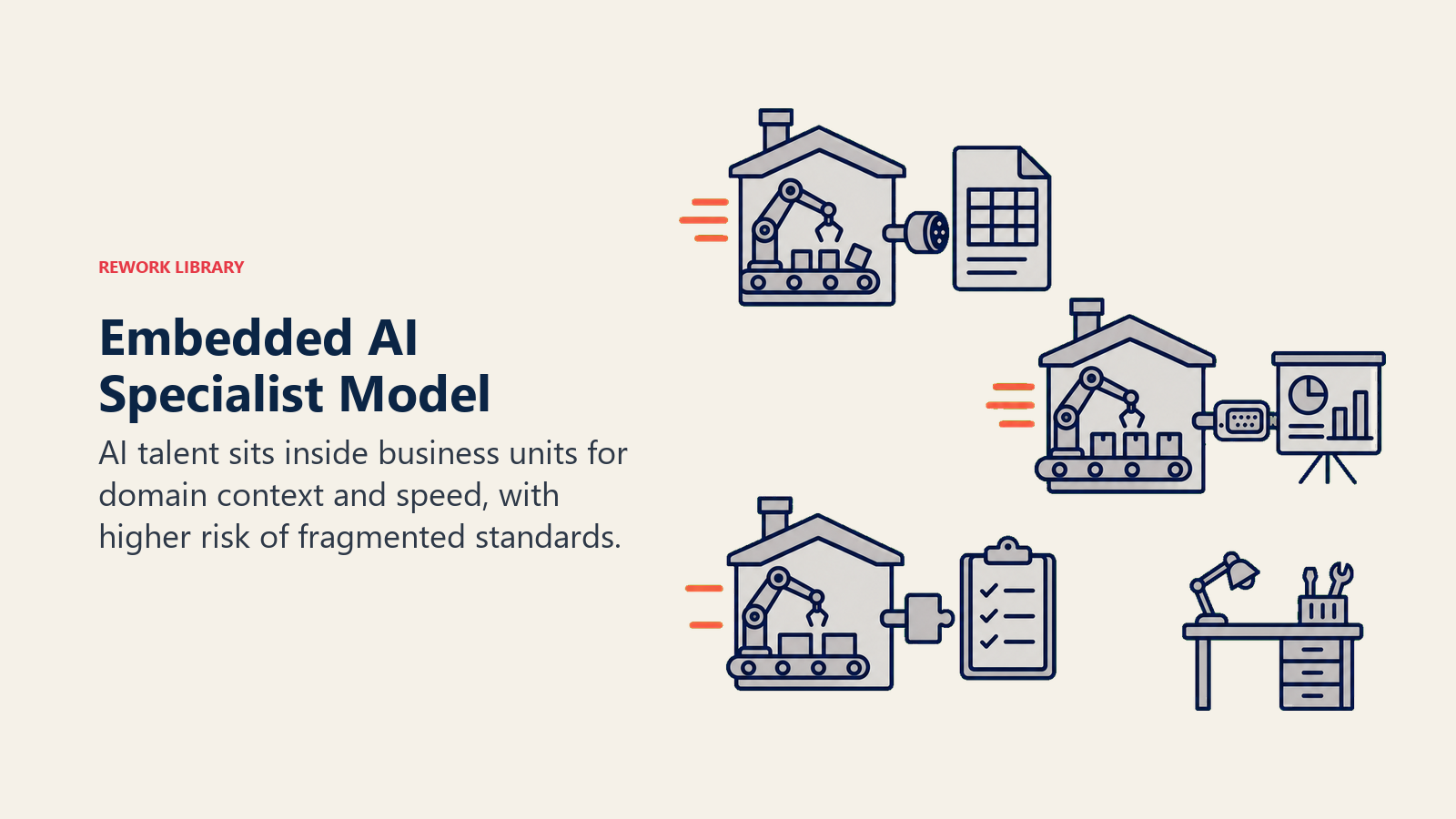
Como funciona na prática: Cada líder de unidade de negócio contrata seus próprios talentos de IA e possui seu roadmap de IA. Pode haver coordenação informal de comunidade de prática, mas sem governança central ou infraestrutura compartilhada. Cada função avança em seu próprio ritmo.
Pontos fortes:
O contexto de domínio é a vantagem principal. Um engenheiro de IA embarcado na função de vendas viu centenas de horas de fluxos de trabalho de vendas, entende quais sinais de Pipeline importam para os vendedores e pode construir ferramentas que se encaixam no trabalho real, não em uma versão teórica. Soluções específicas de unidades de negócio são quase sempre mais adotadas do que soluções construídas pelo CoE porque as pessoas que as construíram entendem o fluxo de trabalho.
Velocidade é a segunda vantagem. Quando a unidade de negócio possui sua capacidade de IA, não há fila, não há processo de intake de projetos, não há sobrecarga de alinhamento entre equipes. Um especialista embarcado pode ir de ideia a protótipo em dias, não em meses.
O alinhamento com as prioridades de negócio é forte por design. O desempenho do especialista embarcado é avaliado pelo líder da unidade de negócio, não por uma equipe central de IA. Os incentivos estão alinhados com o resultado de negócio, não com a sofisticação técnica.
Pontos fracos:
A fragmentação da governança é o risco principal. Sem padrões centralizados, diferentes unidades de negócio acabam com diferentes práticas de dados, diferentes controles de segurança, diferentes stacks de ferramentas de IA e diferentes abordagens de compliance. Em setores regulados, isso é um problema legal. Em todos os setores, cria complexidade de auditoria e proliferação de fornecedores.
Padrões inconsistentes significam que duas unidades de negócio podem implantar o mesmo tipo de ferramenta de IA de formas incompatíveis, criando silos de dados em vez da inteligência integrada que a transformação com IA em última análise requer.
O isolamento de talentos é subestimado. Um único engenheiro de IA embarcado em uma unidade de negócio de 50 pessoas não tem pares técnicos para aprender, revisar código ou colaborar em problemas difíceis. São ilhas. Retenção e desenvolvimento de habilidades sofrem. Os melhores talentos embarcados tendem a sair em busca de ambientes com comunidade técnica.
Mais difícil de gerenciar no nível organizacional. O CIO não tem visibilidade sobre quais ferramentas de IA estão em uso em toda a organização, que dados elas estão acessando ou qual governança existe para elas. Shadow AI é o modelo embarcado levado ao seu ponto lógico final.
Ideal para: Organizações no Estágio 3 a 4 com forte autonomia e cultura de unidades de negócio. Empresas onde velocidade e alinhamento com o negócio importam mais do que consistência de governança. Organizações que já estabeleceram governança centralizada e podem com segurança descentralizar a implantação. Setores de ritmo acelerado onde uma fila de 90 dias no CoE é inaceitável.
Liderança: Cada especialista embarcado se reporta ao seu líder de unidade de negócio. Uma função leve de CIO ou CTO oferece coordenação de comunidade de prática e padrões mínimos de segurança. Sem hierarquia central de IA.
Modelo 3: Federado (Hub-and-Spoke)
Definição: Uma pequena equipe central de plataforma e governança (o hub) combinada com líderes de IA embarcados em cada unidade de negócio principal (os spokes). O hub possui a infraestrutura de plataforma, os padrões de governança e a direção estratégica. Os spokes possuem a implantação específica de domínio, a iteração rápida e as prioridades das unidades de negócio.
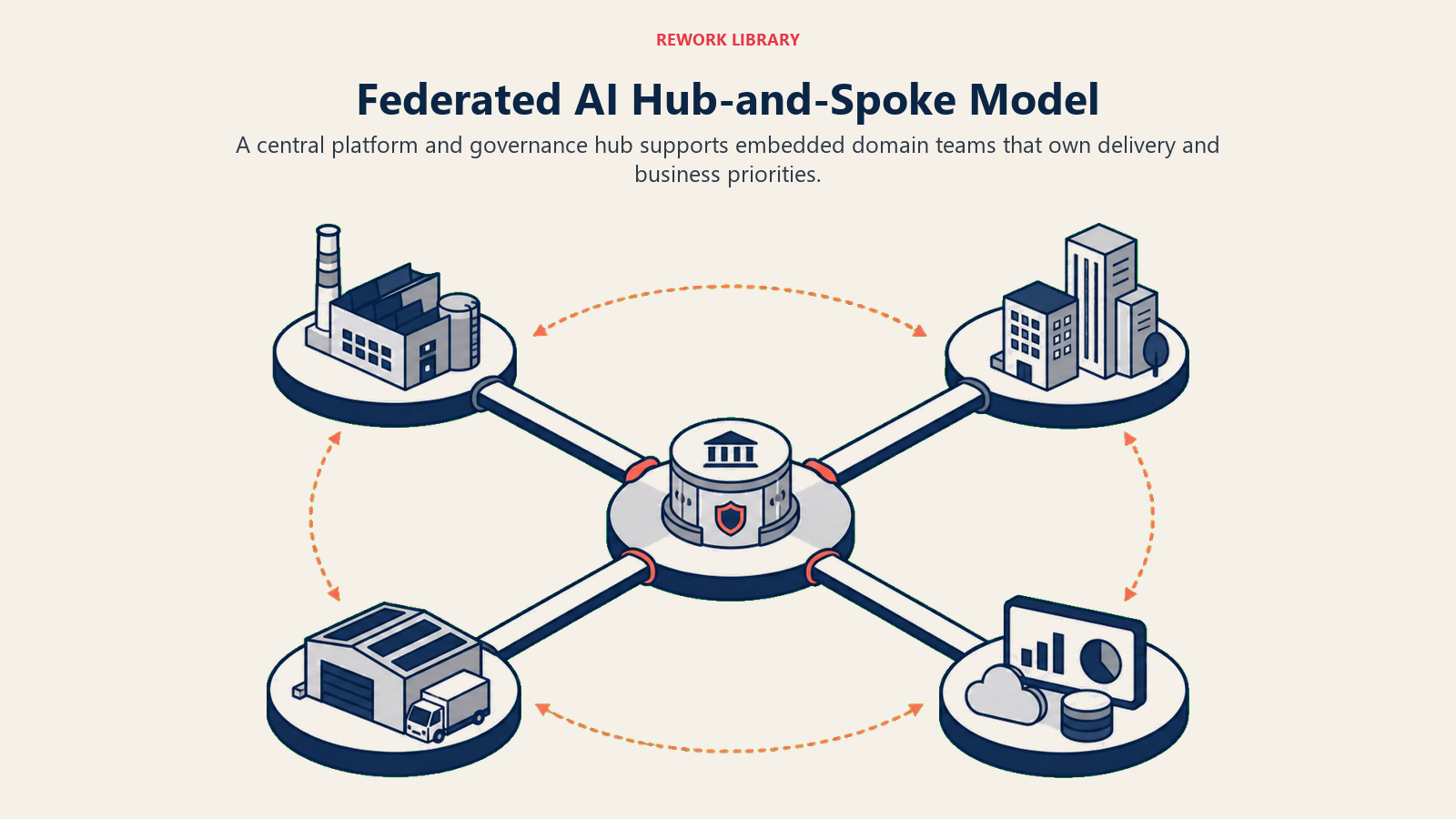
Como funciona na prática: O hub é tipicamente uma equipe pequena de 3 a 8 pessoas: engenheiros de plataforma, um líder de governança e um especialista em avaliação de modelos. Cada unidade de negócio tem um ou dois profissionais de IA dedicados que são responsáveis perante seu líder de unidade de negócio pela entrega, mas alinhados ao hub quanto a padrões, ferramentas e suporte técnico. Os spokes podem se mover rapidamente porque não precisam construir infraestrutura por conta própria. O hub mantém a governança sem precisar possuir cada projeto.
Este é o modelo que a McKinsey descreve em seu framework Rewired como o estado-alvo para grandes organizações que buscam transformação digital e de IA. A formulação específica varia, mas a estrutura central (plataforma compartilhada, expertise de domínio distribuída) aparece consistentemente como o ponto de chegada para organizações que escalaram com sucesso a IA além de programas piloto.
Pontos fortes:
Combina os dois benefícios principais dos outros modelos: a consistência de plataforma e a qualidade de governança do CoE, e o contexto de domínio e a velocidade dos modelos embarcados. Os líderes de IA dos spokes conhecem o negócio; o hub fornece a infraestrutura sobre a qual constroem.
A sobrecarga de coordenação é menor do que parece na prática, porque os spokes estão implantando em infraestrutura compartilhada em vez de construir a própria. A API é padronizada. A arquitetura do Pipeline de dados é padronizada. O checklist de governança é o mesmo para cada implantação de spoke. A variabilidade fica na camada de aplicação, que é onde a expertise das unidades de negócio importa.
O escalonamento é mais suave. Adicionar uma nova unidade de negócio a um modelo federado significa adicionar um novo spoke, não reconstruir o processo de intake do CoE.
Pontos fracos:
A sobrecarga de coordenação ainda é real, mesmo que menor do que em um CoE puro. A relação hub-spoke requer gestão ativa. Spokes que divergem dos padrões do hub criam a mesma fragmentação do modelo embarcado. Governança fraca do hub produz fragmentação mais rapidamente do que nenhuma governança, porque o hub dá falsa confiança de que a coordenação está acontecendo.
A dupla subordinação cria tensão. A prioridade do dia a dia do líder de IA do spoke é determinada pelo seu líder de unidade de negócio, mas seu desenvolvimento de carreira e padrões técnicos estão conectados ao hub. Quando essas prioridades entram em conflito, como ocorrerá, o líder do spoke fica em uma posição difícil. Organizações que projetam mal as relações de subordinação experimentam alta rotatividade nos spokes.
Mais difícil de recrutar. Você precisa tanto de generalistas para o hub (engenharia de plataforma, governança) quanto de especialistas para os spokes (conhecimento de domínio mais capacidade de IA). Essa combinação em uma só pessoa é rara e cara. Muitas organizações constroem o hub primeiro, depois descobrem que não conseguem atrair os talentos certos para os spokes.
Ideal para: Organizações no Estágio 4, tipicamente com ARR acima de $100M e múltiplas linhas de negócio distintas. Empresas com a infraestrutura de gestão para manter dupla responsabilidade sem criar conflito. Organizações que já construíram a infraestrutura centralizada (plataforma de dados, framework de governança) que o hub requer. A maioria das empresas de médio porte não deve tentar começar aqui.
Liderança: Um VP de AI Platform ou VP de AI Engineering dirige o hub, tipicamente subordinado ao CTO ou CAIO. Cada líder de spoke tem uma relação pontilhada com o hub e uma relação contínua com o líder de sua unidade de negócio. O modelo de governança requer que ambas funcionem: autoridade do hub em padrões, autoridade da unidade de negócio em prioridades.
Como escolher conforme o estágio de maturidade
As escolhas de modelo organizacional devem seguir a maturidade, porque a mesma estrutura que acelera pilotos pode desacelerar a adoção em escala mais tarde.
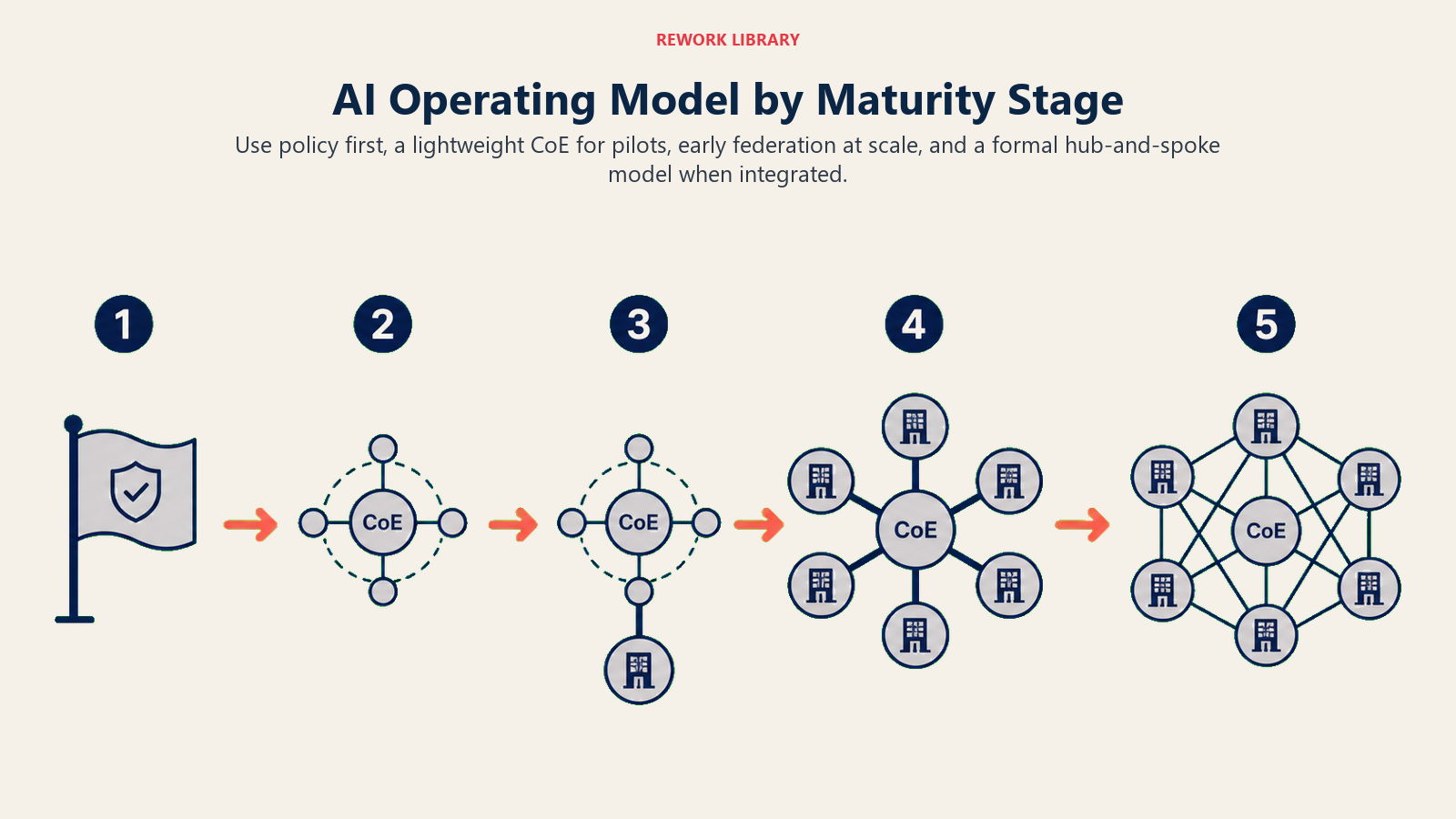
A adequação ao estágio de maturidade é mais determinística do que a maioria das discussões sobre design organizacional reconhece.
Estágio 1 (Ad-hoc): Não construa nenhum modelo dedicado ainda. Você não tem IA suficiente implantada para precisar de uma estrutura de governança. Funcionários individuais usando ChatGPT e Copilot não precisam de um CoE. O investimento certo é política de IA (quais ferramentas são aprovadas, qual classificação de dados se aplica) e treinamento básico em AI literacy. Adicionar complexidade organizacional antes de ter implantações reais para coordenar cria overhead sem valor.
Estágio 2 (Piloto): Comece com um CoE leve ou, para organizações muito pequenas, um único líder de IA com responsabilidades de CoE. A fase piloto requer alguém que possua a governança, avalie fornecedores, gerencie os projetos piloto e construa a infraestrutura de base. Essa é uma função de CoE em forma embrionária. O investimento é modesto (1 a 3 pessoas, orçamento de infraestrutura) e a disciplina de governança estabelecida aqui evita problemas caros no futuro.
Estágio 3 (Escalonado): Comece a embarcar. À medida que você escala além de 2 a 3 casos de uso de IA, o gargalo do CoE aparecerá. A solução é adicionar capacidade embarcada nas unidades de negócio de maior prioridade enquanto mantém a função CoE para governança e plataforma. Este é o modelo federado inicial, embora possa ainda não ser formalizado como tal. O hub é a equipe CoE original; os spokes são os especialistas embarcados nas unidades de negócio que primeiro precisaram de sua própria capacidade.
Estágio 4 (Integrado): Formalize o modelo federado. Quando a IA está embarcada em múltiplos fluxos de trabalho centrais em múltiplas unidades de negócio, e o CoE está principalmente mantendo infraestrutura e governança em vez de construir cada implantação, você chegou ao modelo federado na prática. Formalizá-lo (funções nomeadas de hub e spoke, responsabilidade explícita de governança, caminhos claros de escalada) torna a estrutura informal sustentável.
Estágio 5 (Transformacional): O modelo federado permanece, mas a capacidade de IA tornou-se tão central para o negócio que a distinção entre "função de IA" e "função de negócio" começa a se borrar. O papel do hub muda para pesquisa e desenvolvimento de capacidades emergentes, enquanto os spokes cada vez mais possuem sua própria capacidade.
A realidade dos custos de transição
Esta é a parte que a maioria das conversas sobre design organizacional ignora, e é onde as decisões reais são tomadas.
Passar de um modelo CoE para um modelo federado é caro e perturbador. Requer contratar novos talentos embarcados enquanto retém os talentos do CoE que você está migrando para funções de hub. Requer reescrever a governança para distribuir responsabilidades que estavam anteriormente centralizadas. O Vendor Evaluation Framework for AI Tools torna-se especialmente importante nessa transição: a primeira responsabilidade de governança do hub é frequentemente estabelecer quais ferramentas de fornecedores são padronizadas em toda a organização e quais os spokes podem escolher independentemente. Requer que os líderes de unidades de negócio aceitem a responsabilidade orçamentária por talentos de IA que anteriormente recebiam como serviço compartilhado. E requer que a equipe original do CoE aceite escopo reduzido e possivelmente headcount reduzido.
Essa transição é viável. Mas tipicamente leva de 12 a 18 meses e cria perturbação organizacional significativa durante um período em que você também está tentando escalar implantações de IA. Organizações que descobrem no Estágio 3 que construíram o modelo errado para o Estágio 4 pagam o custo de transição exatamente no momento errado.
A implicação: planeje o estado final antes de construir o estado inicial.
Se você está iniciando um CoE no Estágio 2, projete-o de forma que possa evoluir para um hub. Não construa estruturas de equipe centralizadas que exigirão reconstrução completa para serem descentralizadas. Mantenha a infraestrutura de plataforma centralizada (boa para ambos os modelos) e construa capacidade de entrega de projetos de forma que possa eventualmente migrar para as unidades de negócio.
Se você está construindo capacidade embarcada no Estágio 3, projete-a para que possa se conectar a um hub. Estabeleça padrões agora (mesmo que informalmente) que se tornarão o framework de governança do hub. Não deixe cada especialista embarcado construir sua própria infraestrutura incompatível, porque o primeiro trabalho do hub quando for construído será limpar a fragmentação.
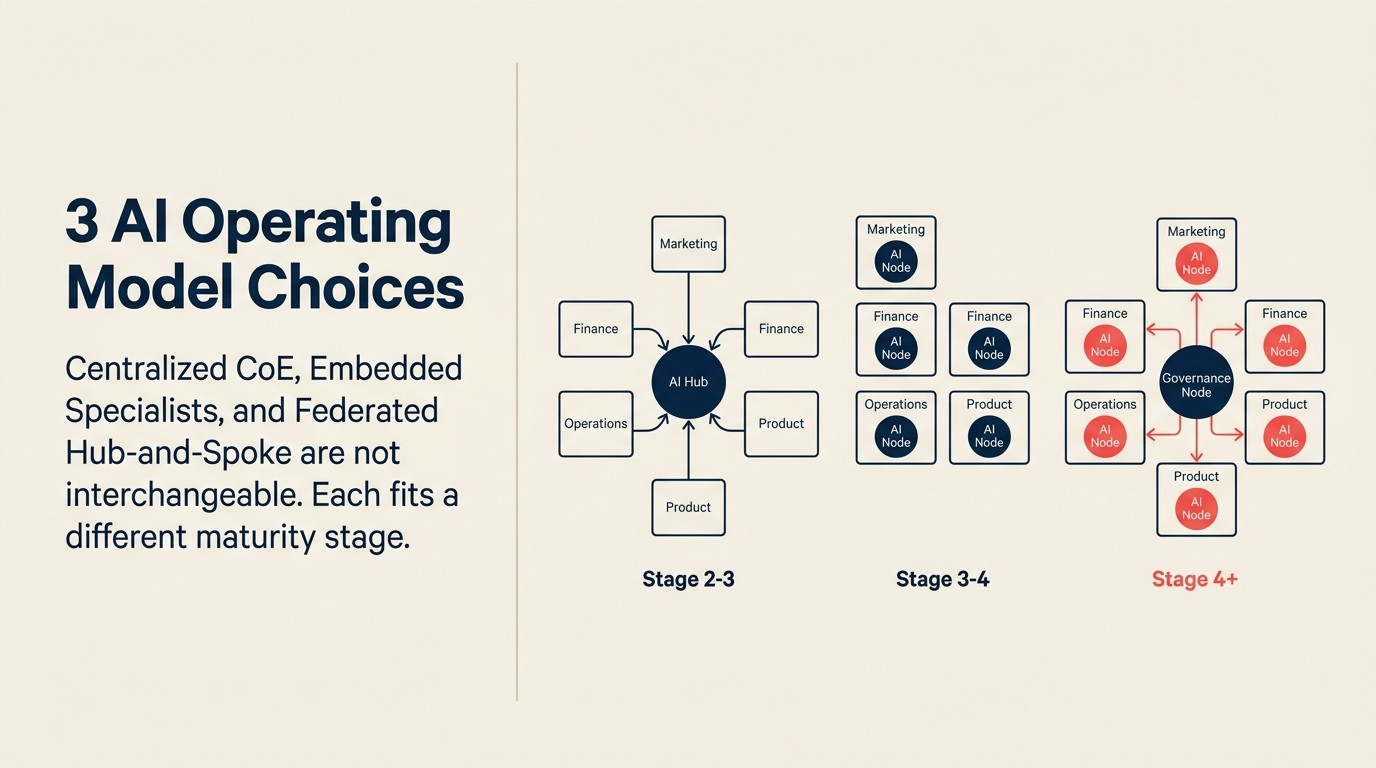
A Escolha de 3 Modelos Operacionais
A Escolha de 3 Modelos Operacionais é um framework de decisão por estágio de maturidade sobre onde a capacidade de IA deve residir em uma organização. As três opções são o AI Center of Excellence centralizado (uma equipe, serviços compartilhados, governança consistente), o modelo de Especialistas Embarcados (talentos de IA dentro das unidades de negócio, contexto de domínio, velocidade máxima) e o Federated Hub-and-Spoke (plataforma e governança centralizadas com spokes de implantação nas unidades de negócio). Cada opção é apropriada em um estágio de maturidade específico e tem um custo de transição alto o suficiente para que escolher o modelo errado para o seu estágio atual crie reorganização cara ao chegar ao próximo.
Citável: "Pesquisas da McKinsey sobre organizações em escala confirmam que risco, compliance e governança de dados são mais frequentemente gerenciados por meio de um CoE centralizado, enquanto implantação e adoção têm mais sucesso por meio de uma estrutura federada. A função de governança permanece central; a função de entrega se distribui."
Citável: "Passar de um modelo CoE para um modelo federado tipicamente leva de 12 a 18 meses e cria perturbação organizacional significativa durante um período em que você também está tentando escalar implantações de IA. O custo de transição é mais alto exatamente no momento errado."
Citável: "O modelo federado é o destino para grandes organizações. Não é o ponto de partida. A maioria das empresas de médio porte precisa construir um CoE antes de poder construir um hub que valha a pena conectar."
| Modelo | Melhor Estágio de Maturidade | Ponto Forte Principal | Risco Principal |
|---|---|---|---|
| CoE Centralizado | Estágio 2 a 3 | Consistência de governança, profundidade de especialistas | Gargalo, distanciamento do contexto de negócio |
| Especialistas Embarcados | Estágio 3 a 4 | Contexto de domínio, velocidade | Fragmentação de governança, shadow AI |
| Federated Hub-and-Spoke | Estágio 4+ | Benefícios combinados de ambos | Tensão de dupla responsabilidade, mais difícil de recrutar |
Análise Rework: Com base em padrões organizacionais de IA empresarial, a falha mais comum na seleção de modelos é a super-ambição. Organizações no Estágio 2 tentam modelos federados que não têm a infraestrutura de gestão ou o pool de talentos para sustentar. O resultado é um hub com pouca autoridade e spokes com pouco suporte. A progressão estágio a estágio, começando com um CoE leve, continua sendo o caminho mais confiável para um modelo federado funcional no Estágio 4.
O que cada modelo exige dos programas de AI literacy
O modelo organizacional que você escolhe define em que tipo de treinamento de AI literacy (ou seja, a capacidade dos funcionários de usar, verificar e governar outputs de IA) você precisa investir.
Em um modelo CoE, a AI literacy para usuários de negócio é crítica, porque esses usuários são a interface entre o CoE e o fluxo de trabalho real. Um usuário de negócio que não consegue articular o que precisa, não consegue avaliar a qualidade do output de IA e não consegue identificar onde a IA está errada cria uma falha de comunicação que o CoE não consegue resolver do seu lado. Treine seus usuários de negócio intensamente em verificação de output e julgamento de escalada.
Em um modelo embarcado, a AI literacy para líderes de unidades de negócio é a prioridade, porque esses líderes estão definindo a direção para seus especialistas embarcados e precisam entender o suficiente para fazer boas perguntas e boas decisões de build vs. buy. A AI literacy executiva é a lacuna mais frequentemente não abordada em modelos embarcados.
Em um modelo federado, ambas as camadas importam: as equipes de spoke precisam de AI literacy técnica completa, enquanto os stakeholders de negócio que atendem precisam de verificação de output e consciência de políticas. O hub precisa de AI literacy específica de governança (gestão de riscos, design de auditoria, avaliação de fornecedores).
Leia AI Literacy: The New Workplace Skill para a estrutura do programa de treinamento, e AI Role Evolution: What Changes for Whom para o design de funções no nível de função que seu modelo organizacional precisa suportar.
O modelo que você escolhe determina quem possui o trabalho de transformação com IA e quão rápido ele avança. Acertar requer honestidade sobre seu estágio atual de maturidade, sua cultura organizacional e onde você realisticamente quer estar em três anos. Pesquisas da McKinsey sobre o State of AI mostram que para risco, compliance e governança de dados, as organizações mais frequentemente usam um modelo totalmente centralizado, enquanto para implantação e adoção, o hub-and-spoke híbrido é a estrutura mais comum em escala. O framework "Rewired" chama o modelo federado de destino; não diz para começar por ali. A maioria das organizações precisa passar pelo CoE antes de poder construir um hub que valha a pena conectar.
Perguntas Frequentes
O que é um AI Center of Excellence?
Um AI Center of Excellence (CoE) é uma equipe centralizada com um modelo de serviços compartilhados onde as unidades de negócio submetem solicitações de projetos de IA e o CoE possui a estratégia, constrói capacidades e entrega projetos em toda a organização. Oferece consistência de governança, profundidade de especialistas e infraestrutura padronizada. Seu ponto fraco principal é o gargalo: uma equipe central com capacidade finita cria filas que atrasam as necessidades das unidades de negócio e aumentam o distanciamento do contexto de negócio.
Qual é a diferença entre o modelo CoE e o modelo embarcado?
No modelo CoE, os talentos de IA são centralizados e atendem todas as unidades de negócio como serviço compartilhado. No modelo embarcado, os talentos de IA e ciência de dados ficam dentro das unidades de negócio, subordinados a líderes de unidades de negócio com contexto de domínio completo e sem filas. O CoE prioriza governança e consistência; o modelo embarcado prioriza velocidade e alinhamento com o negócio. Fragmentação de governança e shadow AI são os principais riscos do modelo embarcado em escala.
O que é o modelo federado hub-and-spoke de IA?
O modelo federado combina uma pequena equipe central de plataforma e governança (o hub) com líderes de IA embarcados em cada unidade de negócio principal (os spokes). O hub possui infraestrutura, padrões e direção estratégica. Os spokes possuem implantação específica de domínio e prioridades das unidades de negócio. Essa estrutura entrega a qualidade de governança do CoE e a velocidade de domínio dos modelos embarcados, mas requer infraestrutura de gestão do Estágio 4 e é difícil de recrutar corretamente.
Qual modelo organizacional de IA é adequado para a minha empresa?
O modelo certo depende do seu estágio de maturidade em IA. Estágio 1 a 2: não construa nenhum modelo dedicado ainda; invista em política de IA e AI literacy básica. Estágio 2 a 3: construa um CoE leve ou um único líder de IA. Estágio 3: comece a embarcar especialistas nas unidades de negócio de maior prioridade enquanto mantém governança do CoE (federado inicial). Estágio 4: formalize o modelo federado com responsabilidade explícita de hub e spoke. Começar com um modelo mais avançado do que seu estágio de maturidade requer cria overhead sem valor.
Qual é o custo de transição entre modelos organizacionais de IA?
A transição de um modelo CoE para um modelo federado leva aproximadamente de 12 a 18 meses e cria perturbação ao mesmo tempo em que você tenta escalar implantações de IA. Requer contratar talentos embarcados, reescrever a governança para distribuir responsabilidades, transferir a responsabilidade orçamentária para as unidades de negócio e reduzir o escopo original do CoE. A mitigação prática é projetar o seu CoE desde o início para que a infraestrutura de plataforma possa evoluir para um hub em vez de exigir reconstrução completa.
Como a maturidade em IA afeta a escolha do modelo organizacional?
Cada estágio de maturidade tem um modelo ótimo correspondente. A correlação é forte o suficiente para ser descrita como quase determinística: organizações no Estágio 2 precisam da governança do CoE e não conseguem operar com sucesso modelos federados. Organizações no Estágio 4 com múltiplos fluxos de trabalho centrais executando IA em unidades de negócio superaram o gargalo do CoE e precisam da estrutura federada. Pesquisas mostram que 45% das organizações de alta maturidade em IA sustentam iniciativas por três ou mais anos versus 20% para pares de menor maturidade, sugerindo que o modelo certo para o estágio é um fator significativo no sucesso a longo prazo.

Co-Founder, Rework.com