Does Culture Eat Strategy for Breakfast? What the Quote Actually Means
Turn this article into takeaways for your work.


Each assistant summarizes the article only for you and suggests best practices for your work.
Updated August 2026
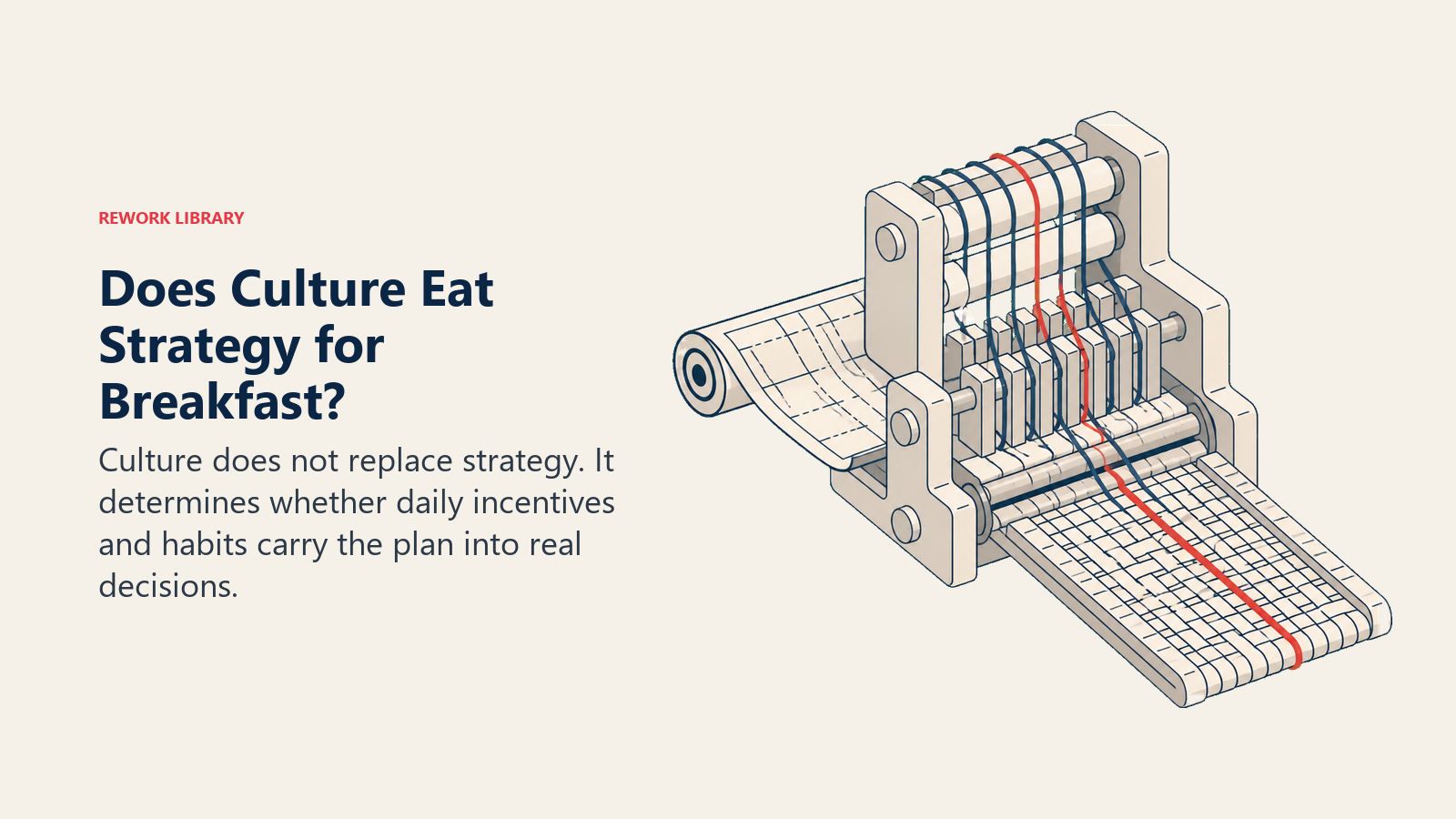
"Culture eats strategy for breakfast" claims that a company's unwritten norms and behaviors will override even a well-designed strategy if the two conflict. The line is almost always credited to Peter Drucker, but there is no record of him ever writing or saying it. The idea behind it is still worth taking seriously, just not as a slogan that pits culture against strategy.
Where the Quote Actually Came From
Start with the honest version of the history, because most articles about this quote get it wrong in the same direction: they repeat the Drucker attribution without checking it, then build an argument on top of a citation that does not exist.
The Peter Drucker Myth
Peter Drucker is one of the most quoted management thinkers of the last century, which makes him a magnet for lines he never actually said. "Culture eats strategy for breakfast" is one of them. Quote Investigator traced the phrase's public record and found no instance of it in Drucker's books, articles, or interviews, including his own 1991 Wall Street Journal piece on organizational culture, where his actual words were more measured: culture, he wrote, "no matter how defined, is singularly persistent." That is a real Drucker sentence about culture's staying power, but it is not the breakfast line and does not carry the same either-or framing.
The earliest documented use Quote Investigator located is from September 2000, in a trade journal called PIMA's North American Papermaker, where two paper-recycling consultants used a close variant of the phrase, years before it became a leadership cliché.
Mark Fields, Ford, and How It Spread
The version of the story that actually explains how the quote went mainstream involves Mark Fields, not Drucker. Fields was President of Ford's Americas division in the mid-2000s and later became Ford's CEO. He used "culture eats strategy for breakfast" as one of his signature lines while pushing Ford through a difficult turnaround, and it appeared in Associated Press coverage of Ford in 2006 as one of his favorite sayings. Fields had attended sessions built around Drucker's ideas, which is likely how the phrase picked up its Drucker byline: not because Drucker said it, but because it sounded like something he would have said.
Citing Drucker for the line is a factual error. Citing Fields, or leaving it unattributed, is accurate and arguably more useful, since it points to where the idea actually proved itself: inside a real strategic turnaround, not a management textbook.
Why the Misattribution Doesn't Kill the Idea
A wrong citation does not make the underlying claim wrong. Organizational theorist Edgar Schein, working decades before the phrase went viral, argued something structurally similar and far better documented: that culture "determines and limits" what strategies an organization can actually execute, because strategy has to run through people who carry existing habits, loyalties, and assumptions about how work gets done. Schein's version is less quotable but more defensible, and it is the version worth building on. For the deeper mechanics of how those layers work, see Schein's three levels of culture, which breaks down artifacts, espoused values, and underlying assumptions, the layer where most strategy actually goes to die.
What the Phrase Really Claims
Strip away the attribution problem and the quote is making a specific, testable claim: strategy is a plan for what an organization intends to do, and culture is the pattern of behavior people actually fall back on when a plan meets a real decision under pressure. When the two point in different directions, the claim goes, behavior wins, because behavior is what happens by default and strategy only happens when someone actively enforces it.
This is not a claim that strategy does not matter. It is a claim about sequencing and enforcement. A strategy document says what the company wants to be true. Culture, understood as the accumulated set of incentives, habits, and unwritten permissions inside the organization, determines what actually happens the first time the strategy asks someone to behave differently than they are used to behaving. If a new go-to-market strategy requires sales reps to walk away from bad-fit deals, but the commission structure and the culture around it still reward closing anything that moves, the strategy will lose that fight almost every time, regardless of how good the market analysis behind it was. What is business culture covers this dynamic in more depth: culture is best understood as what actually happens when no one is grading the performance, which is exactly the condition under which strategy either survives contact with reality or does not.
Key Facts
- No record of "culture eats strategy for breakfast" exists in Peter Drucker's writings, speeches, or interviews. The earliest documented close variant appears in a September 2000 trade-journal article, and the phrase was popularized by Ford executive Mark Fields in the mid-2000s. Source: Quote Investigator
- In a survey of leaders across 38 organizations in 18 countries, 67% said their organization failed to achieve at least two-thirds of the results its strategy targeted, and gaining employee support, not the quality of the strategic plan, was rated the single biggest implementation challenge. Source: Bridges Business Consultancy International
- Companies in the top quartile of McKinsey's Organizational Health Index, a measure closely tied to culture and management practice, deliver total shareholder returns roughly three times higher than bottom-quartile companies. Source: McKinsey
- In McKinsey's November 2025 State of AI survey, 88% of organizations said they now use AI regularly in at least one business function, yet the large majority still report less than 5% of EBIT attributable to it, evidence of an execution gap between adopting the tool and changing how work actually gets done. Source: McKinsey
- In Deloitte's 2026 State of AI in the Enterprise survey of over 3,200 leaders, talent and workforce readiness was the weakest of all dimensions measured, with only about 20% of organizations rating themselves highly prepared, down from the prior year even as AI tool access expanded. Source: Deloitte
When Culture Actually Beats Strategy
The claim holds up best in a specific set of conditions. Recognizing them is more useful than treating the phrase as a universal law.
When the Strategy Requires Behavior the Culture Actively Punishes
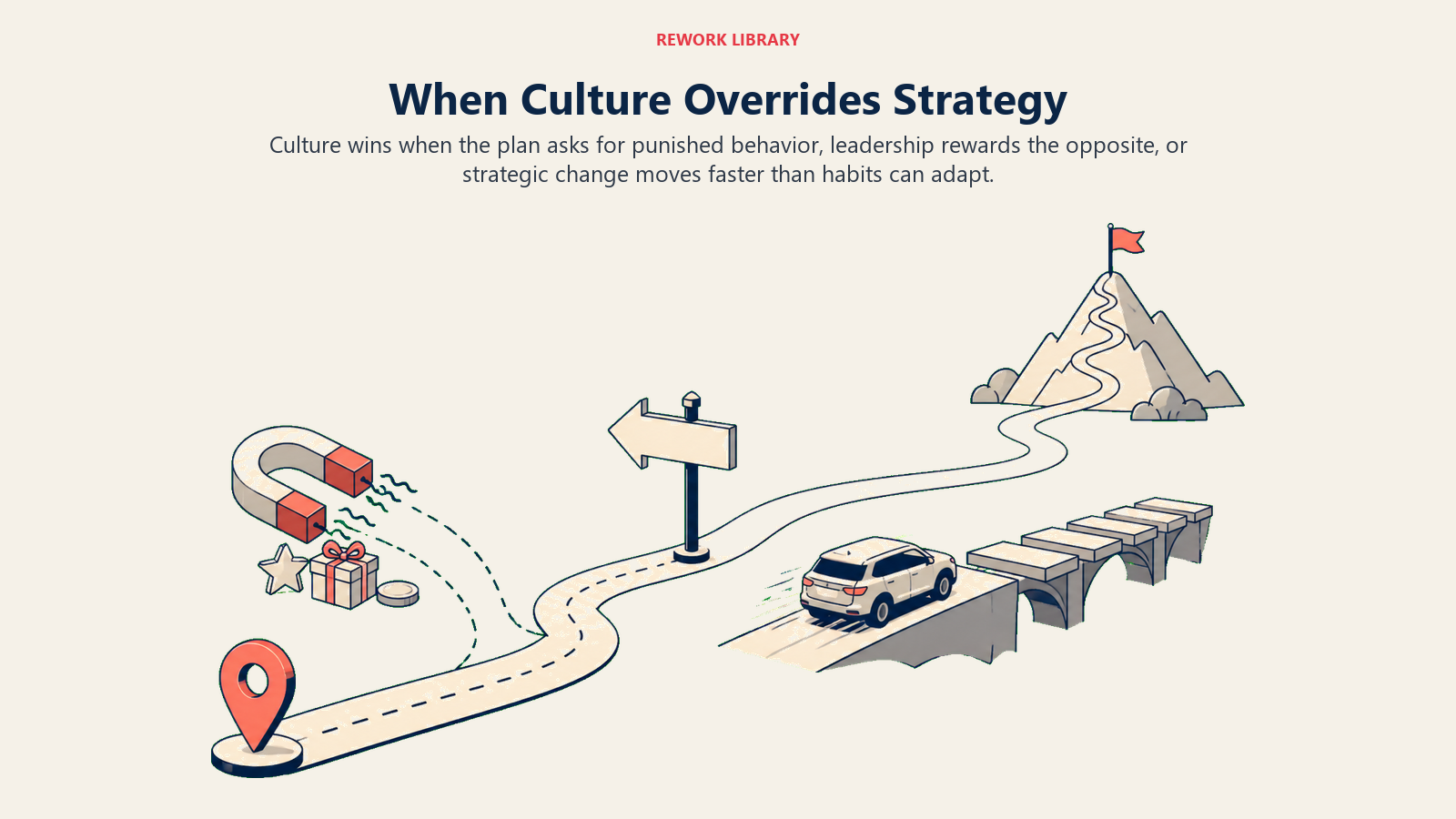
Some strategies do not just ask for new activity, they ask people to stop doing something the culture has quietly rewarded for years. A services firm that decides to compete on speed instead of exhaustive customization is asking people to ship work that feels, to them, unfinished, in a culture that has spent a decade praising thoroughness above everything else. Announcing the new strategy does not remove the old reward pattern. Until the incentives, the praise, and the promotion criteria change to match the new behavior, most people will keep doing what got them recognized before, and the strategy will look like it failed when what actually failed was the assumption that intent alone changes behavior.
When Leadership Says One Thing and Rewards Another
This is the fastest way to watch a strategy collapse. A company announces a customer-first strategy the same quarter it promotes a manager known for treating support tickets as a nuisance, because that manager also hit an aggressive revenue number. Every employee notices the gap within a week, and the lesson they take away is not "we value customers," it is "revenue is what actually gets you promoted here." Leadership's role in shaping culture is largely about closing that gap, because employees read leadership's actions as the real strategy and treat the stated one as aspirational at best.
When Strategy Changes Faster Than Culture Can Absorb It
Mergers, pivots, and rapid strategic resets are the clearest stress test. A newly merged company can publish a unified strategy on day one, but the two workforces are still operating on two different sets of assumptions about how decisions get made, how conflict gets handled, and what counts as good work. The strategy is not wrong. It is simply arriving faster than the underlying culture can integrate, and in that gap, old habits from each legacy organization keep winning the day-to-day decisions that add up to whether the merger actually works. How to change organizational culture covers the pacing problem in detail: culture change on a realistic timeline, not a strategy-announcement timeline.
When Culture and Strategy Are Not Actually Rivals
Here is where the popular version of the quote does real damage. Treated as a rivalry, it invites leaders to pick a side, usually culture, and to treat strategy work as somehow less important or less human. That framing is wrong on the evidence and wrong on the mechanism.
Complements, Not Competitors
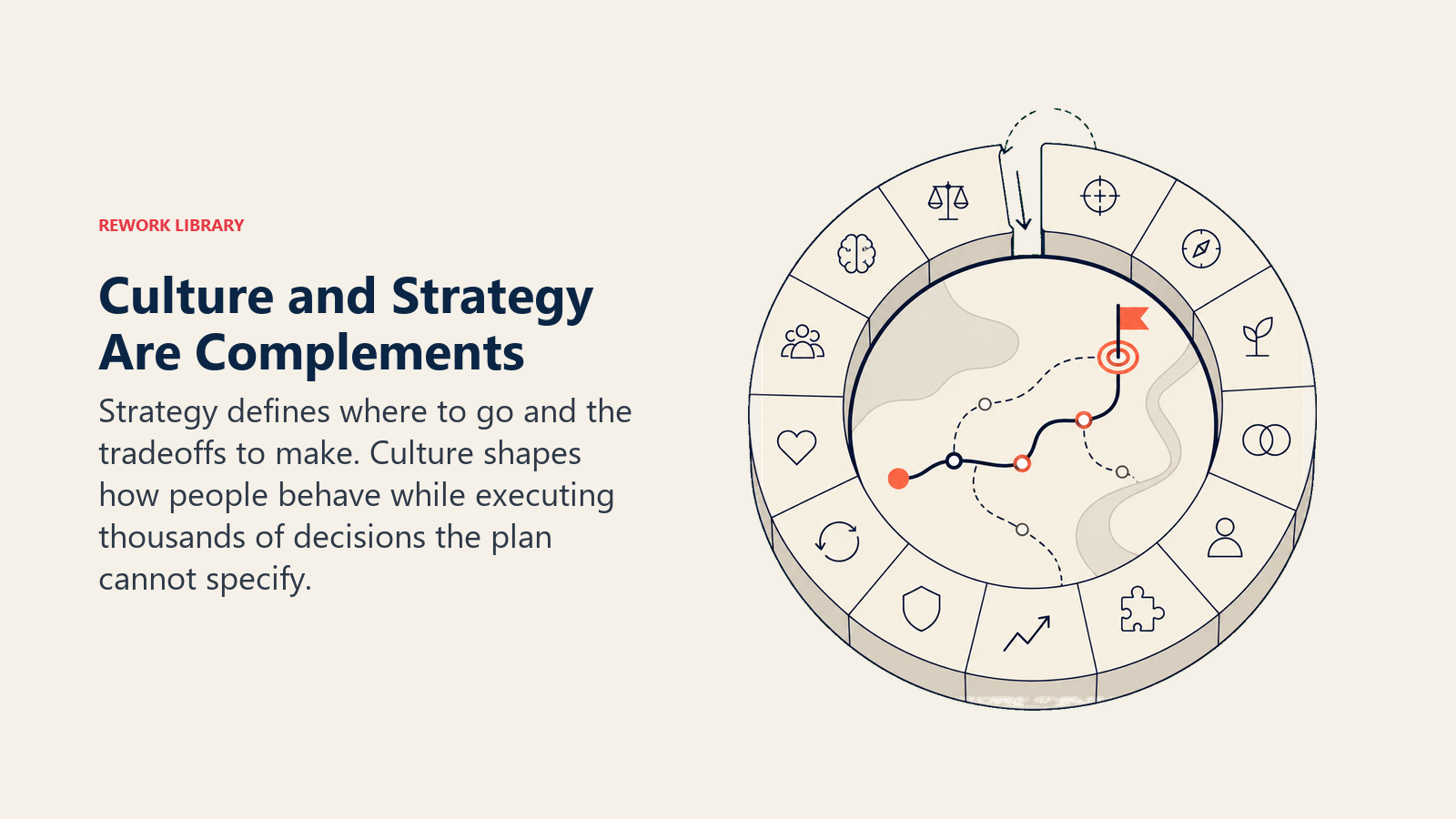
Strategy answers where an organization is trying to go and what tradeoffs it is willing to make to get there. Culture answers how people inside that organization actually behave while getting there, including in the thousands of small, unsupervised moments a strategy document can never cover. Neither one substitutes for the other. A brilliant strategy with a culture that cannot execute it produces exactly what the quote describes: a plan that dies on the vine. But a strong, cohesive culture with no strategic direction produces something just as unproductive, a team that works well together and moves confidently in a direction that does not lead anywhere useful. The link between culture and performance lays out the actual evidence on this: it is culture and strategic clarity together, not culture instead of strategy, that predicts sustained results.
Culture Sets the Boundaries Strategy Has to Work Within
Schein's framing, that culture determines and limits strategy, is more useful here than the breakfast metaphor because it does not force a winner. A culture built around consensus decision-making is not going to execute a strategy that requires split-second, top-down calls, no matter how sound the strategy looks on paper, unless leadership first changes how decisions actually get made. That is not culture defeating strategy. It is culture defining the realistic design space the strategy has to be built inside, the same way a country's infrastructure limits what kind of manufacturing strategy is realistic there. Good strategists account for that constraint from the start instead of discovering it after the launch fails.
Strategy Can Reshape Culture Too
The relationship runs in both directions, which the rivalry framing conveniently ignores. A deliberate strategic choice, entering a new market, restructuring around customer segments instead of products, adopting a genuinely different operating model, can reshape culture over time if leadership backs it with the systems that reinforce it: new hiring criteria, new promotion signals, new metrics on the dashboard everyone watches. The Competing Values Framework is a useful lens here, because it shows culture as something an organization can deliberately shift toward a different quadrant (say, from hierarchy toward market focus) specifically because a new strategy demands a different set of behaviors than the old one did.
How to Align Culture and Strategy Instead of Picking a Side
The practical question is never "which one wins." It is "how do we build both so they reinforce each other," which is a systems problem, not a messaging problem.
Diagnose the Real Gap Before You Choose a Fix
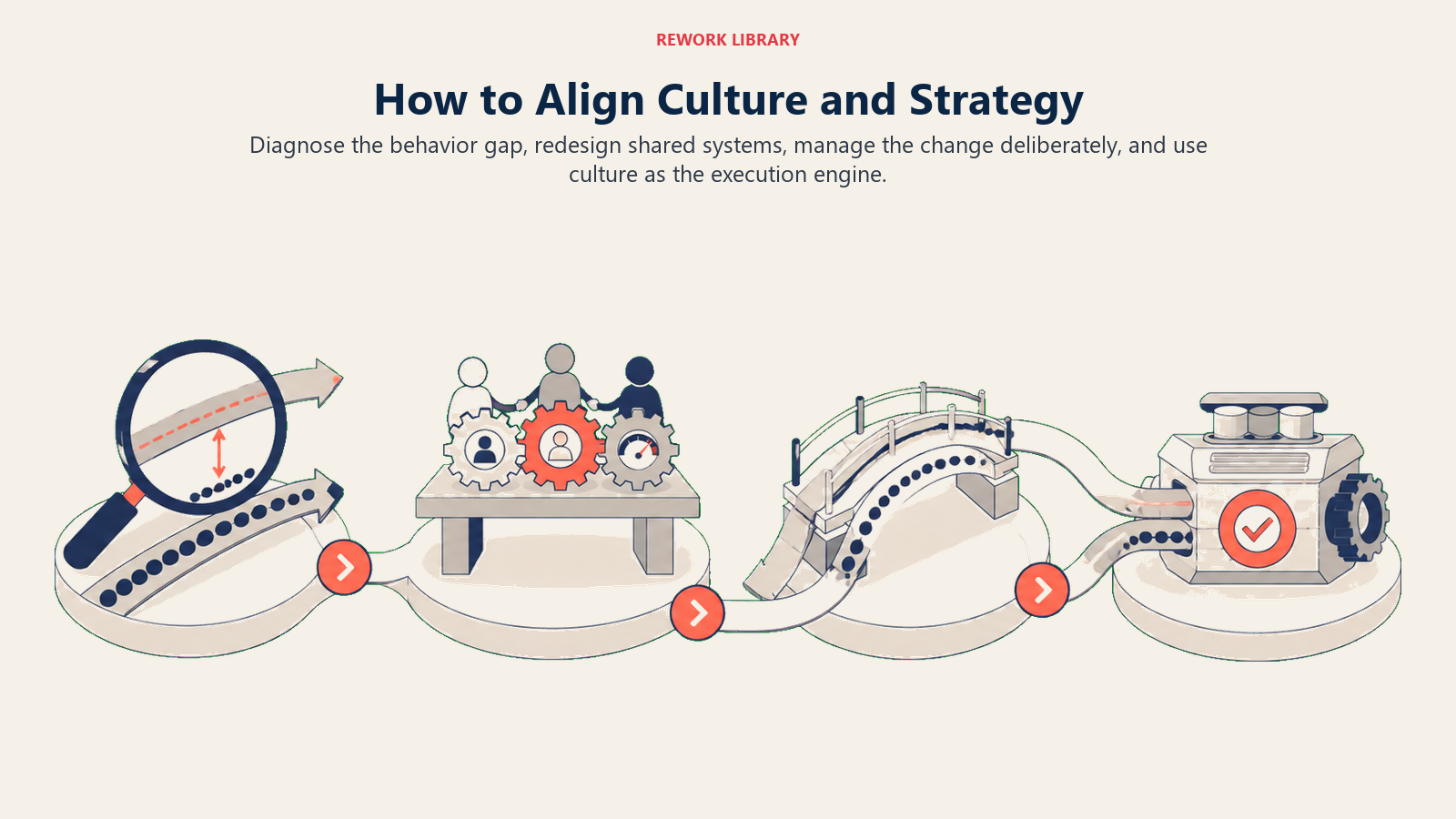
Most leaders jump straight to a culture initiative or a strategy rewrite without first identifying which one is actually broken. Ask a narrower question: where, specifically, does the current strategy ask people to behave in a way the current culture does not reward, or actively punishes? That gap, not culture or strategy in the abstract, is the thing to fix. Vague dissatisfaction ("our culture isn't strategic enough" or "our strategy isn't landing") usually means nobody has done this diagnosis yet.
Redesign the Systems That Enforce Both
Strategy gets executed, or does not, through the same systems that produce culture: who gets hired, who gets promoted, what gets measured, and what a high performer can get away with. If a new strategy needs faster decisions, but the performance review still rewards extensive consensus-building, the review system wins. Fixing that means changing the review criteria, not announcing the new priority in an all-hands meeting. Making the business case for culture ROI helps when this redesign needs budget or executive sign-off, since it translates the work into terms a CFO will engage with.
Treat Culture Change as Change Management, Not a Values Refresh
Aligning culture to a new strategy is a change management problem with a timeline, a communication plan, and named owners, not a poster campaign. Culture and change management walks through the mechanics: sequencing, resistance, and how to avoid the common failure mode where a strategy shift gets announced once and then leadership assumes behavior will follow on its own.
Use Culture as the Execution Engine, On Purpose
The most useful reframe is to stop treating culture as a risk to strategy and start treating it as the thing that actually carries strategy into daily decisions. A culture with high trust and clear norms around ownership will execute almost any reasonable strategy faster than a talented but distrustful one will execute a brilliant one, because trust is what lets people make the thousand small unsupervised calls a strategy depends on without waiting for permission each time. Building that kind of execution capacity, not choosing culture over strategy, is the actual work.
Culture Eats AI Strategy for Breakfast Too
The AI era gives the old idea a sharper edge, because it separates the two variables more cleanly than almost any prior wave of change. AI strategy, which tools to license, which workflows to redesign around agents, which functions to automate first, can now shift within a single quarter. Culture, the trust people place in an AI-generated recommendation, the willingness to actually change a workflow instead of working around the new tool, moves on a much slower clock. That gap is exactly where the McKinsey and Deloitte findings above point: adoption climbs fast, financial impact and workforce readiness lag behind, because the tool changed before the organization's habits did.
Nowhere does this show up more directly than in AI cultural debt, the growing gap between how fast an organization deploys AI tools and how slowly it updates the trust, norms, and accountability structures around using them. A team can have the most current AI strategy in its industry and still get outrun by a competitor with a weaker tool stack but a culture that actually knows how to verify AI output, assign accountability when it is wrong, and fold new capability into real workflows instead of bolting it on top of the old ones. What is AI-native culture describes what the other end of that gap looks like: an organization where the habits around working with AI have caught up to the capability, not just the announcement.
A Simple Test for Your Own Organization
Rather than debating the quote in the abstract, run a short diagnostic against your own current strategy. The signals below tend to separate organizations where culture is quietly sabotaging strategy from ones where the two are actually working together.
| Signal | Culture undermining strategy | Culture reinforcing strategy |
|---|---|---|
| New behavior the strategy requires | Rarely shown by anyone above entry level | Modeled visibly by leadership under pressure |
| Old behavior the strategy should retire | Still quietly rewarded through promotions or praise | No longer gets a high performer a pass |
| Metrics on the dashboard | Measure the old priorities, not the new ones | Updated to reflect what the new strategy actually needs |
| Employee response to the strategy announcement | Polite nodding, no change in daily habits within weeks | Visible shift in how decisions get made within the first quarter |
| Leadership's own decisions | Contradict the stated strategy under time pressure | Hold even when the stated strategy is inconvenient |
If most of your organization lands in the left column, the problem is not that the strategy is wrong. It is that nothing has changed about what gets rewarded, and culture, left alone, will keep doing exactly what it has always done.
The Honest Bottom Line
"Culture eats strategy for breakfast" is a misattributed line built on a real observation: strategy only survives contact with an organization if the people inside it are actually rewarded for carrying it out. Blaming Peter Drucker for the phrase is a factual error worth correcting. Treating culture and strategy as opponents, rather than two systems that have to be designed together, is a bigger and more expensive one. Align them through the same levers, who gets hired, who gets promoted, what gets measured, and what leaders visibly do, and the whole rivalry dissolves. The breakfast metaphor stops being a warning and simply becomes beside the point.

Co-Founder, Rework.com
On this page
- Where the Quote Actually Came From
- The Peter Drucker Myth
- Mark Fields, Ford, and How It Spread
- Why the Misattribution Doesn't Kill the Idea
- What the Phrase Really Claims
- Key Facts
- When Culture Actually Beats Strategy
- When the Strategy Requires Behavior the Culture Actively Punishes
- When Leadership Says One Thing and Rewards Another
- When Strategy Changes Faster Than Culture Can Absorb It
- When Culture and Strategy Are Not Actually Rivals
- Complements, Not Competitors
- Culture Sets the Boundaries Strategy Has to Work Within
- Strategy Can Reshape Culture Too
- How to Align Culture and Strategy Instead of Picking a Side
- Diagnose the Real Gap Before You Choose a Fix
- Redesign the Systems That Enforce Both
- Treat Culture Change as Change Management, Not a Values Refresh
- Use Culture as the Execution Engine, On Purpose
- Culture Eats AI Strategy for Breakfast Too
- A Simple Test for Your Own Organization
- The Honest Bottom Line