Stage 3 to 4: From Scaled to Integrated, When AI Becomes the Operating Model

Turn this article into takeaways for your work.


Each assistant summarizes the article only for you and suggests best practices for your work.
You have AI running in production. Multiple use cases. The team is proud, and they should be. Stage 3 is a real achievement that most organizations in 2026 haven't reached.
But ask yourself: if you turned off every AI tool tomorrow, how different would your operating model look?
If the honest answer is "we'd lose some efficiency but the core workflows would continue unchanged," you're at Stage 3. AI is a layer on top. People do their jobs the same way, with AI assistance available when they choose to use it.
Stage 4 is different. At Stage 4, removing the AI doesn't just reduce efficiency. It breaks the workflow. Customer relationship management (CRM) records aren't updated because the AI updates them; humans don't do that step anymore. Risk assessments aren't produced because the AI produces them. The process was redesigned around AI, not just augmented by it.
That's a much harder thing to build. McKinsey's Rewired and Running Ahead research found that digital and AI leaders generate 10-20% earnings before interest and taxes (EBIT) improvements within two to three years, but only when AI is tied to operational key performance indicators (KPIs) within a redesigned workflow, not added as a productivity layer on top of unchanged processes. And it's why the Stage 3-to-4 transition is the one most enterprises won't complete in 2026. If you're still at Stage 2, start with Stage 2 to 3: From Pilot to Scaled.
What integration actually means
Key Facts: Stage 3-to-4 Integration
- McKinsey's Rewired and Running Ahead research found that digital and AI leaders generate 10-20% EBIT improvements within two to three years, but only when AI is tied to operational KPIs within a redesigned workflow, not added as a productivity layer on top of unchanged processes (McKinsey, 2025)
- Gartner predicts over 40% of agentic AI projects will be canceled by end of 2027, primarily because governance frameworks haven't kept pace with deployment ambition (Gartner, 2025)
- Gartner also found that only 45% of organizations with high AI maturity sustain AI projects in production for three or more years, and in high-maturity organizations, 57% of business units actively trust and use AI solutions versus 14% in low-maturity organizations (Gartner, 2025)
The word "integration" gets used loosely. In the AI maturity context, it has a specific meaning.
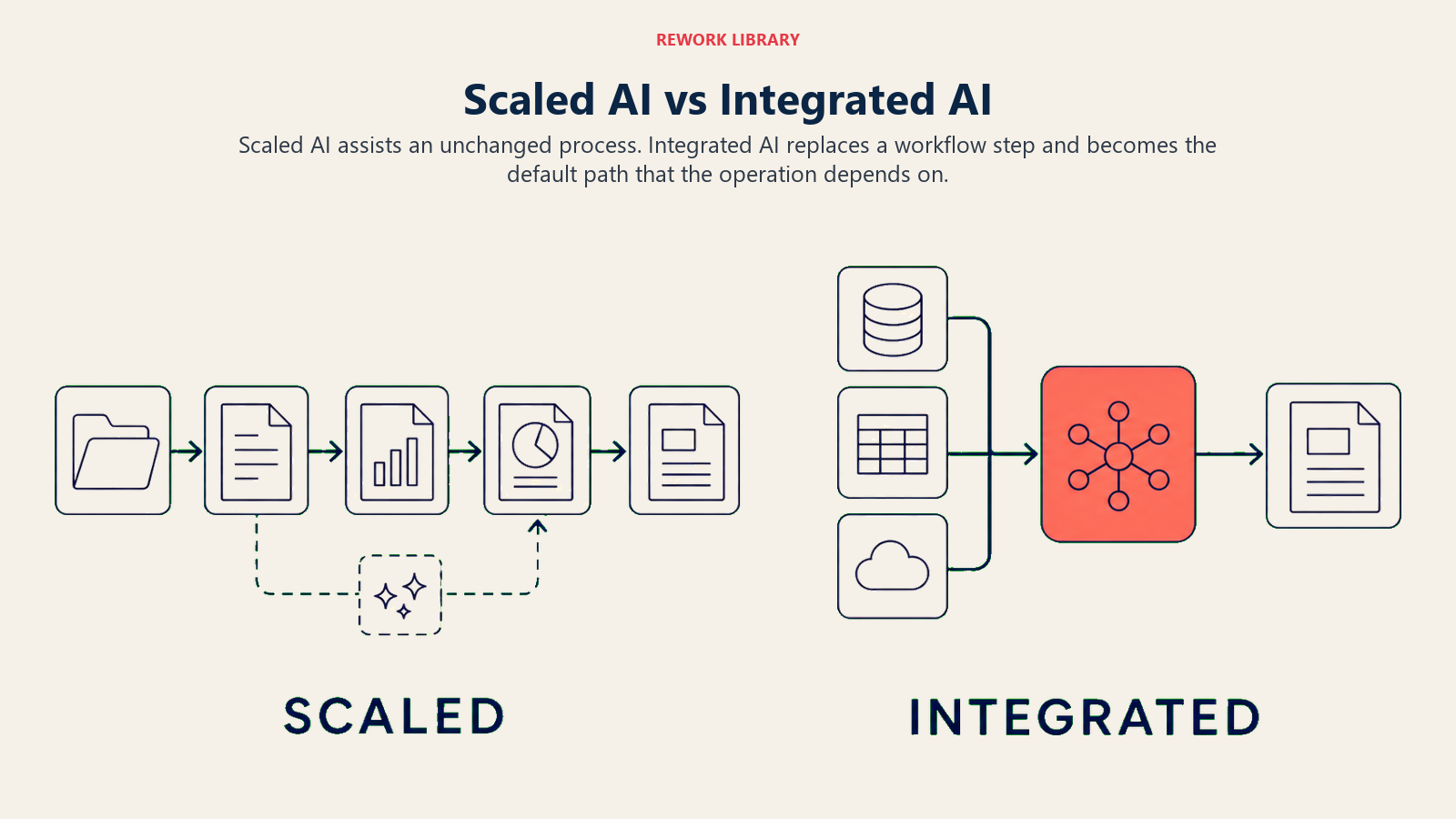
Integration means AI is a native component of a core workflow step, not an optional tool layered over it.
Here's the concrete difference.
Stage 3 (Scaled): Every new customer success manager at your company is given access to an AI tool that helps them prepare for quarterly business reviews (QBRs). Most use it. Some don't. The QBR prep process still exists as a defined workflow; the AI is a productivity option within it.
Stage 4 (Integrated): The QBR prep process was redesigned. The AI automatically generates the QBR brief, pulling from CRM activity data, support tickets, product usage, and previous meeting notes, 48 hours before each QBR, and deposits it in the CSM's queue. The CSM reviews and edits; they no longer write the brief. The old QBR prep workflow doesn't exist anymore.
The difference isn't the AI capability itself. It's whether the human workflow was redesigned to make AI the default path, or whether AI was added as an option to an unchanged workflow.
Stage 4 integration requires the latter. That means rewriting process documentation, retraining teams, restructuring performance metrics, and in some cases, changing org design. Most companies underestimate this.
"The test of Stage 4 integration is simple: if you turned off every AI tool tomorrow, would the core workflow continue unchanged, or would it break? Stage 3 organizations would lose efficiency. Stage 4 organizations would break. The difference is whether the workflow was redesigned around AI as a native component, or whether AI was bolted onto a workflow that still runs the same way without it." (Rework)
The Stage 3-to-4 Crossing Test
A three-criterion diagnostic confirming genuine Stage 4 integration rather than advanced Stage 3 tool layering. Criterion 1 (Workflow Redesign): at least one core function has redesigned its process documentation so that AI is the default path, not an optional tool within an unchanged workflow. Criterion 2 (Bidirectional API Integration): the AI system both reads from and writes back to operational systems without a human copying and pasting the output. Criterion 3 (Governance Parity): audit trails, bias monitoring, and incident response are scaled to match the volume and criticality of the AI's automated decisions. Organizations that meet Criterion 1 but not Criterion 2 have redesigned the workflow on paper but not technically enabled it. Those that meet Criteria 1 and 2 but not Criterion 3 are at Stage 4 technically but Stage 3 in governance, which Gartner's research identifies as the primary cause of agentic AI project cancellations.
The architecture requirements for Stage 4
Stage 4 requires AI to respond to business events, which means the surrounding data, API, and orchestration layers have to be ready.
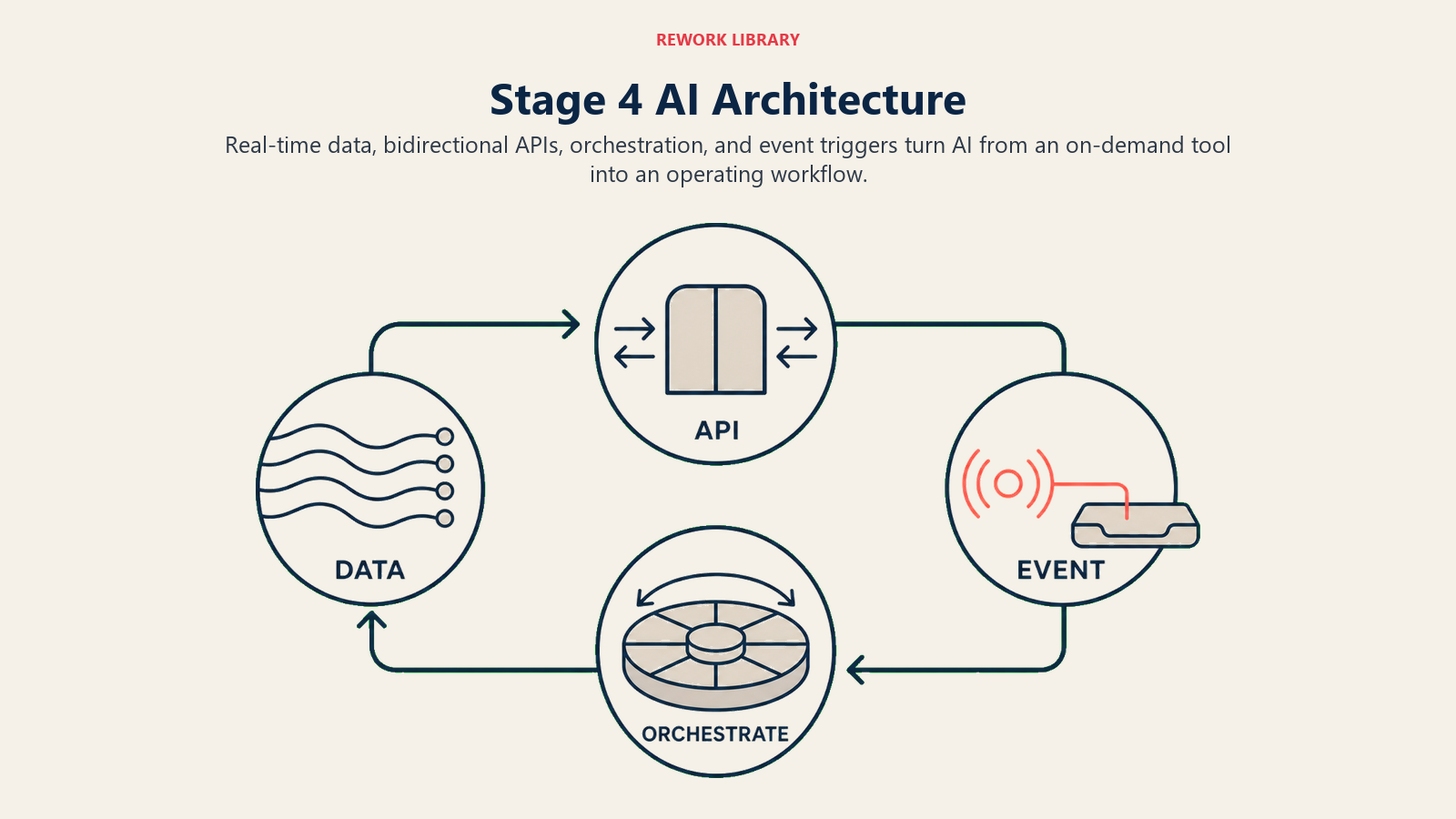
Stage 3 AI runs on request. A user opens a tool, asks a question, gets an answer. Stage 4 AI runs on events. The workflow triggers the AI automatically when conditions are met.
This distinction has technical implications that must be addressed before Stage 4 is possible.
Real-time data pipelines. Event-driven AI requires data that's current. If the AI generates a QBR brief from CRM data that's 48 hours stale, the brief may contain outdated account information. Stage 4 requires data pipelines that update continuously or near-continuously, not nightly batch exports.
API connectivity between AI and operational systems. The AI must be able to write back to the systems it reads from. At Stage 3, AI typically reads data and returns output to a human. At Stage 4, AI reads data, produces output, and writes that output to the operational system: updating the CRM record, creating the calendar event, filing the report. Bidirectional API integration is an architectural requirement. This is the Execute capability working at full depth, and it's why the Generate vs. Execute boundary becomes a governance requirement at Stage 4.
Orchestration layer. Multiple AI agents handling different parts of a workflow need coordination. Which agent runs first? What happens if one fails? How are results passed between steps? This requires a workflow orchestration system, whether that's a purpose-built AI orchestration platform, an existing workflow tool extended for AI, or custom code. The choice matters less than having one.
Event-driven triggers. The shift from "user requests AI" to "event triggers AI" requires an event bus or workflow automation layer that monitors conditions (deal stage changed, ticket created, contract uploaded) and fires the AI workflow automatically.
These four architectural requirements are not add-ons to Stage 3 infrastructure. They represent a meaningful step up in technical complexity. Companies that try to reach Stage 4 without addressing them will find their AI workflows fragile, unreliable, and expensive to debug.
The organizational requirements
Stage 4 isn't only an architectural challenge. It's an organizational one. And the organizational requirements are harder to solve than the technical ones.
Cross-functional alignment between AI team and business units. At Stage 3, the AI team builds things and delivers them to business units. At Stage 4, AI development is a joint function. The customer success manager (CSM) leadership team co-designs the QBR brief workflow with the AI team. They define what data sources matter, what output format works, what human review step is needed. Without this joint ownership, the AI produces technically functional workflows that business units don't trust or use.
AI accountability embedded in functional leadership. At Stage 4, the VP of Customer Success is accountable for the AI-powered QBR process, not just the CSM team's performance. This means functional leaders need enough AI literacy to own AI-powered workflows. They don't need to understand the model architecture. They need to understand the inputs, outputs, failure modes, and review requirements of the AI systems in their function.
Performance metrics that include AI contribution. If you're measuring CSM performance only on outcomes (retention, net promoter score (NPS), expansion) without tracking how AI is contributing, you can't diagnose what's working. Stage 4 organizations track AI utilization, AI output quality, and the correlation between AI workflow usage and business outcomes as operational metrics.
Retraining at scale. When workflows are redesigned around AI, the job changes. A CSM who used to spend 30% of their time on QBR prep now spends that time on higher-order relationship work. That transition requires structured support: new role clarity, updated job descriptions, and active management of the mindset shift from "I write the brief" to "I review and improve the brief."
The governance upgrade for Stage 4
At Stage 3, AI runs in production across several use cases. At Stage 4, AI is making consequential decisions at scale, automatically, without human review on every transaction. The governance requirements are qualitatively different.
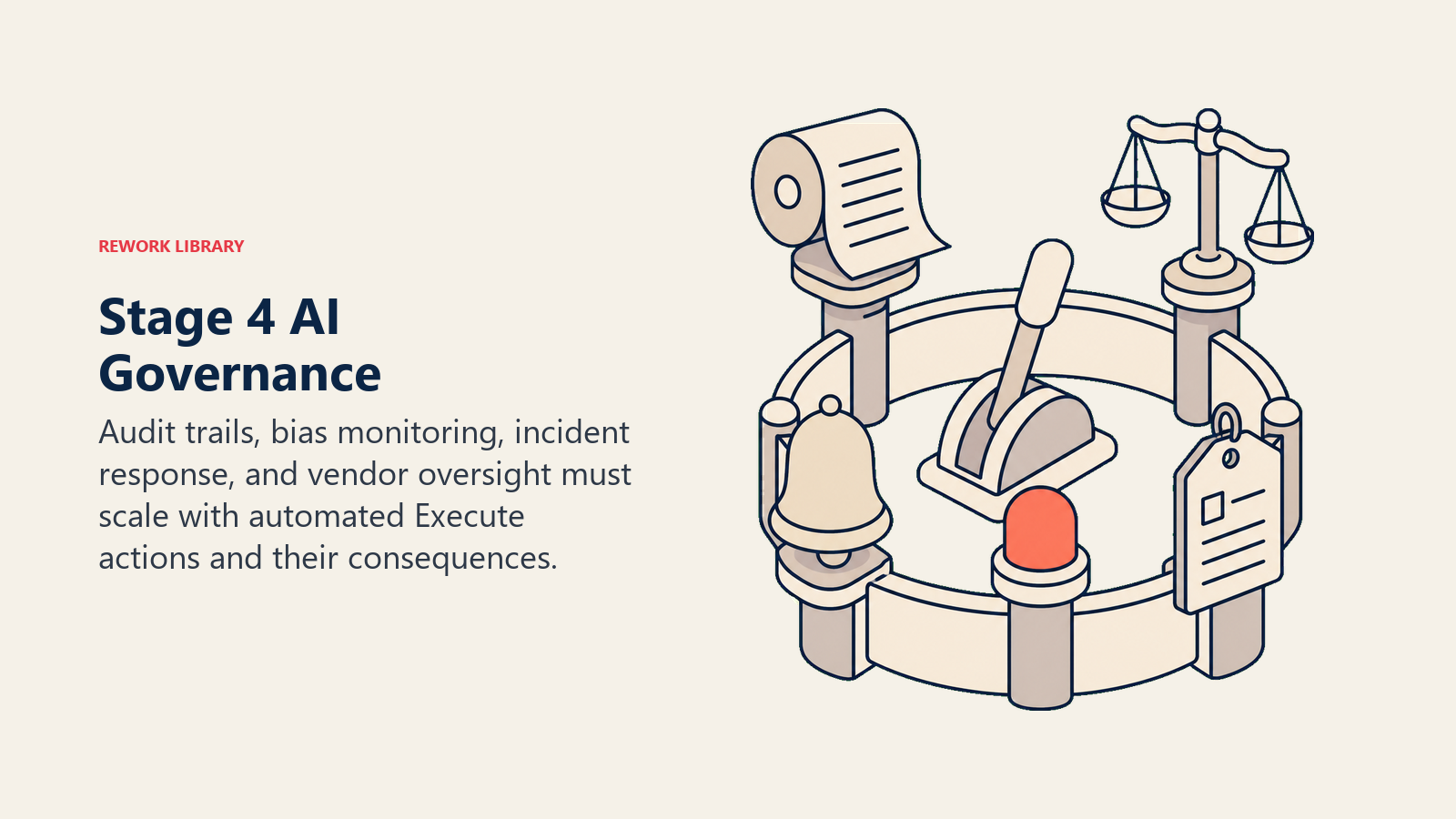
Audit trail requirements become institutional. Every Execute action taken by AI must be logged in a way that's auditable by compliance teams, legal counsel, or regulators. This isn't a nice-to-have. In regulated industries, it's a legal requirement. And even in unregulated industries, the ability to reconstruct what the AI did and why is the foundation of incident investigation.
Bias monitoring. When AI makes consequential decisions at scale (lead scoring, credit decisions, hiring screens, resource allocation), systematic bias can produce outcomes that are unfair or discriminatory at scale. Stage 4 organizations run regular bias audits on high-stakes decision outputs. Not once at launch. Quarterly, at minimum.
Incident response becomes a formal function. At Stage 3, the AI Operations lead handles incidents. At Stage 4, the volume and criticality of potential incidents requires a formal incident response function with defined SLAs, escalation paths, and post-incident review processes. This is similar to how mature SaaS organizations run their production engineering incident response, applied to AI systems.
Vendor governance. At Stage 4, you likely have multiple AI vendor relationships, each with their own data processing terms, model update cadences, and deprecation schedules. Vendor governance means tracking which models are used in which workflows, monitoring vendor announcements for changes that affect your workflows, and maintaining the contractual relationships (data processing agreements (DPAs), enterprise agreements) that authorize production use.
Integration failure modes
The failure modes are useful because they show how integration can go wrong even when the underlying AI model is technically working.
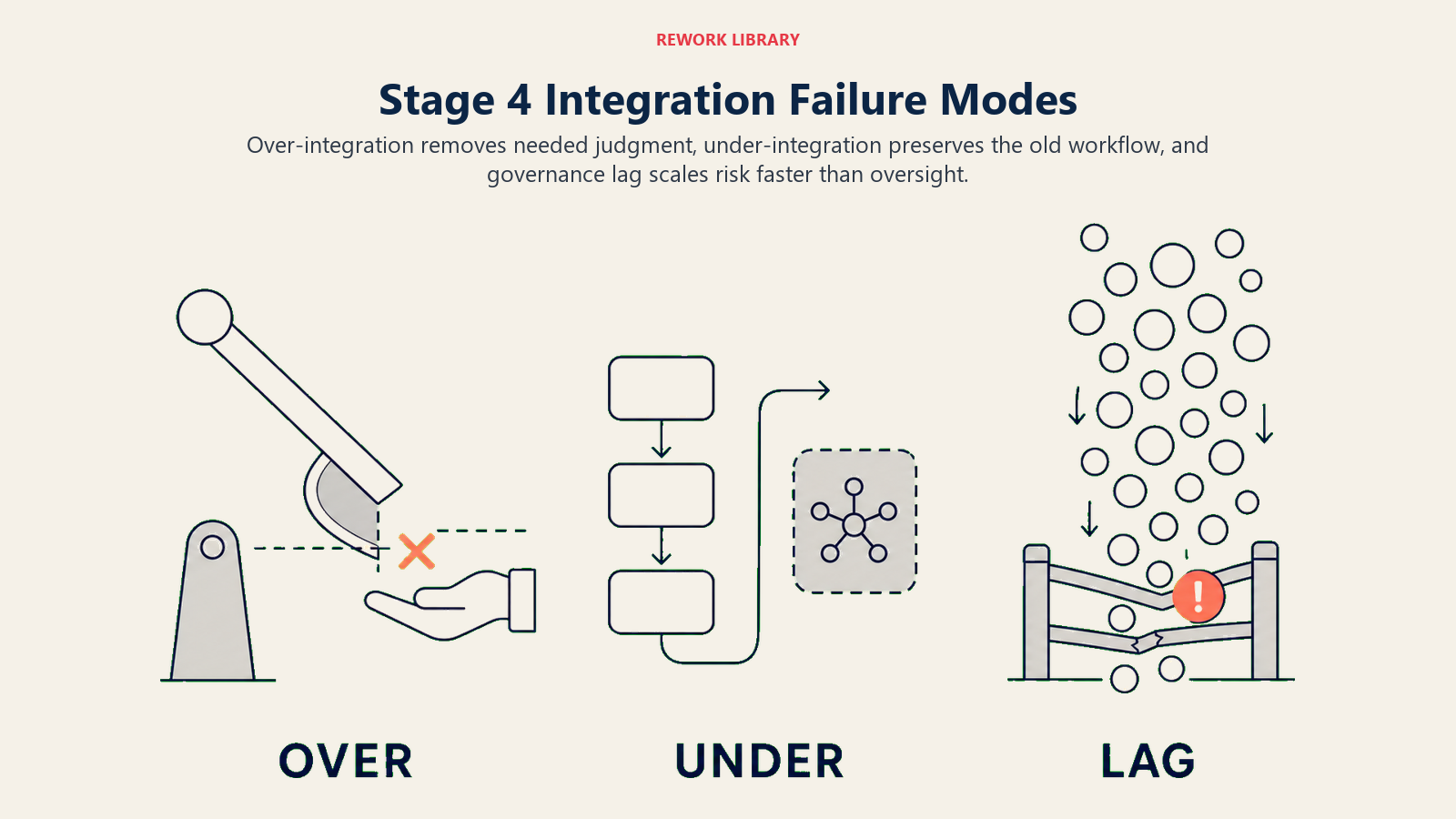
Stage 4 transitions fail in three characteristic ways.
Over-integrating. Automating decisions that require human judgment. A common example: automating the escalation decision for a high-risk customer account. The AI can flag risk signals; humans should make the escalation call. When AI takes consequential decisions that require context, relationship knowledge, or ethical judgment, the integration creates risk rather than value. The rule: automate the data gathering and synthesis. Keep humans in the decision for anything with significant consequence.
Under-integrating. This is more common. Organizations deploy AI to enhance existing workflows but never redesign those workflows. The AI draft email sits in the CRM next to the old email template. Reps choose between them. Some use the AI. Some don't. Adoption stays below 60%. Business outcomes improve slightly. The organization concludes "AI works okay" and never realizes that full workflow redesign would produce 3x the impact. Under-integration is the Stage 3 plateau masquerading as Stage 4.
Governance lag. Integration outpaces policy. The AI is running in 15 workflows, making thousands of automated decisions daily, while the governance infrastructure is still designed for a 3-use-case Stage 3 deployment. Audit trails are incomplete. Bias monitoring hasn't been set up. Incident response is still one person. Gartner research found that over 40% of agentic AI projects will be canceled by end of 2027 largely because governance frameworks haven't kept pace with deployment ambition. Governance lag is how Stage 4 organizations produce the most serious AI incidents: not because the technology failed, but because the oversight infrastructure wasn't built to match the deployment scale.
Rework Analysis: The Stage 3-to-4 transition consistently fails not at the technology layer but at the organizational layer. The architecture can be built. What most companies underestimate is the workflow redesign requirement: every function that integrates AI at Stage 4 needs its process documentation rewritten, its performance metrics recalibrated, and its managers retrained to own AI-powered workflows rather than just using AI tools. A 500-person company attempting Stage 4 integration across three functions simultaneously typically underestimates the change management requirements by 6-12 months. The organizations that get there fastest integrate one function fully before starting the next, using the lessons from Function 1 to accelerate Functions 2 and 3.
What Stage 4 leadership looks like
Stage 4 requires dedicated AI leadership at the executive level.
Chief Information Officer (CIO) or Chief AI and Innovation Officer (CAIO) role. The CIO at a Stage 4 company has AI integration as a primary accountability, not a secondary one. In some organizations, a dedicated CAIO role carries this. Either way, there's a named executive who owns the AI operating model, reports to the board on AI risk and performance, and co-owns the AI strategy with business unit leaders.
Cross-functional AI council. A standing body with representation from each major function (Sales, Customer Success, Product, Legal, Finance, Human Resources) that reviews new AI workflow proposals, monitors integration performance, and escalates governance issues. Not a one-time steering committee. A permanent operating mechanism.
Board-level reporting. AI risk, AI performance, and AI investment are board agenda items at Stage 4. The board needs to understand the risk exposure of AI-integrated workflows, the ROI of AI investment, and the competitive implications of AI strategy. This is a governance maturity requirement, not just a transparency nicety.
A realistic timeline
Most mid-market companies in 2026 are at Stage 1 or Stage 2. A well-run organization moving through the stages might reach Stage 3 by late 2026 or 2027. Stage 4 for most mid-market companies is a 2028-2029 target at the earliest.
That's not pessimism. It's reality. Stage 4 requires organizational redesign, not just technology deployment. Organizational redesign at a 500-1000 person company takes time, especially when it involves retraining hundreds of employees on redesigned workflows.
The companies that get to Stage 4 fastest aren't the ones that rushed. They're the ones that invested in Stage 2 governance and Stage 3 infrastructure correctly, so Stage 4 was an evolution rather than a rebuild.
A 1,000-person SaaS company offers a useful example. They reached Stage 3 in mid-2025, with AI in production across sales ops, support, and content operations. In 2026, they redesigned their customer success workflow so that every CSM uses AI-prepared QBR briefs by default, AI flags churn risk signals, and AI drafts expansion proposals. The QBR prep step is no longer on any CSM's task list. That's Stage 4 in the CS function, even while Sales and Product remain at Stage 3. That's fine. Stage 4 doesn't require every function to integrate simultaneously. It requires at least one function to complete the transition.
What comes next
Once a function reaches Stage 4, the question shifts from "how do we integrate AI into our operations?" to "should AI change what our product or service is?" That's Stage 5, and it's a different kind of decision.
Read: Stage 5: When AI Reshapes Your Product to understand what the highest maturity level actually requires and who realistically gets there.
Read: The 5 Stages of AI Maturity for the complete maturity model with transitions between each stage.
Read: Audit Trails for AI Execute Actions for the governance infrastructure Stage 4 requires before you scale Execute-capable AI workflows.
Frequently Asked Questions
What is the difference between Stage 3 and Stage 4 AI maturity?
At Stage 3, AI is a layer on top of existing workflows. Users have access to AI tools and most use them, but the underlying process still exists and would continue if AI were removed. At Stage 4, the workflow was redesigned with AI as a native component, not an optional enhancement. If you removed the AI, the workflow would break because the human steps it replaced no longer exist in the process documentation or muscle memory.
What is the Stage 3-to-4 Crossing Test?
The Stage 3-to-4 Crossing Test is a three-criterion diagnostic. Criterion 1: at least one core function has redesigned process documentation making AI the default path, not an optional tool. Criterion 2: the AI system both reads from and writes back to operational systems (bidirectional API integration), without human copy-paste. Criterion 3: governance infrastructure (audit trails, bias monitoring, incident response) is scaled to match the volume of the AI's automated decisions. Meeting Criteria 1 and 2 without Criterion 3 is the technical completion of Stage 4 without the governance completion.
What architecture does Stage 4 require beyond Stage 3?
Stage 4 adds four architectural requirements to the Stage 3 infrastructure: real-time data pipelines (event-driven AI needs current data, not nightly batch exports), bidirectional API integration (AI writes back to operational systems, not just reads), an orchestration layer for coordinating multiple AI agents in a workflow, and event-driven triggers that fire AI workflows automatically when business conditions are met rather than waiting for user requests.
Why do organizations fail at the Stage 3-to-4 transition?
Three failure modes dominate: over-integration (automating decisions that require human judgment, creating risk rather than value), under-integration (deploying AI within unchanged workflows rather than redesigning them, which leaves adoption below 60% and impact well below potential), and governance lag (AI is making thousands of automated decisions daily while audit trails, bias monitoring, and incident response are still designed for a three-use-case Stage 3 deployment). Gartner predicts that over 40% of agentic AI projects will be canceled by 2027, primarily due to governance frameworks failing to keep pace with deployment.
When will most mid-market companies reach Stage 4?
Stage 4 for most mid-market companies is a realistic 2028-2029 target. A well-run organization moving through the stages correctly might reach Stage 3 by late 2026 or 2027. Stage 4 requires organizational redesign, not just technology deployment, and organizational redesign takes 18-36 months at a 500-person company. The organizations that get there fastest are those that invested in Stage 2 governance and Stage 3 infrastructure correctly, so Stage 4 is an evolution rather than a rebuild.
See also:
- Sequencing AI Patterns in a Multi-Year Roadmap: how to prioritize which workflows to integrate first at Stage 4
- Why Most AI Transformations Fail: the governance lag failure mode described here in full
- How AI Reshapes the SaaS Operating Model: a SaaS-specific lens on Stage 4 integration

Co-Founder, Rework.com