Workflow Redesign for AI: Why Bolting AI Onto Old Processes Fails
Turn this article into takeaways for your work.


Each assistant summarizes the article only for you and suggests best practices for your work.
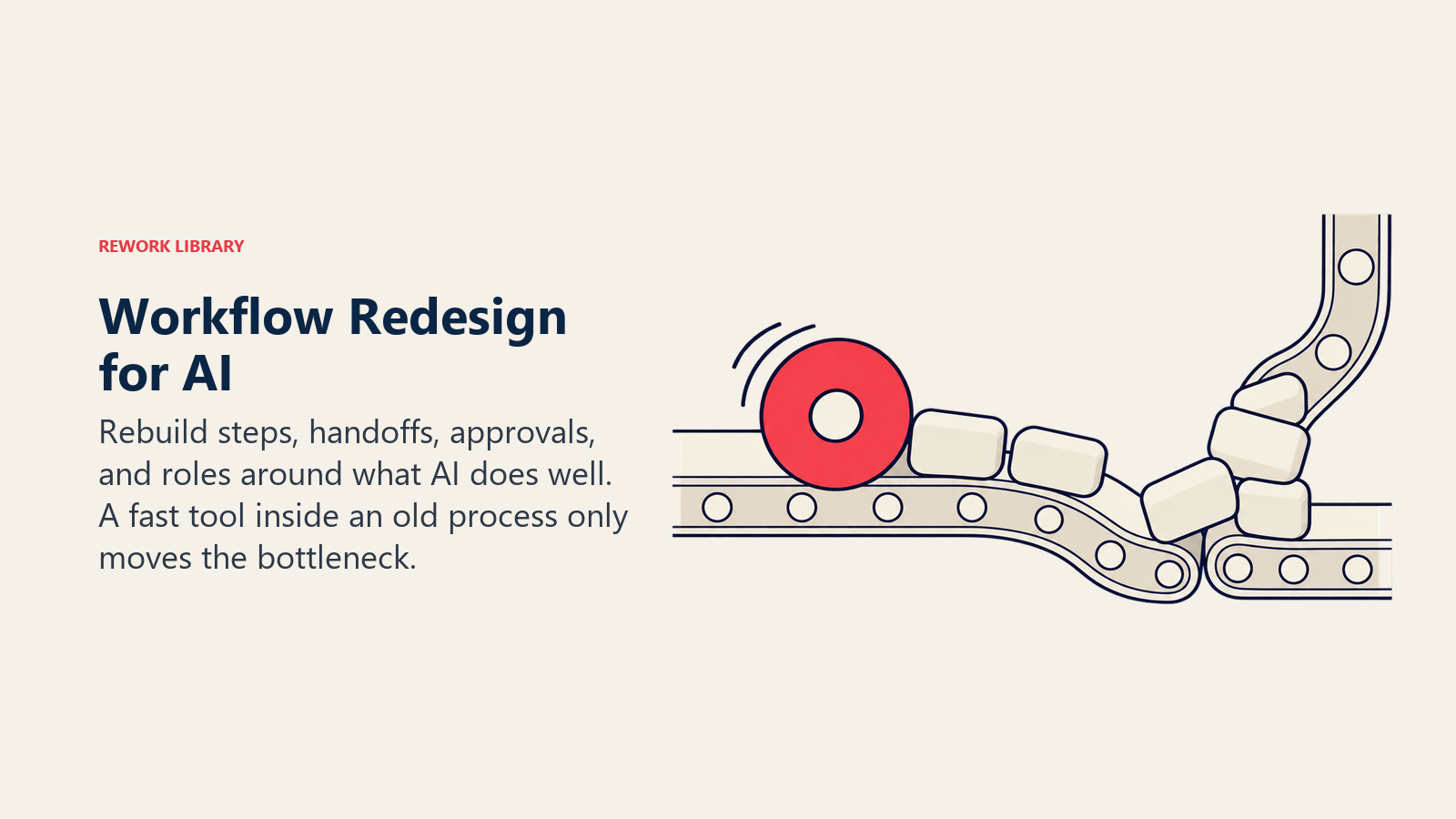
Workflow redesign for AI means rebuilding a process around what AI actually does well, instead of inserting a tool into a process built for humans doing every step manually. Adding AI to one step of an unchanged process runs into the same limit that caps any partial speedup: the untouched parts still set the pace. Companies that redesign the whole workflow capture most of the measured gain; companies that bolt AI onto the existing process mostly don't.
If you've watched a team adopt an AI tool, get faster at one task, and still miss the same deadlines: the bottleneck moved, and nobody looked for it.
Key Facts
- Paul David's 1990 study of electrification found a roughly 40-year gap between the dynamo's introduction (1881) and its productivity payoff (1920s), because factories bolted electric motors onto the same steam-era "group drive" layout instead of redesigning around individual "unit drive" machines (David, "The Dynamo and the Computer," American Economic Review, 1990).
- Economists Erik Brynjolfsson, Daniel Rock, and Chad Syverson's Productivity J-Curve model shows why: complementary intangible investments (retraining, redesign, new roles) count as costs when they happen and only pay off as measured output years later (Brynjolfsson, Rock, Syverson, NBER Working Paper 25148).
- MIT NANDA's 2025 research found 95 percent of generative AI pilots produce no measurable P&L return, tracing the failure to the workflow layer: tools that don't adapt to the actual process get abandoned the moment friction appears (MIT NANDA, "The GenAI Divide: State of AI in Business 2025", via Fortune).
- BCG's 10-20-70 rule holds that only 10 percent of AI transformation effort should go to algorithms, 20 percent to technology and data, and 70 percent to people and process; only 22 percent of companies get past proof-of-concept and only 4 percent create substantial value (BCG, "The Leader's Guide to Transforming with AI").
- McKinsey's 2025 State of AI survey found high performers are nearly three times more likely to have redesigned the underlying workflow around AI rather than adding a tool to an unchanged process (McKinsey, The State of AI: Global Survey 2025).
The Electrification Lesson: New Power Doesn't Redesign the Factory for You
The clearest precedent for what's happening with AI didn't happen with computers. It happened a century earlier, with electricity, and economic historian Paul David wrote the definitive account of it in 1990.
Group Drive to Unit Drive: The 40-Year Gap
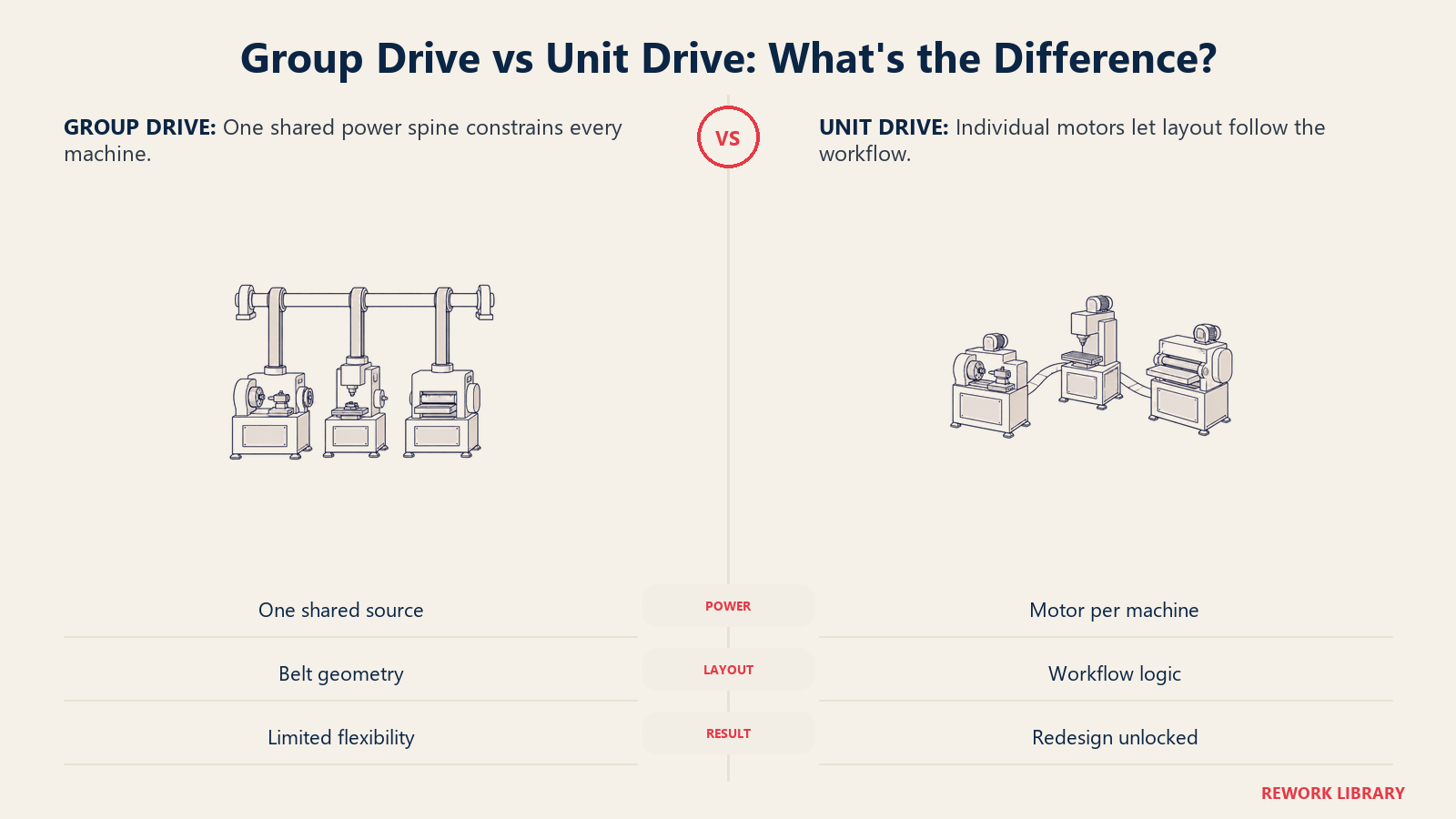
Nineteenth-century factories ran on one power source, usually a steam engine, connected to every machine through a shared network of belts and overhead shafts ("group drive"). Every machine turned at the same time whether in use or not, because they shared one mechanical spine.
The electric dynamo arrived commercially in 1881. For roughly the next four decades, most factory owners did the obvious, cheap thing: swap the steam engine for an electric motor and keep the belts and layout as they were. Productivity barely moved, because the process being powered hadn't changed.
The payoff arrived only once factories threw out group drive for "unit drive": a small motor on every machine. That unlocked what the old layout couldn't: machines placed by workflow logic instead of belt geometry, single-story buildings instead of shaft towers, and equipment that ran only when needed. Unit drive didn't arrive until the 1920s, roughly forty years after the dynamo itself, and David pins the delay on organizational redesign, not the technology.
The Same Story, New Technology
Most companies today are running "group drive AI": the tool replaces one step while the approval chain, handoffs, and review process around it stay exactly as they were built for an all-human team. The tool is faster. The process isn't. The AI productivity paradox covers the McKinsey, MIT, and Gartner numbers behind this same adoption-versus-impact gap in more depth.
Brynjolfsson's Productivity J-Curve explains why this looks like nothing is happening even while real investment is underway. Retraining a team and rebuilding a handoff sequence are intangible investments: they count as cost the year they happen and only show up as output once the redesign runs at scale. A company doing that work now looks, on paper, exactly like one that never bothered. The difference shows up later, for the one that did the work, and it raises the question the productivity dividend asks directly: once the redesign pays off and real hours come free, who actually gets them.
Why "Same Process, Faster Step" Hits a Hard Ceiling
There's a reason a faster individual step so rarely translates into a faster overall result, and it has a name in computer science: Amdahl's Law.
Borrowing a Computing Idea for Process Design
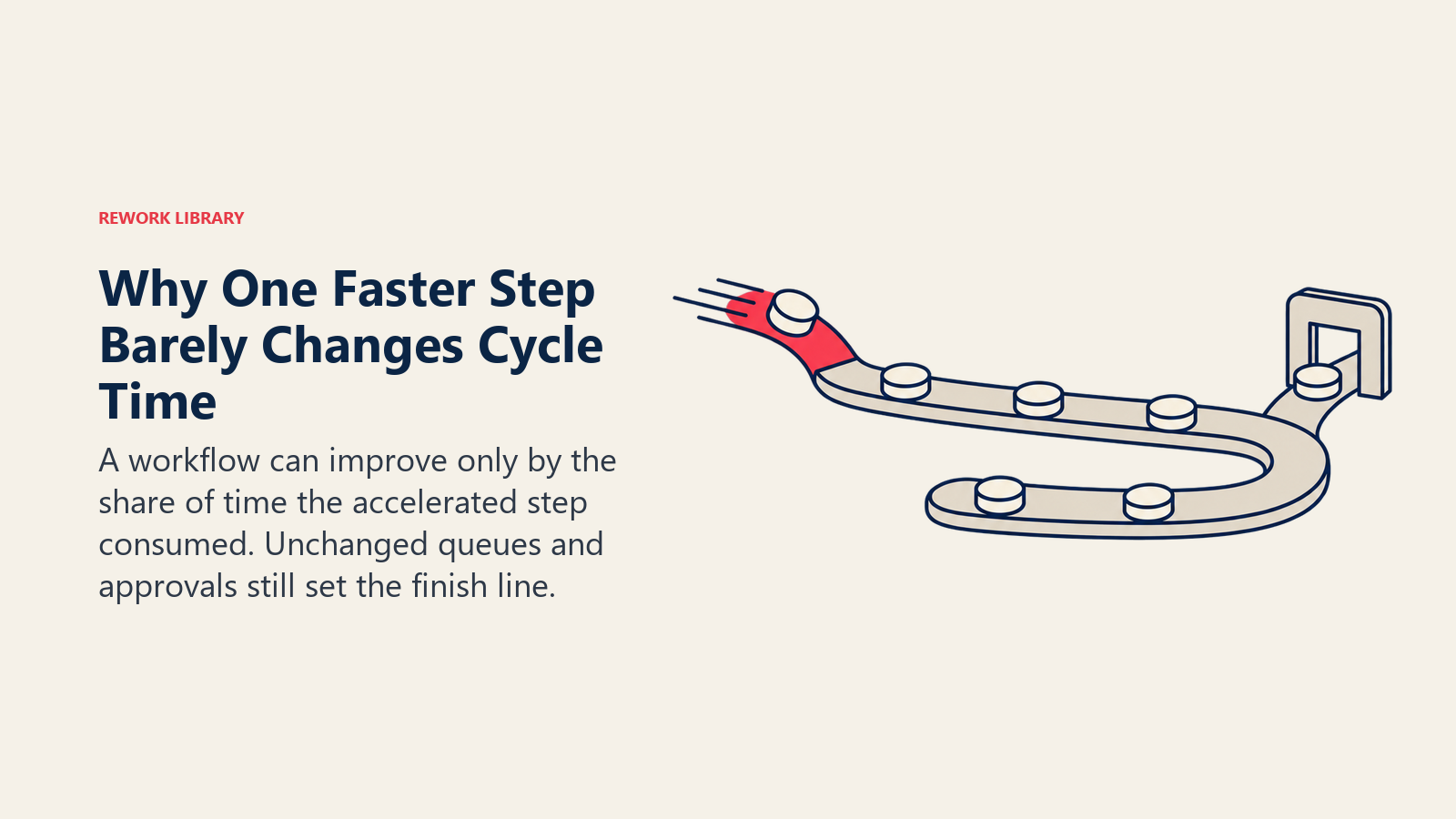
Gene Amdahl's point, made in 1967 about parallel computing, was simple: speed up one part of a system, and the maximum improvement to the whole system is capped by how much of the total time that part consumed. Speed up a step that took 10 percent of cycle time by 10x, and you've saved at most 9 percent overall. The other 90 percent, untouched, still sets the finish line.
Most workflows are chains of steps and handoffs, not one dominant step. AI usually gets pointed at whatever's easiest to automate, like drafting a first version, not whatever consumes the most calendar time. Drafting an email in ten seconds instead of ten minutes feels transformative. If the email then sits in an approval queue for three days either way, nobody downstream notices.
The 10-20-70 Split BCG Keeps Finding
BCG's research converges on the same conclusion from a different angle. Its 10-20-70 rule argues that only 10 percent of the effort behind a successful AI transformation should go into the algorithm, 20 percent into technology and data, and 70 percent into people and process: role redesign, decision rights, training, incentives. Most companies invert that ratio by instinct, because buying a model feels like "doing the AI project" and redesigning who does what feels like a separate, harder initiative.
The cost shows up in BCG's own numbers: only 22 percent of companies make it past proof-of-concept, and only 4 percent create substantial value at scale, despite roughly the same generation of tools being available to all of them. What explained the outcome was how much of the 70 percent they were willing to do.
Find the Actual Bottleneck Before You Automate Anything
If speeding up the wrong step barely moves anything, the next question is finding the right one.
Map the Process, Not the Task List
Most teams can describe their job as a list of tasks. Far fewer can describe it as a process: the sequence, handoffs, and decision points between those tasks. That second description is what actually reveals where time goes, and it usually surprises the people living inside the process, since the slow part is rarely the one that feels most laborious.
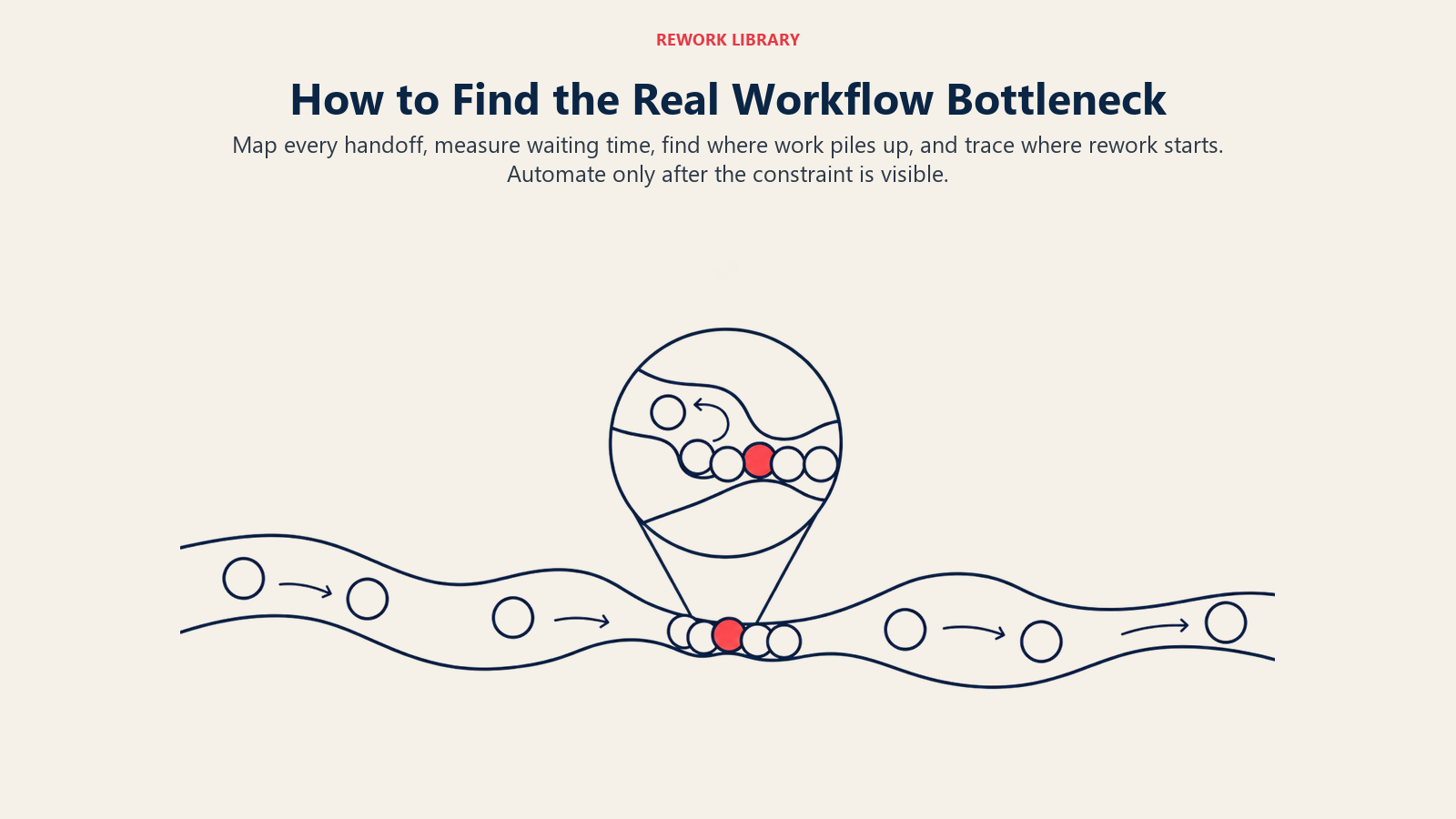
Pick one recurring workflow, an onboarding, a proposal, a hiring pipeline, and write down every step and handoff in order. For one real week, log how long each item sits at each step before moving on, not how long the work itself takes. The gap between those two numbers is almost always where the process is losing time.
Three Questions That Reveal the Real Constraint
- Where does work pile up and wait, rather than move? A queue or approval stage things get stuck in more than any other. That's the constraint, whether or not it's interesting to fix.
- What step, if it disappeared, would change total cycle time the most? Not what people would enjoy losing, but which one measurably gates the finish line.
- Which step gets redone because the step before it produced something wrong? Rework is hidden cycle time, and it often points to AI output that isn't verified properly before it moves downstream, a problem augmentation vs. automation covers in more depth.
Once the real constraint is identified, the question becomes concrete: not where can we add AI, but what does this bottleneck need, and does AI change that.
Redesign Around Verification, Not Production
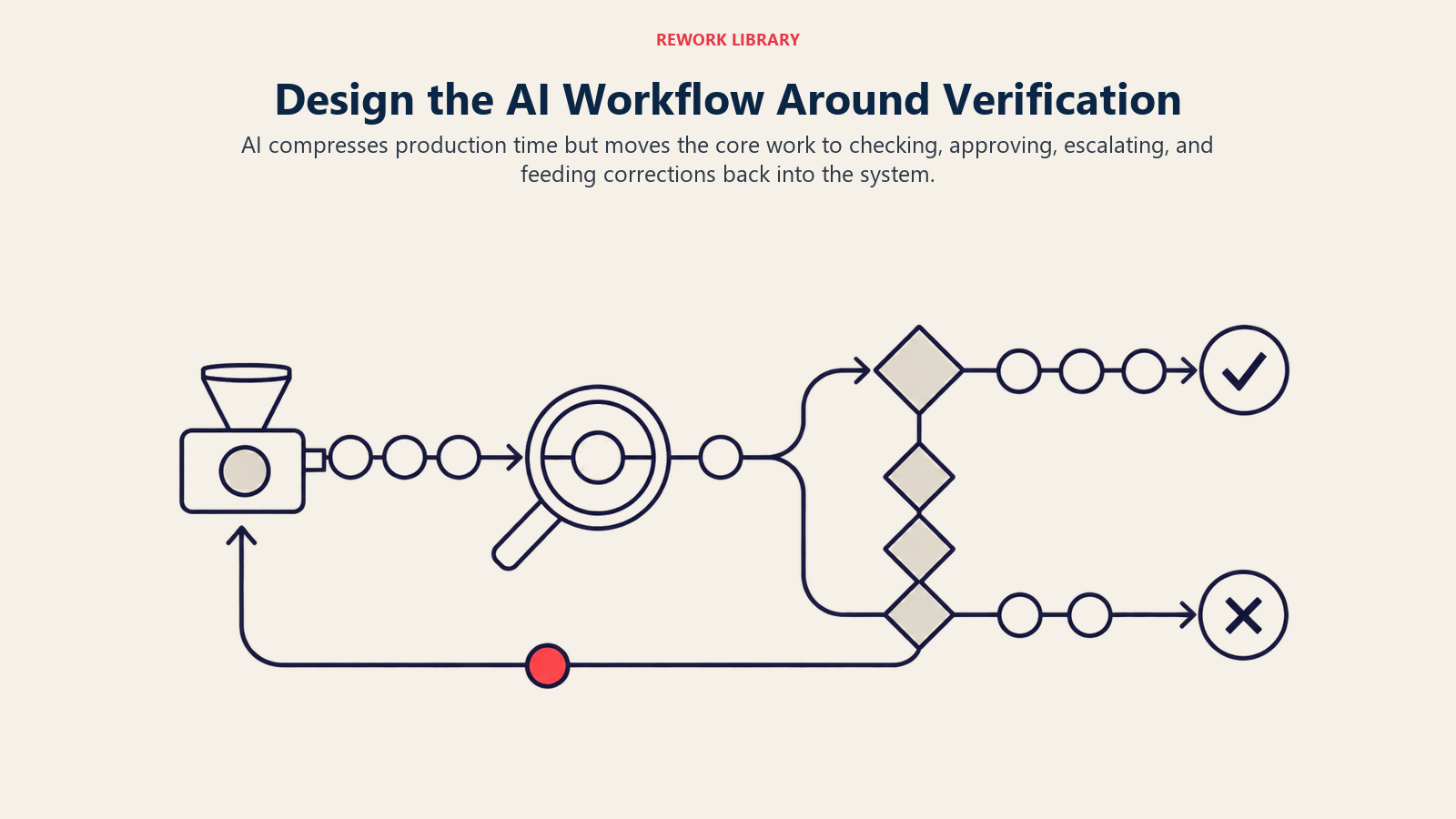
The most common redesign mistake is treating AI as a production upgrade when its real effect on most knowledge work is a shift in where verification has to happen.
What Changes When AI Drafts and a Human Verifies
In a pre-AI process, most of a person's time on a task is production time. Review exists but is lighter, since the person who wrote it already caught most of their own mistakes.
When AI produces the first version, that ratio flips. Production time collapses, but verification time doesn't shrink to match, because checking someone else's output for correctness is a different cognitive task than producing it. A redesigned process treats verification as the new core step: staffed for it, timed for it, measured on it, rather than a quick glance at something "AI already did."
This is also a role change, not just a sequencing one. The person who used to spend the day producing now spends it reviewing and deciding what needs escalation, a different and often more senior skill. From doer to orchestrator covers what that shift demands, and team topologies for human-plus-agent teams covers what it does to the shape of the team the redesigned role sits inside.
Building a Verification Loop That Doesn't Become the New Bottleneck
Managing AI agents as part of the team walks through this same loop in more operational detail, scoping ownership, setting the quality bar, and designing the handoff on purpose, for anyone running it as an ongoing job rather than a one-time redesign project.
- What's the acceptable error rate for this output, and who decided it? A routine reply and a contract clause don't carry the same risk; treating them the same wastes time on one and under-checks the other.
- Who can approve without escalating, and for what? If every AI-assisted output still needs the same senior sign-off as before, only a step got added, not a redesign. Human-in-the-loop design means deciding, deliberately, which decisions the loop actually needs.
- Does the tool improve from what verification catches? Tools that don't retain context get quietly routed around within months, MIT NANDA's research on pilot failure found. A verification step that never feeds back into the tool is a permanent tax, and it's also where small errors compound into AI technical debt.
When to Remove the Step Entirely, Not Automate It
Sometimes the right answer is that the step shouldn't exist at all, for anyone, human or AI.
The Elimination Test
Before automating a step, ask why it exists. Plenty of steps in mature processes outlive their reason: a control for a fraud pattern that stopped years ago, an approval layer added after one incident that never recurred. Automating a step like that just makes it cheaper to keep running forever, and cheap-to-run unnecessary steps are harder to ever cut, since nobody notices the cost.
For every step, ask what specific failure it prevents and how often that failure has actually happened in the last year. "We're not sure" or "it hasn't happened in years" makes it a candidate for elimination, not automation. A real, recent failure earns a redesign first, then an AI upgrade on top of it. This is also the fastest way to avoid the trap in which jobs AI changes rather than replaces: a role rarely disappears because one task got automated, but its shape changes once the unnecessary steps around it get cut for good.
Bolt-On vs. Redesign, Side by Side
| Process | Bolt-on approach | Redesigned approach | What changes in the result |
|---|---|---|---|
| Customer support tickets | AI drafts a reply; an agent still reviews and sends every ticket the same way | Low-risk categories route straight to the customer after an automated check; only ambiguous tickets reach a human | Handle time drops on the tickets that mattered least, freeing agents for tickets that need judgment |
| Sales proposals | AI writes the first draft; the rep still assembles pricing and formatting manually | Pricing pulls from the CRM deal record, AI drafts the narrative, the rep verifies numbers and adds the one paragraph only they can write | Turnaround drops from days to hours, and rep time goes into the deal-specific argument, not formatting |
| Code review | AI comments on every pull request; a senior engineer still reads every line | AI auto-clears error categories it catches reliably; a human reviews only architecture and logic calls | Review queue depth falls because trivial back-and-forth disappears, not because review "got faster" |
| Financial close | AI reconciles accounts faster, but the same approval chain and cutoff dates stay in place | Continuous reconciliation replaces the end-of-month batch, so exceptions resolve daily instead of piling up | The close compresses from days to hours because the backlog that caused the crunch no longer accumulates |
| Hiring screening | AI scores resumes faster; a recruiter still reviews every application in the same order | AI handles first-pass screening against a defined rubric; recruiter time shifts to interviews | Time-to-shortlist drops, and recruiter judgment goes toward decisions that actually require it |
Every redesigned column shares a pattern: the change isn't that AI does the task faster. It's that the process around the task got restructured so the speed actually reaches the finish line instead of stopping at the next unchanged step.
A Step-by-Step Redesign Method Leaders Can Run
- Pick one workflow, not the whole department. A clear start, end, owner, and enough volume that a change is measurable within a quarter. Redesigning everything at once is how this work turns into a slide deck nobody executes.
- Map every step and handoff, then time a real week. Log actual calendar time at each step, including waits and approvals, as the baseline every later claim of improvement gets measured against.
- Find the actual constraint. Where work piles up, what step gates cycle time the most, where rework gets created. Resist starting with the step that's easiest to bolt AI onto; it's frequently not the constraint.
- Run the elimination test on every step first. Name the specific failure each step prevents and how recently it occurred, and cut what no longer earns its place.
- Redesign roles around verification and escalation. Decide the acceptable error rate per output type, who can approve without escalating, and how corrections feed back into the tool.
- Assign a named business-metric owner before piloting. Cycle time, cost per unit, or error rate against the baseline, not a usage count. A pilot with no owner tends to drift into a rollout with no verdict.
- Measure the workflow metric weekly, and let the redesign evolve. The first version is rarely the final one; the weekly number gets you to the next one.
Running this on one workflow teaches a team more about where AI actually pays off than a dozen disconnected pilots ever will.
Making Redesign Someone's Actual Job
Redesign work needs an owner with standing to change how a process runs, not just recommend it, an org design question as much as a technical one. It connects to how org design shifts as AI takes on more production work, and to the choices some companies make about keeping parts of a workflow culturally, not just operationally, human.
Without that ownership, half-redesigned processes accumulate like unpaid debt: a verification step nobody owns, an escalation path nobody defined, an output nobody's checking against a real error rate. Together they show up later as AI cultural debt, costing far more to unwind than it would have cost to design right the first time. The same discipline applies whether the work sits with a single AI agent or several coordinating together.
The factories that rebuilt around unit drive in the 1920s didn't wait for a better motor. They had the motor for forty years. What changed was someone redesigning the floor around what electricity made possible, instead of what steam had made necessary. The tool in front of most companies right now is at least that capable already. The floor is still steam-era. That's the part worth fixing first.

Co-Founder, Rework.com
On this page
- Key Facts
- The Electrification Lesson: New Power Doesn't Redesign the Factory for You
- Group Drive to Unit Drive: The 40-Year Gap
- The Same Story, New Technology
- Why "Same Process, Faster Step" Hits a Hard Ceiling
- Borrowing a Computing Idea for Process Design
- The 10-20-70 Split BCG Keeps Finding
- Find the Actual Bottleneck Before You Automate Anything
- Map the Process, Not the Task List
- Three Questions That Reveal the Real Constraint
- Redesign Around Verification, Not Production
- What Changes When AI Drafts and a Human Verifies
- Building a Verification Loop That Doesn't Become the New Bottleneck
- When to Remove the Step Entirely, Not Automate It
- The Elimination Test
- Bolt-On vs. Redesign, Side by Side
- A Step-by-Step Redesign Method Leaders Can Run
- Making Redesign Someone's Actual Job