The Productivity Dividend: If AI Saves Time, Who Actually Gets It?
Turn this article into takeaways for your work.


Each assistant summarizes the article only for you and suggests best practices for your work.
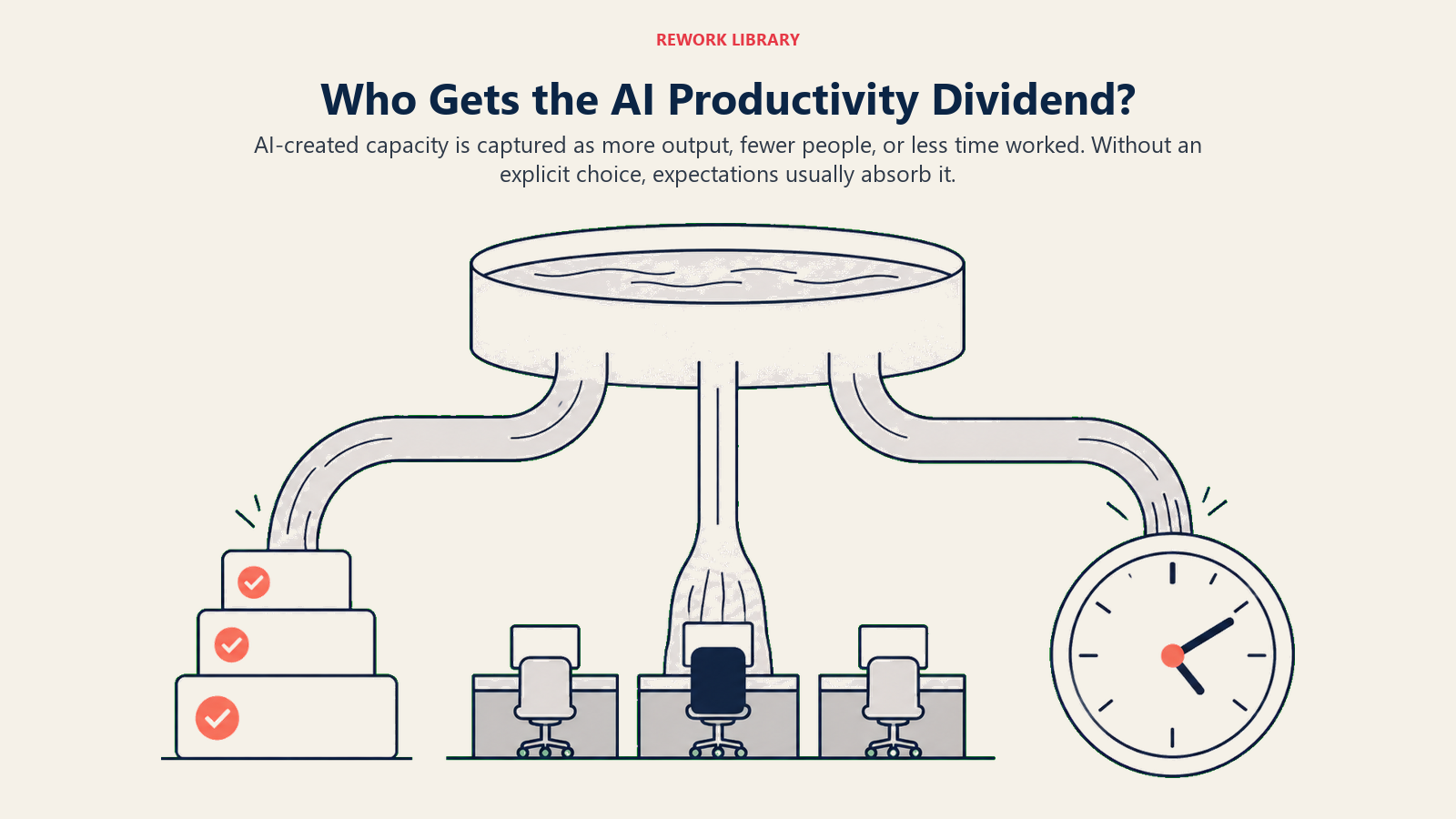
The productivity dividend is the value created when AI lets work get done faster, captured three ways: more output from the same headcount, the same output from fewer people, or the same output in less time per person. Companies pick one by default, usually without deciding to, and history says the third option (less time worked) almost never wins.
If your team got faster this year and nobody can point to where the hours went, that's not a mystery. It's a choice your organization already made without a meeting.
Key Facts
- The UK's six-month four-day week trial (61 companies, roughly 2,900 workers) ended with 92 percent of companies continuing the policy, revenue up 35 percent on average versus the same period a year earlier, and companies rating the experience 8.5 out of 10 (Autonomy Institute, UK Four-Day Week Pilot Results).
- The Boston College-led global pilot (100+ companies across the US, UK, Ireland, Australia, and Canada) found improved productivity and revenue, lower healthcare costs, and reduced turnover; not one participating company said it was unlikely to continue (Boston College News, "A four-day work week?").
- Independent reviewers flag that every major four-day week trial to date is self-selected, lacks a control group, measured revenue instead of output, and drew heavily from office-based professional roles, with only three manufacturing firms in the entire UK sample (The Conversation, "4-day work week trials have been labelled a resounding success, but 4 big questions need answers").
- 95 percent of generative AI pilots deliver no measurable P&L impact, evidence that time saved at the task level frequently never reaches the org chart as a deliberate decision at all (MIT NANDA, "The GenAI Divide: State of AI in Business 2025", via Fortune).
- Across most US industries studied from 1987 to 2015, labor productivity growth outpaced real compensation growth; in information services, productivity grew 5.0 percent annually versus 1.4 percent for compensation, and in manufacturing, 3.3 percent versus 0.8 percent (U.S. Bureau of Labor Statistics, "Understanding the Labor Productivity and Compensation Gap").
- Chats sent outside the standard 9-to-5 workday rose 15 percent year over year, and meetings starting after 8 p.m. rose 16 percent, evidence Microsoft calls the "infinite workday" (Microsoft WorkLab, "Breaking Down the Infinite Workday").
- In 1930, John Maynard Keynes predicted that within a hundred years, rising productivity would let people work as little as 15 hours a week; the standard of living he predicted arrived roughly on schedule, the free time did not (Keynes, "Economic Possibilities for our Grandchildren," 1930).
The Historical Pattern: Productivity Gains Rarely Become Free Time
The idea that saved time should turn into free time has a long, confident, and mostly wrong track record, worth checking before assuming AI breaks the pattern just because the technology is new.
Keynes bet on leisure. He bet wrong.
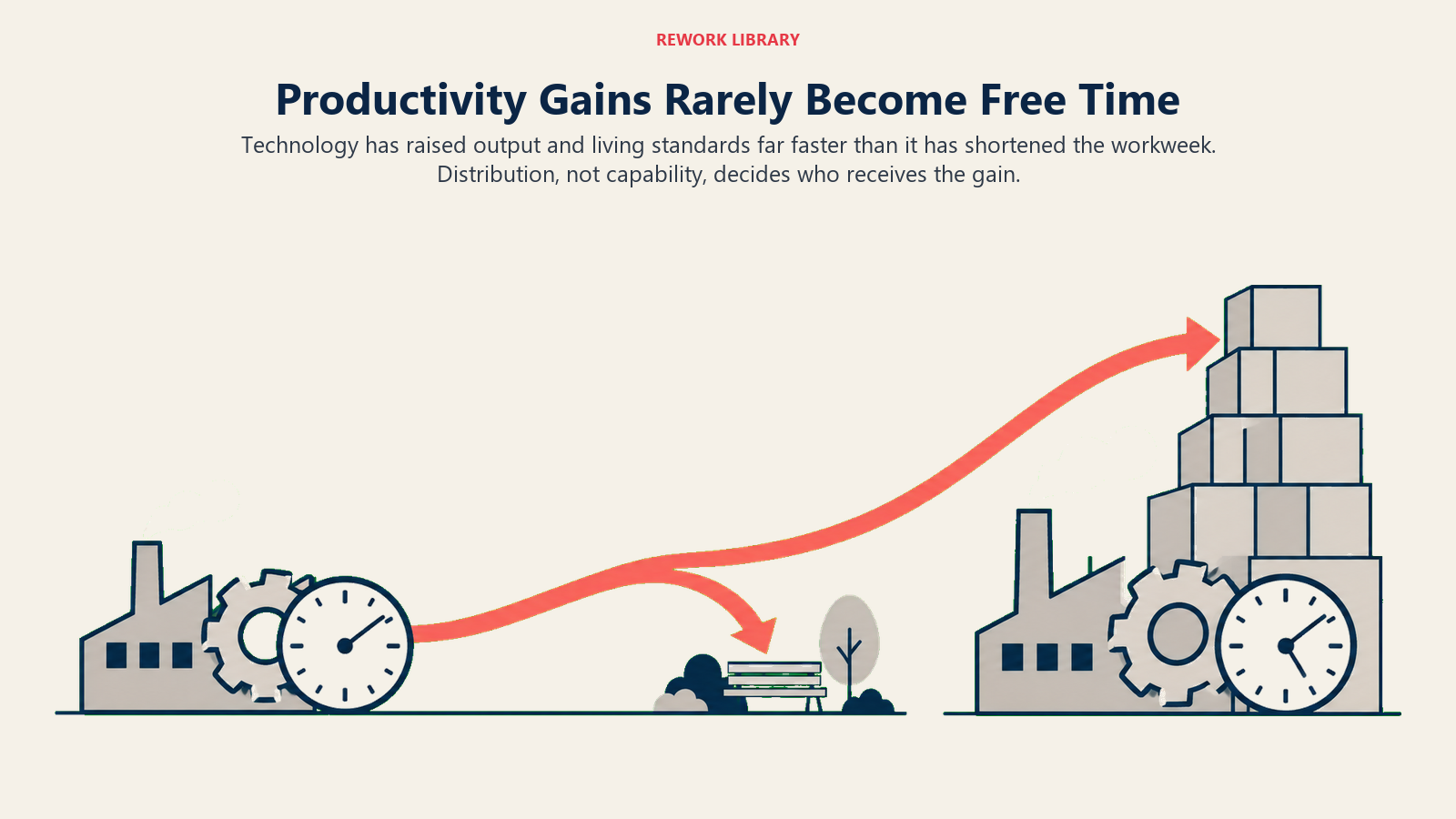
In 1930, John Maynard Keynes wrote an essay predicting that within a century, compounding productivity growth would solve what he called "the economic problem." Standards of living, he thought, would rise four to eight times over. On that count he was roughly right; per-capita output in advanced economies has grown by something close to that multiple since 1930.
On the other half of his prediction, the part everyone remembers, he missed badly. Keynes expected people to convert that abundance into leisure, a 15-hour work week, with work reduced to a minor feature of life. That didn't happen. The standard US work week has hovered around 34 to 40 hours for decades, and knowledge work in particular has expanded to fill more of daily life, not less.
The gap between Keynes's two predictions is the whole story in miniature. The technology delivered. The distribution didn't go where he assumed it would.
Where the gains have actually gone
The data on where 20th and 21st century productivity gains ended up is less mysterious than the leisure question, just less comfortable. Looking at the decades from 1987 to 2015 across 183 US industries, the Bureau of Labor Statistics found that productivity outpaced compensation growth in the large majority of sectors studied. Information services saw productivity climb 5.0 percent a year against 1.4 percent compensation growth. Manufacturing saw 3.3 percent against 0.8 percent. Retail trade: 2.8 percent against 0.2 percent. The pattern holds broadly since the 1970s, when the two series first started to pull apart after decades of moving roughly together.
That's not a single verdict that automation always shrinks workers' share. Research from MIT's David Autor and Neil Thompson complicates the simple story: when automation removes a worker's routine tasks and leaves the hard-to-replace ones behind, the remaining work can become more valuable, not less. Bookkeepers lost a third of their jobs between 1980 and 2018, and the ones who stayed saw real wages rise nearly 40 percent. Inventory clerks saw the opposite: automation hit their specialized tasks directly, employment roughly doubled, and real wages fell 13 percent. Which pattern you get depends on which tasks the technology removes, a decision made by whoever designs the workflow, not a fixed law of automation.
The through-line across a century of general-purpose technology, from electrification to computers to AI, is this: gains get captured by whoever has the leverage to capture them, and "leisure for the workforce" has consistently lost that contest to "more output" and "lower cost" unless someone with authority chose otherwise on purpose.
What the Four-Day Week Trials Actually Found
If the historical pattern is discouraging, the four-day week movement is the most-cited counter-evidence, and it deserves a fair reading of both the results and their limits.
The headline numbers are real and worth taking seriously
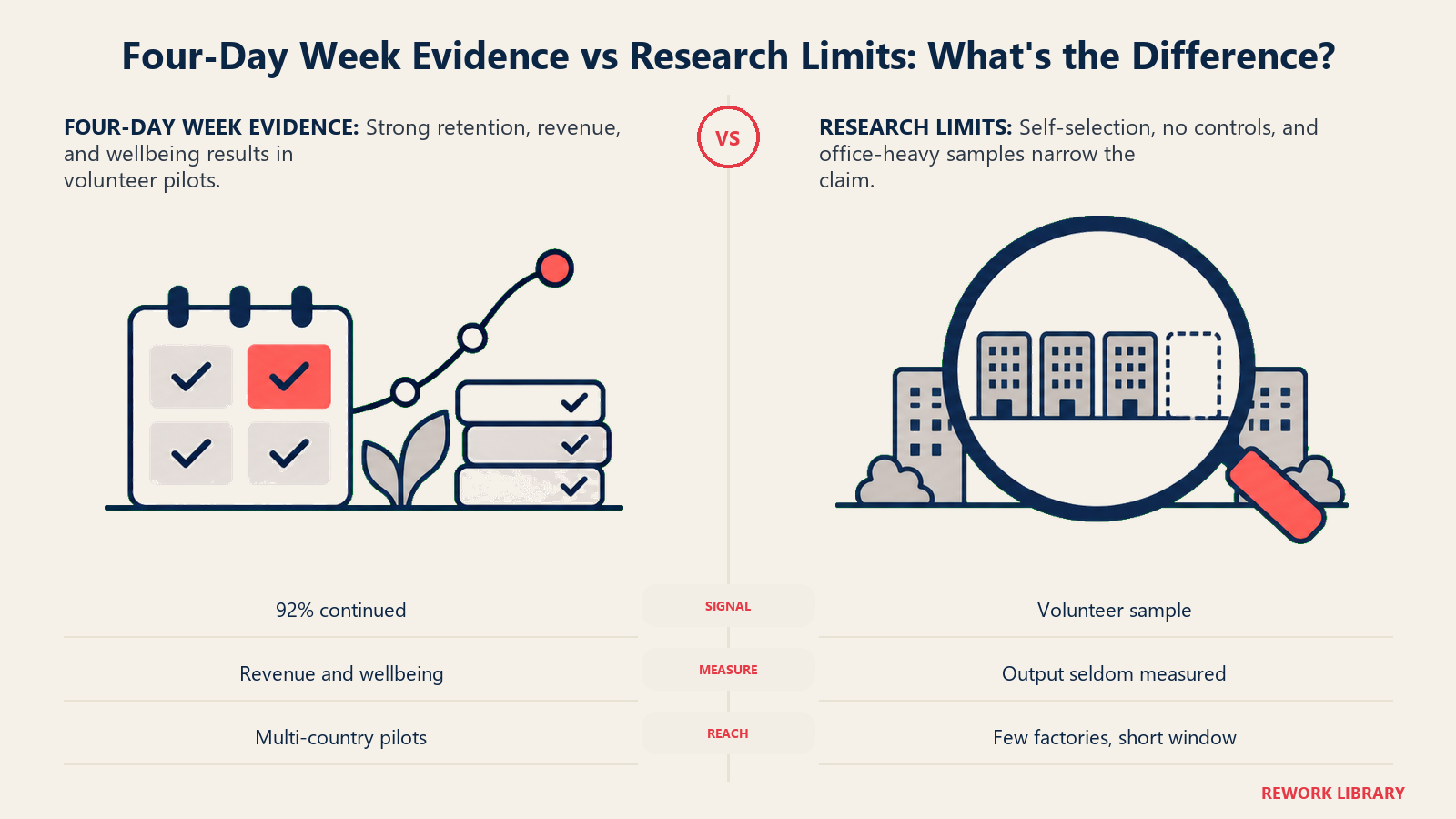
The UK's four-day week pilot, run by 4 Day Week Global and the Autonomy Institute with researchers including Boston College's Juliet Schor, put 61 companies and roughly 2,900 workers through six months at 100 percent of pay for 80 percent of the hours, with an expectation of maintaining 100 percent of output. The results were genuinely striking: 92 percent of companies continued the policy after the trial ended, revenue rose 35 percent on average compared to the equivalent period a year prior, resignations fell sharply, and companies rated their own experience 8.5 out of 10. A parallel Boston College-led pilot spanning more than 100 companies across five countries found the same broad shape: improved productivity and revenue, lower healthcare costs, reduced turnover, and not a single participating company planning to abandon the model.
Employee wellbeing numbers moved the same way across every trial: less burnout, less stress, better sleep, more exercise, better reported life satisfaction. That's consistent across multiple independent cohorts, and it's the strongest empirical case anyone has made in decades that reduced hours and maintained output can coexist.
The methodological limits the headlines skip
Here's what the press-release version leaves out. Every company in every trial volunteered. As The Conversation's review of the evidence points out, companies willing to sign up for a reduced-hours experiment are, almost by construction, companies that already believed it would work or already had slack to cut. That's not a criticism of the companies. It's a limit on what the results can tell you about a company that has never considered the idea.
None of the trials used a control group, so some of the improvement could reflect the attention of being part of a widely publicized pilot rather than the schedule change itself. The "productivity" figure most trials report is company revenue, not output volume, and revenue is sensitive to plenty of things a four-day week has nothing to do with, inflation among them, in a period like 2022 when the largest UK trial ran. The sample also skews heavily office-based and professional; the UK's flagship trial included only three manufacturing firms, and a shift-based factory floor doesn't have the same slack to cut.
None of this means the four-day week doesn't work. It means the evidence supports a narrower claim than the one usually repeated: for firms that resemble the ones who volunteered, over six to twelve months, a shorter week looks sustainable and popular. It does not yet show the gains hold past the trial window or that a company with no existing slack gets the same result. Treat "AI will give everyone a four-day week" with the same caution: an early, promising, narrow hypothesis, not a settled outcome.
The Third Path Nobody Markets: More Output, Same Hours
Between "give employees the time back" and "cut headcount," there's a third option that gets far less attention because nobody announces it: keep the team, keep the hours, and expect more from both. This is, by a wide margin, the default outcome when a company adopts AI without deciding what to do with the time saved.
It happens quietly because it requires no policy change. A support rep who used to close 40 tickets a day and now closes 60 with an AI assist doesn't get a four-day week or a smaller team; the target quietly becomes 60. Workflow redesign for AI covers why this path also tends to underdeliver: a faster step inside an unredesigned process usually just moves the bottleneck, so the "more output" version of the dividend often shows up smaller than the raw speedup suggests. The AI productivity paradox is largely this dynamic in the aggregate data: individual speedups everywhere, company-level output barely moving, because the saved time got absorbed into targets rather than converted into leisure or measurable throughput.
The "fewer people" path is more visible because it shows up in headcount numbers. It's worth being honest that it's a choice with its own tradeoffs, not a more efficient default. Cutting the team that just got faster removes the redundancy that let it absorb the next disruption, and it signals plainly what happens to anyone who gets good at using the tools.
Expectation Inflation: How the Dividend Disappears Without a Decision
There's a fourth thing that happens to saved time, less a path than a failure mode: it gets consumed by rising expectations before anyone notices it existed.
The infinite workday
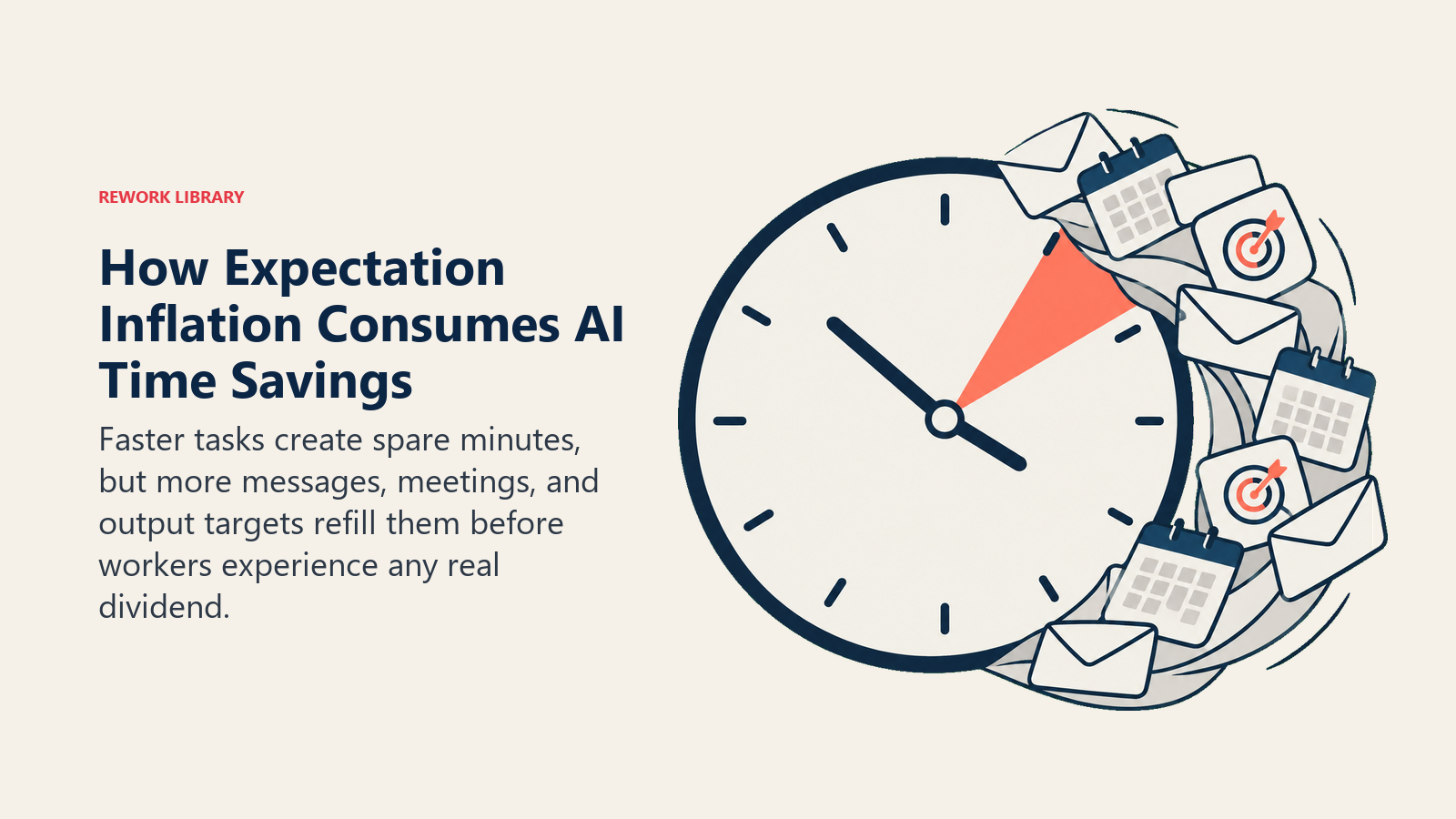
Microsoft's Work Trend Index describes this pattern as the "infinite workday": messages sent outside standard working hours are up 15 percent year over year, meetings starting after 8 p.m. are up 16 percent, and the average knowledge worker is now interrupted roughly every two minutes. That's not what AI adoption was supposed to produce. It's what happens when a tool makes each task faster while the total number of tasks, meetings, and channels expected of a person expands to match the new capacity, a dynamic closely related to what AI-mediated communication does to the volume and pace of everyday work exchanges.
Saved minutes become filled minutes
This is expectation inflation: the baseline of normal output quietly rises to absorb whatever time AI frees up, so nobody experiences a dividend, just a faster treadmill. It's the same mechanism the four-day week trials avoided: those companies made an explicit, visible decision to cap the workload at four days' worth rather than let expectations creep to fill five. Absent that cap, expectations creep by default, because nobody has to approve creep the way they'd approve a stated policy. This is one reason keeping human judgment sharp matters here too: a workforce running on an ever-inflating baseline has less slack for the deliberate thinking that catches an AI system's mistakes before they compound.
Where the Dividend Goes, What It Signals, When It Makes Sense
| Where the dividend goes | What it signals to employees | When it makes sense |
|---|---|---|
| More output, same headcount and hours | "Absorb whatever the tool saves, indefinitely." Reads as extraction if unacknowledged; fair if paired with recognition, pay, or advancement. | Growth-constrained teams with real demand, where extra capacity converts to revenue or backlog reduction the team can see. |
| Fewer people, same output and hours | "The tool made some of you redundant." Necessary in genuine overcapacity, corrosive if it's cost-cutting dressed as efficiency. | Structural overcapacity unrelated to performance, handled with real transition support, not a stealth review of who used AI well enough to survive. |
| Less time worked, same output and pay | "We're sharing the gain with you." The clearest signal of trust, and the rarest choice, since it has no upside for whoever sets the policy. | Stable-demand functions with real evidence, not just a demo, that output holds at reduced hours. |
| Unclaimed (expectation inflation) | "Nobody decided anything. Whatever seems achievable becomes normal." The default when leadership never states which path it's choosing. | Never by design; this is what happens when a company skips the decision, worth naming so it stops being the accident. |
What Employees Conclude From How You Split It
Whichever path an organization takes, employees read it as a statement of values whether leadership intended one or not. A team that gets faster and watches headcount shrink concludes that visible productivity is dangerous to display, and quietly slows down. A team that gets faster and watches targets rise without acknowledgment concludes that speed just buys more work, a fast route to the disengagement covered in burnout culture. A team told plainly "we're keeping the gain as margin this year, and here's why" tends to accept it, because the honesty itself is the signal, not the specific split.
This connects to employee retention: the four-day week trials' resignation drops weren't purely about the extra day off. They were also about the company visibly choosing to give something back rather than silently pocketing the gain, the same transparency that underpins building trust in the workplace more broadly.
Choosing the Split on Purpose, and Saying It Out Loud
The evidence here supports a modest conclusion rather than a dramatic one. AI does not automatically hand anyone a shorter week. History says it won't, the wage-productivity data says it hasn't for fifty years, and even the most successful four-day week trials only worked because someone made an explicit, disclosed decision to route the gain toward employee time rather than let it default to output or headcount. That decision is available to any leadership team. It just doesn't make itself.
Naming the choice is the actual intervention. Before rolling out an AI tool at scale, decide, and state plainly to the team affected, which of the three paths this rollout is meant to fund. Measure against whichever one you picked, on a real metric rather than a usage count, the same discipline measuring individual contribution in AI-augmented work argues for when contribution itself gets harder to see. And if the honest answer is "we haven't decided," say that too. It's a worse answer than any of the three deliberate ones, but far better than letting expectation inflation decide by default and calling it nothing.
The dividend exists. Somebody is already spending it. The only real choice left is whether that somebody made the decision on purpose.
Frequently Asked Questions about the AI Productivity Dividend
What is the AI productivity dividend?
It's the time or value freed up when AI makes a task or workflow faster. That freed capacity gets captured in one of three ways: more output from the same team, the same output from a smaller team, or the same output in fewer hours per person. Which path a company takes is a choice, even when nobody explicitly makes it.
Will AI actually give workers shorter work weeks?
The evidence so far is promising but narrow, not proven at scale. Four-day week trials show strong results for companies that volunteer, but every trial is self-selected, lacks a control group, and skews toward office-based professional roles. History also argues against a shorter-week default: Keynes predicted a 15-hour week by 2030 based on productivity growth that has actually shown up, yet average work hours haven't fallen anywhere close to that.
What did the UK four-day week trial actually find?
Across 61 companies and roughly 2,900 workers over six months, 92 percent of companies continued the four-day policy afterward, revenue rose 35 percent on average versus the same period a year earlier, and companies rated the experience 8.5 out of 10. Employee wellbeing measures, including stress, burnout, and sleep, improved consistently.
What are the real limitations of the four-day week research?
Every trial to date is self-selected (companies chose to participate), none used a control group, most measured revenue rather than actual output volume, and the samples are heavily weighted toward professional and managerial roles. The UK's largest trial included only three manufacturing companies, so the results may not generalize to sectors with less existing slack.
Why doesn't saved time from AI just become free time automatically?
Because nothing forces it to. Absent an explicit decision, expectations quietly rise to absorb whatever capacity AI frees up, a pattern Microsoft's Work Trend Index documents as the "infinite workday." The four-day week trials that succeeded only did so because leadership made a visible, disclosed decision to cap hours rather than let output targets creep to fill the freed time.
Has productivity growth historically turned into higher pay for workers?
Not consistently. US Bureau of Labor Statistics data shows labor productivity growth has outpaced real compensation growth across most industries since the late 1970s. The relationship is not absolute; research on task-level automation shows some roles see rising wages when routine tasks are automated away and harder-to-replace work remains, while others see wages fall when their specialized tasks get automated directly.
How should a company decide what to do with time AI saves?
Decide before the rollout which of the three paths (more output, fewer people, or less time) the initiative is meant to fund, state that decision to the affected team, and measure against it with a real metric rather than a usage count. Employees consistently read the decision itself, more than which specific option gets chosen, as a signal of whether the company is being straight with them.
Is it ever reasonable to keep the productivity gain as more output rather than giving employees time back?
Yes, particularly in growth-constrained teams with genuine demand for more capacity. The problem isn't choosing "more output." It's choosing it silently and expecting employees to keep absorbing higher targets indefinitely without acknowledgment, recognition, or any visible connection between their added output and their own compensation or advancement.

Co-Founder, Rework.com
On this page
- Key Facts
- The Historical Pattern: Productivity Gains Rarely Become Free Time
- Keynes bet on leisure. He bet wrong.
- Where the gains have actually gone
- What the Four-Day Week Trials Actually Found
- The headline numbers are real and worth taking seriously
- The methodological limits the headlines skip
- The Third Path Nobody Markets: More Output, Same Hours
- Expectation Inflation: How the Dividend Disappears Without a Decision
- The infinite workday
- Saved minutes become filled minutes
- Where the Dividend Goes, What It Signals, When It Makes Sense
- What Employees Conclude From How You Split It
- Choosing the Split on Purpose, and Saying It Out Loud