Bahasa Indonesia
Apa itu Post-Sale Management? Panduan Lengkap untuk Customer Success
Turn this article into takeaways for your work.


Each assistant summarizes the article only for you and suggests best practices for your work.
Inilah stat yang harus membuat setiap SaaS executive tidak nyaman: hanya 8% perusahaan B2B SaaS retain lebih dari 90% revenue mereka year-over-year. 92% lainnya? Mereka hemorrhaging customers dan revenue sambil menghabiskan massive budget untuk backfill leak.
Dan inilah uncomfortable truth: masalahnya bukan bahwa customer tidak butuh produk Anda. Ini bahwa kebanyakan perusahaan treat post-sale relationship seperti afterthought. Mereka punya sophisticated sales operations, tapi post-sale? Itu hanya "make sure they don't cancel" dengan beberapa support ticket mixed in.
Jika Anda trying to build predictable recurring revenue, Anda perlu understand ini: post-sale management bukan nice-to-have support function. Ini operational discipline yang menentukan apakah business model Anda actually works.
Apa itu Post-Sale Management?
Post-sale management covers semuanya yang terjadi setelah contract signed. Onboarding, adoption, renewals, expansions, advocacy - entire journey helping customers achieve value dan grow investment mereka over time.
Kata kunci adalah "systematic." Kami tidak talking tentang reactive customer service atau hoping customers figure things out. Real post-sale management treat customer outcomes seperti operation - dengan defined stages, measurement systems, dan continuous optimization.
The Critical Distinction: Post-Sale vs Sales
Sales ends ketika contract signed. Post-sale begins there dan continues untuk entire customer relationship. Tapi perbedaannya goes deeper than timing:
Sales optimizes untuk acquisition. Post-sale optimizes untuk retention dan expansion.
Sales deals dengan prospects. Post-sale deals dengan customers yang sudah invested time, money, dan political capital.
Sales gets paid pada closed deals. Post-sale gets measured pada renewals, expansion, dan lifetime value.
Sales has finite timeline. Post-sale adalah ongoing relationship yang compounds over time.
Inilah shift: di traditional business models, sale was finish line. Di subscription dan recurring revenue models, sale adalah starting line. Economics Anda depend entirely pada what happens next.
Why Post-Sale Management Matters More Than Ever
Tiga forces telah made post-sale operations critical untuk modern B2B companies:
Subscription economics fundamentally changed math. Ketika customers pay upfront untuk perpetual licenses, acquisition was game. Ketika customers pay monthly atau annually dan bisa leave anytime, retention becomes game. Customer Acquisition Cost (CAC) Anda doesn't pay back untuk 12-18 bulan di most SaaS models. Lose customers before that, dan Anda burning cash.
Buyer expectations evolved. Customers expect ongoing value delivery, bukan just product dump. Mereka expect proactive guidance, regular business reviews, dan continuous improvement. Bar untuk "good enough" keeps rising, driven oleh best-in-class experiences dari companies seperti Slack, Stripe, dan Notion.
Competition intensified. Switching costs dropped. Customers have more choices dan less patience. Jika Anda not delivering value, someone else will. Moat isn't your product anymore - it's relationship dan value realization yang Anda build post-sale.
The Six Stages of Post-Sale Management
Effective post-sale operations move customers through six distinct stages. Each has its own goals, metrics, dan intervention strategies.
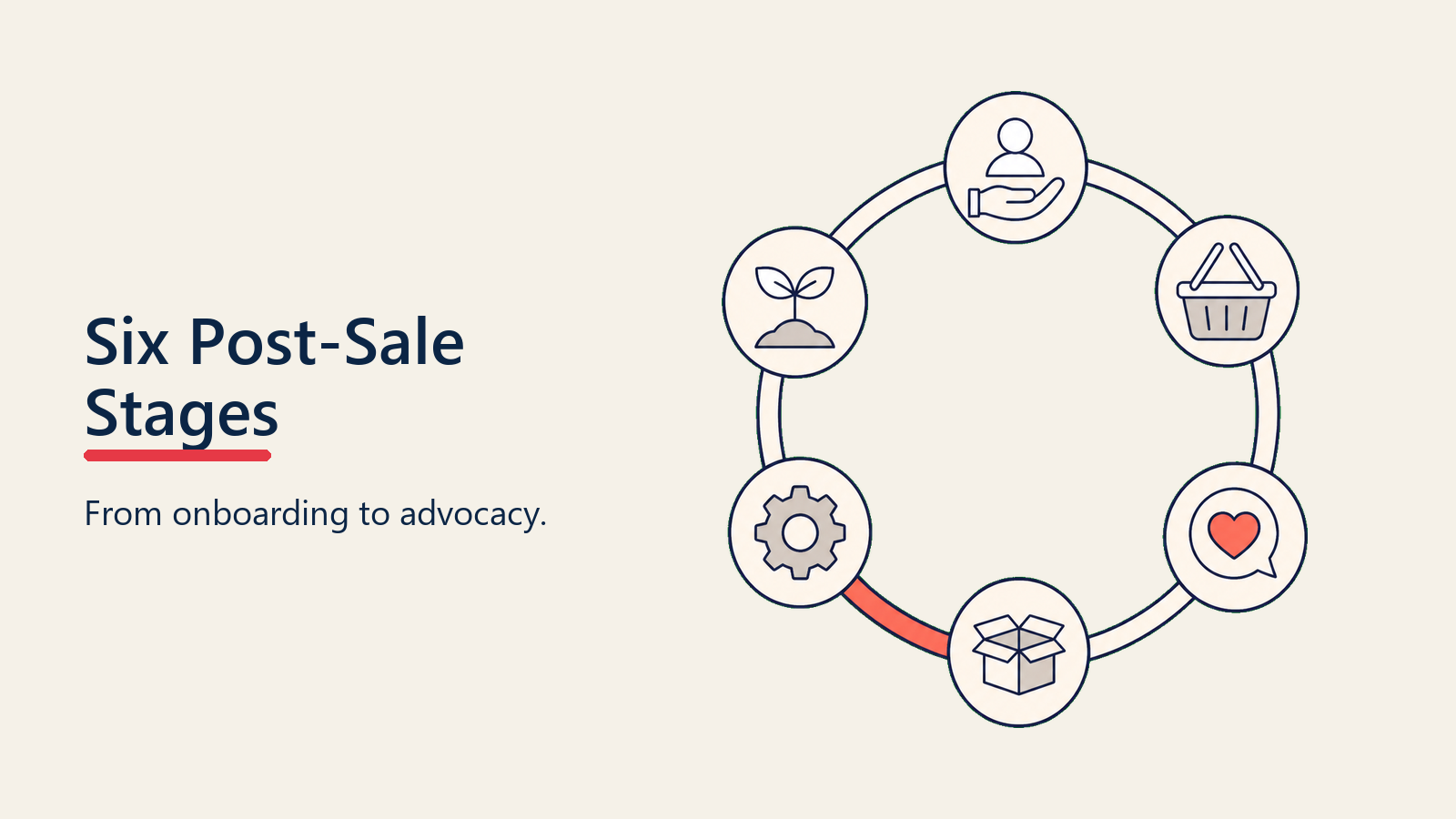
Stage 1: Onboarding (Days 0-90)
Get customers up dan running, configured correctly, dan experiencing first wins mereka. Stage ini sets trajectory untuk entire relationship.
Anda trying to complete technical implementation, train users on core functionality, dan achieve first measurable business outcome. Most importantly, Anda validating bahwa solution actually fits use case mereka.
Customers yang reach value within first 90 days adalah 3-4x more likely to renew. Slow atau failed onboarding adalah number one predictor of early churn. Miss window ini dan Anda fighting uphill battle untuk rest of contract.
Stage 2: Adoption (Months 3-12)
Sekarang Anda driving deeper usage across more users dan features. Moving from basic functionality to comprehensive utilization.
Goal adalah increasing daily dan weekly active users, expanding feature adoption beyond initial use case, dan building real usage habits yang integrate into workflows mereka. Anda juga identifying power users dan internal champions.
Inilah kenapa ini matters: usage depth directly correlates dengan retention. Customers menggunakan 50%+ dari relevant features churn at half rate dari those using basic features only. Jika mereka not adopting, mereka not seeing value. Dan jika mereka not seeing value, mereka not renewing.
Stage 3: Retention (Ongoing)
Keep customers healthy, engaged, dan realizing ongoing value. Ini bukan passive - it requires active health monitoring dan intervention.
Anda maintaining high usage dan engagement levels sambil proactively identifying dan resolving issues before mereka become deal-breakers. Regular business reviews happen here, along dengan early warning detection untuk prevent churn.
Numbers tell story: 5% increase di retention rate bisa increase profits by 25-95% depending on business model Anda. Retention adalah foundation of sustainable growth. Everything else builds on this.
Stage 4: Expansion (Months 6+)
Identify dan capture opportunities untuk grow account through upsells, cross-sells, atau usage-based expansion.
Ini means adding more users atau seats, upgrading ke higher-tier plans, adopting additional products atau modules, dan increasing usage-based consumption. Tapi Anda need to earn right to expand - customers only grow investment mereka ketika mereka already getting value dari what they have.
Net Revenue Retention (NRR) above 100% means Anda growing revenue dari existing customers faster than Anda losing it to churn. Companies dengan 120%+ NRR command premium valuations karena mereka have built-in growth. Mereka not dependent pada new customer acquisition untuk hit numbers mereka.
Stage 5: Renewal (30-180 days before contract end)
Secure contract renewal dengan minimal friction dan maximum retention of revenue.
Anda confirming renewal intent early, addressing any blockers atau concerns, negotiating terms dan pricing, dan processing renewal smoothly dan on-time. Jika Anda having renewal conversation untuk first time 30 days before contract ends, Anda already lost.
Renewals adalah recurring revenue engine Anda. Every point of churn at renewal adalah lost revenue forever, plus CAC yang Anda spent to acquire customer itu in first place. Math brutal ketika Anda lose customers.
Stage 6: Advocacy (Month 12+)
Convert satisfied customers into active promoters yang provide references, case studies, reviews, dan referrals.
Anda securing customer references dan case studies, generating reviews on G2 dan Capterra, obtaining referrals ke similar companies, dan featuring customers di marketing content. Ini bukan just nice to have - it's competitive moat.
Customer acquisition cost untuk referred customers adalah 50-70% lower than other channels. Advocacy creates compounding growth loop di mana happy customers bring Anda more customers, yang become happy customers, yang bring Anda more customers. Ini adalah how efficient growth happens.
The Three Pillars of Effective Post-Sale Management
Sementara post-sale management encompasses many practices, tiga hal separate high-performing operations dari everyone else:
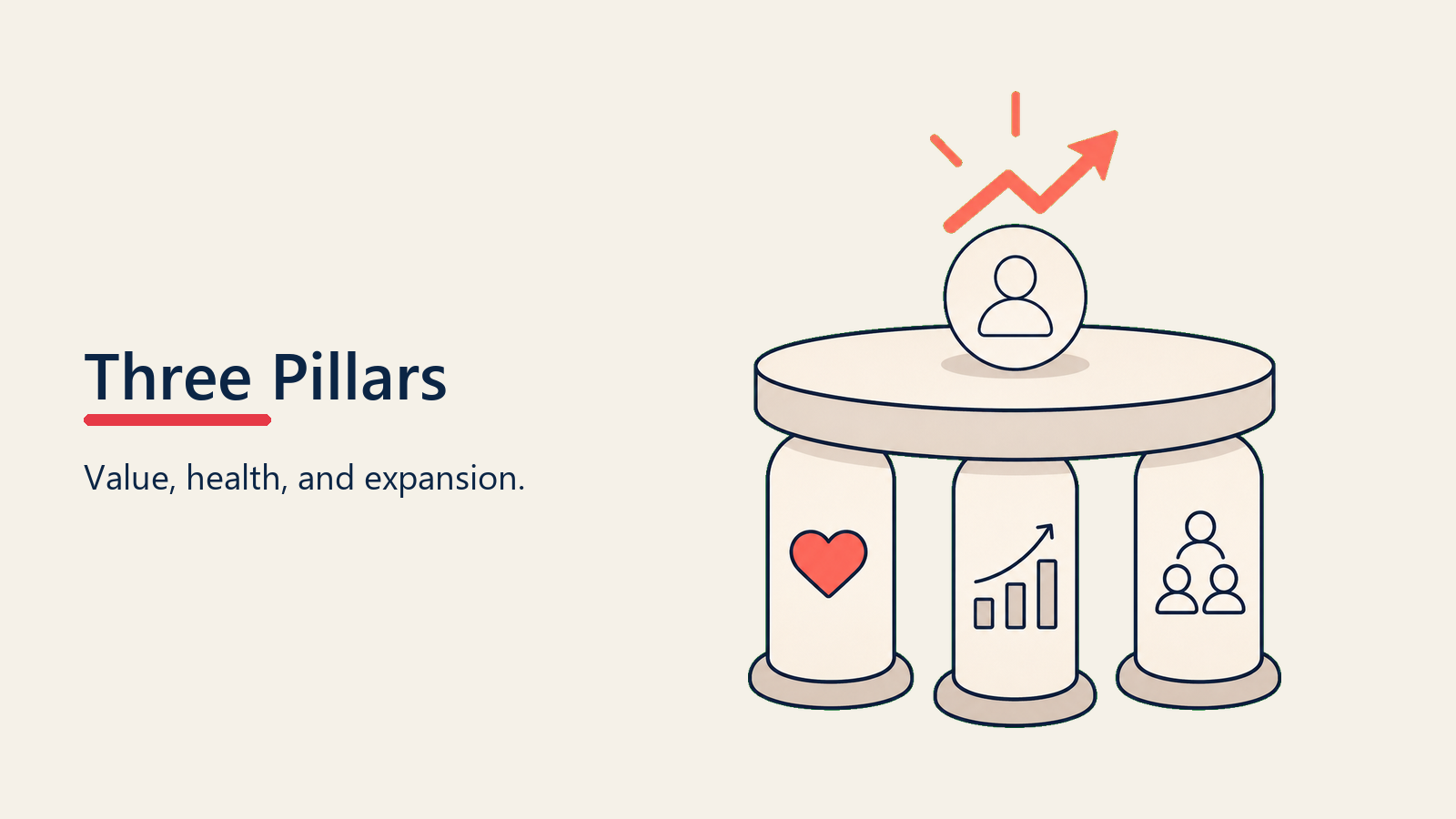
1. Proactive Value Realization
Customers don't renew atau expand karena mereka like you. Mereka renew karena mereka achieving measurable business outcomes yang justify investment.
Mature post-sale operations define success criteria upfront. Business metric apa yang akan improve? Efficiency, revenue, cost reduction? By how much? Anda need quantified target. Within timeframe apa? Be realistic tentang milestones. How will we measure it? Apa data source dan calculation?
Then mereka track progress toward those outcomes dan intervene ketika customers aren't hitting milestones. Ini bukan account management theater dengan quarterly check-ins di mana everyone nods politely. Ini systematic outcome tracking dengan clear accountability.
2. Data-Driven Health Monitoring
Anda can't wait untuk customers mengatakan mereka unhappy. By time mereka complain, mereka often already shopping alternatives.
Effective post-sale operations implement health scoring systems yang combine product usage data (logins, feature adoption, engagement trends), relationship signals (support ticket volume, NPS scores, executive engagement), business context (account changes, competitive activity, budget cycles), dan sentiment indicators (survey responses, meeting sentiment, email tone).
Systems ini flag at-risk accounts early, ketika intervention bisa still work. Companies dengan mature health scoring reduce churn by 15-25% compared to reactive approaches. Perbedaan antara knowing 90 days out versus 30 days out often perbedaan antara saving account dan losing it.
3. Systematic Expansion Motion
Growth dari existing customers shouldn't depend on random "let me know if you need more licenses" conversations. It requires structure.
Ini means defined expansion triggers - usage thresholds, team growth, new use cases yang signal readiness. Proactive outreach ketika triggers itu occur, bukan waiting untuk customers to ask. Product-led expansion hooks seperti upgrade CTAs in-app atau usage-based pricing yang naturally drives growth. Clear handoffs between CSM dan sales untuk complex expansions. Dan tracking expansion pipeline seperti Anda track new business pipeline.
Companies dengan systematic expansion motions achieve Net Revenue Retention rates of 120-130%, compared to 95-105% untuk reactive approaches. Gap itu adalah perbedaan antara hyper-growth dan struggling to hit plan.
What Poor Post-Sale Management Actually Costs You
Companies dengan weak post-sale operations see predictable (dan expensive) results:
70-85% Gross Revenue Retention instead of 90-95%. Itu means Anda losing 15-30% dari revenue base Anda every year just dari logo churn. At rate itu, Anda need to grow new business by 20-30% annually just to stand still.
15-25% higher Customer Acquisition Cost karena Anda can't rely on existing customer expansion dan Anda have low referral rates. Every dollar of growth has to come dari expensive new customer acquisition.
50-70% longer sales cycles untuk new business karena Anda don't have strong case studies, references, atau proof points dari successful customers. Prospects need more convincing ketika mereka can't talk to happy customers.
Negative Net Revenue Retention di mana revenue dari existing customers shrinks faster than it grows. Ini death spiral - Anda running on treadmill, acquiring new customers as fast as possible just to offset losses.
On flip side, companies dengan mature post-sale operations see:
- Gross Revenue Retention of 90-98%
- Net Revenue Retention of 110-130%
- 40-60% of new business dari customer referrals
- Customer Lifetime Value 3-5x higher than acquisition cost
- Predictable, compounding revenue growth
The Economics That Make Post-Sale Investment Essential
Let's run math on kenapa post-sale management isn't optional di recurring revenue models.
Scenario: Anda acquire 100 customers at $50K ACV, spending $50K CAC per customer.
- Total ACV: $5M
- Total acquisition cost: $5M
- Payback period: 12 months (assuming 100% retention)
Without post-sale management:
- Year 1 renewals: 70% (industry average untuk low-touch)
- Year 1 ending revenue: $3.5M
- Anda lost $1.5M di ARR
- Plus Anda burned $5M di CAC
- Net position: -$6.5M relative to expectations
With effective post-sale management:
- Year 1 renewals: 95%
- Year 1 expansion: 15% average account growth
- Year 1 ending revenue: $5.4M ($5M x 0.95 x 1.15)
- Net Revenue Retention: 109%
- Anda added $400K di revenue tanpa any new customer acquisition
Delta between scenarios ini adalah $2.9M di annual recurring revenue. Dan that compounds every year. Over three years, cumulative difference adalah $15-20M di enterprise value.
Inilah kenapa post-sale operations aren't cost center. Mereka primary driver of enterprise value di subscription businesses.
Evolution Stages: From Reactive to Strategic
Post-sale management maturity follows predictable path. Most companies start reactive dan gradually build sophistication.
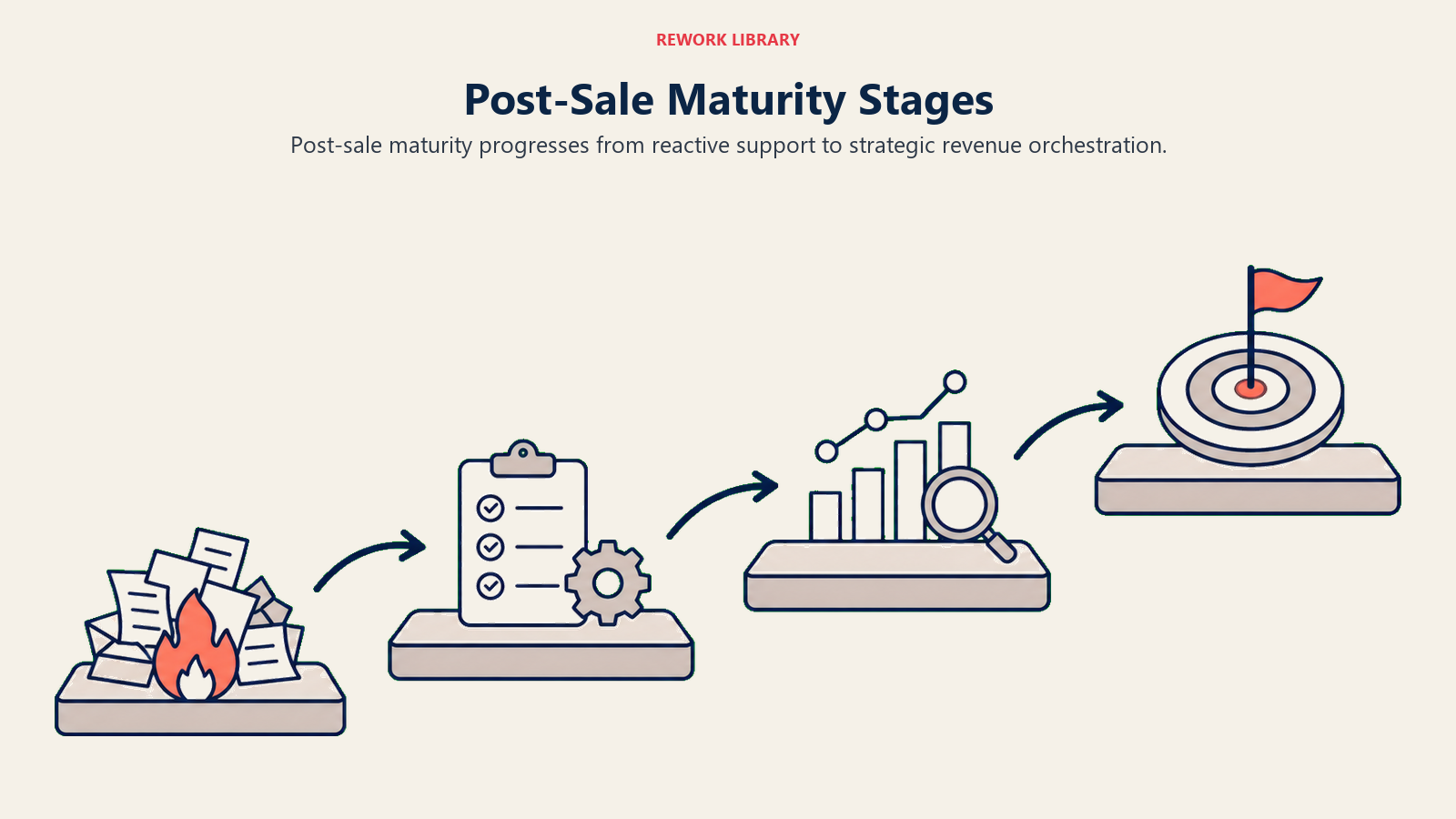
Stage 1: Reactive Support
No dedicated CS team, support handles renewals. Customers contact you ketika mereka have problems. No proactive outreach atau health monitoring. Renewals get handled by sales atau operations, usually late di cycle. Companies at stage ini typically see 70-80% GRR dan 70-85% NRR. Anda losing customers faster than Anda realize.
Stage 2: Basic Account Management
First CSM hires focused pada largest accounts. Quarterly business reviews start happening, though execution inconsistent. Manual tracking di spreadsheets. Renewal process exists tapi still starts too late, usually 30 days before contract end. Anda see improvement: 80-88% GRR dan 85-95% NRR.
Stage 3: Structured Customer Success
Defined CS team dengan account segmentation based on value dan need. Onboarding playbooks dan processes yang create consistency. Basic health scores get implemented. 90-day renewal timeline dengan actual forecasting. Expansion motion emerges, though it's not yet systematic. Typical results: 88-94% GRR dan 95-110% NRR.
Stage 4: Optimized Operations
Sophisticated segmentation dan touch models yang balance high-touch dan tech-touch efficiently. Advanced health scoring dan predictive analytics yang actually predict churn. Automated onboarding dan adoption tracks untuk mid-market dan below. Systematic expansion identification yang doesn't depend on CSM intuition. 120+ day renewal process dengan save strategies ketika needed. Performance jumps: 94-97% GRR dan 110-125% NRR.
Stage 5: Strategic Growth Engine
Customer success drives product roadmap input karena mereka know apa yang customers actually need. Predictive churn models dengan high accuracy yang give Anda time to intervene. Seamless product-led dan human-led expansion working together. Advocacy program driving significant referral revenue. CS team has P&L ownership dan accountability. Best-in-class results: 95-98% GRR dan 120-140% NRR.
Most companies operate between Stage 2 dan Stage 3. Competitive advantage lies dalam reaching Stage 4 dan beyond.
Core Responsibilities of Post-Sale Teams
Apa yang actually happens di post-sale management? Inilah concrete responsibilities:
Customer onboarding: Getting new customers dari signed contract to first value as quickly as possible. Ini includes implementation, training, initial configuration, dan success criteria validation.
Adoption enablement: Driving deeper product usage through training, best practice sharing, feature introduction, dan proactive guidance. Moving customers dari minimal use to comprehensive utilization.
Health monitoring: Continuously assessing account health through usage data, engagement metrics, dan relationship signals. Flagging at-risk accounts untuk intervention.
Renewal management: Running renewal process dari 90-180 days out, confirming intent, negotiating terms, addressing concerns, dan ensuring smooth contract execution.
Expansion identification: Spotting opportunities untuk grow accounts through more users, higher tiers, additional products, atau increased usage. Partnering dengan sales on complex expansions.
Value realization tracking: Measuring apakah customers achieving business outcomes yang mereka purchased produk Anda to deliver. Documenting ROI dan value stories.
Executive engagement: Building relationships dengan customer executives dan decision-makers untuk ensure strategic alignment dan executive sponsorship.
Customer advocacy development: Identifying dan recruiting successful customers untuk references, case studies, speaking opportunities, dan referrals.
Cross-functional coordination: Working dengan product, engineering, dan support untuk resolve customer issues dan incorporate feedback into product development.
Specific allocation of responsibilities ini varies by company size, business model, dan customer segment, tapi functions ini need to happen somewhere di organization Anda.
Maturity Assessment: Where Do You Stand?
Assess current post-sale management maturity Anda dengan questions ini:
Do you know your Gross Revenue Retention dan Net Revenue Retention rates? Jika tidak, Anda not measuring fundamental health of business Anda.
Can you identify at-risk customers 60-90 days before they churn? Jika tidak, Anda intervening too late.
Do you have defined onboarding completion criteria dan time-to-value targets? Jika tidak, onboarding success subjective dan inconsistent.
What percentage of customers actively using produk Anda weekly? Jika Anda don't know, Anda can't drive adoption.
Do you have systematic process untuk identifying expansion opportunities? Jika ad-hoc, Anda leaving revenue on table.
Can you show ROI atau business value metrics untuk top accounts Anda? Jika tidak, renewals based on hope rather than demonstrated value.
Do your CSMs have health scores yang flag accounts before mereka become critical? Jika tidak, Anda operating blind.
Honest answers ke questions ini reveal apakah Anda managing post-sale operationally atau just reacting to problems.
Conclusion: Post-Sale as Your Revenue Engine
Post-sale management isn't expense to minimize. Di recurring revenue businesses, it's operational system yang determines apakah business model Anda succeeds atau fails.
Organizations yang treat post-sale sebagai core discipline - dengan defined processes, clear metrics, dan continuous optimization - build compounding revenue engines. Mereka grow faster, retain more, expand efficiently, dan command premium valuations.
Those yang treat post-sale sebagai afterthought watch revenue leak out bottom of bucket as fast as sales pours it in top. Mereka burn cash on acquisition to offset churn, struggle to prove value, dan eventually hit growth ceiling.
Choice clear: build operational backbone untuk recurring revenue success, atau watch business model Anda slowly fail.
Siap build systematic post-sale operations? Explore complete post-sale customer journey dan learn how to choose the right post-sale model untuk business Anda.
Pelajari lebih lanjut:

On this page
- Apa itu Post-Sale Management?
- The Critical Distinction: Post-Sale vs Sales
- Why Post-Sale Management Matters More Than Ever
- The Six Stages of Post-Sale Management
- Stage 1: Onboarding (Days 0-90)
- Stage 2: Adoption (Months 3-12)
- Stage 3: Retention (Ongoing)
- Stage 4: Expansion (Months 6+)
- Stage 5: Renewal (30-180 days before contract end)
- Stage 6: Advocacy (Month 12+)
- The Three Pillars of Effective Post-Sale Management
- 1. Proactive Value Realization
- 2. Data-Driven Health Monitoring
- 3. Systematic Expansion Motion
- What Poor Post-Sale Management Actually Costs You
- The Economics That Make Post-Sale Investment Essential
- Evolution Stages: From Reactive to Strategic
- Core Responsibilities of Post-Sale Teams
- Maturity Assessment: Where Do You Stand?
- Conclusion: Post-Sale as Your Revenue Engine