Bahasa Indonesia
Voice of Customer Programs: Menangkap Customer Insights Secara Sistematis
Turn this article into takeaways for your work.


Each assistant summarizes the article only for you and suggests best practices for your work.
Kebanyakan perusahaan mengatakan mereka mendengarkan customer. Kemudian Anda melihat bagaimana mereka benar-benar mengumpulkan, menganalisis, dan bertindak pada feedback dan itu berantakan. Support ticket menghilang ke dalam queue. Survey response duduk di spreadsheet yang tidak ada yang baca. CSM mendengar valuable insights di calls tapi tidak punya tempat untuk mendokumentasikannya. Product team membuat keputusan berdasarkan gut feeling karena customer feedback tidak diorganisir secara sistematis.
Mengatakan Anda peduli tentang customer feedback dan memiliki real Voice of Customer (VoC) program adalah hal yang benar-benar berbeda.
Real VoC program tidak hanya mengumpulkan feedback. Ini secara sistematis menangkap input dari multiple sources, menganalisisnya untuk pattern dan priorities, mengarahkan insights ke tim yang bisa bertindak pada mereka, dan closes the loop dengan menunjukkan customer feedback mereka mendorong perubahan nyata. Ini perbedaan antara bertanya pada customer apa yang mereka pikirkan dan benar-benar menggunakan apa yang mereka katakan untuk improve.
Why Voice of Customer Programs Matter
Customer feedback ada di mana-mana di bisnis Anda. Pertanyaannya adalah apakah Anda menangkapnya, mengorganisirnya, dan menggunakannya untuk menjadi lebih baik.
Product development tanpa customer input adalah guesswork
Anda bisa membangun feature yang Anda pikir valuable, atau Anda bisa membangun feature yang customer benar-benar butuhkan. Perusahaan dengan VoC programs yang kuat ship products yang customer inginkan karena mereka building dari real feedback, bukan assumptions.
Churn prevention dimulai dengan memahami kenapa customer frustrated sebelum mereka pergi
VoC programs surface issues early ketika mereka masih fixable. Pada saat customer mengatakan mereka akan pergi, sudah terlambat. Warning signs ada dalam feedback yang Anda tidak capture atau analyze.
Expansion opportunities bersembunyi di customer conversations
CSM Anda mendengar "we'd love if your product could do X" di business review. Tanpa VoC system, insight itu hidup di kepala CSM. Dengan one, itu ter-dokumentasi, di-tag, dan di-route ke product team yang bisa mengevaluasi building X.
Competitive intelligence datang dari customer membandingkan Anda dengan alternatives
Mereka akan mengatakan Anda persis di mana Anda lebih kuat dan di mana competitor menang. Itu strategic intelligence, tapi hanya jika Anda secara sistematis menangkapnya.
Customer relationships menguat ketika customer melihat feedback mereka penting
Ketika customer menyarankan sesuatu di May dan Anda ship itu di August dengan note mengatakan "you asked for this," Anda baru saja menciptakan advocate. Ketika feedback menghilang ke dalam black hole, Anda melatih customer untuk tidak repot-repot sharing lagi.
VoC Program Goals: What You're Actually Trying to Achieve
VoC program membutuhkan clear objectives beyond "listen to customers." Apa yang Anda coba accomplish?
Understanding customer needs berarti terus menerus belajar apa yang customer coba capai, apa yang memblokir mereka, dan bagaimana produk Anda fit ke dalam workflow mereka. Ini memandu semuanya dari product strategy ke marketing messaging.
Identifying improvement opportunities surface gap dalam produk, service, documentation, dan proses Anda. VoC programs harus generate backlog dari concrete improvements yang di-rank berdasarkan impact dan frequency.
Measuring satisfaction mengukur bagaimana customer merasa tentang produk, service, dan relationships Anda. NPS, CSAT, dan health scores memberi Anda metrics untuk track over time dan across segments.
Predicting churn menjadi mungkin ketika Anda spot pattern dalam negative feedback. Customer yang complain tentang specific issues atau menyebutkan certain competitors adalah statistical churn risks. VoC data feeds predictive models.
Discovering upsell opportunities terjadi ketika customer bertanya tentang capabilities yang mereka tidak tahu Anda sudah punya, atau features yang Anda bisa build. Conversations ini mengungkapkan whitespace dan expansion potential.
Validating strategy tests apakah roadmap Anda align dengan customer priorities. Jika customer bertanya untuk mobile apps dan Anda building API features, Anda mungkin solving wrong problems.
Feedback Collection Methods: Capturing Input from Multiple Sources
Customer memberi feedback dengan banyak cara. Tugas Anda adalah menangkap semuanya, bukan hanya convenient channels.
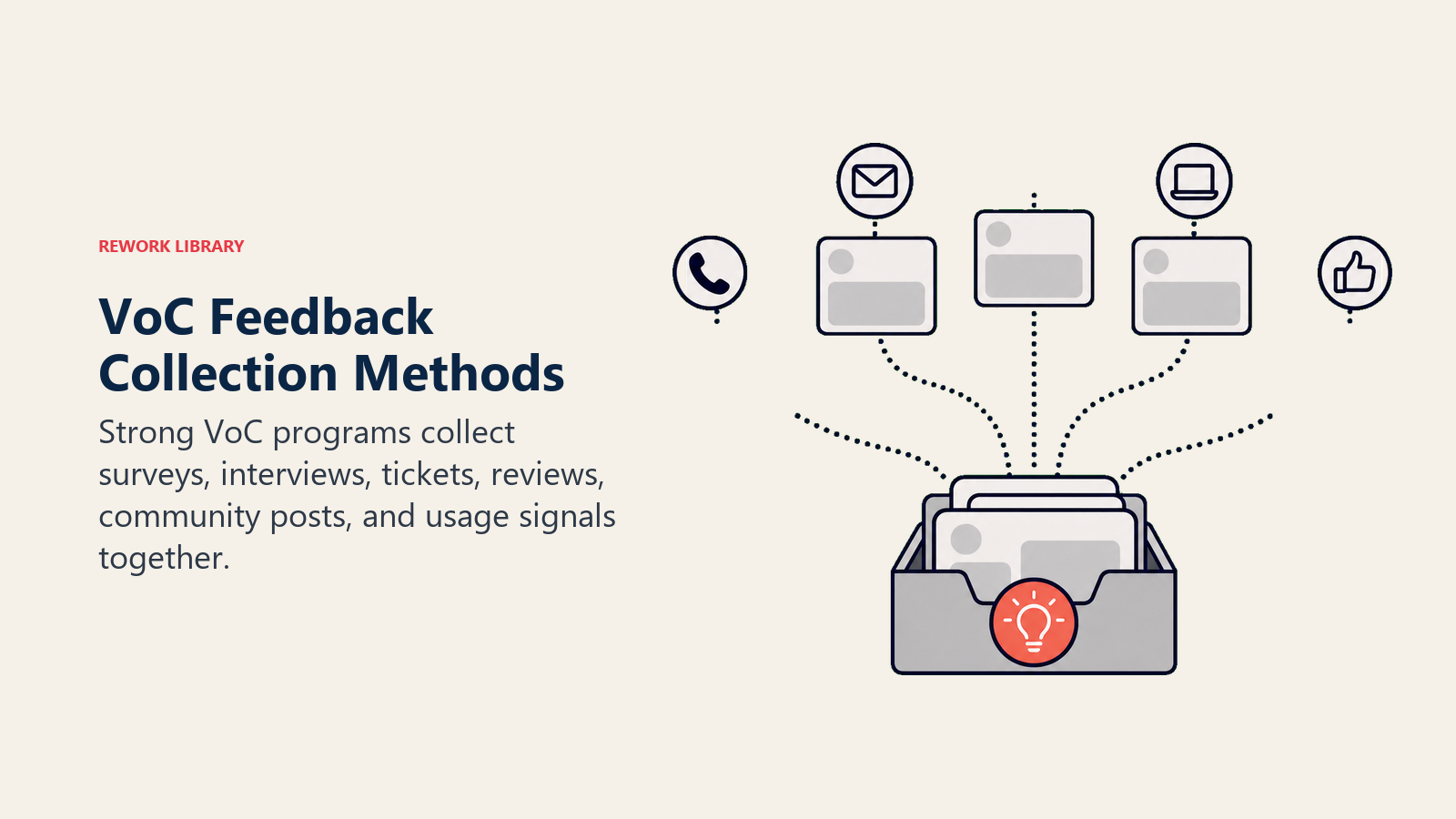
Surveys adalah structured feedback mechanism Anda. NPS mengukur likelihood to recommend. CSAT mengukur satisfaction dengan specific interactions. Custom surveys dig ke particular topics. Mereka work karena mereka scale dan quantify sentiment. Tapi mereka hanya capture apa yang Anda tanyakan.
Customer interviews membiarkan Anda explore topics secara mendalam. Tiga puluh menit dengan customer berbicara tentang challenges, goals, dan experience mereka dengan produk Anda mengungkapkan nuances yang survey tidak bisa capture. Anda belajar "why" di balik ratings.
Focus groups membawa beberapa customer bersama untuk discuss topics. Group dynamic surfaces perspectives yang individuals mungkin tidak mention. Customer build pada ide satu sama lain. Groups bisa didominasi oleh loud voices atau groupthink, though.
Support tickets menunjukkan Anda setiap kali sesuatu tidak bekerja seperti yang diharapkan. Setiap ticket adalah customer mengatakan Anda tentang problem. Analyze tickets by category, frequency, dan resolution time untuk identify systemic issues.
Usage data menunjukkan apa yang customer benar-benar lakukan versus apa yang mereka katakan. Mereka mungkin claim mereka menggunakan feature X secara regular, tapi analytics menunjukkan mereka tidak menyentuhnya dalam bulan. Behavior reveals truth.
Social listening menangkap apa yang customer katakan secara publik—Twitter mentions, LinkedIn posts, review sites, Reddit threads. Unfiltered opinions ini sering lebih honest daripada direct feedback.
Community forums membiarkan customer discuss challenges dan solutions. Pertanyaan apa yang muncul berulang kali? Feature apa yang power users ingin ada? Forums adalah continuous, passive feedback channels.
Sales conversations selama renewals dan expansions surface competitive pressures, budget constraints, dan decision criteria. Sales mendengar objections dan requirements yang tidak pernah mencapai CSMs atau support.
CSM calls adalah di mana relationship feedback terjadi. Business reviews, check-ins, dan strategic planning conversations mengungkapkan bagaimana customer perceive value, apa yang working, dan apa yang frustrating.
VoC programs terbaik pull dari semua sources ini. Relying pada surveys alone melewatkan depth. Relying pada interviews alone tidak scale. Anda membutuhkan breadth dan depth.
Structured Feedback Programs: Proactive Collection Systems
Jangan tunggu customer volunteer feedback. Build programs yang proaktif solicit itu di key moments.
Regular surveys menciptakan predictable feedback rhythms. Quarterly NPS surveys mengukur overall sentiment. Annual customer surveys go deep pada satisfaction, needs, dan competitive positioning. Schedule ini sehingga customer tahu kapan mengharapkan mereka.
Post-interaction feedback menangkap in-the-moment reactions. Setelah support interactions, tanya "How did we do?" Setelah training sessions, tanya "Did this help?" Setelah onboarding, tanya "How was the experience?" Catch feedback ketika fresh.
Milestone surveys trigger ketika customer hit significant moments—setelah 90 hari, setelah renewal pertama mereka, setelah expanding ke new product lines. Transitions ini adalah natural points untuk assess satisfaction dan gather input.
Exit interviews dengan churning customers painful tapi invaluable. Anda tidak bisa save relationship, tapi Anda bisa belajar apa yang salah. Conduct ini secara sistematis dan Anda akan spot patterns pointing ke fixable issues.
Advisory boards mengubah best customers Anda menjadi strategic partners. Quarterly atau bi-annual sessions di mana Anda share roadmap, get feedback, dan discuss industry trends. Advisory boards menyediakan depth dan build champion relationships.
Beta programs engage customers dalam testing new features. Mereka mendapat early access dan influence direction. Anda mendapat real-world validation sebelum full release. Document feedback rigorously selama beta cycles.
Qualitative Feedback: Understanding the "Why" Behind the Data
Angka mengatakan Anda apa yang terjadi. Qualitative feedback mengatakan Anda kenapa.
Customer interviews adalah primary qualitative tool Anda. Schedule 30-60 menit conversations dengan customer across segments, health scores, dan tenure. Tanyakan open-ended questions dan dengarkan lebih dari Anda berbicara. "Tell me about your biggest challenge right now" beats "Are you satisfied with our support?" setiap waktu.
Open-ended survey questions complement rating scales. Setelah bertanya "How likely are you to recommend?" tanya "What's the primary reason for your score?" Verbatim responses menjelaskan angka.
Support conversation analysis berarti membaca through tickets untuk understand context. Spike dalam tickets tentang feature X mungkin bug, confusing UX, missing documentation, atau customers trying to do something unsupported. Angka menunjukkan spike. Reading tickets menjelaskan kenapa.
CSM call insights memerlukan documentation discipline. CSMs mendengar valuable feedback setiap minggu. Tanpa system untuk capturing itu, insights tersebut menguap. Train CSMs untuk log key feedback points selama atau segera setelah calls.
Relationship feedback datang dari trust-based conversations. Customer yang telah membangun relationships dengan CSMs share things yang mereka tidak akan put di surveys—concerns tentang budget, internal politics, competitive evaluations, strategic shifts. Capture ini di CRM Anda dengan appropriate privacy controls.
Quantitative Feedback: Measuring and Tracking Metrics
Qualitative feedback menyediakan depth. Quantitative feedback menyediakan scale dan trendability.
NPS scores mengukur customer loyalty via "How likely are you to recommend?" question di 0-10 scale. Promoters (9-10) adalah loyal dan refer others. Passives (7-8) adalah satisfied tapi uncommitted. Detractors (0-6) adalah unhappy dan vocal. NPS = % Promoters - % Detractors.
Track NPS by segment, product, CSM, dan over time. Company-wide NPS dari 40 mungkin menyembunyikan enterprise NPS dari 60 dan SMB NPS dari 10.
CSAT scores mengukur satisfaction dengan specific interactions—"How satisfied were you with this support experience?" di 1-5 scale. CSAT works untuk transactional feedback di mana Anda ingin tahu jika sesuatu yang spesifik went well.
Survey ratings pada custom questions menyediakan metrics pada specific topics. "How easy is our product to use?" "How well does our product meet your needs?" "How satisfied are you with your CSM?" Masing-masing menjadi trackable metric.
Usage metrics mengukur engagement. Daily active users, feature adoption rates, time in product, depth of usage. Behaviors ini berkorelasi dengan satisfaction dan retention.
Health scores aggregate multiple signals ke dalam satu metric. Combine usage, support volume, NPS, product adoption, dan engagement untuk create overall health grade. Ini membuat accounts comparable at scale.
Support metrics seperti ticket volume, resolution time, dan reopen rates menunjukkan service quality. Declining metrics suggest deteriorating experience.
Adoption data menunjukkan berapa percentage customer menggunakan specific features, complete onboarding, atau hit key milestones. Low adoption pada critical features adalah feedback signal.
Feedback Analysis: Making Sense of What You're Hearing
Mengumpulkan feedback adalah step one. Extracting insights adalah di mana value gets created.
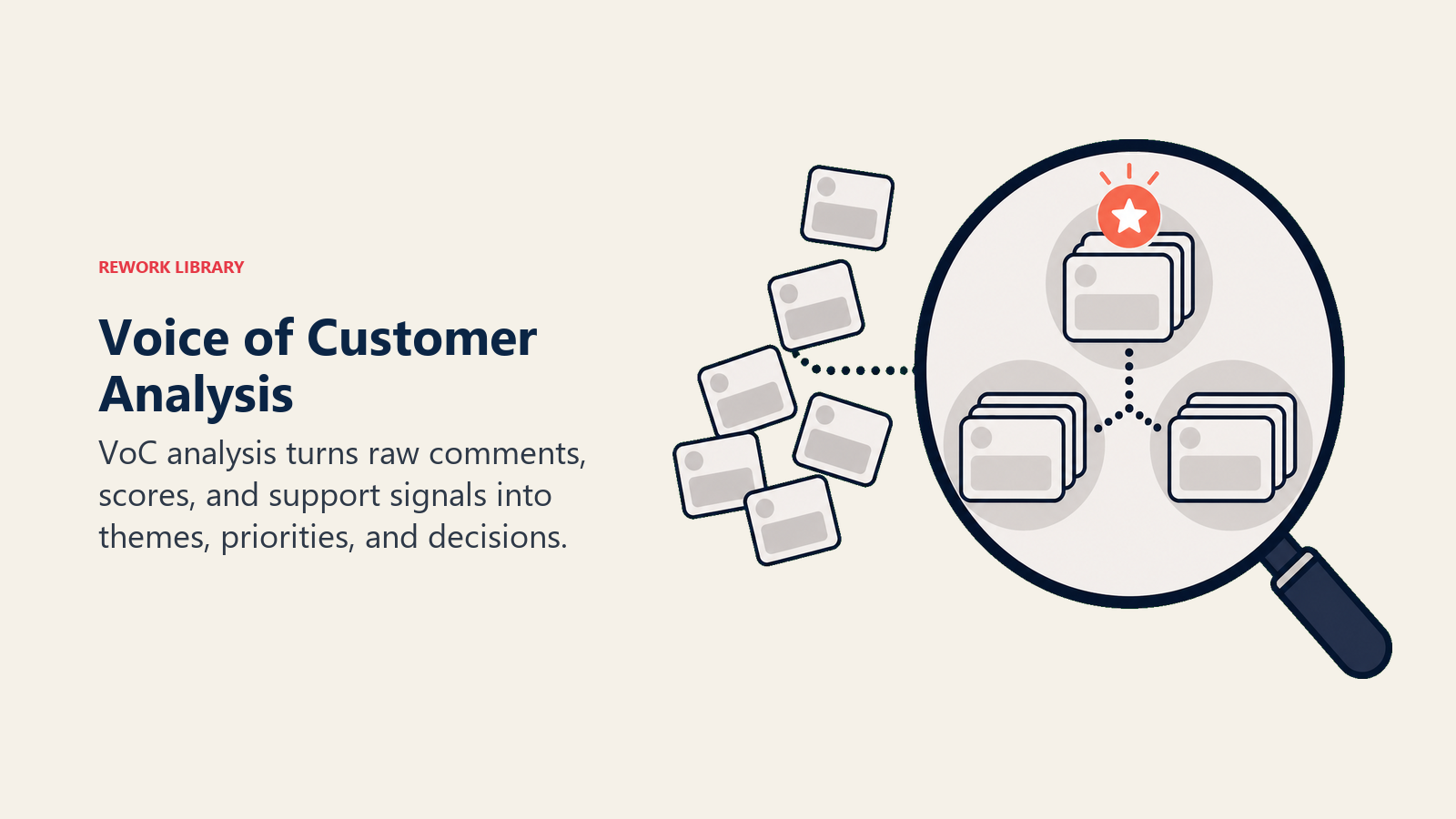
Categorization dan tagging mengorganisir feedback ke dalam themes. Buat taxonomy: Product bugs, feature requests, service issues, documentation gaps, pricing concerns, competitive mentions. Tag setiap piece feedback sehingga Anda bisa aggregate by category.
Tools seperti Salesforce, Zendesk, atau dedicated VoC platforms membiarkan Anda tag feedback ketika datang. Kemudian report: "Kami menerima 147 feature requests quarter ini. Top 5 themes adalah mobile app, API enhancements, reporting improvements, integrations, dan workflow automation."
Trend identification spots patterns over time. Apakah support feedback menjadi lebih positive atau negative? Apakah feature requests shifting dari basic capabilities ke advanced features (indicating maturation)? Apakah competitive mentions meningkat (indicating pressure)?
Root cause analysis dig beneath surface complaints untuk menemukan underlying issues. Customer mengatakan "your product is too complicated" mungkin sebenarnya berarti "your onboarding is insufficient," "our users lack training," atau "this feature is genuinely over-engineered." Jangan hanya count complaints—understand causes.
Segment analysis mengungkapkan apakah different customer groups memiliki different needs. Enterprise customers mungkin ingin advanced features sementara SMB customers ingin simplicity. Analyzing feedback by segment prevents building features yang satisfy nobody karena Anda averaging across conflicting needs.
Priority scoring ranks feedback by impact dan frequency. Feature yang diminta oleh 50 customers carrying $2M dalam ARR outweighs feature yang diminta oleh 200 customers carrying $100K dalam ARR. Weight feedback by business value, bukan hanya volume.
Cross-Functional Sharing: Getting Insights to the Right Teams
Feedback adalah useless jika tetap di CS organization. Anda membutuhkan distribution systems.
Product team feedback loops route feature requests, bug reports, dan usability issues ke product management. Jangan hanya kirim laundry list. Provide context, frequency data, customer segments, dan business impact. Help product teams prioritize.
Weekly atau bi-weekly syncs antara CS dan product review top feedback themes. Product mengkomunikasikan apa yang mereka building dan kenapa. CS shares apa yang customer minta dan kenapa itu matters.
Sales insights dari VoC help sales understand objections, competitive dynamics, dan buying criteria. Ketika customer mention competitors atau express concerns tentang capabilities, sales perlu tahu. Share ini melalui CRM updates, sales enablement sessions, dan deal-specific intelligence.
Support trends harus flow ke support leadership dan training teams. Jika customer secara konsisten confused tentang feature, itu training atau documentation issue, bukan hanya individual support failures.
Leadership reporting menjaga executives connected ke customer voice. Monthly atau quarterly reports summarizing top feedback themes, NPS trends, customer sentiment, dan critical issues ensure leadership tidak lose touch dengan customer reality.
Company-wide learning terjadi melalui regular all-hands sharing, Slack channels dedicated ke customer feedback, atau internal newsletters highlighting customer stories dan insights. VoC tidak seharusnya menjadi secret yang CS team tahu.
Closing the Loop: Showing Customers Their Feedback Matters
Cara tercepat untuk kill future feedback adalah mengabaikan apa yang customer sudah told you.
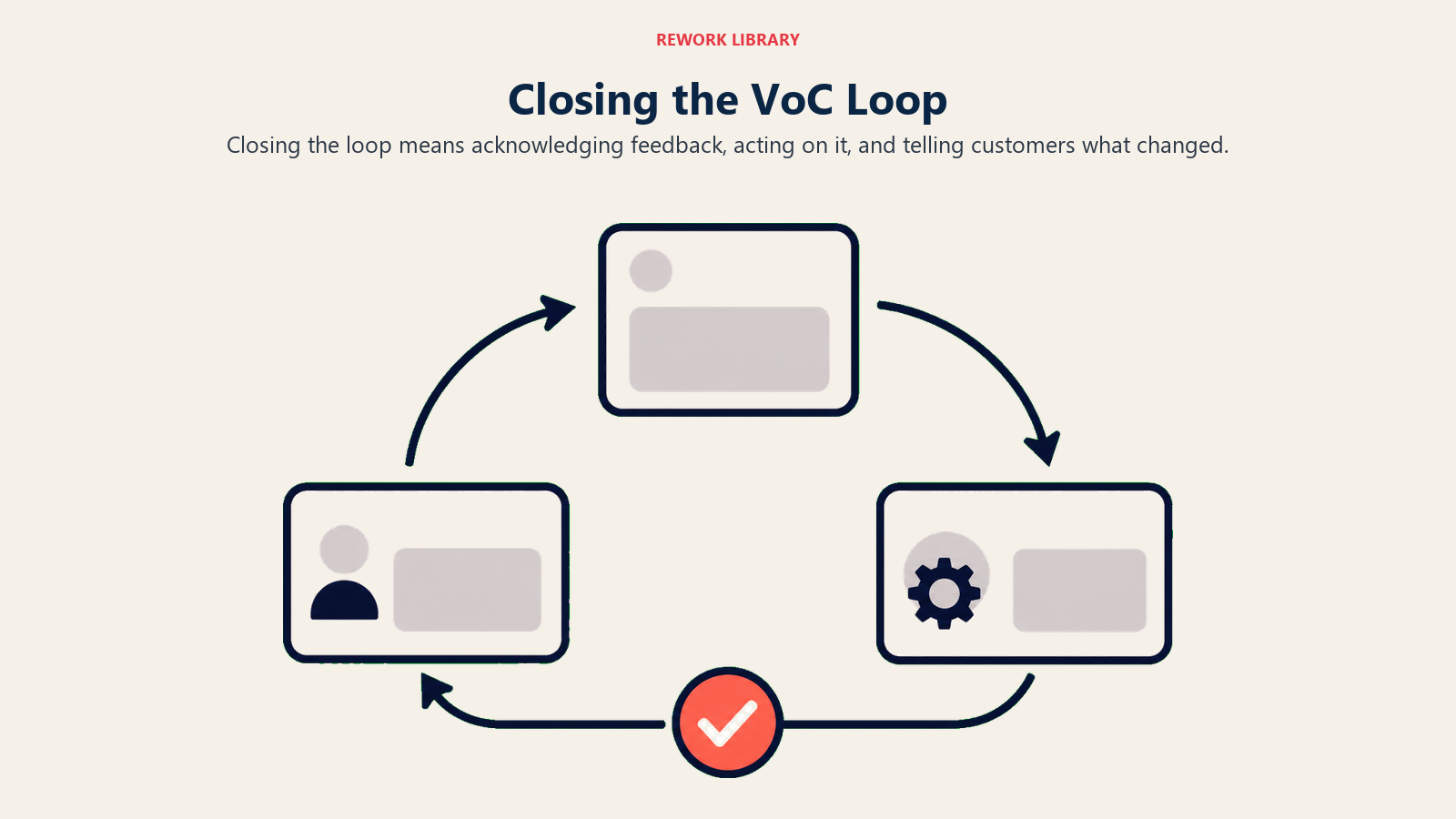
Acknowledging feedback harus terjadi segera. Ketika customer submit feedback via survey, kirim confirmation: "Thanks for your input. We review all feedback and use it to improve." Ketika customer share idea dengan CSM mereka, CSM responds: "That's a great suggestion. I'm documenting this for our product team."
Communicating actions menunjukkan feedback sedang dipertimbangkan. "We've shared your request with our product team. They're evaluating it for the roadmap." Atau "We've identified this as a known issue and are working on a fix." Customer tidak expect setiap request untuk di-build, tapi mereka expect untuk didengar.
Following up on changes closes the loop powerfully. Ketika Anda ship feature yang customer requested, tell them: "You asked for X. We built it. Here's how to use it." Tag customers yang originally requested it sehingga mereka melihat impact mereka.
Showing impact aggregates across customers. Di product release notes: "Based on customer feedback, we've redesigned the reporting interface to make it more intuitive." Di newsletters: "You told us onboarding was confusing. We've rebuilt the getting started guide and reduced setup time by 40%."
Appreciating participation recognizes customers yang provide valuable feedback. Thank them publicly (dengan permission), invite them ke beta programs, atau offer early access ke features yang mereka requested. Make feedback feel worthwhile, bukan seperti shouting into a void.
Driving Action: From Feedback to Improvement
VoC programs fail ketika feedback gets collected tapi nothing changes. System Anda perlu drive actual improvements.
Feedback harus inform improvement roadmaps across product, service, dan operations teams. Feature requests inform product roadmaps. Service feedback shapes training programs. Documentation gaps drive content creation.
Establish rhythm di mana VoC insights are reviewed selama quarterly planning. Product teams harus bisa point ke specific customer feedback yang influenced priorities mereka.
Accountability dan ownership assigns people untuk act pada feedback. Feature requests route ke product managers yang triage dan prioritize. Service issues route ke CS operations yang design process improvements. Support issues route ke team leads yang coach teams atau update help docs.
Tanpa ownership, feedback menjadi "somebody should fix this," yang berarti nobody does.
Tracking implementation monitors actions apa yang diambil pada feedback. Gunakan project management tools untuk track feedback-driven initiatives dari identification through completion. Report tentang ini secara regular: "This quarter we addressed 23 feedback themes, resulting in 12 product improvements, 8 documentation updates, and 3 process changes."
Measuring impact validates apakah changes solved problems. Setelah implementing requested feature, survey customers yang asked for it: "We built X that you requested. Does it solve your need?" Setelah fixing reported issue, check jika tickets tentang issue itu berkurang.
VoC programs create sustainable competitive advantage ketika mereka tidak hanya listen tapi sistematis improve berdasarkan apa yang mereka dengar.
Making VoC Programs Systematic, Not Sporadic
Perbedaan antara perusahaan dengan effective VoC programs dan those just doing occasional surveys adalah systems dan discipline.
Mulai dengan clear feedback collection mechanisms across sources. Buat mudah untuk CSMs log insights, untuk support tag themes, untuk surveys scheduled dan sent automatically. Remove friction dari capture.
Build analysis ke dalam regular rhythms. Weekly support ticket reviews, monthly NPS analysis, quarterly deep-dives ke dalam thematic trends. Make analysis habit, bukan project yang Anda lakukan ketika seseorang bertanya.
Create distribution channels sehingga insights reach teams yang bisa act. Standing meetings, shared reports, tagged CRM fields, Slack channels—whatever works untuk culture Anda. Make feedback visible dan actionable.
Close loops consistently. Ketika customer give feedback, acknowledge it. Ketika Anda act on it, tell them. Ketika patterns emerge, communicate apa yang Anda lakukan tentang mereka. Make customers feel heard.
VoC programs work ketika mereka woven ke dalam bagaimana company Anda operates, bukan bolted on sebagai quarterly initiative yang seseorang remember untuk run occasionally.
Siap build VoC program Anda? Pelajari cara implement NPS satisfaction surveys, manage customer feedback secara sistematis, monitor customer health, dan develop communication strategies yang close feedback loop.
Related resources:

Senior Operations & Growth Strategist
On this page
- Why Voice of Customer Programs Matter
- Product development tanpa customer input adalah guesswork
- Churn prevention dimulai dengan memahami kenapa customer frustrated sebelum mereka pergi
- Expansion opportunities bersembunyi di customer conversations
- Competitive intelligence datang dari customer membandingkan Anda dengan alternatives
- Customer relationships menguat ketika customer melihat feedback mereka penting
- VoC Program Goals: What You're Actually Trying to Achieve
- Feedback Collection Methods: Capturing Input from Multiple Sources
- Structured Feedback Programs: Proactive Collection Systems
- Qualitative Feedback: Understanding the "Why" Behind the Data
- Quantitative Feedback: Measuring and Tracking Metrics
- Feedback Analysis: Making Sense of What You're Hearing
- Cross-Functional Sharing: Getting Insights to the Right Teams
- Closing the Loop: Showing Customers Their Feedback Matters
- Driving Action: From Feedback to Improvement
- Making VoC Programs Systematic, Not Sporadic