Bahasa Indonesia
Model Funnel yang Disepakati: Satu Revenue Funnel yang Dimiliki Marketing dan Sales Bersama
Turn this article into takeaways for your work.


Each assistant summarizes the article only for you and suggests best practices for your work.
Marketing mempresentasikan Funnel mereka. Sales mempresentasikan Pipeline mereka. Keduanya terlihat benar. Tidak ada yang cocok dengan yang lain. Dan di akhir kuartal, tidak ada yang sepakat dari mana pendapatan berasal.
Inilah jebakan funnel paralel. Marketing melacak lead melalui tahap yang mereka definisikan: pengunjung, inquiry, MQL. Sales melacak deal melalui tahap yang mereka definisikan: discovery, proposal, negosiasi, ditutup. Kedua sistem berbagi CRM tapi bukan pemahaman bersama tentang apa arti setiap tahap, siapa yang memilikinya, atau bagaimana lead seharusnya berpindah dari satu dunia ke dunia lain.
Handoff antara kedua Funnel tersebut (saat marketing berkata "ini lead yang berkualifikasi" dan sales berkata "saya akan mengambilnya dari sini") adalah tempat akuntabilitas menghilang. Marketing mengukur volume. Sales mengukur konversi. Tidak ada yang mengukur kesenjangan.
Model funnel yang disepakati memperbaiki ini dengan mengganti dua sistem paralel dengan satu model bersama yang dikontribusikan kedua tim, bisa dibaca kedua tim, dan dipegang kedua tim.
Mengapa Dua Funnel Ada
Riset Gartner tentang keselarasan penjualan dan marketing mengidentifikasi funnel terpisah sebagai alasan tunggal paling umum tim pendapatan melaporkan ketidakselarasan. 47% perusahaan menyebutnya sebagai masalah struktural utama.
Masalah funnel paralel bukan kegagalan orang. Ini adalah hasil struktural dari cara fungsi marketing dan sales berkembang secara terpisah.
Marketing mengadopsi platform otomasi (Marketo, HubSpot, Pardot) yang dirancang di sekitar funnel marketing: tarik, libatkan, nurture, kualifikasi. Platform tersebut mendefinisikan tahap dalam istilah marketing dan melaporkan metrik marketing (traffic, MQL, tingkat nurture).
Sales mengadopsi sistem CRM (Salesforce, Pipedrive, HubSpot CRM) yang dirancang di sekitar Pipeline penjualan: berkualifikasi, discovery, demo, proposal, negosiasi, close. Sistem tersebut mendefinisikan tahap dalam istilah sales dan melaporkan metrik sales (nilai Pipeline, kecepatan tahap, win rate).
Kedua sistem melaporkan ke tujuan pendapatan yang sama. Tidak ada yang dirancang untuk terhubung dengan bersih ke yang lain.
Kemudian ada struktur tujuan: marketing diukur berdasarkan lead yang dihasilkan, sales diukur berdasarkan pendapatan yang ditutup. KPI yang berbeda mendorong perilaku yang berbeda. Marketing menginginkan volume. Sales menginginkan kualitas. Masing-masing mendefinisikan "baik" dalam istilah sistem pengukuran mereka sendiri.
Hasilnya adalah dua tim yang melihat Dashboard yang berbeda, menggunakan nama tahap yang berbeda, dan beroperasi di bawah definisi yang berbeda tentang apa artinya "berkualifikasi." Tidak ada yang sengaja merancang ini. Ini hanya terakumulasi. Glosarium keselarasan marketing-sales seringkali adalah solusi tercepat, yaitu referensi bersama tentang apa arti MQL, SQL, dan ICP di perusahaan Anda secara spesifik.
Fakta Kunci: Keselarasan Funnel dan Dampak Pendapatan
- Perusahaan dengan fungsi penjualan dan marketing yang selaras erat mencapai pertumbuhan pendapatan 24% lebih cepat dan pertumbuhan laba 27% lebih cepat selama tiga tahun, menurut riset SiriusDecisions.
- Organisasi yang mendefinisikan siklus hidup lead formal yang disepakati melihat tingkat retensi pelanggan 36% lebih tinggi dan win rate penjualan 38% lebih tinggi, per Aberdeen Group.
- Hanya 46% perusahaan B2B yang melaporkan memiliki siklus hidup lead yang terformal dan terdokumentasi dengan definisi tahap yang disepakati di marketing dan sales, menurut Demand Gen Report.
- Tim marketing dan sales yang berbagi proses pendapatan umum menghasilkan 208% lebih banyak pendapatan dari upaya marketing mereka, per MarketingProfs.
- Perusahaan yang menggunakan satu CRM sebagai sumber kebenaran untuk kedua tim 3x lebih mungkin melaporkan keselarasan yang kuat dibandingkan yang menggunakan sistem terpisah, per data Salesforce State of Sales.
Funnel yang Disepakati: Definisi Tahap demi Tahap
Framework Unified Revenue Funnel
Unified Revenue Funnel menggantikan dua sistem paralel (funnel marketing + Pipeline penjualan) dengan satu model bersama, tujuh tahap, dan kepemilikan bersama yang eksplisit di setiap transisi. Fitur yang mendefinisikannya adalah bahwa kedua tim, marketing dan sales, berkontribusi, menyetujui, dan diukur terhadap definisi tahap dan benchmark konversi yang sama.
Tujuh tahap: Pengunjung/Tidak Dikenal → Inquiry/Raw Lead → MQL → SAL (opsional) → SQL → Opportunity/Deal Aktif → Closed Won/Closed Lost
Setiap tahap memiliki tiga elemen yang terdokumentasi: apa yang dimiliki marketing, apa yang dimiliki sales, dan apa yang dimiliki keduanya secara bersama. Tanpa ketiganya, kesenjangan kepemilikan berkompound menjadi perselisihan atribusi pendapatan.
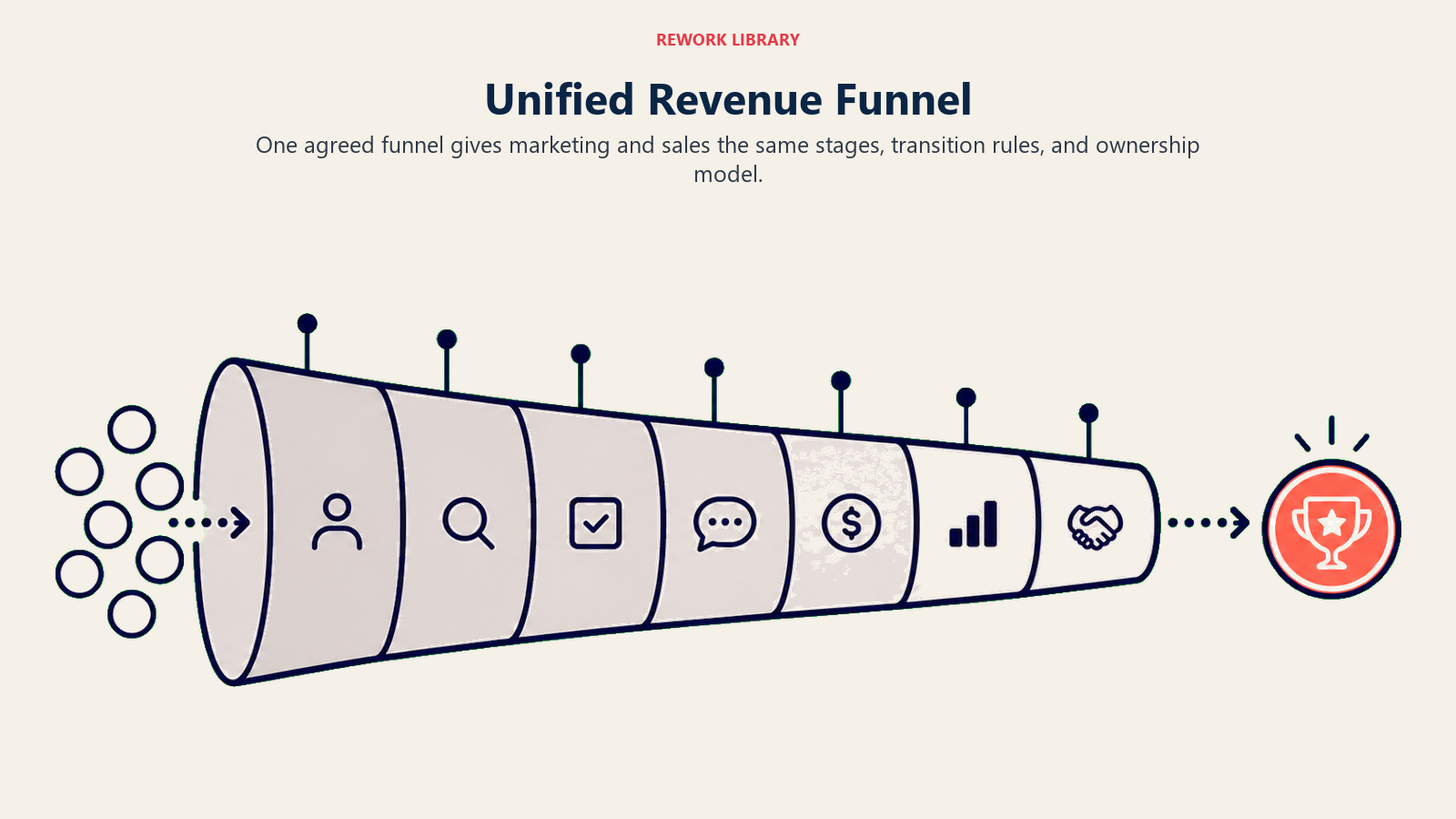
Model funnel yang disepakati memiliki tujuh tahap. Masing-masing memiliki definisi tunggal yang terdokumentasi yang diterima kedua tim. Masing-masing memiliki pemilik yang jelas: marketing, sales, atau bersama.
| Tahap | Definisi | Pemilik | Kriteria keluar |
|---|---|---|---|
| Pengunjung / Tidak Dikenal | Seseorang yang berinteraksi dengan website atau konten Anda, identitas tidak diketahui | Marketing | Memberikan info kontak (form, chat, event) |
| Inquiry / Raw Lead | Kontak yang diketahui, belum berkualifikasi (identitas ditangkap, belum ada penilaian kualifikasi) | Marketing | Dinilai atau diases terhadap ICP |
| MQL | Marketing Qualified Lead: memenuhi kriteria ICP minimum dan menunjukkan sinyal keterlibatan | Marketing | Lulus kriteria SQL atau masuk nurture siklus panjang |
| SAL (opsional) | Sales Accepted Lead: sales telah meninjau dan mengkonfirmasi memenuhi kriteria SQL, dalam jendela tinjauan | Bersama | Diterima ke SQL atau dikembalikan dengan alasan dalam 48-72 jam |
| SQL | Sales Qualified Lead: kesesuaian yang dikonfirmasi, niat, timing; sales berkomitmen untuk mengerjakannya | Sales | Opportunity dibuat atau lead dikembalikan dengan alasan terstruktur |
| Opportunity / Deal Aktif | Keterlibatan penjualan aktif: proyek nyata, pembeli nyata, timeline nyata dalam diskusi | Sales | Closed won atau closed lost |
| Closed Won / Closed Lost | Disposisi akhir: pendapatan atau alasan kehilangan yang terdokumentasi | Sales | Pasca-close: handoff customer success atau analisis kehilangan |
Tahap SAL bersifat opsional. Ini menambahkan nilai ketika ada kompleksitas tinjauan yang tulus saat handoff, ketika kriteria kualifikasi bernuansa dan sales membutuhkan waktu untuk menilai sebelum berkomitmen. Ini menambahkan gesekan ketika menjadi buffer untuk tindak lanjut yang lambat. Jika tahap SAL Anda secara rutin berusia lebih dari 48 jam, hapus saja.
Kunci untuk membuat tabel ini bekerja bukan definisinya sendiri. Ini adalah kesepakatan bersama tentang definisi tersebut. Kedua tim perlu telah meninjau dan menandatangani. Ketika lead macet di MQL selama tiga minggu, kedua tim bisa melihat tabel yang sama dan mendiagnosis mengapa. Framework definisi MQL menentukan dengan tepat sinyal apa yang dibutuhkan lead sebelum memasuki tahap itu.
Poin Kesepakatan di Setiap Tahap
Mendefinisikan tahap adalah bagian yang mudah. Mendefinisikan siapa yang memiliki apa di setiap tahap adalah di mana pekerjaan nyata terjadi.
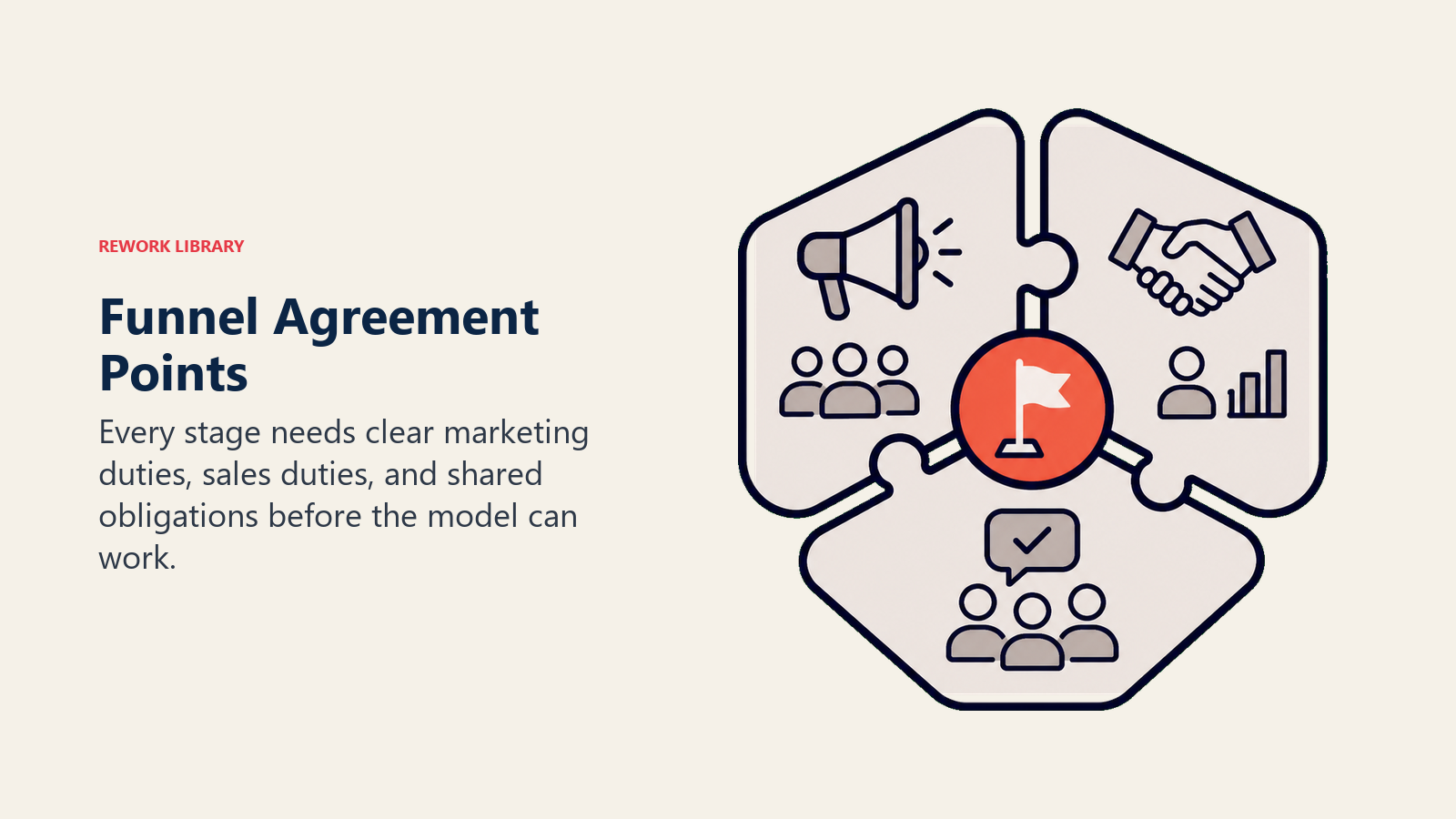
Untuk setiap tahap, Anda perlu tiga hal yang terdokumentasi: apa yang bertanggung jawab marketing, apa yang bertanggung jawab sales, dan apa yang bertanggung jawab kedua tim bersama.
Inquiry / Raw Lead:
- Marketing memiliki: menangkap info kontak, memperkaya data dasar, penilaian awal
- Sales memiliki: tidak ada yet (ini adalah tahap pra-sales)
- Bersama: SLA untuk kapan raw lead harus dinilai (biasanya 24 jam dari penangkapan)
MQL:
- Marketing memiliki: urutan nurture, pemeliharaan penilaian, meneruskan ke SQL ketika ambang terpenuhi
- Sales memiliki: tidak ada yet (tapi harus memiliki visibilitas untuk akun strategis)
- Bersama: Kesepakatan tentang definisi MQL; tinjauan kuartalan apakah definisi sudah terkalibrasi
SQL:
- Marketing memiliki: dokumentasi handoff yang jelas, konteks yang diteruskan dengan lead
- Sales memiliki: sentuhan pertama dalam SLA, disposisi dalam jendela yang ditentukan, feedback terstruktur tentang penolakan
- Bersama: Tinjauan tingkat konversi SQL-ke-Opportunity bulanan; penyesuaian ambang jika konversi turun
Opportunity:
- Marketing memiliki: materi pendukung, case study, intelijen kompetitif atas permintaan
- Sales memiliki: memajukan atau menutup deal
- Bersama: Pelaporan closed-loop (sales memperbarui CRM dengan hasil dan atribusi sumber)
Closed Won / Closed Lost:
- Marketing memiliki: menganalisis pola win/loss berdasarkan sumber, channel, segmen ICP
- Sales memiliki: dokumentasi alasan kehilangan, verifikasi atribusi sumber
- Bersama: Rapat tinjauan win/loss kuartalan dengan data dari kedua sistem
CRM sebagai sumber kebenaran tunggal adalah yang membuat kepemilikan bersama memungkinkan. Jika kedua tim melihat sistem yang berbeda, akuntabilitas bersama di setiap tahap runtuh.
Quotable: Perusahaan B2B dengan fungsi marketing dan sales yang selaras erat mencapai pertumbuhan pendapatan 24% lebih cepat dan pertumbuhan laba 27% lebih cepat selama tiga tahun, menurut riset SiriusDecisions. Mekanisme strukturalnya adalah model funnel bersama, bukan hanya komunikasi yang lebih baik.
Benchmark Conversion Rate per Tahap
Benchmark konversi memberi Anda baseline untuk diukur. Tanpanya, Anda tidak bisa membedakan apakah tingkat MQL-ke-SQL 30% itu baik, buruk, atau tipikal untuk gerakan Anda.
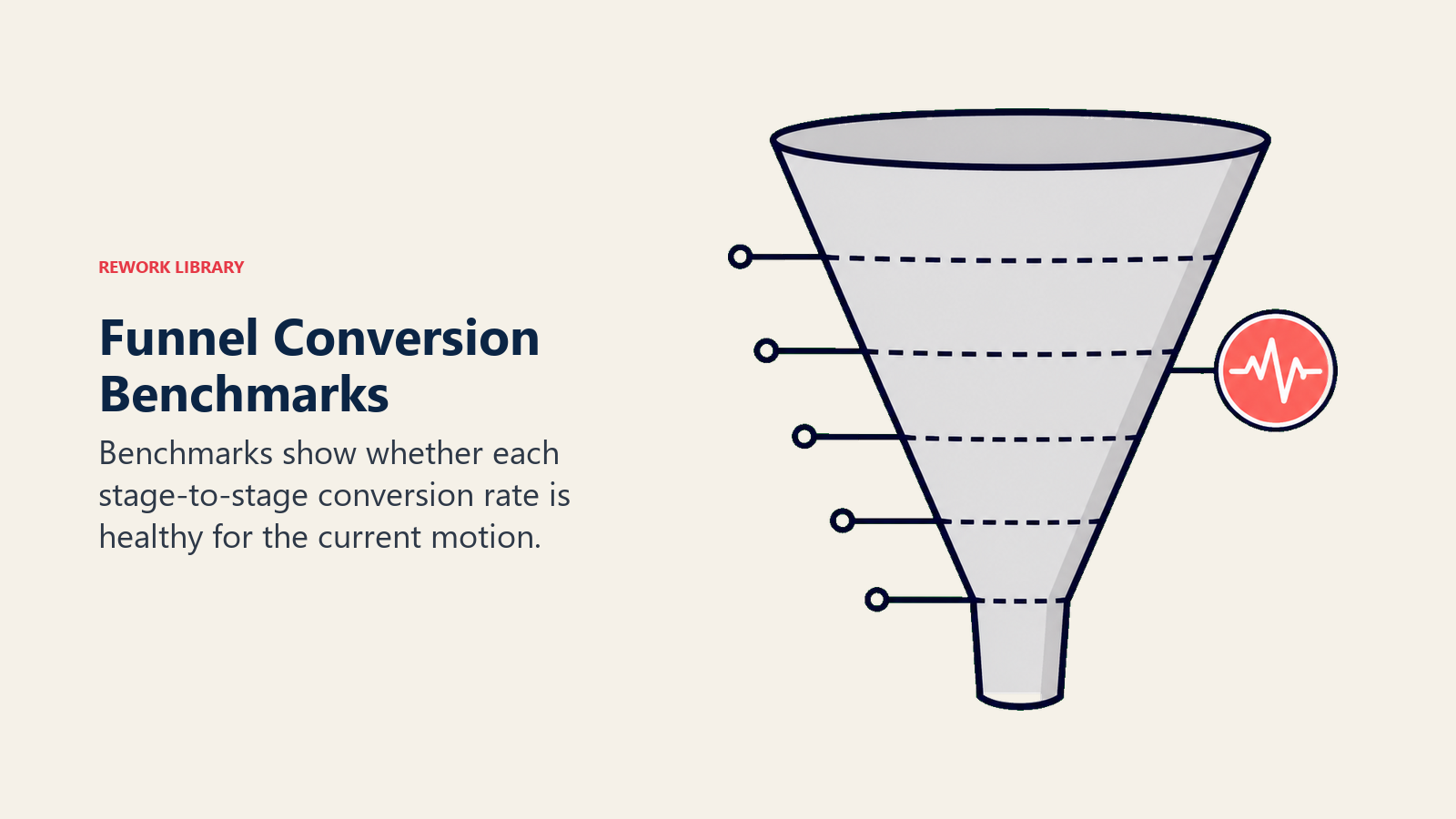
Ini adalah rentang industri untuk B2B SMB dan mid-market. Angka aktual Anda akan bervariasi berdasarkan campuran channel, kualitas ICP, dan kompleksitas produk.
| Transisi | Rentang SMB | Rentang Mid-market | Sinyal perhatian |
|---|---|---|---|
| Pengunjung → Inquiry | 1–3% | 1–4% | Di bawah 1%: masalah landing page atau penawaran |
| Inquiry → MQL | 20–40% | 15–30% | Di bawah 15%: kualitas traffic atau ketidakcocokan ICP |
| MQL → SQL | 30–60% | 25–50% | Di bawah 25%: definisi MQL terlalu longgar |
| SQL → Opportunity | 60–80% | 55–75% | Di bawah 55%: teater penerimaan atau masalah kriteria SQL |
| Opportunity → Closed Won | 20–30% | 15–25% | Di bawah 15%: kualifikasi tahap akhir atau masalah kompetitif |
| Keseluruhan (Pengunjung → Closed Won) | 0,05–0,3% | 0,03–0,2% | Lacak ini sebagai metrik kesehatan komposit |
Benchmark ini adalah rentang, bukan target. Tujuannya bukan mencapai rata-rata industri. Tujuannya mengukur tingkat Anda saat ini, memahami mengapa berada di sana, dan meningkatkannya secara disengaja. Riset full-funnel marketing McKinsey menunjukkan bahwa tim yang mengoptimalkan di seluruh funnel penuh, bukan hanya atas atau bawah, mencapai ROI marketing 15-20% lebih tinggi daripada yang memperlakukan setiap tahap secara terpisah. Untuk bagian SQL-ke-Opportunity dari tabel, benchmark konversi lead-ke-opportunity memberi Anda konteks tambahan dari sisi Pipeline.
Untuk menghitung baseline Anda sendiri, tarik tiga bulan data bersih dari CRM. Hitung lead di setiap tahap berdasarkan tanggal masuk (bukan status saat ini). Bagi jumlah downstream dengan jumlah upstream. Lakukan ini untuk setiap sumber dan channel secara terpisah, karena angka agregat seringkali menyembunyikan masalah serius di channel tertentu. Kadence ulasan Pipeline bersama adalah ritme operasional yang membuat kedua tim selaras tentang angka-angka ini.
Funnel sebagai Dashboard Bersama
Funnel yang disepakati hanya mendorong keselarasan jika kedua tim melihat data yang sama pada waktu yang sama.
Dashboard bersama harus menampilkan:
- Jumlah saat ini di setiap tahap (mingguan atau bulanan)
- Tingkat konversi tahap-ke-tahap untuk periode saat ini vs. periode sebelumnya
- Rata-rata waktu dalam tahap (metrik kecepatan)
- Volume berdasarkan sumber atau channel
Kedua tim meninjau Dashboard ini dalam rapat mingguan yang sama. Bukan tinjauan terpisah. Bukan laporan marketing diikuti laporan sales. Satu tampilan, satu percakapan.
Ritme mingguan itu penting. Tinjauan kuartalan menangkap masalah berbulan-bulan setelah berkompound. Tinjauan mingguan menangkap bottleneck tahap saat masih bisa dikoreksi.
Ketika jumlah tahap atau conversion rate bergerak, Dashboard bersama membuat percakapan menjadi produktif: "MQL-ke-SQL turun dari 45% menjadi 28% bulan ini. Apakah ini perubahan kualitas, perubahan definisi, atau masalah SLA?" Kedua tim melihat angka yang sama dan mendiagnosis bersama.
Proses closed-loop reporting memberi makan paruh hilir Dashboard ini: data win/loss, atribusi sumber, kecepatan kemajuan deal.
Quotable: Tim marketing dan sales yang berbagi proses pendapatan umum menghasilkan 208% lebih banyak pendapatan dari upaya marketing dibandingkan tim yang beroperasi dengan funnel terpisah, per riset MarketingProfs tentang keselarasan lintas fungsi.
Di Mana Funnel Rusak dalam Praktik
Bahkan dengan definisi yang disepakati, tiga masalah eksekusi secara konsisten melemahkan model.
Lewati tahap. Sales membuat opportunity langsung dari kontak tanpa menandainya sebagai SQL terlebih dahulu. Riset Forrester tentang penggabungan funnel marketing dan sales mengidentifikasi lewat-tahap sebagai salah satu kerusakan struktural yang paling persisten. Ketika tim tidak berbagi model siklus hidup tunggal, setiap tim kembali ke definisi tahap mereka sendiri. Marketing membuat SQL untuk kontak yang tidak pernah melewati tahap MQL. Ketika tahap dilewati, data konversi tidak berarti. Anda tidak bisa menghitung tingkat MQL-ke-SQL jika setengah dari SQL tidak pernah memiliki tahap MQL.
Perbaikan: Tegakkan penyelesaian field yang diperlukan sebelum kemajuan tahap. Di Salesforce, Anda bisa memblokir transisi tahap pada field minimum yang diperlukan. Di HubSpot, otomasi tahap siklus hidup bisa menegakkan urutan.
Keterlambatan status. Lead adalah SQL secara nyata tapi masih ditampilkan sebagai MQL dalam CRM karena tidak ada yang memperbaruinya. Atau deal ditutup berminggu-minggu lalu tapi opportunity masih "negosiasi" dalam Pipeline.
Perbaikan: SLA kemajuan tahap. Disposisi SQL dalam 10 hari kerja (maju atau kembali). Tanggal close opportunity harus diperbarui dalam 1 hari kerja dari close aktual. Ketika keterlambatan status diaudit bulanan, ia mengoreksi dirinya sendiri.
Tahap deal yang tidak dipetakan ke tahap lead. Tahap Pipeline penjualan (Discovery, Demo, Proposal, Negosiasi) adalah sub-tahap terperinci dalam tahap funnel "Opportunity". Mereka berguna untuk manajemen Pipeline tapi tidak berkoresponden ke tahap funnel dengan cara yang terhubung dengan bersih ke siklus hidup lead marketing.
Perbaikan: Pertahankan dua set tahap terpisah tapi terhubung. Tahap funnel (Pengunjung hingga Closed Won) adalah model bersama yang digunakan kedua tim. Sub-tahap deal bersifat internal untuk sales untuk manajemen Pipeline. Laporkan tahap funnel untuk percakapan keselarasan; gunakan sub-tahap deal untuk pembinaan sales.
Marketing Funnel vs. Pipeline Sales vs. Unified Revenue Funnel
Sebagian besar tim pendapatan tidak memilih untuk memiliki dua sistem terpisah. Mereka terakumulasi. Memahami apa yang dioptimalkan setiap model membantu menjelaskan mengapa pendekatan terpadu menghasilkan hasil yang lebih baik.
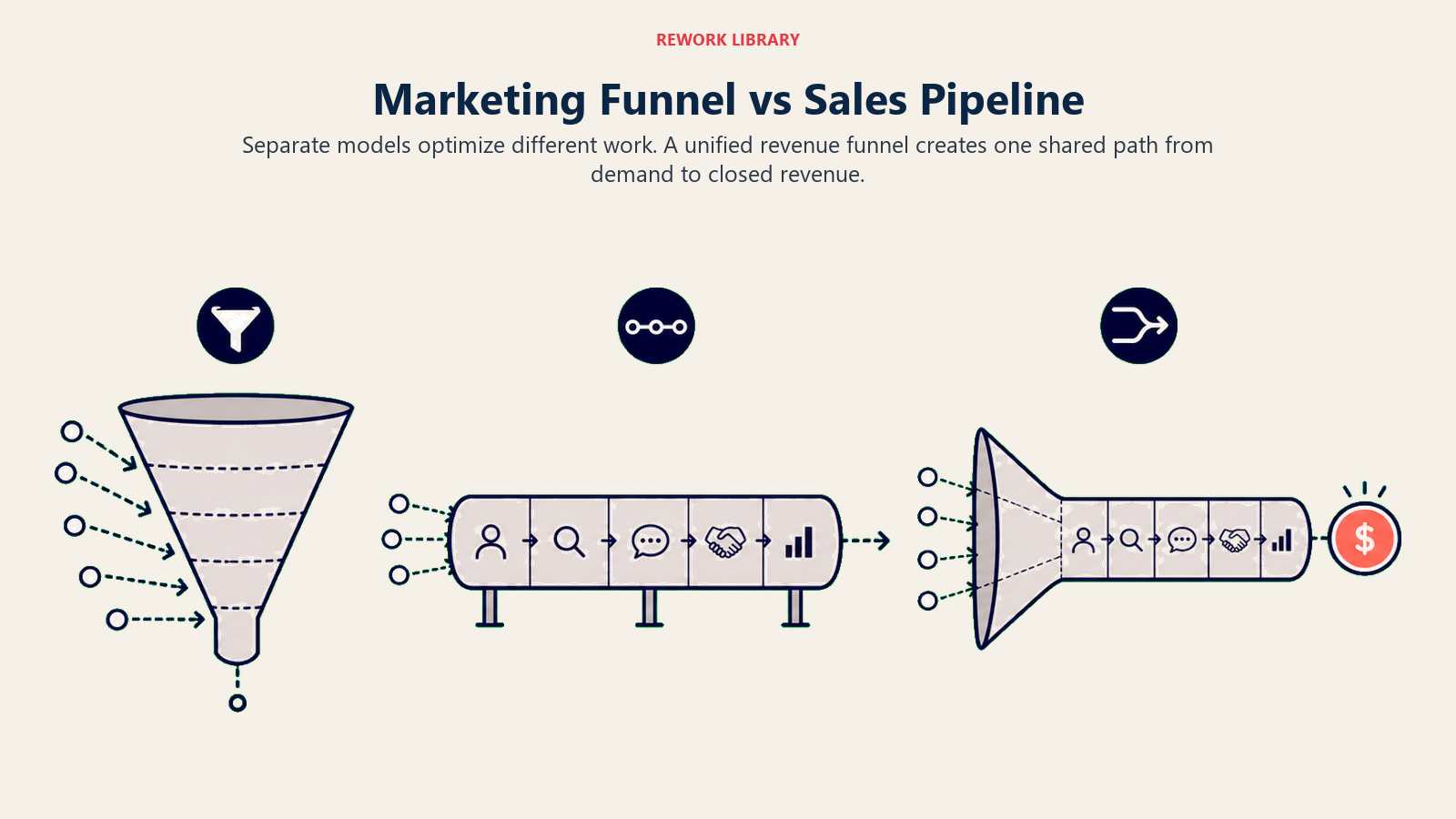
| Dimensi | Marketing Funnel | Pipeline Sales | Unified Revenue Funnel |
|---|---|---|---|
| Pemilik utama | Tim marketing | Tim sales | Kedua tim bersama |
| Bahasa tahap | Pengunjung, Inquiry, MQL | Discovery, Proposal, Negosiasi, Close | Pengunjung → Inquiry → MQL → SQL → Opportunity → Close |
| Metrik keberhasilan | Lead yang dihasilkan, volume MQL | Nilai Pipeline, win rate | Tingkat konversi full-funnel, pendapatan bersama |
| Titik handoff | Didefinisikan sepihak oleh marketing | Didefinisikan sepihak oleh sales | Disepakati bersama dengan sign-off kedua tim |
| Sumber kebenaran | MAP (Marketo, HubSpot) | CRM (Salesforce, Pipedrive) | CRM sebagai sumber kebenaran tunggal untuk keduanya |
| Atribusi | Marketing mengklaim first-touch, multi-touch | Sales mengklaim kepemilikan deal | Model atribusi bersama, closed-loop reporting |
| Dashboard | Marketing melaporkan ke CMO | Sales melaporkan ke CRO | Satu Dashboard yang ditinjau kedua tim dalam rapat yang sama |
| Ketika lead mendingin | Marketing memasukkan kembali ke nurture | Sales menandai sebagai hilang | Pengembalian terstruktur dengan kode penolakan, diarahkan kembali ke marketing |
Model terpadu tidak menghilangkan alat sistem mana pun. Ini menyelaraskan definisi, handoff, dan lapisan pelaporan yang ada di atas keduanya.
Analisis Rework: Tim yang berkonsolidasi ke satu funnel yang disepakati secara konsisten melaporkan dua keuntungan awal: lebih sedikit argumen "kualitas lead" dalam rapat mingguan (karena kedua tim melihat data konversi yang sama), dan identifikasi bottleneck funnel yang lebih cepat (karena lewat-tahap dan keterlambatan status menjadi terlihat dalam Dashboard bersama). Pekerjaan yang lebih sulit adalah tata kelola: rapat kalibrasi kuartalan dan definisi tahap yang dikontrol versi. Sebagian besar tim melewatkan tata kelola dan kemudian bertanya-tanya mengapa model funnel menyimpang setelah enam bulan.
Bentuk Funnel SMB vs. Mid-Market
Model tujuh tahap yang sama berlaku di SMB dan mid-market, tapi bentuk dan kecepatannya sangat berbeda.
Karakteristik funnel SMB:
- Siklus lebih pendek: Pengunjung ke Closed Won dalam 2-8 minggu
- Lebih sedikit tahap yang penting dalam praktik: MQL → SQL → Closed seringkali melewati tahap opportunity yang diperpanjang
- Kecepatan lebih tinggi: Lebih banyak lead, disposisi lebih cepat, ACV lebih rendah
- Tahap SAL biasanya tidak perlu: siklus keputusan cukup pendek sehingga komitmen SQL penuh masuk akal
- Conversion rate cenderung lebih tinggi di tahap akhir (keputusan lebih sederhana, lebih sedikit stakeholder)
Karakteristik funnel mid-market:
- Siklus lebih panjang: 3-9 bulan dari sentuhan pertama hingga close
- Lebih banyak gerbang yang penting: Tahap SAL bisa menambahkan nilai tulus ketika kualifikasi kompleks
- Multi-stakeholder: Satu opportunity mungkin melibatkan 3-7 pengambil keputusan, masing-masing pada tahap funnel yang berbeda
- Volume lebih rendah, ACV lebih tinggi: Setiap lead layak mendapat lebih banyak dukungan marketing dan perhatian sales
- Intent signals membutuhkan lebih banyak konteks: Pembeli mid-market meneliti lebih lama sebelum menunjukkan tangan
Jika perusahaan Anda menjual ke kedua segmen, pertimbangkan model funnel terpisah dengan benchmark konversi dan SLA yang berbeda. Mengukur SMB dan mid-market terhadap ambang yang sama menghasilkan data yang menyesatkan. Artikel keselarasan untuk SMB vs. enterprise mencakup cara mengadaptasi model funnel untuk setiap gerakan. Dan tahap siklus hidup lead dari sisi manajemen lead membantu memperjelas bagaimana nurture pra-funnel memberi makan model yang disepakati di bagian atas funnel.
Mempertahankan Model
Funnel yang disepakati bukan dokumen satu kali. Pasar berubah. Channel berubah. Produk berubah. ICP Anda mungkin bergeser. Salah satu dari itu bisa membuat definisi tahap atau benchmark konversi Anda menjadi usang.
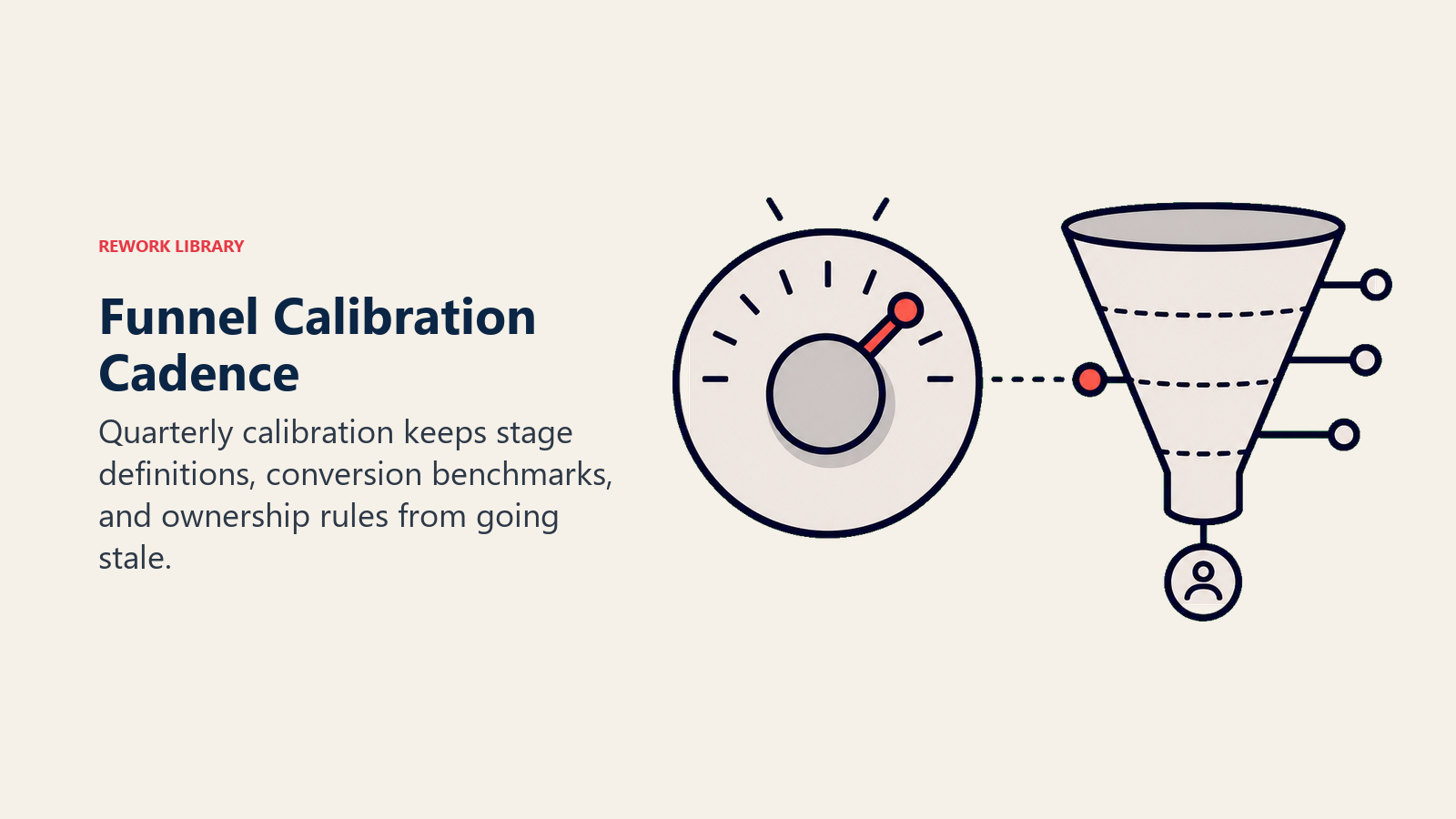
Rapat kalibrasi kuartalan:
- Tinjau conversion rate di setiap tahap terhadap kuartal sebelumnya dan tahun sebelumnya
- Identifikasi tahap mana yang konversinya bergerak lebih dari 10 poin persentase
- Periksa apakah definisi tahap masih mencerminkan cara tim sebenarnya berperilaku
- Perbarui ambang jika data mendukungnya, dengan sign-off kedua tim
Pemicu untuk tinjauan di luar siklus:
- Channel baru diluncurkan yang menghasilkan tipe lead yang berbeda secara material
- Perubahan kepemimpinan sales atau marketing
- Peluncuran produk yang mengubah ICP atau proses pembelian
- Pergerakan conversion rate yang signifikan yang tidak memiliki penjelasan musiman yang jelas
Apa yang harus dilakukan ketika definisi tahap menyimpang: Definisi tahap menyimpang ketika kontributor individual menggunakannya secara tidak konsisten dari waktu ke waktu. Definisi mengatakan "MQL memerlukan 2 sinyal kesesuaian dan 1 sinyal niat" tapi rep telah menerima MQL berdasarkan jabatan saja selama enam bulan.
Ketika Anda mendeteksi penyimpangan, jalankan audit: tarik lead 90 hari terakhir yang mencapai setiap tahap dan periksa terhadap kriteria yang terdokumentasi. Hitung persentase yang tidak akan memenuhi syarat di bawah definisi aktual. Jika penyimpangan >20%, Anda membutuhkan sesi pelatihan ulang atau pembaruan definisi yang mencerminkan cara tim sebenarnya bekerja. Diagnostik kematangan keselarasan dapat membantu Anda menemukan penyimpangan sistemik sebelum berkompound. Panduan kegagalan keselarasan umum mencakup akar penyebab yang paling sering dan perbaikan yang benar-benar bertahan.
Dokumen definisi dan penerimaan SQL adalah pendamping hilir dari model funnel. Ini mendefinisikan apa yang secara spesifik diperlukan tahap SQL dan apa yang dikomitmenkan penerimaan.
Kesimpulan
Dua Funnel yang tidak pernah terhubung adalah akar penyebab sebagian besar perselisihan atribusi pendapatan, debat kualitas lead, dan saling menyalahkan di akhir kuartal.
Satu model yang disepakati tidak menghilangkan perselisihan. Tapi mengubah perselisihan dari "lead Anda buruk" vs. "tindak lanjut Anda lambat" menjadi "konversi MQL-ke-SQL kita turun 12 poin. Mari cari penyebabnya."
Perbedaan antara dua percakapan itu adalah perbedaan antara tim yang melindungi wilayah mereka dan tim yang memperbaiki proses mereka.
Bangun model bersama-sama. Tinjau di ruangan yang sama. Pegang kedua tim terhadap Dashboard yang sama. Ketika angka bergerak, lihat sistemnya, bukan tim yang lain.
Pertanyaan yang Sering Diajukan tentang Model Funnel yang Disepakati
Apa itu model funnel yang disepakati?
Model funnel yang disepakati adalah satu revenue funnel yang dimiliki bersama yang menggantikan sistem pelacakan marketing dan sales yang terpisah. Kedua tim mendefinisikan setiap tahap bersama, berbagi benchmark konversi, dan meninjau Dashboard yang sama dalam rapat yang sama. Kata kuncinya adalah "disepakati." VP Marketing dan VP Sales keduanya menandatangani definisi tahap, aturan kepemilikan, dan SLA penerimaan.
Bagaimana funnel yang disepakati berbeda dari funnel marketing atau Pipeline sales?
Funnel marketing melacak lead melalui tahap yang dimiliki marketing (pengunjung, inquiry, MQL) dan mengoptimalkan untuk volume lead. Pipeline penjualan melacak deal melalui tahap yang dimiliki sales (discovery, proposal, close) dan mengoptimalkan untuk pendapatan. Model funnel yang disepakati menjembatani keduanya dengan membuat definisi tahap bersama di titik handoff, di mana marketing meneruskan lead yang berkualifikasi ke sales, dan satu Dashboard yang dibaca kedua tim.
Berapa tingkat konversi MQL-ke-SQL yang baik?
Untuk B2B SMB, tingkat MQL-ke-SQL yang sehat berkisar 30–60%. Untuk mid-market, rentangnya 25–50%. Di bawah 25% di salah satu segmen biasanya menandakan bahwa definisi MQL terlalu longgar. Marketing meneruskan lead yang tidak memenuhi kriteria SQL yang dibutuhkan sales untuk memajukannya. Tujuannya bukan rata-rata industri; tujuannya memahami mengapa tingkat Anda berada di mana adanya, lalu meningkatkannya secara disengaja.
Seberapa sering kita harus meninjau model funnel?
Minimal, setiap kuartal. Rapat kalibrasi kuartalan harus meninjau conversion rate di setiap tahap terhadap kuartal sebelumnya, memeriksa apakah definisi tahap masih mencerminkan cara tim sebenarnya berperilaku, dan memperbarui ambang jika data mendukungnya. Tinjauan di luar siklus dipicu oleh: peluncuran channel baru, perubahan kepemimpinan, peluncuran produk, atau pergerakan conversion rate yang signifikan dan tidak dapat dijelaskan.
Apa yang menyebabkan penyimpangan tahap funnel?
Penyimpangan tahap terjadi ketika kontributor individual menggunakan tahap secara tidak konsisten dari waktu ke waktu, seringkali karena definisi asli tidak didokumentasikan dengan jelas, manajer berhenti menegakkannya dalam ulasan, atau tim berkembang dan karyawan baru tidak dilatih dengan model yang disepakati. Deteksi penyimpangan dengan mengaudit lead 90 hari terakhir terhadap kriteria yang terdokumentasi. Jika lebih dari 20% tidak memenuhi syarat di bawah definisi aktual, Anda memiliki penyimpangan dan membutuhkan pelatihan ulang atau pembaruan definisi.
Haruskah SMB dan mid-market menggunakan model funnel yang sama?
Struktur tujuh tahap berlaku untuk keduanya, tapi benchmark konversi, SLA, dan kebutuhan tahap SAL harus dikalibrasi secara terpisah. Funnel SMB bergerak lebih cepat (2–8 minggu dari ujung ke ujung) dan memiliki lebih sedikit stakeholder; funnel mid-market berjalan 3–9 bulan dengan keputusan multi-stakeholder. Mengukur keduanya terhadap ambang yang sama menghasilkan data yang menyesatkan yang mengaburkan masalah nyata di satu segmen.
Pelajari Lebih Lanjut

Principal Solution Architect
On this page
- Mengapa Dua Funnel Ada
- Funnel yang Disepakati: Definisi Tahap demi Tahap
- Poin Kesepakatan di Setiap Tahap
- Benchmark Conversion Rate per Tahap
- Funnel sebagai Dashboard Bersama
- Di Mana Funnel Rusak dalam Praktik
- Marketing Funnel vs. Pipeline Sales vs. Unified Revenue Funnel
- Bentuk Funnel SMB vs. Mid-Market
- Mempertahankan Model
- Kesimpulan
- Pelajari Lebih Lanjut