More in
Sales Leadership Insights
Why Sales Org Design Is the Most Under-Rated Growth Lever
Mar 16, 2026
What Great Sales Leaders Actually Do in Their First 90 Days
Mar 10, 2026 · Currently reading
Why Sales Retention Is the New Sales Hiring
Feb 4, 2026
Forecasting Discipline: What Separates 90% Callers from 50% Callers
Jan 19, 2026
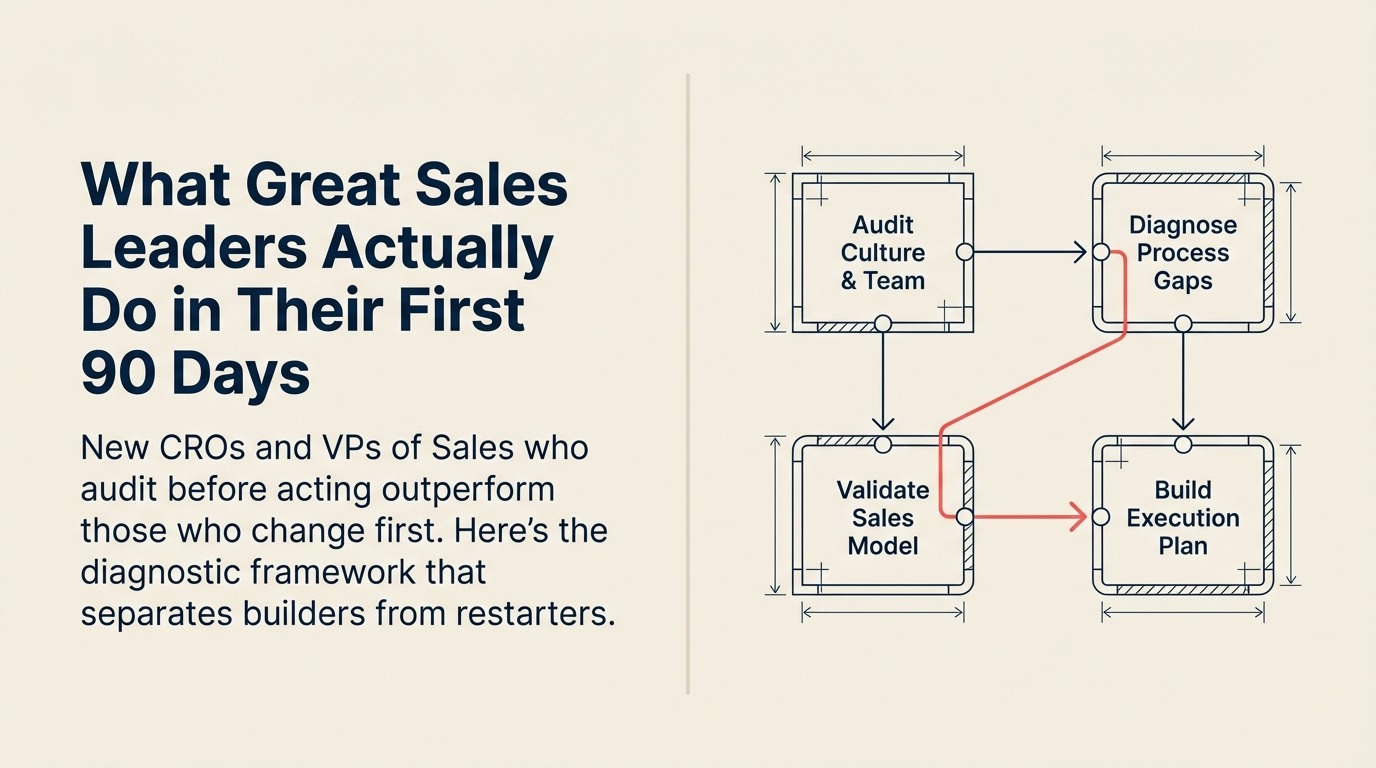
What Great Sales Leaders Actually Do in Their First 90 Days
Turn this article into takeaways for your work.


Each assistant summarizes the article only for you and suggests best practices for your work.
New sales leaders almost always inherit a story someone else started writing. There's an existing quota, a team with its own history, a CRM full of data that may or may not reflect reality, and a board expecting results that feel impossible to deliver without yet understanding the system you're trying to run.
The failure pattern is consistent: new CROs and VPs of Sales default to action. They redesign comp in month one because the commission structure "obviously" isn't working. They open headcount reqs because the team is "clearly undermanned." They kill the existing playbook because it looks like what they didn't use at their last company. By month six, the root cause of poor performance is still there, now buried under three layers of change nobody fully understands yet.
The leaders who build lasting orgs do something different. They spend the first 30 days trying to understand what's actually true before touching anything structural.
The diagnostic sprint: days 1–30
Most new sales leaders treat the first month as orientation. The best treat it as a structured investigation.
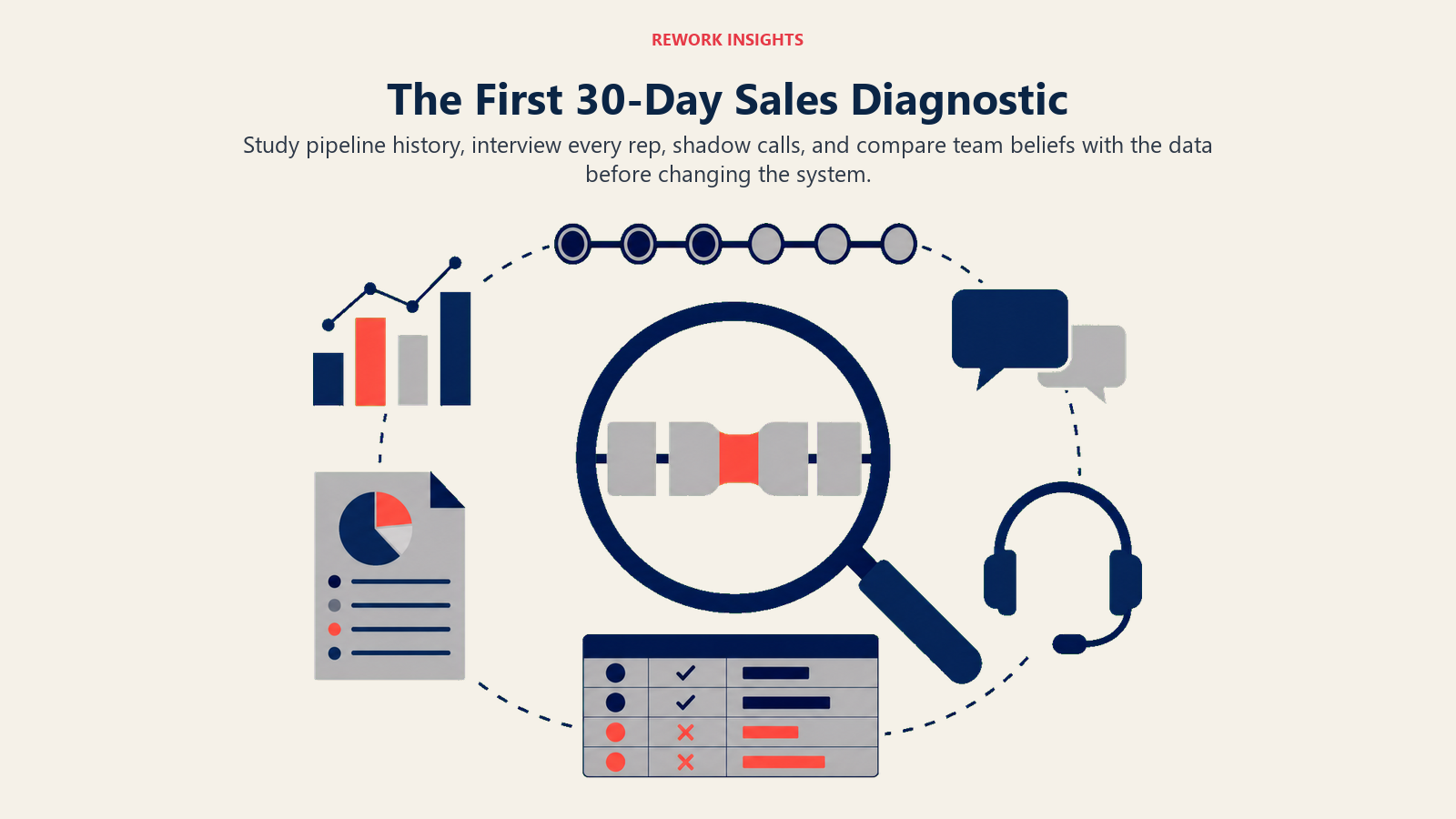
Start with the pipeline. Not the current pipeline status. The history. Open your CRM (Salesforce, HubSpot, whatever's in place) and look at closed-won deals from the last 12 months. Then look at closed-lost. Then look at deals that went dark in late stages. What you're looking for isn't the outcome; it's the pattern. Did late-stage losses cluster in certain segments? Were reps who hit quota last year working the same accounts, same industries, same deal sizes as reps who didn't?
McKinsey research on sales-force effectiveness shows that new sales leaders who spend structured time in diagnostic mode before making changes are significantly more likely to sustain improvements past their first year.
Before you can trust that analysis, though, you need to understand whether the CRM data model itself reflects how deals actually move. A well-designed CRM data model maps fields to real decision points in the buying process. Many inherited systems don't. If yours is one of them, your history analysis will be directionally useful but structurally noisy.
Then do the same for the team. Schedule 30-minute 1:1s with every rep in the first two weeks. Not performance reviews, just conversations. Ask them what's working. Ask what they'd change if they had authority you don't yet trust them with. Ask where they lose deals and where they lose confidence. The answers will be more useful than any dashboard.
Shadow calls. At least five in the first 30 days. You're not evaluating rep performance. You're learning how the org actually sells versus how the playbook says it sells. Those are almost always different.
Read every available win/loss note. If win/loss notes don't exist, that's your first finding.
By day 30, you should be able to answer three questions without guessing. And part of answering them accurately means understanding whether your pipeline stage definitions actually match the buying journey, not just what the playbook says they should represent.
- Where in the sales motion does the team consistently break down? Not "what are our weaknesses," but specifically: at which stage do deals stall or die?
- Which of my reps are structurally limited by the current system, and which are actually underperforming it?
- What does the team think the problem is, and how does that compare to what the data says?
If you can't answer those three questions with confidence by day 30, you haven't listened hard enough.
The three systems every sales org runs on
Here's something most sales leadership training skips: every sales organization actually runs three parallel systems, not one.
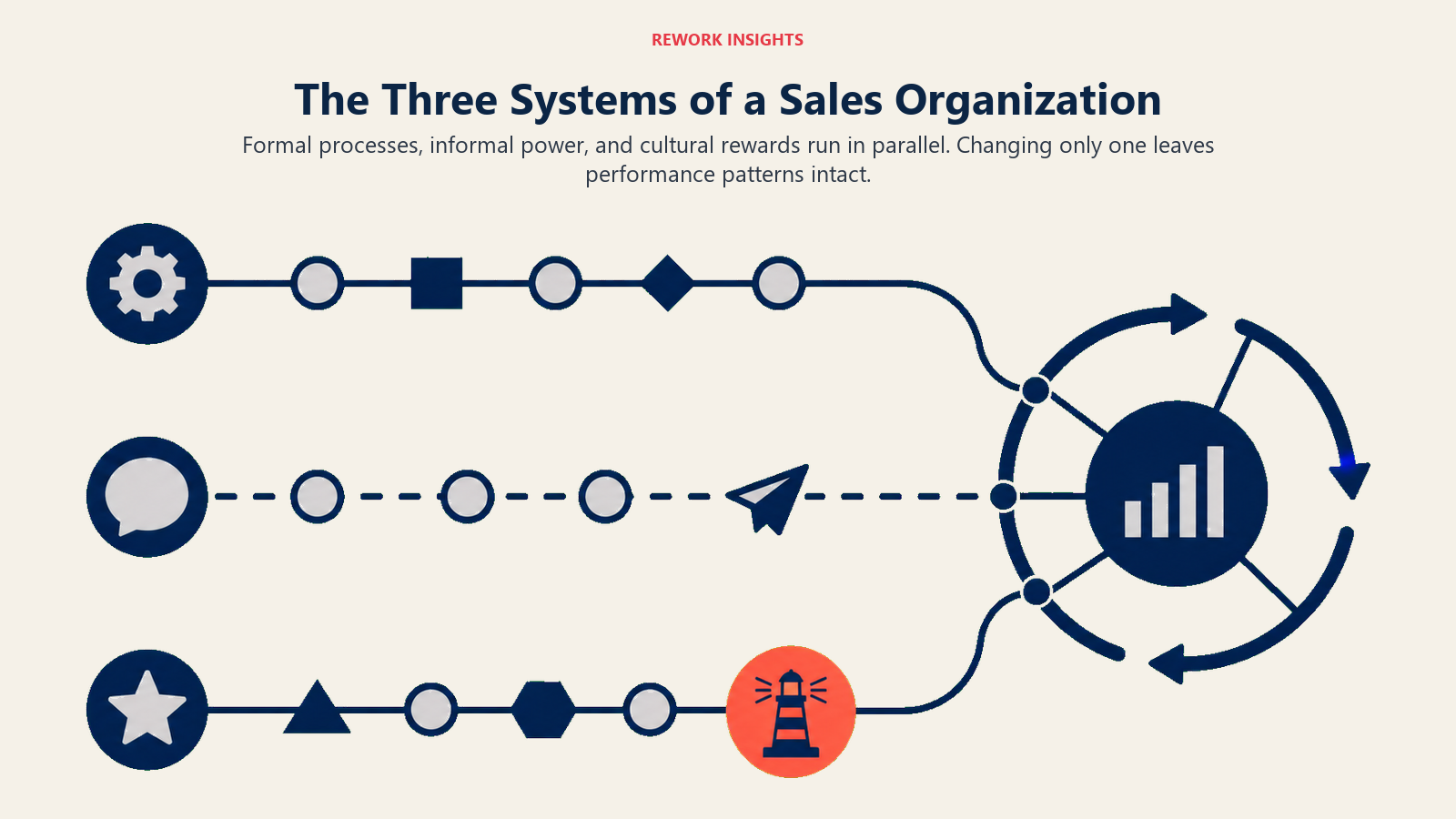
The formal system is what's documented: CRM fields, comp structure, stage gates, quota methodology, onboarding playbook. This is what you inherit on paper and what most new leaders jump to change. Michael Watkins, author of The First 90 Days, calls this the trap of "action imperative", the pressure to demonstrate value through visible change before you've earned the right to know what actually needs changing.
The informal system is how decisions actually get made: which reps get the best inbound leads, who gets air cover when a deal is struggling, which manager's input actually shapes the weekly forecast call. The informal system is almost never written down. You learn it by watching what happens when something goes wrong and noticing who picks up the phone.
The cultural system is what gets quietly rewarded: Does closing a bad-fit deal (high ARR, low retention probability) get celebrated or questioned? Are reps who surface bad news early respected or penalized? Does the team talk about customers or about quota? Cultural systems are the slowest to change and the most expensive to ignore.
New sales leaders who change only the formal system while leaving the informal and cultural systems intact usually wonder why nothing actually changed. The comp plan is new, but the right reps still get the best leads. The CRM has better hygiene, but nobody surfaces real forecast risk because that's still not safe to do.
Where new leaders spend attention wrong
The two most common early mistakes are comp redesign and headcount.
Comp redesign is tempting because it's visible and it signals decisiveness. But comp plans fail for different reasons. Sometimes reps don't understand them. Sometimes the plan rewards top-of-funnel volume in a business where deal quality matters more. Sometimes reps do understand the plan and it's fine, but quota methodology is the actual problem. Redesigning comp before you know which problem you have is like replacing a car engine when the problem is the fuel. Harvard Business Review's research on sales incentives found that poorly timed comp redesigns are among the leading causes of talent attrition in the first year of a new leadership regime.
The headcount mistake is subtler. "We need more reps" is often true, but it's almost never the first thing that's true. If your current team is converting 12% of opportunities at mid-market and you hire five more reps, you now have a bigger team converting 12% of opportunities. Volume without conversion improvement just scales the problem.
One case to contrast: a VP who joined a 30-person SaaS sales team in Q3 and spent the first six weeks in Salesforce history before touching anything. She found that 70% of lost deals were lost in the same stage, technical validation, and that reps had no structured help navigating procurement. That wasn't a comp problem. It wasn't a headcount problem. It was a process gap at a specific stage that no amount of hiring would fix. A structured deal inspection process would have surfaced this pattern months earlier.
Compare that to a CRO who joined a similar-sized team, redesigned comp by day 45, opened five headcount reqs by day 60, and was explaining a miss to the board by Q2. He'd made decisions based on what was visible, not what was true.
The Inherit, Fix, Build diagnostic grid
Before taking action on anything structural, run every potential change through this three-column diagnostic:
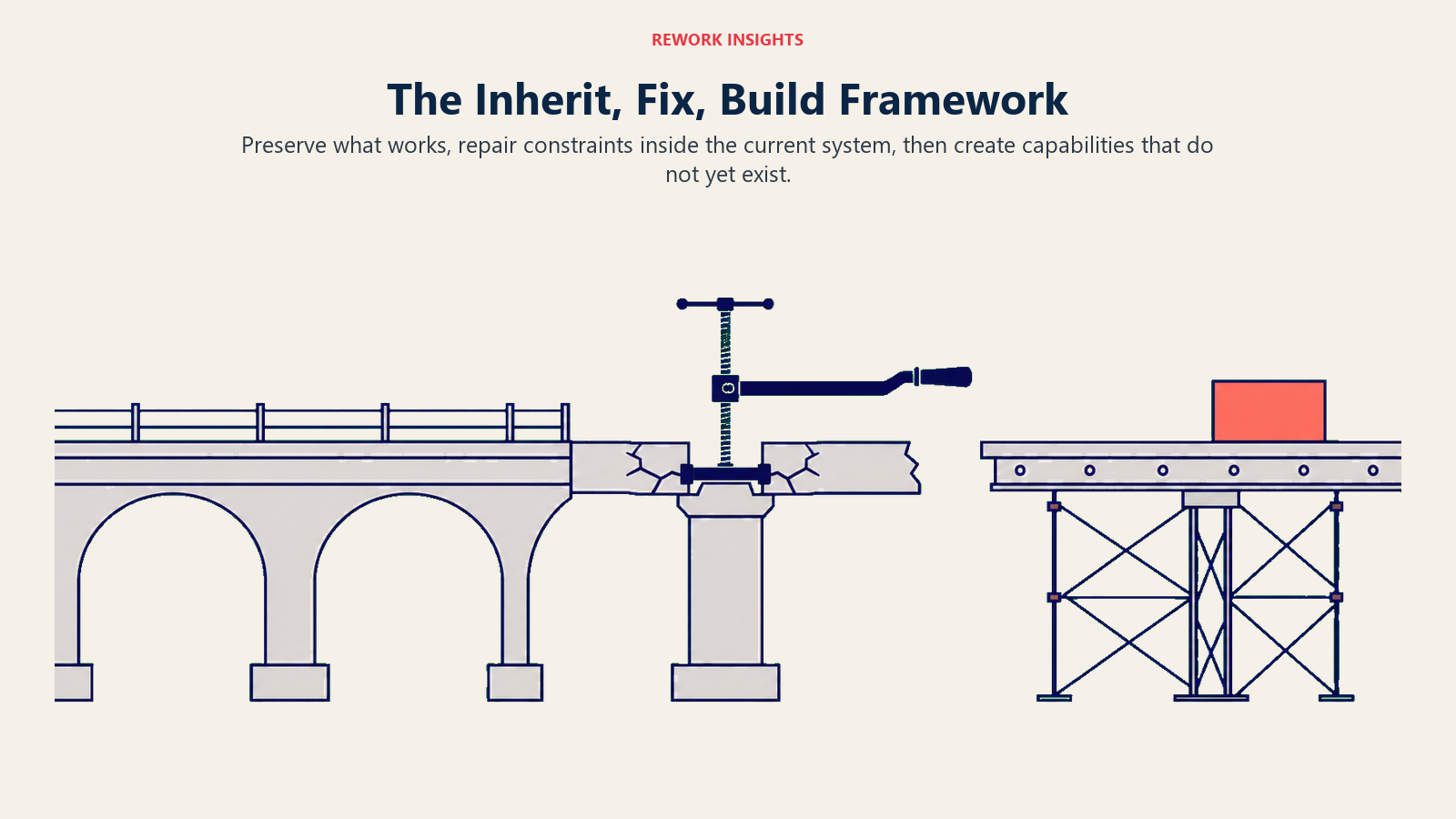
Inherit: things that are working or working well enough that changing them carries more risk than value. Write these down explicitly. New leaders undervalue what's already functional.
Fix: things that are broken but fixable within the existing architecture. Stage gate criteria that don't reflect actual buyer behavior. Qualification questions reps skip because nobody calls them on it. These get attention in months two and three.
Build: things that simply don't exist yet but need to. Formalized deal inspection process. Career ladder for AEs who don't want to go into management. Structured rep coaching rhythm. Building takes longer and shouldn't start until you've stopped the bleeding in the Fix column.
Most new leaders spend their first 90 days entirely in the Build column because it's the most exciting work. The diagnostic grid forces you to spend it in the right order.
The 60-day inflection point
Around day 60, you'll feel pressure to act. The board wants signals of change. The team wants to know what's coming. You've been in observation mode long enough that continuing to watch feels like avoidance. Bain & Company's work on sales transformation timelines consistently shows that leaders who compress the diagnostic phase to less than 45 days to satisfy stakeholder pressure are measurably less likely to drive durable performance improvements.
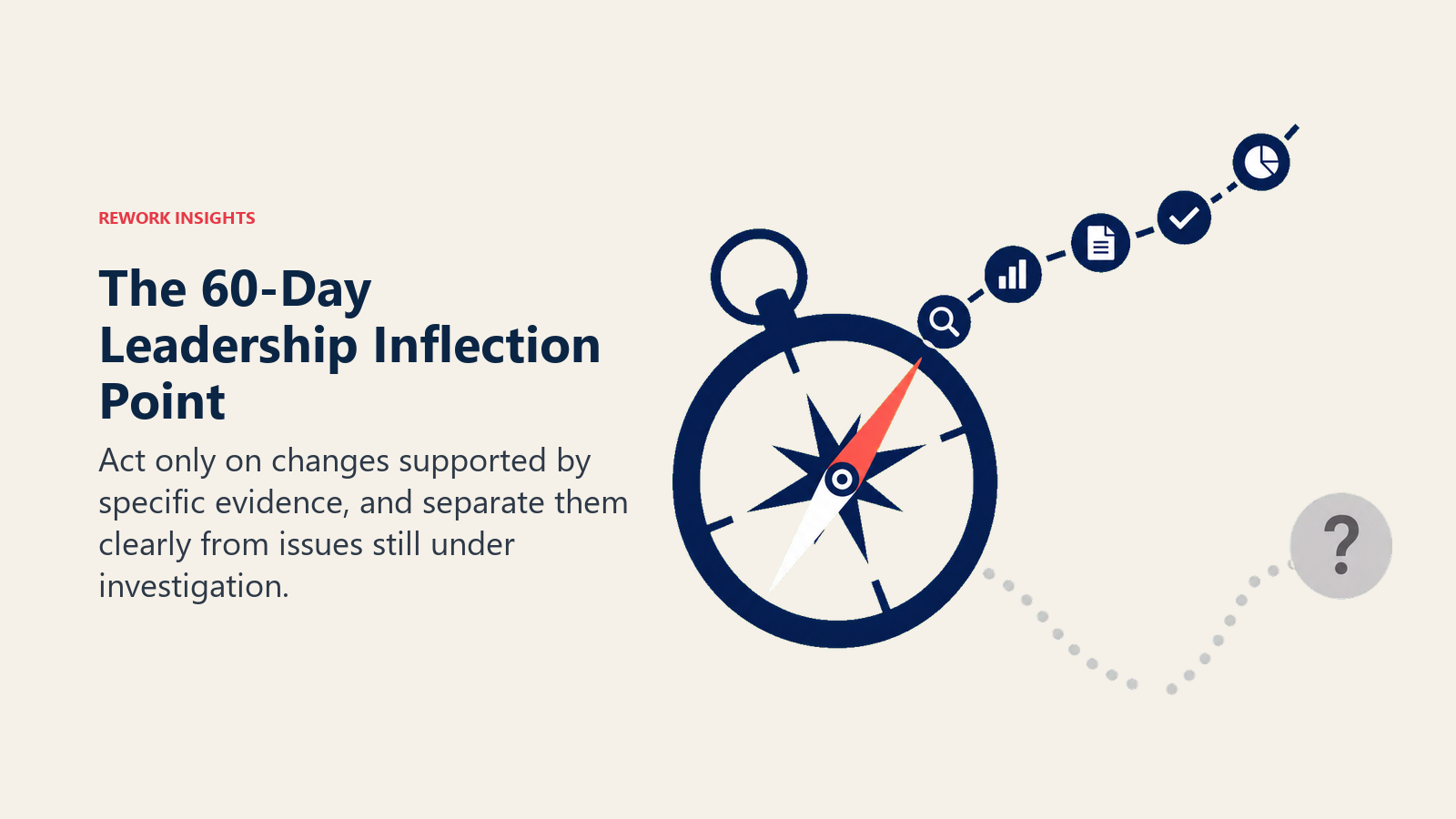
This is the moment to draw the line between what you now understand well enough to change and what you're still learning. Be explicit about this with your team. "I've spent 60 days understanding this org. Here's what I'm going to change, here's why, and here's what I'm still gathering information on." That kind of transparency is rare and creates more trust than a confident reset that turns out to be wrong.
The changes you make at day 60 should be the ones you could defend with specifics, not instinct. Not "I think we need a new comp structure", "the current plan creates a cliff in Q4 that pushes reps to hold pipeline, and here's the deal data that shows it." Understanding the pipeline hygiene culture you've inherited is often the clearest diagnostic for whether reps feel safe updating deal status accurately, or whether they've learned it costs them.
Changes made before you understand the system compound into confusion. Changes made after you understand the system compound into results.
Tactical takeaway
Three questions every new sales leader should be able to answer with confidence by day 30:
- At which specific stage in your sales motion does the team lose the most deals, and is it a skill problem, a process problem, or a product problem?
- Of your reps who missed quota last year, how many are genuinely underperforming versus constrained by a system that sets them up to miss?
- What does the informal system look like (who gets air cover, who gets the best leads, whose forecast input actually matters), and does it align with what you want to reward?
These three questions won't give you a plan. They'll give you a real problem to solve, which is a much better starting point. If you're approaching a leadership transition and want a structured checklist for the operational side, tooling setup, cadences, and early rep meetings, the new manager onboarding checklist covers that ground in practical detail.
Learn More