More in
AI at Work News
OpenAI Opened ChatGPT Advertising to Small Businesses at Any Budget
thg 6 6, 2026
AI Is Everywhere at Work. Only 1 in 10 Say It Transformed the Job
thg 6 6, 2026
Vibe Coding's $10.5B Moment: AI Now Starts Most New Software Builds
thg 6 6, 2026
AI Agents Now Have More System Access Than Your Employees. Few Are Secured
thg 6 5, 2026
Should You Build Your AI or Buy It? Watch What the Giants Bought.
thg 6 5, 2026
Uber Caps Employee AI Spending at $1,500 Per Seat After a Budget Blowout
thg 6 5, 2026
Trump's AI Executive Order Is Deregulatory. Your Compliance Risk Didn't Move
thg 6 4, 2026
AI Pushed 220 Unicorns Below $1B. Pre-ChatGPT Companies Face a Reckoning
thg 6 4, 2026
Token Prices Fell 67% This Year. Your AI Bill Is Going Up Anyway
thg 6 3, 2026
Small Businesses Using AI Report Higher Revenue and Shorter Workdays
thg 6 3, 2026
Voice AI Just Crossed $11B in Valuation: What Sales Leaders Need to Decide Before Their Competitors Do
Turn this article into takeaways for your work.


Each assistant summarizes the article only for you and suggests best practices for your work.
You can usually tell when a technology category crosses from interesting to inevitable. The signal isn't a product announcement. It's a funding round that looks like it's pricing in market leadership.
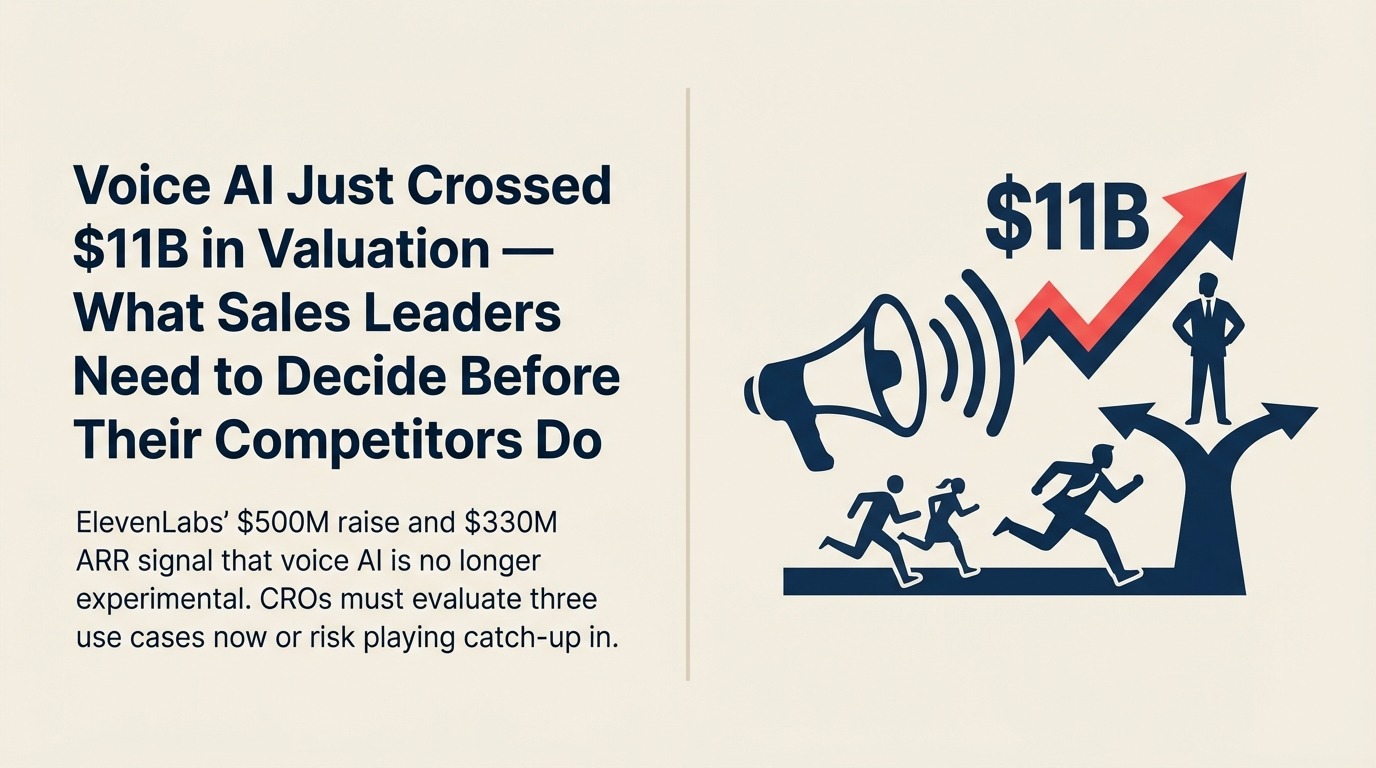
ElevenLabs just did that. According to reporting by PYMNTS, the company closed a $500M Series D led by Sequoia in February 2026, pushing its valuation to $11B and total funding to $781M across five rounds. More telling than the valuation: the company ended 2025 with over $330M in annual recurring revenue, driven primarily by enterprise customers building production-grade voice workflows. That's not a research project. That's a business.
The broader category confirms the signal. According to AssemblyAI's 2026 Voice Agent Report, venture investment in voice AI surged roughly eightfold in 2025, reaching $2.1B. PolyAI, focused on enterprise voice customer service in over 40 languages, raised its own Series D. And 87.5% of builders surveyed say they're actively building voice agents, not just evaluating them.
For sales leaders, the question isn't whether voice AI matters. It's whether you've decided where you stand before the window closes.
Why This Is a Sales Stack Question, Not Just a Tech Question
Voice AI conversations in CRO circles tend to get stuck in two places: either it's dismissed as "not ready for enterprise sales," or it gets lumped into a vague AI strategy discussion that doesn't produce a decision. The AI agents in the sales pipeline picture is broader, but voice is the layer closest to the rep's daily motion.
ElevenLabs' ARR trajectory suggests both framings are now outdated. When an AI voice company closes the year at $330M ARR on enterprise contracts, those enterprises aren't running pilots. They're running workflows. The companies buying voice AI infrastructure in 2026 aren't being adventurous. They're deploying what their counterparts in earlier-adopting sectors already proved out.
The relevant question for a CRO isn't whether voice AI is real. It's which of the three use cases is the right starting point for your team's motion.
Three Voice AI Use Cases That Are Generating Measurable ROI
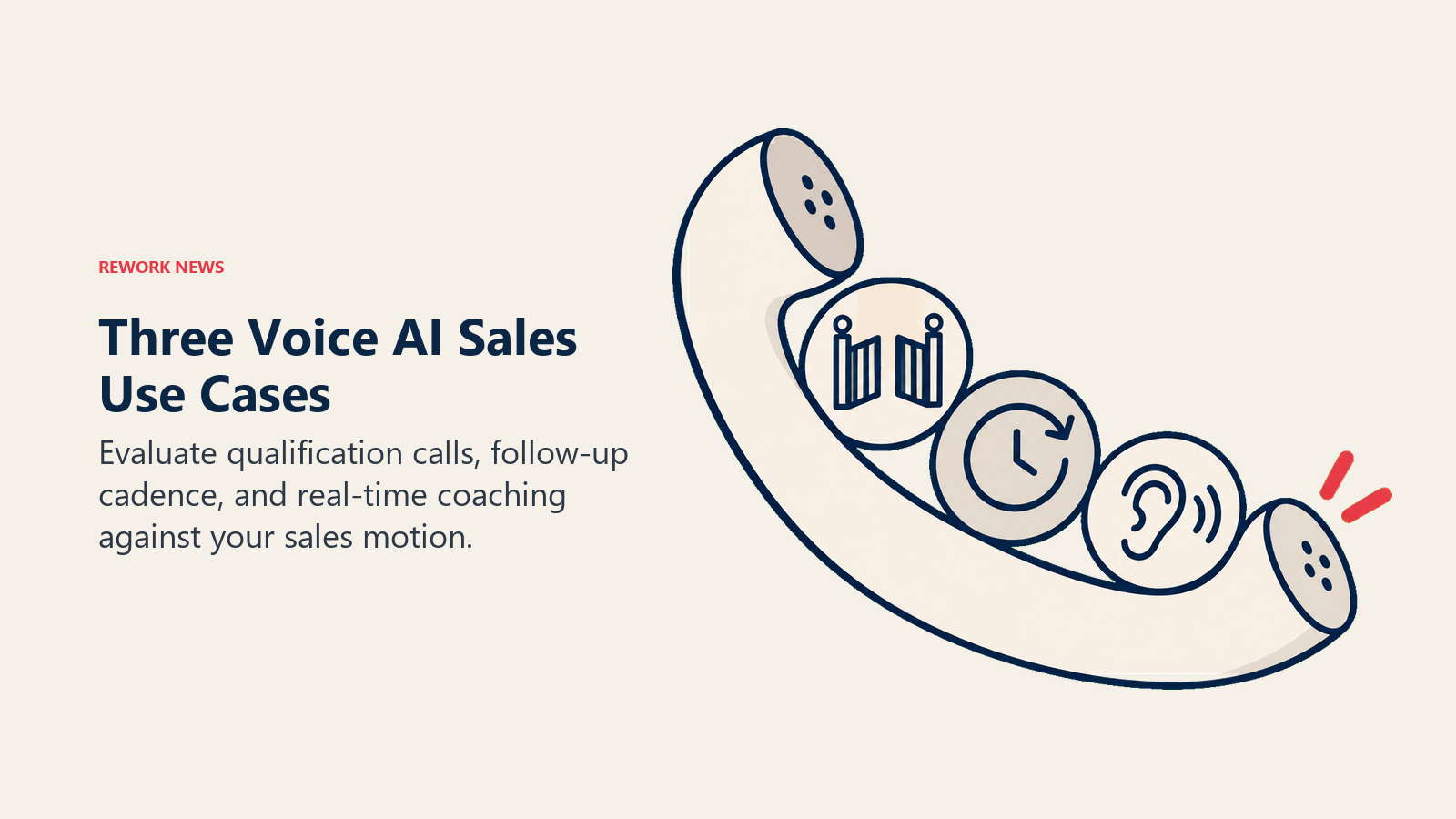
Not all voice AI applications are equivalent in effort or return. Sales organizations that are seeing ROI tend to concentrate it in three specific areas.
Use Case 1: Outbound Call Automation at Scale
Voice agents can now handle a class of outbound prospecting call that previously required either human reps or low-quality auto-dialers: the initial qualification touchpoint. A voice agent that can introduce a proposition, handle a small number of common objections, and route interested prospects to a human rep represents a meaningful shift in the math of outbound prospecting, specifically the ratio of human hours to pipeline qualified.
This use case works best for high-volume, standardized outbound motions where the first-call script is genuinely repeatable. It's not the right fit for complex enterprise sales with long relationship cycles and bespoke messaging at every step.
Use Case 2: Follow-Up Cadence Automation
One of the most consistent sources of deal slippage in B2B sales is the gap between commitment and follow-through on follow-up touchpoints. Voice agents can own the reminder, check-in, and reactivation calls that human reps know they should make but frequently deprioritize under quota pressure. Pipeline hygiene as a culture problem sits directly underneath this: without enforcement mechanisms, the gap persists regardless of tooling.
The ROI case here is straightforward: more touchpoints at consistent quality without adding headcount. And because these calls are logged and transcribed, the data flowing back into your CRM workflow automation improves as a byproduct.
Use Case 3: Real-Time Sales Coaching
Some of the strongest voice AI deployments in B2B sales are happening during live calls, not before or after them. Voice AI systems that monitor call audio in real time, detecting sentiment, flagging objection patterns, and surfacing relevant information to the rep mid-call, function as an always-on coaching layer.
The compounding effect here is significant. Reps who receive real-time coaching on call quality improve faster than reps in traditional coaching structures, where feedback arrives hours or days after the conversation.
A 3-Step Pilot Framework
The right way to evaluate voice AI in a sales workflow is structured enough to produce a real signal without requiring you to put live pipeline at risk during the test.
Step 1: Isolate one use case and one segment.
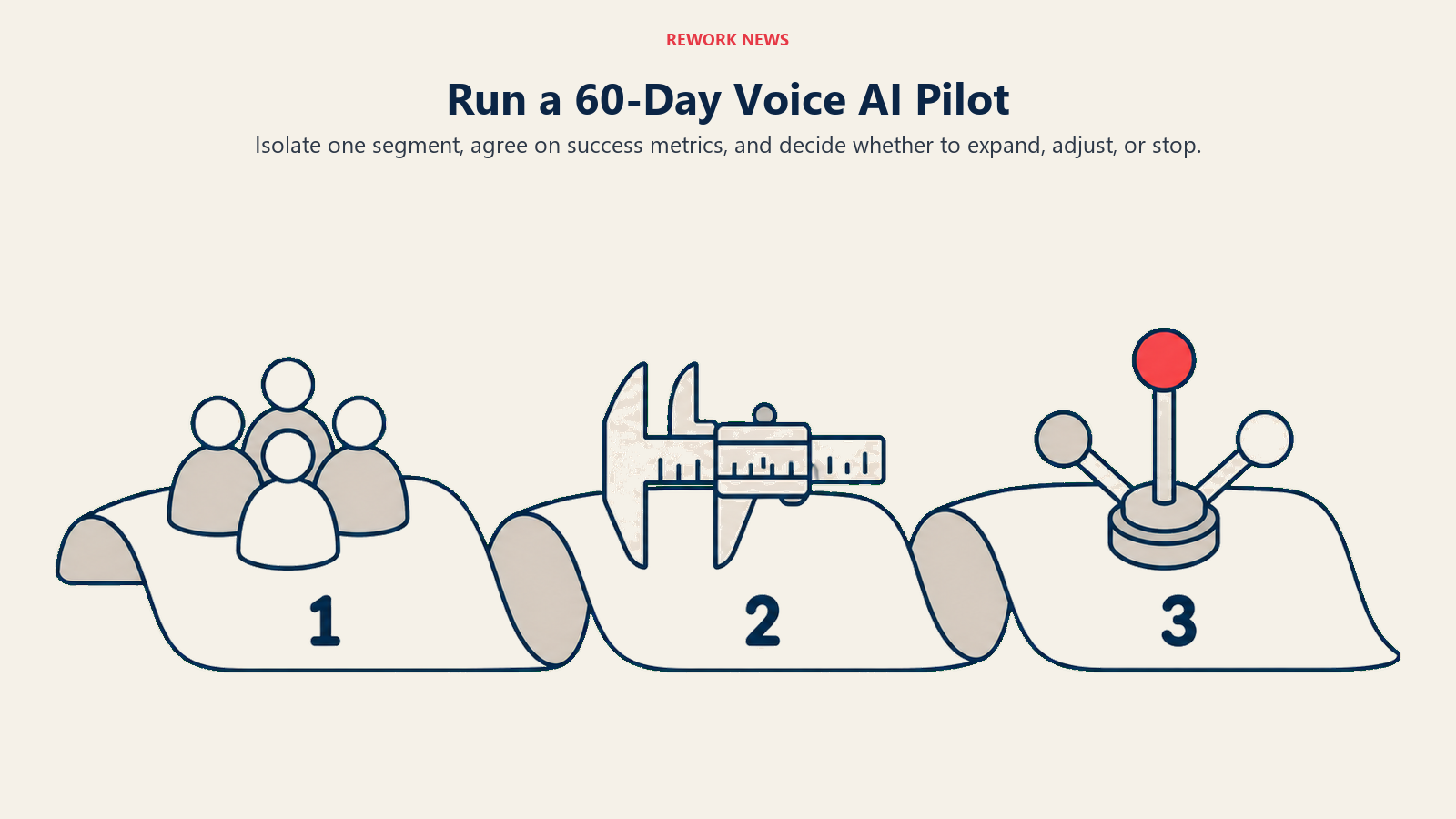
Don't try to test voice AI across your full motion at once. Pick a single use case (outbound qualification is usually the lowest-risk entry point) and apply it to one segment of your prospecting list that's currently underserved. Qualification frameworks are worth revisiting at this stage, because voice agents that aren't calibrated to your qualification logic will generate noise, not pipeline. The segment you choose matters: you want enough volume to generate a real data set, but not your highest-value accounts while the system is unproven.
Step 2: Define the measurement contract upfront.
Before you start, agree on what metrics will determine whether the pilot succeeds or fails. Connection rate and qualified meeting rate are the core metrics for outbound automation. Conversation adherence and rep satisfaction scores matter for real-time coaching. Specifying these before the pilot prevents the conversation from devolving into subjective impressions once the data comes in.
Step 3: Set a 60-day decision deadline.
Voice AI pilots that lack a defined decision date tend to drift indefinitely. Set a 60-day mark at which you'll review the data against your pre-defined metrics and make one of three calls: expand, adjust, or stop. The 60-day discipline forces the evaluation to produce a decision rather than a perpetual "let's see more data" outcome.
What to Test This Quarter
If you're a CRO who's been watching voice AI without committing to a position, the window for low-cost experimentation is closing. The companies that have already deployed and iterated will have a data advantage that compounds over the next 12 months.
The specific decision to make this quarter:
- Identify which of the three use cases above matches your current sales motion and a segment that can absorb a structured test
- Shortlist two voice AI vendors. ElevenLabs is now a serious enterprise player; evaluate it alongside alternatives with CRM integration already built
- Run your 60-day pilot with a clearly defined measurement contract
The $2.1B in voice AI investment in 2025 wasn't speculative. It was infrastructure build-out for a category that's already producing revenue. Sales leaders who treat this quarter as the one to form a real position, not just maintain a watch list, will be 12 months ahead of those who don't. Forecasting discipline is the other side of this equation: the pipeline velocity gains from voice AI only compound if the forecast model reflects them accurately.
Learn More
- Voice Agents Are Now an $11B Category: How Growth Leads Should Evaluate: The conversational stack evaluation for marketing and growth teams
- AI Agents in the Sales Pipeline: Where voice AI fits within the broader agentic sales picture
- Sales Playbook: Building the repeatable process that voice AI agents can execute at scale
- Forecasting Discipline for CROs: Ensuring voice-generated pipeline data feeds accurate forecasts
This article references PYMNTS reporting on ElevenLabs' Series D raise and market context from AssemblyAI's 2026 Voice Agent Report.
