Ramp vs Payhawk in 2026: Free US Card Software or Paid Multi-Entity Infrastructure?
Turn this article into takeaways for your work.


Each assistant summarizes the article only for you and suggests best practices for your work.
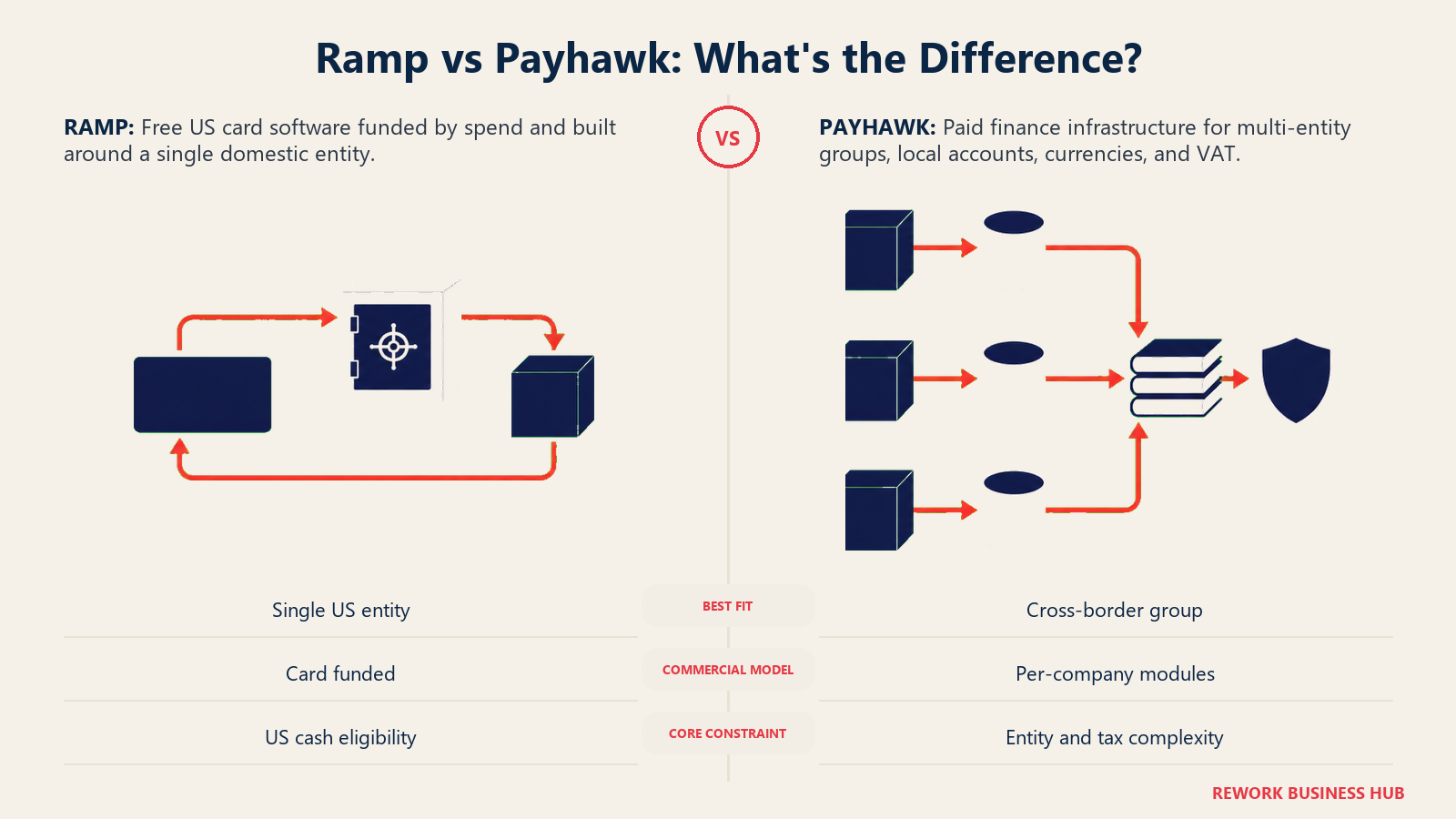
A finance leader typing "Ramp vs Payhawk" into a search bar is usually one of two people. Either you run a single US entity and a colleague mentioned Payhawk at a conference, or you run entities in more than one country and a US-first card program is starting to show its seams. Very few readers are choosing between these two as equals, because they were not built to serve the same company.
That is not a feature checklist. Ramp gives its core software away and earns its living from the interchange on every card swipe. Payhawk charges from the first dollar, by the module, per company, because it sells something a free card program was never built to do: run one consolidated ledger across a Delaware C-corp, a UK Ltd, and a German GmbH, each with its own local bank account and VAT rules. That commercial split, and the entity question underneath it, decides most of what follows.
TL;DR
- Ramp's software is free because Ramp needs your card spend, not a subscription check. Free is $0 per user per month, funded by interchange, with a flat $25,000 cash eligibility bar for every applicant regardless of stage or revenue.
- Payhawk is paid from day one because it sells multi-entity infrastructure, not a card. Travel, Cards & Expenses, Accounts Payable, and Procurement are four modules priced per company per month, built around local IBANs, multi-currency accounts, and cross-entity VAT handling.
- Ramp requires a US-registered entity, full stop. A company with no US corporation, LLC, or LP cannot open a Ramp account at all, regardless of cash or funding history. Payhawk was built for exactly that company.
- The credit assessment is a different test, not just a different bar. Ramp underwrites on cash in the bank. Payhawk's UK/EEA credit line underwrites on trading history: a minimum GBP or EUR 250,000 in annual turnover plus at least one filed year of accounts.
- Both price opaquely past the headline number. Ramp does not publish its Plus platform fee. Payhawk does not publish Complete bundle pricing or what extra entities cost on Enterprise. Neither can be budgeted from the website alone.
- ERP depth favors whoever matches your stack. Ramp names Workday and Oracle Fusion Cloud on Enterprise; Payhawk names native NetSuite, Dynamics 365, and SAP S/4HANA as Enterprise add-ons, with VAT code and Chart of Accounts transfer a US-first tool does not attempt.
Key Facts
Key Facts: The Gap Between These Two Models
- Ramp closed a $750 million Series F in June 2026 at a $44 billion valuation, reporting more than $1 billion in annualized revenue, more than 70,000 customers, and positive free cash flow (Ramp, via PR Newswire).
- Every Ramp applicant needs at least $25,000 in a linked US business bank account, with no separate revenue tier and no exceptions by company stage (Ramp Help Center).
- Payhawk's UK/EEA credit line requires a minimum of GBP or EUR 250,000 in annual turnover and at least one filed year of accounts, for a credit line of up to GBP or EUR 500,000 (Payhawk Help Center).
- Payhawk's US eligibility runs on cash instead of turnover: at least $250,000 for a parent entity, or $100,000 for each subsidiary in a group, held in a US bank account in the applying entity's name (Payhawk Help Center).
- From September 1, 2026, every VAT-registered business in France must be able to receive structured e-invoices, with the obligation to issue starting the same day for large and medium enterprises (France's business portal).
Ramp vs Payhawk at a Glance
| Ramp | Payhawk | |
|---|---|---|
| Core commercial model | Free software, funded by card interchange | Paid software, priced per company per module |
| Entry price | Free, $0 per user per month | No free tier; Growth Program from GBP 149/month, UK/EEA only, under 20 employees |
| Entity requirement | Must be a US corporation, LLC, or LP | UK, EEA, or US entities all eligible |
| Multi-entity handling | "Global coverage" named on Plus, not detailed | Native, with consolidated group-level master data |
| Local currency accounts | Not specified on the published pricing page | Local IBANs per business, multiple currencies |
| Underwriting basis | $25,000 cash balance, flat, any stage | Turnover and filed accounts (UK/EEA) or cash-in-bank (US) |
| Top published price | Plus, $15/user/month plus an undisclosed platform fee | Cards & Expenses from $449/month per company |
| ERP depth named | QuickBooks Online, Xero, NetSuite, Sage Intacct, Workday, Oracle Fusion Cloud | Sage Intacct, NetSuite, Dynamics 365, SAP S/4HANA, Xero, QBO, Exact Online |
| Best fit | Single-entity US company running real card volume | Multi-entity group spanning the US, UK, and EEA |
Sources: Ramp's pricing page, Ramp eligibility, Payhawk's US pricing page, and Payhawk's integrations page.
The Real Question: What Kind of Company Are You?
Most Ramp-vs-Payhawk searches assume this is a preference decision, the way Ramp-vs-Brex genuinely is for a lot of buyers. It usually is not. The same entity-first logic decides Brex vs Payhawk too, if Brex rather than Ramp is the US card program on your list. Ramp's own eligibility rules state that an applicant must be a corporation, LLC, or LP registered in the United States, with a US EIN and a real US physical address that is not a PO box or virtual office (Ramp Help Center). A UK Ltd with no US subsidiary cannot open a Ramp account. Not a worse account, no account at all.
Payhawk exists because of exactly that gap. Built in London and Sofia for European operating companies, then extended to US entities, its core architecture assumes a group with more than one legal entity from day one: consolidated master data across entities, local IBANs issued per business in the currency it actually banks in, and VAT code mapping so a German subsidiary's tax rules do not have to be reconciled by hand against a UK parent's (Payhawk's integrations page). That is not a feature Ramp is missing. It is a problem Ramp's product was never asked to solve, because a single US entity does not have it.
The one place these two genuinely overlap is a US company weighing whether it needs that multi-entity depth yet. A US-only company with 40 employees and no international entity gets nothing from Payhawk's core architecture and would be paying a per-company module price for capability it does not use. A US company that just opened a UK subsidiary, on the other hand, is exactly the buyer this comparison is for, and the rest of this article is built around that decision. The full breakdown by company shape is in the decision table near the end.
Ramp's Free Software: What "Free" Actually Means
Ramp Free is genuinely free: $0 per user per month, with a corporate card, basic travel and expense, accounts payable with AI-powered OCR, treasury, and QuickBooks Online and Xero sync included, no trial window and no downgrade date (Ramp's pricing page). The reason Ramp can do that is interchange, the small fee a card network and issuing bank collect every time a Ramp card is swiped. Contrary Research's analysis of Ramp's business model illustrates the mechanics with a hypothetical: Ramp collects roughly 250 basis points of interchange per transaction, passes back around 200 basis points to its issuing banks (Sutton Bank and Celtic Bank), and keeps the remaining 50 basis points as revenue (Contrary Research). Multiply that sliver by tens of billions of dollars in card volume across more than 70,000 customers, and it funds a real software company, one that reported over $1 billion in annualized revenue and said it was free cash flow positive as of its June 2026 Series F (Ramp, via PR Newswire).
What that model assumes is straightforward: your company routes real spend through Ramp's cards. Ramp underwrites the account on cash in the bank rather than personal credit, requiring $25,000 in a linked US business bank account, verified through Plaid and monitored daily, with no personal guarantee and no founder credit check (Ramp Help Center). That $25,000 gets you in the door. It does not, by itself, determine how much you can spend on the card, because Ramp separately weighs cash flow and revenue when it sets a credit limit.
Here is where "free" earns an asterisk. If your company clears the $25,000 bar but never routes meaningful spend through a Ramp card, either because payments run through an existing bank's cards or because spend genuinely is not large, the software subscription never converts into a bill. What happens instead is that the credit-limit side of the account, sized off cash flow and revenue rather than the flat eligibility minimum, has little reason to grow. You keep the $0 software; you do not get much of a working card program to run it on. Ramp does not publish a formal low-volume penalty, because there is not one to publish. But the model only pays off, for Ramp and for you, once your card spend is the real spend of the business rather than a side account.
| What Ramp Free assumes | What that costs you if it is not true |
|---|---|
| Ramp becomes your primary spend rail | If it does not, Ramp earns little from your account and your credit limit likely stays thin |
| A US entity with $25,000 in a linked bank account | Non-US companies cannot open an account regardless of cash position |
| Card spend, not invoice volume, is the bulk of your outflow | Heavy invoice-only companies get less value from a card-funded model |
| You are comfortable with underwriting that can move with cash flow | Credit limits are not fixed the way a published tier price is |
For the wider field of US-first cards built on the same interchange logic, see best Ramp alternatives and the fuller Ramp vs Brex comparison, which covers the other major player running the identical business model.
Payhawk's Case: Built for Multi-Entity, Multi-Currency Europe
Payhawk does not pretend to be free, and its pricing page leads with the thing it is actually selling: four modules (Travel from $299 per month, Cards & Expenses from $449, Accounts Payable from $349, and Procurement from $499), each priced per company rather than per user, plus a Payhawk Complete bundle with no published price (Payhawk's US pricing page). Every tier, including the entry-level Growth Program, ships with foundational infrastructure that a single-entity US tool has no reason to build: a multi-entity environment with consolidated master data, live accounting integrations to Xero, QuickBooks Online, or Exact Online, and SOC 2, ISO 27001, and PCI DSS Level 1 coverage across the whole account.
The specific capability worth naming is local IBANs. Payhawk issues each business its own bank account numbers in the currencies that business actually operates in, so a German subsidiary sends and receives payments through a local account rather than a US or UK-issued card converting every transaction back through an FX spread (Payhawk's integrations page). Layered on top is tax code mapping: VAT versus GST handling, automated transfer of VAT rates and vendor data, and, on the NetSuite integration specifically, automated reconciliation that carries Chart of Accounts, Departments, VAT codes, and Classification Areas across entities without manual re-entry. None of that is a Ramp feature gap. It is infrastructure a single US entity with no VAT exposure does not need, and infrastructure a group with a UK Ltd and a German GmbH cannot operate without.
The commercial shape follows the same logic. Payhawk's only publicly listed price point in local currency is the Growth Program, from GBP 149 a month, capped at 10 cards, 10 seats, and 15 invoices plus 15 reimbursements a month (Payhawk's Growth Program page), restricted to first-time UK or EEA customers on a single entity with up to 20 employees (Payhawk Help Center). Past that, Standard and Enterprise pricing is quote-only, and scaling to more entities sits behind an "additional entities" line under Enterprise add-ons rather than a published per-entity rate, alongside native bidirectional ERP integrations, enterprise HRIS connections, and a credit line facility offered through J.P. Morgan (Payhawk's US pricing page). The per-company base price not moving when headcount doubles is the pitch. What happens to the bill once your group grows from two entities to eight is a sales conversation, not a number on the page.
| Payhawk module | Starting price | What it buys |
|---|---|---|
| Travel | $299/month per company | Global hotel and flight booking, custom travel policy, automated expense reports |
| Cards & Expenses | $449/month per company | Card program, real-time expense creation, 40+ ERP/accounting/HR integrations |
| Accounts Payable | $349/month per company | Bill management, approval workflows, vendor management, AI line-item splitting |
| Procurement | $499/month per company | Purchase order management, intake forms, 2-way and 3-way matching |
| Payhawk Complete | Not published | All four modules plus integrated AI agents; "best value" per the vendor, no list price |
| Growth Program (UK/EEA only) | From GBP 149/month | Capped: 10 cards, 10 seats, 15 invoices and 15 reimbursements a month, single entity |
Credit Assessment: Two Different Tests, Not Just Two Different Bars
The most useful thing this comparison can tell a buyer is that Ramp and Payhawk are not offering a harder or easier version of the same underwriting. They are asking two different questions.
Ramp asks how much cash is sitting in your linked US bank account right now. The bar is $25,000, flat, whether the company was incorporated last month on a fresh funding round or has been trading profitably for a decade, with no revenue history or filed-accounts requirement in the published eligibility rules (Ramp Help Center). That is a good design choice for the population it targets: cash-rich, revenue-light companies, the exact shape of a business that just closed a venture round and has money in the bank before it has meaningful sales.
Payhawk asks a different question by region, and neither version is a cash snapshot. In the UK and EEA it wants proof of trading: a minimum GBP or EUR 250,000 in annual turnover, at least one filed year of accounts, and management accounts no older than three months, reviewed against a credit line cap of GBP or EUR 500,000 (Payhawk Help Center). In the US it switches to a cash test set far above Ramp's bar: at least $250,000 for a parent entity, or $100,000 per subsidiary, held in a US bank account in the applying entity's own name (Payhawk Help Center). Both Payhawk paths avoid personal guarantees, matching Ramp, but both start from a materially higher floor.
This is where "a company without US venture backing" actually matters. A freshly funded US startup with $30,000 in the bank and no revenue clears Ramp's bar easily and would fail Payhawk's US cash test by a wide margin. A profitably trading UK services company with GBP 400,000 in annual turnover, three years of filed accounts, and modest cash reserves clears Payhawk's UK turnover test comfortably, and could not open a Ramp account at all, because it has no US entity. Ramp's model rewards the balance sheet shape US venture funding produces: a pile of cash, thin trading history. Payhawk's model rewards the opposite: real trading history, whatever the cash position happens to be. Neither is more rigorous. They underwrite different kinds of companies, the same entity-and-geography split running through every section of this article.
| Ramp | Payhawk (UK/EEA) | Payhawk (US) | |
|---|---|---|---|
| What is tested | Cash in a linked US bank account | Annual turnover plus filed accounts | Cash in a US bank account |
| Minimum | $25,000, flat | GBP/EUR 250,000 turnover | $250,000 (parent) or $100,000 (subsidiary) |
| Trading history required | Not specified as a requirement | At least one filed year of accounts | At least one filed year of accounts |
| Personal guarantee | None | None | None |
| Credit line cap | Not published | Up to GBP/EUR 500,000 | Not published |
| Best fit | Cash-rich, revenue-light companies | Established trading companies, thinner cash | Established companies with real US cash reserves |
Pricing Compared
Neither vendor will give you a final number from its website, and the reasons are structural rather than evasive. Ramp's published Plus rate is $15 per user per month, with 20% off on annual billing, but it comes with a platform fee that scales with team size and is never quantified anywhere on the pricing page (Ramp's pricing page). Payhawk's four modules each carry a published starting price, but "starting" is doing real work: the final number also depends on seats, cards, transaction volume, and entity count, and Payhawk Complete, Standard, and Enterprise all route to a custom quote once you need more than the Growth Program's capped small-business tier.
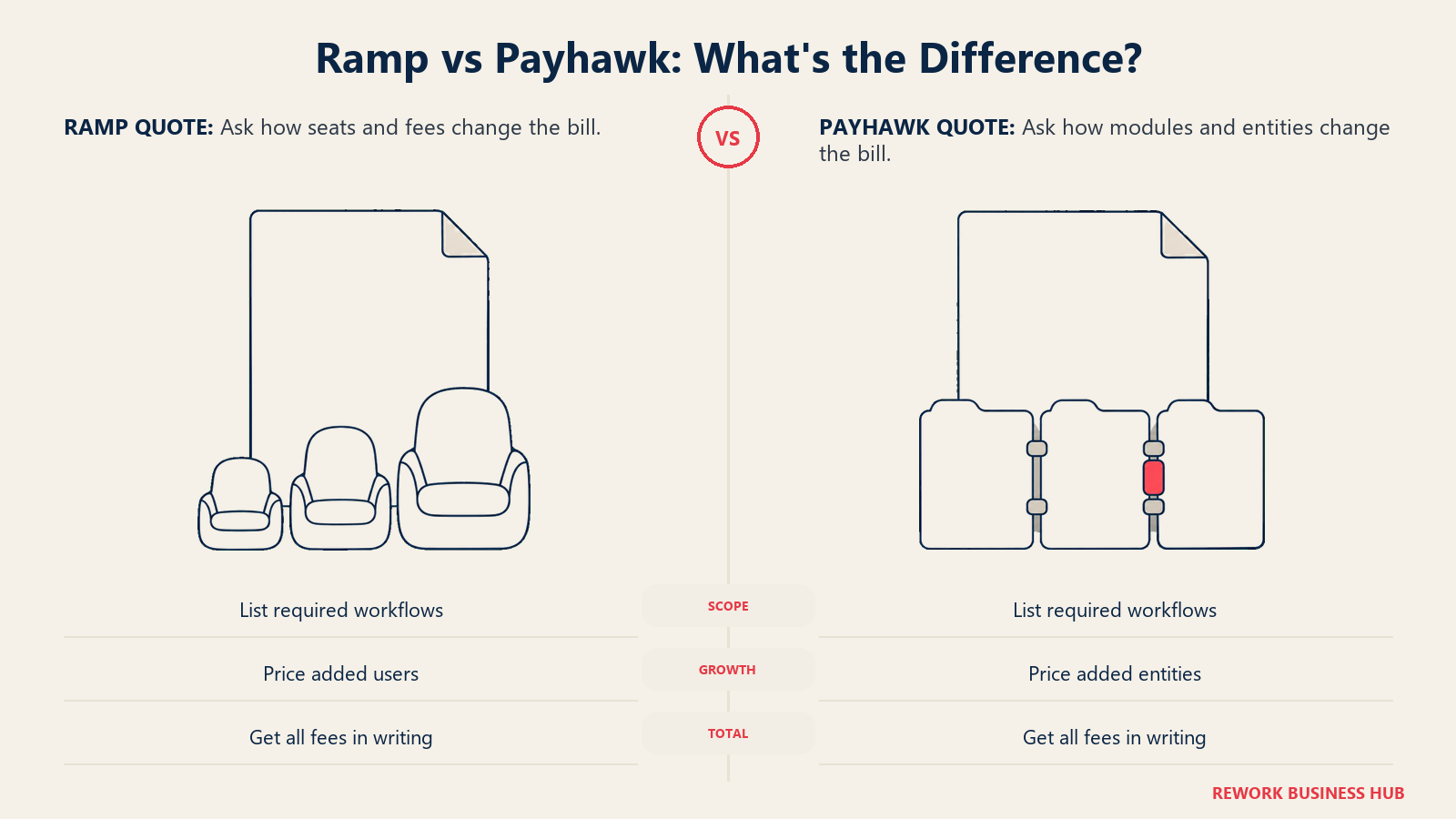
The honest way to compare them is by billing structure, not by picking a headline number and assuming it is the whole bill.
| Vendor and plan | Published price | Billing basis | What determines your real bill |
|---|---|---|---|
| Ramp Free | $0/user/month | Per user, monthly | Nothing; genuinely $0 for the software |
| Ramp Plus | $15/user/month + undisclosed platform fee | Per user, plus a fee scaled to team size | Headcount, plus a fee only Ramp's sales team will quote |
| Ramp Enterprise | Custom | Annual | Negotiated, includes implementation services |
| Payhawk Growth Program | From GBP 149/month | Per company, capped usage | Fixed while you stay under 20 employees, one entity, capped cards and invoices |
| Payhawk single module (Standard) | From $299 to $499/month per company | Per company, per module | Which modules you activate, not headcount |
| Payhawk Complete / Enterprise | Not published | Custom | Entity count, seats, transaction volume, add-ons like extra entities |
Sources: Ramp's pricing page and Payhawk's US pricing page.
Run the two structures against real scenarios and the split gets sharper. Below $750/month is Ramp Plus's approximate floor before its unpublished platform fee; Payhawk's per-company price does not move with headcount at all, which is the whole pitch once entity count, not seat count, is the real cost driver.
| Scenario | Ramp | Payhawk |
|---|---|---|
| 10-person single US entity, no NetSuite | Free, $0/month | Overpays badly; core value is unused without multi-entity complexity |
| 50-person single US entity, needs NetSuite | Plus, ~$750/month + undisclosed platform fee | Cards & Expenses from $449/month, but buys capability this company does not need |
| 50-person single US entity, hires to 250 | Cost keeps climbing per seat | Flat $449/month; price would not move at all |
| 3-entity group across the US, UK, and Germany | Not available as one consolidated program | Cards & Expenses + AP from $798/month, the only option that consolidates the group |
For the wider category context behind both pricing models, see best expense management software and best spend management software, and for the AP module specifically, best AP automation software covers Payhawk's Accounts Payable module against dedicated AP tools rather than against Ramp's bundled version.
ERP and Accounting Integration Depth
Both vendors gate their deepest connections behind a paid tier, but the shape of that depth tracks the rest of this comparison. Ramp names QuickBooks Online and Xero on Free, adds NetSuite and Sage Intacct on Plus with real-time sync that can run at the entity level for intercompany splitting, and reserves Workday and Oracle Fusion Cloud for Enterprise. Payhawk includes Xero, QuickBooks Online, and Exact Online in its base infrastructure across every tier, then moves NetSuite, Dynamics 365, and SAP S/4HANA into Enterprise add-ons described as native and bidirectional, with NetSuite specifically carrying over Chart of Accounts, Departments, VAT codes, and Classification Areas rather than a flat transaction feed.
| System | Ramp | Payhawk |
|---|---|---|
| QuickBooks Online | Included on Free | Included in foundational infrastructure |
| Xero | Included on Free, bi-directional bill sync | Included, with real-time bank reconciliation |
| Exact Online | Not named | Included in foundational infrastructure |
| NetSuite | Plus tier; entity-level sync and custom fields | Enterprise add-on; native bidirectional, transfers VAT codes and Chart of Accounts |
| Sage Intacct | Plus tier; real-time field and vendor-bill sync | Enterprise; native across all entities via the multi-entity module |
| Microsoft Dynamics 365 | Not named on the published page | Enterprise add-on; Business Central and Finance variants |
| SAP S/4HANA | Not named | Template-based CSV/XLS export, not native bidirectional |
| Workday (financials) | Enterprise tier | Not offered as an ERP; Workday appears only as an HRIS connection |
| Oracle Fusion Cloud | Enterprise tier | Not named |
If your accounting stack is the real constraint rather than either card program, best NetSuite alternatives and best Sage Intacct alternatives cover what happens when the ERP itself, not the spend tool sitting on top of it, is the decision that matters most.
Implementation and Data Portability on Exit
Getting started is the easy half for both vendors. Ramp's underwriting is a same-day cash-balance check; Payhawk's runs 24 business hours once complete documentation lands, faster for the capped Growth Program and slower for a multi-entity Enterprise deployment mapping entities, ERPs, and HRIS connections before go-live (Payhawk Help Center). Neither publishes a formal implementation timeline for larger deployments.
Getting your data back out is the part neither vendor documents clearly, and it is worth asking before you sign rather than after. Both support routine exports: Ramp sends expenses, journal entries, and bills to CSV; Payhawk offers on-demand Excel or CSV exports, with or without receipt images, plus custom templates and a dedicated SAP S/4HANA format. Neither publishes a policy for what happens to full historical data, chart-of-accounts mappings, or VAT configurations if you close the account entirely. That gap matters more on the Payhawk side, simply because Payhawk customers have more configured to lose: multi-entity master data and per-subsidiary VAT mappings that a single-entity Ramp account never accumulates. Get the exit policy in writing during the sales process rather than assuming routine export access answers the question.
| Ramp | Payhawk | |
|---|---|---|
| Time to apply | Same day | Same day (Growth Program) to multi-week (Enterprise) |
| Underwriting turnaround | Same day, automated cash check | 24 business hours after complete documents (published for UK/EEA) |
| Routine data export | CSV: expenses, journal entries, bills | Excel/CSV on demand, with or without receipts, custom templates |
| Full-account exit data policy | Not published | Not published |
| What is at risk on exit | Single-entity transaction history | Multi-entity master data, VAT mappings, consolidated custom fields |
When Ramp Is the Right Call
- You have a US entity and $25,000 in the bank, and that is the whole story. Ramp does not ask why the cash is there or how long you have been trading.
- Your spend really will run through the card. The free software is a genuine value only once card interchange is funding it on real volume.
- You are single-entity, or your international footprint is small enough that a US-only tool is not yet a problem.
- NetSuite or Sage Intacct is your ERP and you do not need native SAP or Dynamics 365 support.
When Payhawk Is the Right Call
- You have entities in more than one country, especially a UK or EEA entity with no US presence. Ramp is not an option for that company; Payhawk was built for it.
- VAT handling, local IBANs, and multi-entity consolidation are real operational requirements, not nice-to-haves.
- Your company has trading history and turnover but is not sitting on a fresh cash pile. Payhawk's UK/EEA underwriting rewards exactly that balance sheet shape.
- You would rather pay a predictable per-company price than watch a per-seat bill climb as you hire.
Who Should Choose Which
| If this describes you | Choose | Because |
|---|---|---|
| Single US entity, $25,000+ in the bank, real card volume ahead | Ramp | Free software, funded by the spend you were already going to put on a card |
| UK or EEA entity, no US presence | Payhawk | Ramp is not available to you regardless of financials |
| US parent with foreign subsidiaries needing one ledger | Payhawk | Native multi-entity consolidation Ramp does not attempt |
| Cash-rich, revenue-light US startup | Ramp | The $25,000 flat bar fits that balance sheet shape exactly |
| Trading company with real turnover, thinner cash | Payhawk (UK/EEA) | Underwriting rewards turnover and filed accounts, not idle cash |
| Need native NetSuite or Sage Intacct at entity level, single US entity | Ramp Plus | Named, published tier, no multi-entity premium required |
| Need native NetSuite, Dynamics 365, or SAP alongside multi-entity VAT handling | Payhawk Enterprise | The only one of the two built around that combination |
| Under 20 employees, single UK or EEA entity, first Payhawk customer | Payhawk Growth Program | The one capped, published entry price outside the US |
The verdict: check which company you actually are before you compare a single feature. With no US entity, this is already decided; Payhawk is your option and Ramp is not on the table. With a US entity and no international complexity, Ramp's free tier is hard to beat as long as real spend runs through the card. The narrow band actually choosing between the two, usually a US parent opening its first foreign subsidiary, should price Payhawk's Enterprise tier directly rather than assume the Cards & Expenses starting price is the real number, and get Ramp's Plus platform fee in writing at the same time.
Frequently Asked Questions about Ramp vs Payhawk
Can a UK or EU company sign up for Ramp?
No. Ramp requires the applying entity to be a corporation, LLC, or LP registered in the United States, with a US EIN and a US physical address. A company with no US entity cannot open a Ramp account regardless of cash position, revenue, or funding history.
Is Ramp actually free, or is there a catch?
The software is genuinely $0 per user per month on Free, with no trial window. The catch is economic, not hidden: Ramp funds that tier through card interchange, so it works best when real spend runs through a Ramp card. If it does not, the software stays free but your credit limit, set separately from cash flow and revenue, has little reason to grow.
How much does Payhawk actually cost?
Payhawk publishes per-company monthly starting prices for four modules: Travel from $299, Accounts Payable from $349, Cards & Expenses from $449, and Procurement from $499. Complete, Standard, and Enterprise publish no fixed price and are quoted on entities, seats, and transaction volume. The one published local-currency entry point is the UK/EEA Growth Program, from GBP 149 a month for companies under 20 employees on a single entity.
What is the real difference in how the two companies check eligibility?
Ramp checks cash in a linked US bank account, a flat $25,000 minimum regardless of company stage. Payhawk checks trading history in the UK and EEA (a minimum GBP or EUR 250,000 in annual turnover plus at least one filed year of accounts) and cash in the US ($250,000 for a parent entity or $100,000 per subsidiary). Neither requires a personal guarantee.
Which one has deeper ERP integrations?
It depends on the ERP. Ramp names Workday and Oracle Fusion Cloud on Enterprise, which Payhawk does not offer as ERP connections. Payhawk names native, bidirectional NetSuite, Dynamics 365, and SAP S/4HANA (SAP via export templates rather than a live sync) with VAT code and Chart of Accounts transfer built in, which Ramp's published integrations do not describe to the same depth.
What happens to our data if we cancel either platform?
Neither vendor publishes a specific policy for full data export on account closure. Both support routine CSV and Excel exports for ongoing accounting use. Ask directly what a complete export looks like at contract termination before signing, especially with Payhawk, where multi-entity master data and VAT mappings represent more configuration to lose than a single-entity Ramp account ever accumulates.
We are a US company opening our first European entity. Which one do we need?
This is the one scenario where the two genuinely compete. If the new entity is small and US operations stay dominant, you can often run Ramp for the US entity alone in the near term. Once you need one consolidated ledger, local IBANs, and VAT handling across both entities, that is Payhawk's core use case, worth pricing before your US spend is too deeply wired into Ramp to switch easily.
What to Do Next
Answer one question before you request a demo from either company: does your business have a US-registered entity, yes or no. If no, this comparison is already over; Payhawk, or another Europe-native platform, is your realistic path, whatever the rest of the feature list says. If yes, and you have no entities outside the US, run the numbers on Ramp Free first, since $0 in software cost is hard for any paid platform to beat until card volume or entity count requires more.
If you are the buyer in between, a US company with one or more foreign entities, do not price this off either homepage. Call Payhawk for an Enterprise quote naming your actual entity count, and call Ramp for the Plus platform fee at your actual team size, before comparing a single number. The entity question decided most of this article already; the two quotes you cannot get without asking will decide the rest.
Related Resources:
- Best Expense Management Software in 2026
- Best Spend Management Software in 2026
- Best AP Automation Software in 2026
- Ramp vs Brex
- Brex vs Payhawk
- Best Ramp Alternatives in 2026
- Best Brex Alternatives in 2026
- Best Bill.com Alternatives in 2026
- Best NetSuite Alternatives in 2026
- Best Sage Intacct Alternatives in 2026

Principal Product Marketing Strategist
On this page
- TL;DR
- Key Facts
- Ramp vs Payhawk at a Glance
- The Real Question: What Kind of Company Are You?
- Ramp's Free Software: What "Free" Actually Means
- Payhawk's Case: Built for Multi-Entity, Multi-Currency Europe
- Credit Assessment: Two Different Tests, Not Just Two Different Bars
- Pricing Compared
- ERP and Accounting Integration Depth
- Implementation and Data Portability on Exit
- When Ramp Is the Right Call
- When Payhawk Is the Right Call
- Who Should Choose Which
- What to Do Next