Best Brex Alternatives in 2026: 13 Corporate Card and Spend Platforms Compared
Turn this article into takeaways for your work.


Each assistant summarizes the article only for you and suggests best practices for your work.
Brex is a strong product, and any honest comparison should start there. It issues cards locally in 50+ countries, does not require a personal guarantee, and puts a business account, expense policy engine, bill pay, reimbursements, and travel booking inside one platform. For a company that hired in three countries before it hired a controller, that breadth genuinely removes work.
The reasons people still shop around are just as real. Brex repositioned away from the smallest companies, its underwriting has historically favored funded startups over bootstrapped SMBs, and its Premium tier charges $12 per user per month on top of interchange-funded economics that several competitors give away entirely. Teams whose actual problem is accounts payable or reimbursement often find Brex heavier than the job requires. The 13 platforms below are grouped by what they replace: direct card-led rivals, banking-led options, travel-first tools, Europe-native platforms, and HR or finance suites that fold spend into a system you already run. Start with the category expense management software roundup if you want the full field rather than the Brex-specific view.
Key Facts
Key Facts: What Uncontrolled Spend Actually Costs
- The average cost to process an expense report for a single night hotel stay is $58 and 20 minutes of work, and 19% of reports contain errors or missing information costing an extra $52 and 18 minutes each to fix, per a GBTA Foundation study run with HRS (GBTA).
- Expense reimbursement schemes showed up in 13% of occupational fraud cases studied, with a median loss of $50,000 per case (ACFE, 2024 Report to the Nations).
- 37% of business travelers logged at least one instance of waste or misuse in their expense claims, and just 0.4% of travelers accounted for 25% of all high-risk spending, per Oversight Systems' Spend Analysis Report Volume 3 (2017, the most recent edition of that benchmark) (Oversight).
- The median company takes 6.4 calendar days to close its books, while the top quartile finishes in 4.8 days or less and the bottom quartile needs 10 or more, per APQC's General Accounting Open Standards Benchmarking survey (CFO.com).
- Virtual card payment value reached $5.2 trillion in 2025 and is forecast to hit $17.4 trillion by 2029, per Juniper Research's Global Virtual Cards Market 2025-2029 report (Juniper Research).
Quick Comparison Table
| Tool | Best For | Starting Price | Key Strength | Key Limitation |
|---|---|---|---|---|
| Brex (baseline) | Venture-backed and multi-entity teams operating globally | Essentials $0/user/mo; Premium $12/user/mo | Local card issuance in 50+ countries, no personal guarantee | Moved upmarket; Premium adds a per-seat fee rivals do not charge |
| Ramp | US teams that want cards, expenses, and AP on a free tier | Free $0/user/mo; Plus $15/user/mo plus a platform fee | Fastest close automation in the category | US-first; the Plus platform fee is not published as a number |
| BILL Spend & Expense | Companies wanting free cards beside a mature AP tool | $0/user/mo | Free card program plus a credit line up to $5M | AP and AR is a separate paid product at $49+/user/mo |
| Rho | Teams that want spend software funded by banking | $0 platform, $0 per user | No subscription and no per-user fee at all | You bank with Rho, which is a bigger commitment |
| Mercury | Founders who want banking first and spend controls second | Free $0/mo; Plus $29.90/mo per company | Per-company pricing that does not scale with headcount | Spend controls are lighter than a card-led platform |
| Navan | Travel-heavy teams that want booking and expense together | Business free up to 300 employees | Expense records built from the booking, not rebuilt after | Expense is free only for the first 5 users |
| Payhawk | Multi-entity groups buying by module, not by seat | Cards & Expenses from $449/mo per company | Per-company pricing across entities and currencies | Expensive floor for a team under 25 people |
| Pleo | European teams wanting cards and expenses in one | Starter GBP 9.50/mo billed yearly (3 users) | Cleanest European card experience for small teams | Priced in GBP and EUR; base fee plus per-extra-user |
| Spendesk | European mid-market that refuses per-seat fees | Quote-only, no list price | No active user fees, free card orders | Nothing published; every evaluation starts with sales |
| Expensify | Reimbursement-first teams and accountants | Collect $5 per unique member/mo | Best-known receipt capture and approval flow | Billing model is genuinely hard to compare |
| Rippling Spend | Companies already running Rippling for HR and IT | Quote-only, modular add-on | Cards tied to the employee record and lifecycle | No fixed published price; module sprawl |
| Airbase (Paylocity for Finance) | Paylocity customers consolidating finance vendors | Quote-only, no list price | Guided procurement and deep approval chains | Now part of Paylocity, not an independent product |
| Zoho Expense | Budget-conscious and Zoho-ecosystem teams | Standard $3/user/mo billed annually | Lowest published per-user price on this list | Card issuing depends on region and partner |
| Moss | European teams buying spend in modules | Quote-only, modular | Flexible module and add-on structure | Publishes no figure for either its free or paid plans |
Why Companies Actually Leave Brex
Nobody leaves a spend platform over a feature list. They leave over a mismatch between how the vendor makes money and how their company operates. Here is what actually shows up in the switching conversations.
| Reason | Who Feels It Most | How Often It Triggers a Switch |
|---|---|---|
| Repositioning away from small, non-venture-backed businesses | Bootstrapped SMBs and agencies | Very common |
| Underwriting that historically favored funded startups | Profitable but unfunded companies | Very common |
| Premium at $12 per user per month when rivals charge $0 | Controllers modeling cost at 100+ seats | Common |
| Product is heavier than needed when the real job is AP | AP managers and bookkeepers | Common |
| Reimbursement-only teams paying for a full card platform | Finance leads with low card volume | Common |
| Enterprise and Smart Card tiers priced by quote | CFOs trying to budget a two-year plan | Moderate |
| Weaker fit for a Europe-first entity structure | Group finance directors in the EU and UK | Moderate |
| Banking relationship consolidated with a single provider | Founders who want banking separate from spend | Moderate |
Two of those deserve a caveat. Brex Essentials is genuinely free and already includes global card acceptance, AI custom rules, up to two entities, accounting integrations, local currency wires, travel booking, bill pay, and reimbursements. That is a lot for $0. And the underwriting complaint is a historical pattern, not a published policy, so if your finances have changed since you were last declined, it is worth re-asking rather than assuming.
Pricing Models: The Part That Decides Your Bill
Four different pricing models are represented on this list, and which one a vendor uses tells you more about your eventual invoice than the headline number does.
| Pricing Model | How It Bills | Tools Using It | Watch Out For |
|---|---|---|---|
| Per user, per month | Scales linearly with headcount | Brex Premium, Ramp Plus, Navan Expense, Zoho Expense, Expensify | Whether it counts all users or only active ones |
| Per company, per month | Flat regardless of headcount | Payhawk, Mercury, Pleo base fee | Cheap at 200 people, expensive at 10 |
| Interchange or treasury funded | $0 software, revenue from card spend and deposits | Ramp Free, BILL Spend & Expense, Rho, Brex Essentials | The model needs real card volume to work for you |
| Quote-only | Priced on entities, volume, and module mix | Spendesk, Rippling Spend, Airbase, Moss | Budgeting is impossible until you talk to sales |
One trap is specific to this category. A platform fee is not a per-seat fee, and vendors that charge one rarely publish the number. Ramp's Plus tier carries a platform fee scaled to team size that the pricing page does not quantify, and Spendesk's model is a fixed platform fee plus variable transaction fees with no published figure at all. Ask for both components in writing before you compare anything to Brex Premium's flat $12.
Stage Fit Matrix
Company stage changes what a good Brex replacement looks like. Simple free card programs fit many startups, while multi-entity and travel-heavy platforms become stronger as headcount and complexity grow.
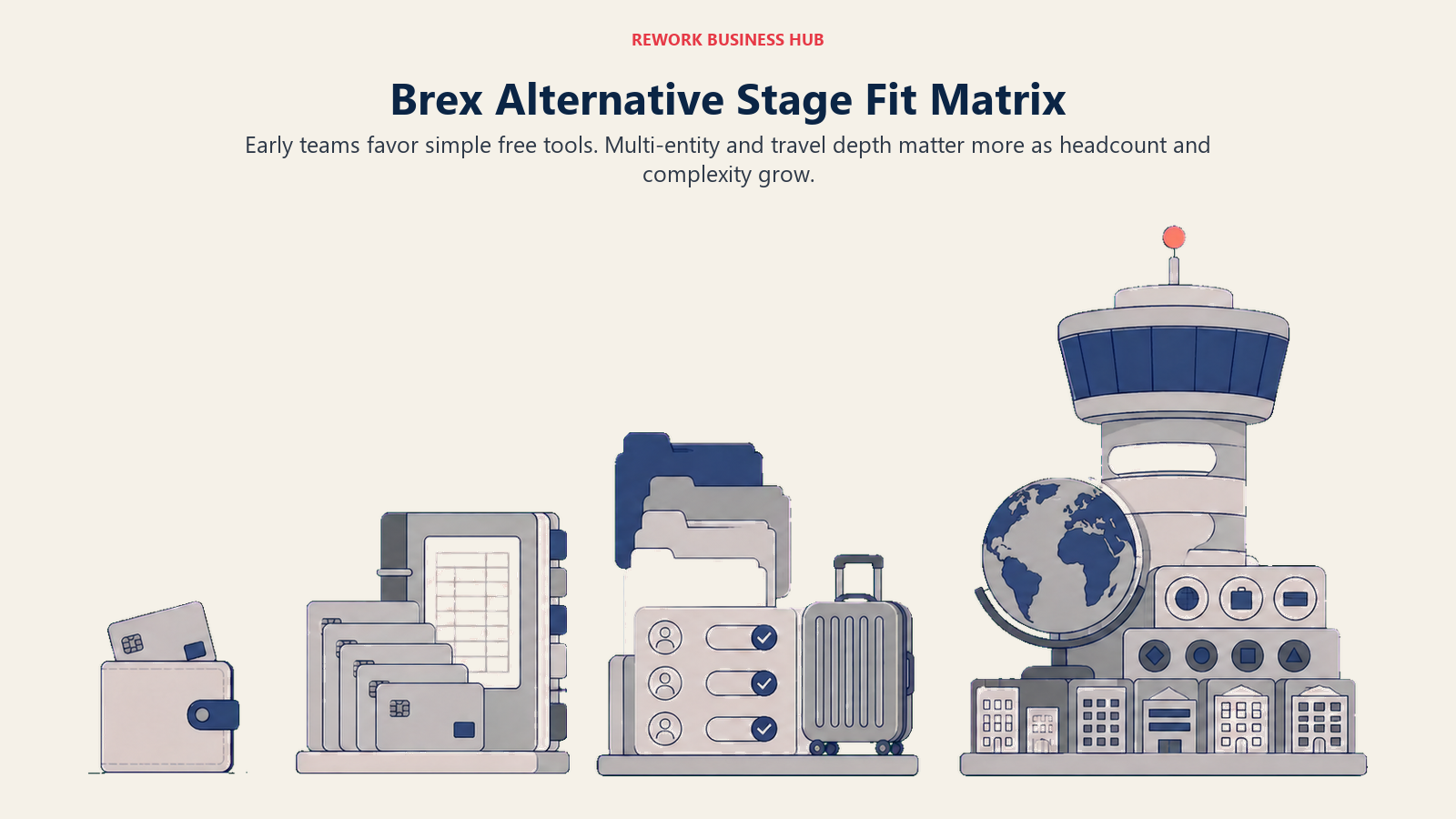
| Tool | Startup (1-10) | Growth (10-50) | Mid-Market (50-200) | Enterprise (200+) |
|---|---|---|---|---|
| Ramp | Strong fit | Strong fit | Strong fit | Possible |
| BILL Spend & Expense | Strong fit | Strong fit | Strong fit | Possible |
| Rho | Strong fit | Strong fit | Possible | Not a fit |
| Mercury | Strong fit | Strong fit | Possible | Not a fit |
| Navan | Strong fit | Strong fit | Strong fit | Strong fit |
| Payhawk | Not a fit | Possible | Strong fit | Strong fit |
| Pleo | Strong fit | Strong fit | Strong fit | Possible |
| Spendesk | Not a fit | Possible | Strong fit | Possible |
| Expensify | Strong fit | Strong fit | Possible | Possible |
| Rippling Spend | Possible | Strong fit | Strong fit | Possible |
| Airbase (Paylocity for Finance) | Not a fit | Possible | Strong fit | Strong fit |
| Zoho Expense | Strong fit | Strong fit | Possible | Not a fit |
| Moss | Possible | Strong fit | Strong fit | Possible |
Sizing and Persona Table
| Tool | Ideal Team Size | Primary Buyer | Region Strength |
|---|---|---|---|
| Ramp | 10 to 500 employees | Controller, Head of Finance | US |
| BILL Spend & Expense | 10 to 500 employees | Controller, AP manager | US |
| Rho | 5 to 200 employees | Founder, controller | US |
| Mercury | 2 to 100 employees | Founder, first finance hire | US |
| Navan | 20 to 5,000 employees | Travel manager, CFO | Global |
| Payhawk | 100 to 2,000 employees | Group CFO, finance director | Europe, UK, US |
| Pleo | 5 to 500 employees | Finance lead, office manager | UK and EU |
| Spendesk | 50 to 1,000 employees | CFO, finance director | France, EU, UK |
| Expensify | 1 to 200 employees | Office manager, bookkeeper, accountant | Global |
| Rippling Spend | 25 to 2,000 employees | Head of People, CFO | US and global |
| Airbase (Paylocity for Finance) | 100 to 2,000 employees | Controller, VP Finance | US |
| Zoho Expense | 1 to 100 employees | Founder, finance manager | Global, strong in India and APAC |
| Moss | 20 to 500 employees | Finance lead, controller | Germany, Netherlands, UK |
1. Ramp - The Direct Rival Most Brex Leavers Test First
Ramp and Brex compete for the same buyer with almost opposite instincts about pricing. Ramp's argument is that cards, reimbursements, bill pay, vendor management, and accounting sync should sit on a free tier most companies under 100 people never outgrow, funded by interchange rather than a subscription. What finance teams actually praise is the close: transactions arrive coded, receipts match automatically, and the sync into QuickBooks, Xero, NetSuite, or Sage Intacct runs continuously instead of as a month-end export. Against the APQC median of 6.4 days to close, that is the specific number Ramp is trying to move.
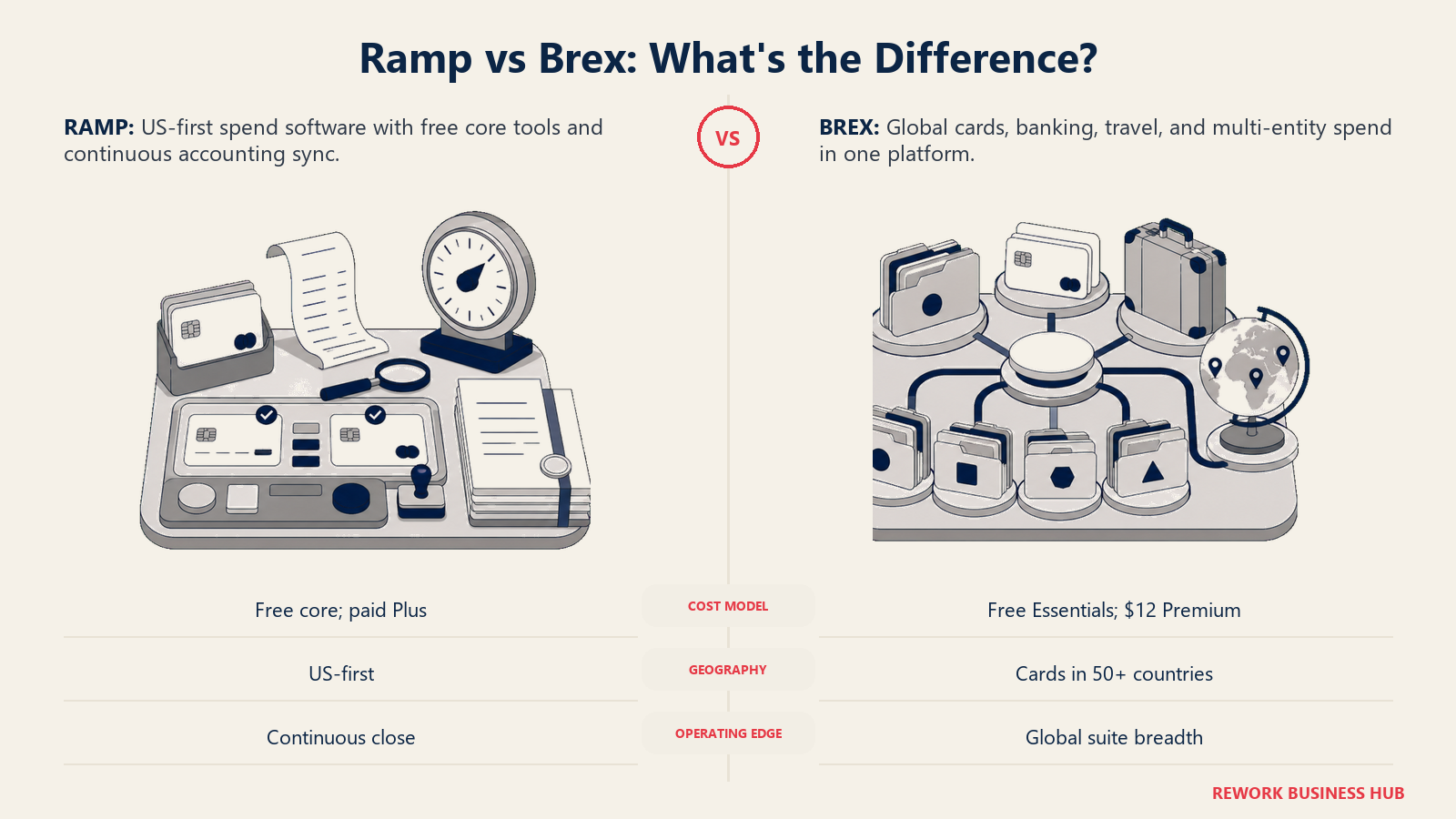
Where Brex wins is geography. Ramp is built US-first, so a company with a German or UK entity will hit gaps that Payhawk or Pleo fill natively. Ramp also does not publish its Plus platform fee, which makes a 200-seat deployment impossible to budget from the website alone.
| What you get | What you don't |
|---|---|
| A free tier covering cards, expenses, and AP | US-centric; thin coverage for foreign entities |
| Continuous accounting sync that shortens close | The Plus platform fee is unpublished |
| Policy controls applied at the card level | Card program still requires underwriting approval |
| Card interchange funds the software, so there is no seat fee | Less per diem and VAT depth than European tools |
Pricing: Free is $0 per user per month. Plus is $15 per user per month plus a platform fee that scales with team size, and Ramp does not publish that fee as a number. Annual billing takes 20% off. Enterprise is contact-sales and billed annually. All figures from Ramp's own pricing page.
Best for: US companies of 10 to 500 people that want everything Brex Premium does without a per-seat line item. If Ramp is the one you are leaving, see best Ramp alternatives.
2. BILL Spend & Expense - Free Cards From an AP Company
BILL Spend & Expense is the former Divvy, and the offer is blunt: a corporate card program with budgets, virtual cards, and expense tracking at $0 per user per month, backed by a credit line running from $1,000 to $5M depending on underwriting. For a Brex user whose real complaint is paying $12 a seat for card controls, that is the cleanest like-for-like swap on this list.
The nuance is that BILL sells two products. Spend & Expense is free. BILL's AP and AR product is a separate per-user subscription, and it is the more mature half of the company. That split matters for exactly the buyer this article describes: if you left Brex because you mainly wanted AP, you are buying BILL's paid product, not its free one.
| What you get | What you don't |
|---|---|
| Cards, budgets, and expense tracking at $0 per user | AP and AR is a separate paid subscription |
| Credit lines from $1,000 up to $5M | Line size depends on underwriting, not on the plan |
| Budget-first model catches overspend before it lands | US-centric; weaker for multi-country entities |
| Pairs with an AP product accountants already know | Two products means two onboarding projects |
Pricing: BILL Spend & Expense is $0 per user per month, including cards, budgets, expense tracking, and credit lines from $1,000 to $5M. BILL's separate AP and AR product runs Essentials $49 per user per month, Team $65, Corporate $89, and Enterprise custom. All figures from BILL's own pricing page.
Best for: US companies of 10 to 500 that want a free card program and will pay separately for serious AP. See best BILL.com alternatives if the two-product structure bothers you.
3. Rho - Spend Software Paid For By Banking
Rho takes the interchange-funded model further than anyone else here. The platform is free in a way that is unusually specific: $0 subscription fees, $0 per-user fees, $0 same-day ACH, wires, and checks, with AP, expense management, and accounting automation included at no charge. For a company running 40 seats, that is $5,760 a year that Brex Premium would bill and Rho does not.
The commitment is bigger, though, and it should be named plainly. Rho works because you bank with Rho. That is a treasury decision involving your board and your auditors, not a software purchase your controller makes alone. Revenue comes from the banking side instead: FX transfers cost 1%, and treasury is 0.15% to 0.6% annually depending on deposit size.
| What you get | What you don't |
|---|---|
| $0 subscription and $0 per-user fees, permanently | You move your banking relationship to Rho |
| Free same-day ACH, wires, and checks | US-focused; not built for multi-country entities |
| AP, expense, and accounting automation included | Less mature than Brex on global card issuance |
| Treasury yields on idle cash | Switching costs are higher than a software swap |
Pricing: The platform is free: $0 subscription fees, $0 per-user fees, and $0 same-day ACH, wires, and checks, with AP, expense, and accounting automation at $0. FX transfers are 1%. Treasury runs 0.15% to 0.6% annually depending on deposit size. All figures from Rho's own pricing page.
Best for: US companies of 5 to 200 people willing to consolidate banking and spend with one provider to eliminate software cost entirely.
4. Mercury - Banking First, Spend Controls Second
Mercury attacks the Brex bundle from the banking end rather than the card end. Founders come for the business account and the clean API, then add cards, bill pay, and reimbursements as the company grows. The structural advantage is pricing: Mercury bills per company, not per user, so adding your tenth or fiftieth employee does not change the invoice.
Be honest about the ceiling. Mercury's spend controls are lighter than a card-led platform's. If your problem is that money leaves before finance sees it, Ramp, Brex, or BILL Spend & Expense enforce policy harder at the point of sale. If your problem is that you want a real business account with competent spend tooling attached, Mercury is a better shape.
| What you get | What you don't |
|---|---|
| Per-company pricing that ignores headcount | Spend controls are lighter than card-led rivals |
| Strong business banking and treasury features | Not built for multi-entity global structures |
| Free tier that genuinely covers early-stage needs | Fewer procurement and approval workflows |
| Clean product that founders can run without finance staff | Less depth for a mid-market controller |
Pricing: Mercury is $0 per month. Mercury Plus is $29.90 per month, or $23.95 per month billed annually (15% off). Mercury Pro is $299 per month. All three are priced per company, not per user. All figures from Mercury's own pricing page.
Best for: Startups and small teams of 2 to 100 that want banking as the foundation and are happy with lighter spend enforcement on top.
5. Navan - When Travel Is the Real Expense Line
Brex includes travel booking, which is why Navan belongs in this comparison rather than a separate one. Navan starts from the trip instead of the receipt: employees book flights and hotels inside Navan, and the expense record is populated from the booking rather than reconstructed afterward. That structural difference removes the entire category of manual matching that generates the GBTA numbers in the Key Facts above.
The entry offer is genuinely generous and genuinely partial. Navan Business is free for companies up to 300 employees with unlimited trips on the travel side. Expense is where charging begins, and understanding that split before you assume "free" covers your whole use case is the single most important thing to check.
| What you get | What you don't |
|---|---|
| Booking and expense share one record | Expense is free only for the first 5 users |
| Travel free for companies up to 300 employees | Weak value if your team rarely travels |
| Policy enforced at booking time, not after | Card and AP depth trails Ramp or Brex |
| Strong inventory and negotiated rates | Enterprise tier is quote-only |
Pricing: Navan Business is free for companies up to 300 employees, with unlimited trips on travel. Navan Expense is free for the first 5 users, then $15 per user per month. Navan Enterprise is contact-sales. All figures from Navan's own pricing page.
Best for: Travel-heavy teams of 20 to 5,000 that used Brex mostly for its travel module and want a specialist instead.
6. Payhawk - Per-Company Pricing Across Entities
Payhawk is the strongest answer to one specific Brex complaint: paying per seat as headcount grows. Payhawk sells modules priced per company, per month, so a 400-person group pays the same platform rate as a 120-person one. For multi-entity European and transatlantic groups, that pricing shape plus native multi-currency and local entity handling is the reason Payhawk keeps showing up on mid-market shortlists.
The tradeoff is the floor. Starting at $449 a month for Cards & Expenses, Payhawk is more expensive than Brex Premium until you cross roughly 37 seats, and stacking modules raises that break-even further. Below 25 people it is simply the wrong tool.
| What you get | What you don't |
|---|---|
| Per-company pricing that ignores headcount | High monthly floor for small teams |
| Genuine multi-entity and multi-currency handling | Modules stack, so the real price needs a quote |
| Strong European accounting and VAT support | Less startup-friendly onboarding than Brex |
| Procurement and travel modules available | Implementation is a project, not a signup |
Pricing: Per company, per month, in USD: Cards & Expenses from $449, Accounts Payable from $349, Travel from $299, Procurement from $499. These are company-level prices, not per-user prices. All figures from Payhawk's own pricing page.
Best for: Multi-entity companies of 100 to 2,000 employees whose headcount growth is outrunning per-seat spend software.
7. Pleo - The European Card Experience for Smaller Teams
Pleo is what a lot of UK and EU teams pick when Brex feels American in ways that matter: local accounting integrations, European bank rails, and support that understands VAT. The product is deliberately simple, built for a finance lead or office manager rather than a controller with a systems background, and the card-and-receipt loop is about as frictionless as this category gets.
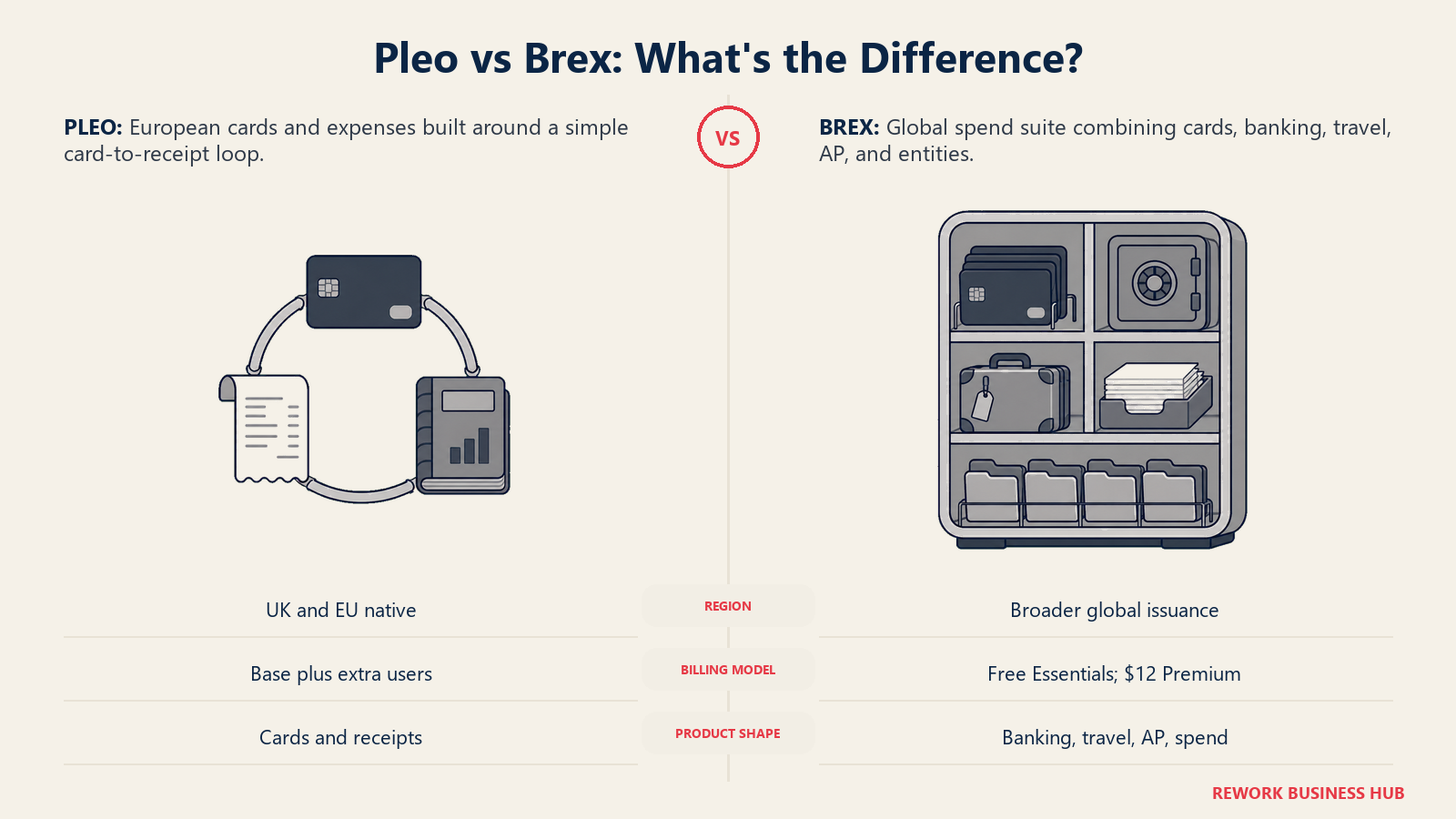
Read the pricing basis carefully. Pleo's UK page is denominated in GBP, and the structure is a base fee including 3 users plus a per-additional-user rate, which behaves like neither a pure per-seat nor a pure per-company model. At 25 users on Essential, you are paying the base plus 22 extra seats, so model your own headcount before comparing it to a flat $12.
| What you get | What you don't |
|---|---|
| Built for European accounting and banking | Priced in GBP and EUR, not USD |
| Base fee plus per-extra-user keeps small teams cheap | Costs climb once you pass roughly 20 users |
| Very low training burden for non-finance staff | Lighter procurement and approval depth |
| Starter tier for teams of 3 or fewer | Weaker for US-headquartered groups |
Pricing: From Pleo's UK pricing page, in GBP. Starter is GBP 9.50 per month billed yearly, capped at 3 users. Essential is GBP 45 per month billed monthly or GBP 39 per month billed yearly, 3 users included, with additional users at GBP 11 each per month. Advanced is GBP 109 monthly or GBP 99 yearly, 3 users included, with additional users at GBP 15 each per month. Business starts at GBP 249 per month billed yearly. These are GBP figures, not converted to USD.
Best for: UK and EU teams of 5 to 500 that want a European-native version of what Brex does.
8. Spendesk - No Per-Seat Fee, No Published Price
Spendesk built its pitch on the exact economics that push people off Brex Premium. The vendor states plainly that it does not charge active user fees, and that card orders are free. Instead the model is a fixed platform fee plus variable transaction fees. For a French, EU, or UK mid-market company adding 40 people a year, removing the per-seat variable from the budget is worth real money.
What you cannot do is evaluate it from the website. Spendesk publishes no prices at any tier, so every comparison starts with a sales conversation and ends with a number you cannot benchmark against a public list. That is a legitimate reason to shortlist it later rather than first.
| What you get | What you don't |
|---|---|
| No active user fees, per the vendor | Zero published pricing at any tier |
| Free card orders | Cannot be budgeted without a sales call |
| Strong European mid-market fit | Less relevant for US-only companies |
| Procurement and approval workflows included | Smaller ecosystem than Brex or Ramp |
Pricing: Quote-only. Spendesk publishes no prices. Its stated model is a fixed platform fee plus variable transaction fees, and the vendor says it does not charge active user fees and that card orders are free. Any specific number you find elsewhere is (reported), not vendor-confirmed.
Best for: European companies of 50 to 1,000 employees that want spend management without a per-seat line and will tolerate a sales-led evaluation.
9. Expensify - When the Real Job Was Reimbursement All Along
A meaningful share of Brex leavers do not need a card program at all. They need receipts out of people's pockets and into approved, reimbursable reports. Expensify has owned that job for over a decade: SmartScan reads the receipt, policy rules flag violations, and approval chains route without anyone building a workflow. Accountants managing books for several small clients lean on it heavily for this reason.
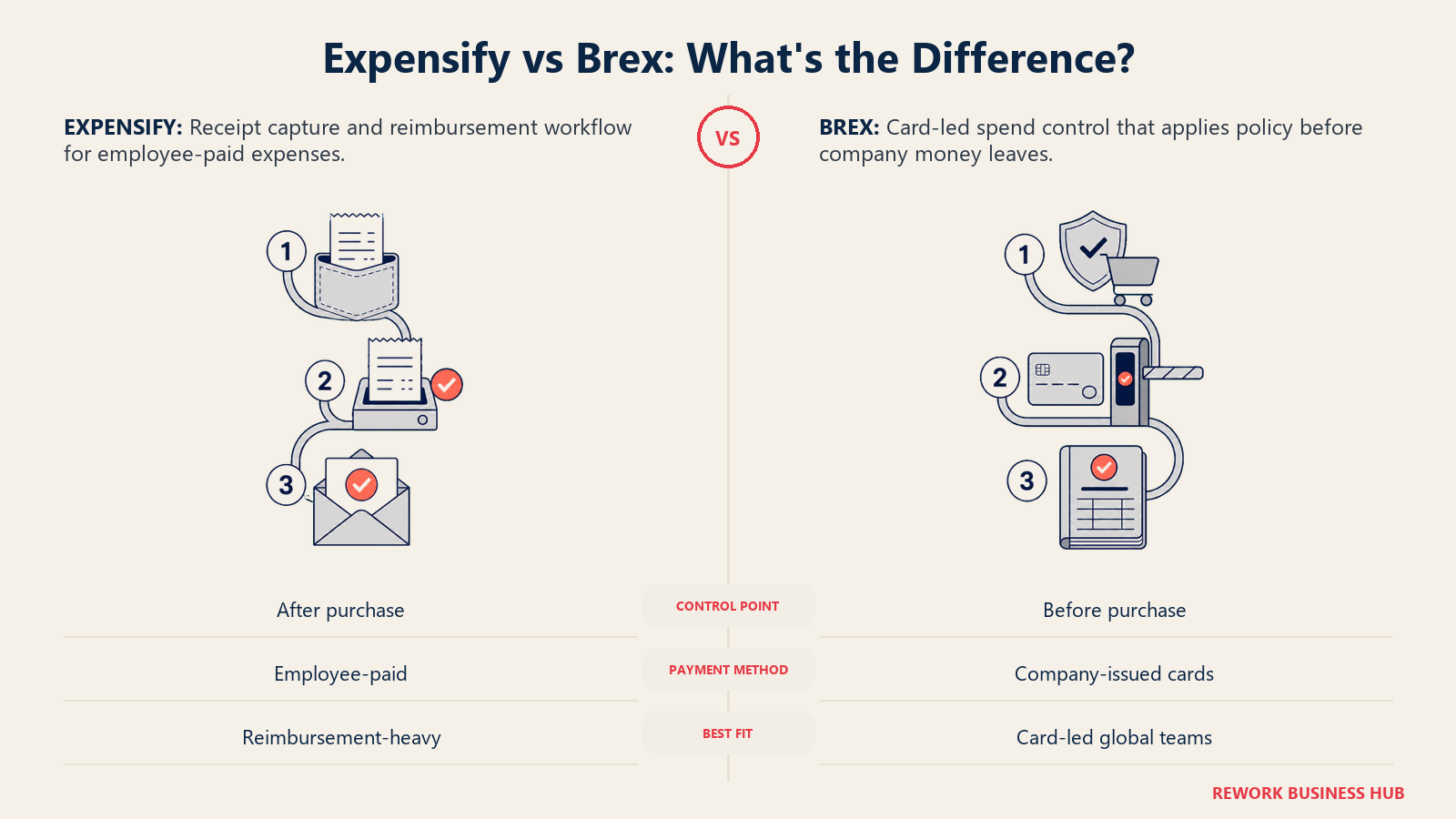
The friction is billing, which confuses more buyers than any other tool in the category. Collect bills on unique members, Control bills on active members, and the Expensify Card cuts the Control rate substantially. Those three variables produce very different invoices at identical headcount, so build your own model before signing.
| What you get | What you don't |
|---|---|
| Best-known receipt capture and approval workflow | Billing model is genuinely hard to compare |
| Works without changing how your team pays | Card and spend controls are lighter than Brex |
| Strong fit for accountants with multiple clients | Control gets expensive without card adoption |
| Long track record and wide integration support | Interface feels dated next to newer entrants |
Pricing: Collect is $5 per unique member per month, pay-per-use only. Control is $18 per member included in your subscription size per month on annual billing, plus $36 per active member above that size; pay-per-use Control is $36 per active member per month. With Expensify Card usage, the annual Control rate drops as low as $9 (up to 50% off) and pay-per-use as low as $18. All figures from Expensify's own pricing documentation.
Best for: Teams of 1 to 200 whose actual problem is reimbursement, not card control. See best Expensify alternatives for the wider field, or Expensify vs Ramp for the head-to-head buyers run most often.
10. Rippling Spend - Cards Tied to the Employee Record
Rippling's argument is structural. If the employee record already drives payroll, benefits, device provisioning, and app access, it should drive the corporate card too. A new hire gets a card with the right limits from the same event that provisions their laptop, and an exit kills the card the same way it kills the SSO session. For a company already running Rippling, that removes a manual handoff Brex cannot reach.
The catch is the same one that applies across Rippling: modular pricing that stacks, and no published number for Spend, Expense, or Corporate Cards. You will be quoted, and the quote will depend on which other modules you run.
| What you get | What you don't |
|---|---|
| Cards provisioned and killed with hire and exit events | No fixed published price for the Spend modules |
| One employee record across HR, IT, and finance | Module costs stack quickly |
| Strong automation rules across the lifecycle | Weak choice if you do not already run Rippling |
| Global payroll and EOR available alongside | Finance depth trails a card-led specialist |
Pricing: No fixed published price. Rippling sells Spend, Expense, and Corporate Cards as modules on its platform, priced by quote. Treat any per-user figure in a third-party guide as (reported) rather than vendor-confirmed.
Best for: Companies of 25 to 2,000 already standardized on Rippling for HR and IT. See best Rippling alternatives if the suite itself is the problem, or the wider HR software roundup.
11. Airbase (Paylocity for Finance) - Consolidation, Not Independence
Airbase used to be the procurement-heavy answer to Brex, with genuinely deep approval chains, guided intake, and purchase-order workflows that suited controllers who wanted spend approved before it happened. That depth still exists. What changed is ownership: the site now reads "Airbase, a Paylocity Company," and the product sits under Paylocity for Finance.
That reframes the buying decision. Airbase is no longer an independent startup competing on product velocity; it is the finance half of an HR and payroll suite. If you already run Paylocity, consolidating spend under the same vendor is a coherent move. If you do not, you are buying into a suite strategy to get one module.
| What you get | What you don't |
|---|---|
| Deep procurement and approval workflows | No longer an independent product roadmap |
| Natural consolidation for Paylocity payroll customers | Quote-only, with no published list price |
| Strong controls for mid-market finance teams | Weak logic if you do not run Paylocity |
| Established AP and intake capability | Less startup-friendly than Brex or Ramp |
Pricing: Quote-only. Neither Airbase nor Paylocity for Finance publishes a list price. Any figure you find in a third-party guide is (reported), not vendor-confirmed.
Best for: Existing Paylocity customers of 100 to 2,000 employees who want payroll and spend under one contract.
12. Zoho Expense - The Cheapest Published Price Here
If you left Brex because $12 a seat was hard to justify for what your team actually does, Zoho Expense is the floor of this market. Standard is $3 per user per month on annual billing, which is a quarter of Brex Premium, and the free plan covers up to 3 users outright. Receipt capture, policy rules, approvals, multi-currency, and mileage all work at that price.
It is genuinely cheaper because it is genuinely narrower. Card issuing depends on region and partner rather than being core to the product, so this is a reimbursement and expense tool with card support attached, not a card-led spend platform. Companies already running Zoho Books or Zoho One get the strongest version of it.
| What you get | What you don't |
|---|---|
| Lowest published per-user price on this list | Card issuing varies by region and partner |
| Free plan for up to 3 users | Not a card-led spend control platform |
| Native fit with Zoho Books and Zoho One | Thinner procurement and multi-entity depth |
| Solid multi-currency and mileage handling | Less polish than Ramp, Brex, or Pleo |
Pricing: The Free plan is $0 for up to 3 users. Standard is $4 per user per month billed monthly, or $3 per user per month billed annually. Premium is $6 per user per month billed monthly, or $5 per user per month billed annually. All figures from Zoho's own pricing page.
Best for: Cost-sensitive teams of 1 to 100, especially anyone already inside the Zoho ecosystem.
13. Moss - Modular European Spend, Priced On Request
Moss covers the German, Dutch, and UK mid-market with a card-and-expense product plus AP and accounting automation, sold as modules rather than tiers. For a company with European entities that found Brex too US-shaped, Moss sits alongside Pleo and Payhawk on the shortlist, generally aimed at a slightly larger team than Pleo and a slightly smaller one than Payhawk.
Pricing is where it gets frustrating. Moss advertises a free plan and paid plans but publishes no figure for either, and states that pricing is determined by the spend modules and add-ons you choose plus the volume of transactions your business processes. A vendor that will not name a number for its own free plan is telling you something about how it wants the evaluation to run.
| What you get | What you don't |
|---|---|
| Modular structure you can grow into | No published figure for free or paid plans |
| Strong German, Dutch, and UK accounting fit | Smaller ecosystem than Pleo or Payhawk |
| Cards, expenses, and AP under one vendor | Volume-based pricing is hard to forecast |
| Reasonable mid-market implementation effort | Limited relevance outside Europe |
Pricing: Quote-only and modular. Moss says pricing is determined by the spend modules and add-ons you choose, as well as the volume of transactions your business processes. It advertises both a free plan and paid plans without publishing a figure for either.
Best for: European teams of 20 to 500 that want modular spend management and will run a sales-led evaluation to get a price.
Accounting Sync: The Question That Decides the Shortlist
The fastest way to cut this list in half is to name your accounting system first. A spend platform that syncs cleanly into your ledger shortens close; one that needs manual mapping adds days to it, which is exactly the gap between APQC's top-quartile 4.8 days and its bottom-quartile 10-plus.
| Your Accounting System | Strongest Options | Note |
|---|---|---|
| QuickBooks Online | Ramp, BILL Spend & Expense, Expensify, Rho, Mercury | Supported by nearly everything on this list |
| Xero | Ramp, Expensify, Pleo, Zoho Expense, Moss | Strong European coverage through Pleo and Moss |
| NetSuite | Ramp, Payhawk, Airbase, Rippling Spend | Confirm which NetSuite modules the sync writes to |
| Sage Intacct | Ramp, Payhawk, Airbase | Ask for a live sync demo, not a screenshot |
| Zoho Books | Zoho Expense | Native by design; anything else needs middleware |
| DATEV or European local ledgers | Moss, Pleo, Payhawk, Spendesk | US-first tools tend to struggle here |
If the ledger itself is the real bottleneck rather than the spend tool, the adjacent decisions are covered in best QuickBooks alternatives, best Xero alternatives, best NetSuite alternatives, and best Sage Intacct alternatives.
What Brex Still Does Best
Plenty of readers here will finish the comparison and stay. These strengths are earned, and no tool above matches all of them at once.
| Brex Strength | Who It Matters For |
|---|---|
| Local card issuance in 50+ countries | Companies with employees or entities outside the US |
| No personal guarantee required | Founders who do not want company debt on their credit |
| Business account, cards, travel, bill pay, and reimbursements in one product | Teams tired of stitching four vendors together |
| Free Essentials tier that already includes global acceptance, AI custom rules, up to two entities, and accounting integrations | Small teams that want breadth at $0 |
| Local currency wires and multi-entity support | Groups running two or more legal entities |
| Travel booking built in rather than integrated | Companies that would otherwise buy Navan separately |
Brex pricing baseline: Essentials is $0 per user per month. Premium is $12 per user per month. Enterprise and Smart Card are contact-sales. Essentials already includes global card acceptance, AI custom rules, up to two entities, accounting integrations, local currency wires, travel booking, bill pay, and reimbursements. All figures from Brex's own pricing page.
Staying put is the right call when you operate in more than one country, you value having travel and banking in the same product, and $12 per user is comfortably less than what running three separate vendors would cost you. AI-assisted approval routing of the kind described in our AI expense approval agent overview is still early across every vendor here, Brex included, so do not let a roadmap slide decide it either way.
How to Choose: Decision Framework
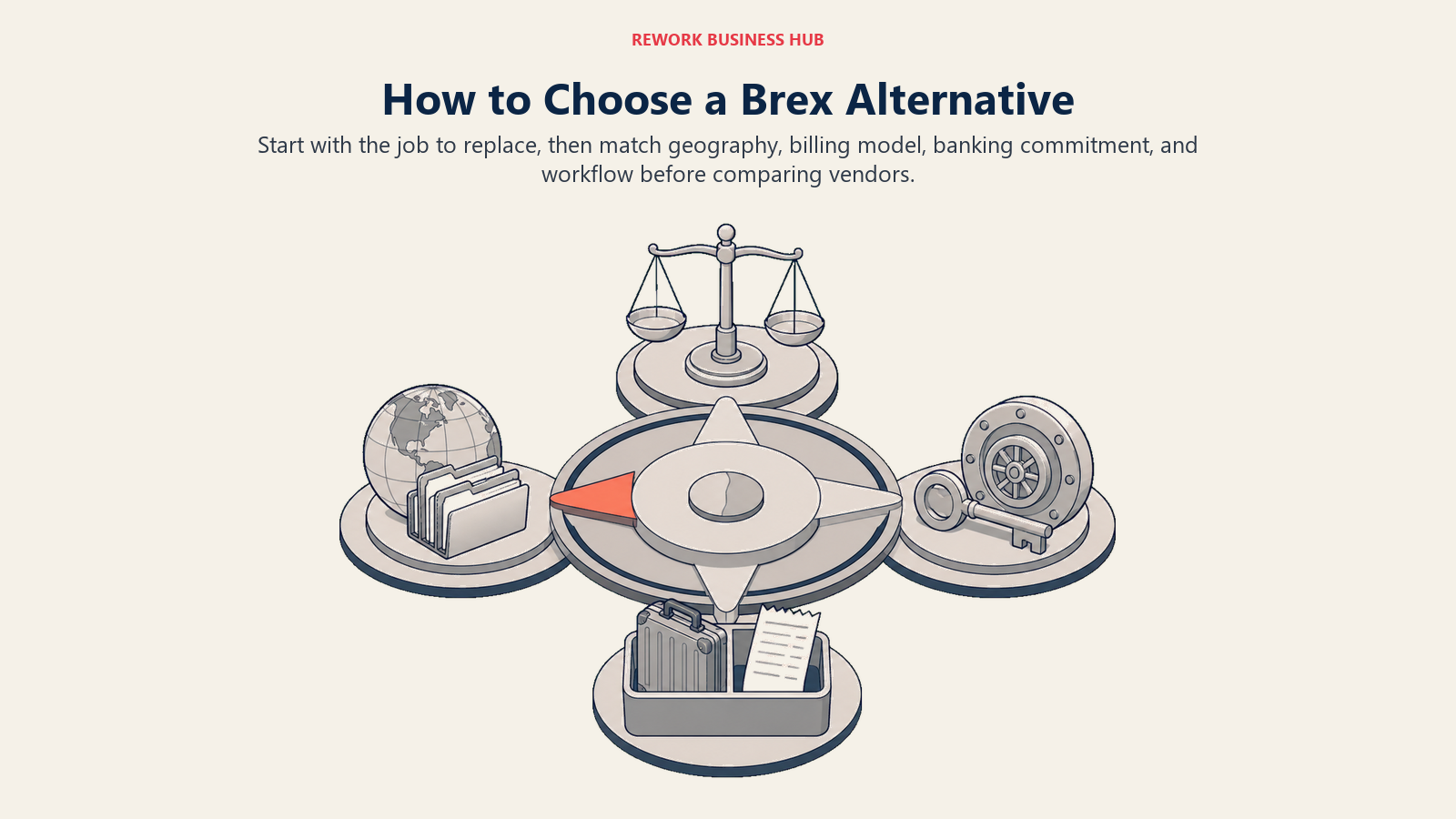
Start with the job you need Brex to replace, then match that need to the vendor whose pricing model, geography, and operating workflow fit it best.
| If you need... | Pick... | Why |
|---|---|---|
| Everything Brex Premium does, without a per-seat fee | Ramp | Free tier covers cards, expenses, and AP in the US |
| A free card program beside a serious AP product | BILL Spend & Expense | $0 per user, with BILL's AP sold separately |
| Zero software cost and a matching banking relationship | Rho | $0 subscription, $0 per user, $0 domestic payments |
| Banking first, with spend controls layered on | Mercury | Per-company pricing that ignores headcount |
| Travel and expense on one record | Navan | Expense is built from the booking, not rebuilt later |
| Pricing that stops rising as you hire | Payhawk | Per-company module pricing across entities |
| A European-native version of Brex for a small team | Pleo | Built for European accounting and banking |
| European spend with no per-seat fee at all | Spendesk | Platform plus transaction fees, no active user fees |
| Reimbursement without issuing any cards | Expensify | Receipt capture and approvals, no card migration |
| Cards that follow the employee lifecycle | Rippling Spend | Provisioned and killed with hire and exit events |
| Spend and payroll under one contract | Airbase (Paylocity for Finance) | Consolidation for existing Paylocity customers |
| The lowest published price per user | Zoho Expense | $3 per user per month billed annually |
| Modular spend for a German, Dutch, or UK entity | Moss | Local ledger fit with a module-based structure |
| To stay | Brex | Multi-country issuance, no personal guarantee, and travel plus banking in one platform |
Buying Mistakes to Avoid
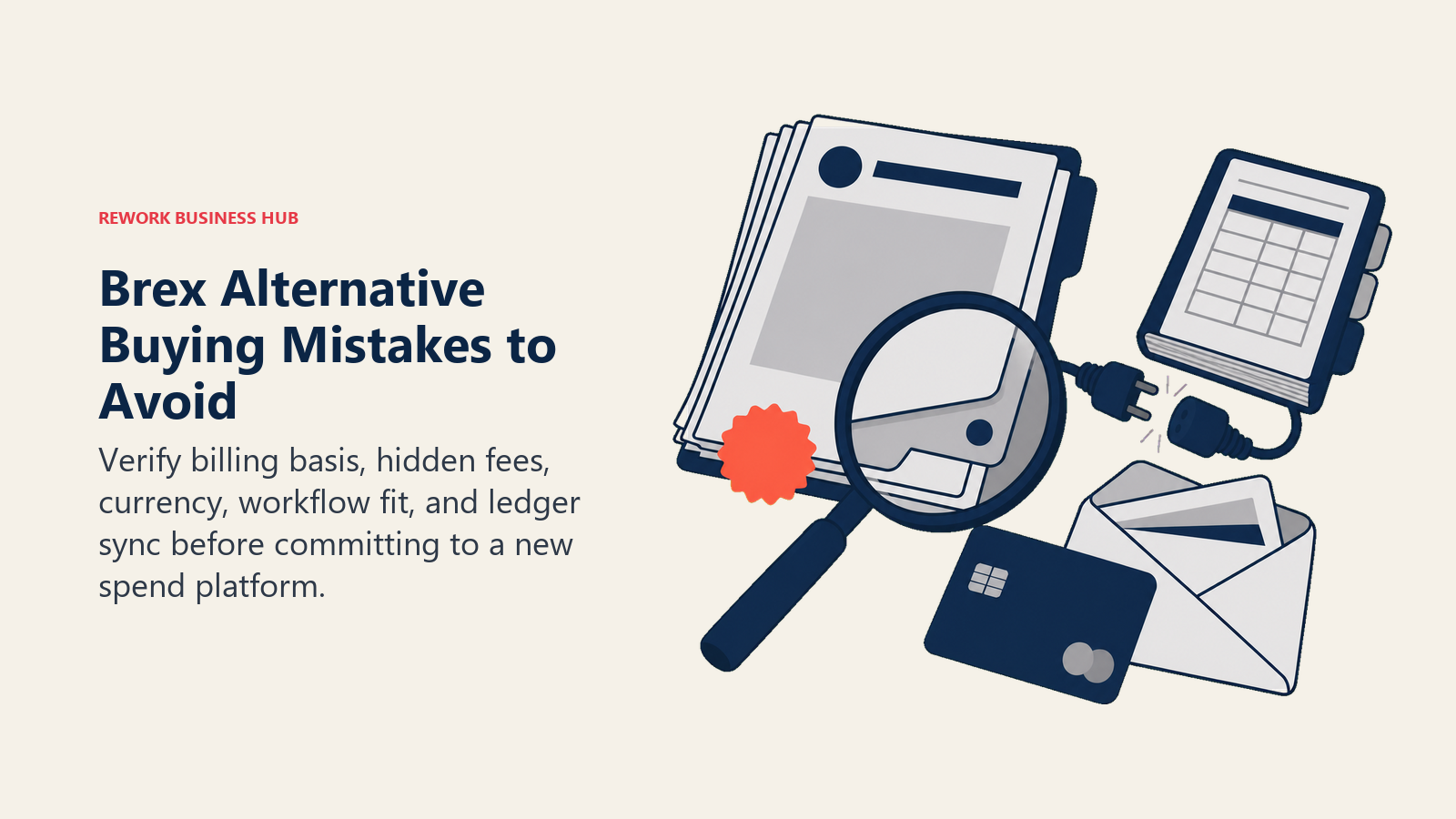
Most expensive mistakes happen before the demo: buyers compare incompatible billing bases, trust unverified prices, or choose the wrong workflow for the spend problem. Verify the commercial model and prove the ledger sync before signing.
| Mistake | What It Looks Like | What to Do Instead |
|---|---|---|
| Comparing a per-seat price to a per-company price | Reading Payhawk's $449 as a per-user rate | Confirm the billing basis in writing before modeling |
| Ignoring an unpublished platform fee | Budgeting Ramp Plus at exactly $15 per user | Ask for the platform fee as a separate line item |
| Converting GBP prices in your head | Putting Pleo's GBP 39 next to a USD tool | Compare in the currency the vendor actually bills |
| Treating a reported figure as vendor-confirmed | Quoting a listicle's Rippling or Airbase number | Get a written quote; label everything else as reported |
| Buying cards when the problem is reimbursement | Rolling out a card program while staff still front costs | Fix the reimbursement flow first |
| Buying reimbursement software when spend is uncontrolled | Adding receipt scanning to spend nobody approved | Issue cards with limits, since a policy PDF cannot decline a charge |
| Skipping the accounting sync test | Finding out the NetSuite mapping is manual after go-live | Push 20 real transactions through the sync during the trial |
| Assuming the free tier covers your whole use case | Reading "Navan is free" as covering expense too | Check which module the free offer applies to |
Budget discipline is a process problem as much as a tooling one, which is why teams that fix policy and ownership before switching platforms tend to get more out of whichever tool they pick. Our AI budgeting agent overview covers where automation genuinely helps and where it just moves the mess.
Frequently Asked Questions about Brex Alternatives
What is the best Brex alternative in 2026?
For most US companies it is Ramp, because its free tier covers cards, expenses, and bill pay without the $12 per user per month that Brex Premium charges. If you want free cards beside a mature AP product, BILL Spend & Expense is the closest match. For European entity structures, Payhawk, Pleo, and Spendesk fit better than either.
How much does Brex actually cost?
Brex Essentials is $0 per user per month and already includes global card acceptance, AI custom rules, up to two entities, accounting integrations, local currency wires, travel booking, bill pay, and reimbursements. Brex Premium is $12 per user per month. Enterprise and Smart Card tiers are priced by quote.
Why do companies leave Brex?
The most common reasons are that Brex repositioned away from the smallest and non-venture-backed companies, that its underwriting has historically favored funded startups over bootstrapped SMBs, and that Premium's $12 per user per month is a cost that Ramp Free, BILL Spend & Expense, Rho, and Brex's own Essentials tier do not charge. Teams that mainly wanted AP or reimbursement also tend to find the platform heavier than the job requires.
Is Ramp cheaper than Brex?
On published pricing, yes at the entry level. Ramp Free is $0 per user per month and covers cards, expenses, and AP, while Brex Essentials is also $0 but Brex Premium is $12 per user per month. The comparison gets murkier at scale, because Ramp Plus is $15 per user per month plus an unpublished platform fee that scales with team size, so get that fee in writing before assuming Ramp wins at 200 seats.
Which Brex alternative works best outside the United States?
Payhawk for multi-entity groups, since it prices per company and handles multiple currencies and local accounting natively. Pleo for smaller UK and EU teams that want a simple card-and-receipt loop. Spendesk for French and EU mid-market companies that want to avoid per-seat fees. Moss for German, Dutch, and UK teams buying spend in modules.
Do any Brex alternatives charge nothing for software?
Yes. Ramp Free, BILL Spend & Expense, and Rho all charge $0 in software fees, and Brex Essentials does too. They earn revenue from card interchange, FX, and treasury instead. The model only works if meaningful spend actually routes through their cards, and in Rho's case it also means banking with them, so a low-card-volume team may do better on a cheap per-user tool like Zoho Expense at $3 per user per month billed annually.
Why do so many spend management vendors refuse to publish pricing?
Spendesk, Rippling Spend, Airbase, and Moss all price around entity structure, transaction volume, and module mix, so one published number would not reflect what most buyers pay. Treat every figure you find for these vendors in a third-party guide as reported rather than confirmed, and insist on a written quote before you build a budget around it.
How much does poor expense control actually cost?
A GBTA Foundation study run with HRS put the cost of processing an expense report for a single night hotel stay at $58 and 20 minutes, with 19% containing errors that cost an extra $52 and 18 minutes each to fix. On the fraud side, the ACFE found expense reimbursement schemes in 13% of occupational fraud cases studied, with a median loss of $50,000 per case.
Will switching spend platforms speed up our close?
It can, but only if the accounting sync genuinely works for your ledger. APQC benchmarks put the median monthly close at 6.4 calendar days, the top quartile at 4.8 or less, and the bottom quartile at 10 or more. The platforms that move that number are the ones where transactions arrive pre-coded and receipts match automatically, so test the sync on real transactions during the trial rather than trusting the integration list.
Do I have to give a personal guarantee on these cards?
Brex does not require one, which is a genuine differentiator. Ramp, BILL Spend & Expense, and Rho also issue corporate cards underwritten against company financials rather than a founder's personal credit, though each sets its own qualification criteria around revenue, cash balance, or banking relationship. Ask each vendor what their underwriting actually requires before you assume you qualify.
What to Do Next
Name the reason you are leaving before you name a replacement. If it is the $12 per seat, go straight to Ramp, BILL Spend & Expense, or Rho and confirm whether their free tiers really cover what you use. If it is underwriting, ask two vendors what they actually require rather than reapplying blind. If it is geography, your shortlist is Payhawk, Pleo, Spendesk, and Moss, and nothing on the US-first list will fix it.
Then run a real two-week trial with your top two, not a demo. Push 20 actual transactions through each: a foreign-currency purchase, a hotel booking, a mileage claim, a duplicate receipt, and a deliberate policy violation you know should be declined. Sync all 20 into your accounting system and count how many need manual fixing on the other side. Whichever platform survives that with the fewest corrections is your answer, and it may well turn out to be the one you already have.
Camellia writes about finance and spend tooling for B2B teams. Last updated August 2026.

Principal Product Marketing Strategist
On this page
- Key Facts
- Quick Comparison Table
- Why Companies Actually Leave Brex
- Pricing Models: The Part That Decides Your Bill
- Stage Fit Matrix
- Sizing and Persona Table
- 1. Ramp - The Direct Rival Most Brex Leavers Test First
- 2. BILL Spend & Expense - Free Cards From an AP Company
- 3. Rho - Spend Software Paid For By Banking
- 4. Mercury - Banking First, Spend Controls Second
- 5. Navan - When Travel Is the Real Expense Line
- 6. Payhawk - Per-Company Pricing Across Entities
- 7. Pleo - The European Card Experience for Smaller Teams
- 8. Spendesk - No Per-Seat Fee, No Published Price
- 9. Expensify - When the Real Job Was Reimbursement All Along
- 10. Rippling Spend - Cards Tied to the Employee Record
- 11. Airbase (Paylocity for Finance) - Consolidation, Not Independence
- 12. Zoho Expense - The Cheapest Published Price Here
- 13. Moss - Modular European Spend, Priced On Request
- Accounting Sync: The Question That Decides the Shortlist
- What Brex Still Does Best
- How to Choose: Decision Framework
- Buying Mistakes to Avoid
- What to Do Next