Ramp vs Brex in 2026: Can You Even Qualify for Both?
Turn this article into takeaways for your work.


Each assistant summarizes the article only for you and suggests best practices for your work.
Type "Ramp vs Brex" into a search box and you will land on a dozen articles running the same feature checklist: both issue corporate cards, both scan receipts, both do bill pay, both do travel, both sync to NetSuite. Read four of those articles back to back and you will come away more confused than when you started, because on a checklist the two products genuinely look almost interchangeable.
They are not interchangeable, and the gap between them has nothing to do with features this year. It comes down to three questions a feature table never answers: does your company actually qualify for the one you want, who owns the platform you are handing your card program to, and what does the paid tier really cost once you account for the number Ramp will not publish. This article is built around those three questions, in that order, because answering them first makes the rest of the comparison much shorter than it looks.
TL;DR
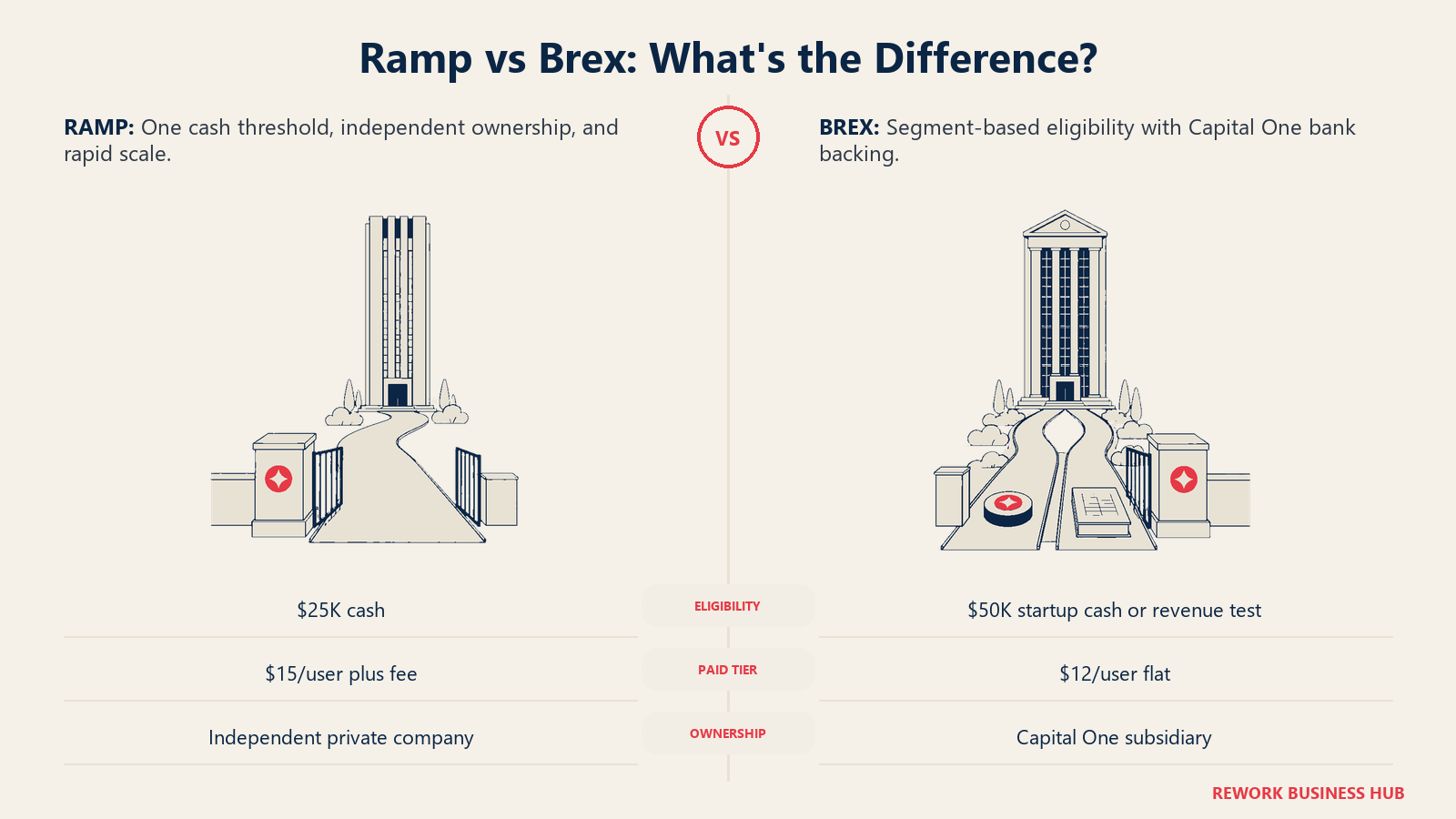
- Ramp's minimum bar is a flat $25,000 cash balance. Every applicant, regardless of stage, needs a corporation, LLC, or LP registered in the US, an EIN, a US physical address, and at least $25,000 sitting in a linked US business bank account. There is no separate revenue tier.
- Brex's bar depends on which segment you fall into, and it is generally higher. Venture or angel-funded startups need a $50,000 minimum cash balance. Mid-market and enterprise applicants need more than $400,000 in monthly revenue. Commercial applicants need more than $500,000 in annual revenue. All applicants need a US EIN, valid US incorporation, US operations, and a US physical address.
- Brex is no longer an independent fintech. Capital One completed its $5.15 billion acquisition of Brex on 7 April 2026. Brex still operates as its own brand with its own product and its own CEO, but the company backing your card program is now a top-10 US bank, not a venture-funded startup.
- Ramp went the other direction: bigger and independent. It closed a $750 million Series F in June 2026 at a $44 billion valuation, crossed $1 billion in annualized revenue, and says it is free-cash-flow positive.
- Both run a genuinely free tier, and both free tiers have a catch. Ramp Free is $0 and funds itself on card interchange. Brex Essentials is $0 and sits behind the eligibility rules above. Neither "free" claim is complete without its qualifier.
- The paid tiers are not a clean price fight. Brex Premium is a flat $12 per user per month. Ramp Plus is $15 per user per month plus an unpublished platform fee based on team size, which makes a precise like-for-like total impossible to state without asking Ramp directly.
Key Facts
Key Facts: What actually changed in 2026
- Capital One completed its $5.15 billion acquisition of Brex on 7 April 2026, combining roughly $2.75 billion in cash with about 10.6 million shares of Capital One stock; Brex continues operating as a distinct brand with Pedro Franceschi remaining CEO (Capital One newsroom).
- Ramp raised a $750 million Series F in June 2026 at a $44 billion valuation, reporting more than $1 billion in annualized revenue and positive free cash flow across more than 70,000 customers (Ramp, via PR Newswire).
- Global commercial card spending crossed $4 trillion for the first time in 2023, up 8% year over year, and is projected to exceed $6 trillion by 2029 (Datos Insights).
- Half of all US venture-backed tech companies have less than 12 months of cash runway, the exact population Brex's $50,000 minimum cash balance rule is built around (Silicon Valley Bank, State of the Markets H1 2025).
- Brex requires a US EIN, valid US incorporation, US operations, and a US physical address for every applicant, on top of the segment-specific cash and revenue minimums (Brex, Who is eligible for Brex).
Ramp vs Brex at a Glance
| Ramp | Brex | |
|---|---|---|
| Ownership in 2026 | Independent, $44 billion valuation, free-cash-flow positive | Subsidiary of Capital One since 7 April 2026, operates as its own brand |
| Entry price | Free, $0 per user per month | Essentials, $0 per user per month |
| Minimum to qualify | $25,000 cash balance, any stage | $50,000 cash balance (venture/angel-funded), or revenue minimums for mid-market, enterprise, and commercial |
| Top published per-seat price | Plus, $15 per user per month plus an unpublished platform fee | Premium, $12 per user per month flat |
| Entity structure | Multi-entity on Plus, described only as "global coverage" | Up to two entities on Essentials, multi-entity US and international on Premium |
| Local-currency card issuance | Not specified on the published pricing page | 50+ countries, on the Smart Card product |
| Core strength | Scale, AI-driven expense review, treasury depth | Backed by a top-10 bank, built-in travel booking on every tier |
| Weakest against the other | The Plus platform fee cannot be budgeted from the website | Eligibility bar shuts out more early-stage and thin-margin companies |
| Best fit | Companies that clear $25,000 cash and want the biggest, fastest-scaling platform | Companies that clear Brex's higher bar and want a bank-backed provider |
| Worst fit | Companies that need a hard number before they can get budget sign-off | Pre-seed companies below $50,000 cash with no qualifying revenue |
Sources: Ramp's pricing page, Ramp eligibility, Applying and signing up for Ramp (U.S. based), Brex's pricing page, and Brex, Who is eligible for Brex.
Who Actually Qualifies: The Eligibility Gate
This is the part most Ramp-vs-Brex content skips entirely, and it is the reason a feature bake-off is the wrong way to read this comparison. For a meaningful share of readers, "which one is better" is not the question. "Which one will approve my application" is, and the two vendors set that bar very differently.
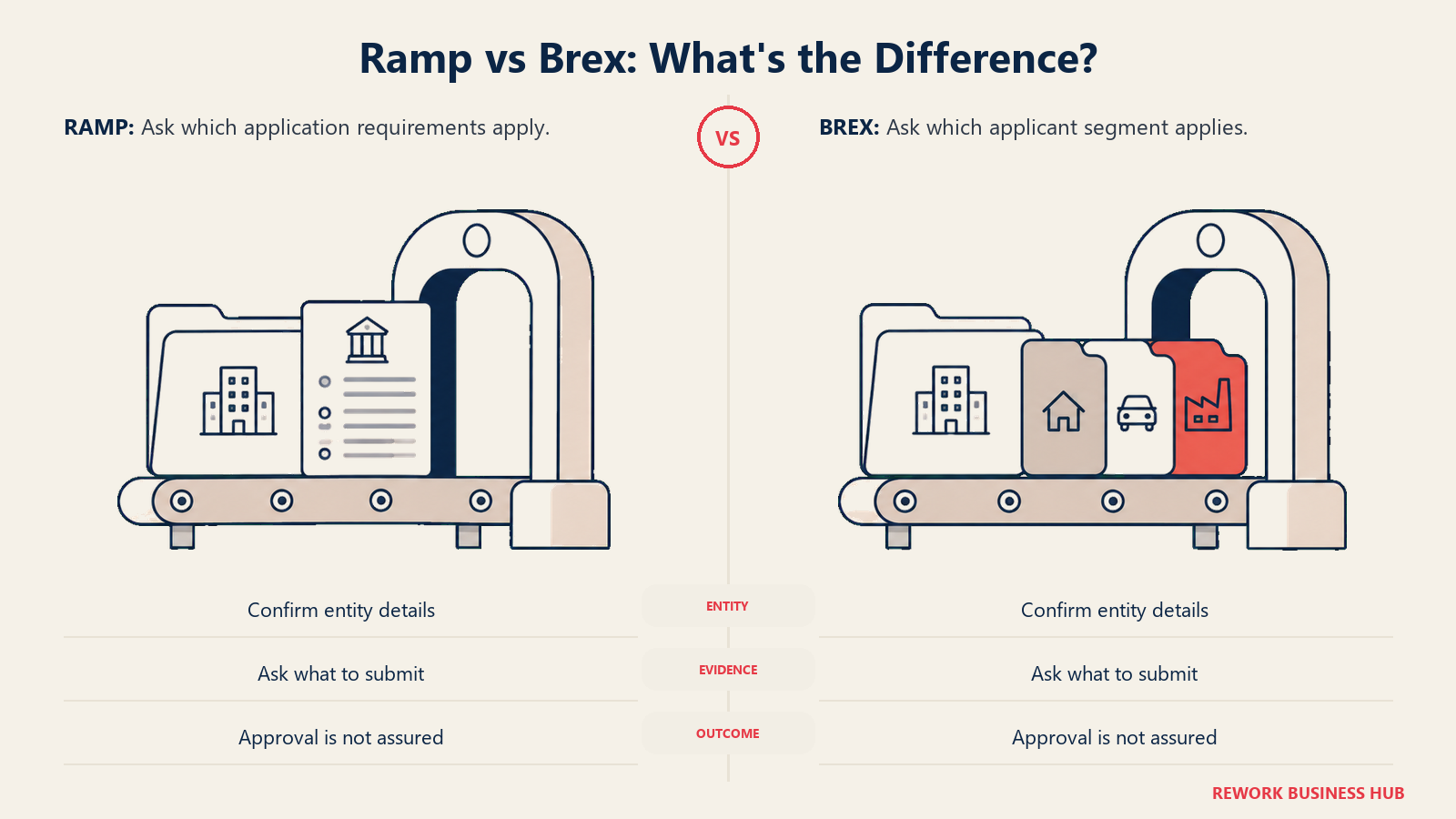
Ramp publishes one bar for everyone. Be a corporation, LLC, or LP registered in the United States (sole proprietors and unregistered businesses do not qualify), supply an EIN, have a real US physical address that is not a PO box, virtual office, or mail-forwarding address, and keep at least $25,000 in cash in a linked US business bank account. That is the whole published list. Ramp says it also weighs cash flow and revenue when it sets a credit limit, but there is no separate revenue tier gating who gets in the door at all (Ramp Help Center).
Brex segments its applicants, and the bar moves depending on which segment you land in. Every applicant needs a US EIN, valid US incorporation, US operations, and a US physical address. Beyond that: venture or angel-funded startups need a $50,000 minimum cash balance (Brex says this can be lower through certain partner referrals), mid-market and enterprise applicants need more than $400,000 in monthly revenue (over $4.8 million a year), and commercial applicants need more than $500,000 in annual revenue (Brex, Who is eligible for Brex).
| Requirement | Ramp | Brex |
|---|---|---|
| Entity type | Corporation, LLC, or LP (no sole proprietors) | Valid US incorporation |
| US operations required | Yes | Yes |
| EIN required | Yes, no exceptions | Yes, no exceptions |
| US physical address | Yes, no PO boxes or virtual offices | Yes |
| Cash balance minimum | $25,000, one flat bar for every applicant | $50,000, venture or angel-funded startups only |
| Revenue-based path | Not published as a separate tier | Over $400,000/month for mid-market and enterprise |
| Revenue-based path (commercial) | Not published as a separate tier | Over $500,000/year for commercial applicants |
| Non-US companies | Not eligible | Not eligible |
| Underwriting factors beyond the minimum | Cash flow and revenue affect credit limit, not eligibility itself | Segment determines which minimum applies |
Read the table the way an actual applicant would. A two-year-old company with $30,000 in the bank and modest revenue clears Ramp's bar and fails Brex's startup bar. A profitable services business with $600,000 in annual revenue but only $20,000 in cash on hand clears Brex's commercial bar and fails Ramp's cash minimum. There is no universal answer to "which one lets more companies in." It depends entirely on whether your company's story is told in cash on hand or in revenue, and that is worth checking before you spend an afternoon comparing feature tables for a product that will reject your application.
Half of all US venture-backed tech companies carry less than 12 months of cash runway (SVB, State of the Markets H1 2025), which is exactly the population Brex's $50,000 startup minimum is calibrated against. A startup running lean on a shrinking runway can clear Ramp's $25,000 bar for months after it would fall short of Brex's $50,000 line. If your company cannot clear either bar, our best Ramp alternatives and best Brex alternatives roundups both cover cards with lower or no cash minimums.
Ownership and Scale in 2026: What Actually Changed
Feature comparisons age slowly. Ownership structures do not, and 2026 delivered the biggest change either company has seen since founding.
Capital One completed its acquisition of Brex on 7 April 2026, a $5.15 billion deal made up of roughly $2.75 billion in cash and about 10.6 million shares of Capital One stock, first announced in January 2026 (Capital One newsroom). Brex is not being folded into Capital One's existing consumer or small-business card lines. It continues to operate as its own product, under its own name, with Pedro Franceschi remaining CEO. What that means in practice is that the company underwriting your card program, holding your deposits at partner institutions, and setting your eligibility rules is now a top-10 US bank rather than a venture-backed independent. Neither Capital One nor Brex's own announcement makes any specific promise about pricing or eligibility staying fixed going forward, so treat this as a fact to weigh, not a guarantee either way.
Ramp took the opposite path. It closed a $750 million Series F in June 2026, more than tripling its valuation over the prior year to $44 billion, with backers including ICONIQ, GIC, Ontario Teachers' Pension Plan, Goldman Sachs Alternatives, and Insight Partners. Ramp reported more than 70,000 customers as of June 2026, more than $1 billion in annualized revenue, and said it is free-cash-flow positive (Ramp, via PR Newswire). It stayed independent and got considerably bigger doing it.
| Ramp | Brex | |
|---|---|---|
| Ownership as of August 2026 | Independent, venture-backed | Wholly owned subsidiary of Capital One (since 7 April 2026) |
| Most recent capital event | $750 million Series F, June 2026 | $5.15 billion acquisition, closed April 2026 |
| Reported valuation or deal size | $44 billion | $5.15 billion acquisition price |
| Reported scale | 70,000+ customers, $1B+ annualized revenue | Not disclosed separately post-acquisition |
| Reported profitability | Free-cash-flow positive, self-reported | Not disclosed separately post-acquisition |
| Product continuity | Unchanged, same independent product | Continues as a distinct Brex-branded product |
| Leadership | Unchanged | Pedro Franceschi remains CEO |
| What this means for buyers | Betting on a large, fast-scaling independent platform | Betting on a fintech now backed by a chartered bank's balance sheet |
Neither side of that table is a verdict. A bank-backed Brex may mean steadier underwriting and a longer institutional runway behind your card program. It may also mean a product roadmap that eventually bends toward Capital One's priorities rather than Brex's own. An independent, $44 billion Ramp may mean faster feature velocity and a business model proven at scale. It also means your card program's stability rests on a private company's continued execution rather than a bank charter. If you are the kind of buyer for whom "who is actually on the other end of this relationship" matters as much as the feature list, this is the section to reread before you sign anything. For a narrower look at Brex specifically as a banking relationship rather than a card program, see our Brex vs Mercury comparison.
Global Footprint and Entity Structure
Both platforms are built US-first, but they diverge on how far outside the US they actually reach once you need more than one entity.
Brex Essentials covers up to two entities. Brex Premium extends that to multi-entity coverage across US and international structures, with customizable ERP and HRIS connections and VAT documentation support for the international side. Brex also sells a separate Smart Card product with local-currency card issuance in more than 50 countries, aimed at companies that need employees spending in their own local currency rather than routing everything back through a US-issued card.
Ramp's published pricing page is thinner on the specifics here. Plus is described as adding "global coverage" alongside its NetSuite and Sage Intacct integrations, without naming a country count or specifying how local-currency issuance works. Enterprise adds Workday and Oracle Fusion Cloud integrations plus a dedicated account manager and implementation services, again without a published country list.
| Capability | Ramp | Brex |
|---|---|---|
| Entities on the entry tier | Not applicable, Free is single-entity | Up to two, on Essentials |
| Multi-entity US and international | "Global coverage" on Plus, unspecified | Explicit on Premium |
| Local-currency card issuance | Not specified on the published pricing page | 50+ countries, on the Smart Card product |
| VAT and international compliance documentation | Not specified on the published pricing page | Named explicitly on Premium |
| Dedicated international support tier | Enterprise, custom | Enterprise, custom |
If your company already runs meaningful spend through a non-US entity today, get the specifics of Ramp's global coverage in writing before you assume it matches Brex's more explicitly documented international structure. Brex names its capability; Ramp names a category.
Pricing Compared
Here is the full published tier sheet for both vendors, with the billing basis spelled out, because the basis is where the "which one is cheaper" arguments usually go wrong.
| Vendor and plan | Published price | Billing basis | What it includes |
|---|---|---|---|
| Ramp Free | $0 per user per month | Per user, monthly | Corporate card, basic travel and expense, AP with OCR, treasury, QuickBooks Online and Xero sync |
| Ramp Plus | $15 per user per month plus a platform fee based on team size | Per user, monthly; save 20% with annual billing | AI-driven expense review, auto-coded line items, NetSuite and Sage Intacct, global coverage, custom roles, audit logging |
| Ramp Enterprise | Custom | Annual billing | Workday and Oracle Fusion Cloud integrations, dedicated account manager, implementation services |
| Brex Essentials | $0 per user per month | Per user, monthly | Global card acceptance, AI custom rules, up to two entities, bill pay, reimbursements, travel booking, API access |
| Brex Premium | $12 per user per month | Per user, monthly, flat | Multiple expense policies, dynamic review chains, AI compliance audit detection, multi-entity US and international, customizable ERP and HRIS, VAT documentation, group travel, live budgets |
| Brex Enterprise | Custom | Custom | Unlimited US or global entities, local card issuance, named account manager |
| Brex Smart Card | Custom | Custom | Local-currency cards in 50+ countries, merchant controls |
Sources: Ramp's pricing page and Brex's pricing page.
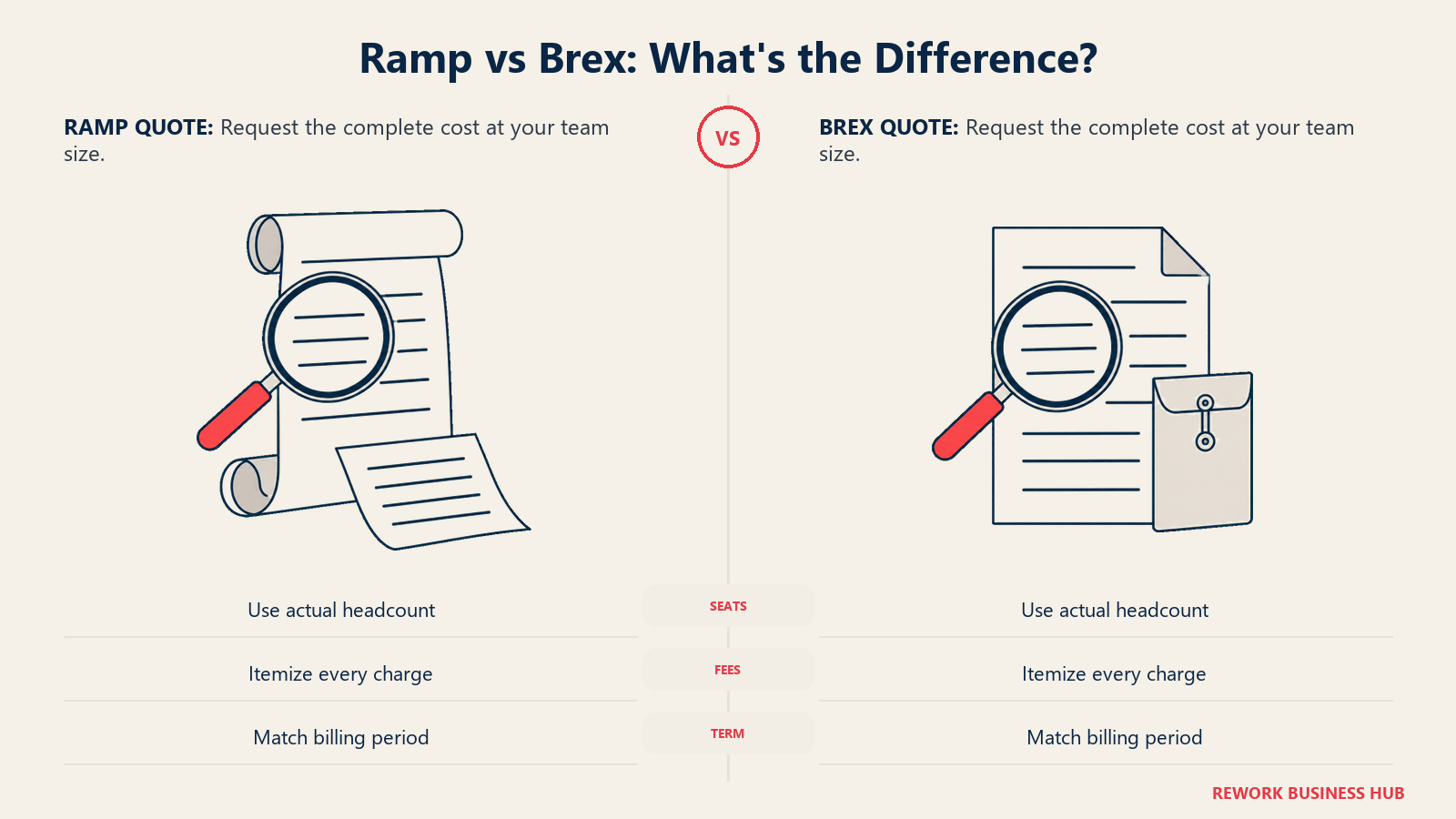
Two things about that table are worth saying plainly. First, $15 per user per month is not the full Ramp Plus bill. The platform fee is real, it scales with team size, and Ramp does not publish the number anywhere on its pricing page. Any total you build for Ramp Plus is a floor, not a quote. Second, Brex Premium's $12 per user per month is not qualified by anything beyond the eligibility gate itself. If you clear the bar to get a Brex account at all, the seat price is exactly what is printed.
Cost model at 10, 25, 50, 100, and 250 users
Assumptions: US company, every seat billed at list price, no negotiated discount, annual totals shown as 12 times the monthly rate unless a published annual discount applies. Ramp Plus is shown both at its full monthly-billing rate and at its published 20% annual-billing discount, with the platform fee left unresolved because it is not a public number.
| Users | Ramp Free | Ramp Plus, monthly billing (+ platform fee) | Ramp Plus, annual billing (+ platform fee) | Brex Essentials | Brex Premium |
|---|---|---|---|---|---|
| 10 | $0 | $1,800 + fee | $1,440 + fee | $0 | $1,440 |
| 25 | $0 | $4,500 + fee | $3,600 + fee | $0 | $3,600 |
| 50 | $0 | $9,000 + fee | $7,200 + fee | $0 | $7,200 |
| 100 | $0 | $18,000 + fee | $14,400 + fee | $0 | $14,400 |
| 250 | $0 | $45,000 + fee | $36,000 + fee | $0 | $36,000 |
All figures are annual software cost in USD, calculated from the published rates above. Look at the two middle columns and one thing jumps out: once you apply Ramp's 20% annual-billing discount, Plus's effective per-seat rate is $12 per user per month, penny for penny the same as Brex Premium's flat rate, at every team size in this table. The two paid tiers are not competing on published price. They are identical on published price. The only thing that can move Ramp Plus above Brex Premium is the platform fee, and because that number is not disclosed, nobody outside Ramp's sales process can say by how much. If you are choosing between Plus and Premium on cost alone, the entire decision comes down to a number you have to ask Ramp for directly, in writing, before you sign.
The free tiers tell a cleaner story. Ramp Free and Brex Essentials are both genuinely $0 at every size in this table, so if your company clears both eligibility bars and does not need Plus- or Premium-only features, the software cost question does not exist. It becomes entirely a question of which free tier's feature set and eligibility bar fits you, which is what the rest of this article covers. For a wider read on how this category prices out against travel-and-expense and reimbursement-first tools, our best expense management software roundup and the Expensify vs Ramp comparison both cover ground this article does not.
Corporate Cards and Spend Controls
Both companies built their business on the card, and both put real controls on the free tier, which is unusual enough in software pricing that it is worth stating outright.
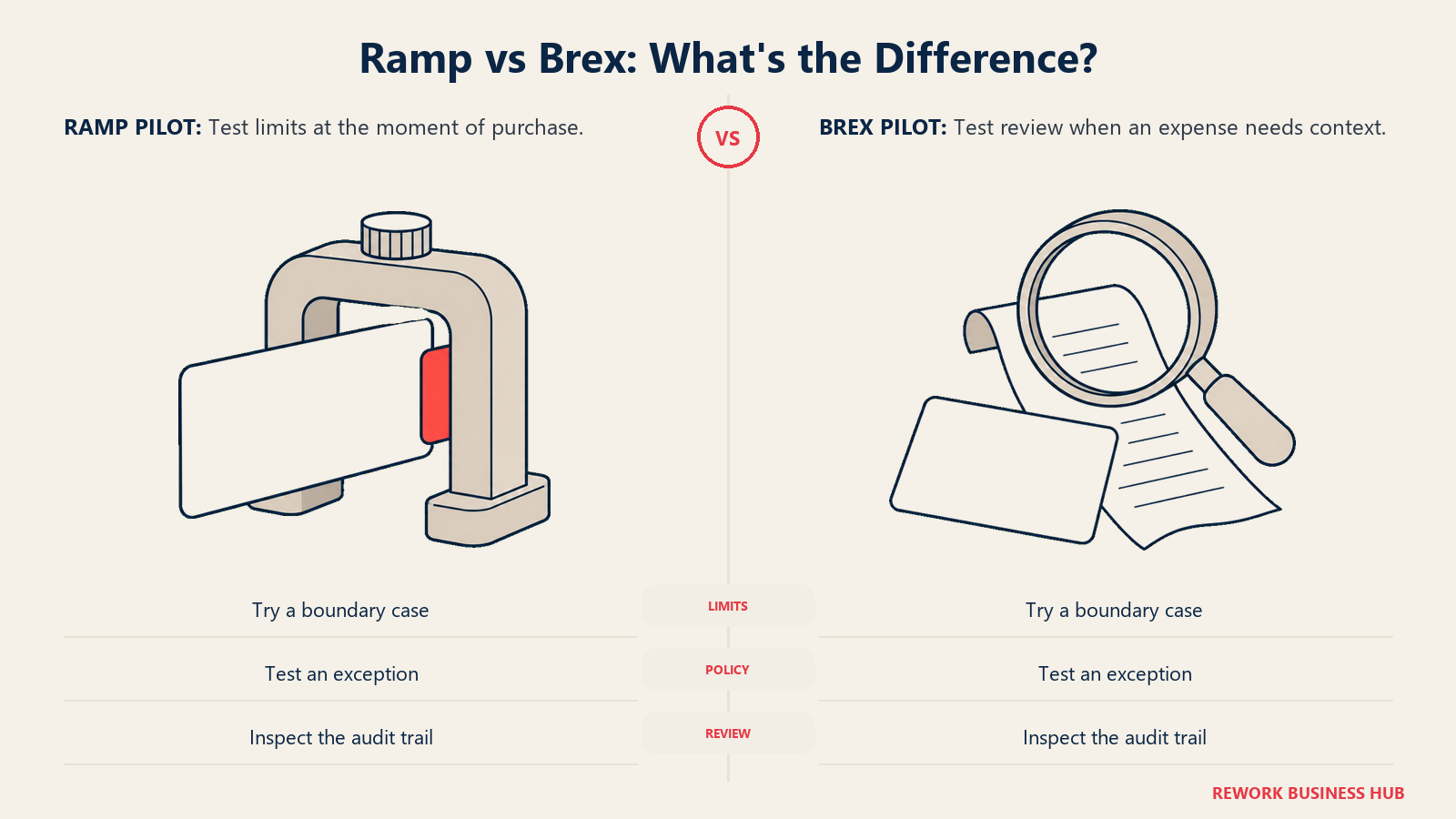
Ramp Free issues unlimited physical and virtual cards, with per-card limits, merchant locks, and category rules, plus budgets that non-finance managers can own without routing every change through accounting. Because Ramp is the card issuer, a violation is enforced by declining the transaction rather than by flagging it after the fact.
Brex Essentials matches that on the fundamentals: global card acceptance and AI-driven custom rules ship on the free tier. Where Brex pulls ahead is on the compliance side of Premium, which adds AI compliance audit detection and dynamic review chains, catching policy violations that slip past a static rule before they get approved rather than only blocking them at swipe time.
| Capability | Ramp | Brex |
|---|---|---|
| Unlimited virtual cards | Yes, on Free | Yes, on Essentials |
| Per-card limits and merchant locks | Yes, on Free | Custom rules, on Essentials |
| Budgets owned outside finance | Basic on Free, advanced on Plus | Live budgets, on Premium |
| AI-driven policy enforcement | AI-driven expense review, on Plus | AI custom rules on Essentials, AI compliance audit detection on Premium |
| Dynamic, multi-step review chains | Not named on the published pricing page | Yes, on Premium |
| Card issuance model | Ramp is the issuer | Brex is the issuer |
| Underwriting required for a card | Yes, tied to the $25,000 eligibility bar | Yes, tied to the segment-based eligibility bars |
Neither of these is a weak card program. The real differentiator sits one layer up, in whether your company clears the door to get a card at all, which is the eligibility section above rather than anything in this table.
Accounts Payable and Bill Pay
Both vendors put AP on the free tier as well, which again breaks the usual pattern of gating bill pay behind a paid plan.
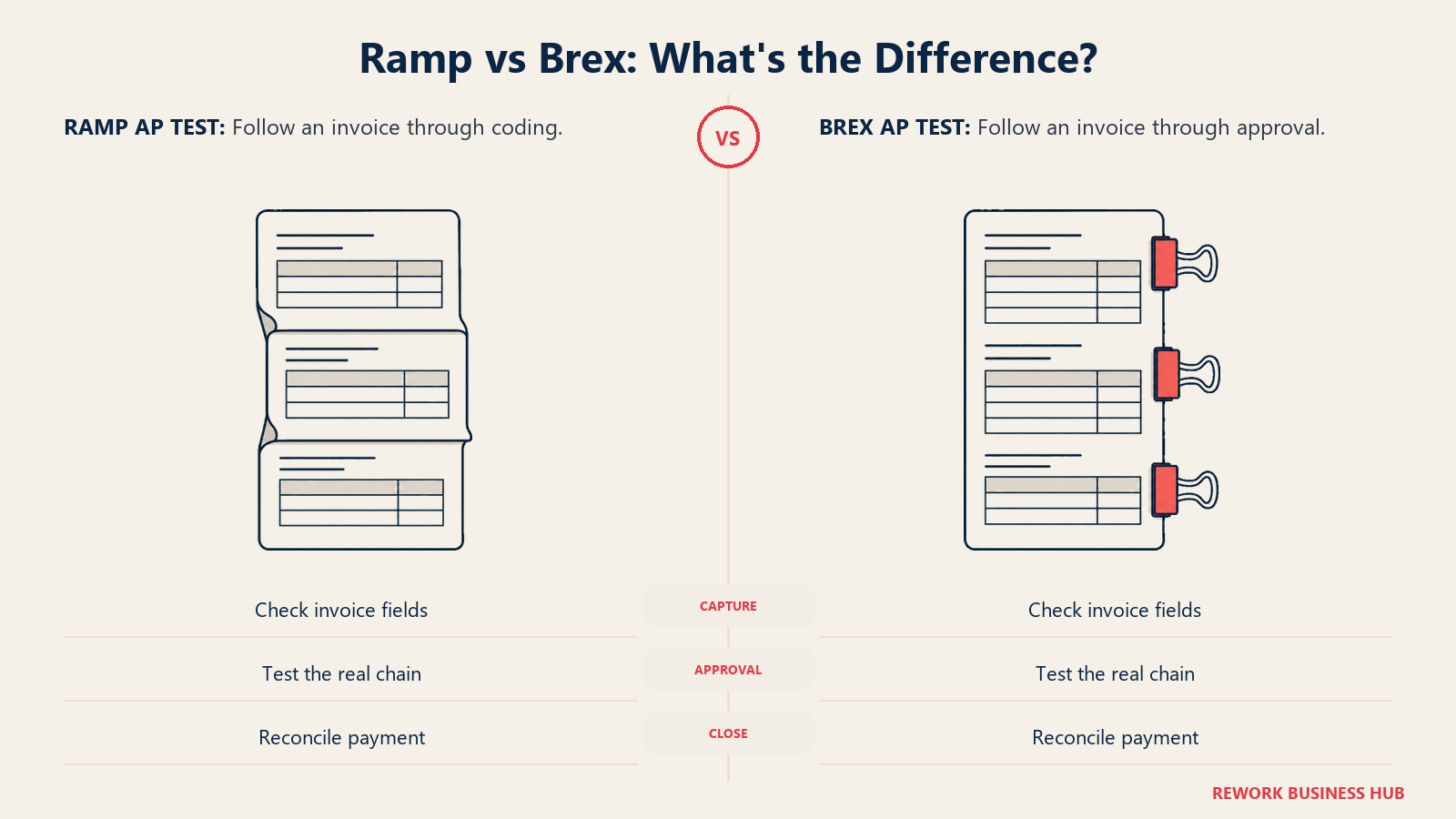
Ramp Free includes accounts payable with AI-powered OCR on invoices and basic vendor management. Brex Essentials includes bill pay and reimbursements natively. The gap widens on the paid tiers: Ramp Plus adds auto-coded line items so an invoice lands already split across the correct GL codes, while Brex Premium adds dynamic review chains that route an invoice through the right approvers based on amount or vendor rather than a single fixed chain.
| Capability | Ramp | Brex |
|---|---|---|
| Bill pay on the entry tier | AP with OCR, on Free | Bill pay, on Essentials |
| Invoice OCR | Yes, AI-powered, on Free | Not named as a distinct feature on Essentials |
| Reimbursements | Supported | Named explicitly on Essentials |
| Line-item coding automation | Auto-coded line items, on Plus | Not named as a distinct feature |
| Multi-step, amount-based review routing | Not named on the published pricing page | Dynamic review chains, on Premium |
| Vendor management | Basic on Free | Not broken out separately on the published page |
If AP volume is the bulk of your reason for evaluating either platform rather than the card program itself, our best AP automation software roundup covers dedicated AP tools that go considerably deeper than either card platform's built-in module.
Travel Booking
This is one of the clearer product differences between the two, and it shows up on the entry tier rather than waiting for a paid plan.
Brex Essentials includes travel booking as a named, standalone capability from the free tier up, and Premium adds group travel management for coordinating multi-person trips. Ramp's published pricing page describes only "basic travel and expense" on Free, without naming a dedicated booking tool the way Brex does, and does not call out an upgraded travel capability on Plus by name.
| Capability | Ramp | Brex |
|---|---|---|
| Travel named on the entry tier | "Basic travel and expense," on Free | Travel booking, on Essentials |
| Group or team travel coordination | Not named on the published pricing page | Group travel, on Premium |
| Travel policy enforcement | Tied to general expense policy rules | Tied to Premium's expense policies and review chains |
If travel volume is a meaningful share of your spend and dedicated booking depth matters more than card consolidation, it is worth trialing both platforms' actual booking flow rather than taking either pricing page's wording at face value. Neither vendor publishes enough detail here to settle the question from the outside.
Accounting and ERP Integrations
Both platforms gate the deeper ERPs behind their paid tier, and the pattern is close to symmetrical, which makes this an easy section to reason about.
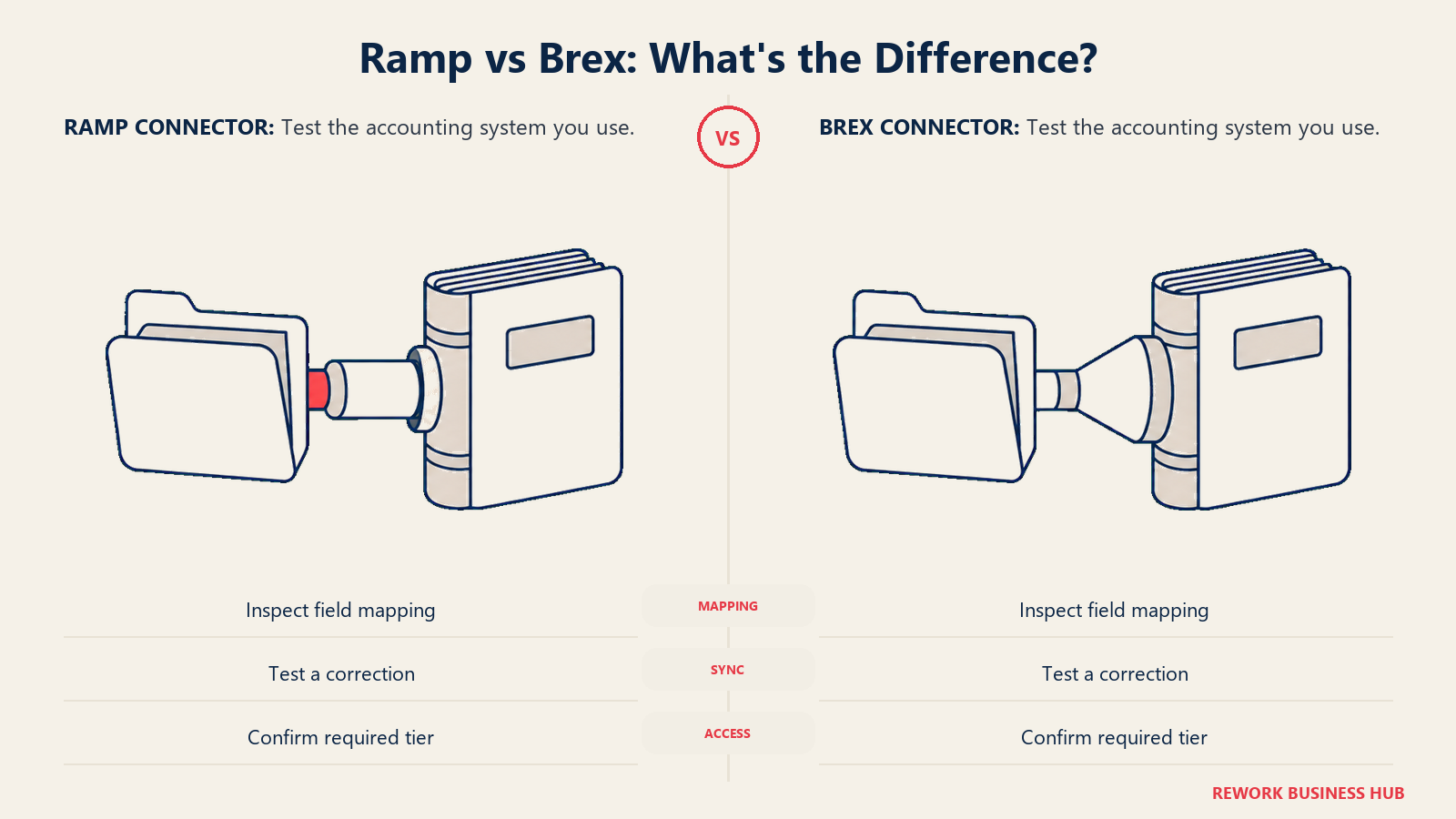
| Accounting system | Ramp tier required | Brex tier required |
|---|---|---|
| QuickBooks Online | Free | Not named as included on Essentials |
| Xero | Free | Not named as included on Essentials |
| NetSuite | Plus | Named as customizable ERP support, Premium |
| Sage Intacct | Plus | Named as customizable ERP support, Premium |
| Workday | Enterprise | Not named on the published pricing page |
| Oracle Fusion Cloud | Enterprise | Not named on the published pricing page |
| HRIS connections | Not named on the published pricing page | Customizable HRIS, Premium |
If your accounting stack is QuickBooks Online or Xero, Ramp names both by name on its free tier, while Brex's published page does not spell out a specific accounting connection on Essentials, only "customizable ERP/HRIS" starting at Premium. If your books already run on NetSuite or Sage Intacct, both vendors push you to their second tier, and that is exactly where the pricing parity from the cost model above matters most: Ramp Plus and Brex Premium land on the same effective per-seat rate once Ramp's annual discount applies, before Ramp's undisclosed platform fee. For the layer underneath this decision, our guide to QuickBooks alternatives covers what happens once the accounting system itself, rather than the card program, is the bottleneck.
Implementation and Switching Cost
Neither of these is an enterprise rollout. Both are self-serve platforms a controller can stand up in a day once the underwriting clears, and the underwriting is exactly where the two diverge.
Ramp's underwriting is a single check: verify the $25,000 cash balance in the linked account, confirm the EIN and entity type, confirm the US address, and the application either clears or it does not. Brex's underwriting branches by segment. A venture-backed applicant needs to demonstrate the $50,000 cash position, sometimes with funding documentation to support the "angel or venture-funded" classification. A commercial or mid-market applicant needs revenue statements showing the $400,000-a-month or $500,000-a-year threshold. That branching adds a step Ramp's flat bar does not have, though it also means a company with strong revenue and thin cash has a path into Brex that Ramp's single cash test does not offer at all.
The one variable neither company has addressed publicly is what changes, if anything, in Brex's underwriting now that a chartered bank owns the business. Banks are typically more conservative than venture-backed fintechs on KYC and compliance documentation, and Capital One has said nothing publicly about tightening or loosening Brex's existing bar. Budget a little extra time for the underwriting conversation with Brex until that settles, and ask directly whether your specific segment's requirements have moved since the acquisition closed.
| Ramp | Brex | |
|---|---|---|
| Time to apply | Same day | Same day |
| Underwriting logic | One flat cash test | Branches by venture, mid-market, enterprise, or commercial segment |
| Documentation typically requested | Bank statement showing the $25,000 balance | Funding documentation (venture path) or revenue statements (commercial/mid-market path) |
| Change management load | Low, mostly a banking-relationship decision | Low to moderate, same shape of decision |
| Financial commitment if you choose wrong | None, Free carries no contract | None, Essentials carries no contract |
| Post-acquisition uncertainty | None, ownership has not changed | Some: ask Brex directly whether Capital One has altered underwriting since 7 April 2026 |
When Ramp Is the Right Call
- You clear the $25,000 cash bar but not a startup-specific revenue story. Ramp does not ask why your cash balance looks the way it does, it asks whether it clears the line.
- You want the largest, fastest-growing independent platform in the category. A $44 billion valuation and $1 billion in annualized revenue are not guarantees of a better product, but they are a real signal about staying power and pace of feature shipping.
- NetSuite or Sage Intacct is your ERP and you do not need Workday or Oracle Fusion Cloud. Both sit cleanly on Plus.
- You would rather negotiate one unknown, the platform fee, than clear a segment-based revenue bar you cannot yet meet.
When Brex Is the Right Call
- Your company's story is told in revenue rather than cash on hand. A profitable, revenue-generating business that keeps little cash on the balance sheet can clear Brex's commercial or mid-market bar while falling short of Ramp's flat cash minimum.
- You want the eligibility bar and the price both spelled out with no unresolved number. Brex Premium's $12 per user per month is the whole bill; there is no undisclosed fee sitting underneath it.
- You are actively booking group travel and want that named as a first-tier capability rather than folded into general expense.
- You want the counterparty behind your card program to be a chartered bank's balance sheet rather than a venture-backed independent, and you are comfortable with a product now owned by Capital One rather than run as a standalone company.
Who Should Choose Which
| If this describes you | Choose | Because |
|---|---|---|
| You have $25,000 to $50,000 in cash but no qualifying revenue story | Ramp Free | You clear Ramp's bar and likely fail Brex's startup minimum |
| You have strong revenue but thin cash reserves | Brex Essentials or Premium | Brex's revenue-based paths do not require a cash minimum the way Ramp's flat bar does |
| You run NetSuite or Sage Intacct and want the deepest, most scaled independent platform | Ramp Plus | Both ERPs sit on Plus, but get the platform fee in writing before you commit |
| You run NetSuite or Sage Intacct and want a fixed, fully disclosed seat price | Brex Premium | $12 per user per month with no undisclosed fee attached |
| You need explicit multi-entity international coverage and local-currency card issuance today | Brex Premium or Smart Card | Ramp's global coverage on Plus is not specified to the same level |
| You want your card program backed by a chartered bank rather than a venture-backed independent | Brex | Capital One completed its acquisition of Brex on 7 April 2026 |
| You want the largest, fastest-scaling independent platform in the category | Ramp | $44 billion valuation, $1B+ annualized revenue, reported free cash flow positive |
| You cannot clear either eligibility bar | Neither, yet | Revisit our best Ramp alternatives and best Brex alternatives roundups for lower-bar options |
The verdict: check eligibility before you compare anything else. If your company clears both bars, the paid tiers are close enough on published price that the decision comes down to whether you would rather bank on Capital One's balance sheet behind Brex or Ramp's independent scale, and whether a fully disclosed $12 per seat matters more to your budgeting process than a $15 seat with an unknown add-on. If your company clears only one bar, that answers the question for you, and the rest of this comparison is background reading for later.
What to Do Next
Before you request a demo from either company, run your own numbers through the eligibility gate first. Pull your current cash balance and your trailing 12 months of revenue, and check both against the tables above. If you clear Ramp's $25,000 cash bar, you have a live option there regardless of your revenue story. If you clear one of Brex's revenue-based paths but not Ramp's cash minimum, Brex is your realistic option even before you compare a single feature.
If you clear both bars, do the one thing this article cannot do for you: call Ramp's sales team and ask for the Plus platform fee in writing at your actual team size, before you build a budget around either platform. Everything else in this comparison, cards, AP, travel, ERP integrations, is close enough between the two that the eligibility gate and that one undisclosed number will do more to decide this than any feature table will. For the rest of the category, our best spend management software roundup covers the field beyond just these two.
Related Resources:

Principal Product Marketing Strategist
On this page
- TL;DR
- Key Facts
- Ramp vs Brex at a Glance
- Who Actually Qualifies: The Eligibility Gate
- Ownership and Scale in 2026: What Actually Changed
- Global Footprint and Entity Structure
- Pricing Compared
- Cost model at 10, 25, 50, 100, and 250 users
- Corporate Cards and Spend Controls
- Accounts Payable and Bill Pay
- Travel Booking
- Accounting and ERP Integrations
- Implementation and Switching Cost
- When Ramp Is the Right Call
- When Brex Is the Right Call
- Who Should Choose Which
- What to Do Next