Best Ramp Alternatives in 2026: 13 Spend Management Platforms Compared
Turn this article into takeaways for your work.


Each assistant summarizes the article only for you and suggests best practices for your work.
Every price below came from the vendor's own pricing page on the date of writing, or is clearly labelled (reported) where the vendor publishes nothing.
For most US companies under a few hundred people, Ramp is still the right answer, and the honest short list of replacements is short: Brex for teams with entities outside the US, Rho or Mercury when you want the bank and the spend software to come from one vendor, Payhawk and Pleo for European operations, and Expensify or Zoho Expense when what you really need is expense reports rather than a card program. Ramp set the category benchmark by giving away a free tier that includes cards, reimbursements, bill pay, and accounting sync, and that tier is genuinely complete rather than a trial in disguise.
The reasons people still shop around are real. Ramp's free tier is funded by interchange, so the model works best when the Ramp card becomes your primary spend rail. Plus is $15 per user per month plus a platform fee that scales with team size, and Ramp does not publish the fee amount, so a 200-person deployment cannot be budgeted from the website. International card issuing and multi-entity depth sit behind higher tiers and still trail Brex and Payhawk. And if most of your spend has to run through an existing bank card program, or your problem is invoices rather than cards, a purpose-built tool is usually cheaper. This guide compares 13 platforms on pricing basis, geography, and the one job each does better than Ramp. For the full category view, start with our expense management software roundup.
Key Facts
Key Facts: What Spend Management Is Actually Costing You
- Processing an expense report for a single night hotel stay costs an average of $58 and 20 minutes of work, per a GBTA Foundation study conducted with HRS (GBTA).
- 19% of expense reports contain errors or missing information, and each one costs an extra $52 and 18 minutes to fix (GBTA).
- The median organization needs 6.4 calendar days to close a month's books, while the top quartile closes in 4.8 days or less and the bottom quartile takes 10 or more, across 2,300 organizations in APQC's benchmarking survey (CFO.com).
- Expense reimbursement schemes showed up in 13% of occupational fraud cases studied, with a median loss of $50,000 per case (ACFE 2024 Report to the Nations).
- Companies without AP automation spend $12.88 to process one invoice and take 17.4 days to do it, per Ardent Partners' State of ePayables research (Bottomline).
Quick Comparison Table
| Tool | Best For | Starting Price | Key Strength | Key Limitation |
|---|---|---|---|---|
| Ramp (the benchmark) | US teams that want cards, expenses, and AP free | Free $0/user/mo; Plus $15/user/mo plus an unpublished platform fee based on team size | Complete free tier, fast close, strong controls | Plus platform fee is not published as a number; US-first |
| Brex | Companies operating in more than one country | Essentials $0/user/mo; Premium $12/user/mo | Global cards, entities, and business account together | Aimed at funded and mid-market firms, not micro-teams |
| BILL Spend & Expense | Free cards next to a mature AP product | $0/user/mo | Free card program plus credit lines to $5M | AP and AR is a separate paid product from $49/user/mo |
| Rho | Replacing the bank and the software at once | $0 platform, $0 per user | No subscription and no per-user fee at all | You bank with Rho, a bigger switch than software |
| Mercury | Startups wanting banking with spend built in | Free $0/mo; Plus $29.90/mo per company | Per-company pricing that ignores headcount | Banking-led, thinner procurement and multi-entity depth |
| Navan | Travel-heavy teams booking and expensing in one place | Business free up to 300 employees | Trip booking and expense on the same record | Expense is free only for the first 5 users |
| Expensify | Reimbursement-first teams and accounting firms | Collect $5 per unique member/mo | Best-known receipt capture and approval chains | Unique versus active member billing confuses buyers |
| Payhawk | Multi-entity finance buying by module, not by seat | Cards and Expenses from $449/mo per company | Price does not move when headcount doubles | High floor for teams under about 40 people |
| Pleo | European teams wanting cards and expenses together | Essential GBP 39/mo billed yearly, 3 users included | Clean European card experience and local support | Priced in GBP and EUR, base fee plus per-extra-user |
| Spendesk | European mid-market that refuses per-seat pricing | Quote only, no published price | No active user fees, free card orders | Nothing published, so evaluation starts with sales |
| Rippling Spend | Companies already running Rippling for HR and IT | Quote only, modular add-on | One employee record drives cards, apps, and access | No fixed published price, and modules stack up |
| Airbase (Paylocity for Finance) | Paylocity customers consolidating vendors | Quote only, no published price | Deep guided procurement and approval workflows | Now a Paylocity product, not an independent platform |
| Zoho Expense | Budget-conscious and Zoho-ecosystem teams | Standard $3/user/mo billed annually | Cheapest credible platform in this comparison | Card issuing depends on region and banking partner |
| Volopay | Teams with operations across Asia Pacific | Quote only, no published price | Multi-currency wallets across APAC markets | No published pricing, smaller ecosystem than Ramp |
Why Teams Look Past Ramp
Ramp does not have a quality problem. It has a fit problem, and the fit breaks in six specific places.
| Reason to Look Elsewhere | Who Feels It Most | How Often It Triggers a Switch |
|---|---|---|
| The free tier assumes the Ramp card becomes your main spend rail | Companies tied to an existing bank card program | Very common |
| Plus is $15 per user per month plus a platform fee Ramp does not publish | Finance leads building a two-year budget | Common |
| Local-currency card issuing and locally funded reimbursements sit at Enterprise | Companies with a foreign entity or foreign staff | Common |
| Multi-entity, custom roles, and NetSuite or Sage Intacct sync require Plus | Controllers on a mid-market ERP | Common |
| Card underwriting is based on business bank balance and cash flow | Pre-revenue or cash-thin businesses | Moderate |
| The problem is really expense reports or invoices, not cards | Services firms reimbursing employee spend | Moderate |
None of that means Ramp is expensive. It means Ramp is cheapest exactly where its card is the payment method, and something else is cheaper everywhere else.
The Pricing Models Behind These Tools
Five different billing models hide inside this category, and mixing them up is the biggest source of a wrong budget. Normalize every quote to the same basis before comparing anything.
| Pricing Model | Vendors Here | What It Means for Your Budget |
|---|---|---|
| Free, funded by interchange | Ramp Free, BILL Spend & Expense, Brex Essentials, Rho | $0 software, but the vendor needs your card volume for the model to work |
| Per user per month | Brex Premium, Navan Expense, Zoho Expense, Expensify | Cost scales with headcount, so model your 24-month hiring plan |
| Per user plus a platform fee | Ramp Plus | Seats times $15 is a floor, not a total, since the fee scales with team size |
| Per company per month | Mercury, Payhawk | Cost is flat no matter how many people you add |
| Base fee plus per-extra-user | Pleo | A small base covers the first three users, then each seat adds a fixed rate |
| Quote only | Spendesk, Rippling Spend, Airbase, Volopay | No budget without a sales call, and renewal terms matter as much as year one |
Stage Fit Matrix
Fit changes with both company maturity and operating shape. Early teams optimize for free or flat pricing, while larger or cross-border teams need entity controls, local card rails, and deeper approval hierarchies.
| Company Stage | Strongest Fits | Why |
|---|---|---|
| Pre-seed to seed, under 10 people | Mercury, Brex Essentials, Zoho Expense | Free or per-company pricing, no card volume commitment |
| Seed to Series A, 10 to 50 | Brex, BILL Spend & Expense, Rho | Free tiers with room to grow, plus banking in one place |
| Series B and up, 50 to 250 | Brex Premium, Payhawk, Rippling Spend | Multi-entity handling and real approval hierarchies |
| Bootstrapped services firm | Expensify, Zoho Expense | Reimbursement-first, no need to move spend to a new card |
| UK or EU operations | Pleo, Payhawk, Spendesk | Local card rails, VAT handling, regional support |
| Asia Pacific operations | Volopay, Brex | Multi-currency coverage outside North America and Europe |
| Already on a large HR or payroll suite | Rippling Spend, Airbase (Paylocity for Finance) | One employee record, one vendor relationship |
1. Brex - The Closest Like-for-Like Rival With Real Global Coverage
Brex is where most Ramp shoppers land, for one reason: it covers the case Ramp handles least well, and it covers it from the free tier down. Cards work across a wide set of countries with local currency support, the business account sits in the same product, and travel booking and bill pay are included rather than bolted on. If you hired in three countries before you hired a controller, that removes a headache Ramp only resolves at Enterprise.
The tradeoff is focus. Brex repositioned away from very small non-venture-backed businesses in 2022, and the product assumes a finance function exists.
| Pros | Cons |
|---|---|
| Global card acceptance from the free tier | Not aimed at small non-funded businesses |
| Essentials includes up to two entities | Enterprise tier is quote-only |
| Business account, cards, travel, and expense together | Fewer AP-specific features than a dedicated AP tool |
Pricing: Essentials is $0 per user per month and already includes global card acceptance, up to two entities, travel booking, bill pay, and reimbursements. Premium is $12 per user per month. Enterprise is contact sales. All figures from Brex's own pricing page.
Best for: Companies of 10 to 1,000 people with staff, entities, or contractors outside the United States. If Brex is the platform you are leaving instead, see best Brex alternatives.
2. BILL Spend & Expense - Free Cards Beside the Most Mature AP Product
BILL Spend & Expense, formerly sold as Divvy, matches Ramp's free-card play and adds something Ramp cannot: BILL's accounts payable business, which processes invoices for a very large base of accountants and mid-market finance teams. If your card program is secondary and the invoice pile is the real problem, that pairing beats Ramp's AP module.
The catch is that the two halves are priced separately, so the free headline only covers half of what most buyers came for.
| Pros | Cons |
|---|---|
| $0 per user per month for cards, budgets, and expense tracking | AP and AR is a separate paid subscription |
| Credit lines from $1,000 up to $5M | Two products means two interfaces to learn |
| Deep accountant channel and partner network | Less polished than Ramp on close automation |
Pricing: BILL Spend & Expense is $0 per user per month. BILL's separate AP and AR product runs Essentials at $49, Team at $65, and Corporate at $89 per user per month, with Enterprise custom. All figures from BILL's own pricing page.
Best for: Finance teams whose invoice volume outweighs their card volume. See best BILL.com alternatives if the AP side is what you are reconsidering, or Ramp vs Bill.com for the direct head-to-head on AP depth, accounting sync, and transaction fees.
3. Rho - Zero Software Fees, Funded by Banking Instead
Rho takes Ramp's interchange-funded logic a step further. The whole platform is free: no subscription, no per-user fee, and same-day ACH, wires, and checks at no cost, with AP, expense, and accounting automation included. Revenue comes from interchange, FX, and treasury instead of software, which makes the pricing conversation short.
The cost is not financial. Rho wants to be your banking platform, not a layer on the bank you already use, and moving operating accounts is a heavier decision than switching expense software.
| Pros | Cons |
|---|---|
| $0 subscription and $0 per-user fees, published plainly | Full value requires moving banking to Rho |
| Same-day ACH, wires, and checks at no cost | Smaller integration ecosystem than Ramp |
| AP, expense, and accounting automation included | US-focused, limited international footprint |
Pricing: The platform is free, with $0 subscription fees and $0 per-user fees. FX transfers carry a 1% fee. Treasury runs 0.15% to 0.6% annually depending on deposit size. All figures from Rho's own pricing page.
Best for: Companies willing to consolidate banking and spend with one provider, typically 10 to 200 people with meaningful idle cash.
4. Mercury - Per-Company Pricing That Ignores Your Headcount
Mercury solves a problem per-seat pricing creates. Its paid tiers bill per company, not per user, so a 15-person team and a 90-person team pay the same. For a company expecting to double headcount inside a year, that is a very different budget line from Ramp Plus, where each hire adds cost twice: once for the seat, once through a platform fee that scales with team size.
Mercury is banking-first, though, so procurement workflows, multi-entity consolidation, and per diem handling are thinner than a dedicated spend platform ships.
| Pros | Cons |
|---|---|
| Paid tiers are per company, so cost is flat as you hire | Banking-led, so spend controls are less deep |
| Free tier covers banking basics at $0 | Thin multi-entity and procurement functionality |
| Predictable pricing with no negotiation needed | Fewer accounting integrations than Ramp or Brex |
Pricing: Mercury is free at $0 per month. Mercury Plus is $29.90 per month, or $23.95 per month billed annually, which is 15% off. Mercury Pro is $299 per month. All tiers are priced per company, not per user. All figures from Mercury's own pricing page.
Best for: Startups and small teams of 5 to 100 people that want banking and basic spend controls under one predictable monthly fee.
5. Navan - When Travel Booking and Expense Should Be One Record
Ramp added travel, but Navan was built around it. Booking, policy enforcement, and the resulting expense live on one record, which removes the reconciliation step where a booking in one system has to be matched to a charge in another. With global business travel spending forecast to hit a record $1.71 trillion in 2026 across 1.84 billion trips, per GBTA's 2026 forecast, that design matters more to travel-heavy teams than any card feature.
Read the free tier carefully, because there are two and they are not the same. Travel is free for companies up to 300 employees; expense is free only for the first five users.
| Pros | Cons |
|---|---|
| Travel and expense on one record, no swivel chair | Expense pricing kicks in after just 5 users |
| Travel is free for companies up to 300 employees | Weaker fit for teams that barely travel |
| Strong inventory and policy enforcement at booking | Card program is less central than Ramp's |
Pricing: Navan Business is free for companies up to 300 employees with unlimited trips on the travel product. Navan Expense is free for the first 5 users, then $15 per user per month. Navan Enterprise is contact sales. All figures from Navan's own pricing page.
Best for: Companies of 20 to 500 people where travel is a top-three spend category rather than an occasional cost.
6. Expensify - The Reimbursement Workhorse When Cards Are Not the Point
If your real problem is that people front their own money and wait to get paid back, a card platform is answering a question you did not ask. Expensify has spent over a decade on that one job: get a receipt out of a pocket, through a policy check and an approval chain, and into a clean payout. Accounting firms managing several small clients lean on it heavily for exactly this.
The billing model is the part buyers get wrong, and it is worth slowing down on. Collect bills per unique member, Control bills differently depending on annual commitment or pay-per-use, and the discounted Control rate depends on using the Expensify Card.
| Pros | Cons |
|---|---|
| Best-known receipt capture and approval workflow | Billing model takes real effort to understand |
| Works without changing how anyone currently pays | Card discount only applies with Expensify Card usage |
| Cheap entry point at the Collect tier | Weaker real-time spend prevention than Ramp |
Pricing: Collect is $5 per unique member per month, pay-per-use only. Control on an annual subscription is $18 per member included in your subscription size per month, plus $36 per active member above that size; on pay-per-use it is $36 per active member per month. With Expensify Card usage, the annual Control rate can drop as low as $9, which is a discount rather than the plain Control price. All figures from Expensify's published pricing documentation.
Best for: Reimbursement-heavy teams and accounting practices. For a direct head-to-head, read Expensify vs Ramp, and see best Expensify alternatives if Expensify is what you are leaving.
7. Payhawk - Per-Company Pricing Built for Multi-Entity Finance
Payhawk is the answer when Ramp's per-seat math stops working. Pricing is per company and modular, so a group controller running six entities pays for deployed modules rather than for every employee who might occasionally buy something. That inverts the usual scaling problem: the more people you add, the better Payhawk looks against a per-user competitor.
Multi-entity handling and European compliance are its genuine advantages over Ramp. The obvious downside is the floor, since $449 per month for cards alone rules it out for a 15-person company.
| Pros | Cons |
|---|---|
| Per-company pricing that does not scale with headcount | High monthly floor for small teams |
| Genuine multi-entity and multi-currency handling | Modules are priced separately and add up |
| Strong European VAT and compliance coverage | Heavier implementation than a free-tier tool |
Pricing: Payhawk publishes per-company monthly starting prices in USD: Cards and Expenses from $449 per month, Accounts Payable from $349 per month, Travel from $299 per month, and Procurement from $499 per month. These are not per-user rates. All figures from Payhawk's own pricing page.
Best for: Companies of 50 to 1,000 people running multiple legal entities, especially with European operations.
8. Pleo - The European Card and Expense Standard
Pleo is what a European team reaches for when Ramp's US-first design shows its seams. Cards, receipt capture, and expense handling are built around European banking rails, VAT rules, and local support expectations rather than adapted for them, and the employee experience is deliberately simple.
Two things to plan around. Pleo prices in GBP and EUR, so a US buyer has to convert before drawing conclusions. And the structure is a base fee including three users plus a per-extra-user rate, which is a third pricing model to normalize.
| Pros | Cons |
|---|---|
| Built for European rails, VAT, and local support | Priced in GBP and EUR, not USD |
| Excellent employee-side experience | Base tiers include only 3 users |
| Starter tier for very small teams | Less procurement depth than Payhawk |
Pricing: Pleo publishes in GBP. Starter is GBP 9.50 per month billed yearly for a maximum of 3 users. Essential is GBP 45 per month billed monthly or GBP 39 per month billed yearly, includes 3 users, then GBP 11 per additional user per month. Advanced is GBP 109 per month billed monthly or GBP 99 per month billed yearly, includes 3 users, then GBP 15 per additional user per month. Business starts from GBP 249 per month billed yearly. All figures from Pleo's own pricing page.
Best for: UK and European teams of 3 to 200 people that want a card and expense product built for their region.
9. Spendesk - No Per-Seat Fee, But No Published Price Either
Spendesk targets the exact objection Ramp Plus raises. Its published position is that it does not charge active user fees, and card orders are free, so growing the team does not automatically grow the bill. Instead there is a fixed platform fee plus variable transaction fees.
The problem is the same one buyers have with Ramp's platform fee, only larger. Spendesk publishes no prices at all, so every evaluation starts with a sales conversation and no list rate to check the quote against.
| Pros | Cons |
|---|---|
| No active user fees, per the vendor's own pricing page | No published price of any kind |
| Free card orders | Every evaluation requires a sales cycle |
| Fixed platform fee plus variable transaction fees | Hard to benchmark against a published competitor |
Pricing: Spendesk publishes no prices. The vendor describes the model as a fixed platform fee plus variable transaction fees, states that it does not charge active user fees, and offers card orders free. Anything more specific requires a quote.
Best for: European mid-market finance teams of 50 to 500 people that value predictable per-seat costs and can absorb a sales-led evaluation.
10. Rippling Spend - Spend Attached to the Employee Record
Rippling's argument is structural. Because the employee record drives payroll, devices, and app access, it can also drive the corporate card, the spend policy, and what happens to all of it on someone's last day. Deprovisioning that kills the card at the same moment it revokes Slack is genuinely hard to replicate across two vendors, and that is the whole pitch.
It only makes sense if you already run Rippling. Bought standalone against Ramp, it is a harder sell: pricing is modular and quote-only, and the module count grows faster than buyers expect.
| Pros | Cons |
|---|---|
| One employee record drives cards, apps, and access | Only compelling if you already use Rippling |
| Automatic deprovisioning of spend at offboarding | No fixed published price, quote-only |
| Consolidates HR, IT, and finance vendors | Modules stack and the total climbs quickly |
Pricing: Rippling does not publish a fixed price for Spend. It is sold as a quote-only, modular add-on on the Rippling platform, so treat any third-party figure as (reported) rather than confirmed.
Best for: Existing Rippling HR and IT customers of 50 to 1,000 people removing a separate spend vendor. See best Rippling alternatives if the wider platform is under review.
11. Airbase, Now Paylocity for Finance - The Suite Consolidation Play
Airbase used to be the procurement-heavy independent finance teams picked when Ramp felt too card-centric. It is now part of Paylocity, marketed as "Airbase, a Paylocity Company" with the product sitting under Paylocity for Finance. The approval depth and guided procurement workflows are still its strongest features, and folding spend into an existing Paylocity relationship is a legitimate reason to choose it.
Do the diligence a post-acquisition product deserves. Roadmap priorities, integration commitments, and support structures all shift after an acquisition, and this one is recent enough to ask about directly.
| Pros | Cons |
|---|---|
| Deep guided procurement and multi-step approvals | No longer an independent product |
| Natural fit alongside Paylocity payroll | Quote-only, no published pricing |
| Handles complex approval hierarchies well | Heavier than Ramp for a simple card program |
Pricing: Quote only. Neither Airbase nor Paylocity publishes a list price for the finance product.
Best for: Paylocity payroll customers of 100 to 1,000 people who want procurement depth and one fewer vendor.
12. Zoho Expense - The Cheapest Credible Platform Here
If your objection to Ramp Plus is purely the number, Zoho Expense is the cheapest serious answer here. It is a real expense platform with receipt scanning, policy rules, approval routing, mileage, and multi-currency, at a fraction of what per-seat competitors charge, and the free tier covers a genuinely small team.
It is a different kind of product, though. Zoho is expense-report software with card feeds attached rather than a card-first spend platform, so controls that decline a transaction before it happens are not the strength.
| Pros | Cons |
|---|---|
| Lowest published per-user price in this list | Expense-report first, not card-first |
| Free tier for up to 3 users | Card issuing varies by region and partner |
| Native fit with Zoho Books and the wider Zoho suite | Weaker real-time spend prevention |
Pricing: Free is $0 for a maximum of 3 users. Standard is $4 per user per month billed monthly, or $3 per user per month billed annually. Premium is $6 per user per month billed monthly, or $5 per user per month billed annually. All figures from Zoho's own pricing page.
Best for: Cost-sensitive teams of 3 to 200 people, and anyone already running Zoho Books.
13. Volopay - Spend Management Across Asia Pacific
Volopay fills the geography Ramp, Brex, Pleo, and Payhawk largely leave alone. It targets companies operating across Asia Pacific, with multi-currency wallets, corporate cards, bill pay, and accounting integrations aimed at businesses whose entities sit in markets that US-first and Europe-first vendors treat as edge cases.
Set expectations on transparency and maturity. Volopay publishes no pricing and routes every enquiry through sales, and coverage varies by market, so confirm your specific countries before shortlisting it.
| Pros | Cons |
|---|---|
| Genuine APAC coverage where US-first tools are thin | No published pricing, quote-only |
| Multi-currency wallets and cross-border payments | Smaller integration ecosystem than Ramp |
| Cards, AP, and expense in one platform | Coverage and features vary by country |
Pricing: Quote only. Volopay publishes no prices and directs buyers to talk to sales.
Best for: Companies of 20 to 500 people with entities or teams across Singapore, Australia, India, and Southeast Asia.
Software Cost at 50 Users
Assumptions: 50 employees all counted as users or active users, annual billing where offered, one product line only, and the currency each vendor actually publishes in. Free tiers show $0 because that is the software charge, not because the model is costless to you.
| Tool and Tier | Monthly Software Cost | Annual Estimate | Basis |
|---|---|---|---|
| Ramp (Free) | $0 | $0 | Vendor-published, funded by interchange |
| BILL Spend & Expense | $0 | $0 | Vendor-published |
| Rho | $0 | $0 | Vendor-published, funded by interchange and treasury |
| Brex (Essentials) | $0 | $0 | Vendor-published |
| Mercury (Plus, annual) | $23.95 | $287.40 | Vendor-published, per company not per user |
| Zoho Expense (Standard, annual) | 50 x $3 = $150 | $1,800 | Vendor-published per user |
| Expensify (Collect) | 50 x $5 = $250 | $3,000 | Vendor-published per unique member |
| Zoho Expense (Premium, annual) | 50 x $5 = $250 | $3,000 | Vendor-published per user |
| Mercury (Pro) | $299 | $3,588 | Vendor-published, per company |
| Payhawk (Cards and Expenses) | From $449 | From $5,388 | Vendor-published, per company not per user |
| Brex (Premium) | 50 x $12 = $600 | $7,200 | Vendor-published per user |
| Ramp (Plus, annual billing) | 50 x $12 = $600 plus platform fee | $7,200 plus platform fee | Per user with the 20% annual discount; platform fee not published |
| Navan (Expense) | 45 x $15 = $675 | $8,100 | Vendor-published, first 5 users free |
| Ramp (Plus, monthly billing) | 50 x $15 = $750 plus platform fee | $9,000 plus platform fee | Vendor-published per user; platform fee not published |
| Pleo (Advanced, yearly) | GBP 99 + (47 x GBP 15) = GBP 804 | GBP 9,648 | Vendor-published in GBP, base includes 3 users |
| Expensify (Control, annual) | 50 x $18 = $900 | $10,800 | Vendor-published; as low as $9 per member with Expensify Card |
Two lines deserve attention. The Ramp Plus rows are the only ones that cannot be totalled, because the platform fee scales with team size and Ramp does not publish the amount, so any budget built from seats times $15 is incomplete by an unknown margin. And Mercury and Payhawk are the only rows that would not change if you doubled headcount to 100, which is the entire argument for per-company pricing.
Geography and Entity Coverage
Geography is where Ramp loses a deal outright rather than on price.
| Requirement | Ramp | Strongest Alternatives |
|---|---|---|
| US-only operations | Excellent on the free tier | BILL Spend & Expense, Rho, Mercury |
| Card issuing in local currency abroad | Enterprise tier, 30+ countries | Brex, Payhawk, Volopay |
| Locally funded reimbursements | Enterprise tier | Brex, Payhawk |
| Two or more legal entities | Plus tier and above | Brex Essentials (up to two), Payhawk, Spendesk |
| UK and EU VAT handling | Not the core strength | Pleo, Payhawk, Spendesk |
| Asia Pacific entities | Limited | Volopay, Brex |
Where the Savings Actually Show Up
Software price is the least interesting part of this decision, because the biggest numbers sit in process cost and cycle time.
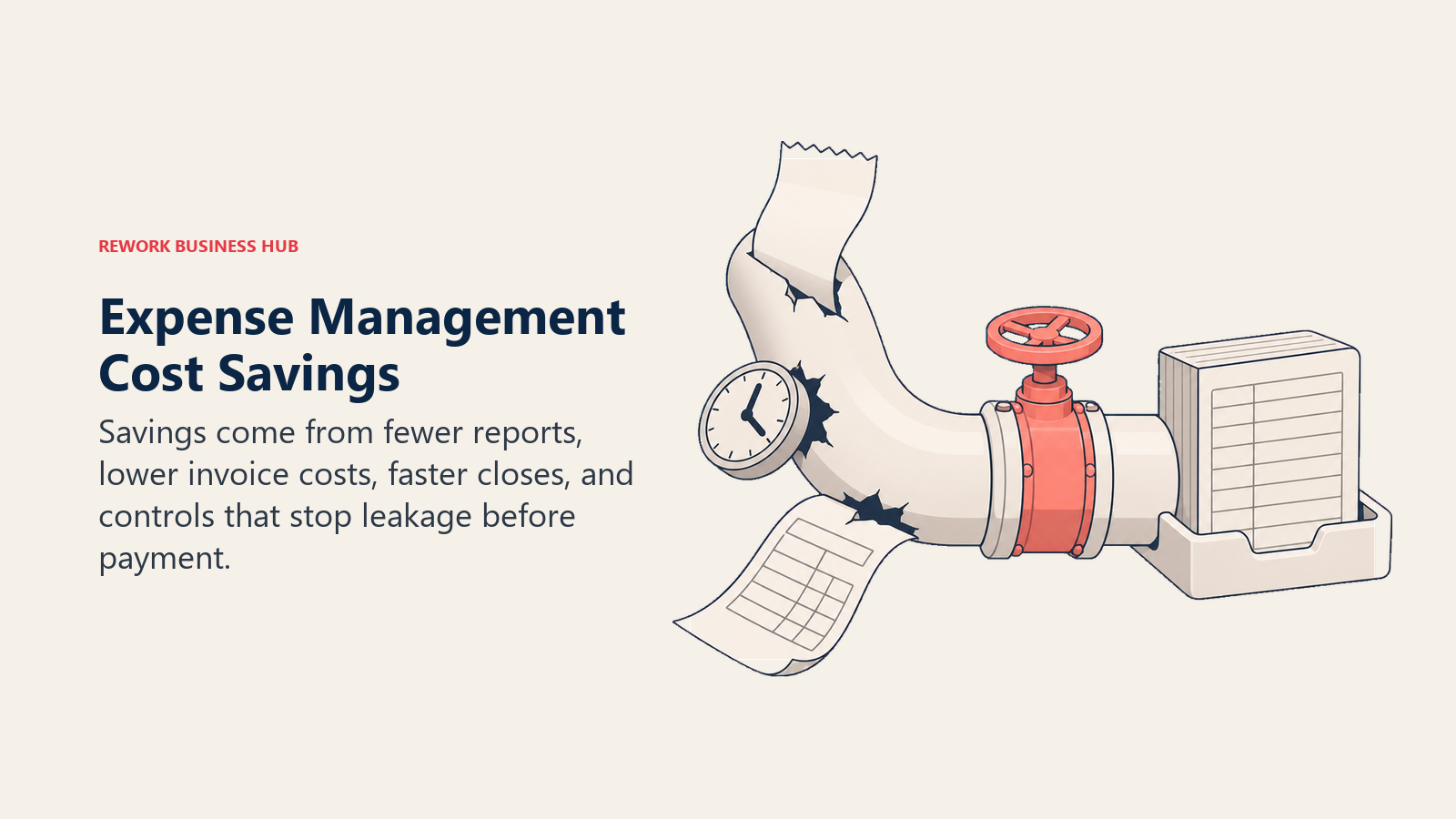
Report handling. At $58 and 20 minutes for a single night hotel stay report, per the GBTA Foundation study with HRS, a company filing 300 reports a month spends roughly $17,400 a month on handling before anyone is reimbursed. The 19% error rate adds $52 and 18 minutes to about one report in five. Card-first tools like Ramp, Brex, and Pleo attack this by removing the report; Expensify and Zoho Expense attack it by making the report faster. Both are valid, and they are not the same purchase.
Invoice cost. APQC's cross-industry benchmark, reported by CFO.com, puts the median cost to process one invoice at $5.83, the top quartile at $2.07 or less, and the bottom quartile at $10 or more. The gap between quartiles is mostly automation depth, which is the argument for pairing spend with a serious AP product such as BILL's.
Close speed and leakage. Ventana Research found 58% of organizations close within six business days, slightly down from 60% in 2019, per the research announcement. Continuous coding and automatic receipt matching move that number, which is what Ramp built its reputation on and what any replacement must match. On the risk side, expense reimbursement schemes appeared in 13% of occupational fraud cases in the ACFE 2024 Report to the Nations, with a median loss of $50,000, and a control that declines a transaction at the point of sale closes that window in a way after-the-fact receipt review never will.
Approval routing, duplicate detection, and policy checks are increasingly handled by software rather than a controller reading line items. Before weighing any vendor's AI claims, the AI expense approval agent breakdown covers what that automation looks like in practice, and the AI budgeting agent overview does the same for forecasting and budget monitoring.
Accounting Stack Fit
Your general ledger narrows this list faster than any feature comparison, because a tool that will not sync cleanly recreates the manual work you were trying to delete.
| Your Accounting System | Strongest Fits Here | Notes |
|---|---|---|
| QuickBooks Online | Ramp Free, BILL Spend & Expense, Rho, Expensify | The most widely supported target; nearly everything integrates |
| Xero | Ramp Free, Pleo, Expensify, Zoho Expense, Volopay | European and APAC tools tend to have the deepest Xero support |
| NetSuite | Ramp Plus, Brex, Payhawk, Airbase | Sync depth varies a lot, so test with real transactions |
| Sage Intacct | Ramp Plus, Brex, Payhawk | Ramp gates this integration behind the Plus tier |
| Workday or Oracle Fusion Cloud | Ramp Enterprise, Payhawk | Enterprise-tier territory for most vendors here |
| Zoho Books | Zoho Expense | Native by design; other tools need middleware |
If the accounting platform is the actual bottleneck rather than the spend tool, the adjacent decisions are covered in best QuickBooks alternatives, best Xero alternatives, best NetSuite alternatives, and best Sage Intacct alternatives.
How to Choose: Decision Framework
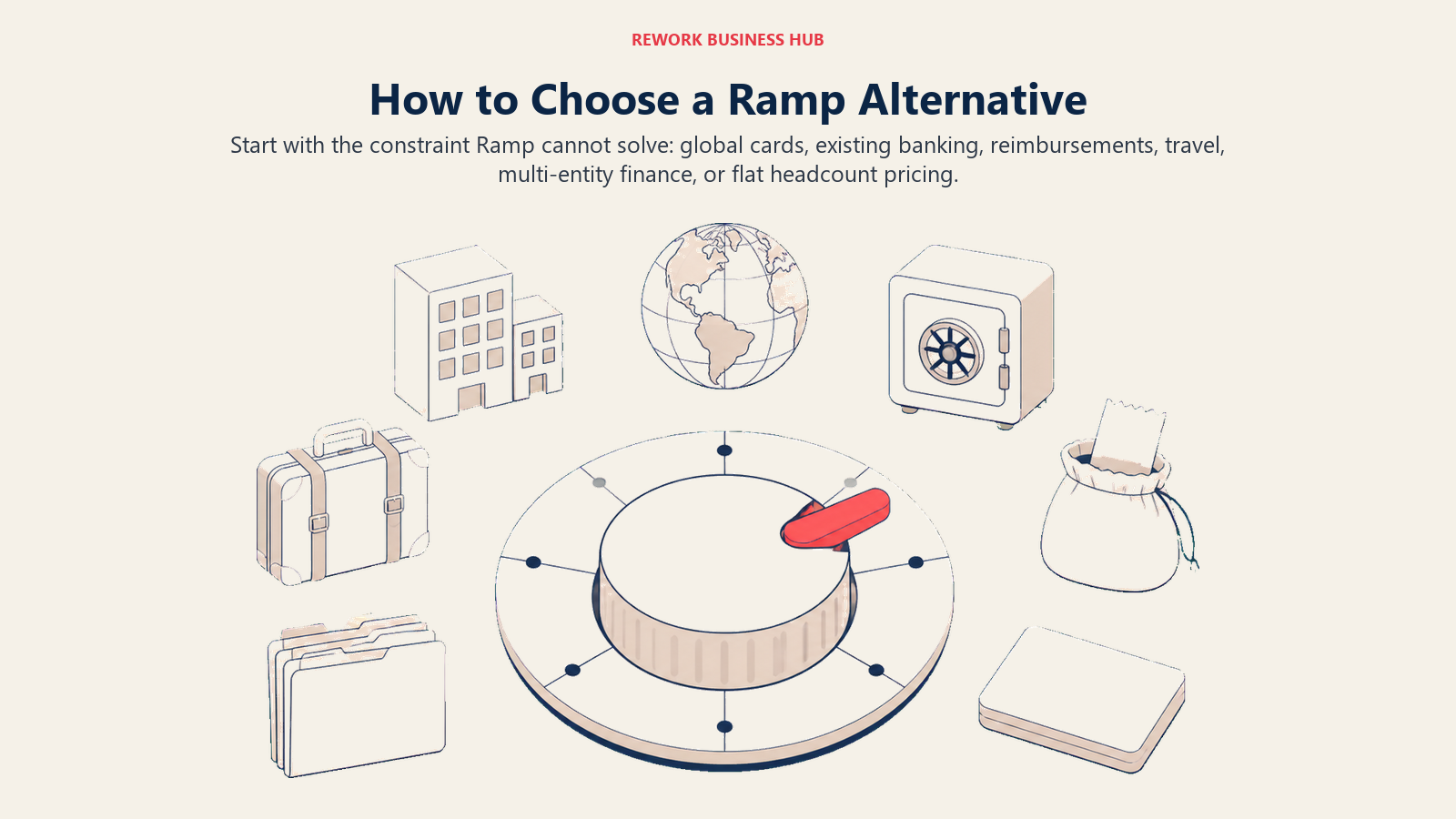
The fastest way to narrow 13 Ramp alternatives is to start with the constraint Ramp cannot solve, then shortlist the products built around that constraint.
| If you need... | Choose |
|---|---|
| Global cards and entities without an Enterprise contract | Brex |
| Free cards next to the most mature AP product | BILL Spend & Expense |
| Zero software fees with banking included | Rho |
| Pricing that stays flat as you hire | Mercury or Payhawk |
| Travel booking and expense on one record | Navan |
| Reimbursement without changing how anyone pays | Expensify or Zoho Expense |
| Multi-entity finance priced per company | Payhawk |
| A card and expense product built for Europe | Pleo or Spendesk |
| Spend tied to the employee record and offboarding | Rippling Spend |
| Procurement depth alongside Paylocity payroll | Airbase (Paylocity for Finance) |
| The lowest published per-user price | Zoho Expense |
| Coverage across Asia Pacific entities | Volopay |
| Staying put makes sense | Ramp, when your spend genuinely runs on its card, operations are US-centred, and the free tier already covers you |
Two options sit outside this list but belong in a thorough evaluation. SAP Concur remains the default for global enterprises with VAT reclaim and audit obligations, and Center is worth a look for teams wanting real-time card visibility without a full platform migration. Neither publishes list pricing, so both start with a sales call.
What Ramp Still Does Best
Most readers here are shopping, not defending Ramp. But it earns these points honestly, and a fair comparison says so.

| Ramp Strength | Who It Matters For |
|---|---|
| A free tier with cards, expenses, AP with AI-powered OCR, and accounting rules | Companies under 100 people that never need to upgrade |
| QuickBooks Online and Xero integrations on the free tier | Small finance teams on mainstream accounting software |
| Continuous transaction coding and receipt matching that shortens close | Controllers judged on days-to-close |
| Policy controls applied at the card rather than after the fact | Finance leads trying to prevent spend, not audit it |
| Vendor management and basic budgets included at $0 | Teams replacing three tools with one |
| Underwriting based on business cash flow, with no personal guarantee | Founders unwilling to sign personally |
If your company is US-based, your spend genuinely runs through the Ramp card, and the free tier covers what you need, switching is hard to justify on economics alone. The alternatives above win on geography, on pricing model, or on doing one specific job better, not on being a cheaper version of the same thing.
Frequently Asked Questions about Ramp Alternatives
How much does Ramp actually cost?
Ramp Free is $0 per user per month and includes unlimited cards, basic travel and expense, AP with AI-powered OCR, and QuickBooks Online and Xero integrations. Ramp Plus is $15 per user per month plus a platform fee based on team size, with 20% off when billed annually, and Ramp does not publish the platform fee amount. Enterprise is contact sales, billed annually.
Is Ramp Plus at $15 per user the full cost?
No, and this is the most common budgeting mistake in the category. Ramp's own pricing page lists Plus as $15 per user per month plus a platform fee based on team size, and the amount is not published, so 50 seats times $15 is a floor rather than a total. Get the platform fee in writing before comparing it to Brex Premium at $12 per user per month.
Why would anyone leave a free product?
Because the free tier is funded by card interchange, so it pays off when the Ramp card becomes your main spend rail. If most spend has to stay on an existing bank card program, if you need local-currency issuing outside the US, or if your problem is invoices and reimbursements rather than cards, a purpose-built tool often costs less in total.
What is the closest direct alternative to Ramp?
Brex. Both offer a genuinely usable free tier with cards, expenses, and bill pay, but Brex Essentials includes global card acceptance and up to two entities at $0 per user per month, where Ramp gates local-currency issuing in 30+ countries to its Enterprise tier.
Which alternatives do not charge per user?
Mercury and Payhawk bill per company, so headcount does not change the price: Mercury Plus is $29.90 per month, or $23.95 billed annually, and Payhawk's Cards and Expenses module starts at $449 per month. Rho charges no subscription or per-user fee at all. Spendesk states it does not charge active user fees but publishes no price.
What should a European company use instead of Ramp?
Pleo, Payhawk, or Spendesk. Pleo is priced in GBP and EUR and built around European card rails, Payhawk prices per company and handles multi-entity VAT work, and Spendesk avoids per-seat fees entirely but requires a sales conversation since it publishes nothing.
Does switching spend platforms actually speed up the close?
It can, and the benchmark shows how much room exists either way. The median organization takes 6.4 calendar days to close a month's books while the top quartile does it in 4.8 days or less, per APQC's survey of 2,300 organizations. Continuous transaction coding and automatic receipt matching are the features tied most directly to that gap, so test them with real transactions during a trial.
What to Do Next
Pick two platforms from the decision framework and run one real month through each trial rather than watching a demo, because demos are built to show the best case. Push a card issue, a policy violation, a reimbursement, an invoice, and a full accounting sync of at least 20 real transactions through both. Whichever one your controller can close a month with, without opening a support ticket, is the one to buy.
If the platform fee is your sticking point, ask Ramp for the number in writing and put it next to Brex at $12 per user per month before deciding. If geography is the issue, start with Payhawk or Pleo. If you want software cost to be zero and you are open to changing banks, look at Rho first.
Camellia writes about finance and spend tooling for B2B teams. Last updated August 2026.

Principal Product Marketing Strategist
On this page
- Key Facts
- Quick Comparison Table
- Why Teams Look Past Ramp
- The Pricing Models Behind These Tools
- Stage Fit Matrix
- 1. Brex - The Closest Like-for-Like Rival With Real Global Coverage
- 2. BILL Spend & Expense - Free Cards Beside the Most Mature AP Product
- 3. Rho - Zero Software Fees, Funded by Banking Instead
- 4. Mercury - Per-Company Pricing That Ignores Your Headcount
- 5. Navan - When Travel Booking and Expense Should Be One Record
- 6. Expensify - The Reimbursement Workhorse When Cards Are Not the Point
- 7. Payhawk - Per-Company Pricing Built for Multi-Entity Finance
- 8. Pleo - The European Card and Expense Standard
- 9. Spendesk - No Per-Seat Fee, But No Published Price Either
- 10. Rippling Spend - Spend Attached to the Employee Record
- 11. Airbase, Now Paylocity for Finance - The Suite Consolidation Play
- 12. Zoho Expense - The Cheapest Credible Platform Here
- 13. Volopay - Spend Management Across Asia Pacific
- Software Cost at 50 Users
- Geography and Entity Coverage
- Where the Savings Actually Show Up
- Accounting Stack Fit
- How to Choose: Decision Framework
- What Ramp Still Does Best
- What to Do Next