Best Bill.com Alternatives in 2026: 13 AP Automation Platforms Compared
Turn this article into takeaways for your work.


Each assistant summarizes the article only for you and suggests best practices for your work.
If you are shopping Bill.com alternatives, the answer depends on which part of BILL is failing you. If the problem is that $49 to $89 per user per month multiplies every time an approver needs a login, look at Payhawk or Tipalti, which price by company rather than by seat, or Melio's Unlimited plan, which is the one Melio tier with no per-user fee. If the problem is international suppliers, Tipalti is the honest upgrade. If the problem is that AP lives in one product and cards live in another, Ramp, Brex, and Rho fold both into one platform at $0 in software. And if the problem is that your ERP is the system of record and you just want invoices to stop piling up, Stampli and AvidXchange bolt onto what you already run.
BILL, formerly Bill.com, earned its position. It has been the SMB accounts payable standard for well over a decade, its accountant channel is unmatched, and the AR side (invoicing and collections next to payables) is something most alternatives here do not attempt. This guide is not an argument that BILL is bad software. It is a map of the 13 platforms buyers actually shortlist when BILL stops fitting, with pricing quoted at its billing basis so you can compare like for like.
Key Facts
Key Facts: What Manual AP Actually Costs
- Companies without AP automation pay an average of $12.88 to process a single invoice and take 17.4 days to do it, per Ardent Partners' State of ePayables research (Bottomline).
- Best-in-class AP teams clear an invoice in 3.1 days against 17.4 days for everyone else, per Ardent Partners' Accounts Payable Metrics That Matter (Medius).
- Top-performing AP teams run a 9% invoice exception rate against an industry average of 22%, which is where duplicate and mismatched invoices hide (Medius).
- 76% of US organizations experienced attempted or actual payments fraud in 2025, and 58% reported fraud attempts on checks specifically, per the 2026 AFP Payments Fraud and Control Survey (AFP).
- Best-in-class teams get 67.2% of their suppliers onto electronic invoicing, which is the single biggest lever on straight-through processing, per Ardent Partners' State of ePayables 2025 (Medius).
Quick Comparison Table
| Tool | Best For | Starting Price | Key Strength | Key Limitation |
|---|---|---|---|---|
| Tipalti | Global supplier payouts and multi-entity AP | Accounts Payable from $99/mo, plus transaction fees | Deepest international payout and supplier onboarding | Full pricing is quote-based, heavier than SMB tools |
| Stampli | Keeping your ERP and fixing only the invoice workflow | Quote-only, no list price | Collaboration and approvals wrapped around each invoice | No published pricing at all |
| Ramp | US teams wanting cards, expenses, and AP in one free tier | Free $0/user/mo; Plus $15/user/mo plus a platform fee | Genuinely usable free tier covering the whole workflow | The Plus platform fee is not published as a number |
| Melio | Small US teams paying a handful of vendors a month | Go $0 (1 user); Core $25/mo plus $10 per extra user | Unlimited plan at $80/mo carries unlimited users | Only the top plan is unlimited; payment fees per transaction, US-centric |
| Brex | Startups and multi-entity companies operating globally | Essentials $0/user/mo; Premium $12/user/mo | Global cards, AP, and a business account together | Less focused on non-venture-backed small firms |
| AvidXchange | Mid-market real estate, construction, and HOA finance | Quote-only, no list price | Vertical depth and a large supplier network | No published pricing; per-transaction model |
| Payhawk | Multi-entity teams buying by module, not by seat | Accounts Payable from $349/mo per company | Per-company pricing that ignores headcount | High floor for teams under 50 people |
| Rho | Teams that want AP software funded by banking | $0 platform, $0 per user, $0 domestic payments | No subscription or per-user fees at all | You bank with Rho, which is a bigger commitment |
| Coupa | Enterprise procure-to-pay with sourcing and contracts | Quote-only, no list price | Full source-to-pay suite, not just AP | Enterprise scope, cost, and implementation time |
| Airbase (Paylocity) | Paylocity payroll customers consolidating vendors | Quote-only, no list price | Guided procurement and multi-step approval depth | Now part of Paylocity, not an independent product |
| Spendesk | European mid-market that wants no per-seat fee | Quote-only; vendor states no active user fees | Platform plus transaction fees instead of seats | Nothing published, every evaluation starts with sales |
| Corpay Complete | Payment-heavy AP with rebate and FX economics | Quote-only, no list price | Payments network scale and cross-border coverage | No published price, sales-led buying process |
| Zoho Books | Small teams that want bills inside their accounting | Standard $20/mo monthly or $15/mo annual (3 users) | Cheapest credible option, AP inside the ledger | Not a dedicated AP platform, thin payment rails |
Why Companies Actually Leave BILL
BILL rarely loses on quality. It loses on shape: how it charges, what it covers, and how many products you have to buy to get one workflow.
| Pain point | Who feels it most | How often it triggers a switch |
|---|---|---|
| $49 to $89 per user per month multiplies with every approver | CFOs and controllers adding department heads | Very common |
| AP and Spend & Expense are two separate products | Finance leads running one onboarding, then another | Very common |
| International payment coverage is thinner than Tipalti's | Companies with suppliers outside the US | Common |
| UI feels dated next to card-led spend platforms | Daily AP users and approvers | Common |
| Approval workflows get rigid at multi-entity scale | Controllers at 3+ entity companies | Moderate |
| Payment speed and holds on new accounts | Founders paying time-sensitive vendors | Moderate |
| Support depth varies once you outgrow the accountant channel | AP managers escalating a stuck payment | Moderate |
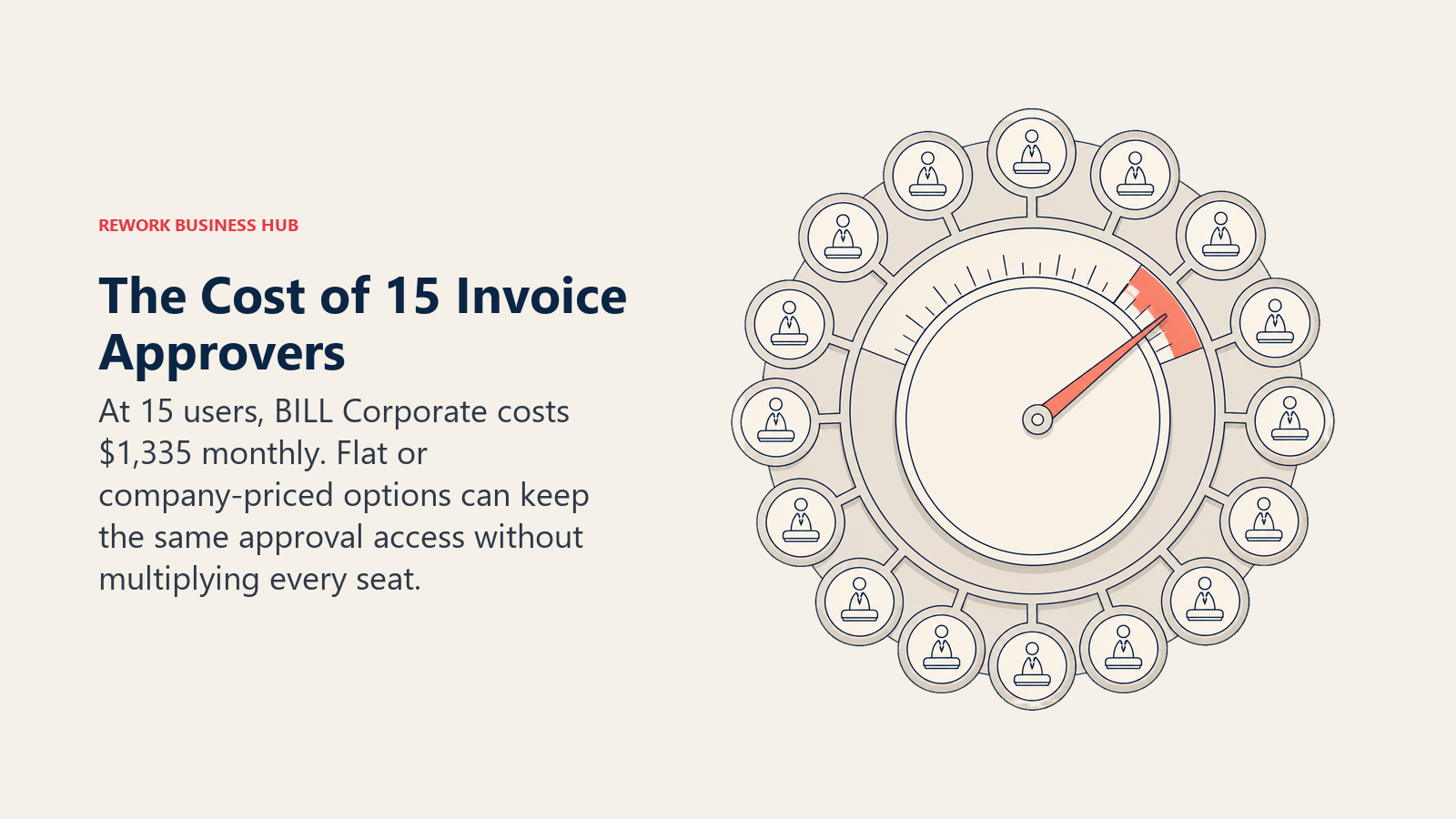
The seat math is the one that ends most BILL contracts. Fifteen people who touch an invoice is not unusual at a 100-person company, and fifteen Corporate seats is $1,335 per month before a single payment fee. The expense management software roundup walks through the same arithmetic across the wider category.
Understand BILL's Two Products Before You Compare Anything
The most common mistake in a BILL replacement project is comparing the wrong half of BILL to the alternative. BILL sells two things, and they are priced on opposite models.
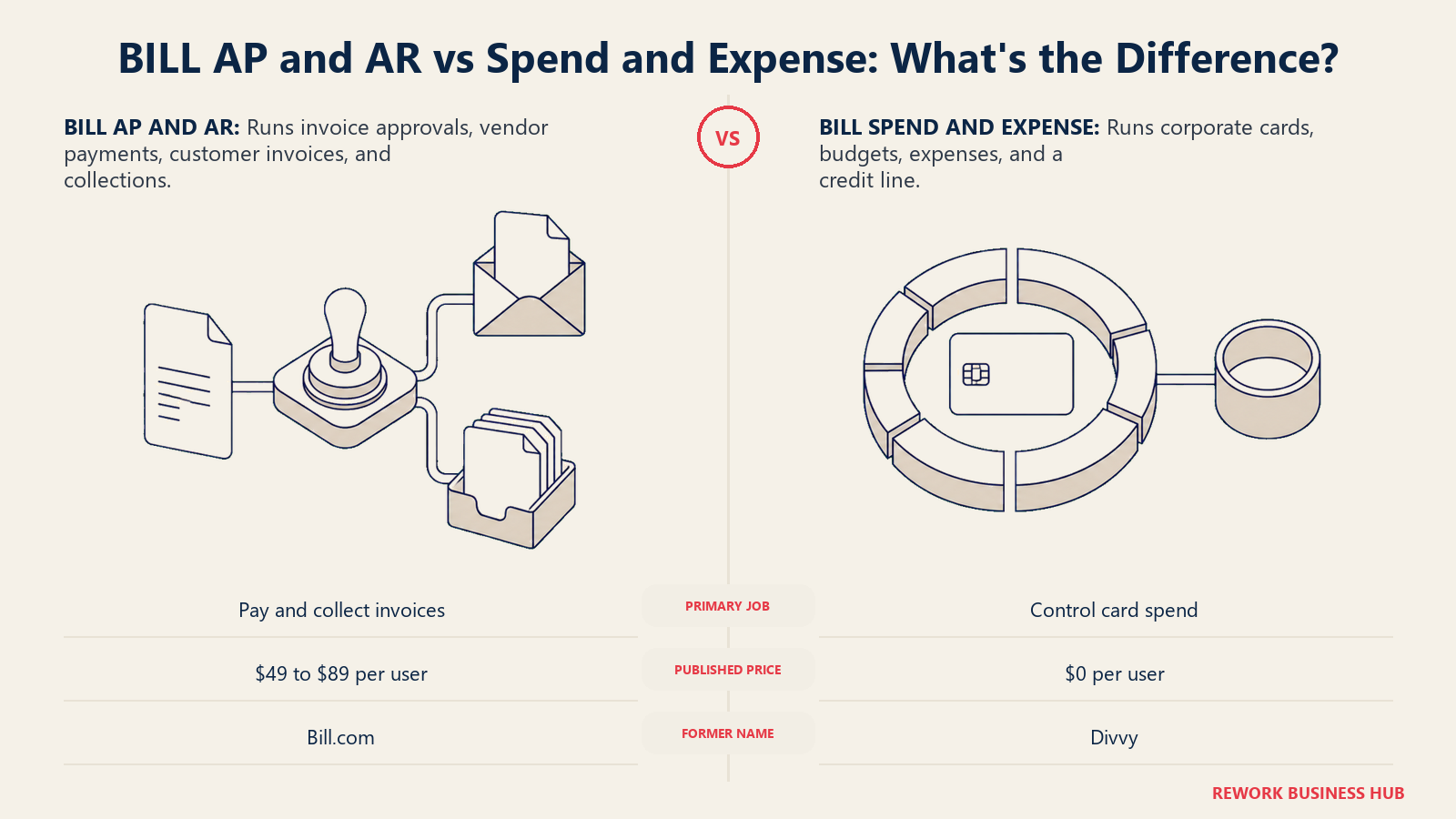
| BILL AP and AR | BILL Spend & Expense | |
|---|---|---|
| What it does | Invoice capture, approvals, vendor payments, customer invoicing and collections | Corporate cards, budgets, expense tracking, credit line |
| Pricing basis | Per user per month | $0 per user per month |
| Published price | Essentials $49, Team $65, Corporate $89, Enterprise custom | Free, funded by interchange and a credit line from $1,000 to $5M |
| Formerly known as | Bill.com | Divvy |
| Direct alternatives | Tipalti, Stampli, Melio, AvidXchange, Corpay Complete | Ramp, Brex, Payhawk, Rho, Spendesk |
All figures above come from BILL's own pricing page. If your complaint is the AP bill, you are shopping the top row and the free card product is irrelevant to the comparison. If your complaint is running two onboarding projects, that is exactly what Ramp, Brex, Payhawk, Rho, and Spendesk are built to collapse.
Pricing Models: The Part Buyers Get Wrong
Four different pricing shapes exist in this list, and the shape matters more than the sticker.
| Model | Who prices this way | What it means for you |
|---|---|---|
| Per user per month | BILL AP/AR, Ramp Plus, Brex Premium | Every approver you add raises the bill, so teams ration logins |
| Per company per month | Payhawk, Tipalti base plans, Melio Unlimited | Headcount does not move the number, so you can give everyone access |
| Free software, revenue from cards and treasury | Ramp Free, Brex Essentials, BILL Spend & Expense, Rho | Only works if real volume flows through their rails |
| Platform fee plus transaction fees | Tipalti, Spendesk, AvidXchange, Corpay Complete | Invoice and payment counts drive the bill, not seats |
| Quote-only enterprise | Coupa, Stampli, Airbase, Corpay Complete | Priced on entities, volume, and module mix; budget for implementation |
Rationing logins is the hidden cost of per-seat AP. When a department head cannot approve in the system, the approval happens in email and the audit trail breaks, which is exactly the gap the 22% industry exception rate lives in.
Stage Fit Matrix
The right replacement changes with company stage: simple tools win early, while cross-border, vertical, and procurement complexity matter as the organization grows.
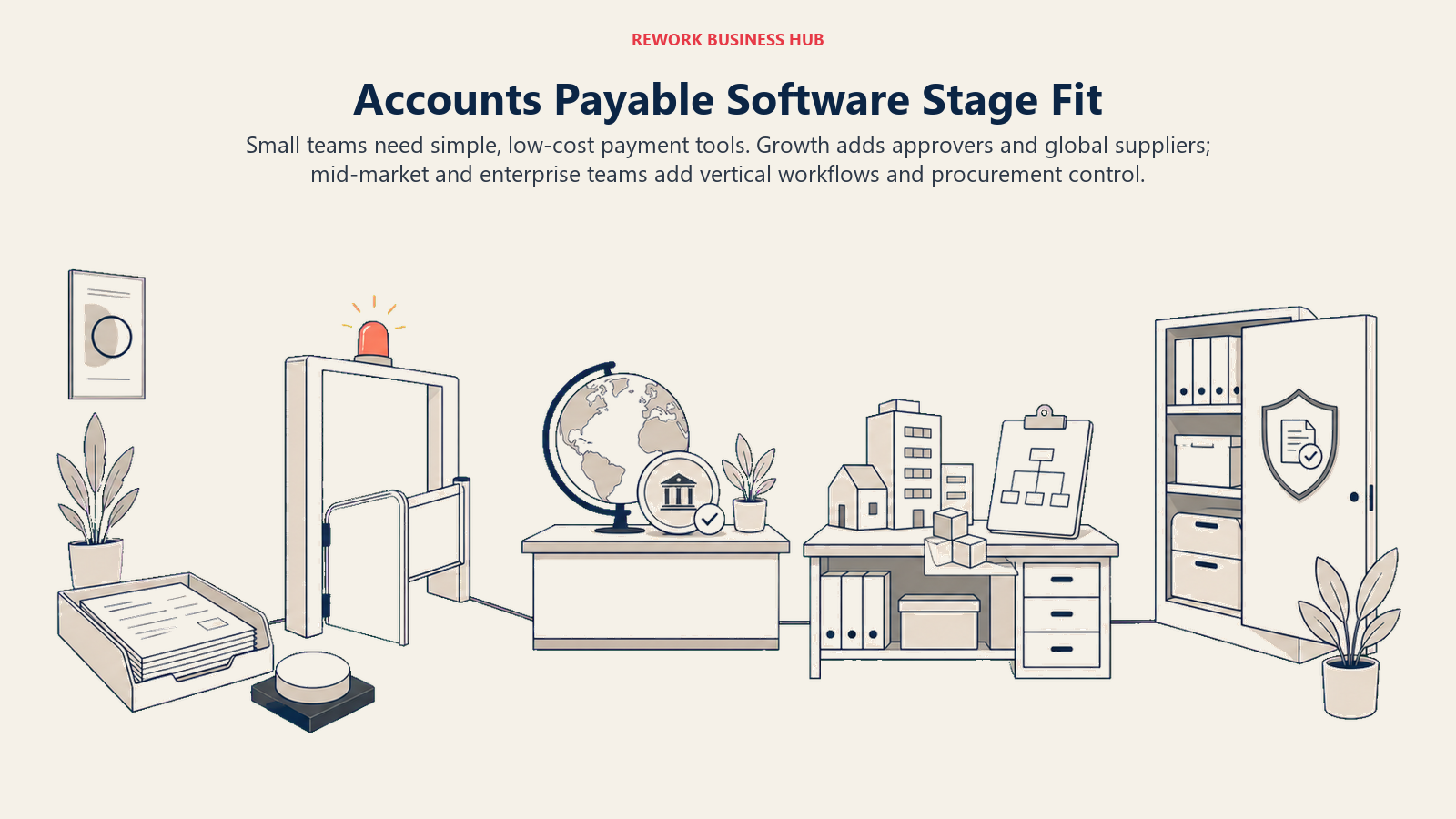
| Company stage | Strongest fits | Why |
|---|---|---|
| Under 10 people, first AP tool | Melio, Zoho Books | Flat or near-flat cost, nothing to implement |
| 10 to 50, US-only | Ramp, Melio Unlimited, Rho | Free or flat software, fast setup, no seat rationing |
| 50 to 200, growing approver count | Ramp, Brex, Stampli | Cards plus AP together, or fix only the invoice workflow |
| 50 to 200, international suppliers | Tipalti, Payhawk | Real cross-border payout and multi-entity handling |
| 200 to 1,000, mid-market verticals | AvidXchange, Corpay Complete, Stampli | Supplier networks and vertical workflow depth |
| 1,000+, procurement-led | Coupa | Sourcing, contracts, and AP as one governed process |
| Already on Paylocity payroll | Airbase (Paylocity for Finance) | Vendor consolidation with one commercial relationship |
Sizing and Persona Table
| Tool | Team size sweet spot | Primary buyer | Who else signs off |
|---|---|---|---|
| Tipalti | 50 to 1,000 | Controller | CFO, Tax |
| Stampli | 50 to 1,000 | AP manager | Controller |
| Ramp | 10 to 500 | CFO or founder | Controller |
| Melio | 1 to 50 | Founder or bookkeeper | Accountant |
| Brex | 20 to 500 | CFO | Controller, Treasury |
| AvidXchange | 100 to 2,000 | AP director | CFO, IT |
| Payhawk | 50 to 1,000 | Finance director | Group CFO |
| Rho | 10 to 300 | CFO or founder | Treasury |
| Coupa | 1,000+ | CPO or CFO | IT, Legal, Procurement |
| Airbase (Paylocity) | 100 to 1,000 | Controller | CFO, HR |
| Spendesk | 50 to 500 | Finance director | CFO |
| Corpay Complete | 200 to 5,000 | AP director | Treasury, CFO |
| Zoho Books | 1 to 25 | Founder or bookkeeper | Accountant |
1. Tipalti - The Global Payables Upgrade BILL Cannot Match
Tipalti is the answer when the reason you are leaving BILL is a map. It was built for companies paying large numbers of suppliers, partners, and creators across borders, and the supplier side is where it separates: vendors onboard themselves through a portal, submit their own banking details, and complete their own tax forms before a payment is ever queued.
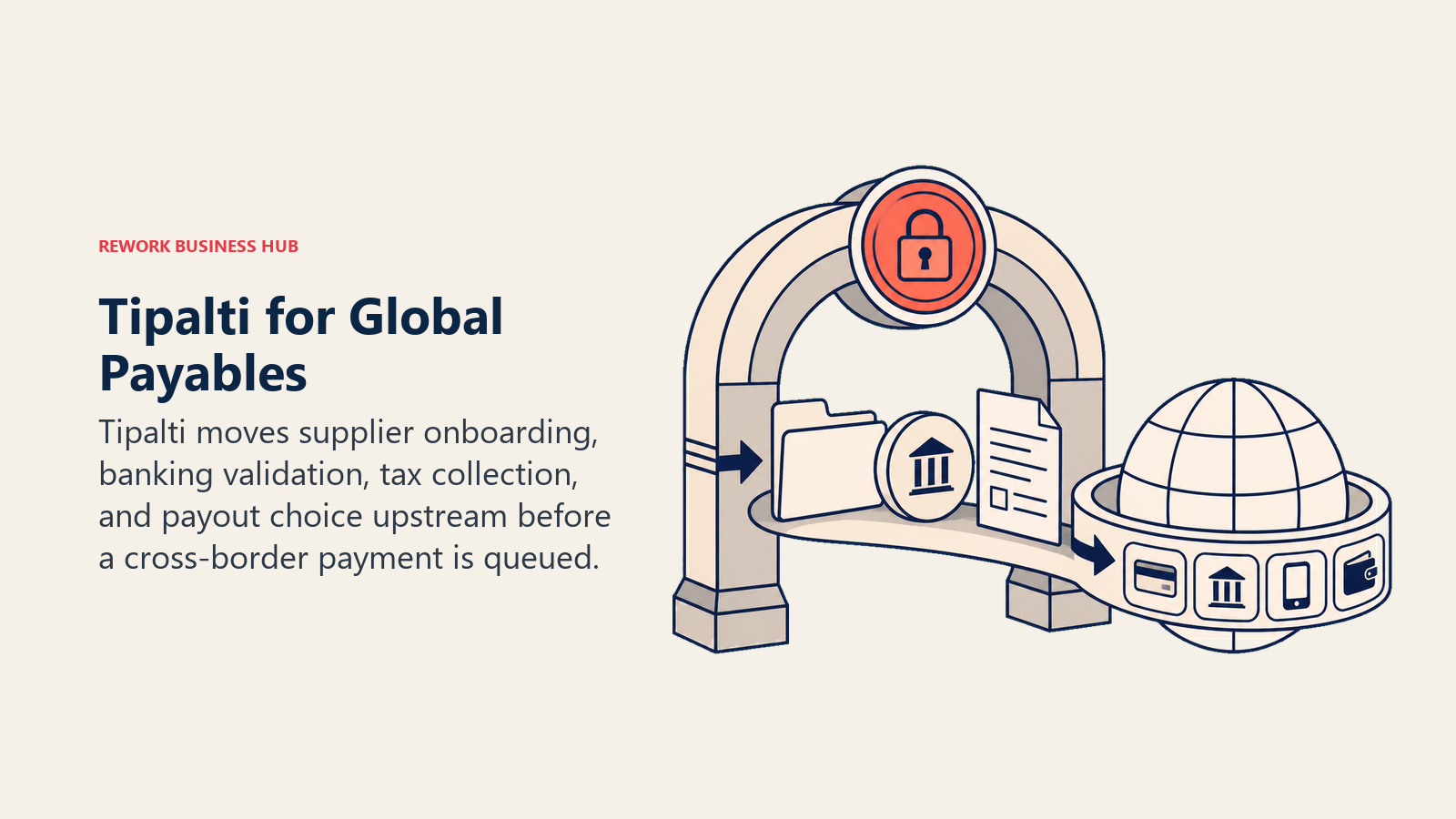
Methodology: Tipalti treats supplier data collection as the first stage of AP rather than an afterthought. Tax form collection, banking validation, and payment method selection all happen on the supplier's side, which removes the manual chase that makes cross-border payments slow.
Target audience: Finance teams at 50 to 1,000 people with international suppliers, multiple entities, or high supplier counts. Marketplaces, ad networks, gaming, and e-commerce show up disproportionately in its customer base.
| Pros | Cons |
|---|---|
| Genuinely deep cross-border payout coverage | Heavier than SMB tools, real implementation effort |
| Supplier self-onboarding removes manual data chasing | Full pricing requires a quote |
| Tax form collection and validation built in | Overkill for a US-only company with 40 vendors |
| Strong multi-entity and subsidiary handling | Transaction fees sit on top of the plan price |
Pricing: Tipalti publishes starting points rather than full plans. Accounts Payable plans start at $99 per month and Mass Payments starts at $249 per month, both plus transaction fees, with complete pricing quote-based. These are company-level starting prices, not per-user rates, and Tipalti states directly on its pricing page that it does not charge per-user or per-approver fees. Both listed plans include unlimited users, which is the structural opposite of BILL's model.
Best for: Any BILL leaver whose real complaint is a supplier in a country BILL handles awkwardly. If you also run NetSuite, see best NetSuite alternatives before locking the stack.
2. Stampli - Fix the Invoice Workflow Without Replacing the ERP
Stampli takes a narrower swing than most of this list and hits it cleanly. Instead of asking you to move payments, cards, and accounting onto a new platform, it wraps a collaboration layer around each individual invoice: the conversation, the approvals, the coding questions, and the audit trail all live on the invoice itself rather than scattered across email threads.
Methodology: Every question about an invoice happens in the invoice's own thread. Stampli's AI assistant learns your coding and approver patterns over time, and the product is designed to sit on top of an existing ERP without a re-implementation, which is the opposite of Coupa's approach.
Target audience: Companies of 50 to 1,000 that like their ERP, have a real AP function, and are losing time to approval chasing rather than to payment execution.
| Pros | Cons |
|---|---|
| Deploys on top of your existing ERP, not instead of it | No published pricing whatsoever |
| Approval conversations attached to each invoice | Narrower scope than card-led spend platforms |
| Strong AI coding suggestions that improve with use | Payments and cards are add-ons, not the core |
| Fast time to value compared to procure-to-pay suites | Weaker answer if your problem is cross-border payouts |
Pricing: Stampli publishes no prices. Its pricing page is a "Request a Quote" form, and pricing is scoped to invoice volume, entity count, and modules. Treat any figure you find elsewhere as reported rather than confirmed.
Best for: AP teams whose bottleneck is approvals and coding questions, not payment rails. Stampli is also the least disruptive option here if you just re-implemented Sage Intacct and cannot face another project.
3. Ramp - Cards, Expenses, and AP Without a Software Bill
Ramp is the most common landing spot for a US company that wants BILL's AP plus BILL's cards without paying for one of them per seat. Bill pay, expense management, corporate cards, and accounting sync all sit in a free tier, and the close automation is the strongest in the category.
Methodology: Ramp makes money from card interchange and treasury rather than software subscriptions, so the free tier is a real product rather than a trial. Its close tooling pushes coded transactions into your ledger continuously instead of in a month-end batch.
Target audience: US companies of 10 to 500 that run enough card spend for the interchange model to work, and want one platform instead of BILL's two.
| Pros | Cons |
|---|---|
| Free tier covers cards, expenses, and bill pay | US-centric, weaker for multi-country entities |
| Fastest month-end close workflow in this list | The Plus platform fee is not published as a number |
| No per-approver charge on the free tier | Interchange model needs meaningful card volume |
| Clean, modern interface approvers actually use | AP depth is shallower than Tipalti or Stampli |
Pricing: Ramp Free is $0 per user per month. Ramp Plus is $15 per user per month plus a platform fee based on team size, and Ramp does not publish the platform fee amount, so budget for it as an unknown. Annual billing takes 20% off. Enterprise is contact sales.
Best for: US finance teams paying BILL twice, once for AP seats and once in effort for a second product. Already on Ramp and reconsidering? See best Ramp alternatives and Expensify vs Ramp, or Ramp vs Bill.com for these two products compared directly.
4. Melio - Unlimited Approvers, But Only on the Top Plan
Melio exists for the specific complaint that starts most BILL replacement projects: you should not pay more because a fifth person needs to approve an invoice. Melio answers it, but check which plan you are actually pricing. Only the Unlimited plan carries unlimited users, at $80 a month or $64 billed annually. Go is capped at a single user, and Core and Boost each add $10 a month ($8 billed annually) per extra user, so the per-seat problem does not go away until you reach the top tier.
Methodology: Melio keeps the base plan cheap, charges for additional users on every tier below Unlimited, and layers payment fees on individual transactions. Paying a vendor by card who only accepts checks is a signature Melio move, and it is how many small businesses stretch working capital without a credit line.
Target audience: US small businesses and bookkeeping firms with 1 to 50 employees, especially anyone running QuickBooks Online.
| Pros | Cons |
|---|---|
| Unlimited plan removes per-user fees entirely | Approvers cost $10/mo each on Go, Core, and Boost |
| Real free tier with no time limit, capped at 1 user | US-centric, international options are limited |
| Pay by card even where vendors take only checks | Less workflow depth than Stampli or Tipalti |
| Tight QuickBooks Online integration | Not built for multi-entity structures |
Pricing: Go is $0 free forever. Core is $25 per month billed monthly or $20 per month billed annually. Boost is $55 monthly or $44 annually. Unlimited is $80 monthly or $64 annually. Platinum is custom. Only Unlimited includes unlimited users: Go is limited to one user with 5 free ACH payments a month, and Core and Boost add $10 per additional user a month, or $8 billed annually. Payment fees are separate: ACH from a bank account $0.50, check $1.50, wire $10, card 2.9%, international ACH in USD a flat $20, and international card 2.9% plus $20.
Best for: Small US teams where BILL's per-seat math is the entire problem. If your ledger is the other half of the decision, compare QuickBooks alternatives at the same time.
5. Brex - Global Cards and AP on One Record
Brex is the closest thing on this list to a global version of the BILL Spend & Expense plus AP combination. Cards, reimbursements, bill pay, and a business account sit in one platform, and Brex handles employees and entities outside the US far more comfortably than BILL does.
Methodology: Like Ramp, Brex funds the software with interchange and treasury rather than seats, which is why Essentials is free. Its differentiator is breadth of geography and its business account, which lets a company run spend and cash management without a separate banking relationship.
Target audience: Venture-backed startups and multi-entity companies of 20 to 500 with people or subsidiaries in more than one country.
| Pros | Cons |
|---|---|
| Strong multi-country card and reimbursement coverage | Weighted toward venture-backed companies |
| Free Essentials tier with real functionality | AP is less deep than a dedicated AP platform |
| Business account plus spend in one place | Underwriting and account decisions can be opinionated |
| Global entity structures handled natively | Premium adds a per-user cost as headcount grows |
Pricing: Brex Essentials is $0 per user per month. Premium is $12 per user per month. Enterprise is contact sales.
Best for: Companies whose BILL frustration is geography plus product sprawl at once. See best Brex alternatives if Brex is the incumbent you are replacing.
6. AvidXchange - Vertical AP Depth for Mid-Market Operations
AvidXchange is the option most SMB-focused lists skip and most mid-market real estate, construction, and community association finance teams already know. It is built around a large supplier network and around industries where an invoice has to be coded to a property, a job, or a unit before it means anything.
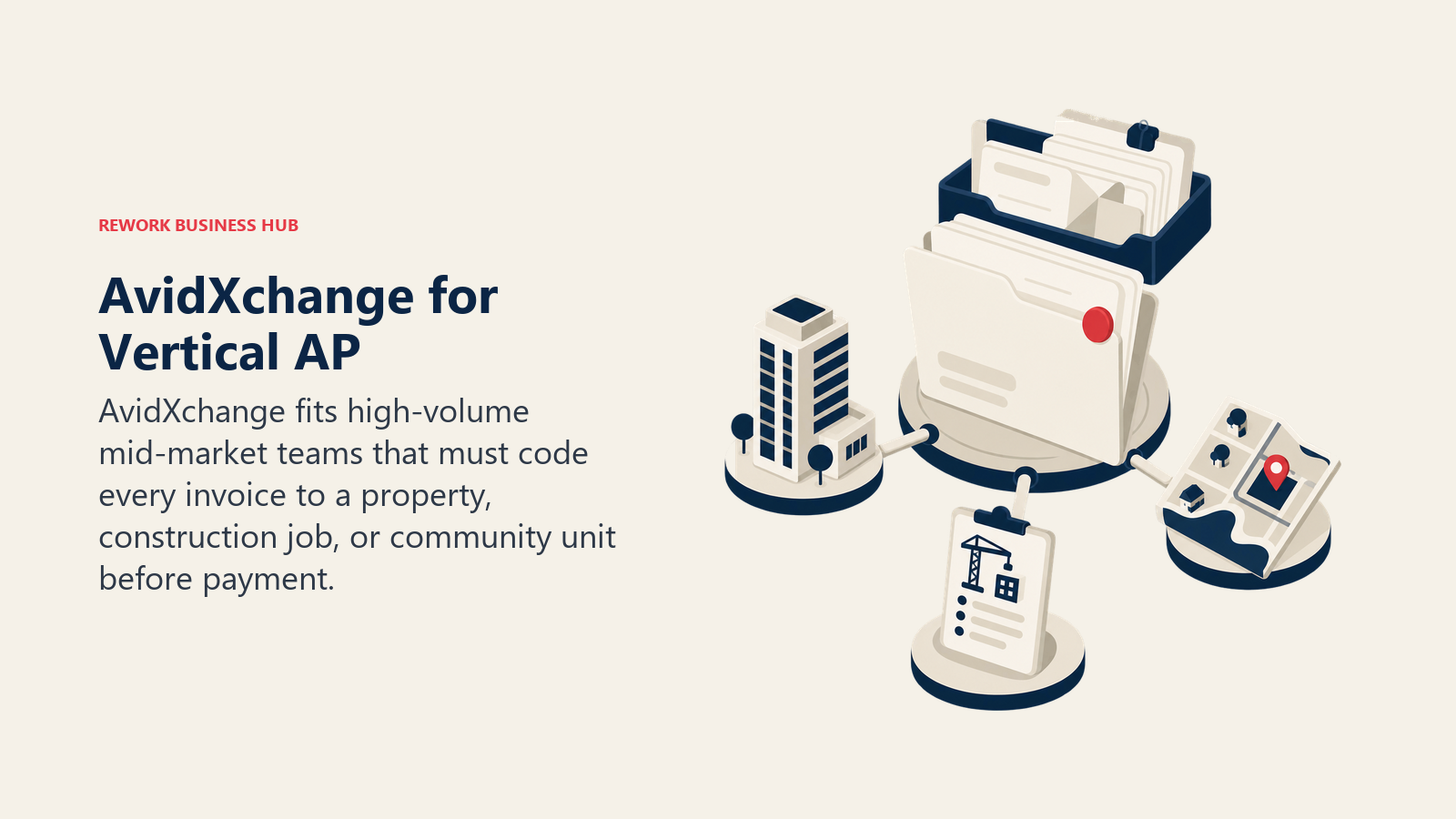
Methodology: AvidXchange pairs invoice automation with its own payment execution and supplier network, and integrates broadly with the vertical accounting systems its customers actually run rather than only the mainstream ledgers.
One ownership note belongs in your evaluation. AvidXchange is no longer a public company: TPG and Corpay closed a take-private acquisition at $10.00 per share on 15 October 2025, valuing it at roughly $2.2 billion, with TPG holding the majority and Corpay taking a minority stake of about 34% (AvidXchange). That matters because Corpay Complete is also on this list, so two entries here now share a shareholder.
Target audience: Mid-market companies of roughly 100 to 2,000 in real estate, construction, HOA and community management, healthcare, financial services, and similar property-heavy or job-costed industries.
| Pros | Cons |
|---|---|
| Vertical workflows for property and job costing | No published list pricing at all |
| Large existing supplier payment network | Per-transaction model needs volume modeling |
| Integrates with vertical accounting systems | Implementation is a project, not a signup |
| Handles high invoice volume comfortably | Interface is functional rather than modern |
Pricing: AvidXchange has no public pricing page and does not publish list pricing. The model is a platform fee plus per-transaction or per-invoice pricing, so your cost is driven by invoice volume rather than seats. Any dollar figure you find in a third-party guide should be treated as (reported) and confirmed in writing before you budget.
Best for: Property managers, contractors, and association managers whose invoice volume is high and whose coding rules are industry-specific.
7. Payhawk - Per-Company Pricing Across Entities
Payhawk answers the seat problem the same way Melio does, but at mid-market scale and across borders. It sells AP, cards and expenses, travel, and procurement as separate modules, each priced per company per month, which means a European group with six entities can add approvers freely.
Methodology: Buy the modules you need rather than a bundle. Because pricing is per company rather than per user, the cost curve flattens exactly where BILL's steepens, and multi-entity consolidation is a first-class feature rather than an enterprise upsell.
Target audience: European and multi-entity companies of 50 to 1,000, particularly groups with subsidiaries across several countries and currencies.
| Pros | Cons |
|---|---|
| Per-company pricing that ignores headcount | High monthly floor for teams under 50 |
| Strong multi-entity and multi-currency handling | Modules stack, so a full deployment adds up |
| Modular buying instead of one forced bundle | Weaker US market presence than Ramp or Brex |
| Cards, AP, travel, and procurement from one vendor | Requires a real implementation conversation |
Pricing: Payhawk publishes per-company monthly starting prices in USD: Accounts Payable from $349 per month, Cards and Expenses from $449 per month, Travel from $299 per month, and Procurement from $499 per month. These are company-level prices, not per-user rates.
Best for: Multi-entity finance teams where BILL's per-seat model becomes untenable at exactly the moment the group structure gets interesting.
8. Rho - AP Software Funded by the Bank, Not by You
Rho makes the most direct financial argument against BILL: the platform costs nothing. There is no subscription fee, no per-user fee, and no charge for same-day ACH, wires, or checks. AP automation, expense management, and accounting automation are all included at $0 because Rho earns its revenue from the banking relationship.
Methodology: Rho bundles a business banking account, corporate cards, treasury, and spend software into one relationship and monetizes deposits, interchange, and FX rather than seats. The pitch is that finance software should be a feature of your bank, not a line item.
Target audience: US companies of 10 to 300 that are willing to consolidate banking and spend with one provider, particularly funded startups holding meaningful cash.
| Pros | Cons |
|---|---|
| $0 platform, $0 per user, $0 domestic payments | Requires moving your banking relationship |
| Same-day ACH, wires, and checks at no cost | Less AP workflow depth than Tipalti or Stampli |
| Treasury built in for idle cash | US-focused, thin for global entity structures |
| Removes both BILL products' costs at once | Vendor concentration risk in one relationship |
Pricing: Rho charges $0 in subscription fees and $0 in per-user fees, with AP, expense, and accounting automation included. FX transfers carry a 1% fee. Treasury runs 0.15% to 0.6% annually depending on deposit size.
Best for: Teams whose BILL invoice looks absurd next to what the software actually does, and who are already open to changing banks.
9. Coupa - Enterprise Procure-to-Pay, Not Just AP
Coupa is a different category of purchase and should be evaluated as one. It covers sourcing, contract management, procurement, invoicing, expenses, and supplier risk as a single governed process, which is what large organizations mean when they say they want to control spend rather than record it.
Methodology: Coupa treats the purchase request as the origin of the invoice. If a purchase was not requested and approved upstream, it should not become a payable downstream, which is a control model BILL does not attempt.
Target audience: Enterprises of 1,000 or more with a real procurement function, multiple ERPs, and compliance obligations that make an uncontrolled purchase a genuine risk.
| Pros | Cons |
|---|---|
| Full source-to-pay coverage in one suite | Enterprise scope, cost, and timeline |
| Strong supplier risk and contract management | Nothing published on pricing |
| Governance that starts before the invoice exists | Requires procurement maturity to pay off |
| Benchmarking data across a large customer base | Wildly oversized for an SMB leaving BILL |
Pricing: Confirm current pricing with Coupa. Pricing is scoped to spend under management, module mix, and entity count. Any figure in a third-party guide is (reported) and unconfirmed.
Best for: Companies whose real gap is procurement governance rather than invoice processing. Our procurement management primer covers the process side before you buy the software.
10. Airbase, Now Paylocity for Finance - The Consolidation Play
Airbase built one of the best guided procurement and multi-step approval experiences in the category, and it is no longer an independent startup. Paylocity acquired it, the site now reads "Airbase, a Paylocity Company," and the product sits inside the Paylocity for Finance line. That changes who it is right for.
Methodology: Airbase's original design put an intake and approval workflow ahead of every dollar, then carried that approval through cards, AP, and reimbursements. Under Paylocity, the same capability is positioned as the finance half of an HR and payroll platform.
Target audience: Existing Paylocity payroll customers of roughly 100 to 1,000 who want spend and payroll under one commercial relationship rather than two.
| Pros | Cons |
|---|---|
| Genuinely strong guided procurement and approvals | No longer an independent product roadmap |
| Cards, AP, and reimbursements in one flow | Best value only if you already run Paylocity |
| One vendor relationship alongside payroll | Quote-only, no published pricing |
| Mature multi-step approval logic | Standalone case is weaker than it was pre-acquisition |
Pricing: Quote-only. Neither Airbase nor Paylocity publishes list pricing for the finance product.
Best for: Paylocity shops. If you do not run Paylocity payroll, the consolidation argument that justifies this choice does not apply to you.
11. Spendesk - No Per-Seat Fee, But No Published Price Either
Spendesk is the European answer to the same seat complaint, and it is unusually explicit about it: the vendor states plainly that it does not charge active user fees. Pricing is a fixed platform fee plus variable transaction fees, which means giving every budget owner access costs nothing extra.
Methodology: Spendesk combines cards, invoice management, expense claims, and approval workflows, then charges for the platform and the transactions rather than the people. For a company where 40 managers each approve a few things a month, that model is structurally cheaper than BILL's.
Target audience: European mid-market companies of 50 to 500 that want card-led spend control with a European accounting and banking fit.
| Pros | Cons |
|---|---|
| Vendor states there are no active user fees | Publishes no prices at all |
| Cards, invoices, and claims in one platform | European fit is stronger than US fit |
| Free card orders and broad budget-owner access | Every evaluation starts with a sales conversation |
| Clean approval experience for non-finance staff | Less AP depth than Tipalti or Stampli |
Pricing: Spendesk publishes no prices. The model is a fixed platform fee plus variable transaction fees, and the vendor states it does not charge active user fees. Get the platform fee and the transaction schedule in writing before comparing.
Best for: European teams whose BILL problem is seats, and who want cards and AP under one European-native vendor.
12. Corpay Complete - Payment Network Economics at Mid-Market Scale
Corpay Complete comes at AP from the payments side rather than the software side. Corpay runs a large commercial payments business, and the AP product is built to route as much of your spend as possible onto payment methods that carry better economics, including virtual cards with rebates and managed cross-border FX.
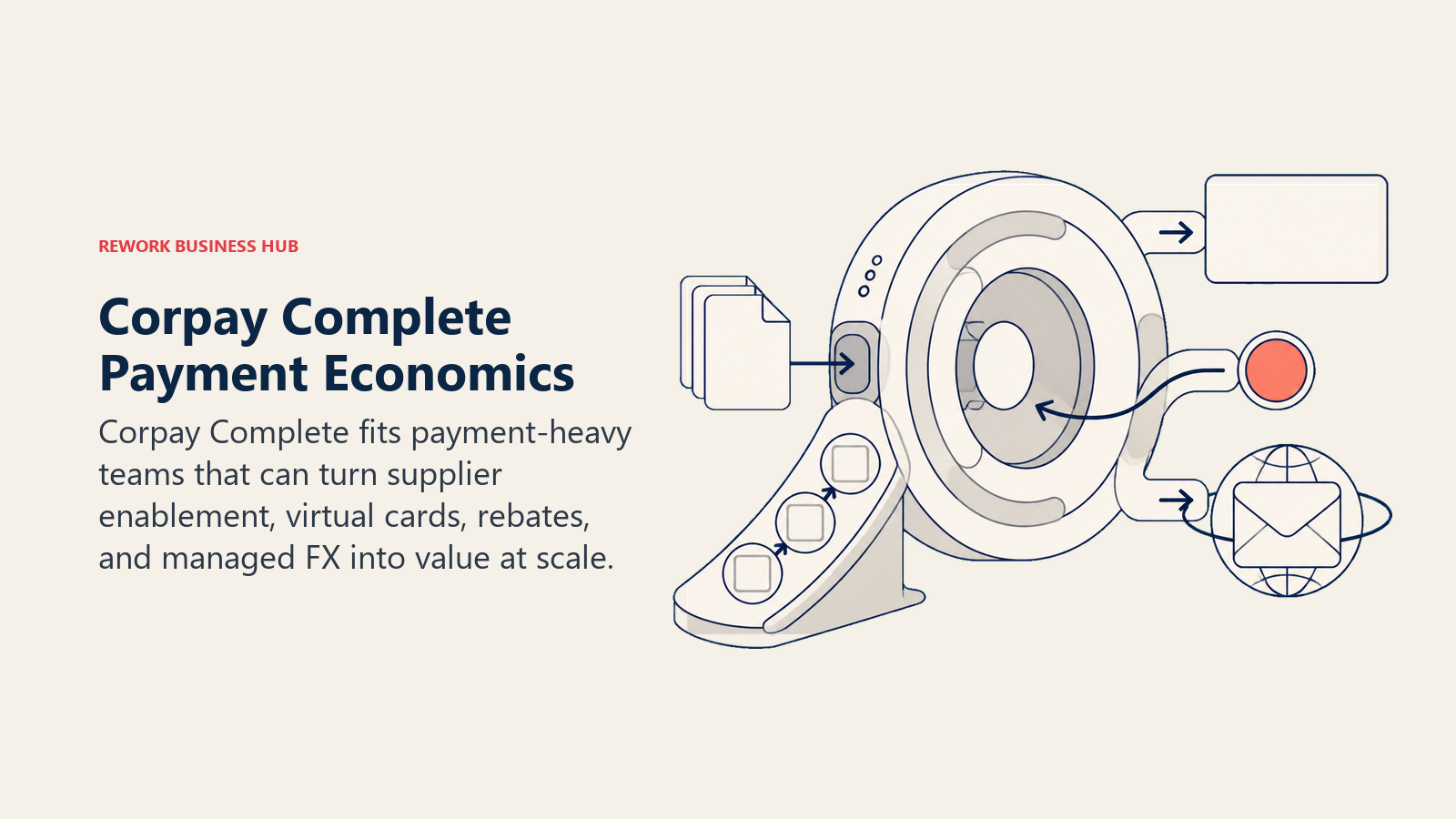
Methodology: The pitch is that AP should not just be cheaper to process, it should generate value on the payment itself. Corpay handles supplier enablement, chasing vendors onto electronic methods, which is the same lever behind the 67.2% supplier e-invoice enablement that best-in-class AP teams reach.
Target audience: Mid-market and larger companies of roughly 200 to 5,000 with high payment volume, meaningful cross-border spend, or a treasury team that cares about FX.
| Pros | Cons |
|---|---|
| Payment network scale and rebate potential | No published list pricing on the site |
| Managed supplier enablement onto electronic payments | Sales-led buying process |
| Strong cross-border and FX handling | Economics depend heavily on your payment mix |
| PO, invoice, and payment automation in one product | Less self-serve than any SMB tool here |
Pricing: Corpay does not publish list pricing for Corpay Complete. Its AP automation pages carry no rate card and route to a sales conversation, though the marketing does note there are no annual fees. Model the rebate assumptions carefully, because that is where the business case usually lives.
Worth knowing before you run both processes: Corpay took a minority stake of roughly 34% in AvidXchange alongside TPG in October 2025. Corpay Complete and AvidXchange are still sold and supported as separate products, but if your shortlist contains both, you are running two evaluations against partially aligned interests rather than two independent bidders.
Best for: AP teams whose payment volume is large enough that payment economics outweigh software cost.
13. Zoho Books - Bills Inside the Ledger, at the Lowest Price Here
Zoho Books is not a dedicated AP platform and should not be sold as one. But for a small company where the honest requirement is vendor bills, purchase orders, and a basic approval step, buying a second product at $49 per user per month is an overreaction, and Zoho Books handles it inside the accounting system for a fraction of that.
Methodology: Bills, purchase orders, vendor records, and approvals live in the same ledger as everything else, so there is no sync to break and no second system to reconcile. The tradeoff is that payment execution depends on regional partners rather than Zoho's own rails.
Target audience: Businesses of 1 to 25 that want AP handled competently rather than optimized, especially anyone already running Zoho One.
| Pros | Cons |
|---|---|
| Cheapest credible option in this comparison | Not a dedicated AP automation platform |
| No sync to break between AP and the ledger | Payment rails depend on region and partner |
| Purchase orders and approvals included | Thin for high invoice volume |
| Included user counts, not pure per-seat pricing | Weak fit above roughly 25 people |
Pricing: Free is $0 for one user plus an accountant. Standard is $20 per month billed monthly or $15 per month billed annually and includes 3 users. Professional is $50 monthly or $40 annually with 5 users. Premium is $70 monthly or $60 annually with 10 users. Elite is $150 monthly or $120 annually, and Ultimate is $275 monthly or $240 annually with 15 users. Extra users are $3 per month, or $2.50 billed annually.
Best for: Small teams whose BILL subscription costs more than their entire accounting stack. See best Zoho Books alternatives and best Xero alternatives if the ledger itself is also in play.
Adjacent Tools Worth Knowing
Three products come up constantly in BILL evaluations without being direct AP replacements.
| Tool | What it actually solves | When to consider it |
|---|---|---|
| Zoho Expense | Employee reimbursement and mileage, not vendor invoices | Your BILL gap is expense claims, not payables |
| Sage Expense Management (formerly Fyle) | Real-time expense feeds on cards you already hold | You keep your bank's corporate cards and want modern expense |
| Sage Intacct AP | Native payables inside a mid-market ERP | You are already implementing Intacct and want fewer systems |
Sage Expense Management is worth flagging for a naming reason: Fyle was acquired by Sage in a deal announced in July 2025 and rebranded, though the product and the fylehq.com domain are unchanged. Its published pricing is Growth at $11.99 per active user per month billed annually with a 5-user minimum, and Business at $14.99 per active user per month billed annually with a 10-user minimum. Zoho Expense publishes Free for up to 3 users, Standard at $4 per user per month billed monthly or $3 billed annually, and Premium at $6 monthly or $5 annually. For a fuller reimbursement comparison, see best Expensify alternatives.
What Changed in This Category Since 2025
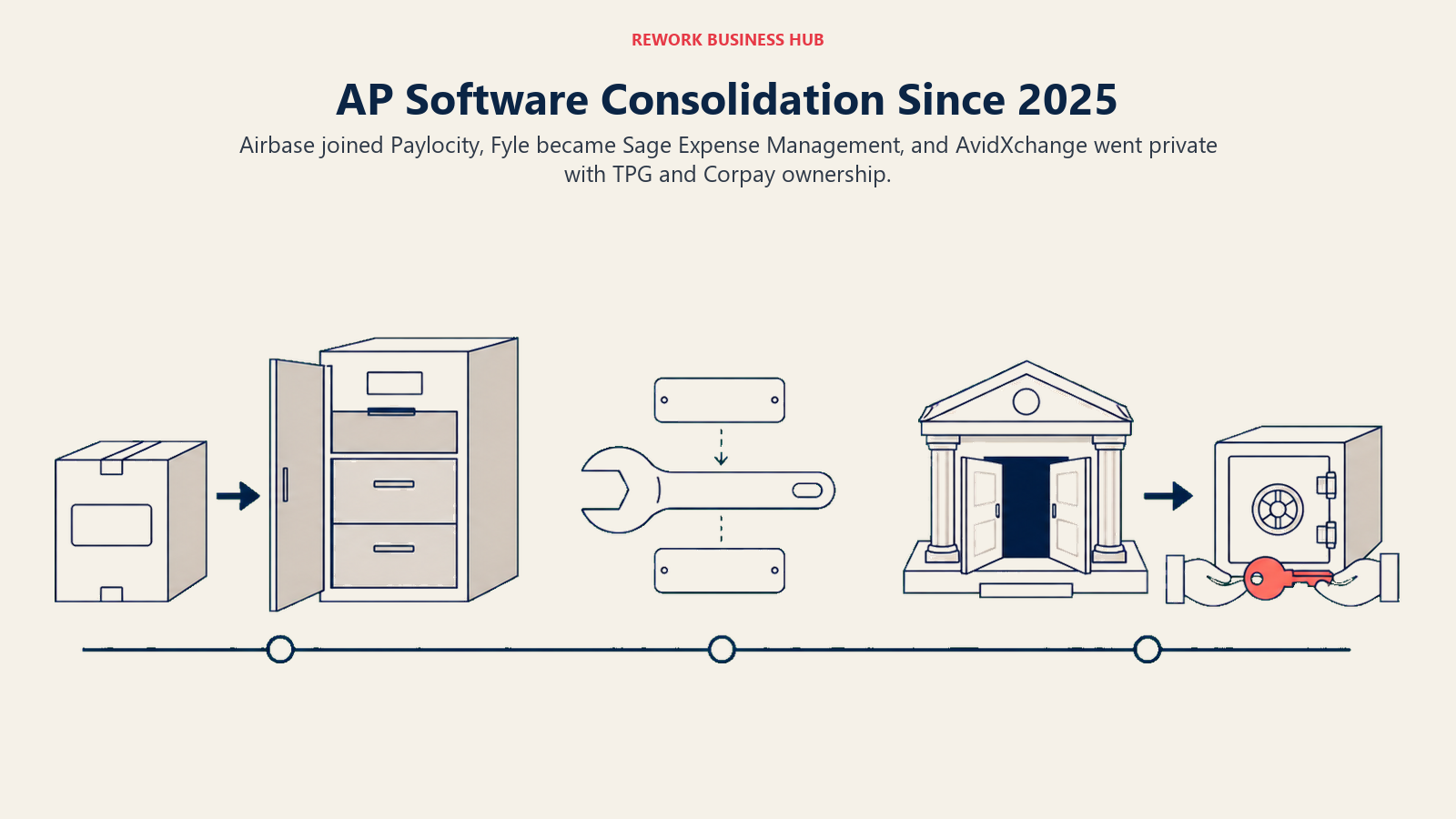
Three of the vendors on this list changed hands or changed names in the last eighteen months, and a shortlist built from an older article will get at least one of them wrong.
| Change | What happened | What it means for your evaluation |
|---|---|---|
| Airbase is now Paylocity | Airbase was acquired by Paylocity and sits inside the Paylocity for Finance line | Judge it as a payroll vendor's finance module, not an independent product |
| Fyle is now Sage Expense Management | Sage announced the acquisition in July 2025 and rebranded the product | Same product and same fylehq.com domain, different roadmap owner |
| AvidXchange went private | TPG and Corpay closed the take-private in October 2025 at roughly $2.2 billion | Corpay holds about 34%, so two vendors here share an investor |
The broader pattern is consolidation. Standalone spend and AP tools are being absorbed into payroll suites, accounting suites, and payments networks, which means the vendor you pick in 2026 may report to a different parent by the time your contract renews. Ask two questions in every demo: who owns this product now, and which team owns the roadmap. Neither question is rude, and both predict your renewal experience better than the feature list does.
True Cost Example: 15 People Who Touch an Invoice
A 100-person company typically has 15 people who need to see, code, or approve an invoice. Here is what one month costs at that number, using each vendor's published rates.
| Platform | Monthly software cost at 15 users | Basis |
|---|---|---|
| BILL Essentials | $735 | $49 per user per month |
| BILL Team | $975 | $65 per user per month |
| BILL Corporate | $1,335 | $89 per user per month |
| Ramp Plus | $225 plus an unpublished platform fee | $15 per user per month |
| Brex Premium | $180 | $12 per user per month |
| Payhawk Accounts Payable | From $349 | Per company, any headcount |
| Melio Boost | $55 monthly or $44 annually | Base plan plus $10 per extra user ($8 annually) |
| Melio Unlimited | $80 monthly or $64 annually | Per company, any headcount |
| Zoho Books Premium | $85 monthly (10 users plus 5 extra at $3) | Included users plus extras |
| Tipalti Accounts Payable | From $99 plus transaction fees | Per company starting price |
| Ramp Free, Brex Essentials, Rho | $0 | Funded by interchange and treasury |
Software cost is not the whole picture. Payment fees, implementation, and the AR functionality BILL includes all belong in the comparison. But a $1,280 monthly gap between BILL Corporate and Melio Unlimited is $15,360 a year, which is real money for a mid-size finance team.
Integration Fit: What Your Accounting Stack Allows
The ledger usually narrows the shortlist faster than the feature list does.
| Your accounting system | Strongest BILL alternatives |
|---|---|
| QuickBooks Online | Ramp, Melio, Rho, Stampli, Brex |
| Xero | Ramp, Melio, Payhawk, Spendesk |
| NetSuite | Tipalti, Stampli, Payhawk, Coupa, Corpay Complete |
| Sage Intacct | Tipalti, Stampli, AvidXchange, Payhawk |
| Zoho Books | Zoho Books native AP, Zoho Expense |
| Microsoft Dynamics 365 Business Central | Stampli, Payhawk, Coupa |
| Vertical systems (property, construction) | AvidXchange, Corpay Complete |
If you are mid-migration on the ledger itself, settle that first. Choosing AP software around an ERP you are about to leave is how companies end up paying for two implementations in one year.
Buying Mistakes to Avoid
| Mistake | What it costs you |
|---|---|
| Comparing BILL Spend & Expense to a paid AP tool | You conclude BILL is free when your actual bill is the AP seats |
| Ignoring payment fees because software is $0 | Melio, Tipalti, and Corpay all carry per-transaction economics |
| Counting only finance seats | Approvers are the users that make per-seat pricing expensive |
| Buying procure-to-pay for an invoice problem | Coupa-class implementations take months you did not budget |
| Assuming a reported price is a real price | Stampli, Coupa, AvidXchange, Spendesk, Airbase, and Corpay publish nothing |
| Dropping BILL's AR side without a plan | Few alternatives here handle customer invoicing and collections |
That last one catches people. BILL does AP and AR in one subscription, and almost nothing on this list replaces the AR half. If you use BILL for collections, price a separate AR tool into the comparison before you call the switch a saving.
What BILL Still Does Best
| BILL strength | Who it matters for |
|---|---|
| AP and AR in one product | Companies that bill customers and pay vendors from one system |
| The largest accountant and bookkeeper channel in SMB | Firms whose outsourced accountant already works in BILL |
| A mature, proven approval and audit trail | Auditors and controllers who need a defensible record |
| Free Spend & Expense card program next to paid AP | Teams that want cards without another software line item |
| Credit lines from $1,000 up to $5M on Spend & Expense | Growing companies needing working capital with the cards |
| Deep QuickBooks, Xero, NetSuite, and Sage Intacct sync | Anyone whose ledger integration is non-negotiable |
If your accountant runs your books inside BILL, if you use the AR side seriously, and if 5 seats covers your approvers, staying is a defensible call. AI is starting to change the coding and matching work at the center of AP, and our AI agents for finance overview covers what is real versus roadmap, on BILL and on every alternative here.
Decision Framework
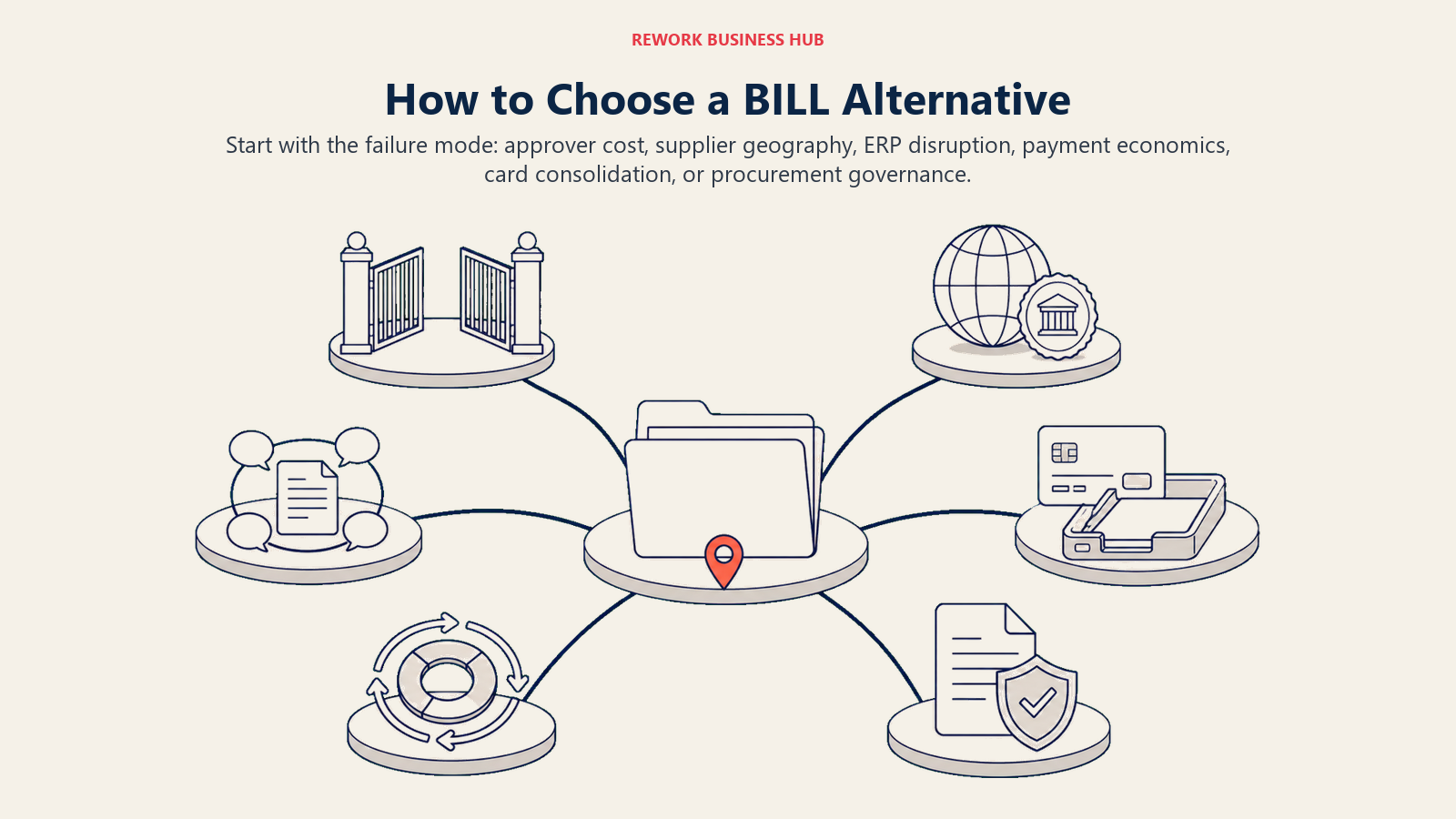
Start with the failure mode, not the vendor list. Seat cost, supplier geography, ERP disruption, payment economics, and procurement scope lead to different shortlists.
| If you need... | Pick | Why |
|---|---|---|
| To stop paying per approver, at small scale | Melio Unlimited | $80 per month, or $64 billed annually, unlimited users |
| To stop paying per approver, at mid-market scale | Payhawk | Per-company modules from $349 per month, multi-entity native |
| Serious international supplier payouts | Tipalti | Supplier self-onboarding, tax collection, cross-border rails |
| Better approvals without replacing your ERP | Stampli | Sits on top of your existing accounting system |
| Cards, expenses, and AP in one free US platform | Ramp | Free tier covers all three, strongest close automation |
| The same breadth across multiple countries | Brex | Global cards and reimbursements plus a business account |
| Zero software cost and a banking relationship to match | Rho | $0 platform, $0 per user, $0 domestic payments |
| Vertical AP for property, construction, or HOA | AvidXchange | Job and property coding with a large supplier network |
| Payment economics and rebates on high volume | Corpay Complete | Payments network scale plus supplier enablement |
| Procurement governance, not just invoice processing | Coupa | Source-to-pay control that starts before the invoice |
| No per-seat fee with a European fit | Spendesk | Vendor states no active user fees |
| Spend and payroll from one vendor | Airbase (Paylocity) | Only worth it if you already run Paylocity |
| Basic bills handled inside your accounting | Zoho Books | Standard at $15 per month annually including 3 users |
| To stay put | BILL | AP and AR together, an accountant channel your firm already uses, and a free card product beside it |
Frequently Asked Questions about Bill.com Alternatives
What is the best Bill.com alternative in 2026?
It depends on which BILL problem you have. Tipalti is the strongest choice for international supplier payouts, Stampli for fixing approvals without replacing your ERP, Ramp and Brex for folding cards and AP into one free platform, and Melio Unlimited or Payhawk if the per-seat pricing is the whole issue. There is no single winner because BILL loses for four different reasons.
How much does Bill.com actually cost?
BILL's AP and AR product is priced per user per month: Essentials at $49, Team at $65, Corporate at $89, and Enterprise on a custom quote. BILL Spend & Expense, the former Divvy, is $0 per user per month and includes cards, budgets, expense tracking, and credit lines from $1,000 up to $5M. Those are two separate products, and confusing them is the most common pricing mistake buyers make.
Is there a free alternative to Bill.com?
Several. Ramp Free, Brex Essentials, and Rho all charge $0 in software fees and make money from card interchange and treasury instead, and Melio's Go plan is free forever with per-transaction payment fees, though it is capped at a single user. The tradeoff is not a hidden charge, it is that the model only works if meaningful spend or deposits flow through their rails.
Which Bill.com alternative is best for international payments?
Tipalti. Its supplier portal collects banking details and tax forms directly from vendors before a payment is queued, which is the part that makes cross-border AP slow everywhere else. Accounts Payable plans start at $99 per month plus transaction fees, with full pricing quoted. Payhawk is the better answer if your issue is multiple European entities rather than supplier geography.
Can I replace Bill.com without changing my accounting system?
Yes, and Stampli is designed specifically for that: it deploys on top of your existing ERP rather than replacing it. Ramp, Melio, Tipalti, and Payhawk also integrate with mainstream ledgers, though the depth varies. Confirm two-way sync on your specific version before signing, because that is where most integration disappointments start.
Why do so many AP vendors refuse to publish pricing?
Stampli, AvidXchange, Coupa, Spendesk, Airbase, and Corpay Complete all price on invoice volume, entity count, and module mix, so a single list price would not describe what most customers pay. Treat any figure you find in a third-party roundup for these vendors as reported rather than confirmed, and get a written quote before you build a budget around it.
How much does manual accounts payable actually cost?
Companies without AP automation pay an average of $12.88 per invoice and take 17.4 days to process one, per Ardent Partners' State of ePayables research. Best-in-class teams clear an invoice in 3.1 days and run a 9% exception rate against an industry average of 22%, which is where duplicate and mismatched invoices tend to hide.
Does switching AP software reduce payment fraud risk?
It reduces some kinds. 76% of US organizations faced attempted or actual payments fraud in 2025 and 58% saw attempts on checks specifically, per the 2026 AFP Payments Fraud and Control Survey, so moving vendors off paper checks onto ACH, virtual cards, or a managed supplier network removes the most attacked channel. It does not address internal risk, which still needs separation of duties and approval limits regardless of platform.
What happens to BILL's AR features if I switch?
You usually lose them. BILL includes customer invoicing and collections alongside payables, and almost none of the alternatives here replace that half. If you use BILL for AR, price a separate invoicing or collections tool into your comparison, or the switch will look cheaper on paper than it is in practice.
What to Do Next
Start by naming which BILL you are replacing. Write one sentence: "our problem is the per-seat AP bill," or "our problem is international suppliers," or "our problem is running two BILL products." That sentence eliminates nine of the thirteen options above before you book a single demo.
Then run a two-week parallel test with your top two, not a demo. Push 20 real invoices through each: one from an international supplier, one that needs three approvals, one duplicate you know should be caught, one with a PO mismatch, and one urgent payment. Sync all 20 to your accounting system and count what needed manual fixing on the other side. The one with the fewest corrections wins, whatever the sales deck said.
If seats are the issue, start with Melio or Payhawk. If geography is the issue, start with Tipalti. If you want cards and AP in one free platform, start with Ramp or Brex. And before you sign anything, get the transaction fee schedule in writing, because that is the number that is missing from every comparison table including this one.
Camellia writes about finance and spend tooling for B2B teams. Last updated August 2026.

Principal Product Marketing Strategist
On this page
- Key Facts
- Quick Comparison Table
- Why Companies Actually Leave BILL
- Understand BILL's Two Products Before You Compare Anything
- Pricing Models: The Part Buyers Get Wrong
- Stage Fit Matrix
- Sizing and Persona Table
- 1. Tipalti - The Global Payables Upgrade BILL Cannot Match
- 2. Stampli - Fix the Invoice Workflow Without Replacing the ERP
- 3. Ramp - Cards, Expenses, and AP Without a Software Bill
- 4. Melio - Unlimited Approvers, But Only on the Top Plan
- 5. Brex - Global Cards and AP on One Record
- 6. AvidXchange - Vertical AP Depth for Mid-Market Operations
- 7. Payhawk - Per-Company Pricing Across Entities
- 8. Rho - AP Software Funded by the Bank, Not by You
- 9. Coupa - Enterprise Procure-to-Pay, Not Just AP
- 10. Airbase, Now Paylocity for Finance - The Consolidation Play
- 11. Spendesk - No Per-Seat Fee, But No Published Price Either
- 12. Corpay Complete - Payment Network Economics at Mid-Market Scale
- 13. Zoho Books - Bills Inside the Ledger, at the Lowest Price Here
- Adjacent Tools Worth Knowing
- What Changed in This Category Since 2025
- True Cost Example: 15 People Who Touch an Invoice
- Integration Fit: What Your Accounting Stack Allows
- Buying Mistakes to Avoid
- What BILL Still Does Best
- Decision Framework
- What to Do Next