Best Sage Intacct Alternatives in 2026: 12 Cloud Accounting and ERP Tools

Turn this article into takeaways for your work.


Each assistant summarizes the article only for you and suggests best practices for your work.
Sage Intacct earns its reputation. Its dimensional general ledger, true multi-entity consolidation, and AICPA-preferred financial management designation make it the gold standard for mid-market cloud accounting. Controllers at professional services firms, nonprofits with grant tracking needs, and CFOs managing multiple subsidiaries genuinely love it. If your primary problem is GAAP-compliant financial reporting at scale, Sage Intacct solves it better than almost anything at the price point.
But "best-in-class financials" and "right tool for your business" don't always overlap. If you're a controller evaluating a renewal or a finance director who's been asked to cut the software budget, the triggers are familiar: annual contract renewals that climb 15-25% each cycle, module and add-on costs that inflate the base price substantially, limited native operational depth outside the GL (no inventory, no project execution, no sales workflows), and implementation complexity that demands a partner on retainer. Controllers, CFOs, and finance directors at scaling mid-market firms often realize they need either more ERP breadth or a leaner accounting stack, depending on which direction the gap runs. The 12 platforms below cover both ends of that spectrum.
If you're also evaluating the broader ERP and financial management landscape, the best NetSuite alternatives guide covers the full mid-market ERP field from a different angle, and best Dynamics 365 alternatives is worth reading if your IT team is already in the Microsoft ecosystem. For teams moving down in complexity rather than up, best QuickBooks alternatives and best Xero alternatives cover the right options at lower price points.
Quick Comparison Table
| Tool | Best For | Starting Price | Key Strength | Key Limitation |
|---|---|---|---|---|
| Oracle NetSuite | Full ERP, multi-entity, growing mid-market | $999/mo base + $129-199/user/mo | Broadest cloud ERP scope in one platform | Six-figure implementation, Oracle pricing complexity |
| Microsoft Dynamics 365 Business Central | Mid-market on Microsoft stack | $80/user/mo (Essentials) | Microsoft ecosystem, strong financials + operations | Implementation cost, partner dependency |
| Acumatica | Distribution, field services, unlimited users | Custom quote ($25K-$75K+/yr) | Consumption-based pricing, no per-user fees | Dated UI, steep learning curve |
| QuickBooks Online/Enterprise | US SMB, familiar accounting | $1,873/yr (1 user, Enterprise) | Widest US accountant ecosystem, easy adoption | Not mid-market ERP, desktop-first architecture |
| Xero | Small teams stepping away from complexity | $25/mo (Early) to $90/mo (Established) | Clean UX, unlimited users, strong integrations | Not an ERP, very limited multi-entity |
| SAP Business One | Manufacturing, distribution, SMB/mid-market | $91/user/mo (Professional, cloud) | Deep inventory, BOM, production planning | Partner-only sales, dated UX, high TCO |
| Odoo | Full ERP scope, open-source flexibility | Free (community) / $25+/user/mo (Enterprise) | Modular, broadest app coverage, low software cost | Requires developer for serious deployments |
| Workday Financial Management | Enterprise, 1,000+ employees | Custom quote ($150-250/employee/yr) | Best-in-class GL for large enterprise, HCM integration | Way too expensive and complex for mid-market |
| Certinia (FinancialForce) | Salesforce-native professional services | $150-350/user/mo (requires Salesforce) | Native Salesforce data model, PSA + ERP unified | Mandatory Salesforce license, narrow ICP |
| Zoho Books | SMB with tight budget, growing team | $20/mo (Standard) to $275/mo (Ultimate) | Best value for full accounting feature set | Not mid-market ERP, limited multi-entity |
| Multiview ERP | Nonprofits, healthcare, public sector finance | Custom quote ($75K-$200K+/yr) | Fund accounting, grant tracking, audit trails | Low brand awareness, narrow vertical focus |
| FreshBooks | Freelancers, small service businesses | $23/mo (Lite, monthly) | Clean invoicing UX, strong time-tracking | Not accounting software for mid-market use |
1. Oracle NetSuite: Full Cloud ERP for the Mid-Market
NetSuite is the most direct replacement if you're leaving Sage Intacct because you need more than a best-in-class GL. It's a genuine cloud ERP: financials, inventory, CRM, order management, procurement, project accounting, and e-commerce under one platform. Where Sage Intacct is finance-first and integrates outward, NetSuite is designed to be the system of record across the whole business.
The product vision is consolidation. Oracle built it for companies that have outgrown a patchwork of QuickBooks plus spreadsheets plus a CRM, or for mid-market firms that need one source of operational and financial truth. The multi-entity and multi-subsidiary support is genuine and mature, and the dimensional reporting (albeit different from Intacct's dimensions approach) is deep.
The honest caveat: NetSuite is expensive, and the complexity scales with your requirements. Base platform fees start around $999/month before user licenses ($129-199/user/month) and module add-ons. Implementation projects routinely run $50K-$200K+ with a SuiteCloud partner. If you're leaving Intacct specifically because of cost, NetSuite won't fix that. If you're leaving because you need more operational ERP depth alongside your financials, it's the strongest replacement at the same tier. See the full best NetSuite alternatives guide for a breakdown of what it competes against.
| What you get | What you don't |
|---|---|
| Full ERP: financials, inventory, CRM, procurement | Simple pricing or predictable renewal costs |
| True multi-entity, multi-currency consolidation | Fast implementation without a partner |
| SuiteAnalytics for cross-functional reporting | A cheaper option at this level of scope |
| 200+ SuiteApps for vertical and functional extensions | Modern UI without customization investment |
| Revenue recognition (ASC 606 and ASC 808) | Easy migration out once you're embedded |
Pricing: $999/month platform fee + $129-199/user/month. Annual contracts, negotiated. Typical mid-market total: $60K-$200K+/year. See NetSuite's ERP product page for module details before entering a sales conversation.
Best for: Growing mid-market companies ($15M-$250M revenue) that need full ERP scope, not just best-in-class accounting.
2. Microsoft Dynamics 365 Business Central: Mid-Market ERP for the Microsoft Stack
Business Central is Microsoft's cloud ERP for small and mid-size businesses, and it's matured substantially over the past two years. The 2025 pricing increase (first in five years) brought Essentials to $80/user/month and Premium to $110/user/month, a transparent, published rate that contrasts sharply with Sage Intacct's opaque negotiated pricing. For companies already running Microsoft 365, Teams, and Power BI, the integration story is genuinely tight.
The philosophy is "ERP that lives inside your Microsoft ecosystem." Financial management, purchasing, inventory, project management, and supply chain are all available without leaving the Microsoft stack. Power Automate handles workflow automation. Power BI handles reporting. Azure AI features are rolling in via Copilot. If your IT team is already in Azure and your finance team uses Excel, the adoption curve is lower than most alternatives.
Business Central hits a real sweet spot for manufacturing and distribution companies (30-300 employees) that need ERP breadth but can't justify a full Dynamics 365 Finance and Operations deployment. It's not as strong as Sage Intacct on pure accounting depth (the dimensional reporting and multi-entity consolidation are less mature), but it adds inventory, production, and service management that Intacct lacks natively. The best Dynamics 365 alternatives guide covers the broader Microsoft ERP stack.
| What you get | What you don't |
|---|---|
| Published, transparent per-user pricing | Sage Intacct-level dimensional accounting depth |
| Native Microsoft 365, Teams, and Power BI integration | Fast implementation (partner dependency is real) |
| Inventory, manufacturing, and project management | Multi-entity consolidation as mature as Intacct |
| Copilot AI features across financial workflows | Simple licensing (Essentials vs. Premium is just the start) |
| Strong global ISV ecosystem via AppSource | Low TCO: implementation adds $40K-$100K+ |
Pricing: Essentials at $80/user/month, Premium at $110/user/month, Team Members at $8/user/month. See Microsoft's Business Central pricing page for current rates.
Best for: Mid-market companies (30-300 employees) already in the Microsoft ecosystem that need ERP breadth beyond pure accounting.
3. Acumatica: Consumption-Based ERP with Unlimited Users
Acumatica's core differentiator is pricing structure. It doesn't charge per user seat. It charges based on transaction volume and the resources your instance consumes, which means your entire team can have system access without the license math that drives up Sage Intacct and NetSuite costs as headcount grows. For companies with large field teams, warehouse workers, or seasonal staff, this changes the economics significantly.
The product is genuinely strong in distribution, manufacturing, field services, and construction. Project accounting is a real strength: time tracking, billing milestones, budget-to-actual variance, and intercompany project allocations are all mature. Multi-entity is solid. The financial core handles GAAP requirements, though the dimensional reporting isn't as elegant as Sage Intacct's.
The honest trade-off is implementation and UX. Acumatica's interface hasn't received the same modernization investment as newer cloud-native tools, and getting it configured correctly requires an authorized Acumatica partner (the partner channel is mandatory, like SAP). Implementation projects run 3-9 months depending on scope. But if your Sage Intacct renewal cost is the problem, Acumatica's consumption model is worth understanding in detail: a company with 80 users paying for 80 named Intacct seats may pay significantly less with Acumatica at the right transaction tier.
| What you get | What you don't |
|---|---|
| Unlimited users at each consumption tier | Modern, intuitive UX |
| Strong distribution, manufacturing, construction modules | Fast self-service implementation |
| Deep project accounting and job costing | Published list pricing (requires partner quote) |
| Open API and native mobile apps | Low entry cost (starts ~$25K+/year) |
| True cloud multi-tenant architecture | CRM depth comparable to dedicated tools |
Pricing: Consumption-based, custom quote via Acumatica's pricing page. Typical mid-market: $25K-$75K/year. Implementation: $30K-$150K+.
Best for: Distribution, field services, manufacturing, and construction companies (50-500 employees) where unlimited user access changes the per-head cost math.
4. QuickBooks Online / Enterprise: US SMB Accounting with Broad Ecosystem
QuickBooks isn't the right comparison if you're a $50M multi-entity manufacturer leaving Sage Intacct. But it's the right comparison for a $5M-$15M US services firm that chose Intacct too early and is now paying $30K/year for financial sophistication they don't yet need. QuickBooks Enterprise starts at $1,873/year (1 user, Silver plan) and scales to $5,364/year for larger teams, a fraction of mid-market Intacct pricing.
The product philosophy is accessibility. QuickBooks built its reputation on accountant familiarity: millions of US CPAs and bookkeepers know the interface, which makes hiring, outsourcing, and year-end audit processes straightforward. Enterprise adds inventory bin tracking, serial and lot numbers, advanced pricing rules, and industry editions (contractor, retail, manufacturing) that the online version lacks.
The ceiling is architecture. QuickBooks Enterprise is desktop-first with a hosted access layer added on top. It doesn't handle true multi-entity consolidation, doesn't scale well above 30-40 concurrent users, and international capabilities are weak. If you're at $20M+ revenue with multiple entities and a sophisticated finance team, you've likely already outgrown it. The best QuickBooks alternatives guide covers what teams typically move to next.
| What you get | What you don't |
|---|---|
| Widest US accountant and bookkeeper ecosystem | True cloud-native architecture |
| Advanced inventory: bin, serial, lot tracking | Multi-entity consolidation |
| Industry editions with tailored workflows | More than 30-40 concurrent users |
| US payroll and tax compliance built-in | International and multi-currency depth |
| Low starting price, familiar UI | Scalability beyond $30M-$50M revenue |
Pricing: Enterprise Gold from $2,210/year, Platinum from $2,717/year, Diamond from $5,363/year, all rising with the number of simultaneous users. QuickBooks Online Simple Start from $38/month. See Intuit's Enterprise pricing page for current plan details.
Best for: US-based SMBs ($1M-$20M revenue) with physical inventory or moderate complexity that want accounting depth without ERP overhead.
5. Xero: Clean Accounting for Small Teams Moving to Simplicity
Xero isn't a Sage Intacct replacement for most mid-market buyers. But for a meaningful segment of companies reviewing their Intacct contract, the honest answer is that they need less, not more. If you're a 15-40 person professional services firm, SaaS startup, or agency that ended up on Intacct through acquisition or overly ambitious procurement, Xero covers your actual accounting needs at $25-$90/month.
Xero's product philosophy is modern accounting for small business: clean bank reconciliation, invoicing, expense tracking, and financial reporting in a UI that accountants and non-accountants alike can use. Unlimited users are included at every plan tier, which matters for growing teams. The integration ecosystem (Stripe, Shopify, Gusto, Hubspot, 1,000+ apps) is tight and well-maintained.
What Xero genuinely doesn't do: multi-entity consolidation of any real depth, inventory management beyond basics, project accounting, or the dimensional reporting that Intacct excels at. If those features drove your Intacct purchase, Xero won't fill the gap. If they didn't, it will save you $20K-$40K/year. For a detailed comparison of where Xero ends and other tools begin, see the best Xero alternatives guide.
| What you get | What you don't |
|---|---|
| Clean, modern accounting UX | Multi-entity consolidation |
| Unlimited users at every plan tier | Inventory management of meaningful depth |
| 1,000+ app integrations via Xero marketplace | Project accounting or budget-to-actual tracking |
| Strong bank reconciliation and invoicing | Dimensional reporting or custom GL structures |
| Transparent published pricing | Scalability beyond 50-100 employees |
Pricing: Early at $25/month (limited invoices/bills), Growing at $55/month (unlimited), Established at $90/month. See Xero's pricing page for current plans.
Best for: Small teams (5-40 employees) that want excellent accounting basics at a fraction of Intacct's cost, and don't need multi-entity or dimensional GL.
6. SAP Business One: SMB ERP for Manufacturing and Distribution
SAP Business One occupies a specific niche: SAP-grade operational depth (inventory, BOM, production, procurement) for companies that can't justify SAP S/4HANA's price tag. Companies in manufacturing, wholesale distribution, food and beverage, and light industrial use it because the supply chain and production modules are genuinely strong, and the brand carries weight in global subsidiary environments where the parent company runs SAP.
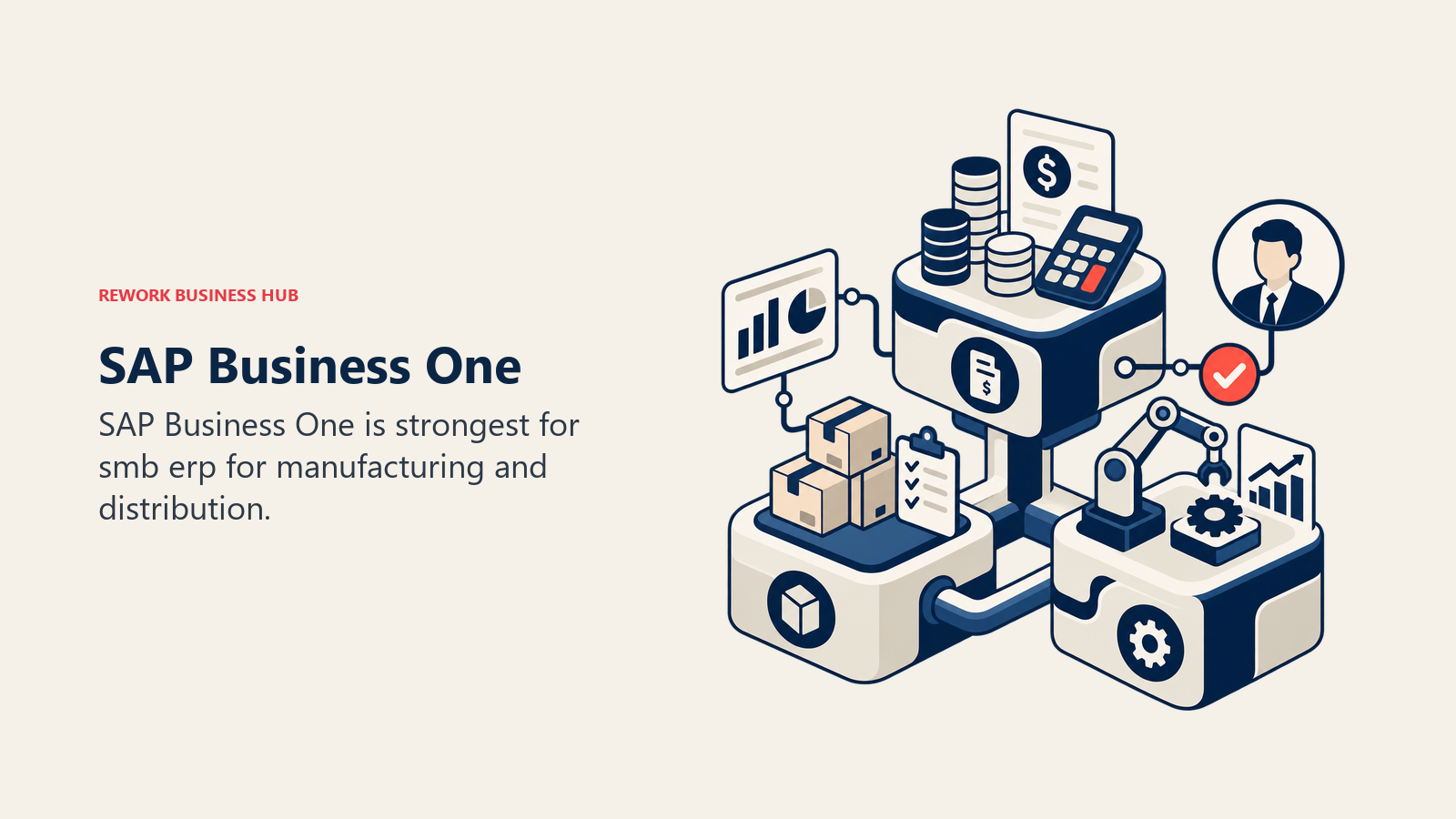
The product vision is "real ERP for growing manufacturers." Where Sage Intacct is finance-first and integrates with other systems for operations, SAP Business One covers the operational layer natively. BOM, production orders, MRP, multi-warehouse management, and landed cost tracking are all built in. Cloud subscription via an SAP partner starts at $91/user/month (Professional license), comparable to Intacct per-user costs, but covering operational modules that Intacct charges add-ons for.
The trade-offs are UX and implementation. SAP Business One still feels like an on-premise product adapted for cloud. The interface hasn't modernized at the rate of cloud-native competitors. Customization requires an ABAP or SDK-familiar developer, and implementation always flows through SAP's partner channel. For companies considering it, the best SAP Business One alternatives guide is worth reviewing alongside.
| What you get | What you don't |
|---|---|
| Strong BOM, MRP, production orders, multi-warehouse | Modern UX or fast self-service setup |
| Procurement and purchase order workflow | Native cloud-first architecture |
| Available on-premise or SAP cloud | CRM that competes with dedicated tools |
| Industry add-ons via SAP partner network | Low TCO: implementation adds $30K-$150K+ |
| SAP brand recognition for global subsidiaries | Simple or published list pricing |
Pricing: Cloud Professional license at $91/user/month, Limited at $47/user/month, Starter (up to 5 users) from $38/user/month via partner. See SAP Business One's product page for details; all pricing is partner-negotiated.
Best for: Manufacturing and distribution companies (30-250 employees) that need operational ERP depth alongside financials and have a technical team or partner for implementation.
7. Odoo: Modular Open-Source ERP at Low Software Cost
Odoo's philosophy is breadth through modularity. Start with accounting, add inventory, then CRM, then manufacturing, then HR, each as a module on the same platform, the same data model. The community edition is free (self-hosted). Enterprise starts at roughly $25/user/month (Standard) on Odoo's cloud. The scope of what you can cover (accounting, purchasing, inventory, manufacturing, sales, HR, project management, e-commerce) is wider than anything else at the price point.
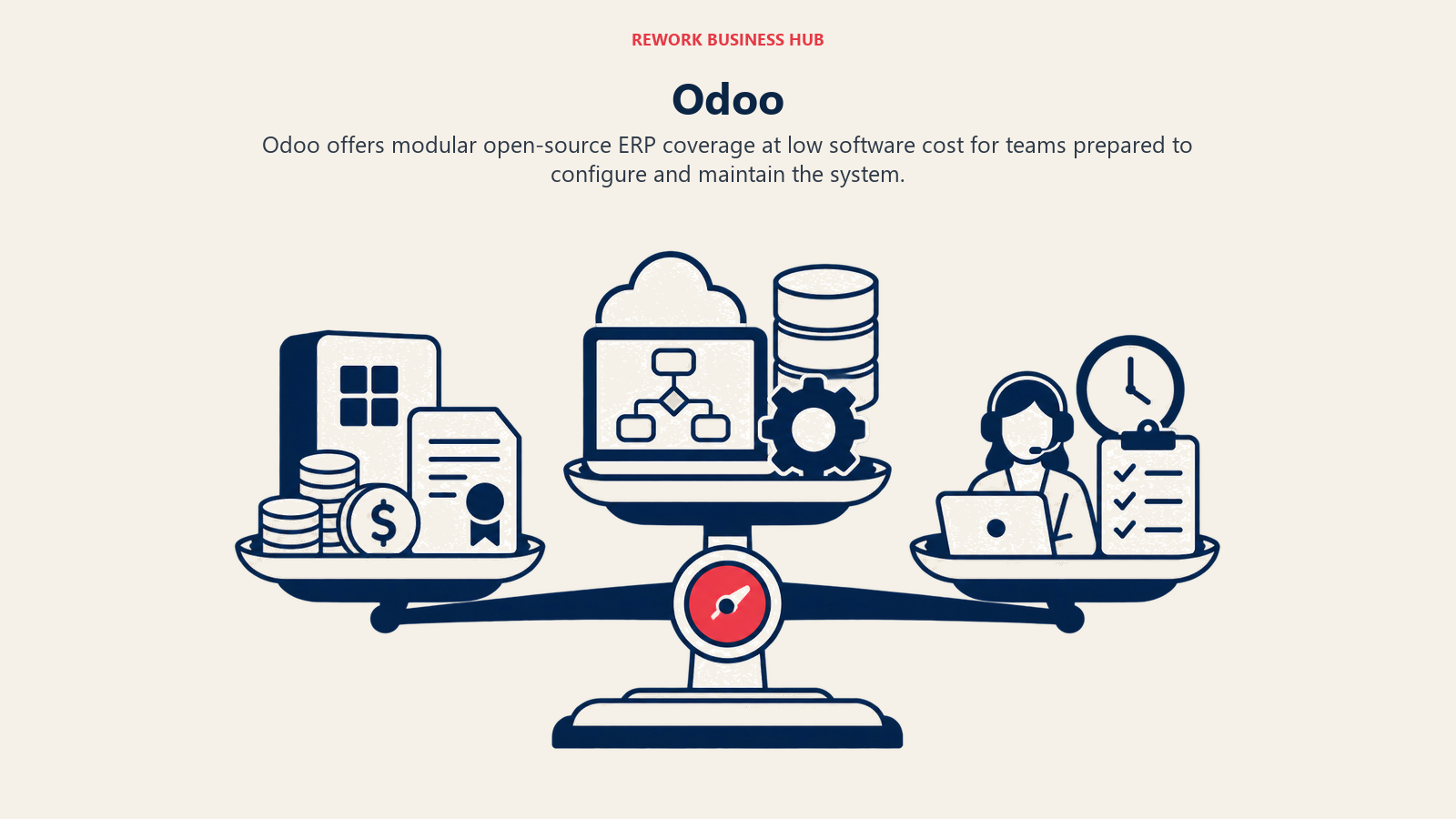
This makes Odoo the strongest Sage Intacct alternative for companies leaving specifically because they want a single ERP rather than a best-in-class finance tool surrounded by integrations. A mid-market firm running Intacct plus a separate CRM, inventory tool, and project management platform could consolidate all four onto Odoo at a lower total software cost, even with the Enterprise license.
The honest caveat is setup. Odoo requires real configuration for production deployments. Community modules vary in quality. Version migrations between major releases (Odoo 17 to 18) are a known headache that requires developer involvement. You're trading one kind of complexity for another. The best Odoo alternatives guide covers what teams compare against when the maintenance burden itself becomes a concern.
| What you get | What you don't |
|---|---|
| Full ERP scope: accounting, inventory, CRM, HR, manufacturing | Ready-to-run without developer configuration |
| Community edition free (self-hosted) | Enterprise-grade multi-entity as mature as Intacct |
| Largest open-source ERP community globally | Polished UX at the level of modern SaaS tools |
| Modular: pay only for what you use | Simple version migration between major releases |
| Self-hosted option eliminates SaaS costs entirely | Consistent module quality across community apps |
Pricing: Community edition free. Enterprise Standard at roughly $25/user/month, Custom (multi-company, custom dev) at roughly $38/user/month. See Odoo's pricing page for current rates; promotional pricing may apply.
Best for: Tech-comfortable companies (15-500 employees) with developer resources that want full ERP coverage and are willing to invest implementation time to eliminate per-module SaaS costs.
8. Workday Financial Management: Enterprise GL for 1,000-Plus Employees
Workday Financial Management is genuinely excellent, but genuinely not a mid-market tool. It's designed for enterprise organizations of 1,000+ employees where the CFO needs unified financial and workforce data on a single platform, where global consolidation involves 50+ entities, and where the implementation budget is measured in millions. Workday doesn't publish pricing; estimates consistently put Financial Management at $150-250/employee/year on top of HCM, with a 1,000-employee company paying $720K-$960K/year combined.
The product vision is the unified enterprise operating model: finance and HR on one data model, which eliminates the reconciliation gap between headcount costs and financial reporting. For large professional services firms, global enterprises, and companies that already run Workday HCM, adding Financial Management makes obvious sense. The GL is deep, the reporting is sophisticated, and the automation around intercompany transactions and consolidation is mature.
For anyone leaving Sage Intacct at mid-market scale ($10M-$150M revenue, under 500 employees), Workday is almost certainly the wrong direction. The implementation timeline runs 12-24 months. The complexity is orders of magnitude higher. And the pricing reflects an enterprise-class product. Include it in a competitive evaluation primarily to establish a ceiling: it tells you what "enterprise-grade" looks like, which helps size whether you're a mid-market or enterprise buyer.
| What you get | What you don't |
|---|---|
| Best-in-class enterprise GL and financial close | Accessible mid-market pricing |
| Unified financial and HCM data model | Fast implementation (12-24 months typical) |
| Deep global consolidation (50+ entities) | A product sized for companies under 500 employees |
| Continuous audit trail and SOX compliance automation | Published pricing: custom quote required |
| Workday Adaptive Planning for FP&A integration | Low implementation cost ($500K-$2M+ is the range) |
Pricing: Custom quote only. Estimates: $150-250/employee/year for Financial Management add-on to HCM. Contact Workday's sales team for a formal briefing.
Best for: Enterprise organizations (1,000+ employees) with mature IT and finance teams that need unified HCM and financial management and have the budget and timeline for a full deployment.
9. Certinia (formerly FinancialForce): Salesforce-Native PSA and ERP for Services Firms
Certinia is the most specific alternative on this list: it's built entirely on the Salesforce Platform and designed exclusively for professional services companies. If you run Salesforce CRM and your primary revenue model is project-based billing (time and materials, fixed fee, subscription), Certinia creates a direct data bridge between your CRM pipeline and your financial statements. That's a genuinely valuable thing when your biggest accounting headache is revenue recognition across a project portfolio.
The rebranding from FinancialForce to Certinia in 2023 reflected a product maturation: the PSA (professional services automation) module and the ERP module now share a unified Services-Centric ERP vision. Project accounting, resource management, billing, and revenue recognition all run on one Salesforce data model, which eliminates the integration overhead that plagues Intacct-plus-Salesforce deployments.
The constraint is the mandatory Salesforce dependency. You need a Salesforce license ($75-300/user/month) plus a Certinia license ($150-350/user/month), for a combined platform cost of $250-600/user/month. If you don't already run Salesforce, the economics don't work. If you do, and you're a services firm where the CRM-to-revenue handoff is where data breaks down, it's the most elegant solution on the market.
| What you get | What you don't |
|---|---|
| Native Salesforce data model (no integration gap) | Feasibility without an existing Salesforce instance |
| PSA + ERP + billing unified in one platform | Broad ERP functionality (limited inventory, manufacturing) |
| Revenue recognition (ASC 606) for project contracts | Affordable base cost: Salesforce adds $75-300/user/mo |
| Resource management and utilization reporting | A large customer base outside professional services |
| Deepest project accounting for services billing | Simple implementation: partner involvement is standard |
Pricing: $150-350/user/month (Certinia), plus mandatory Salesforce CRM at $75-300/user/month. Total platform cost typically $250-600/user/month. See Certinia's product page for current positioning; implementation quotes via partner.
Best for: Professional services firms (consulting, staffing, MSPs) of 100-2,000 employees that already run Salesforce and need native CRM-to-revenue ERP integration.
10. Zoho Books: Full-Featured Accounting at SMB Price Points
Zoho Books is the best-value accounting alternative if your reason for leaving Sage Intacct is cost and you don't need mid-market ERP functionality. The pricing is genuinely different in kind: Standard starts at $20/month, Professional at $50/month, and Ultimate at $275/month. All tiers include real accounting features, bank reconciliation, invoicing, expense management, and basic project tracking. The tier that most growing SMBs land on (Premium at $70/month) covers 10 users.
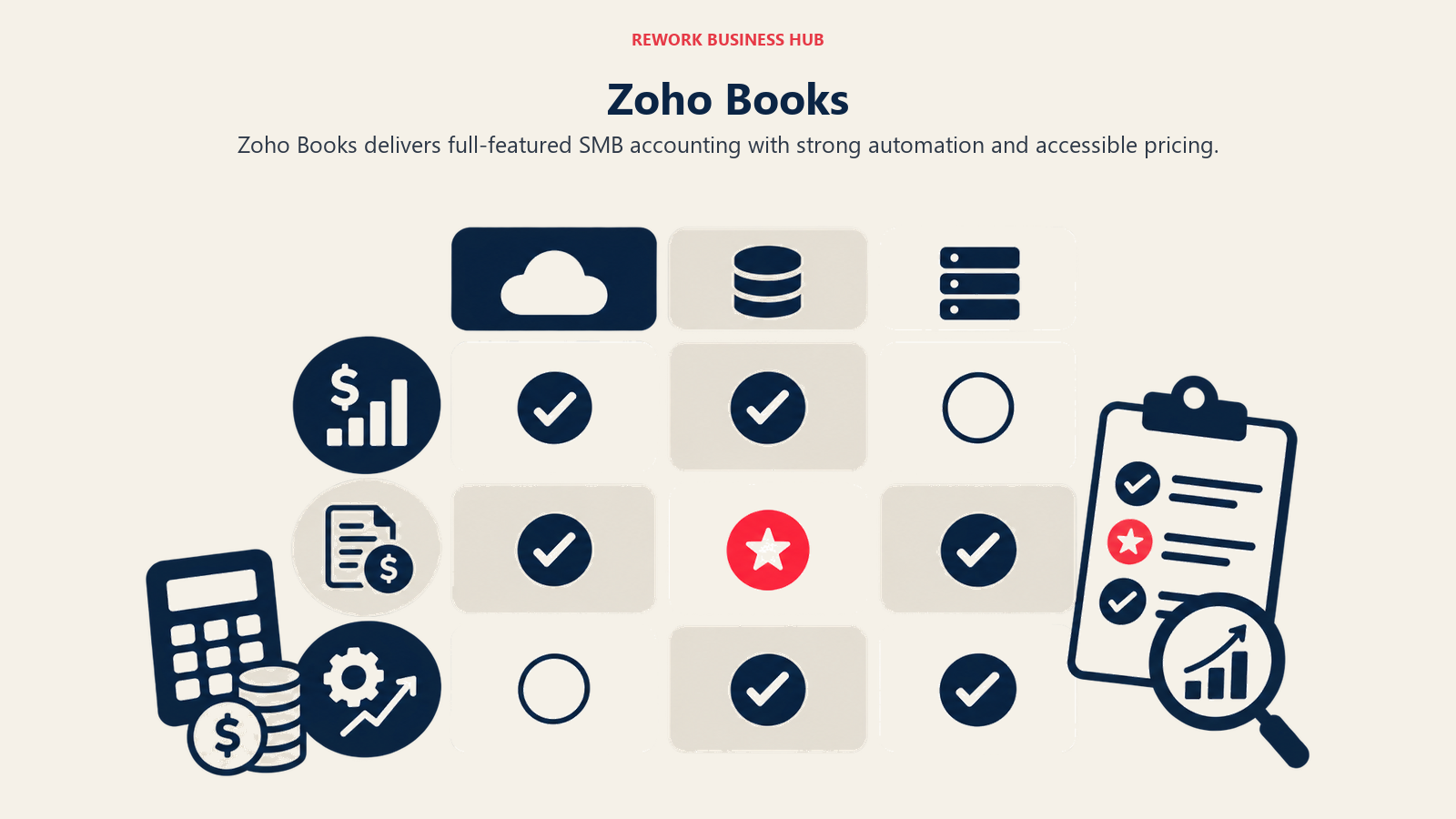
The product philosophy is "complete accounting at SMB price points." Zoho Books isn't a stripped-down tool. It supports multi-currency, purchase orders, vendor credits, inventory basics, client portals, and budgeting across its tiers. And because it's part of the broader Zoho ecosystem, it connects natively to Zoho CRM, Zoho Inventory, Zoho Projects, and Zoho Analytics if you need more coverage over time.
The real ceiling is multi-entity. Zoho Books doesn't do true multi-entity consolidation at the level Sage Intacct does. If you're managing 3+ legal entities and need consolidated financials, Zoho Books will create workarounds, not solutions. For single-entity SMBs under $10M revenue, it covers 90% of what Intacct delivers at 5-10% of the price. The best Zoho Books alternatives guide covers the competitive alternatives at this price tier.
| What you get | What you don't |
|---|---|
| Full accounting features at SMB price points | True multi-entity consolidation |
| Multi-currency, purchase orders, expense management | Dimensional GL or segment-level reporting |
| Native Zoho ecosystem integration (CRM, Inventory) | Audit-grade financial close controls |
| Client portal for B2B invoice management | ERP operational modules (inventory depth, manufacturing) |
| Transparent published pricing, no sales call needed | Enterprise compliance or SOX support |
Pricing: Free plan available. Standard at $20/month, Professional at $50/month, Premium at $70/month, Elite at $150/month, Ultimate at $275/month. See Zoho Books' pricing page for current plan details.
Best for: SMBs (5-100 employees) under $10M revenue that want full accounting functionality at a fraction of Sage Intacct's cost and don't need multi-entity consolidation.
11. Multiview ERP: Fund Accounting and Financial Depth for Nonprofits and Healthcare
Multiview ERP is the least well-known tool on this list and one of the most relevant for a specific buyer: finance teams in nonprofits, healthcare organizations, and public-sector entities that need Sage Intacct-level financial depth but are frustrated by Intacct's pricing, module costs, or nonprofit-specific implementation complexity. Multiview's product is purpose-built for organizations where fund accounting, grant tracking, restricted vs. unrestricted balance sheet reporting, and audit-trail compliance drive the finance function.
The philosophy is finance accuracy for regulated and grant-funded organizations. Multiview competes on depth within its verticals rather than breadth across industries. The GL structure handles fund accounting natively (a significant differentiator from general-purpose mid-market ERP), and the platform is built around audit-ready financial reporting from the ground up. Healthcare organizations use it for department-level cost accounting and payer analysis. Nonprofits use it for grant compliance reporting.
Pricing is custom and not published, but market data suggests deployments in the $75K-$200K+/year range for 20-50 user organizations, with transparent inclusive pricing (no hidden module fees is a stated differentiator against Intacct). For organizations specifically in nonprofit, healthcare, or government finance, it's worth including in the shortlist alongside Intacct and NetSuite.
| What you get | What you don't |
|---|---|
| Native fund accounting and grant tracking | Consumer brand recognition outside its verticals |
| Audit-ready financial reporting from the ground up | A broad ERP with CRM, inventory, or HR modules |
| Department-level cost accounting for healthcare | Self-service onboarding or a trial period |
| Transparent inclusive pricing (no hidden modules) | A large implementation partner ecosystem |
| Strong regulatory compliance and SOX audit trails | Broad integration marketplace |
Pricing: Custom quote only. Typical mid-market deployments: $75K-$200K+/year depending on entities and modules. Contact Multiview's sales team directly.
Best for: Nonprofits, healthcare organizations, and public sector finance teams (50-500 employees) that need fund accounting depth and audit-grade compliance at mid-market scale.
12. FreshBooks: Freelancer and Small Service Business Invoicing
FreshBooks belongs on this list as a "right-size down" option for a specific profile: a solo consultant, small agency, or freelancer who ended up associated with an Intacct instance (often through a parent company or acquisition) and is now standing up their own finance infrastructure. FreshBooks is not a Sage Intacct alternative in any operational sense. It doesn't do multi-entity, doesn't have a real GL structure, and doesn't support the financial complexity that drives Intacct purchases.
What FreshBooks does exceptionally well is invoicing, time tracking, and expense management for service businesses billing by the hour or project. The UI is the cleanest of any tool at the price point. The client portal for sending and receiving invoices is genuinely good. Lite starts at $23/month, Plus at $43/month, Premium at $70/month. Additional users cost $11/person/month.
If you're a controller or CFO building out a mid-market finance stack, FreshBooks isn't it. But if you're a services freelancer or small team (1-15 people) who got handed this article because someone typed "Sage Intacct alternatives" into a search engine, FreshBooks is worth knowing about. For more context on the competitive options, the best FreshBooks alternatives guide covers the nearest alternatives at this tier.
| What you get | What you don't |
|---|---|
| Best-in-class invoicing and client portal UX | A real GL or accounting structure for mid-market |
| Time tracking built into project and invoice workflows | Multi-entity, multi-currency, or dimensional reporting |
| Expense management and receipt capture | Inventory, procurement, or ERP functionality |
| 30-day free trial, no credit card required | Scalability beyond 15-20 person teams |
| Affordable pricing tiers, transparent published rates | Accountant ecosystem as broad as QuickBooks or Xero |
Pricing: Lite at $23/month, Plus at $43/month, Premium at $70/month. Additional users: $11/person/month. See FreshBooks' pricing page for current plan details.
Best for: Freelancers and very small service businesses (1-15 people) that need professional invoicing and time tracking, not mid-market accounting.
Stage Fit Matrix
Where each platform fits in the company growth journey:
| Tool | Startup (1-20) | Growth (20-100) | Mid-Market (100-500) | Enterprise (500+) |
|---|---|---|---|---|
| Oracle NetSuite | With help | Good fit | Best fit | Good fit |
| Dynamics 365 Business Central | No | Consider | Best fit | Consider |
| Acumatica | No | Consider | Best fit | Good fit |
| QuickBooks Online/Enterprise | Best fit | Good fit | Outgrow quickly | No |
| Xero | Best fit | Good fit | Too simple | No |
| SAP Business One | No | Consider | Best fit | Too small for SAP |
| Odoo | With dev help | Good fit | Good fit | Complex |
| Workday Financial Management | No | No | No | Best fit |
| Certinia | No | Consider | Best fit | Good fit |
| Zoho Books | Good fit | Best fit | Consider | No |
| Multiview ERP | No | Consider | Best fit | Good fit |
| FreshBooks | Best fit | Outgrow quickly | No | No |
Sizing and Persona Table
Who buys each tool and at what company size:
| Tool | Company Size | Primary Buyer | Secondary User |
|---|---|---|---|
| Oracle NetSuite | 50-1,000 employees | CFO, COO | Finance team, IT, operations |
| Dynamics 365 Business Central | 30-300 employees | CFO, IT Director | Finance, ops, warehouse |
| Acumatica | 50-500 employees | CFO, IT Director | Finance, project managers, field staff |
| QuickBooks Online/Enterprise | 5-100 employees | Owner, Bookkeeper | Finance team, warehouse staff |
| Xero | 1-50 employees | Founder, Accountant | Finance team |
| SAP Business One | 30-250 employees | COO, IT Director | Finance, production, warehouse |
| Odoo | 15-500 employees | CTO, Founder | All departments |
| Workday Financial Management | 1,000+ employees | CIO, CFO | Finance team, FP&A, HR |
| Certinia | 100-2,000 employees | CFO, VP Professional Services | Finance, project managers, resource managers |
| Zoho Books | 5-100 employees | Founder, Finance Manager | Finance team, accountants |
| Multiview ERP | 50-500 employees | CFO, Controller | Finance team, grant managers, compliance |
| FreshBooks | 1-15 employees | Founder, Freelancer | Bookkeeper, project leads |
How to Choose: Decision Framework
Match the platform to your operating need, team size, implementation capacity, and the trade-offs you can support.
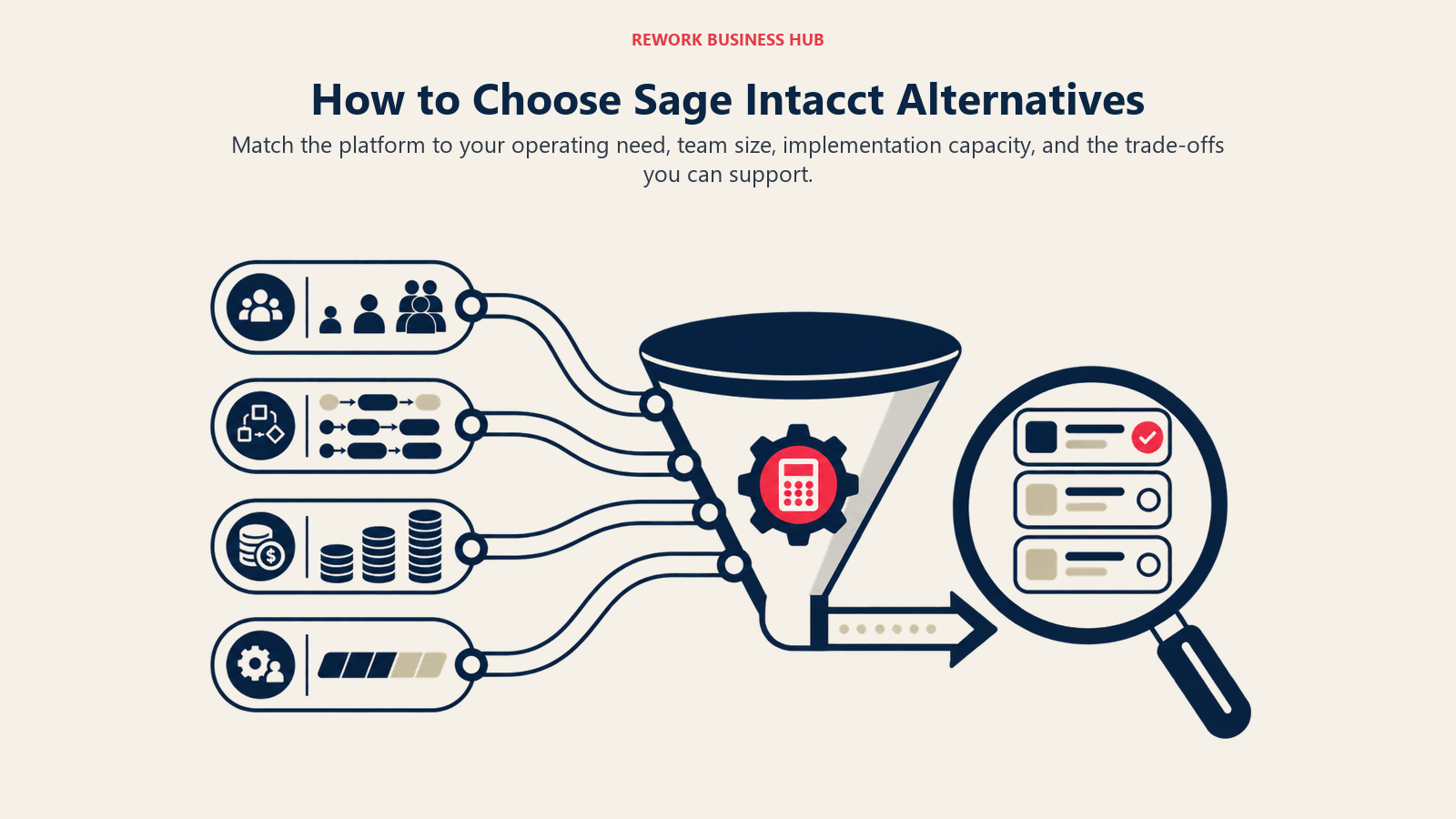
| If your primary need is... | Best pick | Runner-up |
|---|---|---|
| Full ERP to replace finance-only Intacct | Oracle NetSuite | Acumatica |
| ERP with Microsoft ecosystem integration | Dynamics 365 Business Central | Oracle NetSuite |
| Unlimited users, distribution or field services | Acumatica | Odoo |
| Full ERP scope at lowest software cost | Odoo | ERPNext (open source) |
| US accounting, familiar UI, lower cost | QuickBooks Enterprise | QuickBooks Online |
| Simple accounting, small team stepping down | Xero | Zoho Books |
| Manufacturing, BOM, production planning at SMB scale | SAP Business One | Odoo |
| Salesforce-native PSA for services billing | Certinia | Oracle NetSuite |
| Enterprise GL, HCM unified, 1,000+ employees | Workday Financial Management | Oracle NetSuite |
| Nonprofit, healthcare, fund accounting depth | Multiview ERP | Oracle NetSuite |
| Very small business, invoicing-focused | FreshBooks | Xero (Growing plan) |
| Maximum value, mid-tier accounting, SMB | Zoho Books | Xero |
What to Do Next
Before you sign a renewal or a new contract, run a two-week parallel evaluation with your top two picks. Most of the tools above offer trials or demo environments. The things that matter most (how fast your finance team actually adopts it, whether the close process matches your actual workflow, how support responds when something breaks in month-end) won't show up in a vendor demo.
If you're a CFO or controller at a $10M-$100M company where the GL and multi-entity consolidation are the core problem: Sage Intacct is hard to beat on pure accounting depth. NetSuite or Acumatica make sense if you need operational ERP modules alongside the financials, and the added cost reflects added scope. Get both into a real evaluation before committing.
If you're at a nonprofit or healthcare organization where fund accounting and grant compliance drive your requirements: put Multiview ERP on the shortlist alongside Intacct. The pricing model may be more transparent than you expect.
If you're under $5M revenue or under 30 employees and reconsidering whether Intacct was the right call for your current stage: Xero or Zoho Books will cover your actual accounting needs at a fraction of the cost, and you can always move up later. The worst outcome is paying for enterprise-grade financial infrastructure before you have enterprise-grade financial complexity.
And if you genuinely need ERP breadth alongside your financials (inventory, manufacturing, project execution, or procurement) and cost is a constraint, Odoo gives you the widest coverage at the lowest software spend. Budget time for setup. But the software cost savings over a 3-year period against an Intacct-plus-integrations stack are real.

Principal Product Marketing Strategist
On this page
- Quick Comparison Table
- 1. Oracle NetSuite: Full Cloud ERP for the Mid-Market
- 2. Microsoft Dynamics 365 Business Central: Mid-Market ERP for the Microsoft Stack
- 3. Acumatica: Consumption-Based ERP with Unlimited Users
- 4. QuickBooks Online / Enterprise: US SMB Accounting with Broad Ecosystem
- 5. Xero: Clean Accounting for Small Teams Moving to Simplicity
- 6. SAP Business One: SMB ERP for Manufacturing and Distribution
- 7. Odoo: Modular Open-Source ERP at Low Software Cost
- 8. Workday Financial Management: Enterprise GL for 1,000-Plus Employees
- 9. Certinia (formerly FinancialForce): Salesforce-Native PSA and ERP for Services Firms
- 10. Zoho Books: Full-Featured Accounting at SMB Price Points
- 11. Multiview ERP: Fund Accounting and Financial Depth for Nonprofits and Healthcare
- 12. FreshBooks: Freelancer and Small Service Business Invoicing
- Stage Fit Matrix
- Sizing and Persona Table
- How to Choose: Decision Framework
- What to Do Next