Brex vs Payhawk in 2026: Is This a US Company or a European Group?
Turn this article into takeaways for your work.


Each assistant summarizes the article only for you and suggests best practices for your work.
Most "Brex vs Payhawk" content runs the same feature checklist every card comparison runs: both issue cards, both capture receipts, both sync to your accounting system, both do bill pay. Read that checklist and the two products look interchangeable. They are not, and the checklist is why companies end up shortlisting a tool that was never going to approve their application, or that solves a problem they don't have.
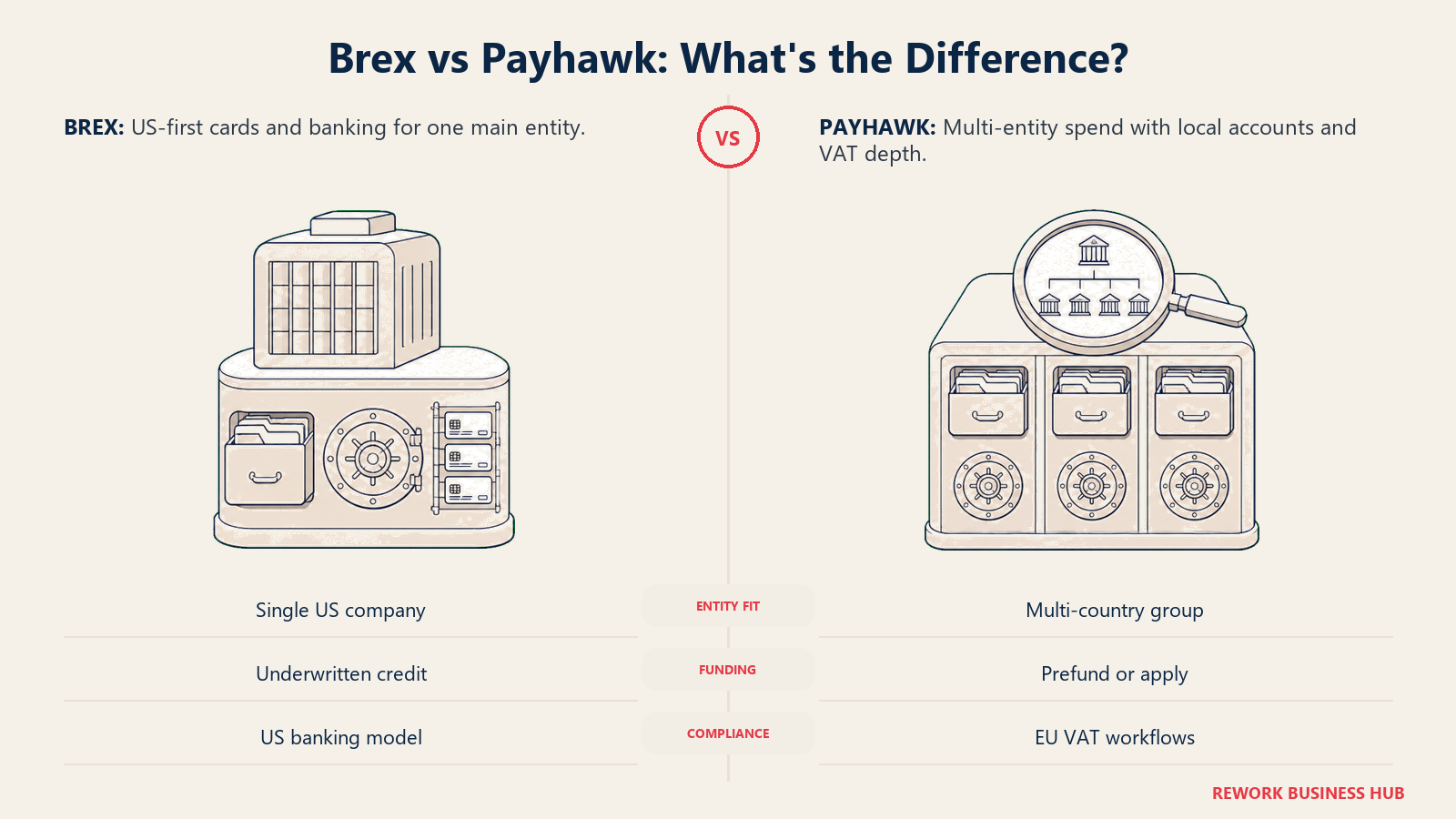
The actual decision is geography and entity structure, and it decides this more often than any feature does. Brex is built US-first: one EIN, one incorporation, one physical address, cards and a business account that assume a single American entity. Payhawk is built the other way: European in origin, designed for a group with several legal entities, several currencies, and several sets of local tax rules to satisfy at once. A company running one US entity and a company running five European subsidiaries are not choosing between the same two products, even though both call themselves spend management. Saying that plainly, before any feature table, is the point of this article.
Once entity structure sorts you into a lane, the rest is genuinely useful: how each handles VAT and local receipts, how deep the ERP integration actually goes, whether getting a card means a credit check or a deposit, and what happens to your spend history the day you leave, the parts most comparisons skip.
TL;DR
- Geography decides this before any feature does. Brex requires a US EIN, US incorporation, US operations, and a US physical address from every applicant. Payhawk operates across the EU, the EEA/EFTA states, the UK, and North America, and is built around companies running more than one legal entity at once.
- The two don't price the same thing. Brex bills per user, $0 on Essentials to $12 on Premium. Payhawk bills per company, by module, from $299 to $499 a month, scaling with admin seats, card count, and transaction volume rather than every employee who holds a card.
- Getting a card works differently. Brex requires every applicant to clear a segmented cash-balance or revenue bar, then revenue-based underwriting. Payhawk offers two paths instead: fund a currency account yourself with no credit check, or apply for a credit line Payhawk's Compliance team reviews.
- Your money sits under different legal protection entirely. Brex's US checking runs through Column N.A., Member FDIC, standard $250,000 coverage extendable to $6 million via a sweep network. Payhawk isn't a bank; its EEA and UK entities hold Electronic Money Institution licenses and safeguard funds at J.P. Morgan Payments under EU and UK e-money law, a different mechanism from FDIC insurance.
- One is now bank-owned, the other is raising money to grow. Capital One completed its $5.15 billion acquisition of Brex on 7 April 2026. Payhawk was reportedly in early talks as of January 2026 for a round that could value it near $2 billion, roughly double its 2022 unicorn valuation.
- VAT and e-invoicing depth is not a close fight. Payhawk verifies EU VAT numbers, integrates with a dedicated VAT-recovery partner, and supports e-invoicing formats for mandates already active or phasing in across Germany, Belgium, France, and Spain. Brex names VAT documentation as a Premium-tier feature without the same country-by-country depth.
Key Facts
Key Facts: the regulatory and ownership backdrop behind this decision
- Capital One completed its $5.15 billion acquisition of Brex on 7 April 2026, combining roughly $2.6 to $2.75 billion in cash with about 10.6 million shares of Capital One stock; Brex continues operating as a distinct brand with Pedro Franceschi remaining CEO (Capital One newsroom).
- Standard FDIC deposit insurance covers up to $250,000 per depositor, per insured bank, the baseline Brex's US checking account sits inside before any extended sweep coverage is added (FDIC).
- Payhawk safeguards customer funds at J.P. Morgan Payments under the Electronic Money Institution licenses held by its EEA and UK entities, a segregation requirement under PSD2 and UK payment services law rather than FDIC-style deposit insurance (Payhawk Trust Portal).
- Payhawk was reportedly in early-stage talks as of January 2026 for a funding round that could value the company near $2 billion, more than double its $1 billion valuation from 2022; Payhawk declined to comment publicly (PYMNTS).
- From 1 September 2026, every VAT-registered business in France must be able to receive structured e-invoices, with the obligation to issue starting the same day for large and medium enterprises, one of several live European e-invoicing mandates this category now has to support (France's business portal).
Brex vs Payhawk at a Glance
| Brex | Payhawk | |
|---|---|---|
| What it's built around | A US corporate card and spend platform with a business account attached | A European-origin, multi-entity spend platform sold as separate modules |
| Entity fit | A single US entity, or a few entities on Premium | Multiple entities across Europe, the UK, and the US at once |
| Entry price | Essentials, $0 per user per month, eligibility gated | No free tier; modules start from $299 to $499 per company per month |
| Local currency accounts | One US business account; no dedicated local IBANs | Dedicated IBANs in 7 currencies across 33 countries |
| Getting a card | Clear a segmented cash or revenue bar, then revenue-based underwriting | Fund a currency account yourself, or apply for a credit line Payhawk underwrites |
| Where deposits sit | Column N.A., Member FDIC; $250,000 standard, up to $6 million via Vault | Safeguarded via EMI license at J.P. Morgan Payments, not FDIC insurance |
| Ownership in 2026 | Wholly owned subsidiary of Capital One since 7 April 2026 | Independent; reportedly evaluating a round near a $2 billion valuation |
| VAT and e-invoicing | Named as a Premium-tier feature, no published country-by-country detail | VAT number verification, VAT-recovery integration, e-invoicing formats for live EU mandates |
| ERP integration style | NetSuite and Sage Intacct native on Premium; QuickBooks Online and Xero on Essentials | NetSuite and Xero native two-way sync; SAP via export template; Dynamics 365 native API |
| Core strength | Fast US setup, revenue-based credit, banking bundled in | Multi-entity, multi-currency, VAT and e-invoicing compliance built in |
| Weakest against the other | Not built around a multi-entity European group structure | High published floor for a single small US team |
| Best fit | One US entity, or a US parent with light international presence | A group with two or more entities, especially with a European one |
Sources: Brex's pricing page, Brex eligibility, Payhawk's US pricing page, and Payhawk's business payments page, all checked 24 to 26 August 2026.
The Geography Question That Decides This First
This is the part a feature-by-feature comparison cannot answer, because it isn't a feature. It's a starting assumption baked into how each product was built.
Brex was designed around a single US company: one EIN, one incorporation, US operations, a US address, and every eligibility rule Brex publishes assumes that structure. International reach exists, through Smart Card and Premium, but as an extension of a US-anchored account, not a native multi-country structure from day one. Payhawk was designed around the opposite assumption: dedicated local accounts across dozens of countries, with consolidating several legal entities under one dashboard treated as the core product rather than an add-on. A group with a German subsidiary, a UK subsidiary, and a US holding company is Payhawk's default customer, not an edge case it accommodates.
| Brex | Payhawk | |
|---|---|---|
| Country of origin and primary design center | United States | Europe (Bulgaria and UK founding teams; EEA and UK regulated entities) |
| Assumed starting entity structure | One US entity | Multiple entities, often spanning countries |
| Where the eligibility rules start | US EIN, US incorporation, US operations, US address | Registered company in one of roughly 33 supported countries |
| How international reach is added | Layered on top of the US account via Premium and Smart Card | Native from the base product |
| Best-documented buyer profile | US startup or scale-up, 10 to 1,000 employees | Group CFO or finance director, 100 to 2,000 employees, Europe, UK, or US |
Practically, the two products rarely lose the same deal. Brex loses when a European entity is already in the picture and the buyer needs a local IBAN, not just a card that works abroad. Payhawk loses when the buyer is a single US company with no international entity on the roadmap, since its floor has nothing to do with a domestic-only case Brex Essentials already covers for free. If your company fits neither cleanly, for instance a US company about to open its first European office, the sections below on VAT and ERP depth are where the decision actually gets made, and if it turns out neither fits at all, our best Brex alternatives roundup and the wider best spend management software guide cover the field beyond these two.
Entity Structure and Local Currency Accounts
Once you're past "which country," the next question is how many entities, and in what currencies they actually bank.
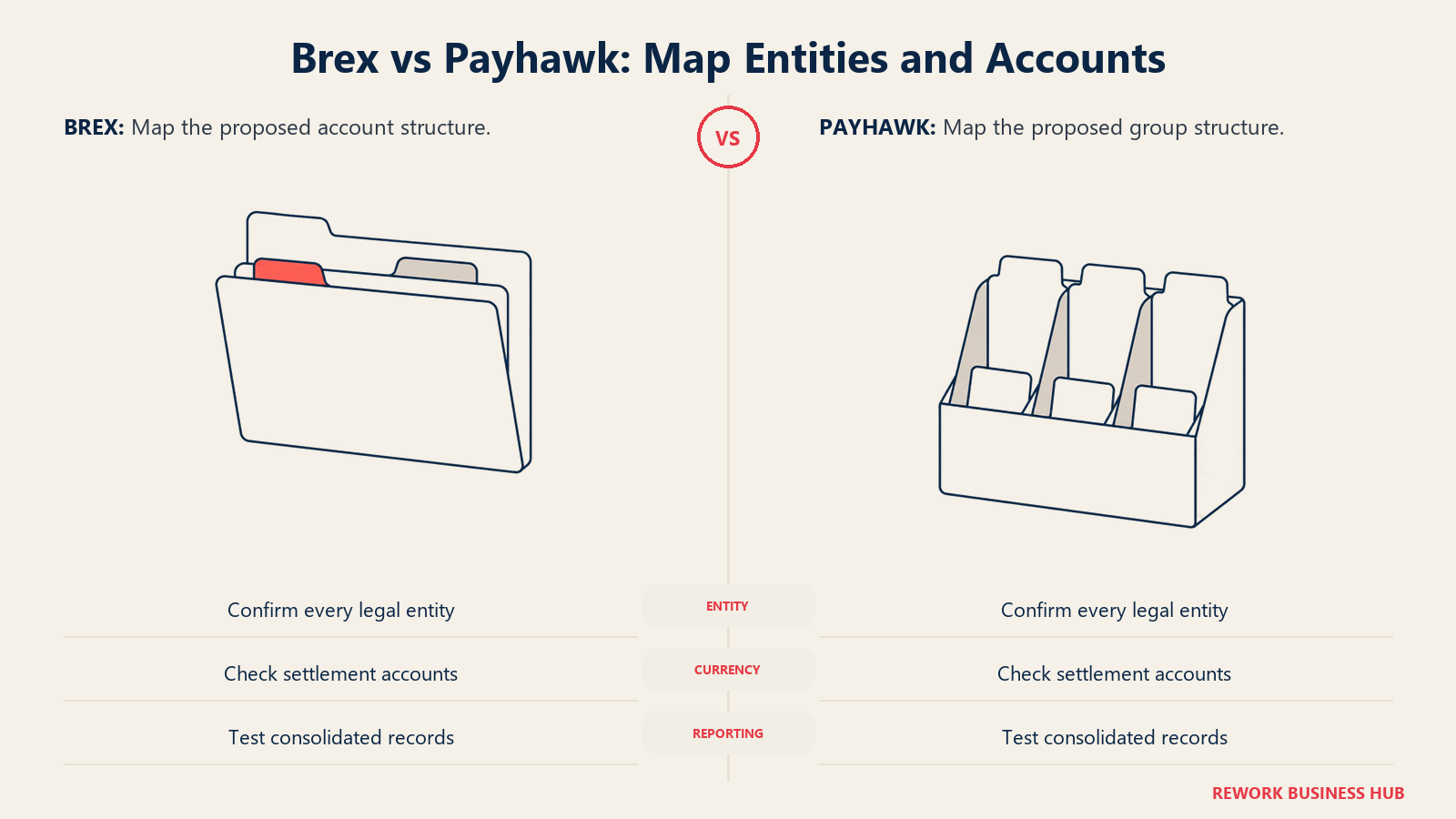
Brex Essentials supports up to two entities. Premium extends that to multi-entity coverage across US and international structures, with customizable ERP and HRIS connections. Brex also sells a separate Smart Card product with local-currency card issuance in more than 50 countries, and its broader card program issues in 30-plus currencies across 60-plus countries, with locally funded reimbursements in over 20 currencies across 45 countries for qualifying customers. None of that comes with a dedicated local IBAN the way a European business account does; it's card infrastructure layered onto a US account, not a local one.
Payhawk issues a dedicated IBAN for each entity and routes each to its own instance in the group dashboard. Business accounts open across roughly 33 countries spanning the EU, the EEA/EFTA states (Norway, Iceland, Liechtenstein, Switzerland), the UK, and North America, settling in seven currencies. Debit cards use those same seven currencies with 0% FX in 26 countries. Credit cards are narrower, issued only in USD, GBP, and EUR, and only once a company clears Payhawk's credit assessment. Beyond that core set, Payhawk's cross-border rails reach further still: 115-plus currencies across roughly 150 countries at a published 0.3% FX markup on the ten most common ones.
| Capability | Brex | Payhawk |
|---|---|---|
| Entities on the entry tier | Up to 2, on Essentials | Any number, module pricing scales by add-on rather than entity count |
| Dedicated local IBAN per entity | Not offered; one US business account | Yes, in 33 countries |
| Settlement currencies on the core account | Not specified as a fixed list | 7: EUR, GBP, USD, CHF, DKK, RON, PLN |
| Debit card currencies | Card issuance in 30+ currencies generally | Same 7 currencies as the IBANs, 0% FX in 26 countries |
| Credit card currencies | Not limited to a named short list | USD, GBP, EUR only, subject to credit assessment |
| Broadest cross-border reach | Local-currency card issuance in 50+ countries via Smart Card | 115+ currencies, ~150 countries for cross-border payments |
| VAT documentation support | Named explicitly on Premium | Built into onboarding for EU entities via VAT number verification |
If your company already runs meaningful spend through a non-US entity today, get the specifics of Brex's international coverage in writing before assuming it matches a European-native IBAN structure. Brex names a capability; Payhawk names an account.
VAT, Local Receipts, and Compliance
This is the section most Brex-vs-Payhawk content skips, and it's the one that actually decides a European buyer's shortlist.
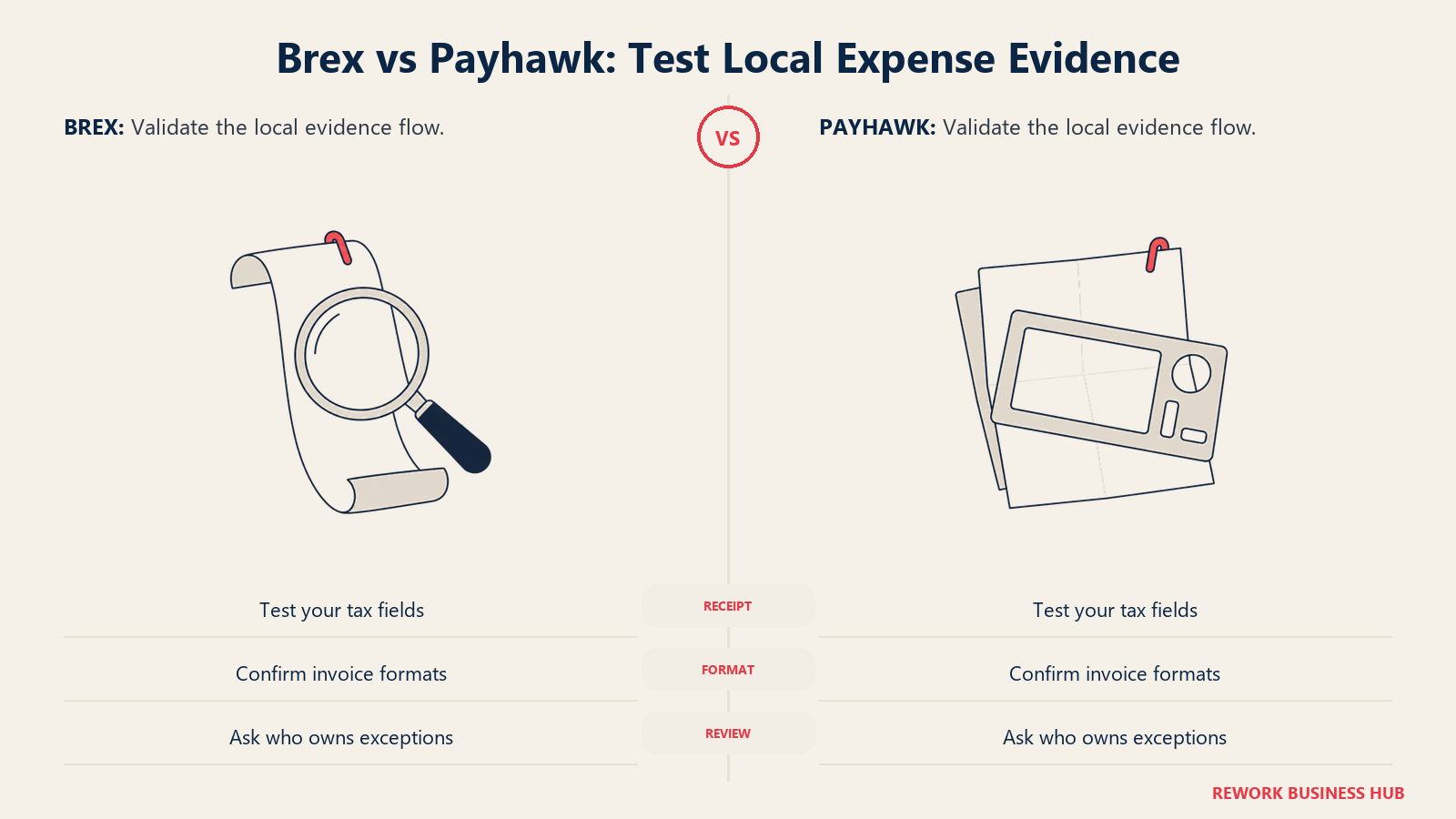
Every EU company that registers with Payhawk provides a VAT number, which Payhawk verifies through the European Commission's VIES system. If the number doesn't verify, the supplier must charge local VAT instead of applying a reverse charge, and Payhawk's workflow reflects that automatically rather than leaving it for finance to catch later. A cardholder photographs a receipt, OCR extracts the data, and finance can adjust VAT rates per the applicable local law before the expense posts. Payhawk also integrates directly with 60dias, a dedicated VAT-recovery service, to pull VAT back out of receipts and invoices that would otherwise sit unclaimed.
Payhawk's e-invoicing coverage goes further than a compliance checkbox. It supports Peppol BIS 3.0, XRechnung, ZUGFeRD, and Factur-X, the structured formats behind Europe's live and upcoming mandates, through a partnership with Invopop, and it automatically three-way matches an incoming e-invoice against the approved expense request. Its own compliance pages name coverage for Germany's requirement to receive XRechnung or ZUGFeRD invoices (in effect since 1 January 2025, issuing phasing in through 2027), Belgium's Peppol BIS 3.0 mandate for B2B transactions (from 1 January 2026), and Spain's Facturae XML requirement (phasing in from 2027). France's mandate is independently confirmed: from 1 September 2026, every VAT-registered business must be able to receive structured e-invoices, with the obligation to issue starting the same day for large and medium enterprises, per France's own government business portal.
Brex's published pricing page names VAT documentation as part of Premium's "customizable ERP and HRIS" bundle. That's real, but it's a capability, not laid out mandate by mandate the way Payhawk's compliance pages do. For a company whose actual requirement is "we need to be ready for Germany's and France's e-invoicing rules this year," that difference in documented depth is the whole evaluation.
| Capability | Brex | Payhawk |
|---|---|---|
| VAT number verification at onboarding | Not published as a named step | Yes, verified through the EU's VIES system |
| VAT rate adjustment on receipts | Not published in comparable detail | Yes, adjustable per applicable local law during review |
| Dedicated VAT-recovery integration | Not published | Yes, via 60dias |
| E-invoicing formats supported | Not named | Peppol BIS 3.0, XRechnung, ZUGFeRD, Factur-X, other EN 16931-compliant formats |
| Named country mandate coverage | Not published country by country | Germany, Belgium, France, Spain named directly on Payhawk's compliance pages |
| Where VAT documentation lives | Bundled into Premium's ERP/HRIS feature set | A dedicated onboarding and compliance workflow |
Getting a Card: Deposit, Credit Line, or Credit Assessment
This is the section that decides whether either company will even open an account for you, and it works nothing alike.
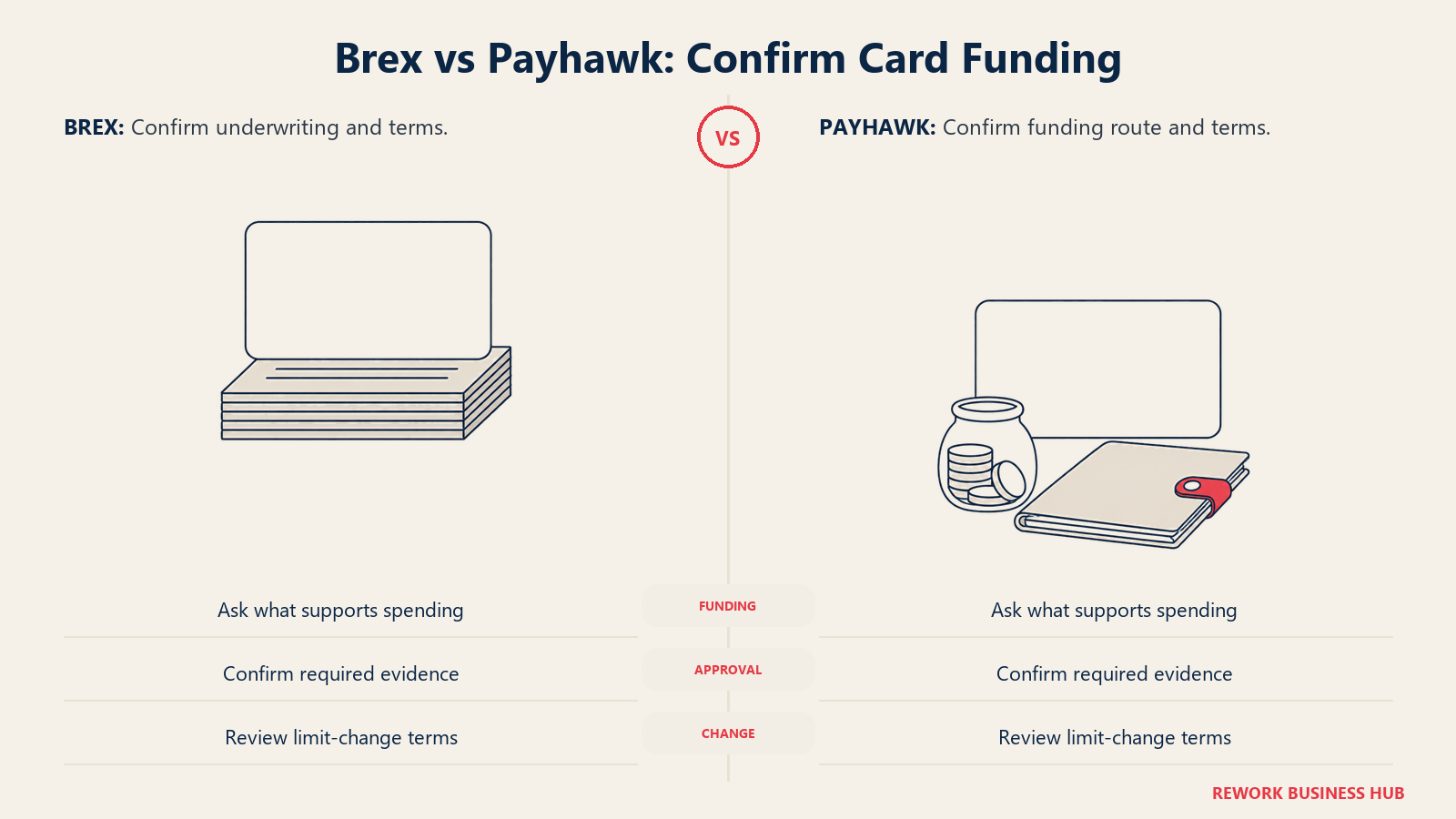
Brex publishes one underwriting model for everyone, branched by segment. Every applicant needs a US EIN, valid US incorporation, US operations, and a US physical address that isn't a PO box or virtual office. Past that baseline, a venture or angel-funded startup needs a minimum $50,000 cash balance (sometimes lower through a partner referral); a mid-market or enterprise applicant needs more than $400,000 a month in revenue; a commercial applicant needs more than $500,000 a year in revenue. Brex then applies revenue-based underwriting, setting your actual credit limit from your balance sheet, income statement, and cash flow. Clearing the published bar does not guarantee approval.
Payhawk splits the question in two, and a buyer can pick either path without justifying a funding stage or revenue history the way Brex requires. The first path is a prefunded debit model: deposit money into a Payhawk currency account, and cards linked to it draw down against the balance you've put in, with no credit assessment, since Payhawk is never extending credit. The second path is a credit line: a company applies, Payhawk's Compliance team reviews it, and on approval a credit currency account opens automatically in the requested currency for card payments specifically. Credit cards under this path are limited to USD, GBP, and EUR, and Payhawk's own materials describe them as "subject to assessment," language that mirrors Brex's underwriting far more than a free-for-all signup.
| Brex | Payhawk | |
|---|---|---|
| Entity requirement | US EIN, US incorporation, US operations, US address | Registered company in one of Payhawk's ~33 supported countries; EU entities also need a VIES-verified VAT number |
| Prefunded, no-credit-check option | Not offered; every applicant is underwritten | Yes, fund a currency account and cards draw against your balance |
| Optional credit line | Required for every applicant | Optional; apply separately, reviewed and approved by Payhawk's Compliance team |
| Numeric minimum to qualify | $50,000 cash (venture/angel-funded), or revenue thresholds by segment | Not published for the deposit route; credit line approval is case by case |
| What sets the actual credit limit | Revenue-based underwriting on financial statements | Payhawk's Compliance team, on application |
| Currencies available on credit cards | Not limited to a named short list | USD, GBP, EUR only |
| Non-qualifying companies | Have no alternative path into Brex | Can still use Payhawk's cards by prefunding, without qualifying for credit |
The practical read: a two-year-old company with real cash but a thin revenue story can clear Brex's startup bar and also just prefund a Payhawk account, no assessment required either way. A profitable services business with strong revenue but little cash can clear Brex's commercial bar, or apply for a Payhawk credit line instead. The buyer genuinely shut out either way is one that can't show cash, can't show qualifying revenue, and can't pass either vendor's credit review, in which case Payhawk's prefunded route is the more forgiving fallback, since it asks for a deposit rather than a financial history.
Pricing Compared
Here is the full published tier sheet for both vendors, with the billing basis spelled out, since that basis is exactly where "which one is cheaper" arguments go wrong in this pairing.
| Vendor and plan | Published price | Billing basis | What it includes |
|---|---|---|---|
| Brex Essentials | $0 per user per month | Per user, monthly; eligibility gated | Global card acceptance, AI custom rules, up to two entities, bill pay, reimbursements, travel booking, API access |
| Brex Premium | $12 per user per month | Per user, monthly, flat | Multiple expense policies, dynamic review chains, AI compliance audit detection, multi-entity US and international, customizable ERP and HRIS, VAT documentation, group travel, live budgets |
| Brex Enterprise | Custom | Custom, annual billing | Unlimited US or global entities, local card issuance, named account manager |
| Brex Smart Card | Custom | Custom | Local-currency cards in 50+ countries, merchant controls |
| Payhawk Travel | From $299 per month | Per company, scales with seats/volume | Global hotel and flight booking, custom travel policy, trip requests, automated expense reports |
| Payhawk Accounts Payable | From $349 per month | Per company, scales with seats/volume | End-to-end bill management, approval workflow designer, vendor management, scheduled and bulk payments, advanced OCR |
| Payhawk Cards & Expenses | From $449 per month | Per company, scales with seats/volume | Connect any card program, real-time expense creation, 40+ ERP/accounting/HR integrations, mobile app, reimbursements, optional Payhawk Visa cards |
| Payhawk Procurement | From $499 per month | Per company, scales with seats/volume | Purchase order management, employee purchase intake, 2-way and 3-way matching |
| Payhawk Complete | No published price | Quote-only | All modules bundled, plus integrated AI agents |
| Payhawk Growth Program (UK/EEA only) | GBP 149 per month | Per company, capped | 10 cards, 10 seats, up to 15 invoices and 15 reimbursements a month; single entity, under 20 employees only |
Sources: Brex's pricing page and Payhawk's US pricing page, both checked 24 to 26 August 2026.
Two things here matter more than the headline numbers. First, Payhawk's own pricing page states the final figure is "based on the plans and add-ons you select, as well as the number of admin/accountant seats, cards, and the volume of transactions you process." So $449 is a floor, not a fixed fee. It doesn't multiply by every employee who carries a card the way Brex's per-user model does, but it can still rise with admin seats and transaction volume, and Payhawk doesn't publish where that rise stops. Second, the Growth Program, Payhawk's one flat-rate small-business option at GBP 149 a month, is capped at a single entity and under 20 employees, which rules out the exact multi-entity buyer the rest of the product is built for. A small UK company can get Payhawk's cheapest offer; the same company with a second entity already needs the full modular pricing above.
Cost model at 10, 25, 37, 50, 100, and 250 users
Assumptions: no negotiated discount, Brex Premium billed monthly at its published per-user rate, Payhawk shown at its published starting floor for Cards & Expenses alone and combined with Accounts Payable, since Brex Premium already bundles bill pay into the same per-user price.
| Users | Brex Essentials | Brex Premium (annual) | Payhawk Cards & Expenses floor (annual) | Payhawk Cards & Expenses + AP floor (annual) |
|---|---|---|---|---|
| 10 | $0, if eligible | $1,440 | $5,388 | $9,576 |
| 25 | $0, if eligible | $3,600 | $5,388 | $9,576 |
| 37 | $0, if eligible | $5,328 | $5,388 | $9,576 |
| 50 | $0, if eligible | $7,200 | $5,388 | $9,576 |
| 100 | $0, if eligible | $14,400 | $5,388 | $9,576 |
| 250 | $0, if eligible | $36,000 | $5,388 | $9,576 |
All figures are annual, in USD, from the published rates above. The crossover is exactly where the raw math predicts: $449 divided by $12 lands at roughly 37 to 38 seats. Below that headcount, Brex Premium's per-user rate is cheaper. Above it, Payhawk's floor is cheaper on paper, and the gap widens as headcount climbs, since Brex keeps multiplying by every seat while Payhawk's floor does not move with general headcount. Treat the Payhawk columns as a floor rather than a ceiling: a 250-person company running meaningful card and invoice volume will likely pay more than $449 and $349 a month once admin-seat and transaction-volume scaling applies, and that real number isn't on the public page. If Accounts Payable matters too, compare the fourth column against Brex Premium directly, since Brex bundles bill pay into its $12 rate at every headcount shown; Payhawk's combined AP and card floor only pulls ahead of Brex Premium's total around 66 to 67 seats. For how the rest of the category prices against these two, our best expense management software roundup and best AP automation software guide cover ground this article doesn't.
ERP and Accounting Integration Depth
Both vendors claim broad ERP reach. The depth behind that claim isn't the same everywhere, and it's worth checking system by system before trusting either page's summary line.
Brex serves QuickBooks Online and Xero on Essentials, its free tier. NetSuite and Sage Intacct move to Premium, described as "customizable ERP" support, alongside customizable HRIS connections that include Workday. Beyond that, Brex's published page doesn't break out integration depth system by system.
Payhawk publishes more granular detail, and the depth varies meaningfully by system. NetSuite gets a native, two-way sync that transfers Chart of Accounts, Departments, VAT codes, and Classification Areas automatically, with no manual re-entry. Xero gets automatic, real-time bank reconciliation. Microsoft Dynamics 365 Business Central gets a direct API integration with automated reconciliation, and Microsoft Dynamics Finance gets automated master data import alongside expense and payment export. SAP S/4HANA is comparatively lighter: Payhawk exports through predefined CSV and XLS templates rather than a native two-way sync, a real step down from what NetSuite and Dynamics get. Payhawk also names Sage Intacct among its supported ERPs and claims more than 40 total ERP, accounting, and HR integrations, without publishing the full list.
| System | Brex | Payhawk |
|---|---|---|
| QuickBooks Online | Included on Essentials | Confirm QuickBooks Online integration depth with Payhawk |
| Xero | Included on Essentials | Native, two-way, real-time bank reconciliation |
| NetSuite | Premium, described as "customizable ERP" | Native two-way sync: Chart of Accounts, Departments, VAT codes, Classification Areas |
| Sage Intacct | Premium | Named among Payhawk's supported ERPs |
| SAP S/4HANA | Not published | CSV/XLS export templates, not a native two-way sync |
| Microsoft Dynamics 365 Business Central | Not published | Native, direct API, automated reconciliation |
| Microsoft Dynamics Finance | Not published | Automated master data import, expense and payment export |
| Workday (HRIS) | Premium | Not named among Payhawk's published integrations |
| Total integrations claimed | Not published as a count | 40+ ERP, accounting, and HR integrations |
If your books run on NetSuite specifically, Payhawk's published sync detail is the more specific of the two. If SAP is your system of record, test both live before assuming either "supported" label means NetSuite-level depth. For the layer underneath this decision entirely, our best NetSuite alternatives guide covers what happens once the accounting system, not the card program, is the actual bottleneck.
What Happens to Your Spend History If You Leave
This is the question almost nobody asks before signing, and the two vendors answer it quite differently.
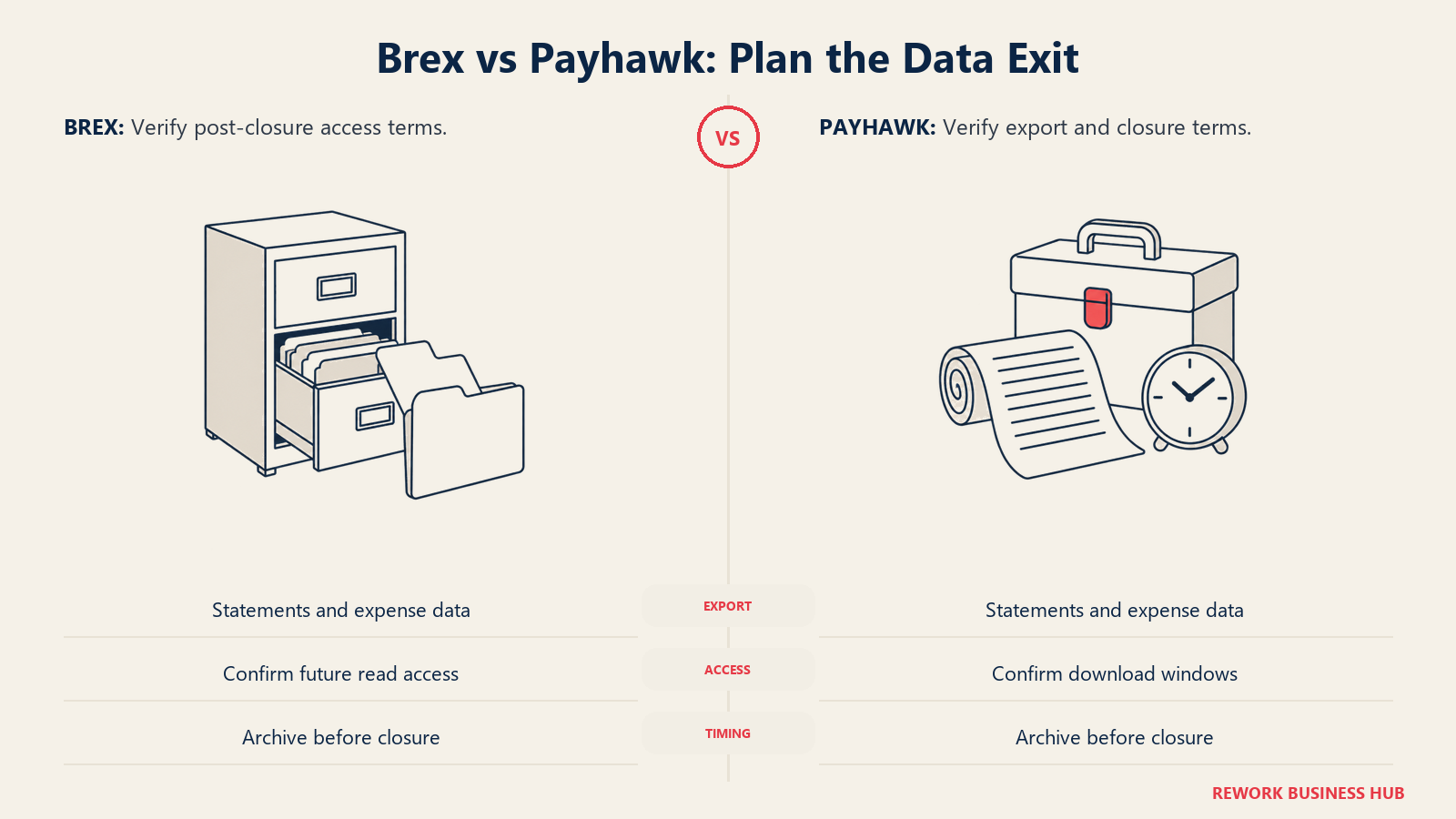
Brex's account-closure documentation states that closed accounts keep permanent read-only dashboard access: "at no point following your account closure will your read-only access be revoked." You can keep signing in to view historic activity and download statements indefinitely. Once an account is closed, information that can legally be deleted is removed from Brex's databases, though de-identified information may be retained where required by law, and unredeemed rewards points cannot be recovered.
Payhawk's export options are broader in format, narrower in access window. Company data exports as PDF, MT940, or CAMT.053 account statements, and on-demand reports for settled transactions download through the browser, each triggering an emailed download link valid for only 12 hours, for security. Separately, Payhawk's Framework Agreement requires any remaining client funds to be redeemed within 10 business days of either party giving termination notice. Neither vendor spells out a specific retention window for historical data after full closure, so the safer move on either platform is exporting everything you need during the offboarding window itself, not after.
| Brex | Payhawk | |
|---|---|---|
| Dashboard access after closure | Permanent read-only access, stated explicitly as never revoked | Not published as permanent; treat the offboarding window as the export deadline |
| Export formats | Statement and table exports (CSV, PDF) across Expenses, Accounting, and Team | PDF, MT940, and CAMT.053 account statements; on-demand reports |
| Download link validity | Not time-limited per Brex's own account-closure page | 12 hours, for security, per export request |
| Remaining funds on closure | Not applicable in the same way; a business account, not a prefunded balance in most cases | Must be redeemed within 10 business days of termination notice |
| Data retention after deletion is legally possible | De-identified information may still be retained where required by law | Not detailed in the materials reviewed; confirm directly against the Framework Agreement |
| Best practice either way | Export before you initiate closure, not after | Export before you initiate closure, not after |
Ownership, Funding, and Where Each Company Is Headed
Feature comparisons age slowly. Ownership structures don't, and 2026 delivered the biggest change either company has seen since founding.
Capital One completed its acquisition of Brex on 7 April 2026, a $5.15 billion deal made up of roughly $2.6 to $2.75 billion in cash and about 10.6 million shares of Capital One stock, first announced in January 2026. Brex is not being folded into Capital One's existing card lines; it continues operating as its own product with Pedro Franceschi remaining CEO. The company underwriting your card program and holding your deposits is now a top-10 US bank holding company rather than a venture-backed independent, at roughly 60% below Brex's $12.3 billion peak valuation from 2021.
Payhawk took the opposite path in 2026, at least so far. It has raised $240 million to date from more than 30 investors, including Endeavor Catalyst, Greenoaks, HubSpot Ventures, and Invus Opportunities, and reached a $1 billion valuation in 2022. As of January 2026, Payhawk was reportedly in early-stage talks for a new round seeking more than $100 million that could value it near $2 billion, though terms were described as preliminary and Payhawk declined to comment. Its 2024 annual recurring revenue was reported at €39.5 million, roughly $46.2 million.
| Brex | Payhawk | |
|---|---|---|
| Ownership as of August 2026 | Wholly owned subsidiary of Capital One | Independent, venture-backed |
| Defining 2026 capital event | $5.15 billion acquisition, closed 7 April 2026 | Reportedly in early talks for a new round (January 2026, unconfirmed) |
| Prior peak valuation | $12.3 billion, 2021 | $1 billion, 2022 |
| Reported new-round target | Not applicable | Near $2 billion, more than $100 million raised (reported) |
| Disclosed recent financials | Not broken out separately post-acquisition | €39.5 million ARR in 2024 (about $46.2 million) |
| What it means for buyers | Underwritten by a chartered bank's balance sheet going forward | Growing independently, weighing whether to raise at a much higher valuation |
Neither row is a verdict. A bank-owned Brex may mean steadier underwriting and a deeper balance sheet behind your card program, or a roadmap that eventually bends toward Capital One's priorities, and neither company has promised otherwise. An independent Payhawk chasing a $2 billion valuation may mean continued fast feature shipping, or a vendor relationship resting on a private company successfully raising and executing rather than a bank's balance sheet. For the narrower version of this same ownership question against a pure banking product, see our Brex vs Mercury comparison; for how Brex stacks up against its other main US rival, see Ramp vs Brex; and if Ramp, not Brex, is the US card program on your list against Payhawk, Ramp vs Payhawk runs this same entity-structure question from that angle.
When Brex Is the Right Call
- You run a single US entity, or a US parent with light international exposure. Every part of Brex's eligibility, banking, and support model assumes this shape, and it fits it well.
- You'd rather clear a cash or revenue bar than build a European compliance stack you don't need yet. Revenue-based underwriting is a familiar process for a US-focused finance team.
- You want deposits sitting behind a chartered US bank with standard FDIC coverage. Column N.A., Member FDIC, extendable to $6 million through Brex Vault's sweep network, is a different risk profile than EMI safeguarding.
- Travel booking needs to be a named, standalone capability from the entry tier, not a separate module you buy later.
- You clear Brex's eligibility bar today and want the software for $0. Essentials genuinely costs nothing in software fees if your cash balance or revenue clears the segment threshold.
When Payhawk Is the Right Call
- You run two or more legal entities, and at least one is European. Dedicated local IBANs in 7 currencies and native multi-entity consolidation solve a problem Brex's US-anchored account structure doesn't attempt to solve the same way.
- VAT reclaim and e-invoicing compliance are live requirements, not someday concerns. Verified VAT numbers, a dedicated VAT-recovery integration, and named mandate coverage for Germany, Belgium, France, and Spain are built into onboarding rather than described as a generic Premium feature.
- You'd rather prefund a currency account than pass a US-style cash or revenue bar. Payhawk's deposit-funded route needs no credit assessment at all, which matters for a company that doesn't fit Brex's venture-funded or revenue-threshold mold.
- Adding day-to-day cardholders shouldn't multiply your software bill. Payhawk's module floor is priced by company, admin seats, and transaction volume, not by every employee who carries a card.
- You're comfortable with a vendor that's independent and, as of publication, weighing new funding rather than one that was just absorbed into a bank holding company.
Who Should Choose Which
| If this describes you | Choose | Because |
|---|---|---|
| You run one US entity and clear Brex's eligibility bar | Brex Essentials | $0 per user, real controls, no European compliance overhead you don't need yet |
| You run 2+ entities, with at least one in Europe | Payhawk | Dedicated local IBANs in 7 currencies, native multi-entity handling from the base product |
| VAT reclaim and e-invoicing compliance are live requirements now | Payhawk | Verified VAT numbers, a dedicated VAT-recovery integration, and named coverage for Germany, Belgium, France, and Spain |
| You have well under 37 cardholders and want the lowest published seat price | Brex Premium | $12 per user beats Payhawk's $449 floor below that crossover point |
| You have 40 or more cardholders on one qualifying entity | Payhawk, if genuinely multi-entity, or a US-focused alternative if not | Payhawk's floor does not multiply by headcount, though it does scale with admin seats and volume |
| You can't show $50,000 in cash or the revenue Brex requires | Payhawk's prefunded route | No published numeric minimum to fund a currency account and start spending against it |
| You want deposits under standard FDIC-style protection | Brex | Column N.A., Member FDIC, extendable through Vault's sweep network |
| You want a card platform that isn't now owned by a bank | Payhawk | Independent as of publication, reportedly raising rather than being acquired |
The verdict: settle the entity-structure question before you compare a single feature. If your company is one US entity today and stays that way, Brex's eligibility model, banking, and pricing are built for that shape, and Payhawk's floor will look expensive for no good reason. If your company already runs, or is about to run, more than one legal entity with at least one outside the US, Payhawk's local IBANs, VAT handling, and multi-entity consolidation solve problems Brex's US-anchored account was never designed for, and the per-seat math favoring Brex below 37 users stops mattering. Everything else here, cards, ERP depth, what happens if you leave, is real and worth reading, but it's a second-order decision behind the one your entity structure already answers.
Frequently Asked Questions about Brex vs Payhawk
Is Brex or Payhawk better for a company with multiple entities?
Payhawk, for most multi-entity cases, especially once one of those entities is European. It issues dedicated IBANs in 7 currencies across 33 countries and treats multi-entity consolidation as a core feature rather than an add-on. Brex supports up to 2 entities on Essentials and more on Premium, but its account structure and eligibility rules are built around a single US entity first.
Does Payhawk require a credit check like Brex does?
Only if you want a credit line. Payhawk offers two paths: prefund a currency account yourself, which needs no credit assessment at all, or apply for a credit line, which Payhawk's Compliance team reviews and approves. Brex has no prefunded alternative; every applicant must clear a segmented cash-balance or revenue bar and go through revenue-based underwriting.
Is my money FDIC insured at either company?
It depends on the entity. Brex's US checking account runs through Column N.A., Member FDIC, with standard $250,000 coverage extendable to $6 million through Brex Vault's sweep network. Payhawk is not a bank. Its EEA and UK entities hold Electronic Money Institution licenses and safeguard customer funds at J.P. Morgan Payments under EU and UK e-money regulation, a different legal protection than FDIC deposit insurance, not a lesser or greater one.
How does Payhawk's pricing actually work?
By module and by company, not by every employee who carries a card. Cards & Expenses starts from $449 a month, Accounts Payable from $349, Travel from $299, and Procurement from $499, all published starting prices from Payhawk's own US pricing page. Payhawk states the final number also scales with admin and accountant seats, card count, and transaction volume, so treat the published figure as a floor rather than a number that holds at every company size.
At what team size does Brex become more expensive than Payhawk?
Roughly 37 to 38 seats, comparing Brex Premium's $12 per user per month against Payhawk's $449 a month Cards & Expenses floor. Below that headcount, Brex Premium is the cheaper published number. Above it, Payhawk's floor is cheaper on paper, though it's a floor that can rise with admin seats and transaction volume rather than a hard ceiling that holds at any size.
Is Brex still an independent company?
No. Capital One completed its $5.15 billion acquisition of Brex on 7 April 2026. Brex continues to operate under its own name with Pedro Franceschi still CEO, but it is now a wholly owned subsidiary of a chartered US bank holding company rather than a standalone, venture-backed fintech.
Does Payhawk handle VAT and e-invoicing automatically?
It handles more of that workflow natively than Brex does. Payhawk verifies EU VAT numbers through the VIES system, integrates with a dedicated VAT-recovery partner to reclaim VAT from receipts and invoices, and supports e-invoicing formats including Peppol BIS 3.0, XRechnung, and Factur-X for mandates already active or phasing in across Germany, Belgium, France, and Spain. Brex names VAT documentation as a feature of its Premium tier without the same jurisdiction-by-jurisdiction detail published.
What happens to our spend history if we switch away from either platform?
Brex keeps your dashboard on permanent read-only access after closure, with statement and table exports available at any time; some de-identified data may still be retained where the law requires it. Payhawk exports account statements as PDF, MT940, or CAMT.053 files through a download link valid for only 12 hours, and requires any remaining client funds redeemed within 10 business days of a termination notice. Export everything you need during the offboarding window, on either platform, rather than assuming indefinite access afterward.
What to Do Next
Before you request a demo from either company, answer the entity question first: how many legal entities does your company run today, how many will it run in the next 12 to 18 months, and where. If the answer is one US entity for the foreseeable future, start with Brex and confirm your cash balance or revenue against its published eligibility table. If it includes a European entity now or soon, start with Payhawk, and use the VAT and e-invoicing section above to check whether your countries are already covered.
If you're genuinely unsure, for instance a US company opening its first European office this year, price both scenarios at your actual headcount using the cost model above, and get Payhawk's real quote in writing rather than assuming the published floor holds. Entity structure and that one written quote will decide this more than any feature table. For the rest of the category, our best spend management software roundup covers the field beyond these two, and our best Navan alternatives guide is worth a look if travel booking turns out to be the module driving your decision.
Related Resources:

Principal Product Marketing Strategist
On this page
- TL;DR
- Key Facts
- Brex vs Payhawk at a Glance
- The Geography Question That Decides This First
- Entity Structure and Local Currency Accounts
- VAT, Local Receipts, and Compliance
- Getting a Card: Deposit, Credit Line, or Credit Assessment
- Pricing Compared
- Cost model at 10, 25, 37, 50, 100, and 250 users
- ERP and Accounting Integration Depth
- What Happens to Your Spend History If You Leave
- Ownership, Funding, and Where Each Company Is Headed
- When Brex Is the Right Call
- When Payhawk Is the Right Call
- Who Should Choose Which
- What to Do Next