Brex vs Mercury in 2026: Is This a Banking Decision or a Spend Decision?
Turn this article into takeaways for your work.


Each assistant summarizes the article only for you and suggests best practices for your work.
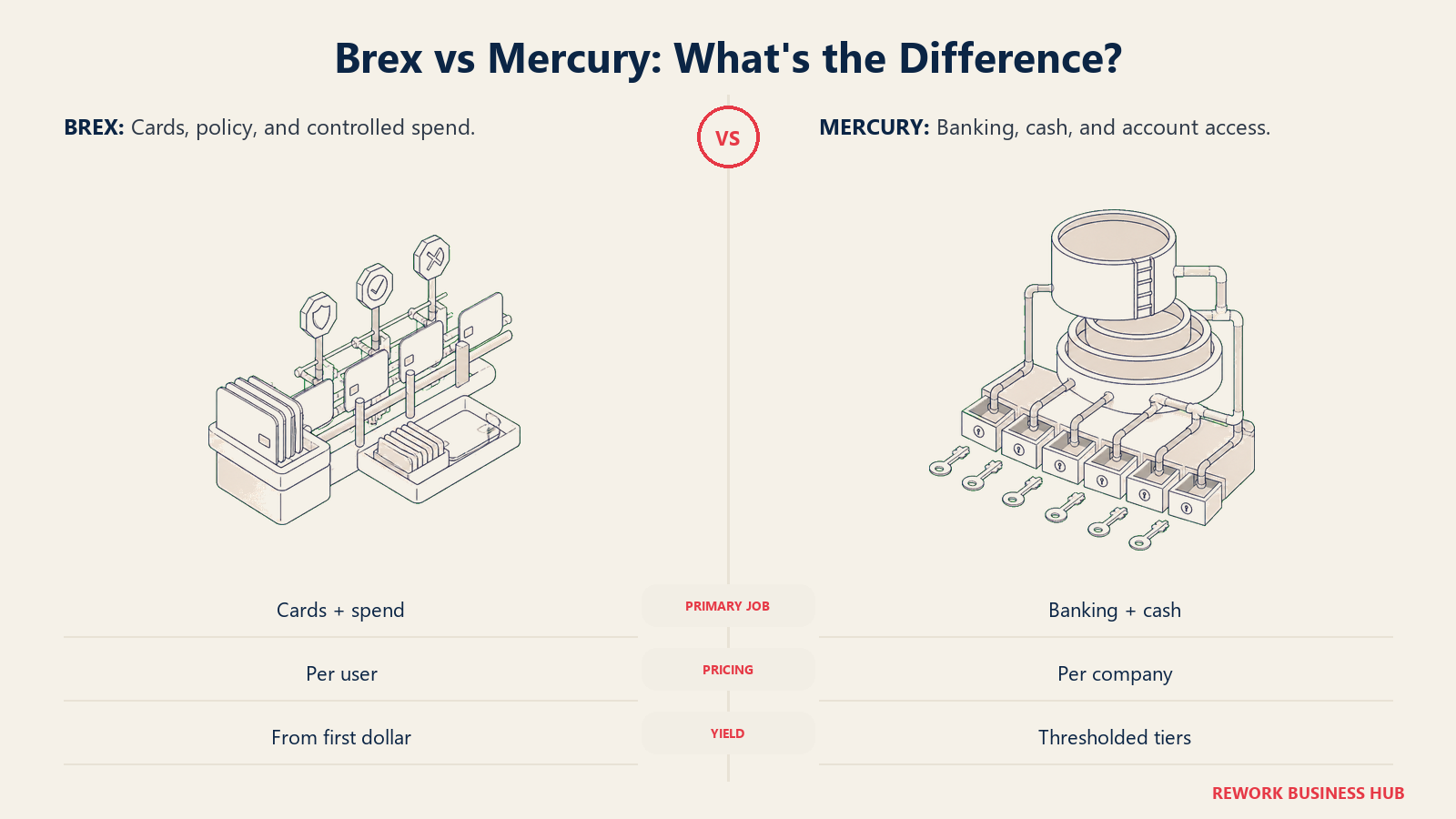
Type "Brex vs Mercury" into a search box and you'll get dozens of articles that line the two up feature by feature, as if they were competing versions of the same product. They aren't. Mercury is a business checking and savings account: you open it, you keep your operating cash in it, and unlimited people on your team can log in and use it for $0 a month. Brex is a corporate card and spend-management platform with a business account bolted on, priced per user, built to stop bad spend before it happens rather than to hold your money.
That difference is the whole article. A reader who lands on this page is usually asking one of three separate questions, and they get a different answer to each one:
- Where should our operating cash actually sit? That's a banking question, and it's Mercury's home turf.
- How do we give 20 or 200 people cards with real controls? That's a spend-management question, and it's Brex's home turf.
- Can one of these be our only finance tool? For a lot of companies, honestly, no. Plenty of finance teams run both: Mercury for the operating account and idle-cash yield, Brex for card issuance and expense policy. Saying that plainly up front is more useful than forcing a winner.
This article covers all three, plus the two facts that decide the comparison before any feature table does: who is even eligible to open an account with each vendor, and the fact that neither one is a chartered bank in the way your last business checking account probably was. If you're comparing the wider spend-management field first, our best spend management software roundup covers the category; if Mercury specifically isn't panning out for you, see our Mercury alternatives guide; and if you've already ruled out Mercury and are choosing between the two leading card platforms, Ramp vs Brex is the more direct comparison.
TL;DR
- Pick Mercury if the question is "where does our cash live." Free checking and savings, unlimited users, no per-seat fee, and a real path to yield once you cross $250,000 in Treasury.
- Pick Brex if the question is "how do we control spend across a growing team." Essentials is $0 per user per month with real card controls; Premium is $12 per user per month for policy depth, ERP integrations, and multi-entity support.
- Eligibility decides this before features do, for a lot of companies. Brex publishes hard minimums: a US EIN, US incorporation, US operations, a US address, and cash-balance or revenue thresholds by segment. Mercury has its own approval process and a published prohibited-country list. Check both before you build a comparison spreadsheet.
- Neither company is a bank, though Brex's owner now is one. Brex checking runs through Column N.A.; Mercury runs through Column N.A. and Choice Financial Group after ending its Evolve Bank & Trust relationship in 2025. Capital One completed its $5.15 billion acquisition of Brex on 7 April 2026, making Brex a wholly owned subsidiary of a chartered national bank holding company, while Mercury has separately won conditional OCC approval to become a chartered bank on its own.
- Yield works differently at every balance level. Brex pays up to 3.70% APY on Treasury with no stated minimum. Mercury requires $250,000 across your accounts before Treasury pays anything at all, then tiers up from there.
- Pricing structure, not price level, is the real divide. Mercury charges per company with unlimited users. Brex charges per user. At 5 employees those numbers barely differ. At 100, they don't compare at all.
Key Facts
Key Facts: what's actually behind this decision
- Standard FDIC deposit insurance covers up to $250,000 per depositor, per insured bank, per ownership category; anything a fintech advertises above that figure comes from spreading deposits across a network of partner banks, not from a single bank's own coverage (FDIC).
- Mercury received conditional approval from the Office of the Comptroller of the Currency on 27 April 2026 to organize as a national bank, Mercury Bank, N.A., five months after filing its application (Businesswire).
- Capital One completed its acquisition of Brex on 7 April 2026 for $5.15 billion, roughly 60% below Brex's $12.3 billion 2021 peak valuation, making Brex a wholly owned subsidiary of a chartered bank holding company (Capital One, CNBC).
- 60% of small businesses report using at least one online-only bank or fintech provider for financial services, up from prior years, according to the Federal Reserve's 2024 Small Business Credit Survey (Federal Reserve).
- The FDIC issued guidance in 2024 requiring banks partnering with fintechs to keep more detailed and reconcilable records of whose money is whose, a direct response to the Synapse-Evolve collapse that froze deposits for customers of several fintech banking apps (FDIC).
- Startups that raised a priced round held a median of $2.4 million in cash on hand shortly after closing, per Carta's 2025 State of Private Markets data, well above the $250,000 threshold where single-bank FDIC coverage stops protecting the full balance (Carta).
Brex vs Mercury at a Glance
| Brex | Mercury | |
|---|---|---|
| What it sells you | A corporate card and spend-management platform, with a business account included | A business checking and savings account, with cards and bill pay layered on |
| Pricing basis | Per user, per month | Per company, unlimited users |
| Entry price | Essentials, $0 per user per month | Free plan, $0 per month, unlimited users |
| Top published self-serve price | Premium, $12 per user per month | Pro, $299 per month ($254.15 billed annually) |
| Who can sign up | US EIN, US incorporation, US operations, US address, plus a minimum cash balance or revenue threshold by segment | Approval-based; published prohibited-country list; underwriting tightened in recent years |
| Corporate ownership | Wholly owned subsidiary of Capital One since 7 April 2026 | Independent, venture-backed |
| Where deposits sit | Column N.A. (checking), plus a sweep network for Vault | Column N.A. and Choice Financial Group, migrated off Evolve Bank & Trust in 2025 |
| Idle-cash yield | Up to 3.70% APY on Treasury, no stated minimum | 3.01% to 3.89% depending on fund and tier, $250,000 minimum to unlock |
| Core strength | Spend controls before the swipe, expense policy, multi-entity | Free banking, simple pricing, bill pay and invoicing bundled in |
| Weakest against the other | Not a place to hold your primary operating cash in the traditional sense | Card issuance and per-user spend policy are lighter than a dedicated card platform |
| Best fit | Teams that need cards, expense policy, and ERP-grade controls across a growing headcount | Any US company that wants a free operating account without per-seat math |
| Worst fit | Companies below the eligibility thresholds, or non-US entities | Companies that need deep, per-user spend policy across a large card program |
Sources: Brex pricing, Brex eligibility, and Mercury pricing, checked 24 to 26 August 2026.
The Category Difference That Decides This
This is the part most comparisons skip, and it's the reason a straight feature-by-feature table misleads more than it helps.
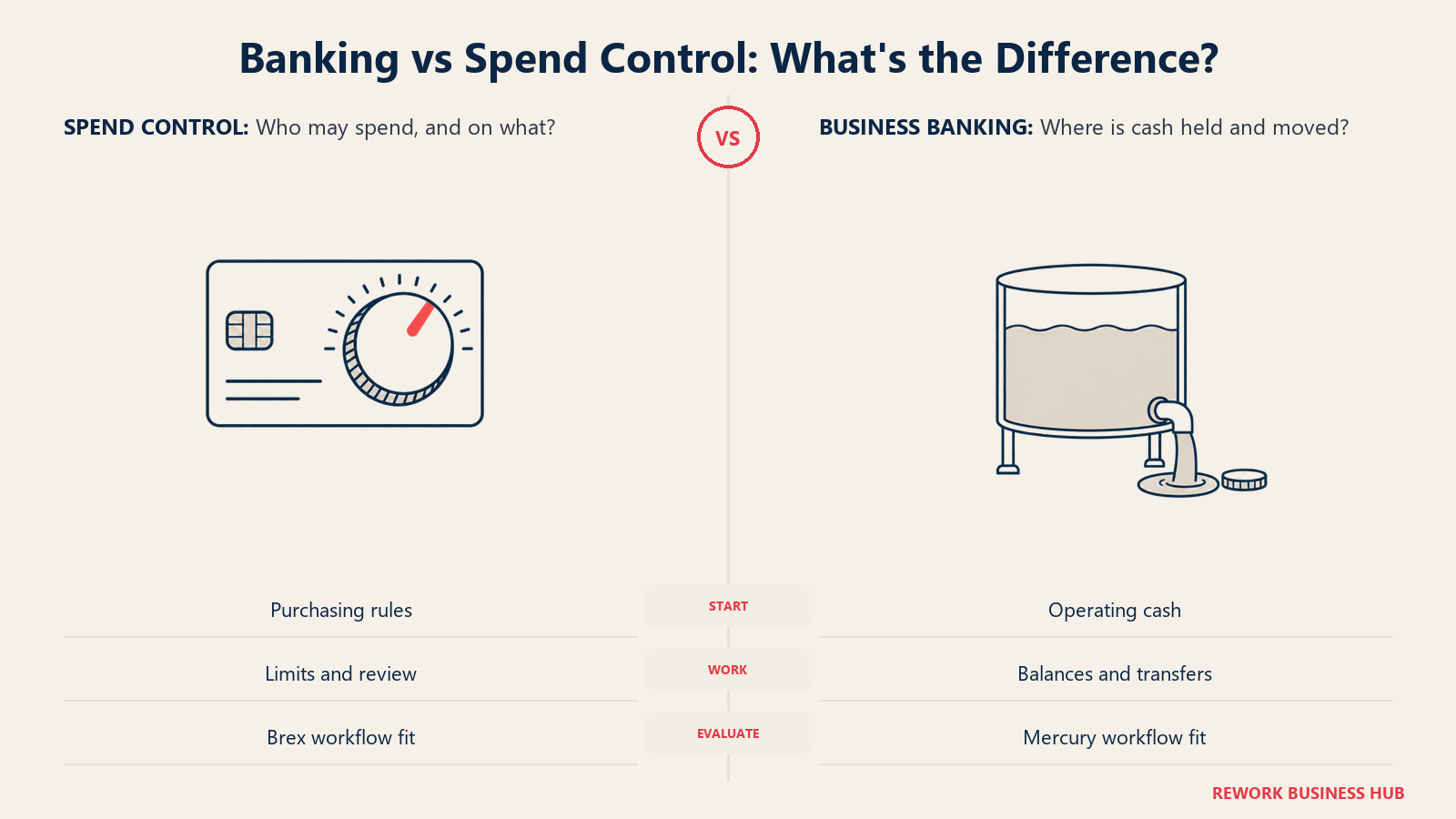
Mercury's business model is a bank account. It makes money on the spread between what it earns holding your deposits and what it pays you, plus the paid tiers (Plus and Pro) for teams that need invoicing volume and dedicated support. Because the product is an account, not a seat, Mercury has no reason to charge per user: more people logging in to view balances or approve payments doesn't cost Mercury anything meaningful, so every plan includes unlimited users.
Brex's business model is a card program with software attached. It makes money on card interchange, on Premium subscriptions, and on treasury and FX services. Because more users on Brex usually means more people with purchasing power, spend policies to configure, and support tickets to answer, pricing per user actually maps to Brex's own cost structure. That's also why Brex's free Essentials tier still exists: like other interchange-funded platforms, the software is close to a customer-acquisition cost, recovered when your team's spend runs through Brex cards.
| Mercury (account model) | Brex (card-and-policy model) | |
|---|---|---|
| What you're actually buying | A place to hold and move money | A way to control who spends what, and how |
| Why pricing is per company | More logins don't cost Mercury much | More users usually means more purchasing power to police |
| Why pricing is per user | Not applicable, Mercury doesn't charge this way | Each seat represents someone who can spend company money |
| What "free" is subsidized by | The deposit spread and paid invoicing tiers | Card interchange revenue |
| What you give up at the free tier | Recurring invoices, unlimited 1099 filings, dedicated support | Deeper expense policy, ERP integrations beyond QuickBooks and Xero, multi-entity depth |
| Where the two overlap | Both offer basic bill pay and reimbursements at $0 | Both offer basic bill pay and reimbursements at $0 |
Read that last row again, because it's the trap in this comparison. Both vendors technically offer bill pay and reimbursements for free, which is why some articles conclude the products are interchangeable. They aren't: Mercury's bill pay exists to move money out of an account you already have; Brex's exists to extend the same spend-control logic that governs its cards to your vendor payments too. Same feature name, different job.
Who Can Actually Sign Up
Before any feature comparison matters, check whether your company clears the door. This is the section a lot of "Brex vs Mercury" content skips entirely, and it's often the one that actually decides the purchase.
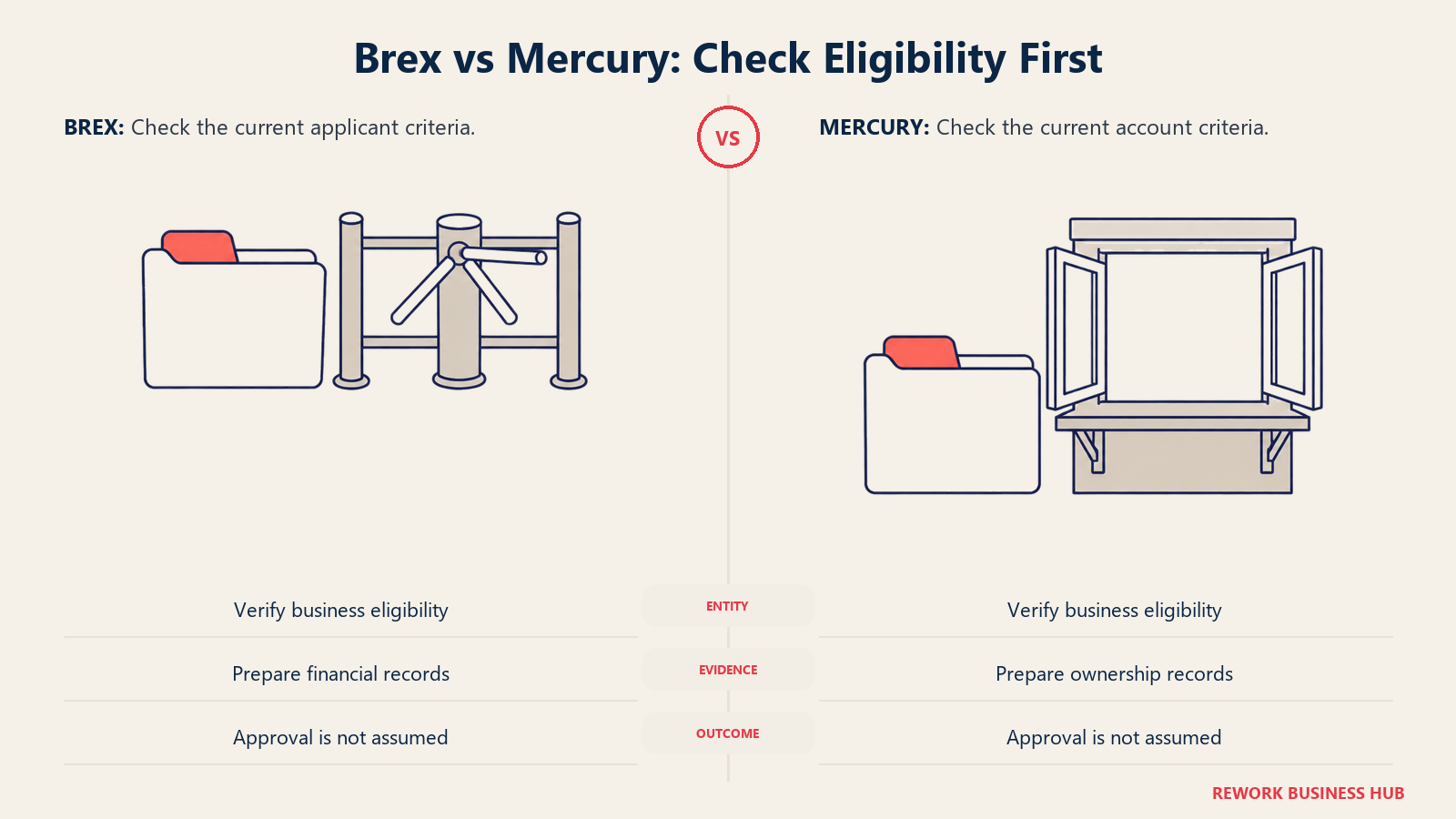
Brex publishes its eligibility bar in specific terms. Every applicant needs a US EIN issued by the IRS, valid US incorporation, US operations, and a US physical address (P.O. boxes and mailbox services don't count) (Brex). Beyond that baseline, the cash or revenue bar depends on your segment:
| Segment | Requirement | Source |
|---|---|---|
| Venture or angel-funded startups | Minimum cash balance of $50,000 (can be lower through certain partner referrals) | Brex |
| Mid-market and enterprise | More than $400,000 per month in revenue (roughly $4.8M per year) for monthly payment terms | Brex |
| Commercial businesses | More than $500,000 in annual revenue for monthly payment terms | Brex |
| Nonprofits | Evaluated case by case, may require board information and 501(c)(3) documentation | Brex |
| Non-US companies | Not eligible; a US EIN, incorporation, operations, and address are all required | Brex |
Mercury doesn't publish a comparable numeric cash bar, but it runs its own underwriting review on every application, maintains a published list of prohibited countries and business types, and has visibly tightened its approval process in recent years, including pausing card shipments to several countries. If your company or its beneficial owners have ties to a country on that list, expect a rejection or a slower manual review regardless of how much cash you're holding; check the current list at support.mercury.com before assuming approval.
| Brex | Mercury | |
|---|---|---|
| Numeric threshold published | Yes, by segment (see table above) | No public dollar minimum |
| Underwriting style | Segment-based cash or revenue rule, applied consistently | Case-by-case review |
| Country restrictions | US-incorporated companies only | Published prohibited-country list |
| What rejects an applicant most often | Falling below the cash/revenue bar for your segment | Beneficial-owner or business ties to a restricted jurisdiction, or an unclear business model |
| Where to verify current rules | brex.com/support/who-is-eligible-for-brex | support.mercury.com |
Practically, this means a very early, unfunded startup, or a company with real revenue but thin cash reserves, may clear Mercury's review and not clear Brex's segment bar. It also means a company with ties to a restricted jurisdiction can hold real US revenue and still not clear Mercury. Run your own numbers against both lists before you spend time comparing feature tables.
Neither of These Is Your Grandfather's Bank
This is the fact most likely to surprise a first-time buyer, and it deserves its own section rather than a footnote.
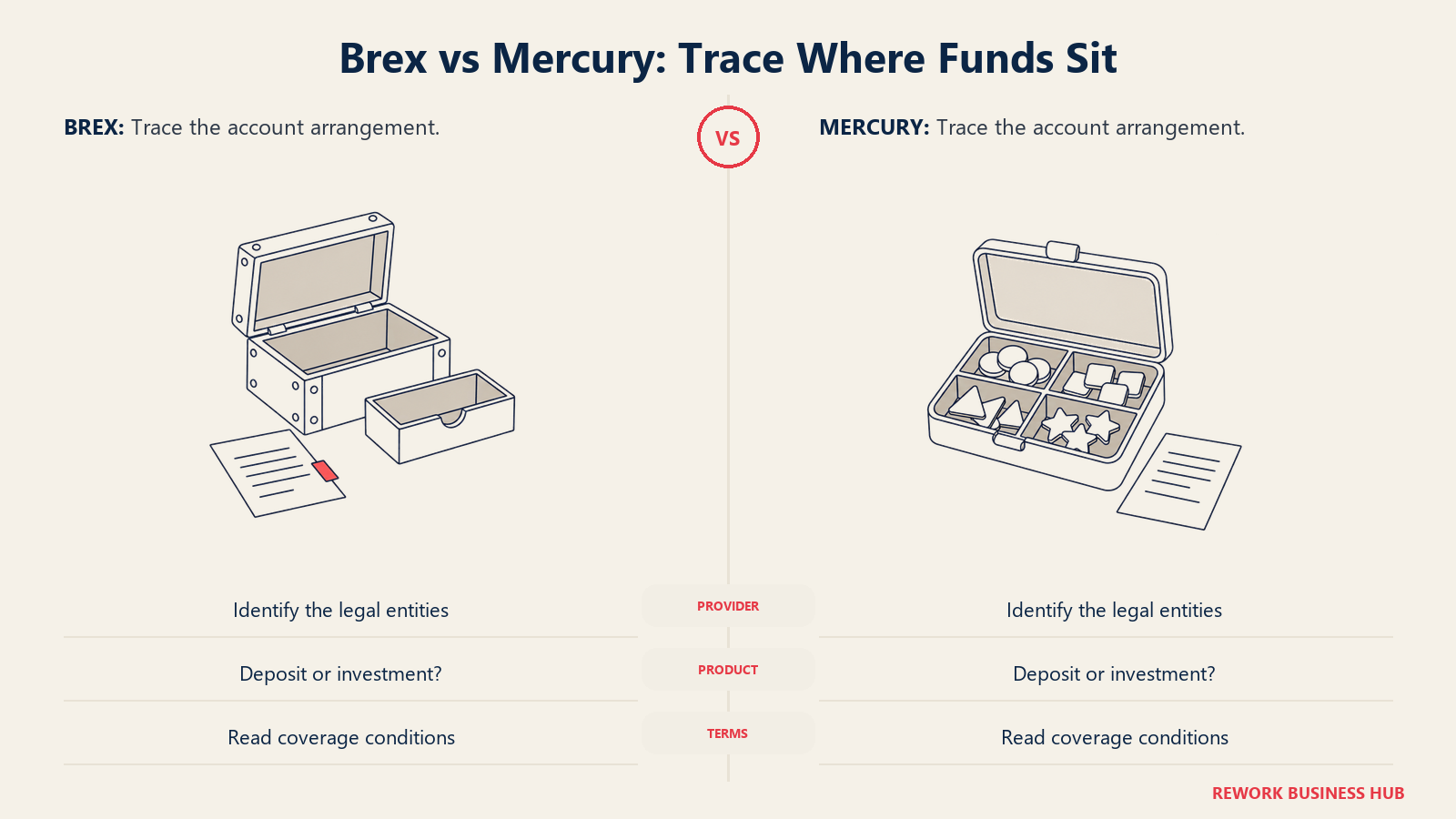
Neither Brex nor Mercury is a chartered bank. Both are financial technology companies that partner with banks to hold deposits and issue accounts, which is a completely normal and legal structure in US fintech, but it changes what "FDIC insured" actually means in practice.
Brex's checking account runs through Column N.A., Member FDIC (Brex). Standard FDIC coverage there is the normal $250,000 per depositor. Brex's Vault product goes further: it sweeps balances above that across a network of partner banks, including Axos Bank, East West Bank, Hinsdale Bank & Trust, Lake Forest Bank & Trust, and LendingClub Bank, extending coverage up to $6 million by keeping no more than $250,000 at any single institution (Brex).
Brex's own regulatory story moved fastest of the two, just not through a charter application. Capital One announced a deal to acquire Brex on 22 January 2026 and completed it on 7 April 2026, for $5.15 billion: roughly $2.6 to $2.75 billion in cash plus about 10.6 million shares of Capital One stock to Brex shareholders, with Capital One paying off Brex's $1.1 billion in outstanding debt immediately after closing (Capital One; Capital One investor relations). The price was about 60% below Brex's $12.3 billion valuation at its 2021 peak. Brex is now a wholly owned subsidiary of Capital One, a chartered national bank holding company, though that is a statement about who owns Brex, not about Brex itself becoming a bank. Neither Capital One's announcement nor Brex's own post about the deal states any change to Brex's banking partner, deposit structure, or FDIC coverage, so, Brex checking still runs through Column N.A. and Vault's sweep arrangement as described above.
Mercury announced in March 2025 that it was ending its relationship with Evolve Bank & Trust and migrating customer deposits to Column N.A. and Choice Financial Group, a move it completed by the end of 2025. Through its own sweep network across those and other partner banks, Mercury advertises up to $5 million in FDIC coverage (Mercury). The most significant recent development, though, is regulatory rather than structural: Mercury received conditional approval from the Office of the Comptroller of the Currency on 27 April 2026 to organize Mercury Bank, N.A., putting it on a path toward becoming a chartered bank in its own right rather than a fintech layered on top of partner banks (Businesswire). Final authorization still requires sign-off from the FDIC and the Federal Reserve, so Mercury's deposits still sit at its partner banks.
| Brex | Mercury | |
|---|---|---|
| Chartered bank? | No, a fintech, now owned by a chartered bank holding company | No, a fintech, pending its own national bank charter |
| Checking deposits held at | Column N.A., Member FDIC (unchanged) | Column N.A. and Choice Financial Group |
| Standard FDIC coverage | $250,000 per depositor at the primary bank | $250,000 per depositor at each partner bank |
| Extended coverage via sweep | Up to $6 million through Brex Vault's partner-bank network | Up to $5 million through Mercury's sweep network |
| Regulatory milestone | Acquired by Capital One, closed 7 April 2026, $5.15 billion | OCC conditional approval for Mercury Bank, N.A., granted 27 April 2026, FDIC and Fed approval still pending |
| What to call it in writing | "Brex's partner bank," never "Brex Bank"; Brex is "a Capital One subsidiary," not "part of Capital One Bank" | "Mercury's partner banks," never "Mercury Bank" (until the charter is finalized) |
Why this matters beyond terminology: the 2024 collapse of banking-as-a-service middleware provider Synapse froze deposits for customers of several fintech banking apps for months, because record-keeping between the fintech, the middleware layer, and the partner bank didn't reconcile cleanly (FDIC guidance issued in response). Neither Brex nor Mercury used Synapse, but the episode is why any extended FDIC figure above $250,000 deserves a follow-up question about exactly which banks are involved and how the sweep is structured, not just the headline number.
Yield on Idle Cash
If your company is holding meaningful cash and not spending it immediately, the yield question is often worth more than the software features on either side.
Brex pays up to 3.70% APY on funds moved into its Treasury product, invested in the BNY Dreyfus Government Cash Management money market fund (DGVXX), with the rate effective as of 24 August 2026 and no stated minimum balance to participate (Brex). Uninvested cash sitting in the base checking account earns nothing.
Mercury Treasury requires a combined balance of $250,000 across your Mercury accounts before it unlocks at all, then tiers the rate up by deposit size across two fund options, a government money market fund (MRGXX) and an ultra-short bond fund (MCRYX), both net of fees, as of Mercury's published rates:
| Deposit range | Government money market (MRGXX) | Ultra-short bonds (MCRYX) |
|---|---|---|
| $250K to $2M | 3.12% | 3.44% |
| $2M to $5M | 3.27% | 3.59% |
| $5M to $10M | 3.37% | 3.69% |
| $10M to $20M | 3.47% | 3.79% |
| $20M to $50M | 3.57% | 3.89% |
| Above $50M | Contact for rates | Contact for rates |
Source: Mercury Treasury. The government money market fund offers same-day liquidity; the ultra-short bond fund settles in one to two days. Accounts above $25 million can also access personalized portfolio management through Morgan Stanley.
| Brex Treasury | Mercury Treasury | |
|---|---|---|
| Minimum balance to earn anything | None stated | $250,000 combined across Mercury accounts |
| Rate at entry | Up to 3.70% APY | 3.12% to 3.44% depending on fund, at the $250K tier |
| Rate scales with balance | Not tiered publicly | Yes, six published tiers up to $50M+ |
| Underlying fund | BNY Dreyfus Government Cash Management (DGVXX) | State Street government money market (MRGXX) or an ultra-short bond fund (MCRYX) |
| Liquidity | Same-hour, per Brex | Same-day (MRGXX) or 1 to 2 days (MCRYX) |
| Best for | Companies that want yield from dollar one, regardless of balance | Companies already holding $250,000-plus who want a rate that improves with scale |
The practical read: a company with under $250,000 sitting idle gets meaningfully more from Brex Treasury, because Mercury pays nothing below that line. A company comfortably above $250,000, especially one holding several million post-raise (Carta puts the median priced-round cash balance at $2.4 million, per its 2025 State of Private Markets report, which is linked in the Key Facts above), should compare the actual blended rate at its balance tier against Brex's flat published rate before assuming either one wins by default.
Pricing Structure: Per User vs Per Company
Here is the crossover the headline prices hide. Mercury's published plans, in full:
| Plan | Price | Basis | What's included |
|---|---|---|---|
| Mercury (free) | $0 per month | Per company, unlimited users | Checking and savings, free ACH, free domestic wires, real-time payments, free bill pay, basic invoicing, 6 free checkbooks per year, QuickBooks and Xero automations |
| Mercury Plus | $29.90/month, or $23.95/month billed annually | Per company, unlimited users | Adds invoicing with ACH debit ($1 per transaction), recurring invoices, an invoicing API (500 requests/month), unlimited 1099 filings |
| Mercury Pro | $299/month, or $254.15/month billed annually | Per company, unlimited users | Adds a dedicated relationship manager, $0 ACH debit, unlimited invoicing API calls, NetSuite-enriched automations |
Source: Mercury pricing.
Brex's published plans:
| Plan | Price | Basis | What's included |
|---|---|---|---|
| Brex Essentials | $0 per user per month | Per user | Global card acceptance, AI-driven custom rules, up to two entities, bill pay, reimbursements, travel booking, API access |
| Brex Premium | $12 per user per month | Per user | Multiple expense policies, dynamic review chains, AI compliance audit detection, multi-entity across US and international, customizable ERP and HRIS integrations, VAT documentation, group travel, live budgets |
| Brex Enterprise | Custom | Custom | Unlimited US or global entities, local card issuance, a named account manager |
| Brex Smart Card | Custom | Custom | Local-currency cards in 50+ countries, merchant controls |
Source: Brex pricing.
Because Mercury's price doesn't move with headcount and Brex's does, the two only look comparable at small team sizes. Here's what that means in annual dollars, using list prices with no negotiated discount:
Annual cost at 5, 25, 50, 100, and 250 users
| Users | Mercury (free) | Mercury Plus (annual) | Mercury Pro (annual) | Brex Essentials | Brex Premium |
|---|---|---|---|---|---|
| 5 | $0 | $287.40 | $3,049.80 | $0 | $720 |
| 25 | $0 | $287.40 | $3,049.80 | $0 | $3,600 |
| 50 | $0 | $287.40 | $3,049.80 | $0 | $7,200 |
| 100 | $0 | $287.40 | $3,049.80 | $0 | $14,400 |
| 250 | $0 | $287.40 | $3,049.80 | $0 | $36,000 |
All figures are annual, in USD, calculated from the published rates above (Mercury Plus and Pro annual-billing rates; Brex Essentials and Premium at list price with no card-program discount). Mercury's column never moves, because the price is set at the company level and every plan includes unlimited users. Brex's Essentials column also stays at $0, since it's free per user, but Premium climbs in a straight line with headcount because it's billed per user.
Read the table plainly: if your team needs Premium-tier Brex features (multi-entity, ERP integrations, dynamic approval chains) at 250 people, that's $36,000 a year Mercury simply never charges you, because Mercury doesn't gate features by seat count the same way. But that comparison is slightly unfair in the other direction too: Mercury Plus and Pro don't buy you card issuance, per-user spend policy, or expense review chains at any price. If the team needs both a free operating account and per-user spend controls at scale, the realistic budget line is Mercury (free) plus Brex Premium at whatever headcount is actually swiping cards, not one platform's price against the other's.
How the rest of the market prices against these two
| Vendor | Published price | Basis |
|---|---|---|
| Ramp Free | $0 per user per month | Per user, free tier |
| Ramp Plus | $15/user/month plus an unpublished platform fee | Per user |
| BILL Spend & Expense | $0 per user per month | Per user, free (formerly Divvy) |
| Rho | $0 subscription, $0 per-user fee, $0 checking minimum | Per company |
| Relay Starter | $0/month, no minimum balance | Per company |
| Relay Scale | $120/month list, discounted to $90/month at time of writing | Per company |
| Bluevine Standard | $0/month, 1.3% APY with activity requirement | Per company |
That context matters because Mercury is not the only free operating account in this cluster, and Brex is not the only free card program. Our Mercury alternatives roundup covers Rho, Relay, and Bluevine in depth, and our Ramp vs Brex comparison covers the other major interchange-funded card platform if Brex's eligibility bar rules you out.
Corporate Cards and Spend Controls
This is Brex's home ground, and the design philosophy shows in how each product structures a card.
Brex Essentials issues virtual and physical cards with AI-driven custom rules that flag or block spend against policy, and supports up to two legal entities at no cost. Premium adds multiple expense policies (so Sales and Engineering can run under different rules), dynamic review chains that route an expense to different approvers based on amount or category, and AI-driven compliance audit detection that flags likely policy violations before an approver even looks at the report.
Mercury issues an unlimited number of virtual cards and one physical card per employee, with custom daily, weekly, or monthly spend limits per person, cards locked to specific merchants from a list of over 1,000, and company-wide merchant or category restrictions (Mercury support). Mercury has also begun rolling out "agent cards," aimed at businesses that want an AI system to make purchases within a preset, unchangeable spending limit, a genuinely new category of control (CFO Tech).
| Capability | Brex | Mercury |
|---|---|---|
| Issues its own cards | Yes, core to the product | Yes, unlimited virtual, one physical per employee |
| Per-user spend limits | Yes, policy-based, deepens on Premium | Yes, daily/weekly/monthly limits per card |
| Merchant locks | Yes | Yes, from a list of 1,000+ merchants |
| Multiple expense policies by team | Premium only | Not a distinct feature; limits are set per card |
| Dynamic, amount-based approval routing | Premium only | Multi-layered approval rules on Bill Pay, not on card spend specifically |
| AI compliance / audit detection | Premium | Not published as a comparable feature |
| Agent (AI purchasing) cards | Not published | Yes, a newly launched capability |
| Multi-entity support | Up to 2 entities on Essentials, more on Premium and Enterprise | Not a core feature; Mercury accounts are structured per company |
| International card issuance | 30+ currencies, 60+ countries; Smart Card adds local-currency cards in 50+ countries | Primarily US-focused |
If the actual problem you're solving is "our team keeps spending outside policy and we find out a month later," Brex's per-user policy engine is built for exactly that. If the problem is closer to "give the team cards with sane limits without paying a subscription," Mercury's card controls, bundled into a free account, cover a lot of that ground without a per-seat cost.
Accounts Payable and Bill Pay
Both platforms bundle bill pay into their entry tier, which surprises buyers used to AP being a separate purchase.
Brex Essentials includes bill pay with two-way invoice matching against purchase orders, and can provision Brex cards for vendor and indirect procurement spend with per-transaction limits. Brex also supports one-time or recurring domestic and international payments in local currency across 50+ countries via ACH, wire, or card.
Mercury's Bill Pay, available on the free plan, auto-populates bill details from a dedicated inbox, uses AI to extract invoice data, and detects duplicate invoices. Multi-layered approval rules let bills route through several approvers, and payments can be approved directly from Slack or Mercury's mobile app. A more advanced financial-workflows tier, priced separately at $35 per month, adds deeper automation on top of Bill Pay, which itself remains free with unlimited bills processed.
| Brex | Mercury | |
|---|---|---|
| Bill pay on the entry tier | Yes, Essentials | Yes, free plan |
| Invoice-to-PO matching | Two-way matching | Not published as a comparable feature |
| AI invoice data extraction | Not a named feature on bill pay specifically | Yes, on Bill Pay |
| Multi-layered approval routing | Dynamic review chains on Premium | Yes, multi-layered rules on the free plan |
| Slack approvals | Not published | Yes |
| Advanced automation tier | Included in Premium's broader feature set | Separate financial-workflows tier at $35/month |
| Payment methods | ACH, wire, card, in 50+ countries local currency | ACH, domestic and international wire, check |
Both platforms sit well ahead of doing this manually. Ardent Partners' State of ePayables research puts the cost of processing a single invoice without automation at $12.88 and 17.4 days, a benchmark either tool comfortably beats on the AP side alone (Bottomline). If AP depth specifically, not banking or cards, is your actual gap, our AP automation software roundup and our head-to-head on Bill.com vs Tipalti cover dedicated tools built for higher invoice volume than either of these platforms targets.
Accounting Integrations
| Accounting system | Brex tier required | Mercury tier required |
|---|---|---|
| QuickBooks Online | Essentials | Free |
| Xero | Essentials | Free |
| NetSuite | Premium | Pro (NetSuite-enriched automations) |
| Sage Intacct | Premium | Not published |
| Workday (HRIS) | Premium | Not published |
| Oracle Fusion Cloud | Not published | Not published |
The pattern is close to symmetrical. Both vendors serve QuickBooks Online and Xero users on their cheapest tier, which means both are effectively free for a company running standard small-business accounting software. Once you're on NetSuite, both push you to a paid tier: Brex Premium at $12 per user per month, or Mercury Pro at $299 a month flat regardless of headcount. At meaningful team size, that flat Mercury Pro fee for NetSuite automations becomes the cheaper of the two, since it doesn't multiply by seats. If your accounting stack itself is the actual constraint, our guides to NetSuite alternatives and Sage Intacct alternatives cover that layer directly.
International Payments
Brex sends international wires with no transaction fee, including local-currency wires that show the exchange rate upfront and typically route through fewer intermediary banks than a standard USD wire (Brex). Brex can issue physical and virtual cards in 30 or more currencies across 60 or more countries, with locally funded reimbursements and card issuance in over 20 currencies across 45 countries for qualifying customers, and Smart Card extends local-currency card issuance further.
Mercury sends USD international wires for free, with an optional $15 fee for a wire type that covers the recipient's transaction costs. Sending in a non-USD currency carries a 1% foreign exchange fee that covers both conversion and any intermediary bank charges, across 200-plus countries and regions in 40-plus local currencies (Mercury). Companies exchanging more than $200,000 a month can request different fee arrangements directly.
| Brex | Mercury | |
|---|---|---|
| USD international wires | Free | Free |
| Non-USD wires | Local-currency wires with upfront rate | 1% FX fee covering conversion and intermediary costs |
| Countries/currencies for card issuance | 60+ countries, 30+ currencies | Primarily US-issued cards |
| Best fit | Companies issuing cards or paying vendors in many currencies | Companies mostly wiring in and out of USD, occasionally converting |
Neither platform is built as a dedicated multi-currency operating bank the way a European-native fintech is. If your company holds meaningful non-US entities or needs local issuing outside the US as a first-class feature rather than an add-on, treat both of these as US-centric and shortlist a specialist alongside them.
When Mercury Is the Right Call
- You just need a free operating account and don't want to think about seats. No per-user math, no card-eligibility gate to clear first, just an account.
- Your team is small but everyone needs banking access. Bookkeepers, contractors, co-founders, and part-time finance help can all log in without adding to a bill.
- You're holding six or seven figures in idle cash and want yield that scales with balance. Once you clear $250,000, Mercury's tiered Treasury rates reward larger balances directly.
- You want simple bill pay and invoicing without buying a card program you don't need yet. Mercury's free Bill Pay and basic invoicing cover a real slice of AP without a subscription.
- You want exposure to a fintech on a path toward becoming a chartered bank, for whatever weight that carries in your own risk assessment, rather than one that plans to stay bank-partnered indefinitely.
When Brex Is the Right Call
- You're issuing cards to a growing headcount and need real per-user spend policy. Dynamic review chains and multiple expense policies solve a problem Mercury's card limits don't attempt to solve.
- You clear the eligibility bar and want the software for $0. Essentials genuinely costs nothing if your cash balance or revenue clears the segment threshold.
- You need yield starting from a small balance. Brex Treasury pays from dollar one, with no $250,000 floor, which matters for an earlier-stage company that isn't sitting on much idle cash yet.
- You operate across multiple entities or countries already. Multi-entity support, local-currency card issuance in 50-plus countries, and ERP-grade integrations on Premium are built for that from the start.
- You want AI-driven compliance and audit detection on top of a card program, catching likely policy violations before an approver has to hunt for them manually.
Who Should Choose Which
| If this describes you | Choose | Because |
|---|---|---|
| You want a free operating account, no card underwriting required | Mercury (free) | Unlimited users, no per-seat fee, real banking features |
| You need cards with per-user spend policy and you clear the eligibility bar | Brex Essentials | $0 per user with real controls, once you qualify |
| You're growing past 50 users and need dynamic approval chains and ERP integrations | Brex Premium | Per-user cost is real, but the policy depth scales with the team |
| You're holding $250,000-plus in idle cash and want it to earn more as it grows | Mercury Plus or Pro, with Treasury unlocked | Tiered rates reward larger balances, and the plan price stays flat regardless of headcount |
| You don't clear Brex's segment-based cash or revenue bar | Mercury | Mercury's approval process doesn't publish an equivalent numeric floor |
| You have real spend or entities outside the US | Brex, with caveats | Multi-currency card issuance beats Mercury's US-first design, though neither is a full multi-currency operating bank |
| You want both banking and per-user spend control without compromise | Both, run in parallel | Mercury as the operating account, Brex for the card program, is a common and reasonable split |
The verdict: answer the category question before the feature question. If you're deciding where your operating cash should live, and you don't need per-user card policy today, Mercury's free plan is very hard to argue against, because there's no seat cost to weigh against anything. If you're deciding how to control spend across a team that's already spending unevenly, and you clear Brex's eligibility bar, Essentials gives you that control for the same $0. The two aren't really substitutes, which is why a meaningful share of the companies searching this comparison end up running both.
Frequently Asked Questions about Brex vs Mercury
Is Brex or Mercury actually free?
Both have a genuinely $0 tier, but they're free in different ways. Mercury's free plan is $0 per month for the whole company with unlimited users, no card-eligibility gate beyond Mercury's own approval process. Brex Essentials is $0 per user per month, but you must first clear Brex's published eligibility requirements, including a minimum cash balance or revenue threshold depending on your company type.
What's the actual difference between Brex and Mercury?
Mercury is a business bank account: checking, savings, and bill pay, priced per company with unlimited users. Brex is a corporate card and spend-management platform with a bank account attached, priced per user, built around controlling spend before it happens rather than holding your operating cash. Many companies use both.
Can I get a Brex account if my company is new or unfunded?
Only if you clear Brex's published thresholds. Venture or angel-funded startups need a minimum $50,000 cash balance (sometimes lower through a partner referral). Companies without institutional funding need more than $500,000 in annual revenue, or more than $400,000 a month for mid-market and enterprise accounts. Below those bars, Brex is not an option regardless of how good a fit the software would otherwise be.
Is my money safe at Brex or Mercury if neither is a real bank?
Both hold deposits at FDIC-member partner banks, and both extend coverage past the standard $250,000 through a sweep network: up to $6 million at Brex through Vault, and up to $5 million at Mercury. Mercury has also won conditional OCC approval to become a chartered bank, Mercury Bank, N.A., though FDIC and Federal Reserve approval are still pending. Brex, meanwhile, became a wholly owned subsidiary of Capital One when that acquisition closed on 7 April 2026; neither company has stated any change to Brex's deposit structure as a result, so Brex checking still runs through Column N.A.. Ask either vendor exactly which partner banks hold your funds and how the sweep is structured before treating an advertised coverage figure as guaranteed.
Which one pays more interest on idle cash?
It depends on your balance. Brex Treasury pays up to 3.70% APY with no minimum balance, so it's the better option below $250,000. Mercury Treasury requires $250,000 across your accounts to unlock at all, then pays 3.12% to 3.89% depending on the fund and your deposit tier, which can outpace Brex at higher balances once you compare the actual tiered rate rather than the headline number.
Do both companies use the same bank behind the scenes?
They overlap. Brex's checking account and Mercury's checking and savings accounts both run through Column N.A., though each maintains its own broader sweep network of additional partner banks for extended FDIC coverage. Sharing a primary partner bank doesn't mean the products, terms, or coverage are identical.
Should we use both Brex and Mercury?
It's a common setup. Keeping the operating account and idle cash at Mercury for the free banking and yield-at-scale, while running card issuance and per-user spend policy through Brex, lets you take the free tier from both products without asking either one to do a job it wasn't built for.
What to Do Next
Before you request a demo of either product, answer one question honestly: are you trying to decide where your company's cash should sit, or are you trying to decide how to control what your team spends? If it's the first question, check Mercury's approval requirements and open a free account, since there's no cost to trying it. If it's the second, run your company's numbers against Brex's published eligibility table above before you invest time in a sales conversation, since a company below the cash or revenue bar for its segment won't be approved regardless of fit. And if the honest answer is both questions matter, price out running Mercury as your bank and Brex for card issuance in parallel. At the free tiers on both sides, that costs nothing to test for a month.
Related Resources:

Principal Product Marketing Strategist
On this page
- TL;DR
- Key Facts
- Brex vs Mercury at a Glance
- The Category Difference That Decides This
- Who Can Actually Sign Up
- Neither of These Is Your Grandfather's Bank
- Yield on Idle Cash
- Pricing Structure: Per User vs Per Company
- Annual cost at 5, 25, 50, 100, and 250 users
- How the rest of the market prices against these two
- Corporate Cards and Spend Controls
- Accounts Payable and Bill Pay
- Accounting Integrations
- International Payments
- When Mercury Is the Right Call
- When Brex Is the Right Call
- Who Should Choose Which
- What to Do Next