Best HR Software (HRIS) in 2026: 14 Platforms Ranked by Fit
Turn this article into takeaways for your work.


Each assistant summarizes the article only for you and suggests best practices for your work.
The best HR software in 2026 is the one that matches your headcount, your payroll footprint, and your actual pain point, not the one with the longest feature list. BambooHR wins for small teams that want a clean core HRIS. Rippling wins for companies that want HR, IT, and finance in one system of record. Deel wins if you're hiring across borders. ADP and Workday win at real enterprise scale. Rework wins if your actual problem is too many disconnected tools and you want HR unified with sales, lead, and work ops. And Lattice and 15Five aren't HRIS at all, they're focused performance and engagement layers that sit on top of whatever system you already run payroll through. This guide ranks 14 platforms by fit so you can shortlist fast instead of demoing everything.
Most HR software searches start the same way: someone got burned. Payroll ran late, a new hire's I-9 fell through the cracks, or the CEO asked for headcount-by-department and it took three days to pull together in spreadsheets. That's usually the trigger for buying an HRIS, and the data backs the instinct: 85% of employers that use automation or AI in HR say it saves time and/or increases their efficiency, according to SHRM. It's also why so many teams buy the wrong one. They shop for the tool with the most modules instead of the tool that fixes the specific process that's broken. This guide breaks down 14 real options, what they cost, and who each one actually fits.
Key Facts
Key Facts: HR Software Effectiveness
- 85% of employers using automation or AI in HR say it saves time and/or increases efficiency (SHRM).
- Structured onboarding produces 50% greater new-hire productivity and makes new employees 58% more likely to still be with the company after three years (SHRM).
- Disengaged employees cost the global economy $8.9 trillion in lost productivity a year, while teams in the top quartile of engagement post 23% higher profitability than the bottom quartile (Gallup).
- 89% of HR professionals whose organization uses AI to support recruiting say it saves them time or increases their efficiency (SHRM).
- Only 24% of HR functions believe they're achieving maximum value from their HR technology investment, per Gartner research reported by SHRM (SHRM).
Quick Comparison Table
Use this to narrow the field before you dig into individual vendor trade-offs.
| Tool | Best For | Starting Price | Key Strength | Key Limitation |
|---|---|---|---|---|
| BambooHR | Small to mid-size teams wanting a clean core HRIS | $10/employee/mo (Core) | Simple, well-liked UI; strong ATS add-on | Payroll and benefits cost extra; reporting is basic on lower tiers |
| Rippling | Companies wanting HR, IT, and finance unified | No public price; quote only | Deepest platform breadth (HR + IT + spend) | Pricing is opaque; easy to overbuy modules you don't need |
| Gusto | Small businesses running US payroll for the first time | $49/mo + $6/employee (Simple) | Best payroll UX for non-experts; transparent pricing | Thin outside the US; limited for complex HR needs |
| ADP Workforce Now | Mid-size to large companies wanting enterprise-grade payroll | Custom quote (no public pricing) | Payroll accuracy and compliance depth at scale | Pricing opacity; implementation and support quality vary by reseller |
| Workday | Large enterprises (1,000+ employees) needing full HCM | Custom quote (typically $14-28/employee/mo negotiated) | Deepest HCM + financials integration | Expensive, slow to implement; overkill under 1,000 employees |
| Deel | Companies hiring employees and contractors across borders | $599/employee/mo (EOR); $49/contractor/mo | Fastest way to hire compliantly in 130+ countries | EOR pricing is steep at low volume; best-of-breed, not core HRIS |
| HiBob | Mid-size, culture-forward companies wanting a modern HRIS | Custom quote (~$8-18/employee/mo typical) | Strong UX, culture and engagement features | No published pricing; core HR only, payroll varies by region |
| Personio | European and global mid-market teams | Custom quote (~$5-15/employee/mo typical) | Built for EU compliance from the ground up | Weaker US payroll depth; pricing not published |
| Paycor | US mid-market companies wanting payroll + HR + talent | Custom quote (sales call required) | Strong compliance tools for regulated industries | Public pricing was pulled in 2025; quote-only now |
| Namely | Mid-size US companies (25-1,000 employees) | $9/employee/mo (Namely Now, entry tier) | Full HRIS + payroll + talent in one contract | Upper tiers are custom quote; less modern UI than newer entrants |
| Justworks | Startups and small businesses wanting a PEO | $79/employee/mo (PEO Basic) | Simple flat pricing; access to large-group benefits | Per-employee cost gets expensive as headcount grows |
| Lattice | Companies that already have an HRIS and need performance management | $10/seat/mo (Performance) | Best-in-class OKRs, reviews, and manager tools | Not an HRIS, no payroll; needs a core system alongside it |
| 15Five | Companies wanting continuous feedback and manager coaching | $4/user/mo (Engage) | Strong manager enablement, AI coaching add-ons | Not an HRIS; overlaps with Lattice rather than replacing an HRIS |
| Rework | Mid-size teams wanting HR unified with sales, lead, and work ops | People: Quote on request; other apps sold as engines, e.g. Process Engine from $99/mo billed yearly (5 seats) | People app covers HRIS, time & attendance, and timesheets alongside Sales Ops, Lead Ops, and Work Ops | Not a deep global payroll suite or PEO; no published per-employee People price |
How to Choose HR Software in 2026
Most HR software evaluations fail for the same reason CRM evaluations fail: teams compare feature lists before they've answered the questions that actually determine fit. The stakes are real: only 24% of HR functions believe they're achieving maximum value from their HR technology investment, according to Gartner research reported by SHRM, and a mismatched tool is one of the most common reasons why.
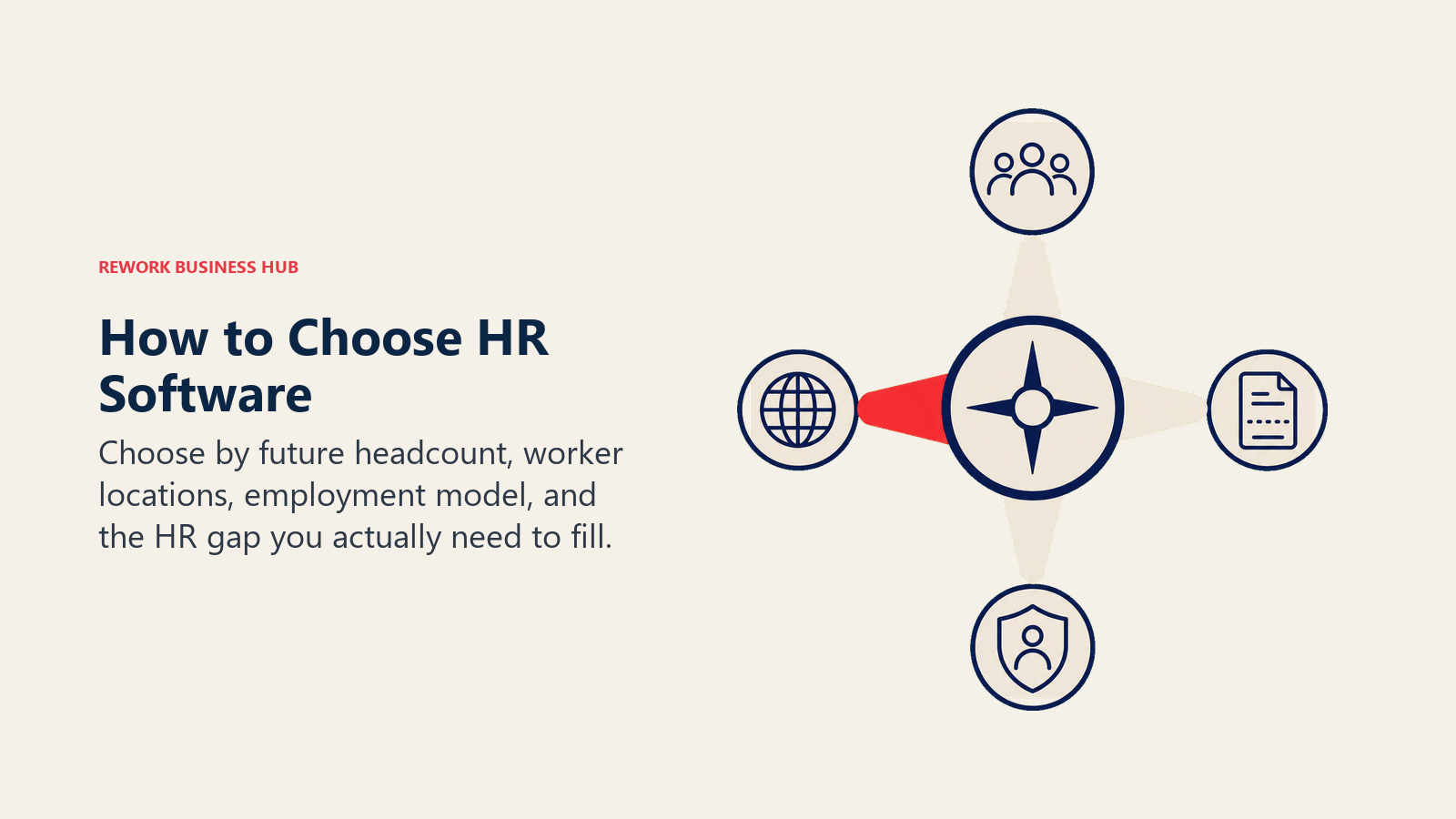
- What's your headcount today, and where will it be in 18 months? A 15-person startup and a 400-person mid-market company need fundamentally different systems, and buying for the size you'll be in three years usually means overpaying now.
- Where do your employees live? A single-country US team has very different payroll needs than a team spread across 12 countries with a mix of employees and contractors.
- Are you buying a core HRIS, a payroll engine, a PEO, or a performance layer? These are four different categories that get marketed as if they're interchangeable. Get clear on which gap you're actually filling.
There's a fourth question worth adding in 2026: do you need employer-of-record coverage, or just payroll? Confusing the two is the single most common mid-market buying mistake. Payroll software runs payments for employees already legally employable in a country. An EOR (like Deel) makes you able to legally employ someone in a country where you have no entity at all. If you're not sure which one your team needs, our guide to choosing HR software walks through the distinction before you start demos.
Framework: By Company Size
| Team Size | What You Need | Best Fits |
|---|---|---|
| 1-25 people | Simple onboarding, basic payroll, low admin overhead | Gusto, Justworks, BambooHR |
| 25-100 people | Structured HRIS + payroll + benefits admin | BambooHR, HiBob, Namely, Rippling |
| 100-500 people | Full HRIS + talent + compliance depth | Rippling, Namely, Paycor, HiBob |
| 500-2,500 people | Enterprise payroll and compliance, multi-entity support | ADP Workforce Now, Paycor, Workday |
| 2,500+ people | Full HCM with financials integration | Workday, ADP Workforce Now |
Framework: By Global Payroll Needs
| Situation | What Matters Most | Best Fits |
|---|---|---|
| US-only team | Clean payroll UX, state tax compliance | Gusto, BambooHR, Justworks |
| Hiring 1-10 people abroad, no entities | Employer of Record (EOR) | Deel |
| EU-headquartered or EU-heavy team | Local compliance, works councils, GDPR-native design | Personio |
| Established entities in multiple countries | Global payroll aggregation, not EOR | Deel Global Payroll, Rippling |
| Mixed employee and contractor workforce globally | Contractor management + compliant misclassification handling | Deel |
Global hiring is where most HR software mistakes get expensive fast: an EOR contract at the wrong volume, or a payroll vendor that can't actually run compliant payroll in the countries you're hiring in. The guide to choosing global payroll software is worth reading before you sign anything with a multi-year term attached.
Framework: All-in-One vs Best-of-Breed
| Approach | What It Looks Like | Best Fits |
|---|---|---|
| All-in-one HRIS | One vendor for HR, payroll, benefits, and often talent | Rippling, Namely, HiBob, BambooHR |
| Core HRIS + specialized performance layer | HRIS handles records and payroll; a separate tool handles reviews, OKRs, engagement | BambooHR + Lattice, Namely + 15Five |
| PEO (co-employment) | Vendor becomes co-employer, bundles benefits at scale | Justworks |
| Global EOR + local HRIS | EOR for countries without entities, local systems where you have them | Deel |
| HR unified with sales and work ops | HR, time tracking, and timesheets share a platform with sales pipeline and project work, not just HR modules | Rework |
All-in-one sounds appealing because it's one contract and one login. But it's also how companies end up paying for performance management modules they never turn on, inside an HRIS that was chosen for payroll. If your reviews and OKRs process actually matters to your culture, a specialized tool like Lattice or 15Five layered on top of a simpler core HRIS often produces better adoption than a bundled module nobody opens.
Stage Fit Matrix
| Tool | Startup (1-25) | Growth (25-100) | Mid-Market (100-500) | Enterprise (500+) |
|---|---|---|---|---|
| BambooHR | Strong fit | Strong fit | Possible | - |
| Rippling | Possible | Strong fit | Strong fit | Possible |
| Gusto | Strong fit | Strong fit | - | - |
| ADP Workforce Now | - | Possible | Strong fit | Strong fit |
| Workday | - | - | Possible | Strong fit |
| Deel | Strong fit | Strong fit | Strong fit | Possible |
| HiBob | Possible | Strong fit | Strong fit | Possible |
| Personio | Possible | Strong fit | Strong fit | Possible |
| Paycor | - | Possible | Strong fit | Possible |
| Namely | - | Possible | Strong fit | Possible |
| Justworks | Strong fit | Strong fit | Possible | - |
| Lattice | - | Possible | Strong fit | Strong fit |
| 15Five | Possible | Strong fit | Strong fit | Possible |
| Rework | Possible | Strong fit | Possible | - |
Sizing and Persona Table
| Tool | Ideal Team Size | Primary Buyer Persona |
|---|---|---|
| BambooHR | 20-500 employees | HR Director, Head of People, Office Manager |
| Rippling | 25-2,000 employees | COO, Head of People Ops, IT Director |
| Gusto | 1-100 employees | Founder, Office Manager, Bookkeeper |
| ADP Workforce Now | 200-5,000+ employees | VP HR, Payroll Director, CFO |
| Workday | 1,000-50,000+ employees | CHRO, VP HRIS, IT/HR Systems team |
| Deel | 5-1,000 employees, distributed | Head of People, COO, Global Mobility lead |
| HiBob | 50-1,000 employees | Head of People, HR Director |
| Personio | 25-2,000 employees, EU-based | HR Director, People Ops lead |
| Paycor | 50-2,000 employees | HR Director, Payroll Manager, CFO |
| Namely | 25-1,000 employees | HR Director, VP People |
| Justworks | 1-200 employees | Founder, Operations Lead, Office Manager |
| Lattice | 50-5,000 employees | Head of People, VP People, HRBP |
| 15Five | 20-2,000 employees | Head of People, VP Engineering, People Ops |
| Rework | 10-200 employees | COO, Head of People/Ops, Founder |
1. BambooHR: Cleanest Core HRIS for Small and Mid-Size Teams
BambooHR's product philosophy has stayed consistent for over a decade: HR software should feel less like enterprise software and more like a well-designed consumer app. Employee records, org charts, time-off requests, and onboarding checklists are all built around a simple, uncluttered interface that HR generalists (not IT departments) can configure themselves.
That simplicity is exactly why BambooHR remains a default first HRIS for companies moving off spreadsheets. Setup is fast, and adoption doesn't require a training program. The payoff shows up early: structured onboarding produces 50% greater new-hire productivity and makes employees 58% more likely to still be with the company after three years, per research reported by SHRM. The applicant tracking system add-on is genuinely strong for a company this size, competitive with dedicated ATS tools at a fraction of the cost.
The ceiling shows up in reporting depth and payroll coverage. Custom reporting is limited on the Core tier, and BambooHR's own payroll product only covers the US, so international teams need a separate payroll vendor stitched in. If you've already outgrown BambooHR, our best BambooHR alternatives guide covers what comes next.
| What you get | What you don't |
|---|---|
| Clean, fast-to-adopt UI for HR generalists | Custom reporting is basic below the Elite tier |
| Strong ATS add-on for hiring | US-only payroll; no native global payroll |
| Automatic volume discounts as headcount grows | Compensation planning and benchmarking are Elite-only |
| Flat pricing for teams under 25 employees | Performance module is thinner than dedicated tools like Lattice |
Pricing: Core $10/employee/mo; Pro $17/employee/mo; Elite $25/employee/mo (billed monthly). Teams of 25 or fewer employees pay a flat rate starting at $250/mo. A bundle discount applies when combining Payroll and Benefits Administration.
Best for: 20-500 person US-based teams wanting a simple, well-liked core HRIS without heavy IT involvement
The two head-to-heads that decide this one most often are BambooHR vs Rippling, where the question is HRIS depth against platform breadth, and BambooHR vs Gusto, where it is HRIS-first against payroll-first.
2. Rippling: Broadest Platform, HR + IT + Finance in One System
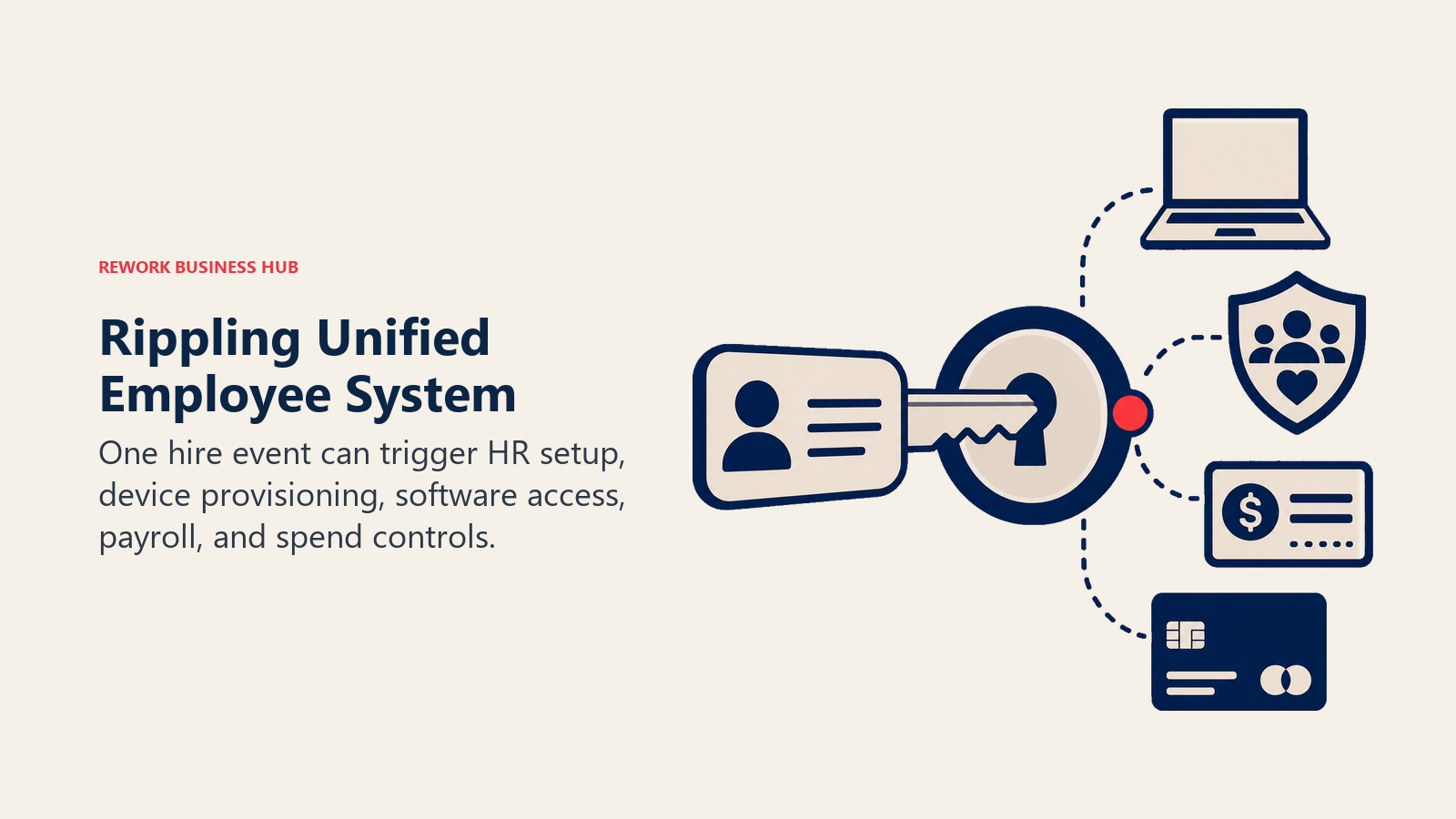
Rippling's bet is that the employee record should be the single source of truth for more than HR. Onboard someone in Rippling and it can simultaneously provision their laptop, assign their software licenses, enroll them in benefits, add them to payroll, and open a corporate card, all triggered from one hire event.
That breadth is Rippling's real differentiator against BambooHR or Gusto. For companies whose IT and HR pain points are tangled together (a new hire needs a laptop shipped and a Slack account and a payroll record on day one), Rippling collapses what would otherwise be three separate vendor relationships into one. The upside compounds with adoption: 89% of HR professionals whose organization uses AI to support recruiting say it saves them time or increases their efficiency, according to SHRM.
The tradeoff is pricing transparency and the temptation to overbuy. Rippling's per-module pricing isn't published, and sales reps are known for bundling modules a smaller team doesn't need. Most companies end up paying $20-35 per employee per month once they've added the modules they actually use, well above the advertised entry price. See our best Rippling alternatives if the module sprawl feels like more than you need.
| What you get | What you don't |
|---|---|
| HR + IT + finance unified in one employee record | Pricing is opaque; requires a sales call for real numbers |
| Global payroll and EOR options available | Easy to overbuy modules during the sales process |
| Strong automation (triggers across HR, IT, finance) | Steeper learning curve than BambooHR or Gusto |
| Scales from startup to 2,000+ employees | Full value requires buying into multiple modules |
Pricing: Rippling publishes no rate card. Its pricing page is a quote form, and it states only that each product is bought alongside a required core platform, that most products bill per employee per month, and that some carry a monthly base fee. Reported figures put the base platform around $8 per employee per month with combined HR and payroll configurations landing at $20-35 PEPM, but none of that is vendor-published.
Best for: Companies of 25-2,000 employees that want HR, IT provisioning, and spend management under one login
Buyers at this stage usually run Rippling against one of two rivals: Gusto vs Rippling if the alternative is a simpler payroll-first tool, or Rippling vs Deel if the hiring is happening across borders.
3. Gusto: Best Payroll UX for First-Time Buyers
Gusto's product philosophy is that running payroll shouldn't require a finance background. The interface walks non-experts through tax filings, new-hire reporting, and benefits enrollment in plain language, and it's consistently rated as the easiest payroll tool to self-serve without a dedicated payroll admin.
For small businesses running payroll for the first time, that matters more than any feature comparison. Gusto handles federal, state, and local tax filing automatically, offers health insurance brokerage in 38 states, and includes unlimited payroll runs on every plan, so off-cycle corrections don't trigger surprise fees.
The honest limitation is depth. Gusto is built for single-country US payroll; it doesn't support international employees, and HR functionality beyond payroll (performance reviews, advanced reporting, workflow automation) stays basic even on the top tier. Teams past 100 employees with more complex needs usually outgrow it. Our best Gusto alternatives guide covers where to look next.
| What you get | What you don't |
|---|---|
| Best-in-class payroll UX for non-experts | US-only; no international payroll or EOR |
| Transparent, published pricing | HR functionality is thin beyond payroll |
| Unlimited payroll runs, no off-cycle fees | Advanced reporting and workflow automation limited |
| Health insurance brokerage in 38 states | Not built for companies past ~100 employees |
Pricing: Simple $49/mo + $6/employee/mo; Plus $80/mo + $12/employee/mo; Premium $180/mo + $22/employee/mo. Contractor Only plan is $35/mo flat for 1099-only businesses.
Best for: US-only small businesses (1-100 employees) running payroll without a dedicated payroll or finance hire
If Gusto is on your shortlist, BambooHR vs Gusto works through which product should be the system of record, and Gusto vs Rippling covers the case where platform breadth is the other option.
4. ADP Workforce Now: Enterprise-Grade Payroll Accuracy at Scale
ADP's product philosophy hasn't changed in decades because it doesn't need to: payroll accuracy and tax compliance at scale, backed by one of the largest payroll infrastructure operations in the world. Workforce Now is ADP's mid-market and enterprise HCM suite, covering payroll, benefits, time tracking, and talent management across Select, Plus, and Premium tiers.
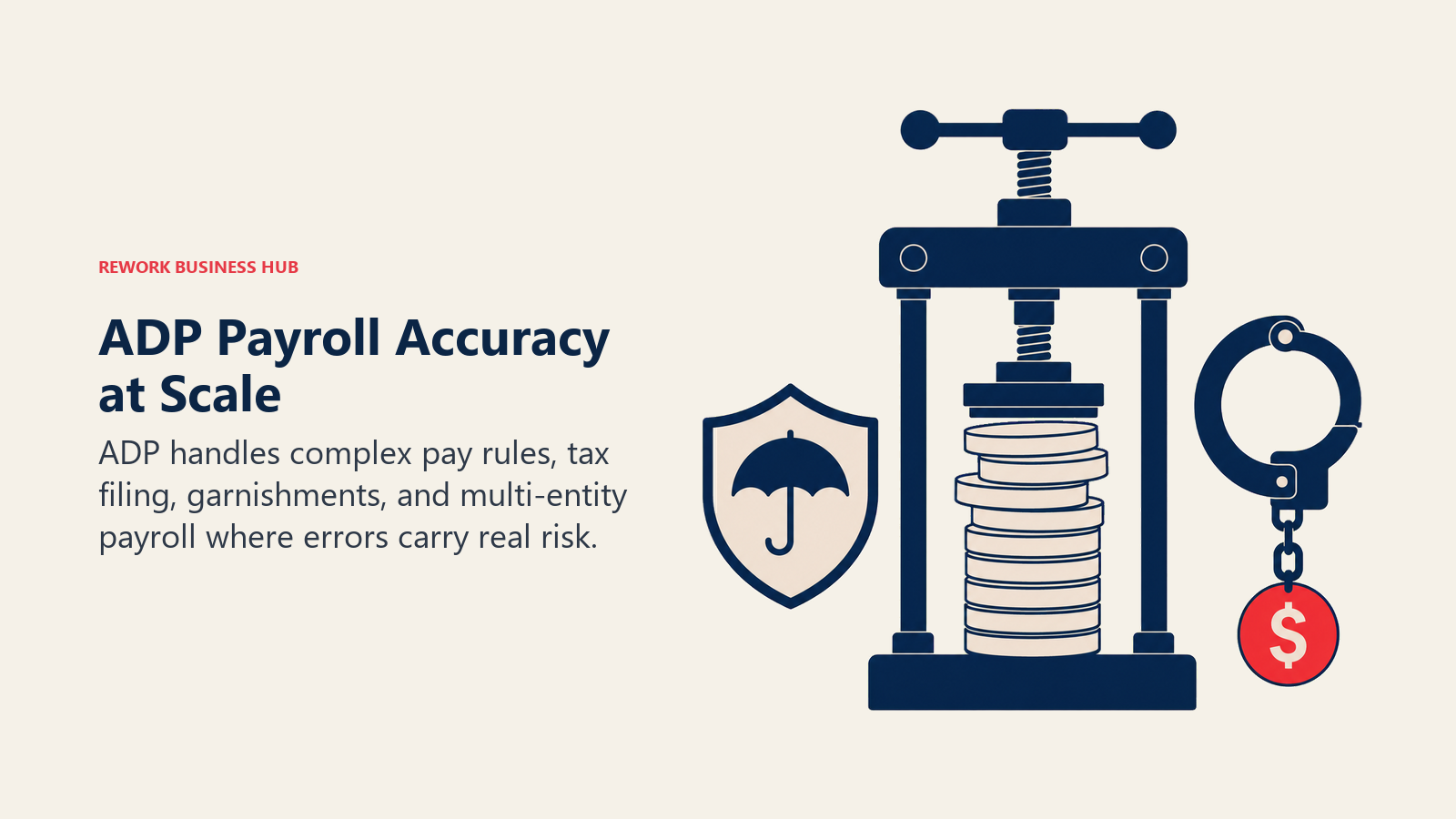
For companies with complex, multi-state or multi-entity payroll and compliance requirements that can't tolerate errors, ADP's depth is hard to match. Tax filing accuracy, garnishment handling, and support for complex pay rules (union contracts, shift differentials, multi-state tax reciprocity) are areas where ADP's decades of infrastructure show.
The friction is pricing opacity and inconsistent implementation quality. ADP does not publish pricing anywhere, every quote requires a sales call, and support experience varies significantly depending on which reseller or account team you're assigned. Implementation fees and add-on module costs can add up quickly beyond the base PEPM rate. See our best ADP alternatives if the black-box pricing is a dealbreaker.
| What you get | What you don't |
|---|---|
| Deep payroll accuracy and tax compliance at scale | No published pricing; every quote is a sales negotiation |
| Handles complex pay rules and multi-entity payroll | Implementation and support quality vary by reseller |
| Large integration marketplace | UI feels dated compared to newer entrants |
| Strong compliance tooling for regulated industries | Contract terms and fee structures are hard to compare across vendors |
Pricing: Select, Plus, and Premium tiers, all quote-only. Third-party benchmarks estimate $10-30 per employee per month depending on tier, modules, and negotiated volume discounts. Call ADP sales directly for an accurate number.
Best for: 200-5,000+ employee companies with complex, multi-state payroll needs and dedicated payroll or HR admin staff
5. Workday: Deepest HCM for Large Enterprises
Workday's philosophy is that HR, finance, and planning data should live in one system, not three that need to be reconciled at quarter-end. Workday HCM ties workforce data directly into Workday Financials and Adaptive Planning, giving large enterprises a single source of truth for headcount, compensation, and budget.
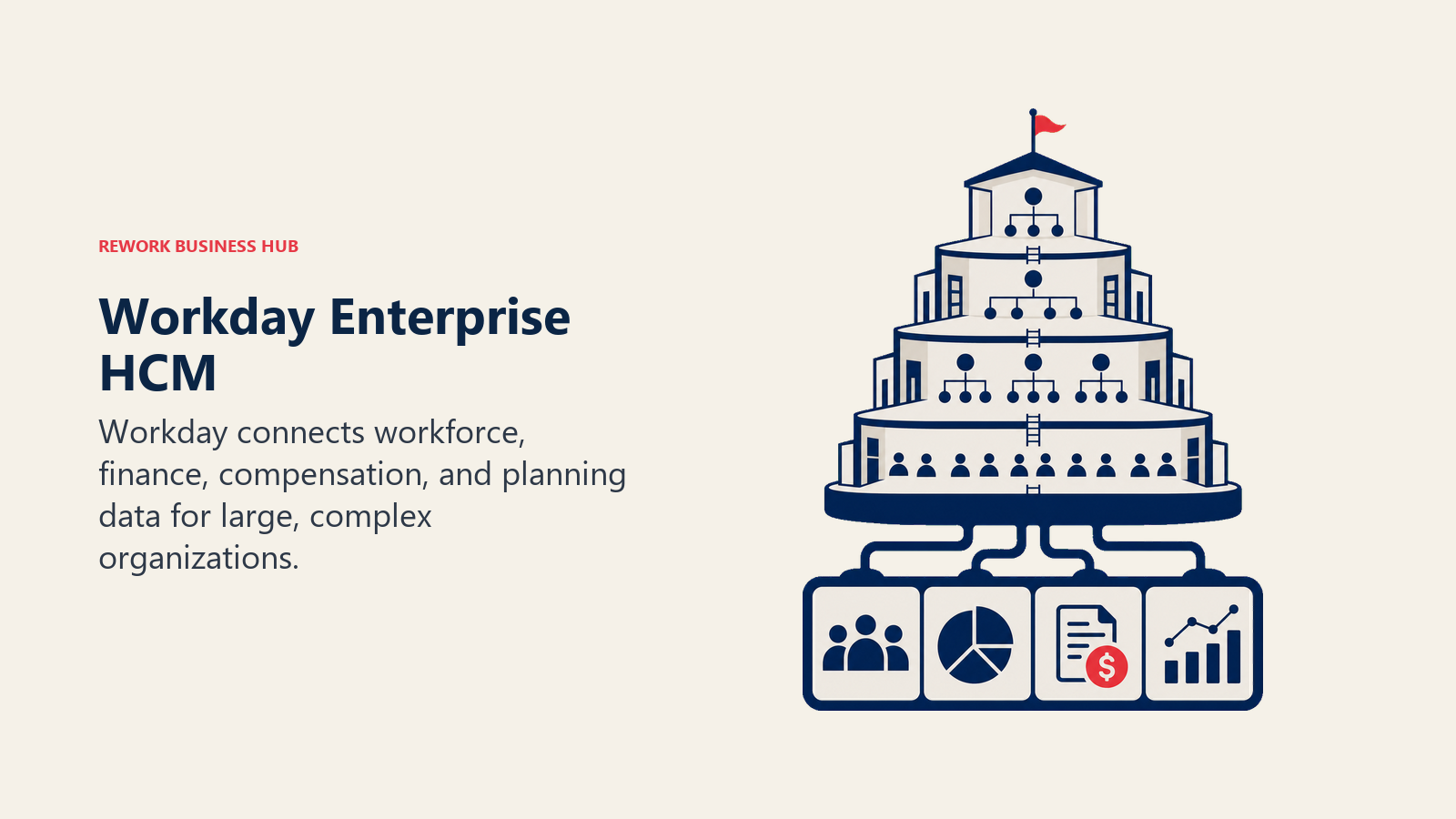
No HR platform on this list matches Workday's depth for complex organizational structures: multi-entity hierarchies, sophisticated compensation planning, workforce analytics, and succession planning at a scale that smaller HRIS platforms simply weren't built for.
That depth comes at real cost. Implementation typically takes months, requires dedicated Workday admin headcount to maintain, and first-year total investment (subscription plus implementation, training, and change management) regularly runs into six or seven figures for a large enterprise deployment. It's overkill for anything under roughly 1,000 employees.
| What you get | What you don't |
|---|---|
| Deepest HCM + financials integration available | High implementation cost and multi-month rollout |
| Sophisticated compensation and workforce planning | Requires dedicated Workday admin staff to maintain |
| Scales to tens of thousands of employees | Massive overkill below ~1,000 employees |
| Strong audit and compliance tooling for public companies | Custom pricing means every deal needs a procurement process |
Pricing: Fully custom, quote-only. Published list pricing generally runs $20-40 per employee per month, though negotiated enterprise deals typically land at $14-28 PEPM. First-year total cost including implementation often reaches well beyond the subscription price alone.
Best for: Enterprises of 1,000+ employees needing unified HR, financials, and workforce planning in one platform
6. Deel: Fastest Way to Hire Compliantly Across Borders
Deel's product philosophy is that geography shouldn't be the reason you can't hire the best person for a role. Through its Employer of Record (EOR) network, Deel becomes the legal employer of your staff in countries where you have no entity, handling local payroll, tax withholding, benefits, and termination compliance on your behalf.
For companies building a distributed team without wanting to set up legal entities in a dozen countries, Deel has become close to the default choice. It covers 130+ countries, and the platform experience (contracts, onboarding, payroll runs, expense management) is genuinely fast compared to working with local law firms and payroll bureaus directly.
The honest tradeoff is cost at low volume. EOR pricing starts steep per employee, though volume discounts bring the effective rate down meaningfully once you're hiring at scale in a given country. Deel is also not a core HRIS, it solves the global employment problem specifically, so most companies pair it with a domestic HRIS for their home-country team. Our best Deel alternatives guide covers other EOR and global payroll options.
| What you get | What you don't |
|---|---|
| EOR coverage in 130+ countries, fast setup | EOR pricing is steep at low headcount per country |
| Contractor management and compliance built in | Not a core domestic HRIS; needs pairing with one |
| Global payroll option for countries with existing entities | Employer taxes and statutory benefits add 13-40% beyond the platform fee |
| Fast time-to-hire compared to setting up local entities | Contractor of Record tier adds cost for misclassification-sensitive roles |
Pricing: EOR from $599/employee/mo, with volume discounts down to roughly $350-500/mo for 20-50+ employees in a given country. Contractor Management from $49/contractor/mo; Contractor of Record $325/mo. Global Payroll priced separately for companies with existing local entities.
Best for: Companies hiring 5-1,000 employees and contractors across multiple countries without local entities
Rippling vs Deel settles the version of this decision most teams actually face: whether you need someone to be the legal employer abroad, or just one platform for entities you already own.
7. HiBob: Modern HRIS Built Around Culture and Engagement
HiBob's product philosophy is that HR software should reflect how a modern company actually feels, not how a compliance department wants it to look. The interface (branded "Bob") leans into social feeds, shoutouts, and a genuinely pleasant onboarding experience that employees actually engage with instead of ignoring.
For culture-forward, mid-size companies where employee experience is a real differentiator in hiring and retention, that design philosophy translates into higher actual usage than more utilitarian HRIS platforms. Compensation management, people analytics, and performance tools are all built in natively rather than bolted on. The stakes for engagement aren't trivial: Gallup estimates that disengaged employees cost the global economy $8.9 trillion a year in lost productivity, while teams in the top quartile of engagement post 23% higher profitability than the bottom quartile.
The tradeoff is that HiBob doesn't publish pricing anywhere, which makes early-stage budgeting hard, and payroll support varies significantly by country, so US and multi-country teams need to verify coverage before assuming it's included. See our best HiBob alternatives if you need clearer pricing upfront.
| What you get | What you don't |
|---|---|
| Genuinely engaging UX; high real-world adoption | No published pricing anywhere |
| Native compensation management and people analytics | Payroll coverage varies significantly by country |
| Strong culture and engagement tooling | Implementation fee typically 10-20% of annual cost |
| Modular pricing (pay for what you use) | Performance module add-ons increase PEPM meaningfully |
Pricing: Custom quote only, PEPM pricing based on headcount, modules, and contract length. Market estimates typically fall between $8 and $18 per employee per month depending on configuration and negotiated volume.
Best for: 50-1,000 person culture-forward companies prioritizing employee experience and engagement
8. Personio: Built for European and Global Compliance from Day One
Personio's product philosophy starts from a different default than most HRIS on this list: European compliance first, everything else second. Works council requirements, GDPR-native data handling, and multi-country European payroll integrations are core to the product, not an afterthought bolted onto a US-first platform.
For EU-headquartered companies or global companies with a meaningful European headcount, that difference matters. Personio's Core and Core Pro tiers cover employee records, absence management, workflow automation, and reporting, with payroll handled through certified local partners in each country.
The honest limitation is the inverse of its strength: Personio's US payroll depth lags behind Gusto or Rippling, so companies primarily hiring in the US will find better native payroll support elsewhere. Pricing also isn't published, and renewal increases are a frequent complaint in user reviews. Our best Personio alternatives guide covers other European-strong options.
| What you get | What you don't |
|---|---|
| Built for EU compliance and works councils natively | Weaker US payroll depth than US-first vendors |
| Certified local payroll partners across Europe | No published pricing; quote-only |
| Strong workflow automation for people processes | Annual renewal increases of 10-20% are a common complaint |
| GDPR-native data handling | Less common outside EMEA-heavy organizations |
Pricing: Custom quote only. Market estimates typically range $5-15 per employee per month depending on tier (Core vs Core Pro) and negotiated volume, with multi-year commitments unlocking further discounts.
Best for: European-headquartered or EU-heavy global teams of 25-2,000 employees
9. Paycor: Compliance-Heavy Payroll and HR for US Mid-Market
Paycor's product philosophy centers on regulated, labor-intensive industries: healthcare, manufacturing, restaurants, and other sectors with complex scheduling, overtime rules, and compliance exposure. Payroll, HR, time tracking, and talent modules are built around the reality of shift-based, hourly-heavy workforces rather than a generic office headcount.
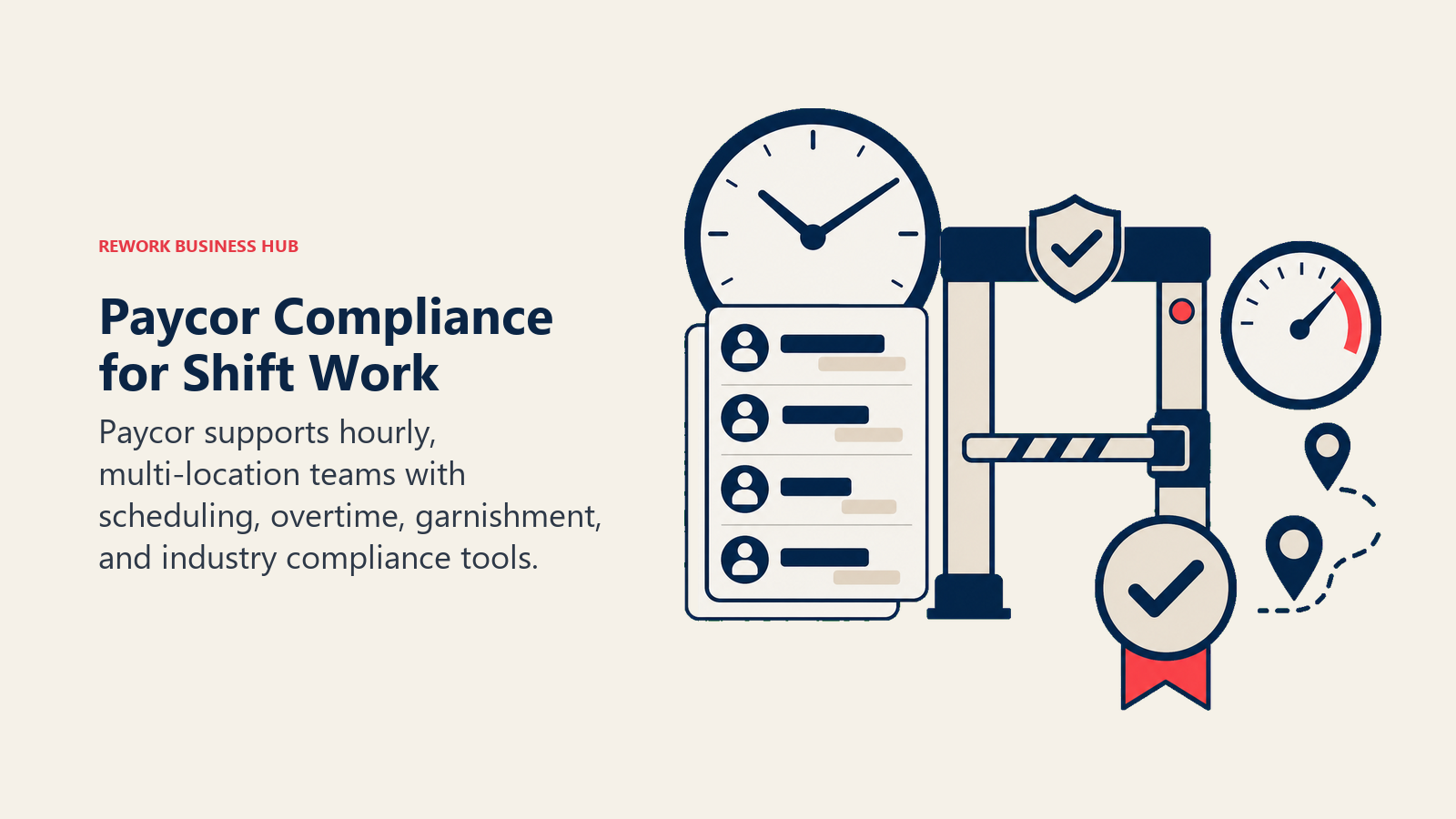
For mid-market companies in those verticals, Paycor's compliance depth (garnishments, ACA reporting, tip credit calculations, multi-state overtime rules) covers edge cases that generalist HRIS platforms handle poorly. Its analytics and workforce management tools are also stronger than most competitors at this price point.
The friction in 2026 is that Paycor pulled its public pricing page entirely, so every evaluation now starts with a sales call rather than a self-serve estimate. Third-party benchmarks suggest small businesses land around $99-299/mo base plus $6-16 per employee, while mid-market companies see all-in PEPM rates of $19-27 depending on modules. Paychex completed its acquisition of Paycor in April 2025 and the brand still runs as its own platform, which is worth raising on that sales call. If the quote comes back higher than you expected, the best Paycor alternatives breakdown ranks the mid-market platforms that do publish a rate.
| What you get | What you don't |
|---|---|
| Strong compliance tooling for regulated, shift-based industries | No public pricing as of 2025; sales call required |
| Solid workforce management and scheduling tools | Interface feels dated compared to newer entrants |
| Analytics depth above most mid-market competitors | Implementation fees can run $2,000-$10,000+ |
| Good fit for hourly-heavy, multi-location workforces | Less differentiated for standard office-based headcounts |
Pricing: Quote-only as of 2025. Third-party benchmarks estimate small business plans around $99-299/mo plus $6-16/employee, with mid-market all-in PEPM rates of $19-27 depending on module selection.
Best for: US mid-market companies (50-2,000 employees) in healthcare, manufacturing, hospitality, or other shift-based, compliance-heavy industries
10. Namely: Full HRIS Built for the Mid-Market Middle
Namely's product philosophy targets a specific gap: companies that have outgrown Gusto or BambooHR but aren't ready for ADP's enterprise complexity or price. The platform bundles core HR, payroll, and talent management, with tiers that scale from self-serve HR up to managed payroll and benefits administration.
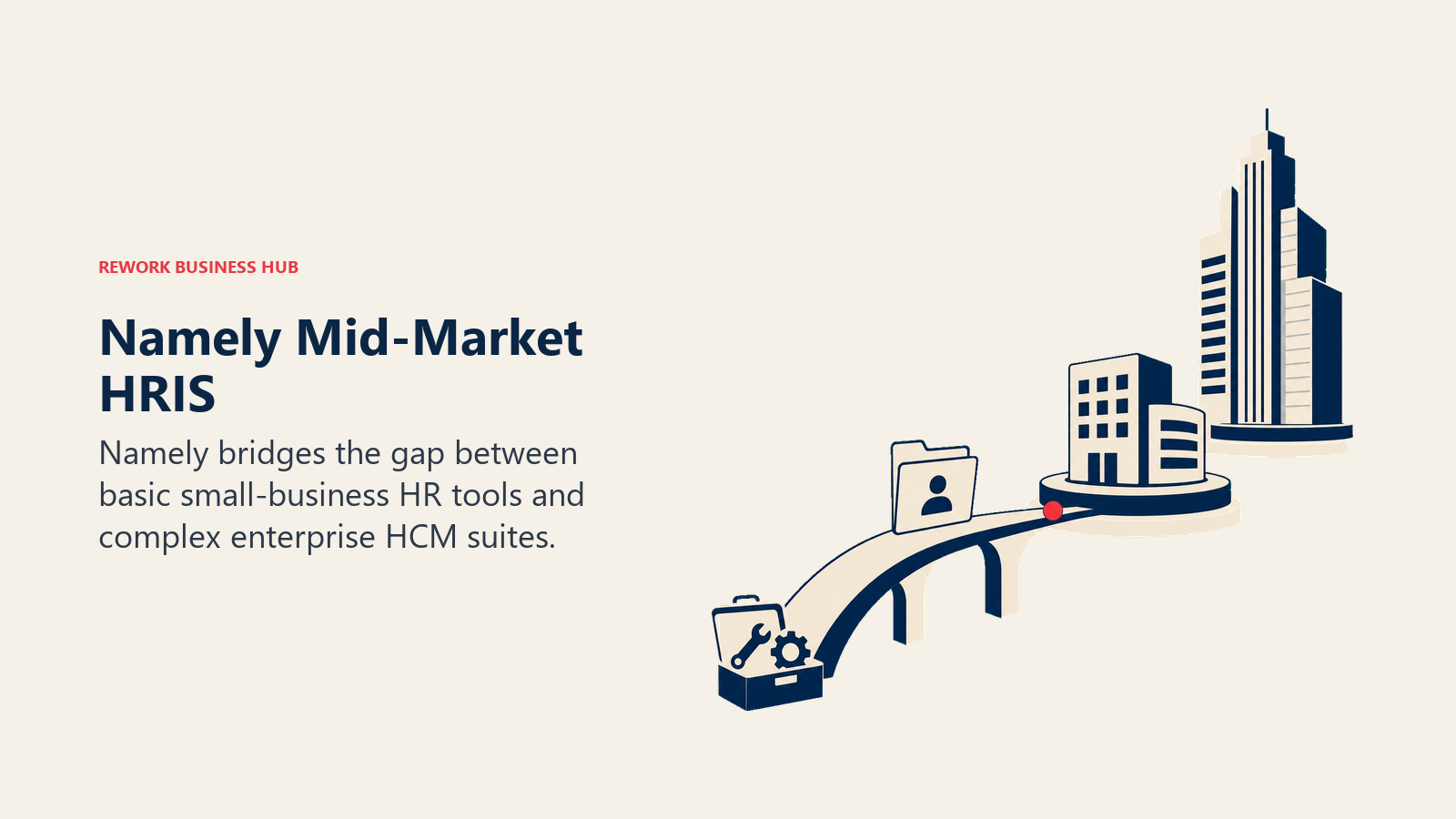
For HR Directors at 25-1,000 person companies who want one vendor covering the full employee lifecycle without a six-figure enterprise contract, Namely fills a real gap. Its entry tier, Namely Now, is priced transparently, which is unusual at this end of the market.
The tradeoff is that the higher tiers (Plus, Plus People, Complete) all move to custom pricing, and the interface, while functional, doesn't feel as modern as HiBob or Rippling. Companies evaluating Namely should get a clear quote for the full tier they'll actually need, not just the published entry price. See our best Namely alternatives for other mid-market HRIS options.
| What you get | What you don't |
|---|---|
| Full HRIS + payroll + talent in one contract | Only the entry tier has published pricing |
| Transparent entry-level pricing (Namely Now) | UI feels less modern than newer HRIS entrants |
| Scales up to managed payroll and benefits (Complete) | Higher tiers require a sales conversation |
| Built specifically for the 25-1,000 employee range | Less differentiated feature set vs HiBob or Rippling |
Pricing: Namely Now starts at $9/employee/mo. Namely Plus, Plus People, and Complete are custom quote based on modules and managed services selected.
Best for: 25-1,000 employee US companies wanting a full HRIS without enterprise-tier complexity or cost
11. Justworks: Simplest PEO for Startups and Small Business
Justworks' product philosophy is co-employment simplicity: as a PEO, Justworks becomes the employer of record for tax and benefits purposes, which lets small companies access large-group health insurance rates, workers' comp coverage, and compliance support they couldn't get on their own.
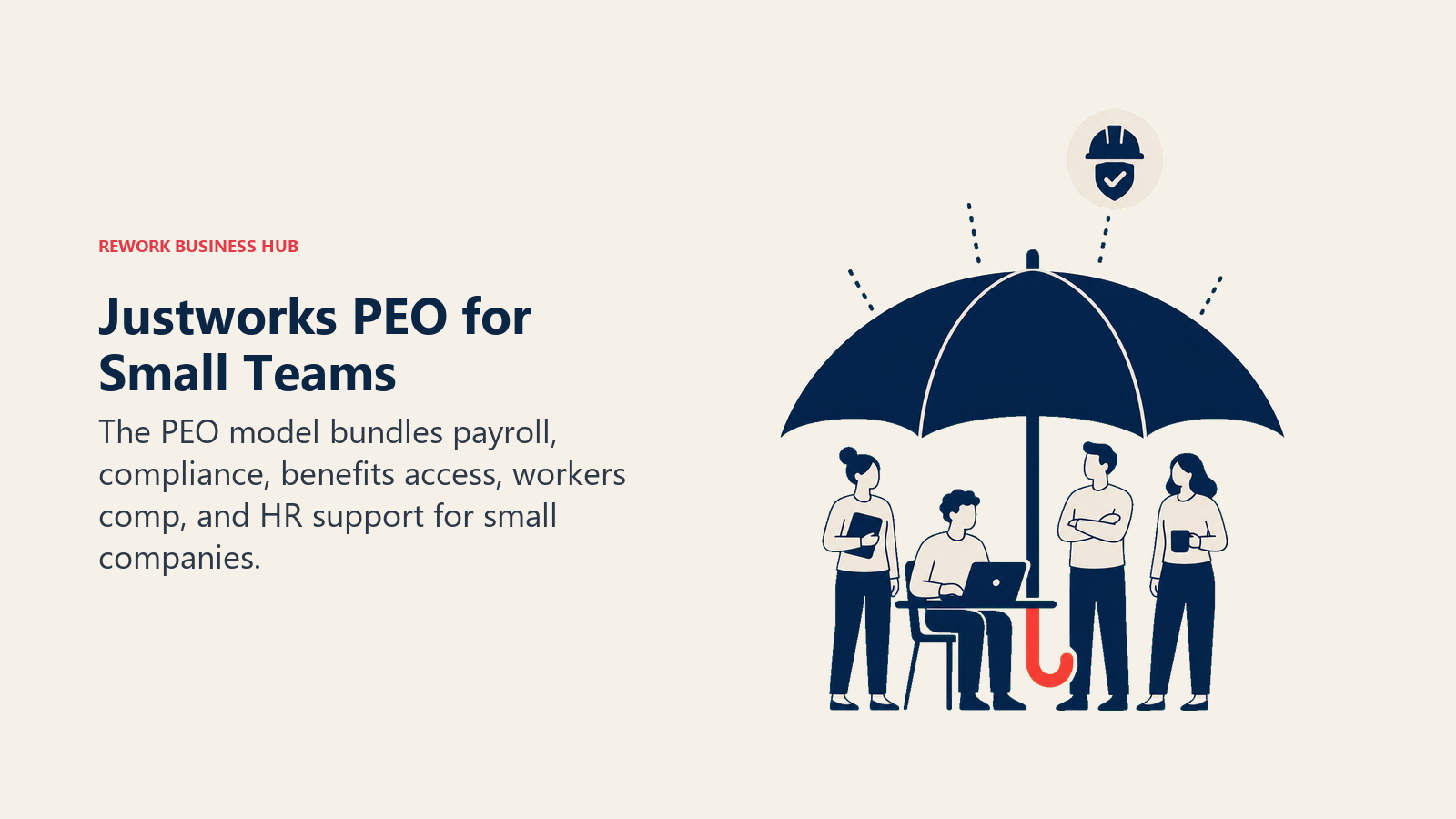
For founders and small operations teams who don't want to become payroll and compliance experts, Justworks removes an entire category of risk and admin. Payroll, compliance alerts, 401(k) access, and HR consulting are all bundled into flat, published per-employee pricing, a rarity among PEOs.
The tradeoff is cost at scale. PEO pricing is charged per employee regardless of salary, so a $79-109/employee/month fee that feels reasonable at 10 people becomes a meaningful line item at 100. Most companies outgrow a PEO once they have the headcount to negotiate their own benefits directly.
| What you get | What you don't |
|---|---|
| Simple, published flat per-employee pricing | Cost per employee doesn't shrink meaningfully at scale |
| Access to large-group health insurance rates | Co-employment model isn't right for every company or industry |
| Compliance support and workers' comp bundled in | Less flexible than a standalone HRIS for complex org structures |
| 24/7 support and onboarding tools included | Benefits premiums are additional, not included in the PEPM fee |
Pricing: PEO Basic $79/employee/mo; PEO Plus $109/employee/mo. Benefits premiums, workers' compensation, and employer taxes are additional and vary by election.
Best for: Startups and small businesses (1-200 employees) that want compliance and benefits access without building an internal HR function
12. Lattice: Best-in-Class Performance Management and OKRs
Lattice's product philosophy is narrow and deliberate: it doesn't try to be an HRIS. Instead, it focuses entirely on the performance layer, reviews, 1:1s, goals and OKRs, engagement surveys, and manager coaching tools, and does it deeper than any HRIS's bundled performance module.
For companies that already have payroll and core HR solved through another vendor, Lattice is what you add when performance management actually matters to your culture and a checkbox module inside your HRIS isn't cutting it. Its manager tools (1:1 agendas, feedback prompts, update tracking) are consistently the most-cited reason teams choose it over building performance process in a spreadsheet or their HRIS's native tool.
The honest limitation is that Lattice requires an HRIS alongside it for records, payroll, and compliance, it's a complement, not a replacement. Our best Lattice alternatives guide covers other performance-focused options if the modular pricing adds up faster than expected.
| What you get | What you don't |
|---|---|
| Best-in-class reviews, OKRs, and goal tracking | Not an HRIS; no payroll or employee records |
| Strong manager tools (1:1s, feedback, updates) | Modular add-ons (Compensation, Grow) increase per-seat cost quickly |
| Engagement surveys and people analytics | $4,000 minimum annual contract |
| Modular pricing lets you buy only what you need | Requires pairing with a core HRIS |
Pricing: Performance $10/seat/mo; Goals & OKRs $8/seat/mo; Engagement $4/seat/mo; Foundations bundle (Performance + Goals) $13/seat/mo. Compensation add-on +$6/seat/mo; Grow add-on +$4/seat/mo. Minimum annual contract $4,000, billed annually.
Best for: 50-5,000 person companies with a core HRIS already in place that want a dedicated performance management layer
13. 15Five: Continuous Feedback and Manager Coaching
15Five's product philosophy is that performance management should happen continuously, not just in an annual review cycle nobody prepares for. Weekly check-ins, pulse surveys, and AI-assisted manager coaching are the core of the product, aimed at catching engagement problems before they show up in exit interviews.
For companies whose biggest people problem is manager effectiveness rather than review-cycle process, 15Five's manager-focused tools (including Kona, its AI meeting assistant and coach) are a genuine differentiator against Lattice, which leans more toward structured OKRs and formal review cycles.
Like Lattice, 15Five is not an HRIS and doesn't touch payroll or compliance. Pricing is transparent and modular, which makes budgeting easier than most competitors on this list, but the tiers add up quickly once you layer in Kona AI Coach or Compensation add-ons. See our best 15Five alternatives if you want to compare it against Lattice and other engagement-first tools directly.
| What you get | What you don't |
|---|---|
| Transparent, published per-user pricing | Not an HRIS; no payroll or core employee records |
| Strong continuous feedback and manager coaching tools | AI Coach and Compensation add-ons increase cost quickly |
| AI meeting assistant (Kona) built into the platform | Overlaps heavily with Lattice; pick one, not both |
| Lighter-weight than Lattice for smaller teams | Less depth in formal OKR/goal-cascading than Lattice |
Pricing: Engage $4/user/mo; Perform $11/user/mo; Total Platform $16/user/mo (billed annually). Add-ons: Kona AI Meeting Assistant $2/employee/mo, Kona Coach $19/manager/mo, Compensation $9/user/mo ($11/user/mo with salary benchmarking).
Best for: 20-2,000 person companies prioritizing continuous feedback and manager coaching over formal annual review cycles
14. Rework: HR Unified with Sales, Lead, and Work Ops in One Platform
Rework's product philosophy is different from the other 13 tools on this list: it doesn't try to be a specialized best-of-breed HRIS first. Rework is a unified work platform built around three product lines, Sales Ops, Lead Ops, and Work Ops, and its People app extends that same system of record into HR, covering full HRIS, time and attendance (clock-in and clock-out), and timesheets.
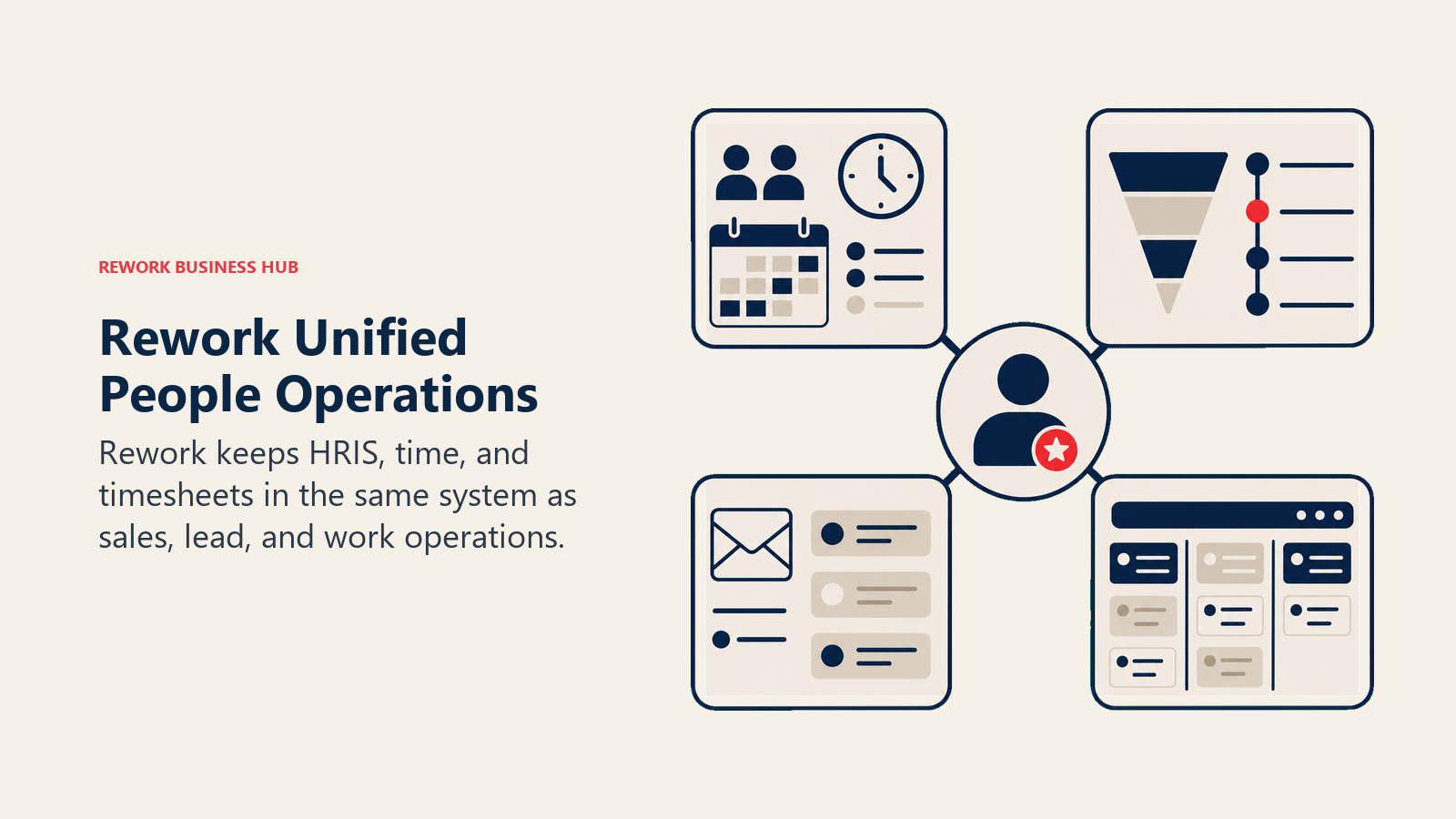
For mid-size teams (roughly 10-200 people) that are already running sales pipelines, lead capture, or project work through Rework, adding People means employee records, time tracking, and timesheets live in the same platform as the rest of the business instead of a fourth or fifth vendor stitched in through integrations. That consolidation is the actual pitch: fewer logins, one employee record referenced across HR and revenue operations, and one less contract to renegotiate every year.
The honest limitation: Rework is not a deep global payroll suite like Workday or Deel, and it's not a benefits-first PEO like Justworks. If your primary need is multi-country payroll compliance, works-council handling, or large-group benefits brokering, a specialized platform still wins on depth. Rework wins on consolidation for teams whose core problem is too many disconnected tools, not deep HR compliance in a single country.
| What you get | What you don't |
|---|---|
| HRIS, time & attendance, and timesheets in the same platform as Sales Ops, Lead Ops, and Work Ops | Not a global payroll or EOR platform like Deel or Workday |
| One employee record shared across HR and revenue operations | Not a benefits-first PEO like Justworks |
| No separate vendor contract or integration to maintain for core HR | Sold as packaged platform pricing, not published per-employee People rates |
| Fits teams already running Sales Ops, Lead Ops, or Work Ops on Rework | Less specialized HR depth than the dedicated HRIS platforms elsewhere on this list |
Pricing: Rework sells engine pricing with seats in blocks of 5, not per-employee HRIS seats. Rework People is not publicly priced; pricing is quoted per organization. The priced engines are separate products rather than a proxy for it: the Process Engine (workflows, approvals, requests), for reference, starts at $99/month billed yearly with 5 work seats included. See rework.com/pricing for current plans.
Best for: 10-200 person teams that want HR and people management unified with sales, lead, and work operations in one platform instead of running a separate best-of-breed HRIS.
HR Software Buying Mistakes to Avoid
Most failed HR software rollouts aren't caused by picking a bad tool, they're caused by picking a tool that doesn't match the actual problem. Here are the most common mistakes and what to do instead.
| Mistake | What It Looks Like | What to Do Instead |
|---|---|---|
| Buying an HRIS to fix a performance management problem | Signing a bigger HRIS contract when the real gap is manager 1:1s and reviews | Add a focused tool like Lattice or 15Five instead of a full re-platform |
| Confusing payroll software with an EOR | Using Gusto or ADP to try to pay someone in a country with no entity | Use an EOR like Deel for countries where you have no legal entity |
| Ignoring implementation cost | Budgeting only for the per-employee subscription fee | Add implementation, migration, and training cost, especially for ADP or Workday |
| Choosing based on the demo, not the admin workflow | Picking the tool with the flashiest UI without testing actual HR-admin tasks | Have your HR admin run a real onboarding and offboarding flow before buying |
| Over-buying modules during the sales process | Ending up with add-ons for performance, benchmarking, or IT you never use | Map your actual required workflows before the sales call, not during it |
| Assuming PEO pricing stays cheap at scale | Staying on a PEO past the headcount where a standalone HRIS + broker would be cheaper | Re-evaluate PEO vs standalone HRIS once you cross ~50-75 employees |
| Ignoring compliance requirements until an audit | Discovering multi-state or international compliance gaps after they've already caused a problem | Confirm compliance coverage for every state or country you operate in before signing |
| Re-platforming too often | Switching HRIS every 18 months as each tool's ceiling shows up | Pick a platform with 2-3 years of headcount growth room built in |
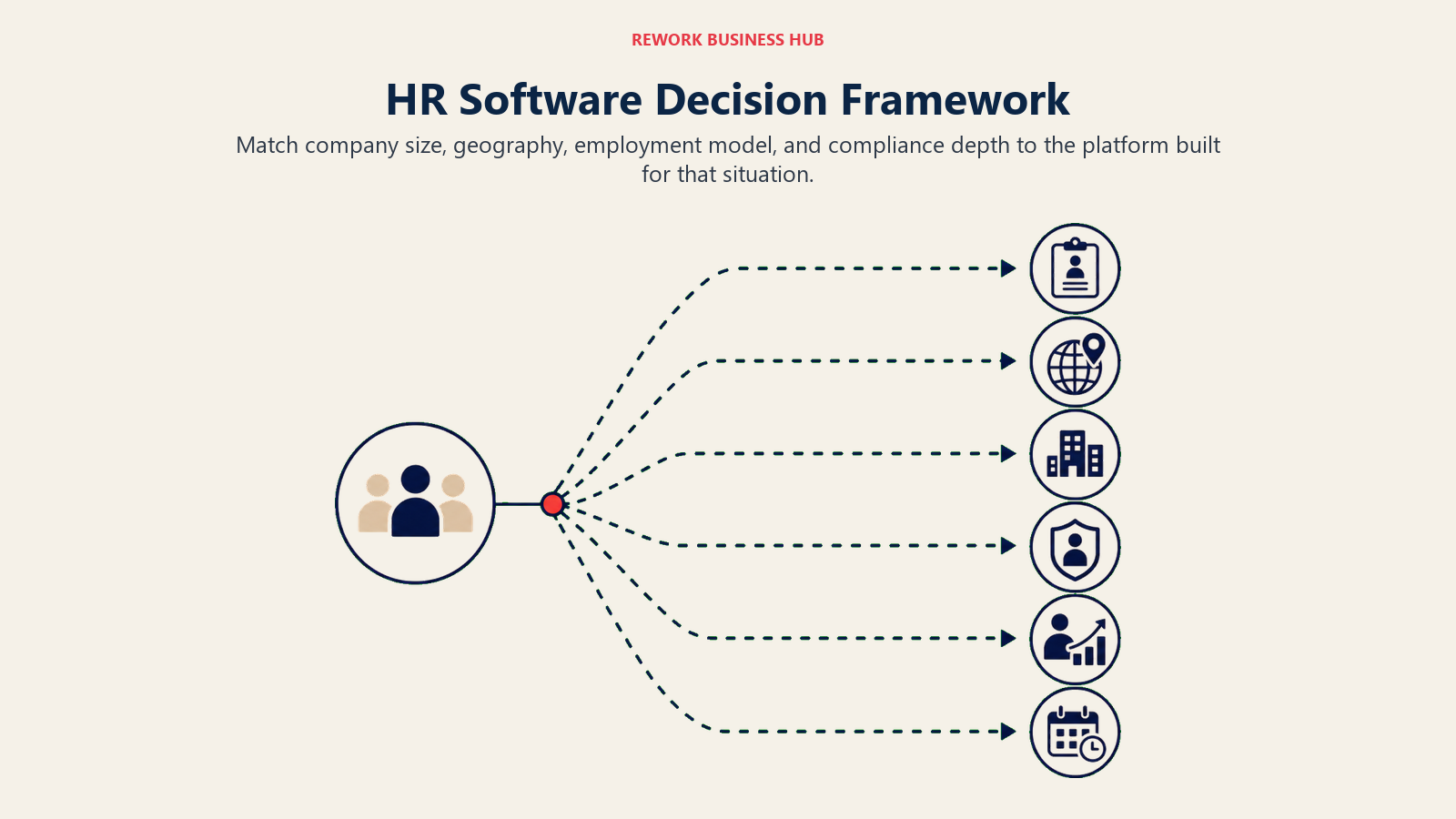
Decision Framework
Match your situation to the right platform.
| If you need... | Pick... | Why |
|---|---|---|
| The simplest, cleanest core HRIS for a small team | BambooHR | Fast setup, strong ATS, well-liked UI |
| HR, IT, and finance unified in one system | Rippling | Deepest platform breadth; one hire event triggers everything |
| Payroll that a non-expert can run confidently | Gusto | Best payroll UX; transparent pricing; unlimited runs |
| Enterprise-grade payroll accuracy at scale | ADP Workforce Now | Decades of payroll infrastructure; handles complex pay rules |
| Full HCM tied to financials for a large enterprise | Workday | Deepest HCM + financials integration available |
| To hire employees or contractors in countries with no entity | Deel | EOR coverage in 130+ countries; fastest compliant path |
| A modern, engagement-forward HRIS | HiBob | Genuinely high adoption; strong culture tooling |
| European compliance built in from day one | Personio | GDPR-native, works-council-aware, EU payroll partners |
| Compliance depth for a shift-based, regulated workforce | Paycor | Strong tooling for healthcare, manufacturing, hospitality |
| A full HRIS built for the 25-1,000 employee middle | Namely | Transparent entry pricing; scales to managed payroll |
| Compliance and benefits access without an internal HR team | Justworks | Simple flat PEO pricing; large-group benefits access |
| Best-in-class OKRs and structured performance reviews | Lattice | Deepest performance layer on the market; pairs with any HRIS |
| Continuous feedback and manager coaching | 15Five | AI-assisted manager tools; lighter-weight than Lattice |
| HR unified with sales, lead, and work ops in one platform | Rework | People app (HRIS, time & attendance, timesheets) lives alongside Sales Ops, Lead Ops, and Work Ops instead of a separate vendor |
What to Do Next
Start by naming the actual problem, not the tool category. If payroll is the pain, evaluate Gusto, ADP, or Paycor against your headcount and geography. If it's a performance and manager-effectiveness problem, look at Lattice or 15Five before assuming you need to replace your whole HRIS. If you're hiring your first international employee, start with Deel or Personio rather than trying to stretch a US-only payroll tool to cover it.
If your starting point is a platform already in place rather than a blank slate, the migration guides are more useful than this roundup: best Zoho People alternatives for teams outgrowing the cheapest tier in the category, best Employment Hero alternatives for Australian and New Zealand businesses that need award interpretation and Single Touch Payroll covered, best Factorial alternatives for European SMBs hitting the limits of modular per-module pricing, and best Sage HR alternatives for teams that priced Sage's calculator with three modules attached and found it well above the headline rate.
Shortlist two platforms, run a real onboarding and offboarding workflow in each during the trial or demo, and get your actual HR admin (not just the buyer) to weigh in before you sign. The tool that gets used correctly every pay cycle beats the one with the longest feature list on the sales deck.

Senior Customer Retention Strategist
On this page
- Key Facts
- Quick Comparison Table
- How to Choose HR Software in 2026
- Framework: By Company Size
- Framework: By Global Payroll Needs
- Framework: All-in-One vs Best-of-Breed
- Stage Fit Matrix
- Sizing and Persona Table
- 1. BambooHR: Cleanest Core HRIS for Small and Mid-Size Teams
- 2. Rippling: Broadest Platform, HR + IT + Finance in One System
- 3. Gusto: Best Payroll UX for First-Time Buyers
- 4. ADP Workforce Now: Enterprise-Grade Payroll Accuracy at Scale
- 5. Workday: Deepest HCM for Large Enterprises
- 6. Deel: Fastest Way to Hire Compliantly Across Borders
- 7. HiBob: Modern HRIS Built Around Culture and Engagement
- 8. Personio: Built for European and Global Compliance from Day One
- 9. Paycor: Compliance-Heavy Payroll and HR for US Mid-Market
- 10. Namely: Full HRIS Built for the Mid-Market Middle
- 11. Justworks: Simplest PEO for Startups and Small Business
- 12. Lattice: Best-in-Class Performance Management and OKRs
- 13. 15Five: Continuous Feedback and Manager Coaching
- 14. Rework: HR Unified with Sales, Lead, and Work Ops in One Platform
- HR Software Buying Mistakes to Avoid
- Decision Framework
- What to Do Next