Apollo.io vs Outreach vs Salesloft: Data vs Revenue Execution in 2026
Turn this article into takeaways for your work.


Each assistant summarizes the article only for you and suggests best practices for your work.
You're evaluating three tools that get lumped into the same "sales engagement" category, and that framing is part of the problem. Apollo.io, Outreach, and Salesloft don't compete on the same axis. Apollo sells you a contact database with sequencing attached, so a small team without a data budget gets prospects and outbound tooling for one low per-seat price. Outreach and Salesloft sell no data at all. They assume you already have a CRM full of contacts and a pipeline that needs consistency, coaching, and forecasting applied to it at scale, and they charge enterprise prices with annual contracts and real onboarding for that.
That difference decides more of this decision than any feature checklist. If you're a 10-person team without a RevOps hire, Apollo is usually the right answer, full stop. If you're running 100-plus reps with a dedicated ops function and a Salesforce instance to defend, Apollo's shallower pipeline management will frustrate you and the enterprise pair starts to make sense. Between Outreach and Salesloft, the split is narrower: Outreach leans further into AI-driven deal execution and forecasting, Salesloft leans into the seller's daily cadence and conversation intelligence, now bundled with Clari's forecasting since their December 2025 merger. This guide prices all three at 5, 25, and 100 seats, using Apollo's own published rates and real buyer transaction data for the two vendors that don't publish a number. If you want the wider field these three sit inside, our best sales engagement platforms guide covers 14 tools across the category.
Outreach has rebranded to Outreach.ai, repositioning as an "AI Agent Platform for Revenue Teams" with new Amplify packaging (Essentials, Core, Plus, Pro). Salesloft completed its merger with Clari in December 2025 and now markets itself as "The Predictive Revenue System," with pricing pages showing two current packages (Advanced and Elite). Both changes are reflected throughout this comparison, current as of August 2026.
TL;DR
| Factor | Apollo.io | Outreach | Salesloft |
|---|---|---|---|
| What you're buying | A contact database plus sequencing | An AI agent platform for revenue execution (no data included) | Cadence management plus Clari forecasting (no data included) |
| Pricing model | Published: $0 to $119/seat/month, plus a credit system | Quote only: seat access plus AI-credit consumption | Quote only: seat-based, custom |
| Parent company | Independent | Independent, privately held | Clari (merged December 2025) |
| Best for | Teams under about 30 reps with no data budget and no RevOps hire | Enterprise revenue orgs (100+ reps) wanting AI agents across the deal cycle | Mid-market to enterprise teams (50 to 500+ reps) wanting cadences plus forecasting in one contract |
| CRM required underneath? | No, ships light pipeline management | Yes, Salesforce, HubSpot, or Microsoft Dynamics | Yes, Salesforce or HubSpot |
| Weakest point | Data accuracy at scale and shallow deal management for complex cycles | Cost and configuration overhead below about 50 reps | Cost, plus buying into a company still mid-integration with Clari |
| Reported annual cost at 25 seats | $14,700 to $23,700 (published) | $30,000 to $48,000 (reported) | $30,000 to $39,000 (reported) |
What Each Tool Is Actually Built For
Apollo's thesis hasn't changed since it built its following: most teams starting outbound don't have a list, so give them the list and the tool to work it in one subscription. The 2026 version of Apollo layers AI research, AI lead scoring, and "agentic loops" onto that core, but the product is still fundamentally a 275-million-plus contact and company database with sequencing, a dialer, and light deal management wrapped around it. It's the only one of the three that owns its own data. If Apollo's data accuracy or sequence depth is the specific thing you've outgrown, best Apollo.io alternatives covers the data-provider and enrichment-focused options separately from this comparison.
Outreach has moved the furthest in 2026. The company rebranded from outreach.io to outreach.ai, and it now describes itself as "the AI Agent Platform for Revenue teams," not a sales engagement platform. Its spring 2026 release shipped Outreach Omni, a universal conversational agent that can answer a question about a deal and then draft or send the follow-up email inside the same conversation, plus Agent Studio, a visual canvas for building and scheduling custom agents. Outreach is also listed in Salesforce's AgentExchange marketplace now, which matters if your team already runs Salesforce-validated security review. None of this changes what sits underneath: Outreach still requires Salesforce, HubSpot, or Microsoft Dynamics as the system of record. It executes against your pipeline; it doesn't replace it. For more on how agents are changing execution work generally, not just at Outreach, see AI agents in the sales pipeline. And if Outreach's price or configuration overhead is the actual blocker, best Outreach alternatives covers 10 platforms built for teams that don't fit its enterprise mold.
Salesloft's repositioning is different in kind. After closing its merger with Clari on December 3, 2025 (Steve Cox now runs the combined company, reporting roughly $450 million in combined ARR and 5,000-plus customers), Salesloft now markets itself as "The Predictive Revenue System." The pitch is that cadence execution and Clari's forecasting shouldn't be two separate purchases. If you were evaluating Salesloft for its Conversations coaching layer or its Drift-sourced buyer intent, know that Drift itself is being sunset: Clari and Salesloft announced on March 6, 2026 that they're referring existing Drift customers to a startup called 1mind as the conversational-AI successor, not migrating them automatically. That's a Drift-specific wind-down, separate from Salesloft's core cadence product, but it's a real signal of how much this category has consolidated in the past year. If you're also weighing Clari's revenue intelligence layer on its own merits, Gong vs Clari covers that comparison directly. And if the merger uncertainty itself is what's giving you pause, best Salesloft alternatives walks through 10 platforms outside the Clari orbit entirely.
| Apollo.io | Outreach | Salesloft | |
|---|---|---|---|
| Core identity | Contact database plus sequencing | AI agent platform for revenue execution | AI revenue orchestration ("Predictive Revenue System") |
| Owns prospect data? | Yes, 275M+ contacts and companies | No, assumes your CRM is already populated | No, assumes your CRM is already populated |
| 2026 headline move | AI Assistant, AI Research, and Agentic Loops layered onto the existing database | Rebrand to Outreach.ai; Omni and Agent Studio; Amplify packaging | Clari merger closed; Drift sunset announced; forecasting bundled in |
| Sits on top of a CRM, or replaces one? | Light internal deal management, not a CRM replacement | Sits on top of Salesforce, HubSpot, or Dynamics | Sits on top of Salesforce or HubSpot |
Decision by Business Goal
| If your goal is... | Pick... | Why |
|---|---|---|
| Get contacts and outbound tooling live this week without a data budget | Apollo.io | Database and sequencing ship in the same subscription; self-serve setup |
| Run AI agents across the full deal cycle for a 100+ rep org | Outreach | Omni and Agent Studio are purpose-built for agent-driven execution at scale |
| Combine cadence discipline with board-grade forecasting in one contract | Salesloft | Clari's forecasting is now native to the platform, not a bolt-on |
| Keep cost predictable for a team under 30 reps with no RevOps hire | Apollo.io | Published per-seat pricing; no dedicated admin required to configure |
| Prove pipeline risk to a board with engagement-based signals | Outreach or Salesloft | Both now sell forecasting and deal-risk scoring as core capabilities, not add-ons |
| Avoid buying into a vendor mid-acquisition integration | Apollo.io or Outreach | Salesloft is still integrating with Clari post-merger; expect roadmap and packaging shifts through 2026 |
Team and Role Fit
| Dimension | Apollo.io | Outreach | Salesloft |
|---|---|---|---|
| Company size sweet spot | 1 to 300 employees | 100 to 2,000+ employees | 50 to 1,000+ employees |
| Primary buyer | Founder, Sales Manager, Head of SDR | VP Sales, CRO, RevOps Director | CRO, VP Revenue Operations |
| RevOps maturity needed | None to light | A dedicated RevOps or Sales Ops owner is effectively required | A dedicated RevOps or Sales Ops owner is effectively required |
| Who configures sequences day to day | Individual reps or a sales manager | RevOps/Sales Ops admin builds, reps execute | RevOps/Sales Ops admin builds, reps execute |
| Viable without an existing CRM? | Yes, ships its own light pipeline | No, needs Salesforce, HubSpot, or Dynamics underneath | No, needs Salesforce or HubSpot underneath |
A useful gut check: if your team doesn't have anyone whose job includes the words "revenue operations," Outreach and Salesloft will feel like renting a stadium to host a dinner party. Both are built to be configured by a specialist, not discovered by a rep on day one.
Pricing at Real Team Sizes
Apollo.io: published, per seat, with a credit system underneath
Apollo is the only one of the three with a public pricing page: apollo.io/pricing.
| Tier | Price | Credits per seat/year | Notes |
|---|---|---|---|
| Free | $0 | 900, granted monthly | 1 mailbox, 250 emails/day, 2 sequences |
| Basic | $49/seat/month, billed annually | 30,000, granted upfront | 1 mailbox/user, 250 emails/day cap |
| Professional (most popular) | $79/seat/month, billed annually | 48,000, granted upfront | Unlimited Google/Microsoft mailboxes + 5 SMTP mailboxes/user, unlimited daily sends, deal management, call recording |
| Organization | $119/seat/month, billed annually, 3-seat minimum | 72,000, granted upfront | Adds SSO, custom LLM key, advanced security, dedicated GTM engineer |
The credit system is the honest friction point, and it's worth doing the math before you buy. Every action costs a different number of credits: an email address costs 1 credit, a phone number costs 8, data enrichment costs 1 to 8, and Apollo's own US dialer costs 2 credits per minute of talk time. On Basic's 30,000 annual credits, that's either 30,000 email lookups or roughly 3,750 phone-number lookups per seat, a difference that matters immediately for a phone-heavy SDR team. A rep who dials for just three hours a week through Apollo's own dialer burns nearly 19,000 credits a year on talk time alone (180 minutes a week at 2 credits a minute, 52 weeks), before a single contact lookup. Teams doing heavy outbound calling should budget for Professional or the Advanced Dialer add-on ($119/team/month, billed annually), not Basic.
One more detail worth knowing before you buy: Apollo's FAQ states plainly that it's "gradually rolling out the new credit system to existing customers," so if you're comparing notes with a team that bought Apollo a year ago, their plan may work differently than what's on the pricing page today.
Outreach and Salesloft: quote only, reported from real buyer data
Neither Outreach nor Salesloft publishes a per-seat price. Outreach's own pricing page (outreach.ai/pricing) states plainly: "Per user pricing. No platform fees. Support included," and sells four packages, Amplify Essentials, Core, Plus, and Pro, each bundling seat access with an AI-credit allotment (10,000 to 100,000 credits depending on tier). Every tier reads "Request pricing." Salesloft's own pricing page (salesloft.com/pricing) is similarly quote-only, currently naming two packages, Advanced and Elite, with no dollar figure published anywhere on the page.
Because neither vendor publishes numbers, this comparison uses real transaction data from Vendr, a SaaS procurement platform that aggregates anonymized buyer contracts. Label these figures (reported), since they reflect what buyers actually paid, not a vendor rate card:
| Vendor | Median annual contract (reported) | Range observed (reported) | Sample size |
|---|---|---|---|
| Outreach | $45,600/year (Vendr) | $8,540 to $213,832/year | 913 purchases |
| Salesloft | $30,740/year (Vendr) | Roughly $60 to $170/user/month depending on team size | 704 purchases |
Older market estimates put Outreach's minimum annual commitment near $20,000. Vendr's broader dataset shows real deals as low as $8,540, though the $45,600 median tells you most buyers land well above either floor once they add reps and modules. Outreach's per-tier costs are reported by multiple 2026 buyer-pricing trackers at roughly $100/user/month for Amplify Core, $130 for Plus, and $160 for Pro. Salesloft's per-seat bands, per Vendr, run roughly $60 to $85/user/month for smaller deployments (10 to 25 users), $100 to $130 for mid-size (25 to 75 users), and $130 to $170 for larger ones (75-plus users), with the phone dialer priced separately at a reported $200 to $300 per user per year on top.
Real annual cost at 5, 25, and 100 seats
| Seats | Apollo.io (published) | Outreach (reported) | Salesloft (reported) |
|---|---|---|---|
| 5 seats | $2,940 (Basic) to $7,140 (Organization, min. 3 seats) | $6,000 to $9,600, though realistically below the size either vendor actively courts | $3,600 to $5,100, similarly below the realistic floor |
| 25 seats | $14,700 (Basic) to $23,700 (Professional) | $30,000 to $48,000 | $30,000 to $39,000 |
| 100 seats | $58,800 (Basic) to $94,800 (Professional) | $120,000 to $192,000 | $156,000 to $204,000, plus roughly $20,000 to $30,000/year if the dialer add-on is needed |
The ranking doesn't flip with scale here, but the gap does something more useful: it shows you exactly where Apollo's math stops looking like a bargain. At 5 seats, Apollo's Basic tier runs $2,940 a year, roughly half of even the low end of what Outreach reports and below Salesloft's reported low end too, and that's before accounting for the fact that neither enterprise platform is likely to seriously court a 5-person deal at all. At 100 seats, Apollo is still the cheapest option by a wide margin (its Professional tier at $94,800 sits below the low end of both reported enterprise ranges), but its pipeline management, coaching, and forecasting depth are real gaps for a team that size. That's the actual trade a 100-rep team is weighing: pay noticeably more for governance and forecasting, or accept Apollo's lighter workflow and put the savings toward a RevOps hire instead.
Minimum seats and annual commitments
| Apollo.io | Outreach | Salesloft | |
|---|---|---|---|
| Published seat minimum | None on Basic/Professional; 3 seats on Organization | None published | None published |
| Realistic floor in practice | 1 seat (Free tier exists) | Vendr's lowest recorded deal: $8,540/year | Vendr's data implies most real deployments sit well above the smallest reported band |
| Contract term | Monthly available; annual billing shown is the discounted rate | Annual, quote-based | Annual, quote-based |
| Onboarding fee | None | Not published; budget real RevOps time for teams over 100 reps | Not published; budget real RevOps time for teams over 100 reps |
Implementation and Change Management
| Factor | Apollo.io | Outreach | Salesloft |
|---|---|---|---|
| Time to first sequence live | Same day, self-serve | 2 to 8 weeks depending on team size, RevOps-led | 2 to 8 weeks depending on team size, RevOps-led |
| Admin ownership | Any rep or sales manager | Dedicated RevOps/Sales Ops owner expected | Dedicated RevOps/Sales Ops owner expected |
| CRM required before setup | No | Yes, Salesforce, HubSpot, or Dynamics | Yes, Salesforce or HubSpot |
| Training load | Low, most reps self-onboard from the extension and inbox | Moderate to high, admin configuration plus rep training on agent workflows | Moderate to high, admin configuration plus rep training |
| 2026-specific risk | Legacy vs. new credit-system customers may see different limits | Confirm which Amplify tier your quote maps to; packaging just changed | Buying into a company still mid-integration with Clari post-merger; roadmap and packaging are actively shifting |
The Salesloft risk is worth taking seriously if you're evaluating right now rather than in six months. A combined company reporting $450 million in ARR across 5,000-plus customers doesn't reshuffle its product line overnight, but the Drift sunset shows the pace of change: an acquired product went from "core differentiator" to "referred to a third party" inside about 15 months. Ask directly in your sales process which parts of the current roadmap are Clari-driven versus Salesloft-legacy, and get commitments in writing.
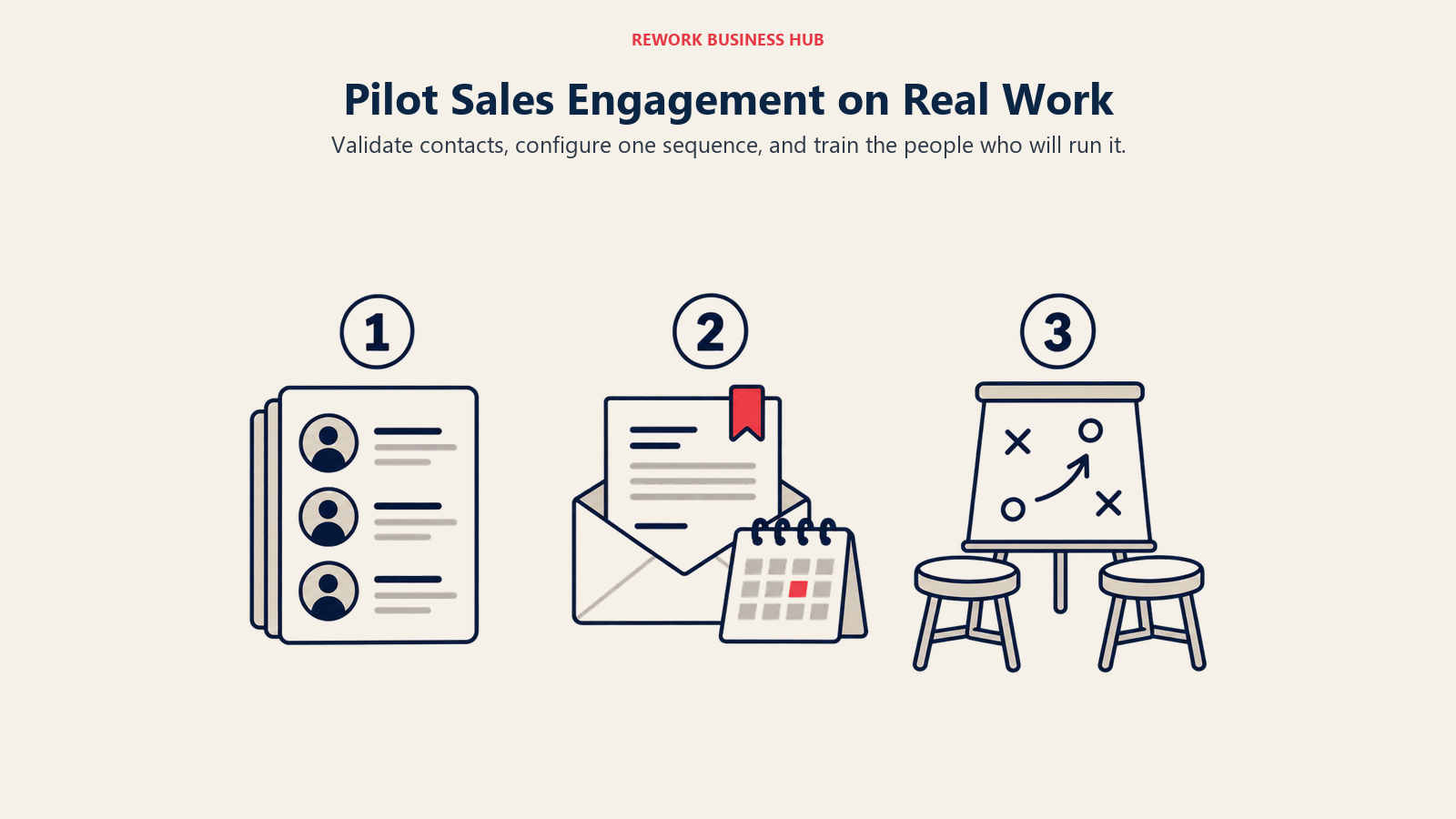
Before you configure sequences in any new platform, it's worth locking down your qualification frameworks first. Sequence logic built on fuzzy lead scoring wastes whichever tool you end up buying, regardless of which of these three you pick. And since forecasting is now a headline feature for two of the three tools here, get your forecast cadence discipline right before you lean on either platform's AI to do that work for you. A forecasting model fed by an undisciplined process just automates the same bad number faster.
Risk and Governance
CRM sync depth
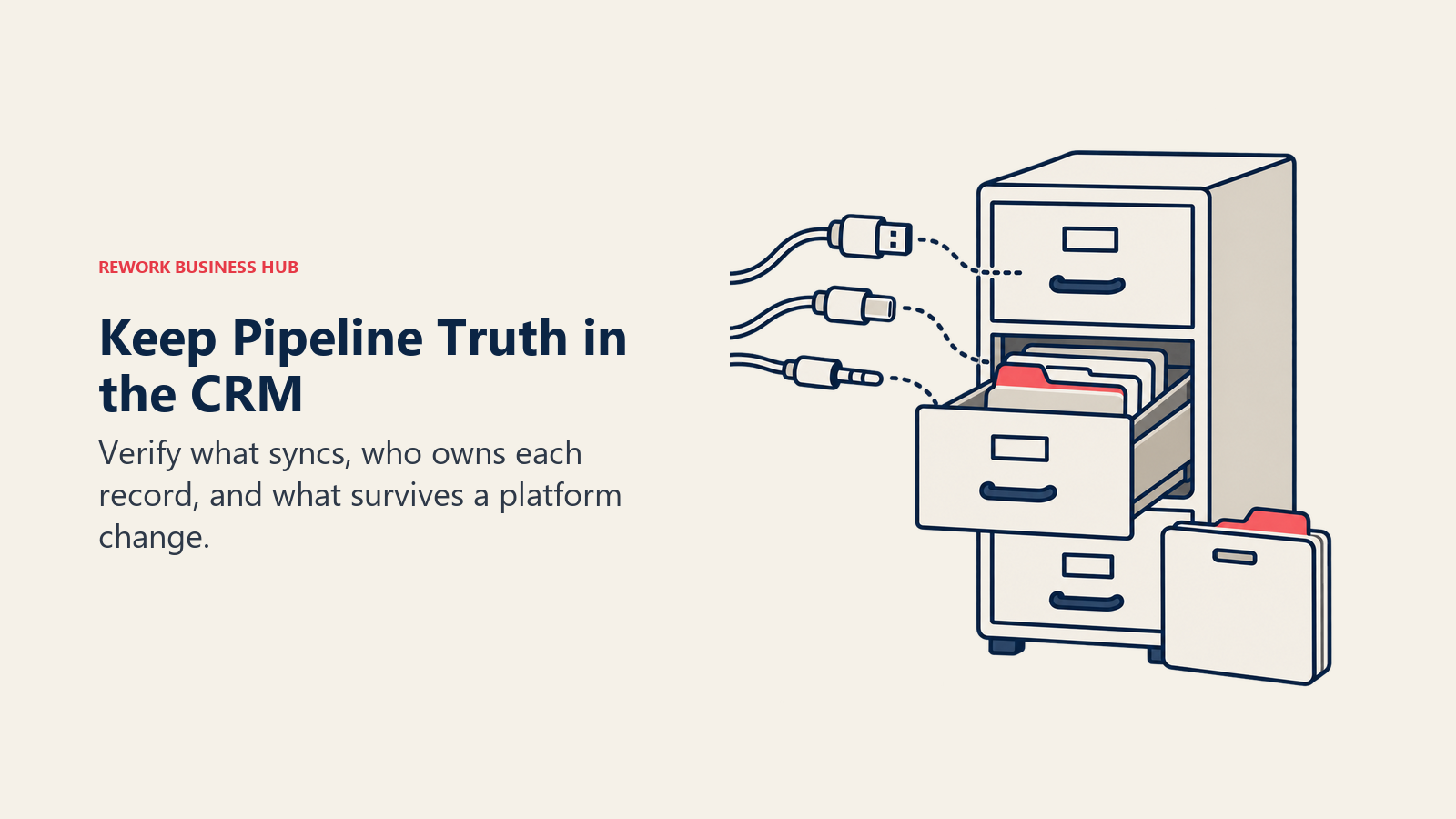
None of these three tools is a CRM replacement for a team that already has Salesforce or HubSpot in place, though they connect to that system of record with different depth.
| Apollo.io | Outreach | Salesloft | |
|---|---|---|---|
| Salesforce sync | Native integration, automated CRM enrichment from Basic tier up | Deepest native sync in the category; listed in Salesforce's AgentExchange marketplace | Native bi-directional sync, listed as a core platform capability |
| HubSpot sync | Native integration | Yes, though Salesforce gets the richer feature set | Native sync |
| Acts as its own system of record | Light internal deal management only, not a full CRM | No, always sits on top of a CRM | No, always sits on top of a CRM |
| Where pipeline truth actually lives | Your CRM if connected, or Apollo's own light pipeline if not | Your CRM | Your CRM |
If your team doesn't have a CRM yet and isn't planning to buy one, that changes this comparison more than any feature row does. Outreach and Salesloft both assume Salesforce, HubSpot, or Dynamics underneath them; neither is viable as a standalone system of record. For a broader look at CRM options if that's the actual gap, see best CRM software in 2026.
Email deliverability and domain reputation risk
This is the risk buyers underweight most, and it gets more expensive to fix after the fact than before you sign.
| Apollo.io | Outreach | Salesloft | |
|---|---|---|---|
| Sending model | Connected mailbox (Gmail/Microsoft); 1 mailbox/seat on Free-Basic, unlimited Google/Microsoft plus SMTP slots on Professional-Organization | Bring your own mailbox (Google Workspace, Microsoft 365, or SMTP) | Bring your own mailbox (Google Workspace or Microsoft 365) |
| Daily send cap | 250 emails/day on Free-Basic, unlimited on Professional-Organization | Set by your own mailbox provider's limits, not the platform | Set by your own mailbox provider's limits, not the platform |
| Built-in warmup | Yes, Deliverability Suite and Email Warmup from Basic tier up | No native warmup product | No native warmup product |
| Who owns domain reputation risk | Shared, Apollo's sending infrastructure plus your connected mailbox | Entirely yours | Entirely yours |
Outreach and Salesloft assume you already have deliverability infrastructure handled, because they were built for teams with an IT function managing SPF, DKIM, and DMARC on dedicated sending subdomains. If that's not true of your team yet, factor in either hiring for it or layering a dedicated warmup tool on top of either platform, which is a real cost that won't show up on the vendor's quote.
What leaving costs
None of the three vendors exports sequence or cadence logic in a format a competitor can import. Multi-step branching sequences, A/B test history, and call recordings tied to a vendor's own AI models are effectively locked to that platform. Raw activity that's already synced into your CRM (logged emails, logged calls) typically survives a switch since it lives in Salesforce or HubSpot, not in the sequencing tool. Everything the vendor calculated on top of that activity, engagement scoring, deal-risk flags, coaching analytics, does not transfer. Budget real rebuild time, not just the new contract's price, when comparing what switching actually costs.
When Apollo.io Is the Right Call
You don't have a data budget yet. If prospecting data and outbound tooling are both gaps, Apollo closes both for one line item instead of two vendor relationships (a database plus a separate sequencer).
Your team is under about 30 reps and nobody's job title includes "RevOps." Apollo's self-serve setup means a sales manager or founder can configure sequences without a specialist. Outreach and Salesloft both expect a dedicated admin.
You're testing outbound as a channel before committing budget. The Free tier and $49/month Basic tier let you validate whether cold outbound works for your business before signing an annual enterprise contract.
You're fine with lighter pipeline management. Apollo's Deal Management is real but shallow next to Outreach's or Salesloft's forecasting depth. If your deals are short-cycle and low-complexity, that's not a real cost. If they're multi-stakeholder, multi-month enterprise deals, it will show.
When Outreach Is the Right Call
You're running 100-plus reps with a dedicated RevOps function. Outreach's Amplify Plus and Pro tiers bundle advanced agents, conversation intelligence, and forecasting into one seat-plus-credit structure built for that scale.
AI-driven execution across the whole deal cycle is the actual ask. Omni and Agent Studio are the most agent-forward products in this comparison. If you want agents drafting follow-ups, flagging deal risk, and prepping forecasts without a human touching every step, Outreach has invested the furthest here in 2026.
Salesforce is already your system of record and you care about validated integrations. Outreach's listing in Salesforce's AgentExchange marketplace signals a level of enterprise security review that matters to some procurement teams.
Forecast accuracy is a board-level concern. Outreach's forecasting and deal-health scoring exist specifically to answer "how confident are we in this number," which is a different question than "did the sequence get sent."
When Salesloft Is the Right Call
You want cadence execution and forecasting under one contract instead of two. The whole point of the Clari merger is to stop selling engagement and revenue intelligence as separate purchases. If you were going to buy Clari anyway, the bundle is the honest reason to pick Salesloft over Outreach.
Conversation intelligence and seller coaching matter as much as sequencing. Salesloft's Conversations layer, plus the reported 12% higher closed/won rate and $1.3M in stack-consolidation savings from a Forrester Total Economic Impact study commissioned by Salesloft (April 2025), point to coaching and consolidation as the product's real strengths, not just cadence automation.
You're comfortable buying into a company mid-integration for the combined roadmap. That's a real ask in 2026. The upside is a forecasting layer Apollo doesn't have; the cost is a product still settling into its post-merger shape, including the Drift wind-down.
Your existing revenue tech stack is scattered and consolidation itself is the win. If you're running three or four disconnected point tools today, folding cadences and forecasting into one Clari-owned platform is a legitimate simplification, independent of any single feature.
Decision Framework
| Scenario | Pick |
|---|---|
| Team under 30 reps, no RevOps hire, no existing data | Apollo.io |
| 100+ reps, dedicated RevOps, want AI agents across the deal cycle | Outreach |
| Want cadences plus Clari forecasting in one contract | Salesloft |
| Testing outbound as a channel before committing real budget | Apollo.io |
| Board needs engagement-based forecast confidence | Outreach or Salesloft |
| Conversation intelligence and coaching matter as much as sending | Salesloft |
| Phone-heavy SDR team on a tight credit budget | Apollo.io Professional, not Basic |
| Already running or evaluating Clari for forecasting | Salesloft |
| Salesforce is system of record and validated integrations matter | Outreach |
| Want the cheapest realistic path to 100 seats with governance still intact | Weigh Apollo's savings against Outreach's or Salesloft's forecasting depth directly; there's no free version of that trade |
Frequently Asked Questions About Apollo.io, Outreach, and Salesloft
What is the main difference between Apollo.io, Outreach, and Salesloft?
Apollo.io bundles a prospect database with sequencing, so you get data and outbound tooling in one subscription. Outreach and Salesloft include no data at all; both assume you already have a CRM full of contacts and sell execution, coaching, and forecasting on top of it.
Which of the three is cheapest for a small team?
Apollo.io, by a wide margin. Its published Basic tier runs $49 per seat per month ($588/year), while Outreach and Salesloft rarely quote competitively below roughly 20 to 25 seats, per real buyer data from Vendr.
Does Apollo.io replace Outreach or Salesloft?
Not for a full-cycle enterprise motion. Apollo's sequencing and deal management are real but shallower than either enterprise platform, with no built-in forecasting or coaching layer. For SDR-led outbound under about 30 reps, it's often a full replacement. For complex, multi-stakeholder enterprise deals at scale, it usually isn't.
Is Salesloft still an independent company?
No. Salesloft merged with Clari in a deal that closed December 3, 2025. The combined company is led by CEO Steve Cox and now markets Salesloft as part of "The Predictive Revenue System," bundling cadences with Clari's forecasting.
Why did Outreach change its domain to outreach.ai?
Outreach rebranded in 2025 to reflect its shift toward an AI-native platform, launching new AI agents (Outreach Omni, Agent Studio) and repositioning from "sales engagement" to "AI Agent Platform for Revenue teams" in its spring 2026 release.
What happened to Drift after the Salesloft and Clari merger?
Clari and Salesloft announced on March 6, 2026 that Drift is being sunset, with existing Drift customers referred to a startup called 1mind as the conversational-AI successor rather than migrated automatically. This affects Drift specifically, not Salesloft's core cadence and forecasting product.
Which tool has the deepest Salesforce integration?
Outreach and Salesloft are both built as engagement layers on top of Salesforce, with mature bi-directional sync; Outreach is also listed in Salesforce's AgentExchange marketplace as of 2026. Apollo integrates natively with Salesforce too, but its integration exists to enrich records and log activity, not to run your forecast.
Do Outreach and Salesloft publish their pricing?
No. Both are quote-only. This comparison uses each vendor's own site to confirm current packaging (Outreach's four Amplify tiers, Salesloft's Advanced and Elite tiers) and real buyer transaction data from Vendr, labeled (reported), to estimate actual cost since neither vendor lists a number.
What to Do Next
Don't evaluate these three on a feature grid. Answer one question first: do you already have the contacts and the CRM, or do you need Apollo to supply both? That single question eliminates one or two of these three for most teams before you book a single demo.
If you're still deciding between Outreach and Salesloft specifically, run a two-week pilot with your actual reps on your actual pipeline instead of a scripted demo. Send real sequences, route real replies, and time how long it takes a rep to get comfortable. The platform that produces more booked meetings with fewer "this is a pain to configure" complaints is the one worth the annual contract, not the one with the flashier agent demo.
And if what you actually need is sequences wired directly into a live CRM and shared pipeline, without an enterprise contract, and Apollo's deal management is too thin for the complexity of what you're closing, that's a different shape of tool than any of the three compared here. Rework's Revenue Engine packages CRM, sequences, and a shared inbox from $159 a month billed yearly, with 5 marketing and 5 sales seats included. It won't hand you a prospect database the way Apollo does, so it doesn't solve a pure data gap. But if the actual problem is "sequences and pipeline live in two disconnected systems," it's worth a look before you sign a five- or six-figure annual contract with either enterprise platform.

Principal CRM Strategist
On this page
- TL;DR
- What Each Tool Is Actually Built For
- Decision by Business Goal
- Team and Role Fit
- Pricing at Real Team Sizes
- Apollo.io: published, per seat, with a credit system underneath
- Outreach and Salesloft: quote only, reported from real buyer data
- Real annual cost at 5, 25, and 100 seats
- Minimum seats and annual commitments
- Implementation and Change Management
- Risk and Governance
- CRM sync depth
- Email deliverability and domain reputation risk
- What leaving costs
- When Apollo.io Is the Right Call
- When Outreach Is the Right Call
- When Salesloft Is the Right Call
- Decision Framework
- What to Do Next