Workable vs Greenhouse: Which Applicant Tracking System Fits How You Buy in 2026?
Turn this article into takeaways for your work.


Each assistant summarizes the article only for you and suggests best practices for your work.
Updated September 2026
If you're a Head of Talent, VP People, or founder-operator at a 20 to 250-person company shopping for an applicant tracking system, you've probably landed on both of these names within the first ten minutes of searching. Workable and Greenhouse both show up on nearly every "best ATS" shortlist, and both are genuinely good products. The decision between them is rarely about which one has more features. It's about how you want to buy software and how much process discipline you're ready to run.
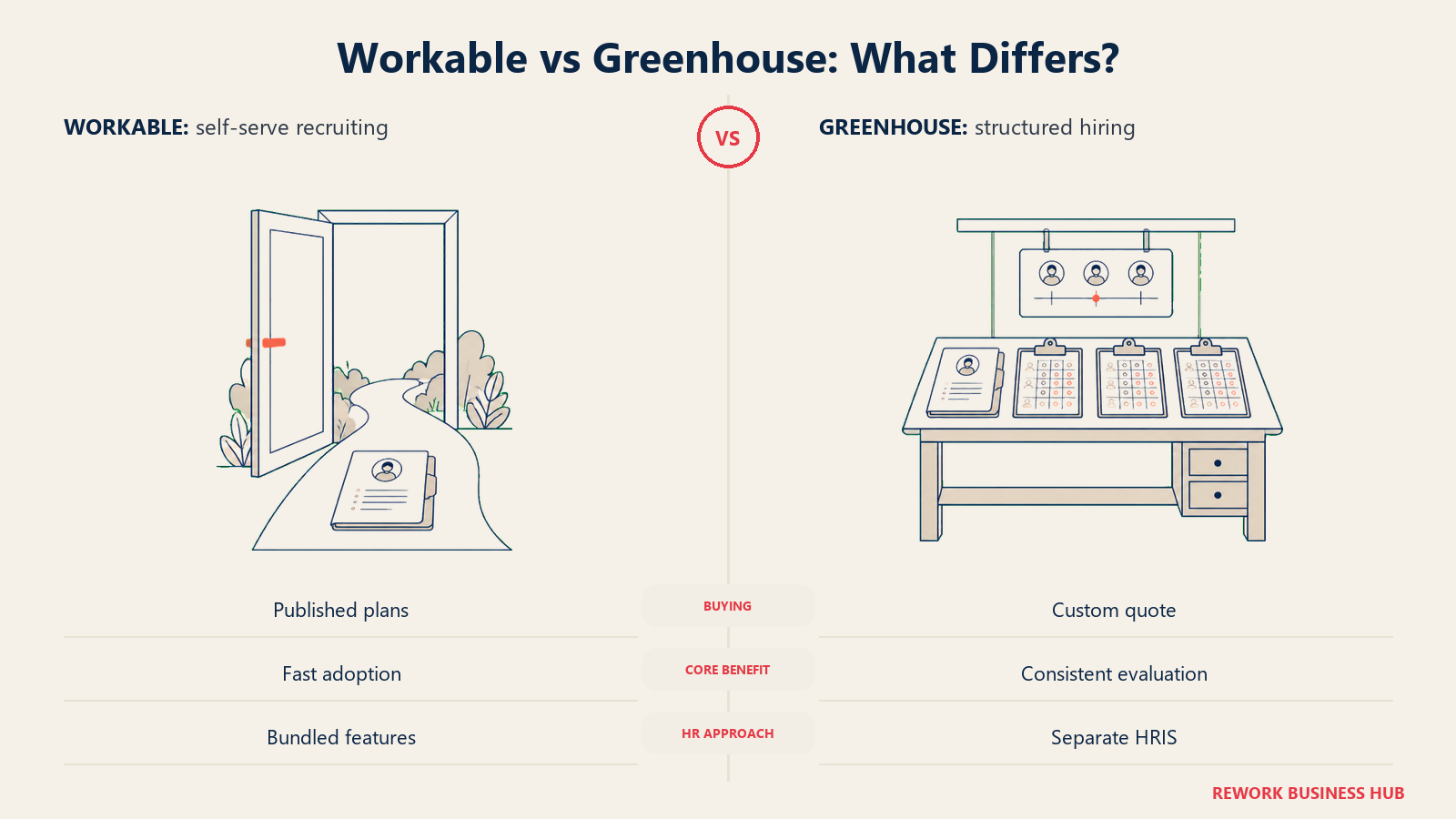
Workable publishes its prices, sells itself without a sales call, and bundles recruiting with a growing HR layer, an all-in-one system a lean team can turn on this week. Greenhouse keeps its prices behind a demo request and builds around structured hiring: interview kits, scorecards, and a process meant to make evaluation consistent across every interviewer, backed by the deepest integration marketplace in the category. Neither model is wrong. One optimizes for speed and budget certainty, the other for process rigor at scale. Picking the one that doesn't match how your team actually operates means fighting the tool for a year.
TL;DR
| Workable | Greenhouse | |
|---|---|---|
| Core philosophy | Transparent-priced, self-serve, recruiting bundled with HR | Structured hiring: interview kits, scorecards, consistent evaluation |
| Best for | 20 to 250-person teams that want to buy without a sales call | Companies standardizing a high-volume, multi-interviewer hiring process |
| Pricing model | Published, per-employee-band tiers (Standard, Premier, Enterprise) | Three tiers (Core, Plus, Pro), quote-only |
| Typical annual cost (small team) | $3,588 to $8,628/yr at the 1-20 employee band, before add-ons | Reported median around $26,587/yr across all sizes (Vendr) |
| Sourcing | Native AI sourcing against 400M+ profiles, 200+ job boards | Sourcing Automation included on Plus tier and above |
| HR bundle | Recruiting plus HR (attendance, performance) in one plan | None; hiring only, HRIS is a separate purchase |
| G2 rating | 4.4 out of 5 (700+ reviews) | 4.4 out of 5 (3,900+ reviews) |
| Integration depth | Native job board network, smaller published partner directory | 250+ integration partners, 450+ pre-built integrations |
Who Each Platform Is Actually Built For
Workable's own pricing page prices by employee headcount band, not by seat or hiring volume, which tells you exactly who it's built for: a company that wants to know its cost before it books a demo, and one that's usually hiring across a full org rather than running a dedicated recruiting function. The product ships recruiting and an expanding HR layer (performance and engagement tools, attendance) as one plan, which fits a generalist HR or ops person who owns both hiring and the basics of people management.
Greenhouse's three tiers are framed around hiring complexity, not headcount: Core is pitched as bringing structure to hiring, Plus as optimizing the operation, and Pro as managing complexity at scale, according to Greenhouse's own pricing page. That framing tells you who it's for: a company that has decided evaluation needs to be standardized, usually because it's hiring across multiple departments and wants every interviewer scoring candidates against the same criteria.
| Workable | Greenhouse | |
|---|---|---|
| Sweet-spot team | Lean HR or ops team buying self-serve, without procurement | Talent acquisition teams standardizing process across many hiring managers |
| Team maturity | Wants a working ATS this week, not a multi-week rollout | Has decided structured interviews matter, ready to build scorecards |
| Primary use case | Fast, budget-predictable hiring bundled with HR basics | Consistent, bias-reduced evaluation at hiring volume |
| Buying trigger | Outgrowing spreadsheets and free job board postings, no time for a sales cycle | Outgrowing an unstructured or informal interview process |
| Org shape | Usually no dedicated TA function; HR or a generalist owns hiring | Dedicated talent acquisition function or a fast-growing multi-department org |
Neither framing is a knock on the other platform. It's the difference between a tool built so a small team can buy it without help, and a tool built so a bigger team can standardize how it evaluates people.
Key Facts
Key Facts: ATS Cost, Renewals, and Time to Hire
- The average US cost per hire climbed to $5,475 for non-executive roles in 2025, up from $4,129 in 2016. (SHRM, 2025)
- Median time-to-fill for non-executive roles sits at 39 calendar days, per SHRM's most recent recruiting benchmarking research. (SHRM Recruiting Benchmarking, 2026)
- The global applicant tracking system market grew from an estimated $2.96 billion in 2025 to $3.17 billion in 2026, a 7.1% CAGR. (Research and Markets, 2026)
- 79% of IT leaders hit a price increase at renewal in the past 12 months, and a routine 5 to 7% bump is now commonly 15% or higher. (Zylo 2026 SaaS Management Index, 2026)
- Enterprise SaaS price inflation hit 16.4% in June 2026, the highest monthly rate on record. (Vertice, 2026)
That last stat matters more than it looks in a two-tool comparison. A published rate card doesn't just save you a sales call, it gives you a number to hold a vendor to when renewal season shows up with a bigger increase than you budgeted for.
Published Price and Self-Serve vs Quote and Process: The Core Difference
Both platforms are full applicant tracking systems: job postings, pipelines, candidate profiles, offer workflows, and reporting all ship in each one. The difference that actually decides your evaluation timeline is how each company sells and what each company was built to enforce.
Workable puts a rate card on its own website. You can see the Standard, Premier, and Enterprise prices for your employee band, start a 15-day free trial with no credit card, and be posting jobs to more than 200 boards the same afternoon. That's a deliberate product bet: reduce friction between "I need an ATS" and "I'm using an ATS" to as close to zero as the software allows.
Greenhouse makes the opposite bet. Its pricing page names three tiers, Core, Plus, and Pro, but prices none of them, saying cost depends on "the plan you choose, your hiring volume and organizational complexity, and the features and capabilities required." What you get in exchange for the sales call is a structured hiring model built around the interview kit, which bundles instructions, questions, the candidate's resume, and a scorecard into one document every interviewer works from. Scorecards are organized into three or four categories of attributes so interviewers evaluate candidates against the same criteria instead of a general impression, which is the mechanism behind Greenhouse's bias-reduction reputation.
| Capability | Workable | Greenhouse |
|---|---|---|
| Pricing transparency | Published rate card by employee band | Quote-only, no dollar figures on the pricing page |
| Time to first job posted | Same day, self-serve trial | Weeks, demo and quote process first |
| Interview kits and scorecards | Available; not the product's organizing principle | Core to the product, built for every stage |
| Sourcing and AI candidate matching | Native, core to every plan (3,000 free AI credits) | Available via Sourcing Automation, included on Plus and above |
| HR features bundled in | Yes, Performance & Engagement add-on and growing HR layer | No; hiring only |
| Buying process | No sales call required | Sales call and custom quote required |
Pricing and the True Cost of Ownership
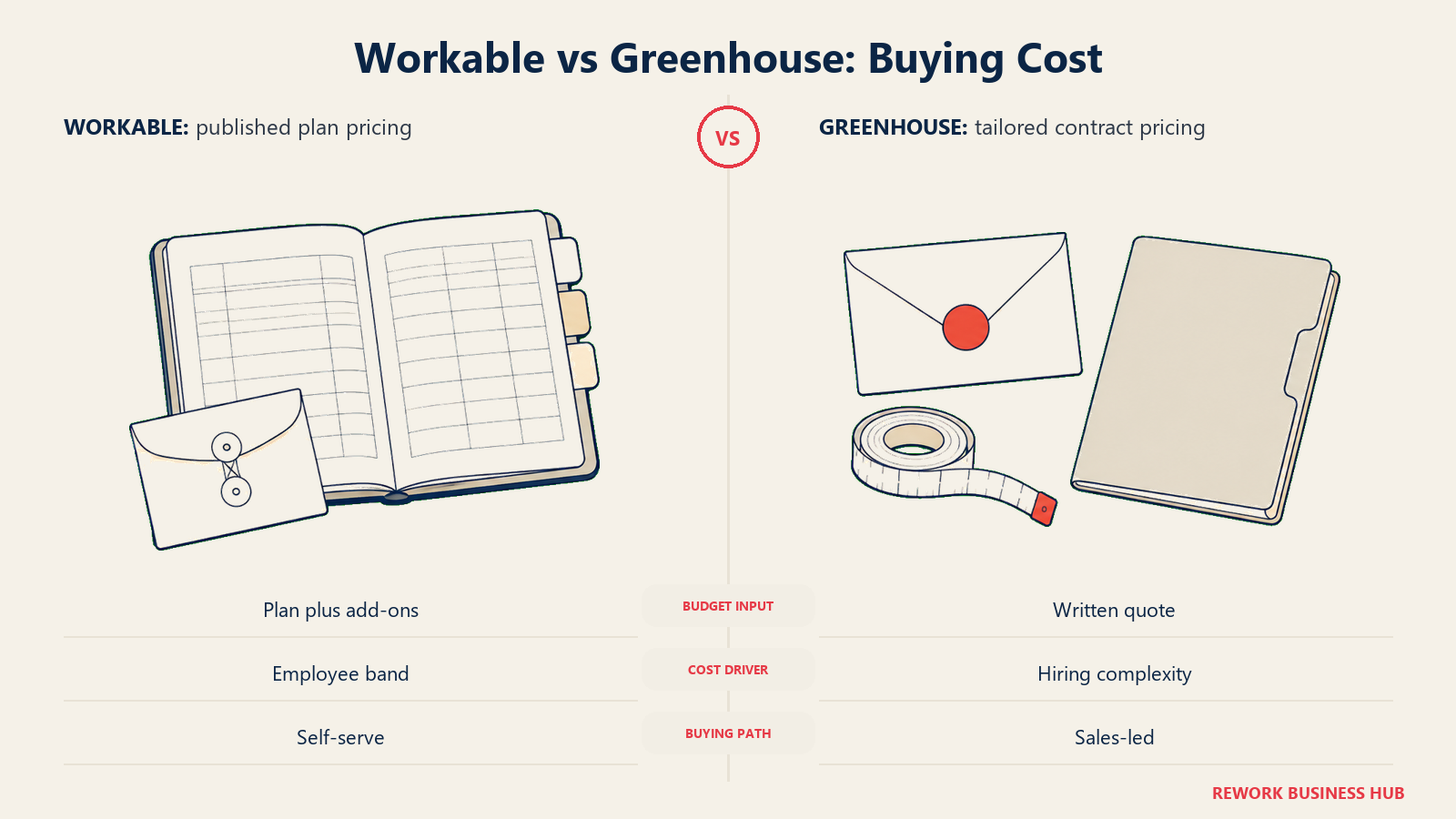
This is the section most people click through for, so start with the number you can actually pin down. At the 1-20 employee band, Workable's own pricing page lists three tiers: Standard at $299/month ($3,588/year), Premier at $599/month ($7,188/year), and Enterprise at $719/month ($8,628/year), with the annual rate carrying a 20% discount over paying month to month. Workable's page bundles Recruiting and HR into that single price and explicitly markets the discount as a reason to buy both together rather than separately. Prices scale upward as you select a larger employee-count band, but Workable doesn't publish a monthly-billing rate on the page beyond that framing, so don't try to back into one.
| Plan | Monthly | Annual | What's included by default |
|---|---|---|---|
| Standard | $299/mo | $3,588/yr | Core ATS, job board syndication, 3,000 free AI credits, add-ons priced separately |
| Premier | $599/mo | $7,188/yr | Standard, plus texting, video interviews, assessments, and performance tools included |
| Enterprise | $719/mo | $8,628/yr | Premier, plus deeper admin, security, and support features |
Add-ons matter if you're pricing out the Standard plan specifically, because Standard doesn't include them by default: Texting+ runs $89/month, Video interviews+ $109/month, and Assessments+ $59/month. Every paid plan starts with 3,000 free AI credits for sourcing and screening; if you burn through those, paid credit packs run from roughly $0.12/credit down to about $0.095/credit at volume. None of that appears on Greenhouse's site, because Greenhouse doesn't price anything publicly.
Greenhouse's own pricing page names Core, Plus, and Pro but attaches no dollar figures to any of them; the site routes every visitor to a demo request. What follows is reported buyer-side data, not a confirmed vendor quote, so treat it as a planning range, not a number you can hold Greenhouse to in a negotiation.
| Data point | Greenhouse (reported) | Source |
|---|---|---|
| Median negotiated annual contract | About $26,587/year | Vendr verified-purchase data |
| Full reported range | $10,152 to $75,188/year | Vendr verified-purchase data |
| Entry tier (Core), estimated | Roughly $5,100 to $12,000+/year | Third-party buyer research, not a vendor figure |
| What drives the quote | Plan tier, hiring volume, org complexity, required features | Greenhouse's own pricing page |
| Implementation fee | Often billed separately | Common industry pattern, confirm before signing |
Put those two pricing models side by side and the tradeoff is plain. Workable gives you a number today that you can put in a budget line before you talk to anyone. Greenhouse gives you a process: a demo, a quote, and a number that, per the reported range, could land anywhere from roughly $10,600 to well over $75,000 depending on how big and how complex your hiring operation is. If your finance team wants a fixed line item before approving a pilot, that difference alone can decide the shortlist. If your hiring volume genuinely varies year to year, Greenhouse's usage-linked model might track your actual cost more honestly than a flat employee-band price that doesn't care how many roles you're filling.
Sourcing and Job Distribution
If your biggest hiring problem is an empty top of funnel, this is where Workable earns its reputation. Job posts syndicate automatically to more than 200 boards the moment you publish a requisition, and Workable's AI sourcing tool searches a database of more than 400 million candidate profiles to surface matches without a recruiter running manual searches. That combination, one-click distribution plus built-in AI sourcing, is the reason Workable gets picked by lean teams that don't have a dedicated sourcer on staff.
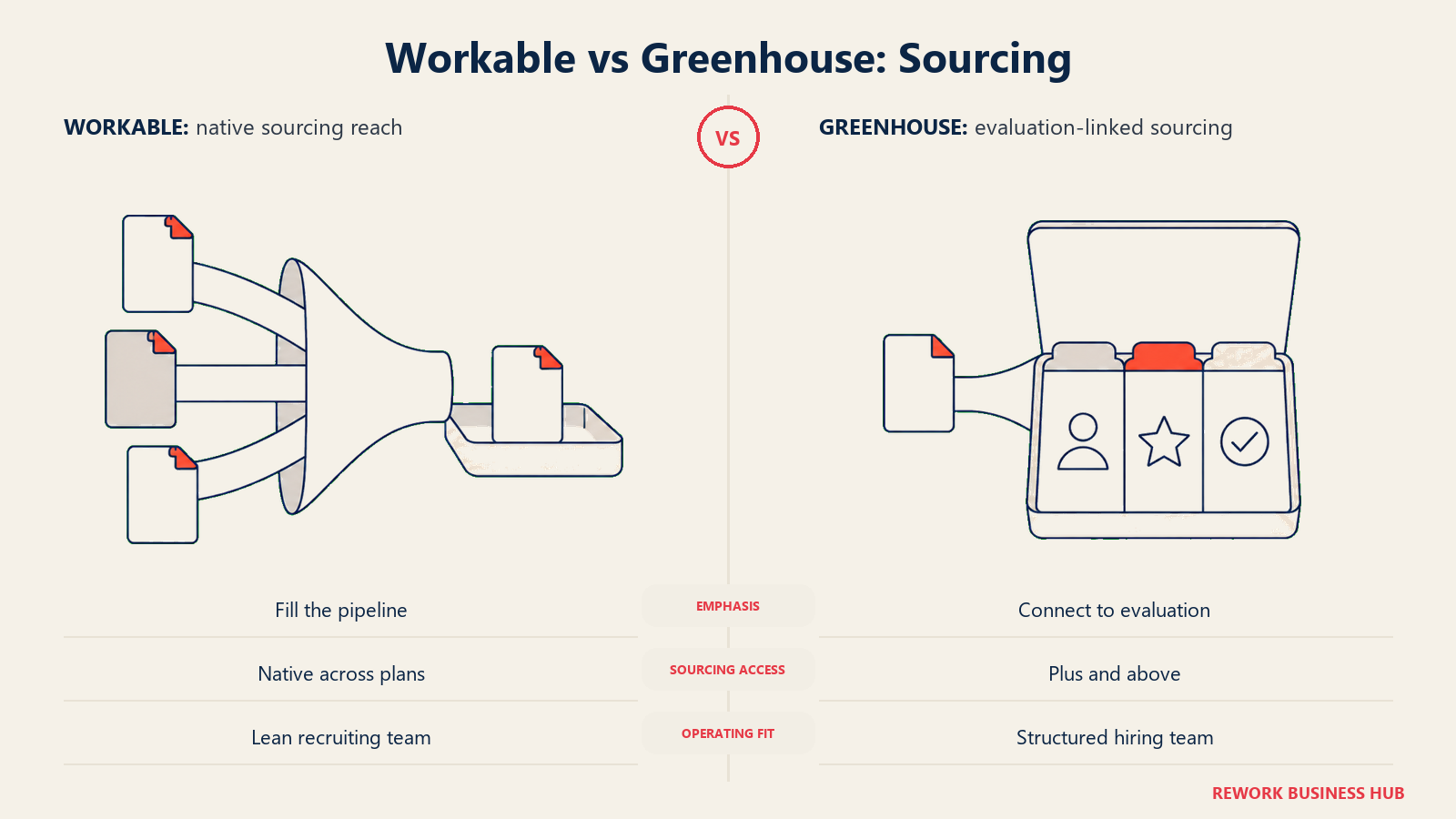
Greenhouse's approach to sourcing is a layer on top of a structured-hiring core rather than the product's starting point. Sourcing Automation ships as part of the Plus tier and above, and it's built to plug into the same interview kits and scorecards you're already using, so candidates move from sourced to evaluated inside one consistent process. It's a genuinely capable tool, but you're buying it as an extension of an evaluation-first product, not a sourcing-first one.
| Capability | Workable | Greenhouse |
|---|---|---|
| Job board network | 200+ boards, automatic syndication | Broad, structured job board posting |
| AI candidate sourcing | Native on every plan, 400M+ profile database | Sourcing Automation, included on Plus tier and above |
| Free AI credits | 3,000 credits included on every paid plan | Not applicable; not a credit-based model |
| Best fit | Teams without a dedicated sourcer, high applicant volume | Teams that want sourcing tied directly into scorecard-based evaluation |
Structured Hiring and Scorecards
If your actual problem is inconsistent evaluation, not an empty pipeline, Greenhouse's structured hiring model is the more direct fix. The scorecard forces every interviewer to rate a candidate against the same defined attributes instead of submitting an unstructured "strong yes" or "pass," which is the single biggest lever for reducing interviewer-to-interviewer inconsistency once more than a couple of people sit in on interviews. That discipline is what shows up most in reviews of the product: users consistently cite the ability to centralize candidate information and keep evaluation criteria consistent across a hiring committee.
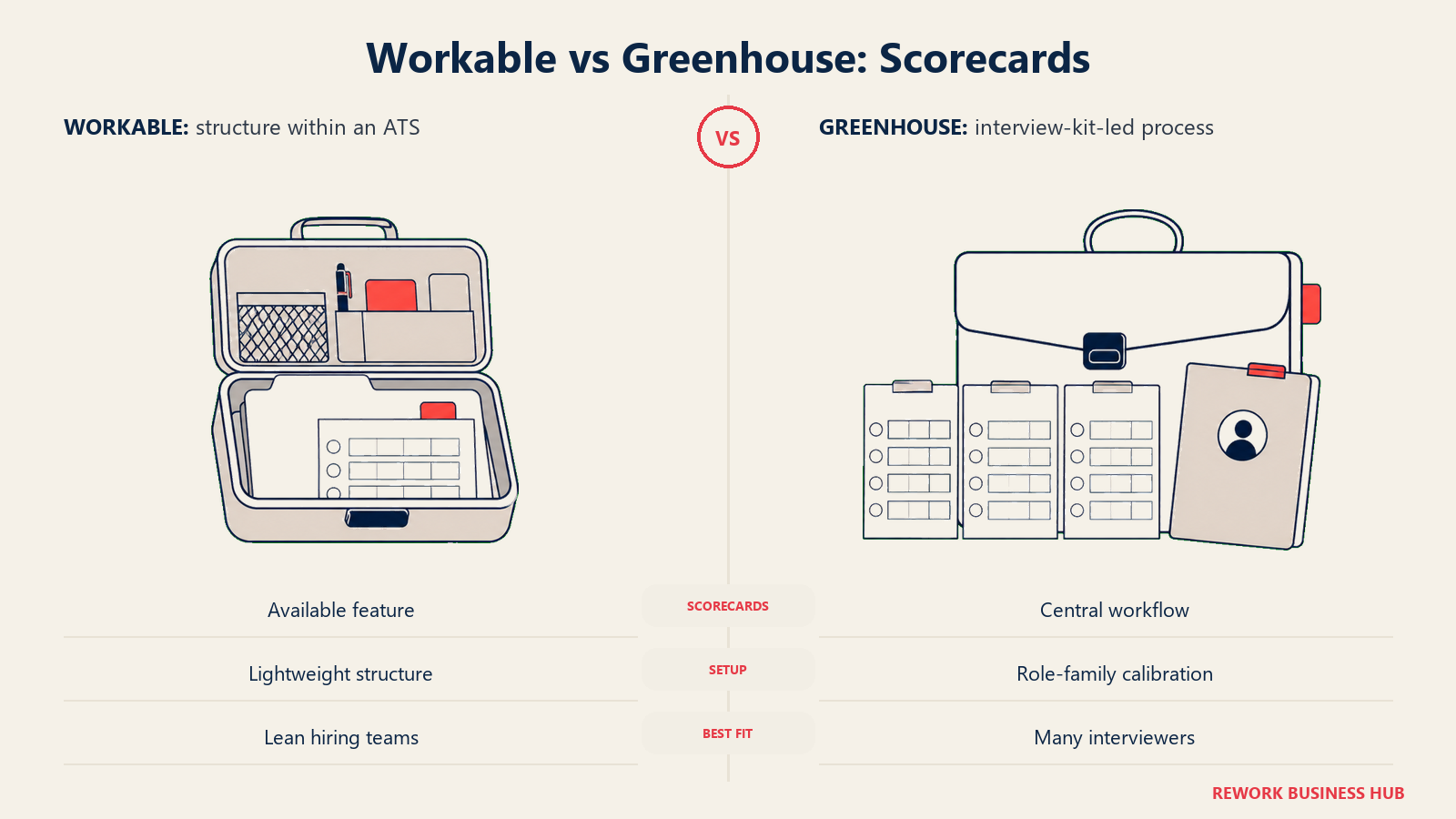
Workable supports structured interviews too. Scorecards, interview guides, and collaborative feedback all exist in the product, but they're features inside a broader, faster-moving ATS, not the organizing principle the way they are for Greenhouse. A team that wants a lightweight version of structure will find what it needs. A team that wants to build a full competency framework tied to role families, calibrate scorecards across departments, and run audit-grade evaluation for compliance reasons will find Greenhouse's tooling built specifically for that job, the same reason it comes up against other structured-hiring platforms like Ashby; see our Greenhouse vs Ashby comparison if scorecard depth and native analytics both matter to you.
| Capability | Workable | Greenhouse |
|---|---|---|
| Interview scorecards | Available as a feature | Core to the product, mandatory workflow design |
| Interview kits (questions plus scorecard bundled) | Basic version available | Purpose-built, the product's central object |
| Bias-reduction framing | Present but secondary | Primary design goal, marketed explicitly |
| Best fit | Some structure without heavy process overhead | Standardizing evaluation across many interviewers and departments |
For a deeper look at how scorecards differ from looser evaluation rubrics and when the extra structure is worth the setup time, see our guide to interview scorecards vs rubrics.
The HR and HRIS Bundle Question
This is the sharpest structural difference between the two, and it's worth pulling out on its own instead of burying it in the pricing table. Workable's pricing page markets bundling Recruiting and HR together explicitly, with the 20% annual discount pitched partly as a reason to buy both instead of stitching a separate HRIS on top. The Premier and Enterprise tiers fold in a Performance & Engagement layer, so a small company can run hiring and basic people operations from the same login without a second vendor relationship.
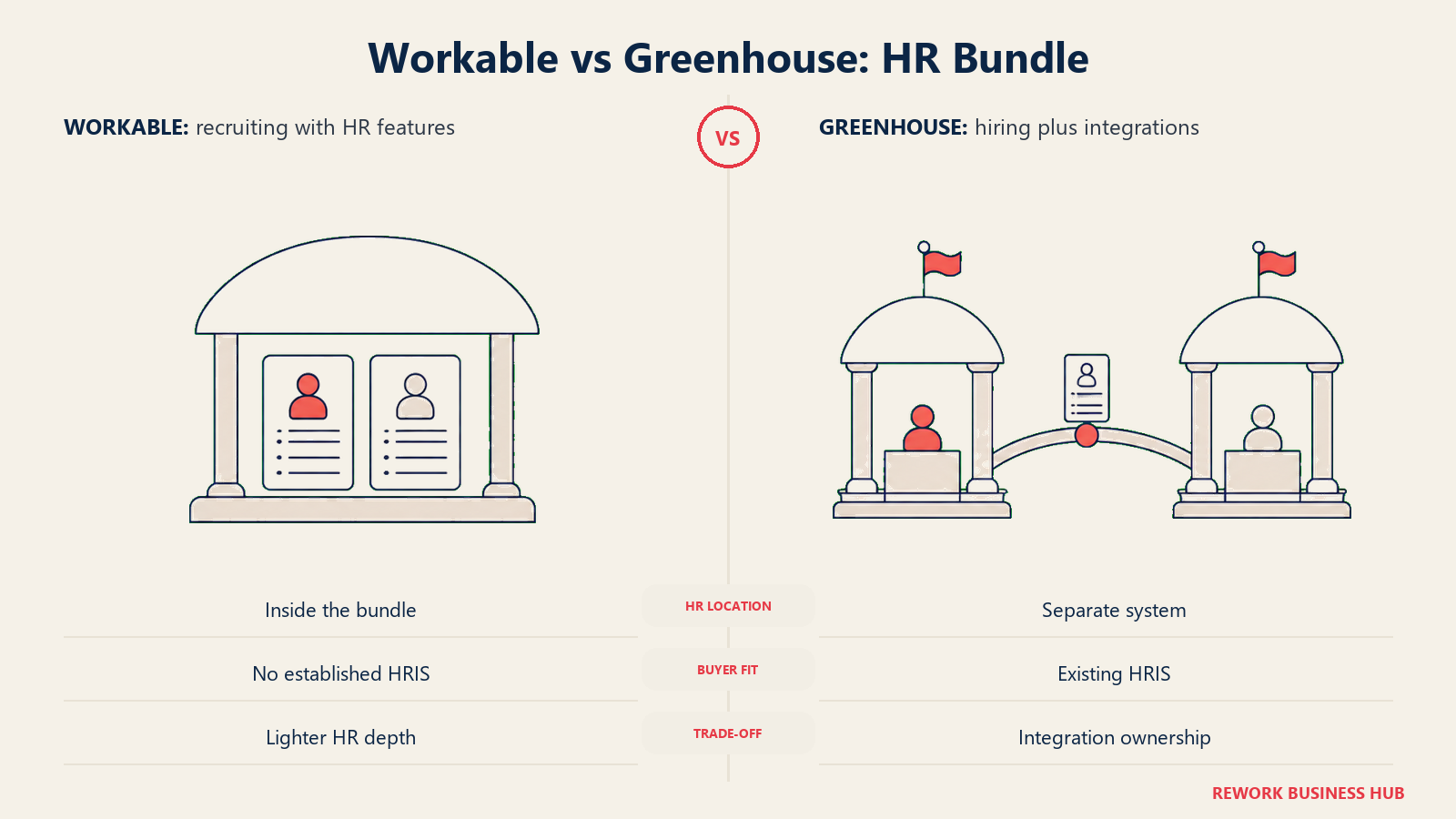
Greenhouse doesn't try to be an HR system, and it isn't pretending otherwise. It's a hiring tool, full stop, with the deepest structured-evaluation tooling in the category, and its own marketplace of 250+ integration partners exists specifically so you can connect it to whatever HRIS, payroll, or onboarding tool you already run. That's a legitimate design choice: do one thing at a category-leading depth and let integrations handle the rest. If you go that route, our best HR software roundup covers the HRIS side of that pairing.
| Workable | Greenhouse | |
|---|---|---|
| HR features in the core product | Yes, growing HR layer (attendance, performance tools) | No; hiring only |
| Where HRIS lives | Increasingly inside Workable itself | A separate system, connected via integration |
| Who this fits | Teams without a dedicated HRIS, wanting one login | Teams with an established HRIS that just needs a hiring connector |
| Tradeoff | HR depth is shallower than a dedicated HRIS platform | Requires and pays for a separate HR system either way |
If a single login for hiring and basic HR is the actual goal, Workable's bundle is the more direct answer of the two ATS-first products on this page. But it's worth knowing that model isn't unique to Workable, and later in this article we'll look at what changes when hiring, HR, and time tracking all live on one platform by design rather than as a bundled add-on.
Reporting and Analytics
| Reporting | Workable | Greenhouse |
|---|---|---|
| Standard reporting | Built in, deepens on Premier and Enterprise tiers | Robust and detailed, though several reviewers describe it as unintuitive without training |
| AI-powered filters | Not the primary framing; AI is sourcing-led | Available on Plus tier and above |
| Business intelligence connector | Not a named feature | Available on Plus tier and above |
| DEI / bias reporting | Basic reporting on interview activity | Tied directly to structured scorecards and standardized criteria |
| Best for | Quick visibility into pipeline and sourcing activity | Funnel and interviewer-consistency analysis at scale |
Integrations
| Integration | Workable | Greenhouse |
|---|---|---|
| Job board network | 200+ boards, native syndication | Broad, structured job board posting |
| Named partner ecosystem | Smaller published directory, deep native sourcing instead | 250+ distinct integration partners, 450+ pre-built integrations |
| HRIS connectivity | Increasingly native (Workable's own HR layer) | Via integration marketplace, no native HRIS |
| AI credit-based tools | Native sourcing and screening on a credit system | Sourcing Automation bundled into Plus tier, no credit system |
| Open API access | Yes | Yes |
Implementation and Time to Go Live
| Workable | Greenhouse | |
|---|---|---|
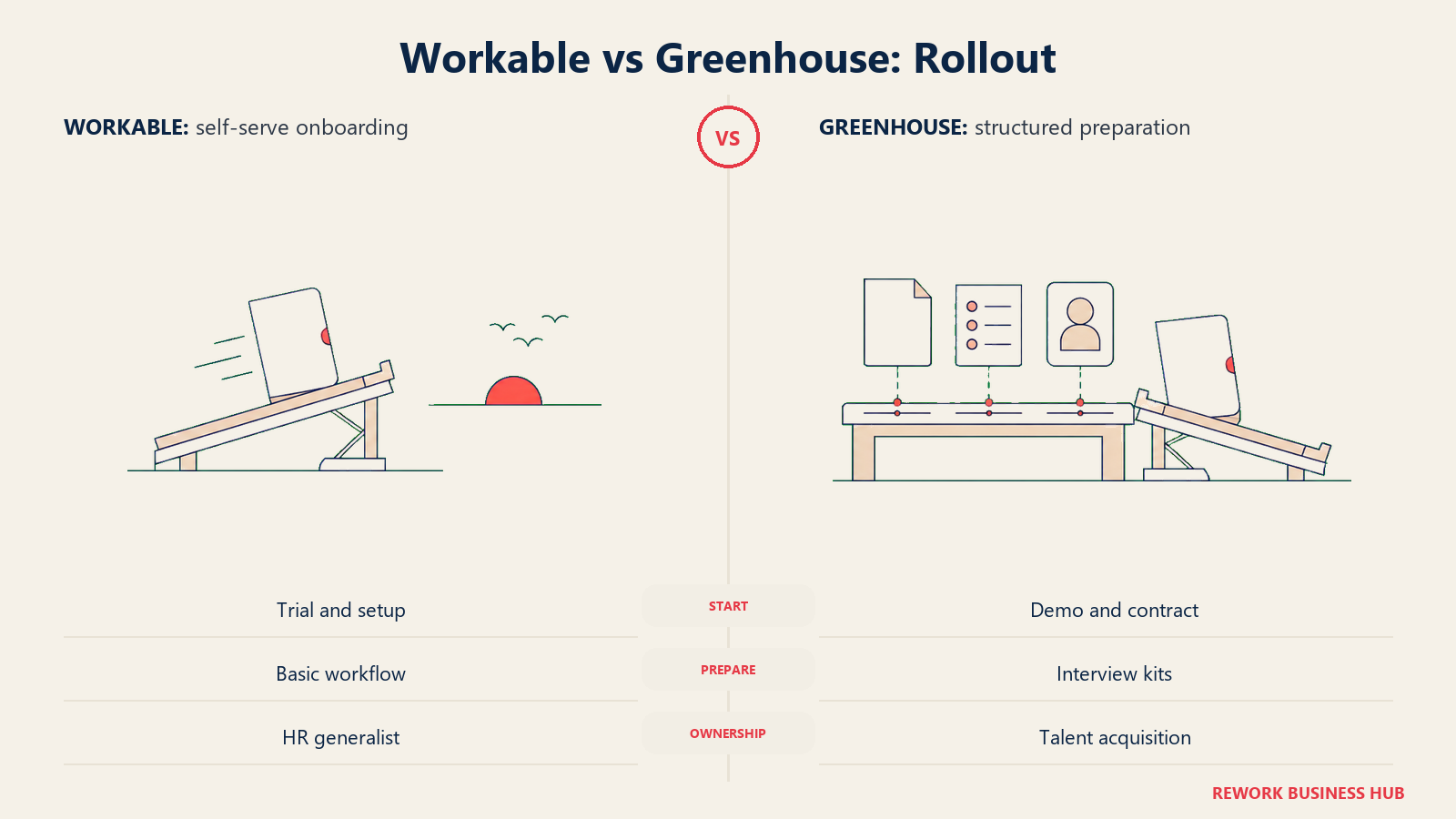
| Time to first job posted | Same day, 15-day free trial, no credit card | Weeks; demo, quote, and contracting happen first |
| Setup effort | Low; designed for self-serve onboarding | Meaningful; interview kits and scorecards need defining per role family before launch |
| Who typically leads rollout | HR generalist or founder-operator, often without help | A talent acquisition function, sometimes with Greenhouse's implementation support |
| Training load | Light; interface is built for fast adoption | Steeper for admins, especially around reporting and scorecard design |
The honest read: Workable's time-to-value advantage is real and it's the whole point of the product. If you need to be hiring inside the ATS this week, Greenhouse's quote-and-contract process alone probably rules it out for that timeline. But the setup work Greenhouse asks for upfront, defining interview kits and scorecards role by role, is also the work that makes structured hiring actually work once you're running it across a dozen hiring managers. Skipping that work with a faster tool doesn't remove the need for it; it just means you'll do it later, informally, or not at all.
Scaling Past 200 Employees
Workable's pricing model is built around employee-count bands, and that's the detail to watch as you grow. A company that adds headcount in ops, engineering, or support, without hiring any faster, still moves into a bigger pricing band and pays more at the next renewal. That's a materially different growth curve than a per-seat or per-recruiter model, and it's worth modeling out before you sign a multi-year deal if you're expecting the company to grow past 200 employees during the contract.
Greenhouse's quote scales on hiring volume and organizational complexity rather than total headcount, which can track your actual usage more fairly at scale, but it also means you lose the pricing certainty that made Workable attractive at the smaller end. A 250-person company with a lean, steady hiring pace might land a smaller Greenhouse quote than a 250-person company hiring aggressively across a dozen departments, even though both have the same headcount. Neither model is objectively better here. It depends on whether your growth is driven by total headcount or by hiring volume specifically, and you should ask each vendor's sales team directly how a specific growth scenario changes your renewal number before you sign.
When Greenhouse Is the Right Call
- You're standardizing a hiring process across multiple departments and need every interviewer scoring candidates against the same criteria
- Reducing interviewer bias and building a defensible, auditable evaluation trail matters for compliance or DEI reporting
- You're hiring at meaningful volume and need reporting depth to analyze funnel performance by stage, source, and interviewer
- You have, or are building, a dedicated talent acquisition function that can own scorecard design and interview kit maintenance
- Your hiring volume genuinely fluctuates year to year, and you'd rather a quote track that than pay a flat rate tied to headcount
When Workable Is the Right Call
- You want a published price you can budget against before you ever talk to sales
- You're a lean HR or ops team without a dedicated recruiter, and you need job distribution and AI sourcing to do the heavy lifting
- You want hiring and basic HR functions running from the same login instead of stitching together two vendor relationships
- Your growth is driven by hiring volume more than by total headcount, so an employee-band price stays predictable
- You need to be live and posting jobs this week, not after a multi-week sales and implementation process
If Neither Fits: Hiring on the Same Platform as HR and Time Tracking
Worth naming honestly: Workable's recruiting-plus-HR bundle is the closest thing on this page to a real answer for "I don't want hiring and HR in two separate systems." It's a good one for a lean team, and if that's your only requirement, it's worth serious consideration on its own. But it's still an ATS with HR features layered on, not a workforce platform where hiring was designed as one module among several from the start.
Rework's E-Hiring, Interview, and Career modules run on the same platform as HRIS, Timesheet, and Payroll, so a candidate becomes an employee record, with time tracking and payroll already connected, without a handoff between separate systems or a bundled-on HR add-on. That's a meaningfully different starting point than either Workable or Greenhouse, both of which are hiring products first. It's not the right fit if you run high-volume agency recruiting or a sourcing-led talent CRM strategy; Rework doesn't try to match Lever's nurture depth or Greenhouse's scorecard sophistication, and its integration marketplace is nowhere near Greenhouse's 250-plus partners. Where it's worth a look is the opposite scenario: hiring is one piece of a broader people-operations platform you'd rather run in one place instead of stitching an ATS to an HRIS after the fact. Pricing is quote on request; see rework.com/pricing for current details.
Decision Framework
| If you are... | Pick |
|---|---|
| Buying without a sales call and wanting a published price today | Workable |
| Standardizing evaluation across many interviewers and departments | Greenhouse |
| Running lean, without a dedicated recruiter or sourcer | Workable |
| Building a defensible, auditable, bias-reduction-focused interview process | Greenhouse |
| Wanting hiring and basic HR under one login without a second vendor | Workable |
| Needing the deepest integration marketplace in the category | Greenhouse |
| Wanting hiring on the same platform as full HRIS, timesheets, and payroll | Rework (see rework.com/pricing) |
| Comparing every option in the category, not just these two | See our Best Applicant Tracking Systems roundup |
What to Do Next
- Decide how you want to buy before you take a demo. If a published price you can budget against today matters more than a custom-fit quote, that alone tilts the decision toward Workable.
- Get Greenhouse's quote in writing early, and ask directly how the number changes if your hiring volume doubles or your headcount grows past 200. Its usage-linked model can move more than a flat-rate one.
- Add up Workable's real cost before you commit to Standard. Texting, video interviews, and assessments are all separate charges on that tier; Premier may be the cheaper real-world choice once you tally them.
- Map whether your growth is headcount-driven or hiring-volume-driven. That single fact decides which vendor's pricing model actually tracks your costs fairly over the next two years.
- If your bottleneck is that hiring, HR, and time tracking live in three disconnected systems, that's a different shape of problem than either ATS solves on its own; see the Rework section above.
- Running a proactive, sourcing-led recruiting strategy instead? Neither tool on this page is built around that the way Lever is; our Greenhouse vs Lever comparison covers that fork, and our Lever alternatives guide covers lighter options in that direction.
- Under 50 employees and still narrowing your options? Our best recruiting software for small business roundup is scoped to that stage specifically.
- Still building your shortlist? Our Workable alternatives guide and Greenhouse alternatives guide cover lighter and heavier options on either side, and our guide to choosing recruiting software walks through the full evaluation framework before you sit through a single sales call.

Principal Product Marketing Strategist
On this page
- TL;DR
- Who Each Platform Is Actually Built For
- Key Facts
- Published Price and Self-Serve vs Quote and Process: The Core Difference
- Pricing and the True Cost of Ownership
- Sourcing and Job Distribution
- Structured Hiring and Scorecards
- The HR and HRIS Bundle Question
- Reporting and Analytics
- Integrations
- Implementation and Time to Go Live
- Scaling Past 200 Employees
- When Greenhouse Is the Right Call
- When Workable Is the Right Call
- If Neither Fits: Hiring on the Same Platform as HR and Time Tracking
- Decision Framework
- What to Do Next