Best Recruiting Software for Small Business in 2026: 15 Tools for Hiring Without a Full-Time Recruiter
Turn this article into takeaways for your work.


Each assistant summarizes the article only for you and suggests best practices for your work.
Updated September 2026
If you're a founder, office manager, or the first person handed "hiring" as part of a bigger job, the honest answer to "which recruiting software should I buy" is often "none yet." A shared spreadsheet and a folder of resumes gets a lot of small companies through their first several hires just fine. The moment that stops working, usually somewhere between your third open role and your fifth candidate in one pipeline, is the moment this list becomes useful.
This guide ranks 15 recruiting tools for small businesses of roughly 5 to 100 employees hiring occasionally, without a dedicated recruiter on staff and without a budget for an enterprise ATS contract. It's the small-business-focused cut of our broader best applicant tracking systems roundup, which also covers mid-market and enterprise options if your hiring volume outgrows this list. Every price below is checked against the vendor's own pricing page as of September 2026, monthly and annual quoted separately where a vendor prints both. Evaluation criteria: what it actually costs at your real hiring volume, whether you can run it yourself without training a specialist, and how much of the workflow the software genuinely replaces versus what still lives in a spreadsheet next to it. 75% of recruiters and talent professionals now use some form of recruiting software, and 94% of them say it improved their hiring process, per Capterra's recruiting software impact study, so the question for most small businesses isn't really "if" anymore. It's "when," and "which one."
Do You Even Need Recruiting Software Yet?
Before you compare a single tool, answer this honestly: how many roles are you filling, and how many people need to see candidate status at once?
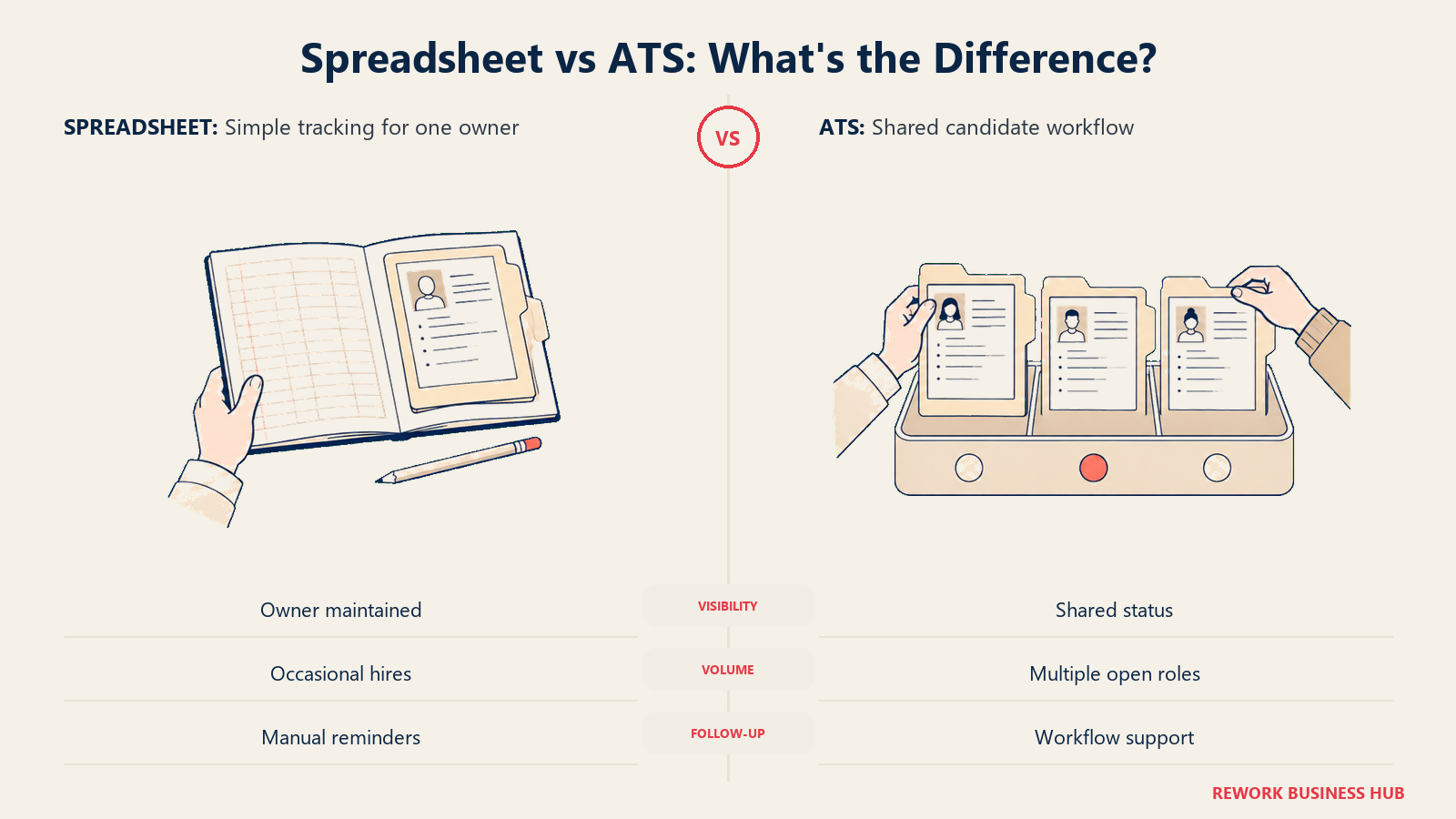
If you're filling one or two roles a year and you personally read every resume that comes in, a shared spreadsheet (or even a well-organized email label) will carry you through this stage fine. Paying for software at that volume is paying to solve a problem you don't have yet. That's true even though the median non-executive cost-per-hire climbed to $1,300 in 2026, per SHRM's 2026 Recruiting Benchmarking data; most of that cost is job ads and time, not software, and a free ATS tier doesn't move that number much at low volume.
The signals that you've actually outgrown the spreadsheet are specific, not vague:
| Signal | What It Means for You |
|---|---|
| You're filling 1-2 roles a year, one person deciding | A spreadsheet or email folder is genuinely fine. Don't pay for software yet. |
| You have more than 5 candidates in the pipeline for a single role | This is where spreadsheets start losing track of who's been contacted, who ghosted, and who's waiting on you. It's the real trigger point. |
| More than one person (you plus a manager, a co-founder, an office admin) needs to see candidate status | Shared visibility is exactly what a free ATS tier is built for, and it costs nothing to try. |
| You're running 3 or more roles open at the same time | The 1-job caps on free tiers (Breezy HR, Zoho Recruit) stop covering you here. Budget for an entry paid tier. |
| Candidates are asking why they haven't heard back | That's a process gap software fixes structurally, with automated status emails, not a hiring problem you can out-hustle with more spreadsheet columns. |
If none of those describe you yet, bookmark this page and come back when they do. If two or more already sound familiar, keep reading.
One scope note before you do. This list covers in-house hiring, where you are filling your own roles. If you are a staffing or recruiting agency placing candidates with client companies, you need a different class of tool entirely, one built around client submittals, timesheets, and billing. Best Bullhorn alternatives covers that market instead.
Key Facts
- The median cost-per-hire for non-executive roles rose to $1,300 in 2026, up from $1,200 in 2025, per SHRM's 2026 Recruiting Benchmarking data.
- Median time-to-fill for non-executive roles fell to 39 days in 2026, down from 44 in 2025, according to the same SHRM report.
- Small and mid-sized employers averaged 83.5 days to fill a role in 2025 versus 51.7 days for enterprise employers, a gap that widens the case for process help at smaller companies, per Employ Inc.'s 2025 hiring benchmarks report as covered by HR Dive.
- 75% of recruiters and talent management professionals now use some form of recruiting or applicant tracking software, and 94% say it improved their hiring process, per Capterra's recruiting software impact study.
- 57% of job candidates have abandoned an application partway through because the form was too long or complex, according to a LiveCareer survey reported by HR Dive, which matters most for a small business with limited applicant volume to begin with.
Quick Comparison Table
| Tool | Best For | Starting Price | Key Strength | Key Limitation |
|---|---|---|---|---|
| Breezy HR | First ATS for a very small team | Free (Bootstrap, 1 active position) or $157/mo (Startup, annual) | Permanent free tier, flat fee, unlimited users on paid plans | Free tier capped at 1 active position at a time |
| Zoho Recruit | Cost-conscious SMBs already using Zoho | Free (1 job/recruiter license) or $25/recruiter/mo (Standard, annual) | Cheapest full-featured option, wide Zoho ecosystem | Free plan limited to 1 active job per license |
| JazzHR | Budget-conscious small hiring teams | $1,000/yr (Hero, billed annually) | Flat annual fee, not billed per seat | Entry tier caps out around 3 concurrent job postings |
| Workable | SMBs running hiring without a dedicated recruiter | $299/mo or $3,588/yr (Standard) | AI sourcing and screening built into every plan | Priced by employee headcount band, not job count |
| Manatal | Lean teams wanting AI matching on a budget | $15/user/mo annual, $19 monthly (Professional) | Cheapest AI-assisted ATS on this list | Professional tier capped at 15 open jobs |
| Rework | Teams that want hiring on the same platform as HR records and staff time | Quote on request | E-Hiring, Interview, and Career unified with HRIS and time tracking | Not built for high-volume agency recruiting |
| Recruitee (Tellent) | People-ops teams wanting a collaborative pipeline | No published price (reported ~€301/mo Start, annual; 1-year minimum) | Clean collaborative scorecards, low admin overhead | No published pricing, quote required |
| BambooHR | Teams that want hiring bundled into their HR system | $10/employee/mo (Core) or $250/mo flat for 25-or-fewer employees | Applicant tracking included in every HR package, not an add-on | Priced per employee, not per job opening |
| Homerun | Small teams wanting a genuinely good-looking careers page | Free trial, then from EUR 89/mo annual (Light) | Career page and hiring pipeline built as one product | Tops out at 10 job slots on its highest published tier |
| Jobsoid | Very small teams wanting simple, unlimited-user pricing | Free (Beginner) or $49/mo annual (Lite) | Unlimited users and candidates on every tier, including free | Job-posting caps are tight on lower tiers |
| Greenhouse | Structured hiring once you're ready to invest | No published price (reported $5,100-$12,000+/yr small teams; Vendr median $26,587) | Deepest integration marketplace, structured interview kits | Overkill and over-budget for teams hiring under 10 roles a year |
| Lever | Growing teams wanting ATS plus candidate nurture | Custom quote (reported ~$3,500-$15,000+/yr) | Built-in CRM-style nurture (LeverTRM) | Priced on total company headcount, not recruiter seats |
| Ashby | Funded startups wanting analytics built in natively | From $400/mo (Foundations, up to 100 employees) | Strongest native analytics and reporting on this list | Cost jumps sharply once you cross 100 employees |
| Teamtailor | Brand-conscious teams competing for attention | Custom quote (reported ~$3,600-$4,800/yr entry) | Best career-site builder and employer branding tools | No published pricing, quote required |
| Pinpoint | Teams under real DEI or compliance pressure | Custom quote (reported ~$4,140/yr Growth) | Bias-reduction workflows, white-glove onboarding included | Premium price relative to company size |
Annual Cost at Your Hiring Volume
Most tools on this list don't price by seat. They price by job slots, by employee headcount, or they don't publish a number at all. That makes "starting price" a weak way to compare them, because the real question is what you'll actually pay running 3, 10, or 25 roles open at once. The table below works out each tool's published tiers against those three volumes, using annual billing where a vendor offers it (annual is essentially always cheaper than month-to-month across this category), and flags where a tool's pricing doesn't move with job count at all because it's driven by headcount instead.
| Tool | At 3 Open Roles | At 10 Open Roles | At 25 Open Roles |
|---|---|---|---|
| Breezy HR | $1,884/yr (Startup) | $1,884/yr (Startup) | $1,884/yr (Startup) |
| Zoho Recruit | $300/yr (1 Standard license, 10-job cap) | $300/yr (1 Standard license, right at the cap) | $900/yr (3 Standard licenses, 30-job capacity) |
| JazzHR | $1,000/yr (Hero) | $3,480/yr (Plus, 200-job cap) | $3,480/yr (Plus) |
| Workable | $3,588/yr+ (Standard, entry band) | Depends on headcount band, not job count | Depends on headcount band, not job count |
| Manatal | $180/yr (Professional, 1 user) | $180/yr (Professional, under 15-job cap) | $420/yr (Enterprise, unlimited jobs, 1 user) |
| Rework | Quote on request | Quote on request | Quote on request |
| Recruitee (Tellent) | No published price (reported ~€301/mo Start, annual; 1-year minimum) | Custom quote (Advance, no published price) | Custom quote (Optimize, unlimited posts) |
| BambooHR (30-employee example) | $3,600/yr (Core, 5-job cap) | $6,120/yr (Pro, 25-job cap) | $6,120/yr (Pro, right at the cap) |
| Homerun | EUR 1,068/yr (Light, annual, 3-slot cap) | EUR 2,988/yr (Plus, annual, 10-slot cap) | Contact sales, exceeds Plus's 10-slot cap |
| Jobsoid | $588/yr (Lite, 3-post cap) | $1,188/yr (Standard, 10-post cap) | $2,988/yr (Pro, 50-post cap) |
| Greenhouse | No published price (reported $5,100-$12,000+/yr small teams; Vendr median $26,587) | Same, scales with headcount not roles | Same, scales with headcount not roles |
| Lever | Custom quote (reported ~$3,500-$15,000+/yr) | Same, scales with headcount not roles | Same, scales with headcount not roles |
| Ashby | ~$4,800/yr equivalent (Foundations, up to 100 employees) | Same, up to 100 employees | Same, up to 100 employees |
| Teamtailor | Custom quote (reported ~$3,600-$4,800/yr entry, per Vendr) | Same, scales with headcount not roles | Same, scales with headcount not roles |
| Pinpoint | Custom quote (reported ~$4,140/yr Growth) | Same, scales with headcount not roles | Same, scales with headcount not roles |
How to read a few of the less obvious rows: Breezy HR's price doesn't change across the three columns because every paid tier, not just the top one, includes unlimited active positions; Growth and Business add features like automated reference checks and e-signatures, not extra job-slot room, so you only move up when you need those features specifically. Zoho Recruit and Homerun both cap active jobs per license or per tier, so running more roles at once means either stacking licenses (Zoho) or hitting a hard ceiling that requires a sales call (Homerun, past 10 slots). JazzHR jumps from $1,000 to $3,480 the moment you cross roughly 3 concurrent postings because there's no tier in between. Ashby's Foundations plan is $400/month, or $4,800/year at the month-to-month rate; Ashby advertises a 10% discount for an annual commitment, which would land close to $4,320/year, though the checkout page is what sets the final number, not this math.
How to Choose Recruiting Software for a Small Business
Most small businesses shortlist based on price alone and end up either underpaying for a tool that caps out in two months, or overpaying for enterprise features nobody on a 15-person team will ever touch. Three questions get you closer to the right answer before you demo anything.
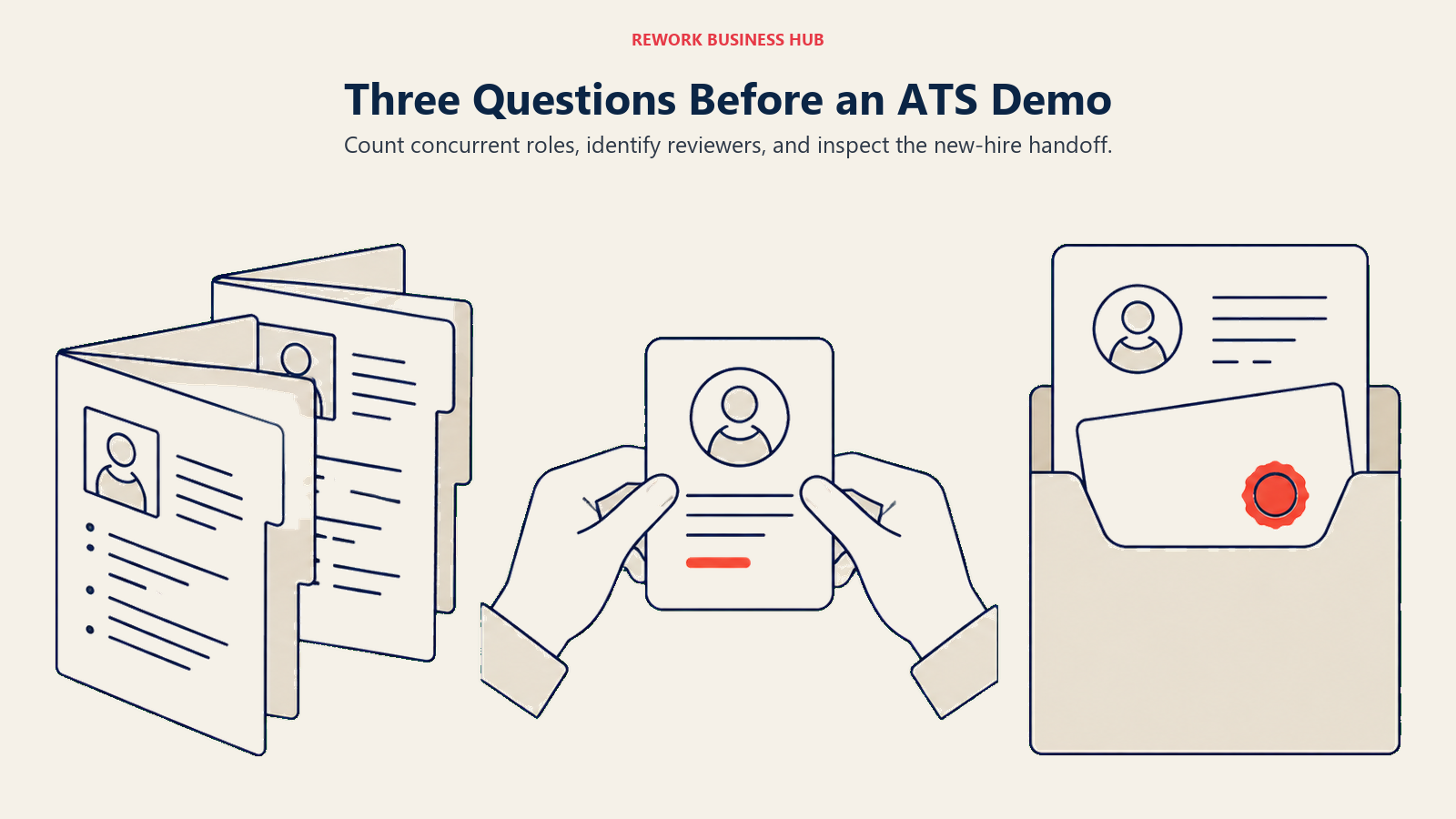
How many roles will you realistically have open at once, not per year? A company hiring 8 roles across the year but never more than 1-2 at a time has completely different software needs than one running 5 roles simultaneously during a growth push. Job-slot caps (JazzHR, Zoho Recruit, Homerun, Jobsoid) are built around the second number, not the first.
Who else needs to see candidate status? If it's just you, a free tier or a spreadsheet is genuinely enough. The moment a co-founder, a hiring manager, or an office admin needs visibility without pinging you for updates, that's the trigger for real software, and it's usually worth paying for even at low job volume.
What happens to the candidate the day they accept? If your ATS, payroll, and HR records are three separate logins, someone is retyping the same person's information three times. That gap is exactly what BambooHR and Rework are built to close on the People side, where hiring flows directly into an employee record instead of a CSV export and a re-import.
Once you've narrowed a shortlist, the next steps in the hiring process have their own tooling decisions. Structured technical or skills screening is covered in our best TestGorilla alternatives roundup, and if video interviews are part of your process, best video interview software covers that layer separately from the ATS itself.
Framework: by hiring volume
| Hiring Volume | What You Need | Best Fits |
|---|---|---|
| 1-2 roles a year, occasional | Free tier, or nothing at all | Breezy HR (free), Zoho Recruit (free), a spreadsheet |
| 3-10 roles a year, steady but small | Budget flat-fee or per-user entry tier | JazzHR, Jobsoid, Manatal, Homerun |
| 10-25 roles a year, growing team | Full-featured SMB platform with room to add users | Workable, Recruitee, BambooHR, Rework |
| 25+ roles a year, multiple hiring managers | Mid-market platform with analytics and structured process | Greenhouse, Ashby, Lever, Teamtailor, Pinpoint |
Framework: by what you actually need
| Priority | What Matters Most | Best Fits |
|---|---|---|
| Lowest possible cost | Free tier or flat annual fee | Breezy HR, Zoho Recruit, Jobsoid, JazzHR |
| AI screening because you're drowning in applicants | Resume screening and matching built in | Workable, Manatal, Zoho Recruit |
| Hiring and HR records in one system | New hire becomes an employee record automatically | Rework, BambooHR |
| A career page that looks professional | Built-in career-site builder | Homerun, Teamtailor, Recruitee |
| Compliance and structured, auditable interviews | DEI and bias-reduction workflows | Pinpoint, Greenhouse |
| Room to grow past 100 employees without switching tools | Headcount-based pricing that scales cleanly | Ashby, Lever, Greenhouse |
Stage Fit Matrix
| Tool | Under 10 | 10-25 | 25-50 | 50-100 | 100+ |
|---|---|---|---|---|---|
| Breezy HR | Strong fit | Strong fit | Possible | - | - |
| Zoho Recruit | Strong fit | Strong fit | Strong fit | Possible | - |
| JazzHR | Strong fit | Strong fit | Possible | - | - |
| Workable | Possible | Strong fit | Strong fit | Strong fit | Possible |
| Manatal | Strong fit | Strong fit | Strong fit | Possible | - |
| Rework | Possible | Strong fit | Strong fit | Strong fit | Possible |
| Recruitee (Tellent) | Possible | Strong fit | Strong fit | Possible | - |
| BambooHR | Possible | Strong fit | Strong fit | Strong fit | Possible |
| Homerun | Strong fit | Strong fit | Possible | - | - |
| Jobsoid | Strong fit | Strong fit | Possible | - | - |
| Greenhouse | - | - | Possible | Strong fit | Strong fit |
| Lever | - | - | Possible | Strong fit | Strong fit |
| Ashby | - | Possible | Strong fit | Strong fit | Possible |
| Teamtailor | - | Possible | Strong fit | Strong fit | Strong fit |
| Pinpoint | - | - | Possible | Strong fit | Strong fit |
Sizing and Persona Table
| Tool | Ideal Company Size | Primary Buyer Persona |
|---|---|---|
| Breezy HR | 1-30 employees | Founder, first-time hiring manager |
| Zoho Recruit | 5-100 employees | HR generalist, cost-conscious founder |
| JazzHR | 5-75 employees | Founder, office manager, first HR hire |
| Workable | 10-150 employees | Founder, HR manager doing hiring solo |
| Manatal | 5-100 employees | HR generalist, recruiting consultant |
| Rework | 20-100 employees | COO, Head of People, founder-operator |
| Recruitee (Tellent) | 20-150 employees | HR manager, people-ops lead |
| BambooHR | 10-100 employees | HR generalist wanting HR and hiring in one system |
| Homerun | 1-50 employees | Founder, small people team |
| Jobsoid | 1-50 employees | Founder, budget-conscious HR lead |
| Greenhouse | 50-500 employees | Head of Talent, TA Director |
| Lever | 100-500 employees | Head of Recruiting |
| Ashby | 20-200 employees | Head of Talent at a funded startup |
| Teamtailor | 30-300 employees | Head of Talent Acquisition, employer branding lead |
| Pinpoint | 50-300 employees | Head of Talent, compliance-focused HR leader |
1. Breezy HR: The Free-Forever Starting Point
Breezy HR's Bootstrap plan is free, permanently, not a time-limited trial, and it includes unlimited users. The catch, and it's a real one, is that Bootstrap covers exactly 1 active position or candidate pool at a time. For a founder filling one role, that's plenty. For a company running two searches at once, it isn't, and you'll hit the wall on day one of the second req.
Paid tiers keep the flat-fee, unlimited-user structure and remove the position cap entirely: every paid plan, from Startup on up, includes unlimited active positions, not just the top tier. Growth and Business add automated reference checking, e-signatures, and multiple recruiting pipelines, which matter more as your process gets more formal, not as your job count grows.
| What You Get | What You Don't |
|---|---|
| Permanent free tier, not a trial (Bootstrap) | Free tier limited to 1 active position at a time |
| Unlimited positions on every paid tier, not just the top one | AI and sourcing tools are thinner than Workable's |
| Flat monthly fee, unlimited users at every level | Advanced integrations sit behind the top Business and custom Pro tiers |
| Drag-and-drop visual pipeline, fast to learn | Add-ons like SMS and AI credits cost extra |
Pricing: Bootstrap free (1 active position); Startup $157/mo annual, $189/mo month-to-month; Growth $273/mo annual, $329/mo monthly; Business $439/mo annual, $529/mo monthly; Custom Pro is quote-only.
Best for: Founders and first-time hiring managers (1-30 employees) who want a real pipeline without paying for one until they're running more than one search at a time.
2. Zoho Recruit: The Cheapest Full-Featured Option
Zoho Recruit's Corporate HR edition has a genuinely free plan, not just a trial, and it's a full applicant tracker: pipeline stages, resume parsing, and a career page. The limit is 1 active job per recruiter license, which is the same shape of constraint as Breezy's Bootstrap tier, just measured per license instead of per account.
Where Zoho pulls ahead of Breezy for a slightly bigger team is the paid tier math: Standard runs $25 per recruiter license per month billed annually, and each license covers 10 active jobs, not 1. That means a single $25/month license can carry a small business through several roles open at once, which is hard to beat on pure cost per job slot. The wider Zoho ecosystem (Zoho Books, Zoho Desk, Zoho CRM) is a real bonus if you're already in it, and mostly irrelevant if you're not.
| What You Get | What You Don't |
|---|---|
| Forever-free plan, not a trial | Free plan capped at 1 active job per license |
| $25/recruiter/mo covers 10 active jobs, cheap per job slot | Interface feels dated next to Workable or Homerun |
| Deep Zoho ecosystem integration if you're already there | No monthly (non-annual) rate published for paid tiers |
| AI candidate matching on paid tiers | Add-ons (employee licenses, video interviews) add up |
Pricing: Free (1 active job/recruiter license); Standard $25/recruiter/mo billed annually (10 active jobs/license); Enterprise $50/recruiter/mo billed annually (20 active jobs/license). Add-ons: Employee License $8.34/mo billed annually in packs of 10, Vendor Portal $6/mo, Video Interviews $12/job opening.
Best for: Cost-conscious small businesses (5-100 employees), especially ones already using other Zoho products.
3. JazzHR: A Flat Annual Fee, Not a Per-Seat Bill
JazzHR's real pitch is pricing structure, not features: every plan is a flat annual fee, which is genuinely uncommon in this category. The pricing page prints three tiers, Hero at $1,000/year, Plus at $3,480/year, and Pro at $5,508/year, all billed annually, with no monthly figure published anywhere on the page.
Worth being precise about here: JazzHR's pricing page does not print a seat count, and it doesn't say "unlimited users" anywhere on it. Some older write-ups repeat that claim as JazzHR's headline strength, but it isn't verifiable from the vendor's own page as of this writing. What is verifiable and genuinely useful: JazzHR's published pricing is a flat annual fee, not priced per seat, so a 5-person hiring team and a 30-person hiring team pay the identical plan price as long as their job volume fits the tier. The real constraint is job volume, not headcount: Hero caps out around 3 concurrent job postings a month, and Plus raises that to 200 active jobs while adding AI candidate matching and structured assessments.
| What You Get | What You Don't |
|---|---|
| Flat annual fee, not billed per seat | No seat count or "unlimited users" claim printed on the pricing page |
| Transparent, published pricing with a free trial | Entry tier caps out around 3 concurrent job postings |
| AI candidate matching and structured assessments (Plus and up) | No built-in CRM or candidate nurture |
| Same parent company (Employ Inc.) as Lever, for what that's worth | Job-volume caps make rapid growth expensive between Hero and Plus |
Pricing: Hero $1,000/yr; Plus $3,480/yr; Pro $5,508/yr, all billed annually. Monthly billing is available but no monthly figure is printed on the pricing page.
Best for: Small hiring teams (5-75 employees) that want a real structured ATS at a predictable, flat price rather than per-user math. If you've outgrown JazzHR's job caps, our best JazzHR alternatives roundup covers where to go next.
4. Workable: AI Sourcing Built Into Every Plan
Workable's bet is that a small hiring team shouldn't need separate tools to post a job, source candidates, screen them, and schedule interviews. Every plan bundles job board distribution to 200+ boards, AI-assisted sourcing, and candidate screening, with 3,000 free AI credits included and extra credits priced as low as $0.095 each at volume.
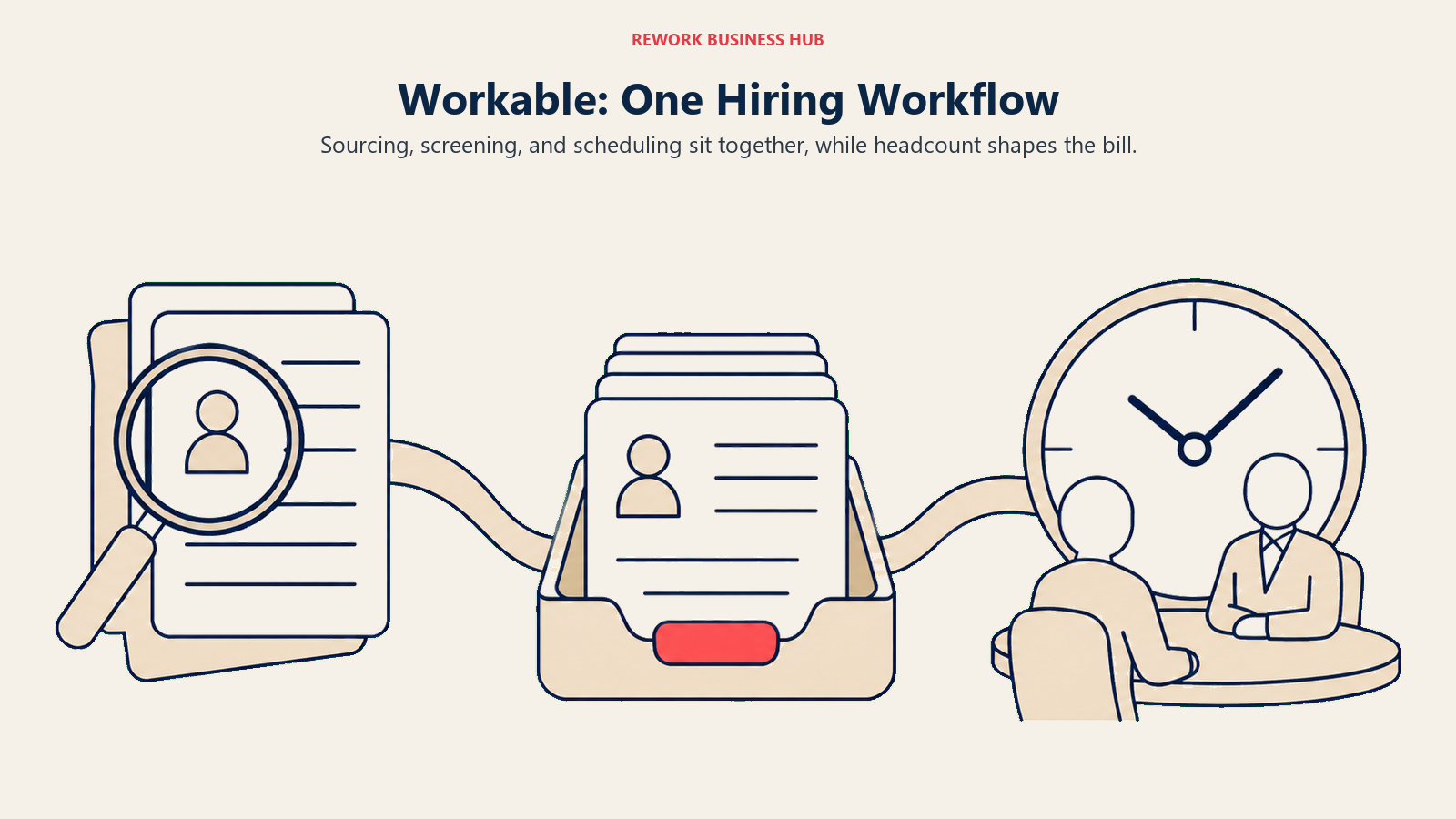
The pricing model is the thing to understand before you buy: Workable prices by employee headcount band, not by the number of jobs open or the number of recruiters using the tool. That means a 15-person company and a 15-person company running 8 open roles pay the same Standard-tier price, but the Standard tier itself is scoped to a specific headcount band, so growing past that band moves you to Premier regardless of hiring volume. It's a genuinely different pricing logic than the job-slot tools earlier on this list, and worth confirming against your actual headcount before you assume the entry price applies.
| What You Get | What You Don't |
|---|---|
| AI sourcing and screening built into every plan | Pricing scales with employee headcount, not job count |
| Job distribution to 200+ boards from one post | Texting and some assessments are paid add-ons on lower tiers |
| Fast setup, minimal admin overhead | Less workflow customization than Greenhouse or Ashby |
| 15-day free trial, transparent published pricing | AI credits run out and cost extra past the included allotment |
Pricing: Standard $299/mo or $3,588/yr; Premier $599/mo or $7,188/yr; Enterprise $719/mo or $8,628/yr, priced by employee headcount band (the figures above are the entry band).
Best for: SMBs (10-150 employees) running hiring without a dedicated recruiter or sourcing team. See our best Workable alternatives if the headcount-based pricing doesn't fit your model.
5. Manatal: The Cheapest AI-Assisted ATS
Manatal's whole positioning is doing more of what Workable and Zoho do, at a lower entry price, with AI candidate scoring built into the base tier rather than gated behind an add-on. Professional runs $15 per user per month on annual billing, which is genuinely the least expensive AI-assisted option on this list, and it covers up to 15 open jobs and 10,000 candidates.
The ceiling on Professional shows up fast if you're running a busier hiring season: once you need more than 15 concurrent jobs or want unlimited candidate storage, Enterprise at $35/user/month annual removes both caps. Manatal is also popular with recruiting agencies and consultants working multiple small-business clients at once, which shows up in its multi-pipeline features even though the base product works fine for a single in-house team.
| What You Get | What You Don't |
|---|---|
| Cheapest AI-assisted ATS on this list at $15/user/mo | Professional tier caps out at 15 open jobs |
| Up to 10,000 candidates on Professional, unlimited on Enterprise | Career-site builder is more basic than Homerun's or Teamtailor's |
| Per-user pricing keeps small teams cheap | Costs climb linearly per added recruiter, unlike flat-fee tools |
| Both monthly and annual rates published clearly | Enterprise Plus tier pricing isn't published at all |
Pricing: Professional $15/user/mo annual, $19 monthly (up to 15 jobs, 10,000 candidates); Enterprise $35/user/mo annual, $39 monthly (unlimited jobs and candidates); Enterprise Plus $55/user/mo annual, $59 monthly (custom on demand).
Best for: Lean teams and recruiting consultants (5-100 employees) that want AI matching without paying Workable- or Zoho-level prices for it.
6. Rework: Hiring on the Same Platform as HR Records and Staff Time
Rework's E-Hiring, Interview, and Career modules are live inside the People product line, alongside HRIS, time and attendance, and timesheets. The pitch is narrower than "another ATS with more features": the moment someone accepts an offer, they shouldn't disappear from one system and get manually re-entered into another. A candidate who moves through E-Hiring for screening and Interview for structured scheduling becomes an employee record inside the same platform that already tracks attendance, timesheets, and HR data, with no CSV export and re-import between systems.
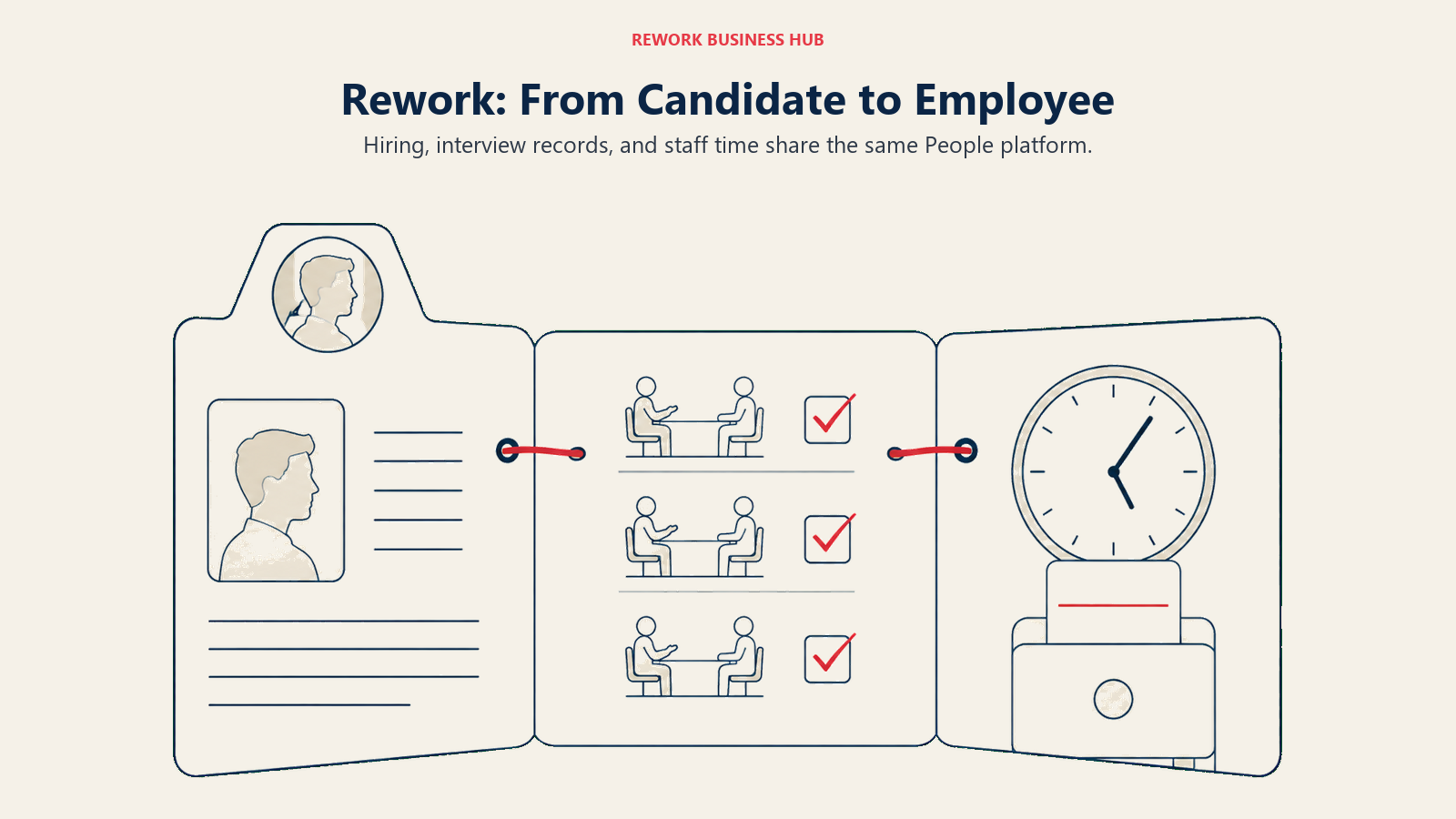
The Career module rounds this out with a branded careers page feeding directly into the same pipeline, so job posts, applications, interviews, and the eventual employee record all share one data model instead of three connected tools. Where Rework does not compete is recruiting depth: there's no CRM-style candidate nurture engine like Lever's, no staffing-agency VMS workflow like Bullhorn's, and a smaller integration marketplace than Greenhouse's. If your hiring motion is high-volume or built around ongoing passive-candidate sourcing, a specialist tool on this list will serve that specific job better. Where Rework wins for a small business is consolidation: one login instead of three, and a new hire's HR record that already exists on day one.
| What You Get | What You Don't |
|---|---|
| Hiring (E-Hiring, Interview, Career) unified with HRIS and time tracking | Not built for high-volume agency recruiting |
| New hire becomes an employee record automatically, no re-entry | No CRM-style deep candidate nurture engine |
| One platform instead of separate ATS, HRIS, and time-tracking logins | Smaller integration marketplace than Greenhouse |
| Packages, not per-user licenses, across the People line | Not the deepest option for pure sourcing workflows |
Pricing: Quoted per organization; the People line, which includes E-Hiring, Interview, and Career, does not have a published per-seat price. See rework.com/pricing for current details.
Best for: 20-100 person teams that want hiring, HR records, and staff time on one platform instead of stitching together an ATS, an HRIS, and a time-tracking tool.
Not ideal for: Solo hiring or a 1-2 person operation (Rework's packages assume a small team, not a single user), high-volume agency recruiting, or teams whose core need is a deep sourcing and CRM-style talent pipeline.
7. Recruitee (Tellent): Collaborative Hiring Without Enterprise Complexity
Recruitee, now operating under the Tellent Recruitee brand, is built around the idea that hiring managers, interviewers, and the person running the process should all work from one visual pipeline instead of losing feedback in email threads after every interview round. The kanban-style board and structured scorecards make it one of the easier tools on this list to roll out without training anyone.
Pricing is the honest gap here: nothing is published. Plans are named Start, Advance, and Optimize, and the differentiator that actually matters for a small business is job-post capacity: Start includes 5 active job posts, and Optimize removes the cap entirely with unlimited posts. Recruitee requires an annual contract minimum with a monthly payment option, and the page advertises a 20% discount for paying annually versus the monthly option within that contract. Existing benchmarking for the entry Start tier puts it around $199 or more per month, labeled here explicitly as an estimate, not a vendor-confirmed figure.
| What You Get | What You Don't |
|---|---|
| Collaborative pipeline with structured scorecards | No published pricing, quote required |
| Unlimited job posts on the top Optimize plan | Start plan capped at 5 active job posts |
| Clean UI, fast rollout without heavy training | Sourcing and CRM depth well below Lever or Ashby |
| 20% discount advertised for paying annually | Advance and Optimize pricing isn't published at any level |
Pricing: Custom quote; entry Start plan estimated around $199/mo or more (reported, not vendor-published), 5 active job posts. Advance and Optimize pricing require a sales conversation.
Best for: People-ops-led small businesses (20-150 employees) that want a collaborative, structured pipeline without enterprise-level admin overhead.
8. BambooHR: Hiring Bundled Into Your HR System
BambooHR's core pitch is that a small business shouldn't need a separate ATS purchase on top of its HR software. Applicant tracking, called Hiring, is included in all three BambooHR packages, not sold as a separate add-on: Core, Pro, and Elite each include it, differentiated by how many open jobs you can run at once (5, 25, and 50, respectively) rather than by whether you get the feature at all.
Pricing runs per employee per month: Core at $10, Pro at $17, Elite at $25. Companies of 25 or fewer employees get a simpler flat rate instead, starting at $250/month, which removes the per-employee math entirely at that size. The tradeoff against a standalone ATS is exactly what you'd expect: BambooHR's hiring workflow is solid but not as deep as a purpose-built tool like Greenhouse or Ashby, and you're paying per employee across your whole company, not just the people involved in hiring.
| What You Get | What You Don't |
|---|---|
| Applicant tracking included in every HR package, not an add-on | Priced per employee company-wide, not per hiring-team seat |
| Flat rate for companies of 25 or fewer employees | Hiring workflow is less deep than a purpose-built ATS |
| One system for HR records, time tracking, and hiring | Open-job caps (5/25/50) tie your hiring capacity to your HR tier |
| Predictable per-employee pricing as you grow | Not built for staffing agencies or high-volume recruiting |
Pricing: Core $10/employee/mo (5 open jobs); Pro $17/employee/mo (25 open jobs); Elite $25/employee/mo (50 open jobs). Companies of 25 or fewer employees pay a flat rate starting at $250/mo instead.
Best for: Small businesses (10-100 employees) that want hiring and core HR (records, time tracking) in the same system from day one, without buying two products.
9. Homerun: A Careers Page Worth Sharing
Homerun's differentiator is treating the careers page as the actual product, not a bolted-on afterthought: the built-in page builder produces a genuinely good-looking, on-brand jobs page without needing a designer, and the pipeline underneath handles scorecards and collaboration once applications land. It's a European product (Netherlands-based), and it prices in euros rather than dollars, which is worth flagging upfront since every other tool on this list quotes in USD.
The tier structure ties job slots to a monthly seat allowance: Light includes 3 job slots and 25 employee seats, Basic moves to 6 slots and 75 seats, and Plus tops out at 10 slots and 150 seats. That 10-slot ceiling on the highest published tier is a real limitation for a company running more than 10 roles open at once; past that, you're contacting Homerun directly rather than reading a number off the pricing page. Extra employee seats beyond a tier's allowance cost EUR 4/month each across every plan.
| What You Get | What You Don't |
|---|---|
| Career page and hiring pipeline built as one product | Prices in EUR, not USD |
| 15-day free trial, no credit card needed | Tops out at 10 job slots on the highest published tier |
| Employee seat allowances (25-150) included per tier | Extra seats beyond the allowance cost EUR 4/mo each |
| Transparent published pricing with an annual discount | Smaller name recognition in the US market than Breezy or Workable |
Pricing: Light EUR 89/mo annual, EUR 99/mo monthly (3 job slots, 25 seats); Basic EUR 159/mo annual, EUR 179/mo monthly (6 job slots, 75 seats); Plus EUR 249/mo annual, EUR 289/mo monthly (10 job slots, 150 seats).
Best for: Small businesses (1-50 employees) that want a genuinely polished careers page without hiring a designer, especially in Europe.
10. Jobsoid: Simple Pricing, Unlimited Users on Every Tier
Jobsoid's positioning is straightforward: a real applicant tracker with a genuinely free Beginner tier, and every paid tier above it includes unlimited user accounts and unlimited candidates, a rarer combination than it should be at this price point. The tiers scale by job-posting volume instead: Lite covers 3 job postings, Standard covers 10, and Pro covers 50, with pricing dropping when you pay annually versus monthly (Jobsoid advertises up to 20% savings for annual billing).
For a very small team, this is one of the cleanest budget options on the list precisely because the pricing logic is easy to explain to whoever signs off on the expense: pick the tier that matches how many roles you'll have open at once, and every hiring manager or interviewer you add costs nothing extra. The product itself is less polished and less AI-forward than Workable or Manatal, which is the tradeoff for the simplicity.
| What You Get | What You Don't |
|---|---|
| Free Beginner tier, still actively sold | Fewer AI features than Workable or Manatal |
| Unlimited user accounts and candidates on every paid tier | Job-posting caps are tight relative to price at the Lite tier |
| Up to 20% savings advertised for annual billing | Smaller integration ecosystem than the bigger names on this list |
| Simple, easy-to-explain per-job pricing | Less brand recognition, so fewer public reviews to lean on |
Pricing: Beginner free; Lite $49/mo annual, $59 monthly (3 job postings); Standard $99/mo annual, $119 monthly (10 job postings); Pro $249/mo annual, $299 monthly (50 job postings).
Best for: Very small, budget-first teams (1-50 employees) that want unlimited users without paying a per-seat premium for it.
11. Greenhouse: Structured Hiring for When You're Ready to Invest
Greenhouse built its reputation on structured, repeatable hiring: scorecards, structured interview kits, and consistent evaluation criteria across every candidate. It's the tool most likely to come up when a growing company's board or a new VP of People asks for a "real" ATS, and the integration marketplace (assessments, background checks, video interviewing, all plugging in natively) is the deepest on this list. See our best TestGorilla alternatives or best HackerRank alternatives for two of the assessment categories that plug into it.
For most companies still hiring under 10 roles a year, Greenhouse is genuinely more platform, and more cost, than the job justifies. Greenhouse doesn't publish pricing, and third-party benchmarking puts small-team entry contracts around $5,100 to $12,000 a year, well above every budget tool earlier in this list. It's worth knowing about as the ceiling you're comparing against, not necessarily the first purchase. Our best Greenhouse alternatives roundup and the direct Greenhouse vs Lever comparison go deeper on where it fits against similar-tier tools.
| What You Get | What You Don't |
|---|---|
| Structured interview kits and scorecards | No public pricing, custom quote required |
| Hundreds of native integrations | Add-on modules (onboarding, sourcing) cost extra |
| Strong reporting for pipeline health | Overkill and over-budget for teams hiring under 10 roles a year |
| Trusted brand once you're ready to scale hiring | Steeper learning curve than budget SMB tools |
Pricing: Custom quote; reported small-team entry contracts run roughly $5,100-$12,000/yr based on third-party benchmarking.
Best for: Growing small businesses (50+ employees) ready to invest in structured, bias-reducing hiring once volume justifies the cost.
12. Lever: ATS Plus Candidate Nurture for a Growing Team
Lever treats recruiting as a nurture problem as much as a tracking problem. LeverTRM (Talent Relationship Management) keeps every candidate, hired or not, as an ongoing relationship: past applicants resurface for new roles, and sourcing analytics track effectiveness over time rather than just per-requisition status. That's a genuinely different product philosophy than the job-slot tools earlier in this guide.
The catch for a small business is pricing structure: Lever prices on total company headcount, not on the number of people actually using the platform, so a 60-person company pays for all 60 employees even if two people touch Lever day to day. That math rarely favors a company under 50 employees. If you're weighing it against the category leader, our best Lever alternatives roundup covers where each wins.
| What You Get | What You Don't |
|---|---|
| Built-in candidate nurture and sourcing analytics (LeverTRM) | No public pricing, quote required |
| Strong reporting on pipeline and sourcing effectiveness | Priced on total company headcount, not recruiter seats |
| Employ Inc. backing means a stable roadmap and support | Steeper learning curve than budget SMB tools |
| Solid native integrations for a mid-market platform | Not the cheapest option at small team size |
Pricing: Custom quote; third-party benchmarking reports figures roughly in the $3,500-$15,000+/yr range depending on headcount and negotiation.
Best for: Growing companies (100+ employees) with an active sourcing motion, not just reactive job posting, and the headcount to make total-employee pricing worth it.
13. Ashby: Native Analytics for a Funded Startup
Ashby's founding bet was that a modern ATS should ship with a CRM, interview scheduling, and real analytics natively, not stitched together from point solutions. That resonates especially with venture-backed startups: Ashby's reporting is consistently the strongest on this list for cohort analysis and pipeline conversion, without needing a separate BI tool bolted on.
The pricing model is straightforward at small scale: Foundations is a flat $400/month covering up to 100 employees, with a 10% discount for an annual commitment. That flat structure is genuinely easy to budget against, right up until you cross the 100-employee line into custom-quoted Plus and Enterprise tiers, where costs jump sharply. For a small business still under that threshold, Foundations is one of the more transparent options on this list. If you're weighing it against a similar-tier competitor, our best Ashby alternatives roundup covers the field.
| What You Get | What You Don't |
|---|---|
| Native ATS, CRM, scheduling, and analytics in one product | Foundations pricing jumps sharply once you cross 100 employees |
| Best-in-class reporting and pipeline dashboards | Plus and Enterprise tiers are custom quote only |
| Modern, fast interface | Skews toward tech and venture-backed hiring culture |
| Foundations has transparent, published pricing | No published per-job or per-user granularity below the flat rate |
Pricing: Foundations $400/mo (up to 100 employees), 10% discount for an annual commitment; Plus and Enterprise are custom quote.
Best for: Funded startups and scale-ups (20-200 employees) that want ATS, CRM, and analytics in one modern product with transparent entry pricing.
14. Teamtailor: The Career-Site-First Option
Teamtailor treats the careers page as the product, not an add-on to an ATS. Its built-in career-site builder lets non-technical HR teams ship a genuinely good-looking, on-brand jobs page, with the ATS workflow underneath handling pipeline, scorecards, and collaboration once applications come in. Pricing is company-size based with unlimited users, so there's no per-seat penalty for involving every hiring manager.
Teamtailor doesn't publish pricing at all, not even a starting figure, which is a real gap for a small business trying to budget before a sales call. The most concrete third-party figures available come from Vendr's buyer-reported contract data: entry-level contracts run roughly $300-$400 a month, scaling to $600-$1,200 a month for growth-stage teams and $1,500 or more for larger organizations, per Vendr's Teamtailor pricing data.
| What You Get | What You Don't |
|---|---|
| Best-in-class career site builder and employer branding tools | No published pricing anywhere, quote required |
| Unlimited users, no per-seat pricing penalty | Light on outbound sourcing and CRM depth |
| Clean ATS workflow underneath the career-site layer | Not built for high-volume or agency-style recruiting |
| Strong for EU and EU-adjacent hiring | Reported entry pricing (~$300-$400/mo) still lands above most budget tools on this list |
Pricing: Custom quote; Vendr's buyer-reported data puts entry contracts around $3,600-$4,800/yr, scaling to $18,000+/yr for larger teams.
Best for: Brand-conscious small businesses (30-300 employees) where career site quality and candidate experience drive inbound applications.
15. Pinpoint: Built for Compliance-Heavy Hiring
Pinpoint's positioning centers on structured, unbiased hiring and the compliance reporting that goes with it: anonymized screening options, structured interview scorecards, and diversity reporting built to hold up to an audit rather than just look good in a demo. White-glove onboarding is bundled into every plan instead of sold separately, which matters if your team doesn't have the bandwidth to self-serve a rollout.
Pinpoint has no public rate card at all; its pricing page returns nothing but a request-a-quote form. The most concrete third-party figures available report the Growth plan around $345 a month on annual billing, per Pin's Pinpoint pricing breakdown, scaling to roughly $1,200 a month for Enterprise. That puts Pinpoint at a real premium relative to its typical customer size, which is the tradeoff for the compliance depth.
| What You Get | What You Don't |
|---|---|
| Structured bias-reduction workflows and DEI reporting | No public pricing, not even a starting figure |
| White-glove onboarding included, not a paid add-on | Premium price relative to typical company size |
| Unlimited seats, company-size based pricing | Smaller integration ecosystem than Greenhouse |
| Strong for compliance-heavy hiring processes | Overkill if DEI and compliance reporting isn't a current priority |
Pricing: Custom quote; third-party benchmarking reports the Growth plan around $4,140/yr, scaling to roughly $14,400+/yr for Enterprise.
Best for: Small businesses (50+ employees) under real compliance or DEI reporting pressure, where the premium buys real audit-ready structure.
Recruiting Software Buying Mistakes Small Businesses Make
Most failed rollouts at this size aren't a software problem. They're a fit problem that shows up in month two, once the free-trial excitement wears off.
| Mistake | What It Looks Like | What to Do Instead |
|---|---|---|
| Buying software before you actually need it | A 3-person team signs a $3,000/yr contract to fill one role | Use a spreadsheet until you're running 3+ roles at once, or juggling more than 5 candidates in a single pipeline |
| Missing the free-tier job cap | Signing up for Breezy or Zoho Recruit expecting to post 5 jobs at once | Read the cap before you build a process around it: 1 active job per account or license on both free tiers |
| Assuming flat-fee means unlimited job postings | Treating JazzHR's or Breezy's flat pricing as if job volume doesn't matter | Flat-fee tools still cap concurrent job slots by tier, just not by seat count |
| Pricing by total headcount instead of hiring volume | A 40-person company assumes a Lever or Workable quote scales with 3 open roles, not 40 employees | Ask every vendor directly: is this priced by users, by job slots, or by total company headcount? |
| Skipping the trial and buying on a demo alone | Signing an annual contract without testing the actual candidate-facing application form | Apply to your own open role through the free trial before paying for a year upfront |
| Treating the ATS and HR system as permanently separate | New hires get re-entered by hand into payroll and time tracking after every offer | Prioritize BambooHR or Rework if hiring, HR, and time tracking living in three logins is your real pain point |
Decision Framework
| If you need... | Pick... | Why |
|---|---|---|
| The cheapest way off spreadsheets | Zoho Recruit or Breezy HR | Both have a genuine forever-free tier, not a trial |
| A flat annual fee instead of per-user pricing | JazzHR | Published flat-fee tiers, not billed per seat |
| AI screening because applicant volume is overwhelming | Workable or Manatal | Built-in AI sourcing and matching at SMB-friendly prices |
| Hiring, HR records, and staff time on one platform | Rework | E-Hiring, Interview, and Career unified with HRIS and time tracking |
| Hiring folded into a broader HR suite you already run | BambooHR | Applicant tracking included in every HR package, not an add-on |
| A collaborative pipeline for a people-ops-led team | Recruitee (Tellent) | Structured scorecards, low admin overhead |
| A career page that actually looks professional | Homerun or Teamtailor | Career-site builder built into the product itself |
| Room to grow past 100 employees without re-platforming | Ashby, Greenhouse, or Lever | Mid-market analytics and structured hiring, worth the step up in cost |
Frequently Asked Questions about Recruiting Software for Small Business
What is the best free recruiting software for a small business?
Breezy HR's Bootstrap plan and Zoho Recruit's free plan are both permanently free, not trials. Breezy caps you at 1 active position at a time with unlimited users; Zoho caps you at 1 active job per recruiter license. Jobsoid also has a free Beginner tier with unlimited users and candidates. Pick based on whether you'll ever need more than one role open at once before you'd need to upgrade anyway.
Do I actually need an ATS if I'm only hiring one or two people a year?
Probably not yet. A shared spreadsheet handles low-volume, single-decision-maker hiring fine. The real trigger points are running 3 or more roles open at the same time, having more than 5 candidates in one pipeline, or needing more than one person to see candidate status without pinging you directly.
How much should a small business budget for recruiting software?
For genuinely budget-first tools (JazzHR, Jobsoid, Manatal, Homerun), expect roughly $180 to $3,500 a year depending on job volume and user count. Full-featured SMB platforms like Workable, Recruitee, or BambooHR typically run $3,500 to $8,000 a year. Mid-market step-ups like Greenhouse, Ashby, or Lever run $4,000 to $15,000-plus a year and are usually more than a sub-25-employee company needs.
What's the difference between pricing by job slots, by users, and by company headcount?
Job-slot pricing (JazzHR, Zoho Recruit, Homerun, Jobsoid) caps how many roles you can have open at once, regardless of team size, which rewards a small business hiring occasionally. Per-user pricing (Manatal, Bullhorn) scales with how many people touch the tool. Headcount-based pricing (Workable, Lever, Ashby, BambooHR) scales with your total company size, whether or not most of those employees ever log into the ATS.
Can I use recruiting software without buying a full HR suite?
Yes. Breezy HR, Zoho Recruit, JazzHR, Workable, Manatal, Recruitee, Homerun, Jobsoid, Greenhouse, Lever, Ashby, Teamtailor, and Pinpoint all sell standalone ATS products. BambooHR and Rework are the two on this list where hiring is part of a broader HR platform by design, which is the point if consolidating logins is your actual goal.
Is JazzHR really unlimited users?
JazzHR's own pricing page doesn't print a seat count or the words "unlimited users" anywhere on it, so that claim isn't verifiable from the vendor's current page. What is verifiable: JazzHR bills a flat annual fee per plan rather than charging per seat, so adding hiring managers doesn't change your bill the way it would on a per-user tool.
What to Do Next
Before you book a single demo, answer the two questions this guide keeps coming back to: how many roles will you realistically have open at once, and who besides you needs to see candidate status. Those two answers alone eliminate most of this list. Then pick one free or budget tool to actually trial, post one real open role through it, and fill out your own application form as a candidate would. The tool your hiring managers will use every week beats the one with the longest feature list on a sales page.
If your team is still filling one role a year with a spreadsheet and a shared inbox, that's a completely reasonable place to stay for now. Come back when the second or third role opens up at the same time, and start with whichever free tier's job cap matches how you actually hire.

Principal Product Marketing Strategist
On this page
- Do You Even Need Recruiting Software Yet?
- Key Facts
- Quick Comparison Table
- Annual Cost at Your Hiring Volume
- How to Choose Recruiting Software for a Small Business
- Stage Fit Matrix
- Sizing and Persona Table
- 1. Breezy HR: The Free-Forever Starting Point
- 2. Zoho Recruit: The Cheapest Full-Featured Option
- 3. JazzHR: A Flat Annual Fee, Not a Per-Seat Bill
- 4. Workable: AI Sourcing Built Into Every Plan
- 5. Manatal: The Cheapest AI-Assisted ATS
- 6. Rework: Hiring on the Same Platform as HR Records and Staff Time
- 7. Recruitee (Tellent): Collaborative Hiring Without Enterprise Complexity
- 8. BambooHR: Hiring Bundled Into Your HR System
- 9. Homerun: A Careers Page Worth Sharing
- 10. Jobsoid: Simple Pricing, Unlimited Users on Every Tier
- 11. Greenhouse: Structured Hiring for When You're Ready to Invest
- 12. Lever: ATS Plus Candidate Nurture for a Growing Team
- 13. Ashby: Native Analytics for a Funded Startup
- 14. Teamtailor: The Career-Site-First Option
- 15. Pinpoint: Built for Compliance-Heavy Hiring
- Recruiting Software Buying Mistakes Small Businesses Make
- Decision Framework
- What to Do Next