More in
Hiring Guide for Growing Teams
How to Hire Your First AE: The Interview Loop That Actually Filters
Apr 21, 2026
Hiring an SDR Manager: When to Promote Internally vs Hire External
Apr 21, 2026
Your First Head of Marketing: IC, Builder, or Strategist?
Apr 21, 2026
Hiring a RevOps Leader: Signs You Need One, How to Scope the Role
Apr 21, 2026
CS Leader Hiring Guide: Farmer, Builder, or Scaler?
Apr 21, 2026
Sales Engineering Hiring: Technical Depth vs Commercial Instinct
Apr 21, 2026
Hiring a Chief of Staff: When It's Right and When It's Premature
Apr 21, 2026
The First Product Hire at a Growing B2B Company
Apr 21, 2026
Finance Leader Hiring: Controller, VP Finance, or CFO?
Apr 21, 2026
Scorecards vs Rubrics: Designing an Interview Process That Scales
Apr 21, 2026 · Currently reading
Scorecards vs Rubrics: Designing an Interview Process That Scales
Turn this article into takeaways for your work.


Each assistant summarizes the article only for you and suggests best practices for your work.
Five interviewers come out of a panel loop with five completely different takes on the same candidate. One is a strong hire. One is a no hire. Two are undecided. And nobody can explain their rating beyond "I just wasn't sure about them."
You spend 90 minutes in the debrief trying to reconcile these reads and end up making the decision based on whoever argued most confidently. Six months later, the candidate isn't working out. Or you passed on someone who would have been excellent.
This is the calibration problem. And it almost always comes from the same source: you have an interview process, but you don't have evaluation infrastructure.
The fix isn't more interviews. It's scorecards and rubrics, used correctly and in the right combination. The same tools that prevent this in AE hiring work across every role family in your org. Research from the National Bureau of Economic Research found that structured hiring processes with defined criteria improve the quality of hires by 26% compared to unstructured processes, primarily by reducing post-hoc rationalization in debrief discussions.
The Difference (And Why It Matters)
Most people use "scorecard" and "rubric" interchangeably. They're not the same thing.
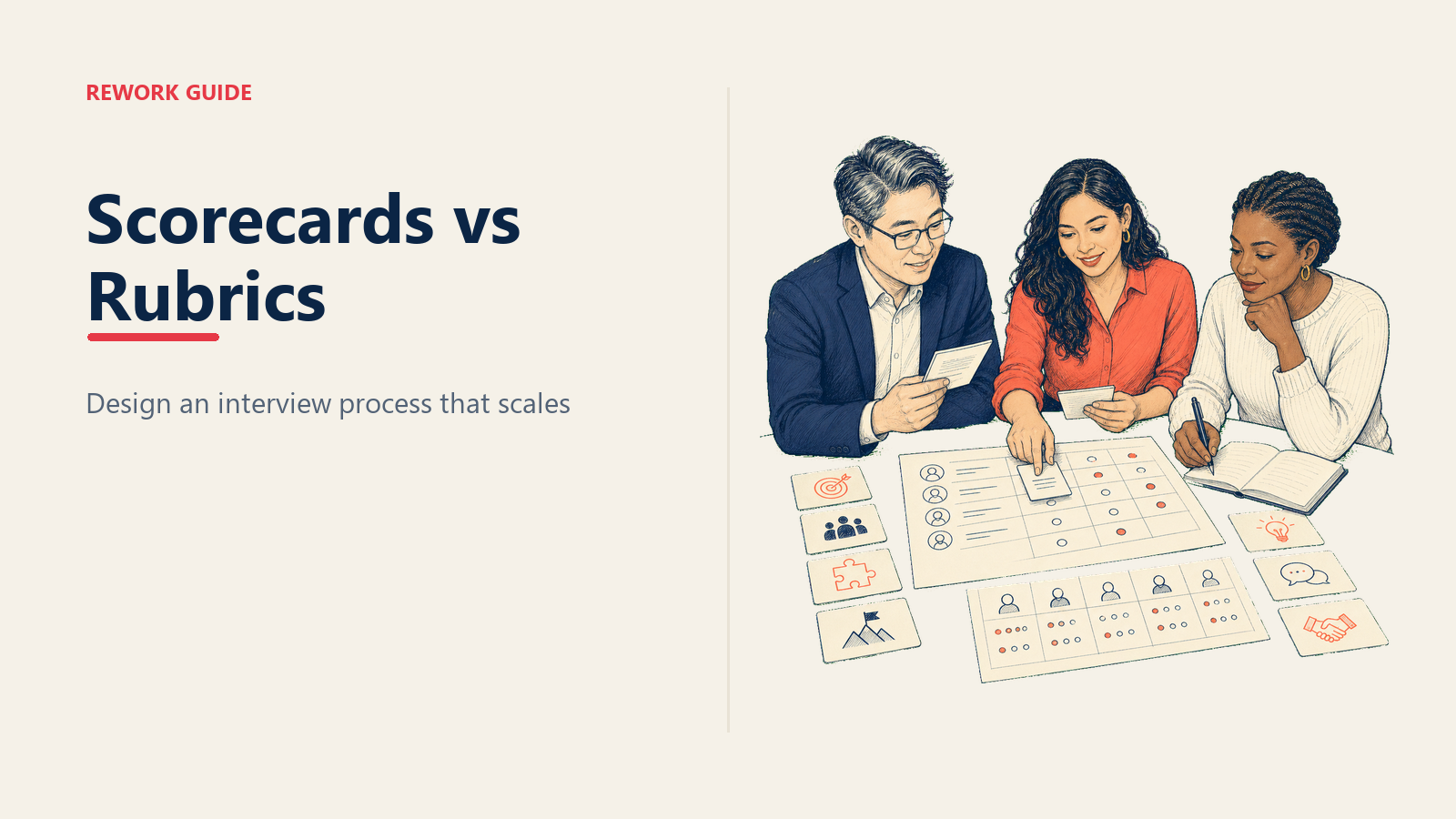
A scorecard defines what you're measuring. It lists the competencies you're evaluating, assigns each one to an interviewer, and collects the scores. A scorecard answers: "What do we care about for this role?"
A rubric defines how to score each dimension. It gives behavioral anchors: specific, observable descriptions of what each rating level looks like in practice. A rubric answers: "What does a 3 look like vs a 4 for discovery quality?"
You need both, in that order. A scorecard without rubrics is just a form people fill out based on gut instinct. A rubric without a scorecard is a set of definitions that nobody applies consistently because they're not tied to the evaluation structure.
The combination is what creates inter-rater reliability, meaning different interviewers scoring the same candidate the same way. SHRM's research on structured interviews shows that structured, rubric-backed evaluations reduce intra-panel scoring variance by up to 40% compared to free-form debriefs, the single biggest driver of consistent hiring quality.
Step 1: Identify Competencies Per Role Family
The first mistake companies make is using the same scorecard for every role. A Sales Development Representative and a Senior Solutions Engineer require completely different competency sets.
But you also don't need to build a custom scorecard from scratch for every hire. Build role families, clusters of roles that share the same core competencies, and create one scorecard per family.
Common role families in a 100-300 person company:
| Role Family | Core Competencies |
|---|---|
| Individual Sales (AE, SDR) | Discovery quality, objection handling, pipeline discipline, closing instinct, coachability |
| Sales Leadership | Team coaching, pipeline management, cross-functional influence, hiring instinct, strategic thinking |
| Customer Success | Customer empathy, data fluency, escalation judgment, retention mindset, process orientation |
| Operations (RevOps, FinOps) | Systems thinking, prioritization, stakeholder communication, data accuracy, change management |
| Product | Customer problem-first thinking, prioritization, spec quality, cross-functional communication, execution |
| Engineering | Technical depth, code quality, communication, collaboration, problem decomposition |
| Marketing | Channel knowledge, analytical fluency, creative judgment, commercial instinct, collaboration |
| People/HR | Legal awareness, judgment, organizational awareness, communication, process design |
Within each family, pick 7-10 core competencies maximum. If your scorecard has 15 competencies, interviewers will score them quickly and without real distinction. Seven well-defined competencies scored thoughtfully are worth more than fifteen vaguely defined ones.
Step 2: Build the Universal Scorecard Template
Here's a template you can adapt for any role family:
Candidate: _______________ Role: _______________ Interviewer: _______________ Date: _______________ Interview stage: [ ] Phone screen [ ] Technical [ ] Panel [ ] Work sample debrief
| Competency | Owner | Rating (1-4) | Evidence / Notes |
|---|---|---|---|
| [Competency 1] | Interviewer A | ||
| [Competency 2] | Interviewer B | ||
| [Competency 3] | Interviewer B | ||
| [Competency 4] | Interviewer C | ||
| [Competency 5] | Interviewer C | ||
| [Competency 6] | All | ||
| [Competency 7] | Interviewer A |
Overall recommendation: [ ] Strong hire [ ] Hire [ ] No hire [ ] Strong no hire
One specific strength:
One specific concern:
Evidence that most influenced this rating:
The "Evidence / Notes" column is not optional. An interviewer who can't write down specific behavioral evidence for their scores is telling you they're scoring on gut feel, not observation.
Assign each competency to a specific interviewer, not "everyone." When everyone is responsible for a dimension, nobody covers it rigorously.
Step 3: Assign Rubrics to Each Competency
Here are fully worked rubrics for three example competencies. Use these as models for building your own.
Rubric: Discovery Quality (Sales roles)
| Rating | Label | Behavioral Description |
|---|---|---|
| 4 | Exceptional | Opened with customer situation questions before any product mention. Asked two or more second-order follow-ups on each answer. Identified unstated business impact and named it back to the prospect. Left the call with a complete picture of value, timeline, and stakeholders. |
| 3 | Strong | Asked relevant discovery questions before pitching. Followed up on key answers with one level of depth. Identified primary pain and connected it to a product capability. Occasionally shifted to pitch mode before fully exploring the customer's situation. |
| 2 | Developing | Asked surface-level discovery questions but moved to product pitch after initial answers. Did not probe into business impact or urgency. Relied on the prospect to volunteer important information. |
| 1 | Does not meet bar | Led with product features or demo immediately. Discovery questions (if any) felt like formalities before the pitch. Did not understand prospect's situation by end of call. |
Rubric: Prioritization (Product roles)
| Rating | Label | Behavioral Description |
|---|---|---|
| 4 | Exceptional | Identified constraints before prioritizing. Used a clear framework (impact, effort, urgency) applied consistently. Made explicit trade-offs and explained the logic. Acknowledged uncertainty where present. Proactively identified items that would require follow-up information before committing. |
| 3 | Strong | Used a reasonable method for prioritization with minimal prompting. Made trade-offs with clear business rationale. Occasionally needed prompting to address items they'd implicitly deprioritized. |
| 2 | Developing | Prioritized based on gut instinct or loudest-customer logic. Trade-off reasoning was unclear or post-hoc. Did not distinguish between urgent and important. |
| 1 | Does not meet bar | Could not prioritize a backlog without significant guidance. Relied on the interviewer to identify constraints. No clear method applied. |
Rubric: Stakeholder Communication (Operations roles)
| Rating | Label | Behavioral Description |
|---|---|---|
| 4 | Exceptional | Proactively identifies which stakeholders need to know what information and when. Frames process changes in terms of stakeholder benefit. Handles disagreement by surfacing trade-offs, not just repeating position. Documents communication so it doesn't rely on memory. |
| 3 | Strong | Communicates changes to affected stakeholders in time. Responds well to disagreement with constructive framing. Occasionally reactive rather than proactive in communication approach. |
| 2 | Developing | Communicates when prompted but doesn't proactively identify stakeholder needs. Defensive when challenged, defaults to technical explanation rather than business framing. |
| 1 | Does not meet bar | Poor awareness of who needs information. Communicates primarily within their own function. Escalates conflict rather than resolving it. |
Build rubrics for each of your seven core competencies in the same format. Involve your best interviewers in the behavioral descriptions. They know what "exceptional" looks like in your specific context better than any framework.
Step 4: Train Interviewers on Calibration
A rubric without calibration training is just a form. The debrief protocol is where quality bars get set and recalibrated over time.
Run a 90-minute interviewer training session before you start using the new scorecard system. Cover:
Part 1: What we're measuring and why (20 minutes) Walk through the competencies for each role family. Explain why you chose those seven dimensions and not others. This context helps interviewers understand what they're looking for, not just how to fill in the form.
Part 2: Calibration exercise (40 minutes) Use a real or fictional candidate example. Have each interviewer score the same 20-minute interview recording independently using the rubric. Then compare scores. Discuss: where did people diverge? What counted as evidence for a 3 vs a 4? Resolve the disagreements by grounding them in the behavioral anchors.
Part 3: Debrief protocol (30 minutes) Walk through the debrief process (see Step 5). Practice one debrief on a fictional candidate: how to run it, how to prevent anchoring, and how to resolve genuine disagreement.
Recalibrate annually or any time you notice consistent scoring patterns that seem off (e.g., everyone scoring every candidate 3 out of 4 regardless of performance).
Step 5: The Debrief Protocol
The debrief is where the scorecard either works or fails.
Common failure modes:
- The first person to speak sets the anchor for everyone else's opinion
- The hiring manager dominates the room and junior interviewers defer
- Nobody has filled out the scorecard before the debrief
- The debrief turns into a personality discussion rather than an evidence review
The right protocol:
Scores submitted before the call. No exceptions. An interviewer who hasn't submitted their scorecard before the debrief is not allowed to lead with an opinion. They can listen and contribute, but not set the frame.
Go around the table by competency, not by overall recommendation. Instead of "who wants to share their take?", go through each competency one by one and have the assigned interviewer share their score and evidence.
Discuss divergence, not consensus. When interviewers scored the same competency differently (a 2 vs a 4, for example), that's the most valuable discussion. What did each person observe? Was one of them observing something the other missed?
Don't reveal the overall recommendation until all competencies are covered. Anchoring to a headline "strong hire" before discussing the specific evidence pulls everyone toward confirmation bias.
The hiring manager makes the final call, but must articulate which competency scores drove the decision. "I'm making this hire because they scored 3-4 across the six most important competencies for this role, and the 2 on is in a dimension we can develop." That's a defensible decision.
Setting Your Minimum Score Threshold
Before you start interviewing, define the minimum acceptable total score and any knockout competencies.
Example for an AE role:
- Minimum total score: 24/40 (across 10 competencies)
- Knockout competencies: Discovery quality (must score 3+) and Coachability (must score 3+)
- A candidate who scores 26/40 but has a 2 on Discovery quality is a no hire regardless of total score
Write this down and share it with the hiring team before the first interview. This prevents post-hoc rationalization of a marginal hire because "they were so strong in other areas." When you're hiring for culture fit, the knockout competency concept is particularly important. Undocumented cultural rejections create legal exposure that structured knockout criteria prevent.
Protecting Against Bias
Structured evaluation reduces bias, but it doesn't eliminate it. A few specific protections:
Require evidence for all scores. Any score without written behavioral evidence should be challenged in the debrief. "I just felt like they weren't a 4" is not evidence. "They answered the objection by giving a price discount immediately without probing the concern" is.
Use the same question set for every candidate in the same role. When interviewers ask different questions of different candidates, you can't compare scores because you're evaluating different stimulus. Standardize the question bank per stage.
Review score distributions over time. If one interviewer scores everyone 4/4 or everyone 1/4, they're not using the rubric. Review scoring patterns quarterly with your hiring team.
Separate the "would I enjoy working with them" gut check from the scorecard. That gut check matters, but it should come at the end as a culture and values input. It should not influence individual competency scores. Cross-reference it with reference check findings before it factors into the final decision. References often validate or challenge exactly this kind of interpersonal perception.
The Business Case for Structure
Mid-market companies often skip this because it feels like overhead. You're trying to hire, not build an HR system. But the cost of an unstructured process compounds quickly:
- A single bad hire at $150k OTE costs $300-600k in lost productivity, ramp investment, and opportunity cost
- Discrimination claims arising from undocumented evaluation processes settle for $50-500k in legal costs alone. The EEOC's latest enforcement data shows that hiring-related discrimination charges represent nearly 30% of all employment discrimination filings each year
- Teams that see inconsistent hiring quality standards lose confidence in the hiring process, and top performers start questioning whether the bar is being maintained
A one-day investment to build a proper scorecard and rubric system pays back within the first hire it filters correctly. Combine it with structured reference checks and culture-fit documentation practices and you have a defensible hiring process end to end.
Learn More

Head of Enterprise Solutions
On this page
- The Difference (And Why It Matters)
- Step 1: Identify Competencies Per Role Family
- Step 2: Build the Universal Scorecard Template
- Step 3: Assign Rubrics to Each Competency
- Rubric: Discovery Quality (Sales roles)
- Rubric: Prioritization (Product roles)
- Rubric: Stakeholder Communication (Operations roles)
- Step 4: Train Interviewers on Calibration
- Step 5: The Debrief Protocol
- Setting Your Minimum Score Threshold
- Protecting Against Bias
- The Business Case for Structure
- Learn More