Best Google Meet Alternatives in 2026: 12 Video Conferencing Tools for Teams
Turn this article into takeaways for your work.


Each assistant summarizes the article only for you and suggests best practices for your work.
Google Meet earns its default status honestly. It's already inside Gmail and Google Calendar, so a meeting link shows up on every invite without installing anything. The free tier is genuinely usable: 100 participants, live captions in dozens of languages, and infrastructure borrowed from the same network that runs Search. For a huge number of teams, that's simply enough.
It stops being enough at a few predictable points: cloud recording sits behind Business Standard, not Starter. Webinar and moderation tools are thin next to a dedicated events platform. Dial-in and larger participant caps mean climbing the Workspace ladder rather than buying video alone. And if your team isn't otherwise on Workspace, Meet means paying for a second collaboration stack you don't use for anything else. This roundup covers 12 tools worth evaluating if that sounds familiar (see also pointless meetings if the problem is volume, not the tool), evaluated on pricing, caps, and fit, not marketing copy.
Key Facts
- The average Microsoft Teams user's weekly meeting time rose 252% between February 2020 and the most recent Work Trend Index release, per Microsoft WorkLab.
- 86% of workers globally say their meetings include at least one remote participant, per Owl Labs' State of Hybrid Work report.
- 71% of senior managers say meetings are unproductive and inefficient, per Harvard Business Review's "Stop the Meeting Madness".
- Workers report an average of roughly five online or hybrid meetings a week, per Owl Labs' 2025 State of Hybrid Work research.
- The global video conferencing market is on track to reach roughly $12 billion in 2026, per Grand View Research.
Quick Comparison Table
| Tool | Best For | Starting Price | Key Strength | Key Limitation |
|---|---|---|---|---|
| Zoom | Teams that want the most familiar client | Free; ~$16.99/host/mo Pro | Universal adoption, reliable at scale | Per-host pricing, 40-min free group cap |
| Microsoft Teams | M365 organizations | Free; $4/user/mo (Essentials) | Full collaboration suite bundled in | Heavy client, complex for small teams |
| Cisco Webex | Regulated or security-sensitive buyers | Free; ~$12/user/mo Meet, annual | FedRAMP authorized, end-to-end encryption | Paid tier pricing not published on-site |
| Whereby | External client calls, no-download rooms | Free (4 attendees); $10.99/mo | Frictionless browser join, permanent room URL | 200-person ceiling |
| RingCentral Video | Generous free tier, phone bundle upside | Free (100 participants, 50-minute meetings) | Strong free plan, video plus phone in one vendor | Free meetings cap at 50 minutes, paid price not public |
| GoTo Meeting | SMBs with a fixed set of hosts | ~$12/organizer/mo annual | Simple, reliable, no feature bloat | Per-organizer pricing stings as teams grow |
| Zoho Meeting | Zoho ecosystem, budget-first buyers | Free; ~$10/host/mo Standard | Cheapest credible paid entry point here | No flat, published rate |
| Dialpad Meetings | AI-first SMB and sales teams | Free (10 attendees); ~$15/host/mo | AI transcripts and summaries built in | 100-participant cap on the paid tier |
| Jitsi Meet | Privacy-first teams and self-hosters | Free, open source | Zero licensing cost, full data control | Running it well needs DevOps capacity |
| Livestorm | Browser-based webinars and events | Free (20 min, 30 attendees); usage-based paid | No client install for hosts or attendees | Credit-based pricing is harder to predict |
| ClickMeeting | Webinar registration and automation | Free (25 attendees); Live from ~$26/mo annual, ~$32 monthly | Registration pages, polling, replay built in | Not designed for daily internal standups |
| 8x8 | Global phone, SMS, and video in one vendor | Custom quote (self-serve list pricing retired) | One bill for calling and meetings worldwide | Hard to get a price without a sales call |
1. Zoom: Best for Teams That Want the Most Familiar Client
Zoom is still the tool most external contacts already have installed, which matters more than any feature comparison once clients, candidates, or investors are on the call. Call quality holds up on weak connections, the waiting room works, and recordings land without the fiddling some competitors require.
The free Basic plan caps group calls at 40 minutes with up to 100 participants, a real constraint for any standing weekly sync. Pro removes the time cap (30-hour meetings) and adds 10 GB of cloud storage plus unlimited AI Companion use, still capped at 100 participants. Business raises the ceiling to 300 participants; Enterprise scales to 1,000 and adds a phone system plus webinars for up to 500 attendees as an add-on.
Zoom Pro runs about $16.99/host/month monthly, about $13.33/host/month billed annually. Business runs $21.99/host/month monthly, roughly $18.33/host/month annual.
Pricing: Free (100 participants, 40-min group cap). Pro ~$16.99/host/month monthly, ~$13.33/host/month annual. Business ~$21.99/host/month monthly, ~$18.33/host/month annual. Enterprise: custom. See Zoom pricing.
Best for: Teams whose external contacts already run Zoom and who need reliability at 1,000-plus participants more than a bundled price.
| Pros | Cons |
|---|---|
| Widest client recognition among external contacts | Per-host licensing gets expensive on larger teams |
| 30-hour meetings on every paid tier | 40-minute cap on free group calls |
| Reliable at large scale (1,000+ participants) | Vendor page doesn't publish plain dollar prices |
| Deep third-party app marketplace | AI Companion pricing is bundled, not itemized |
2. Microsoft Teams: Best for Microsoft 365 Organizations
Teams isn't a video app that happens to chat, it's chat, file storage, and task tracking that happens to include video. If your org already runs Microsoft 365, that bundling makes a standalone meeting tool hard to justify.
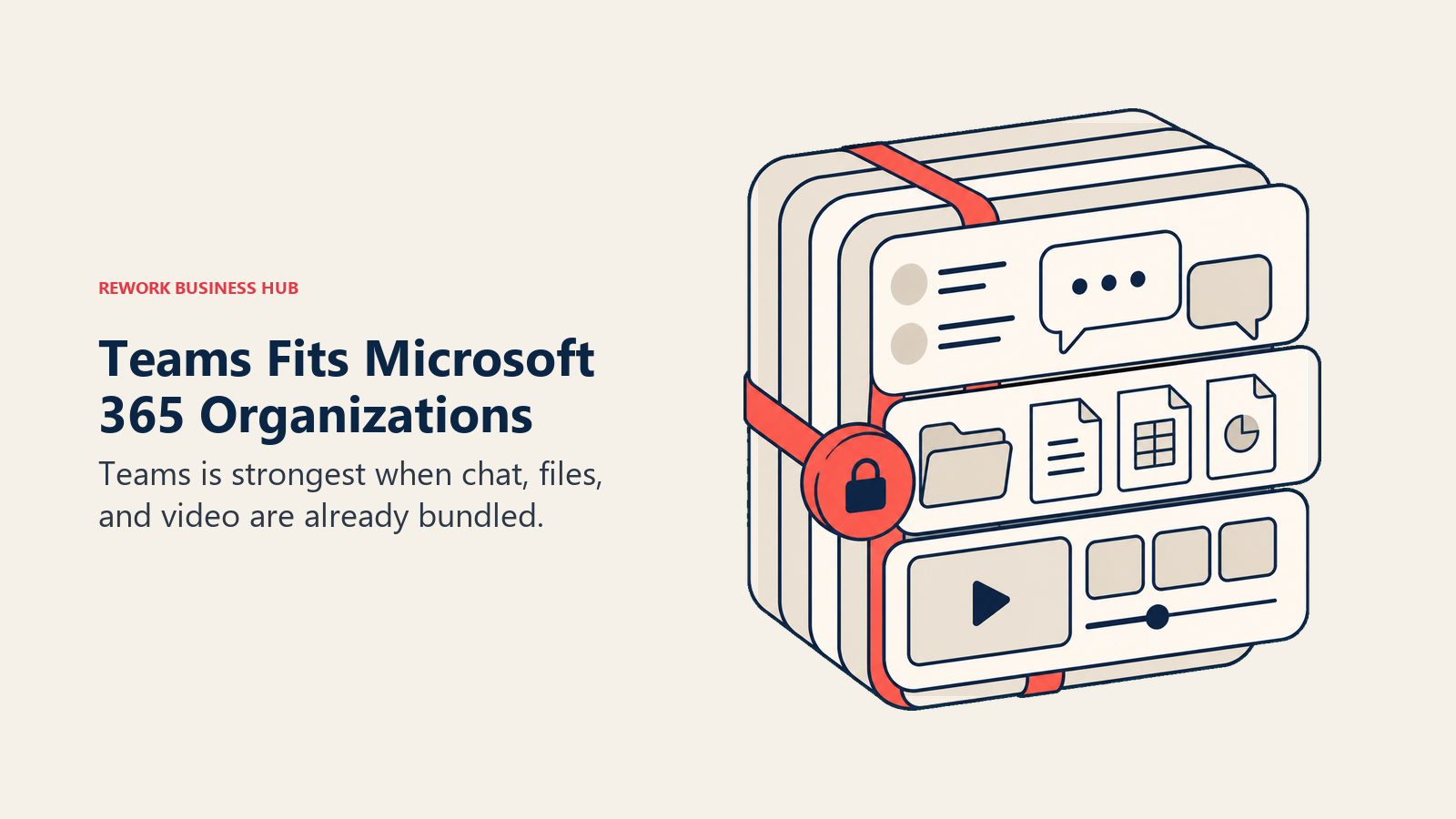
Per Microsoft's own plan comparison, Teams Essentials runs $4/user/month annual and covers chat, calling, and video with 300 participants and 30-hour meetings. M365 Business Basic is $7/user/month annual and adds Exchange, SharePoint, and 1 TB of storage, up from $6 earlier this year. The bigger shift: Business Standard now bundles Copilot AI directly into the plan at $23.50/user/month annual, where it previously sold Standard and the Copilot add-on separately. A free plan covers unlimited chat and meetings up to 60 minutes with 100 participants.
That bundled math is hard to beat for organizations already paying for Exchange and SharePoint. The trade-off is a client that consumes meaningful memory and an onboarding curve that overwhelms teams who just wanted a meeting link, a real concern given remote and hybrid meeting load keeps climbing.
Pricing: Free plan available (60-min cap, 100 participants). Teams Essentials $4/user/month annual. M365 Business Basic $7/user/month annual. M365 Business Standard (with Copilot bundled) $23.50/user/month annual. See Microsoft Teams pricing.
Best for: Organizations already standardized on Microsoft 365 who want to consolidate video into a suite they're paying for anyway.
| Pros | Cons |
|---|---|
| Bundled with Exchange, SharePoint, OneDrive | Heavy client, high memory usage |
| 300 participants and 30-hour meetings even on Essentials | Complex onboarding for teams that just want video |
| Copilot now included in Business Standard | 2026 price increases narrowed the value gap |
| Deep admin and compliance controls | Overkill if you don't need the rest of M365 |
3. Cisco Webex: Best for Regulated and Security-Sensitive Buyers
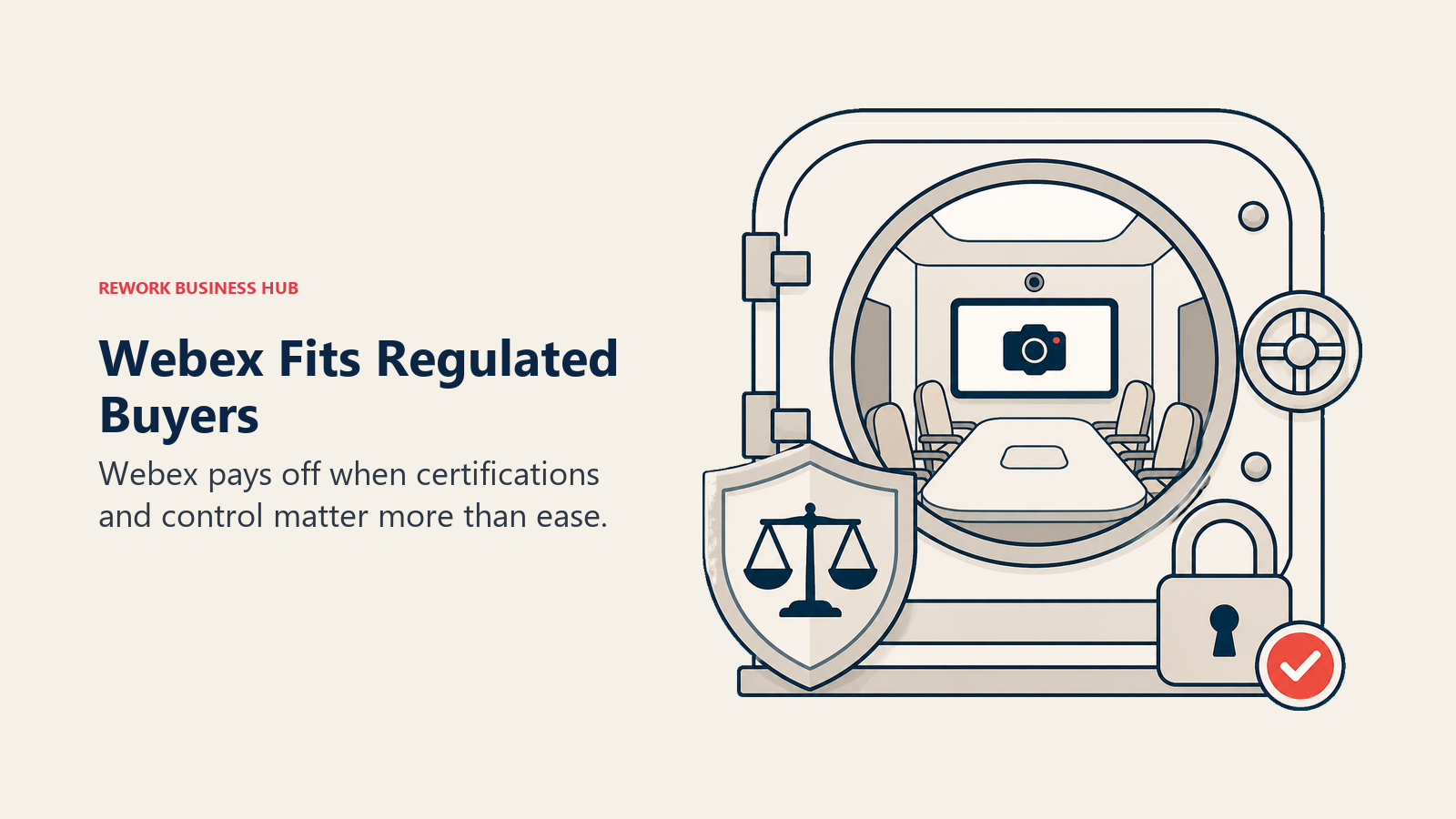
Webex exists for the buyer who treats security certifications as a procurement requirement. Webex for Government carries FedRAMP authorization per the FedRAMP Marketplace, and the platform adds end-to-end encryption, SOC 2 alignment, and on-premises deployment options that matter in government, defense, healthcare, and finance.
Webex's free plan covers 100 participants for up to 40 minutes, tighter than the 50-minute cap it carried earlier this year. Beyond Free, Webex Meet runs roughly $12/user/month billed annually, about $14.50 billed monthly (200 participants, 24-hour meetings), and Webex Suite adds calling for roughly $22.50/user/month annual, about $25 monthly. Enterprise is custom-quoted, scales to 1,000 participants, and bundles the full AI Assistant.
Outside regulated industries, that certification depth is wasted money: the interface reads dated next to Meet or Teams, and SMBs rarely need FedRAMP badges enough to justify the premium.
Pricing: Free (100 participants, 40 min). Webex Meet ~$12/user/month annual, ~$14.50 monthly. Webex Suite ~$22.50/user/month annual, ~$25 monthly. Enterprise: custom. See Webex pricing.
Best for: Regulated enterprise buyers where FedRAMP, HIPAA, or SOC 2 compliance is a hard procurement gate.
| Pros | Cons |
|---|---|
| FedRAMP authorized, HIPAA and SOC 2 aligned | Paid pricing isn't published in plain numbers |
| End-to-end encryption and on-prem options | Interface feels dated next to newer tools |
| 1,000-participant rooms at Enterprise | Weak value for non-regulated small teams |
| Full AI Assistant bundled at Enterprise | Free tier's 40-min cap is tighter than rivals |
4. Whereby: Best for External Client Calls Without a Download
Whereby's whole pitch is one URL: a permanent room like whereby.com/yourcompany anyone can join from a browser tab, no download, no account, no launcher prompt. For client-facing teams, that removes the biggest source of join friction in a first call.
Per Whereby's own pricing page, the free plan covers one room with up to 4 attendees and a 30-minute cap. Pro is $10.99/month for one host, extending to 100 attendees with unlimited recording and custom branding. Business is $13.99/host/month, 3-host minimum, scaling to 200 attendees and adding shared rooms plus a custom subdomain.
The ceiling is real: 200 participants rules out all-hands calls, and the 3-host minimum on Business means a two-person team pays for a seat it won't use. Whereby also sells an embeddable video product for SaaS apps, billed separately.
Pricing: Free (4 attendees, 30-min cap). Pro $10.99/host/month (1 host, 100 attendees). Business $13.99/host/month, 3-host minimum (200 attendees). See Whereby pricing.
Best for: Small teams, consultants, and customer-facing roles that need a persistent, no-download link for calls with people outside the company.
| Pros | Cons |
|---|---|
| No download for attendees, join from a browser tab | 200-person ceiling rules out large events |
| Permanent, shareable room URL | 3-host minimum on Business |
| Embeddable via API for custom apps | No large webinar or town-hall mode |
| Clean interface, fast to learn | Smaller integration ecosystem than Zoom or Teams |
5. RingCentral Video: Best for a Generous Free Tier With Phone Upside
RingCentral's free video tier is one of the more usable here: unlimited meetings with up to 100 participants at no cost, each capped at 50 minutes. That covers standups and most check-ins, but longer workshops will cut off. A paid RingEX plan covers meetings up to 24 hours with up to 300 participants.
The real argument for RingCentral is RingEX: phone, SMS, messaging, and video under one login, appealing to companies replacing a PBX system anyway. Video Pro+ runs roughly $11.99/user/month annual under 100 seats, dropping to around $10.99 past that threshold.
If you only need video, RingCentral is more platform than most teams want. It earns its keep when consolidating a phone system and a meeting tool into one vendor.
Pricing: Free (100 participants, 50-minute meetings). Video Pro+ ~$11.99/user/month annual under 100 seats. RingEX bundles start higher. See RingCentral Video pricing.
Best for: Mid-market teams replacing a business phone system who want video folded into the same bill.
| Pros | Cons |
|---|---|
| 100 participants free, no credit card required | Free tier now capped at 50 minutes |
| 24-hour meetings on paid RingEX plans | Paid video-only pricing isn't published plainly |
| Phone, SMS, and video under one vendor | Platform breadth adds onboarding overhead |
| Strong AI summary features at Pro+ | Overkill if video is the only need |
6. GoTo Meeting: Best for SMBs With a Fixed Set of Hosts
GoTo Meeting has been reliable long enough that IT teams stop thinking about it. The feature set stays narrow on purpose: meetings, screen sharing, recording, and calendar integration, with none of the sprawl that turns onboarding into a project.
GoTo Professional runs about $12/organizer/month annual ($14 monthly) supports 150 participants, Business at $16/organizer/month annual ($19 monthly) extends to 250 with unlimited cloud recording. Enterprise is custom-quoted to 3,000 participants.
The defining trade-off is per-organizer pricing: cheap if only a handful of people schedule calls, but it scales poorly once most of the team needs hosting rights, with no bundled messaging or storage to offset the cost the way M365 or Workspace does.
Pricing: Professional ~$12/organizer/month annual, ~$14 monthly. Business ~$16/organizer/month annual, ~$19 monthly. Enterprise: custom. See GoTo Meeting pricing.
Best for: SMBs with a fixed, known set of meeting hosts who want a simple video tool without ecosystem lock-in.
| Pros | Cons |
|---|---|
| Simple, fast to deploy, minimal training | Per-organizer pricing punishes larger teams |
| 150 to 250 participants without an enterprise tier | No bundled messaging or file storage |
| Unlimited cloud recording on Business | Confirm current pricing with GoTo |
| Long track record of reliability | UI feels conservative next to newer entrants |
7. Zoho Meeting: Best for Zoho Ecosystem and Budget-First Buyers
Zoho Meeting's natural home is a team already running Zoho CRM, Projects, or Desk: meetings launch from a contact record, recordings attach to a project card, and support calls log to a ticket automatically.
Per Zoho's own free plan, meetings run up to 60 minutes with 100 participants at no cost. Zoho prices through a live calculator, with Standard at roughly $10/host/month annual and Professional at roughly $19/host/month annual, both scaling with the participant-capacity tier you pick.
That entry price is still the cheapest credible paid option here. Confirm the exact number at checkout, since Zoho prices by capacity tier rather than a flat rate, and value drops outside the Zoho suite.
Pricing: Free (100 participants, 60 min). Standard ~$10/host/month annual, scales with participant tier. Professional ~$19/host/month annual. See Zoho Meeting pricing.
Best for: Teams already using Zoho CRM or Zoho One who want video without adding a separate vendor.
| Pros | Cons |
|---|---|
| Among the cheapest paid entry points in this list | Final price depends on a capacity tier, not flat |
| Deep native integration across the Zoho suite | Weak value outside the Zoho ecosystem |
| 60-minute free plan (longer than Zoom's 40) | No flat, published rate |
| Webinar edition available separately | UI prioritizes density over polish |
8. Dialpad Meetings: Best for AI-First SMB and Sales Teams
Dialpad's whole philosophy is AI by default: every call gets a live transcript, action items get pulled out automatically, and a summary lands in your inbox with no one taking notes. That's the base product, not an upsell.
The free plan covers 10 participants for 45 minutes. The Business tier runs roughly $15/host/month annual, $20/month monthly, unlocking 100 participants and 5-hour meetings with full transcription and AI summaries.
The AI layer is a real differentiator for teams who'd otherwise pay separately for a Gong- or Chorus-style tool. The trade-off is scale: 100 participants sits below what a mid-market all-hands needs.
Pricing: Free (10 participants, 45 min). Business ~$15/host/month annual, ~$20/month monthly. See Dialpad pricing.
Best for: SMB sales and ops teams who want AI call intelligence built in rather than bought as a separate subscription.
| Pros | Cons |
|---|---|
| AI transcripts and action items included by default | 100-participant cap on the standard paid tier |
| No separate AI add-on fee | Free plan capped at 45 minutes |
| Bundles cleanly with Dialpad's phone product | Smaller ecosystem than Teams or Meet |
| Clean, modern interface | Vendor pricing page didn't publish plan-level figures |
9. Jitsi Meet: Best for Privacy-First Teams and Self-Hosters
Jitsi Meet is fully open source and free to use at meet.jit.si with no account required. Organizations that need full control over where call data lives, or whose legal team has ruled out US-based cloud providers, can self-host the entire stack instead.
There's no licensing fee, ever. Running it well is the honest cost: performance tuning for larger calls, TURN server configuration, and ongoing patching are real DevOps work. Jitsi's own team offers JaaS (Jitsi as a Service), managed hosting for teams that want the software without running the infrastructure, priced on usage. The public meet.jit.si instance is a shared resource and can be inconsistent under heavy load, so treat it as a trial, not a production dependency.
Pricing: Free and open source, self-hosted or via the public instance. Managed hosting available through JaaS at usage-based pricing (contact for a quote). See Jitsi.
Best for: Security-conscious or data-residency-constrained organizations with the DevOps capacity to run their own infrastructure.
| Pros | Cons |
|---|---|
| Zero licensing cost, always | Requires real DevOps effort to run well |
| Full data control when self-hosted | Public shared instance can be unreliable |
| No account required to join a call | No enterprise support without a paid managed option |
| End-to-end encryption available | Steep setup curve for non-technical teams |
10. Livestorm: Best for Browser-Based Webinars and Events
Livestorm competes for the same webinar budget as ClickMeeting, but nothing requires a download: hosts and attendees both join from a browser tab, removing the biggest drop-off point in webinar registration-to-attendance conversion.
Livestorm no longer charges a flat fee: it prices Pro at €2.50 per attendee credit, one credit per unique attendee per session, up to 4 hours. Enterprise extends to 12-hour sessions at custom pricing. The free plan covers roughly 20-minute sessions for up to 30 attendees.
Credit-based pricing is predictable if event volume is steady, but harder to estimate upfront than a flat monthly number.
Pricing: Free (roughly 20-min sessions, up to 30 attendees). Pro €2.50 per attendee credit, 4-hour sessions. Enterprise: custom, 12-hour sessions. See Livestorm pricing.
Best for: Marketing and RevOps teams running frequent webinars who want no-download attendance and predictable per-attendee costs.
| Pros | Cons |
|---|---|
| No download for hosts or attendees | Credit-based pricing is harder to estimate upfront |
| Strong CRM and marketing automation integrations | Free plan is limited to short sessions |
| Scales to 12-hour Enterprise sessions | Cost rises with unique attendee volume, not flat |
| Browser-first join reduces registration drop-off | Pricing structure changed recently, worth re-checking |
11. ClickMeeting: Best for Webinar Registration and Automation
ClickMeeting builds for webinars first, daily meetings second. Where Zoom or Meet treat webinars as an add-on, ClickMeeting's core product is the webinar workflow: registration pages, polling, Q&A management, follow-up emails, and on-demand replay.
Per ClickMeeting's own pricing page, the free plan now covers up to 25 participants for a 14-day trial, no card required. The Live plan scales in participant tiers (50 to 1,000 attendees) with annual billing saving up to 20%, and Automated adds evergreen, on-demand webinar automation at the same tiers. The entry Live tier runs around $32/month monthly, roughly $26/month annual. Enterprise covers up to 10,000 attendees with white-label branding.
It's purpose-built, both the strength and the constraint. Teams running regular webinars get more than a bolt-on Zoom add-on at a comparable price, but daily standups still need a separate tool.
Pricing: Free (25 attendees, 14-day trial). Live from ~$32/month monthly, ~$26/month annual, entry tier. Automated adds evergreen webinars at the same tiers. Enterprise: custom. See ClickMeeting pricing.
Best for: Marketing and enablement teams running regular webinars who want a dedicated platform instead of a Zoom add-on.
| Pros | Cons |
|---|---|
| Registration, polling, and Q&A built in | Not built for daily internal meetings |
| On-demand replay and webinar automation | Requires a separate tool for standups |
| Free tier now covers 25 attendees | No flat, published rate |
| Up to 10,000 attendees at Enterprise | Less brand recognition than Zoom Webinars |
12. 8x8: Best for Global Phone, SMS, and Video in One Vendor
8x8 sells video as part of a broader unified communications platform (8x8 Work) bundling calling, SMS, and team chat with number coverage across dozens of countries. For a distributed, multi-country workforce, that consolidation is the actual pitch, not video quality alone.
The honest 8x8 no longer publishes a self-serve price list for meetings or its UCaaS bundle the way it did a couple of years ago. Older list pricing put entry plans around $15/user/month annually and premium tiers at $44 to $57/user/month. Budget for a quote, not a checkout page.
That opacity itself is a cost: a team evaluating alternatives to a free, transparent tool like Meet loses time it can't see a price up front.
Pricing: Custom quote required. Historical list pricing (no longer published) ranged roughly $15 to $57/user/month depending on tier. See 8x8 pricing.
Best for: Distributed, multi-country teams that want one vendor for phone, SMS, and video and don't mind a sales conversation to get there.
| Pros | Cons |
|---|---|
| One vendor for global calling, SMS, and video | Self-serve pricing is largely gone |
| Strong international number coverage | Hard to compare cost without a sales call |
| Consolidates several tools into one bill | Overkill if you only need video |
| Enterprise-grade UCaaS feature depth | Slower evaluation cycle than self-serve competitors |
Stage Fit Matrix
| Tool | Startup (0-10) | Growth (10-50) | Mid-Market (50-200) | Enterprise (200+) |
|---|---|---|---|---|
| Zoom | Strong | Strong | Strong | Strong |
| Microsoft Teams | Moderate | Strong | Strong | Strong |
| Cisco Webex | Weak | Moderate | Strong | Very strong |
| Whereby | Very strong | Strong | Moderate | Weak |
| RingCentral Video | Strong | Strong | Strong | Moderate |
| GoTo Meeting | Strong | Strong | Moderate | Weak |
| Zoho Meeting | Strong | Strong | Moderate | Weak |
| Dialpad Meetings | Strong | Strong | Moderate | Weak |
| Jitsi Meet | Moderate (needs DevOps) | Moderate | Strong (self-host) | Strong |
| Livestorm | Moderate | Strong | Strong | Strong |
| ClickMeeting | Moderate | Strong | Strong | Strong |
| 8x8 | Weak | Moderate | Strong | Strong |
Sizing and Persona Table
| Tool | Team Size Sweet Spot | Primary Buyer | Secondary Buyer |
|---|---|---|---|
| Zoom | Any size, especially client-facing | IT Admin | Founder or Ops Lead |
| Microsoft Teams | 10-2,000 | IT Admin | COO or CTO |
| Cisco Webex | 200+ in regulated industries | CISO or CTO | Procurement |
| Whereby | 2-50 | Founder or Head of Sales | Operations Manager |
| RingCentral Video | 20-500 | IT Admin or CTO | CFO (phone TCO comparison) |
| GoTo Meeting | 5-100 hosts | Office Manager | IT Admin |
| Zoho Meeting | 5-100 on Zoho | Ops Manager | Finance (cost driver) |
| Dialpad Meetings | 10-200 | VP of Sales | Ops Lead |
| Jitsi Meet | Any, with DevOps capacity | DevOps or Security Lead | CTO |
| Livestorm | 10-500 (events focus) | Marketing Manager | RevOps |
| ClickMeeting | 5-500 (events focus) | Marketing Manager | Demand Gen Lead |
| 8x8 | 50-1,000, multi-country | IT Admin or CTO | Procurement |
What Google Meet Still Does Best
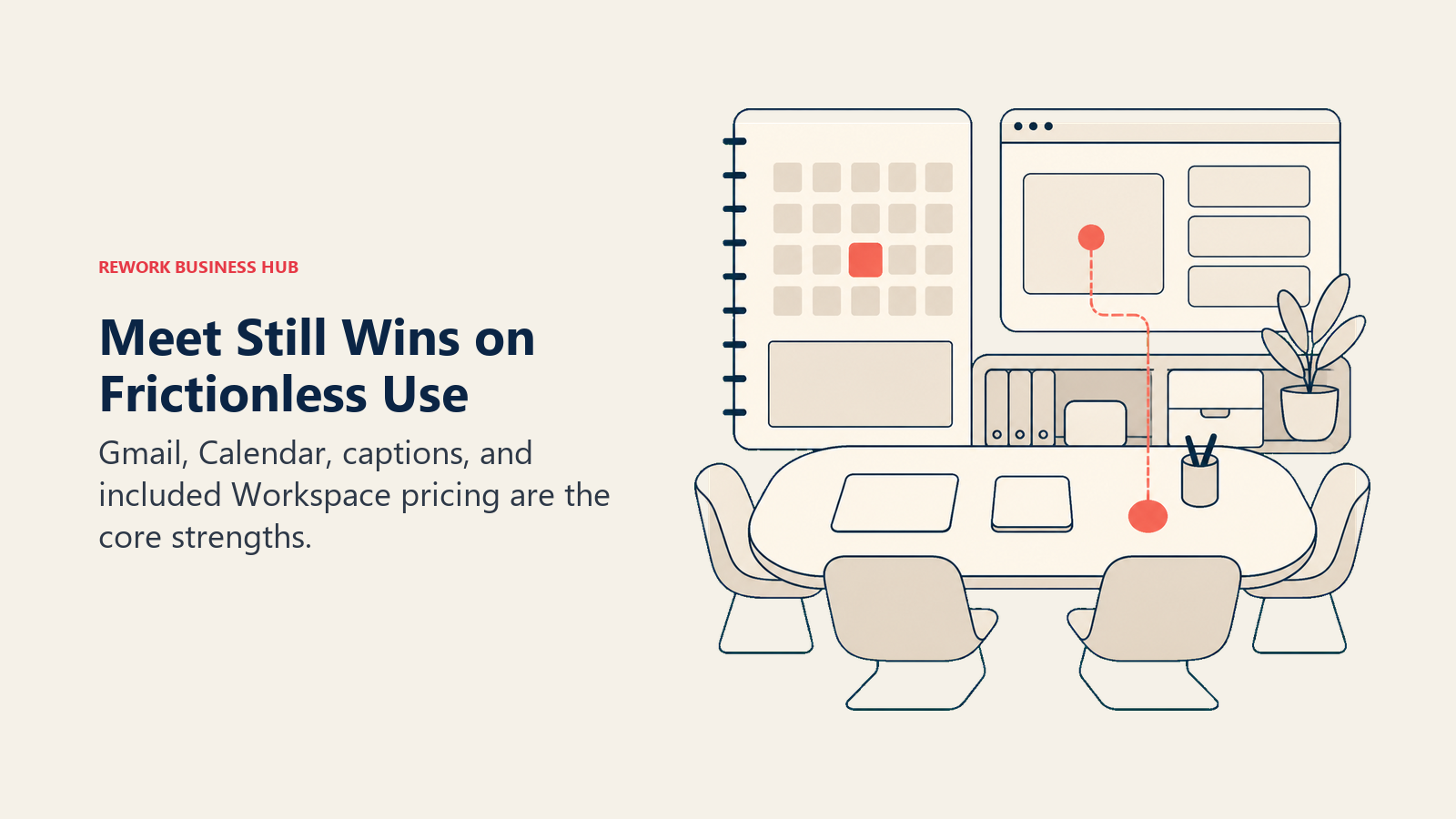
Meet has real strengths worth naming honestly before you switch, especially if a plan upgrade solves the problem cheaper than a migration project would.
| Meet Strength | Why It Matters |
|---|---|
| Zero-friction Gmail and Calendar integration | A meeting link appears on every invite automatically, no separate app for guests |
| Included free inside Workspace | No extra line item if you already pay for Gmail, Docs, and Drive |
| Live captions and translation | Real-time captions across dozens of languages on every tier |
| Google Cloud infrastructure | Runs on the same network behind Search and Gmail, rarely down |
| Consistent UI across devices | Minimal onboarding, the same experience on browser, mobile, and Chromebooks |
If your main complaint is the 100-participant free cap or missing cloud recording, a straight upgrade to Business Standard ($14/user/month annual, per Google Workspace's own pricing page) may solve it faster than switching tools and retraining your team. Google is currently running a promotional 50% discount on Starter and 40% off Standard for a team's first 20 users, for 12 months, which shifts that math further. Run the comparison before you commit to a migration.
How to Choose: Decision Framework
| If you need... | Choose |
|---|---|
| The most widely recognized client for external calls | Zoom |
| Full Microsoft 365 bundled with your meetings | Microsoft Teams |
| FedRAMP, HIPAA, or SOC 2 compliance | Cisco Webex |
| Frictionless client calls with zero download | Whereby |
| The most generous free tier for daily standups | RingCentral Video |
| A simple tool for a fixed set of meeting hosts | GoTo Meeting |
| An affordable paid tier, and you're on Zoho | Zoho Meeting |
| Built-in AI transcripts without a separate subscription | Dialpad Meetings |
| Full data sovereignty and in-house DevOps capacity | Jitsi Meet (self-hosted) |
| Browser-based webinars with deep CRM integration | Livestorm |
| Webinar registration and automation on a budget | ClickMeeting |
| One vendor for global phone, SMS, and video | 8x8 |
What to Do Next
Pick your top two candidates from the framework above and run a two-week pilot, one team per tool. Give one group your specialist pick (Whereby for client calls, ClickMeeting or Livestorm for webinars, Dialpad for sales) and keep the other on Meet as the control. Track join friction, recording reliability, and whether people forget the new tool exists by day five. After two weeks you'll have real usage data instead of a spec sheet.
If you're rethinking the broader Workspace stack alongside video, our Google Workspace alternatives roundup covers the rest of the suite, and Slack alternatives is worth a look if messaging is on the table too. For async video instead of live calls, see Loom alternatives, and for team documentation alongside meetings, Confluence alternatives is worth a read. If Zoom or Webex end up on your shortlist instead, we've broken each out separately: best Zoom alternatives and best Webex alternatives.
Frequently Asked Questions about Google Meet Alternatives
What's the real difference between Google Meet and Zoom for a small team?
Meet is free inside Workspace with a 100-participant cap and a 60-minute limit on free calls. Zoom's free Basic plan caps calls at 40 minutes but has a wider following among external contacts, which matters more once clients and partners are involved.
Which Google Meet alternative has the best free plan?
RingCentral Video's free tier (100 participants) is one of the more generous options here, though each meeting caps at 50 minutes. Zoho Meeting's free plan runs a full 60 minutes with 100 participants, longer than Zoom's 40-minute cap.
What's the best Google Meet alternative for running webinars?
Livestorm and ClickMeeting are both built for webinars first. Livestorm now prices by attendee credit and skips downloads entirely for hosts and guests. ClickMeeting adds registration pages, polling, and on-demand replay, with a free tier covering up to 25 attendees.
Can I self-host a video meeting tool instead of paying for Google Meet or Zoom?
Yes. Jitsi Meet is free and open source, and you can run the entire stack on your own servers for full control over where call data lives. It needs real DevOps capacity at scale, or you can use Jitsi's own managed JaaS hosting instead.
Do I have to leave Google Workspace entirely to switch video tools?
No. Every tool here works independently of your email and document stack. Plenty of teams keep Gmail and Docs while running meetings through Zoom, Whereby, or another specialist tool, though you'll lose Meet's automatic calendar-invite integration.
What's the most secure alternative to Google Meet for a regulated industry?
Cisco Webex, which carries FedRAMP authorization for government use per the FedRAMP Marketplace, along with end-to-end encryption and on-premises deployment options Meet doesn't offer at any tier.
Camellia writes about productivity and collaboration tooling for B2B teams. Last updated August 2026.

Principal Product Marketing Strategist
On this page
- Key Facts
- Quick Comparison Table
- 1. Zoom: Best for Teams That Want the Most Familiar Client
- 2. Microsoft Teams: Best for Microsoft 365 Organizations
- 3. Cisco Webex: Best for Regulated and Security-Sensitive Buyers
- 4. Whereby: Best for External Client Calls Without a Download
- 5. RingCentral Video: Best for a Generous Free Tier With Phone Upside
- 6. GoTo Meeting: Best for SMBs With a Fixed Set of Hosts
- 7. Zoho Meeting: Best for Zoho Ecosystem and Budget-First Buyers
- 8. Dialpad Meetings: Best for AI-First SMB and Sales Teams
- 9. Jitsi Meet: Best for Privacy-First Teams and Self-Hosters
- 10. Livestorm: Best for Browser-Based Webinars and Events
- 11. ClickMeeting: Best for Webinar Registration and Automation
- 12. 8x8: Best for Global Phone, SMS, and Video in One Vendor
- Stage Fit Matrix
- Sizing and Persona Table
- What Google Meet Still Does Best
- How to Choose: Decision Framework
- What to Do Next