Klaviyo vs HubSpot Marketing Hub vs MailerLite: Which One Fits What You're Selling?
Turn this article into takeaways for your work.


Each assistant summarizes the article only for you and suggests best practices for your work.
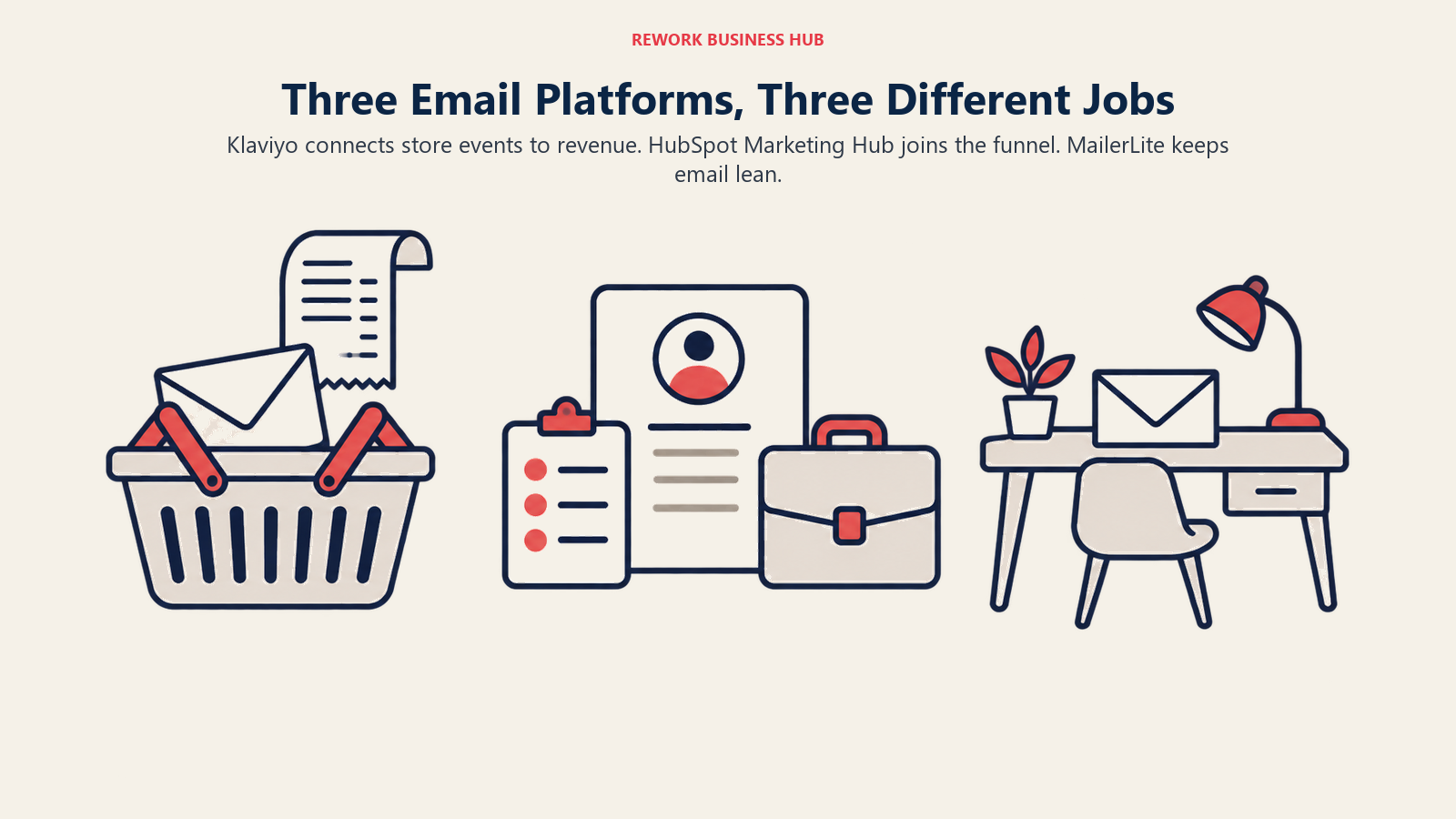
These three names show up in the same searches and get compared in the same breath, but they weren't built to solve the same problem. Klaviyo is built for ecommerce revenue: deep Shopify and store-data integration, flows triggered by what someone browsed or bought, and revenue attributed per send, which is why DTC brands accept its price. HubSpot Marketing Hub is the platform play: email is one part of a CRM-attached suite with landing pages, forms, workflows, and reporting across the funnel, bought by B2B teams who want one system instead of stitching together best-of-breed tools. MailerLite is the lean sender: genuinely cheap, pleasant to use, automation strong enough for a creator or a small business, and it doesn't pretend to be a platform.
So the real sorting question isn't which tool has more features. It's whether you're selling products, running a B2B funnel, or just trying to send good email without the bill turning into a second rent payment. We priced all three at 5,000, 50,000, and 250,000 contacts using each vendor's own live pricing tools, because in this category the meter is the actual story and the ranking moves with where your list sits today.
TL;DR
| Klaviyo | HubSpot Marketing Hub | MailerLite | |
|---|---|---|---|
| Built for | Ecommerce revenue: flows tied to purchase and browse behavior, revenue attributed per send | A full-funnel platform: email, forms, landing pages, and CRM sharing one contact record | Sending good email cheaply, with automation strong enough for a small team |
| What sets your price | "Active profiles": anyone who can be emailed, whether you email them or not | "Marketing contacts": anyone targeted with a marketing email or ad in the period | "Active subscribers": unsubscribed and bounced contacts don't count |
| Entry paid price | $20/month, 500 profiles | $20/month per seat (Starter), 1,000 marketing contacts included | $49/month (Comfort) or $69/month (Power) at 5,000 subscribers |
| Free plan | Yes, 250 profiles, 500 emails/month | Yes, 2 users, no credit card required | Yes, 250 subscribers, 2,500 emails/month |
| Native CRM / deal pipeline | No | Yes, the whole product is organized around one | Basic contact tags and segments, no pipeline |
| Real automation unlocks at | Every paid tier | Professional and Enterprise, both with a mandatory one-time onboarding fee | Comfort tier up (50 automations); unlimited on Power |
| Other channels | SMS, MMS, and WhatsApp metered per message, not bundled | WhatsApp bundled on Professional/Enterprise; SMS via add-on | Email only, no native SMS |
| Dedicated IP | Case-by-case for high-volume senders, no published self-serve tier | Paid add-on, Professional and Enterprise only | Enterprise tier only |
| Self-serve pricing tops out around | 150,000 active profiles | No hard cap, but the schedule gets awkward past Enterprise's included 10,000 | 200,000 subscribers |
| Best for | DTC and ecommerce brands on Shopify or WooCommerce | B2B marketing teams that want marketing, CRM, and sales on one record | Creators, solopreneurs, and small teams watching the bill |
What Each Tool Is Actually Built For
Klaviyo: revenue is the entire design principle
Klaviyo's philosophy is that email and SMS should get measured the way a paid ad channel gets measured: by revenue produced, not open rate. Every flow ties back to real purchase data pulled directly from Shopify, WooCommerce, and other store platforms, so a merchandiser can see exactly how many dollars an abandoned-cart flow produced. That data-first design shows up in Klaviyo's own numbers: across more than 183,000 accounts, automated flows generate close to 41% of total email revenue from just 5.3% of sends, and revenue per recipient runs nearly 18 times higher on flows than on one-off campaigns, according to Klaviyo's own email marketing benchmarks. Behavior-triggered flows built on store data outperform broadcast sends by an order of magnitude, and Klaviyo is built to make that gap visible rather than just real.
HubSpot Marketing Hub: email is one seat at a bigger table
HubSpot's bet has never really been about email. It's the flywheel: attract, engage, and close, all fed by one shared contact record across marketing, sales, and service. Marketing Hub extends that record to landing pages, ad attribution, forms, and nurture, so a lead's path from first click to closed deal lives in one place instead of scattered across a marketing tool and a separate CRM. That's the whole reason to pick it over Klaviyo or MailerLite: you're buying a data model, and email is one channel that runs on top of it. The tradeoff shows up fast in the pricing: HubSpot's Professional and Enterprise tiers both carry a mandatory, one-time onboarding fee on top of the monthly price, $3,000 and $7,000 respectively, stated explicitly on HubSpot's own Marketing Hub pricing page.
MailerLite: cheap, clean, and not pretending otherwise
MailerLite's philosophy is that a small business or a creator shouldn't need a steep learning curve or a five-figure budget to run professional campaigns. The drag-and-drop builder and a genuinely usable free tier are aimed at getting someone sending inside an hour, and the pricing follows the same logic: every paid plan gets the full feature set, and you only pay more for a bigger list or more sending, not for features a competitor would gate behind a higher tier. One thing worth knowing before you commit: MailerLite isn't the independent, bootstrapped company it used to be. It was acquired by Vercom S.A., a Polish communications software company that's part of the cyber_Folks group, confirmed by MailerLite's own leadership page, which lists a Chief Legal Officer shared across MailerLite and Vercom, and by Computer Weekly's reporting on the acquisition. The product and pricing haven't changed because of it, but know that going in if vendor independence matters to your evaluation.
| Capability | Klaviyo | HubSpot Marketing Hub | MailerLite |
|---|---|---|---|
| Behavior-triggered flows on store events | Deepest of the three, native to Shopify/WooCommerce | Requires an ecommerce integration; not the design center | Basic ecommerce triggers, less depth than Klaviyo |
| Forms and landing pages | Basic, not the focus | Deep, tied to the same contact record as email | Included on Comfort and Power, capped at 10 pages on Comfort |
| Lead scoring | Not a Klaviyo concept | Yes, native to the CRM | Not available |
| Deal pipeline | No | Yes, the product's center of gravity | No |
Decision by Business Goal
| Your actual goal | Pick |
|---|---|
| Attribute revenue to a specific welcome flow or abandoned-cart email | Klaviyo |
| Give sales visibility into which leads opened which nurture email | HubSpot Marketing Hub |
| Keep the monthly bill under $50 with a list under 5,000 | MailerLite |
| Run landing pages, forms, and email off one connected contact record | HubSpot Marketing Hub |
| Trigger a flow off a browse event or a specific product purchase | Klaviyo |
| Get real multi-step automation without hiring a marketing ops person | MailerLite Comfort, or Klaviyo if the trigger is a store event |
| Avoid a five-figure onboarding charge just to unlock automation | Klaviyo or MailerLite; HubSpot's automation tiers both carry a mandatory onboarding fee |
| Consolidate marketing, sales, and service data in one CRM | HubSpot Marketing Hub |
Team and Role Fit
| Team / role | Better fit | Why |
|---|---|---|
| Ecommerce manager or DTC brand | Klaviyo | Native store-data flows and revenue-per-send attribution |
| B2B marketing team that wants one system with sales | HubSpot Marketing Hub | CRM, forms, landing pages, and email share one contact record |
| Solo marketer, creator, or small business owner | MailerLite | Lowest cost, fastest to learn, no CRM complexity to fight through |
| RevOps or marketing ops wanting unified funnel reporting | HubSpot Marketing Hub | Built around one data model from first click to closed deal |
| Growth marketer running lifecycle experiments on purchase data | Klaviyo | Flows trigger on real store events, not just email engagement |
| Budget-constrained team that still wants real automation | MailerLite | Comfort unlocks 50 automations well under either competitor's price at the same list size |
For the buying framework behind this decision rather than just these three vendors, see how to choose email marketing software.
Pricing at 5,000, 50,000, and 250,000 Contacts
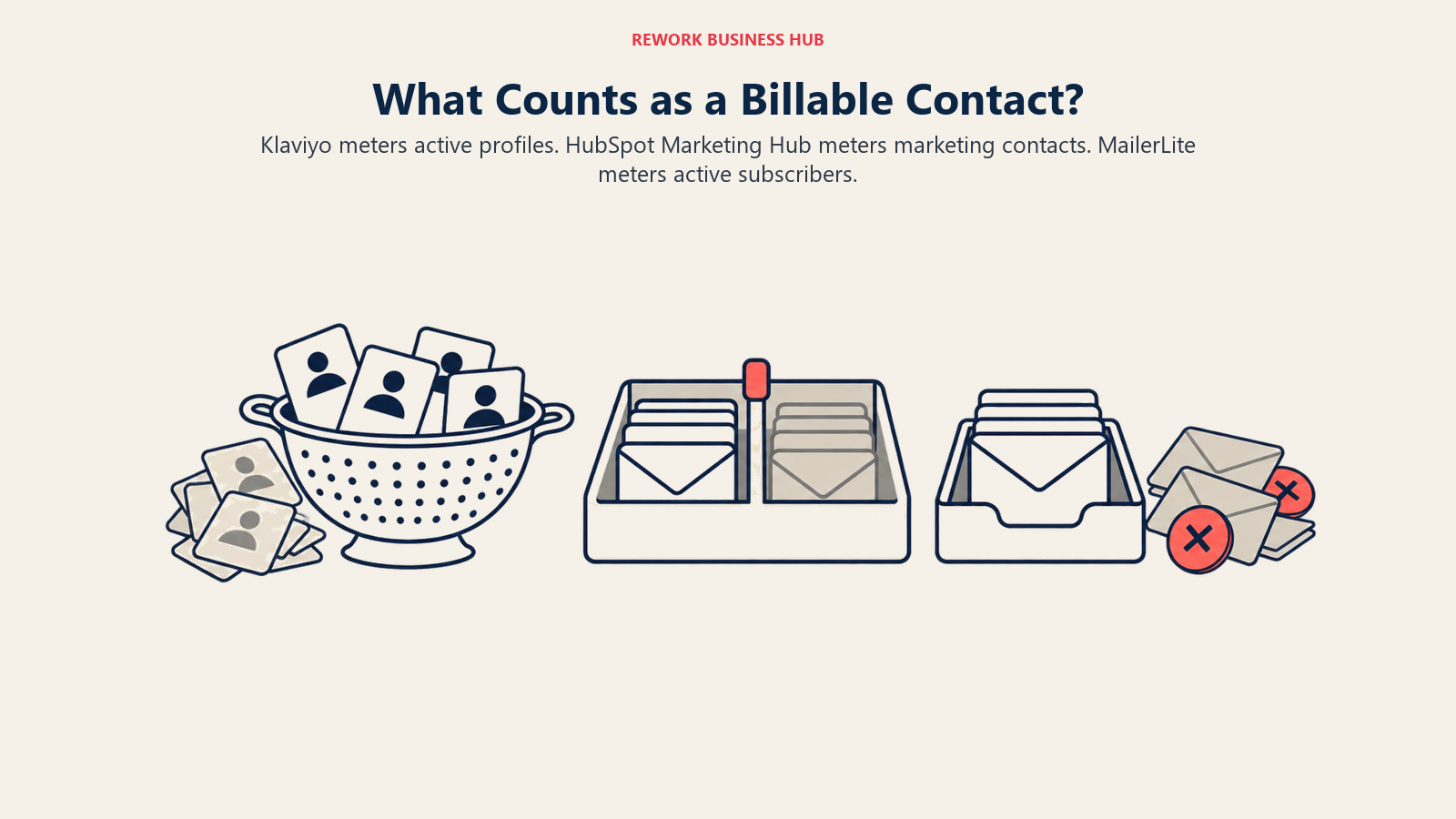
Every pricing page here leads with its cheapest number, and none of the three meter your bill the same way, so the sticker price alone tells you almost nothing. Here's exactly what counts toward what you pay on each, per each vendor's own source.
| Klaviyo | HubSpot Marketing Hub | MailerLite | |
|---|---|---|---|
| What counts toward your bill | Active profiles: anyone who can be emailed, opted in or not, as long as they haven't been suppressed | Marketing contacts: anyone targeted with a marketing email or ad in the billing period | Active subscribers: anyone who hasn't unsubscribed or bounced |
| Unsubscribed contacts | Excluded once processed (up to 72 hours to refresh) | Convert to non-marketing status; stored free, not billed | Excluded |
| Bounced contacts | Excluded once suppressed | Convert to non-marketing status | Excluded |
| Non-marketing / CRM-only contacts | Not a separate category on Klaviyo | Stored free for reporting and sales use, up to 15 million per account | Not a separate category on MailerLite |
| Source | Klaviyo Help Center | HubSpot's marketing contacts pricing catalog | MailerLite pricing page |
That difference is worth real money on a list with any churn. A brand with 30,000 signups but 10,000 hard bounces and unsubscribes pays for roughly 20,000 on Klaviyo or MailerLite, but a HubSpot account with the same churn keeps those 10,000 dead contacts free, since they simply stop counting as marketing contacts.
Pricing at 5,000 contacts
| Platform / tier | Monthly billing | Annual billing (monthly equivalent) | What's included |
|---|---|---|---|
| Klaviyo Email | $100/month | Not offered; Klaviyo's self-serve Email plan has no annual-prepay discount | 50,000 emails/month |
| HubSpot Starter (1 seat) | $210/month ($20 seat plus $190 in contact tiers) | Same rate; the billing-period toggle mainly affects Professional and Enterprise | 1 seat, basic drip only, no CRM automation |
| HubSpot Professional (3 seats) | $1,040/month ($890 plus $150 in contact tiers) | $950/month ($800 plus $150) | 3 seats, full automation; $3,000 one-time onboarding not included |
| HubSpot Enterprise (5 seats) | $3,600/month | $3,600/month (sold as an annual contract) | 5 seats, already covers up to 10,000 contacts; $7,000 one-time onboarding not included |
| MailerLite Comfort | $49/month | $44.10/month | 50,000 emails/month, 3 seats, 50 automations |
| MailerLite Power | $69/month | $62.10/month | Unlimited emails, seats, and automations |
MailerLite wins on price by a wide margin here, and it isn't close. HubSpot Starter looks competitive with Klaviyo on paper, but it buys a single seat and no real automation builder, the actual reason most teams look at HubSpot in the first place.
Pricing at 50,000 contacts
| Platform / tier | Monthly billing | Annual billing (monthly equivalent) | What's included |
|---|---|---|---|
| Klaviyo Email | $720/month | Not offered | 500,000 emails/month |
| HubSpot Starter (1 seat) | $2,010/month | Same rate | Not a realistic tier at this size; shown for scale only |
| HubSpot Professional (3 seats) | $3,110/month | $3,020/month | 3 seats, full automation |
| HubSpot Enterprise (5 seats) | $4,000/month | $4,000/month | 5 seats |
| MailerLite Comfort | $319/month | $287.10/month | 500,000 emails/month |
| MailerLite Power | $389/month | $350.10/month | Unlimited emails |
MailerLite still leads on raw price, but Klaviyo's gap narrows once you weigh what it buys: revenue attribution and store-triggered flows that neither MailerLite nor a standalone HubSpot subscription is built to do. HubSpot Professional has grown to more than 6 times Klaviyo's rate for the same list size, before the onboarding fee even enters the math.
Pricing at 250,000 contacts
This is where the sticker-price story falls apart, and it's the most useful thing this comparison can show you.
| Platform / tier | Monthly cost | Notes |
|---|---|---|
| Klaviyo Email | Not published | Klaviyo's self-serve calculator tops out at 150,000 profiles ($1,955/month) and routes anything larger to a custom Enterprise quote |
| HubSpot Starter (1 seat) | $10,010/month, per the published schedule | Not a realistic tier at this size; shown for scale only |
| HubSpot Professional (3 seats) | $9,330/month monthly-pay, $9,240/month annual-pay, per the published overage schedule | HubSpot would almost certainly route a list this size to Enterprise in practice |
| HubSpot Enterprise (5 seats) | $5,600/month | The cheapest of HubSpot's own three tiers at this size, since its per-contact overage rate keeps falling as the list grows |
| MailerLite Comfort or Power | Not published | MailerLite's self-serve calculator tops out at 200,000 subscribers ($819 to $1,119/month) and routes anything larger to a custom Enterprise quote |
None of the three vendors publish a self-serve price at 250,000 contacts. Klaviyo and MailerLite both cap their public calculators well below that size and hand you to a sales conversation instead. HubSpot is the only one with a fully published number this high, and only because its contact-tier schedule technically extends that far; a list this size is a strong Enterprise candidate regardless, and Enterprise beats Professional here because its per-contact rate drops faster as volume climbs. Anywhere near this size, budget for a real sales conversation, not a number off a pricing page.
Send volume is a separate limit from contact count, and each platform handles it differently
| Klaviyo | HubSpot Marketing Hub | MailerLite | |
|---|---|---|---|
| What caps how much you can send | 10x your active profile count in emails per month, on every paid tier | Nothing formal by volume; the meter is which contacts you marketed to, not how many emails went out | Comfort: 10x your subscriber tier; Power: unlimited, subject to a fair-use policy |
| Example at 50,000 contacts | 500,000 emails/month included | Effectively unlimited sends to your marketable contacts | Comfort: 500,000/month; Power: unlimited |
| If you need more sends than your contact count implies | Move up a profile tier, since the send cap scales with it | Not applicable; this isn't how HubSpot bills | Move to Power, or a higher Comfort tier |
Implementation and Change Management
All three require the same groundwork before day one matters: authenticate your sending domain with SPF, DKIM, and a DMARC record. Google has required this for any sender pushing more than 5,000 messages a day to Gmail addresses since February 1, 2024, and it applies no matter which of these three platforms sends the mail, according to Google's own email sender guidelines. None of the three do that DNS setup for you, and skipping it is the single most common reason a migration tanks deliverability in week one.
| Klaviyo | HubSpot Marketing Hub | MailerLite | |
|---|---|---|---|
| List import | CSV, or a native re-sync from Shopify/WooCommerce | CSV import or CRM sync; properties need mapping, not just addresses | CSV import |
| Warm-up needed | Yes, domain and any new dedicated IP | Yes, same DNS requirement as any platform | Yes, standard practice regardless of platform |
| What transfers automatically | Contacts and consent status only | Contacts and basic properties; pipeline structure is modeled by hand | Contacts and consent status only |
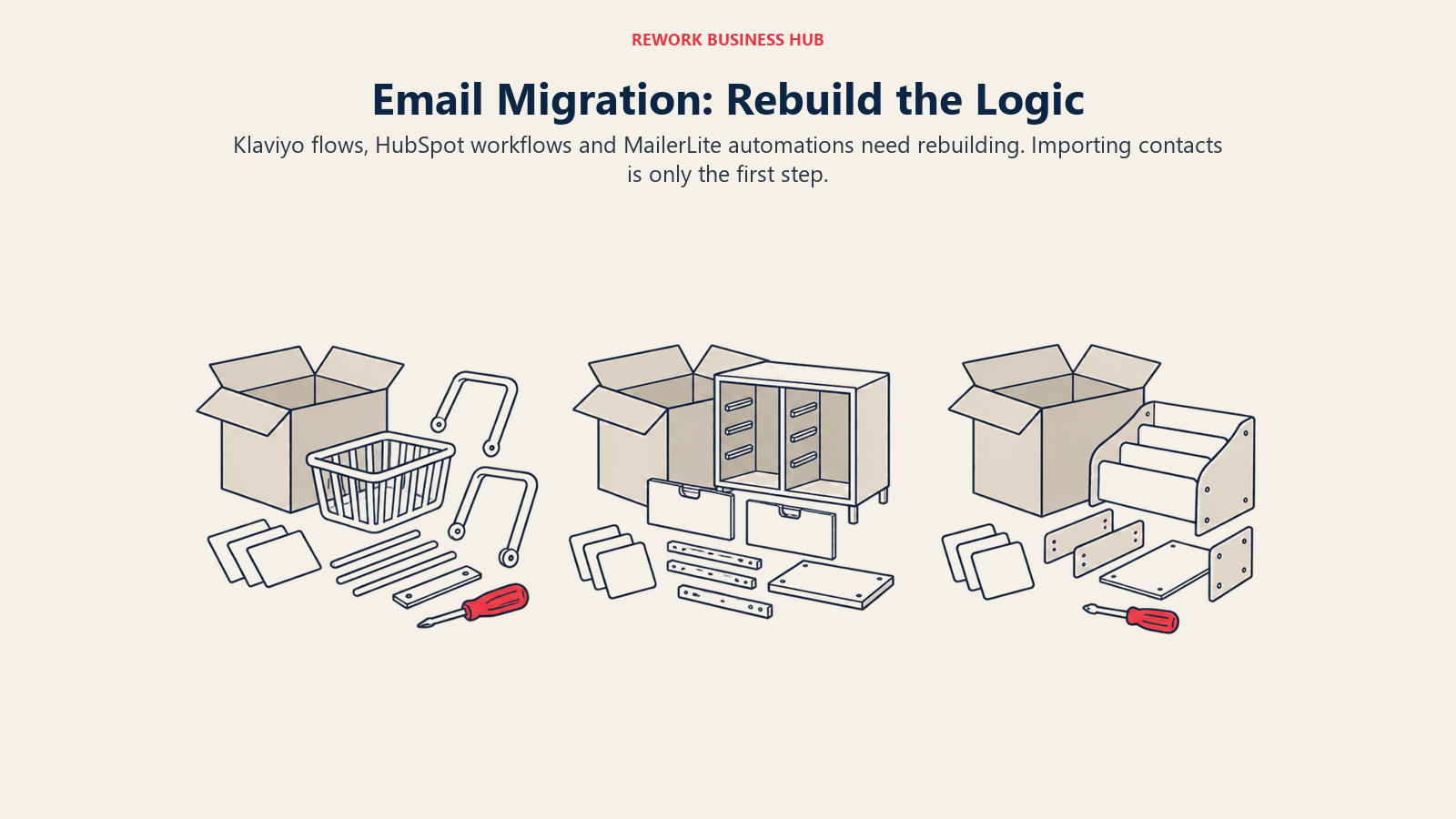
| What you rebuild by hand | Every flow's trigger logic, tied to store events | Every workflow, form, and landing page, plus CRM structure | Every automation's trigger logic |
| Heaviest migration direction | Moving off Klaviyo once flows are tied to store data | Moving on or off HubSpot; you're migrating a CRM, not just an inbox | Lightest of the three; no CRM structure to rebuild |
| Realistic parallel-run window | 2 to 4 weeks | 4 to 8 weeks for Professional/Enterprise with CRM migration | 1 to 2 weeks |
None of the three import a competitor's automation logic. Whatever flow, workflow, or automation trigger you rely on today gets rebuilt from scratch, a real project even when the contact import itself takes an afternoon. Budget that rebuild time separately from the switch date, and don't cut over fully until a real campaign has sent and landed from the new platform.
Risk and Governance
Dedicated IPs exist on all three, but none of them hand one out by default
| Klaviyo | HubSpot Marketing Hub | MailerLite | |
|---|---|---|---|
| Dedicated IP available | Yes, but not self-serve at any published tier | Yes, as a paid add-on | Yes, Enterprise only |
| How you get one | Case-by-case approval through your Customer Success Manager, aimed at high-volume, consistent senders | Purchase the Dedicated IP Address Add-On on Professional or Enterprise; HubSpot suggests it once you're past 100,000 messages a month | Included only on a custom Enterprise contract (200,000+ subscribers) |
| Warm-up period | 30 days | Auto-managed based on contact engagement; no fixed day count published | Not published |
| Price | Not published | Not published, contact sales | Not published, contact sales |
| Source | Klaviyo Help Center: dedicated vs. shared IPs | HubSpot's dedicated IP product page | MailerLite pricing page |
If consistent inbox placement at scale matters more than any pricing-table number above, none of the three make it easy to buy off a shelf; all three gate it behind a sales conversation and steady, meaningful send volume first.
Ownership and lock-in
| Klaviyo | HubSpot Marketing Hub | MailerLite | |
|---|---|---|---|
| Ownership | Publicly traded, NYSE: KVYO, since September 2023 | Publicly traded, NASDAQ: HUBS | Owned by Vercom S.A., part of Poland's cyber_Folks group |
| Contract structure | Month-to-month self-serve; custom terms above 150,000 profiles | Starter is flexible; Professional and Enterprise both carry a mandatory one-time onboarding fee, and Enterprise is an annual contract | Month-to-month or annual (10% discount); Enterprise is a custom annual contract |
| Lock-in risk | High once flows are deeply tied to store event data | Highest of the three; you're tied to a CRM, not just an inbox tool | Lowest; contacts and a shallower feature set move to a competitor fastest |
None carry an obvious shutdown risk. But "who owns this" is still worth checking before you commit, since a company that looked independent two years ago isn't necessarily independent today.
When Klaviyo Is the Right Call
- You run a Shopify or WooCommerce store and want every flow's revenue traceable to an actual purchase, not just an open or a click
- Your highest-value sends trigger off real store events (an abandoned cart, a browsed product, a post-purchase window), not a calendar
- The premium over MailerLite is smaller than what a manual reporting workaround would cost your team
- SMS and email need to run off the same purchase data, even paying per message
When HubSpot Marketing Hub Is the Right Call
- Marketing and sales genuinely need to work off the same contact record, not a shared spreadsheet export
- You're building a full funnel, forms, landing pages, ad attribution, and nurture, in one connected system instead of four stitched-together tools
- You've budgeted the $3,000 or $7,000 onboarding fee as a real line item, not a surprise found after signing
- Someone owns CRM hygiene, since the platform's value depends on the contact record staying clean
When MailerLite Is the Right Call
- Your list is a few thousand to a few tens of thousands of contacts, and the monthly bill is a real constraint
- You need real, multi-step automation but don't have a marketing ops hire to build something as deep as Klaviyo's flows or HubSpot's workflows
- You don't need a CRM, store-data attribution, or SMS, just good email sent reliably and cheaply
- Vendor independence isn't a dealbreaker, since MailerLite now operates under Vercom and cyber_Folks rather than as a standalone company
Decision Framework
| If you are... | Pick |
|---|---|
| A DTC or ecommerce brand on Shopify or WooCommerce wanting revenue attributed to each send | Klaviyo |
| A B2B marketing team that wants CRM, forms, landing pages, and email on one record | HubSpot Marketing Hub |
| A creator, solopreneur, or small team watching every dollar of the software budget | MailerLite |
| Growing past a few thousand contacts and still weighing automation depth against price | Model your real contact count through the tables above; the ranking isn't the same at every size |
| About to pay a $3,000 or $7,000 onboarding fee just to unlock automation | Confirm you actually need the CRM first; Klaviyo and MailerLite both offer real automation without one |
| Approaching 250,000 contacts | None of the three publish self-serve pricing at that size; budget for a sales conversation regardless of which you pick |
| Comparing more than these three platforms | See the best email marketing software roundup |
The verdict: if revenue attribution on purchase-triggered flows is the job, Klaviyo is worth its premium over MailerLite at every size tested. If the job is unifying marketing and sales on one contact record, HubSpot is the only one of the three actually built for that, and the onboarding fee is the cost of buying a CRM, not an email tool. If the job is just sending good email without the bill creeping past what the list is worth, MailerLite wins on price at 5,000 and 50,000 contacts by a wide enough margin that the other two need a specific reason to justify the gap.
What to Do Next
Pull your actual contact count and churn rate (unsubscribes and bounces as a share of your list), not next year's target, and run both through the tables above; the ranking moves with list size more than with any feature comparison. If you're leaning Klaviyo or MailerLite, build one real flow or automation with your own data during the trial before committing annually. If you're leaning HubSpot, get the $3,000 or $7,000 onboarding fee written into your budget approval before you sign, since it's easy to miss on a page that leads with the monthly number.
For the wider field, the best email marketing software roundup ranks 12 platforms by fit. If Klaviyo's pricing curve is the sticking point, best Klaviyo alternatives covers 10 other options. If MailerLite's free plan turned out smaller than you expected, best MailerLite alternatives compares 14 tools on exactly that. If HubSpot is more platform than you need, best HubSpot alternatives covers lower-cost ways to get marketing and CRM data talking to each other. For a broader buying framework rather than these three vendors, see how to choose email marketing software for ecommerce, how to choose an all-in-one marketing platform, or how to choose email marketing software for a small business.
Frequently Asked Questions about Klaviyo vs HubSpot Marketing Hub vs MailerLite
Is Klaviyo, HubSpot Marketing Hub, or MailerLite cheapest?
At 5,000 and 50,000 contacts, MailerLite is cheapest by far, from $49 to $319 a month on Comfort billed monthly (or $44.10 to $287.10 billed annually). Klaviyo sits in the middle, from $100 to $720. HubSpot costs the most once you pick a tier that actually automates, partly because Professional and Enterprise both carry a one-time onboarding fee. At 250,000 contacts the story flips: neither Klaviyo nor MailerLite publishes a self-serve price that high, so HubSpot Enterprise, at $5,600 a month, is the only published number left standing.
What counts as a billable contact on each platform?
Klaviyo bills "active profiles," anyone who can be emailed whether opted in or not, as long as they aren't suppressed. HubSpot bills "marketing contacts," anyone targeted with a marketing email or ad; non-marketing contacts store free, up to 15 million per account. MailerLite bills "active subscribers" only, so unsubscribed or bounced contacts never count.
Does HubSpot Marketing Hub really charge an onboarding fee?
Yes. HubSpot's own pricing page states plainly that Professional carries a required, one-time onboarding fee of $3,000, and Enterprise carries a required, one-time onboarding fee of $7,000, neither included in the monthly price shown on the page.
Which of the three offers a dedicated sending IP?
All three technically offer one, but none hand it out by default. Klaviyo approves dedicated IPs case by case through your Customer Success Manager, mainly for high-volume, consistent senders. HubSpot sells a Dedicated IP Add-On on Professional and Enterprise, recommended past 100,000 messages a month. MailerLite reserves it for Enterprise customers only. None publish a price for it.
Is MailerLite still an independent company?
No. MailerLite was acquired by Vercom S.A., a Polish communications software company that's part of the cyber_Folks group, confirmed by MailerLite's own leadership page, which lists a Chief Legal Officer shared across MailerLite and Vercom. The product and pricing haven't changed, but it's worth knowing if vendor independence matters to your evaluation.
How hard is it to migrate between these three?
Moving contacts is easy on all three, a CSV import or a native connector. What doesn't move is the logic: Klaviyo's flows, HubSpot's workflows and CRM structure, and MailerLite's automations all get rebuilt by hand, since none imports a competitor's trigger logic. Moving on or off HubSpot is the heaviest lift, since you're migrating a CRM's worth of data, not just a list.
Can Klaviyo or MailerLite replace a CRM the way HubSpot can?
No. Klaviyo has no deal pipeline, and MailerLite's contact management doesn't go beyond tags and segments. If marketing and sales can't see the same record, HubSpot is what's actually built to fix that. If the problem is just sending good email, buying a CRM's worth of platform to solve it is the expensive way to get there.
What if my company doesn't fit neatly into ecommerce, B2B, or lean-budget categories?
Weigh it by what you'd miss most. If losing revenue attribution on a purchase-triggered flow would hurt, lean Klaviyo. If losing a shared record between marketing and sales would hurt, lean HubSpot. If the monthly bill is the actual constraint right now, lean MailerLite and revisit once that constraint changes.

Principal Product Marketing Strategist
On this page
- TL;DR
- What Each Tool Is Actually Built For
- Klaviyo: revenue is the entire design principle
- HubSpot Marketing Hub: email is one seat at a bigger table
- MailerLite: cheap, clean, and not pretending otherwise
- Decision by Business Goal
- Team and Role Fit
- Pricing at 5,000, 50,000, and 250,000 Contacts
- Pricing at 5,000 contacts
- Pricing at 50,000 contacts
- Pricing at 250,000 contacts
- Send volume is a separate limit from contact count, and each platform handles it differently
- Implementation and Change Management
- Risk and Governance
- Dedicated IPs exist on all three, but none of them hand one out by default
- Ownership and lock-in
- When Klaviyo Is the Right Call
- When HubSpot Marketing Hub Is the Right Call
- When MailerLite Is the Right Call
- Decision Framework
- What to Do Next