iSpring Learn vs LearnUpon vs Litmos: Which LMS Fits Your Training Job in 2026?
Turn this article into takeaways for your work.


Each assistant summarizes the article only for you and suggests best practices for your work.
These three keep landing on the same shortlist for an odd reason: they rarely compete for the same buyer, yet search treats them as interchangeable. iSpring Learn gets found by L&D teams who already build courses in PowerPoint and want a delivery platform that doesn't fight that workflow. LearnUpon gets found by companies that discover, usually the hard way, that training employees and training customers aren't the same job and shouldn't share one login. Litmos gets found by HR and compliance teams that need to prove, on demand, a named person completed a named course by a named date. Side by side, the "winner" changes completely depending on which of those three jobs you're actually hiring an LMS to do.
This guide is for the L&D director, CHRO, or training manager who has to write the requisition and defend it through procurement. It compares the three at the level that decides most real purchases and gets skipped in a demo: what SCORM and xAPI content survives import intact, how reporting holds up in a compliance audit, whether learner records survive a future migration, how SSO and HRIS provisioning actually work, and what training looks like for people who don't sit at a desk. Every price below comes from the vendor's own pricing page, and Litmos's ownership gets its own section since it changed in a way that still confuses buyers years later. Haven't narrowed the category yet? Start with the LMS software roundup for 2026 first.
Key Facts
- Organizations with a high-development culture report 11% greater profitability and are twice as likely to retain their employees, according to Gallup.
- 88% of organizations are concerned about employee retention, and providing learning opportunities is their number one retention strategy, per LinkedIn Learning's Workplace Learning Report.
- 59 of every 100 workers worldwide will need reskilling or upskilling by 2030, according to the World Economic Forum's Future of Jobs Report 2025.
- Average direct learning expenditure ran $846 per employee in 2025, per ATD's 2026 State of the Industry report.
- Total US training expenditure rose 4.9% to $102.8 billion in 2025, according to Training Magazine's 2025 Training Industry Report.
TL;DR
| iSpring Learn | LearnUpon | Litmos | |
|---|---|---|---|
| Built for | Teams authoring their own courses, often already on iSpring's PowerPoint-based tools | Companies training employees, customers, and partners from one login | Mid-market and enterprise teams that need audit-ready compliance training |
| Pricing model | Published, billed annually per active user, in 100/300/500-user bands | Not published. Quote-only, with stated minimum user counts by audience | Not published. Quote-only, no minimums stated at any tier |
| Entry price (published) | $6.91/active user/month at 100 users ($8,286/year) | None published. Employees plan starts "From 100 Users" | None published at any of its three tiers |
| SCORM / xAPI | SCORM, AICC, and cmi5 native; xAPI followed through a proprietary layer, not full compliance | SCORM 1.2/2004 plus full xAPI (Tin Can) support | SCORM, xAPI, and AICC, per the vendor's own platform page |
| Ownership | Privately held, iSpring Solutions | Privately held, LearnUpon | Independent since December 2022, owned by Francisco Partners after the SAP divestiture |
| Best for | Course-heavy programs already invested in iSpring's authoring tools | Companies running employee, customer, and partner training as separate programs | Compliance and audit-heavy programs that want a large pre-built content library |
What Each Tool Is Actually Built For
iSpring built its name on iSpring Suite, a PowerPoint-based authoring tool many L&D teams already use before they ever shop for an LMS. iSpring Learn is the delivery half: courses built in iSpring's tools, or any SCORM package, land in a platform with tracking, quizzes, certificates, and reporting on top, no separate authoring purchase to coordinate. If your team already has subject-matter experts building slides, iSpring Learn gets a course live faster than a tool that asks you to learn a new authoring paradigm first.
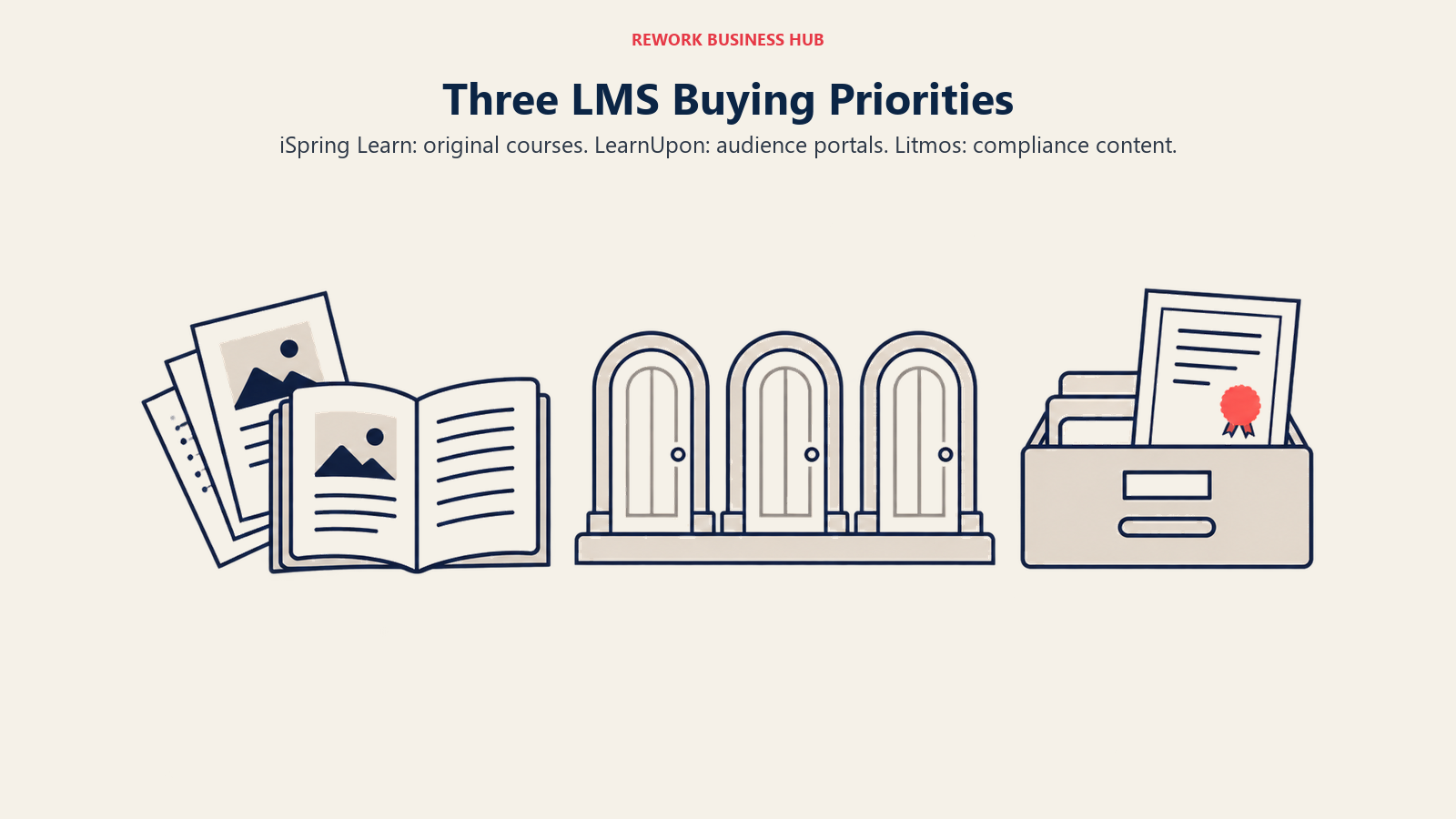
LearnUpon starts from a different premise: most companies eventually train three different audiences, employees, customers, and partners, and shouldn't need three different platforms to do it. Its "portals" architecture lets one admin backend run separate, separately branded experiences for each audience, with reporting rolling up centrally, the honest differentiator against employee-only platforms, and why LearnUpon shows up repeatedly across this collection when a buyer's real problem is running more than one training program at once.
Litmos is the broad, off-the-shelf corporate LMS of the three: a large library of ready-made compliance and soft-skills content, an AI authoring tool for building mobile-responsive SCORM courses without much design work, and reporting aimed squarely at proving training happened on schedule. It also carries an ownership story worth getting right before you shortlist it.
| iSpring Learn | LearnUpon | Litmos | |
|---|---|---|---|
| Primary use case | Deliver and track courses authored in iSpring Suite, or any SCORM/AICC package | Run separate branded training portals for employees, customers, and partners | Deploy a large pre-built compliance and soft-skills library fast, with an audit trail |
| Ideal buyer | An L&D team of one or two, already fluent in PowerPoint-based authoring | A company formalizing customer education or partner enablement on top of internal training | An HR or compliance function that has to prove training happened on a schedule |
| Company stage | Small to mid-size, actively building an original course library | Mid-market, past the point where one course library for everyone makes sense | Established mid-market to enterprise, with an existing compliance mandate |
What Changed at Litmos That Still Confuses Buyers
For years this product was marketed as SAP Litmos, and plenty of shortlists still name it that way out of habit. That ownership ended when SAP agreed to sell the Litmos business to the private equity firm Francisco Partners in August 2022; the deal completed December 1, 2022, and Litmos became independent, with Francisco Partners pledging investment in the team, product, and customer success (SAP News, Francisco Partners, Litmos's own blog). Checking litmos.com directly in August 2026 confirms it stuck: no SAP branding anywhere, "The Learning Acceleration Platform" as the tagline, and a footer reading simply "©2026 Litmos. All Rights Reserved." The product and the company are both just Litmos now.
| What it used to mean | What it means now | |
|---|---|---|
| Product name | SAP Litmos | Litmos |
| Owner | SAP | Francisco Partners (private equity), independent since December 1, 2022 |
| Why buyers cared | Tight integration with SAP SuccessFactors for SAP-standardized enterprises | Confirm current SuccessFactors integration depth directly; it's no longer a default part of the pitch |
The practical read: don't shortlist Litmos today for tighter SAP integration, that was the old pitch and may not hold at the same depth anymore. Evaluate it as an independent vendor on its own product and roadmap, and confirm current SuccessFactors integration scope directly with sales.
Decision by Business Goal
| Your situation | Best fit | Why |
|---|---|---|
| Subject-matter experts already build slides, and you want them shipping courses without learning a new authoring tool | iSpring Learn | Delivery pairs directly with iSpring Suite's PowerPoint-based authoring, and pricing is the only one of the three you can model without a call |
| You train employees today and are about to formalize a paid customer certification or partner program | LearnUpon | Purpose-built, separately branded portals per audience, with reporting rolled up centrally |
| Legal, safety, or HR needs a defensible record that named people completed named training by a deadline | Litmos | Compliance workflows and audit readiness are the core pitch, backed by a large pre-built content library |
| You want a real number for a budget spreadsheet before a sales call | iSpring Learn (at 500 users or fewer) | The only one of the three publishing per-user rates; the others are quote-only regardless of size |
| You're scaling toward 2,000 learners and expect to negotiate anyway | Any of the three | All three become a sales conversation above roughly 500 users; iSpring's pricing transparency stops mattering at that scale |
Team and Role Fit
| Role | iSpring Learn | LearnUpon | Litmos |
|---|---|---|---|
| L&D / instructional designer | Strong. Authoring and delivery live together | Moderate. Author elsewhere, deliver and track here | Moderate. Leans on the pre-built library over original authoring |
| HR / compliance lead | Workable for smaller compliance programs | Workable if compliance is one of several audiences | Strongest fit. Audit and certification tracking are the core sell |
| Customer education / partner enablement owner | Weak. No distinct external-audience portal | Strongest fit. Purpose-built multi-portal architecture | Workable via the add-on content library, not purpose-built for it |
SCORM, xAPI, and What Actually Breaks on Import
Every vendor here claims standards support in a marketing sentence. What matters more is what happens the day you upload a real course built somewhere else, and none of the three publishes a clean, comparable answer to that on its pricing page.
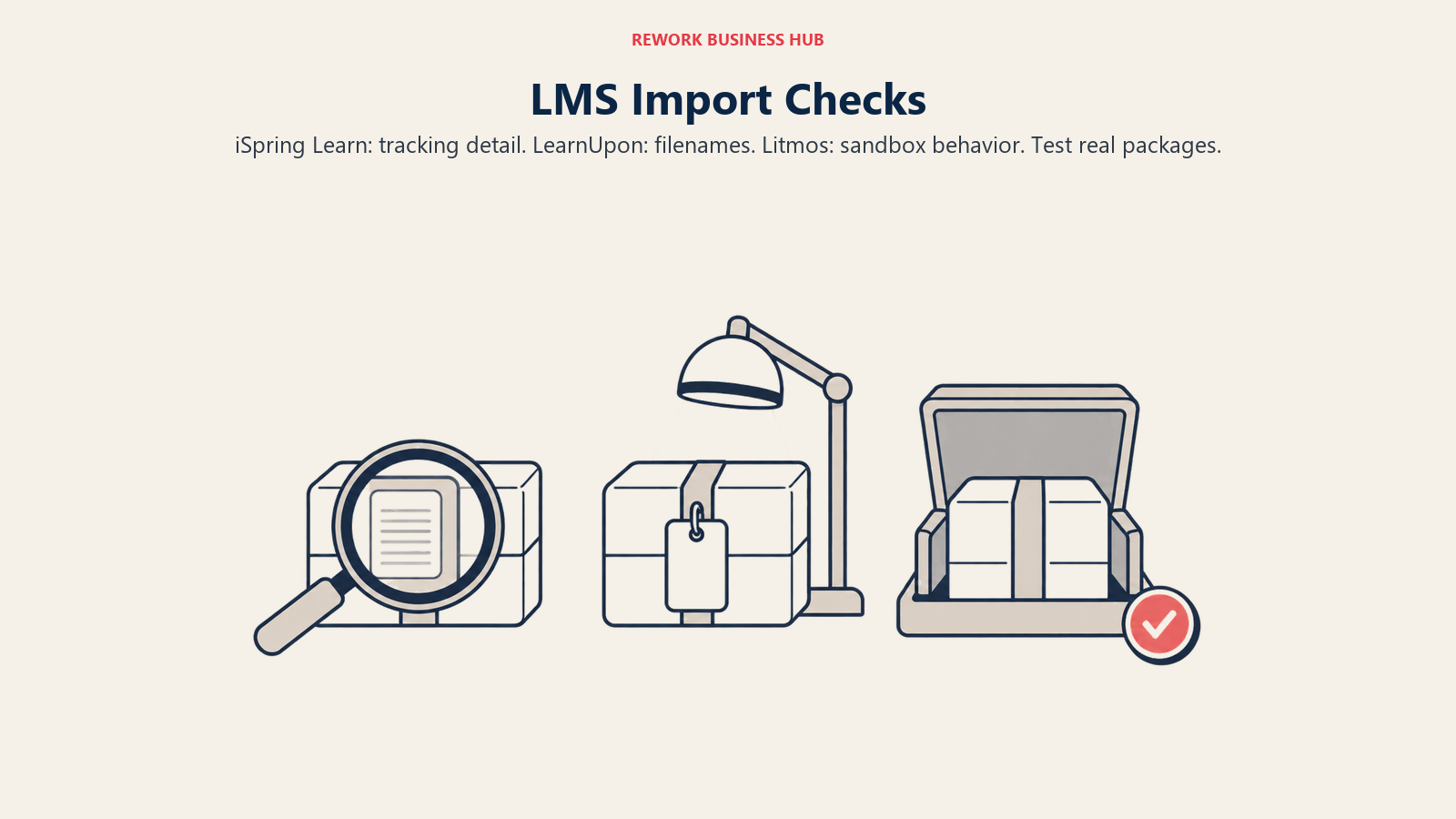
iSpring Learn supports SCORM 1.2 and 2004, AICC, and cmi5 natively. Its own documentation admits xAPI runs through a proprietary course-communication layer, not full compliance, capturing basic progress rather than rich xAPI statements (iSpring Solutions); content from a different xAPI-native tool may track less detail once it lands here. LearnUpon supports SCORM 1.2/2004 plus full xAPI (LearnUpon support), with one real friction point: its troubleshooting docs state SCORM filenames can't contain UTF-8 characters (LearnUpon support), a small thing until a course built by a non-English-speaking team fails to encode over an accented filename.
Litmos states SCORM, xAPI, and AICC support directly on its own platform page (Litmos) and separately documents an AI authoring tool for building mobile-responsive SCORM courses in-platform. It doesn't publish a list of known import quirks the way LearnUpon does; treat that as a gap to close in a sandbox, not evidence there isn't one.
| iSpring Learn | LearnUpon | Litmos | |
|---|---|---|---|
| SCORM | 1.2 and 2004, native | 1.2 and 2004, native | Supported, per the vendor's platform page |
| xAPI (Tin Can) | Follows xAPI principles through a proprietary layer, not full compliance | Full xAPI support alongside SCORM | Supported, per the vendor's platform page |
| AICC / cmi5 | Both supported | Not detailed on public pages | AICC supported; cmi5 not detailed publicly |
| What actually breaks on import | Content built in another xAPI tool may report only basic progress once it lands here | SCORM filenames with UTF-8 characters fail to import, per the vendor's own troubleshooting doc | No public list of known quirks; test a real course in a sandbox before rollout |
Compliance Reporting, Audit Trails, and Migration
A real compliance audit doesn't care about a feature list. It wants a named person, a named course, a timestamp, and proof the certificate hadn't expired when the work happened. All three offer certificates and completion tracking, but they're not equally built around defending that record later.
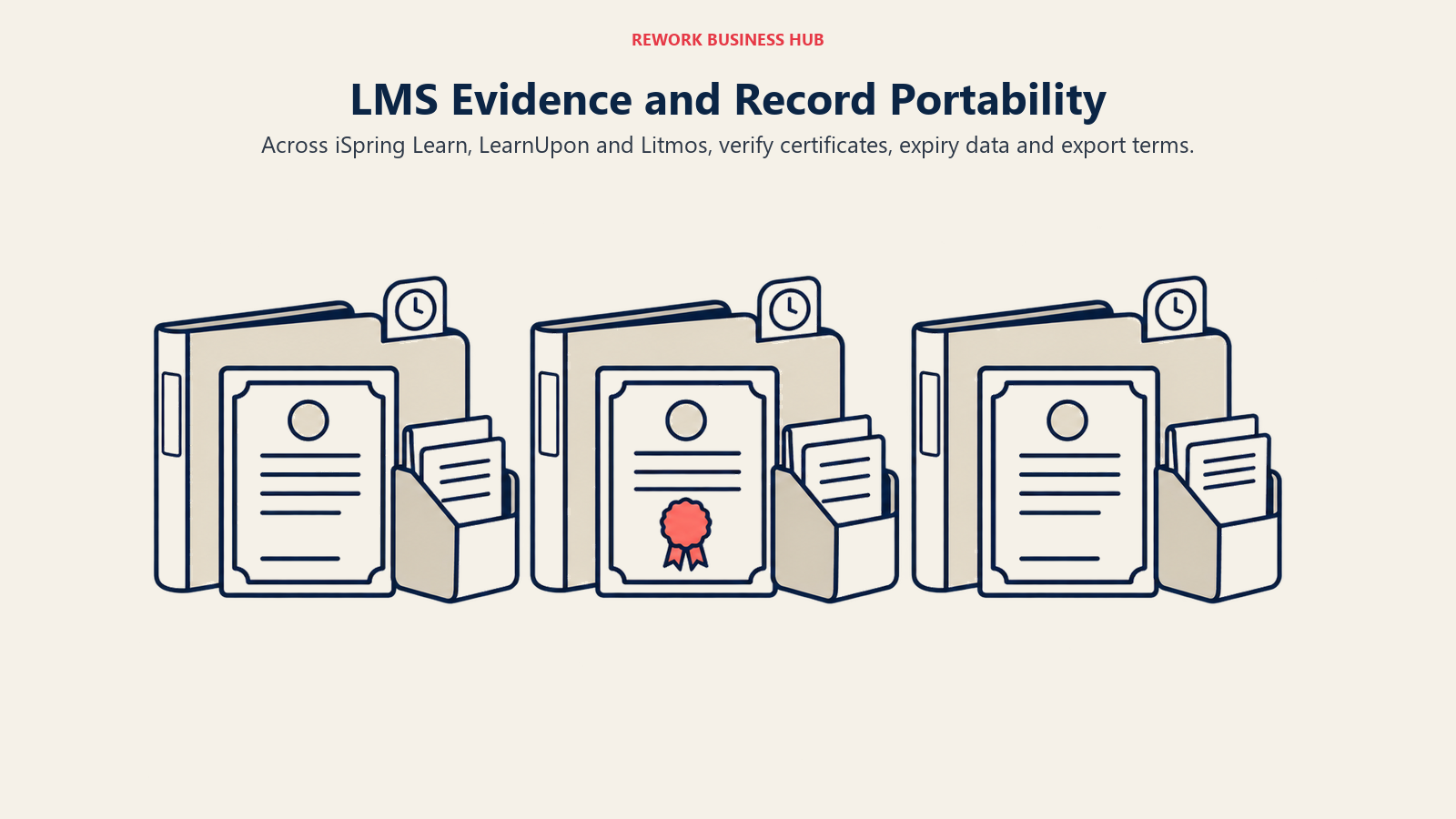
Litmos markets audit readiness directly: its platform page promises to "automate compliance management, certifications, and audit readiness," citing a customer, Russel Mineral Equipment, reaching 99% compliance within a year (Litmos), a vendor-published claim worth testing yourself, not taking as a guarantee. iSpring Learn layers certificates and quiz results on course completion, with active-user login data as secondary evidence. LearnUpon's certification tracking targets the same use case, with centralized reporting across every portal, useful if your obligation spans employees and partners at once.
The gap that applies to all three: none publishes a public data-export or migration policy. If you ever leave, what format do records and expiry dates come out in, and who keeps historical data after cancellation? Get it in writing during procurement.
| iSpring Learn | LearnUpon | Litmos | |
|---|---|---|---|
| Certificates & expiry tracking | Yes, layered on courses and quizzes | Yes, positioned for certification-based training | Yes, core to the compliance pitch |
| Audit-ready reporting | Active-user login data plus course/quiz completion | Centralized reporting across every portal | Marketed explicitly as audit readiness, with a vendor-published customer case study |
| Published data-export / migration policy | Not published | Not published | Not published |
| What to ask before signing | How complete records export if you ever leave | Whether reporting rolls up identically across all portal types | Whether the cited case study's headcount and industry actually match yours |
Identity, Provisioning, and Where Your Team Actually Learns
Single Sign-On and HRIS Provisioning
Manual account creation is the first thing that breaks once a rollout passes a few dozen people. LearnUpon is the most transparent here: its knowledge base documents SAML 2.0 SSO (LearnUpon support) plus OpenID Connect, and named HRIS connectors, including BambooHR, Salesforce, and HubSpot, that auto-provision learners. iSpring Learn and Litmos both claim identity integrations in broader marketing but publish no comparable connector detail, so confirm specifics for your actual HRIS with sales.
| iSpring Learn | LearnUpon | Litmos | |
|---|---|---|---|
| SSO | Supported; specifics not detailed on public pages | SAML 2.0 and OpenID Connect, documented publicly | Enterprise identity integrations claimed; confirm specifics with sales |
| HRIS auto-provisioning | Not detailed publicly | Named connectors (BambooHR, Salesforce, HubSpot) with attribute mapping | Not detailed publicly |
If you haven't settled on the HRIS these connectors need to talk to yet, the standalone-LMS question might be premature; our HR software roundup covers that category from scratch.
Mobile and Offline Learning for Deskless Staff
Field techs, retail staff, and warehouse crews don't sit at a desk with reliable Wi-Fi, so offline capability matters for a meaningful share of the audience these tools serve. iSpring Learn ships a free native app with full offline access, syncing progress once back online (iSpring Solutions). Litmos names the feature directly, Offline SCORM Module Viewing on Mobile App: learners download a module, complete it offline, and results transmit on the next relaunch (Litmos Help Center). LearnUpon ships native iOS and Android apps with downloadable, offline-capable courses too (LearnUpon support), though reviewers describe its offline experience as lighter than tools built specifically for frontline training, worth a direct test if that's your primary need.
| iSpring Learn | LearnUpon | Litmos | |
|---|---|---|---|
| Native mobile app | Yes, free, iOS and Android | Yes, iOS and Android | Yes |
| Offline access | Full offline course access built into the app | Courses download for offline use, with progress syncing on reconnect | Offline SCORM module viewing is a named, documented feature |
Pricing at 100, 500, and 2,000 Learners
None of these three gets priced the same way, and treating their numbers as apples-to-apples is how a budget goes wrong. iSpring Learn bills per active user (someone who logs in at least once in a given month) on a published rate card, so you can calculate an exact annual number before talking to sales. LearnUpon doesn't publish a rate at all, only floors: minimum user counts by which audience you're training, with the actual fee appearing once you're in a quote. Litmos publishes nothing, not even a floor, three tiers all displaying "Contact for Pricing" with no stated minimum anywhere. Before comparing a dollar figure across these three, know what you're even being charged for: a logged-in active user, a registered seat against a stated minimum, or a fully negotiated fee.
| Learners | iSpring Learn | LearnUpon | Litmos |
|---|---|---|---|
| 100 | $6.91/active user/month, $8,286/year (published, Business plan, billed annually) | Quote only. Clears the "From 100 Users" floor for the Employees plan; no dollar figure published | Quote only. No minimum published at any tier |
| 500 | $3.97/active user/month, $23,790/year (published, Business plan's top band) | Quote only. Clears every published floor across all three portal types; no dollar figure published | Quote only. No minimum published at any tier |
| 2,000 | Quote only. Above the published 500-user band, iSpring moves to a custom Enterprise quote | Quote only. No dollar figure published at any size | Quote only. No minimum published at any tier |
Notice what happens between the top row and the bottom one. At 100 and 500 learners, iSpring Learn is the only vendor willing to put a number on its own website, real transparency you can budget against without booking a call. At 2,000 learners that advantage disappears: iSpring's published bands stop at 500 users, so all three route you to the same place, a sales conversation. Under 500 learners, iSpring's transparency is a genuine differentiator. Planning for 2,000 from the start, don't let it drive the decision, since it won't survive contact with your actual scale, and budget time for a real negotiation with all three.
Implementation and Change Management
iSpring Learn moves fastest for teams already producing content in PowerPoint or iSpring Suite, no new authoring paradigm to learn alongside a new delivery platform. It moves slower building an original library from zero, since the tool assumes you're already comfortable authoring rather than teaching you how.
LearnUpon's setup complexity scales with how many portals you configure: a single-audience rollout is straightforward, while a three-portal rollout spanning employees, customers, and partners is a real project of branding and permission decisions, serious enough that LearnUpon publishes a dedicated help article on portal setup to walk through with an implementation consultant. Litmos tends to get something live fastest in absolute terms, since the pre-built library lets you staff a compliance course from the catalog instead of authoring from scratch, but the tradeoff sits earlier: a fully quote-only sales cycle with no published pricing signal, so the negotiation itself takes longer before implementation starts.
| iSpring Learn | LearnUpon | Litmos | |
|---|---|---|---|
| Fastest path to launch | Teams with an existing PowerPoint/iSpring Suite course library | Single-audience (employee-only) rollout | Compliance programs using the pre-built library instead of authoring |
| Where it slows down | Building an original course library from zero | Multi-portal rollouts need real branding and permission planning up front | The quote-only sales process itself, before implementation starts |
| Who should lead the rollout | L&D / instructional designer | Whoever owns the newest audience, often customer education or partner enablement | HR or compliance, with IT for identity integration |
If AI-assisted course generation is part of your longer-term plan for any of these three, ground that decision in what AI-augmented learning actually requires operationally, and track the rollout against a real time-to-productivity benchmark rather than course-completion numbers alone.
Risk and Governance
Vendor stability is a governance question, not just a features one. iSpring Learn and LearnUpon are both privately held with no ownership changes to flag. Litmos has the real story: independent since December 2022, owned by private equity firm Francisco Partners after SAP's divestiture, not a red flag by itself, but the old "buy Litmos because you're standardized on SAP" logic no longer applies by default. Confirm current roadmap commitments and integration depth directly rather than inheriting assumptions from an older comparison.
Data portability is the second gap, and it applies evenly across all three: none publishes a policy on how learner records or completion history export if you switch platforms later. For a program that has to survive an audit or a vendor change, get that answer in writing before signing, not after you need it.
When iSpring Learn Is the Right Call
You already have course content built in iSpring Suite, or you're willing to standardize on it, and buying authoring and delivery from two vendors feels wasteful. You need a real number for a budget request before your first sales call, and your headcount sits at 500 users or fewer, where the published rate card applies. Your program lives or dies on active engagement rather than headcount on a roster, so billing by active user rewards utilization instead of penalizing dormant seats.
Wrong call if you're running distinct customer or partner programs alongside employee training, no purpose-built multi-audience portal here, or if you need a large pre-built compliance library instead of a place to publish your own courses.
When LearnUpon Is the Right Call
You're already running, or about to launch, training for more than one audience, employees plus customers or partners, and don't want three separate logins and reporting systems to reconcile. Documented SSO and HRIS provisioning matter enough that you want SAML and named connectors written down in a public knowledge base, not just promised in a sales deck. You clear the published user-count floors (100 for Employees, 300 for Customer Education, 150 for Associations) and accept a quote-only process either way, since LearnUpon's transparency is architectural, not pricing-based.
Wrong call if you're a single-audience, employee-only shop well under 100 users, more than you need, or if a hard number before your first call matters more than anything else here. If that describes you, best LearnUpon alternatives works through the platforms that publish a price and set no floor.
When Litmos Is the Right Call
Compliance, safety, or regulatory training is the actual job, and you need certificates, expiry tracking, and reporting built to survive a regulator's questions or a legal dispute. You'd rather deploy from a large pre-built library than author original courses, and speed to a live, audit-ready program matters more than owning the content. You've confirmed current support continuity directly with sales rather than assuming the old SAP-backed pitch still applies, and accept a fully quote-only process publishing zero minimums at any tier.
Wrong call if you want any public pricing signal before a sales call, Litmos publishes less than the other two, or your program is really about authoring original content, not deploying material that already exists.
Decision Framework
| If you need... | Choose |
|---|---|
| The only one of the three with a real, published price at 500 users or fewer | iSpring Learn |
| Separate branded portals for employees, customers, and partners in one account | LearnUpon |
| A large pre-built compliance library and an audit-ready paper trail | Litmos |
| Documented SAML SSO plus named HRIS connectors out of the box | LearnUpon |
| Authoring and delivery bundled into one purchase, built around PowerPoint-based content | iSpring Learn |
| Certificate and expiry tracking built specifically around a compliance mandate | Litmos |
| A workable answer above 2,000 learners without pretending one vendor has published pricing there | None of the three; budget time for a real negotiation regardless of which you pick |
Frequently Asked Questions about iSpring Learn, LearnUpon, and Litmos
What's the real difference between iSpring Learn, LearnUpon, and Litmos?
It comes down to the job each is built for. iSpring Learn pairs delivery with PowerPoint-based authoring for original courses. LearnUpon runs separate branded portals for employees, customers, and partners from one account. Litmos leans on a large pre-built compliance content library with audit-ready reporting. Pick based on whether you're authoring content, training multiple audiences, or proving compliance, not feature count.
Is Litmos still owned by SAP?
No. SAP sold Litmos to the private equity firm Francisco Partners in August 2022, and the deal closed December 1, 2022. Litmos has operated independently since, with no SAP branding on its current site. If a comparison or a sales conversation still calls it "SAP Litmos," confirm current ownership and integration depth directly, since the old SAP-backed pitch no longer applies by default.
Which of the three publishes real pricing?
Only iSpring Learn. Its Business plan bills per active user, billed annually, at $6.91, $4.46, and $3.97 per user per month for 100, 300, and 500 users. LearnUpon publishes minimum user counts by audience (100 for Employees, 300 for Customer Education, 150 for Associations) but no dollar figures. Litmos publishes neither prices nor minimums at any tier.
Does iSpring Learn's pricing advantage hold at scale?
Only up to 500 users. Above that, iSpring's own pricing page moves to a custom Enterprise quote, the same place LearnUpon and Litmos already start at any size. Planning for roughly 2,000 learners means budgeting for a negotiation with all three vendors, not just two of them.
What breaks when you import SCORM or xAPI content into these platforms?
Each has a specific, documented issue worth testing before rollout. iSpring Learn uses a proprietary layer for xAPI rather than full compliance, so content from another xAPI tool may report only basic progress here. LearnUpon's own troubleshooting docs state SCORM filenames with UTF-8 characters fail to import. Litmos states SCORM, xAPI, and AICC support on its platform page but doesn't publish known import quirks, so test a real course in a sandbox first.
Which one is built for training customers or partners, not just employees?
LearnUpon, by a wide margin. Its architecture runs separate branded portals, LearnUpon for Employees, Customer Education, and Associations, from a single account with reporting rolled up centrally. Neither iSpring Learn nor Litmos offers a comparable purpose-built multi-audience structure.
Do any of these publish a data migration or export policy?
No. None of the three publishes a public policy on how learner records, certificates, or completion data export if you switch vendors later. Ask directly during the sales process what format your data leaves in and who retains historical records after cancellation.
What to Do Next
Match your shortlist to the actual job before you request pricing. If subject-matter experts are already building slides, request an iSpring Learn quote at your real headcount and check it against the published $6.91 to $3.97 range yourself, no call needed. If you're formalizing a customer or partner program alongside employee training, ask LearnUpon for a demo scoped to every portal you'll actually run, not just Employees, and pair the rollout with a documented certification tracking framework, the same logic behind product knowledge onboarding for external users. If compliance is the driver, put one real regulation in front of Litmos's sales team and ask them to show the actual report it produces, not the marketing claim, and confirm ownership and support continuity directly. Whichever you choose, force a written answer on data export and migration before you sign, since none of the three states that policy publicly. Still weighing the category against a wider field: the Docebo, TalentLMS, and Absorb LMS alternatives guides cover these three names against more options, and our continuous learning page is worth a read before committing budget to a dedicated platform.
Camellia writes about L&D and training technology for B2B teams.

Principal Product Marketing Strategist
On this page
- Key Facts
- TL;DR
- What Each Tool Is Actually Built For
- What Changed at Litmos That Still Confuses Buyers
- Decision by Business Goal
- Team and Role Fit
- SCORM, xAPI, and What Actually Breaks on Import
- Compliance Reporting, Audit Trails, and Migration
- Identity, Provisioning, and Where Your Team Actually Learns
- Single Sign-On and HRIS Provisioning
- Mobile and Offline Learning for Deskless Staff
- Pricing at 100, 500, and 2,000 Learners
- Implementation and Change Management
- Risk and Governance
- When iSpring Learn Is the Right Call
- When LearnUpon Is the Right Call
- When Litmos Is the Right Call
- Decision Framework
- What to Do Next