Stova vs Accelevents vs Eventzilla: Enterprise, Mid-Market or Budget Event Platform in 2026?
Turn this article into takeaways for your work.


Each assistant summarizes the article only for you and suggests best practices for your work.
If you're comparing Stova, Accelevents and Eventzilla, you've probably noticed they don't feel like three versions of the same product. That's because they aren't. They sit at different points on two axes that matter more than any feature checklist: how big and complex the program is, and how the vendor wants to get paid for it. Eventzilla is a registration and ticketing tool with a published, mostly per-ticket price. Accelevents is a mid-market all-rounder, virtual, hybrid and in-person delivery in one platform, sold on a flat license covering everything you run on it. Stova is the enterprise end: a full event lifecycle platform, registration through onsite badging, sold on an annual contract to organizations running a whole program of events, not just one.
Stova is worth a note before anything else, because its own history causes confusion. It's the current name for what used to be three separate companies, Aventri, MeetingPlay and eventcore, merged and rebranded in October 2022. Evaluating it today means evaluating one platform, not three; nobody sells Aventri or MeetingPlay as standalone products anymore. This guide prices all three vendors at three event shapes, a free internal event, a paid flagship conference, and a ten-event annual calendar, because the ranking between them changes depending on which one you're running. For the wider category, our best event management software guide for 2026 covers the full field beyond these three.
TL;DR
| Stova | Accelevents | Eventzilla | |
|---|---|---|---|
| Started as | Aventri, MeetingPlay and eventcore, merged and rebranded as one company in October 2022 | An all-in-one virtual, hybrid and in-person platform built for the ground Hopin once owned | A registration and ticketing platform built around a transparent per-registration fee |
| Organizing principle | Run the full event lifecycle, registration through onsite badging, across an annual program | One flat license covers unlimited admin seats and, on the Business tier, unlimited events | Pay per registration, or move to a flat annual plan once volume justifies it |
| Commercial model | Core $1,995 + $3.00/reg; Pro $5,995 + $4.50/reg; Enterprise $12,995 + $5.60/reg, sales-assisted | Professional $7,500 for one event; Business $13,500 for unlimited events; Enterprise and White Label quote-only | Basic $1.50/reg; Pro 1.9% + $1.50/reg; Plus 2.9% + $1.50/reg; Annual $1,999/yr for 500 regs, zero fees |
| Typical buyer | VP Events or a planner consolidating a legacy Aventri or MeetingPlay contract | Events Manager or Marketing Ops lead who wants a number before a sales call | Small business owner or solo organizer running budget ticketed events |
| Company size fit | Roughly 200 to 5,000-plus employees | Roughly 20 to 500 employees | Roughly 1 to 200 employees |
| Cheapest at | High-ticket-price single conferences (see the pricing scenarios below) | High-volume or high-value programs where a flat ceiling beats a percentage fee | Free events and lower-ticket-price, high-volume programs |
Key Facts
- Stova is the current name for Aventri, MeetingPlay and eventcore, three formerly separate platforms merged and rebranded on October 10, 2022, according to Stova's own rebrand announcement and BusinessWire's coverage.
- Stova now publishes package-level pricing on its own site: Core at $1,995 plus $3.00 per registration, Pro at $5,995 plus $4.50, and Enterprise at $12,995 plus $5.60, per Stova's packages page. Earlier roundups in this collection called Stova quote-only with no published figures; that has changed.
- Accelevents publishes a 99.99% platform uptime figure over the trailing 90 days and a 21-second average chat response time, per its own homepage.
- Eventzilla's Basic tier charges $1.50 flat per registration, free events cost nothing on any tier, and its Annual plan starts at $1,999 a year with zero per-registration fees for the first 500 registrations, per Eventzilla's pricing page.
- Accelevents adds no markup on card processing: Stripe charges 2.9% plus $0.30 per transaction and Braintree charges 2.89% plus $0.29, both passed through at cost, per Accelevents' help center.
What Each Platform Is Actually Built For
The three answer different questions, mapped to company size and event complexity.
Eventzilla is a registration and ticketing tool, full stop: a registration page, ticket sales, check-in, and badge printing on the higher tiers. No venue sourcing, no room blocks, no wearable hardware. It fits when registration is the whole job, not a piece of a bigger program; our best Eventbrite alternatives roundup covers the same ground if Eventzilla's fee structure isn't quite the fit.
Accelevents is the mid-market all-rounder: virtual, hybrid and in-person delivery in one platform, with ticketing, sessions and exhibitor tools on top, for a team running enough events to want one system instead of stitching point tools together. It's the closest thing here to what Hopin used to be before its assets moved to RingCentral Events, a full-event platform with a self-serve-feeling free trial ahead of the paid tiers.
Stova is the enterprise end. It absorbed three formerly separate companies into one registration-through-onsite-badging platform, sold the way enterprise software usually is: an annual contract, sales-assisted, not self-checkout. The pitch to a VP of Events is consolidation, one vendor relationship instead of three, across a whole calendar of programs. If Cvent is also on the shortlist, our Cvent vs Bizzabo comparison covers the two most common enterprise names head to head.
| Stova | Accelevents | Eventzilla | |
|---|---|---|---|
| Core job | Full event lifecycle across an annual program: registration, mobile app, onsite badging, virtual/hybrid | Virtual, hybrid and in-person delivery in one platform with ticketing, sessions and exhibitor tools | Registration and ticketing, with check-in and badge printing on Pro and above |
| Where it came from | Aventri + MeetingPlay merged January 2022, acquired eventcore June 2022, rebranded Stova October 2022 | Built as an independent all-in-one virtual, hybrid and in-person platform | Built as an independent registration and ticketing platform |
| Venue sourcing or room blocks | Not a published capability on Stova's current site | Not offered | Not offered |
| Onsite hardware | Onsite lead capture named on the Enterprise tier; no wearable badge product confirmed | Onsite check-in named as a core capability; no wearable badge product | Onsite check-in and badge printing from Pro up |
| Virtual and hybrid delivery | Included, inherited from the merged platforms | Included as a core capability, not an add-on | Included from the Plus tier up |
| Buying process | Demo-first, sales-assisted; package prices are published but a final quote still requires contact | Mostly self-serve pricing with a free trial; Enterprise and White Label are quote-only | Fully self-serve; sign up and publish a registration page without talking to sales |
Ticket Economics: Who Actually Pays the Fee
This is where the three genuinely diverge, and where organizers get surprised after they've already committed.
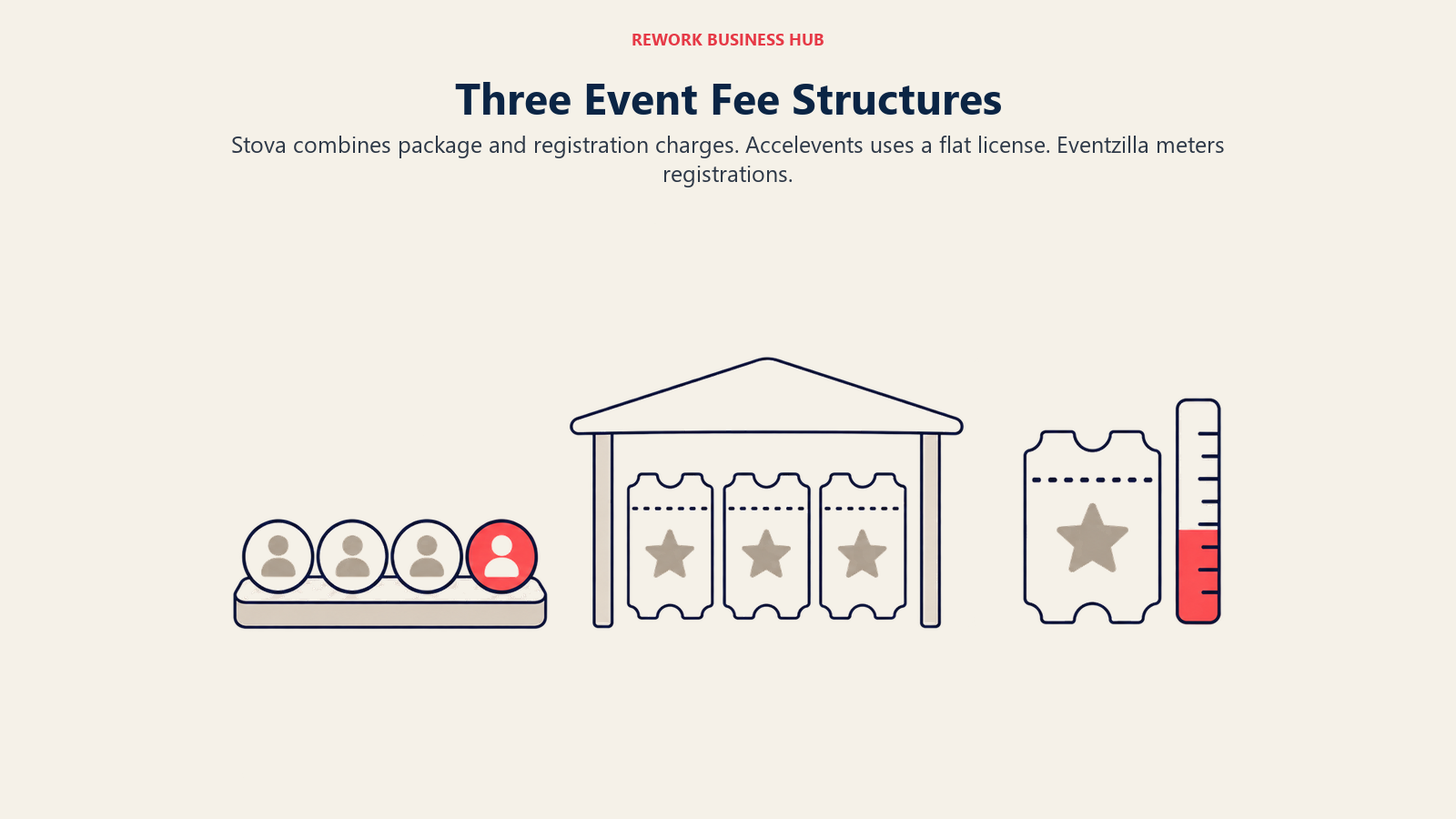
Eventzilla's fee is the most visible, quoted per registration; the organizer can absorb it or pass it through at checkout. Free events cost nothing on any tier. Card processing isn't broken out separately the way it is on Accelevents', so treat the published rate as the full ticketing cost.
Accelevents inverts that visibility. Its $7,500 or $13,500 platform fee is a flat license paid regardless of ticket sales, so it never appears in checkout. Card processing does show up separately: Stripe at 2.9% plus $0.30, or Braintree at 2.89% plus $0.29, with no markup added. The organizer chooses whether to absorb that or pass it to the attendee, same as Eventzilla, just on a smaller, processor-only number.
Stova's model is structurally closer to Eventzilla's, a package fee plus a per-registration rate, but without Eventzilla's explicit free-event exemption. Nothing on Stova's packages page waives the rate for a free registration, so budget as if it applies to every registration processed until a rep confirms otherwise. Whether it's visible to the attendee or absorbed into the contract isn't stated either; ask before you assume.
Refund handling matters if your event carries cancellation risk. Eventzilla auto-refunds on a full cancellation, including its own fee, but keeps that fee on a partial cancellation, with any organizer-set cancellation fee deducted first. Accelevents refunds land back in five to ten business days, and a partial refund partially refunds its own fee too, friendlier than Eventzilla's partial-cancellation rule. Stova publishes no refund policy; it's contract territory.
| Ticket economics factor | Stova | Accelevents | Eventzilla |
|---|---|---|---|
| Fee structure | Package fee plus per-registration rate ($3.00 to $5.60 depending on tier) | Flat per-event or per-year license, no per-registration fee | Per-registration fee ($1.50 flat to 2.9% + $1.50) or a flat annual plan |
| Who typically absorbs the fee | Not publicly stated; likely negotiated per contract | Always the organizer; never appears in attendee checkout | Organizer's choice: absorb it or pass it to the attendee |
| Free events | Per-registration rate appears to still apply (not confirmed exempt) | Full platform fee still applies; no discount for a free event | Free, on every tier |
| Card processing | Not publicly broken out | Stripe 2.9% + $0.30, or Braintree 2.89% + $0.29, passed through with no markup | Not broken out separately from the published per-registration rate |
| Refund handling | Not publicly documented | Refunds in 5 to 10 business days; partial refunds also partially refund the fee | Auto-refunded on full cancellation; fee kept on partial cancellation |
What a Free 300-Person Event Actually Costs
Start with the simplest case: an internal town hall, 300 people, nobody pays for a ticket. This is where the three pricing models produce the widest gap in the article.
| Platform | Tier used | Total cost |
|---|---|---|
| Eventzilla | Basic | $0 |
| Stova | Core | $2,895 ($1,995 package + 300 x $3.00/reg, assuming the rate applies to free registrations) |
| Accelevents | Professional | $7,500 (flat, regardless of ticket price) |
Eventzilla wins by the widest margin here: a wholly free event costs nothing on its cheapest tier, confirmed on its own pricing page. Accelevents' Professional tier doesn't discount for a free event; the $7,500 license buys platform access whether or not anyone pays for a ticket, worth knowing before assuming a mid-market platform is "basically free" for an internal event. Stova lands in the middle, assuming its per-registration rate applies uniformly.
What a Paid 1,000-Person Conference Actually Costs
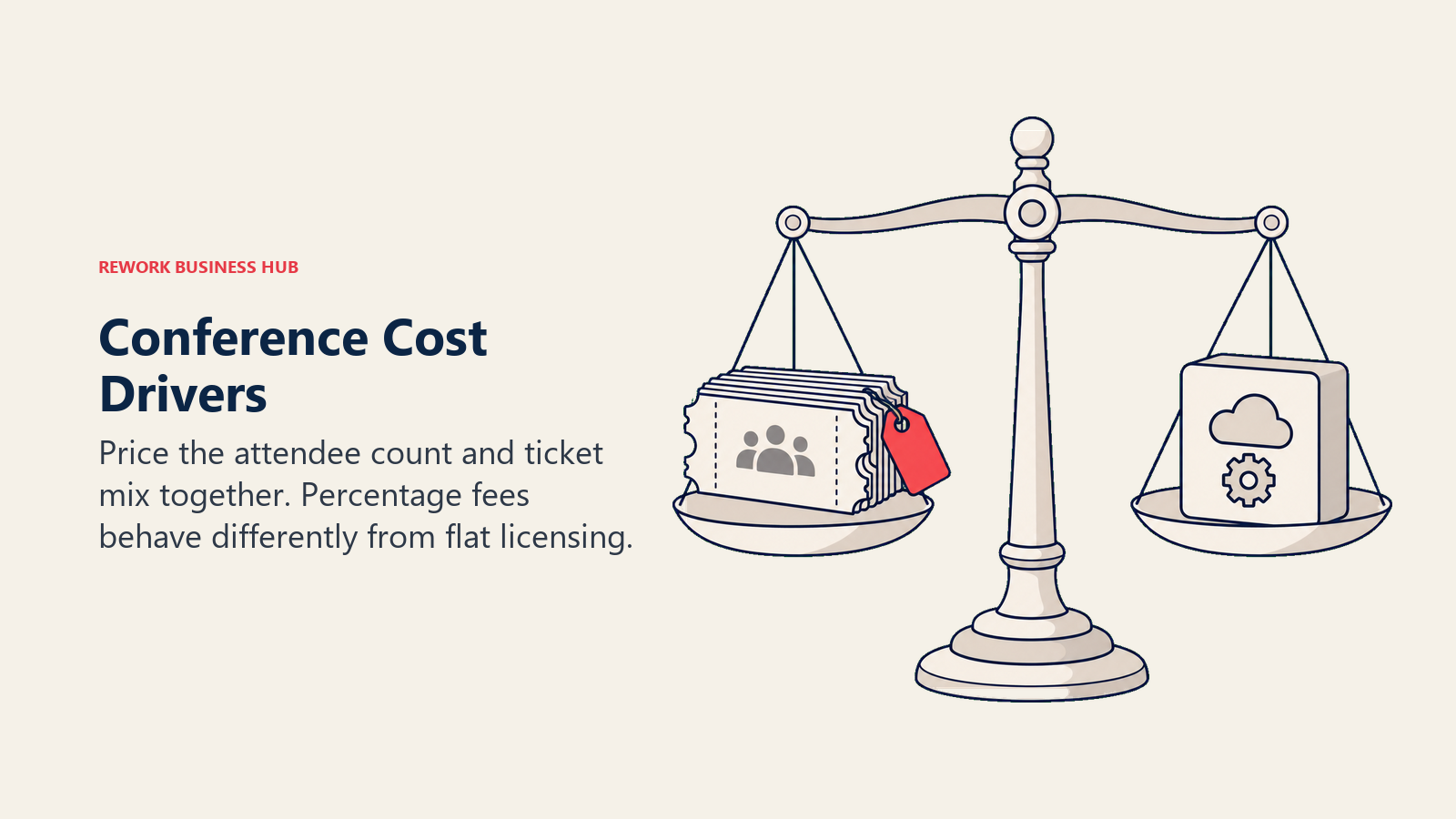
Now the flip: a real, paid, flagship conference. Assume 1,000 attendees at $500 a ticket ($500,000 gross), a realistic price for a mid-market B2B conference with a keynote lineup and a trade-show floor.
| Platform | Tier used | Total cost | Note |
|---|---|---|---|
| Stova | Core | $4,995 | $1,995 package + 1,000 x $3.00/reg |
| Accelevents | Professional | $7,500 | Flat, unaffected by ticket price or attendee count |
| Eventzilla | Pro | $11,000 | 1,000 x ($500 x 1.9% + $1.50); needed because a real conference usually runs more than one ticket type, which Basic doesn't support |
| Eventzilla | Basic (single ticket type only) | $1,500 | 1,000 x $1.50 flat; only works if the whole event sells one ticket type at one price |
This is the flip the free-event scenario doesn't show. Stova is cheapest here, Accelevents sits in the middle, and Eventzilla, so dominant a scenario ago, becomes priciest once its percentage fee applies to a $500 ticket at volume. The exception: a conference selling one ticket type at one price puts Eventzilla's Basic at $1,500, but that constraint rules Basic out for most real conferences.
What a 10-Event Annual Programme Actually Costs
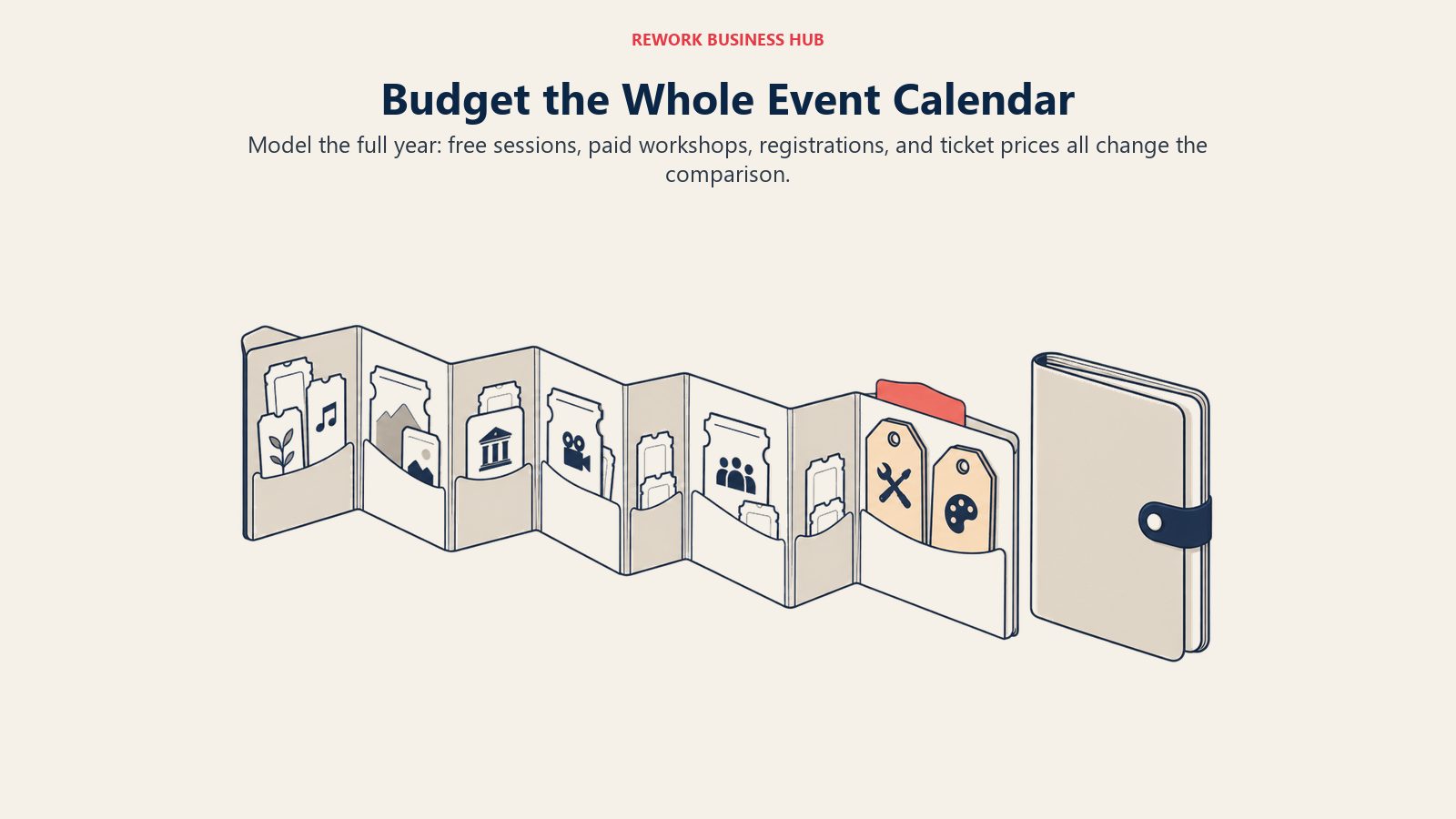
Last, the shape Accelevents' Business tier and Eventzilla's per-registration model were built to answer: a calendar of events across a year rather than one flagship conference. Assume 10 events and 1,500 registrations combined: five free internal sessions (750 registrations) and five paid workshops averaging $150 a ticket (750 registrations, $112,500 gross).
| Platform | Tier used | Total cost | Note |
|---|---|---|---|
| Eventzilla | Pro | $3,263 | $0 for the 750 free registrations, plus 750 x ($150 x 1.9% + $1.50) for the paid ones |
| Stova | Core | $6,495 | $1,995 package + 1,500 x $3.00/reg across the year |
| Accelevents | Business | $13,500 | Flat annual license, unlimited events, unaffected by the registration count or ticket price above |
Eventzilla is cheapest again here, and Accelevents is priciest, the conference scenario's mechanic running in reverse: Eventzilla's cost tracks ticket price, cheap at $150, expensive at $500. Accelevents never moves, so it still costs $13,500 at twice the events or double the ticket price, the point where it likely wins instead. Stova sits between the two, scaling with volume but not price, so it's rarely cheapest and rarely most expensive.
Put the three scenarios together and the pattern is the finding, not any single number. Eventzilla is cheapest at free or low ticket prices and priciest once price climbs, since its fee is a percentage of that price. Accelevents is expensive for one small event, but its cost never rises with size or frequency, the predictable choice once volume or price crosses your threshold. Stova rarely wins at small scale, since Core assumes real volume, but it doesn't spike at a high ticket price either. Run your own numbers before picking a winner; the crossover point belongs to your numbers, not a fixed rule.
Decision by Business Goal
| Your goal | Best fit | Why |
|---|---|---|
| Get a paid conference live in under a month, no procurement fight | Eventzilla | Self-serve signup, no sales cycle, pricing you can act on today |
| Run a free town hall or all-hands for a few hundred people at the lowest cost | Eventzilla | Free events cost nothing on any tier |
| Consolidate a legacy Aventri or MeetingPlay relationship into one platform | Stova | It is that platform; the three predecessor brands no longer exist separately |
| Keep cost predictable no matter how large the program grows | Accelevents | Flat licensing carries no per-registration exposure |
| Source venues, manage hotel room blocks, or run corporate travel | None of these three | See Cvent vs Bizzabo for platforms built around that job |
| Avoid a sales cycle entirely and buy today | Eventzilla | Fully self-serve; Accelevents needs sales past the free trial, Stova requires a demo |
| Get published uptime and support-response numbers to hold a vendor to | Accelevents | 99.99% 90-day uptime and a 21-second response time, both public |
Team and Role Fit
| Stova | Accelevents | Eventzilla | |
|---|---|---|---|
| Typical buyer title | VP Events, Global Events Director, Head of Meetings | Events Manager, Marketing Ops, Nonprofit Director | Small Business Owner, Solo Organizer, Community Organizer |
| Company size | Roughly 200 to 5,000-plus employees | Roughly 20 to 500 employees | Roughly 1 to 200 employees |
| Team running it | A dedicated events or meetings operations function | One to a handful of events staff, often doubling as marketing | Usually one person, sometimes with seasonal or volunteer help |
| Procurement involvement | Likely, given the annual contract | Possible above Professional; $7,500 to $13,500 often needs sign-off | Rarely; within most team leads' spending authority |
| Who owns day-of execution | Events operations, with a Stova-side account manager on Enterprise | The internal events team, backed by Accelevents' 24/7 support | The organizer directly; support depth varies by tier |
Implementation Time Against a Fixed Event Date
If your event date is fixed and close, the buying process matters as much as the feature set.
Eventzilla is built for this: sign up, build a registration page, and go live the same day, no sales call at any tier. If a conference is six weeks out with no platform in place, Eventzilla is realistically the only one of the three that fits that runway.
Accelevents sits in the middle. A free trial exists for evaluation, but Professional and Business, the tiers with real depth, appear to route through a sales conversation rather than instant checkout. Budget days to a couple of weeks for a signed contract, then implementation on top, still faster than an enterprise cycle. If the event is one piece of a larger cross-functional push, our best project management software guide for 2026 covers the coordination layer around it.
Stova is the slowest path by design. Every package's "Get Started" button leads to a contact form or demo booking, not checkout, even though the page now shows real numbers. Budget for a genuine sales cycle, likely weeks, before implementation even starts, which matters against a fixed, near event date.
| Implementation factor | Stova | Accelevents | Eventzilla |
|---|---|---|---|
| Buying process | Demo-first, sales-assisted, even though package prices are published | Free trial available; Professional and Business appear sales-assisted past that | Fully self-serve, no sales call required |
| Realistic time to a signed deal | Weeks | Days to a couple of weeks | Same day |
| Heaviest setup work | Configuring which package and modules the program needs | Deciding which tier and add-ons the events require | Building the registration page and ticket types |
| Best fit for a near-term event | Poor fit unless already under contract | Workable if the trial covers the immediate need | Best fit of the three |
Risk and Governance: Data, Support and Show-Day Failure
Three questions matter more than feature depth once the event is actually running: who owns the attendee data, what support looks like if something breaks, and what a show-day failure actually costs.
Accelevents is unusually transparent here. Its homepage publishes 99.99% platform uptime over the trailing 90 days, a 21-second average chat response time, and 24/7 support from the entry tier, not gated to a higher plan. Neither Stova nor Eventzilla publishes an equivalent figure. Eventzilla names priority after-hours support on Plus only; Basic and Pro aren't confirmed for the same coverage, so a weekend conference on Basic should confirm support hours before the event. Stova's Enterprise tier names a dedicated account manager, implying a higher support tier, but nothing public quantifies response time or uptime; ask for an SLA in writing if show-day support is a real concern.
Data ownership follows a similar pattern. Attendee data is the organizer's in principle on all three, but export mechanics differ. Eventzilla and Accelevents both run self-serve dashboards with export built in, testable before signing anything. Stova routes data access through the account relationship instead; Core names API access and Enterprise adds premium integrations, suggesting deeper connectivity but not easier self-serve export. Confirm format, retention, and what happens to the data if you cancel, before signing; if it needs to feed a CRM afterward, our best CRM software guide for 2026 covers where it usually lands.
None of the three publishes a plain-language "what happens if it goes down mid-event" policy. Ask directly rather than assume, especially for Stova given the size of program it's usually sold into.
| Risk factor | Stova | Accelevents | Eventzilla |
|---|---|---|---|
| Published uptime SLA | Not publicly stated | 99.99% over the trailing 90 days | Not publicly stated |
| Support response time | Not publicly quantified; Enterprise names a dedicated account manager | 21-second average chat response, 24/7 from the entry tier | Priority after-hours support named on Plus; not confirmed on Basic or Pro |
| Data export model | Contract-driven; API on Core, deeper integrations on Enterprise | Self-serve dashboard export | Self-serve dashboard export |
| Vendor lock-in risk | Higher; annual contract, harder to test before committing | Moderate; a free trial exists, but paid tiers are a real commitment | Lower; no long-term contract outside the annual plan |
When Stova Is the Right Call
- You're already an Aventri, MeetingPlay or eventcore customer. Stova is the platform you were already on; there's no legacy product to migrate away from, and continuity is the real argument for staying.
- You're running a genuine annual program, not a single event. The package-plus-per-registration model, and a 1,000-registration annual minimum reported by Capterra, assume a full calendar.
- You need enterprise governance and a dedicated account relationship. The Enterprise tier's strategic account manager and premium integrations target exactly this buyer.
- A high average ticket price makes percentage fees expensive elsewhere. The conference scenario above shows Stova undercutting both rivals once ticket price reaches enterprise territory.
If the sales cycle doesn't fit your timeline, the best Cvent alternatives roundup covers other enterprise-grade options. Not ideal for: buying today with no sales call, or a small, free event where the $1,995 minimum is dead weight.
When Accelevents Is the Right Call
- You want a real number before a sales call, at mid-market scale. $7,500 and $13,500 are actual published prices, rare in this category outside Eventzilla.
- You're running a genuine calendar of events, not just one. Business tier's flat $13,500 for unlimited events is the cost predictability this category usually lacks.
- A cost ceiling matters more than the lowest possible number. The annual-programme scenario shows Accelevents as priciest at that specific volume, but the only one whose price never moves.
- You want published uptime and support numbers to hold the vendor to. 99.99% uptime and a 21-second response time are concrete, not marketing copy.
Not ideal for: a single free or low-attendance event, where the flat fee isn't offset by usage, or a team that specifically needs Stova's governance depth or Eventzilla's zero-commitment buy.
When Eventzilla Is the Right Call
- Registration and ticketing is the whole job. No venue sourcing, no wearable hardware, no enterprise workflow, and the vendor doesn't pretend otherwise.
- The event is free, or the ticket price is modest. Free events cost nothing, and the percentage fee stays cheap until price climbs into flagship territory.
- You need to buy today, with no sales call. Self-serve signup is the fastest path to a live registration page here.
- Budget authority sits with one person, not a procurement process. A $1.50 per-registration fee or $1,999 annual plan rarely needs sign-off.
If a flat per-seat license is also on the shortlist, our best Swoogo alternatives roundup compares that model directly. Not ideal for: a high-ticket flagship conference, where the fee overtakes both rivals, or a program needing enterprise workflow, approvals, or hardware beyond basic badge printing.
Decision Framework
| If this is true for you | Pick |
|---|---|
| You're consolidating a legacy Aventri or MeetingPlay relationship | Stova |
| Your average ticket price is high and volume is real | Stova |
| You want a flat license that doesn't move regardless of program size | Accelevents |
| You're running a real calendar of events at a modest ticket price | Eventzilla; past its curve, Accelevents |
| Your event is free or low-ticket-price | Eventzilla |
| You need to buy today with no sales call | Eventzilla |
| You need venue sourcing, room blocks, or corporate travel | None of these three; see Cvent vs Bizzabo |
| You want published uptime and support-response numbers before you sign | Accelevents |
| Comparing the wider category beyond these three | See the 2026 event management software guide |
What to Do Next
- Model your own numbers, not the scenarios above. Real attendee count, ticket price, and event count for the year; the crossover point between these three belongs to your numbers, not a fixed rule.
- Ask Stova for a written quote naming registrations included. The published $1,995 to $12,995 prices are a starting point; get the per-registration rate and any annual minimum in writing.
- Use Accelevents' free trial before committing to Professional or Business. Confirm it handles your actual ticket types and reporting needs before the $7,500 or $13,500 commitment.
- Build a real Eventzilla registration page and check the fee math live. Its self-serve model shows the actual per-registration cost before you pay anything.
- Confirm support hours and data export terms in writing. None of the three publishes a plain-language show-day failure policy; ask directly rather than assume.
- Plan the post-event follow-up before the event, not after. Registration data only helps if it reaches the team running nurture; our best email marketing software guide for 2026 covers where it typically needs to land.
Related Resources:

On this page
- TL;DR
- Key Facts
- What Each Platform Is Actually Built For
- Ticket Economics: Who Actually Pays the Fee
- What a Free 300-Person Event Actually Costs
- What a Paid 1,000-Person Conference Actually Costs
- What a 10-Event Annual Programme Actually Costs
- Decision by Business Goal
- Team and Role Fit
- Implementation Time Against a Fixed Event Date
- Risk and Governance: Data, Support and Show-Day Failure
- When Stova Is the Right Call
- When Accelevents Is the Right Call
- When Eventzilla Is the Right Call
- Decision Framework
- What to Do Next