Carta vs Shareworks: Which Equity Platform Fits Your Stage in 2026?
Turn this article into takeaways for your work.


Each assistant summarizes the article only for you and suggests best practices for your work.
Updated August 2026
If you've landed on this comparison, there's a decent chance you're not actually choosing between Carta and Shareworks the way you'd choose between two CRMs or two project trackers. More often, someone asks "should we be on Shareworks by now?" after years on Carta, or a public company evaluating equity administration vendors puts Carta on the list out of habit and gets told, gently, that it's not really built for what they need next. This comparison is for founders, CFOs, controllers, and stock plan administrators trying to figure out which situation they're actually in.
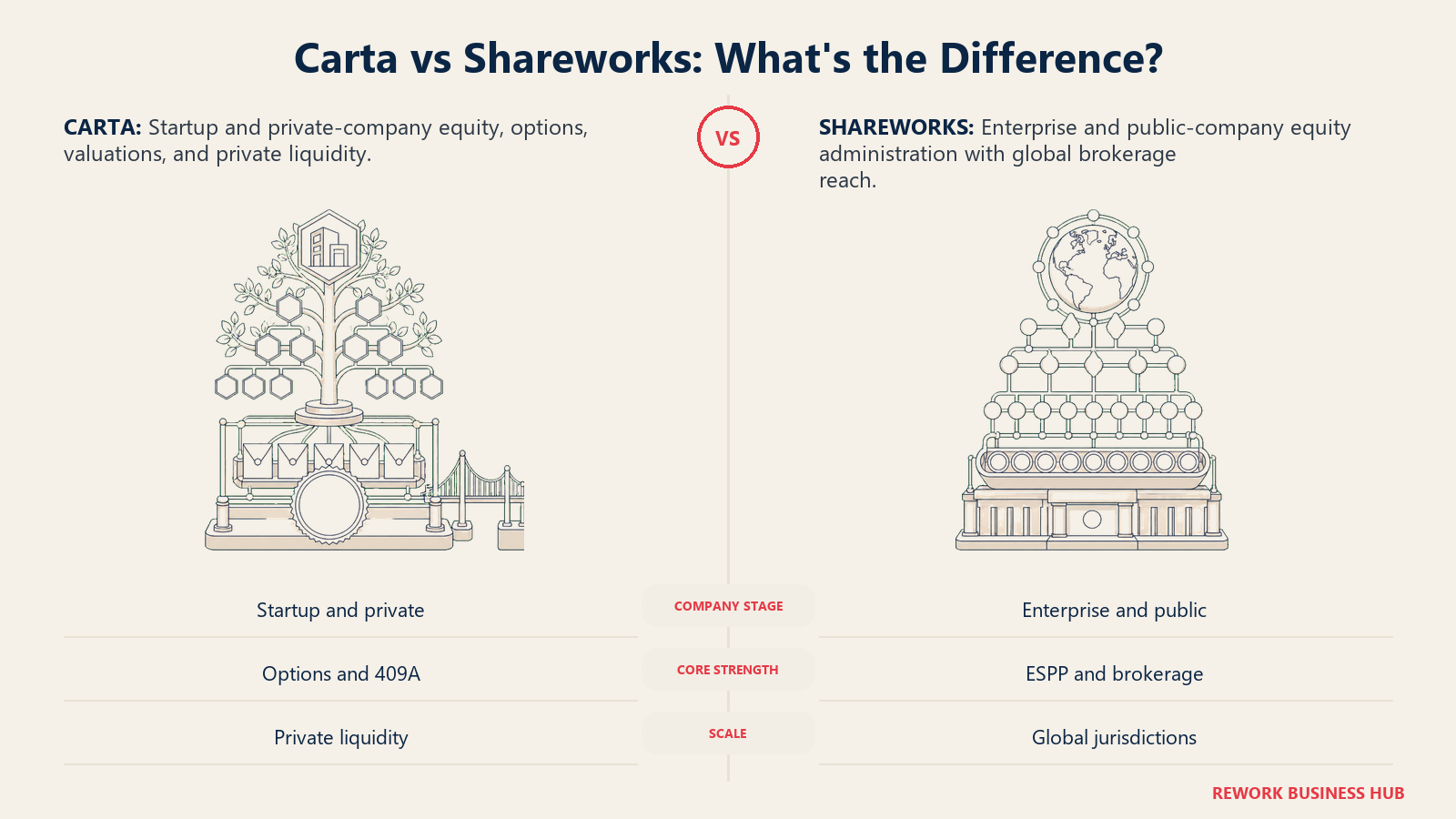
That's because this is a stage comparison more than a feature comparison. Carta is where venture-backed companies start: it's the default cap table for seed and Series A companies, and it stays useful well into growth stage. Shareworks, now sold under the Morgan Stanley at Work brand, is where companies with large distributed employee populations, ESPPs running at real scale, and public-company ambitions (or public-company status already in hand) tend to end up. The two platforms overlap on paper (both manage equity, both run 409A valuations, both handle RSUs and options) but they were built for buyers at opposite ends of the same journey, and that shows up in almost every section below.
TL;DR
| Carta | Shareworks (Morgan Stanley at Work) | |
|---|---|---|
| Core identity | Cap table and equity management platform, SEC-registered transfer agent under Section 3(a)(25) | Equity plan administration suite inside Morgan Stanley's workplace financial solutions business |
| Primary buyer and stage | Venture-backed private companies, from formation through late-stage private growth | Larger, often multinational companies with big distributed workforces, public or heading there |
| Origin story | Built from the startup up, starting as a cap table tool for founders and investors | Built from the enterprise down, originally for large multinational public companies, later extended to private companies too |
| Free entry point | Launch tier: free, up to 25 stakeholders and $1M raised | None; no free tier, no self-serve signup, quote only |
| Paid pricing | Build, Grow, and Scale tiers exist with feature lists, but Carta publishes no dollar figures; its pricing FAQ says each package is priced per stakeholder with a minimum annual fee | No pricing published anywhere; every engagement is sales-led |
| 409A valuations | Core, high-volume offering; a large share of the private-company 409A market runs through Carta | Available as a named product line, positioned more for larger or public-adjacent organizations |
| Brokerage and liquidity | CartaX facilitates private secondary transactions and tender offers; no ongoing public-market brokerage for participants | Participant accounts sit on Morgan Stanley Smith Barney infrastructure with a direct path to E*TRADE from Morgan Stanley for public-market trading |
| Typical fit | A startup that wants its cap table, 409A, and option grants in one product without a sales cycle | An organization with thousands of plan participants across many countries that needs enterprise-grade administration and brokerage in one relationship |
Key Facts
- ESOPs alone cover 15.1 million participants across 6,411 companies in the United States, holding more than $2 trillion in combined assets, according to the National Center for Employee Ownership's most recent Department of Labor data (NCEO).
- 57% of public companies now offer an employee stock purchase plan, but the median participation rate among eligible employees sits at just 38%, per the NASPP/Deloitte Tax Equity Incentives Design Survey (NASPP).
- US venture capital deployed $320 billion across 15,352 deals in 2025, and every one of those financings created or updated a company cap table, according to the NVCA 2026 Yearbook (NVCA).
- Startups on Carta's own platform raised nearly $120 billion in new funding in 2025, up almost 17% from 2024, per Carta's State of Private Markets: 2025 in Review (Carta).
- Carta administered 71 tender offers with roughly $3 billion in combined transaction volume in the first half of 2026 alone, the highest H1 figures in at least six years, according to Carta's own data desk (Carta).
Who Each Platform Is Really For
Both platforms sell "equity management," but the buyer who gets real value out of each one looks very different, and the gap comes down to headcount, geography, and where the company sits in its lifecycle.
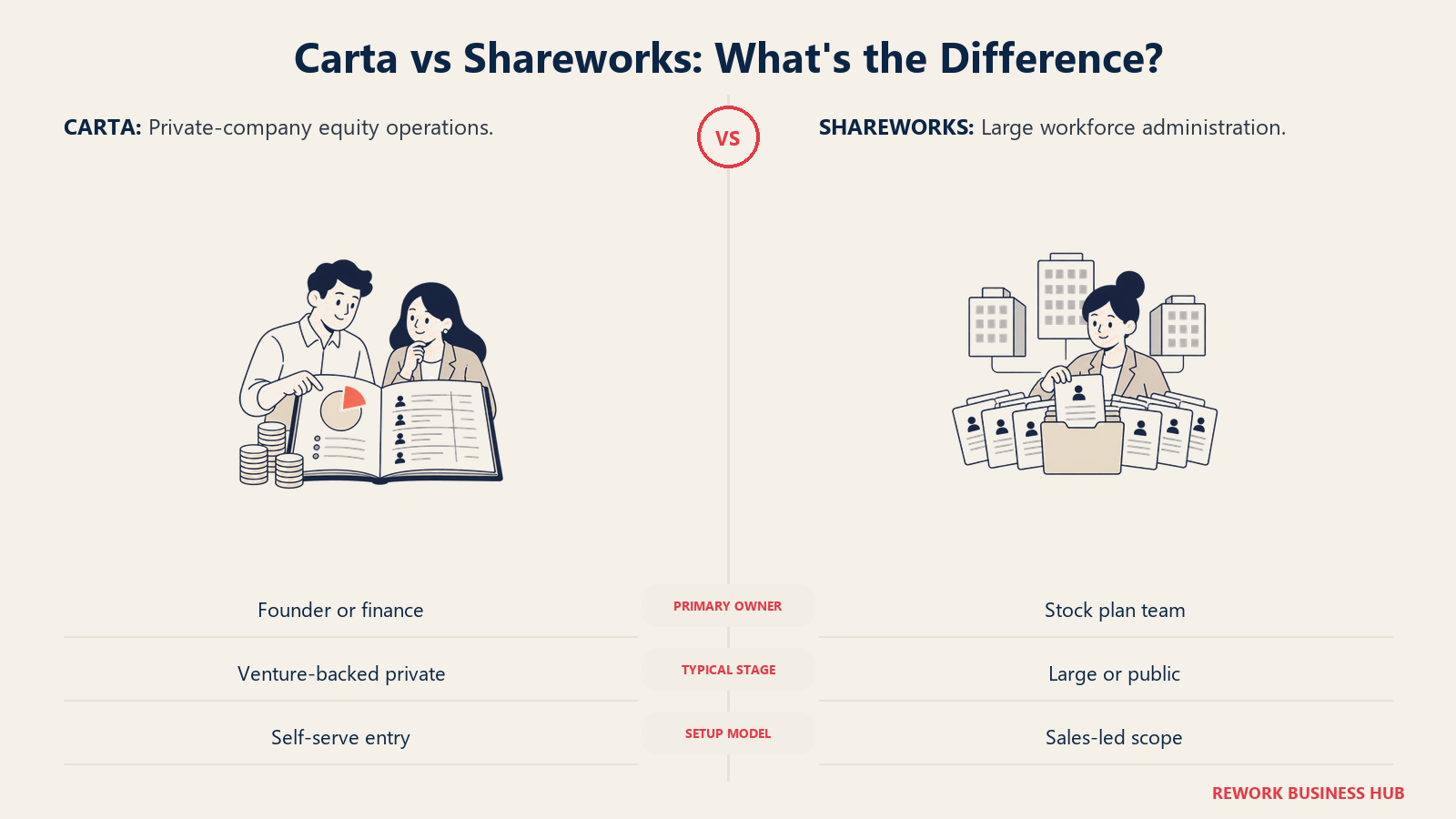
Carta's natural buyer is a founder or finance lead at a venture-backed company that just raised a round, needs a 409A valuation on file, and wants option grants, vesting, and the cap table itself living in one product without a procurement cycle. That buyer can sign up for the free Launch tier, be looking at a working cap table the same day, and only talk to a Carta salesperson once the company outgrows the free plan's 25-stakeholder ceiling.
Shareworks' natural buyer looks nothing like that. It's a stock plan administrator, equity compensation manager, or finance systems owner at an organization, often public or planning an IPO, with hundreds or thousands of plan participants spread across multiple countries, running RSU vesting, ESPP enrollment windows, and option exercises at a volume where a self-serve product would buckle. There's no free tier to test-drive; every relationship starts with a sales conversation, which itself signals the scale of company Shareworks expects to be talking to.
| Carta | Shareworks | |
|---|---|---|
| Primary buyer | Founder, controller, or finance lead at a venture-backed startup | Stock plan administrator or equity comp manager at a large, often public or pre-IPO company |
| Company stage | Formation through late-stage private (Series A to pre-IPO, broadly) | Late-stage private through public, and large private companies with public-scale headcount |
| The question they're solving | "How do I get a compliant cap table, a 409A, and option grants running without hiring a team to manage it?" | "How do I administer equity for thousands of participants across many countries with audit-ready reporting and real brokerage access?" |
| Where it's strongest | Fast setup, high-volume 409A delivery, private secondary liquidity through CartaX | Deep multinational tax and regulatory coverage, enterprise reporting, native brokerage through Morgan Stanley |
| Where it disappoints | A large multinational public company outgrows Carta's private-market-centric infrastructure and gets referred elsewhere for transfer agent work | A 15-person seed-stage startup gets a sales process and enterprise scope it doesn't need yet |
| Buying trigger | A funding round, a 409A deadline, or the first option grants going out the door | Growing plan-participant count, multi-country expansion, or an approaching IPO or public listing |
A quick way to sanity-check which profile you're actually in:
| Signal | Points toward Carta | Points toward Shareworks |
|---|---|---|
| Company status | Private, still raising priced rounds | Public, recently public, or filing an S-1 within the next year or two |
| Plan participants | Dozens to a few hundred | Hundreds to tens of thousands |
| Countries with equity holders | A handful, growing slowly | A dozen or more, already in place |
| ESPP in place today | Rare | Common |
| Finance team shape | A controller or finance lead wearing multiple hats | A dedicated stock plan administration function |
If your company just raised a round and needs a cap table this week, Pulley and Carta are both built for exactly that moment; Shareworks generally isn't in that conversation yet.
Cap Table Management Depth
Cap table management is the one category where both platforms genuinely compete, but the depth and audience differ.
Carta's cap table is the product it's most known for: real-time ownership tracking, waterfall and scenario modeling, dilution analysis across funding rounds, and investor-facing views that let VCs check their ownership stake without emailing the finance team. It's built to be touched constantly, by founders modeling a new round, by investors checking their position, and by finance leads reconciling grants against the model.
Shareworks' cap table module exists too, listed among its named product lines alongside Equity Administration and Financial Reporting, but it's built to sit underneath a much larger administration workload rather than to be the daily-use modeling tool a founder opens between board meetings. It's less about "what does my next round do to my ownership" and more about "does every one of our thousands of grants across every entity reconcile correctly."
| Cap table factor | Carta | Shareworks |
|---|---|---|
| Real-time ownership tracking | Yes, core product experience | Yes, but positioned as one module inside a broader administration suite |
| Scenario and waterfall modeling | Built for frequent founder and investor use | Available, weighted toward administrator and finance-team use |
| Multi-entity support | Common for holding company and subsidiary structures at growth stage | Standard for large, often multinational corporate structures |
| Investor-facing views | A named strength; investors log in directly to check ownership | Not the primary use case; Shareworks' participant-facing side is built around employees, not investors |
| Best fit | A company still actively raising rounds and modeling dilution | A company whose cap table is large, stable, and mostly about accurate administration, not frequent modeling |
409A Valuations
409A valuations are where Carta built one of its clearest reputational moats. A large share of the private-company 409A market runs through Carta, and the product ships as a high-volume, largely standardized offering built to turn around quickly for companies that need a defensible fair market value on file before granting options.
Shareworks lists 409A Valuations as one of its named product lines too, but the buyer profile is different: it's positioned for organizations that are typically larger, often already inside the Morgan Stanley relationship for other reasons, rather than the high-volume, self-serve-adjacent flow Carta built its reputation on.
| 409A factor | Carta | Shareworks |
|---|---|---|
| Volume and reputation | High-volume, widely used across the venture-backed startup market | Available, positioned for larger or already-engaged Morgan Stanley clients |
| Typical buyer | A startup needing its first (or fifth) valuation on a predictable cadence | An organization already running equity administration through Shareworks that wants valuations in the same relationship |
| Integration with the cap table | Native; the valuation and the cap table live in the same product | Native to the broader Shareworks product suite |
| Where to verify cost | Carta does not publish 409A pricing separately from its tier structure; ask directly | Not published; part of the same quote-only process as the rest of Shareworks |
Equity Plan Administration vs Full-Service Administration
This is a real, meaningful distinction, not just different marketing language for the same thing. "Equity plan administration" (Carta's frame) means the software runs the mechanics: grants, vesting schedules, exercises, and cap table updates, largely self-service for the company operating it. "Full-service administration" (closer to how Shareworks positions itself for larger clients) means more of the operational and compliance burden sits with the vendor's own team, not just the software.
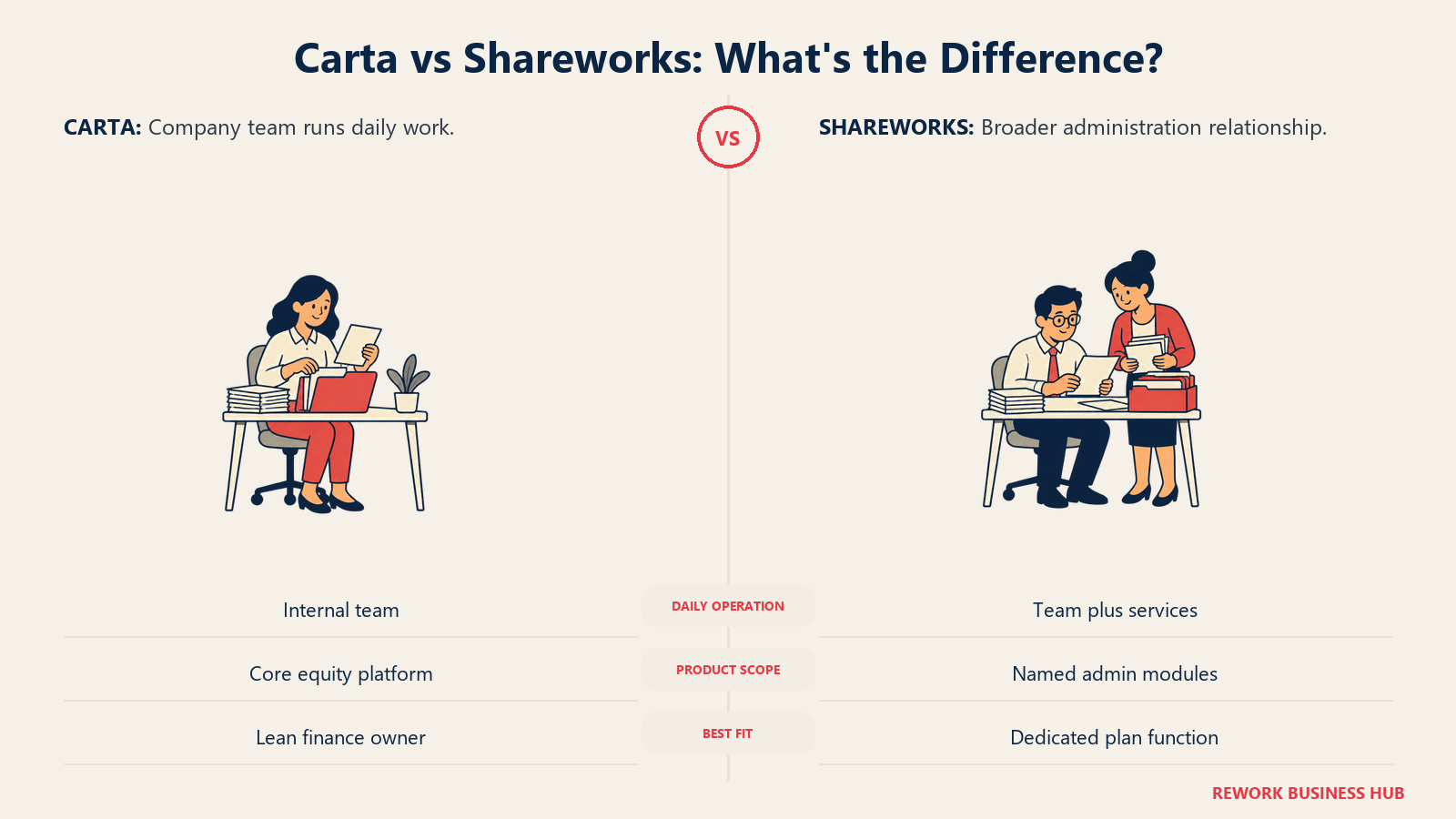
Shareworks' own product naming makes this explicit: Equity Administration, Financial Reporting, Participant Experience, and Forms Filing are listed as distinct product lines, which signals a vendor built to own more of the operational surface area, not just hand a company a tool and let its own team run everything through it.
| Administration factor | Carta | Shareworks |
|---|---|---|
| Primary model | Self-service software; the company's own team runs day-to-day administration | Software plus a broader administration relationship, with named modules for reporting and forms filing |
| Named admin surface | Cap table, grants, 409A, compliance tools inside one product | Equity Administration, Financial Reporting, Participant Experience, Forms Filing, Global Intelligence, Cap Table, and 409A Valuations as distinct lines |
| Staffing implication | A finance lead or controller can typically run it directly, especially pre-scale | Often assumes a dedicated stock plan administrator or a team, given the scope of what's being administered |
| Best fit | A lean finance team that wants control and speed | An organization that wants more of the administrative load absorbed into the vendor relationship |
Laid out side by side, the named product surface each vendor sells looks like this:
| Named capability | Carta | Shareworks |
|---|---|---|
| Cap table and ownership tracking | Core product | Cap Table (named product line) |
| 409A valuations | Core product | 409A Valuations (named product line) |
| Grant and vesting administration | Core product | Equity Administration (named product line) |
| Financial and audit reporting | Included, scoped to private-company needs | Financial Reporting (named product line) |
| Employee-facing portal | Included | Participant Experience (named product line) |
| Tax and regulatory forms | Form 3921, Rule 701 disclosures | Forms Filing (named product line) |
| Multi-country tax and regulatory tracking | Present, lighter weight | Global Intelligence (named product line) |
ESPP and RSU Handling
RSUs are core to both products, but ESPPs are where the gap between "startup tool" and "public-company infrastructure" shows up most clearly, because ESPPs are mostly a public-company mechanism in the first place.
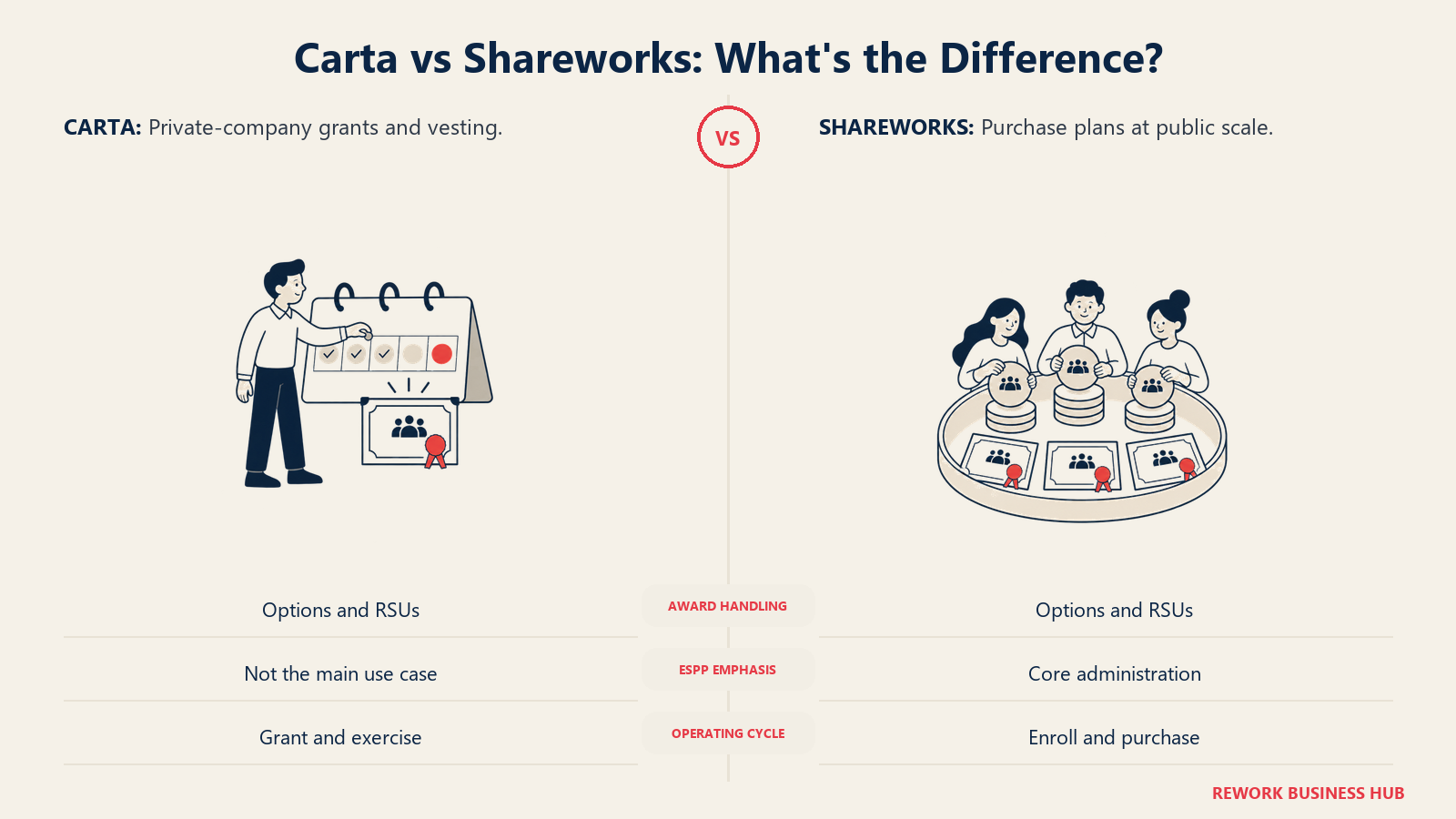
Carta administers RSUs and stock options as part of its core cap table and equity management flow, appropriate for private companies where RSUs are increasingly common but ESPPs are rare (ESPPs need publicly tradable stock to make the "purchase at a discount, then sell" mechanic work). Shareworks, built from the public-company side of the market, handles ESPP enrollment windows, purchase periods, and disqualifying-disposition tracking as a first-class capability, alongside the RSU tracking (vesting dates, quantities, and documents) that both platforms support.
| ESPP/RSU factor | Carta | Shareworks |
|---|---|---|
| RSU vesting and tracking | Yes, standard part of the equity management flow | Yes, with participant-facing tools for tracking vesting dates and quantities |
| ESPP enrollment and purchase periods | Not a primary use case; most Carta customers are private companies without a tradable stock to run an ESPP against | Core capability, built for the public-company ESPP mechanics NASPP and Deloitte survey every year |
| Qualified vs non-qualified ESPP tracking | Not applicable to most Carta customers | Supported as part of the broader plan administration suite |
| Option exercise administration | Core, high-frequency workflow for private companies | Supported within the equity administration module |
| Where this shows up in your decision | If you don't have a public ESPP to run, this section barely matters | If ESPP administration at scale is the actual project, Shareworks is built around exactly that |
If ESPP payroll deductions are part of what's driving this evaluation, it's worth checking how your payroll platform itself handles equity-linked withholding; our best payroll software guide covers that ground separately.
Participant Experience and Support
Both vendors put real effort into the employee-facing side of the product, since a confusing participant portal generates support tickets and, worse, mistrust in the equity itself.
Carta's participant experience is built for the private-company employee: viewing a grant, understanding a vesting schedule, and eventually exercising options, often for the first time in that employee's career. Shareworks names Participant Experience as one of its own product lines, and it's built for a different kind of employee: someone who may be juggling RSU vesting, ESPP enrollment, and (post-IPO) actual open-market trading of shares they already own, often across a global workforce with different tax rules by country.
| Participant experience factor | Carta | Shareworks |
|---|---|---|
| Portal purpose | Understand and eventually exercise private-company equity | Manage a wider range of events: vesting, ESPP purchases, and public-market trading |
| Education content | Built for employees who may be new to equity compensation entirely | Built for a workforce that may already hold and trade shares, alongside newer participants |
| Support model | Standard support tiers by plan | Support delivered as part of a broader Morgan Stanley at Work relationship |
| Multi-country participant support | Present but lighter, matching Carta's private-company customer base | A named strength, given the global workforce most Shareworks customers manage |
Global Mobility and Multi-Country Tax
This is one of the widest gaps between the two products, because it tracks directly to company size and geographic footprint.
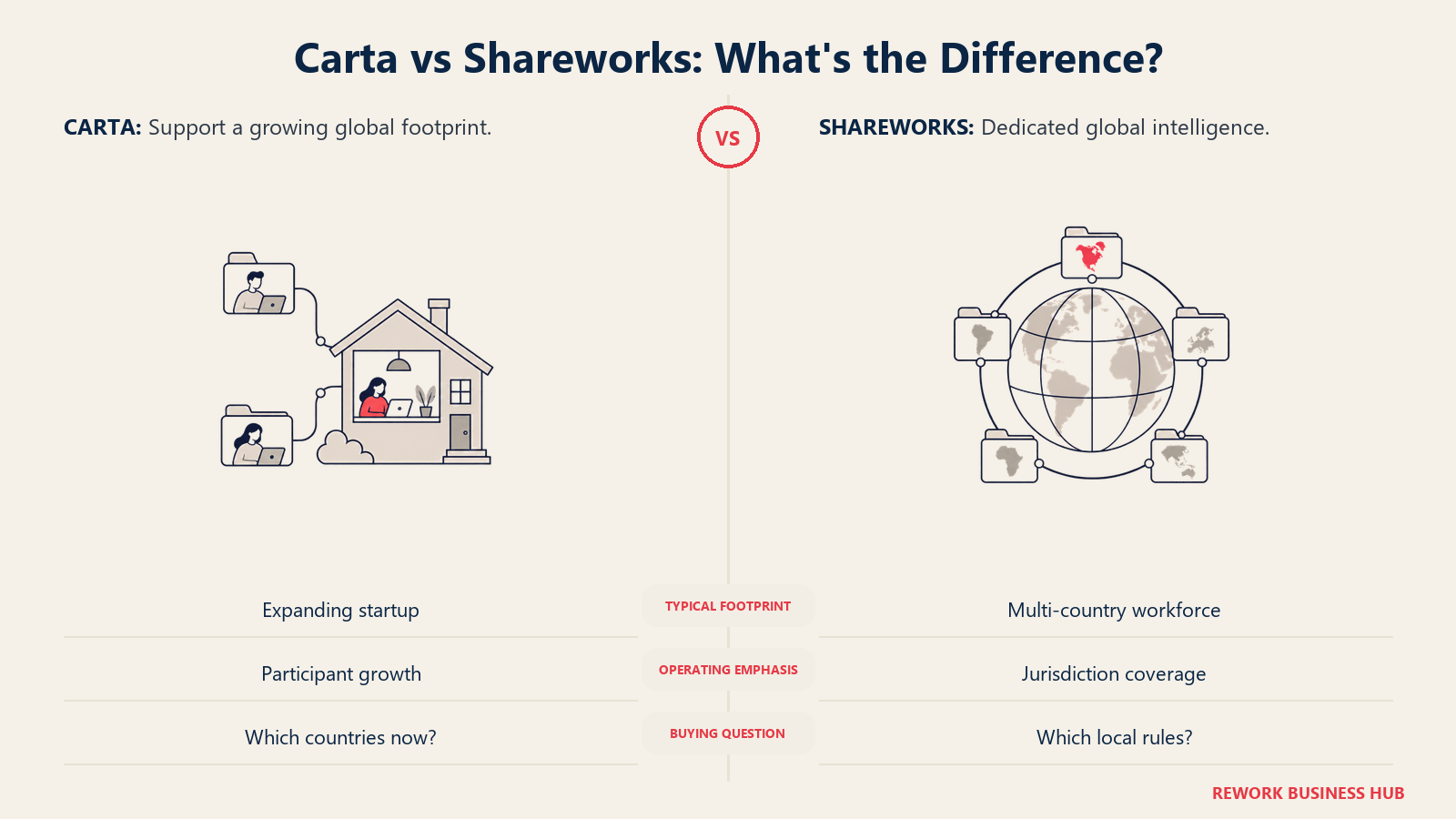
Shareworks' Global Intelligence application is built specifically for this problem: a comprehensive resource covering tax and regulatory information across more than 150 jurisdictions, kept current by a network of global providers, covering exchange control requirements, translation requirements, and securities law filings that change by country and by plan type. That's the kind of infrastructure a company only needs once it has meaningful headcount outside its home country holding equity.
Carta supports global participants too, but it isn't the product's center of gravity. Most Carta customers are US-headquartered venture-backed companies with a smaller, growing footprint of international employees, not multinational organizations running equity plans across 150-plus jurisdictions simultaneously.
| Global mobility factor | Carta | Shareworks |
|---|---|---|
| Jurisdictional coverage | Supports international participants as a growing company adds them | 150+ jurisdictions tracked through the dedicated Global Intelligence application |
| Regulatory update cadence | Not a named, standalone product | Maintained by a network of global providers with regular updates, per Morgan Stanley's own description |
| Exchange control and securities filing tracking | Not a core, named capability | Explicitly covered inside Global Intelligence |
| Best fit | A startup adding its first few international hires or remote employees with equity | A company already running, or about to run, equity plans across dozens of countries |
If your company's equity footprint is more European than global, Ledgy is worth a look too; it's built with European reporting and multi-jurisdiction depth as a starting point rather than an add-on.
Brokerage, Transfer Agent, and Liquidity
This section is where the two companies' underlying business models diverge the most, and it's worth understanding both, because it shapes what happens to shares after they vest or get exercised.
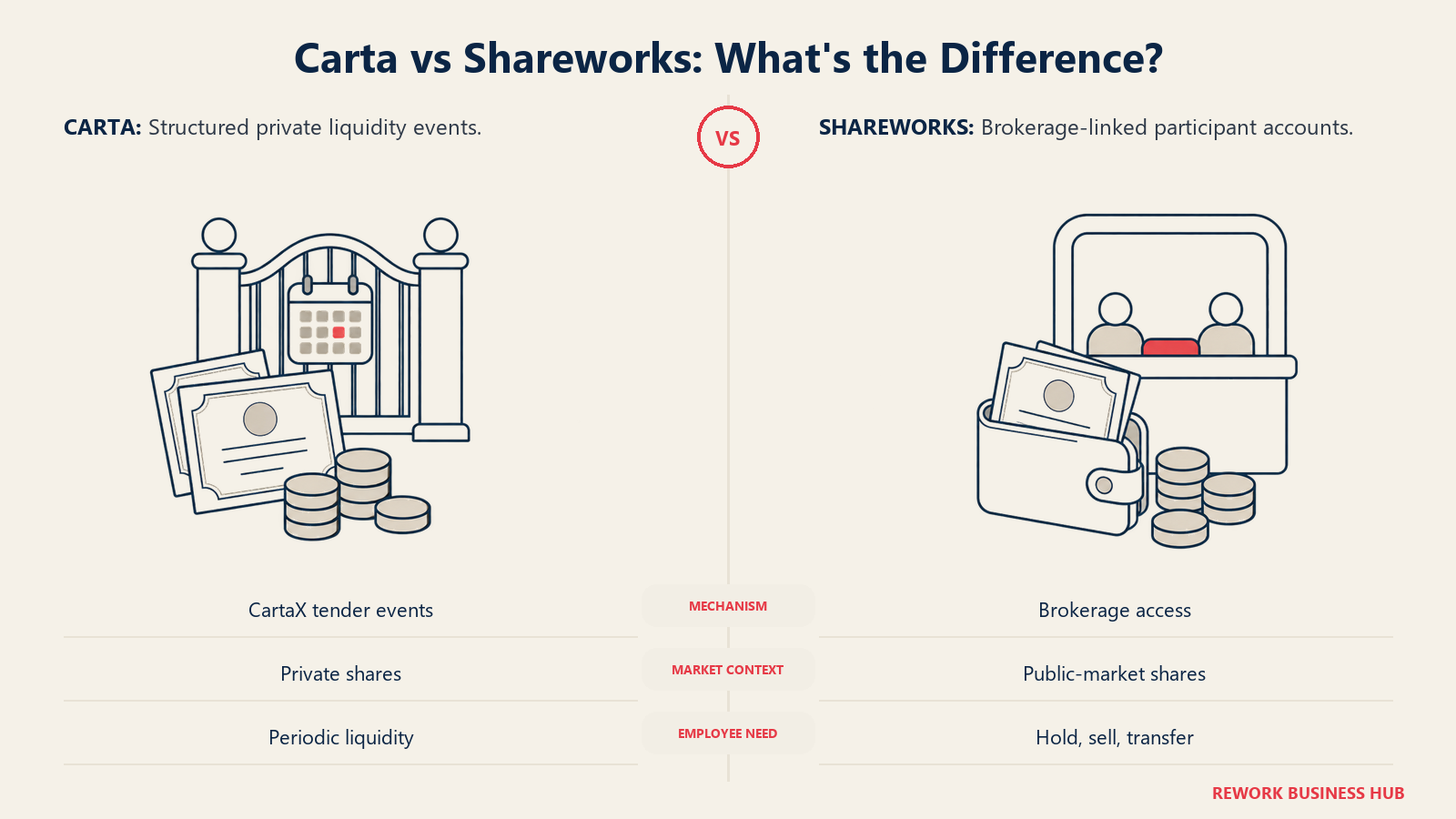
Carta is itself a transfer agent, registered with the SEC under Section 3(a)(25) of the Securities Exchange Act of 1934, and its CartaX platform facilitates private secondary transactions, including tender offers and auction-based deals, for companies still private. But for public company transfer agent work specifically, Carta refers clients to Odyssey Transfer and Trust Company as its exclusive partner, which tells you plainly where Carta sees its own center of gravity: private markets, not public-company share registry work.
Shareworks sits inside Morgan Stanley's brokerage infrastructure directly. Participant stock plan accounts are serviced through Morgan Stanley Smith Barney LLC, and Morgan Stanley has been migrating those accounts onto E*TRADE from Morgan Stanley, giving participants a built-in path from vested shares to an actual brokerage account where they can hold, sell, or transfer those shares without leaving the Morgan Stanley ecosystem. For a public company's employees, that's a meaningfully different experience than a private company's employees holding illiquid shares with no trading venue at all.
| Brokerage/transfer factor | Carta | Shareworks |
|---|---|---|
| Transfer agent status | SEC-registered transfer agent (Section 3(a)(25)); refers public-company work to Odyssey Transfer and Trust | Operates inside Morgan Stanley's registered brokerage and transfer infrastructure |
| Liquidity mechanism | CartaX: tender offers and private secondary transactions for still-private companies | Direct brokerage access via Morgan Stanley Smith Barney and E*TRADE from Morgan Stanley |
| Best for | A private company wanting occasional, structured liquidity events for employees and investors | A public (or newly public) company's employees who need an ongoing way to hold and trade vested shares |
| What to verify before buying | Whether you need CartaX-style periodic liquidity or full-time public-market brokerage access | Whether your workforce is large and liquid enough to make the built-in brokerage relationship worth the scope of the engagement |
Compliance and Reporting
Both platforms take equity compliance seriously, but the specific obligations they're built around differ by company type.
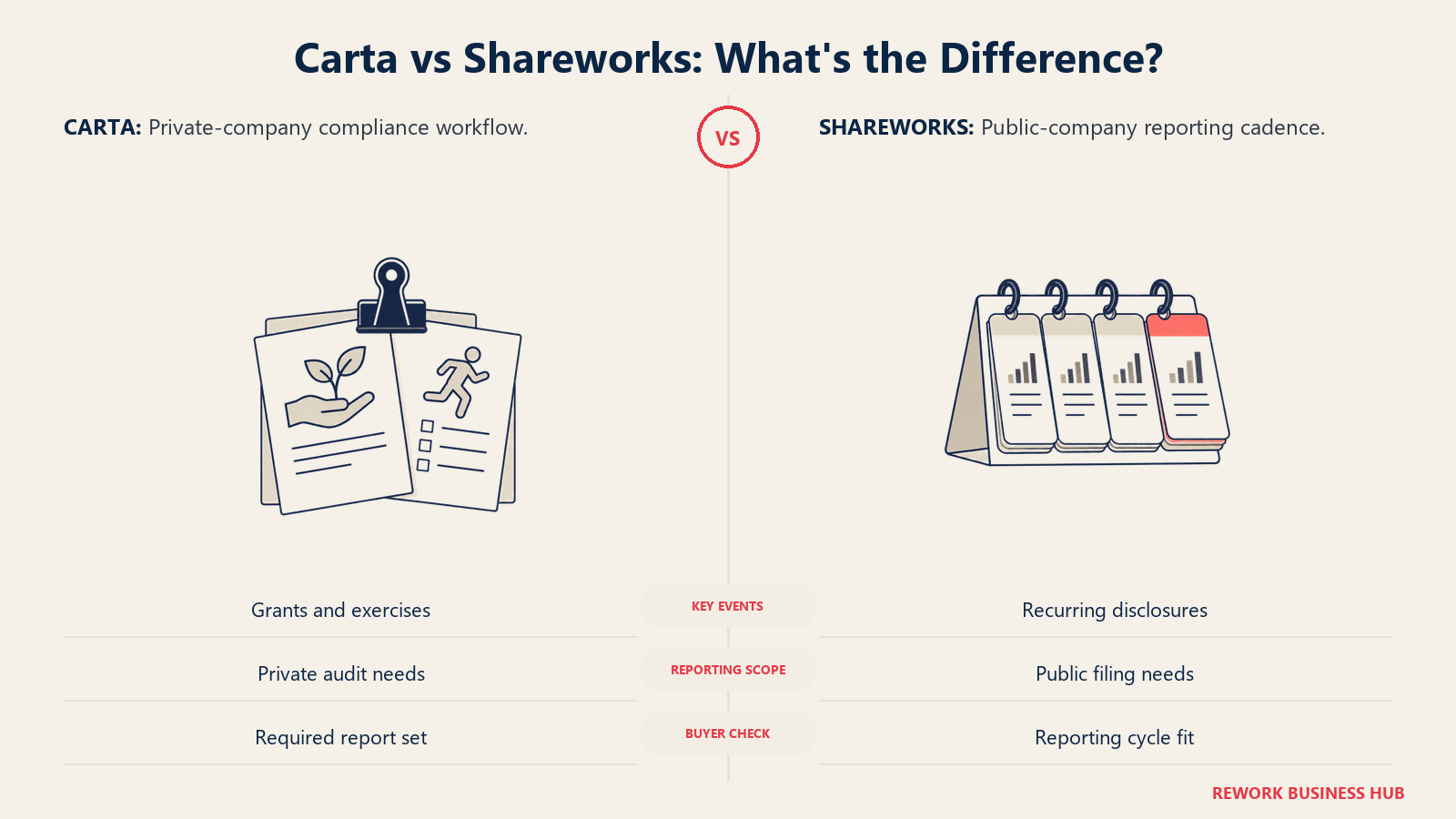
On the private-company side, Carta's compliance tooling covers the mechanics private companies actually need: Rule 701 disclosure management (sending and tracking the required disclosures to award holders once a company crosses Rule 701's exemption thresholds), automatic generation of Form 3921 for every ISO exercise, and ASC 718 and US GAAP reporting support, delivered separately from the 409A valuation itself since tax guidance under Section 409A and accounting guidance under ASC 718 have been diverging.
Shareworks covers the same underlying accounting standard, ASC 718, but from the public-company angle: stock-based compensation expense has to be recognized and disclosed in every quarterly 10-Q and annual 10-K filing once a company is public, with no funding-stage threshold or exemption to grow into. Forms Filing is listed as its own named Shareworks product line, and Financial Reporting is positioned around audit-ready output delivered in real time, the kind of reporting cadence a public company's controller and auditors expect.
| Compliance factor | Carta | Shareworks |
|---|---|---|
| Rule 701 (private company exemption) | Named capability: disclosure management and tracking | Less central; Rule 701 applies specifically to private company issuances |
| Form 3921 (ISO exercises) | Automatically generated for every ISO exercise | Handled as part of the broader Forms Filing product line |
| ASC 718 (stock comp expense) | Delivered as a distinct workstream from the 409A valuation, with dedicated GAAP reporting support | Core, ongoing requirement for every public-company customer, tied directly to 10-Q and 10-K filings |
| SEC filing support | Present for companies approaching or crossing public-company thresholds, often via partners | A named strength, since a large share of Shareworks' customer base already files with the SEC |
| Audit-ready reporting | Available, scoped to private-company audit needs | Positioned as real-time and audit-ready by design, matching public-company reporting cycles |
Once stock comp expense is calculated, it still has to land somewhere in the books; our best accounting software guide covers how that ASC 718 number typically flows into the general ledger and the close process.
Integrations with HRIS and Payroll
Integration depth is a useful proxy for which stack each vendor expects its customers to already be running, and the pattern here tracks the startup-versus-enterprise divide closely.
Carta's HRIS and payroll integrations lean toward the tools a venture-backed startup is actually using: native connections with platforms like Gusto and Rippling support cap table updates and option exercise workflows without manual data entry, which fits a lean finance team that doesn't have a dedicated systems administrator.
Shareworks integrates with the HRIS and payroll systems large, often public companies run: Workday, ADP, and SAP SuccessFactors are named integration partners, with a Workday API enabling flexible file imports and real-time data sharing, so that a change in an employee record inside Workday flows through to equity administration automatically. That's infrastructure built for a company with an established HRIS team, not a startup wiring up its first payroll provider.
| Integration factor | Carta | Shareworks |
|---|---|---|
| Typical HRIS/payroll partners | Gusto, Rippling, and similar startup-stack tools | Workday, ADP, SAP SuccessFactors, and similar enterprise-stack tools |
| Data sync model | Supports cap table and option-exercise workflows tied to payroll events | Real-time API-based data sharing, including a dedicated Workday integration |
| Assumed buyer maturity | A startup running a lean, modern HR and payroll stack | An organization with an established, often multi-system HRIS environment |
| Where to check first | Whether your specific payroll provider has a native Carta connection today | Whether your HRIS is already one of Shareworks' named integration partners |
If you're also re-evaluating the HRIS itself as part of this decision, our best HR software guide is a useful parallel read.
The Pricing Opacity Trade
Here's the part most third-party roundups get wrong, and it's worth being direct about it: neither Carta nor Shareworks publishes a usable price for its paid tiers, and any dollar figure attached to either vendor on a review site, a listicle, or a rival's comparison blog is an estimate, not a confirmed number. Reprinting one of those figures as a "starting price" would make this article less accurate, not more useful, so we're not doing that.
Carta publishes only its free Launch tier: up to 25 stakeholders and $1M raised, at no cost. Build (up to 50 stakeholders), Grow, and Scale (both with flexible stakeholder limits) all exist as named tiers with feature lists, but Carta's own pricing FAQ states plainly that each paid package is priced per stakeholder against a minimum annual fee, and every paid-tier button routes straight to a sales conversation. Third-party sites print conflicting numbers for what a paid Carta plan actually costs; none of them is Carta itself, so none of them belongs in this article.
Shareworks goes a step further and publishes no pricing at all, not even a free tier to anchor against. There's no self-serve signup path; every relationship starts as a sales-led conversation, which is consistent with everything else about how the product is built and sold.
The practical consequence is straightforward: Carta can be evaluated in an afternoon. You can create a free Launch account, see the actual cap table product, and get a real sense of the interface before a single sales call happens. Shareworks cannot be evaluated that way at all; there's no version of the product you can see without first entering a procurement cycle.
| Pricing factor | Carta | Shareworks |
|---|---|---|
| Free tier | Yes, Launch: up to 25 stakeholders, $1M raised cap | None |
| Self-serve trial | Yes, through the Launch tier itself | No |
| Published paid pricing | None; per-stakeholder pricing with a minimum annual fee, per Carta's own FAQ | None; fully quote-only |
| What drives the eventual number | Tier (Build, Grow, or Scale), stakeholder count, and which features you need beyond the free plan | Company size, participant count, country footprint, and which product lines (administration, reporting, brokerage, valuations) you're bundling |
| Time to see the actual product | Same day, via the free Launch signup | Only after a sales conversation begins |
Questions worth bringing into a Shareworks quote conversation: how many countries will hold participants in year one, whether Financial Reporting and Forms Filing are bundled or billed as separate lines, and whether brokerage access through Morgan Stanley Smith Barney and E*TRADE is included or a separate arrangement. Questions worth bringing into a Carta paid-tier conversation: what your actual stakeholder count will be a year from now, not just today, since that's the number the per-stakeholder pricing scales against, and which of the extra capabilities in Grow or Scale you'll actually use versus what you'd be paying for and not touching.
If a Carta quote comes back higher than you expected, our own best Carta alternatives roundup already covers 13 vendors with real, published pricing, including Pulley, which publishes flat annual pricing starting at its Startup tier instead of routing every plan through a sales call.
Implementation Weight and Migration
Neither vendor publishes a single implementation-duration figure, and the reason tracks directly back to how differently the two products are built and sold.
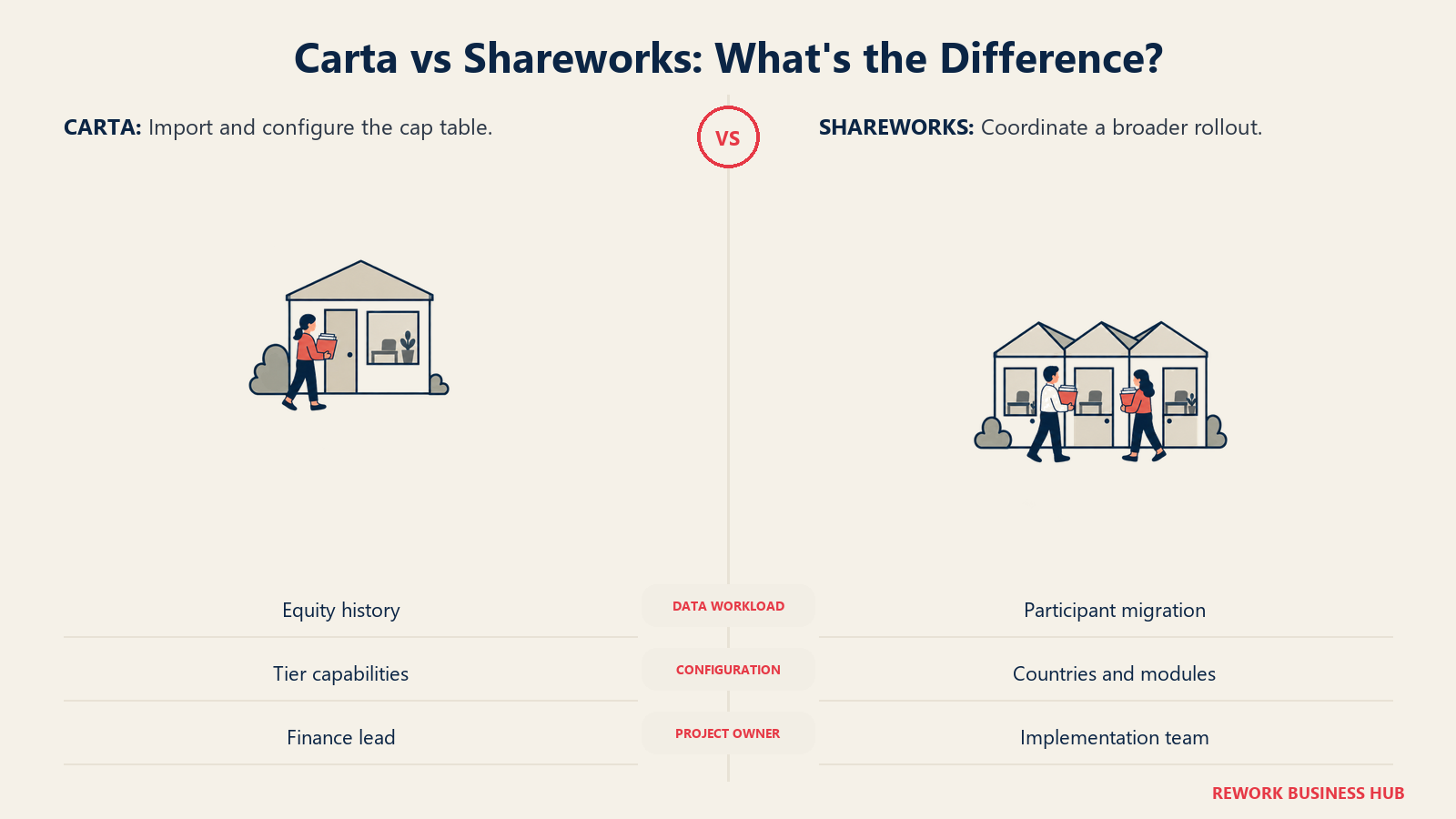
Carta's implementation weight scales with company complexity, but for most customers it's genuinely light: create a Launch account, import the cap table (often from a spreadsheet or a prior tool), and start issuing grants. Moving up to Build, Grow, or Scale adds configuration around 409A cadence, more stakeholder types, and deeper compliance tooling, but there's rarely a multi-month rollout the way enterprise software often requires.
Shareworks implementation is a different order of project. Standing up Global Intelligence across dozens of jurisdictions, wiring a Workday or ADP integration, configuring Forms Filing and Financial Reporting for a public company's audit cycle, and migrating thousands of existing participant records from a prior system all take real time and, typically, a dedicated project team on both sides. That weight is the direct cost of the depth described in every section above; it isn't a flaw so much as the natural result of the scope.
| Implementation factor | Carta | Shareworks |
|---|---|---|
| Typical setup path | Self-serve signup, spreadsheet or prior-tool cap table import | Sales-led onboarding, typically with a dedicated implementation team |
| What drives timeline most | Stakeholder count, complexity of prior equity history, and which tier's features need configuring | Participant count, country footprint, HRIS/payroll integration scope, and which product lines are bundled |
| Migration risk | Import errors from a messy prior cap table are the main risk | Data migration from a legacy platform, plus multi-country compliance configuration, is the heavier lift |
| Where cost risk sits | Underestimating your stakeholder count and re-negotiating a tier sooner than planned | Underestimating implementation scope across jurisdictions, integrations, and reporting requirements |
Downstream of implementation, the expense forecasts both platforms produce usually feed into a broader planning process; our best FP&A software guide covers the tools finance teams use once that data needs to flow into a model.
Scale Ceiling on Each Side
This is where the two products stop competing for the same buyer entirely, and it's the cleanest way to summarize the whole comparison.
Carta scales comfortably from a two-founder company on the free Launch tier through late-stage private companies with meaningful headcount and multiple funding rounds behind them, and CartaX gives even large private companies a structured way to run liquidity events without going public. Where Carta's model shows real strain is at true multinational, public-company scale, exactly the point at which Carta itself refers customers elsewhere for transfer agent services.
Shareworks' scale ceiling, by contrast, is effectively theirs to define, since it was built from the top of the market down. Its practical floor is higher than its ceiling is a concern: a fifteen-person startup would be taking on far more platform, process, and sales overhead than it needs, in the same way a small team would be over-provisioned on almost any enterprise software built for a Fortune 500 buyer.
| Scale factor | Carta | Shareworks |
|---|---|---|
| Comfortable floor | A two-person founding team on the free Launch tier | Meaningfully larger; there's no lightweight entry point |
| Comfortable ceiling | Late-stage private companies with complex cap tables and active secondary liquidity via CartaX | Effectively unbounded; built for large multinational public companies from the start |
| Where it strains | True multinational public-company transfer agent and registry work | Any company too small to justify a sales-led enterprise relationship |
| Best fit at scale | Growing private companies that want depth without enterprise overhead | Large, often public or newly public organizations with global, high-volume equity administration needs |
When Carta Is the Right Call
- You're pre-Series A and need a working cap table today. The free Launch tier gets you a real product, not a demo, and it's the fastest way to get option grants and a cap table in order after a first priced round.
- 409A valuations are a recurring, predictable need. Carta's high-volume 409A business is one of its strongest, most tested capabilities, and having it live inside the same product as the cap table keeps valuations and grants in sync.
- You expect to need private secondary liquidity before an IPO. CartaX gives founders and long-tenured employees a structured way to sell some shares without waiting for a public listing that may be years away.
- Your finance team is lean and wants direct control. Carta's self-service model fits a company where a controller or finance lead runs equity administration directly, rather than handing significant operational scope to a vendor's team.
When Shareworks Is the Right Call
- You're public, or close enough that it's the realistic near-term plan. ASC 718 expense recognition and 10-Q/10-K disclosure aren't optional once you're public, and Shareworks' Financial Reporting and Forms Filing lines are built directly around that obligation.
- Your workforce spans dozens of countries. The Global Intelligence application's coverage of 150-plus jurisdictions is exactly the kind of infrastructure a purely domestic cap table tool was never built to provide.
- ESPP administration at real scale is the actual project. If enrollment windows, purchase periods, and disqualifying-disposition tracking across thousands of participants are the problem you're solving, Shareworks was built around that mechanic from the public-company side of the market.
- You want brokerage access built into the same relationship. Participant accounts routed through Morgan Stanley Smith Barney and E*TRADE from Morgan Stanley give employees a direct path from vested shares to an actual trading account, without a separate brokerage relationship to stand up.
If Shareworks' enterprise scope is more than your team needs today, our best Shareworks alternatives roundup covers lighter platforms built for companies that aren't at full public-company scale yet.
Decision Framework
| If this is true for you | Pick |
|---|---|
| You just raised a round and need a cap table and 409A running this week | Carta |
| You're public, or filing your first 10-Q within the next year or two | Shareworks |
| You want a free tier to actually try before any sales conversation | Carta |
| Your plan participants span 20 or more countries | Shareworks |
| ESPP administration at scale is the core project, not RSUs or options | Shareworks |
| You expect to run a tender offer or private secondary sale before an IPO | Carta, via CartaX |
| You want brokerage access built into the same vendor relationship | Shareworks, via Morgan Stanley Smith Barney and E*TRADE |
| Your finance team wants to run equity administration directly, without a large vendor-side team | Carta |
| Neither fits because you're comparing early-stage private options broadly | See the best Carta alternatives roundup for the wider field |
What to Do Next
- Name your actual stage, not your aspirational one. If you're privately held with a domestic-heavy cap table, Carta's model fits what you need today. If you're public, filing soon, or running equity across dozens of countries, Shareworks' scope matches the real obligations you're carrying.
- Count your countries, not just your headcount. A 500-person company entirely in one country has very different needs than a 150-person company spread across 20. Global Intelligence's 150-plus jurisdiction coverage only pays for itself once that footprint is real.
- Check whether ESPP is actually in scope. If there's no employee stock purchase plan, or none planned before an IPO, a meaningful share of Shareworks' built-for-public-companies depth won't be doing work for you yet.
- Ask both vendors what actually drives their number. For Carta, that's tier plus stakeholder count. For Shareworks, that's participant count, country footprint, and which product lines (administration, reporting, brokerage, valuations) you're bundling into one relationship.
- Get a written quote scoped to your real inputs before it goes into a budget request. Neither vendor publishes a price, so the only honest comparison is two written quotes built from your actual stakeholder or participant count, not a range pulled from a third-party site.
If the wait for two quotes is the sticking point, our equity management software roundup covers the platforms that do publish a price, and the cap table software roundup does the same for the ownership-record layer.
Frequently Asked Questions about Carta vs Shareworks
Does Carta publish pricing?
Only for its free Launch tier, which covers up to 25 stakeholders and $1M raised. Build, Grow, and Scale exist as named paid tiers, but Carta's own pricing FAQ says each package is priced per stakeholder with a minimum annual fee, and no dollar figures are published. Every paid tier routes to a sales conversation.
Does Shareworks publish pricing?
No. There is no published price anywhere on the Shareworks or Morgan Stanley at Work pages, no free tier, and no self-serve signup. Every engagement starts as a sales-led conversation scoped to company size, participant count, and country footprint.
What's the real difference between Carta and Shareworks?
Carta is built for venture-backed private companies from formation through late-stage private growth, with a free entry tier and a high-volume 409A business. Shareworks, sold under the Morgan Stanley at Work brand, was built for large, often public or multinational companies running equity administration, ESPPs, and brokerage access at scale, with no free tier and a sales-led buying process.
Can a small startup use Shareworks?
There's no structural reason a small company couldn't sign a Shareworks contract, but the product's depth, the lack of a free or self-serve tier, and its enterprise-scale reporting and Global Intelligence tooling are built for a much larger organization, so a small team typically gets more platform and process than it needs.
Does Carta support 409A valuations?
Yes, and it's one of Carta's core, high-volume offerings, delivered inside the same product as the cap table itself. Shareworks lists 409A Valuations as a named product line too, but it's positioned for larger organizations already inside the Morgan Stanley relationship rather than as a high-volume, standalone service.
Does Shareworks include brokerage access?
Yes. Participant stock plan accounts are serviced through Morgan Stanley Smith Barney LLC, with accounts increasingly migrated to E*TRADE from Morgan Stanley, giving participants a direct path to hold, sell, or transfer vested shares. Carta's equivalent, CartaX, facilitates periodic private secondary transactions and tender offers rather than ongoing public-market brokerage.
Which platform handles ESPPs better?
Shareworks, by a wide margin. ESPPs are largely a public-company mechanism, and Shareworks was built from the public-company side of the market to handle enrollment windows, purchase periods, and disqualifying-disposition tracking at scale. Most Carta customers are private companies without a tradable stock to run an ESPP against in the first place.
Which platform is easier to evaluate before committing?
Carta. Its free Launch tier lets you see the actual product the same day you sign up, with no sales call required. Shareworks has no equivalent; every look at the product starts with a sales-led conversation.

Principal Product Marketing Strategist
On this page
- TL;DR
- Key Facts
- Who Each Platform Is Really For
- Cap Table Management Depth
- 409A Valuations
- Equity Plan Administration vs Full-Service Administration
- ESPP and RSU Handling
- Participant Experience and Support
- Global Mobility and Multi-Country Tax
- Brokerage, Transfer Agent, and Liquidity
- Compliance and Reporting
- Integrations with HRIS and Payroll
- The Pricing Opacity Trade
- Implementation Weight and Migration
- Scale Ceiling on Each Side
- When Carta Is the Right Call
- When Shareworks Is the Right Call
- Decision Framework
- What to Do Next