Best Equity Management Software in 2026: 14 Platforms for Finance and People Teams
Turn this article into takeaways for your work.


Each assistant summarizes the article only for you and suggests best practices for your work.
Updated September 2026
If you need software that administers equity compensation end to end rather than just recording who owns what, the shortlist is short: Shareworks and J.P. Morgan Workplace Solutions for full-service administration at global scale, Certent Equity Management for ASC 718 expense and SEC reporting depth, Computershare where transfer agent infrastructure matters, Carta and Ledgy for growth companies that want to self-administer, and Pulley or Astrella where a published price beats a sales call. This guide covers 14 platforms for CFOs, controllers, stock plan administrators, total rewards leads, and general counsel who own grants, vesting, exercises, ESPP cycles, withholding, and the expense entry that lands in the general ledger every quarter. Every price below came from the vendor's own pricing page in September 2026, and where a vendor publishes nothing, this guide says so instead of printing a guessed range.
One honest line before you read further, because these two searches get confused constantly. If your problem is the ownership record itself, shares and SAFEs and option pools and 409A and waterfall modeling and what to send investors, you want the cap table software roundup instead. This page is about what happens after the record exists: automating a grant cycle, running a vesting calendar, settling an exercise, withholding tax in six countries, closing ASC 718 expense, and keeping employees from letting money expire because the participant portal confused them. Plenty of tools do both. Very few do both well, and the ones that specialize in administration are usually the ones that publish no price at all.
Key Facts
- An estimated 11.8 million U.S. employees participate in equity compensation plans, across restricted stock, stock options, and employee stock purchase plans, per the most recent full-year data (2023) compiled by the National Center for Employee Ownership (NCEO, Employee Ownership by the Numbers).
- 71% of companies outsource at least some part of stock plan administration, with 52% partially outsourced and 19% outsourcing most functions. Only 9% keep every function in-house (NASPP/Deloitte Tax, 2025 Equity Administration Survey).
- 85% of companies with fewer than 750 employees have one dedicated equity administrator or none at all, while 52% of companies above 5,000 employees have two or more (NASPP/Deloitte Tax, 2025 Equity Administration Survey).
- Just over 40% of public companies still grant stock options, down from 100% in 2000, while nearly all now grant service-based full-value awards and 95% of those use RSUs (NASPP/Deloitte Tax, 2024 Equity Incentives Design Survey).
- Fewer than 30% of companies use AI anywhere in equity plan administration, and among those that do, 82% use it for emails, presentations, and documents rather than core administration (NASPP/Deloitte Tax, 2025 Equity Administration Survey).
Quick Comparison Table
| Tool | Best For | Starting Price | Key Strength | Key Limitation |
|---|---|---|---|---|
| Carta | Growth companies that want the largest installed base and a free on-ramp | Launch free (up to 25 stakeholders, $1M raised); paid tiers priced per stakeholder, no dollar figure published | Widest recognition, deepest partner ecosystem, and 409A plus liquidity products under one roof | Build, Grow, and Scale publish no price at all, only a per-stakeholder model with a minimum annual fee |
| Shareworks (Morgan Stanley at Work) | Companies that want grants, vesting, and participant calls handled for them | No published pricing anywhere, quote only, no self-serve signup | Native brokerage and liquidity execution plus live participant support | You cannot pre-qualify the cost against a budget before a sales call |
| J.P. Morgan Workplace Solutions | Multinational private and public companies with plans across many countries | No published pricing, enterprise quote only | Bank-scale global administration, formerly Global Shares | Same price opacity, plus an enterprise sales cycle before any number |
| Fidelity Private Shares | Private companies wanting bank-backed administration with a genuine free tier | Launch free (up to 25 stakeholders, under $1M raised); Startup, Growth, and Scale publish no dollar figure | Free entry point plus a $400 Delaware incorporation package | Everything above Launch routes to a quote |
| Ledgy | European and multi-country employers with real local compliance requirements | Launch free (max 50 stakeholders); Scale from EUR 5,000/year; Enterprise from EUR 18,000/year | Multi-country plan support with a dedicated financial reporting module | Euro pricing, and reporting depth costs extra on top of the base plan |
| Certent Equity Management | Public and pre-IPO companies whose bottleneck is ASC 718 and SEC filings | No published pricing; the page routes to a pricing request | ASC 718 and IFRS 2 expense, Section 16 forms, EDGAR filing, 400-plus prebuilt reports | Enterprise-only posture, overbuilt for a 30-person company |
| Computershare | Global and public companies that want transfer agent and plan administration together | No published pricing, quote only | EquatePlus platform plus 1,000-plus equity specialists across major markets | Retired its self-serve private-company product, so smaller private companies are no longer the fit |
| Pulley | Startups that want every tier priced in the open and no sales call | Startup $1,200/year (25 stakeholders included); Growth $3,500/year (40 included) | Fully published plan pricing, plus token and crypto equity products | No free plan, and no published per-extra-stakeholder rate |
| Astrella by EQ | Companies that want banded pricing they can forecast against as they grow | Early Stage $1,200/year (0-25 stakeholders), billed annually | Three published stakeholder bands on transfer agent infrastructure | Above 300 stakeholders the price reverts to a custom quote |
| Vestd | UK companies running EMI, growth shares, and Companies House filings | Self-Serve from GBP 2,200/year (from GBP 220/month), plus VAT, 12-month minimum | Published plan prices plus deep UK share scheme and HMRC support | UK-centric, and most useful capabilities are priced as add-ons |
| Cake Equity | Australian and APAC companies that want every tier priced, 409A included | Free (5 stakeholders); Build $1,000 annually (25 included, $1 per extra) | Published price at every paid tier plus a bundled audit-ready 409A on Team | Per-stakeholder rates jump sharply between tiers, from $1 to $5 to $60 |
| Qapita | Companies with an India or Southeast Asia employee and investor base | Spark free (25 stakeholders, under $1M raised); Surge $1,600/year (40 included) | Published USD pricing with clear per-stakeholder overage rates | Overage fees of $40 to $60 per stakeholder per year move the real cost fast |
| EquityList | Early-stage teams that want a modern, AI-assisted admin tool at a low entry price | Free (10 stakeholders); Build $1,200 billed annually, or $125/month billed monthly | Recently simplified, transparent lineup with published stakeholder overages | Younger platform with a shorter track record on complex multi-country plans |
| Eqvista | Small and bootstrapped companies wanting cap table plus valuations cheaply | Freemium free (under 20 stakeholders); Premium $2/month per stakeholder | 409A valuations priced openly by funding round, from $990/year | Custom pricing kicks in above 50 stakeholders, and administration depth is thin |
Full-Service Administration Versus Self-Serve Software
Before any feature comparison, settle one question: how much of the administration work do you want to buy, and how much will your own team do? This fork eliminates roughly half the list, and most companies land on the outsourced side. Per the NASPP and Deloitte Tax 2025 Equity Administration Survey, the most commonly outsourced tasks are exactly the ones that eat calendar time: processing award vesting and releases (51%), distributing grant agreements (45%), and processing option exercises (45%).
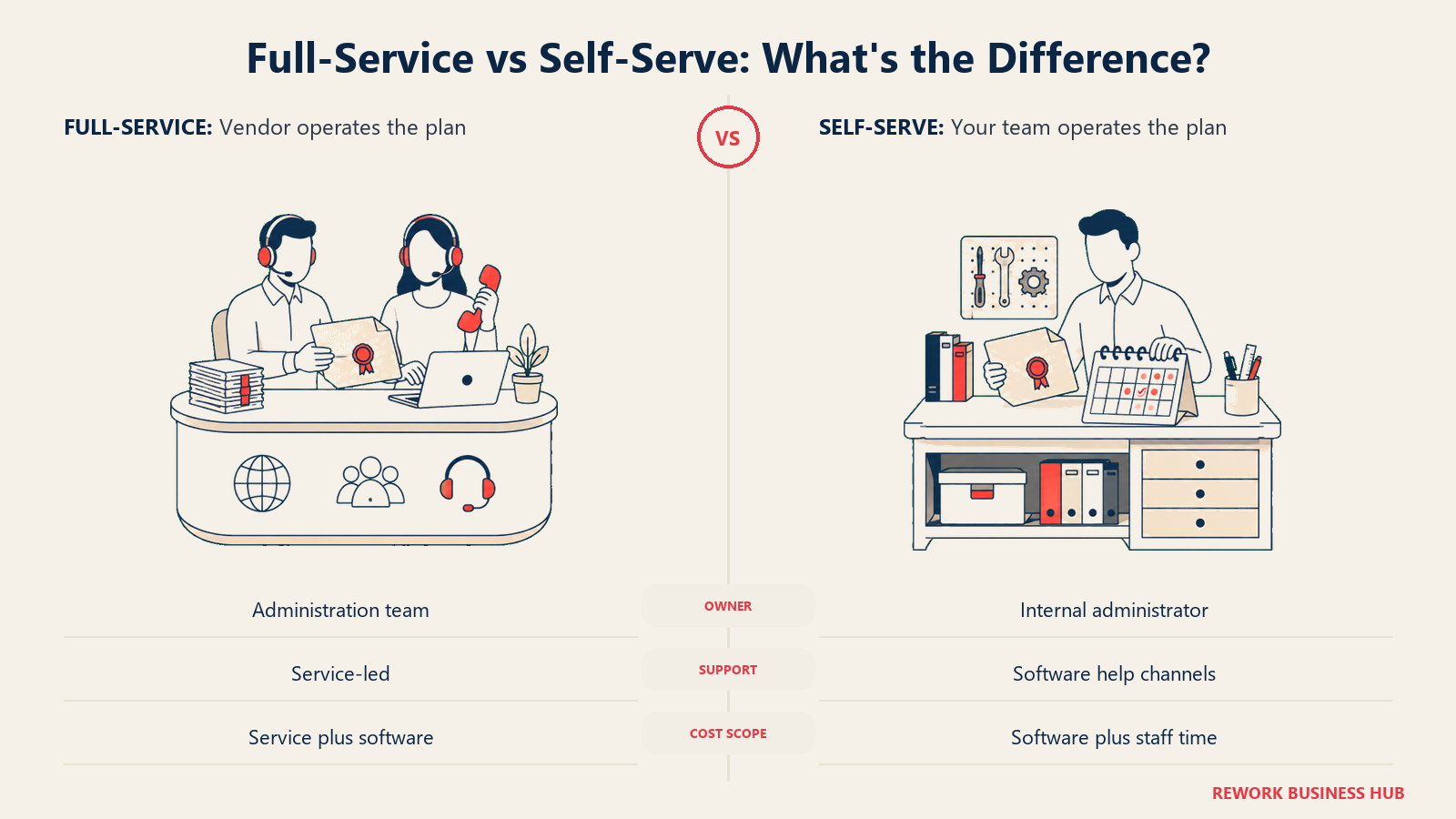
| Full-service administration | Self-serve software | |
|---|---|---|
| Representative platforms | Shareworks, J.P. Morgan Workplace Solutions, Computershare, Fidelity Private Shares (upper tiers) | Carta, Ledgy, Pulley, Astrella, Cake Equity, Qapita, EquityList, Eqvista |
| Who processes a grant cycle | A named administration team on the vendor side | Your controller, stock plan administrator, or a finance generalist |
| Participant support model | Live phone and chat support with a plan administrator | In-app help centre and ticketed email support |
| Exercises and settlements | Executed through an in-house or affiliated broker | Instructions handed off to a separate broker or handled manually |
| Tax withholding across countries | Usually included in the service, calculated centrally | Ranges from strong (Ledgy, Qapita) to basically absent |
| ASC 718 expense | Produced and reconciled for you, or by a dedicated reporting module | Usually a report you export and then reconcile yourself |
| What you actually pay for | Headcount you do not have to hire, and liability someone else carries | Software, plus the internal time nobody costs properly at signature |
| Where it breaks down | Price opacity, long sales cycles, and slow change requests | Nobody owns compliance when the one administrator leaves |
A self-serve platform assumes an owner exists, and at most companies that owner is one person. Below about 100 employees it is usually a controller doing equity as a side quest, which works fine until the first ESPP purchase window or the first multi-country RSU vest.
Ownership is also rarely where you would guess. The same survey found 68% of companies place primary responsibility inside HR, compensation and benefits, and only 19% inside accounting or finance, though that flips in tech, where nearly half of Silicon Valley respondents run it out of finance. Either way the work is cross-functional: HR touches it at 90% of respondents, payroll at 74%, legal at 73%, and accounting at 72%. Buy for the team that will operate it, not the department holding the budget line.
Stage Fit: Private, Pre-IPO, and Public
Requirements change shape twice: once when a company starts granting to the general workforce, and again when it files. A platform that handles a 40-person option pool beautifully can be flatly unable to produce a Section 16 filing or a proxy compensation table.
| Platform | Early private (under 50 stakeholders) | Growth private (50 to 500) | Pre-IPO | Public company |
|---|---|---|---|---|
| Carta | Strong, free Launch tier | Strong | Strong, with liquidity and tender support | Limited, most public issuers move elsewhere |
| Shareworks | Overbuilt | Good | Strong | Strong |
| J.P. Morgan Workplace Solutions | Overbuilt | Good | Strong | Strong |
| Fidelity Private Shares | Strong, free Launch tier | Good | Good | Not the target, private company product |
| Ledgy | Strong, free to 50 stakeholders | Strong across EU entities | Good | Custom pricing, handled case by case |
| Certent Equity Management | Overbuilt | Good | Strong | Strong, this is the design point |
| Computershare | No longer the fit | Good at global scale | Strong | Strong |
| Pulley | Strong | Strong | Good | Not the target |
| Astrella by EQ | Strong | Strong to 300 stakeholders | Moderate | Not the target |
| Vestd | Strong for UK companies | Good for UK companies | Moderate | Not the target |
| Cake Equity | Strong | Good to roughly 100 stakeholders | Moderate | Not the target |
| Qapita | Strong in APAC | Strong in APAC | Good | Not the target |
| EquityList | Strong | Good | Moderate | Not the target |
| Eqvista | Strong on price | Moderate | Limited | Not the target |
Almost nobody upgrades cleanly across that whole span. Companies that expect to file typically re-platform once, somewhere between a late private round and the S-1, moving toward Certent, Shareworks, J.P. Morgan Workplace Solutions, or Computershare, because those four were built around the reporting a public company owes rather than the fundraising a private one does. If you can see the filing from where you sit, budget for a migration rather than assuming your current tool grows with you.
The Full-Service and Enterprise-Scale Platforms
These seven serve companies where equity administration is a real operating function with a named owner, a quarterly close dependency, and usually a multi-country participant base. Five of the seven publish no plan pricing at all, which is a category characteristic rather than a coincidence: administration is priced on plan complexity, participant count, and how much of the work the vendor absorbs, and none of those fit a pricing page.
1. Carta: The Default Starting Point With a Pricing Catch
Carta's thesis is that equity should live in one place from incorporation through liquidity, so the same account that holds the cap table issues grants, runs the vesting calendar, produces the 409A, hosts the participant portal, and eventually runs the tender offer. For a company self-administering, that consolidation beats stitching a cap table tool to a valuation provider to a broker and reconciling three versions of the same grant.
Where it gets uncomfortable is price. Launch is free up to 25 stakeholders and $1M raised, the easiest on-ramp in the category. Above that, Carta's own FAQ says each package carries a price per stakeholder with a minimum annual fee, with Build capped at 50 stakeholders and Grow and Scale carrying a flexible limit. You can learn the structure without ever learning the number.
On administration specifically, Carta is strong on grant issuance, electronic acceptance, vesting automation, and exercise workflows, and thinner on the reporting a public company owes. Most issuers that file move elsewhere.
| Pros | Cons |
|---|---|
| Largest installed base, so most advisors, lawyers, and investors already know it | No paid tier publishes a dollar figure anywhere |
| Grants, vesting, 409A, participant portal, and liquidity in one account | Per-stakeholder pricing against an undisclosed minimum is hard to forecast |
| Free Launch tier removes the cost objection for the first 25 stakeholders | Public-company reporting is not the design point |
Sizing fit: 10-50 and 50-200 are the sweet spots. Stage fit: seed through late private, including tender offers.
Pricing: Launch is free, up to 25 stakeholders and $1M raised. Build (up to 50 stakeholders), Grow, and Scale are each priced per stakeholder against a minimum annual fee that Carta does not publish. No dollar figure is available for any paid tier.
Best for: A private growth company that wants one account covering grants, vesting, valuations, and liquidity, and is willing to run a sales process to learn what it costs. If Carta is the incumbent you are trying to leave, the Carta alternatives guide covers that move directly.
2. Shareworks (Morgan Stanley at Work): White-Glove Administration With Wealth Attached
Shareworks is what most people mean by full-service equity administration. The platform handles grants, vesting, ESPP cycles, exercises, and releases, but what buyers actually pay for is the administration team behind it plus the brokerage and wealth infrastructure Morgan Stanley brings to settlements and liquidity events. When an employee exercises, execution happens inside the same organisation. When an employee has a question about their own equity, they can talk to a person. Neither is true of most software here.

That model matters more than it looks on a feature grid. The NASPP and Deloitte survey found the three most outsourced tasks are vesting and release processing, grant agreement distribution, and option exercise processing, which is a fair description of what a Shareworks administrator does for you. If you have one overloaded stock plan administrator, buying that capacity often beats hiring it.
The friction is entirely commercial. There is no pricing page, no tier list, no self-serve signup, and no free tier on either the Shareworks or Morgan Stanley at Work site.
| Pros | Cons |
|---|---|
| Genuine administration service, not just software you operate yourself | No published pricing of any kind, so budgeting starts blind |
| Native brokerage and wealth infrastructure for exercises and liquidity | Enterprise sales cycle before you see a number |
| Live participant support that a ticket queue does not replicate | Overbuilt and overpriced for a company under about 100 participants |
Sizing fit: 200+ participants, and workable from around 50 with real plan complexity. Stage fit: late private, pre-IPO, and public.
Pricing: No published pricing anywhere. Quote only, with no self-serve signup and no free tier.
Best for: A company that wants grants, vesting, and participant questions handled by someone else, and that has the scale to justify a full-service contract. If it is on your shortlist, the Shareworks alternatives guide covers what else fits the same brief, and Carta vs. Shareworks covers the single most common head-to-head in this category.
3. J.P. Morgan Workplace Solutions: Global Plan Administration at Bank Scale
J.P. Morgan Workplace Solutions is the renamed Global Shares platform, acquired by J.P. Morgan in August 2022. At acquisition it served roughly 650 corporate clients, from early-stage startups through mature multinational public corporations, with close to $200 billion in assets under administration across more than 800,000 corporate employee participants. That is the scale argument, and it is the reason this platform sits on nearly every enterprise shortlist alongside Shareworks.
Functionally it covers the same ground as Shareworks: cap table, grant and vesting administration, ESPP, plan modelling, participant portal, and the audit trail companies answering to regulators need. Its distinguishing strength is country coverage. If your participants sit across a dozen tax jurisdictions and nobody can tell you what withholding applies to a mobile employee who vested in three of them, this is the tier of platform that solves that rather than reporting it. NASPP and Deloitte found business travellers still have the lowest compliance rates of any mobile employee group, though the share of companies complying rose 15% between the 2022 and 2025 surveys.
| Pros | Cons |
|---|---|
| Roughly $200 billion in assets under administration and 800,000-plus participants at acquisition | No published pricing, enterprise quote only |
| Deep multi-country tax, mobility, and local compliance coverage | Long enterprise implementation, measured in quarters not weeks |
| Banking parent behind settlements, custody, and liquidity | Genuinely overbuilt for a single-country company under 100 participants |
Sizing fit: 200+ participants. Stage fit: growth private, pre-IPO, and public.
Pricing: No published pricing. Enterprise, quote only.
Best for: A multinational employer whose equity plan spans multiple tax jurisdictions and that wants a bank-backed administrator rather than software its own team operates.
4. Fidelity Private Shares: A Bank-Backed Free Tier for Private Companies
Fidelity Private Shares is the odd one out among the bank-backed options, because it leads with a free tier rather than a sales call. Launch is free for up to 25 stakeholders and under $1M raised, which puts a Fidelity-operated platform in reach of a company that has not raised institutional money yet. Above that, Startup, Growth, and Scale publish detailed feature lists and no dollar figures, so the transparency stops exactly where the paying starts.
What it is genuinely good at is the legal and administrative machinery around private-company equity: board consents, document generation and execution, grant approvals, and the audit trail connecting all of it. That heritage comes from Shoobx, the equity management and financing automation platform Fidelity acquired in January 2023, and it shows in how document-centric the workflow feels next to a cap table tool that treats grants as rows. Shoobx folded into Fidelity Stock Plan Services, which at the time provided equity recordkeeping and administration to nearly 700 companies covering 2.5 million plan participants (Fidelity Investments, acquisition announcement). A $400 incorporation package covers Delaware C Corp filing fees, a year of registered agent service, and a complimentary Launch subscription.
The trade-off is scope. This is a private company product, so if you are shopping for public-company reporting it is not the answer.
| Pros | Cons |
|---|---|
| Genuine free tier from a bank-backed provider, no sales call required | Startup, Growth, and Scale publish features but no prices |
| Strong document, consent, and approval automation around every grant | Not built for public-company filings or proxy reporting |
| $400 Delaware incorporation package with a year of registered agent service | Smaller ecosystem than Carta among investors and law firms |
Sizing fit: 1-10 and 10-50 at the free tier, 50-200 on paid plans. Stage fit: incorporation through late private.
Pricing: Launch is free, up to 25 stakeholders and under $1M raised. Startup, Growth, and Scale publish no dollar figures. Incorporation package $400.
Best for: A private company that wants bank-backed equity administration with real document and board-consent automation, and that can start free while it is still small.
5. Ledgy: Multi-Country Plans and Reporting Built in Europe
Ledgy is built out of Europe, and the product reflects a market where a 200-person company routinely has employees under five tax regimes holding five different instruments. Multi-country plan support is native rather than bolted on, scenario modelling follows European fundraising norms, and the participant experience is localised in a way US-built tools rarely bother with.
Its pricing is unusually honest for this category. Launch is free with a maximum of 50 stakeholders, double the 25-stakeholder ceiling most of this list settles on and the single most useful free tier here for a company that has hired past its founding team. Scale starts at EUR 5,000 a year including 50-plus stakeholders, Enterprise at EUR 18,000 a year including 200-plus, and public companies are quoted individually.
Budget for reporting separately. Ledgy sells financial reporting as an add-on module rather than bundling it: Essentials from EUR 3,000 a year, Advanced from EUR 5,000. If ASC 718 or IFRS 2 expense is why you are shopping, that add-on is not optional, and it roughly doubles the entry cost.
| Pros | Cons |
|---|---|
| Free tier holds 50 stakeholders, the most generous published ceiling on this list | Financial reporting is a paid add-on from EUR 3,000/year on top of the base plan |
| Published starting prices for Scale and Enterprise, unusual in this category | Euro pricing complicates budgeting for US-headquartered buyers |
| Native multi-country plan, tax, and participant support across European jurisdictions | Weaker US brand recognition than Carta or Pulley |
Sizing fit: 10-50 free, 50-200 on Scale, 200+ on Enterprise. Stage fit: seed through late private, with custom handling for public issuers.
Pricing: Launch free (max 50 stakeholders). Scale starts at EUR 5,000/year (50-plus stakeholders included). Enterprise starts at EUR 18,000/year (200-plus included). Financial reporting add-on: Essentials from EUR 3,000/year, Advanced from EUR 5,000/year. Public companies: custom.
Best for: A European or multi-country employer that needs local compliance depth and wants a starting price on the page. The Ledgy alternatives guide covers the comparison from the other direction.
6. Certent Equity Management: Built Around ASC 718 and SEC Reporting
Certent Equity Management, now part of insightsoftware, approaches equity from the accounting side rather than the fundraising side, and that single difference explains who buys it. The platform automates ASC 718 and IFRS 2 expense calculations and journal entries, produces the SEC forms a public issuer owes including Section 16 filings, supports XBRL and iXBRL and EDGAR submission, generates proxy compensation tables, and ships with more than 400 prebuilt reports. It handles 15-plus award types, which matters once your plan has drifted past plain options and RSUs into performance awards, SARs, and phantom units.

It is also broker-agnostic and deployment-flexible: self-managed, outsourced, or hybrid, with a white-label participant portal. That suits a company keeping its existing broker relationships while consolidating the accounting layer, a common shape at pre-IPO scale where the broker was chosen years before the reporting problem arrived.
Grant-type mix is why this tier keeps growing. Per the NASPP and Deloitte 2024 Equity Incentives Design Survey, nearly all public companies now grant service-based full-value awards, 95% of those use RSUs, 90% also grant performance awards, and only just over 40% still grant stock options. Performance awards carry accounting complexity a startup-oriented tool was never designed for.
| Pros | Cons |
|---|---|
| ASC 718 and IFRS 2 expense, journal entries, and audit trail built in, not exported | No pricing published; the page routes to a quote request |
| Section 16 forms, EDGAR submission, XBRL support, and proxy tables | Enterprise implementation and enterprise expectations |
| Broker-agnostic, with self-managed, outsourced, or hybrid deployment | Wrong tool entirely for a 30-person company with one option pool |
Sizing fit: 200+ participants. Stage fit: late private, pre-IPO, and public.
Pricing: No pricing figures published. The pricing page routes to a "Get Pricing and Promos" request.
Best for: A pre-IPO or public company whose real bottleneck is stock compensation expense, disclosure, and filings rather than cap table hygiene.
7. Computershare: Transfer Agent Infrastructure for Global and Public Plans
Computershare comes at equity management from the registry side. It is a transfer agent and corporate trust business first, with employee share plan administration built on top, and its own materials describe more than 30 years in the business and over 1,000 equity specialists across major markets. The platform is EquatePlus, supported by EquatePyramid for financial reporting, EquateFalcon as an automated grant engine, EquateInsights for reporting, and EquateAPI for data exchange with payroll and HRIS.
Coverage runs across ESPP including global and country-specific variants, options including ISOs, Canadian options and UK CSOPs, SARs and phantom plans, RSUs and RSAs, and performance share units. Service spans compliance, tax, reporting, nominee structures, and custody, with an execution-only option for companies that want settlement without the administration wrap.
One thing to get right before shortlisting: Computershare does not currently sell a self-serve cap table product for small private companies. It launched GEMSpm for that market in 2020 and has since withdrawn it, and its current employee share plan pages market only the full-service EquatePlus platform. Computershare has not published a retirement notice of its own, so treat the exact withdrawal date as unconfirmed, but do not plan around GEMSpm being available. If a smaller private company is what you are buying for, Computershare is not the vendor to shortlist.
| Pros | Cons |
|---|---|
| Transfer agent, registry, and plan administration from one provider | No published pricing, quote only |
| Over 1,000 equity specialists and a full global plan-type catalogue | Withdrew its self-serve private-company product, so small companies are out of scope |
| Execution-only option for companies that want settlement without full service | Sales and implementation cycle sized for large enterprises |
Sizing fit: 200+ participants. Stage fit: growth private through public, strongest for listed issuers.
Pricing: No published price. Quote only.
Best for: A global or listed company that wants its transfer agent and its employee plan administrator to be the same organisation.
The Self-Serve and Growth-Stage Platforms
These seven assume your team runs the plan. They are cheaper, faster to implement, and almost all publish a real number, which makes them easy to evaluate and easy to underestimate. The cost that does not appear on the invoice is internal: someone has to own the vesting calendar, the exercise queue, the withholding, and the quarterly expense file. Price these against the fully loaded hours of the person who will actually do that, not against each other.
8. Pulley: Every Tier Priced in the Open
Pulley's positioning is straightforward: everything a startup needs to run equity, priced on the page, no sales call to find out. Startup is $1,200 a year and includes the first 25 stakeholders. Growth is $3,500 a year and includes the first 40. Enterprise is a contact-us tier, billed annually. There is no free plan, only a trial aimed at companies switching from Carta, which is an unusual and fairly honest choice: Pulley would rather charge from day one than build a funnel on a free tier it has to upsell out of.
Two details worth knowing. Pulley counts angel investors writing cheques of $50,000 or less as half a stakeholder, which changes the maths for a company with a long angel round. And it publishes no per-extra-stakeholder rate, so once you pass the included count you are back to asking.
Pulley also runs a separate crypto line: Token Cap Table at $4,500 a year, Distributions at $4,500 a year, Valuations from $10,000. If you administer token grants alongside conventional equity, that is a rarity here. On administration depth it sits mid-list: strong on grants, board approvals, exercises, and 409A workflow, thinner on multi-country tax and public reporting.
| Pros | Cons |
|---|---|
| Every standard tier priced in the open, no quote gate | No free plan, only a switcher trial |
| Angel cheques of $50,000 or less count as half a stakeholder | No published per-extra-stakeholder rate above the included count |
| Separate token and crypto equity products, priced openly | Multi-country tax and mobility are not the strength |
Sizing fit: 10-50 on Startup, 50-200 on Growth. Stage fit: pre-seed through Series C.
Pricing: Startup $1,200/year, first 25 stakeholders included. Growth $3,500/year, first 40 included. Enterprise: contact us, billed annually. Token Cap Table $4,500/year, Distributions $4,500/year, Valuations from $10,000.
Best for: A startup that wants published pricing and modern grant, approval, and exercise workflows without an enterprise sales process. The Pulley alternatives guide and the direct Carta vs. Pulley comparison cover the two matchups buyers ask about most.
9. Astrella by EQ: Banded Pricing on a Transfer Agent Foundation
Astrella is a division of EQ Private Company Solutions, drawing on the shareholder-services history of American Stock Transfer and Equiniti. That lineage is the pitch: equity administration built by an organisation whose day job is being a registrar, not by a startup learning shareholder record-keeping as it goes. It also inherited the customer base of LTSE Equity, which exited the cap table business and pointed its customers here.
The commercial model is the clearest on this list. Early Stage is $1,200 a year for 0 to 25 stakeholders, Emerging $3,200 for 26 to 100, Accelerate $8,200 for 101 to 300, and above 300 it becomes a custom quote. All tiers bill annually. Astrella's page notes that displayed pricing is standard pricing and may not reflect partnership or custom arrangements, so a partner-sourced deal can differ, but a finance lead can still model three years of growth against published bands without talking to anyone.
Administration coverage is competent rather than deep: grants, vesting, stakeholder portal, document management, and reporting. It is not where you go for global mobility or Section 16 filings.
| Pros | Cons |
|---|---|
| Three published stakeholder bands, so the next tier's cost is knowable in advance | Above 300 stakeholders it becomes a custom quote |
| Backed by AST and Equiniti registrar infrastructure | Fewer modern automation and AI features than newer entrants |
| Existing migration path for former LTSE Equity customers | Not built for public-company reporting or multi-country tax |
Sizing fit: 10-50 on Early Stage, 50-200 on Emerging, 200+ on Accelerate. Stage fit: seed through late private.
Pricing: Early Stage $1,200/year (0-25 stakeholders). Emerging $3,200/year (26-100). Accelerate $8,200/year (101-300). Above 300: custom quote. All billed annually.
Best for: A company that wants to forecast three years of equity administration cost from a published table rather than a series of renewals.
10. Vestd: UK EMI Schemes With Published Plan Prices
Vestd is the UK specialist, and it is specialised in a way that makes it either the obvious answer or entirely irrelevant. EMI option schemes, growth shares, unapproved options, agreements, valuations, and direct filing with Companies House and HMRC are the core of the product, and they are handled with a level of local detail no generalist platform matches. If you run a UK limited company and your equity questions are about EMI eligibility and annual returns rather than ASC 718, this is the shortlist.
Contrary to a claim that circulates widely, Vestd does publish plan prices. Self-Serve starts at GBP 2,200 a year, which the site also expresses as from GBP 220 a month. Guided starts at GBP 4,200 a year, or from GBP 420 a month. Full Service is enquiry-only. VAT is charged on top and there is a minimum 12-month term, both easy to forget when comparing against a US dollar sticker price.
Price the add-ons before you sign, because several things you might assume are included are not: incorporation GBP 100, InVestd Raise GBP 150 a month, additional valuations from GBP 1,000, 409A valuations from GBP 700, digitising an existing scheme from GBP 250, live HMRC submission support GBP 25 a month, new share classes from GBP 250, Companies House reconciliations from GBP 25 a month, a nominee structure for up to 50 shareholders from GBP 50 a month, and share movement history from GBP 250.
| Pros | Cons |
|---|---|
| Deepest UK share scheme support, with direct Companies House and HMRC filing | UK-focused, so a US or multi-country plan is the wrong fit |
| Plan prices are published in both annual and monthly form | VAT on top plus a minimum 12-month term |
| Guided and Full Service tiers for teams without in-house equity expertise | A long add-on list can double the effective annual cost |
Sizing fit: 1-10 through 50-200, UK entities. Stage fit: incorporation through growth.
Pricing: Self-Serve from GBP 2,200/year (from GBP 220/month). Guided from GBP 4,200/year (from GBP 420/month). Full Service: enquire. VAT charged in addition, minimum 12-month term. Add-ons priced separately as listed above.
Best for: A UK limited company running EMI or growth share schemes that wants filings, valuations, and agreements handled in one place.
11. Cake Equity: Published Pricing and a Bundled 409A
Cake Equity is an Australian platform aimed at founders who want equity issued and administered without a lawyer in the loop for every grant, and it publishes a price at every tier, which puts it in a small minority here. Free is $0 and includes 5 stakeholders. Build is $1,000 annually with 25 stakeholders included and $1 per additional stakeholder. Team is $2,750 annually with 40 included, $5 per additional stakeholder, and an audit-ready 409A valuation bundled. Pro is custom-priced with 100 stakeholders included and $60 per additional stakeholder, also with a 409A included. A standalone 409A add-on is $1,500. Build saves 10% versus quarterly billing.

Read that per-stakeholder ladder carefully, because it is the most misquoted thing about this platform. The $60 rate is a Pro rate, not a Team rate. Team charges $5. The jump from $1 to $5 to $60 is not a vendor typo either; Pro includes 100 stakeholders and a valuation before any overage applies, so the marginal rate sits on a much larger base of included service.
Where it earns its place is granting workflow: employee-facing offer documents, digital acceptance, vesting tracking, and a participant view non-finance employees actually understand. Where it stops is complex multi-country tax and public-company reporting.
| Pros | Cons |
|---|---|
| A published price at every paid tier, including per-stakeholder overages | Overage rates jump steeply between tiers, $1 to $5 to $60 |
| Audit-ready 409A bundled into Team and Pro, standalone at $1,500 | Pro's base price is custom despite the published overage rate |
| Clear participant-facing offer and acceptance flow | No public-company reporting or deep mobility support |
Sizing fit: 1-10 free, 10-50 on Build, 50-200 on Team and Pro. Stage fit: incorporation through Series B.
Pricing: Free $0 (5 stakeholders). Build $1,000 annually (25 included, $1 per additional). Team $2,750 annually (40 included, $5 per additional, audit-ready 409A included). Pro custom (100 included, $60 per additional, 409A included). Standalone 409A $1,500. Build saves 10% versus quarterly billing.
Best for: An Australian or APAC company that wants transparent per-stakeholder pricing and a clean employee granting experience.
12. Qapita: Equity Administration Built for APAC
Qapita was built for India and Southeast Asia, where equity administration runs into local company law, currency controls, and employee expectations that US-built tools handle badly or not at all. If your cap table sits in Singapore and your engineers sit in India, this is the platform designed for that shape, and it prices in USD so a US or European investor can still read the invoice.
Spark is free for up to 25 stakeholders and less than $1M raised. Surge is $1,600 a year for up to 40 stakeholders, then $40 per stakeholder per year beyond. Growth is $3,000 a year for up to 50, then $60 per stakeholder per year beyond. Enterprise is custom, and everything bills annually.
Model the overage, not the headline. A 120-stakeholder company on Growth pays $3,000 plus 70 stakeholders at $60, so the real annual figure is $7,200 rather than $3,000. That is on the page, but it is the arithmetic buyers skip when comparing headline prices across a shortlist. Coverage includes grants, vesting, ESOP pool management, buybacks and liquidity events, and participant reporting, with local documentation for its markets.
| Pros | Cons |
|---|---|
| Purpose-built for India and Southeast Asia company law and ESOP practice | Per-stakeholder overages of $40 to $60/year change the real cost sharply |
| USD pricing published at every self-serve tier | Less relevant if your whole plan sits in the US or Europe |
| Buyback and liquidity event support that many peers lack | Not a public-company reporting platform |
Sizing fit: 10-50 on Surge, 50-200 on Growth. Stage fit: seed through late private.
Pricing: Spark free (up to 25 stakeholders, under $1M raised). Surge $1,600/year (up to 40 stakeholders, then $40 per stakeholder/year). Growth $3,000/year (up to 50 stakeholders, then $60 per stakeholder/year). Enterprise custom. All USD, billed annually.
Best for: A company with an India or Southeast Asia employee base that needs local ESOP practice handled properly rather than approximated.
13. EquityList: Repriced, Simplified, and AI-Leaning
EquityList repriced and simplified its lineup, and the current structure is cleaner than anything written about it a year ago. Free is $0 with 10 stakeholders included and 1,000 lifetime AI credits, and it is no longer gated on how much you have raised, which used to be the catch. Build is $1,200 billed annually, roughly $100 a month equivalent, with 35 stakeholders included and $35 per additional stakeholder per year. Billed monthly, Build is $125 a month with $4 per additional stakeholder per month. Growth is $3,500 billed annually with 50 stakeholders included and $50 per additional stakeholder per year. Enterprise is custom.
Take the annual figures as the real entry price. The site's own banner advertises a saving for annual billing, and Build behaves as you would expect, $1,200 a year against $125 a month. Ignore the Growth monthly panel for comparison purposes, because the monthly figure shown there undercuts the annual equivalent and contradicts the page's own annual-saving claim. Quote Growth at $3,500 a year and confirm the monthly rate with sales if you need it.
The product leans harder on AI assistance than most peers, which sits oddly against the survey data: fewer than 30% of companies use AI anywhere in equity plan administration, and 82% of those that do use it for emails and documents rather than administration itself.
| Pros | Cons |
|---|---|
| Free tier now holds 10 stakeholders with no funds-raised gate | Younger platform with a shorter track record on complex plans |
| Published stakeholder overages at $35 and $50 per year | The Growth monthly panel contradicts the site's own annual-saving banner |
| Both monthly and annual billing published on Build | AI credits are a lifetime allowance, not a recurring one |
Sizing fit: 1-10 free, 10-50 on Build, 50-200 on Growth. Stage fit: pre-seed through Series B.
Pricing: Free $0 (10 stakeholders, 1,000 lifetime AI credits). Build $1,200 billed annually (35 stakeholders included, $35 per additional per year), or $125/month billed monthly ($4 per additional per month). Growth $3,500 billed annually (50 stakeholders included, $50 per additional per year). Enterprise custom.
Best for: An early-stage team that wants a low published entry price, a usable free tier, and clear overage rates it can model before hiring.
14. Eqvista: Low-Cost Cap Table Plus Valuation Bundles
Eqvista competes on price and on valuations, and it is upfront about both. The freemium cap table is $0 for under 20 stakeholders with no credit card, and the premium cap table is $2 per stakeholder per month, with custom pricing above 50 stakeholders. The valuation line is priced by funding round rather than by negotiation: $990 a year for a startup or pre-revenue company, $1,290 for friends and family or angel stage, $1,990 at seed, $2,590 at Series A, custom at Series B and beyond. Expedited processing starts at $490 and QSBS attestation at $1,000.
The annual 409A packages include unlimited 409A updates plus the premium cap table, which is aggressive at the low end. A pre-revenue company paying $990 a year gets unlimited valuation updates and the cap table for less than most competitors charge for the cap table alone.
The honest limitation is administration depth. This is a cap table and valuation product with equity administration attached, not an administration platform. Grant workflows, participant experience, withholding, and expense reporting are all thinner than the platforms above it, and once you cross 50 stakeholders you are into custom pricing anyway.
| Pros | Cons |
|---|---|
| 409A valuations priced openly by funding round, from $990/year | Custom pricing starts above 50 stakeholders |
| Annual valuation packages bundle unlimited updates plus the premium cap table | Administration and participant experience are thin compared to peers |
| Free under 20 stakeholders with no credit card required | Not suitable for multi-country plans or public-company reporting |
Sizing fit: 1-10 and 10-50. Stage fit: pre-seed through Series A.
Pricing: Freemium $0 (under 20 stakeholders). Premium cap table $2/month per stakeholder, custom above 50 stakeholders. 409A by round: $990/year startup or pre-revenue, $1,290 friends and family or angel, $1,990 seed, $2,590 Series A, custom Series B and above. Expedited processing from $490, QSBS attestation from $1,000.
Best for: A bootstrapped or early-stage company that wants a cheap cap table and predictable 409A pricing more than it wants administration automation.
ASC 718 Expense and Financial Reporting
Stock compensation expense is where equity administration stops being an HR problem and becomes an audit problem. Every grant creates a fair value that has to be amortised over a service period, adjusted for forfeitures, and disclosed. This table reflects what each vendor markets for that job, not an audit of the calculation engines.
| Platform | ASC 718 or IFRS 2 expense | Journal entries | Disclosure and SEC forms | Practical note |
|---|---|---|---|---|
| Certent Equity Management | Core capability, both standards | Automated, with audit trail | Section 16 forms, EDGAR submission, XBRL and iXBRL, proxy tables | This is the design point of the product |
| Computershare | Handled through EquatePyramid financial reporting | Supported within the service | Delivered as part of full-service administration | Reporting sits inside a managed service, not a self-serve module |
| Shareworks | Produced as part of the administration service | Supported within the service | Supported for public issuers | You are buying the team as much as the engine |
| J.P. Morgan Workplace Solutions | Produced as part of the administration service | Supported within the service | Supported for public issuers | Strongest where reporting spans many jurisdictions |
| Ledgy | Paid financial reporting add-on, Essentials or Advanced | Included in the reporting module | Built for European reporting requirements | Budget the add-on, it is not in the base plan |
| Carta | Expense reporting available on paid tiers | Exportable reports | Not built for Section 16 or proxy filings | Fine privately, most issuers re-platform before filing |
| Fidelity Private Shares | Reporting for private company needs | Exportable reports | Private company product, not a filing platform | Document and consent automation is the real strength |
| Pulley | Expense reporting for private companies | Exportable reports | Not a filing platform | Sized for pre-IPO private reporting |
| Astrella by EQ | Standard reporting suite | Exportable reports | Not a filing platform | Registrar heritage shows in records, not accounting |
| Cake Equity | Basic expense reporting | Exportable reports | Not a filing platform | Granting experience is the strength |
| Qapita | Reporting for local requirements in its markets | Exportable reports | Not a filing platform | Local statutory reporting rather than SEC |
| EquityList | Reporting on paid tiers | Exportable reports | Not a filing platform | Younger reporting stack |
| Eqvista | Basic reporting | Exportable reports | Not a filing platform | Valuation-led rather than accounting-led |
| Vestd | UK statutory and HMRC reporting | Exportable reports | HMRC and Companies House, not SEC | Correct standard, different country |
The pattern is blunt. A couple of these were designed around the accounting, most were designed around the ownership record, and the difference only shows up at your first audit with a material equity balance. If expense is currently reconciled in a spreadsheet between your cap table and your ledger, the fix is either a reporting-first platform or a tighter connection into the accounting system you already run, which the accounting software roundup covers.
Participant Experience, Exercises, and Broker Integration
Participant experience is the part of equity administration finance teams under-weight and employees judge you on, and it has a measurable cost. Carta's own data on startups using its platform found employees exercised just 32.2% of vested, in-the-money options in the fourth quarter of 2024, against 54.2% three years earlier (Carta, State of Startup Compensation H2 2024, vendor data on its own customer base). The private-market slowdown explains much of that, but the direction still matters: a lot of granted value never converts, and confusion at the exercise step is part of why.
| Platform | Participant portal | Exercise and settlement path | Broker or liquidity integration |
|---|---|---|---|
| Shareworks | Full participant portal with live phone and chat support | Executed through affiliated brokerage | Native, including liquidity events |
| J.P. Morgan Workplace Solutions | Full participant portal with supported service | Executed through the bank's infrastructure | Native, global |
| Computershare | EquatePlus participant platform and app | Full-service or execution-only settlement | Native, with custody and nominee options |
| Certent Equity Management | White-label participant portal | Broker-agnostic | Integrates with your existing broker |
| Carta | Strong self-serve portal, ticketed support | In-app exercise workflow | Tender offers and liquidity products in-platform |
| Fidelity Private Shares | Self-serve portal with document access | In-app exercise and document flow | Fidelity relationship, private company scope |
| Ledgy | Localised self-serve portal | In-app exercise workflow | Partner-based rather than native |
| Pulley | Self-serve portal | In-app exercise and approval flow | Partner-based |
| Astrella by EQ | Stakeholder portal | Standard exercise workflow | Registrar infrastructure behind it |
| Cake Equity | Employee offer and acceptance flow | Standard exercise workflow | Partner-based |
| Qapita | Participant portal with local language support | Exercise plus buyback and liquidity support | Buyback and liquidity events supported |
| EquityList | Modern self-serve portal | Standard exercise workflow | Partner-based |
| Vestd | Shareholder portal | UK scheme exercise flow | UK-specific |
| Eqvista | Basic stakeholder access | Basic exercise recording | Minimal |
The practical read: if a meaningful share of your employees will exercise while the company is still private, the platforms with native brokerage or an explicit liquidity workflow save you a manual reconciliation every time. If exercises are rare and mostly happen at termination, a self-serve portal plus a clear email is enough. Either way the participant data has to reconcile with payroll, because the withholding lands there. The payroll software roundup covers that integration, and the HR software roundup is the place to look if employee records keep drifting out of sync with grant data.
Global Mobility and Multi-Jurisdiction Coverage
Cross-border equity is where most platforms quietly stop helping. An employee who was granted in Germany, vested partly while assigned to Singapore, and exercised after moving to the US creates a withholding calculation that no cap table tool solves on its own, and getting it wrong creates a payroll liability rather than a reporting inconvenience.
This is a large and growing part of the category. The Global Equity Organisation's 2025 Global Equity Insights Survey, now in its thirteenth edition, gathered responses from 177 companies across 20 countries and 11 industries, with global mobility among its named focus areas (GEO, GEIS 2025). And NASPP and Deloitte found business travellers remain the least compliant mobile employee group, even as the share of companies complying rose 15% between the 2022 and 2025 editions (NASPP, business traveller tax compliance).
| Platform | Multi-country plan support | Tax withholding across jurisdictions | Mobility tracking | Best-fit geography |
|---|---|---|---|---|
| J.P. Morgan Workplace Solutions | Extensive | Handled within the service | Supported | Global |
| Shareworks | Extensive | Handled within the service | Supported | Global, US-centred |
| Computershare | Extensive, including country-specific ESPP variants | Handled within the service | Supported | Global |
| Certent Equity Management | Strong, ASC 718 and IFRS 2 | Reporting-led rather than service-led | Partial | US and international issuers |
| Ledgy | Strong across European jurisdictions | Strong in supported countries | Partial | Europe |
| Qapita | Strong in India and Southeast Asia | Strong in supported countries | Partial | APAC |
| Carta | Moderate, US plus Carta Europe | Limited | Limited | US and Europe |
| Vestd | UK only | UK and HMRC | Not applicable | United Kingdom |
| Cake Equity | Moderate, Australia and APAC | Limited | Limited | Australia and APAC |
| Fidelity Private Shares | Limited, US private companies | Limited | Limited | United States |
| Pulley | Limited | Limited | Limited | United States |
| Astrella by EQ | Limited | Limited | Limited | United States |
| EquityList | Limited | Limited | Limited | US and India |
| Eqvista | Limited | Limited | Limited | United States |
If you have participants in more than about four countries, the shortlist compresses hard to the top three or four rows, and that is the single most common reason a company outgrows a startup-oriented tool long before it outgrows the stakeholder count.
Pricing Transparency: Who Publishes a Number
Price opacity is not a footnote in this category, it is a buying consideration. Four of these 14 publish nothing at all, and Carta publishes a pricing model without a price. That shapes your evaluation timeline more than any feature gap: a quote-only shortlist means weeks of sales calls before you can build a comparison, and it means you cannot benchmark a renewal against anything.
| Platform | Publishes plan prices | Entry price you can verify today | What you have to ask for |
|---|---|---|---|
| Astrella by EQ | Yes, three bands | $1,200/year (0-25 stakeholders) | Anything above 300 stakeholders |
| Pulley | Yes | $1,200/year (25 included) | Enterprise, and per-extra-stakeholder rates |
| Cake Equity | Yes, plus overage rates | Free, then $1,000 annually (25 included) | Pro base price |
| Qapita | Yes, plus overage rates | Free, then $1,600/year (40 included) | Enterprise |
| EquityList | Yes, monthly and annual | Free, then $1,200 billed annually (35 included) | Enterprise, and the Growth monthly rate |
| Eqvista | Yes, per stakeholder | Free, then $2/month per stakeholder | Anything above 50 stakeholders |
| Vestd | Yes, annual and monthly | GBP 2,200/year (from GBP 220/month), plus VAT | Full Service tier |
| Ledgy | Starting prices only | Free, then from EUR 5,000/year | Exact Scale, Enterprise, and public company pricing |
| Carta | No, model only | Free Launch tier | Every paid tier price and the minimum annual fee |
| Fidelity Private Shares | No, free tier only | Free Launch tier | Startup, Growth, and Scale pricing |
| Shareworks | No | Nothing published | Everything |
| J.P. Morgan Workplace Solutions | No | Nothing published | Everything |
| Certent Equity Management | No | Nothing published | Everything |
| Computershare | No | Nothing published | Everything |
The pattern is not a coincidence. Published-price platforms sell software you operate. Quote-only platforms sell a service whose cost genuinely varies with plan complexity, participant count, and jurisdictions, so opacity there is at least explicable. What is harder to defend is a per-stakeholder model published without the per-stakeholder number.
How to Choose: Decision Framework
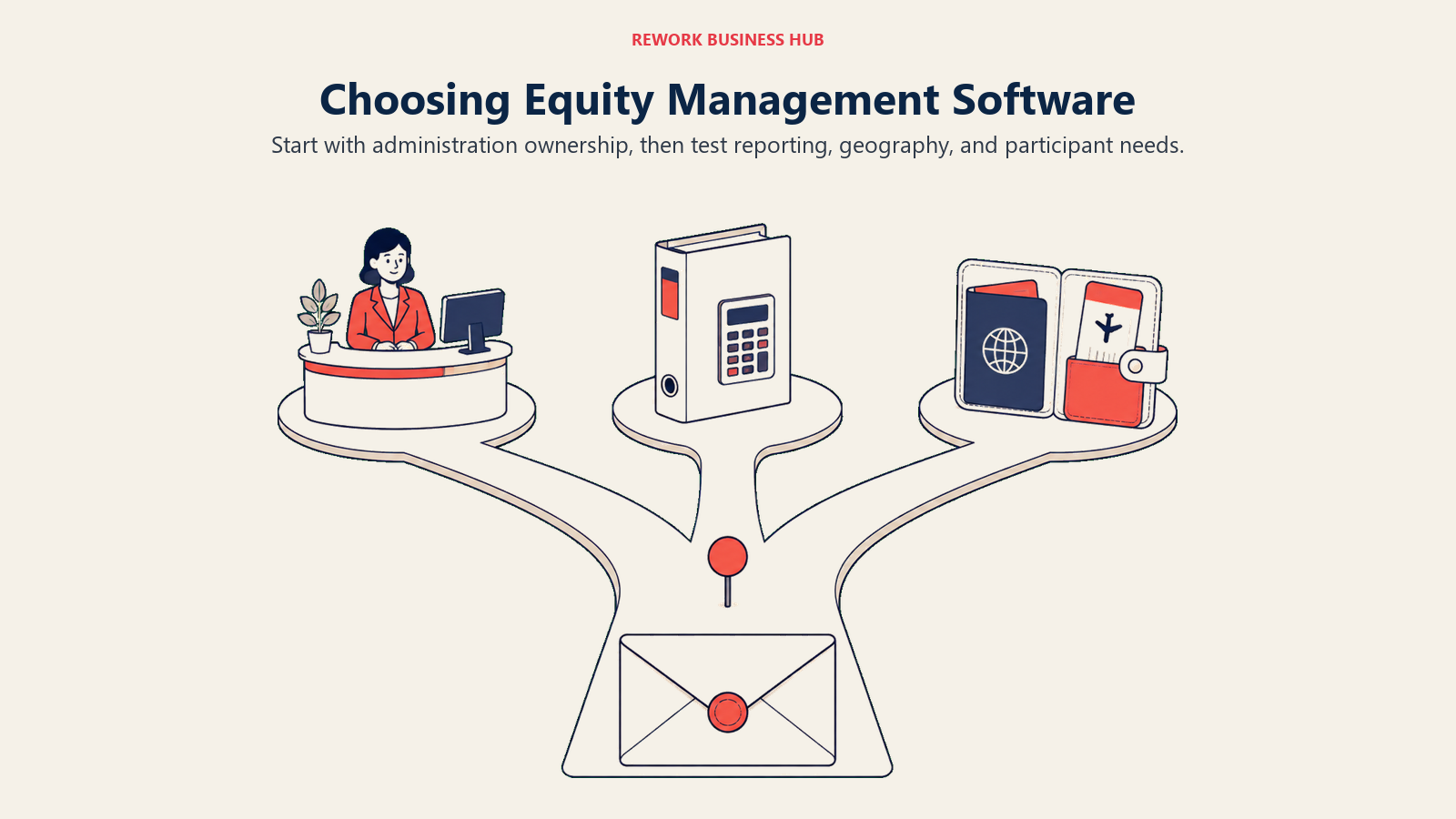
Choose around the work your team must own: administration, reporting, local plan requirements, and participant support.
| If you need... | Choose |
|---|---|
| Someone else to run grants, vesting, and participant support at global scale | Shareworks or J.P. Morgan Workplace Solutions |
| ASC 718 expense, Section 16 forms, and EDGAR filing in one platform | Certent Equity Management |
| Transfer agent, registry, and employee plan administration from one provider | Computershare |
| One account covering grants, vesting, 409A, and a tender offer, privately | Carta |
| Multi-country European plan support with a starting price on the page | Ledgy |
| A free tier from a bank-backed provider with strong document automation | Fidelity Private Shares |
| Every standard tier priced openly, with no sales call | Pulley or Astrella by EQ |
| EMI schemes, Companies House filing, and HMRC support in the UK | Vestd |
| An India or Southeast Asia employee base handled with local ESOP practice | Qapita |
| The cheapest workable combination of cap table and recurring 409A | Eqvista or Cake Equity |
Frequently Asked Questions about Equity Management Software
What is the difference between equity management software and cap table software?
Cap table software maintains the ownership record: who holds what across shares, options, SAFEs, and convertibles, plus 409A valuations and waterfall modelling. Equity management software covers the administration lifecycle on top of that record, including grant issuance and acceptance, vesting automation, exercises, ESPP cycles, tax withholding, ASC 718 expense, and participant support. Most platforms do some of both, but the administration-first ones tend to be quote-only and the record-first ones tend to publish a price.
How much does equity management software cost in 2026?
Self-serve platforms with published pricing start around $1,200 a year: Pulley Startup at $1,200 for 25 stakeholders, Astrella Early Stage at $1,200 for 0 to 25, and EquityList Build at $1,200 billed annually for 35. Mid tiers run $2,750 to $3,500 a year, and Astrella Accelerate reaches $8,200 at 101 to 300 stakeholders. Full-service administration from Shareworks, J.P. Morgan Workplace Solutions, Computershare, and Certent publishes no pricing and is quoted on plan complexity, participant count, and jurisdictions.
Which equity management platforms publish their pricing?
Astrella, Pulley, Cake Equity, Qapita, EquityList, Eqvista, and Vestd all publish plan prices, and Ledgy publishes starting figures for its paid tiers. Carta publishes a pricing model, per stakeholder against a minimum annual fee, without the actual figures. Shareworks, J.P. Morgan Workplace Solutions, Certent Equity Management, and Computershare publish nothing and quote every deal.
Which platform is best for ASC 718 and public-company reporting?
Certent Equity Management, because ASC 718 and IFRS 2 expense, journal entries, Section 16 forms, EDGAR submission, XBRL support, and proxy compensation tables are the design point of the product rather than an add-on. Computershare, Shareworks, and J.P. Morgan Workplace Solutions cover the same ground inside a full-service arrangement. Startup-oriented platforms produce exportable expense reports but are not filing platforms.
Do I need a separate platform once my company goes public?
Usually yes, and it is better to plan for that than to discover it during the S-1 process. Most platforms here are built around private-company needs: rounds, option pools, 409A valuations, and investor reporting. Public obligations such as Section 16 filings, proxy tables, EDGAR submission, and quarterly disclosure are handled by a narrower set of vendors, so companies that expect to file typically re-platform once between a late private round and the listing.
How many people does it take to administer an equity plan?
Fewer than most companies expect, which is part of the risk. Per the NASPP and Deloitte Tax 2025 Equity Administration Survey, 85% of companies with fewer than 750 employees have one dedicated equity administrator or none at all, while 52% of companies above 5,000 employees have two or more. That is also why 71% outsource at least some of the work and only 9% keep every function in-house.
Which department should own equity administration?
There is no single right answer, but the data shows a default. The same NASPP and Deloitte survey found 68% of companies place primary responsibility in HR, compensation and benefits, and 19% in accounting or finance, with tech companies far more likely to run it out of finance. Whoever owns it, the work is cross-functional: HR participates at 90% of companies, payroll at 74%, legal at 73%, and accounting at 72%.
What happens to equity administration for employees who move between countries?
Vesting across jurisdictions can create withholding obligations in more than one of them, and getting it wrong creates a payroll liability rather than a reporting inconvenience. Only the full-service platforms, J.P. Morgan Workplace Solutions, Shareworks, and Computershare, plus regionally strong tools like Ledgy in Europe and Qapita in APAC, handle this well. NASPP and Deloitte found business travellers remain the least compliant mobile employee group even as overall compliance improved 15% between the 2022 and 2025 surveys.
What to Do Next
Run one grant cycle end to end in a trial or sandbox with your top two picks, using your real data rather than the vendor's demo set. Import an actual grant with a real vesting schedule, issue it, accept it as a participant, process an exercise, then produce the expense report and hand it to whoever closes your books. That takes an afternoon and surfaces the two things a feature comparison never does: where your existing data is dirty, and which step your team will silently stop doing three months after go-live.
Then price the internal side honestly. Add the fully loaded hours of whoever will own the vesting calendar, the exercise queue, and the quarterly expense file before comparing a self-serve platform against a full-service quote. A $1,200 tool plus a quarter of a controller's time is not cheaper than an administered service, and 71% of companies have already reached that conclusion for at least part of the work. If cap table hygiene rather than administration is the real problem, start with the cap table software roundup, and if this is part of a wider finance rebuild, the FP&A software roundup covers where dilution and equity expense land in the forecast.
Camellia writes about equity administration and cap table software for B2B finance teams. Pricing verified against vendor pricing pages in September 2026.

Principal Product Marketing Strategist
On this page
- Key Facts
- Quick Comparison Table
- Full-Service Administration Versus Self-Serve Software
- Stage Fit: Private, Pre-IPO, and Public
- The Full-Service and Enterprise-Scale Platforms
- 1. Carta: The Default Starting Point With a Pricing Catch
- 2. Shareworks (Morgan Stanley at Work): White-Glove Administration With Wealth Attached
- 3. J.P. Morgan Workplace Solutions: Global Plan Administration at Bank Scale
- 4. Fidelity Private Shares: A Bank-Backed Free Tier for Private Companies
- 5. Ledgy: Multi-Country Plans and Reporting Built in Europe
- 6. Certent Equity Management: Built Around ASC 718 and SEC Reporting
- 7. Computershare: Transfer Agent Infrastructure for Global and Public Plans
- The Self-Serve and Growth-Stage Platforms
- 8. Pulley: Every Tier Priced in the Open
- 9. Astrella by EQ: Banded Pricing on a Transfer Agent Foundation
- 10. Vestd: UK EMI Schemes With Published Plan Prices
- 11. Cake Equity: Published Pricing and a Bundled 409A
- 12. Qapita: Equity Administration Built for APAC
- 13. EquityList: Repriced, Simplified, and AI-Leaning
- 14. Eqvista: Low-Cost Cap Table Plus Valuation Bundles
- ASC 718 Expense and Financial Reporting
- Participant Experience, Exercises, and Broker Integration
- Global Mobility and Multi-Jurisdiction Coverage
- Pricing Transparency: Who Publishes a Number
- How to Choose: Decision Framework
- What to Do Next