Best Contract Management Software in 2026: 16 CLM Platforms for Legal, Sales, and Procurement Teams
Turn this article into takeaways for your work.


Each assistant summarizes the article only for you and suggests best practices for your work.
The best contract management software in 2026 depends on which half of the contract lifecycle is costing you time. Ironclad and Icertis lead on workflow depth and enterprise governance. Agiloft wins on no-code configurability. Concord is the rare name here with prices published on its own site. Rework earns its spot at #6 for a different reason: it's the only platform that keeps contracts on the same customer record as the CRM deal that produced them, instead of a standalone legal system synced through an integration. This guide ranks 16 platforms across that range, from enterprise-grade CLM to a couple of lightweight document tools that get lumped into the category by mistake, plus one name worth flagging because it's being shut down.
Tools are evaluated on pricing transparency, implementation effort, workflow depth, and fit by team size. Most CLM vendors quote pricing per organization rather than publish it; where that's the case, this guide says so plainly and labels any third-party estimate (reported) rather than vendor-confirmed.
Key Facts
- Poor contract management costs organizations an average of 9.2% of annual revenue through missed deadlines, unfavorable renewals, and overlooked terms. (World Commerce & Contracting)
- 71% of organizations can't locate at least 10% of their own active contracts. (Procurement Tactics)
- The global CLM software market is valued at $3.39 billion in 2026 and is projected to reach $6.26 billion by 2031, a 13.06% compound annual growth rate. (Mordor Intelligence)
- 87% of general counsel now report using AI within their legal teams, up from 44% a year earlier. (FTI Consulting and Relativity General Counsel Report)
- Nearly half of legal teams (49%) still manage contracts through email, Word documents, and shared folders; automating the process cuts average cycle time from 19 days to 3. (SpotDraft's 2025 Contract Efficiency Benchmarking Survey, per Businesswire)
Quick Comparison Table
| Tool | Best For | Starting Price | Key Strength | Key Limitation |
|---|---|---|---|---|
| Ironclad | Workflow-first CLM with the deepest Salesforce tie-in | Custom quote (~$30K-$150K+/yr, reported) | No-code Workflow Designer, Jurist AI | No published pricing |
| DocuSign CLM | Teams already standardized on DocuSign eSignature | Custom quote (reported $10K-$100K+/yr depending on scale) | eSignature bundled in, familiar brand | Pricing often bundles add-ons |
| Icertis | Large, regulated enterprises at massive contract volume | Custom quote (reported ~$88K median ACV, $150K-$500K+/yr at scale) | Deepest AI obligation extraction, SAP-native | 6 to 12-month implementation |
| Agiloft | No-code, self-configured CLM | Free (Astra AI); full CLM from ~$6K/yr (reported) | No-code configurability, 6-year Gartner Leader | Real deployments still take config effort |
| Conga CLM | Salesforce and Conga CPQ shops | Custom quote (reported ~$360-$889/user/yr, roughly $15K-$60K+/yr standalone) | Native quote-to-contract data | Weak fit outside Conga/Salesforce |
| Rework | Contracts on the same record as the deal | Quote on request (rework.com/pricing) | Contract + CRM + People unified | No clause-level AI redlining |
| LinkSquares | AI-native post-signature analytics for legal and finance | Custom quote (reported ~$31K/yr median, $30K-$100K+/yr at scale) | Strong spend and obligation analytics | Lighter pre-signature workflow |
| Juro | Sales-led, browser-native contracting | Custom quote (reported $15K-$60K+/yr) | No Word or PDF round-trips | Thin regulated-industry compliance depth |
| ContractPodAi (Leah) | Enterprise legal, contracting, procurement | Custom quote (reported $50K-$200K+/yr) | Agentic, cross-department automation | Enterprise-first cost and complexity |
| Concord | Published pricing, unlimited e-signatures | $499/mo billed annually (5 users) | Transparent, self-serve pricing | No enterprise AI obligation depth |
| SpotDraft | Implementation bundled into the price | Custom quote (reported $5K-$50K+/yr) | Setup and support included | No published pricing |
| Gatekeeper | CLM plus vendor and third-party risk management | Custom quote (~$1,245/mo entry, reported) | Contract and vendor risk on one record | No published pricing |
| ContractSafe | Simple repository priced by contract volume | ~$450-$815/mo reported (up to 100 contracts) | No per-user fees, unlimited users | No AI obligation extraction |
| Sirion | Post-signature AI analytics at enterprise scale | Custom quote (~$150K-$400K+/yr, reported) | Deepest post-signature obligation tracking | Months-long enterprise implementation |
| Docubee | Nobody starting fresh in 2026 | Reported from $9.95/user/mo historically | Simple contract generation and eSign | Product is being retired December 2026 |
| PandaDoc | Simple proposals, not negotiated contracts | From $19/user/mo (reported) | Fast, affordable, familiar to sales teams | Not a legal-grade CLM |
Contract Management Software vs. E-Signature Tools
Two names here, PandaDoc and Docubee, plus a confusing near-miss in DocuSign CLM, pull in research traffic from people who don't actually need a full CLM. E-signature software handles the last step: getting a document signed and stored. A CLM adds everything around that moment: drafting from templates, clause libraries, redlining and negotiation, multi-stage approval routing, and often post-signature obligation and renewal tracking across the whole contract portfolio.
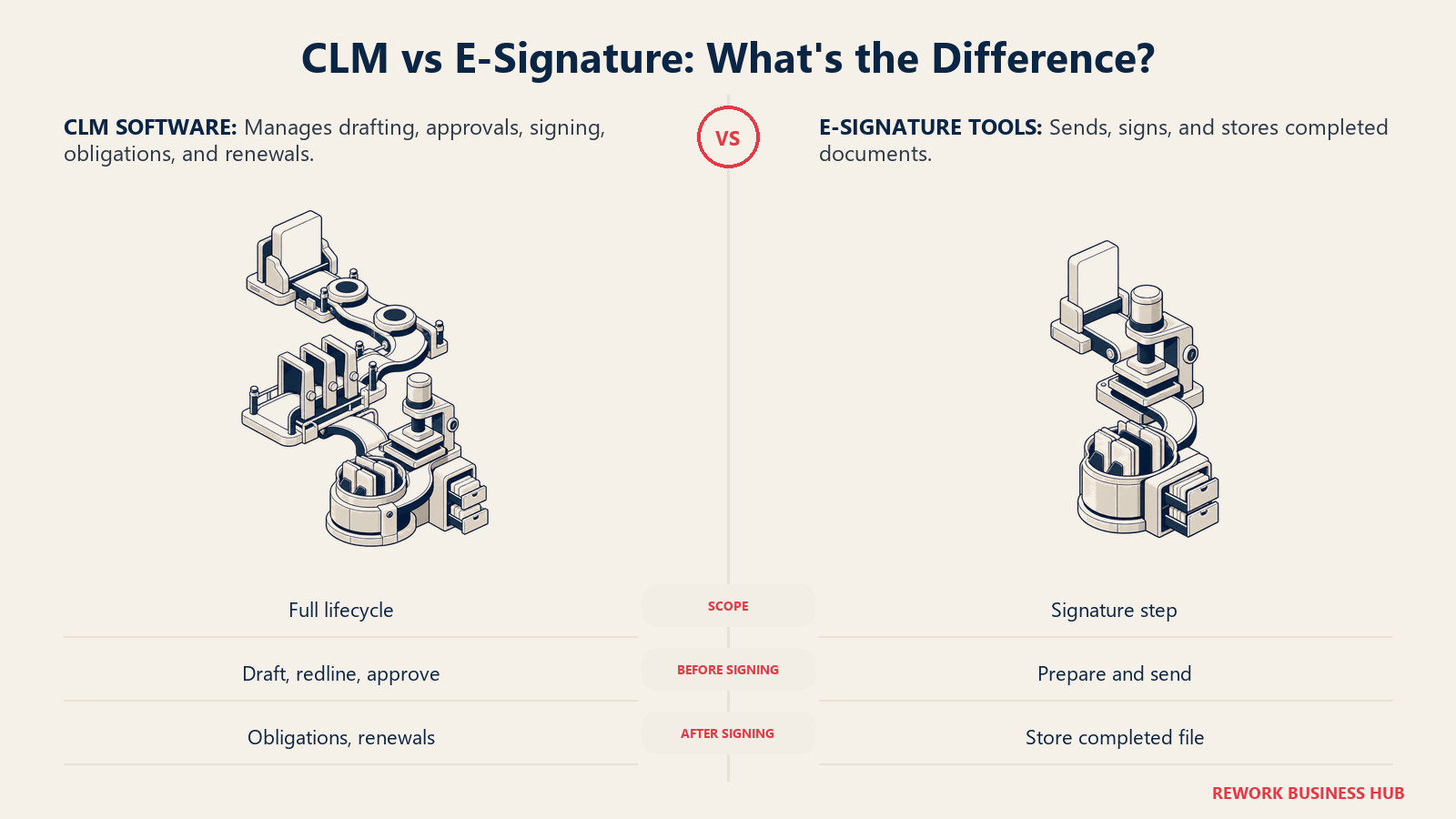
If your only pain point is getting documents signed faster, a lighter e-signature tool solves it without CLM pricing or a multi-month rollout. See Best DocuSign Alternatives or Best PandaDoc Alternatives, and how to choose e-signature software for the buying framework. If your pain point is what happens before and after that signature, intake, redlining, approvals, renewals, obligation tracking, the 16 platforms below are the real comparison set.
1. Ironclad: The Category's Workflow-First Leader
Ironclad is the name most legal-ops teams look at first: a no-code Workflow Designer that lets business users build approval chains without engineering, Ironclad AI (branded Jurist) for drafting and redlining, and the deepest Salesforce integration in the category (Salesforce runs its own internal contracting through Ironclad company-wide). A Forrester Total Economic Impact study commissioned by Ironclad found a composite customer achieved 314% ROI and a 65% improvement in contract efficiency over three years. (Ironclad)
Ironclad does not publish pricing; its own pricing page routes every visitor to a "Get a Custom Quote" form. Third-party trackers report real-world contracts commonly running $30,000 to $150,000-plus per year, plus $10,000 to $75,000-plus in implementation fees, with G2 listing average implementation time at roughly four months. (Hyperstart)
| What you get | What you don't |
|---|---|
| No-code Workflow Designer for complex approval chains | Published, self-serve pricing |
| Jurist AI for drafting, redlining, and contract Q&A | A fast rollout without professional services |
| The deepest Salesforce integration in the category | A budget-friendly entry point |
| Strong brand recognition among counterparties | Fast search across a large legacy archive |
Pricing: Quote-only. Reported estimates run $30,000 to $150,000-plus per year, plus $10,000 to $75,000-plus in implementation fees. Best for: Legal-ops teams with the headcount to build playbooks and clause libraries, wanting the deepest workflow control and Salesforce tie-in in the category. See Ironclad vs DocuSign CLM for a head-to-head, or Best Ironclad Alternatives if the price or implementation timeline rules it out. Not ideal for: Teams wanting transparent pricing before a sales call, or a small legal team without a dedicated CLM administrator.
2. DocuSign CLM: Familiar Brand, eSignature Bundled In
DocuSign CLM extends the world's most recognized e-signature brand into full contract lifecycle management: template generation, clause libraries, redlining, and approval routing, built on the eSignature engine most teams already trust. Worth knowing upfront: it's a separately priced, separately sold product, not a feature bundled into your existing signing plan.
DocuSign does not publish CLM pricing; even the "Plans & Pricing" link on its own CLM page routes to eSignature pricing, not CLM. Third-party trackers report enterprise CLM quotes typically starting around $10,000 to $50,000 per year for smaller deployments, scaling past $200,000 for large rollouts. (Bind Legal) A Forrester Total Economic Impact study commissioned by DocuSign found a composite CLM customer achieved 449% ROI over three years. (DocuSign)
| What you get | What you don't |
|---|---|
| DocuSign eSignature bundled into the CLM license | Published, self-serve pricing |
| Familiar brand for counterparties already on DocuSign | A UI built specifically for legal workflows first |
| Broad template and clause library support | Fast implementation without professional services |
| Wide API and integration ecosystem | A clean line between CLM and eSignature pricing |
Pricing: Quote-only. Third-party estimates put smaller deployments at roughly $10,000 to $50,000-plus per year, scaling well past $200,000 for large enterprise rollouts (reported). Best for: Teams already standardized on DocuSign eSignature wanting authoring and workflow without adding a second vendor relationship. See Ironclad vs DocuSign CLM for the direct comparison, or Best DocuSign Alternatives if e-signature is the only real gap. Not ideal for: Teams wanting transparent, self-serve pricing before a sales call.
3. Icertis: Enterprise-Grade Depth for Regulated Industries
Icertis Contract Intelligence targets the largest, most regulated enterprises: companies with billions in revenue running thousands of contracts across multiple business units, with AI that reads obligations and risk clauses and ties contract data into ERP systems (native SAP S/4HANA and Ariba integration) at a depth few competitors match. 92% of customers recommend Icertis in Gartner's 2026 Peer Insights Voice of the Customer report. (Icertis)
Icertis does not publish pricing. Real-world subscriptions commonly run $150,000 to $500,000-plus per year, with first-year costs (implementation included) often reaching $200,000 to $300,000-plus, and implementation typically taking 6 to 12 months. (SignEasy)
| What you get | What you don't |
|---|---|
| Deep AI-driven obligation and risk extraction | Published, transparent pricing |
| Purpose-built for large, regulated enterprises | Fast time-to-value for smaller teams |
| Tight ERP and procurement system integration | A setup a 3-person legal team can self-serve |
| Proven track record at Fortune 500 contract volume | A budget-friendly entry point |
Pricing: Quote-only. Reported estimates run $150,000 to $500,000-plus per year. Best for: Large, regulated enterprises with dedicated legal-ops and procurement teams managing high contract volume. See Best Icertis Alternatives if that price and timeline don't fit. Not ideal for: Mid-market legal teams without a dedicated CLM administrator.
4. Agiloft: No-Code Configurability, Free AI Tier to Start
Agiloft has held a Leader spot in Gartner's Magic Quadrant for CLM for six straight years, on one pitch: a no-code platform that business admins, not developers, configure to match their own contract process and data model. In 2026 it added Agiloft Astra, a free AI assistant tier open to legal, procurement, finance, or sales professionals with no waitlist. (PR Newswire)
The full CLM platform is quote-only. Third-party estimates place the Essentials tier around $6,000 per year, scaling past $60,000 annually for enterprise-grade Premium packages, split across power users, licensed users, and lower-cost portal users for external counterparties. (Aavenir)
| What you get | What you don't |
|---|---|
| No-code configuration by business admins, not developers | A single, flat published price |
| Free Astra AI tier with no waitlist | Configuration that's zero-effort at enterprise scale |
| Flexible data model for unusual contract types | The fastest, simplest onboarding on this list |
| Six straight years as a Gartner Magic Quadrant Leader | A generous free tier for the full CLM platform |
Pricing: Astra AI tier is free. Full CLM platform is quote-only; reported estimates span $6,000 to $60,000-plus per year depending on tier and user mix. Best for: Teams wanting to configure their own contract workflow and data model without engineering support. See Best Agiloft Alternatives for the full field. Not ideal for: Teams wanting a pre-built process out of the box rather than one they build themselves.
5. Conga CLM: Contract Management Bundled With Quote-to-Cash
Conga built its name in CPQ and document generation before folding CLM into the same Salesforce-native revenue suite, so a team already running Conga CPQ gets contract authoring and negotiation in the same data model as the quote that generated it. A Forrester Total Economic Impact study commissioned by Conga found a composite customer realized 294% ROI and $19.3 million in benefit over three years. (Forsys)
Conga does not publish CLM pricing; its own pricing page states plans are "built for your business" and routes buyers to a quote request. Third-party estimates put standalone CLM deals at roughly $15,000 to $60,000-plus per year, scaling to $100,000-$300,000-plus for a full CPQ-plus-CLM deployment. (Bind Legal)
| What you get | What you don't |
|---|---|
| Native fit with Conga CPQ and Salesforce Revenue Cloud | Published, self-serve pricing |
| Quote-to-contract data continuity | A lightweight option for non-Salesforce teams |
| Mature document generation and negotiation tools | Fast setup outside the Conga/Salesforce ecosystem |
| Established enterprise customer base | Simplicity for a small, standalone legal team |
Pricing: Quote-only; reported at $15,000 to $60,000-plus per year standalone, scaling to $100,000-$300,000-plus for a full CPQ-plus-CLM deployment. Best for: Salesforce shops already using Conga CPQ wanting contracts on the same quote-to-cash data model. Teams weighing a move off it should read our Conga CLM alternatives roundup, or the Agiloft vs Conga CLM head-to-head if those two are the shortlist. Not ideal for: Teams outside the Salesforce and Conga ecosystem wanting a standalone CLM.
6. Rework: Contracts on the Same Record as the Deal
Rework's Contract module lives inside the same platform as its CRM/Sales, Lead Management, Work Ops, and People apps, so a contract tied to a deal shares the same account and contact record as the pipeline that created it, instead of syncing between a CRM and a separate CLM through an integration. The pitch isn't legal-grade clause AI or deep obligation management; it's that sales, contracts, and the resulting customer record shouldn't live in three different logins.
| What you get | What you don't |
|---|---|
| Contracts on the same customer record as CRM/Sales | Clause-level AI redlining depth of Ironclad or Sirion |
| One platform across CRM, Lead Ops, Work Ops, and People | A dedicated legal-ops obligation management console |
| No separate integration to sync deal and contract data | Icertis/Sirion-grade compliance and audit tooling |
| Packaged annual pricing, not per-envelope or per-clause fees | A free or solo tier |
Pricing: Rework does not publish a price for the Contract module. Rework sells packaged plans, not per-user CLM licenses, and Contract is quoted per organization. See rework.com/pricing for the published product lines, or ask the team for a Contract quote. Best for: Mid-size teams (roughly 20-200 people) wanting contracts, the CRM pipeline, and the resulting customer record in one platform instead of three logins. See Best CRM Software for how the Sales Ops side compares to Salesforce and HubSpot. Not ideal for: Legal teams needing clause-level AI redlining, formal obligation management, or Icertis/Sirion-grade compliance depth.
7. LinkSquares: AI-Native CLM With Finance and Legal Analytics
LinkSquares built its platform AI-first rather than adding AI onto document storage, with a strength in spend and obligation analytics that pulls finance and legal onto the same page: renewal dates, auto-escalating fees, and non-standard terms surfaced automatically instead of found in a manual audit. It holds a 4.7 out of 5 rating across 427 G2 reviews and a Leader badge in G2's Summer 2026 Grid Report for CLM. (LinkSquares)
LinkSquares does not publish pricing; its own pricing page states plans are personalized based on user count, contract volume, and required features. Reported deals run $30,000 to $100,000-plus per year, with a Vendr-tracked median around $31,000. (Vendr)
| What you get | What you don't |
|---|---|
| AI-native contract analytics and spend tracking | Published, transparent pricing |
| Strong finance-and-legal shared reporting | The lightest onboarding on this list |
| Repository search across historical contract terms | A free or self-serve entry tier |
| Purpose-built for post-signature obligation tracking | Ironclad or Agiloft-level pre-signature workflow depth |
Pricing: Quote-only, based on user count, contract volume, and selected modules; reported deals run $30,000 to $100,000-plus per year. Best for: Legal and finance teams wanting analytics on existing contract obligations and spend. See Best LinkSquares Alternatives for the full field. Not ideal for: Teams whose bottleneck is pre-signature intake and approvals, not post-signature analytics.
8. Juro: Browser-Native, Built for Sales-Led Contracting
Juro's clearest differentiator is that contracts never leave the browser: no exporting to Word for redlines, no PDF round-trips for signature, just one editable document multiple people can negotiate in real time. That matters given how much time manual review already eats: human-led contract review takes 92 minutes on average per contract, before negotiation even starts. (Juro)
Juro is quote-only, priced through a custom calculator based on contract volume, contract types, AI features, and integrations. (Juro) Third-party estimates put annual contracts in the roughly $15,000 to $60,000 range depending on scale (reported, Bind Legal).
| What you get | What you don't |
|---|---|
| Browser-native editor, no Word or PDF round-trips | Published, self-serve pricing |
| Fast contracting for sales-led commercial deals | Deep clause library depth of legacy enterprise CLMs |
| Real-time multi-party negotiation in one document | Heavy procurement or vendor-risk feature depth |
| Unlimited users on top-tier plans | Icertis-grade regulated-industry compliance tooling |
Pricing: Quote-only, via a usage-based calculator. Reported estimates run $15,000 to $60,000 per year depending on volume. Best for: Sales-led organizations wanting commercial teams to draft and negotiate routine contracts without a Word or PDF handoff to legal. If Juro is on the way out rather than in, see Juro alternatives, or Juro vs PandaDoc if the choice is between those two. Not ideal for: Heavily regulated enterprises needing deep obligation and compliance tooling.
9. ContractPodAi (now Leah): Agentic AI Across Legal, Contracting, and Procurement
ContractPodAi rebranded to Leah in 2026, repositioning from a legal-team CLM into an agentic platform for enterprise commercial operations: CLM, legal risk and matter management, and source-to-pay procurement running as one connected system instead of three. (Leah)
Leah does not publish pricing; the site routes buyers to a demo, consistent with its enterprise, Fortune 500-weighted base. Third-party estimates put real-world deals at $50,000 to $200,000-plus per year (reported, Bind Legal).
| What you get | What you don't |
|---|---|
| AI-native platform spanning legal, contracting, procurement | Published, transparent pricing |
| Autonomous, multi-step workflow execution | A lightweight option for a small legal team |
| Built for large, cross-functional enterprise operations | Fast, self-serve onboarding |
| Legal risk and matter management alongside CLM | Simplicity; the platform is broad by design |
Pricing: Quote-only, enterprise sales process. Reported estimates run $50,000 to $200,000-plus per year. Best for: Large enterprises wanting legal, contracting, and procurement automated as one connected operation. Not ideal for: Small or mid-size legal teams wanting a focused CLM rather than a cross-department platform.
10. Concord: Published Pricing, Unlimited E-Signatures Included
Concord stands out on this list for a simple reason: it publishes its prices. Where most CLM vendors route every visitor to a demo request, Concord lists three tiers with exact monthly rates, included users, and per-additional-user costs on its own pricing page, plus unlimited e-signatures and documents on every plan. (Concord)
| What you get | What you don't |
|---|---|
| Published pricing you can budget against today | A free tier |
| Unlimited e-signatures and documents on every plan | Icertis/Sirion-grade AI obligation extraction |
| Three clear tiers (Essentials, Business, Enterprise) | The Workflow Designer flexibility of Ironclad |
| Fast, self-serve evaluation without a sales call | Enterprise procurement or ERP integration depth |
Pricing: Essentials $499/month billed annually (5 users included, additional users $49/month); Business $899/month billed annually (5 users, additional users $69/month); Enterprise $1,299/month billed annually (5 users, additional users $89/month, volume discounts available). Best for: Mid-market teams wanting transparent pricing and unlimited e-signatures without a sales negotiation. Not ideal for: Large enterprises needing deep AI obligation management or ERP-grade procurement integration. Teams who have outgrown it can compare the step-up options in our Concord alternatives roundup.
11. SpotDraft: AI Redlining With Implementation Bundled In
SpotDraft's pitch is that everything needed to go live, implementation, workflow setup, integrations, and 24/7 support, ships included rather than billed as a separate professional-services engagement. Its AI redlining (VerifAI) targets in-house legal teams working alongside sales on routine commercial paper.
SpotDraft is quote-only, priced by either user count or contract volume. (SpotDraft) Third-party estimates put annual contracts at $5,000 to $50,000-plus depending on team size and features (reported, Bind Legal).
| What you get | What you don't |
|---|---|
| Implementation, integrations, and support included | Published, self-serve pricing |
| AI-assisted redlining for routine commercial contracts | The deepest enterprise procurement integrations |
| Choice of user-based or volume-based pricing | A free trial without a sales conversation |
| Faster time-to-value than most enterprise CLMs | Icertis/Sirion-grade regulated-industry depth |
Pricing: Quote-only, priced by users or contract volume; implementation and support included at no extra cost. Reported estimates run $5,000 to $50,000-plus per year. Best for: Legal teams wanting AI redlining and a faster, fully supported implementation without paying extra for onboarding. Not ideal for: Enterprises needing deep procurement or ERP integrations beyond core CLM.
12. Gatekeeper: Contract Management Plus Vendor Risk
Gatekeeper's angle is that a contract and the vendor relationship behind it shouldn't live in separate systems: its platform combines CLM with vendor and third-party risk management, so a renewal date, a compliance certificate, and a vendor risk score sit on the same record.
Gatekeeper publishes three named tiers (PRO, ENTERPRISE, ENTERPRISE PLUS) but no prices; the page routes every visitor to a demo request. Third-party pricing analysis reports the entry-level tier starting around $1,245 per month. (Hyperstart)
| What you get | What you don't |
|---|---|
| Combined CLM and vendor/third-party risk management | Published, self-serve pricing |
| Vendor risk scoring alongside contract terms | A pure focus on legal redlining depth |
| Three named tiers to frame a scoping conversation | Sales-led contracting speed of Juro |
| Strong fit for procurement-heavy organizations | The lightest possible onboarding |
Pricing: Quote-only across PRO, ENTERPRISE, and ENTERPRISE PLUS tiers; reported entry-level pricing starts around $1,245 per month. Best for: Procurement and vendor management teams wanting contract terms and vendor risk in one system. Not ideal for: Legal teams whose primary need is contract drafting and redlining rather than vendor risk.
13. ContractSafe: Simple Repository Pricing, No Per-User Fees
ContractSafe's positioning is deliberately plain: a straightforward contract repository with reminders, approvals, and e-signature layered on top, priced by contract volume rather than seat count, so adding a new team member doesn't trigger a new line item.
ContractSafe publishes three tiers (Organize, Finalize, Maximize) with a volume selector, but no exact figure until you pick a band. For up to 100 contracts, third-party trackers report Organize at $450/month, Finalize at $660/month, and Maximize at $815/month. (SignEasy)
| What you get | What you don't |
|---|---|
| Pricing by contract volume, not per user | Exact prices without selecting a volume tier |
| Simple repository, reminders, and approvals | AI-driven clause or obligation extraction |
| E-signature and API access on higher tiers | Ironclad/Agiloft-level workflow configurability |
| Fast setup for a small legal team | Deep enterprise procurement integrations |
Pricing: Quote-only, selected by contract volume band (100 or fewer up to 1,000-plus) across Organize, Finalize, and Maximize tiers; reported rates run $450 to $815 per month for up to 100 contracts (reported). Best for: Small legal teams wanting a simple, affordable repository without per-user math as headcount grows. Not ideal for: Teams needing AI-driven obligation management or deep workflow automation.
14. Sirion: Post-Signature AI Analytics for Enterprise Contracts
Sirion competes directly with Icertis for large, complex enterprise contract portfolios, with a particular strength in post-signature obligation tracking: once a contract is signed, its AI reads it for renewal terms, SLAs, and compliance obligations most teams would otherwise track in a spreadsheet or miss entirely. Integrations with SAP Ariba are common in Sirion deployments.
Sirion does not publish pricing, and it's one of the less consistently reported prices in this category; quotes depend on contract volume, module selection, and integrations. (Sirion) One third-party estimate positions full enterprise deployments at $150,000 to $400,000-plus per year (reported, Dioptra).
| What you get | What you don't |
|---|---|
| Strong post-signature AI obligation and SLA tracking | Published, transparent pricing |
| SAP Ariba and enterprise procurement integrations | A fast, low-touch implementation |
| Tiered modules (Contract Intelligence vs. full CLM) | A budget-friendly entry point for smaller teams |
| Built for large, complex enterprise portfolios | Simplicity for a small legal team |
Pricing: Quote-only; one reported estimate puts full enterprise deployments at $150,000 to $400,000-plus per year, and standard enterprise implementation runs months and typically requires professional services (reported). Best for: Large enterprises wanting AI-driven post-signature obligation and SLA tracking at Icertis-level scale. Not ideal for: Smaller legal teams without the contract volume to justify enterprise implementation.
15. Docubee: Being Retired, Not a Safe New Purchase in 2026
Docubee (formerly OnTask) built a lightweight contract automation platform used across legal, healthcare, construction, and financial services, with the vendor reporting more than 5 million documents processed across 28,000-plus organizations. (Docubee) That history is past tense now. Apryse acquired Docubee and is retiring it entirely on December 31, 2026: the application and website shut down permanently that day, and access to data, signed documents, APIs, and workflows ends with it. Customers can request a one-time data export only through June 30, 2026, and Apryse confirms that export will not auto-migrate into its recommended replacement, Xodo Sign. (Docubee)
Docubee's own pricing page no longer shows Docubee pricing; it now redirects into Xodo Sign's lighter eSignature plans. Historic reported pricing put Docubee Sign at $9.95 per user per month, Contract Essentials at $14.95, and Contract Pro at $49.95, billed annually, with custom Enterprise pricing above that (reported, Tekpon).
| What you get | What you don't |
|---|---|
| A simple contract generation and eSignature workflow, while it lasts | Any product runway past December 31, 2026 |
| Historic per-user pricing under $50/month across tiers | A live pricing page or an active roadmap |
| A one-time data export window through June 30, 2026 | Automatic migration of that data into its own replacement |
| Name recognition from 28,000-plus past customer organizations | A reason to sign a new contract with it today |
Pricing: No longer independently published; the vendor's own pricing page now redirects to Xodo Sign. Historic reported per-user pricing ran $9.95 to $49.95 per month (reported). Best for: Nobody starting fresh. Existing Docubee customers should treat this as the prompt to request a data export before June 30, 2026 and shortlist a permanent replacement. Not ideal for: Any new contract management deployment in 2026. It's listed here so buyers researching the category don't accidentally sign up for a product that won't exist in five months.
16. PandaDoc: Lightweight Document Workflow, Not a Legal-Grade CLM
PandaDoc isn't a CLM in the Ironclad or Icertis sense. It's document workflow and e-signature software that many sales teams already use for proposals and simple contracts, worth a mention for teams whose "contract management" problem is really a handful of standard agreements rather than negotiated, clause-heavy paper.
Figures below come from third-party pricing trackers reflecting PandaDoc's published site (reported, Vendr, Proposify): a free plan (5 documents/month), Starter from $19/user/month billed annually (2-seat cap, no CRM integrations), Business from $49/user/month billed annually, and custom Enterprise pricing.
| What you get | What you don't |
|---|---|
| Simple, affordable document and e-signature workflow | Contract negotiation or redlining workflow depth |
| A free plan for occasional use | Obligation management or post-signature analytics |
| Familiar to sales teams already sending proposals | Legal-grade clause libraries and approval routing |
| Fast setup, no implementation project | A fit for high-volume, negotiated legal contracts |
Pricing: Free (5 documents/month); Starter from $19/user/month (annual, 2-seat cap, no CRM integrations); Business from $49/user/month (annual); Enterprise custom (reported). Best for: Sales and ops teams sending standard proposals and simple agreements, not negotiated legal contracts. See Best PandaDoc Alternatives for the document-automation category in more depth, or how to choose document automation software for the buying framework. Not ideal for: Legal teams needing clause libraries, redlining, or negotiated contract workflows.
How to Choose: Decision Framework
Run whichever pick survives this framework through a broader SaaS vendor evaluation scorecard before signing a multi-year CLM contract.
| If your team needs... | Best pick |
|---|---|
| The most powerful no-code workflow builder and deep Salesforce tie-in | Ironclad |
| To extend an existing DocuSign eSignature relationship | DocuSign CLM |
| Enterprise-grade governance for a regulated, high-volume organization | Icertis |
| A no-code platform you configure yourself | Agiloft |
| Contracts tied to Conga CPQ or Salesforce Revenue Cloud | Conga CLM |
| Contracts on the same record as the CRM pipeline, not a separate tool | Rework |
| AI-native spend and obligation analytics for legal and finance | LinkSquares |
| Sales-led contracting without a Word or PDF handoff to legal | Juro |
| Agentic AI automating legal, procurement, and finance workflows | ContractPodAi (Leah) |
| Published pricing and unlimited e-signatures | Concord |
| Implementation and support bundled in, not billed separately | SpotDraft |
| CLM combined with vendor and third-party risk management | Gatekeeper |
| A simple repository priced by contract volume, not seats | ContractSafe |
| Post-signature obligation and SLA tracking at enterprise scale | Sirion |
| A lightweight tool for standard proposals, not negotiated contracts | PandaDoc |
What to Do Next
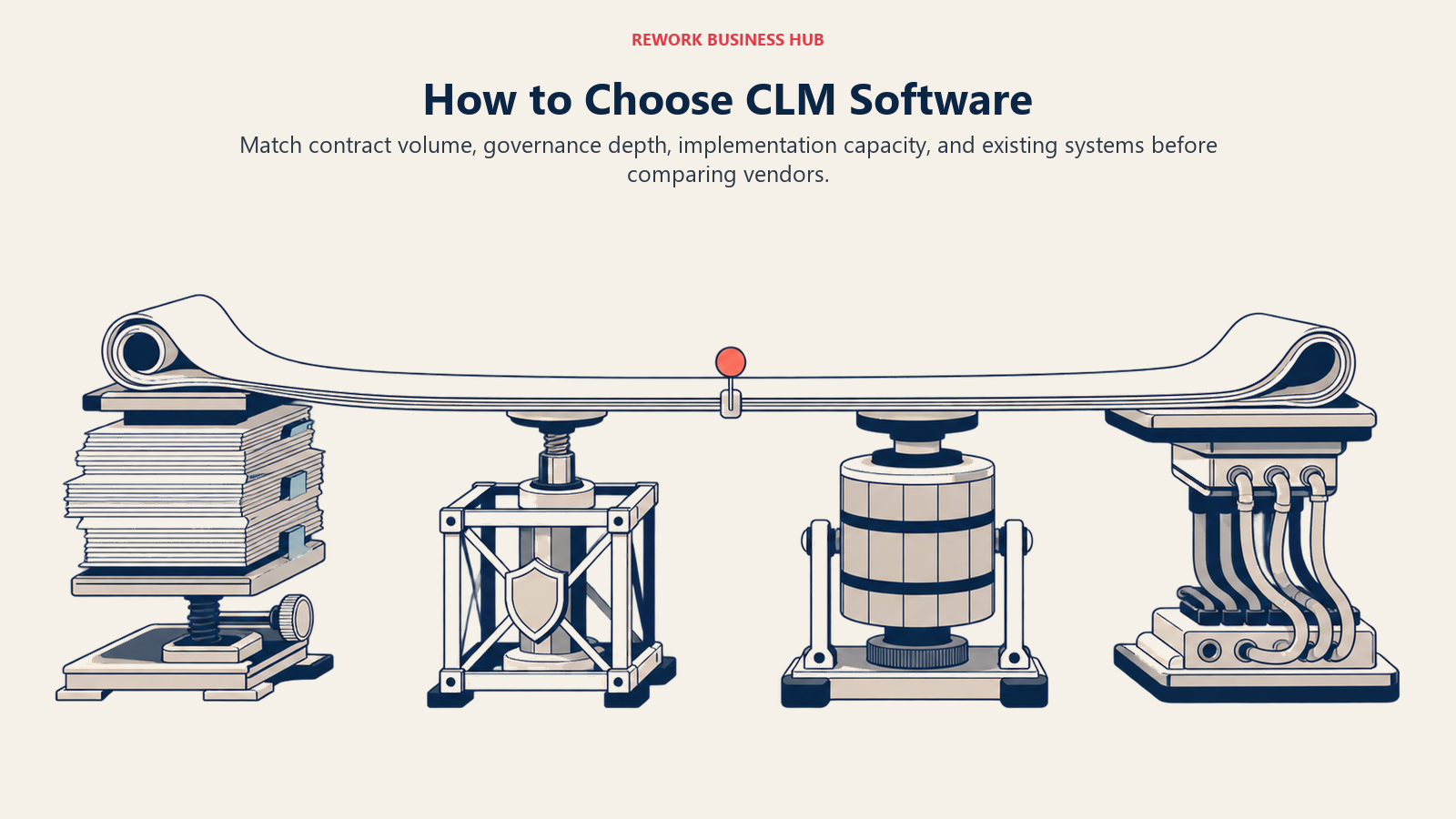
Match your contract volume, compliance needs, and existing stack (Salesforce, DocuSign, or neither) to the framework above, then run your top two picks against real contracts, not a sandbox demo. Load an actual redline and a real renewal into each tool to see which one your legal, sales, and procurement teams want to open next quarter. If your real problem is that contracts, deals, and customer history live in three different systems, not a gap in legal-grade CLM depth, start with Rework's Contract module and compare it against a focused CLM like Concord before committing to a six-figure contract.

Principal Product Marketing Strategist
On this page
- Key Facts
- Quick Comparison Table
- Contract Management Software vs. E-Signature Tools
- 1. Ironclad: The Category's Workflow-First Leader
- 2. DocuSign CLM: Familiar Brand, eSignature Bundled In
- 3. Icertis: Enterprise-Grade Depth for Regulated Industries
- 4. Agiloft: No-Code Configurability, Free AI Tier to Start
- 5. Conga CLM: Contract Management Bundled With Quote-to-Cash
- 6. Rework: Contracts on the Same Record as the Deal
- 7. LinkSquares: AI-Native CLM With Finance and Legal Analytics
- 8. Juro: Browser-Native, Built for Sales-Led Contracting
- 9. ContractPodAi (now Leah): Agentic AI Across Legal, Contracting, and Procurement
- 10. Concord: Published Pricing, Unlimited E-Signatures Included
- 11. SpotDraft: AI Redlining With Implementation Bundled In
- 12. Gatekeeper: Contract Management Plus Vendor Risk
- 13. ContractSafe: Simple Repository Pricing, No Per-User Fees
- 14. Sirion: Post-Signature AI Analytics for Enterprise Contracts
- 15. Docubee: Being Retired, Not a Safe New Purchase in 2026
- 16. PandaDoc: Lightweight Document Workflow, Not a Legal-Grade CLM
- How to Choose: Decision Framework
- What to Do Next