Best Landbot Alternatives in 2026: 11 No-Code Chatbot Tools for Conversational Forms and Lead Generation
Turn this article into takeaways for your work.


Each assistant summarizes the article only for you and suggests best practices for your work.
The best Landbot alternatives in 2026 are Typeform, Jotform, ManyChat, Chatfuel, Tars, Botpress, Respond.io, Tidio, WATI, Zoho SalesIQ, and Intercom. The right pick depends on whether you need a pure conversational-form replacement for static web forms, WhatsApp-specific automation, or a developer-grade conversational AI platform. This guide compares all 11 on pricing, strengths, and fit.
Landbot built its name on a real idea: turn a boring web form or a scripted bot flow into something that reads like a conversation, without writing code. Drag a block, connect it to the next one, publish it to a web widget, an embed, or WhatsApp, and watch completion rates climb because a chat-style interface feels less like paperwork. For agencies, marketing teams, and small ops shops running lead-qualification flows, that works. But teams that outgrow Landbot tend to hit the same three walls: the pricing meters by chats per month plus a separate AI-chat allowance that's easy to blow through, seats are hard-capped per tier (1, then 2, then 3, then 5+), and WhatsApp isn't included until the Professional WA tier or above. None of that is a dealbreaker on its own. Together, they push growing teams to look elsewhere. This list covers where they land.
Key Facts
- The low-code/no-code development platform market is projected to reach $48.91 billion in 2026 and grow to $376.92 billion by 2034, a 29.10% CAGR, per Fortune Business Insights.
- 73.3% of consumers across 22 global markets prefer messaging over other channels when contacting a business, and 72.4% say they're more likely to buy from a brand that offers it, per WhatsApp's 2026 State of Business Messaging report.
- Typeform's own Data on Data report found its conversational forms complete at an average of 47.3%, more than 25 percentage points above the 21.5% industry average for traditional web forms (vendor benchmark, via PR Newswire).
- 88% of customers now expect faster response times than they did a year ago, and 74% expect round-the-clock service because AI has made it the norm, per Zendesk's CX Trends 2026 report.
- Salesloft (Drift's owner) announced in March 2026 that it is sunsetting Drift's conversational marketing product entirely and referring existing customers to a third-party successor, per Salesloft's own newsroom. It's a reminder to check a vendor's roadmap, not just its price, before you commit.
Quick Comparison Table
| Tool | Best For | Starting Price | Key Strength | Key Limitation |
|---|---|---|---|---|
| Typeform | Marketing and ops teams replacing static web forms with a conversational one | Free; paid from $28/mo ($25/mo annual) | Best-in-class conversational form UX and completion-rate data | No chatbot logic, live chat, or WhatsApp automation |
| Jotform | Teams wanting conversational forms plus a lightweight AI chatbot in one product | Free; paid from $39/mo ($34/mo annual) | Forms and AI Agents (chatbot) share one builder and one dataset | AI Agents feel bolted onto a forms product, not built chatbot-first |
| ManyChat | DTC and social ad teams running Meta-first bot flows | Free; paid from $14/mo | Deepest Instagram, Messenger, WhatsApp, and SMS bot ecosystem | Contact-metered pricing gets expensive fast at volume |
| Chatfuel | Meta-only teams wanting the simplest possible no-code bot builder | Free; AI PRO from $49/mo | Clean visual builder, official Meta and WhatsApp Business Solution Provider status | Only two tiers now; a steep jump from free to AI PRO |
| Tars | Enterprise conversational landing pages and lead-qualification bots | Free (50 conversations/mo); paid from $499/mo | Purpose-built conversational landing pages that replace a marketing page entirely | Enormous jump from free to the $499/mo Premium floor |
| Botpress | Developers and technical teams building custom conversational AI agents | Free; paid from $150/mo (annual) | Open, extensible agent framework with real LLM control | Requires technical setup; not a marketer's drag-and-drop tool |
| Respond.io | High-volume WhatsApp and social messaging for sales and CS teams | From $79/mo (5 users) | Deepest multi-channel inbox for messaging-heavy markets | No native CRM or sales pipeline |
| Tidio | SMBs and e-commerce wanting AI chat plus lightweight automation | Free; paid from $29/mo ($24.17 annual) | Fast Shopify setup, Lyro AI, approachable pricing | Limited for B2B lead routing or multi-team ops |
| WATI | WhatsApp Business API automation, broadcasts, and lead-gen bots | From $99/mo ($79/mo annual) | Deep WhatsApp-native tooling with AI co-pilot credits | WhatsApp-only; no other channel coverage |
| Zoho SalesIQ | Zoho-suite teams wanting chatbot plus live chat bundled with CRM | Free; paid from $7/operator/mo (annual) | Tight Zoho CRM tie-in at accessible per-operator pricing | Weaker standalone chatbot depth than dedicated bot platforms |
| Intercom | Enterprise support teams wanting an AI agent layered on a help desk | From $29/seat/mo + Fin AI usage | Fin AI resolves tickets at scale with a pay-per-outcome model | Cost stacks fast once Fin AI usage and seats both scale |
Why Teams Are Leaving Landbot
The pattern is consistent enough to name directly, because the right alternative depends on which specific wall a team hit first.
The chat meter plus the AI-chat meter is two bills, not one. Landbot counts monthly chats separately from AI chats, and both allowances run out. A Professional-tier team burning through 2,500 chats and 300 AI chats a month can find themselves paying EUR 0.05 per extra chat on top of a EUR 100/month subscription before they've hit a growth spurt. Budgeting for one meter is normal SaaS math. Budgeting for two, on top of a currency most US-based finance teams don't budget in by default, adds friction that a flat per-seat tool doesn't.
Seats are hard-capped, and the caps are small. Starter tops out at 2 seats, Professional at 3, and anything past that requires a custom Business quote. A support or sales team of six people outgrows Landbot's published tiers before they outgrow the actual chat volume.
WhatsApp is a paid add-on, not a default channel. Teams that assume "no-code chatbot platform in 2026" includes WhatsApp by default are often surprised that Landbot only bundles a full WhatsApp number at the Professional WA tier (EUR 160/month) or in a custom Business deal. Below that, it's a EUR 100/month add-on layered on top of the base subscription.
There's no CRM, so qualified leads still need somewhere to land. Landbot captures conversation data well, but getting a qualified lead from a bot flow into a sales pipeline with an owner, a stage, and a follow-up date means exporting to Zapier or a separate CRM. That gap is exactly where handoffs go quiet.
The bot canvas gets hard to maintain past a certain size. Like most visual flow builders, Landbot's canvas is intuitive for a handful of flows and difficult to navigate once a team has stacked dozens of branching conditions on top of each other. Teams that need conditional logic driven by live CRM data, not just prior answers in the same conversation, hit a ceiling here.
Stage Fit Matrix
| Tool | Startup (1-20) | Growth Stage (20-200) | Mid-Market (200-1000) | Enterprise (1000+) |
|---|---|---|---|---|
| Typeform | Sweet spot | Works well | Moderate | Limited for deep workflow needs |
| Jotform | Sweet spot | Works well | Moderate | Limited without Enterprise tier |
| ManyChat | Sweet spot | Works well | Limited | Not designed for enterprise |
| Chatfuel | Sweet spot | Works well | Limited | Not designed for enterprise |
| Tars | Not viable below Premium | Stretch (budget) | Good fit | Sweet spot |
| Botpress | Good fit for technical teams | Good fit | Good fit | Sweet spot with Enterprise |
| Respond.io | Good fit | Good fit | Good fit | Good at volume |
| Tidio | Sweet spot | Works for SMB | Limited | Not designed for enterprise |
| WATI | Good fit | Good fit | Moderate | Limited |
| Zoho SalesIQ | Good fit | Good fit | Good fit inside Zoho stack | Moderate outside Zoho stack |
| Intercom | Stretch (budget) | Good fit | Strong fit | Sweet spot |
Sizing and Persona Table
| Tool | Team Size Sweet Spot | Primary Buyer | Team or Company-Wide? |
|---|---|---|---|
| Typeform | 1-200 employees | Marketing Manager, Growth Marketer | Marketing, HR, research; single-workflow use |
| Jotform | 1-200 employees | Ops Manager, Marketing Manager | Marketing + ops; forms-first teams |
| ManyChat | 1-200 employees | Growth Marketer, Social Media Manager | Marketing-led; social-first automation |
| Chatfuel | 1-100 employees | Social Media Manager, Growth Marketer | Marketing; Meta-first automation teams |
| Tars | 200-5,000 employees | VP Marketing, Demand Gen | Marketing-led; landing-page replacement |
| Botpress | 10-1,000 employees | Head of Engineering, Product Manager | Technical teams building custom agents |
| Respond.io | 5-500 employees | Head of Customer Comms, Sales Ops | Sales + CS; messaging-ops teams |
| Tidio | 1-100 employees | Founder, E-commerce Manager | Small support or e-commerce teams |
| WATI | 5-200 employees | Head of Marketing, Sales Manager | Sales + marketing; WhatsApp-first teams |
| Zoho SalesIQ | 5-300 employees | Head of Support, Zoho admin | Support + sales; Zoho-suite teams |
| Intercom | 20-2,000 employees | VP Support, Head of CX | Support-led; scales to sales and marketing add-ons |
1. Typeform: Conversational Forms Done Right
Typeform is the closest thing to a direct swap for Landbot's conversational-form use case, minus the chatbot logic. Its product philosophy is singular: a form should feel like a conversation, one question at a time, and that format alone measurably lifts completion rates over a traditional multi-field form. Typeform's own Data on Data report backs that up with real numbers rather than a marketing claim, and it's the platform most people picture when they hear "conversational form."
Where Typeform differs from Landbot is scope. It doesn't build bot flows for WhatsApp, Messenger, or a website chat widget. There's no branching chatbot logic that responds to live data mid-conversation, no WhatsApp channel, and no lead-routing layer. What it does have is a genuinely best-in-class authoring experience for the form itself, video questions, logic jumps, and (on higher tiers) AI-assisted question generation, plus a completion-rate track record that Landbot's own conversational forms are trying to replicate.
| What you get | What you don't |
|---|---|
| Best-in-class conversational form builder with proven completion-rate data | Chatbot logic, live chat, or a WhatsApp channel |
| AI-powered form creation and conditional logic | Native CRM or lead-routing capability |
| Video questions and drop-off analytics on paid tiers | A bot canvas for scripted conversations outside a form |
| Clean, branded, mobile-friendly form experience | Multi-channel deployment beyond the web |
Pricing: Free (100 responses/mo, 1 user). Basic $28/mo ($25/mo billed annually, 100 responses). Plus $56/mo ($50/mo annual, 1,000 responses, 3 users). Business $91/mo ($83/mo annual, 10,000 responses, 5 users). Enterprise custom. See Typeform's pricing page for current tiers.
Best for: Marketing and research teams that need the single best conversational-form experience for surveys, applications, and lead-capture forms, and don't need chatbot logic or messaging channels alongside it.
2. Jotform: Forms Plus AI Agents in One Builder
Jotform's pitch is breadth: build the form, and if you also want a lightweight AI chatbot, it lives in the same product under the "AI Agents" umbrella, sharing the same submission data and dashboard. That's a meaningfully different structure than Landbot's chat-first design, where the form is one output of a bot flow rather than the other way around.
The AI Agents feature handles FAQ-style conversations, guides a visitor through a structured intake, and can hand off a qualified lead into Jotform's own tables or an integration. For teams already using Jotform for HR intake, event registration, or customer feedback, adding a chatbot on top without a second subscription is a real convenience. The tradeoff is depth. Jotform's AI Agents don't have the branching sophistication or the channel reach (WhatsApp, Messenger) that a purpose-built bot platform offers, and the tier structure (25, 50, 100 "AI Agents" per plan) is really a submission-volume proxy dressed up as an agent count.
| What you get | What you don't |
|---|---|
| Forms and a lightweight AI chatbot sharing one dataset and dashboard | WhatsApp, Messenger, or social DM automation |
| Generous entry-level limits, including HIPAA support on Gold | Deep branching logic comparable to a dedicated bot platform |
| Voice call and SMS capability bundled into every paid tier | A live agent handoff workflow as robust as a support inbox |
| Single-user simplicity across all non-Enterprise tiers | Multi-user team collaboration below the Enterprise tier |
Pricing: Starter free (5 forms, 100 submissions/mo). Bronze $39/mo ($34/mo annual, 25 forms, 1,000 submissions). Silver $49/mo ($39/mo annual, 50 forms, 2,500 submissions). Gold $129/mo ($99/mo annual, 100 forms, 10,000 submissions). Enterprise custom. See Jotform's pricing page for current tiers.
Best for: Teams that already build a lot of forms (HR, events, feedback, intake) and want a basic AI chatbot layered on top without adding a second tool to the stack.
3. ManyChat: The Biggest Name in No-Code Chat Automation
ManyChat is the platform most people compare Landbot against by default, and for good reason: both build visual, no-code bot flows across Instagram, Messenger, WhatsApp, and SMS. ManyChat's ecosystem is simply larger. More templates, more third-party integrations, a bigger community of agency operators building flows for clients, and deeper AI-conversation features baked into the Pro tier and above.
The philosophy is DTC and social-ad-first: capture a lead from a Meta ad, qualify them in a bot flow, and convert inside the conversation. Where ManyChat and Landbot genuinely diverge is pricing structure. ManyChat meters strictly by active contacts per month, with overage charges once a plan's cap is hit, while Landbot meters by chats plus a separate AI-chat allowance. Neither is objectively cheaper; which one wins depends on whether your conversation volume or your contact-list size grows faster.
| What you get | What you don't |
|---|---|
| Deepest Meta ecosystem: Instagram, Messenger, WhatsApp, SMS, and email | Native CRM or B2B lead-routing depth |
| Manychat AI baked into Pro tier and above | A conversational-form product comparable to Typeform |
| Large template and integration library from years of market share | Multi-team assignment logic at any real depth |
| Unified inbox with seat-based assignment on Business and Advanced | Predictable costs at high contact volume without watching overage |
Pricing: Free (25 active contacts/mo, 1 user). Essential $14/mo (250 contacts, 2 users). Pro $29/mo (2,500 contacts, 3 users, AI included). Business $69/mo (7,500 contacts, 5 users). Advanced $139/mo (25,000 contacts, 10 users). See ManyChat's pricing page for current tiers and annual discounts.
Best for: DTC brands, course creators, and social-ad-driven marketing teams that want the widest Meta-ecosystem bot automation and don't need it connected to a B2B sales pipeline.
4. Chatfuel: The Simplest No-Code Meta Bot Builder
Chatfuel simplified its entire pricing model in 2026 down to two tiers: a genuinely capable free plan (Chatfuel Light, no credit card required) covering Instagram, Facebook, and WhatsApp automation with a shared inbox, and a single paid tier, AI PRO at $49/month, that adds an AI sales manager, an AI knowledge base, broadcasts, and lead-qualification funnels. That's a much cleaner structure than Landbot's four-tier, chat-metered model, and it removes the guesswork of picking between three or four paid plans.
The limitation is the one Chatfuel has always had: it's Meta-only. There's no email automation, no standalone web-chat widget with the depth Landbot or Tidio offer, and no unified inbox spanning channels outside Instagram, Facebook, and WhatsApp. For a team whose entire lead-gen motion runs through Meta ads and Meta-owned channels, that's not a limitation at all. For a team fielding leads from a website, email, and Meta simultaneously, it's a real gap.
| What you get | What you don't |
|---|---|
| Clean two-tier pricing: free or $49/mo, no confusing middle tiers | Channels outside Instagram, Facebook, and WhatsApp |
| Official Meta Partner and WhatsApp Business Solution Provider status | A conversational-form builder for web-based lead capture |
| AI sales manager and knowledge base included in the one paid tier | Native CRM or sales pipeline |
| Fast setup with no technical skill required | A free tier deep enough for serious automation without upgrading |
Pricing: Chatfuel Light free. AI PRO $49/mo (annual billing available at a discount). See Chatfuel's pricing page for current details.
Best for: Small to mid-size Meta-first teams that want the simplest possible no-code bot builder for Instagram, Facebook, and WhatsApp without evaluating multiple confusing tiers.
5. Tars: Conversational Landing Pages for Enterprise Lead Gen
Tars (HelloTars) takes Landbot's core idea, replace a form with a conversation, and applies it to an entire landing page rather than just a form embed. A Tars "conversational landing page" replaces a traditional PPC landing page outright: instead of a headline, a hero image, and a static form, a visitor lands in a scripted conversation that qualifies them step by step. For paid-search and paid-social teams optimizing landing-page conversion rate as a primary KPI, that's a meaningfully different product than a chat widget bolted onto an existing page.
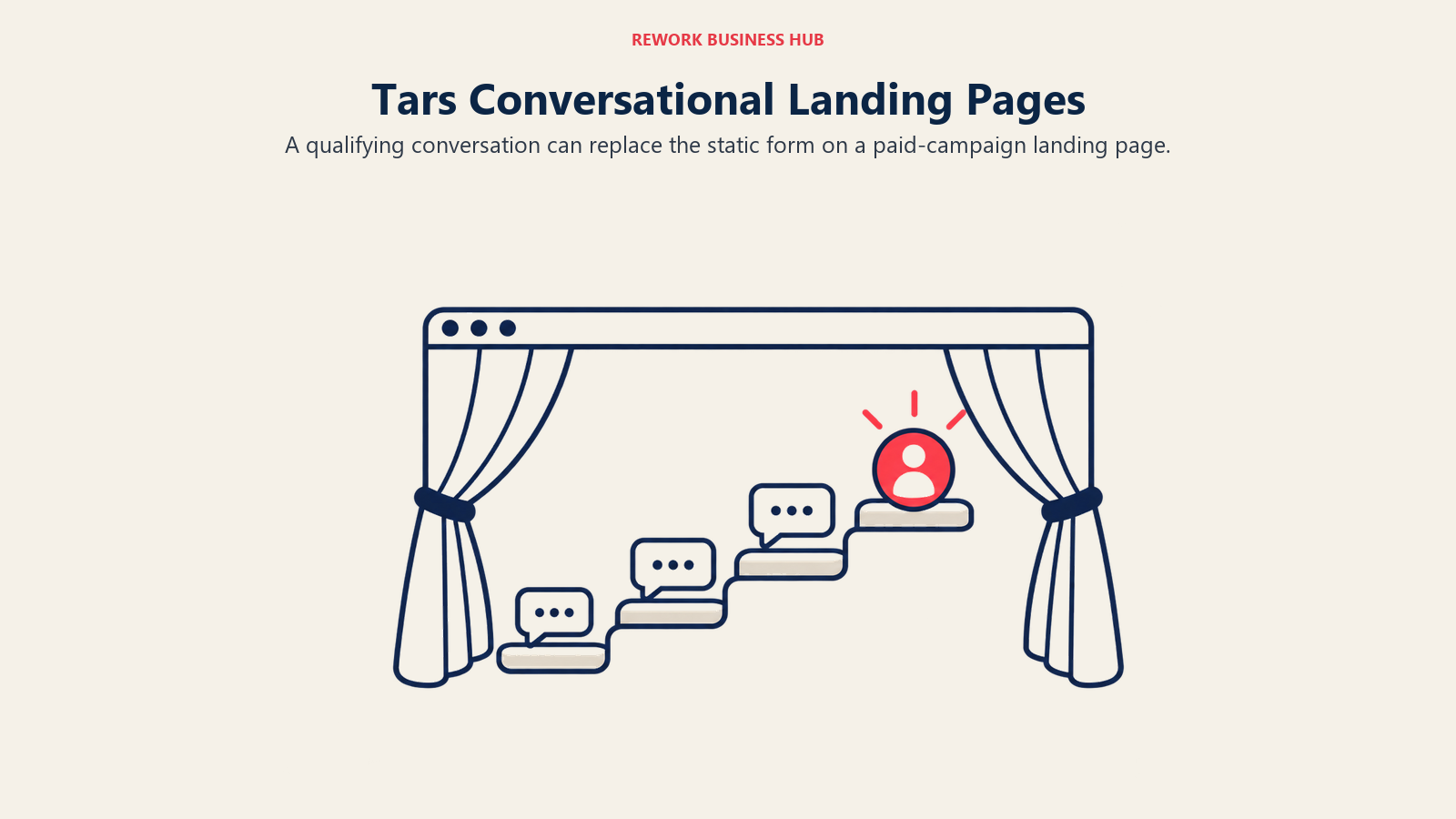
The pricing structure is worth flagging directly: Tars runs a free Freemium tier (50 conversations/month) and then jumps straight to a $499/month Premium floor, with live chat and professional support sold as separate annual add-ons on top. There's no gentle middle tier the way Landbot, ManyChat, or Chatfuel offer. That makes Tars a genuine enterprise-budget decision, not a growth-stage one.
| What you get | What you don't |
|---|---|
| Purpose-built conversational landing pages, not just a form or widget | An affordable middle tier between free and enterprise pricing |
| Advanced LLM models and large knowledge-base training on Premium | A self-serve growth-stage price point |
| ISO and SOC 2 compliance built into Premium and Enterprise | Native CRM or lead-distribution logic |
| Configurable conversation volume tiers within Premium | Live chat included by default (it's a paid add-on) |
Pricing: Freemium free (50 conversations/mo). Premium $499/mo (17% discount billed annually; configurable up to 10,000 conversations/mo). Enterprise custom. Live chat add-on $600/year/seat. See Tars's pricing page for current details.
Best for: Enterprise and upper-mid-market paid-acquisition teams that want an entire landing page rebuilt as a qualifying conversation, and have the budget for a $499/month-plus floor.
6. Botpress: Open, Developer-Grade Conversational AI
Botpress is the pick for teams that find Landbot's no-code canvas too limiting once conversation logic needs to call external APIs, reason over a large knowledge base, or run custom code mid-conversation. It's an open, extensible framework for building conversational agents, not a marketing tool with a drag-and-drop flow builder aimed at non-technical users. Engineers get real control over which LLM powers the agent, how it retrieves knowledge, and how it hands off to a human.
That flexibility is also the limitation. Botpress is not the tool for a marketer who wants to publish a lead-qualification bot this afternoon. It expects a technical owner, and its pricing reflects a usage-based model (conversations plus AI-spend credits) that requires forecasting effort a simpler flat-tier tool doesn't. For teams building an internal support agent or a genuinely custom customer-facing AI product, that tradeoff is worth it.
| What you get | What you don't |
|---|---|
| Open, extensible agent framework with real LLM and logic control | A no-code drag-and-drop builder for non-technical marketers |
| Unlimited AI agents on paid tiers, not capped per seat | Predictable flat pricing; usage credits require forecasting |
| Team routing, RBAC, and real-time collaboration on the Team tier | A conversational-form product for static lead-capture forms |
| Whitelabel webchat and custom-domain help center on Plus and above | WhatsApp or Instagram automation out of the box |
Pricing: Free (3 seats, 100 conversations/mo). Plus $150/mo billed annually (250 conversations included, $25 AI usage credit). Team $750/mo billed annually (unlimited seats, 1,500 conversations included, $150 AI usage credit). Enterprise custom. See Botpress's pricing page for current details.
Best for: Engineering and product teams building a custom conversational AI agent that needs real logic and LLM control, not a marketing-owned bot flow.
7. Respond.io: Multi-Channel Messaging at Scale
Respond.io does one job at genuine depth: unify every messaging channel a team's customers actually use (WhatsApp Business API, Messenger, Instagram DM, Telegram, LINE, WeChat, Viber, web chat) into a single inbox, with automation for routing, assignment, and follow-up across every one of them. It assumes a CRM lives elsewhere and focuses entirely on being excellent at the conversation layer.
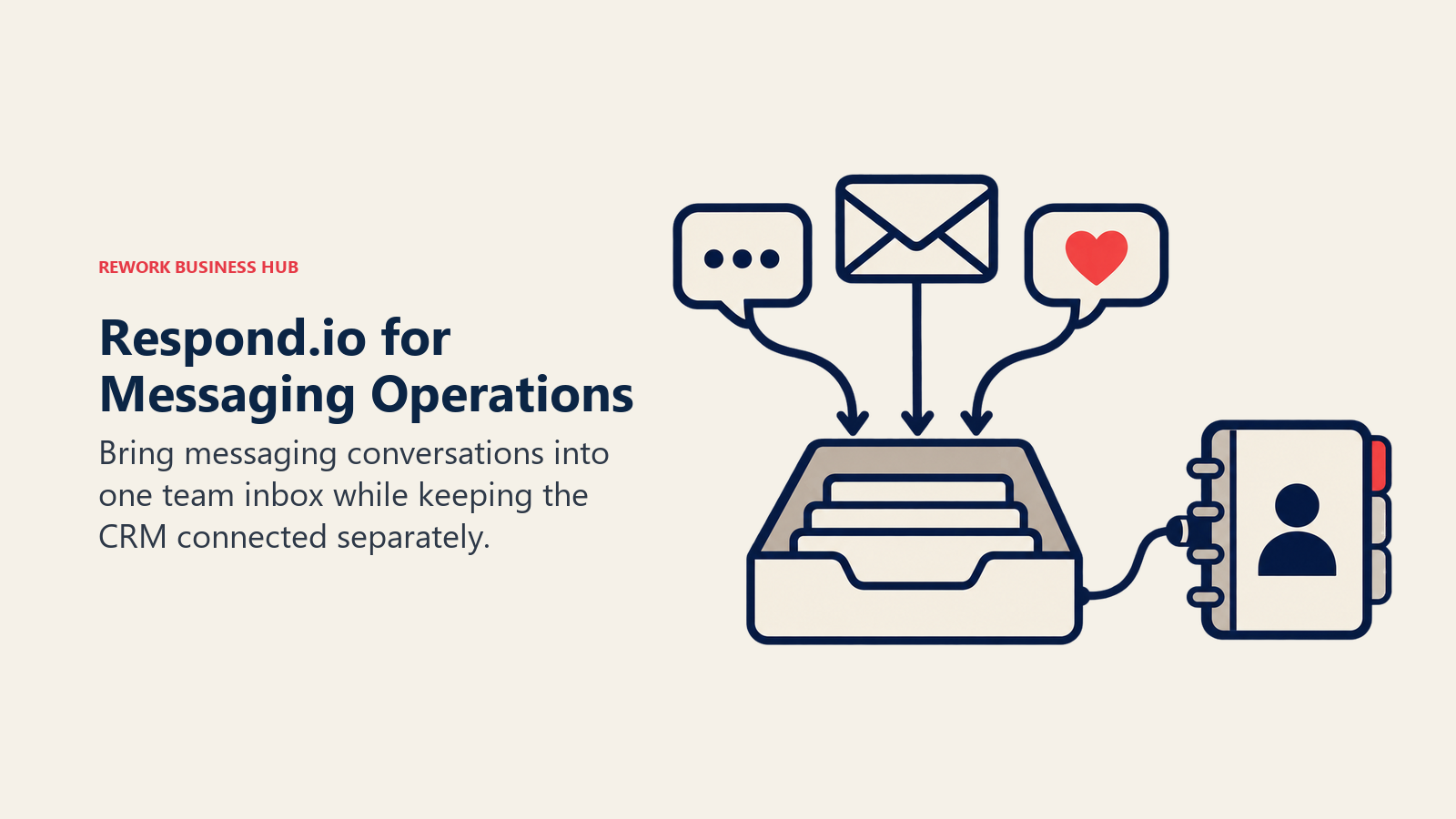
For teams in Southeast Asia, the Middle East, or Latin America, where WhatsApp, LINE, and Telegram are the dominant inbound channels, Respond.io's channel depth is broader than Landbot's, which focuses on a web widget with WhatsApp as an add-on rather than a primary channel. The Respond.io alternatives guide is worth reading directly if channel coverage, not bot-flow authoring, is the deciding factor.
| What you get | What you don't |
|---|---|
| Widest native channel coverage on this list: WhatsApp, Telegram, LINE, WeChat, Viber | Built-in CRM, deal pipeline, or lead-scoring logic |
| Strong assignment automation and a real API for custom integrations | A conversational-form builder |
| Clean agent inbox built for high message volume | Bot-flow authoring as visual or beginner-friendly as Landbot's |
| AI credits and AI agents bundled from the Growth tier up | A flat, predictable price as usage and users both scale |
Pricing: Starter $79/mo (5 users included, +$12/mo/user extra). Growth $159/mo (10 users, +$20/mo/user, 10,000 AI credits). Advanced $279/mo (10 users, +$24/mo/user, 20,000 AI credits). Enterprise custom. Annual billing saves 20% on every tier. See Respond.io's pricing page for current details.
Best for: Operations and sales teams running high-volume conversations across WhatsApp and messaging channels, particularly in markets where those channels drive most inbound leads.
8. Tidio: AI Chat and Automation for E-Commerce
Tidio's differentiation is Lyro, its AI agent, paired with tight Shopify and WooCommerce integration. The philosophy is straightforward: help small and mid-size online stores answer routine questions and qualify leads without hiring a dedicated support team, at a price point that doesn't require a budget conversation. A Shopify store can have Lyro live, answering product FAQs, in under an hour.
Where Tidio differs from Landbot is orientation. Tidio is a live-chat-and-AI-agent tool first, with a lighter automation layer (called Flows) on top, rather than Landbot's bot-flow-first design. Tidio doesn't build the kind of scripted, branching conversational form Landbot or Typeform specialize in, and it has no B2B lead-routing or CRM connectivity at any depth. It's the right swap when a team's real need was a faster answer engine for incoming questions, not a lead-qualification bot.
| What you get | What you don't |
|---|---|
| Fast Shopify and WooCommerce setup with Lyro AI included | B2B lead routing, scoring, or CRM integration depth |
| Approachable entry pricing with a real free tier | A conversational-form builder comparable to Typeform |
| Visual automation (Flows) for FAQ deflection and simple sequences | Complex branching logic for large catalogs or multi-team routing |
| Clean live-chat interface with low onboarding friction | Multi-team assignment logic or SLA tracking |
Pricing: Free (50 billable conversations/mo, 50 Lyro AI conversations one-off). Starter $29/mo billed monthly, or $24.17/mo billed annually ($290/yr, two months free), 100 billable conversations. Growth from $59/mo billed monthly, or $49.17/mo billed annually, up to 2,000 billable conversations. Plus from $300/mo plus usage fees. Premium custom (from 3,000 Lyro AI conversations, guaranteed 50% resolution rate). See Tidio's pricing page for current details.
Best for: E-commerce brands and small service businesses that want AI chat deflection and basic lead capture without the overhead of a full bot-automation platform.
9. WATI: WhatsApp Business API, Purpose-Built
WATI does one channel and does it deeply: WhatsApp Business API automation, broadcasts, a shared team inbox, chatbots, and two-way conversation management, all inside a WhatsApp-native platform. If WhatsApp is genuinely the primary channel (not an add-on the way it is on Landbot's lower tiers), WATI offers more automation depth on that one channel than a multi-channel competitor typically can.
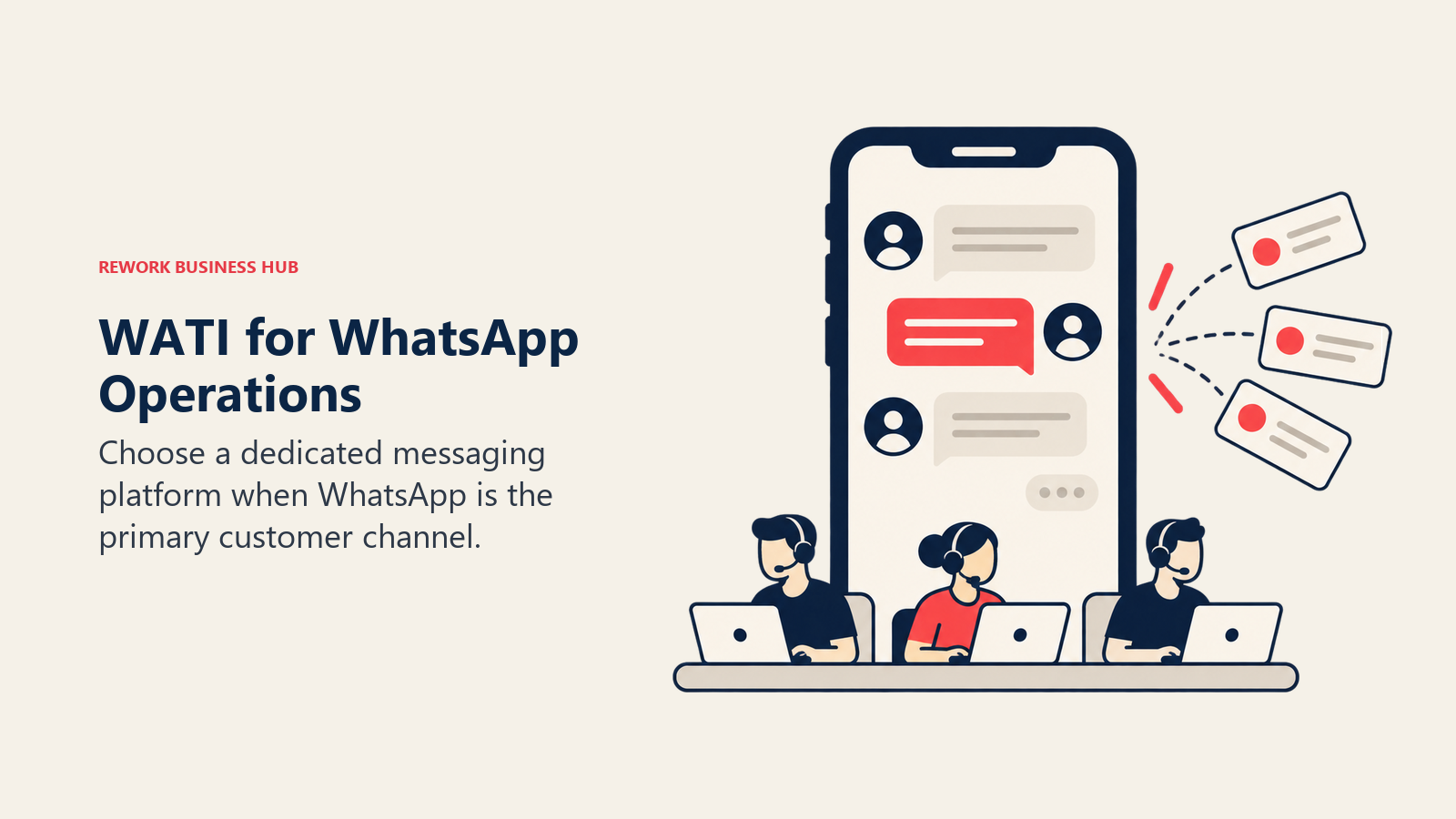
WATI repriced upward in 2026, and the jump is worth flagging: Growth now starts at $99/month ($79/month billed annually) for 3 users and one channel, a meaningfully higher floor than in prior years. Pro and Business layer on advanced chatbots, lead qualification, and AI co-pilot credits, but additional users cost $24 to $69 per user per month depending on tier. The limitation is the one the name implies: it's WhatsApp-only. If leads also come in via web chat, email, or Instagram, WATI handles none of that natively.
| What you get | What you don't |
|---|---|
| Deep WhatsApp Business API tooling: broadcasts, chatbots, AI co-pilot | Any channel beyond WhatsApp |
| Zero-fee WhatsApp setup and e-commerce catalog support | Built-in CRM or pipeline management |
| Multiple WhatsApp numbers and volume discounts on Business | A conversational-form builder for non-WhatsApp lead capture |
| Pre-approved template management for broadcast compliance | Predictable per-user costs as the team grows past the included seats |
Pricing: Growth $99/mo ($79/mo annual, 3 users, 1 channel). Pro $199/mo ($159/mo annual, 5 users, +$24/user extra). Business $399/mo ($319/mo annual, 5 users, +$69/user extra). See WATI's pricing page for current details.
Best for: E-commerce, service businesses, and B2B teams where WhatsApp is the dominant customer channel and the team needs deeper automation than Landbot's WhatsApp add-on provides.
10. Zoho SalesIQ: Chatbot and Live Chat Inside the Zoho Stack
Zoho SalesIQ bundles a chatbot builder, live chat, and visitor tracking into one product that plugs directly into Zoho CRM, Zoho Desk, and the rest of the Zoho suite without a separate integration project. For a team already running Zoho CRM, that tie-in is the entire pitch: a lead captured by a SalesIQ chatbot lands in the CRM record automatically, something Landbot needs an integration or a manual export to replicate.
Outside the Zoho ecosystem, the standalone chatbot depth is more modest than a dedicated bot platform. The Free plan (3 operators, 10,000 visitors/month) is genuinely usable for a small team, and paid tiers add more chatbots, bot-session volume, and AI-powered self-help through Zoho's Zia assistant on Enterprise. Zoho publishes its per-operator rates directly on its pricing page.
| What you get | What you don't |
|---|---|
| Native Zoho CRM and Zoho Desk integration with no separate project | Standalone chatbot sophistication matching Botpress or Tars |
| Accessible per-operator pricing with a genuinely usable free tier | A conversational-form product for web-based lead capture |
| Visitor tracking, lead/company scoring, and workflow automation on Basic+ | Deep multi-channel messaging beyond web chat |
| Zia AI-powered self-help and bot training via URLs on Enterprise | Strong standalone value outside the Zoho ecosystem |
Pricing: Free (3 operators, 10,000 visitors/mo, 100 chat sessions/mo). Basic US$7/operator/mo billed annually. Professional US$12.75/operator/mo billed annually. Enterprise US$20/operator/mo billed annually. Local taxes are added on top. Zoho does not print a separate month-to-month rate on the page. See Zoho SalesIQ's pricing page for current details.
Best for: Teams already using or evaluating Zoho CRM or Zoho Desk that want a chatbot and live chat included in the same ecosystem without a separate integration project.
11. Intercom: Enterprise Support AI at a Per-Outcome Price
Intercom sits at the far enterprise end of this list, and its Fin AI Agent represents a genuinely different pricing model than anything else here: instead of metering by chats, contacts, or conversations, Fin charges per resolved outcome, currently $0.99 each, on top of a seat-based platform fee. That model rewards a team whose AI agent actually resolves issues and penalizes one that just generates a lot of unresolved back-and-forth.
Intercom isn't a conversational-form or lead-qualification bot builder the way Landbot is; it's a help desk with an AI layer, and its natural comparison point is a support team deciding between a human-first and an AI-first resolution model, not a marketing team building a lead-capture flow. For teams evaluating it specifically against a lighter chat tool, the Intercom alternatives guide and the Intercom vs. Tidio comparison both go deeper on where the two overlap and where they don't.
| What you get | What you don't |
|---|---|
| Fin AI Agent priced per resolved outcome, not per seat or per contact | A conversational-form or lead-qualification bot builder |
| Free Lite seats bundled in on Advanced (20) and Expert (50) tiers | A pricing model that's simple to forecast at scale |
| Deep help-desk feature set: workflows, reporting, Copilot for agents | Affordable entry pricing for a small, budget-constrained team |
| Standalone Fin option for teams on another help desk entirely | Native WhatsApp or Instagram bot-flow automation |
Pricing: Essential $29/seat/mo. Advanced $85/seat/mo (20 free Lite seats included). Expert $132/seat/mo (50 free Lite seats included). Fin AI Agent from $0.99 per resolved outcome on any plan. See Intercom's pricing page for current details.
Best for: Support-led organizations (20-2,000 employees) that want an AI agent resolving tickets at scale on a pay-per-outcome model, layered on a full help desk.
Channel Coverage Comparison
Channel coverage matters most when the platform handles the conversations buyers actually use without a brittle handoff to a second tool.
| Channel | Respond.io | WATI | ManyChat | Chatfuel | Zoho SalesIQ | Tidio | Intercom | Typeform | Jotform |
|---|---|---|---|---|---|---|---|---|---|
| Web chat / widget | Native | No | Native | No | Native | Native | Native | No (form only) | No (form only) |
| Native | Native | Native | Native | Integration | Integration | Integration | No | No | |
| Messenger | Native | No | Native | Native | Integration | Integration | Integration | No | No |
| Instagram DM | Native | No | Native | Native | No | Integration | Integration | No | No |
| Email inbox | Native | No | Native | No | Native | Native | Native | No | No |
| SMS | Native | No | Native | No | No | No | No | No | No |
| Conversational form | No | No | No | No | No | No | No | Native | Native |
Conversational Form and Lead Capture Comparison
This is the table that matters most for teams switching from Landbot because the conversational-form use case, not the chatbot use case, is the real reason they adopted it in the first place.
| Capability | Typeform | Jotform | Tars | Landbot |
|---|---|---|---|---|
| Single-question conversational form | Native | Native | Native (full-page) | Native |
| Video questions | Yes | No | No | No |
| Conditional logic on answers | Yes | Yes | Yes | Yes |
| Native lead scoring | No | No | No | No |
| Native CRM / pipeline handoff | No | Via integration | Via integration | Via integration |
| AI-assisted question generation | Yes | Yes | Yes (LLM-driven) | Yes (AI chats) |
Automation Capability Comparison
| Capability | Respond.io | ManyChat | Botpress | Chatfuel | WATI |
|---|---|---|---|---|---|
| Visual flow builder | Yes | Yes | Code + visual | Yes | Yes |
| Conditional branching on CRM data | Via API | Limited | Yes (custom code) | No | No |
| Cross-channel sequence | Yes | Yes | Yes | No | No |
| Broadcast / bulk messaging | Yes | Yes | Yes | Yes | Yes |
| AI-assisted routing or resolution | Yes (AI credits) | Yes (Manychat AI) | Yes (LLM-native) | Yes (AI PRO) | Yes (AI co-pilot) |
| Webhook / API triggers | Yes | Yes | Yes | Yes | Yes |
Pricing Reference Table
| Tool | Entry Paid Plan | Mid-Tier Plan | Notes |
|---|---|---|---|
| Typeform | $28/mo ($25/mo annual) | $91/mo ($83/mo annual) | Metered by monthly responses |
| Jotform | $39/mo ($34/mo annual) | $129/mo ($99/mo annual) | Metered by forms + submissions |
| ManyChat | $14/mo | $69/mo | Metered by active contacts |
| Chatfuel | $49/mo (AI PRO) | Same tier, annual discount | Only two tiers as of 2026 |
| Tars | $499/mo | Configurable within Premium | No mid-range tier between free and $499 |
| Botpress | $150/mo (annual) | $750/mo (annual) | Usage-based conversation + AI credits |
| Respond.io | $79/mo (5 users) | $279/mo (10 users) | +$12 to $24/mo per extra user by tier |
| Tidio | $29/mo ($24.17 annual) | $59/mo ($49.17 annual) | Metered by billable + Lyro AI conversations |
| WATI | $99/mo ($79/mo annual) | $399/mo ($319/mo annual) | Repriced upward in 2026 |
| Zoho SalesIQ | $7/operator/mo (annual) | $12.75/operator/mo (annual) | Per-operator; annual rates only |
| Intercom | $29/seat/mo | $85/seat/mo | Fin AI Agent billed separately, $0.99/outcome |
How to Choose: Decision Framework
Use these criteria to narrow the field by workflow, budget, channel mix, and how technical the team building the bot actually is.
| If you need this... | Pick this |
|---|---|
| The single best conversational-form builder for surveys, applications, and lead-capture forms | Typeform |
| Forms and a lightweight AI chatbot sharing one dataset without a second subscription | Jotform |
| The widest Meta-ecosystem bot automation for social-ad-driven DTC growth | ManyChat |
| The simplest possible free-to-$49/mo no-code Meta bot builder | Chatfuel |
| An entire landing page rebuilt as a qualifying conversation, with enterprise budget | Tars |
| Developer-grade conversational AI with real LLM and logic control | Botpress |
| The deepest multi-channel messaging inbox for WhatsApp-heavy markets | Respond.io |
| AI chat deflection and lead capture for a Shopify or WooCommerce store | Tidio |
| WhatsApp-only automation, broadcasts, and a team inbox at depth | WATI |
| A chatbot and live chat bundled inside an existing Zoho CRM subscription | Zoho SalesIQ |
| An AI agent resolving support tickets at scale on a pay-per-outcome model | Intercom |
What to Do Next
Before picking a Landbot alternative, answer three questions. Is the actual job a conversational form (replacing a static web form), a bot flow (qualifying a lead across a script), or a messaging inbox (handling incoming WhatsApp and social DMs)? Those are three different products wearing similar marketing language, and Typeform, ManyChat, and Respond.io respectively are the purest answers to each. Second: does a qualified lead need to land in a CRM with an owner and a follow-up date, or is the conversation itself the end product? If it's the former, check how each tool hands that lead to your CRM before you commit, and if you already run Zoho CRM, Zoho SalesIQ keeps the chat and the record in the same stack. Third: does the team building the flow need a no-code canvas, or does it have engineering capacity for something like Botpress that trades ease of use for real logic control?
Run a two-week pilot with your top two picks using real incoming leads or form traffic, not test data. Chat-meter overages, seat caps, and integration friction either show up in that window or they don't. Teams building the handoff from a bot or form into a sales pipeline should also review the best live chat software roundup and the best ManyChat alternatives guide for how the messaging and CRM layers connect once a lead is qualified. And if Tidio is the tool you're evaluating against a heavier AI-agent option, Tidio's own alternatives roundup is worth reading before you commit either way.
Frequently Asked Questions about Landbot Alternatives
What is the best Landbot alternative overall?
There's no single best for everyone. Typeform is the closest swap for Landbot's conversational-form use case specifically. ManyChat and Chatfuel are the closest swaps for its bot-flow-on-Meta use case. For teams already on Zoho CRM, Zoho SalesIQ keeps the bot, the live chat, and the lead record in one stack.
Why do teams switch away from Landbot?
The most common triggers are the combined chat-plus-AI-chat meter running out faster than expected, hard seat caps at 1, 2, 3, and then 5-plus users, WhatsApp being a paid add-on rather than a default channel, and no native CRM for what happens after a lead is captured.
Is there a free Landbot alternative?
Yes. Typeform, Jotform, ManyChat, Chatfuel, Botpress, and Tidio all offer usable free tiers. Free plans work well at low volume; most teams move to a paid tier once they need more responses or conversations per month, multiple seats, or deeper automation.
Which Landbot alternative is best for WhatsApp specifically?
WATI is purpose-built for the WhatsApp Business API with broadcasts, chatbots, and a shared team inbox. Respond.io is the stronger pick if WhatsApp needs to sit alongside other channels like Telegram, LINE, or WeChat in the same inbox.
Do I need a CRM-connected chat or form tool, or is the conversation layer itself enough?
Answer this before you choose. If a qualified lead needs to be routed to a rep, scored, and tracked through close, make sure the tool connects natively to the CRM where that happens (Zoho SalesIQ does this inside the Zoho stack), so there's no fragile export step. If the goal is just a better-converting form or a Meta-only bot, a focused tool like Typeform, ManyChat, or Chatfuel is enough on its own.

Senior Implementation Consultant
On this page
- Key Facts
- Quick Comparison Table
- Why Teams Are Leaving Landbot
- Stage Fit Matrix
- Sizing and Persona Table
- 1. Typeform: Conversational Forms Done Right
- 2. Jotform: Forms Plus AI Agents in One Builder
- 3. ManyChat: The Biggest Name in No-Code Chat Automation
- 4. Chatfuel: The Simplest No-Code Meta Bot Builder
- 5. Tars: Conversational Landing Pages for Enterprise Lead Gen
- 6. Botpress: Open, Developer-Grade Conversational AI
- 7. Respond.io: Multi-Channel Messaging at Scale
- 8. Tidio: AI Chat and Automation for E-Commerce
- 9. WATI: WhatsApp Business API, Purpose-Built
- 10. Zoho SalesIQ: Chatbot and Live Chat Inside the Zoho Stack
- 11. Intercom: Enterprise Support AI at a Per-Outcome Price
- Channel Coverage Comparison
- Conversational Form and Lead Capture Comparison
- Automation Capability Comparison
- Pricing Reference Table
- How to Choose: Decision Framework
- What to Do Next