Best Respond.io Alternatives in 2026: 10 Multi-Channel Messaging Platforms for Sales and Support Teams
Turn this article into takeaways for your work.


Each assistant summarizes the article only for you and suggests best practices for your work.
Respond.io is technically impressive. It handles WhatsApp Business API, Messenger, Instagram DM, Viber, Telegram, and live chat in a single inbox, and it has a workflow automation builder that can do a lot. But if you've spent any time with it, you already know the catch: the pricing structure is opaque, the learning curve is steep for what should be a messaging tool, and the CRM depth is shallow given what you're paying.
If you're a sales or support team lead at a company between 20 and 500 employees, you're likely looking for something that handles multi-channel messaging without requiring a solutions engineer to configure it. Or you need actual CRM functionality, not just a shared inbox. Or you just want pricing that doesn't require a sales call to decode. This list covers 10 alternatives that do one or more of those things better, starting with the one that covers the most ground.
Quick Comparison Table
| Tool | Best For | Starting Price | Key Strength | Key Limitation |
|---|---|---|---|---|
| Rework | Mid-size teams needing CRM + multi-channel inbox | From $159/mo billed yearly, 5 marketing + 5 sales seats (rework.com/pricing) | Unified CRM + Lead Management + chat inbox in one product | Not ideal for solo users or enterprise-scale customization |
| ManyChat | E-commerce and D2C brands automating Meta/WhatsApp flows | Free; Pro from $15/mo | Chat automation for Meta channels and WhatsApp | Not a CRM; limited outside Meta/WhatsApp |
| Tidio | Small e-commerce sites needing AI chat + live chat | Free; Lyro AI from $39/mo | Lyro AI chatbot handles up to 70% of chats automatically | Support-focused; weak on sales pipeline |
| Crisp | Startups and small teams wanting affordable chat + light CRM | Free; Pro from $25/workspace/mo | Very affordable; good developer experience | Limited automation depth at lower tiers |
| Intercom | Mid-market product and SaaS companies | Starts ~$39/seat/mo | Fin AI handles complex support queries; deep product integrations | Expensive at scale; best for product-led companies |
| Freshchat | Freshworks customers wanting messaging in their existing stack | Free; Growth from $19/agent/mo | Tight Freshdesk/Freshsales integration | Weaker WhatsApp/social channel depth vs specialists |
| WATI | WhatsApp-first SMBs in emerging markets | Growth from $49/mo | Purpose-built WhatsApp Business API platform | Single-channel; poor for non-WhatsApp needs |
| Trengo | European SMBs wanting a team inbox without a CRM layer | Boost from EUR 349/mo flat, 10 users included (EUR 299/mo billed annually) | Clean UI; good channel coverage; fair pricing | CRM is lightweight; limited automation depth |
| Sleekflow | Social commerce teams in Southeast Asia | Starter from $79/mo | Instagram/WhatsApp commerce + payment link support | Niche geographic strength; maturing product |
| Bird (MessageBird) | Enterprises needing programmable omnichannel comms | Pay-per-use / custom | API-first; massive channel depth; global SMS/WhatsApp reach | Not a plug-and-play product; requires dev resources |
1. Rework: Unified CRM + Multi-Channel Inbox for Mid-Size Teams
Respond.io positions itself as a "conversational CRM" but the CRM side is thin. Rework is what happens when you build a real CRM and a real multi-channel inbox as a single product, not two tools bolted together.
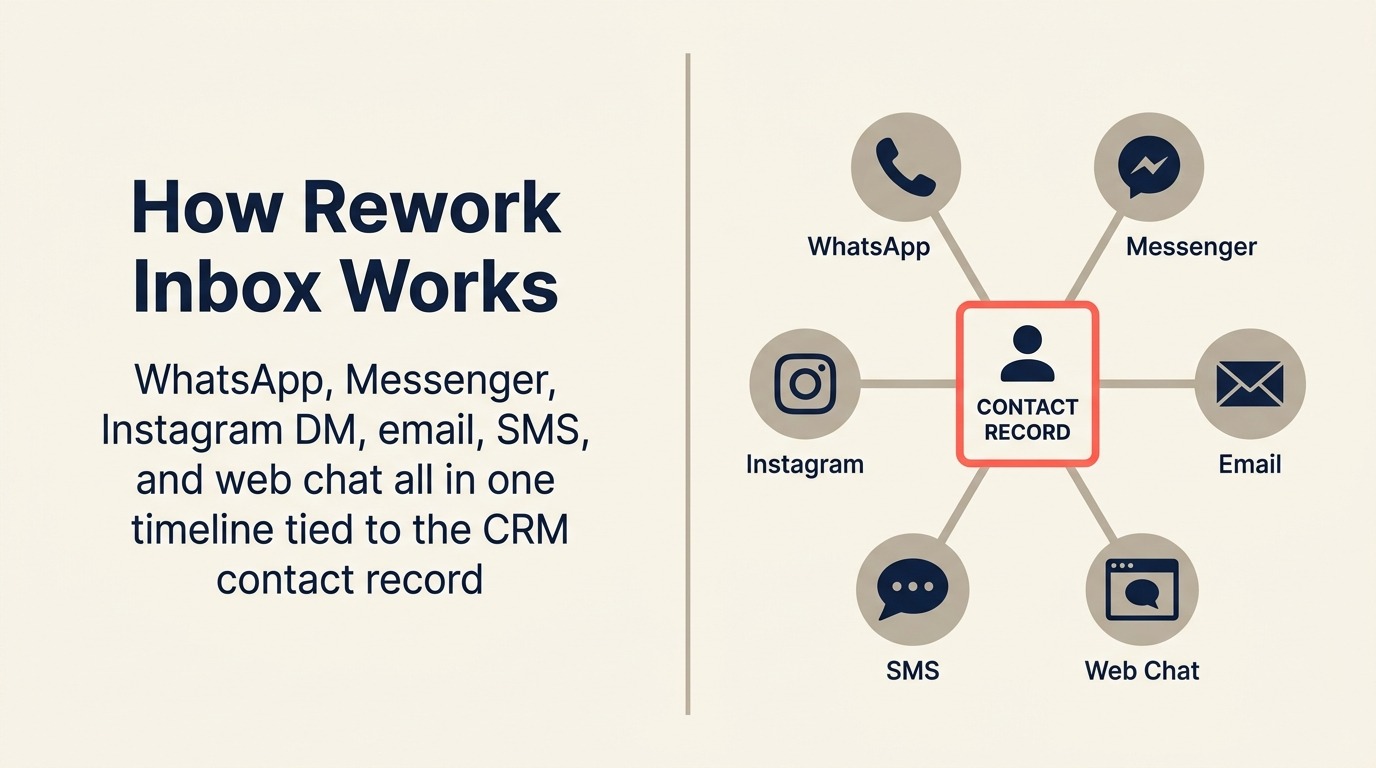
The core story for teams coming from Respond.io: every conversation in WhatsApp, Messenger, Instagram DM, TikTok, Telegram, LINE, Zalo, and web chat is tied to the same contact record in the CRM. You don't sync data between a messaging tool and a separate pipeline tracker. Sales context and support history live in one place. When a lead comes in via WhatsApp, it can go straight into the pipeline without re-keying.
Rework's Lead Management is genuinely differentiated here. Equal and weighted round-robin, rule-based routers, and SLA rules are built into the inbox and lead apps. The marketing-to-sales handoff happens inside the same product. You're not stitching Respond.io to a CRM to a routing tool using Zapier. If you're coming specifically from Respond.io's WhatsApp-heavy workflows, the Respond.io vs ManyChat B2B sales comparison explains how each handles sales automation differently. And setting up Respond.io with HubSpot is worth reading if you've already built workflows on Respond.io and want to understand what migrating off actually involves.
Methodology: Built for cross-functional teams where sales, marketing, and customer success touch the same customer. The product philosophy is unified ops, not a standalone inbox.
Target audience: 20-500 employee companies in B2B SaaS, e-commerce, professional services, real estate, education, and healthcare. Decision maker is typically a Head of Sales, Head of Ops, or RevOps lead.
Sizing fit: Growth stage (10-50) through mid-market (50-500). Not the right fit for solo operators or enterprise organizations needing deep Salesforce-level custom objects.
Stage fit: Teams that have outgrown a simple inbox tool and need the CRM layer without buying two products.
Team vs company-wide: Company-wide. Sales, marketing, CS, and ops all use the same platform.
| What you get | What you don't |
|---|---|
| WhatsApp, Messenger, IG DM, web chat, Telegram, Zalo in one inbox | Deep enterprise governance or on-prem deployment |
| Full CRM with pipeline, quota tracking, and forecasting | A simple tool for a 3-person team |
| Routing: equal or weighted round-robin, rule-based routers, SLA | Marketo/Pardot-level enterprise demand gen |
| Marketing-to-sales handoff in one product | Salesforce AppExchange-equivalent ecosystem |
| Cross-team workflow automation (approval chains sit in the separate Process Engine) | Purpose-built ticketing depth (Zendesk-grade) |
Pricing: Revenue Engine (CRM, omnichannel inbox and lead capture) is $159/month billed yearly ($1,908/year) or $190 month to month, with 5 marketing and 5 sales seats included. The inbox alone is the Marketing Engine, from $99/month billed yearly. 14-day free trial. See rework.com/pricing.
Best for: Mid-size sales and ops teams that want CRM + multi-channel messaging without managing two separate platforms.
2. ManyChat: Chat Automation for Meta Channels and WhatsApp
ManyChat's product philosophy is simple: automate the repetitive parts of Meta channel conversations so your team only handles the moments that matter. It's not trying to be a CRM. It's a conversation automation layer that sits on top of Facebook Messenger, Instagram DM, and WhatsApp Business. For a broader look at how ManyChat stacks up against CRM-connected platforms, the ManyChat alternatives guide covers the full spectrum from Meta-only bots to unified lead management.
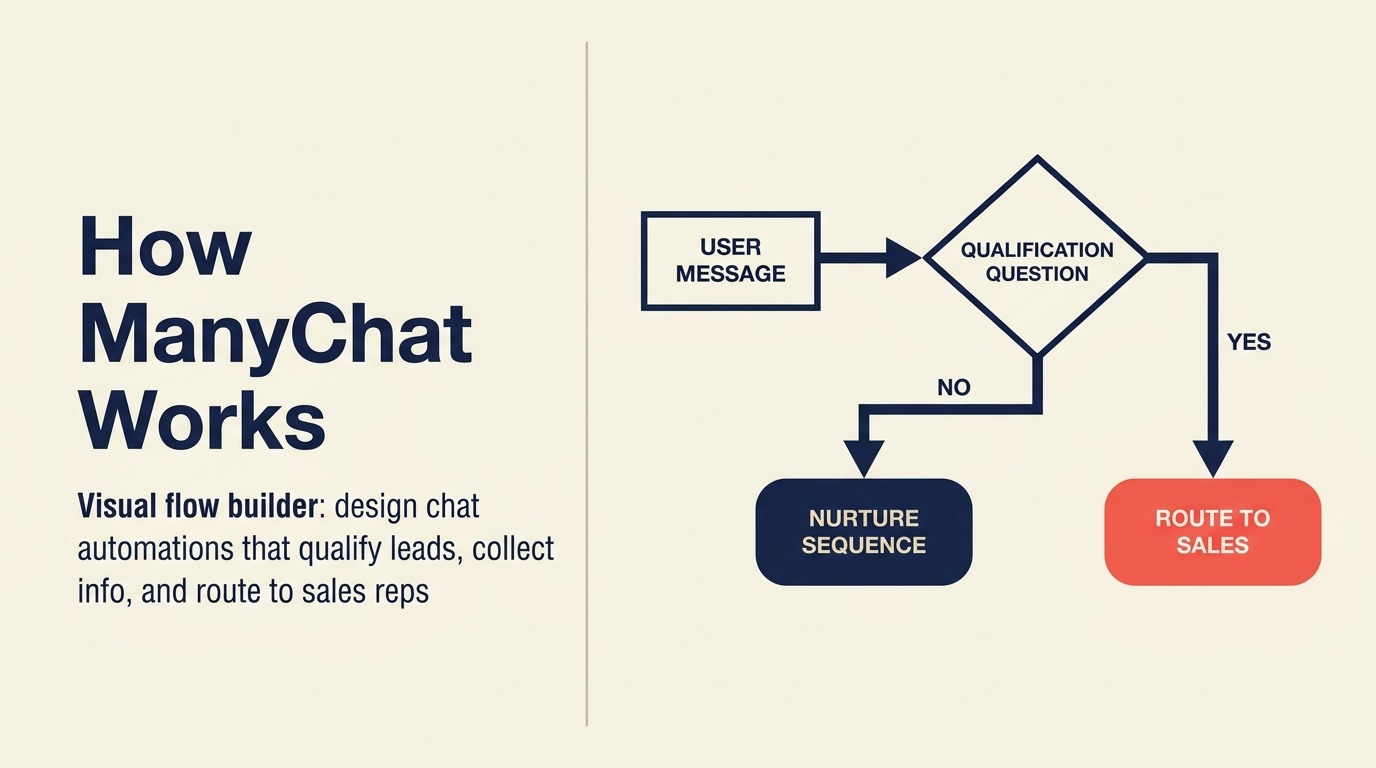
The automation builder is the standout feature. Flow-based, visual, and genuinely easy to use without a developer. You can build lead qualification sequences, broadcast campaigns, drip sequences, and e-commerce abandoned cart recovery flows in hours. For D2C brands running paid social, it's hard to beat.
Methodology: Automate-first. The philosophy is that most customer interactions follow predictable patterns that don't need a human until a qualifier is met.
Target audience: E-commerce brands, course creators, coaches, and D2C businesses generating leads or sales through Facebook Ads, Instagram, and WhatsApp. Typically 1-50 employees, with a marketing-first buyer.
Sizing fit: Solo operators through growth-stage companies (up to ~50 employees). Starts to feel insufficient for mid-market teams needing a full CRM layer or multi-department workflows.
Stage fit: Best at the PMF-to-early-growth stage where the primary acquisition channel is paid social and the team needs automation to scale without headcount.
Team vs company-wide: Marketing and sales team tool, not company-wide. Limited utility for CS or ops teams.
| What you get | What you don't |
|---|---|
| Best-in-class visual flow builder for Meta channels | Any meaningful CRM functionality |
| WhatsApp Business API automation | Channels outside Meta ecosystem (no email, SMS native) |
| Broadcast and drip campaign tools | Pipeline tracking or sales forecasting |
| Affordable entry pricing (free tier available) | Territory routing or SLA management |
Pricing: Free plan for up to 1,000 contacts. Pro plan from $15/month. WhatsApp features require a WhatsApp Business account with a separate API cost. See ManyChat's pricing page for current tiers.
Best for: D2C and e-commerce brands automating lead gen and customer conversations through Meta channels and WhatsApp, with a marketing-first team.
Stage Fit Matrix
| Tool | Startup (1-20) | Growth (20-100) | Mid-Market (100-500) | Enterprise (500+) |
|---|---|---|---|---|
| Rework | Possible | Strong fit | Strong fit | Partial fit |
| ManyChat | Strong fit | Strong fit | Weak fit | Not recommended |
| Tidio | Strong fit | Moderate fit | Weak fit | Not recommended |
| Crisp | Strong fit | Moderate fit | Weak fit | Not recommended |
| Intercom | Moderate fit | Strong fit | Strong fit | Moderate fit |
| Freshchat | Moderate fit | Moderate fit | Strong fit (Freshworks stack) | Strong fit |
| WATI | Strong fit | Strong fit | Moderate fit | Not recommended |
| Trengo | Moderate fit | Strong fit | Moderate fit | Weak fit |
| Sleekflow | Moderate fit | Strong fit | Moderate fit | Weak fit |
| Bird | Not recommended | Moderate fit | Strong fit | Strong fit |
3. Tidio: AI Chatbot Lyro Plus Live Chat for Small E-Commerce
Tidio's angle is AI-first support. Its Lyro AI chatbot is genuinely capable of handling up to 70% of support queries automatically using a knowledge base you train it on. For a small e-commerce store getting hundreds of "where's my order?" and "how do I return this?" questions daily, Lyro can meaningfully reduce ticket volume without hiring another support agent. If Tidio isn't quite the right fit, the best Tidio alternatives guide maps out what teams typically move to at each stage.
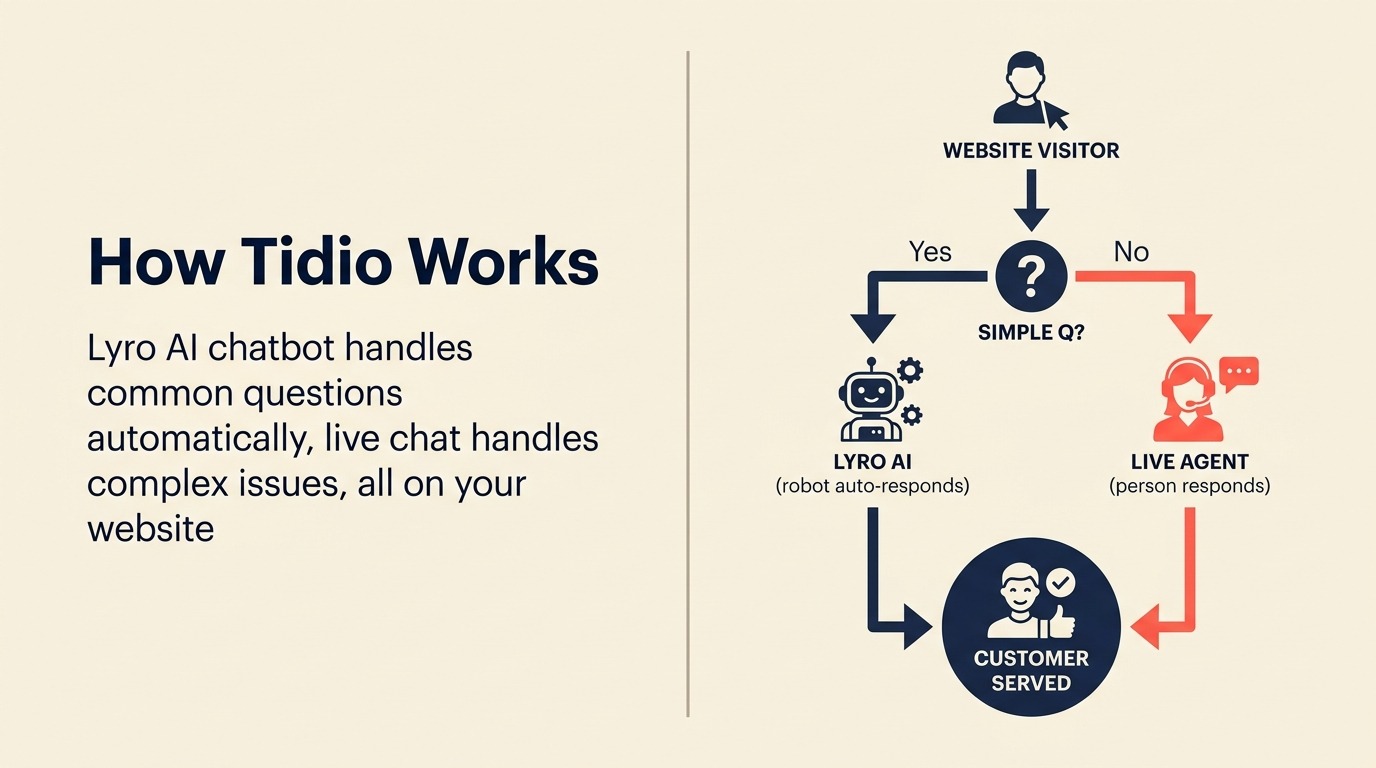
Methodology: Automate-first support, with live chat as the escalation path. Tidio believes most support queries are repetitive and should never reach a human agent.
Target audience: Small to mid-size e-commerce businesses, Shopify and WooCommerce stores, and online service businesses. Typically 1-50 employees. Buyer is usually the business owner or a support manager.
Sizing fit: Best for solo operators through small growth-stage businesses (1-50 employees). The AI chatbot ROI diminishes as you scale into more complex support workflows that need human judgment.
Stage fit: Startup through early growth. Tidio is easy to set up quickly (you can go from install to live chat in under an hour on Shopify).
Team vs company-wide: Support team tool. Not designed for sales pipelines or ops workflows.
| What you get | What you don't |
|---|---|
| Lyro AI handles repetitive queries automatically | CRM depth or pipeline management |
| Shopify/WooCommerce native integration | WhatsApp or Instagram DM (limited multi-channel) |
| Live chat, email ticketing, and Messenger in one inbox | Lead routing or territory management |
| Affordable pricing with a free tier | Outbound messaging or campaign tools |
Pricing: Free plan with limited chatbot conversations. Lyro AI starts at $39/month for 50 resolved conversations. Communicator plan at $29/agent/month adds live chat seats.
Best for: Small e-commerce businesses that want to reduce support ticket volume through AI, without managing a complex platform.
4. Crisp: Affordable Chat Plus CRM-Lite for Startups
Crisp is a good option if you're coming from Respond.io and find it overcomplicated. The product is cleaner, the pricing is transparent, and the free plan is genuinely usable. Crisp covers live chat, shared inbox, email, Messenger, Twitter DM, and a basic CRM layer in one product.
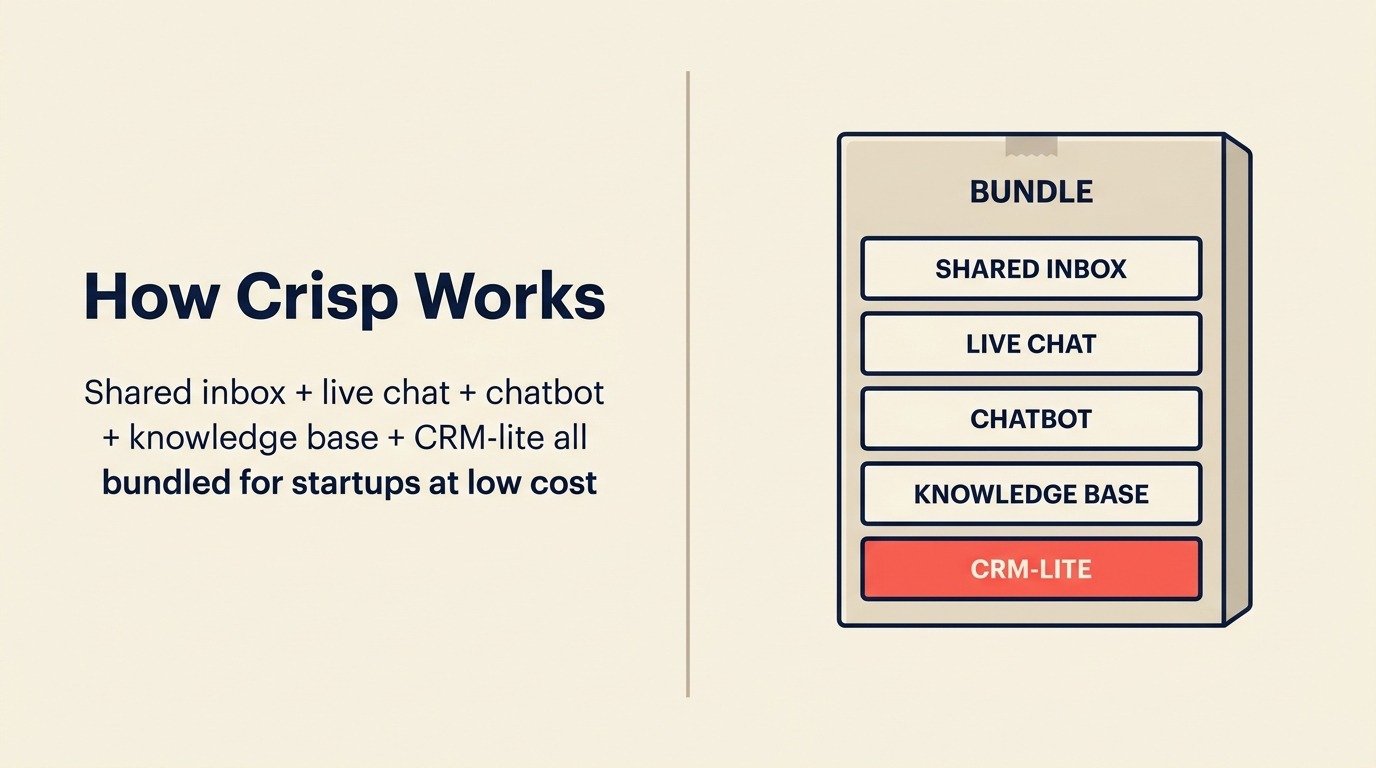
Methodology: Start simple, scale up. Crisp's philosophy is that most small teams don't need enterprise complexity. It's designed to be opinionated but not overwhelming.
Target audience: Startups, SaaS companies, and small businesses in the 1-50 employee range. Developers appreciate the clean API. Buyer is typically the founder or a support/sales lead.
Sizing fit: Solo through growth stage (1-50 employees). The CRM layer is light enough that it gets outgrown by teams doing serious pipeline management. But for early-stage companies, it's often enough.
Stage fit: Pre-revenue through early traction. Crisp gets you a shared inbox and basic CRM without a setup cost. It's a good landing spot before you graduate to a full CRM.
Team vs company-wide: Support and sales team tool. Marketing and ops workflows are limited.
| What you get | What you don't |
|---|---|
| Clean shared inbox with fair multi-channel coverage | Deep lead routing or SLA management |
| Basic CRM with contact and deal tracking | Automation builder depth at lower tiers |
| Free plan that actually works for small teams | Native WhatsApp Business API |
| Good developer experience and clean API | Advanced reporting or forecasting |
Pricing: Free plan for 2 agents. Pro plan at $25/workspace/month. Unlimited plan at $95/workspace/month. No per-seat pricing on workspace plans, which is unusual and often cheaper for small teams. See Crisp's pricing page for full details.
Best for: Startups wanting a clean, affordable shared inbox with a light CRM, before they need more depth.
5. Intercom: Conversational Platform Plus Fin AI for Product-Led Companies
Intercom is the most mature product on this list. Its Fin AI agent handles genuinely complex support queries, not just keyword matching. It integrates deeply with product data so support conversations can reference user behavior, subscription status, and in-app events in real time. The best Intercom alternatives guide is worth a read if you're shopping around before committing.
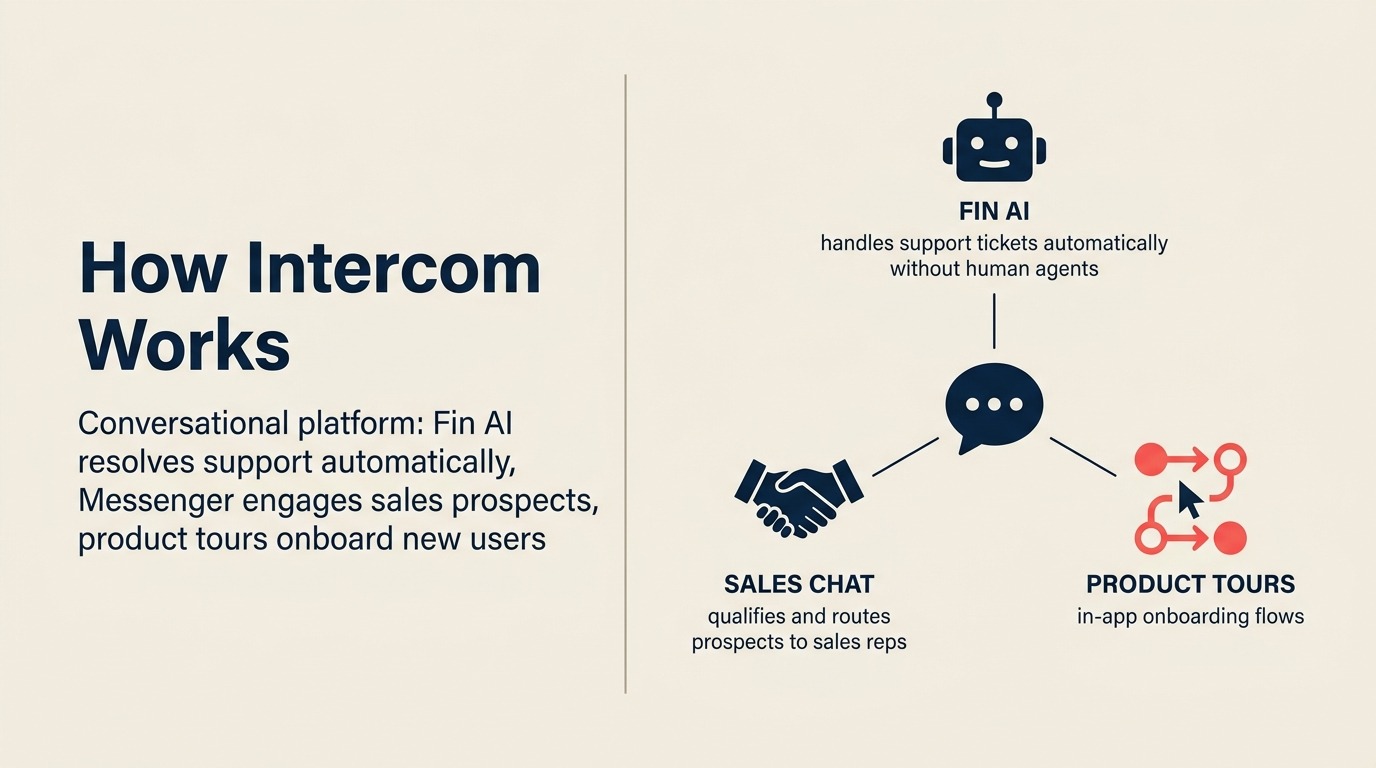
Methodology: The philosophy is that support and sales conversations should be informed by product context. Intercom treats the customer's in-app behavior as a first-class signal in every conversation.
Target audience: Mid-market SaaS and product-led companies where the support team needs access to product data during conversations. Typical buyer is a Head of Support or VP of Customer Success at a 50-500 employee SaaS company.
Sizing fit: Growth through mid-market (50-500 employees). It can scale to enterprise but pricing gets uncomfortable at volume. Startups often find it expensive relative to alternatives.
Stage fit: Growth stage and beyond. Intercom is worth the cost when your product complexity creates complex support needs that justify an AI agent trained on deep product context.
Team vs company-wide: Primarily a support and CS team tool. Sales features exist (outbound, leads inbox) but Intercom's core product identity is support-first.
| What you get | What you don't |
|---|---|
| Fin AI handles complex queries with product context | Simple, low-cost setup for small teams |
| Deeply integrated with product analytics and user data | Competitive pricing vs. newer alternatives |
| Outbound messaging and onboarding sequences | Native WhatsApp or Instagram DM (requires integration) |
| Strong mobile SDK for in-app support | Full CRM or pipeline management |
Pricing: Starts at approximately $39/seat/month. Fin AI usage is billed per resolution. Costs scale quickly with volume. Enterprise pricing requires a custom quote. See Intercom's pricing page for the latest.
Best for: Product-led SaaS companies where support complexity justifies an AI agent with deep product context, and where the team is willing to pay for it.
6. Freshchat: Freshworks Messaging for Existing Freshworks Customers
Freshchat is Freshworks' messaging product. On its own, it's a capable shared inbox with live chat, WhatsApp (via integration), email, and Messenger. The real value case is if your team already uses Freshdesk for ticketing or Freshsales as a CRM. In that context, Freshchat is the messaging layer that completes the Freshworks suite.
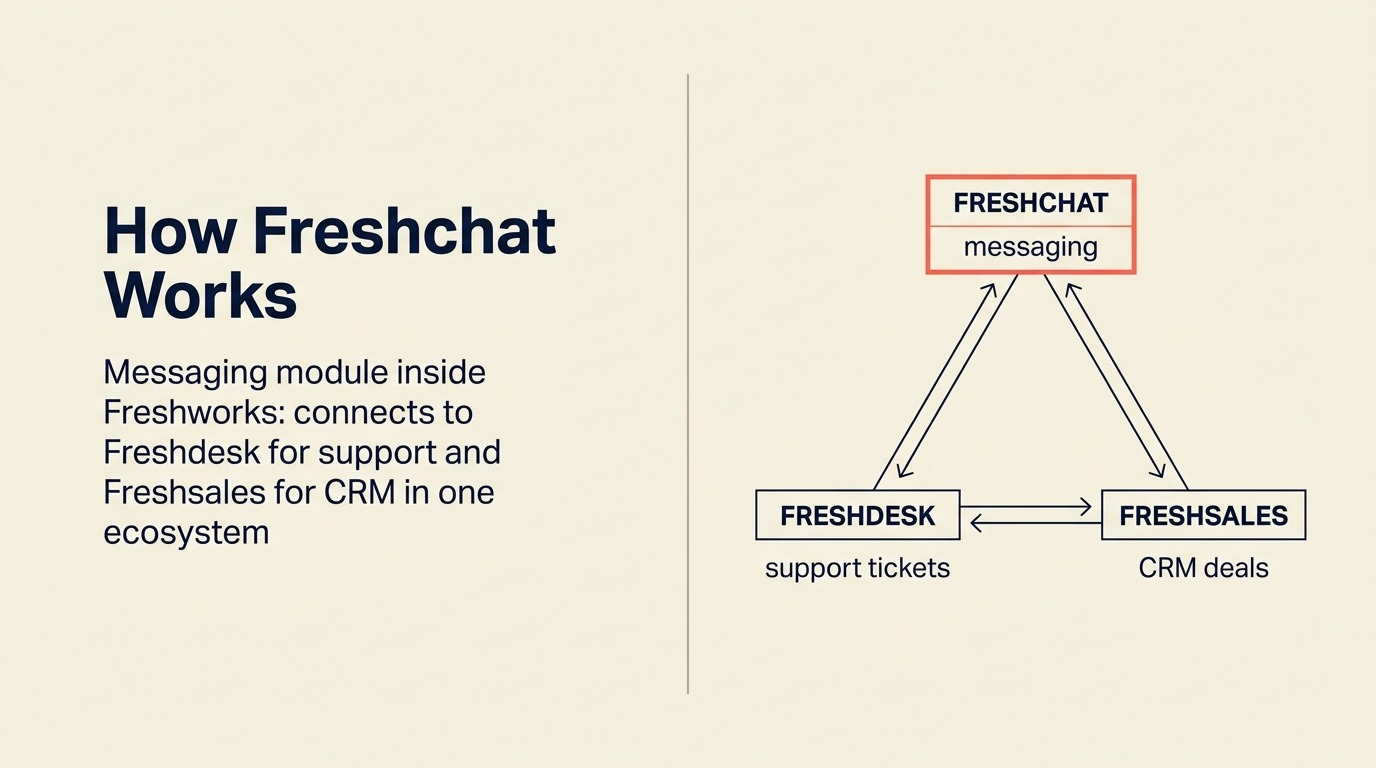
Methodology: Freshworks' platform strategy: build a suite of business software where each product works independently but works better together. Freshchat is designed to make Freshdesk and Freshsales more complete.
Target audience: SMBs and mid-market companies already in the Freshworks ecosystem, or companies evaluating the full Freshworks suite. Typical buyer is an IT manager or Head of Support.
Sizing fit: Growth through mid-market (20-500 employees). Freshworks pricing is relatively accessible compared to Intercom or Salesforce.
Stage fit: Any stage, but the value proposition increases significantly if you're committed to the Freshworks ecosystem.
Team vs company-wide: Support team first, with sales messaging features when connected to Freshsales.
| What you get | What you don't |
|---|---|
| Tight integration with Freshdesk and Freshsales | Deep WhatsApp/Instagram DM native support |
| Affordable pricing with a free plan | Best-in-class chat automation outside the Freshworks suite |
| AI chatbot (Freddy) for basic query resolution | Competitive lead routing features vs. specialists |
Pricing: Free plan up to 10 agents. Growth plan at $19/agent/month. Pro at $49/agent/month adds automation rules and team routing.
Best for: Teams already in the Freshworks stack who want messaging that connects naturally to their existing Freshdesk tickets and Freshsales pipeline.
7. WATI: WhatsApp Business API Platform for SMBs
WATI is purpose-built for WhatsApp. If WhatsApp is your primary customer communication channel and you need a clean, affordable tool to manage it at scale without enterprise complexity, WATI is worth evaluating. For context on how WhatsApp fits into a broader B2B sales motion, WhatsApp in B2B sales covers the strategy side well.
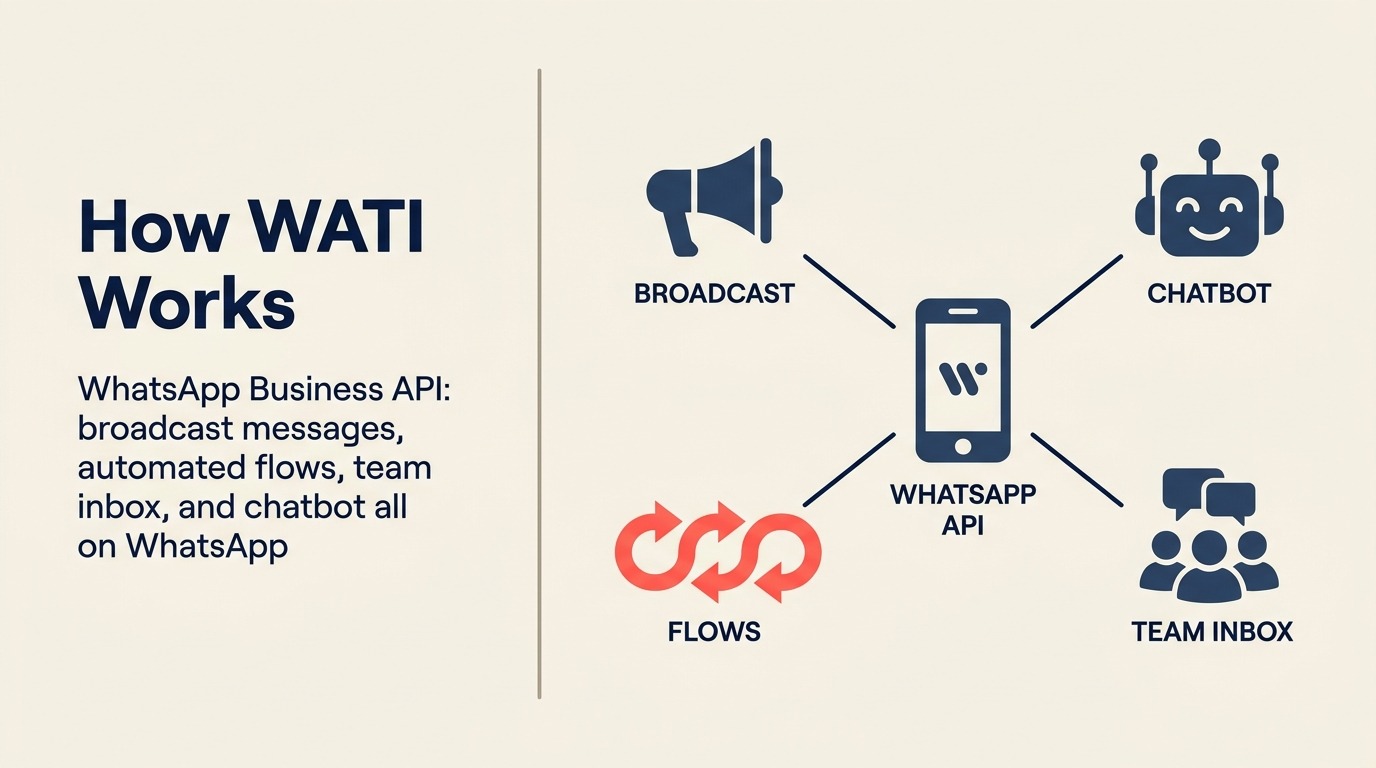
Methodology: WhatsApp-first. WATI's product thesis is that WhatsApp is the dominant messaging channel in emerging markets and that SMBs deserve a purpose-built tool rather than an enterprise platform with WhatsApp bolted on.
Target audience: SMBs in South Asia, Southeast Asia, the Middle East, Africa, and Latin America where WhatsApp is the primary business communication channel. Typical buyer is a business owner, sales manager, or small customer support team.
Sizing fit: Startup through growth stage (1-100 employees). Teams at mid-market scale with serious multi-channel needs will outgrow it quickly.
Stage fit: Best for companies at PMF stage scaling their first professional WhatsApp setup. It handles the WhatsApp Business API complexity so you don't have to manage it yourself.
Team vs company-wide: Sales and support team tool for WhatsApp-heavy communication patterns.
| What you get | What you don't |
|---|---|
| Simple, affordable WhatsApp Business API management | Any meaningful presence outside WhatsApp |
| Broadcast campaigns and template management | CRM depth or pipeline forecasting |
| Basic chatbot builder for WhatsApp | Multi-channel inbox (no email, Messenger, Instagram) |
| Per-team member pricing that scales predictably | Advanced automation or workflow tools |
Pricing: Growth plan at $49/month for 5 team members. Pro at $99/month for 10 members. Additional members are extra. WhatsApp conversation costs (Meta's fees) are billed separately. See WATI's pricing page for current details.
Best for: WhatsApp-first SMBs in emerging markets that need a clean, affordable way to manage WhatsApp Business at scale.
8. Trengo: Multi-Channel Team Inbox for European SMBs
Trengo sits between a basic shared inbox and a conversational CRM. It covers WhatsApp Business, Messenger, Instagram, email, live chat, and voice in a single team inbox. The UI is clean. The pricing is transparent. It's designed for European SMBs who want better than a basic helpdesk without paying enterprise prices.
Methodology: Team inbox first. Trengo believes that the right starting point for most SMBs is a unified team inbox where all channels land together, with automation layered on top.
Target audience: European SMBs in retail, logistics, hospitality, and professional services. Typically 10-200 employees. Buyer is a customer support lead, operations manager, or small business owner.
Sizing fit: Growth through mid-market (10-200 employees). It gets outgrown by teams that need deep CRM capabilities or advanced pipeline management.
Stage fit: Growth stage companies that have outgrown individual email inboxes but don't yet need a full CRM.
Team vs company-wide: Support and sales team tool.
| What you get | What you don't |
|---|---|
| Clean multi-channel inbox with good WhatsApp support | Deep CRM or pipeline management |
| Team routing and assignment rules | Advanced lead scoring or distribution logic |
| Fair, transparent pricing | Automation builder depth |
| GDPR-friendly with EU data residency options | Native AI chatbot capabilities |
Pricing: Boost EUR 349/month with 10 users and 500 conversations included, Pro EUR 599/month with 20 users and 1,500 conversations, Enterprise custom. Annual billing brings those to roughly EUR 299 and EUR 499/month. Extra users run EUR 30 to EUR 50 each depending on tier, and extra conversations EUR 18 per 100. Trengo sells flat plans with users bundled in, not a per-agent rate, so compare it against per-seat tools on total cost at your team size rather than headline price.
Best for: European SMBs wanting a clean multi-channel team inbox with fair pricing and without the overhead of an enterprise platform.
Sizing and Persona Table
| Tool | Company Size | Primary Buyer | Team Focus | Geography Strength |
|---|---|---|---|---|
| Rework | 20-500 employees | Head of Sales, RevOps, Head of Ops | Sales + CS + Marketing + Ops | Global, strongest in Southeast Asia |
| ManyChat | 1-50 employees | Marketing manager, business owner | Marketing | Global (Meta markets) |
| Tidio | 1-50 employees | Business owner, support manager | Support | E-commerce globally |
| Crisp | 1-50 employees | Founder, support lead | Support + Sales (light) | Global, dev-friendly |
| Intercom | 50-500 employees | Head of Support, VP CS | Support + CS | Global (SaaS) |
| Freshchat | 20-500 employees | IT manager, Head of Support | Support + Sales (in Freshworks) | Global |
| WATI | 1-100 employees | Business owner, sales manager | Sales + Support | APAC, MENA, LATAM |
| Trengo | 10-200 employees | Customer support lead, Ops manager | Support + Sales | Europe |
| Sleekflow | 10-200 employees | E-commerce manager, marketing lead | Marketing + Sales | Southeast Asia |
| Bird | 200+ employees | Head of Engineering, CTO, IT Director | Engineering + Marketing + Ops | Global enterprise |
9. Sleekflow: Social Commerce Messaging for Southeast Asia
Sleekflow targets e-commerce and retail businesses where social commerce is central to the buying journey. Its product is built around WhatsApp, Instagram, and Facebook Messenger with commerce features like product catalogs and payment link sharing baked into the conversation flow.
Methodology: Social commerce first. Sleekflow's thesis is that in Southeast Asian markets, the customer journey from discovery to purchase happens inside messaging apps, and businesses need a tool that closes the loop between chat and transaction.
Target audience: E-commerce brands, retail businesses, and direct-to-consumer brands in Southeast Asia, particularly in Singapore, Hong Kong, Malaysia, and the Philippines. Typical buyer is an e-commerce manager or marketing director.
Sizing fit: Growth stage (10-200 employees). The social commerce focus limits its appeal for B2B companies or businesses where social channels aren't central to the sales process.
Stage fit: Growth stage companies building out their social commerce capabilities. Less relevant for teams whose customer acquisition doesn't run through Instagram and WhatsApp.
Team vs company-wide: Marketing and sales team tool.
| What you get | What you don't |
|---|---|
| Commerce features built into chat (catalogs, payment links) | Mature enterprise feature set |
| Strong Instagram and WhatsApp integration | Meaningful presence outside Southeast Asia |
| Team inbox with assignment and routing | Deep CRM or pipeline forecasting |
| Broadcast and campaign tools | Competitive pricing vs. simpler alternatives |
Pricing: Starter at $79/month. Growth at $299/month. Enterprise pricing available on request.
Best for: Southeast Asian e-commerce and retail brands that close sales through WhatsApp and Instagram, and need commerce features inside the conversation.
10. Bird (Formerly MessageBird): Programmable Omnichannel for Enterprise
Bird is an API-first communications platform. It handles SMS, WhatsApp, email, voice, and push notifications at massive scale. Global enterprises and developer-heavy companies use it when they need programmable, high-volume communications infrastructure that they control.
Methodology: Infrastructure first. Bird's philosophy is that enterprise communication needs are too complex and varied for a plug-and-play tool. The product is designed to be configured by developers and integrated into existing systems.
Target audience: Enterprises and high-growth companies with engineering resources to build and maintain custom communication workflows. Typical buyer is a Head of Engineering, CTO, or IT director, often alongside a marketing or growth team sponsor.
Sizing fit: Mid-market to enterprise (200+ employees). The API-first model requires developer resources that most SMBs don't have.
Stage fit: Growth stage through mature enterprise. Bird is overkill for a team that just wants a shared inbox, but it's the right choice when you need programmable communications at scale.
Team vs company-wide: Primarily engineering and product team led, with marketing and ops as stakeholders.
| What you get | What you don't |
|---|---|
| Programmable SMS, WhatsApp, email, voice, and push at scale | A plug-and-play product for non-technical teams |
| Global carrier relationships and high deliverability | Built-in CRM or pipeline management |
| Flexible pay-per-use pricing model | Simple onboarding or a UI-first experience |
| Enterprise SLAs and compliance tools | Quick time-to-value without engineering investment |
Pricing: Pay-per-use model with channel-specific rates. Enterprise plans with committed volumes available on request. Costs depend heavily on message volume and channel mix.
Best for: Enterprises and developer-first companies that need programmable, high-volume omnichannel communications infrastructure with engineering resources to manage it.
How to Choose: Decision Framework
Use this table after you have ruled out tools that do not match your primary channel or operating model.
| If your priority is... | Pick this |
|---|---|
| CRM + multi-channel inbox in one product, no tool-stitching | Rework |
| Automating Meta/WhatsApp flows for e-commerce marketing | ManyChat |
| Reducing support ticket volume with AI at a low cost | Tidio |
| A clean, affordable shared inbox for a small startup | Crisp |
| Complex AI support with deep product context for SaaS | Intercom |
| Staying inside your existing Freshworks stack | Freshchat |
| WhatsApp-only at an SMB budget in emerging markets | WATI |
| Multi-channel team inbox for a European SMB | Trengo |
| Social commerce through Instagram/WhatsApp in Southeast Asia | Sleekflow |
| Programmable omnichannel at enterprise scale with dev resources | Bird |
When Respond.io Is Still the Right Call
Not every team should leave Respond.io. It's worth keeping if your use case is specifically WhatsApp Business API at mid-market scale with complex automation logic and you have the internal resources to configure and maintain it. The automation builder is legitimately powerful, and if your team has already built workflows on top of it, the migration cost is real.
Respond.io is also a reasonable choice for teams in Southeast Asia and the Middle East where WhatsApp is the primary channel and the platform's regional support infrastructure is an advantage.
But if you're paying for features you haven't configured, if the learning curve is blocking adoption, or if you're running a CRM alongside it and wondering why both tools don't talk to each other cleanly, those are signs you're paying for more than you're getting.
What to Do Next
Pick your top two options from the decision framework above and run a two-week pilot with the team that will actually use the tool daily. Don't evaluate on feature lists. Evaluate on how quickly new agents can handle a live conversation without training, and whether the data from those conversations shows up where your sales or support managers need it.
For most mid-size teams reading this, the honest shortlist is Rework if you need CRM depth, ManyChat if your acquisition is Meta-heavy, or Trengo/Crisp if you want a clean inbox without the full platform commitment. Teams that also need to automate lead handoffs from chat to pipeline should review how form-to-CRM automation works to understand where the messaging layer ends and lead management begins. And if you're wrestling with how to route incoming chats to the right rep, lead routing for chat covers the logic in practical detail.
According to G2's customer messaging platforms category, Respond.io scores well on channel coverage but consistently gets lower marks on ease of setup and value for money relative to alternatives, which tracks with what teams tell us when they're switching.

Senior Implementation Consultant
On this page
- Quick Comparison Table
- 1. Rework: Unified CRM + Multi-Channel Inbox for Mid-Size Teams
- 2. ManyChat: Chat Automation for Meta Channels and WhatsApp
- Stage Fit Matrix
- 3. Tidio: AI Chatbot Lyro Plus Live Chat for Small E-Commerce
- 4. Crisp: Affordable Chat Plus CRM-Lite for Startups
- 5. Intercom: Conversational Platform Plus Fin AI for Product-Led Companies
- 6. Freshchat: Freshworks Messaging for Existing Freshworks Customers
- 7. WATI: WhatsApp Business API Platform for SMBs
- 8. Trengo: Multi-Channel Team Inbox for European SMBs
- Sizing and Persona Table
- 9. Sleekflow: Social Commerce Messaging for Southeast Asia
- 10. Bird (Formerly MessageBird): Programmable Omnichannel for Enterprise
- How to Choose: Decision Framework
- When Respond.io Is Still the Right Call
- What to Do Next