Appian vs Pega: Which Enterprise BPM Platform Fits Your Team in 2026?
Turn this article into takeaways for your work.


Each assistant summarizes the article only for you and suggests best practices for your work.
Gartner named both Appian and Pega Leaders in its inaugural Magic Quadrant for Business Orchestration and Automation Technologies. Neither vendor publishes a dollar figure anywhere on its own site. Both facts shape everything below.
Most "Appian vs Pega" guides open with a feature checklist, then quietly skip the part where you try to find out what either platform actually costs. That part matters more than the checklist. Appian names three editions, Standard, Advanced and Premium, and tells you they're "priced per user, per month, per app" without ever printing a number. Pega doesn't even go that far: no tiers, no per-user figure, no starting range, just a form that routes you into a quote conversation.
That's not a footnote here, it's the frame. You're reading this because your organization is past the point where a lightweight workflow tool covers what you need, and you're now choosing between two platforms built for genuinely complex, high-stakes process work: multi-stage approvals, regulated decisioning, case types that don't follow a single script, and integration into systems that have been running for twenty years. Both Appian and Pega were named Leaders in Gartner's inaugural Magic Quadrant for Business Orchestration and Automation Technologies (BOAT), published in October 2025, so this isn't a Leader-versus-challenger comparison. It's two Leaders with genuinely different centers of gravity, and the choice between them turns on what kind of work you're actually orchestrating. For the wider field this comparison sits inside, see our roundup of business process management software.
TL;DR
| Appian | Pega | |
|---|---|---|
| What it is | Enterprise process orchestration platform built around a virtual data layer, low-code app building and process mining | Enterprise case management and real-time decisioning platform built around a rules engine and Customer Decision Hub |
| How you buy it | Standard, Advanced and Premium editions, each "priced per user, per month, per app", no dollar figure published | No named tiers and no dollar figures at all; production licensing is a custom quote |
| Cheapest way to try it | Community Edition, free, but personal development only, explicitly not production | Free Platform Trial |
| Core building block | Process models and Records orchestrating structured and case-based work, layered on Data Fabric | Cases moving through stages, governed by a class-hierarchy rules engine |
| Named decisioning product | Business rules inside the process layer; no separate branded decisioning product | Customer Decision Hub, a dedicated real-time next-best-action engine with its own audit tooling |
| Native AI in 2026 | AI Process HQ, MCP-based agent interoperability, a Snowflake Cortex partnership, spec-driven AI development | GenAI Blueprint, Knowledge Buddy, Autopilot and Coach, agentic AI inside Customer Decision Hub |
| 2025 Gartner BOAT recognition | Leader | Leader |
| Best for | Teams unifying many process and case types, plus legacy data, under one governed platform | Teams where real-time, explainable, regulated decisioning is the actual product being bought |
Key Facts
- Gartner published its first Magic Quadrant for Business Orchestration and Automation Technologies (BOAT) in October 2025, naming both Appian and Pega Leaders, according to Appian's press release and Pega's own announcement via Business Wire.
- Forrester named Pega a Leader in The Forrester Wave: AI Decisioning Platforms, Q2 2025, giving it the highest possible score in the strategy category, including vision, innovation, roadmap and partner ecosystem, according to Pega's Forrester report page.
- The global low-code development technology market is forecast to reach $44.5 billion by 2026, growing 19% over four years, according to Gartner's forecast as reported by InfoWorld.
- Appian carries a 4.2 out of 5 rating from 77 reviews on Capterra, while Pega Platform carries a 4.4 out of 5 rating from 17 reviews, as of a live check in September 2026 against Appian's Capterra page and Pega Platform's Capterra page.
- Both vendors' government clouds hold FedRAMP High authorization: Appian Government Cloud on the FedRAMP Marketplace, and Pega's government offering on the FedRAMP Marketplace.
Who Each Tool Is Really For
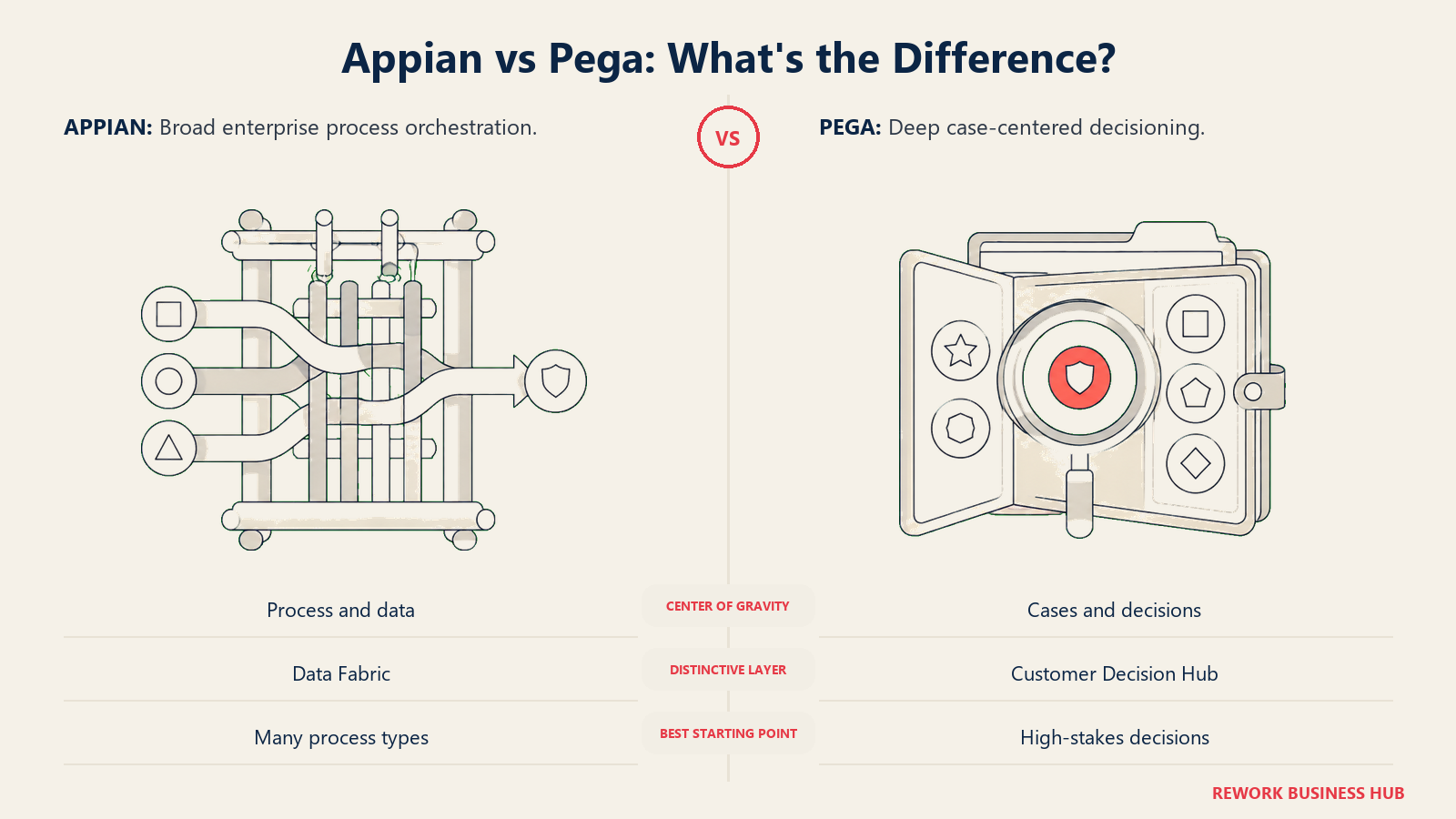
Appian grew up as a general-purpose enterprise process orchestration platform. Its pitch is breadth: one governed system for building low-code apps, running structured and unstructured case work, mining existing processes to find what to automate next, and unifying data from legacy systems without physically moving it. The buyer is typically an enterprise architecture or digital transformation leader trying to consolidate several point tools, and several process types, under one platform with one security model.
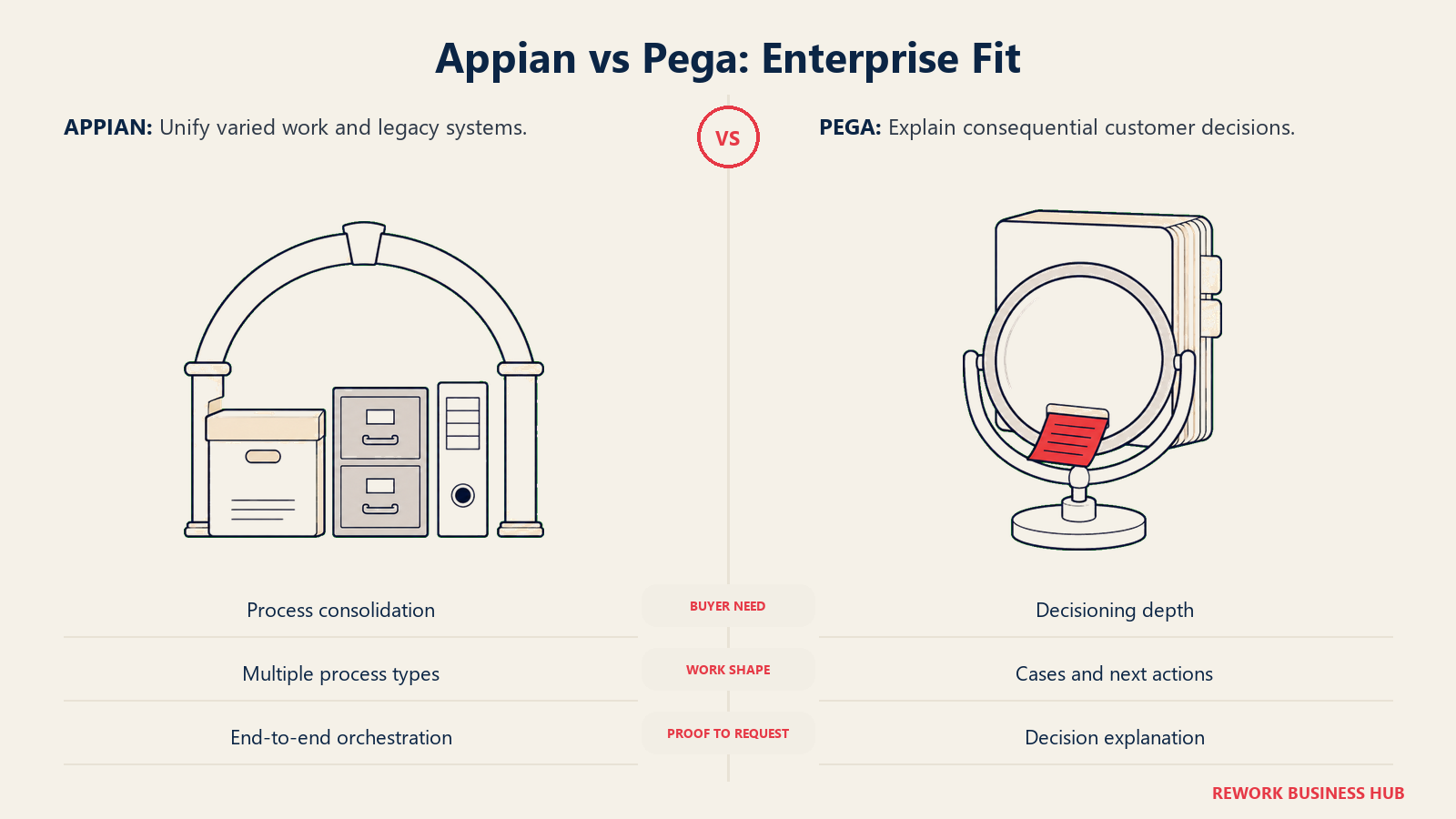
Pega grew up inside insurance and financial services claims and underwriting, and it still shows. Its center of gravity is a single, deep capability: real-time decisioning that tells you the next best action for a specific customer, claim or application, with a full audit trail behind every decision. Case management sits around that decisioning core rather than the other way around. The buyer is usually someone whose actual product is the decision itself, a loan approval, a claims triage call, a next-best-offer, and who needs that decision to be explainable to a regulator after the fact.
| Dimension | Appian | Pega |
|---|---|---|
| Primary use case | Broad process orchestration, low-code app building and legacy data unification across many process types | Real-time, explainable decisioning plus case management for complex, regulated workflows |
| Who typically buys it | Enterprise architects and digital transformation leaders consolidating multiple systems | Heads of decisioning, claims, underwriting or customer engagement in regulated industries |
| Evaluation path | Sales-led; no published price at any tier, editions named but unquoted | Sales-led; no tiers or figures published at all, custom quote from a Platform Trial |
| Where it lives in the org | Positioned as an enterprise-wide orchestration and integration layer | Positioned as the decisioning and case-management core for a specific line of business |
| Ideal team maturity | Organizations ready to run a federated development model across several business units | Organizations that can staff and retain certified System Architects for ongoing rule maintenance |
| Industry fit | Appian | Pega |
|---|---|---|
| Banking, mid-size and digital-first | Strong: named use case for speed-to-market process automation | Good, though heavier to stand up than Appian for a first process |
| Complex retail loan origination and risk decisioning | Moderate: rules exist, but no dedicated decisioning brand | Strong: named strength, with claims and underwriting DNA behind it |
| Insurance claims and healthcare payer decisioning | Moderate | Strong: Customer Decision Hub and Agent Tracer are purpose-built for this |
| Government and public sector | Strong: FedRAMP High and DoD IL5-authorized Government Cloud | Strong: FedRAMP Moderate government cloud, FedRAMP High ATO attained |
| Legacy system modernization and ERP process orchestration | Strong: named strength, including a 2026 Snowflake and SAP-adjacent partnership push | Moderate: less publicly emphasized than Appian's data-unification story |
If what you actually need is a diagram of a process rather than a system that runs it, that's a different comparison entirely, see Lucidchart vs Visio for that question. And if your process is genuinely lighter than what either enterprise suite assumes, our Kissflow vs Pipefy comparison covers departmental-scale platforms built for a smaller team.
Case Management and Decisioning Depth
This is the section that actually separates these two platforms, more than pricing or AI marketing does.
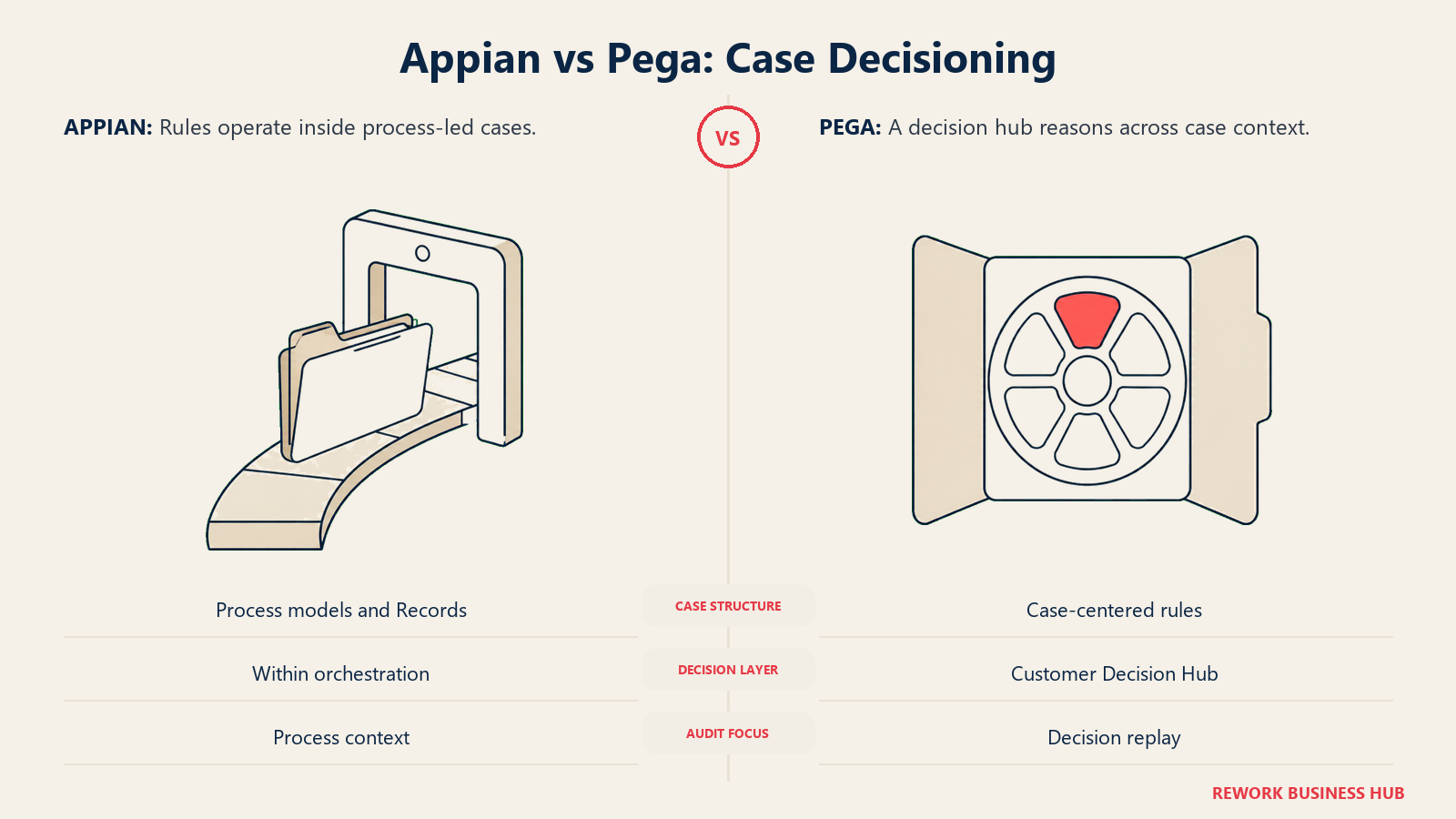
Appian's case management runs through process models and Records: a case is a process instance, tracked and orchestrated the same way a structured workflow is, with the flexibility to branch into ad hoc steps when the work doesn't follow a fixed sequence. Business rules live inside that process layer as a component, not as a standalone product. Appian's own materials talk about process orchestration, robotic process automation and enterprise AI as a connected set, but there's no equivalent to a dedicated, separately branded decisioning engine.
Pega inverts that structure. Customer Decision Hub is a standalone, centralized decisioning layer: it evaluates customer data, predictive and adaptive models, eligibility rules and business priorities in real time, at every touchpoint, and returns a next-best-action in milliseconds. Every proposal, gate decision and rule-set version is correlated to the case, stage and step through Agent Tracer, which supports full replay, root-cause analysis and compliance audits, a feature built specifically for teams that need to explain a decision after the fact.
| Capability | Appian | Pega |
|---|---|---|
| Case orchestration model | Process models and Records, structured and ad hoc work in one construct | Cases moving through stages, governed by class-hierarchy rules |
| Dedicated decisioning product | No, rules are a component inside the process layer | Yes, Customer Decision Hub, a standalone real-time decisioning brain |
| Real-time next-best-action | Not a named, separately branded capability | Core capability: predictive and adaptive models plus engagement policies |
| Decision-level audit trail | Governed by general platform security and compliance tooling | Agent Tracer: correlates every proposal, gate decision and rule version for replay and audit |
| Where the decisioning depth was built | General enterprise process automation | Insurance claims and financial services underwriting, still the platform's center of gravity |
Process Modeling and Low-Code App Building
Appian's builder is Appian Designer, and applications are assembled from process models, interfaces and data objects, expressed through Appian's proprietary SAIL language (Self-Assembling Interface Layer). SAIL powers everything the end user sees, and Appian supports federated development so multiple teams can build against the same governed platform without stepping on each other. The tradeoff: apps built this way have no native way to export as portable code, so moving off the platform generally means rebuilding rather than migrating.
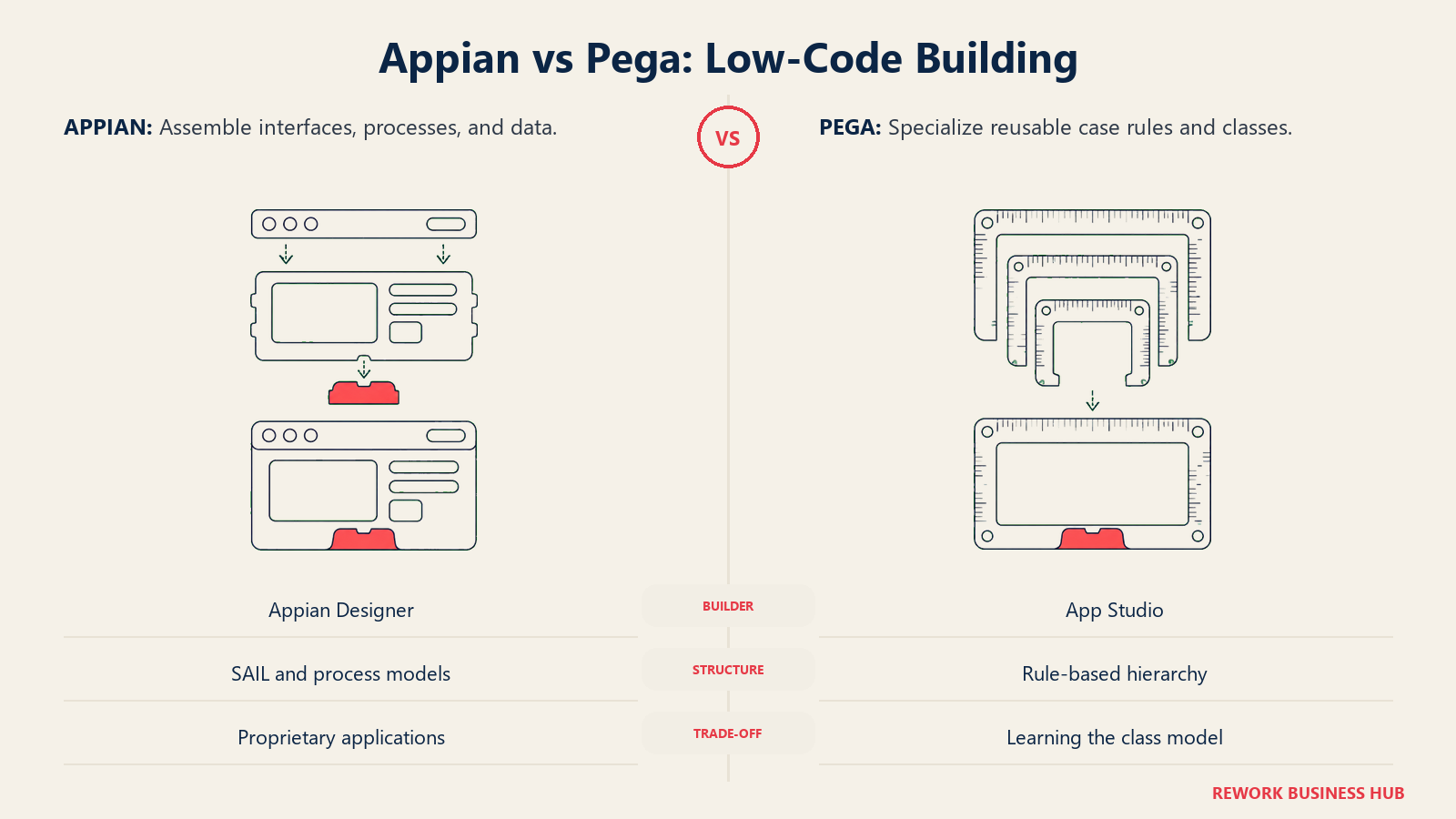
Pega's builder is App Studio, and the underlying architecture is a rule-based class hierarchy: a case type inherits and specializes rules from parent classes, which is powerful for reuse but adds real conceptual overhead for a new developer. Pega Express is the vendor's guided, design-thinking delivery methodology built into App Studio, aimed at getting a first Minimum Lovable Product live in as little as 60 to 90 days rather than a traditional multi-quarter BPM rollout.
| Capability | Appian | Pega |
|---|---|---|
| Primary builder | Appian Designer | App Studio |
| Expression/interface language | SAIL, Appian's proprietary language | Rule-based class hierarchy, native to Pega Platform |
| Guided fast-start methodology | Federated development across teams | Pega Express, targeting a first release in 60 to 90 days |
| Learning curve reported by users | Rated easier to learn in Capterra reviews, "super nice and easy" deployment | Reviewers describe documentation as overwhelming for developers new to the platform |
| Code portability if you leave | None: no native export to a Git repository or portable code | Limited: rules can migrate across Pega deployments, but only within the same major platform version |
If what your team actually needs is document-centric workflow and eSignature rather than full enterprise case orchestration, that's a lighter category. See our Nintex alternatives guide for that narrower question.
AI and Agentic Capability in 2026
Neither vendor is behind here, and both spent 2026 turning AI from a bolt-on into something structural to the platform.
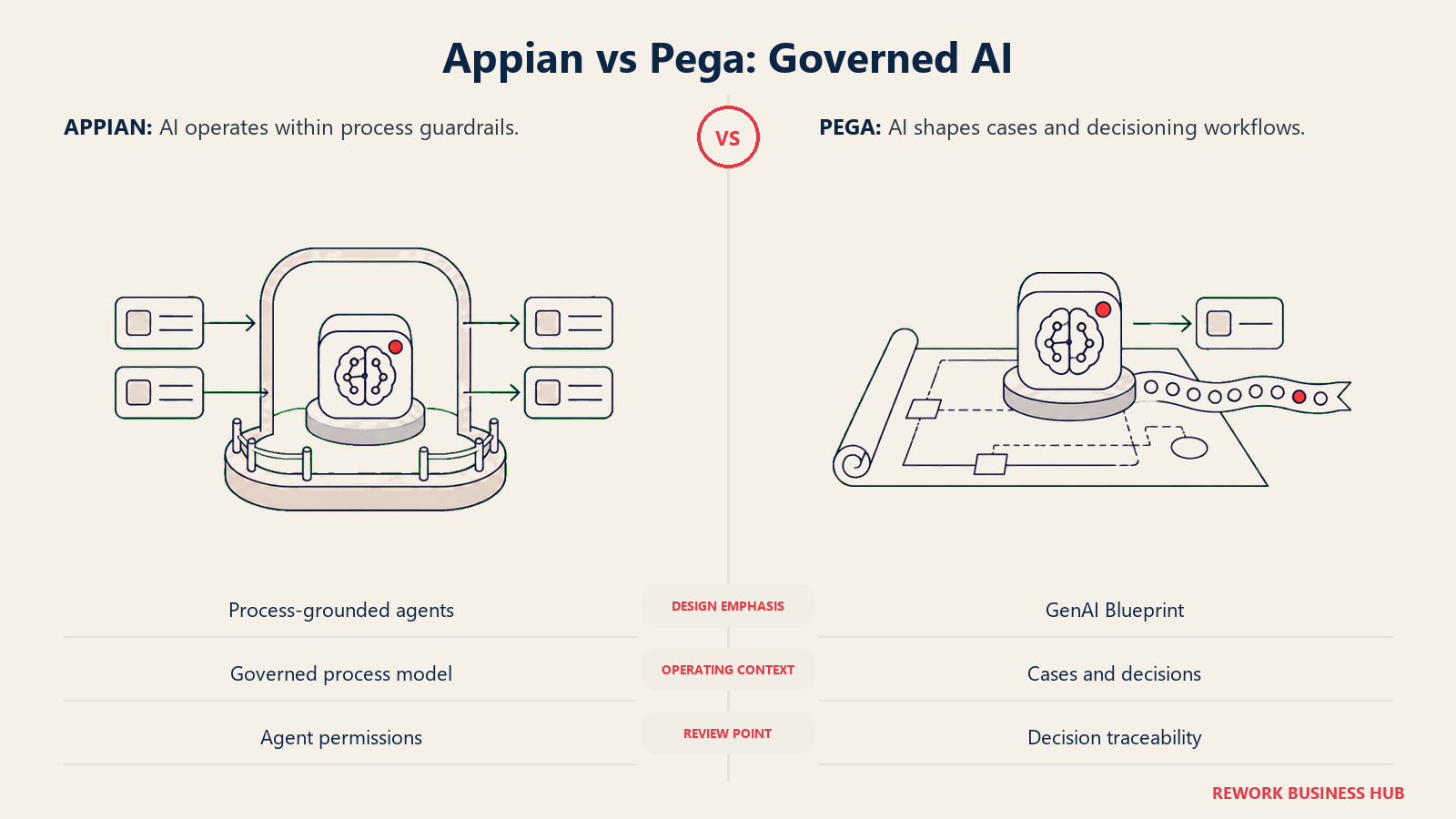
Appian's approach anchors AI inside the process itself. Process HQ combines process insights with data fabric insights, and an AI Copilot lets a user chat with the platform to build dashboards, surface KPIs and get suggested process improvements. In April 2026, Appian announced AI-assisted, spec-driven development and adopted the Model Context Protocol (MCP) so agents can interface securely with external enterprise systems, alongside a new technology partnership with Snowflake that lets Appian agents call Snowflake Cortex AI to make data-backed decisions inside a governed process. Appian's own framing is that anchoring AI within a process model gives it the structure and guardrails a freestanding agent lacks.
Pega's AI centers on GenAI Blueprint, which generates a working case design and decisioning workflow, and can build AI agents, from a natural-language prompt before a developer opens a traditional builder. Knowledge Buddy, Autopilot and Coach round out the GenAI layer (all three are weighted topics on Pega's own System Architect certification exam), and agentic AI is built into Customer Decision Hub itself, so the decisioning engine can act, not just recommend. Pega also combines its GenAI Blueprint with Process and Task Mining, aiming explicitly at what the vendor calls a path to autonomous automation.
| AI capability | Appian | Pega |
|---|---|---|
| Where AI is anchored | Inside the process model, via Process HQ and AI Copilot | Inside case design and decisioning, via GenAI Blueprint and Customer Decision Hub |
| Natural-language app or case generation | AI-assisted, spec-driven development (announced April 2026) | GenAI Blueprint: generates a full case-and-decisioning design from a prompt |
| Agent interoperability standard | Adopted MCP for secure agent-to-system connections | Not the headline framing; agentic AI is embedded inside Customer Decision Hub instead |
| External AI data partnership | Snowflake Cortex AI, announced April 2026 | Not a named equivalent partnership in current materials |
| Named AI assistants | AI Copilot | Knowledge Buddy, Autopilot, Coach |
| Process/task mining plus AI | Process HQ: process insights and data fabric insights together | Process and Task Mining combined with GenAI Blueprint for automation prioritization |
Data Layer and Integration
Appian markets Data Fabric as one of the platform's four named pillars, alongside process mining, process automation and what it calls total experience. It's a virtual data layer: it connects to data across disparate systems without physically moving or duplicating it, giving low-code developers a unified, 360-degree view they can build against directly. That's a genuinely distinct architectural bet, and it's the reason Appian leans so hard into legacy modernization and ERP orchestration use cases.
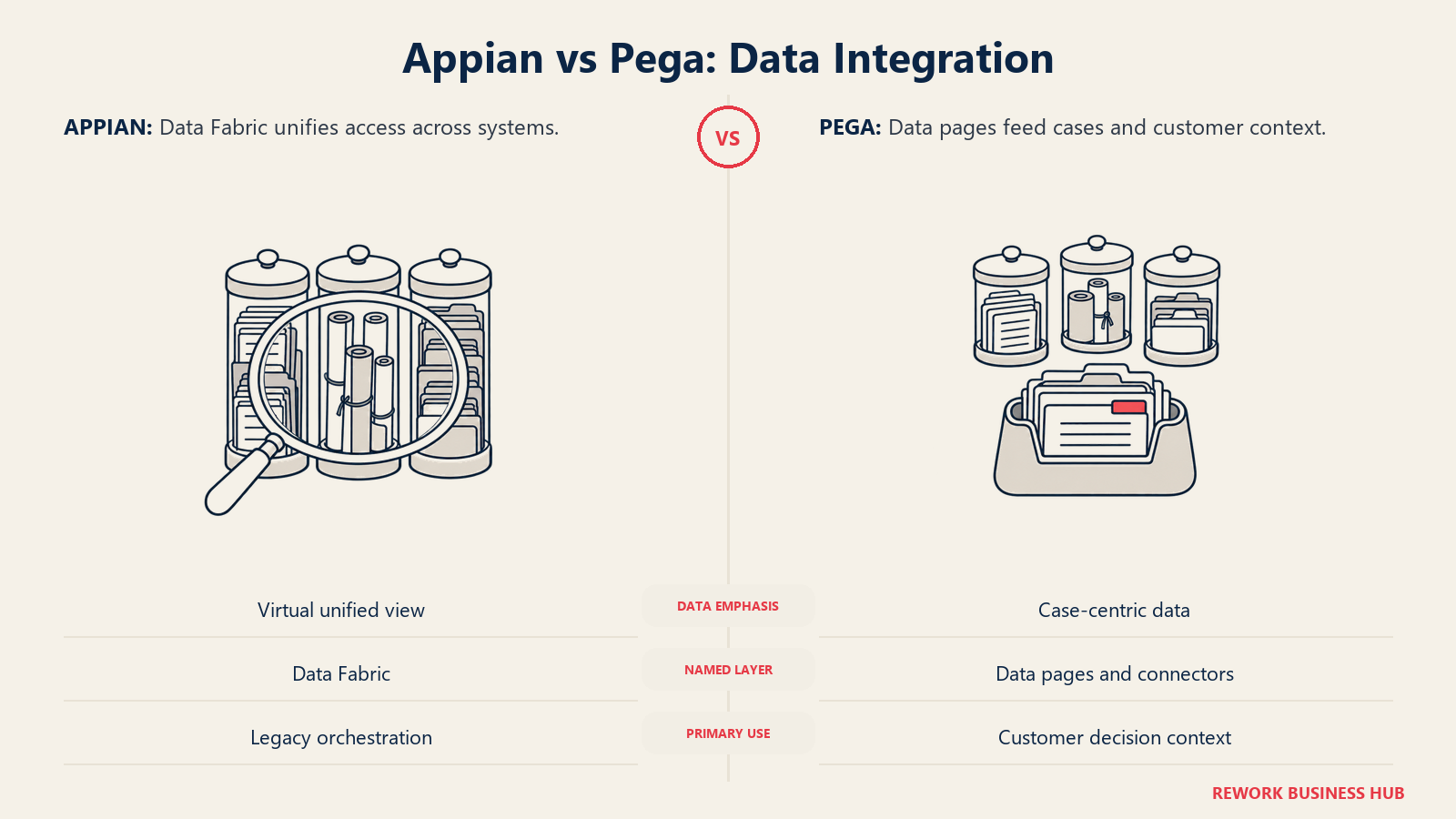
Pega doesn't market an equivalent standalone virtual data layer. Its data model is case-centric: data pages and connectors feed both the case itself and the Customer Profile that Customer Decision Hub reasons over, and integration depth is generally scoped project by project rather than sold as a distinct platform pillar the way Data Fabric is. That doesn't mean Pega integrates poorly, its decisioning depth depends on getting customer data right, but the marketing and architecture emphasis sits somewhere different than Appian's.
| Capability | Appian | Pega |
|---|---|---|
| Named virtual data layer | Yes, Data Fabric, one of four core platform pillars | No directly equivalent named product |
| How data reaches the process | Low-code discovery, unification and optimization across sources, without moving data | Data pages and connectors feeding case data and the Customer Profile |
| Where integration depth is emphasized | Legacy modernization, ERP orchestration, enterprise-wide data unification | Customer data quality feeding real-time decisioning accuracy |
| 2026 integration news | Snowflake Cortex AI partnership, MCP adoption for agent-to-system calls | Not a comparable named 2026 data-partnership announcement in current materials |
A team that has outgrown a database-first, app-building tool and wants a full BPM layer instead is really asking a related but different question. Our Quickbase alternatives guide covers that adjacent, database-first category.
Deployment and Cloud Options
Both platforms support the deployment flexibility a regulated enterprise buyer expects, but the mechanics differ.
Appian deploys in the cloud, on-premises, or hybrid, on AWS or Azure infrastructure, and offers Appian Government Cloud (AGC), a dedicated private-cloud environment on AWS GovCloud (US-West). AGC holds FedRAMP High authorization for hosting sensitive civilian government data and has a renewed DoD Impact Level 5 (IL5) Provisional Authority to Operate, authorizing it to host Controlled Unclassified Information.
Pega offers three deployment paths: Pega Cloud, a fully managed service; Client-Managed Cloud, where the client deploys Pega Docker images into its own AWS, Azure or GCP environment with Pega providing platform support only; and Pega Cloud for Government, which supports FedRAMP Low and Moderate as well as DoD Impact Level 2, with Pega separately having attained FedRAMP High Authority to Operate status.
| Deployment factor | Appian | Pega |
|---|---|---|
| Cloud-hosted option | Appian Cloud, on AWS or Azure | Pega Cloud, fully managed |
| Self-managed / client-owned infrastructure | Supported, on-premises or hybrid | Client-Managed Cloud: client's own AWS, Azure or GCP via Pega-provided Docker images |
| Dedicated government cloud | Appian Government Cloud, AWS GovCloud (US-West) | Pega Cloud for Government |
| Highest government authorization held | FedRAMP High, plus DoD IL5 (Controlled Unclassified Information) | FedRAMP High ATO attained; Government Cloud itself scoped to FedRAMP Moderate / IL2 |
| Where responsibility sits in the self-managed model | Client owns infrastructure, Appian licenses the platform | Client owns everything except platform support in Client-Managed Cloud |
Governance, Audit and Regulated Industries
Both vendors treat compliance as table stakes rather than a differentiator, but the shape of what they emphasize is different. Appian's public materials describe broad investment in security and compliance, data privacy and regulatory governance across the platform, without singling out decisioning explainability as a distinct capability. Pega's governance story is more pointed: because Customer Decision Hub makes a live decision about a real customer, the platform builds explainability in at the decision level. Agent Tracer correlates every proposal, gate decision and action back to a specific case, stage, step and rule-set version, which is precisely the artifact a compliance or audit team needs when a regulator asks why a specific loan was denied or a specific claim was flagged.
That distinction matters more than a certification checklist, though the checklists themselves are both credible. Neither vendor's list should substitute for your own compliance team's direct review before signing.
| Governance area | Appian | Pega |
|---|---|---|
| General security and compliance investment | Broad platform-wide commitment described in public materials | Broad platform-wide commitment, same tier of maturity |
| Decision-level audit and replay | Not a separately named capability | Agent Tracer: full replay, root-cause analysis and compliance audit down to rule-set version |
| Government cloud authorization | FedRAMP High, DoD IL5 | FedRAMP High ATO attained, Government Cloud scoped to Moderate / IL2 |
| Where each is strongest for a regulator conversation | Data provenance and legacy-system lineage, via Data Fabric | Explaining a specific automated decision after the fact |
Developer Experience and Skills Market
Both platforms are proprietary, and both require certified talent to run at real scale, which is worth pricing into your evaluation the same way you'd price the software itself.
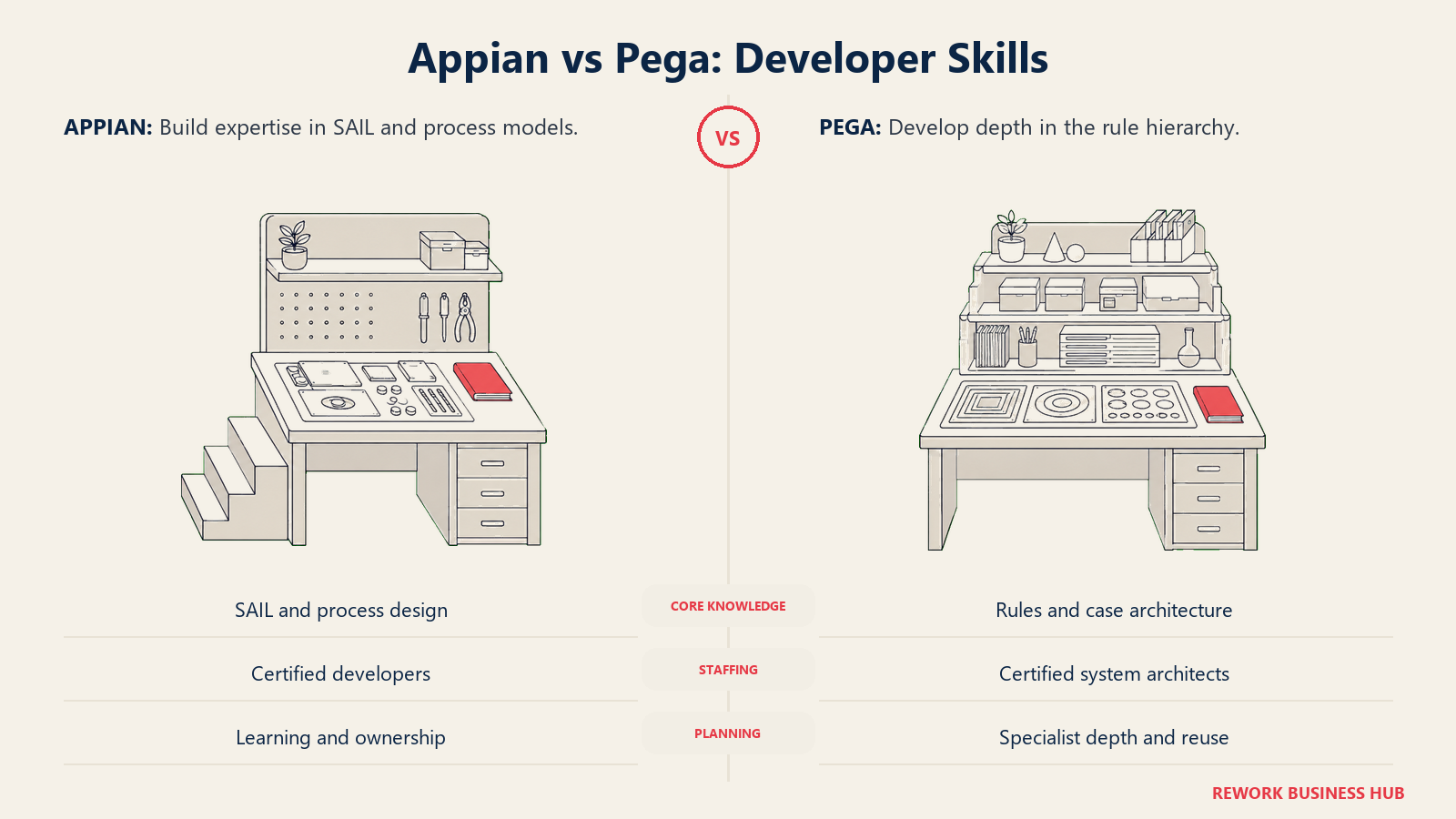
Appian's SAIL language and process-model builder get rated as approachable by existing users: Capterra reviewers describe the platform as easy to learn with a "super nice and easy" deployment suite, and an Appian Certified Developer commands an average salary in the $118,000 to $126,000 range in the United States, with senior, certified specialists reaching $140,000 to $165,000-plus.
Pega's rule-based class hierarchy has a steeper reputation. Capterra reviewers note the documentation "can be improved for developers new to the platform since it is very overwhelming." That depth is reflected in the certification ladder and pay: a Pega Certified System Architect (CSA) is the entry credential, Certified Senior System Architect (CSSA) professionals average around $132,563 at Pegasystems itself according to Payscale, and Certified Lead System Architects (CLSA), the top tier, can earn upwards of $180,000 in senior or lead roles.
| Factor | Appian | Pega |
|---|---|---|
| Proprietary language / architecture | SAIL (Self-Assembling Interface Layer) | Rule-based class hierarchy (inheritance and specialization) |
| Entry certification | Appian Certified Developer | Pega Certified System Architect (CSA) |
| Senior certification | Appian Certified Lead Developer | Certified Senior System Architect (CSSA), then Certified Lead System Architect (CLSA) |
| Reported learning curve | Rated easier to learn by existing users on Capterra | Rated steeper, with documentation described as overwhelming for newcomers |
| Reported average developer pay (US) | $118,000 to $126,000, up to $165,000-plus for senior certified talent | CSSA averaging roughly $132,563 at Pegasystems; CLSA reaching $180,000-plus |
Vendor Lock-In and Switching Costs
Neither platform is designed to be easy to leave, and pretending otherwise would undersell the real cost of this decision.
Appian's SAIL applications have no native export path into a portable code repository, so an organization that has built out 200-plus processes in Appian generally faces a rebuild, not a migration, if it switches platforms later. That risk is compounded by per-app pricing: a growing app portfolio increases both the cost of staying and the cost of leaving at the same time.
Pega's lock-in shows up differently: the class-hierarchy rules architecture makes reuse powerful inside the platform, but rule sets can only migrate between environments running the same major Pega Platform version, which constrains how freely an organization can move rules across a long-lived deployment, let alone off the platform entirely. In both cases, the scarcity of certified talent, SAIL developers on one side, CSA/CSSA/CLSA architects on the other, cuts both ways: it's expensive to hire the people who can build on either platform, and expensive to walk away from the people you've already trained.
| Lock-in factor | Appian | Pega |
|---|---|---|
| Portable code export | None; apps live entirely inside Appian's proprietary SAIL model | Limited; rule migration constrained to the same major platform version |
| What a migration actually requires | Rebuilding processes from scratch on a new platform | Re-architecting rule sets, often alongside a version upgrade |
| Talent scarcity cuts both ways | SAIL skills are platform-specific and command a premium | CSA/CSSA/CLSA skills are platform-specific and command a premium |
| Where switching cost concentrates | Growing app count (per-app pricing plus per-app rebuild cost) | Growing rule-set complexity and inheritance depth |
Cost: What You Can Actually Establish
Here's the part neither vendor makes easy, and where printing a number would do more harm than an honest gap.
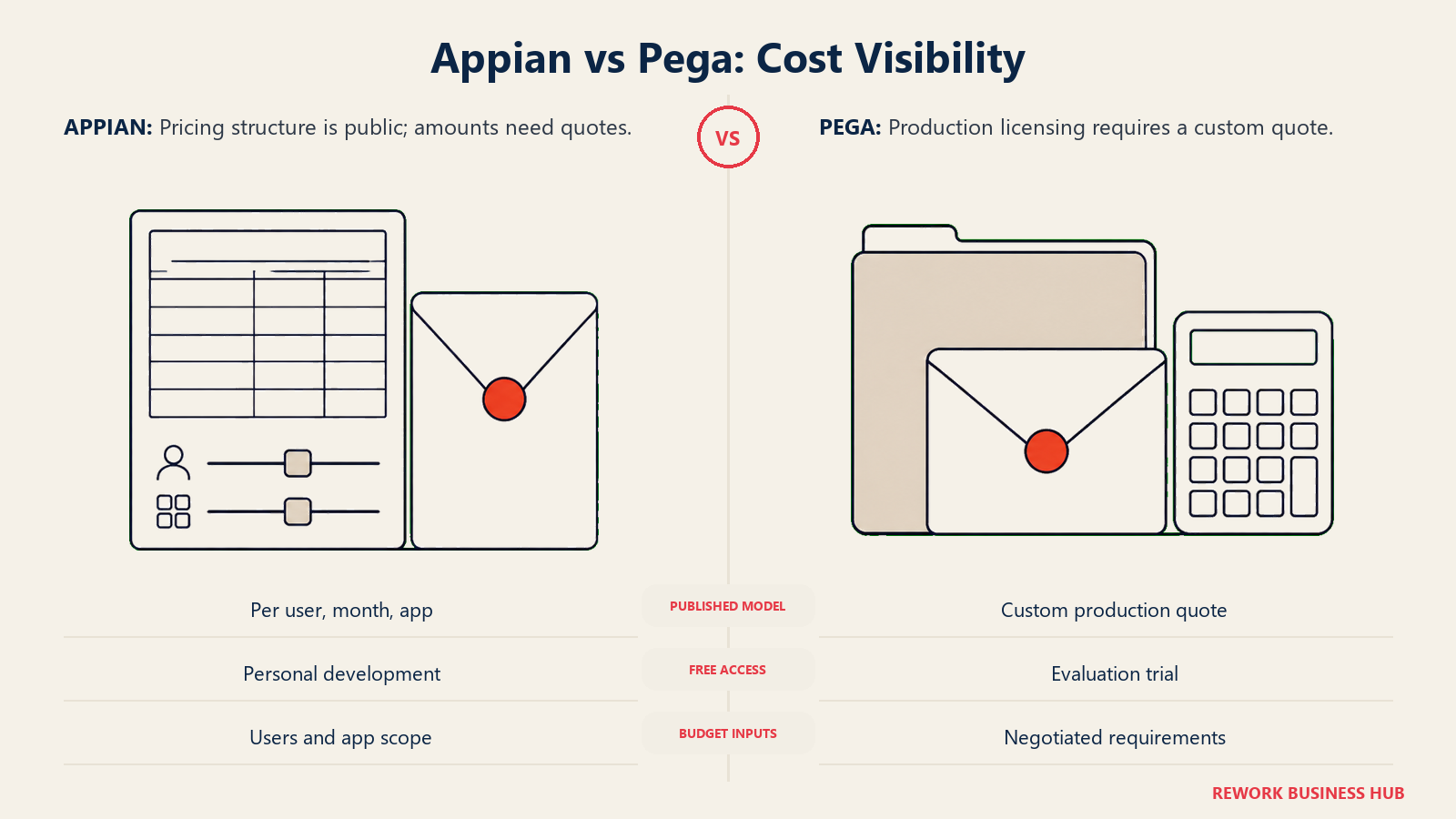
What's knowable about Appian's price: the shape of the model, not a figure. Three editions, Standard, Advanced and Premium, are each "priced per user, per month, per app," meaning cost scales on two axes at once, seats and the number of distinct apps you build, not seats alone. Community Edition is free, but it's explicitly personal development only, not a production tier, so it tells you nothing about what running a real app at your organization would cost.
What's knowable about Pega's price: almost nothing. Pega's own pricing page names no tiers and no figures at all. A free Platform Trial exists for evaluation, but production licensing is a fully custom quote with no public starting point to anchor against.
| What you can establish | Appian | Pega |
|---|---|---|
| Published dollar figure anywhere | None | None |
| Pricing unit named by the vendor | Per user, per month, per app (three editions) | Not disclosed; no unit, no tier names |
| Free option | Community Edition, personal development only | Platform Trial, time-boxed evaluation |
| Primary cost driver beyond seats | Number of distinct apps built on the platform | Decisioning volume, case complexity, cloud vs client-managed, add-on modules |
| Where a real number first appears | A sales-scoped quote per edition | A sales-scoped quote with no edition structure to anchor it |
| Ask for in writing before you sign | Why it matters |
|---|---|
| Appian's exact definition of an "app" for billing purposes | Determines whether a new case type or a new department rollout triggers a new per-app charge |
| Whether AI Process HQ, process mining and Data Fabric are bundled or add-on | These are core to Appian's pitch; confirm they're not priced separately from the base edition |
| Pega's licensing unit: named users, roles, or decisioning volume | Pega doesn't publish a unit, so get the actual metric the quote is built on |
| Which Pega modules (Customer Decision Hub, RPA, Process Mining) are included vs. sold separately | Decisioning is Pega's core value; confirm it isn't priced as a separate line item from the base platform |
| Environment count (dev, test, staging, production) and support SLA tier | Both vendors' real total cost usually includes non-production environments that aren't part of the headline quote |
At 10, 25 or 100 seats, neither vendor gives you enough public information to build a defensible number. Budget the sales process itself, not just the software, into your evaluation timeline for both platforms.
Implementation and Time to Value
Appian's fast-start path leans on process mining to identify which processes are worth automating first, then federated development to let multiple teams build against the same governed Data Fabric without a single team becoming a bottleneck. That breadth is also the tradeoff: standing up Appian across several process types and business units is a bigger initial program than standing up one workflow.
Pega's fast-start path is more explicit about speed. Pega Express is a named, guided methodology built into App Studio, aimed at shipping a first Minimum Lovable Product in as little as 60 to 90 days, and GenAI Blueprint can generate a working case-and-decisioning design from a natural-language prompt before a developer opens the builder at all, compressing the design phase specifically.
| Factor | Appian | Pega |
|---|---|---|
| Named fast-start methodology | Federated development plus process mining to prioritize candidates | Pega Express, targeting a first Minimum Lovable Product in 60 to 90 days |
| AI-accelerated design phase | AI Copilot inside Process HQ, plus spec-driven AI development (2026) | GenAI Blueprint generates the case and decisioning design from a prompt |
| Certified talent needed to scale | Appian Certified Developer / Lead Developer | CSA at minimum, CSSA or CLSA for complex rule-set work |
| Named implementation partners | Accenture, Deloitte, Roboyo and Conexxia, recognized in Appian's 2026 partner awards | EY and other global systems integrators deliver Customer Decision Hub programs |
| Where time-to-value concentrates | Getting Data Fabric connected across legacy systems first | Getting the decisioning model and data feeding Customer Decision Hub right first |
When Appian Is the Right Call
- You're consolidating many different process and case types under one governed platform, and want low-code app building, process mining and a genuine virtual data layer in the same product rather than three separate tools.
- Legacy system modernization is the actual project, and Data Fabric's promise, a unified view across old systems without physically moving the data, matches what you need more than a decisioning-first platform does.
- You need FedRAMP High plus DoD IL5 out of the box for Controlled Unclassified Information, and Appian Government Cloud already covers that authorization level.
- Your teams want to build fast and iteratively across business units, and federated development plus a reportedly gentler learning curve fits an organization without a deep bench of specialized architects yet.
If Appian's per-app pricing structure or its SAIL lock-in is the specific concern, our Appian alternatives roundup covers platforms with different tradeoffs on both fronts.
When Pega Is the Right Call
- Real-time, explainable decisioning is the actual product you're buying, not a feature bolted onto workflow, whether that's next-best-offer, claims triage or credit risk decisioning.
- You operate in a regulated industry that needs to explain a specific automated decision after the fact, where Agent Tracer's replay and root-cause tooling down to the rule-set version is purpose-built for exactly that conversation.
- You already have, or can build, a bench of certified System Architects, and you're comfortable with Pega's reputation for a steeper learning curve and a higher total cost of ownership in exchange for decisioning depth.
- You're consolidating case management and decisioning into a single vendor, rather than pairing a general workflow tool with a separate, bolted-on decision engine.
If Pega's rules-engine depth is more platform than your actual process needs, especially for lighter, sequential work, see our Kissflow alternatives or Pipefy alternatives roundups for tools built for a smaller footprint.
Decision Framework
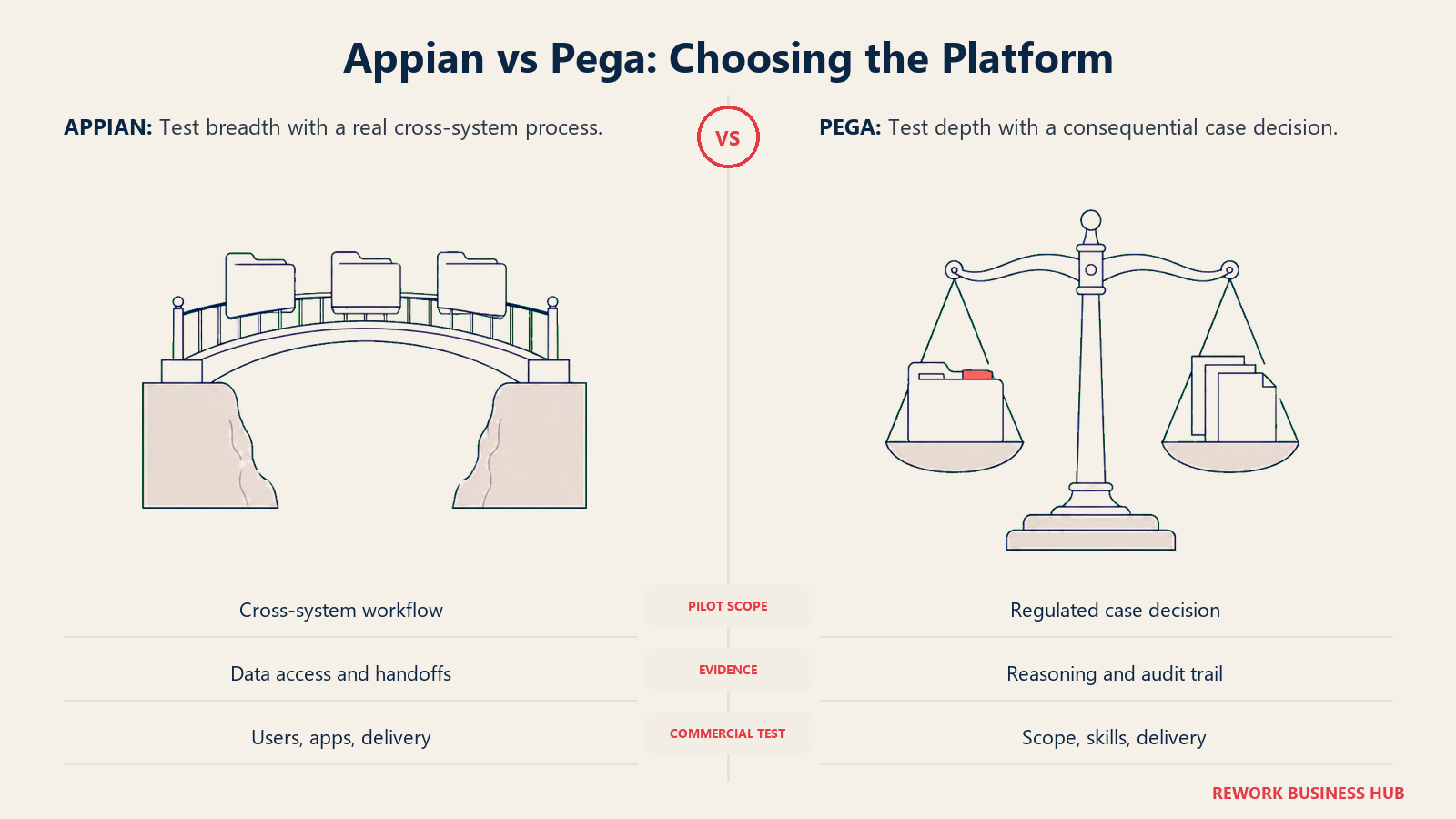
Test breadth with a real cross-system process. Test depth with a consequential case decision.
| If you are... | Pick |
|---|---|
| Consolidating many process types, apps and legacy data sources under one platform | Appian |
| Running real-time, explainable decisioning as the core product (loans, claims, offers) | Pega |
| Needing FedRAMP High plus DoD IL5 for Controlled Unclassified Information today | Appian |
| Needing decision-level audit and replay down to a specific rule-set version | Pega |
| Prioritizing a gentler learning curve and faster onboarding for new developers | Appian |
| Willing to invest in a deep bench of certified System Architects for decisioning depth | Pega |
| Building a genuine virtual data layer across old, disconnected systems | Appian |
| Needing a confirmed number for a procurement committee before a single sales call | Neither, confirm directly with each vendor and get it in writing |
The short version. Appian's strength is breadth: one governed platform for orchestrating many process types, building low-code apps, and unifying legacy data through Data Fabric. Pega's strength is depth in one place: real-time, explainable, auditable decisioning that grew out of claims and underwriting and still shows in the platform's architecture. Neither vendor will hand you a defensible per-seat number without a sales conversation, so treat the evaluation itself, not just the platform, as part of the project timeline.
What to Do Next
Write down what the actual product of this project is. If it's a decision, an approval, a triage call, a next-best-offer, that needs to be explainable to a regulator after the fact, start the Pega conversation and ask specifically about Customer Decision Hub and Agent Tracer, not just the base platform. If it's consolidating a sprawling set of processes, apps and legacy data sources under one governed system, start with Appian and ask to see Data Fabric connected against a real, messy data source before you sign anything.
If the real problem sitting underneath this decision is that your workflow tool, your CRM and your HR system only talk to each other through integrations that break at the worst moment, that's a different question than Appian versus Pega. Rework runs Workflow, BPM, Request approvals, Task, Project, Docs and E-Sign on the same platform as Sales CRM, Lead Management and the People app (HRIS, timesheets, payroll), so a process, the deal it's tied to, and the person handling it live in one system instead of three. Its Process Engine starts at $99/month billed yearly ($1,188/year) or $120 month to month, with 5 work seats included and extra seats in blocks of 5 at $13/month per block on yearly billing; see rework.com/pricing for current terms. It's worth saying plainly: Rework isn't a BPMN 2.0 process-orchestration engine, it doesn't compete with Appian or Pega on executable process modeling, case-management depth, real-time decisioning or regulated audit trails, and it isn't built for solo buyers. If what you actually need is what Appian and Pega do, stay on this page and get both quotes in writing.
Frequently Asked Questions about Appian vs Pega
Is Appian or Pega cheaper?
Neither vendor publishes a number, so there's no confident answer without a sales quote. Appian names three editions priced per user, per month, per app, while Pega names no tiers or figures at all. Get a written quote scoped to your actual user count, app count and decisioning volume from both before assuming either is cheaper.
Does either vendor offer a genuinely free way to try the platform?
Both have a free option, but neither is a usable production tier. Appian's Community Edition is free for personal development only. Pega offers a free Platform Trial for evaluation. Neither lets you run a real production app or case without moving to a paid, quoted tier.
What is Appian Data Fabric?
Data Fabric is Appian's virtual data layer: it connects to data across multiple, disparate systems without physically moving or duplicating it, giving low-code developers a unified view to build against. It's one of four pillars Appian names for its platform, alongside process mining, process automation and total experience.
What is Pega Customer Decision Hub?
Customer Decision Hub is Pega's standalone, real-time decisioning engine. It evaluates customer data, predictive and adaptive models, eligibility rules and business priorities at every touchpoint to return a next-best-action in milliseconds, and it's the platform's most distinctive, separately branded capability.
Which platform is better for regulated industries like banking, insurance or healthcare?
Both serve regulated industries, but the depth is different. Pega's Customer Decision Hub and Agent Tracer are purpose-built for explaining a specific automated decision after the fact, which matters directly to a regulator. Appian's strength in regulated environments leans toward data provenance and legacy-system lineage through Data Fabric, and both platforms' government clouds hold FedRAMP High authorization.
Does Appian or Pega have stronger AI in 2026?
Both shipped real, structural AI rather than a bolted-on chatbot. Appian anchors AI inside the process model itself, through Process HQ, AI Copilot, and 2026 additions like MCP-based agent interoperability and a Snowflake Cortex AI partnership. Pega anchors AI inside case design and decisioning, through GenAI Blueprint, Knowledge Buddy, Autopilot, Coach, and agentic AI built into Customer Decision Hub.
Which platform is easier to learn for a new developer?
Appian is generally rated easier to learn by existing users, with Capterra reviewers describing deployment as straightforward. Pega's rule-based class hierarchy has a steeper reputation, with reviewers describing the documentation as overwhelming for developers new to the platform, though that depth is also what powers Pega's reuse model.
Is switching between Appian and Pega, or off either platform, difficult?
Yes, on both sides. Appian applications built in SAIL have no native export to portable code, so leaving generally means rebuilding. Pega's rule sets can migrate between environments, but only within the same major Pega Platform version, which limits how freely an organization can move rules across a long-lived deployment.
Which platform has deeper case management?
It depends what "deep" means to you. Appian's case model is flexible and integrated with its broader process orchestration and Data Fabric. Pega's case management is built around, and audited by, its Customer Decision Hub, so it's deeper specifically for cases where the decision inside the case is the regulated, high-stakes part.
Are both Appian and Pega recognized as leaders by analysts?
Yes. Both were named Leaders in Gartner's inaugural Magic Quadrant for Business Orchestration and Automation Technologies, published in October 2025. Pega was separately named a Leader in The Forrester Wave for AI Decisioning Platforms, Q2 2025, with the highest score in the strategy category.
Which platform is stronger for process mining?
Both have invested here and both have been recognized by Gartner in process mining or process intelligence platform evaluations. Appian's Process HQ combines process insights with data fabric insights in one view. Pega combines process and task mining with GenAI Blueprint specifically to prioritize automation candidates toward what it calls autonomous automation.
What certifications do I need to staff either platform?
For Appian, the ladder runs from Appian Certified Developer to Appian Certified Lead Developer. For Pega, it runs from Certified System Architect (CSA) to Certified Senior System Architect (CSSA) to Certified Lead System Architect (CLSA), with CLSA-level talent commanding the highest pay on either platform.

Customer Success Operations Manager
On this page
- TL;DR
- Key Facts
- Who Each Tool Is Really For
- Case Management and Decisioning Depth
- Process Modeling and Low-Code App Building
- AI and Agentic Capability in 2026
- Data Layer and Integration
- Deployment and Cloud Options
- Governance, Audit and Regulated Industries
- Developer Experience and Skills Market
- Vendor Lock-In and Switching Costs
- Cost: What You Can Actually Establish
- Implementation and Time to Value
- When Appian Is the Right Call
- When Pega Is the Right Call
- Decision Framework
- What to Do Next