Retool vs Bubble: Internal Tool or the Product You Actually Ship?
Turn this article into takeaways for your work.


Each assistant summarizes the article only for you and suggests best practices for your work.
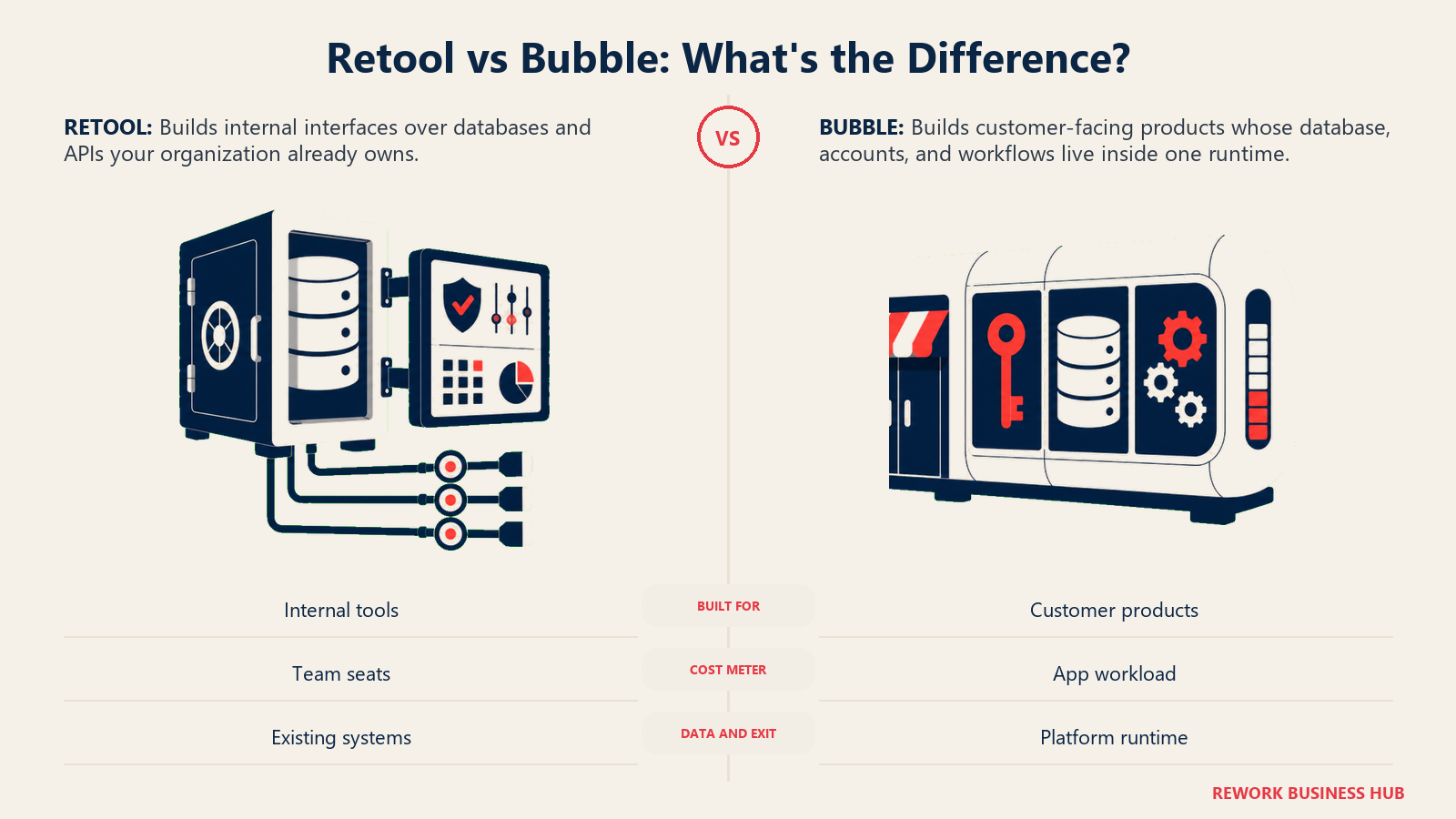
You're an IT director, ops lead, or founder with a shortlist that has both Retool and Bubble on it, and that alone is worth pausing on. These two tools get compared constantly, and almost never because they solve the same problem. Retool builds internal tools: the admin panel your support team lives in, the ops dashboard sitting on top of a database you already run, the console nobody outside your company will ever see. Bubble builds the product itself: a customer-facing web app, and now a mobile one too, with its own database, its own user accounts, and its own signup flow, something you'd eventually put a price on and sell.
Get that distinction wrong and every feature row below will mislead you. The second thing that decides this comparison, and the reason the two vendors' bills behave nothing alike, is what each one meters. Retool charges per person, by role: a builder costs $50 a month on Business, an internal user costs $15, and your first 50 external users are free. Bubble doesn't count people at all. It charges a flat plan price plus workload units, a measure of how much your app actually does, so the bill moves with traffic and backend activity, not headcount. One cost scales predictably with your team size. The other scales with how busy your product gets, a genuinely different kind of risk to sign up for.
TL;DR
| Retool | Bubble | |
|---|---|---|
| Built for | Internal tools on top of data and APIs you already run: admin panels, ops dashboards, support consoles | A standalone customer-facing product with its own database, users, and signup flow |
| Pricing model | Per person, billed by role: builder, internal user, external user | Flat plan price plus workload units, a usage measure, not a headcount |
| Entry price | Free up to 5 users and 500 workflow runs/month; Team from $10/builder + $5/internal user a month, billed annually | Free (development-version only); Starter from $29/month web only, billed annually |
| Free plan | Real and usable for a small internal build | Development only. No live app, no custom domain |
| What actually moves the bill | Headcount, split by role | Workload consumption, plus the editor-seat cap on your plan tier |
| Strongest fit | Ops, support, and internal staff who need a UI over an existing database or API | A product you're building to launch, with users or customers of its own |
| Weakest fit | A customer-facing app with its own signup and billing | An internal admin tool nobody outside the company logs into |
| When you outgrow it | Self-host on Team/Business rates (capped at 100 users), or keep your SQL and rebuild the front end elsewhere | No self-host option and no portable code export. The app's logic stays inside Bubble's own runtime |
What Each Tool Is Actually Built For
Retool starts from the assumption that your data already exists somewhere: a Postgres database, a REST API, Stripe, Salesforce, an internal microservice. You connect to what you already have, then drag together tables, forms, and buttons that read and write against it. Nothing about Retool wants to become your system of record. It wants to be the fastest possible UI layer on top of the system of record you already run, built by and for people who already work at your company.
Bubble starts from the opposite assumption: that nothing exists yet. You define your own data types inside Bubble's own database, design pages visually, and wire up logic with its no-code workflow engine, and the result is a complete, deployable web application, or, since Bubble's 2025 mobile launch, a native app too, with its own signup and login flow, its own hosting, and its own domain. Bubble isn't a layer on top of your business. It is the software your business runs, or sells, or gives away to the public.
| Retool | Bubble | |
|---|---|---|
| Org fit | Any company with an existing database, API, or SaaS stack that needs an internal UI over it | Founders and product teams building a customer-facing app from scratch |
| Buying trigger | Ops or support team needs a dashboard, console, or admin panel fast, without pulling an engineer off the roadmap | You need to launch a real product with signups, its own data, and paying or active users |
| Data model | Connects to 50+ existing data sources: SQL databases, REST/GraphQL APIs, SaaS tools | Bubble's own built-in database, modeled from scratch inside the builder |
| Scripting | SQL and JavaScript, native throughout components and transformers | Bubble's visual workflow engine; no query language required |
| Output | Internal web app, used by people who already work with you | Public web app, plus native iOS and Android apps since the 2025 mobile launch |
Key Facts
- Bubble has powered more than 6 million apps across 180+ countries, with over $850 million transacted through the platform, per Bubble's own June 2025 announcement of native mobile support.
- In Retool's 2025 Builder Report (1,128 builders surveyed in July 2025), 48% of non-engineers said they now build production-ready solutions independently, without waiting on an engineering team.
- 85% of the 100 SaaS companies Metronome and Greyhound surveyed in January 2025 had adopted usage-based pricing in some form, and 77% of the largest software companies use some level of consumption pricing, per Orb's compiled SaaS pricing statistics, the exact billing shape behind Bubble's workload units.
- By 2026, developers outside formal IT departments will make up at least 80% of the low-code user base, up from 60% in 2021, per Gartner as reported by InfoWorld, the same shift that put a citizen-developer builder like Bubble and an ops-team builder like Retool in front of non-engineers at once.
- Solo founders made up 36.3% of new U.S. startups in 2025, the highest share in more than 50 years, per Carta's Solo Founders Report, close to the audience Bubble's no-engineer builder targets and Retool, built for teams with an existing engineering or ops function, generally does not.
Decision by Business Goal
| Your goal | Pick this | Why |
|---|---|---|
| "I need a dashboard my ops or support team can use by next week, on top of data we already have" | Retool | Connects directly to your existing database or API; no need to model data from scratch |
| "I'm building a product I plan to charge outside customers for" | Bubble | Ships a complete customer-facing app with its own database, accounts, and signup flow |
| "I want my bill to scale with headcount I control, not with how busy the app gets" | Retool | Per-seat pricing by role; the bill is set by who logs in |
| "I don't want a traffic spike to blow up my software bill overnight" | Retool | The core meter is seats. Workflow-run caps exist but headcount, not traffic, drives the price |
| "I need native iOS and Android apps, not just a responsive web page" | Bubble | Ships real native mobile apps since its 2025 launch; Retool's mobile app is a companion viewer, not a build target |
| "My team already writes SQL and JavaScript and wants that power in the builder" | Retool | Native SQL queries and JS transformers throughout; Bubble stays inside its own visual workflow engine |
Team and Role Fit
| Role | Retool | Bubble |
|---|---|---|
| Non-technical builder | Workable for simple CRUD screens, but the tool assumes some comfort with how data is structured | The primary audience. Visual data model, visual workflow logic, no SQL or JS required |
| Technical/developer builder | Full SQL and JavaScript access inside components and transformers, the deepest ceiling in this collection | Real headroom through plugins and API connectors, but logic still runs inside Bubble's own workflow engine |
| Internal staff / end user | Billed per seat: $15/month on Business, cheaper on Team | Not billed as a distinct category. Bubble doesn't separate "internal" from "external"; every logged-in person is an app user inside your own database |
| External/customer user | 0 to 50 free, then banded down from $8/month on Business | Bubble doesn't meter people at all. A customer-facing signup flow is the default assumption of the whole product |
| IT or platform admin | Manages a fixed, forecastable per-seat bill and a set of existing-source connections | Manages workload consumption and the editor-seat limit tied to the plan tier |
Core Capability and Builder Model
Retool's builder assumes you already know your data. Connect to a Postgres or MySQL database, a REST or GraphQL API, or one of dozens of pre-built integrations (Stripe, Salesforce, Slack, Google Sheets), and Retool's component library, tables, forms, buttons, charts, snaps onto whatever comes back. Every query can be raw SQL or JavaScript. There's no abstraction layer hiding the underlying system from you, which is the whole point: Retool is a UI, not a database.
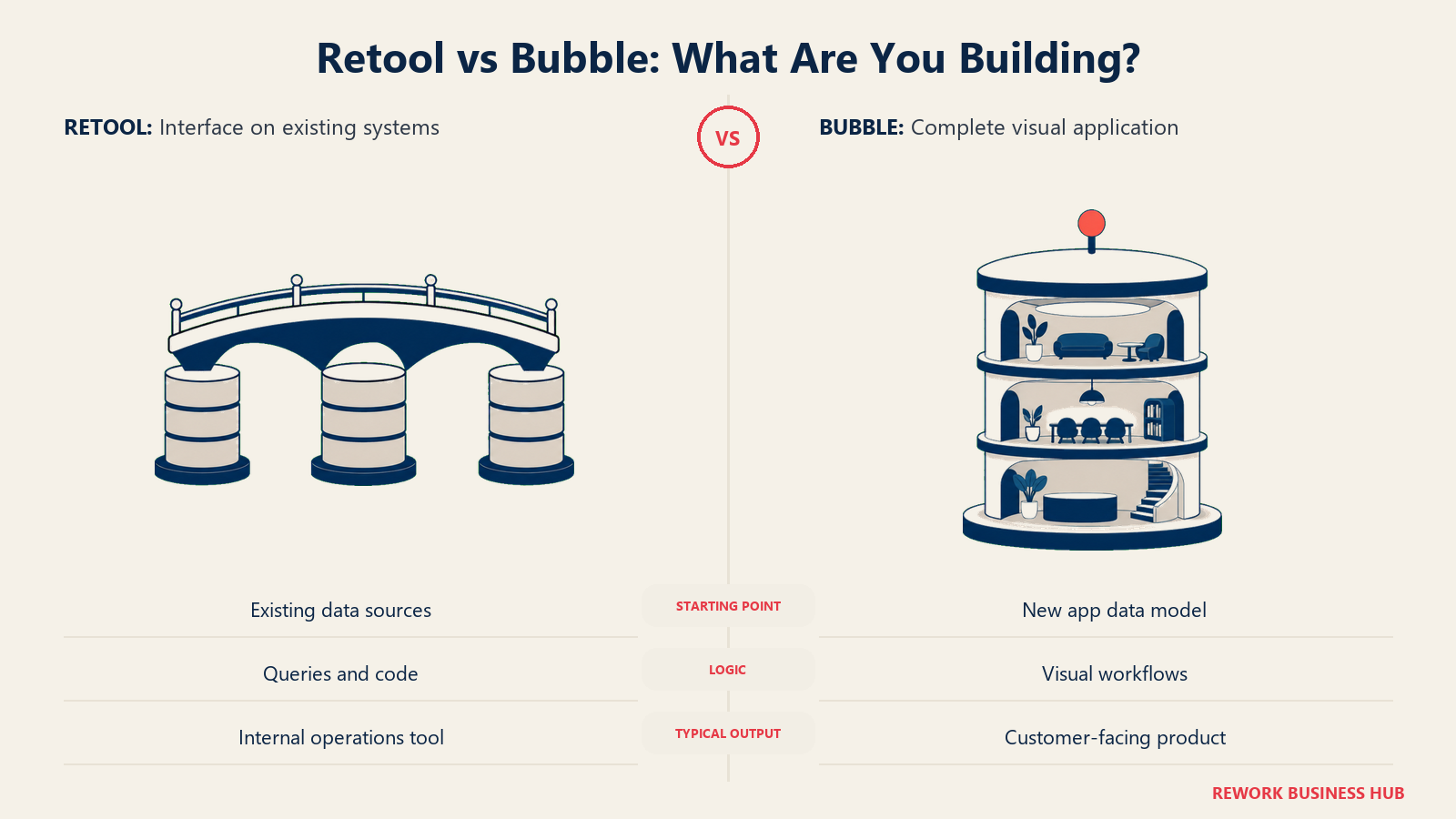
Bubble's builder assumes the opposite. There's no existing data to connect to, so Bubble gives you one: define data types and fields inside its own built-in database, then design pages visually and wire up logic in the Workflow tab, if/then branching, custom events, backend workflows on a schedule or via API. No SQL, no JavaScript required, though a plugin marketplace and an API connector let a technical builder push past the visual ceiling when needed.
| Capability | Retool | Bubble |
|---|---|---|
| Data source | Connects to a database or API you already run: 50+ pre-built integrations plus any REST/GraphQL endpoint | Bubble's own built-in database, modeled from scratch inside the builder |
| Query language | Raw SQL and JavaScript, native throughout | None required. A visual workflow engine handles the logic |
| UI components | Purpose-built for internal/admin patterns: tables, forms, JSON explorers, approval buttons | General-purpose page builder for a full customer-facing product |
| Backend logic | JS transformers plus scheduled and triggered workflows (Retool Workflows) | Backend workflows, scheduled events, and API workflows, all visual |
| Extensibility | Custom components in React; full JS and SQL access | Plugin marketplace, API connector, custom code elements for advanced builders |
| Output | Internal web app, plus a companion mobile app for viewing tools on the go | Full web app, and native iOS/Android apps since the 2025 mobile launch |
| Ceiling for a technical builder | High. It's real SQL and JS most of the way down | Moderate. Depth comes from plugins and workarounds inside a builder that stays fundamentally visual |
If the actual requirement is technical depth beyond either tool's ceiling, that's the territory our Retool alternatives guide and our Retool vs Softr vs Budibase comparison both cover in more depth.
Two Different Meters: Seats Versus Workload Units
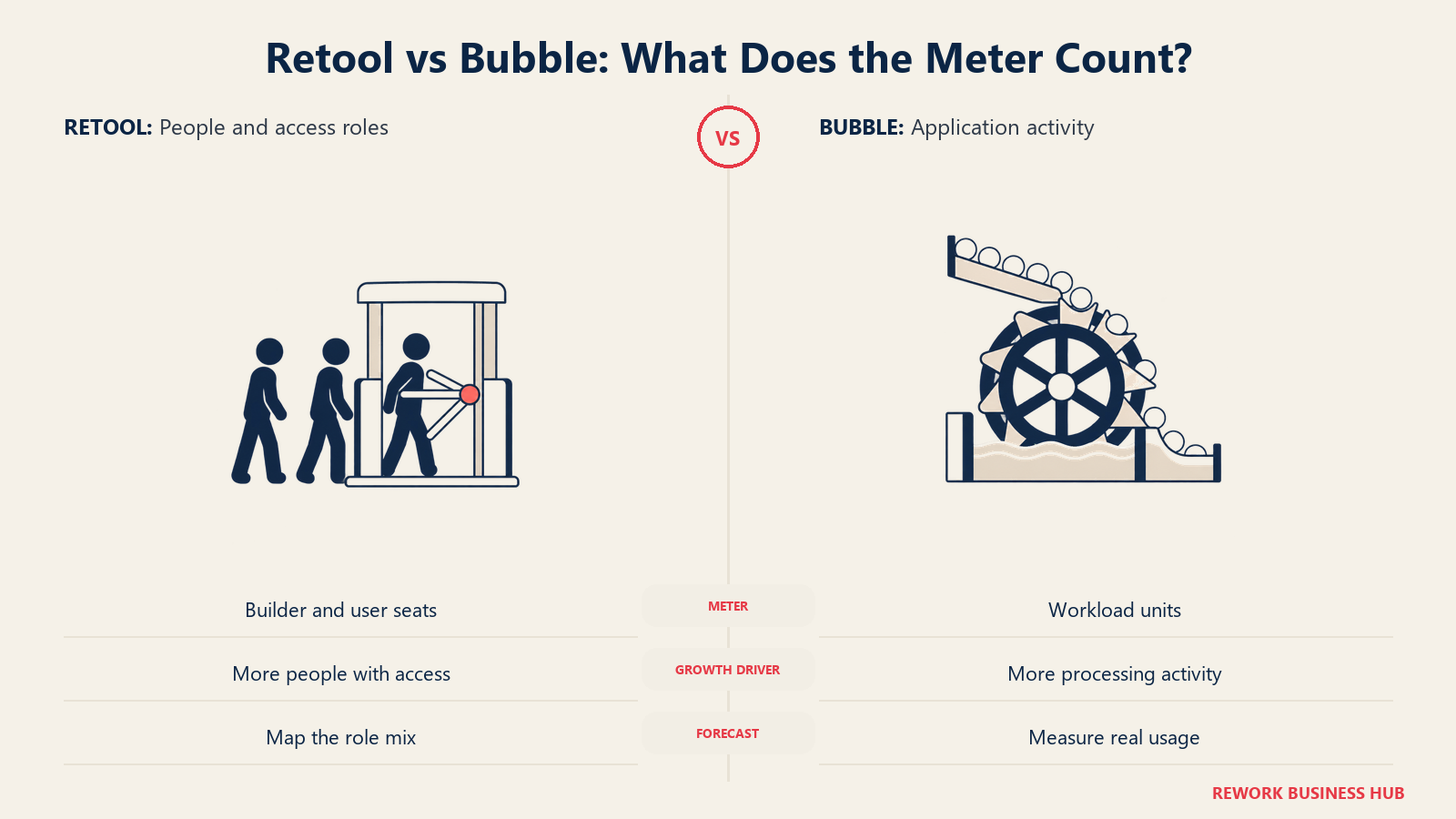
This is why a plain side-by-side pricing table can mislead you if you don't read past the dollar signs. Retool counts people. Every builder, internal user, and external user past the free 50 adds a line to the bill, knowable in advance because your org chart already tells you who needs a login. Bubble counts activity: page loads, database operations, and backend workflow runs, rolled into a single number called workload units (WU), resetting every month regardless of who's logged in. A Bubble app with 5 quiet users and a heavy backend job running hourly can burn through more WU than one with 500 people who barely touch it.
| Retool | Bubble | |
|---|---|---|
| What's metered | People, by role (builder, internal user, external user) | Workload units: app activity (page loads, database operations, workflow runs) |
| Free of charge | Nothing, past the free tier's 5-user cap | End users, on any plan |
| What sets the plan tier | Builders and internal users you need seats for | Workload units expected per month, plus app editors needed |
| Effect of a headcount spike | Adds cost directly, one line per person | Nothing, unless it also drives more workload |
| Effect of a usage spike | Nothing, unless more people also need logins | Risks exceeding the plan's WU allotment, forcing an upgrade |
| Predictability | High. Knowable from your org chart in advance | Lower. Tracks product performance, forecastable but not fully controllable |
Pricing at Real Team Sizes
Do the math with each vendor's own published numbers, not a sibling article's numbers. Retool bills by role, annually by default, with a higher rate if you pay monthly. Bubble bills the app, and the web-only figures below are deliberately separate from the web-and-mobile figures, because printing one without the other is the single most common pricing mistake made about this tool.
Retool's published tiers, per Retool's pricing page:
| Plan | Builder | Internal user | External user |
|---|---|---|---|
| Free | $0, up to 5 users total, 500 workflow runs/month | Included | Included |
| Team | $10/month billed annually ($12 billed monthly) | $5/month billed annually ($7 billed monthly) | Not available on Team |
| Business | $50/month billed annually ($65 billed monthly) | $15/month billed annually ($18 billed monthly) | First 50 free; 51 to 250 at $8/month annually ($10 monthly); 251 to 500 at $6/month annually ($7 monthly); 500+ at $4/month annually ($5 monthly) |
| Enterprise | Contact for pricing | Contact for pricing | Contact for pricing |
Self-hosted deployments bill at the same per-role rates, with Team and Business self-hosted capped at 100 total users.
Bubble's published tiers, per Bubble's pricing page. Every figure below is web only; web and mobile runs meaningfully higher on every paid tier.
| Plan | Web only | Web and mobile | Workload units/month | App editors |
|---|---|---|---|---|
| Free | $0 | $0 | 50,000 | 1 |
| Starter | $29/month billed annually ($32 billed monthly) | $59/month billed annually | 175,000 | 1 |
| Growth | $119/month billed annually | $209/month billed annually | 250,000 | 2 |
| Team | $349/month billed annually | $549/month billed annually | 500,000 | 5 |
| Enterprise | Contact for pricing | Contact for pricing | Custom | Custom |
Bubble's Free plan is development-version only: no live app, no custom domain, so it can't host anything a real user would ever reach. Bubble's page advertises "save up to 20% annually"; the figures above are already the annual basis. File storage is a separate add-on at $3 per 100 GB/month on every paid tier.
What 10, 25, and 100 users actually cost
For Retool, assume a realistic ops team: a handful of people building and maintaining tools, and everyone else just using what gets built. At 10 users, assume 2 builders and 8 internal users. At 25, assume 3 builders and 22 internal users. At 100, assume 5 builders and 95 internal users, all priced on Business, since Team lacks external-user support and some of the governance controls most 100-person deployments will want. For Bubble, the same 10/25/100 framing measures something else: end users of the app you built, meaning customers or members, not staff. Headcount barely moves that bill. What moves it is workload, how much those users actually do inside the app, and how many people on your team need an editor seat to keep building it.
| Size | Retool Business (annual) | Retool Team (annual) | Bubble (web only, annual) |
|---|---|---|---|
| 10 (2 builders + 8 internal / 10 end users) | 2 x $50 + 8 x $15 = $220/month, $2,640/year | 2 x $10 + 8 x $5 = $60/month, $720/year | Starter's $29/month covers this comfortably; the binding constraint is the 1 included editor, not the 175,000 WU/month cap |
| 25 (3 builders + 22 internal / 25 end users) | 3 x $50 + 22 x $15 = $480/month, $5,760/year | 3 x $10 + 22 x $5 = $140/month, $1,680/year | Still likely Starter or Growth ($119/month); workload per user decides the tier, not headcount |
| 100 (5 builders + 95 internal / 100 end users) | 5 x $50 + 95 x $15 = $1,675/month, $20,100/year | 5 x $10 + 95 x $5 = $525/month, $6,300/year | Could stay on Starter if lightly used, or force Growth/Team if those 100 are active daily; workload units consumed decide the tier, not headcount |
The point of that last column isn't the specific dollar figures, it's that Bubble's row doesn't move the way Retool's does. Ten lightly active users and a hundred lightly active users can land on the exact same plan. Ten users hammering a data-heavy backend workflow can force an upgrade that a hundred passive browsers never would. If your business case depends on knowing the bill in advance, that's a difference in kind, not just in degree, from Retool's per-seat model.
Who Logs In: Internal Staff Versus Paying Customers
| Retool | Bubble | |
|---|---|---|
| Who typically logs in | Your own employees: support reps, ops staff, sales ops, finance | Your customers, members, or the public: the people your product is for |
| Account system | No built-in customer signup flow; users are provisioned by an admin inside Retool's own user management | Full signup, login, password reset, and permission system built into the app itself |
| Billing relationship to the login | Every login can cost you money (builder, internal, or external seat) | Logins cost nothing directly. Usage is what costs money |
| Data ownership of the login's activity | Lives in whatever database or API you connected Retool to | Lives inside Bubble's own database, on Bubble's own infrastructure |
| What happens at scale | Cost grows in a straight line with headcount | Cost grows with what those users actually do, not with how many there are |
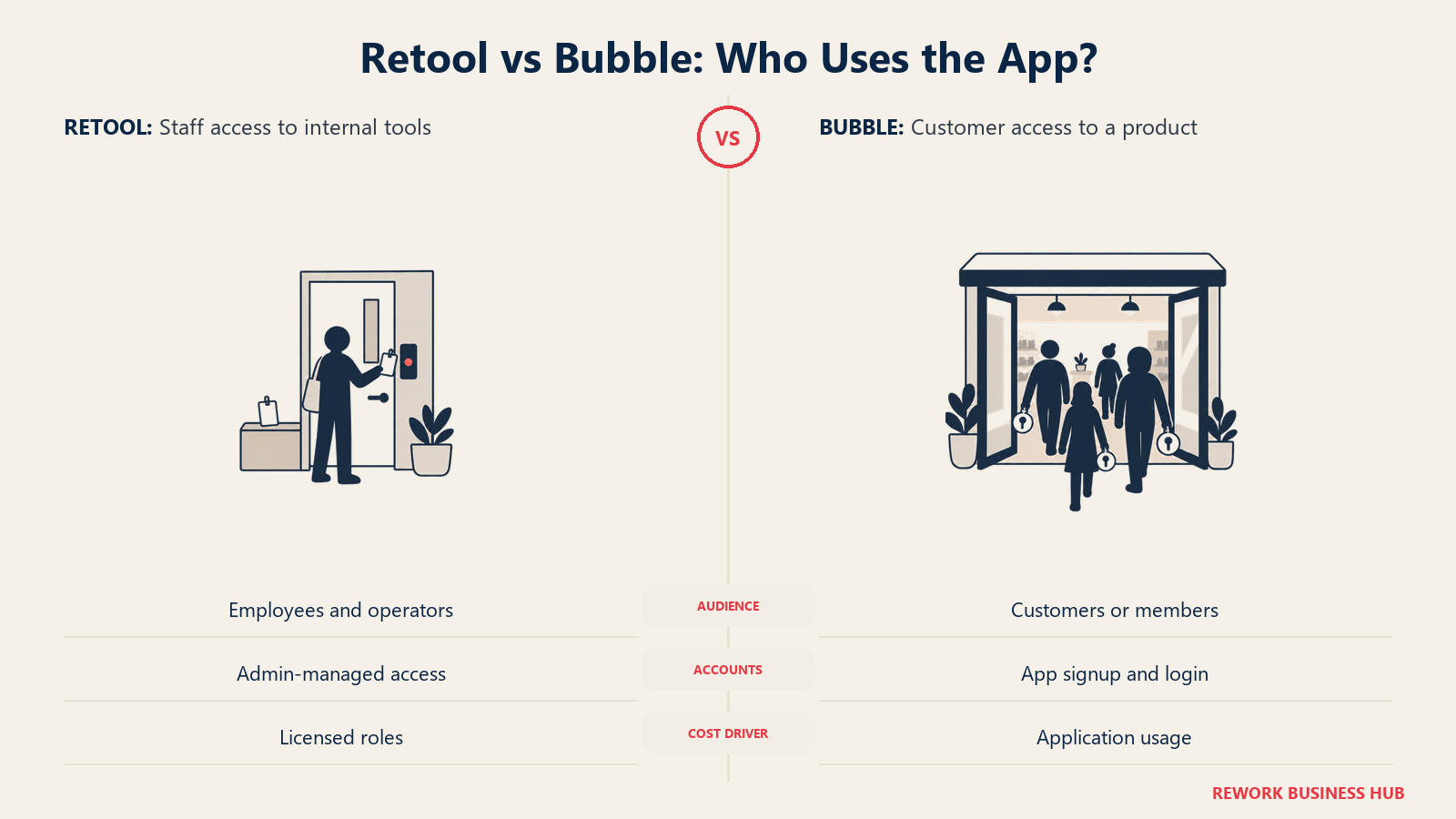
That distinction compresses the whole article into one question: who is this app for? If the honest answer is "people on my payroll," Retool's per-seat model prices exactly what you're adding: another person with access. If it's "people who don't work here and might pay us," Bubble's workload model prices exactly what you're building: a product whose costs should track its own usage. If Bubble's own hosting still feels like more lock-in than the build warrants, our Bubble vs Softr comparison covers a lighter alternative built on an existing no-code database instead of Bubble's own.
Implementation and Change Management
| Retool | Bubble | |
|---|---|---|
| Time to first working screen | Hours, once a data source is connected; the ceiling is the connection, not the builder | Hours for a simple screen; longer once real workflow logic and a from-scratch data model are involved |
| Learning curve | Comfortable for anyone who already understands SQL or a REST API; steeper without that background | Comfortable for a non-technical builder from day one; genuine ramp time for complex conditional workflows |
| Who can build it | Ops-adjacent staff, analysts, and engineers alike; the tool rewards existing data fluency | Non-technical founders and product people, the audience the tool is explicitly built for |
| Data migration effort | Low. Retool never owns your data, it connects to what's already there | Can be substantial if you're migrating an existing product's data into Bubble's own database structure |
| Onboarding and support | Self-serve documentation and community forum; paid support on higher tiers | Self-serve documentation, an active community forum and BubbleCon events, paid support on higher tiers |
Risk, Governance, and Lock-In
Retool's biggest structural advantage shows up here, not in the feature list. Because Retool never owns your data in the strict sense, the underlying database or API stays exactly where it was before you ever opened the builder. Walk away from Retool tomorrow and your data isn't stranded; only the admin panel built on top of it is. Self-hosting and VPC deployment exist on paid plans for teams that need the tool running inside their own infrastructure, a real answer to a real compliance question.
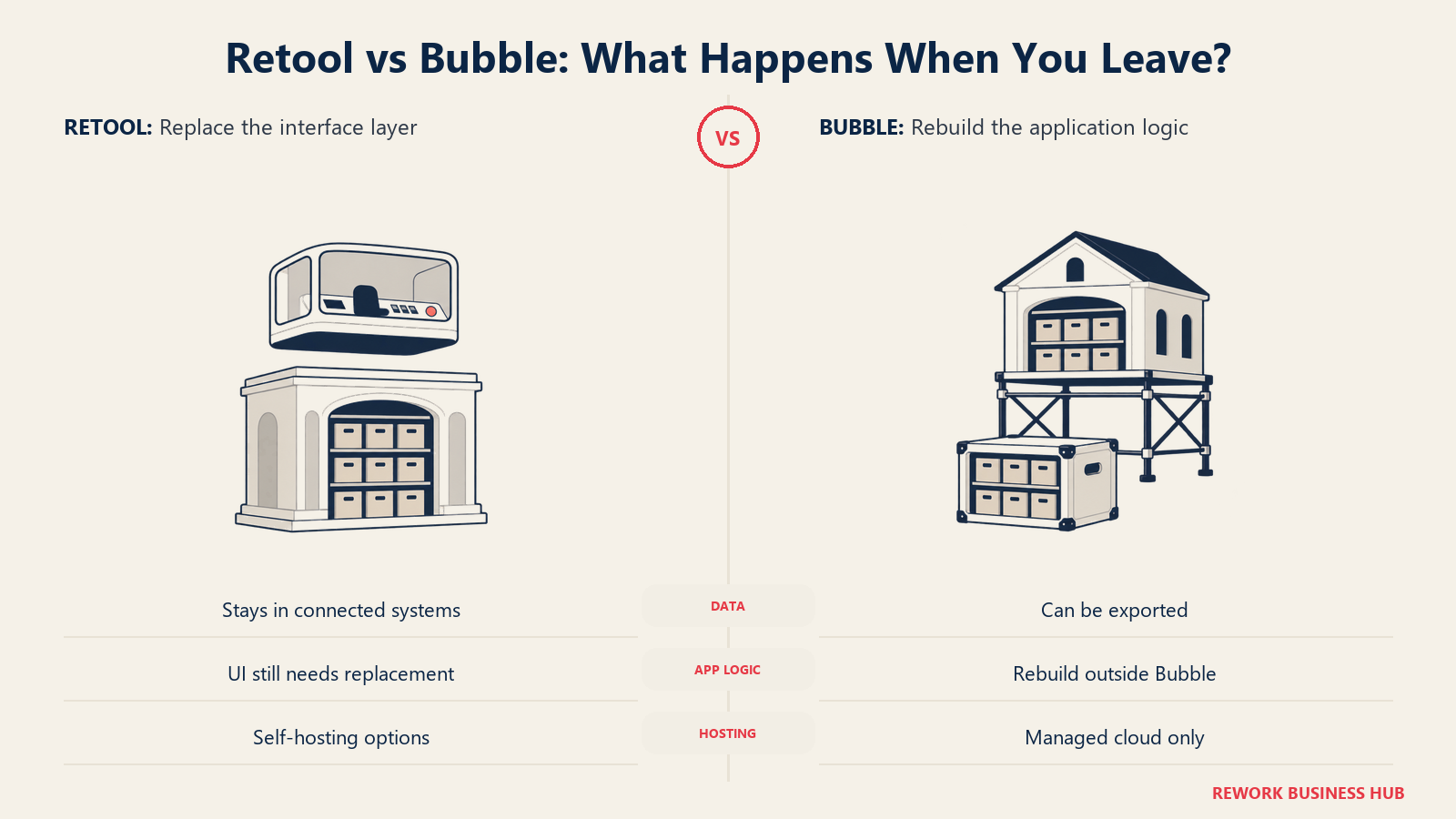
Bubble's structure is different by design, because the whole point is that Bubble is the product, not a layer on top of one. The app's data and logic both live inside Bubble's own runtime, and there's no self-hosted option, no way to export the finished app as portable source code a developer could pick up and run elsewhere. Migrating off Bubble later means exporting the data (which Bubble does support) and rebuilding the logic by hand in whatever comes next. That's the honest trade-off behind every visual, no-code builder, covered further in our Bubble alternatives guide: build speed today, in exchange for portability later.
| Retool | Bubble | |
|---|---|---|
| Where the data lives | Wherever you connected it: your own database, API, or SaaS accounts | Inside Bubble's own database, on Bubble's own infrastructure |
| Self-hosted / on-prem option | Yes, on Team and Business (capped at 100 users); full control on Enterprise | No. Cloud-only |
| Code export | No packaged export, but the data was never captured in the first place | No portable source-code export; logic stays inside Bubble's proprietary runtime |
| Vendor lock-in | Contained to the UI layer; systems of record untouched | Higher. The app itself lives entirely inside Bubble |
| Governance for regulated builds | VPC/self-hosted options exist; confirm current certification scope on Retool's security page | No self-hosted path; confirm current compliance posture on Bubble's security page |
If Microsoft-ecosystem ties and deeper enterprise governance matter more than either vendor here, our Power Apps vs Retool comparison is the more relevant read. And if the requirement is a heavier internal-tools platform with its own compliance ceiling above what Retool offers, our OutSystems alternatives guide covers that end of the market.
When Retool Is the Right Call
- Your data already lives somewhere real: a production database, a set of internal APIs, a stack of SaaS tools you already pay for, and you need a UI on top of it, not a new place to store anything
- The people who'll use what you build are on your own payroll, and you want a bill that scales in a straight line with exactly who has access
- Someone on the team is comfortable with SQL or a REST API, and you want that power available inside the builder, not walled off behind a visual-only ceiling
- Self-hosting or VPC deployment is a real requirement, not a nice-to-have, because of where your company operates or who regulates it
- You're building an internal console, not a product with its own customers, signups, or billing
When Bubble Is the Right Call
- You're building the actual product: a customer-facing web or mobile app with its own users, its own data, and its own reason to exist independent of anything else you run
- You don't have an engineer on the team yet, or don't want to hire one before validating the idea, and the visual builder is meant to close that gap entirely
- You need real native iOS and Android apps from the same build, not a responsive page resized for a phone
- You'd rather have a bill that tracks your product's own usage than one that grows every time you add a teammate
- You're comfortable with the trade-off: fast to build, harder to walk away from later, because the app's logic and data live entirely inside Bubble's own runtime
If neither shape fits because the actual need is a fast, mobile-first build for field or frontline staff rather than an office admin panel or a full customer product, our Glide alternatives guide covers that narrower, table-first category instead.
Decision Framework
| If you are... | Pick |
|---|---|
| Building an admin panel, dashboard, or console for your own staff | Retool |
| Building a customer-facing product with its own signup flow | Bubble |
| Connecting to a database or API you already run | Retool |
| Starting from nothing, with no existing system of record | Bubble |
| Budgeting a bill that scales with headcount you control | Retool |
| Comfortable with a bill that scales with product usage instead | Bubble |
| A non-technical founder building a first product alone | Bubble |
| A team with SQL/API fluency building internal tooling fast | Retool |
| Needing self-hosted or VPC deployment for compliance | Retool |
| Comparing the wider category, not just these two | See our full no-code app builder roundup |
What to Do Next
- Answer the one question that decides most of this: who logs in? Your own staff on top of data you already run, start pricing Retool. Customers or the public with their own accounts, start pricing Bubble.
- Model your actual headcount split for Retool before picking a tier. Builders and internal users cost different amounts; a rough guess changes the annual number meaningfully at 25 or 100 people.
- Don't quote a Bubble price without saying web only or web and mobile. The gap between $29 and $59 a month on Starter alone is real money at any size, and printing the wrong one is the single most common mistake made about this tool.
- Rebuild your single most complex screen in both tools before committing. For Retool, that's the screen with the heaviest query. For Bubble, it's the screen with the most conditional workflow logic.
- Still not sure either shape fits? Our best no-code app builders roundup widens the search.
Frequently Asked Questions about Retool vs Bubble
Is Retool cheaper than Bubble?
It depends on who's using what you build. Retool's free tier (5 users, 500 workflow runs a month) often covers a small internal build for nothing; past that, Business pricing ($50/builder and $15/internal user a month, annually) scales with headcount. Bubble doesn't price by headcount at all; its $29 to $349 a month web-only plans (annually) scale with workload units instead, so a low-traffic app can stay cheap regardless of team size, and a high-traffic app can cost more than Retool even with a tiny team.
Does Bubble's $29 a month plan include mobile apps?
No. $29 a month billed annually is the web-only price for Bubble's Starter plan. The same tier with web and native mobile app support runs $59 a month billed annually. Several Bubble comparisons elsewhere quote $29 without saying which version they mean; always check whether a Bubble price includes mobile before comparing it to anything else.
Can Retool build a customer-facing app, or is it really internal-only?
Retool is built and priced around internal tools: admin panels, dashboards, and consoles for people who already work at your company. It supports an "external user" pricing band (the first 50 are free on Business) for cases like a client-facing portal, but its component library, data model, and pricing structure all assume the app sits on top of data you already run, not a new product with its own signup flow. For that, Bubble is the more direct fit.
What is a Bubble workload unit?
A workload unit (WU) is Bubble's rolled-up measure of how much an app does in a given month: page loads, database reads and writes, and backend workflow runs all count against the plan's monthly allotment. Free is capped at 50,000 WU/month, Starter at 175,000, Growth at 250,000, and Team at 500,000. Exceeding the allotment generally means moving to a higher tier; confirm current overage terms on Bubble's own pricing page before budgeting against them.
Is Retool's free tier enough to build something real?
For a small, genuinely internal build, often yes. The Free plan covers up to 5 users and 500 workflow runs a month, plenty for a single ops dashboard used by a handful of people. It stops being enough once your builder count, internal-user count, or workflow-run volume grows past those caps, which for most teams happens well before 25 users.
Can either tool self-host or run on-prem?
Retool can, on Team and Business at the same per-role rates (capped at 100 total users self-hosted), plus a fuller VPC or on-prem option on Enterprise. Bubble has no self-hosted option at all; every app runs on Bubble's own cloud infrastructure, which matters if data residency or infrastructure control is a hard requirement.
What happens if I outgrow Retool or Bubble?
Differently, in each direction. Retool never owned your underlying data, since it connects to a database or API you already run, so walking away means rebuilding the UI layer, not migrating your systems of record. Bubble's app, data model and workflow logic together, lives entirely inside Bubble's own runtime with no portable code export, so outgrowing it means exporting the data (which Bubble does support) and rebuilding the logic by hand in whatever comes next.
Related Resources:

Principal Product Marketing Strategist
On this page
- TL;DR
- What Each Tool Is Actually Built For
- Key Facts
- Decision by Business Goal
- Team and Role Fit
- Core Capability and Builder Model
- Two Different Meters: Seats Versus Workload Units
- Pricing at Real Team Sizes
- What 10, 25, and 100 users actually cost
- Who Logs In: Internal Staff Versus Paying Customers
- Implementation and Change Management
- Risk, Governance, and Lock-In
- When Retool Is the Right Call
- When Bubble Is the Right Call
- Decision Framework
- What to Do Next