Best AI Tools for Insurance Claims Processing in 2026
Turn this article into takeaways for your work.


Each assistant summarizes the article only for you and suggests best practices for your work.
If you're evaluating AI tools for insurance claims processing in 2026, Sprout.ai and Five Sigma lead if you want end-to-end automation from first notice of loss through settlement, Shift Technology and FRISS lead for fraud detection and decisioning, Tractable and CCC Intelligent Solutions lead for photo-based damage and estimating, Roots (Bevaya) leads for document AI and agentic claims processing, and EvolutionIQ and CLARA Analytics lead for adjuster guidance on disability, workers' comp, and casualty lines. This guide ranks 14 tools by the job they're actually built for, not by whichever vendor shipped the loudest AI announcement this quarter.
Claims is the one part of the insurance business where AI has the clearest, most measurable payoff: faster cycle times, fewer leakage dollars, and adjusters who spend their day on judgment calls instead of data entry. It's also the part of the business with the least tolerance for a black box, since a wrong or unexplainable claims decision creates regulatory exposure fast. Each tool below is evaluated on what it actually automates, who it's built for, and how it handles the compliance question.
What Changed in 2026
- The NAIC AI Systems Evaluation Tool moved from proposal to active pilot. Twelve states (California, Colorado, Connecticut, Florida, Iowa, Louisiana, Maryland, Pennsylvania, Rhode Island, Vermont, Virginia, and Wisconsin) are running the pilot from March through September 2026, with a revised version headed to the Fall National Meeting for potential adoption in November, per Fenwick's regulatory summary.
- AI-generated fraud became a board-level problem, not just an SIU problem. Verisk's 2026 fraud study found that nearly every insurer surveyed now sees AI-edited claim photos and documents as a real threat, pushing fraud vendors like Shift Technology and FRISS to add document-authenticity scoring alongside their existing fraud models.
- Document AI shifted from OCR to agentic processing. Roots rebranded its platform to Bevaya and pushed InsurGPT toward straight-through document classification in the high-90s percent range, a jump from the extraction-and-flag model most document AI tools shipped through 2025.
- Auto physical damage AI went mainstream at scale. CCC Intelligent Solutions now has AI estimating live at more than 6,500 repair shops and over 125 insurers, with AI-driven products growing roughly 50% year over year, a sign the technology has moved well past early-adopter carriers.
Key Facts
- Insurance fraud costs the United States an estimated $308.6 billion a year, with property and casualty claims accounting for roughly $45 billion of that total, per the Coalition Against Insurance Fraud's economic impact report.
- 98% of insurers agree that AI-powered editing tools are fueling a rise in digital insurance fraud, and 99% say they've already encountered manipulated or AI-altered claim documentation, per Verisk's 2026 State of Insurance Fraud study.
- More than a third of consumers (36%) say they'd consider digitally altering a claim photo or document even if it broke their insurer's rules, rising to 55% of Gen Z respondents, per the same Verisk study.
- Insurers deliver adequate digital status updates, one of the top drivers of claims satisfaction, in only 22% of claims, per J.D. Power's 2025 U.S. Claims Digital Experience Study.
- 32% of auto insurance shoppers now use AI tools when comparing coverage, and those who do are 1.3 times more likely to switch carriers, per J.D. Power's 2026 U.S. Auto Insurance Study.
Quick Comparison Table
| Tool | Best For | Starting Price | Key Strength | Key Limitation |
|---|---|---|---|---|
| Sprout.ai | End-to-end claims automation, FNOL to settlement | Custom, demo required | Auto-adjudication across multiple document-heavy lines | No published pricing, enterprise sales cycle |
| Five Sigma (Clive) | AI-native claims management platform | Custom, demo required | Multi-agent AI works standalone or as a CMS overlay | Newer platform than Guidewire/Duck Creek for legacy shops |
| Shift Technology | Fraud detection and claims decisioning at scale | Custom, demo required | Broadest AI platform spanning underwriting, claims, and fraud | Broad scope means a longer implementation than a point tool |
| Tractable | Photo-based damage and repair-cost appraisal | Custom, demo required | Real-time computer vision, industry standard for touchless estimates | Appraisal only, needs pairing with a full claims system |
| CCC Intelligent Solutions | Auto physical damage estimating at scale | Bundled into CCC subscription + custom | Largest AI estimating network: 6,500+ shops, 125+ insurers | Strongest in auto; thinner outside physical damage |
| Roots (Bevaya / InsurGPT) | Document AI and agentic claims processing | Custom, demo required | Up to 99% straight-through document processing | Enterprise implementation, not self-serve |
| CLARA Analytics (CLARAty.ai) | Workers' comp, auto liability, and GL claims intelligence | Custom, demo required | Largest bodily-injury claims AI dataset in category | Casualty-focused, less relevant for first-party property |
| EvolutionIQ | Adjuster guidance for disability and workers' comp | Custom, demo required | Proven claim flow-through and LTD-transition reduction | Narrower scope: guidance, not FNOL or fraud |
| Charlee.ai | Litigation and severity prediction, claims triage | Custom, demo required | Real-time litigation probability scoring | Scoring layer, not a standalone claims workflow system |
| Gradient AI | Explainable risk scoring for claims and underwriting | Custom, demo required | Models trained on your own carrier data, not generic benchmarks | Risk-scoring engine, not a full claims platform |
| FRISS | Fraud and compliance scoring at intake | Custom, demo required | Real-time fraud scoring across underwriting and claims | Core strength skews toward point-of-sale fraud |
| Snapsheet | Virtual appraisal and claims management | Custom, not published | Started in virtual appraisal, now a full CMS option | No public pricing; newer to full CMS than Five Sigma |
| Hi Marley | Claims communication via SMS | Custom, not published | Purpose-built adjuster-to-policyholder conversation thread | Doesn't run conversational FNOL intake itself |
| Ushur | Conversational AI FNOL intake | Custom, not published | 24/7 digital FNOL with fast deployment | Probabilistic output raises audit-trail questions for strict LOBs |
1. Sprout.ai: End-to-End Claims Automation From FNOL to Settlement
Sprout.ai is built around one job: taking a claim from first notice of loss all the way to adjudication with as little human touch as possible. The platform ingests documents, photos, and structured data across auto, property, travel, and health lines, then applies decisioning logic to auto-settle straightforward claims while routing complex ones to an adjuster with the groundwork already done.
Where Sprout.ai earns its place at the top of this list is document-heavy environments. It's a strong fit for insurers running multiple lines of business on a single claims-automation layer rather than stitching together separate point tools for FNOL, document extraction, and adjudication. Like most vendors on this list, there's no published pricing, deal structure depends on document volume, lines of business, and adjudication scope, so budget for a scoped demo rather than a self-serve signup.
Best for: Mid-size to large P&C and health insurers that want one platform automating the full claims lifecycle across multiple document-heavy lines
Key strengths:
- Full FNOL-to-settlement automation, not just a single step in the workflow
- Covers multiple lines of business (auto, property, travel, health) on one platform
- Strong leakage prevention and fraud detection built into the adjudication logic
Limitations:
- Custom, enterprise-only pricing with a required demo before any quote
- Best ROI shows up at real document volume, less compelling for a small regional book
- No self-serve trial, so evaluation requires a scoped sales process
| What you get | What you don't |
|---|---|
| Full-lifecycle automation across multiple claim types | No published pricing or self-serve tier |
| Strong document and fraud handling in one platform | Requires a scoped demo before you see real numbers |
| Consistent adjudication across lines of business | Best value depends on document volume being genuinely high |
Pricing: Custom, enterprise-only, demo required; deal structure depends on document volume, lines of business, and adjudication scope. See sprout.ai.
2. Five Sigma (Clive): AI-Native Claims Management Platform
Five Sigma took a different approach than most of this list: instead of bolting an AI layer onto a legacy claims management system, it built the CMS itself around AI from day one. Clive, its multi-agent AI, works either as the engine inside Five Sigma's own cloud-native CMS or as an overlay on top of an insurer's existing claims system, which makes it a realistic option for carriers who aren't ready for a full core-system replacement.
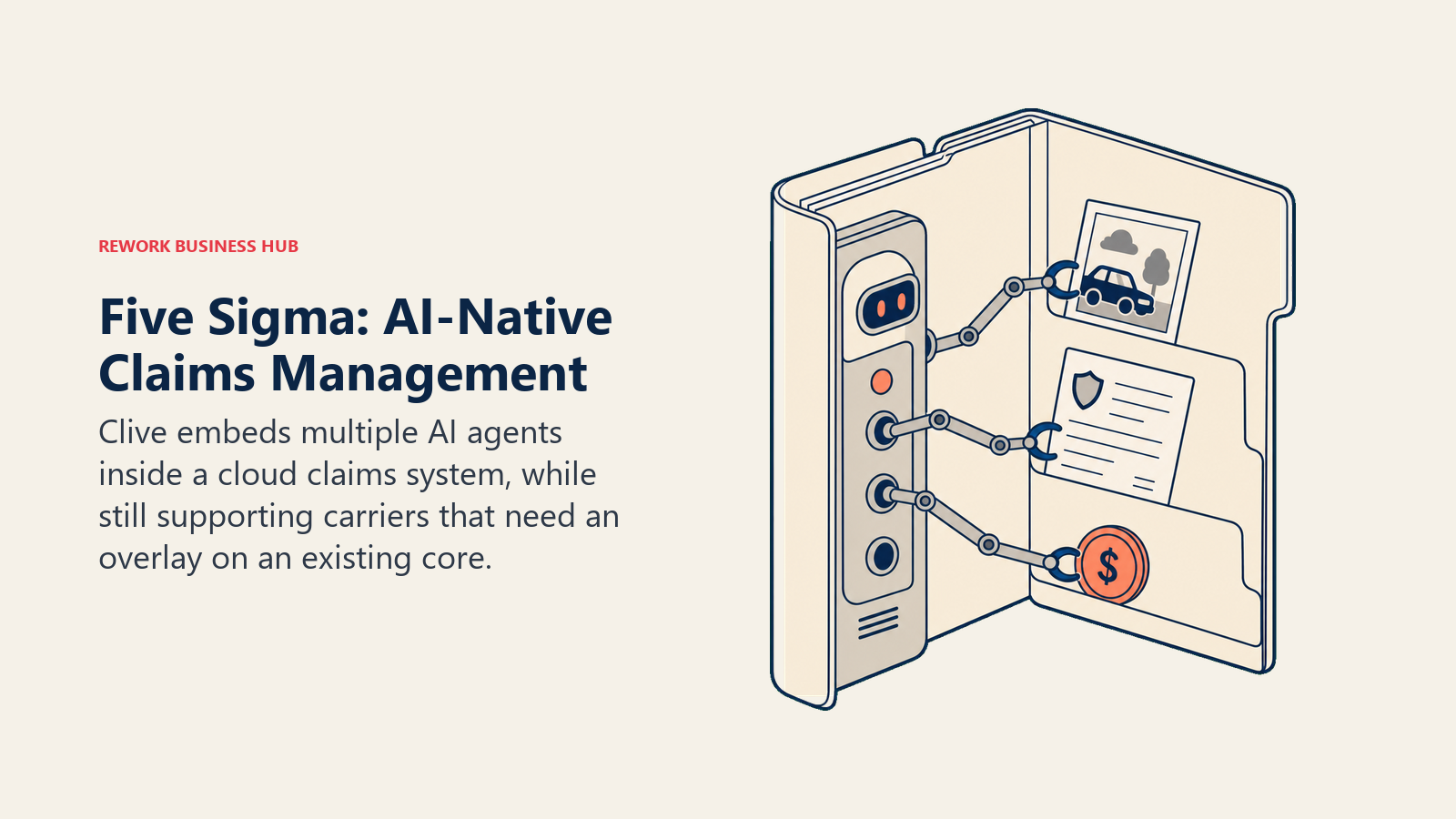
The 2026 addition worth noting is native embedded analytics, powered by Metabase, that gives claims leaders real-time operational and financial data inside the platform instead of exporting to an external BI tool. Insurers on the platform report average cycle time cut by more than 60% and time-to-settlement improved by 45%, according to Five Sigma. If you're weighing whether to modernize claims workflows more broadly before picking a point AI tool, best AI automation tools is a useful adjacent read.
Best for: P&C insurers and MGAs that want an AI-native claims management system, either as a full CMS replacement or an overlay on an existing one
Key strengths:
- Multi-agent AI (Clive) built into the core platform, not added afterward
- Flexible deployment: standalone CMS or overlay on an existing system
- Native embedded analytics removes the need for a separate BI tool
Limitations:
- Newer entrant than Guidewire or Duck Creek for carriers deeply invested in legacy core systems
- Custom pricing with no published self-serve tier
- Cycle-time and settlement figures are vendor-reported, worth validating in your own pilot
| What you get | What you don't |
|---|---|
| AI-native CMS with flexible standalone or overlay deployment | No public pricing; scoped by claim volume |
| Native analytics layer built into the platform | Newer brand recognition than legacy core-system vendors |
| Reported cycle-time and settlement-speed gains | Vendor-reported metrics should be validated in a pilot |
Pricing: Custom, demo required, scoped by claim volume. See fivesigmalabs.com.
3. Shift Technology: Fraud Detection and Claims Decisioning at Scale
Shift Technology is the broadest platform on this list, spanning generative, agentic, and predictive AI across underwriting, claims, and fraud and risk. Its Claims Fraud Detection product scores each claim against an evolving library of hundreds of fraud scenarios and can analyze structured data alongside scanned documents, images, and video, drawing on Azure OpenAI infrastructure to compress what used to be weeks of document sorting into days.
Shift's scale shows up in its partnerships: the company is working with the ICA and EXL on a national motor-insurance fraud detection platform launched in early 2026, and its work with French insurer Covéa spans underwriting risk, claims fraud, compliance scoring, and case management, delivering underwriting ROI within three months of go-live. That breadth is also the tradeoff, Shift is built for insurers who want one AI platform across multiple risk functions, not a narrow claims-only point solution.
Best for: Large insurers and national fraud bureaus that want one AI platform spanning underwriting risk, claims fraud, and case management
Key strengths:
- Broadest scope of any tool on this list: underwriting, claims, and fraud in one platform
- Analyzes unstructured data (documents, images, video) alongside structured claims data
- Proven at national scale through fraud-bureau and multi-line carrier partnerships
Limitations:
- Broader scope means a longer, more complex implementation than a narrow point tool
- Custom enterprise pricing with no published tiers
- Best suited to insurers ready to commit across multiple risk functions, not a single workflow
| What you get | What you don't |
|---|---|
| Fraud, claims, and underwriting risk in one AI platform | No published pricing or lightweight entry tier |
| Proven at national and multi-line enterprise scale | Longer implementation than a single-purpose tool |
| Handles unstructured data (images, video, scans) natively | Requires committing across more than one risk function to see full value |
Pricing: Custom, enterprise-only, demo required. See shift-technology.com.
4. Tractable: Photo-Based Damage and Repair-Cost Appraisal
Tractable solves a narrower but very real problem: turning a policyholder's smartphone photos into a damage assessment and repair estimate in seconds, with pixel-level precision, instead of waiting days for an in-person inspection. It's become the industry standard for real-time visual damage assessment across both auto and property claims, processing thousands of claims a day for more than 20 insurers and automotive companies, including GEICO and every major Japanese insurer.

The results speak to why it's spread so fast: Admiral Seguros reported that Tractable enabled 90% of its auto estimates to run touchless, with 98% of assessments completed in under 15 minutes. That's the kind of speed gain that shows up directly in customer satisfaction scores, especially given how much digital claims satisfaction depends on fast, visible progress. The tradeoff is scope: Tractable appraises damage, it doesn't run your FNOL intake, fraud screening, or full claims workflow, so it needs to sit inside a broader claims stack.
Best for: Auto and property insurers that want fast, accurate photo-based damage appraisal without waiting on in-person inspections
Key strengths:
- Industry-standard computer vision for real-time visual damage assessment
- Proven at real scale: thousands of daily claims across 20+ major insurers
- Dramatically faster touchless estimates (Admiral Seguros: 90% touchless, 98% under 15 minutes)
Limitations:
- Appraisal-only scope, needs to be paired with a full claims management system
- No public pricing; enterprise sales process
- Accuracy depends on photo quality, which varies by policyholder
| What you get | What you don't |
|---|---|
| Industry-leading computer vision for damage assessment | Not a full claims management or FNOL system |
| Proven touchless-estimate results at major carriers | No published pricing tiers |
| Works across both auto and property damage | Requires integration into a broader claims workflow |
Pricing: Custom, enterprise-only, demo required. See tractable.ai.
5. CCC Intelligent Solutions: Auto Physical Damage Estimating at Scale
CCC has quietly become the largest AI estimating network in the auto claims category. More than 6,500 repair shops now use CCC's AI estimating, alongside over 125 insurers, and the company's AI products are growing at roughly 50% year over year, now running at close to a $120 million annual revenue pace. That scale matters because it means the AI has been trained and validated against an enormous, ongoing stream of real repair and claims data, not a limited pilot dataset.

CCC's AI generates line-level estimates on qualified repairable vehicles in seconds, and its computer vision extends into repair-versus-replace decisions, repairability determinations, injury predictions, and subrogation demands. Because CCC's estimating platform already sits inside most insurer and repair-shop workflows, adopting the AI layer is typically an add-on to an existing subscription rather than a net-new procurement. The tradeoff is scope: CCC's depth is in auto physical damage specifically, its footprint outside that lane is thinner than dedicated multi-line platforms like Sprout.ai or Five Sigma.
Best for: Auto insurers and repair networks that want AI estimating already embedded in the ecosystem most of the industry already runs on
Key strengths:
- Largest AI estimating footprint in the category: 6,500+ shops, 125+ insurers
- Line-level estimates generated in seconds on qualified vehicles
- Extends into repairability, total loss, injury prediction, and subrogation
Limitations:
- Primarily an auto physical damage specialist, thinner coverage outside that lane
- Pricing is bundled into existing CCC subscriptions plus custom emerging-solutions add-ons, not self-serve
- Less useful for property, workers' comp, or liability claims
| What you get | What you don't |
|---|---|
| The largest AI estimating network in auto claims | Narrower scope outside auto physical damage |
| Deep integration into existing repair-shop workflows | Not self-serve; bundled/custom pricing |
| Extends into total loss, subrogation, and injury prediction | Less relevant for property or casualty-heavy claims teams |
Pricing: Bundled into existing CCC estimating subscriptions, plus custom emerging-solutions pricing. See cccis.com.
6. Roots (Bevaya / InsurGPT): Document AI and Agentic Claims Processing
Roots rebranded its flagship platform to Bevaya in May 2026, built around InsurGPT, an ensemble of AI models trained on more than 300 million proprietary insurance documents that understand insurance-specific language and context in a way general-purpose LLMs don't. On the claims side, that translates into document classification, indexing, and routing that reaches up to 99% straight-through processing, with a Document Indexing AI Agent that classifies more than 70 document types at 98%+ accuracy.
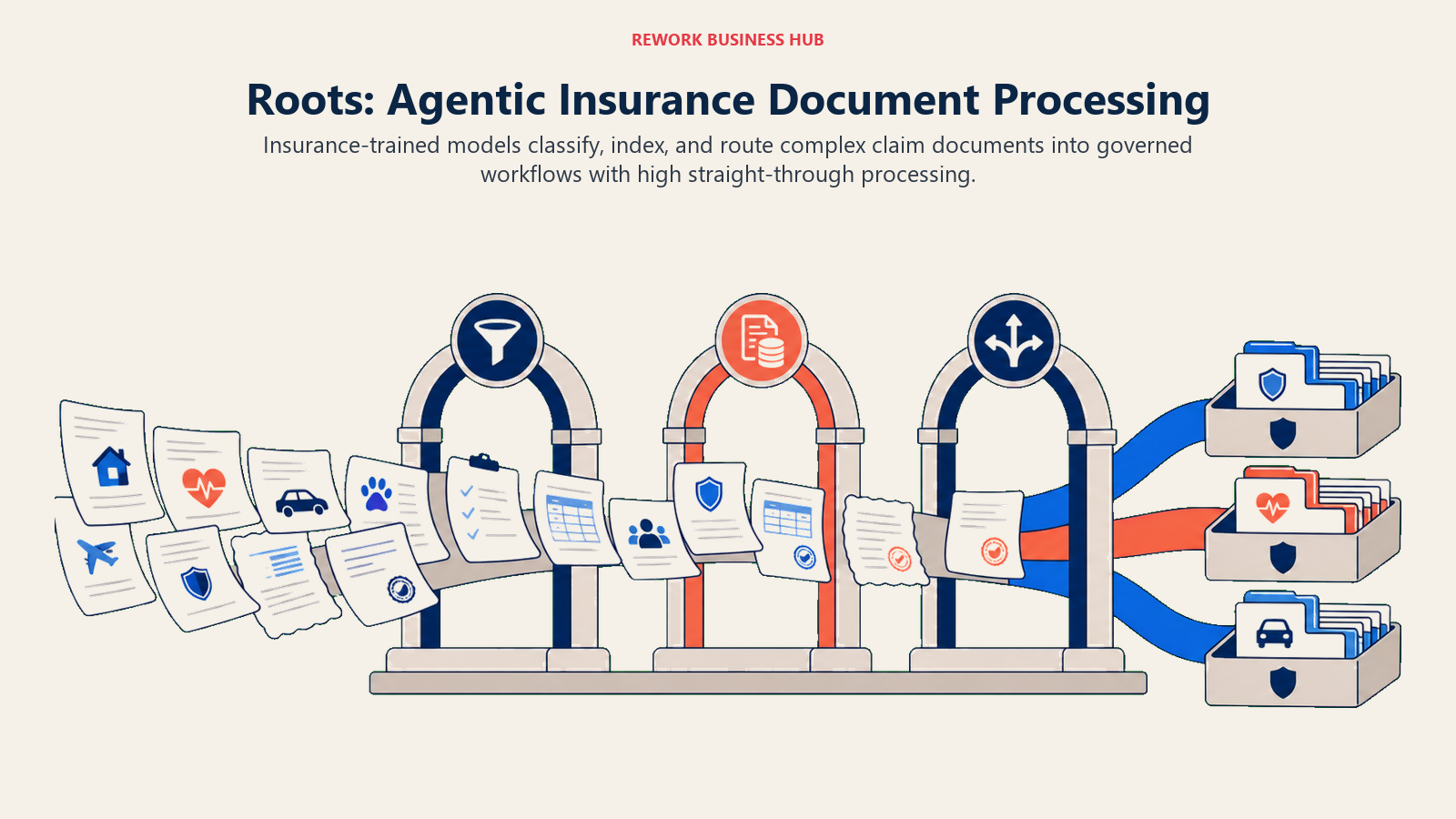
What separates Roots from a typical OCR vendor is the agentic layer: Bevaya lets carriers, brokers, and TPAs design and govern AI agents across underwriting, claims, and policy servicing, not just extract fields from a form. The platform's document indexing accelerator has been validated by Guidewire specifically for ClaimCenter, and the company has racked up more than 115 production deployments across the industry's largest organizations, including three of the top five P&C carriers. For teams evaluating agentic AI more broadly before committing to a claims-specific deployment, best AI agents covers the wider category.
Best for: Enterprise carriers, brokers, and TPAs that want insurance-trained document AI and agentic claims processing layered onto an existing core system
Key strengths:
- InsurGPT is trained specifically on insurance documents, not a generic LLM fine-tune
- Up to 99% straight-through processing on document classification and routing
- Guidewire-validated accelerator and a track record with major P&C carriers
Limitations:
- Enterprise implementation, not a lightweight self-serve tool
- Custom pricing with a required sales and scoping process
- Best value requires real document volume and an existing core system to integrate against
| What you get | What you don't |
|---|---|
| Insurance-specific AI trained on 300M+ documents | Enterprise-only, not self-serve |
| Up to 99% straight-through document processing | Custom pricing, scoped implementation |
| Proven at top-five P&C carrier scale, Guidewire-validated | Needs an existing core system to integrate against |
Pricing: Custom, enterprise-only, demo required. See bevaya.ai.
7. CLARA Analytics (CLARAty.ai): Claims Intelligence for Workers' Comp, Auto Liability, and GL
CLARA Analytics built its platform around the hardest, most expensive claims to manage well: bodily-injury cases across workers' compensation, auto liability, and general liability. CLARAty.ai runs on what the company calls the largest claims AI dataset of bodily-injury cases in the category, powering document intelligence, claims guidance for adjusters, provider network optimization, and attorney management from one system.
The client roster tells you who this is built for: Amazon selected CLARA Analytics specifically to improve health and claim outcomes across its corporate workers' comp program. In 2025 and 2026, CLARA extended into subrogation detection and a dedicated fraud product, CLARA Fraud, which scores claims and provides data-driven justification for SIU referrals, alongside Claims DocIntel Pro for document intelligence on auto and general liability files. If bodily-injury and casualty claims aren't your primary volume driver, though, CLARA's focus narrows its relevance compared to a multi-line platform.
Best for: Carriers, MGAs/MGUs, reinsurers, and self-insured organizations managing significant workers' comp, auto liability, or GL bodily-injury claim volume
Key strengths:
- Largest bodily-injury claims AI dataset in the category, purpose-built for casualty lines
- Proven at enterprise scale (Amazon's corporate workers' comp program)
- Dedicated fraud (CLARA Fraud) and document intelligence (DocIntel Pro) products
Limitations:
- Casualty and bodily-injury focus, less relevant for property or first-party claims
- Custom pricing, no published self-serve tier
- Best fit depends on genuine workers' comp or liability claim volume
| What you get | What you don't |
|---|---|
| Deepest bodily-injury and casualty claims dataset in the category | Narrower relevance outside workers' comp, auto liability, GL |
| Proven at large self-insured and enterprise scale | Custom pricing, no self-serve tier |
| Dedicated fraud and document intelligence products | Best value depends on real casualty claim volume |
Pricing: Custom, enterprise-only, demo required. See claraanalytics.com.
8. EvolutionIQ: Adjuster Guidance for Disability and Workers' Comp
EvolutionIQ, now owned by MetLife, focuses on a specific and measurable job: telling a disability or workers' comp adjuster the right next action on every claim. It's a human-in-the-loop AI, meaning it recommends interventions like earlier medical specialist referrals rather than making autonomous decisions, which matters a lot in lines of business where a wrong call has real financial and legal consequences.
The results are among the most concrete on this list. Carriers and third-party administrators using the platform for more than a year have seen claim flow-through reduced by up to 45%, and the rate of claims moving from short-term to long-term disability cut by roughly 50%. EvolutionIQ's Medhub product adds AI medical summarization specifically for workers' comp claims, cutting down the manual record review that eats up adjuster time on complex casualty files. Being MetLife-owned is worth flagging for carriers who compete directly with MetLife, some will prefer a vendor without that ownership structure.
Best for: Disability, workers' comp, and casualty carriers that want proven next-best-action guidance for adjusters, not full claims automation
Key strengths:
- Human-in-the-loop design keeps adjusters in control of final decisions
- Documented, carrier-reported reductions in claim flow-through and LTD transitions
- Medhub adds AI medical summarization specifically for workers' comp files
Limitations:
- Narrower scope than full claims automation platforms: guidance, not FNOL or fraud
- MetLife ownership may be a consideration for competing carriers
- Custom pricing, enterprise sales process
| What you get | What you don't |
|---|---|
| Proven, carrier-reported claim outcome improvements | Narrower scope: guidance layer, not full claims automation |
| Human-in-the-loop design for regulated casualty lines | MetLife ownership may matter to some competing carriers |
| AI medical summarization built specifically for workers' comp | Custom pricing with no published tiers |
Pricing: Custom, enterprise-only, demo required. See evolutioniq.com.
9. Charlee.ai: Litigation and Severity Prediction, Claims Triage
Charlee.ai's job is prediction, not processing. Trained on more than 55 million claims, its engine scores incoming claims for fraud indicators, predicted severity, and litigation likelihood, then prioritizes them so simpler claims move fast and high-risk, pre-litigation cases get an experienced adjuster's attention early. That triage step is what most claims teams are missing: without it, a claim heading toward litigation often looks identical to a routine one until it's already too late to change the outcome.
Charlee.ai is integrated into several core claims systems rather than sold as a standalone workflow tool, including a 2026 integration with PCMS Atlas that embeds real-time litigation probability scores and fraud detection directly into that platform. It also monitors reserve adequacy and flags early high-severity bodily-injury cases, giving claims leaders a forward-looking view instead of a reactive one. Because it's a scoring and prediction layer, it needs to sit on top of an existing claims management system rather than replace one.
Best for: P&C carriers that want litigation and severity prediction layered onto their existing claims management system
Key strengths:
- Pre-trained on 55M+ claims for litigation probability and severity scoring
- Prioritizes claims by predicted risk, not just intake order
- Integrates into core systems (Guidewire, Duck Creek, PCMS Atlas) rather than requiring a switch
Limitations:
- Prediction and scoring layer, not a full claims workflow system on its own
- Requires integration work with your existing CMS
- Custom pricing, no published self-serve tier
| What you get | What you don't |
|---|---|
| Litigation and severity prediction trained on 55M+ claims | Not a standalone claims management system |
| Integrates into Guidewire, Duck Creek, and PCMS Atlas | Requires core-system integration to deploy |
| Early fraud and high-severity bodily-injury alerts | Custom pricing, enterprise sales process |
Pricing: Custom, enterprise-only, demo required. See charlee.ai.
10. Gradient AI: Explainable Risk Scoring for Claims and Underwriting
Gradient AI takes a data-first approach that sets it apart from tools trained on generic industry benchmarks: its models are trained on a carrier's own historical policy, premium, claims, and loss-development data, then output a risk score with feature-importance explanations showing which signals drove the prediction. On the claims side, that means high-risk claims get flagged early, so experienced adjusters can be routed to the files where they'll make the biggest difference.
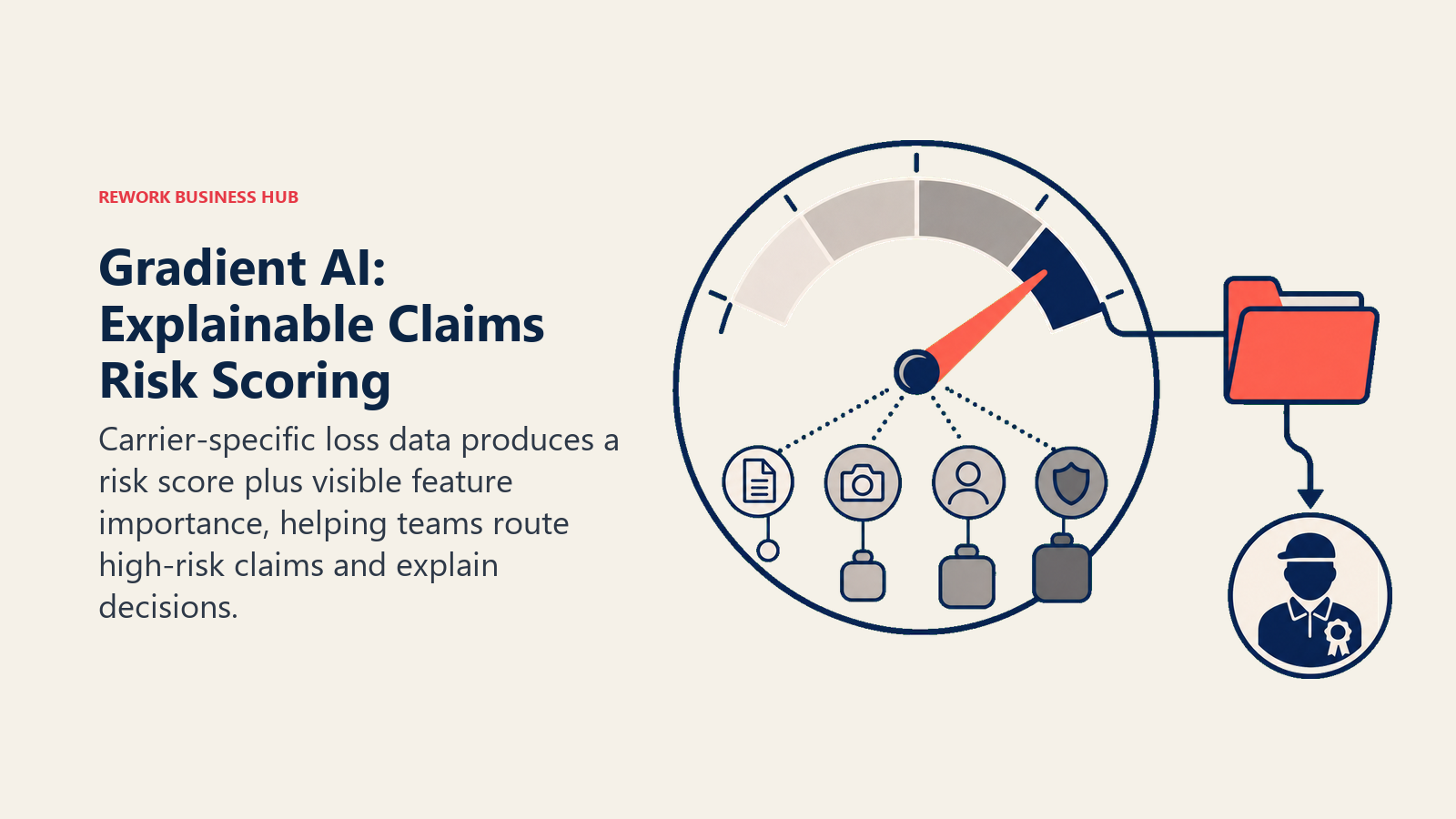
The explainability piece matters more in 2026 than it did a year ago, with the NAIC's Model Bulletin requiring insurers to be able to explain how an AI system contributed to an adverse decision. Gradient AI's feature-importance layer is built to answer exactly that kind of regulatory question, which is a meaningful differentiator against black-box scoring engines. The tradeoff is scope: Gradient AI is a risk-scoring engine, not a full claims processing or communication platform, so it works best as a layer on top of an existing CMS.
Best for: Insurers that want explainable, carrier-specific risk scoring for both claims triage and underwriting, not a full claims workflow platform
Key strengths:
- Models trained on your own carrier's historical data, not generic benchmarks
- Explainable feature-importance scoring built for regulatory transparency
- Spans both underwriting and claims risk from one scoring engine
Limitations:
- Risk-scoring engine, not a full claims management or communication platform
- Requires meaningful historical data to train an effective carrier-specific model
- Custom pricing, no published self-serve tier
| What you get | What you don't |
|---|---|
| Explainable risk scores trained on your own claims data | Not a full claims processing or communication platform |
| Useful across both underwriting and claims risk | Needs sufficient historical data to train well |
| Built with regulatory explainability in mind | Custom pricing, enterprise sales process |
Pricing: Custom, enterprise-only, demo required. See gradientai.com.
11. FRISS: Fraud and Compliance Scoring at Intake
FRISS is a European-born fraud detection specialist and one of the closest alternatives to Shift Technology in this category, covering three stages: underwriting fraud detection at the point of policy sale, real-time claims fraud scoring at intake, and SIU case management with network analysis for investigators. It positions itself as the leading provider of what it calls Trust Automation, real-time scoring that gives claims teams instant context on the risk level of a customer or interaction.
Where FRISS distinguishes itself is breadth across the policy lifecycle: because it scores both applications and claims, it can catch patterns that only become visible when you connect underwriting-stage signals to claims-stage behavior. Its core strength, though, still skews toward the underwriting-fraud side of the business, carriers whose primary pain point is claims-stage fraud specifically may find Shift Technology or Charlee.ai a tighter fit for that narrower job.
Best for: Insurers that want fraud and compliance scoring spanning both underwriting and claims, not a claims-only point solution
Key strengths:
- Covers the full fraud lifecycle: underwriting, claims, and SIU case management
- Real-time scoring at both policy application and claims intake
- Strong European market presence as a genuine Shift Technology alternative
Limitations:
- Core strength skews toward underwriting-fraud detection over pure claims fraud
- Custom pricing, no published tiers
- Best value requires deploying across both underwriting and claims, not claims alone
| What you get | What you don't |
|---|---|
| Fraud scoring across the full policy lifecycle | Core strength skews toward underwriting over claims |
| SIU case management and network analysis included | No published pricing |
| Strong alternative to Shift Technology, especially in Europe | Best value needs both underwriting and claims deployment |
Pricing: Custom, enterprise-only, demo required. See friss.com.
12. Snapsheet: Virtual Appraisal and Claims Management
Snapsheet started as a virtual appraisal company and has since built out into a full claims management system, giving it a somewhat unusual position: it can be adopted narrowly for photo-based virtual appraisals or as a broader claims platform once a carrier is ready to expand. The core value proposition is speed and accuracy, reducing cycle time, increasing appraisal accuracy, and enabling digital payments so a claim can move from photo submission to payout without an in-person inspection.

Because Snapsheet grew from a point solution into a platform rather than being built as a full CMS from the start, it's a reasonable middle ground for carriers who want more than Tractable's pure appraisal scope but aren't ready for the full commitment of Five Sigma or Sprout.ai. Pricing isn't published, and like most of this category, expect a subscription structure tied to claim or user volume rather than a flat public rate.
Best for: Auto insurers that want virtual appraisal with the option to grow into a fuller claims management platform over time
Key strengths:
- Started in virtual appraisal, giving it deep expertise in that specific workflow
- Grew into a full claims management system, not just a point tool
- Digital payment capability built into the claims-to-payout flow
Limitations:
- No public pricing; likely tied to claim or user volume
- Newer to the full CMS category than dedicated platforms like Five Sigma
- Less proven at the largest enterprise scale than CCC or Shift Technology
| What you get | What you don't |
|---|---|
| Strong virtual appraisal foundation plus growing CMS features | No published pricing |
| Digital payment built into the claim-to-payout workflow | Newer to full CMS category than dedicated platforms |
| Flexible: adopt narrowly or expand into a full platform | Less enterprise scale proof than CCC or Shift Technology |
Pricing: Custom, not published; subscription typically tied to claim or user volume. See snapsheetclaims.com.
13. Hi Marley: Claims Communication via SMS
Hi Marley solves a problem most claims-AI vendors ignore: the back-and-forth after FNOL, status updates, document requests, scheduling, that happens over phone tag and email today. It's a purpose-built conversational platform connecting carriers, policyholders, and service providers in a single trusted SMS thread, and it's now trusted by more than 130 customers, including 13 of the top 30 P&C carriers.
In June 2026, Hi Marley expanded beyond claims into policyholder service more broadly, launching Hi Marley for Service to handle high-volume interactions like billing and policy changes in the same structured channel. That expansion is telling: carriers that adopted it for claims communication liked it enough to want the same experience elsewhere. Worth noting for claims leaders specifically, Hi Marley is focused on the communication layer after FNOL, it doesn't run conversational FNOL intake itself, so it pairs naturally with a tool like Ushur rather than replacing it.
Best for: P&C carriers whose claims experience breaks down in the post-FNOL back-and-forth: status updates, document requests, and scheduling
Key strengths:
- Purpose-built for P&C claims communication, not a generic customer-service chatbot retrofit
- Proven adoption: 130+ customers including 13 of the top 30 P&C carriers
- 2026 expansion into policyholder service shows platform staying power
Limitations:
- Focused on post-FNOL communication, doesn't handle conversational FNOL intake
- Custom pricing, not published
- Best paired with a separate FNOL or claims-management tool for full coverage
| What you get | What you don't |
|---|---|
| Purpose-built SMS communication trusted by top-30 P&C carriers | Doesn't run FNOL intake itself |
| Single trusted thread across carrier, policyholder, and service providers | No published pricing |
| 2026 expansion into broader policyholder service | Needs pairing with a separate FNOL tool for full coverage |
Pricing: Custom, not published. See himarley.com.
14. Ushur: Conversational AI FNOL Intake
Ushur is an AI-first customer engagement platform with a strong presence in insurance, and its digital FNOL handler is built to do the opposite of what most legacy intake processes do: let a policyholder report a claim through a guided digital conversation, on web or mobile, without waiting on hold. The vendor reports 8x faster processing and roughly 90% cost reduction with 24/7 claims intake compared to a traditional call-center FNOL process.

Ushur is a strong fit when the priority is customer-experience modernization and speed to market, it's genuinely one of the fastest ways to stand up a modern FNOL front door. The honest caveat, and one worth taking seriously given the regulatory direction of 2026, is that AI-first conversational systems are inherently stochastic: outputs can vary in how they capture claim data, and for lines of business where a strict audit trail is a hard compliance requirement, that variability needs real testing before you rely on it for regulated intake. For a broader look at conversational AI options, best AI chatbots covers the category outside insurance-specific tools.
Best for: Insurers that want fast, modern conversational FNOL intake and are willing to validate output consistency before deploying it on strictly regulated lines
Key strengths:
- Vendor-reported 8x faster processing and roughly 90% cost reduction on FNOL intake
- 24/7 digital claims reporting without call-center wait times
- Fast time-to-market compared to a full claims-platform rebuild
Limitations:
- Stochastic AI outputs can introduce variability in how claim data is captured
- Regulated lines with strict audit-trail requirements need extra validation before go-live
- Custom pricing, not published
| What you get | What you don't |
|---|---|
| Fast, modern conversational FNOL intake, 24/7 | Probabilistic outputs need validation for regulated lines |
| Reported 8x speed and ~90% cost reduction on intake | No published pricing |
| Quick time-to-market vs. a full platform rebuild | Not a full claims management or fraud-detection system |
Pricing: Custom, not published. See ushur.ai.
Pricing at a Glance
| Tool | Entry Price | Pricing Model | Demo/Pilot Available? |
|---|---|---|---|
| Sprout.ai | Custom | Enterprise quote, scoped by document volume/LOB | Yes |
| Five Sigma (Clive) | Custom | SaaS platform, scoped by claim volume | Yes |
| Shift Technology | Custom | Enterprise platform licensing | Yes |
| Tractable | Custom | Volume-based licensing | Yes |
| CCC Intelligent Solutions | Bundled + custom | Add-on to existing CCC subscription | Yes |
| Roots (Bevaya) | Custom | Enterprise agentic AI platform licensing | Yes |
| CLARA Analytics | Custom | Enterprise SaaS, scoped by claim volume/LOB | Yes |
| EvolutionIQ | Custom | Enterprise claims guidance licensing | Yes |
| Charlee.ai | Custom | Enterprise platform licensing | Yes |
| Gradient AI | Custom | Model licensing, scoped by data volume | Yes |
| FRISS | Custom | Enterprise fraud-scoring licensing | Yes |
| Snapsheet | Custom, not published | SaaS, scoped by claim/user volume | Yes |
| Hi Marley | Custom, not published | Per-carrier SMS platform licensing | Yes |
| Ushur | Custom, not published | Platform plus usage-based | Yes |
How to Choose: Decision Framework
| If you need... | Pick... | Why |
|---|---|---|
| End-to-end claims automation from FNOL to settlement across lines | Sprout.ai | Full-lifecycle, document-heavy automation on one platform |
| A full claims management system with AI agents built in | Five Sigma (Clive) | AI-native CMS that works standalone or as an overlay |
| Fraud detection and decisioning at national/enterprise scale | Shift Technology | Broadest fraud and decisioning platform, proven at national scale |
| Instant photo-based damage and repair-cost estimates | Tractable | Computer vision built specifically for real-time visual damage assessment |
| Auto physical damage estimating at the largest network scale | CCC Intelligent Solutions | Already embedded at 6,500+ repair shops and 125+ insurers |
| Document classification and agentic processing at near-total STP | Roots (Bevaya / InsurGPT) | Insurance-trained AI purpose-built for claims documents |
| Workers' comp, auto liability, or GL bodily-injury claims intelligence | CLARA Analytics | Largest bodily-injury claims AI dataset in the category |
| Next-best-action guidance for disability or workers' comp adjusters | EvolutionIQ | Human-in-the-loop guidance with documented outcome improvements |
| Litigation and severity prediction before a claim escalates | Charlee.ai | Real-time litigation probability scoring trained on 55M+ claims |
| Explainable risk scores trained on your own claims history | Gradient AI | Models trained on carrier-specific data, with feature-level explainability |
| Real-time fraud scoring across underwriting and claims intake | FRISS | Point-of-sale and claims fraud scoring in one platform |
| Virtual appraisal with room to grow into a fuller claims platform | Snapsheet | Started in virtual appraisal, now a broader CMS option |
| Structured SMS communication between adjusters and policyholders | Hi Marley | Purpose-built conversation thread trusted by top-30 P&C carriers |
| Fast, modern conversational FNOL intake | Ushur | 24/7 digital FNOL handler built for speed and CX |
Framework: By Carrier Size and Claims Volume
| Profile | Volume Signal | Best Fits |
|---|---|---|
| Small regional carrier or MGA | Under 5,000 claims/month | Snapsheet, Hi Marley, Ushur |
| Mid-size P&C carrier | 5,000-50,000 claims/month | Five Sigma, Sprout.ai, Tractable, CLARA Analytics |
| Large national or multi-line carrier | 50,000+ claims/month | Shift Technology, CCC Intelligent Solutions, Roots (Bevaya), Gradient AI |
| Disability, workers' comp specialist, or TPA | Casualty-focused, any volume | EvolutionIQ, CLARA Analytics, Charlee.ai |
| SIU or fraud investigation unit | Fraud-specific, not volume-driven | Shift Technology, FRISS, Charlee.ai |
Compliance, Explainability, and Regulatory Risk
Claims AI carries more regulatory weight than almost any other AI use case in insurance, because a claims decision directly affects a consumer's money. The NAIC's Model Bulletin on the Use of Artificial Intelligence Systems by Insurers, adopted in December 2023, requires insurers to maintain a written AI governance program and to be able to give a specific, accurate explanation when an AI-informed decision produces an adverse outcome for a policyholder. More than 40 states have now adopted or are actively considering AI-specific insurance regulation built on that framework, according to Quarles & Brady's tracking of state adoption.
That's not theoretical for the tools on this list. The NAIC's AI Systems Evaluation Tool, now piloting across twelve states through September 2026, asks carriers structured questions about governance programs, bias testing, vendor oversight, and documentation, meaning the AI vendor you choose becomes part of your own regulatory exam answers. Before signing with any tool here, ask three questions: Can the vendor produce a plain-language explanation for any individual claims decision it influences? Does a human stay in the loop for adverse outcomes, or does the system act autonomously? And can the vendor show you their own bias-testing results, not just describe the process. Tools built with explainability as a first-class feature, like Gradient AI's feature-importance scoring or EvolutionIQ's human-in-the-loop design, have a real head start here over pure black-box scoring engines.
Where AI Claims Tools Are Headed
The claims category is converging on two things at once: faster processing and harder scrutiny. Every tool on this list is racing to cut cycle time and leakage, but 2026's regulatory pilots make clear that speed without explainability is a liability, not a win. Expect the next wave of product announcements to lean as heavily on "here's how we explain this decision" as they do on "here's how fast we made it." The fraud side of the category is also getting harder, not easier, as AI-generated claim photos and documents become common enough that Verisk found virtually every insurer already dealing with them.
If you're building out your broader AI toolkit alongside claims specifically, best AI tools for enterprise and best AI tools for data analysis cover the adjacent categories most claims and operations leaders are evaluating in parallel. And if your finance team is watching claims payout and reserve automation as part of a wider AI rollout, best AI tools for finance teams is a useful next read.
Frequently Asked Questions about AI Tools for Insurance Claims Processing
What's the best AI tool for insurance claims processing in 2026?
There's no single best tool, the right pick depends on the job. Sprout.ai and Five Sigma lead for end-to-end claims automation, Shift Technology and FRISS lead for fraud detection, Tractable and CCC Intelligent Solutions lead for photo-based damage appraisal, Roots (Bevaya) leads for document AI, and EvolutionIQ and CLARA Analytics lead for adjuster guidance on disability and casualty lines. Match the tool to the specific claims job, not a general ranking.
Can AI tools replace human claims adjusters entirely?
No, and most vendors on this list don't claim to. EvolutionIQ and Gradient AI are explicitly human-in-the-loop, recommending actions rather than making autonomous decisions. Even tools with high straight-through processing rates, like Roots' up-to-99% document classification, are automating a specific step (document routing, appraisal, fraud scoring), not replacing an adjuster's judgment on complex or contested claims. Regulatory pressure through the NAIC Model Bulletin also pushes toward keeping humans in the loop for adverse outcomes.
How much do AI claims processing tools cost?
Almost every tool on this list uses custom, enterprise pricing with no public rate card, deal size typically scales with claim volume, document volume, and lines of business covered. CCC Intelligent Solutions is a partial exception since its AI estimating is often an add-on to a CCC subscription insurers already have. Budget for a scoped demo and a multi-month evaluation rather than a same-day signup for any tool on this list.
What is FNOL automation and which tools handle it best?
FNOL (first notice of loss) automation lets a policyholder report a claim digitally, through a guided chat or form, instead of a phone call, and routes it into the claims workflow automatically. Ushur is built specifically for conversational FNOL intake, Sprout.ai and Five Sigma both handle FNOL as the entry point to their broader automation, and Hi Marley picks up the communication that follows FNOL rather than the intake step itself.
How do insurers stay compliant with the NAIC AI Model Bulletin when adopting these tools?
Start by confirming the vendor can produce a plain-language explanation for any individual claims decision it influences, since the Model Bulletin requires insurers to explain adverse AI-informed outcomes to consumers. Ask for the vendor's own bias-testing documentation, not just a description of their process, and confirm whether a human stays in the loop for adverse decisions. More than 40 states have adopted or are considering rules built on the Model Bulletin, so this isn't optional due diligence, it's becoming a standard part of vendor selection.
Which AI tool is best for fraud detection specifically?
Shift Technology has the broadest fraud footprint, spanning underwriting, claims, and national fraud-bureau partnerships. FRISS is the closest direct alternative, especially strong in Europe and on the underwriting-fraud side. CLARA Fraud and Charlee.ai both add fraud and litigation-risk scoring specifically for casualty and bodily-injury claims, which is a narrower but often higher-value fit for workers' comp and liability-heavy books.
Do these AI claims tools work with Guidewire or Duck Creek?
Most are built to integrate with, not replace, existing core systems. Roots' document indexing accelerator is Guidewire-validated for ClaimCenter specifically, Charlee.ai integrates into Guidewire, Duck Creek, and PCMS Atlas, and Shift Technology has a documented partnership with Duck Creek for fraud and subrogation. Five Sigma is the exception that can run as either a standalone CMS or an overlay, so confirm your specific core-system version supports the integration before you commit.

Principal Product Marketing Strategist
On this page
- What Changed in 2026
- Key Facts
- Quick Comparison Table
- 1. Sprout.ai: End-to-End Claims Automation From FNOL to Settlement
- 2. Five Sigma (Clive): AI-Native Claims Management Platform
- 3. Shift Technology: Fraud Detection and Claims Decisioning at Scale
- 4. Tractable: Photo-Based Damage and Repair-Cost Appraisal
- 5. CCC Intelligent Solutions: Auto Physical Damage Estimating at Scale
- 6. Roots (Bevaya / InsurGPT): Document AI and Agentic Claims Processing
- 7. CLARA Analytics (CLARAty.ai): Claims Intelligence for Workers' Comp, Auto Liability, and GL
- 8. EvolutionIQ: Adjuster Guidance for Disability and Workers' Comp
- 9. Charlee.ai: Litigation and Severity Prediction, Claims Triage
- 10. Gradient AI: Explainable Risk Scoring for Claims and Underwriting
- 11. FRISS: Fraud and Compliance Scoring at Intake
- 12. Snapsheet: Virtual Appraisal and Claims Management
- 13. Hi Marley: Claims Communication via SMS
- 14. Ushur: Conversational AI FNOL Intake
- Pricing at a Glance
- How to Choose: Decision Framework
- Framework: By Carrier Size and Claims Volume
- Compliance, Explainability, and Regulatory Risk
- Where AI Claims Tools Are Headed