Best Free AI Agents in 2026: 17 Tools Ranked by What's Actually Free
Turn this article into takeaways for your work.


Each assistant summarizes the article only for you and suggests best practices for your work.
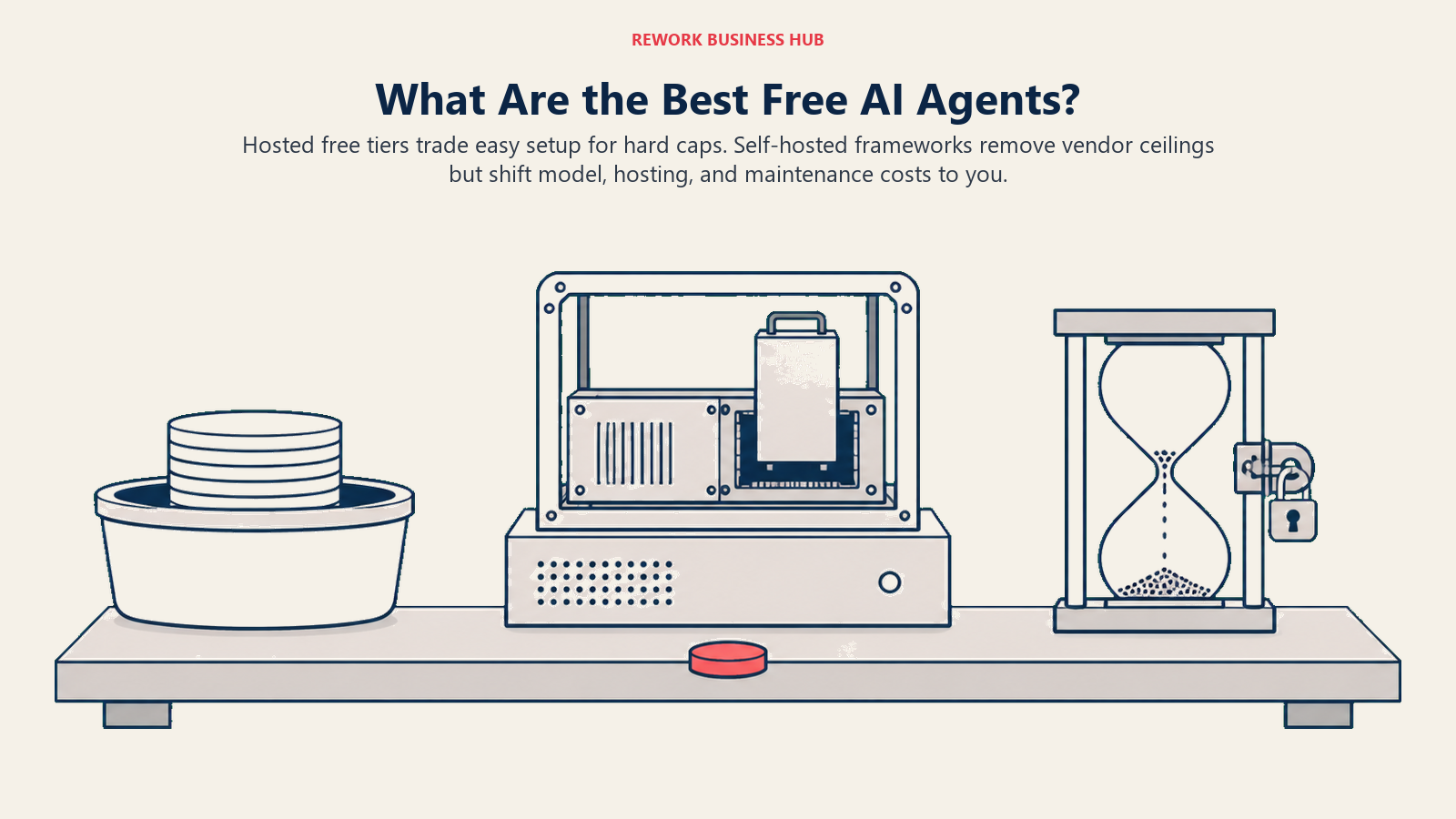
The best free AI agent for your team depends on which kind of "free" you can actually live with. Zapier Agents and Stack AI hand you a genuine zero-cost tier with nothing to host. n8n and CrewAI cost nothing indefinitely if you're willing to self-host open-source code. And if what you actually clicked on was Lindy, Gumloop, or ChatGPT's agent mode, none of those are free past a trial or a locked door, no matter what the landing page implies. This guide sorts 17 AI agents into three honest categories, plus two well-known chatbot tools that don't clear the bar for "agent" on their free plan at all.
An AI agent plans a sequence of steps and calls tools or APIs to carry them out; what is an AI agent covers that plan-act-observe loop in full. An AI tool assists a human who does the deciding at every step. That line matters more on a "free" list than almost anywhere else, because plenty of vendors put "AI agent" on a free chatbot that only answers questions and gate the actual tool-calling behind a paid tier. This guide enforces that distinction product by product instead of assuming it. If you'd rather build your own agent than buy one, how to build an AI agent is the vendor-neutral blueprint. If you want the full paid-and-free landscape, start with best AI agent platforms in 2026.
Key Facts
- KPMG's Q2 2026 Global AI Pulse found 49% of leaders had scaled back AI agent deployments because running costs outweighed the benefits, exactly the blind spot an unbudgeted "free" tier creates once its ceiling arrives, per Forbes' coverage of the KPMG survey.
- More than 1.1 million public GitHub repositories now import an LLM SDK, up 178% year over year, much of it built on the free, open-source frameworks covered in this guide, per GitHub's 2025 Octoverse report.
- Enterprises buying ready-made AI solutions instead of building their own rose from 53% in 2024 to 76% in 2025, per Menlo Ventures' State of Generative AI in the Enterprise.
- Gartner predicts more than 40% of agentic AI projects will be canceled by the end of 2027, citing unclear business value and inadequate risk controls, per Gartner.
- 57% of organizations now have AI agents running in production, per LangChain's State of Agent Engineering survey of 1,340 practitioners.
- 89% of development executives are implementing or planning a citizen developer strategy, the population most likely to reach for a free no-code agent tier first, per Forrester's Developer Survey, 2025.
The Three Kinds of "Free" in AI Agents
Every vendor in this category calls something "free." Three very different things hide behind that word, and mixing them up is how a team budgets for $0 and gets billed for $400 a month later.
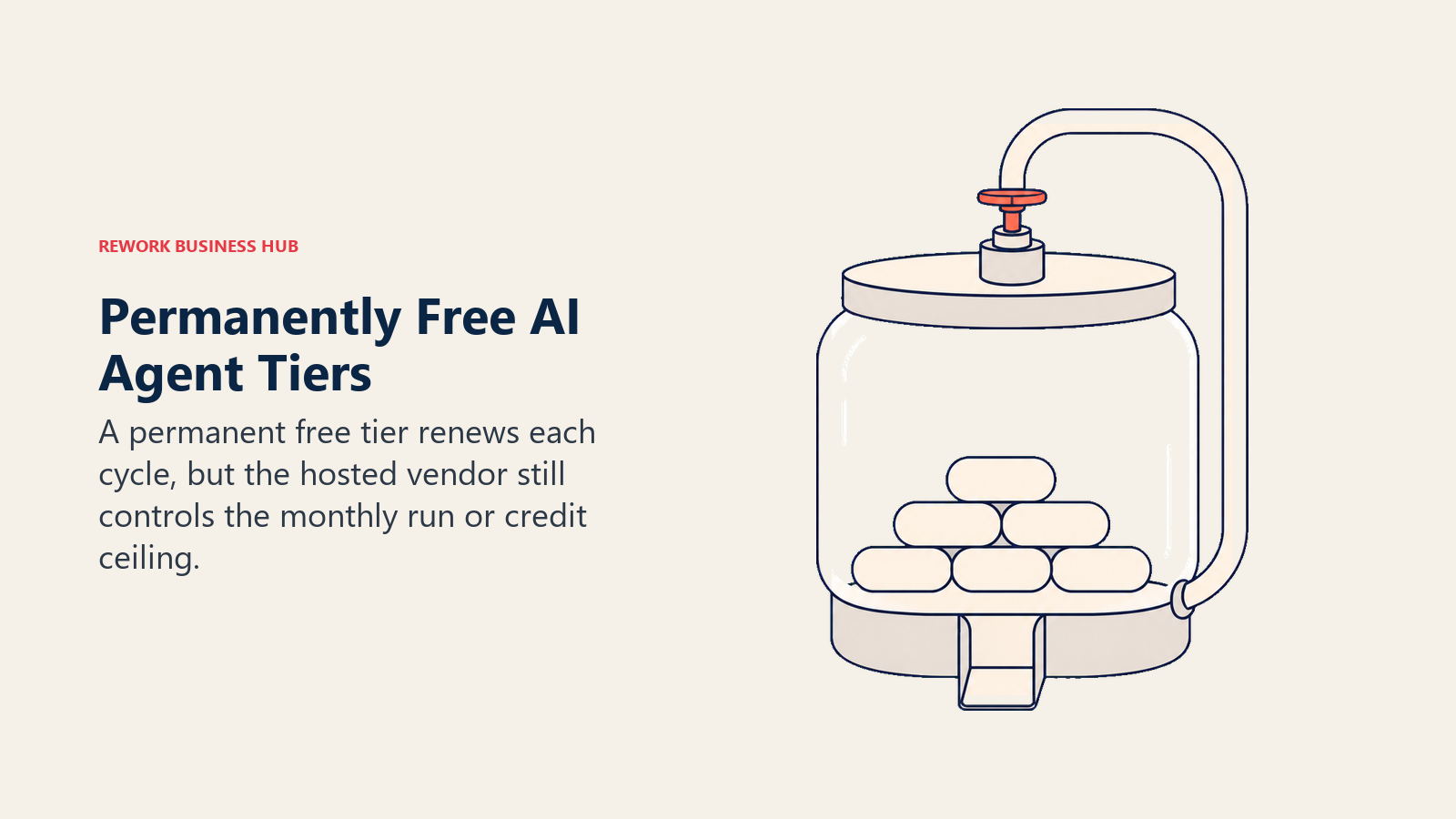
- Permanently free tier. A vendor-hosted product with a real $0/month plan that doesn't expire, capped by usage (runs, credits, tasks) rather than a calendar. The vendor absorbs the underlying AI model cost inside your usage cap, so you never see a second bill for tokens as long as you stay under the ceiling.
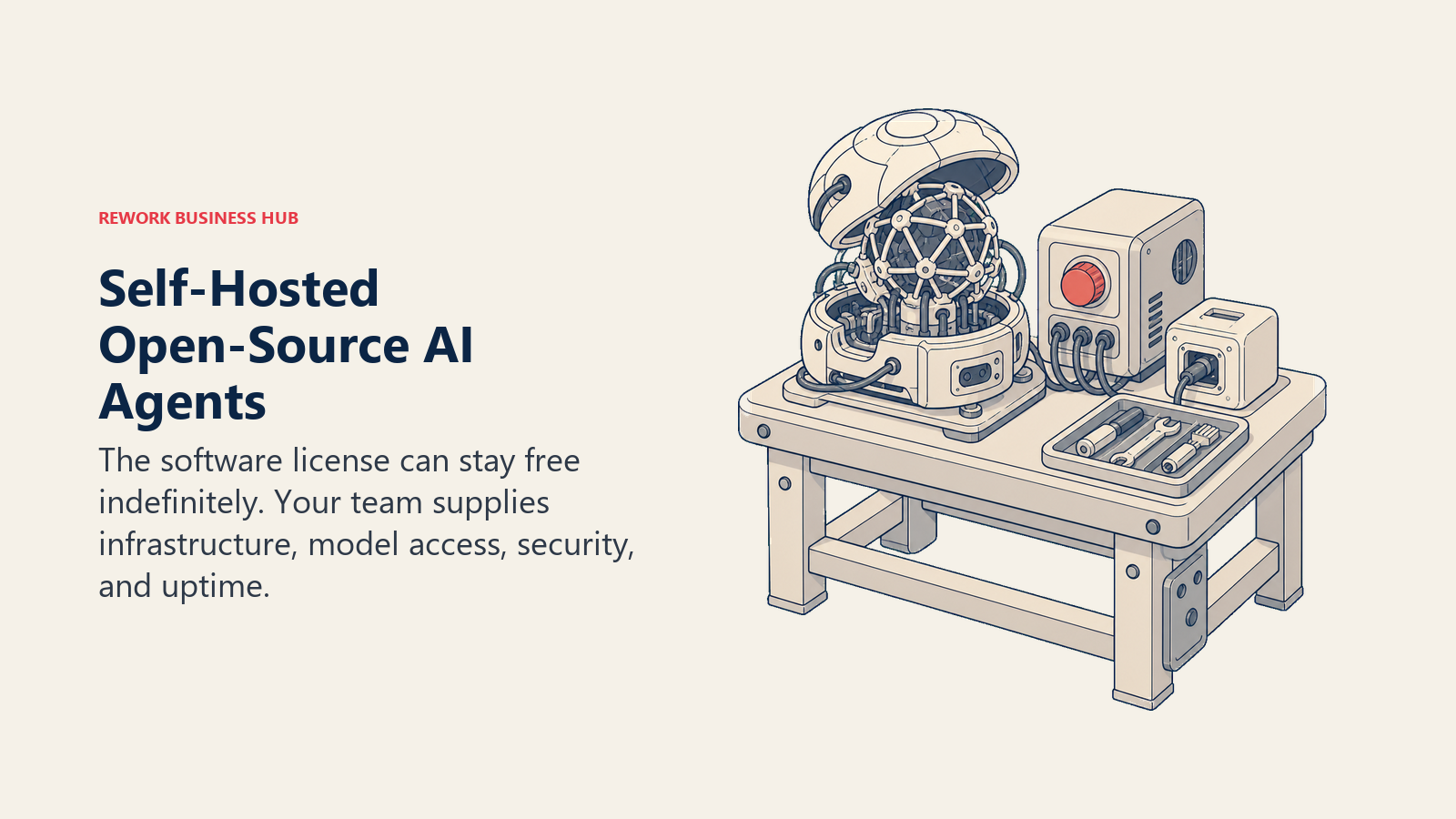
- Free and open source, self-hosted. The code costs nothing and never will, under a license that lets you run it indefinitely. You supply the server and, in almost every case, your own AI model API key, so "free" means "no license fee," not "no bill at all."
- Free trial or limited credit grant. A clock or a one-time allotment, not a tier. It exists to get a card on file or a demo booked, and the real price shows up the moment the trial ends or the credits run out.
A fourth pattern showed up often enough in researching this list that it earns its own section below: a genuinely free plan that simply isn't an agent yet. Chatbase and Tidio both ship a real $0/month tier, and neither one includes the tool-calling "Actions" that make something an agent rather than a chatbot, until you pay.
Quick Comparison Table
| Tool | Free Category | Free Ceiling | Genuinely Agentic on Free? | Cheapest Paid Tier |
|---|---|---|---|---|
| Zapier Agents | Permanently free | 400 activities/mo | Yes | About $33/mo (annual) |
| Make (AI Agents) | Permanently free | 1,000 credits/mo | Yes | $9/mo |
| Stack AI | Permanently free | 500 runs/mo, 1 seat | Yes | Enterprise, custom (no mid-tier) |
| Beam AI | Permanently free | 20 tasks/mo | Yes | $50/mo |
| Dify Cloud | Permanently free | 200 message credits/mo | Yes | $49.17/mo ($590/yr) |
| Flowise Cloud | Permanently free | 100 predictions/mo | Yes | $35/mo |
| n8n (Community) | Open source, self-hosted | Unlimited, your infrastructure | Yes | EUR 20/mo (~$22) Cloud, if you skip self-hosting |
| CrewAI | Open source, self-hosted | Unlimited, your infrastructure | Yes | Enterprise, custom, for hosted AMP beyond 50 free runs/mo |
| Hugging Face smolagents | Open source, self-hosted | Unlimited, your infrastructure | Yes | Not applicable, the code stays free |
| Langflow | Open source, self-hosted | Unlimited, your infrastructure | Yes | Not applicable, no small hosted tier |
| OpenHands | Open source, self-hosted | Unlimited locally | Yes | Enterprise, custom, for team Cloud |
| Lindy | Trial only | 1 week, Slack signup only | Yes, once paid | $29.99/mo per user |
| Gumloop | Trial only | 14 days | Yes, once paid | $37/mo |
| Relevance AI | Reported only | Not shown on the public page | Yes, once paid | Custom, sales-gated |
| Microsoft Copilot Studio | One-time credit | $200 one-time Azure credit | Yes, once paid | $200/mo per 25,000 credits |
| ChatGPT (OpenAI) | Not on free plan | None on Free or Go | No, Plus required | $20/mo (Plus) |
| Google Gemini | Not on free plan | None on the free app | No, AI Pro required | $19.99/mo (Google AI Pro) |
| Chatbase | Free, not agentic | 50 message credits/mo | No, Actions need Standard | $120/mo for tool-calling |
| Tidio (Lyro) | Free, limited | 50 conversations, lifetime | Mostly Q&A, not confirmed multi-step | $32.50/mo add-on |
The Real Cost of "Free"
Here's the honest number most "best free" lists skip: what does a small team actually pay to run one of these at real, modest volume, not a demo? The benchmark below assumes roughly 500 agent actions a month, a fair proxy for a 3 to 8 person team running one or two agents daily in production, not just kicking the tires. KPMG's finding that 49% of leaders scaled back agent spending over unforecast costs is exactly the trap this table is built to avoid.
| Tool | Model Cost Included in Free Tier? | Realistic All-In Cost at ~500 Actions/Month |
|---|---|---|
| Zapier Agents | Yes, Zapier's own AI | $0 if you stay under 400; about $33/mo the moment you cross it |
| Make (AI Agents) | Yes, by default, or bring your own key | $0, comfortably under the 1,000-credit cap |
| Stack AI | Yes | $0, though 500 runs is the scenario's exact ceiling, with no headroom |
| Beam AI | Yes | Effectively $50/mo (Pro); 20 free tasks/mo is far below 500 |
| Dify Cloud | Yes | Effectively $49.17/mo (Professional); 200 credits/mo falls short |
| Flowise Cloud | Yes | Effectively $35/mo (Starter); 100 predictions/mo falls short |
| n8n (self-hosted) | No, bring your own key | Roughly $15 to $30/mo (a small VPS plus model tokens), our estimate |
| CrewAI (open source) | No, bring your own key | Roughly $10 to $25/mo in model tokens, our estimate; $0 license |
| smolagents | No, bring your own key or a local model | Roughly $5 to $20/mo in tokens, or $0 with a local open-weight model |
| Langflow | No, bring your own key | Roughly $15 to $30/mo (hosting plus tokens), our estimate |
| OpenHands (local) | Optional, or pay-at-cost with no markup | Roughly $10 to $25/mo in model usage, $0 license |
The pattern: every hosted free tier that bundles model cost is either genuinely free at this volume (Zapier Agents, Make, Stack AI) or quietly forces an upgrade before you get there (Beam AI, Dify, Flowise). Every self-hosted open-source option lands in the same rough $10 to $30 a month band once you price in tokens and a server, consistently cheaper than any paid SaaS tier on this list, which is the actual case for open source, not "$0."
The Ceiling, the Cliff, and Whether It's Production-Safe
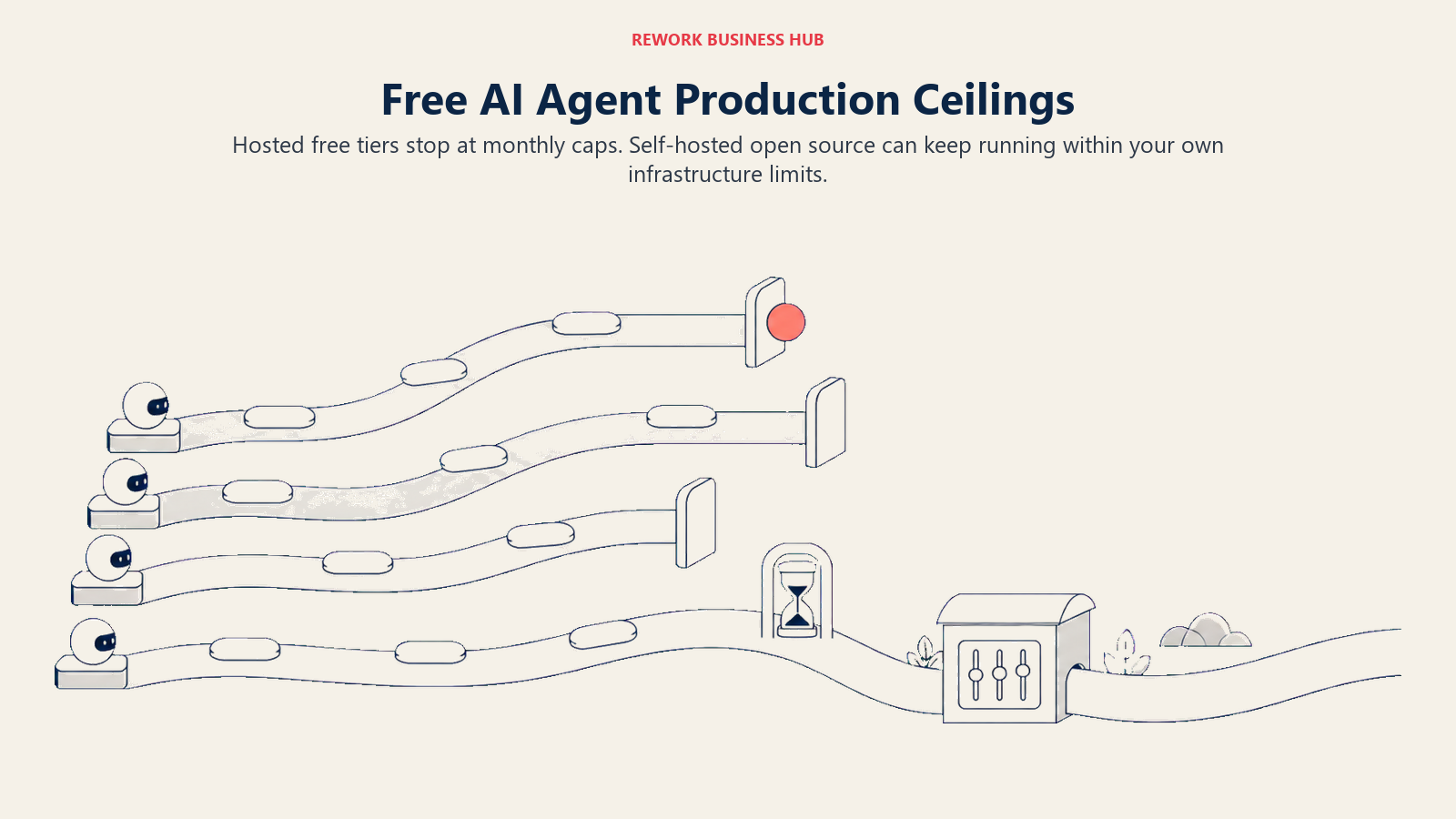
The important distinction is not whether a tool starts free, but whether its limit resets, expires, or disappears when you operate the stack yourself.
| Tool | Free Ceiling | What Happens at the Cap | First Paid Tier | Production-Safe on Free? |
|---|---|---|---|---|
| Zapier Agents | 400 activities/mo | Runs pause until reset or upgrade | ~$33/mo (1,500 activities) | Low-volume use only |
| Make (AI Agents) | 1,000 credits/mo | Runs pause until reset or upgrade | $9/mo (10,000 credits) | Low-volume use only |
| Stack AI | 500 runs/mo, 1 seat | Runs blocked until reset | Enterprise, custom, no mid-tier | Evaluation only |
| Beam AI | 20 tasks/mo | Tasks blocked until reset | $50/mo (200 tasks) | Evaluation only |
| Dify Cloud | 200 message credits/mo | Requests blocked until reset | $49.17/mo (5,000 credits) | Evaluation only |
| Flowise Cloud | 100 predictions/mo, 2 flows | Predictions blocked until reset | $35/mo (higher volume) | Evaluation only |
| n8n Community | None; your infrastructure is the limit | Not applicable, you control capacity | EUR 20/mo Cloud, optional | Yes, genuinely |
| CrewAI (open source) | None; your infrastructure is the limit | Not applicable | Enterprise, custom, for hosted AMP | Yes, genuinely |
| smolagents | None; your infrastructure is the limit | Not applicable | Not applicable | Yes, genuinely |
| Langflow | None; your infrastructure is the limit | Not applicable | Not applicable | Yes, genuinely |
| OpenHands (local) | None; your machine is the limit | Not applicable | Enterprise, custom, for Cloud teams | Yes, for solo use |
| Lindy | 1 week, Slack signup only | Billing starts immediately, no grace period | $29.99/mo per user | No free option to be safe on |
| Gumloop | 14 days | Access ends, subscription required | $37/mo plus an 8% fee | No free option |
| Relevance AI | Not shown publicly | Unknown; a sales conversation is required | Custom, sales-gated | Not confirmed |
| Microsoft Copilot Studio | $200 one-time Azure credit | Charges begin once the credit is spent | $200/mo per 25,000 credits | No, the credit is one-time |
| ChatGPT (OpenAI) | Not available on Free or Go | Feature is gated, not metered | $20/mo (Plus) | No free option |
| Google Gemini | Not available on the free app | Feature is gated, not metered | $19.99/mo (Google AI Pro) | No free option |
Self-hosted open source is the only column where "production-safe" and "free" hold at the same time without an asterisk. Every hosted free tier here is real, but a single seat, community-only support, and a hard monthly cap are what an evaluation plan looks like, not what you'd want carrying a customer-facing workflow.
Data and Privacy on Free Tiers
The real price of a free tier is sometimes your data, not your card. This is where the "free" AI agent story gets closest to the AI tool story most people already know from ChatGPT and Gemini's consumer apps.
| Tool | Free-Tier Data Use | How to Check or Opt Out |
|---|---|---|
| ChatGPT (Free, Go, Plus, and Pro personal accounts) | Enrolled in model training by default | Settings, Data Controls, "Improve the model for everyone," or use Temporary Chat |
| Google Gemini (free consumer app) | Enrolled in training and human review by default | Turn off Gemini Apps Activity, or use Temporary Chat; Workspace, Enterprise, and API usage are excluded by default |
| Microsoft Copilot Studio | Governed at the tenant level, not a personal toggle | Set by your organization's Microsoft 365 admin and compliance tooling |
| SaaS agent builders (Zapier Agents, Make, Stack AI, Beam AI, Dify Cloud, Flowise Cloud) | Prompts and workflow data pass through the vendor's hosting and whichever LLM API it calls on your behalf | Read each vendor's own privacy policy and DPA before routing real customer data through a capped free plan |
| Self-hosted open source (n8n, CrewAI, smolagents, Langflow, OpenHands) | Nothing leaves your infrastructure except the model API calls you choose to make | You control this entirely; the only outside party is whichever model provider you point it at |
OpenAI's own data usage policy documents the personal-account training default and the opt-out path. The pattern to remember: consumer apps default to using your conversations to improve the product, developer APIs and self-hosted code generally don't, and a free tier on a business SaaS product sits in between, so read the actual policy instead of assuming either extreme.
Category 1: Permanently Free Tiers
These six products have a real $0/month plan that doesn't expire on its own. Each one bundles the underlying AI model cost into its usage cap, which is why the "real cost" table above shows most of them at genuine $0 for a small team.
1. Zapier Agents: The Widest Free Ceiling With No Card Required to Start
Zapier's dedicated agent product runs on its own activity meter, separate from core Zapier's task pool, and gives 400 agent activities a month free, permanently, using Zapier's own AI so you never plug in a separate model key. An activity covers a trigger, a knowledge-source lookup, an action, a web search, or a browsing step, so a real multi-step agent run can burn several activities at once.
| What you get | What you don't |
|---|---|
| 400 agent activities/month, forever, no expiration | Runs on its own meter, separate from your core Zap task allowance |
| No separate model API key needed | Non-technical builders may still need a Zapier admin for complex flows |
Pricing: Free (400 activities/month). Pro roughly $33.33/month, billed annually (1,500 activities/month). Enterprise custom. See zapier.com/pricing.
Best for: Teams that want a genuinely free agent today without hosting anything or bringing their own AI model key.
2. Make (AI Agents): Cheapest Real Upgrade Once You Outgrow Free
Make's AI Agents feature is available across every plan, including Free, per Make's own pricing page, so you don't need to pay just to unlock agent behavior. The Free plan includes 1,000 credits a month using Make's built-in AI provider, or you can bring your own LLM key to control spend more directly.
| What you get | What you don't |
|---|---|
| AI Agents available on the Free plan itself, not gated to paid | Credit math (plan tier plus volume) takes some effort to plan |
| Bring-your-own-LLM-key option to manage cost precisely | 1,000 credits/mo is a modest ceiling for daily production use |
Pricing: Free (1,000 credits/month). Core $9/month. Pro $16/month. Teams $29/month, each scalable separately by credit volume. Enterprise custom. See make.com/en/pricing.
Best for: Teams that want the least expensive real upgrade path once a free tier stops being enough.
3. Stack AI: The Deepest Free Agent-Building Toolkit, With No Middle Tier
Stack AI's free plan genuinely includes its Agents and Flow modules, not a stripped preview, along with retrieval-augmented generation for grounding an agent in your own documents. 500 runs a month, 2 projects, and 1 seat is real headroom for prototyping a working agent before you spend anything.
| What you get | What you don't |
|---|---|
| Full agent-building modules on the free tier, not a limited demo | Only 1 seat; a team needs the jump straight to Enterprise |
| 500 runs/month with retrieval-augmented generation included | No tier between Free and a custom Enterprise conversation |
Pricing: Free ($0/month, 500 runs, 2 projects, 1 seat). Enterprise custom. See stackai.com/pricing.
Best for: A technical builder who wants to prototype a real, document-grounded agent before committing budget.
4. Beam AI: Free for Structured Back-Office Tasks, at a Low Ceiling
Beam AI is built for agentic process automation: document verification, invoice processing, claims handling, and similar rule-based back-office work. The free tier gives 20 tasks a month with self-healing output correction included, enough to prove the concept on one real workflow, not to run it daily.
| What you get | What you don't |
|---|---|
| Genuine free tier for a structured, document-heavy process | 20 tasks/mo is a narrow ceiling for anything beyond a proof of concept |
| Self-healing output correction included even on Free | The jump from Pro ($50/mo) to Scale ($3,990/mo) is a steep cliff |
Pricing: Free ($0/month, 20 tasks). Pro $50/month (200 tasks, unlimited steps). Scale $3,990/month. Custom for bespoke deployments. See beam.ai/pricing.
Best for: Testing one structured back-office process, like invoice intake, before paying for real volume.
5. Dify Cloud: A Free Sandbox for a Full LLMOps Agent Stack
Dify bundles a visual builder, prompt IDE, RAG pipeline, and agent orchestration into one product, and the Sandbox tier gives 200 message credits a month, 5 apps, and 50 knowledge documents free, enough to build and demo a real agent workflow end to end. Dify's Community Edition is also free to self-host, under the source-available Dify Open Source License, which blocks running Dify to operate a competing multi-tenant SaaS without a commercial license from LangGenius; that restriction doesn't affect a company self-hosting for its own internal use.
| What you get | What you don't |
|---|---|
| A full builder, RAG, and agent stack free on Sandbox | 200 message credits/mo is thin for daily production traffic |
| Self-hostable Community Edition at no license cost | The self-host license blocks reselling it as your own SaaS |
Pricing: Sandbox free (200 message credits/month). Professional $590/year ($49.17/month), 5,000 credits/month. Team $1,590/year ($132.50/month), 10,000 credits/month. Enterprise custom. See dify.ai/pricing.
Best for: Teams that want one self-hosted or cloud tool covering the whole agent stack, not just orchestration.
6. Flowise Cloud: A Free Visual Canvas Inside a Node Stack
Flowise puts a visual, node-based canvas over agent orchestration, aimed at teams already running a JavaScript or Node backend who don't want to bring Python into the stack just to prototype an agent. The free cloud tier covers 2 flows and 100 predictions a month, enough for a genuine proof of concept.
| What you get | What you don't |
|---|---|
| Easiest visual builder to try free inside a Node-first stack | Only 2 flows and 100 predictions/mo on the free tier |
| Self-hostable core under Apache-2.0, separate from Cloud | Workday's August 2025 acquisition makes long-term neutrality worth watching |
Pricing: Cloud free (2 flows, 100 predictions/month, 5MB storage). Starter $35/month (10,000 predictions). Pro $65/month (50,000 predictions, 5 users). Enterprise custom. Self-hosted core Apache-2.0, free indefinitely. See flowiseai.com.
Best for: JavaScript and TypeScript teams that want a free visual builder without adopting a Python stack.
Category 2: Free and Open Source, Self-Hosted
Nothing here has a vendor-imposed usage ceiling, because there's no vendor metering you. What you pay instead is your own server and, in most cases, your own AI model API key, which the cost table above puts at roughly $10 to $30 a month for a small team's real usage. That's the honest tradeoff behind the 178% year-over-year jump in GitHub repositories importing an LLM SDK: free code plus real infrastructure, not free code plus nothing.
7. n8n Community Edition: Genuinely Production-Safe at Zero License Cost
n8n's Community Edition ships the same AI Agent node, built on LangChain primitives, as every paid tier, with no cap on workflows, executions, or users when self-hosted. The license is n8n's own Sustainable Use License, a fair-code, source-available license, not a pure OSI license like MIT or Apache-2.0: you can self-host and modify it freely for your own internal use, but you can't resell it as a competing hosted service. For a business running its own agents internally, that restriction doesn't bite. See building an AI agent with n8n.
| What you get | What you don't |
|---|---|
| Free, unlimited self-hosted executions with no vendor cap | Sustainable Use License restricts reselling it as your own hosted product |
| A native JavaScript code node without leaving the canvas | Self-hosting means you own your own uptime and patching |
Pricing: Community Edition free, self-hosted, unlimited. Cloud Starter about EUR 20/month annual (roughly $22, 2,500 executions). Cloud Pro about EUR 50/month (roughly $54, 10,000 executions). Cloud Business about EUR 667/month (roughly $720), self-hosted with SSO. See n8n.io/pricing.
Best for: Technical or regulated teams that want a real production agent workflow running on infrastructure they control, at no license cost.
8. CrewAI: A Fully Permissive License, Plus a Small Free Hosted Tier
CrewAI's open-source core, the Python framework itself, is MIT licensed with no enterprise carve-out, and you can run it unlimited, self-hosted, for free with your own model API key. If you'd rather not self-host, the hosted AMP platform also has a free Basic tier of 50 executions a month, though CrewAI discontinued its self-serve paid Professional plan in 2026, leaving only free Basic or custom Enterprise for the hosted option. See building an AI agent with CrewAI.
| What you get | What you don't |
|---|---|
| MIT-licensed core, fully permissive, no usage ceiling if self-run | AMP's free hosted tier caps at 50 executions/month |
| Fastest path to a working multi-agent demo of any framework here | No public paid mid-tier for AMP anymore, only free or Enterprise |
Pricing: Open-source Python framework free (MIT license), unlimited when self-run. Hosted AMP Basic tier free (50 executions/month). Enterprise custom. See crewai.com/pricing.
Best for: A team that wants the fastest path to a working multi-agent prototype under a completely unrestricted license.
9. Hugging Face smolagents: Free Code, Paired With Free Compute
smolagents takes a different approach than most frameworks on this list: instead of chaining JSON tool calls, its core "CodeAgent" writes and runs small pieces of Python as its primary action. The library itself is Apache-2.0 and costs nothing to run, ever, and Hugging Face's own Spaces offer free CPU Basic hardware and free dynamic GPU access (ZeroGPU) for prototyping, so you can test a real agent without paying for compute or a model API key, though production use still needs either your own model budget or a local open-weight model.
| What you get | What you don't |
|---|---|
| Apache-2.0, no usage ceiling, tiny enough to read in an afternoon | Minimal by design; you assemble more scaffolding yourself |
| Free CPU and GPU (ZeroGPU) compute on Hugging Face Spaces | Free Spaces compute suits prototyping more than guaranteed production capacity |
Pricing: Framework free, Apache-2.0, unlimited. Hugging Face Spaces: CPU Basic free; ZeroGPU free with dynamic access to high-end GPUs. See huggingface.co/pricing.
Best for: Engineers who want to read and own every line of their agent loop, with free compute to test it on.
10. Langflow: An MIT License With No Enterprise Carve-Out
Langflow puts a visual canvas over LangChain-style components and exports what you build as runnable Python or a callable API endpoint, and unlike Dify or Flowise, it carries no license carve-out at all: it's MIT, full stop. DataStax acquired Langflow in 2024 and IBM acquired DataStax in 2025, so Langflow's roadmap now sits inside IBM's watsonx strategy, and its earlier small hosted product is no longer offered as a simple standalone plan; check langflow.org for current status before assuming a paid hosted tier exists. The framework itself remains free and self-hostable regardless.
| What you get | What you don't |
|---|---|
| True MIT license, no enterprise directory walled off | No small standalone hosted tier currently advertised |
| Visual canvas that exports to runnable Python or an API endpoint | An IBM-owned roadmap may prioritize watsonx over community requests |
Pricing: Framework free, MIT, self-hosted, unlimited. Production deployment beyond self-hosting runs through IBM watsonx Orchestrate at custom enterprise pricing. See langflow.org.
Best for: Teams that want a free, cleanly licensed visual builder for prototyping before handing a flow to engineers.
11. OpenHands: A Free Local Coding Agent, MIT Licensed
OpenHands gives an agent a real sandboxed shell, browser, and code editor so it can plan, write, run, test, and fix code on its own, and the local version is a full, MIT-licensed release built for running on your own machine at no cost. OpenHands Cloud adds an Individual tier that's still free, using either your own model API key or the OpenHands provider at cost with no markup, plus a custom Enterprise tier for private-VPC or self-hosted team deployments.
| What you get | What you don't |
|---|---|
| Fully free local mode, MIT licensed, no carve-outs | Purpose-built for coding tasks, not a general-purpose business agent |
| Free Cloud Individual tier, at-cost model access with no markup | Enterprise pricing isn't published; a custom quote is required |
Pricing: Local version free, MIT. Cloud Individual free (bring your own key or pay-at-cost). Enterprise custom. See openhands.dev/pricing.
Best for: A developer who wants an autonomous coding agent running locally at zero cost, not a general-purpose workflow agent.
Category 3: Free Trial or Limited Credit Grant (Not Really Free)
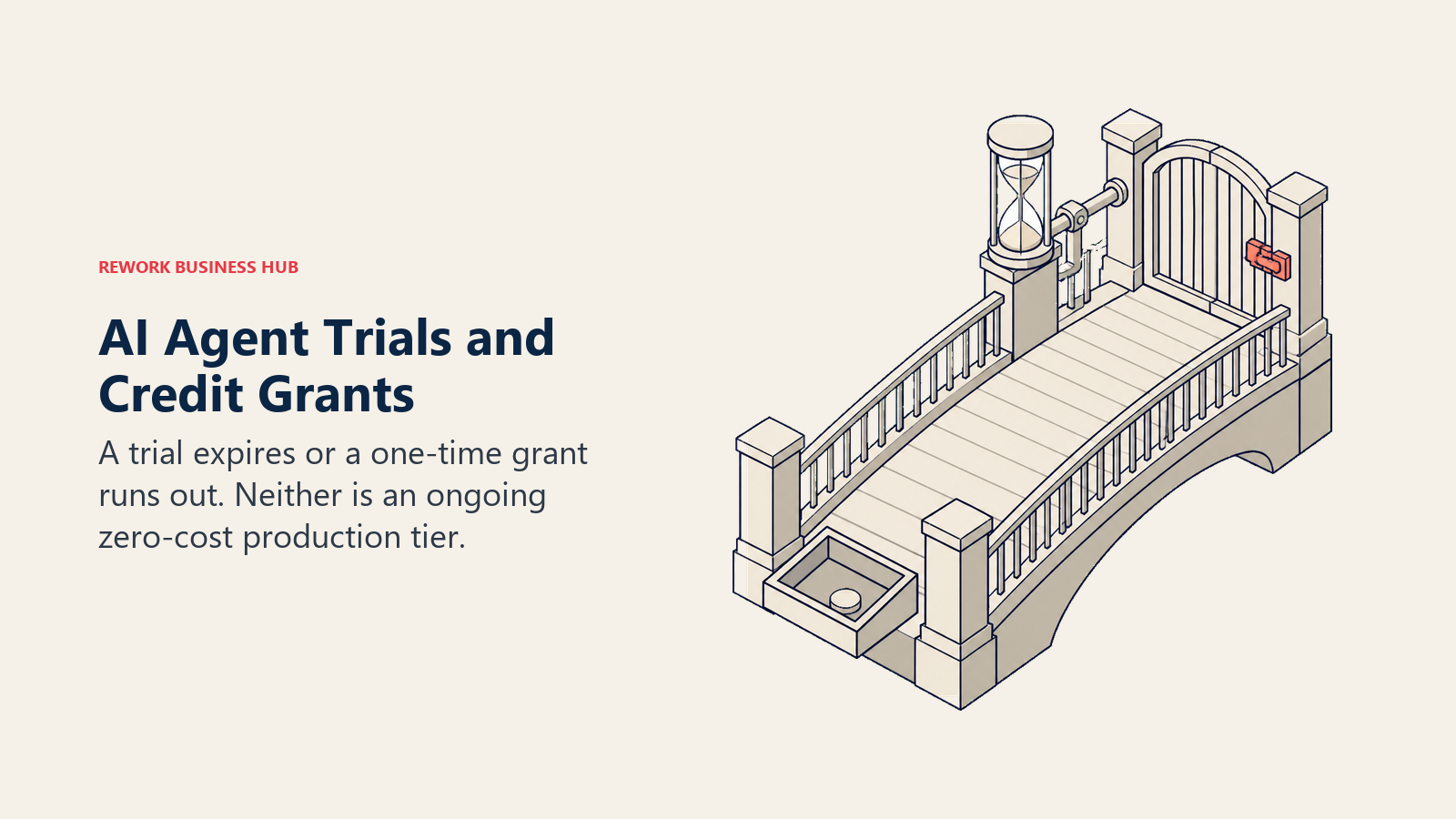
These six show up in searches for "free AI agent," and none of them has an ongoing $0/month plan. Treating any of them as free is how a team's budget goes from $0 to a real invoice with no warning.
12. Lindy: No Free Tier, Just a One-Week, Condition-Gated Exception
Lindy's own pricing page confirms there's no permanent free plan at all. The only no-cost option is a first week free for teammates who join through an existing Slack workspace, and Lindy states plainly that direct signups are billed right away, with the one-week exception available once per teammate. Every real use of Lindy costs money starting almost immediately. See building an AI agent with Lindy.
| What you get | What you don't |
|---|---|
| A working agent set up in under an hour once you're paying | No permanent free plan on the current pricing page |
| One condition-gated week free, Slack signups only | Direct signups are billed immediately, with no trial at all |
Pricing: Plus $29.99/month per user (3,000 credits). Pro $99.99/month (15,000 credits). Max $199.99/month (35,000 credits). Enterprise custom. See lindy.ai/pricing.
Best for: Teams who've already decided to pay and just want the fastest no-code setup, not anyone shopping for free.
13. Gumloop: A 14-Day Trial, Not a Tier
Gumloop is built for ops and research automation, pulling data from many sources and enriching it inside a no-code canvas with Python code blocks available for technical teammates. There's no ongoing free plan, only a 14-day trial, after which Pro starts at $37 a month plus an 8% orchestration fee stacked on top of credit spend, a cost most competitors fold into the credit price itself.
| What you get | What you don't |
|---|---|
| Unlimited seats even on the entry paid plan | No free tier, only a 14-day trial |
| Python code blocks inside a no-code canvas | An 8% orchestration fee stacks on top of credit spend |
Pricing: Pro $37/month (20,000 credits, 14-day trial). Enterprise custom with volume discounts on the fee. See gumloop.com/pricing.
Best for: Ops or research teams that already know they'll pay and just want to test fit for two weeks first.
14. Relevance AI: A Pricing Page That No Longer Shows a Number
Relevance AI's framing is distinct: instead of one agent doing one job, you assemble a team of agents that hand off work to each other, an "AI workforce" modeled on a human department. The public pricing page shows only an Enterprise tier gated behind "Talk to sales," with no self-serve price or free-tier number displayed. A free tier (around 200 actions a month) and a Pro tier of reportedly about $19 a month still exist for direct in-app signups, so get a live quote before budgeting.
| What you get | What you don't |
|---|---|
| Genuine multi-agent orchestration, not a single bot | No price or free-tier detail on the public page as of August 2026 |
| Vendor compute credits reportedly roll over instead of expiring | Any free tier claim currently rests on third-party reports, not vendor confirmation |
Pricing: Public page shows Enterprise only, custom quote required. A free tier and a Pro tier of reportedly about $19/month are available for in-app signups. See relevanceai.com/pricing.
Best for: Teams designing a genuine multi-agent workflow who are prepared to get on a call to learn the real price.
15. Microsoft Copilot Studio: A One-Time Credit, Not an Ongoing Free Tier
Copilot Studio grounds an agent in whatever your organization already has in SharePoint, Dataverse, and Microsoft Graph. The Copilot Studio user license itself is free, but that's not the same as free usage: real agent runs consume Copilot Credits, and the only no-cost allowance is a one-time $200 credit for new Azure accounts, plus an unspecified-length "try for free" offer. Once that credit is spent, every action is billed, whether through a prepaid $200-per-25,000-credit pack or pay-as-you-go.
| What you get | What you don't |
|---|---|
| Native SharePoint, Dataverse, and Teams grounding | No ongoing $0/month tier for real usage |
| A one-time $200 Azure credit for new accounts | Per-action credit consumption isn't published upfront |
Pricing: Copilot Studio user license free; a one-time $200 Azure credit for new accounts. Ongoing usage: prepaid packs $200/month for 25,000 credits, or pay-as-you-go around $0.01/credit. Usage inside an existing $30/user/month Microsoft 365 Copilot license is included, but that license itself isn't free. See Microsoft's Copilot Studio pricing.
Best for: Microsoft 365 shops that already pay for Copilot and want agent usage folded into that existing license.
16. ChatGPT (OpenAI): Agent Mode Starts at Plus, Not Free
OpenAI's own Free and Go ($8/month) plans do not include ChatGPT's agent mode, the feature that browses the web, uses a computer, and completes multi-step tasks with less supervision. Plus, at $20 a month, is the minimum tier where agent capability appears at all. Worth knowing before you route anything sensitive through it: personal ChatGPT accounts on Free, Go, Plus, and Pro are enrolled in model training by default, with an opt-out available in Data Controls.
| What you get | What you don't |
|---|---|
| Native web search, code execution, and file tools once on Plus | Free and Go plans exclude agent mode entirely |
| Broad model access on Free for ordinary chat | Personal accounts train the model by default unless you opt out |
Pricing: Free: $0/month, no agent mode. Go: $8/month, no agent mode. Plus: $20/month, agent mode included. See chatgpt.com/pricing.
Best for: Anyone who already has ChatGPT Plus for other reasons and wants agent mode as a bonus, not a reason to sign up alone.
17. Google Gemini: Deep Research and Agent Features Live Behind Google AI Pro
Gemini's free consumer app gives you chat access to Google's models plus basic image and canvas features, but Deep Research, agent capability inside Search, and the Antigravity agent-development platform all require a paid Google AI plan. Google AI Pro runs $19.99 a month and unlocks the entry level of that agent tier; Google AI Ultra, repriced at Google I/O 2026 down from its earlier $250 figure, now runs $100 or $200 a month depending on the tier, for teams that need the deepest agent limits. Free-app conversations are also used for training and human review by default, the same pattern as ChatGPT's personal accounts, unless you turn off Gemini Apps Activity.
| What you get | What you don't |
|---|---|
| Free chat access to Gemini's models for ordinary use | Deep Research and agent features are gated behind Google AI Pro |
| Google AI Pro at $19.99/mo for entry-level agent access | Free-app conversations default to training and human review |
Pricing: Free: $0/month, no agent features. Google AI Pro: $19.99/month. Google AI Ultra: $100/month or $200/month tiers as of the 2026 repricing. See gemini.google/subscriptions.
Best for: Someone who already wants Google AI Pro for Gemini 3 Pro access and treats agent features as part of that bundle.
The Chatbot Trap: Free Plans That Aren't Actually Agents Yet
Two well-known tools show up constantly in "free AI agent" searches, and both genuinely have a $0/month plan. Neither one includes agentic tool-calling on that plan, which means the free tier is a chatbot, not the agent the search implied.
| Tool | Free Plan | Why It's Not a Free Agent |
|---|---|---|
| Chatbase | $0/month, 50 message credits, 1 member | "Actions" (the tool-calling feature) start at Standard, $120/month; Free only answers questions |
| Tidio (Lyro) | $0/month, 50 Lyro AI conversations for the account's lifetime, not monthly | Positioned around answering questions; confirmed multi-step transactional actions aren't part of the free tier |
Chatbase's own pricing page is explicit about this: AI Actions, the feature that lets an agent call an API or take a step rather than just reply, is an 18-per-agent allowance starting at the $120-a-month Standard tier. Tidio's free Lyro allowance is also unusually structured: it's 50 conversations total for the life of the free account, not a monthly refresh like every paid tier gets, which makes it closer to a one-time trial wearing a "free plan" label. Neither is a bad product; both are strong entries in best AI chatbot builders in 2026, a genuinely different shopping list from this one. They're just the clearest example in this whole category of why "free" and "agent" need to be verified as two separate claims, not one.
How to Choose: Decision Framework
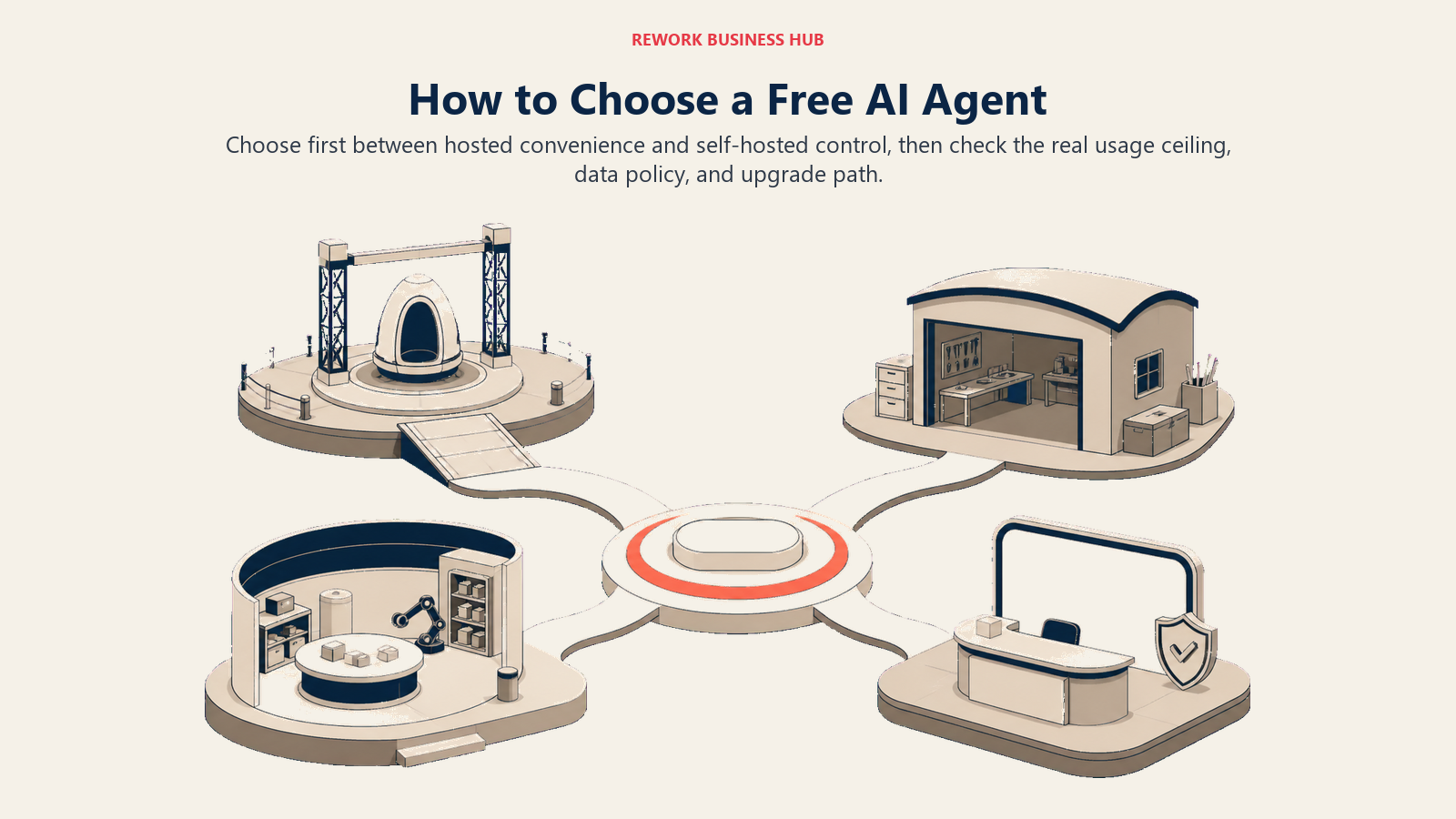
Choose by matching the free model to the constraint you can actually accept: setup work, infrastructure ownership, usage depth, coding skill, or a verified path to paid production.
| If you need... | Pick... | Why |
|---|---|---|
| A real $0/month tier with zero setup | Zapier Agents or Make | Both include a genuinely agentic free tier that never expires |
| The lowest-risk long-term free option | n8n or CrewAI, self-hosted | No vendor ceiling ever, only your own infrastructure and model costs |
| Real agent-building depth to prototype free | Stack AI | 500 runs/month, with Agents and Flow modules both included |
| Structured back-office automation to test free | Beam AI | 20 free tasks/month before Pro |
| A fully permissive license with no carve-out | Langflow or smolagents | MIT and Apache-2.0 respectively, no enterprise directory walled off |
| A coding-specific agent to run locally at no cost | OpenHands | MIT, runs on your machine, bring your own model key |
| To confirm a number before you build on it | Relevance AI | Its public page is sales-gated; get a written quote before assuming a free tier exists |
| Real agent-mode use inside ChatGPT or Gemini | ChatGPT Plus ($20/mo) or Google AI Pro ($19.99/mo) | Neither vendor's free consumer plan includes agent-style autonomy |
| A free plan that's actually a chatbot, not an agent | Skip Chatbase or Tidio's free tier for this use case | Neither includes agentic tool-calling until you pay |
Frequently Asked Questions about Free AI Agents
What's the real difference between a free AI agent tier and a free trial?
A free tier is a permanent $0/month plan capped by usage, like 400 activities or 500 runs a month, that never expires on its own. A free trial is a countdown, typically 7 to 14 days, after which the product stops working or starts billing automatically. Lindy and Gumloop are trial-only; Zapier Agents and Stack AI have genuine ongoing free tiers.
Which AI agents are genuinely free forever, not just during a trial?
Zapier Agents (400 activities/month), Make's AI Agents (1,000 credits/month), Stack AI (500 runs/month), Beam AI (20 tasks/month), Dify Cloud's Sandbox (200 message credits/month), and Flowise Cloud (100 predictions/month) all have ongoing $0 plans with no expiration date.
Is a free, open-source, self-hosted AI agent framework actually free?
The code and the license cost nothing, which holds for n8n, CrewAI, smolagents, Langflow, and OpenHands. What isn't free is the server you run it on and, in almost every case, the AI model API calls it makes, so budget roughly $15 to $30 a month in infrastructure and tokens for a small team's real usage, not $0.
Does a free AI agent plan use my data to train the vendor's models?
It depends on the product, not the price. ChatGPT's personal Free, Go, Plus, and Pro plans are enrolled in model training by default, with an opt-out in Data Controls, and Google's free Gemini app conversations are used for training and human review by default unless you turn off Gemini Apps Activity. Self-hosted open-source agents never send anything anywhere except the model API you point them at.
What happens when I hit a free tier's usage cap?
Almost every SaaS free tier on this list simply blocks further runs, tasks, or activities until the monthly cycle resets or you upgrade, rather than auto-charging you. The exception is anything on a countdown trial, like Gumloop or Lindy's Slack-only first week, where access itself ends rather than just throttling.
Are any of these free options actually safe to run in production, or are they all just for testing?
Self-hosted open source is the one category that's genuinely production-safe for free, since n8n, CrewAI's open-source core, smolagents, Langflow, and OpenHands all run under permissive or fair-code licenses with no vendor-imposed ceiling. The hosted free tiers are real, but their caps and single-seat or community-only support tend to make them evaluation tools rather than something you'd run a customer-facing workflow on.
Why don't ChatGPT and Gemini include agent mode on their free plans?
Both companies gate multi-step autonomous features behind their cheapest paid consumer tier: ChatGPT's agent mode needs at least Plus at $20/month, not the $8/month Go plan, and Gemini's Deep Research and agent capabilities need Google AI Pro at $19.99/month. Neither vendor has explained why publicly, but an agent task consumes far more compute per request than a single chat reply, which is the likely economic reason.
Is Lindy's free trial actually free?
Barely. Lindy has no permanent free plan at all; the only no-cost option is a one-time first week for teammates who join through an existing Slack workspace, and Lindy's own pricing page states that direct signups are billed immediately with no trial. Treat any "free" claim about Lindy as a one-week, condition-gated exception, not a tier.
What's the cheapest real paid tier once I outgrow a free plan?
Make's Core plan at $9/month is the least expensive upgrade on this list. Zapier Agents Pro runs about $33/month, and n8n's cheapest Cloud tier runs about $22/month if self-hosting isn't worth your time, though self-hosting itself stays free indefinitely.
What to Do Next
Pick your category before you pick your vendor. If you want a working agent this afternoon with nothing to maintain, start with Zapier Agents or Make and treat the free ceiling as a real budget line, not a surprise waiting to happen. If you're comfortable running a server, n8n or CrewAI cost nothing indefinitely and won't force a re-platform the day you outgrow a vendor's cap. And if a product's pricing page won't show you a number without a sales call, the way Relevance AI's does, treat that absence as information too, not an oversight to work around. For the fuller paid-and-free landscape, best AI agent platforms in 2026 covers the managed enterprise suites this guide leaves out, best no-code AI agent builders goes deeper on the no-code layer specifically, and best open-source AI agent frameworks covers the full self-hosted landscape beyond the five frameworks here. If you're ready to build rather than buy, how to build an AI agent and no-code versus code AI agents cover the decision either way, and AI agent ROI is worth reading before you scale past whatever free tier you start on.

Principal Product Marketing Strategist
On this page
- Key Facts
- The Three Kinds of "Free" in AI Agents
- Quick Comparison Table
- The Real Cost of "Free"
- The Ceiling, the Cliff, and Whether It's Production-Safe
- Data and Privacy on Free Tiers
- Category 1: Permanently Free Tiers
- 1. Zapier Agents: The Widest Free Ceiling With No Card Required to Start
- 2. Make (AI Agents): Cheapest Real Upgrade Once You Outgrow Free
- 3. Stack AI: The Deepest Free Agent-Building Toolkit, With No Middle Tier
- 4. Beam AI: Free for Structured Back-Office Tasks, at a Low Ceiling
- 5. Dify Cloud: A Free Sandbox for a Full LLMOps Agent Stack
- 6. Flowise Cloud: A Free Visual Canvas Inside a Node Stack
- Category 2: Free and Open Source, Self-Hosted
- 7. n8n Community Edition: Genuinely Production-Safe at Zero License Cost
- 8. CrewAI: A Fully Permissive License, Plus a Small Free Hosted Tier
- 9. Hugging Face smolagents: Free Code, Paired With Free Compute
- 10. Langflow: An MIT License With No Enterprise Carve-Out
- 11. OpenHands: A Free Local Coding Agent, MIT Licensed
- Category 3: Free Trial or Limited Credit Grant (Not Really Free)
- 12. Lindy: No Free Tier, Just a One-Week, Condition-Gated Exception
- 13. Gumloop: A 14-Day Trial, Not a Tier
- 14. Relevance AI: A Pricing Page That No Longer Shows a Number
- 15. Microsoft Copilot Studio: A One-Time Credit, Not an Ongoing Free Tier
- 16. ChatGPT (OpenAI): Agent Mode Starts at Plus, Not Free
- 17. Google Gemini: Deep Research and Agent Features Live Behind Google AI Pro
- The Chatbot Trap: Free Plans That Aren't Actually Agents Yet
- How to Choose: Decision Framework
- What to Do Next