Best Open-Source AI Agent Frameworks in 2026: 15 Frameworks for Teams That Want to Own Their Stack
Turn this article into takeaways for your work.


Each assistant summarizes the article only for you and suggests best practices for your work.
The best open-source AI agent framework in 2026 depends more on your licence tolerance and your runtime than on any feature checklist: LangGraph and CrewAI lead production Python deployments, Mastra leads if your team lives in TypeScript, and Dify covers the widest surface if you want a self-hosted app instead of a code library. This guide ranks 15 frameworks that are genuinely open source (a public repo, a real licence, self-hostable on your own infrastructure), not just free to try, and it names the handful that ship under an open-core or source-available licence instead of a pure permissive one.
Picking wrong here costs more than picking the wrong SaaS tool. You're choosing an abstraction your engineers will write thousands of lines against, and migrating off a graph-based orchestration layer six months in is a multi-week project, not a re-export. Every entry below is evaluated against its actual LICENSE file, current GitHub activity, language support, state and durability model, and hosted pricing where one exists. If you're still deciding between a self-hosted framework and a managed product, our best AI agent platforms roundup covers the full landscape both sides live in.
Key Facts
- More than 1.1 million public GitHub repositories now import an LLM SDK, up 178% year over year, with roughly 694,000 of those created in the past 12 months alone, per GitHub's 2025 Octoverse report.
- 57% of organizations report having AI agents running in production, per LangChain's State of Agent Engineering survey of 1,340 practitioners (November 18 to December 2, 2025), though only 52.4% run offline evaluations against that traffic.
- Gartner predicts more than 40% of agentic AI projects will be canceled by the end of 2027 over unclear ROI and weak governance, and estimates only about 130 of the thousands of self-described agentic AI vendors are the real thing.
- Open-source models' share of enterprise LLM usage fell to 11% in 2025, down from 19% in 2024, even as total enterprise generative AI spending roughly tripled to $37 billion, per Menlo Ventures.
- AI agents jumped from roughly 12% to 66.3% task success on OSWorld, the benchmark for real computer-use tasks, in the year leading into 2026, per Stanford HAI's AI Index.
What Changed in Open-Source Agent Frameworks This Year
- Microsoft merged AutoGen and Semantic Kernel into Microsoft Agent Framework, which reached version 1.0 for .NET and Python on April 3, 2026. AutoGen's README now says the project is archived, with no bug fixes, security fixes, new features, or support from Microsoft, and Semantic Kernel's README names Agent Framework as its successor.
- AG2, the community fork of AutoGen created after a 2024 governance split, shipped v1.0 on July 27, 2026, moving the classic
ConversableAgentandGroupChatclasses to a separate ag2-classic repository. - OpenAI removed the Assistants API on August 26, 2026, per its deprecations page. If you're building new, use the Agents SDK covered here.
- Flowise was wound down: code freeze on July 29, 2026, the GitHub repository archived in August, and end of life for official core-team support on August 31, 2026. The Apache-2.0 code stays on GitHub for anyone who wants to fork it.
- CrewAI simplified its commercial pricing down to two public tiers (free AMP Basic and custom Enterprise) after briefly running a self-serve Professional plan.
- IBM closed its acquisition of DataStax in May 2025, which means Langflow now sits inside IBM's watsonx orbit.
- Workday acquired FlowiseAI in August 2025, less than a year before the open-source Flowise project was wound down.
Quick Comparison Table
Use this to shortlist by licence and language before reading the licence and self-hosting detail below.
| Framework | Licence | Language | Best For | Hosted Tier |
|---|---|---|---|---|
| LangGraph | MIT | Python, TypeScript | Stateful, production-grade agent workflows | LangSmith Plus $39/seat/mo |
| CrewAI | MIT | Python | Role-based multi-agent crews, fast to start | AMP: free or custom Enterprise |
| AG2 | Apache-2.0 | Python | The AutoGen conversational pattern, community-governed, v1.0 since July 2026 | None, community project |
| OpenAI Agents SDK | MIT | Python, TypeScript | Minimal SDK backed by a model vendor | Pay-per-token via OpenAI or 100+ providers |
| Pydantic AI | MIT | Python | Type-safe, validated agent outputs | Logfire from $0, Team $49/mo |
| Microsoft Agent Framework | MIT | .NET, Python (Go in preview) | Microsoft-stack teams; successor to Semantic Kernel and AutoGen | None; pay for model and Azure usage |
| LlamaIndex Workflows | MIT | Python, TypeScript | Retrieval-heavy, event-driven agents | LlamaCloud, usage-based |
| Agno | Apache-2.0 | Python | High-concurrency, low-overhead agent fleets | AgentOS, custom pricing |
| Mastra | Apache-2.0 (core) | TypeScript | Full-stack JS teams | Mastra Cloud: free, Teams $250/mo |
| smolagents | Apache-2.0 | Python | Minimal, auditable, code-executing agents | None, community project |
| Haystack | Apache-2.0 | Python | Production retrieval and document pipelines | Enterprise Platform, custom |
| Dify | Modified Apache-2.0 (source-available) | Python, TypeScript | Self-hosted LLMOps app, not just a library | Cloud: $0 to $159/mo, Enterprise custom |
| Langflow | MIT | Python | Visual prototyping, MIT with no carve-outs | Part of IBM/DataStax ecosystem |
| Flowise | Apache-2.0 (core) | TypeScript | Existing Node deployments only; archived in August 2026 | Cloud: $0 to $65/mo |
| OpenHands | MIT | Python | Autonomous coding agent, not general orchestration | Cloud: free individual, custom Enterprise |
How to Read "Open Source" Here: Licence Reality Check
Not everything billed as "open source" in the agent space carries the same rights, and this is the detail most roundups skip. An OSI-approved licence (MIT, Apache-2.0) puts no restriction on how you use, modify, or resell the code. A source-available or open-core licence publishes the code but reserves a specific right, usually the right to resell it as your own hosted SaaS, for the vendor. That distinction rarely shows up until legal review, which is too late.
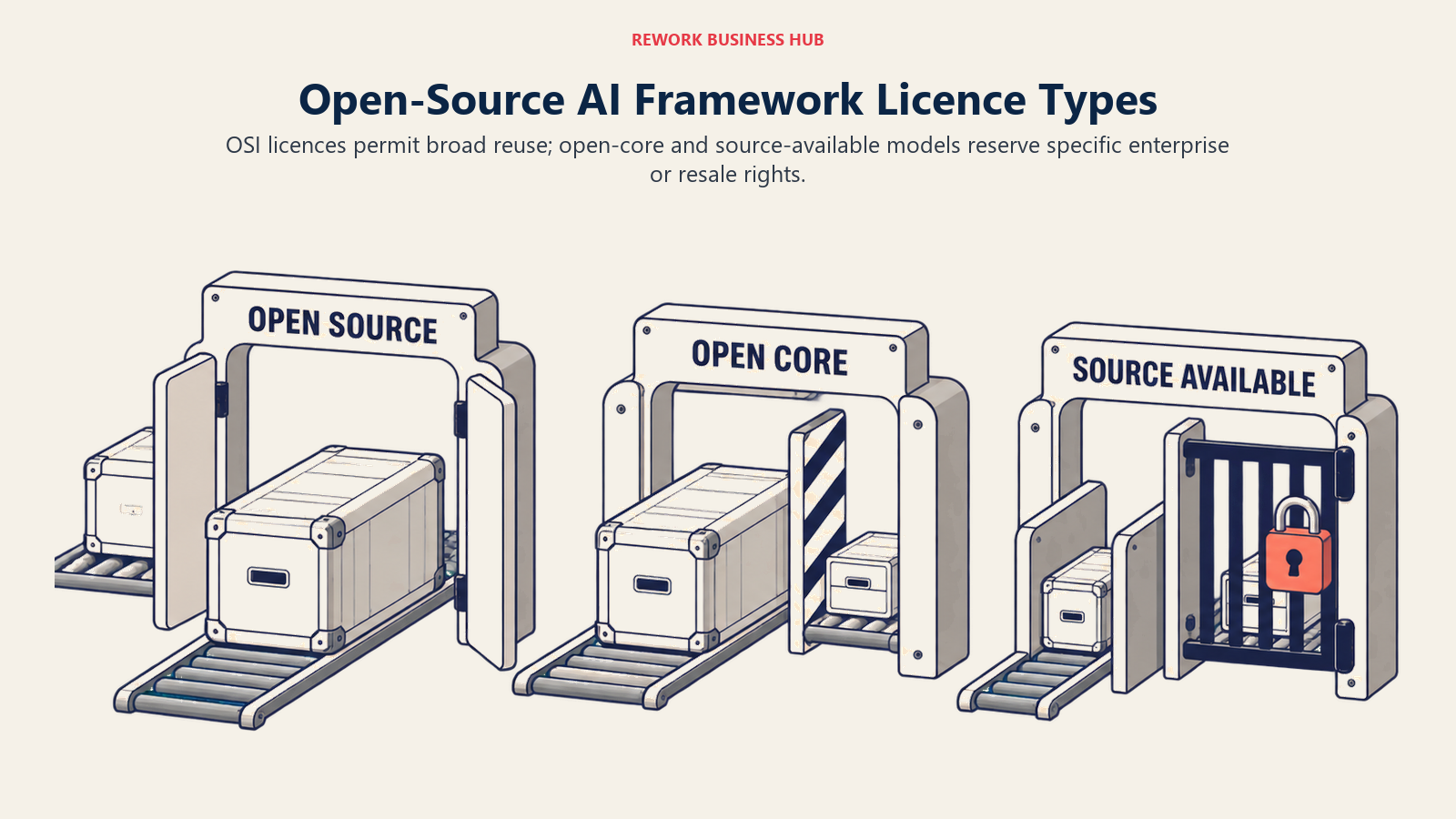
Dify is the clearest case: its licence is a modified Apache-2.0 (the "Dify Open Source License") that explicitly blocks running Dify to operate a multi-tenant SaaS without a commercial licence from LangGenius, and it locks the console's branding outside a paid tier. That's a real, meaningful restriction an OSI licence would not permit, which makes Dify source-available rather than open source in the strict sense, even though the vast majority of its code is genuinely Apache-2.0. Mastra and Flowise both take a cleaner open-core approach: their core frameworks are unrestricted Apache-2.0, and only a specific enterprise directory (ee/ for Mastra, enterprise/ for Flowise) sits behind a separate commercial licence. Everything you'd need to self-host a production agent in either framework is in the open part.
| Framework | Licence | OSI Open Source | What It Restricts |
|---|---|---|---|
| LangGraph | MIT | Yes | Nothing |
| CrewAI | MIT | Yes | Nothing |
| AG2 | Apache-2.0 | Yes | Nothing |
| OpenAI Agents SDK | MIT | Yes | Nothing |
| Pydantic AI | MIT | Yes | Nothing |
| Microsoft Agent Framework | MIT | Yes | Nothing |
| LlamaIndex Workflows | MIT | Yes | Nothing |
| Agno | Apache-2.0 | Yes | Nothing |
| Mastra | Apache-2.0 (core) | Core: yes | ee/ directory needs a paid licence in production |
| smolagents | Apache-2.0 | Yes | Nothing |
| Haystack | Apache-2.0 | Yes | Nothing |
| Dify | Modified Apache-2.0 | No | Multi-tenant SaaS resale and console branding |
| Langflow | MIT | Yes | Nothing |
| Flowise | Apache-2.0 (core) | Core: yes | enterprise/ directory is proprietary |
None of this stops a company from self-hosting any of the 15 for internal use. It matters the moment you plan to embed one inside a product you sell.
Self-Hosting, Language, and State: The Engineering Fit
The 15 frameworks split into three real categories: code-first orchestration libraries you import into a service (LangGraph, CrewAI, AG2, OpenAI Agents SDK, Pydantic AI, Microsoft Agent Framework, LlamaIndex Workflows, Agno, Mastra, smolagents, Haystack), self-hosted visual or full-app platforms (Dify, Langflow, Flowise), and a specialized coding-agent runtime (OpenHands). All 15 run entirely on your own infrastructure with no forced call-home. What differs is how much durability you get for free versus how much you build yourself.
| Framework | Language(s) | Self-Hosted | Built-In State and Durability |
|---|---|---|---|
| LangGraph | Python, TypeScript | Yes | Native checkpointing, pause, resume, and time-travel debugging |
| CrewAI | Python | Yes, or CrewAI Factory | Flow state persists locally; deeper durability lives in the AMP cloud |
| AG2 | Python | Yes | v1.0 Hub keeps a write-ahead log and audit trail; classic GroupChat is in-memory unless you add persistence |
| OpenAI Agents SDK | Python, TypeScript | Yes | Sessions API for basic history; durable state is on you |
| Pydantic AI | Python | Yes | Message-history objects you persist yourself |
| Microsoft Agent Framework | .NET, Python (Go in preview) | Yes | Workflow checkpointing, pause and resume, and human-in-the-loop approval |
| LlamaIndex Workflows | Python, TypeScript | Yes | Workflow context can serialize and resume between steps |
| Agno | Python | Yes | Built-in session and state storage designed for high concurrency |
| Mastra | TypeScript | Yes | Native workflow suspend/resume plus pluggable memory storage |
| smolagents | Python | Yes | Stateless by default; you wire persistence |
| Haystack | Python | Yes | Pipeline state via document stores, not turn-by-turn checkpointing |
| Dify | Python, TypeScript (Docker) | Yes | Conversation and workflow state stored in its own database |
| Langflow | Python | Yes | Flow state stored per session in its database |
| Flowise | TypeScript | Yes | Chat history and flow state stored in its own database |
| OpenHands | Python | Yes | Session state in its runtime; long runs checkpoint to the workspace |
If your agent needs to survive a server restart mid-task, that "built-in" column is the one to read closely, not the star count.
Maintenance and Community Health: Who's Actually Still Building
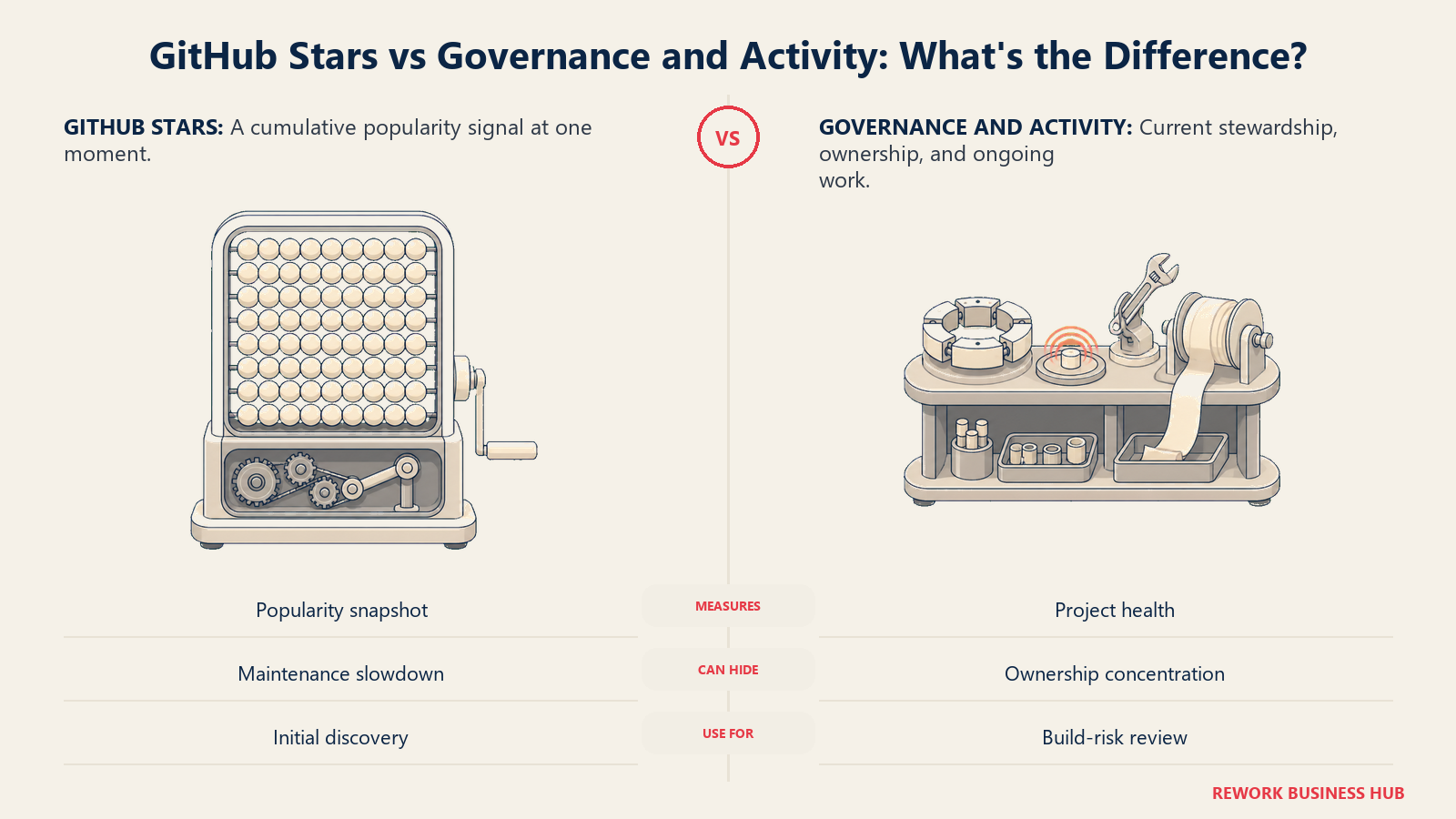
A star count alone tells you almost nothing about whether a project is safe to build on. Governance and recent activity tell you much more: a company-controlled repo can be archived or folded into a successor on the company's schedule, the way Microsoft archived AutoGen and folded Semantic Kernel into Microsoft Agent Framework, and the way FlowiseAI wound down Flowise, while a smaller, community-governed fork can keep shipping past the point where the company that started it moves on.
| Framework | GitHub Stars (Nov 2026) | Primary Backer | Governance | Last Push |
|---|---|---|---|---|
| LangGraph | 44,293 | LangChain Inc | Company-led | Same day |
| CrewAI | 60,395 | CrewAI Inc | Company-led | Same day |
| AG2 | 5,039 | AG2ai community org | Open governance | Same day |
| OpenAI Agents SDK | 30,443 | OpenAI | Company-led | Same day |
| Pydantic AI | 20,990 | Pydantic Validation Ltd | Company-led | Same day |
| Microsoft Agent Framework | 14,483 | Microsoft | Company-led | Same day |
| LlamaIndex Workflows | 52,774 | LlamaIndex Inc | Company-led | Same week |
| Agno | 43,011 | Agno | Company-led | Same day |
| Mastra | 29,264 | Mastra AI | Company-led | Same day |
| smolagents | 30,177 | Hugging Face | Company-led | Same week |
| Haystack | 26,904 | deepset | Company-led | Same week |
| Dify | 160,178 | LangGenius Inc | Company-led | Same day |
| Langflow | 156,232 | DataStax (IBM) | Company-led | Same day |
| Flowise | 55,543 | FlowiseAI (Workday) | Archived, end of life August 31, 2026 | August 2026 |
| OpenHands | 92,448 | All Hands AI | Company-led | Same day |
Stars and push dates are a November 2026 snapshot, not a permanent ranking; they change daily. The pattern worth noting: 14 of these 15 projects are led by a single company, which means the roadmap, and occasionally the licence, can shift whenever that company's strategy does. AG2 is the one project here with genuinely open, non-corporate governance.
1. LangGraph: The Production Standard for Stateful Agents
LangGraph, from LangChain Inc, models an agent as a graph of nodes and edges instead of a single prompt loop, which is what makes pause, resume, branching, and "time travel" debugging native rather than bolted on. That checkpointing model is the main reason it shows up so often as the production default once a team moves past a prototype. It works standalone or alongside the broader LangChain ecosystem, and ships for both Python and TypeScript.
The trade-off is the graph mental model itself: it takes longer to learn than a role-based crew, and the best observability layer, LangSmith, is free for one seat but priced per seat beyond that. For a hands-on walkthrough, see our build an AI agent with LangGraph tutorial.
| What you get | What you don't |
|---|---|
| Native checkpointing, pause, resume, time-travel debugging | Steeper learning curve than role-based frameworks |
| Human-in-the-loop approval steps as a first-class primitive | Full observability (LangSmith) is paid beyond one free seat |
| Large integration ecosystem via LangChain | More boilerplate than CrewAI for a simple single-agent task |
| Python and TypeScript support | Deployment tooling (LangGraph Platform) is a separate paid layer |
Licence: MIT. Best for: Teams building agents that must pause, resume, and recover state without losing progress.
2. CrewAI: Role-Based Crews, Fastest Time to a Working Demo
CrewAI defines agents by role, goal, and backstory, groups them into a crew, and runs them sequentially or hierarchically against a set of tasks. That structure, plus a large tutorial and course ecosystem, is why it's often the fastest path from zero to a working multi-agent demo. Flows add a more deterministic, code-first control layer for teams who outgrow pure autonomous crews.
CrewAI Inc's hosted AMP platform handles deployment and observability, and pricing simplified in 2026 to a free Basic tier (50 executions per month) and a custom Enterprise tier, after a self-serve Professional plan was discontinued. For hands-on setup, see build an AI agent with CrewAI.
| What you get | What you don't |
|---|---|
| Fastest path to a working multi-agent demo | Role-play abstraction can feel like overhead for one simple agent |
| Both autonomous crews and deterministic Flows in one framework | Production-grade observability lives behind the AMP cloud product |
| Large community, courses, and templates | No public self-serve paid tier anymore, only free or Enterprise |
| MIT licence, fully permissive | Deep durability across long-running tasks is thinner than LangGraph |
Licence: MIT. Best for: Teams that want role-based multi-agent collaboration running in an afternoon.
3. AG2: The AutoGen Lineage, Now at v1.0
Microsoft's AutoGen was one of the first widely-adopted multi-agent conversation frameworks. In late 2024, several of its original creators left Microsoft and forked the project into AG2, first as a GitHub fork and then as its own organization, inheriting the autogen and pyautogen PyPI package names in the process. The split was about governance: Microsoft kept AutoGen company-led, while AG2 became community-governed.
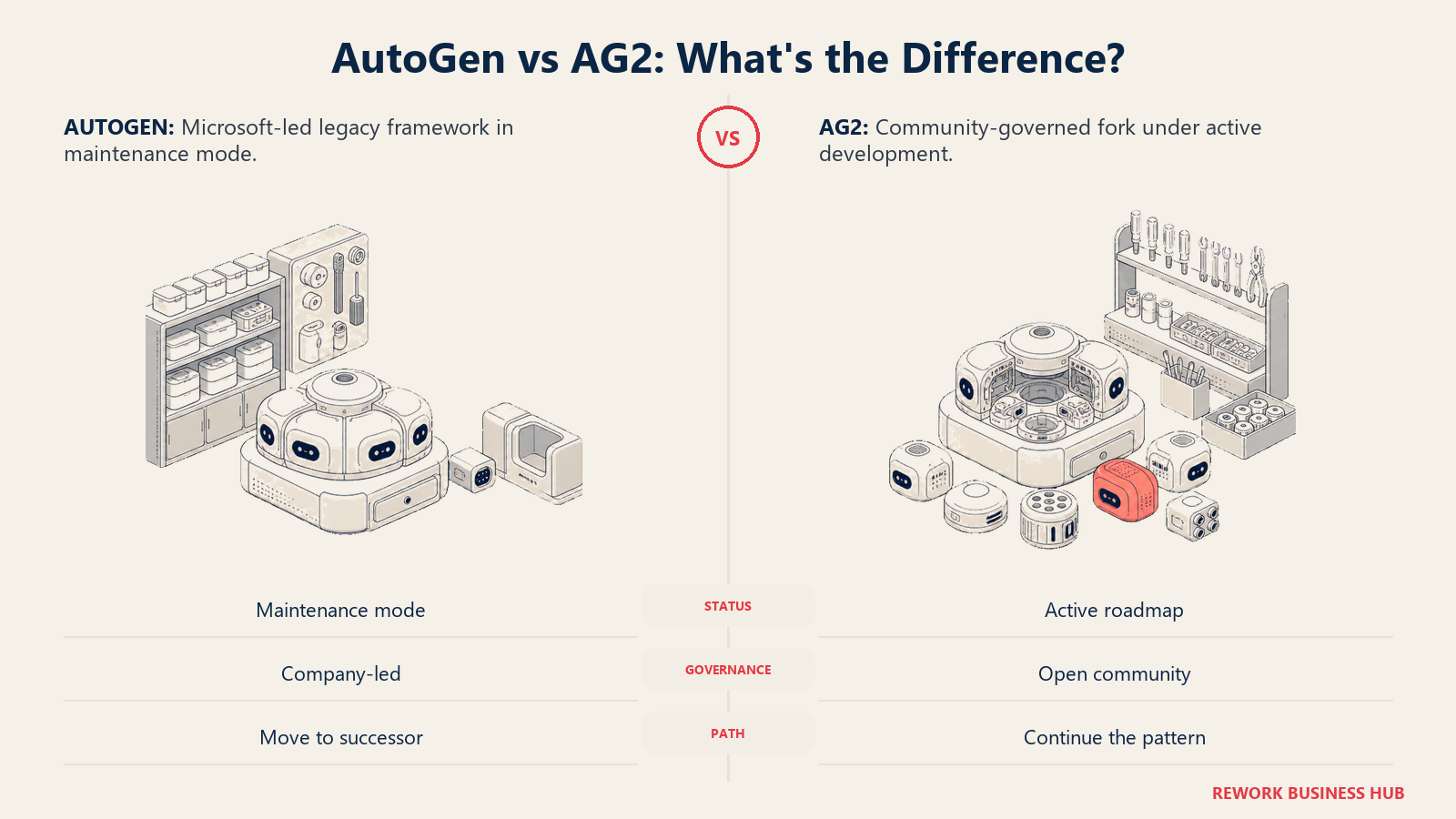
The two paths have since split for good. Microsoft has archived AutoGen: its README says Microsoft provides no bug fixes, security fixes, new features, or support, and sends new users to Microsoft Agent Framework (entry 6). AG2 is where the conversational lineage is still actively developed under Apache-2.0, and it shipped v1.0 on July 27, 2026.
That release isn't a drop-in upgrade. The classic ConversableAgent and GroupChat classes moved to a separate ag2-classic repository, and a new Network of typed channels replaces the group chat, swarm, and nested-chat patterns, with a central Hub that owns the registry, a write-ahead log, and an audit trail. If you want the conversational multi-agent pattern AutoGen popularized, with ongoing open-source development, AG2 is the living project. For the underlying pattern either way, see multi-agent systems.
| What you get | What you don't |
|---|---|
| The "conversation as control flow" pattern AutoGen popularized, still actively developed | v1.0 isn't a drop-in upgrade; classic AutoGen or AG2 code needs migrating or stays on ag2-classic |
| Apache-2.0 with open, community governance | Far smaller community and star count than LangGraph or the original AutoGen repo |
| A Hub with a write-ahead log and audit trail built into the v1.0 core | Older AutoGen tutorials and examples won't run on the v1.0 Network unchanged |
Licence: Apache-2.0. (The original AutoGen code is MIT-licensed but archived and no longer supported by Microsoft.) Best for: Teams that want the AutoGen conversational pattern under open governance, starting fresh on AG2 v1.0 rather than on AutoGen.
4. OpenAI Agents SDK: The Lightest SDK, Built by the Model Vendor
The OpenAI Agents SDK is the production successor to OpenAI's experimental "Swarm" pattern: a deliberately small set of primitives (Agents, Handoffs, Guardrails, Sessions) built on top of the Responses API. Despite the name, it isn't locked to OpenAI models. An official LiteLLM extension gives it access to more than 100 providers, including Anthropic, Gemini, and Bedrock, through the same agent code.
Worth stating plainly: this is a different product from the OpenAI Assistants API, which OpenAI removed from its API on August 26, 2026. The Agents SDK is the actively developed path forward.
| What you get | What you don't |
|---|---|
| Minimal surface area, fast to learn end to end | Youngest major framework here, fewer battle-tested production patterns |
| Backed directly by a frontier model lab | Thinner built-in persistence story than LangGraph's checkpointing |
| Genuine multi-provider support via the official LiteLLM extension | Name invites confusion with the retired Assistants API |
| Python and TypeScript, MIT licence | LiteLLM provider support is officially best-effort, still in beta |
Licence: MIT. Best for: Teams that want the smallest possible dependency footprint and are comfortable wiring their own persistence.
5. Pydantic AI: Type-Safe Agents for FastAPI-Trained Teams
Pydantic AI comes from the team behind Pydantic itself, the validation library most Python web APIs already depend on, and it shows: agent outputs are structured and validated by construction rather than parsed hopefully from a text blob, and tool dependencies are injected the way FastAPI injects request dependencies. That makes malformed tool calls a type error you catch in testing, not an incident you catch in production.
The framework itself is fully open and free. Logfire, the team's optional observability product, is separate: a free tier with 10 million spans a month, a Team tier at $49 a month for five seats, and a Growth tier at $249 a month for unlimited seats, all confirmed on pydantic.dev/pricing.
| What you get | What you don't |
|---|---|
| Structured, validated outputs by construction, not by hope | Younger ecosystem than LangGraph or CrewAI, fewer community templates |
| FastAPI-style dependency injection makes testing straightforward | Multi-agent choreography is less opinionated, you design more of it yourself |
| Backed by a team most Python shops already trust | Smaller catalog of pre-built integrations than the LangChain ecosystem |
| Model-agnostic, MIT licence | Optional Logfire observability is a separate paid product |
Licence: MIT. Best for: Python teams that want agent outputs to fail a type check instead of failing in production.
6. Microsoft Agent Framework: The Successor to Semantic Kernel and AutoGen
Microsoft Agent Framework is what Semantic Kernel and AutoGen became. Microsoft merged the two into one SDK, which reached version 1.0 for both .NET and Python on April 3, 2026, and Semantic Kernel's README now names it as the successor. A Go SDK exists too, but it lives in a separate repository and is still in public preview.
What it brings to this list is enterprise plumbing in an MIT-licensed codebase: five orchestration patterns (Sequential, Concurrent, Handoff, Group Chat, and Magentic), checkpointing and human-in-the-loop control, built-in OpenTelemetry tracing, and optional hosting on Microsoft Foundry. Teams with existing code get official migration guides from Semantic Kernel and from AutoGen. One thing to check before moving a Java shop: Semantic Kernel was the only framework here with mature Java support, and Agent Framework's README lists Python, .NET, and the preview Go SDK.
| What you get | What you don't |
|---|---|
| Microsoft's supported path, at 1.0 with stable APIs for .NET and Python | Go SDK still in public preview; no Java SDK listed |
| Five orchestration patterns, with checkpointing and human-in-the-loop approval | Magentic's iterative planning makes total run cost hard to predict upfront |
| Built-in OpenTelemetry tracing and optional Foundry-hosted agents | Best fit narrows outside the Microsoft and Azure ecosystem |
| MIT licence, fully permissive | Moving off Semantic Kernel or AutoGen is a real migration, not a version bump |
Licence: MIT. Best for: .NET and Python teams on Microsoft's stack, and anyone with a Semantic Kernel or AutoGen codebase planning the move.
7. LlamaIndex Workflows: Event-Driven Orchestration From a RAG Pedigree
LlamaIndex Workflows models an agent as a set of async steps that emit and consume typed events, so a multi-step agent reads like a small state machine instead of a dedicated graph DSL. It grew directly out of LlamaIndex's data-connector and retrieval heritage, LlamaHub included, which shows in how naturally it handles agents whose core job is pulling from documents and structured data rather than pure conversation.
LlamaIndex Inc's hosted LlamaCloud handles parsing and indexing at usage-based rates, kept separate from the orchestration framework, which stays free and open.
| What you get | What you don't |
|---|---|
| Best-in-class data connectors and retrieval primitives | Smaller multi-agent-specific community than LangGraph or CrewAI |
| Lightweight event model, easy to reason about step by step | Most tutorials still assume a RAG use case even for general agents |
| Works standalone or layered under the full LlamaIndex stack | Workflow context serialization is newer than LangGraph's checkpointing |
| Python and TypeScript, MIT licence | Hosted LlamaCloud is a separate usage-based product, not free |
Licence: MIT. Best for: Teams building agents where retrieval over documents or data is the core job, not an add-on.
8. Agno: The Performance-First Framework Formerly Known as Phidata
Agno, renamed from Phidata in January 2025, now positions itself less as a library and more as an "agentic operating system," built around Agents, Teams, and Workflows abstractions plus a runtime called AgentOS that owns durable state and exposes it over HTTP. The pitch is speed: Agno's own published benchmarks claim roughly 5,000 times faster agent instantiation and about 50 times less memory than LangGraph. That's a vendor claim worth benchmarking against your own workload before you rely on it, not an independently verified figure.
| What you get | What you don't |
|---|---|
| Genuinely lightweight runtime, useful for high-concurrency agent fleets | Performance claims are vendor-published; verify on your own workload |
| Built-in multi-modal support and session storage | Smaller community and fewer third-party tutorials than the top frameworks |
| Fast release cadence since the 2025 rebrand | Younger governance model than the Microsoft- or LangChain-backed options |
| Apache-2.0, fully permissive | AgentOS hosted control plane pricing isn't publicly listed |
Licence: Apache-2.0. Best for: Teams running large numbers of concurrent lightweight agents where instantiation overhead is a real, measured bottleneck.
9. Mastra: TypeScript-Native Agents for Full-Stack JS Teams
Mastra, built by a team that includes former Gatsby engineers, is the first framework on this list designed API-first for TypeScript rather than ported from a Python design. Workflows, agents, RAG, evals, and a memory layer are built to sit naturally inside an existing Next.js or Node service, which matters if standing up a separate Python microservice just to run agents isn't worth the operational overhead.
The core framework is Apache-2.0. An ee/ directory carries a separate Mastra Enterprise licence, source-available for development but requiring a paid licence in production, and the optional Mastra Cloud control plane starts free (100,000 observability events, 24 CPU hours, 15-day retention) with a Teams tier at $250 a month, confirmed on mastra.ai/pricing.
| What you get | What you don't |
|---|---|
| API-first TypeScript design, not a ported Python framework | Open-core licence: ee/ directory needs a paid licence in production |
| Fits naturally inside an existing Next.js or Node stack | Younger than the Python-first incumbents, fewer production war stories |
| Native workflow suspend and resume, pluggable memory | Smaller plugin ecosystem than LangChain's ten thousand-plus integrations |
| Active docs and a fast release cadence | Mastra Cloud overage pricing ($10/100K events, $0.35/CPU hour) adds up at scale |
Licence: Apache-2.0 (core), separate commercial licence for ee/. Best for: JavaScript and TypeScript teams that don't want to stand up a separate Python service just to run agents.
10. smolagents: Hugging Face's Minimal, Code-Writing Agents
smolagents takes a different bet than the rest of this list: instead of chaining JSON tool calls, its core "CodeAgent" writes and executes small pieces of Python as its primary action. Hugging Face's argument is that this cuts the number of steps and the error rate compared to classic tool-calling loops, since a model writing results = [search(q) for q in queries] does in one step what three sequential tool calls would need. The core library is deliberately small, small enough to read end to end in an afternoon.
| What you get | What you don't |
|---|---|
| Genuinely tiny, auditable core you can read in an afternoon | Minimal by design, so you assemble more production scaffolding yourself |
| Code-as-action pattern reduces tool-call chaining errors | Less suited to complex multi-agent choreography out of the box |
| Native Hugging Face Hub and Inference integration | Smaller ecosystem of third-party integrations than LangChain or LlamaIndex |
| Apache-2.0, fully permissive | No official hosted deployment or observability product |
Licence: Apache-2.0. Best for: Teams that want to understand every line of their agent loop, or that are already deep in the Hugging Face ecosystem.
11. Haystack: Production Retrieval Pipelines With Agents Built In
Haystack, maintained by the German company deepset, started as a search and retrieval pipeline framework years before "agent" became the industry's word of the month, and that heritage shows in how explicit and battle-tested its component and pipeline model is for retrieval and document processing. Agents in Haystack are built as components inside the same pipeline graph, not a separate bolt-on concept.
deepset sells a Haystack Enterprise Starter (support plus production templates) and a full Haystack Enterprise Platform on top of the open core, both priced by organization size rather than published as a rate card.
| What you get | What you don't |
|---|---|
| Explicit, mature pipeline control over retrieval and routing | Pipeline-first mental model feels less conversational than CrewAI |
| Strong document processing and evaluation tooling from search-engine roots | Smaller mindshare in agent-specific tutorials despite the maturity |
| Real production deployments predating the current agent hype cycle | Enterprise pricing isn't published, org-size-based on request |
| Apache-2.0, fully permissive | Fewer default multi-agent orchestration patterns than CrewAI or AG2 |
Licence: Apache-2.0. Best for: Teams whose agent's real job is accurate retrieval and document handling, with conversation as a thin layer on top.
12. Dify: The Full LLMOps App, With a Licence You Should Actually Read
Dify packages a visual workflow builder, a prompt IDE, a RAG pipeline, agent orchestration, and observability into one self-hosted application, which makes it closer to a full LLMOps platform than a code library. That breadth, plus a large community, is likely why it's the most-starred repository in this entire list, just ahead of Langflow. LangGenius, the company behind it, also runs Dify Cloud: a free Sandbox tier, Professional at $59 a month ($590 a year billed annually), Team at $159 a month ($1,590 a year billed annually), and a custom Enterprise tier, all confirmed on dify.ai/pricing.
Read the licence section above before betting a resold product on this one: Dify's modified Apache-2.0 licence blocks operating it as a multi-tenant SaaS without a commercial licence from LangGenius. For a fully-managed alternative that sidesteps the self-hosting question entirely, see our best no-code AI agent builders roundup.
| What you get | What you don't |
|---|---|
| Broadest feature surface here: builder, RAG, agents, evals, observability in one app | Licence blocks reselling it as your own multi-tenant SaaS without a paid licence |
| Huge community, fast to a working internal tool without writing orchestration code | Console branding can't be stripped outside a paid tier |
| Self-hosted or Dify Cloud, your choice | Message-credit pricing on Cloud adds a metering layer to plan around |
| Among the most-starred repos in this list, very active development | Source-available, not OSI open source, despite the Apache-2.0 base |
Licence: Modified Apache-2.0 ("Dify Open Source License"), source-available. Best for: Teams that want an internal, self-hosted LLM app builder for employees, not a codebase to embed inside a resold product.
13. Langflow: Drag-and-Drop Building, Now Inside IBM's Orbit
Langflow puts a visual canvas over LangChain-style components, and it exports what you build as runnable Python or a callable API endpoint, which makes it a genuinely popular way to prototype an agent flow and hand it to engineers, or to demo one to a non-technical stakeholder. DataStax acquired Langflow in April 2024, and IBM closed its acquisition of DataStax in May 2025, so Langflow's roadmap now sits inside IBM's watsonx strategy.
Unlike Dify or Flowise, Langflow carries no licence carve-out: it's MIT, full stop.
| What you get | What you don't |
|---|---|
| True MIT licence with no enterprise carve-out | Visual flows are harder to version-control and code-review at scale than plain code |
| Visual canvas lowers the bar for non-engineers to prototype | An IBM-owned roadmap may prioritize watsonx integration over community requests |
| Exports to runnable Python or an API endpoint | Second-largest repo by star count here, which also means a lot of feature sprawl to sort through |
| Backed by IBM's distribution and enterprise sales motion | Python-first, so a JavaScript-first stack takes on a Python service |
Licence: MIT. Best for: Teams that want a free, MIT-licensed visual builder for prototyping before committing a flow to hand-written code.
14. Flowise: Archived in 2026, Still Forkable Under Apache-2.0
Flowise was the TypeScript-native answer to Langflow's Python-first canvas, which mattered if your backend was already a Node service and you didn't want to bring Python into the stack just for agent prototyping. Workday announced its acquisition of FlowiseAI in August 2025, confirmed in Workday's own newsroom.
Then the maintainers wound Flowise down. Feature development and pull-request review stopped with a code freeze on July 29, 2026, the GitHub repository was archived in August with issues and pull requests locked, and official core-team presence ended on August 31, 2026. The code doesn't disappear: the Apache-2.0 core stays on GitHub, the enterprise/ directory keeps its separate proprietary licence, and the maintainers encourage teams to fork the repo. Flowise Cloud still lists Free, Starter ($35 a month), and Pro ($65 a month, $15 per extra user beyond five) plans on flowiseai.com, but the sunset notice doesn't say how long Cloud will keep running.
| What you get | What you don't |
|---|---|
| An Apache-2.0 core you can keep running and fork | No core-team fixes or support after August 31, 2026 |
| Still simple to self-host inside a Node stack you already run | Archived repo: issues and pull requests are locked |
| Cloud plans still listed for small projects | Cloud's long-term future isn't stated in the sunset notice |
| Existing flows keep working where they're deployed | Any new build should start on a maintained option such as Langflow or Mastra |
Licence: Apache-2.0 (core), proprietary licence for enterprise/. Best for: Teams already running Flowise that need a fork-or-migrate plan; new JavaScript builds should look at Mastra (entry 9) instead.
15. OpenHands: The Open-Source Autonomous Software Engineer
OpenHands, renamed from OpenDevin in late 2024 and built by All Hands AI, does a different job than the other 14 frameworks on this list. It's not a general-purpose library you assemble a custom agent on top of, it's a specialized runtime that gives an agent a real sandboxed shell, browser, and code editor so it can plan, write, run, test, and fix code autonomously. If you're comparing it against hosted coding-agent products instead, see our best AI coding agents roundup.
All Hands AI runs OpenHands Cloud alongside the free local version: an Individual tier that's free with your own API key or pay-at-cost model access, and a custom Enterprise tier for private-VPC or self-hosted deployment with SSO, confirmed on openhands.dev/pricing.
| What you get | What you don't |
|---|---|
| Genuinely autonomous end-to-end loop: plan, code, run, test, fix | Narrower purpose than the rest of this list, built for coding specifically |
| MIT licence with no carve-outs | Safe, sandboxed execution takes real setup effort to run well self-hosted |
| Free local mode plus an at-cost hosted option | Not a toolkit for building a customer support or sales agent |
| Large, fast-growing community (backed by an $18.8M Series A) | Enterprise pricing isn't published, custom quote only |
Licence: MIT. Best for: Teams that want an open, self-hostable alternative to closed coding-agent products, not a framework to build a general-purpose agent on.
The Real Cost of "Free"
Every framework's code is free in all 15 cases. What isn't free is everything that makes an agent trustworthy enough to run unattended. Almost every vendor on this list monetizes the same layer: not the orchestration code, but the observability, evaluation, and managed hosting wrapped around it.
| What's Free | What Usually Isn't | Who Charges For It |
|---|---|---|
| The orchestration or builder code itself | Production-grade tracing and evaluation | LangSmith, Pydantic Logfire, Mastra Cloud, CrewAI AMP |
| Running the framework on your own infrastructure | Managed deployment and hosting | LangGraph Platform, Dify Cloud, Flowise Cloud, OpenHands Cloud |
| Basic self-hosting for internal use | Enterprise support, SSO, RBAC, and SLAs | Every vendor here, once you cross roughly 10 to 20 seats |
| Reading the documentation | The engineering hours to wire memory, retries, and guardrails yourself | Nobody bills for this, which is exactly why it's the real cost |
Budget for that last row before you budget for a licence fee. A framework with a $0 price tag and no engineer who understands its state model is more expensive than a framework with a modest hosted tier and a team that's fluent in it.
How to Choose: Decision Framework
Match your situation to the right starting point, then read that framework's full section above before committing.
| If you need... | Pick... | Why |
|---|---|---|
| Durable, pausable, resumable production workflows | LangGraph | Native checkpointing and time-travel debugging, nothing bolted on |
| A working multi-agent demo by end of day | CrewAI | Role-based crews are the fastest path to something that runs |
| The AutoGen conversational pattern, still actively maintained | AG2 | Apache-2.0, community-governed, v1.0 since July 2026; AutoGen itself is archived |
| The lightest SDK, from the model vendor itself | OpenAI Agents SDK | Minimal primitives, genuine multi-provider support via LiteLLM |
| Agent outputs that fail a type check instead of production | Pydantic AI | Structured, validated outputs by construction |
| Retrieval-heavy agents over documents and data | LlamaIndex Workflows | Built on the strongest RAG and data-connector heritage here |
| Thousands of concurrent, lightweight agents | Agno | Purpose-built for low instantiation overhead, verify claims yourself |
| A TypeScript-native framework inside a Next.js stack | Mastra | API-first TypeScript design, not a ported Python library |
| A visual builder your less technical teammates can use | Langflow | MIT with no carve-outs; Flowise, the Node option, was archived in August 2026 |
| One self-hosted app covering builder, RAG, agents, and evals | Dify | Widest feature surface, but read the licence before reselling it |
| An autonomous agent that ships code, not conversation | OpenHands | Purpose-built coding-agent runtime, not a general library |
| A Microsoft stack, or code on Semantic Kernel or AutoGen | Microsoft Agent Framework | Successor to both, at 1.0 for .NET and Python, with official migration guides from each |
If your team would rather evaluate a fully managed platform instead of assembling one from a framework, our best enterprise AI agent platforms roundup and our choosing an AI agent platform guide both cover that path.
What to Do Next
Don't evaluate all 15 frameworks at once. Narrow to two based on your language (Python or TypeScript) and your build style (code library or visual app), then build the same small agent, one tool call, one multi-step handoff, and one deliberate failure case, in both. The framework that survives you trying to break it is the one to build on.
If your team would rather not build the agent at all, our best AI agent platforms roundup covers managed alternatives, and the how to build an AI agent guide walks through the underlying steps regardless of which framework you end up choosing.
Co-Founder, Rework.com
On this page
- Key Facts
- What Changed in Open-Source Agent Frameworks This Year
- Quick Comparison Table
- How to Read "Open Source" Here: Licence Reality Check
- Self-Hosting, Language, and State: The Engineering Fit
- Maintenance and Community Health: Who's Actually Still Building
- 1. LangGraph: The Production Standard for Stateful Agents
- 2. CrewAI: Role-Based Crews, Fastest Time to a Working Demo
- 3. AG2: The AutoGen Lineage, Now at v1.0
- 4. OpenAI Agents SDK: The Lightest SDK, Built by the Model Vendor
- 5. Pydantic AI: Type-Safe Agents for FastAPI-Trained Teams
- 6. Microsoft Agent Framework: The Successor to Semantic Kernel and AutoGen
- 7. LlamaIndex Workflows: Event-Driven Orchestration From a RAG Pedigree
- 8. Agno: The Performance-First Framework Formerly Known as Phidata
- 9. Mastra: TypeScript-Native Agents for Full-Stack JS Teams
- 10. smolagents: Hugging Face's Minimal, Code-Writing Agents
- 11. Haystack: Production Retrieval Pipelines With Agents Built In
- 12. Dify: The Full LLMOps App, With a Licence You Should Actually Read
- 13. Langflow: Drag-and-Drop Building, Now Inside IBM's Orbit
- 14. Flowise: Archived in 2026, Still Forkable Under Apache-2.0
- 15. OpenHands: The Open-Source Autonomous Software Engineer
- The Real Cost of "Free"
- How to Choose: Decision Framework
- What to Do Next