Pemarkahan Lead Bersama: Membina Model Pemarkahan yang Sesuai untuk Pemasaran dan Jualan
Turn this article into takeaways for your work.


Each assistant summarizes the article only for you and suggests best practices for your work.
Pemasaran menghabiskan tiga bulan membina model pemarkahan. Menemu bual jualan, menganalisis data tertutup-menang, menyediakan peraturan MAP. Kemudian menghantarnya.
Jualan melihat kelompok pertama lead yang mendapat skor tinggi, menghubungi beberapa, dan kembali bekerja dengan senarai mereka sendiri. Skor itu, kata mereka, tidak sepadan dengan apa yang mereka lihat secara sebenar dalam akaun.
Begitulah kebanyakan projek pemarkahan lead berakhir. Bukan dengan model yang buruk. Dengan model yang tidak dipercayai sesiapa.
Masalahnya biasanya bukan matematik. Ia adalah prosesnya. Apabila pemasaran membina model pemarkahan dan menyerahkannya kepada jualan, jualan tidak mempunyai pemilikan terhadap hasilnya. Mereka tidak memutuskan isyarat mana yang penting. Mereka tidak mengesahkan pemberat. Apabila model menghasilkan lead yang tidak akan mereka hubungi, mereka tidak mempunyai sebab untuk tunduk kepadanya.
Model yang dibina bersama, di mana kedua-dua pasukan menyumbang kepada pemberat, mengujinya terhadap data tertutup-menang sebenar, dan menandatangani ambang, adalah satu-satunya jenis yang bertahan apabila berhadapan dengan pasukan jualan. Sebelum membina model, kedua-dua pasukan seharusnya telah bersetuju tentang rangka kerja ICP bersama, pemberat pemarkahan hanya sebaik definisi pelanggan ideal yang mendasarinya.
Model Pemarkahan yang Tidak Digunakan Sesiapa
Sebelum kita tiba kepada apa yang perlu dibina, ada baiknya untuk jujur tentang mengapa kebanyakan model pemarkahan gagal. Gambaran keseluruhan Forrester mengenai pemarkahan minat individu menggariskan cabaran teras dengan baik: skor hanya berguna apabila pasukan yang dimaksudkan untuk dilayaninya mempercayai input tersebut.
Masalah 1: Pemasaran mentakrifkan model secara sepihak. Jualan tidak berada dalam bilik apabila pemberat ditetapkan. Mereka tidak mempunyai konteks mengapa lawatan halaman harga bernilai 25 mata tetapi kehadiran webinar bernilai 15. Apabila model menghasilkan keputusan yang bertentangan dengan logik, mereka tidak cukup mempercayainya untuk mengesampingkan gerak hati mereka.
Masalah 2: Model memberi terlalu banyak berat kepada penglibatan berbanding kesesuaian. Pembukaan e-mel, lawatan blog, klik sosial: ini menggembungkan skor untuk orang yang berminat dengan kandungan tetapi tidak akan pernah membeli. Pengurus pemasaran di syarikat 10 orang yang membaca setiap e-mel yang anda hantar mendapat skor lebih tinggi daripada VP Operasi di syarikat 300 orang yang menjadi sasaran anda yang melawat halaman harga anda sekali. Pencetak skor tinggi itu bukan lead yang lebih baik.
Masalah 3: Tiada peraturan pereputan. Lead yang memuat turun panduan 14 bulan yang lalu masih mempunyai skor itu. Isyarat penglibatan lama tidak mencerminkan niat semasa. Tanpa pereputan, skor lama yang tinggi menyemakkan bahagian atas barisan prioriti.
Masalah 4: Model tidak pernah dikalibrasi semula. Pasaran berubah. ICP anda beralih. Saluran baharu menjana lead dengan kualiti berbeza. Model pemarkahan yang dibina pada data tertutup-menang tahun lalu boleh jadi salah secara aktif pada masa ia berjalan selama 18 bulan.
Pemilikan bersama membetulkan Masalah 1 secara berstruktur, kerana jualan terlibat dalam membina model dan mereka mempunyai konteks untuk pemberat itu. Tiga masalah lain memerlukan keputusan reka bentuk khusus, yang merupakan perkara yang dibincangkan dalam artikel ini. Jika anda tidak pasti sama ada syarikat anda memerlukan pemarkahan formal sama sekali, artikel ketika anda tidak memerlukan pemarkahan lead merangkumi kes di mana kelayakan yang lebih mudah mengatasi sistem pemarkahan.
Model Tiga Dimensi
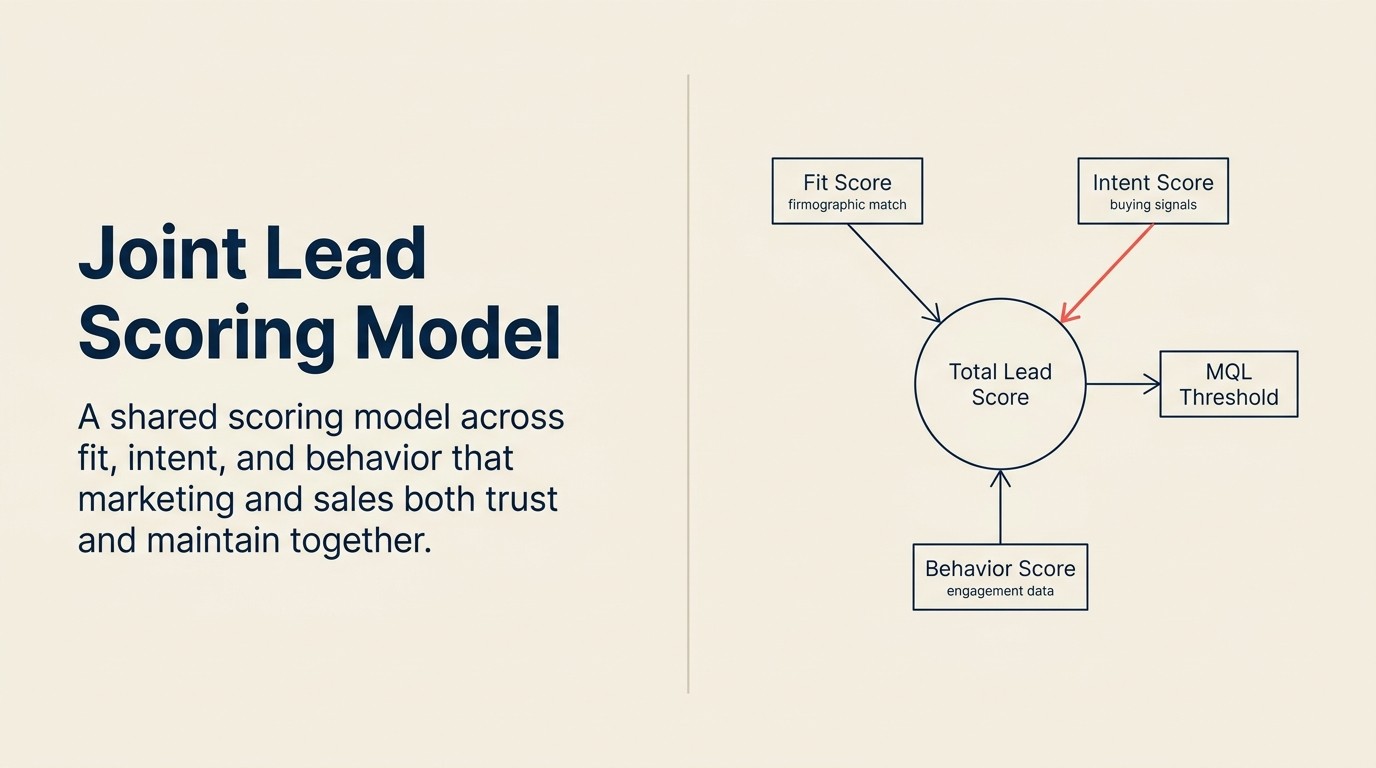
Segitiga Pemarkahan Kesesuaian + Niat + Tingkah Laku
Segitiga Pemarkahan Kesesuaian + Niat + Tingkah Laku adalah model pemarkahan lead tiga dimensi di mana setiap paksi mengukur kualiti lead yang berbeza, boleh diskoran secara bebas, boleh dilaporkan secara bebas, dan boleh dikalibrasi secara bebas.
- Kesesuaian (siapa mereka): Isyarat firmografi dan peranan yang statik. Padanan ICP, senioriti jawatan, tumpukan teknologi, saiz syarikat. Tidak mereput dengan cepat.
- Niat (apa yang mereka selidiki sekarang): Isyarat tetingkap pembelian aktif. Permintaan demo, lawatan harga, penyelidikan kategori G2, lonjakan topik Bombora. Mereput dalam beberapa hari hingga minggu.
- Tingkah Laku (seberapa terlibat mereka dengan anda): Isyarat kedalaman penglibatan. Kehadiran webinar, muat turun kandungan, penggunaan percubaan. Mereput dalam 30–90 hari.
Lead perlu melepasi ambang minimum pada sekurang-kurangnya dua dimensi sebelum mencapai status MQL. Tingkah laku tinggi sahaja tidak melayakkan lead. Kesesuaian tinggi sahaja tidak melayakkan lead. Segitiga memerlukan sekurang-kurangnya dua kaki untuk berdiri.
Fakta Utama: Keberkesanan Pemarkahan Lead
- Syarikat yang menggunakan pemarkahan lead melihat peningkatan ROI penjanaan lead sebanyak 77% berbanding syarikat yang tidak, menurut penyelidikan MarketingSherpa mengenai amalan kelayakan B2B.
- Pasukan jualan yang mengambil bahagian dalam mereka bentuk model pemarkahan lead adalah 3x lebih berkemungkinan menggunakan skor lead dalam pengutamaan, menurut kajian SiriusDecisions mengenai penyelarasan rentas fungsi.
- Model pemarkahan lead yang merangkumi peraturan pereputan tingkah laku mengatasi model statik sebanyak 28% dalam kadar penukaran SQL-ke-peluang, berdasarkan analisis Aberdeen Group.
Model pemarkahan yang dibina pada tiga dimensi berasingan (kesesuaian, niat, dan tingkah laku) lebih telus dan boleh dikekalkan daripada skor komposit tunggal kerana setiap dimensi boleh difahami sendiri.
Skor kesesuaian: Siapa syarikat dan orangnya. Isyarat statik atau perlahan bergerak yang mencerminkan sama ada akaun ini berada dalam pasaran sasaran anda.
Skor niat: Apa yang mereka selidiki secara aktif. Isyarat yang menunjukkan tetingkap pembelian sedang terbuka atau menghampiri.
Skor tingkah laku: Apa yang mereka lakukan dengan kandungan dan produk anda. Isyarat penglibatan yang menunjukkan kedalaman minat.
Setiap dimensi boleh diskoran secara berasingan, dilaporkan secara berasingan, dan dikalibrasi secara berasingan. Apabila lead mempunyai kesesuaian tinggi tetapi niat rendah, itu adalah isyarat berguna yang hilang dalam nombor komposit tunggal.
Artikel pemarkahan kesesuaian vs niat pergi lebih mendalam mengenai pertukaran antara dua dimensi ini. Artikel ini memberi tumpuan kepada cara membina ketiga-tiganya bersama.
Pemarkahan Kesesuaian: Apa yang Perlu Disertakan
Isyarat kesesuaian menjawab: "Adakah ini jenis syarikat dan orang yang patut kita jual kepadanya?"
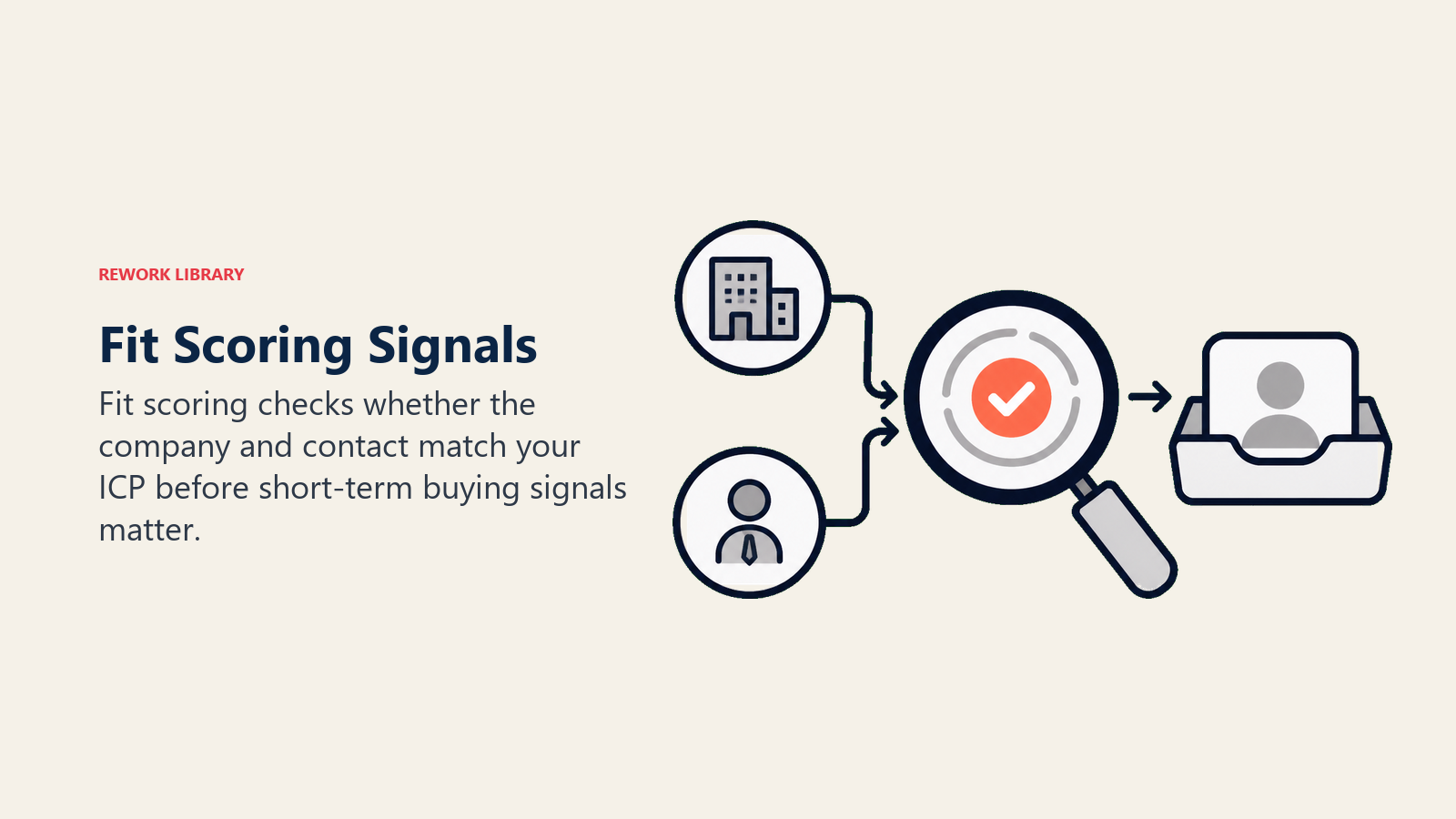 Isyarat firmografi (peringkat syarikat):
| Isyarat | Mata (contoh) | Sumber |
|---|---|---|
| Saiz syarikat: 50-500 pekerja | +20 | Medan borang, Clearbit, ZoomInfo |
| Padanan industri sasaran | +15 | Medan borang, pengayaan |
| Geografi: rantau yang dilayan | +10 | IP, medan borang |
| Saiz syarikat: 501-2000 pekerja | +10 | Pengayaan |
| Saiz syarikat: di luar julat sasaran | -15 | Pengayaan |
Isyarat peranan/jawatan (peringkat individu):
| Isyarat | Mata (contoh) | Sumber |
|---|---|---|
| VP atau C-level dalam fungsi relevan | +25 | Medan borang, pengayaan LinkedIn |
| Pengarah dalam fungsi relevan | +15 | Medan borang, pengayaan LinkedIn |
| Pengurus dalam fungsi relevan | +5 | Medan borang |
| IC dalam fungsi relevan | 0 | Medan borang |
| Di luar fungsi sasaran | -10 | Medan borang |
Isyarat tumpukan teknologi: Jika produk anda berintegrasi dengan atau menggantikan alat tertentu, kenalan yang syarikatnya menggunakan alat tersebut adalah kesesuaian yang lebih baik daripada yang tidak.
| Isyarat | Mata (contoh) | Sumber |
|---|---|---|
| Menggunakan rakan kongsi integrasi sasaran | +15 | Clearbit, G2, pengayaan |
| Menggunakan alat yang anda gantikan | +10 | Clearbit, dilaporkan sendiri |
| Tiada pertindihan tumpukan teknologi yang relevan | 0 | N/A |
Isyarat kesesuaian negatif (penyahkelayak): Ini adalah kritikal dan sering dilangkau.
| Isyarat | Mata | Kesan |
|---|---|---|
| Domain pesaing yang diketahui | -100 | Berkesan menyahkelayak |
| E-mel pelajar / domain akademik | -50 | Ditindas |
| Di luar geografi yang dilayan | -30 | Mengurangkan skor dengan ketara |
| Syarikat terlalu kecil (< 10 pekerja) | -20 | Diprioritaskan rendah |
Isyarat negatif sama pentingnya dengan yang positif. Model pemarkahan tanpa penyahkelayak menghasilkan skor tinggi untuk orang yang tidak akan pernah membeli.
Pemarkahan Niat: Isyarat Pihak Ketiga dan Pihak Pertama
Isyarat niat menjawab: "Adakah mereka secara aktif mencari untuk menyelesaikan masalah ini sekarang?"
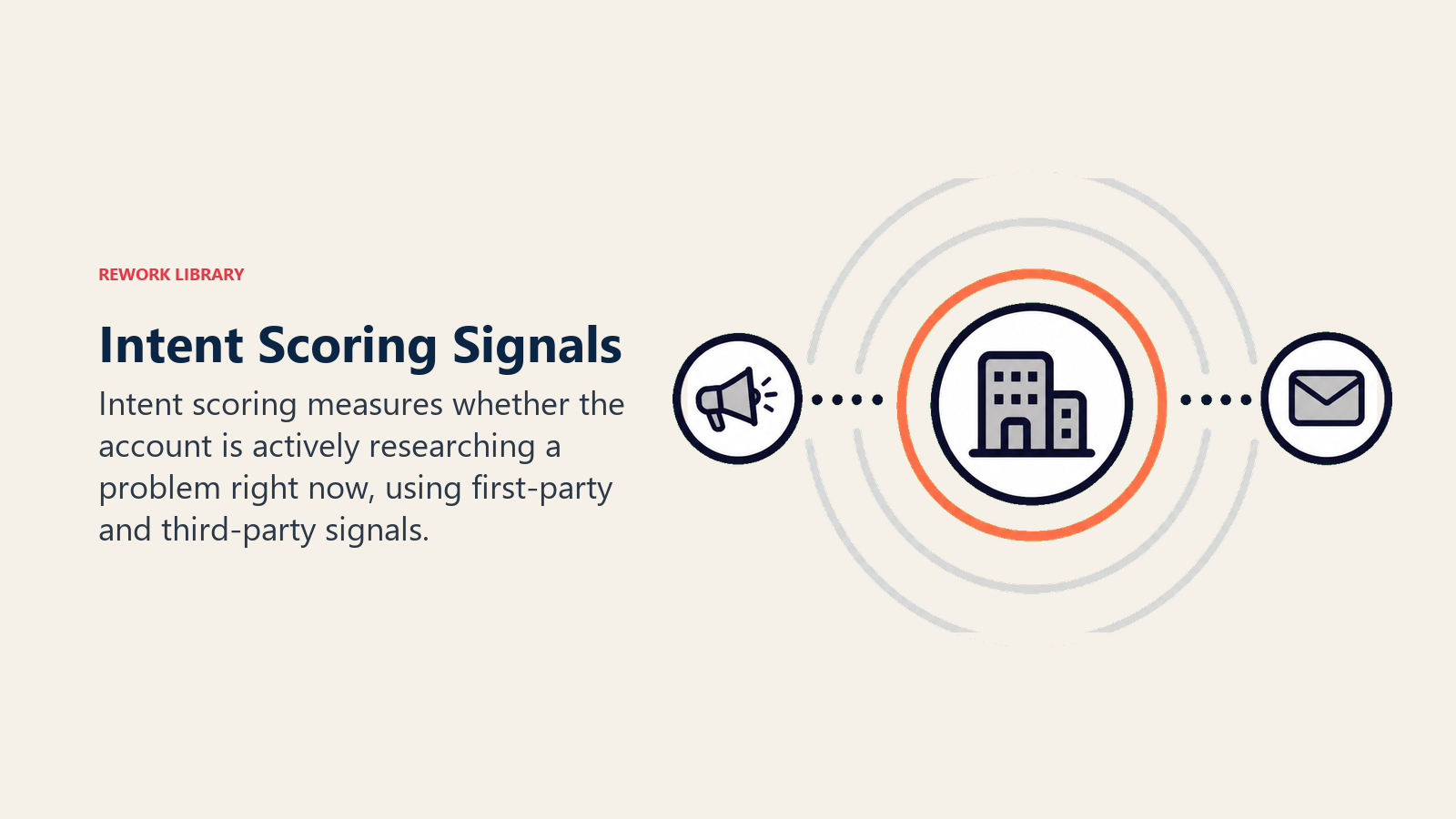 Isyarat niat pihak pertama datang dari hartanah anda sendiri. Ini adalah yang paling dipercayai kerana anda telah memerhati tingkah laku secara langsung.
| Isyarat | Mata (contoh) | Mengapa |
|---|---|---|
| Permintaan demo diserahkan | +50 | Isyarat pembelian eksplisit |
| Lawatan halaman harga (3+ halaman dalam) | +35 | Penilaian aktif |
| Kalkulator ROI digunakan | +30 | Niat komersial |
| Halaman perbandingan pesaing | +25 | Mod penilaian |
| Percubaan percuma dimulakan | +40 | Niat produk yang kuat |
| Lawatan halaman harga (tunggal) | +15 | Isyarat penyelidikan |
Isyarat niat pihak ketiga datang daripada pembekal data yang menjejak tingkah laku penyelidikan merentasi pelbagai laman web: G2, Bombora, TechTarget, dan platform yang serupa. Panduan Gartner mengenai pemarkahan lead B2B dengan isyarat niat menunjukkan bahawa syarikat yang menggunakan data niat bersama kriteria kesesuaian firmografi adalah dua kali lebih berkemungkinan mencapai kadar penukaran atas Funnel 10% atau lebih tinggi.
| Isyarat | Mata (contoh) | Sumber |
|---|---|---|
| Lonjakan topik: kategori relevan (Bombora) | +30 | Bombora |
| Paparan profil G2 untuk kategori anda | +25 | G2 Buyer Intent |
| Lonjakan penyelidikan kategori | +20 | TechTarget, Bombora |
Data niat pihak ketiga adalah berkuasa tetapi memerlukan belanjawan dan kerja integrasi. Jika anda tidak memilikinya, isyarat pihak pertama sahaja boleh membina model yang berfungsi. Isyarat proksi juga berjaya: jika kenalan telah menggunakan 4+ kandungan bahagian bawah Funnel dalam 30 hari, itu adalah isyarat niat yang munasabah walaupun tanpa data luaran.
Cara memberi berat kepada niat berbanding kesesuaian: Untuk kebanyakan gerakan B2B berpandukan inbound, niat harus membawa lebih banyak berat daripada kesesuaian apabila kedua-duanya ada. Syarikat yang sesuai sempurna yang melakukan penyelidikan aktif adalah lebih berharga daripada syarikat yang sesuai sempurna yang memuat turun satu entri blog. Tetapi niat tanpa kesesuaian masih bunyi, jadi beri berat mengikutnya.
Pemarkahan Tingkah Laku: Kedalaman Penglibatan
Isyarat tingkah laku menjawab: "Seberapa terlibat orang ini dengan kita secara khusus?"
 Penglibatan kandungan:
| Isyarat | Mata (contoh) | Nota |
|---|---|---|
| Webinar dihadiri (langsung) | +20 | Kehadiran langsung > tontonan rakaman |
| Panduan atau muat turun e-buku | +10 | |
| Lawatan blog (3+ halaman) | +8 | |
| Webinar didaftar, tidak hadir | +3 | Isyarat lemah |
| Pembukaan surat berita | +2 | Sangat lemah; jangan beri terlalu banyak berat |
| Klik e-mel (pautan ke kandungan) | +5 | Lebih kuat daripada pembukaan |
Penglibatan produk (jika berkenaan):
| Isyarat | Mata (contoh) | Nota |
|---|---|---|
| Akaun percubaan dicipta | +30 | Niat yang kuat |
| Ciri digunakan dalam percubaan | +15 setiap ciri | |
| Percubaan melebihi had penggunaan | +25 | Isyarat kapasiti |
Peraturan pereputan (tidak boleh dinegotiasikan):
Isyarat tingkah laku lama seharusnya mereput. Lead yang melawat blog anda 14 bulan yang lalu tidak sedang terlibat. Menjalankan skor tingkah laku lama mereka ke hadapan meracuni model.
| Usia isyarat | Pengganda skor |
|---|---|
| 0-30 hari | 100% |
| 31-60 hari | 75% |
| 61-90 hari | 50% |
| 91-180 hari | 25% |
| 180+ hari | 0% (atau had sumbangan) |
Kebanyakan platform MAP menyokong peraturan pereputan secara asli. Jika platform anda tidak, jalankan kerja berkelompok bulanan yang mengira semula skor dengan faktor penuaan yang digunakan.
Setelah anda mempunyai skor bagi setiap dimensi, soalan seterusnya ialah bagaimana menggabungkannya menjadi keputusan yang akan benar-benar ditindaklanjuti oleh jualan.
Menggabungkan Tiga Dimensi
Tiga pendekatan untuk menggabungkan kesesuaian, niat, dan tingkah laku ke dalam skor yang boleh digunakan:
Pilihan 1: Skor komposit. Tambah ketiga-tiga skor dimensi ke dalam satu nombor. Mudah dilaporkan. Mudah dibandingkan. Tetapi ia kehilangan keterlihatan peringkat dimensi. Anda tidak dapat memberitahu sama ada skor 85 adalah kesesuaian-tinggi/niat-rendah atau kesesuaian-rendah/tingkah laku-tinggi.
Pilihan 2: Logik ambang (disyorkan untuk kebanyakan pasukan). Takrifkan ambang minimum setiap dimensi. Lead hanya mencapai status MQL jika ia mencapai minimum pada sekurang-kurangnya dua daripada tiga dimensi. Ini menghalang lead yang sangat terlibat-tetapi-tidak-sesuai daripada mendapat skor ke MQL.
Contoh logik ambang:
- MQL memerlukan: Skor Kesesuaian ≥ 30 DAN (Skor Niat ≥ 20 ATAU Skor Tingkah Laku ≥ 25)
- MQL Panas: Kesesuaian ≥ 40 DAN Niat ≥ 30
Pilihan 3: Model matriks. Laporkan kesesuaian dan niat sebagai paksi berasingan. Kesesuaian-tinggi/niat-tinggi = outreach segera. Kesesuaian-tinggi/niat-rendah = nurture. Kesesuaian-rendah/niat-tinggi = tangani dengan berhati-hati. Kesesuaian-rendah/niat-rendah = tindas. Ini memberi jualan konteks paling berguna tetapi memerlukan sokongan UI untuk menjadi praktikal.
Untuk pasukan dengan MAP dan CRM yang boleh memaparkan pelbagai medan skor, logik ambang dengan pelaporan dimensi berasingan memberi anda yang terbaik dari kedua-dua pendekatan.
Petikan: Syarikat dengan amalan pengurusan lead dan pemarkahan yang matang menjana 50% lebih banyak lead yang bersedia untuk jualan pada kos 33% lebih rendah setiap lead berbanding syarikat yang menggunakan kelayakan ad hoc, menurut Penyelidikan Forrester mengenai demand gen B2B.
Petikan: Pasukan jualan yang mengambil bahagian dalam mereka bentuk model pemarkahan lead adalah 3x lebih berkemungkinan menggunakan skor lead dalam pengutamaan harian berbanding pasukan yang menerima model pemarkahan yang dibina oleh pemasaran sahaja, menurut kajian SiriusDecisions mengenai penyelarasan rentas fungsi.
Mendapatkan Penerimaan Jualan terhadap Model
Pemilikan bersama bukan kotak semak. Ia memerlukan langkah-langkah tertentu.
Langkah 1: Temu bual 3-5 wakil jualan sebelum membina. Tanya mereka: "Apabila anda melihat lead baharu, apakah perkara pertama yang anda semak? Apa yang membuat anda memutuskan untuk menghubungi dengan segera berbanding minggu depan? Apakah lead terbaik anda dalam 6 bulan yang lalu, dan apakah yang ada persamaan antara mereka?"
Jawapan mereka memberitahu anda isyarat mana yang penting dalam amalan. Bukan isyarat yang difikirkan penting oleh pemasaran.
Langkah 2: Kongsikan draf pemberat dan minta cabaran. Bentangkan logik pemarkahan dengan pemberat. Jemput perselisihan. "Pemasaran memberi lawatan halaman harga 35 mata. Adakah itu sepadan dengan apa yang anda lihat? Apabila seseorang melawati harga, berapa kerap ia membawa kepada perbualan yang nyata?"
Di mana jualan membantah, sama ada jelaskan data yang menyokong pemberat atau sesuaikannya. Kedua-dua hasil mengukuhkan model. Ambang skor MQL-ke-SQL perlu ditetapkan bersama atas sebab yang sama, ia adalah output model, dan jualan perlu mempercayai apa yang dihasilkan oleh ambang tersebut.
Langkah 3: Sahkan terhadap lead yang diketahui baik dan diketahui buruk. Tarik 20-30 perjanjian tertutup-menang dari 12 bulan yang lalu. Jalankan logik pemarkahan terhadap rekod lead mereka dan semak skor mereka. Jika perjanjian terbaik anda akan mendapat skor rendah di bawah model, anda mempunyai masalah kalibrasi. Latihan yang sama dengan tertutup-kalah: lead tertutup-kalah teratas seharusnya mendapat skor lebih rendah daripada lead tertutup-menang teratas. Rangka kerja kelayakan lead dalam koleksi pengurusan lead menawarkan perspektif tambahan mengenai isyarat apa yang sebenarnya membezakan lead yang boleh ditutup daripada bunyi.
Langkah 4: Jalankan percubaan sebelum siaran. Beri skor kepada kelompok lead baharu di bawah model baharu. Jualan menyemak 20 lead yang diberi skor tertinggi dan menilai sama ada mereka bersetuju dengan pengutamaan. Kalibrasi berdasarkan maklum balas sebelum melancarkan secara meluas.
Proses ini mengambil masa 4-6 minggu. Ia lebih perlahan daripada sekadar membina model sendiri. Tetapi ia adalah perbezaan antara model yang diterima pakai dan model yang diabaikan.
Analisis Rework: Proses penerimaan empat langkah (temu bual wakil, kongsikan draf pemberat, sahkan terhadap data tertutup-menang, jalankan percubaan) biasanya mengambil masa 4–6 minggu dan merupakan pelaburan dengan leverage tertinggi dalam penerimaan jangka panjang model pemarkahan. Pasukan yang melangkau ke "mari kita sahaja lancarkan dan sesuaikan kemudian" secara konsisten melaporkan hasil yang sama dalam 3–6 bulan: jualan berhenti melihat skor dan bekerja dengan senarai mereka sendiri. Langkah percubaan paling penting, memberi skor 20 lead sebenar dengan semakan jualan sebelum siaran langsung menampakkan ralat kalibrasi sebelum ia merosakkan kepercayaan.
Tadbir Urus Skor: Siapa yang Mengubah Pemberat
Model pemarkahan tanpa tadbir urus akan merosot. Seseorang menambah mata untuk membuka surat berita kerana ia mudah. Pemasaran mengemas kini halaman produk dan tingkah laku klik berubah tetapi tiada siapa yang mengemas kini logik pemarkahan. Pemberat yang betul enam bulan yang lalu kini salah.
Tadbir urus tidak perlu birokratik. Ia perlu jelas. Templat SLA pemasaran-jualan adalah tempat yang baik untuk mendokumentasikan peraturan tadbir urus bersama komitmen penyelarasan yang lebih luas yang ditandatangani oleh kedua-dua pasukan.
| Keputusan | Pemilik | Kelulusan diperlukan |
|---|---|---|
| Pemberat untuk isyarat sedia ada | Marketing Ops | Kelulusan VP Pemasaran; maklumkan VP Jualan |
| Menambah kategori isyarat baharu | Marketing Ops | Kelulusan VP Pemasaran dan VP Jualan |
| Mengubah ambang MQL/SQL | Marketing Ops | Kelulusan kedua-dua VP; dokumen perubahan dalam SLA |
| Perubahan penyahkelayak | Marketing Ops | Kelulusan kedua-dua VP |
| Pembaikan kecemasan (model jelas rosak) | Marketing Ops | Kelulusan lisan dari kedua-dua VP; kelulusan formal dalam 1 minggu |
Mesyuarat semakan suku tahunan: 45 minit. Tarik data penukaran mengikut skor dimensi. Semak sebarang isyarat yang ditambah atau diubah. Sahkan model masih dikalibrasi terhadap data tertutup-menang semasa. Kedua-dua VP hadir.
Tadbir urus menghalang model daripada merosot. Tetapi anda masih memerlukan proses untuk menangkap saat-saat model secara senyap berhenti meramal. Itulah gunanya pengesahan.
Menguji dan Mengesahkan Model
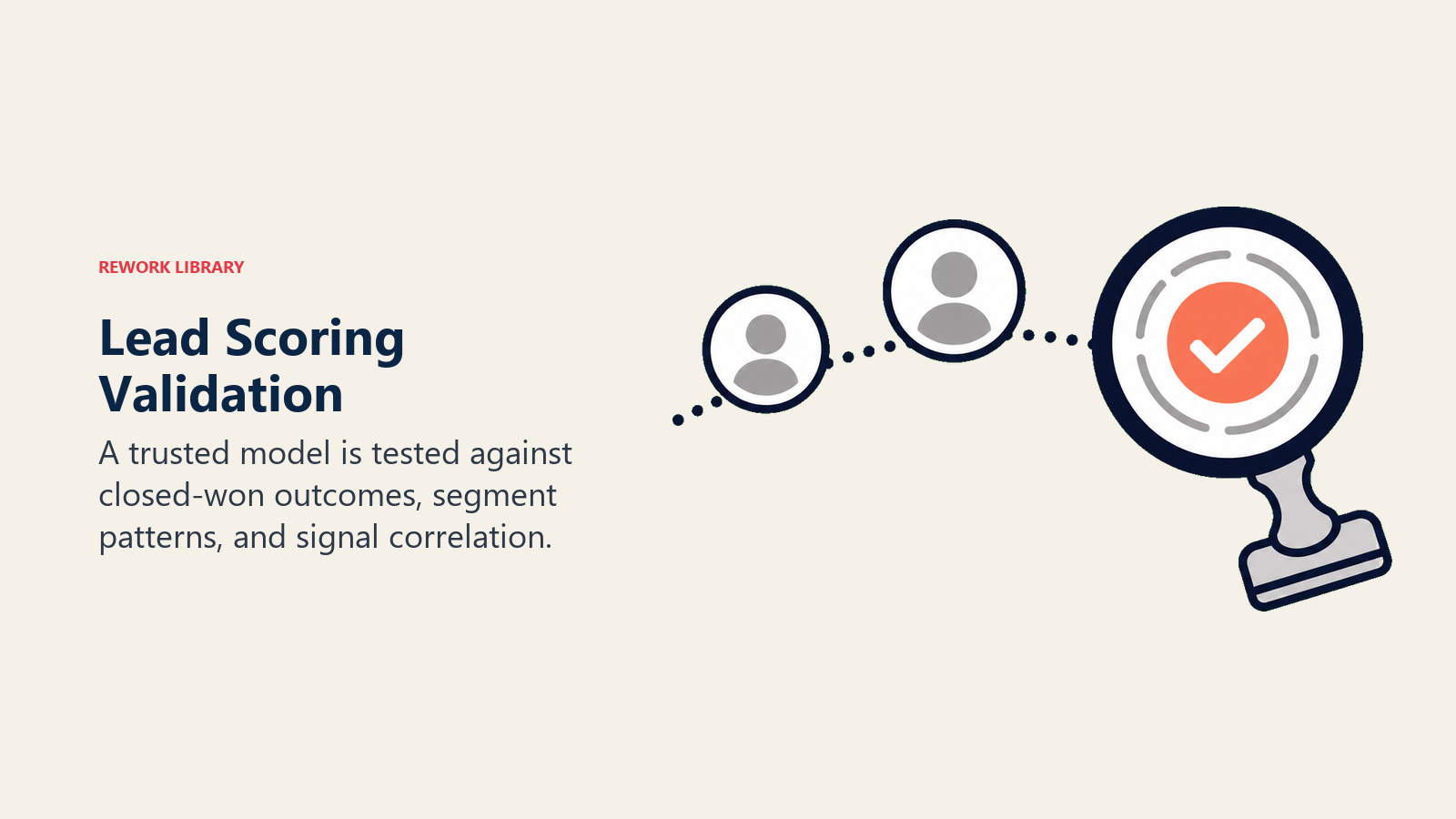
Model yang disahkan terhadap data tertutup-menang adalah standard minimum untuk mempercayainya.
 Analisis korelasi:
Untuk setiap isyarat dalam model, kira korelasi antara mempunyai isyarat itu dan akhirnya ditutup sebagai menang. Lakukan ini setiap segmen (SMB vs. mid-market) jika ICP anda berbeza. Isyarat dengan korelasi rendah terhadap tertutup-menang harus diberi berat lebih rendah atau dikeluarkan. Isyarat dengan korelasi tinggi harus diberi berat lebih tinggi.
Analisis korelasi:
Untuk setiap isyarat dalam model, kira korelasi antara mempunyai isyarat itu dan akhirnya ditutup sebagai menang. Lakukan ini setiap segmen (SMB vs. mid-market) jika ICP anda berbeza. Isyarat dengan korelasi rendah terhadap tertutup-menang harus diberi berat lebih rendah atau dikeluarkan. Isyarat dengan korelasi tinggi harus diberi berat lebih tinggi.
Analisis ini tidak memerlukan pasukan sains data. Hamparan dengan data tertutup-menang vs tertutup-kalah dan lajur kehadiran/ketiadaan isyarat akan menampakkan korelasi yang anda perlukan.
Kalibrasi semula suku tahunan:
- Tarik 90 hari terakhir SQL
- Semak kadar penukaran SQL-ke-peluang mengikut jalur skor (60-70, 70-80, 80-90, 90+)
- Jika kadar penukaran tidak berkorelasi dengan jalur skor, model memerlukan kalibrasi semula
- Tarik sebarang isyarat yang ditambah dalam suku tahun terakhir dan semak korelasi individu mereka dengan penukaran
- Analisis kadar penukaran daripada pasukan pipeline menyuapi terus ke dalam semakan ini, jalur skor yang tidak berkorelasi dengan perkembangan peringkat muncul dengan jelas di sana
Pembinaan semula tahunan sepenuhnya: Setiap 12-18 bulan, bina semula model dari awal menggunakan 12 bulan data tertutup terkini. Penyelidikan Gartner mengenai pemarkahan lead ramalan mengesahkan bahawa model yang dibina semula pada data segar secara konsisten mengatasi yang dibiarkan statik, walaupun perubahan kecil dalam ICP atau campuran saluran anda boleh menjadikan pemberat 18 bulan lama secara aktif mengelirukan. Keadaan pasaran berubah. ICP anda mungkin telah beralih. Model lama yang dibina pada data lapuk berprestasi rendah tanpa sesiapa menyedarinya kerana kemerosotan itu beransur-ansur.
Rangka kerja definisi MQL dan ambang pemarkahan harus disemak bersama semasa pembinaan semula tahunan, kerana ia direka bentuk untuk selaras.
Kesimpulan
Model pemarkahan yang dibina oleh kedua-dua pasukan lebih bernilai daripada model sempurna yang hanya dipercayai oleh pemasaran.
Itu bukan bermakna anda harus membina model yang buruk untuk mendapat penerimaan. Ia bermakna proses melibatkan jualan dalam membina model (temu bual, cabaran pemberat, pengesahan percubaan) menjadikan model lebih baik serta lebih diterima pakai.
Jualan mengetahui sesuatu tentang apa yang menjadikan lead baik yang tidak dapat dilihat oleh pemasaran dalam data penglibatan. Pemasaran mengetahui sesuatu tentang apa yang menjana isyarat niat yang tidak diperhatikan oleh jualan. Model yang dibina bersama menggabungkan kedua-duanya.
Binanya bersama. Sahkan terhadap data sebenar. Tadbir urus secara eksplisit. Kalibrasi semula suku tahunan.
Matlamatnya bukan skor. Ia adalah bahasa bersama untuk pengutamaan, satu yang digunakan oleh kedua-dua pasukan kerana kedua-duanya mempercayainya.
Soalan Lazim tentang Pemarkahan Lead Bersama
Apakah pemarkahan lead bersama?
Pemarkahan lead bersama adalah model pemarkahan yang dibina secara kolaboratif oleh pemasaran dan jualan, di mana kedua-dua pasukan menyumbang kepada pemberat isyarat, mengesahkan model terhadap data tertutup-menang, dan menandatangani ambang MQL/SQL. Elemen "bersama" bukan seremoni, ia bermakna jualan mempunyai pemilikan terhadap hasilnya, yang merupakan satu-satunya cara model pemarkahan bertahan apabila berhadapan dengan pasukan jualan yang sebenar.
Apakah tiga dimensi pemarkahan lead?
Tiga dimensi adalah kesesuaian (siapa syarikat dan orangnya, isyarat firmografi dan peranan), niat (sama ada mereka sedang menyelidiki penyelesaian sekarang, lawatan harga, permintaan demo, lonjakan niat pihak ketiga), dan tingkah laku (seberapa terlibat mereka dengan kandungan dan produk anda). Setiap dimensi mereput pada kadar yang berbeza: kesesuaian hampir statik, niat mereput dalam beberapa hari, tingkah laku mereput dalam 30–90 hari.
Mengapa kebanyakan model pemarkahan lead gagal?
Kebanyakan model pemarkahan gagal kerana pemasaran membinakannya secara sepihak (jadi jualan tidak mempercayai atau menggunakannya), mereka memberi terlalu banyak berat kepada isyarat penglibatan berbanding kesesuaian (jadi persona "terlibat tetapi tidak akan pernah membeli" mendapat skor terlalu tinggi), mereka tidak mempunyai peraturan pereputan (jadi isyarat lama mencemari skor semasa), dan mereka tidak pernah dikalibrasi semula terhadap data tertutup-menang semasa. Pemilikan bersama menangani masalah pertama; tiga lainnya memerlukan keputusan reka bentuk yang disengajakan.
Bagaimana kesesuaian dan niat harus diberi berat berbanding satu sama lain?
Ia bergantung pada gerakan jualan anda. Gerakan berpandukan inbound: Kesesuaian 50%, Niat 35%, Tingkah Laku 15%, kesesuaian adalah pembeza kerana inbound sudah menyaring pra-niat. Gerakan ABM: Kesesuaian 25%, Niat 60%, Tingkah Laku 15%, anda telah menyaring akaun pada kesesuaian, jadi niat adalah pencetus. Gerakan PLG: Kesesuaian 25%, Niat 25%, Tingkah Laku produk 50%, penggunaan percubaan meramalkan penukaran lebih baik daripada mana-mana isyarat tradisional.
Apakah peraturan pereputan dalam pemarkahan lead, dan mengapa ia penting?
Peraturan pereputan secara automatik mengurangkan skor lead apabila isyarat tingkah laku menua. Lead yang melawat halaman harga anda 14 bulan yang lalu bukan sedang dalam tetingkap pembelian, tetapi tanpa pereputan, isyarat lama itu masih menyumbang kepada skor mereka dan boleh mendorong mereka ke bahagian atas barisan prioriti. Pereputan standard: isyarat pada nilai penuh untuk 0–30 hari, turun kepada 75% pada 31–60 hari, 50% pada 61–90 hari, 25% pada 91–180 hari, dan 0% selepas 180 hari.
Bagaimana kita mengesahkan bahawa model pemarkahan kita berfungsi?
Tarik 90 hari terakhir SQL anda. Semak penukaran SQL-ke-peluang mengikut jalur skor (60–70, 70–80, 80–90, 90+). Jika jalur skor lebih tinggi tidak bertukar pada kadar yang lebih tinggi secara bermakna, model memerlukan kalibrasi semula. Juga jalankan analisis tertutup-menang vs tertutup-kalah: 50 perjanjian menang teratas anda seharusnya mendapat skor jauh lebih tinggi daripada 50 perjanjian kalah teratas anda. Jika tidak, model tidak meramalkan hasil.
Ketahui Lebih Lanjut

Principal Solution Architect
On this page
- Model Pemarkahan yang Tidak Digunakan Sesiapa
- Model Tiga Dimensi
- Pemarkahan Kesesuaian: Apa yang Perlu Disertakan
- Pemarkahan Niat: Isyarat Pihak Ketiga dan Pihak Pertama
- Pemarkahan Tingkah Laku: Kedalaman Penglibatan
- Menggabungkan Tiga Dimensi
- Mendapatkan Penerimaan Jualan terhadap Model
- Tadbir Urus Skor: Siapa yang Mengubah Pemberat
- Menguji dan Mengesahkan Model
- Kesimpulan
- Ketahui Lebih Lanjut