Workforce AI Enablement: Organizational Capability Framework

Turn this article into takeaways for your work.


Each assistant summarizes the article only for you and suggests best practices for your work.
What You'll Get From This Guide
- 5-Level Maturity Model: Progressive workforce AI capabilities from basic AI awareness to enterprise-wide AI fluency and innovation leadership
- Implementation Roadmap: Clear step-by-step progression through AI enablement levels with timelines, training investments, and success metrics
- Competitive Edge: Organizations with advanced workforce AI enablement are 4.2x more likely to achieve successful AI transformation outcomes
- Tools and Resources: Comprehensive AI training frameworks, assessment tools, and change management resources for Organizational Development
Strategic Imperative for Organizational Excellence
The gap between AI potential and workforce readiness has become the defining challenge for modern enterprises. According to PwC's 2025 Global AI Skills Survey, only 25% of workers receive formal AI training from their employers, yet 73% of CEOs cite AI adoption as their top strategic priority. This disconnect creates a massive execution gap that separates AI leaders from everyone else.
AI capabilities are advancing across all business functions, and competitive advantage now depends on how well your workforce can use these tools. McKinsey's 2025 AI Adoption Study shows that organizations with mature workforce AI enablement programs achieve 3.8x higher returns on AI investments compared to those taking an ad-hoc approach.
Accenture research shows that companies with systematic AI training programs achieve 67% faster AI deployment cycles and 52% higher employee satisfaction with new technology. The rapid rise of AI tools has widened this capability gap. AI-enabled organizations show 45% higher productivity growth and 58% better talent retention compared to competitors still struggling with basic adoption.
Workforce AI Enablement as an organizational competency is the enterprise's systematic ability to train employees on AI tools, integrate AI capabilities across all job functions, develop AI-native work practices, and build competitive advantages through workforce AI fluency.
The Competitive Advantage Metrics for Workforce AI Enablement
Organizations with mature workforce AI enablement capabilities demonstrate:
- Productivity Performance: 45% higher productivity growth through AI-augmented workflows and task automation
- AI Investment Returns: 3.8x higher ROI on AI technology investments through effective workforce adoption
- Innovation Speed: 67% faster AI deployment and experimentation cycles through skilled workforce
- Employee Engagement: 52% higher satisfaction scores among employees trained on AI tools
- Talent Retention: 58% lower turnover among employees who receive structured AI development opportunities
- Competitive Position: 4.2x higher likelihood of achieving market leadership in AI-driven transformation
- Time to Value: 71% faster time-to-value on AI initiatives through workforce readiness
The 5 Levels of Workforce AI Enablement Maturity
Maturity advances from isolated experimentation to governed, organization-wide AI capability and continuous workforce reinvention.
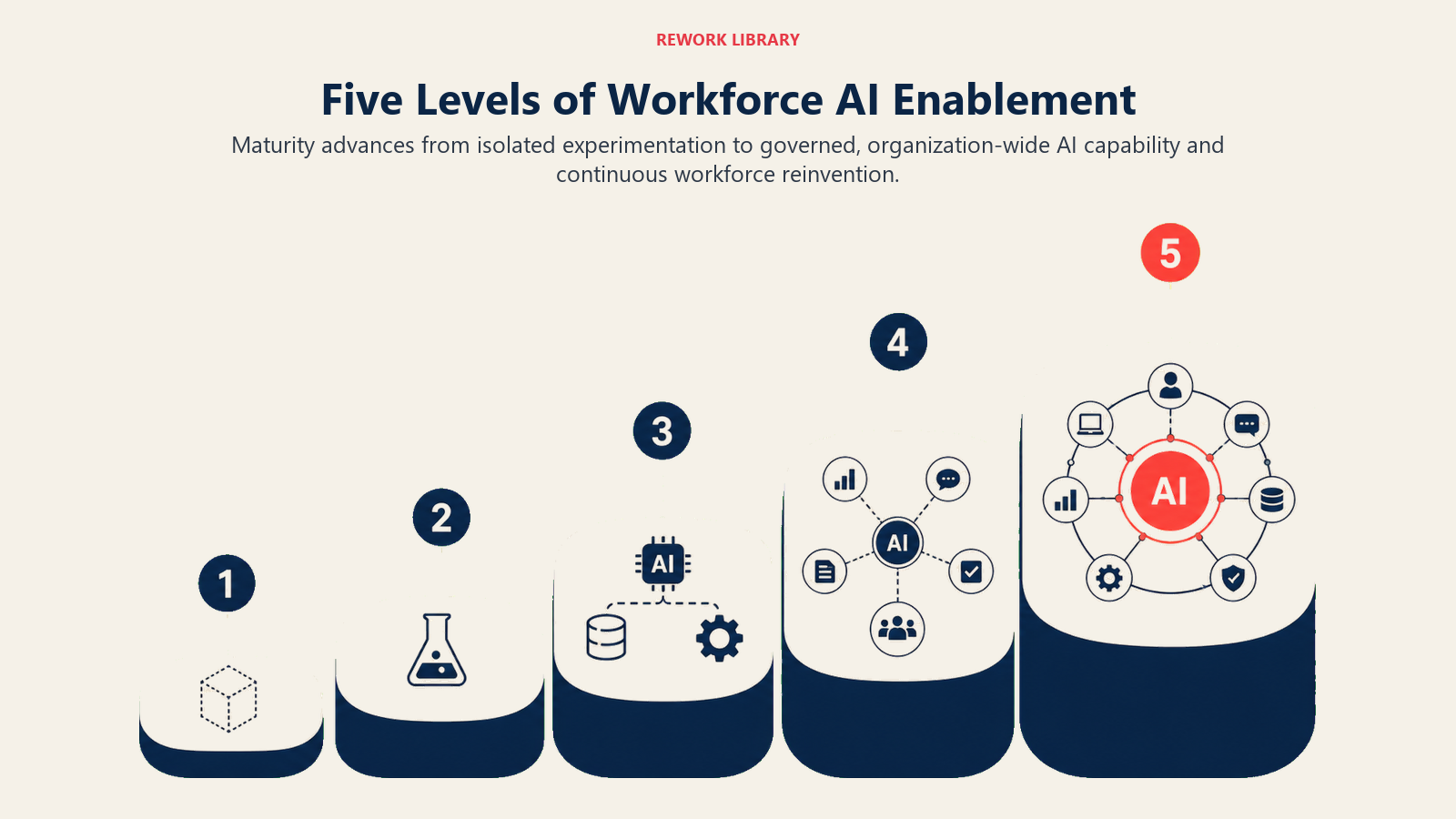
Level 1: Reactive - Basic AI Awareness (Bottom 25% of Organizations)
Organizational Characteristics:
- AI adoption is reactive, driven by individual curiosity or fear of falling behind rather than strategy
- No formal AI training programs exist. Employees learn through informal channels or self-study
- Leadership lacks understanding of AI capabilities and workforce training requirements
- Organizational culture treats AI as IT responsibility rather than enterprise competency
- AI tool usage is inconsistent, unsanctioned, and often creates security or compliance risks
Capability Indicators:
- No structured AI training or dedicated workforce development resources for AI skills
- AI adoption attempts fail 65-75% of the time due to inadequate preparation and skill gaps
- Employees using AI tools lack guidance on appropriate use cases and ethical considerations
Business Impact & Costs:
- AI investments generate only 20-30% of expected returns due to poor workforce adoption
- Shadow AI usage creates security vulnerabilities and compliance exposure
- Employee frustration with AI tools leads to resistance and abandoned initiatives
Real-World Examples:
- Traditional retailers (2023-2024): Rushed AI chatbot deployments failed due to inadequate employee training on managing AI-customer interactions
- Regional banks (2024): AI tool rollouts stalled when frontline staff couldn't integrate tools into daily workflows
Investment vs. Return:
- Minimal investment in AI workforce development (less than 0.5% of payroll)
- Return deficit of -40% to -60% compared to AI-enabled benchmark organizations
Benchmark: Bottom 25th percentile - Organizations consistently trail AI adoption curve by 18-24 months
Level 2: Structured - Formal AI Training Programs (25th-50th Percentile)
Organizational Characteristics:
- Formal AI training strategy established with dedicated learning resources and governance
- Structured approach to AI tool introduction with pilot programs and phased rollouts
- Leadership receives foundational AI literacy training and understands workforce implications
- Standard AI usage guidelines and acceptable use policies exist across the organization
- Initial coaching and mentoring programs help employees develop AI skills
Capability Indicators:
- AI adoption success rate improves to 55-65% through structured training and support
- Basic AI competency assessments implemented across business units
- Employee confidence with AI tools shows measurable improvement
Business Impact & Costs:
- AI investments achieve 50-70% of expected returns through improved workforce adoption
- Compliance and security risks reduced by 60% through standardized AI governance
- Productivity improvements of 15-25% in roles with targeted AI training
Real-World Examples:
- Salesforce (2023-2024): Systematic AI training for sales teams on Einstein AI features improved forecast accuracy by 34%
- Unilever (2024): Structured AI enablement program trained 30,000 employees on generative AI tools within 8 months
Investment vs. Return:
- Investment of 1-2% of payroll in AI workforce development
- Return of 40-60% improvement in AI initiative success rates
Benchmark: 25th-50th percentile - Organizations adopt industry-standard AI training but lack advanced capability development
Level 3: Proactive - Integrated AI Fluency Culture (50th-75th Percentile)
Organizational Characteristics:
- AI fluency integrated into organizational culture with AI competencies required at all levels
- Enterprise-wide AI training function with role-specific programs and advanced skill paths
- Cross-functional AI communities share knowledge and develop best practices
- Employees at all levels expected to identify and implement AI opportunities in their work
- Technology platforms support experimentation, learning, and AI skill development
Capability Indicators:
- AI initiative success rate reaches 75-85% through systematic workforce enablement
- AI fluency becomes hiring criteria and performance evaluation factor
- Innovation from workforce AI usage drives new process improvements and customer solutions
Business Impact & Costs:
- AI investments achieve 100-150% of expected returns through workforce-driven optimization
- Productivity improvements of 30-45% across AI-enabled roles and functions
- Employee-generated AI innovations contribute to competitive differentiation
Real-World Examples:
- Microsoft (2023-2025): Company-wide Copilot enablement program trained 180,000 employees with role-specific AI skill paths
- JPMorgan Chase (2024-2025): AI literacy requirements for all employees combined with advanced programs for technical roles
Investment vs. Return:
- Investment of 2-4% of payroll in AI capability development
- Return of 80-120% improvement in AI-driven productivity and innovation
Benchmark: 50th-75th percentile - Organizations demonstrate systematic AI fluency and employee-driven AI innovation
Level 4: Anticipatory - AI-Native Workforce and Innovation Leadership (75th-95th Percentile)
Organizational Characteristics:
- Workforce AI enablement drives business model innovation and competitive differentiation
- Advanced AI coaching, prompt engineering, and AI orchestration skills developed at scale
- Global AI champion networks enable rapid capability transfer and innovation diffusion
- AI Centers of Excellence support workforce development and leading change initiatives
- Continuous AI learning systems capture and apply new AI capabilities across the enterprise
Capability Indicators:
- AI initiative success rate exceeds 90% with breakthrough productivity and innovation outcomes
- Organization consistently leads industry in workforce AI capability and adoption speed
- Employee AI innovations create new revenue streams and market opportunities
Business Impact & Costs:
- AI investments generate 200-350% ROI through workforce-driven optimization and innovation
- Time-to-value on new AI capabilities is 70% faster than industry benchmarks
- Workforce AI capabilities become a recognized competitive advantage and talent magnet
Real-World Examples:
- Google (2023-2026): AI-native workforce culture where all employees leverage AI tools daily, with advanced training for AI builders
- Anthropic (2024-2026): Deep AI fluency across all functions enables rapid product iteration and customer solution development
Investment vs. Return:
- Investment of 4-6% of payroll in advanced AI capabilities and continuous learning
- Return of 180-300% improvement in competitive positioning through AI workforce excellence
Benchmark: 75th-95th percentile - Organizations shape AI adoption standards and attract top AI-fluent talent
Level 5: Transformational - Global AI Workforce Standards and Industry Leadership (Top 5% of Organizations)
Organizational Characteristics:
- Organization sets global standards for workforce AI enablement excellence and training methodology
- Thought leadership in AI workforce development influences industry practices and policy
- AI workforce capabilities create lasting competitive advantages and talent ecosystem leadership
- Global AI learning ecosystems extend beyond organizational boundaries to shape workforce evolution
- AI training expertise becomes monetizable intellectual property and consulting revenue stream
Capability Indicators:
- AI initiative success rate approaches 95% with industry-defining workforce capability outcomes
- Organization consulted by competitors, governments, and educators for AI workforce expertise
- Workforce AI innovations are studied and replicated across industries and global markets
Business Impact & Costs:
- AI workforce investments generate 400-700% ROI through market creation and ecosystem leadership
- Organization commands premium valuations due to demonstrated AI workforce excellence
- AI workforce capabilities enable transformation of entire industries and creation of new work paradigms
Real-World Examples:
- OpenAI (2022-2026): AI workforce enablement leadership influences how organizations globally train employees on AI
- NVIDIA (2020-2026): Deep Learning Institute programs became industry standard for AI workforce development
Investment vs. Return:
- Investment of 6-10% of payroll in transformational AI capabilities and ecosystem development
- Return of 350-600% premium in market valuation due to AI workforce leadership
Benchmark: Top 5th percentile - Organizations define global AI workforce standards and create new AI-enabled work paradigms
Your Roadmap: How to Advance Through Each Level
Current State Pain Points: Most organizations struggle with AI adoption initiatives that consume significant resources but don't change how employees actually work. Common challenges include resistance to new AI tools, inadequate training time, skills that don't transfer to daily work, fear of job displacement, and difficulty measuring AI readiness. These issues compound as AI capabilities advance faster than workforce adaptation.
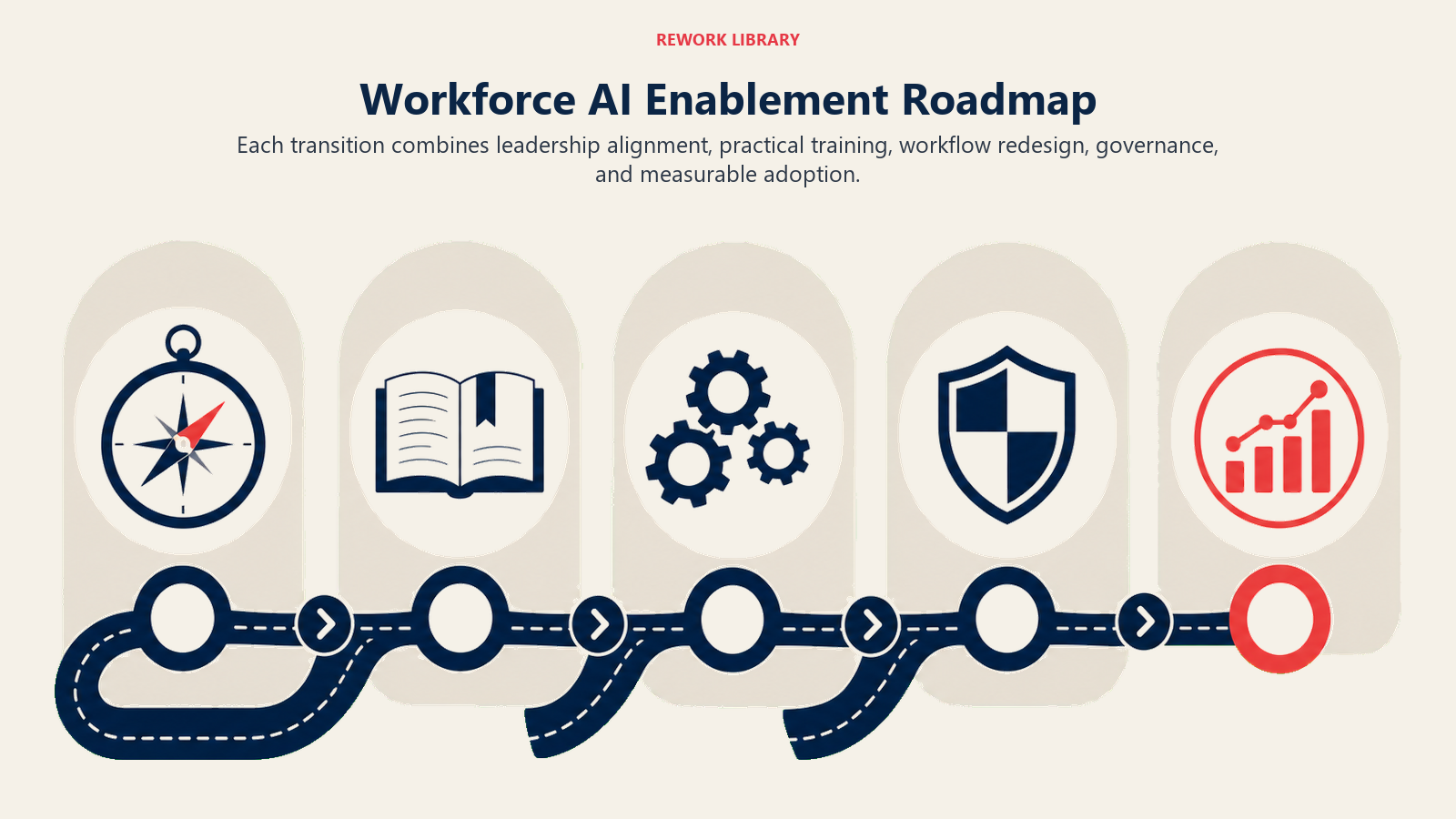
Target Outcomes: Advanced workforce AI enablement positions organizations to capture the full value of AI investments through workforce readiness. The ultimate goal is building an AI-native workforce that consistently finds new ways to use AI for competitive advantage while adapting quickly to new AI capabilities.
Level 1 to Level 2: Building AI Training Foundation (6-12 months)
Step 1: AI Literacy Program Development (4 months) - Create foundational AI training curriculum covering AI concepts, tool categories, ethical considerations, and appropriate use cases. Train leadership team on AI implications for their functions. Invest $200K-400K in curriculum development and learning platform.
Step 2: AI Governance Framework (3 months) - Establish AI usage policies, acceptable use guidelines, data handling requirements, and security protocols. Create clear guidance on approved AI tools and prohibited uses. Budget $100K-200K for policy development and legal review.
Step 3: Pilot Training Programs (3-5 months) - Deploy foundational AI training to pilot groups representing key business functions. Measure adoption rates, competency improvements, and productivity impact. Allocate $150K-300K for pilot execution and assessment.
Level 2 to Level 3: AI Fluency Integration (12-18 months)
Step 1: Role-Specific AI Training (8 months) - Develop tailored AI training programs for each job family addressing specific use cases, tools, and workflows. Create AI skill matrices aligned with career development. Investment of $500K-1M for program development and delivery.
Step 2: AI Champion Network (6 months) - Identify and develop AI champions across business units who provide peer support, share best practices, and drive adoption. Build community platforms for knowledge sharing. Budget $200K-400K for champion development and support.
Step 3: AI Integration into Performance (6 months) - Incorporate AI fluency into hiring criteria, performance evaluations, and promotion requirements. Create recognition programs for AI innovation. Investment of $150K-300K for system integration and change management.
Level 3 to Level 4: AI-Native Workforce Development (18-24 months)
Step 1: Advanced AI Skills Academy (12 months) - Build advanced training in prompt engineering, AI orchestration, AI tool evaluation, and AI-human collaboration. Create certification pathways for AI specialization. Investment of $1M-2M for academy development and staffing.
Step 2: AI Centers of Excellence (10 months) - Establish centralized AI expertise centers that support business units, develop best practices, and accelerate AI innovation. Budget $800K-1.5M for CoE operations and infrastructure.
Step 3: Continuous AI Learning System (8 months) - Create systems for rapid capability updates as AI evolves, including real-time training on new tools and features. Investment of $500K-1M for learning infrastructure and content.
Level 4 to Level 5: Global AI Workforce Leadership (24-36 months)
Step 1: AI Training Thought Leadership (18 months) - Establish global AI workforce development leadership through research publication, conference leadership, and methodology development. Build intellectual property portfolio around AI training approaches. Investment of $2M-4M annually.
Step 2: AI Workforce Ecosystem Development (15 months) - Develop partnerships with educational institutions, AI vendors, and industry bodies that shape AI workforce standards. Create AI training consulting services. Budget $1.5M-3M for ecosystem development.
Step 3: AI Work Paradigm Creation (12-18 months) - Use advanced AI workforce capabilities to create new models for AI-human work collaboration that influence industry practices globally. Investment of $3M-6M for research and implementation.
Quick Assessment: What Level Are You?
Level 1 Indicators:
- No formal AI training programs exist for employees
- AI adoption is inconsistent and driven by individual initiative
- Leadership lacks clear understanding of AI workforce implications
- Shadow AI usage creates compliance and security concerns
- Employee resistance to AI tools is common and unaddressed
Level 2 Indicators:
- Formal AI training strategy and dedicated learning resources established
- Structured AI tool introduction with governance and acceptable use policies
- AI adoption success rate improves to 55-65% through systematic training
- Standard AI competency assessments measure progress across business units
- Initial productivity improvements visible in trained employee groups
Level 3 Indicators:
- AI fluency integrated into organizational culture and performance expectations
- Role-specific AI training programs address distinct job family requirements
- AI initiative success rate reaches 75-85% through workforce enablement
- AI champion networks drive adoption and innovation across functions
- Employee-generated AI improvements contribute to competitive advantage
Level 4 Indicators:
- Workforce AI capabilities drive business model innovation and market differentiation
- Advanced AI training develops prompt engineering, orchestration, and evaluation skills
- AI initiative success rate exceeds 90% with breakthrough outcomes
- AI Centers of Excellence support enterprise-wide capability development
- Organization leads industry in AI adoption speed and workforce capability
Level 5 Indicators:
- Organization sets global standards for workforce AI enablement and training methodology
- AI workforce thought leadership influences industry practices and educational curricula
- AI initiative success rate approaches 95% with industry-defining outcomes
- AI workforce capabilities create lasting competitive advantages and ecosystem leadership
- AI training expertise generates consulting revenue and partnership opportunities
Building AI Literacy Across the Organization
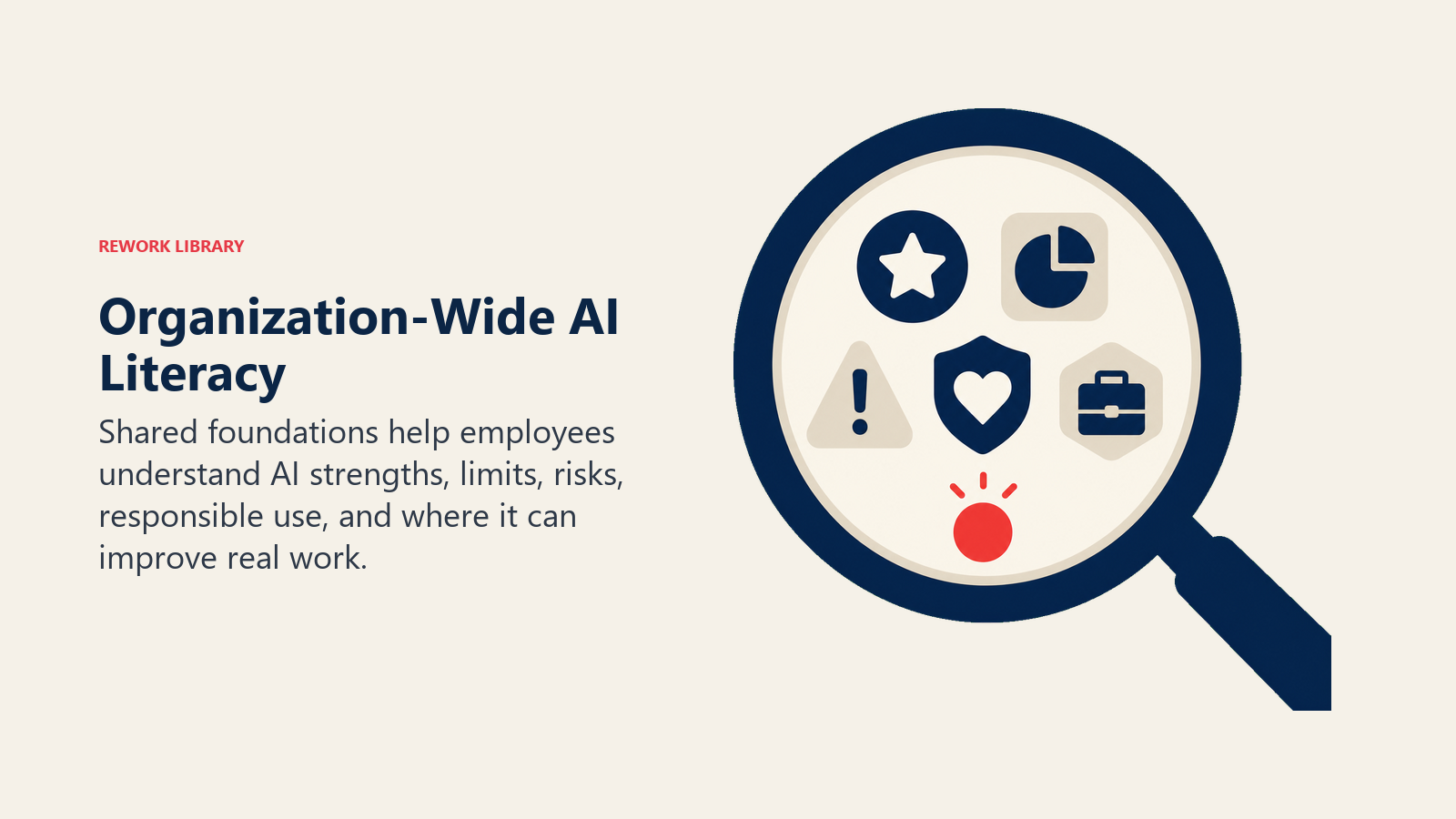
Effective AI literacy programs address multiple dimensions of workforce readiness. Unlike traditional technology training that focuses on button clicks and feature navigation, AI literacy builds conceptual understanding alongside practical skills.
Core AI Literacy Components
Conceptual Understanding covers how AI models work at a high level, their strengths and limitations, and how to evaluate AI output quality. Employees don't need to understand neural network architecture, but they should understand why AI sometimes produces confident-sounding errors and how to verify outputs.
Tool Proficiency builds hands-on skills with specific AI tools relevant to each role. This includes prompt writing, output refinement, and workflow integration. The focus is on productive use rather than technical mastery.
Ethical Awareness addresses appropriate AI use, data privacy considerations, bias recognition, and organizational policies. Employees need clear frameworks for deciding when AI use is appropriate and when human judgment should prevail.
Workflow Integration shows employees how to incorporate AI into existing work processes without disruption. This practical focus on daily application drives actual adoption rather than just awareness.
Delivery Approaches That Work
Microlearning modules of 10-15 minutes work better than lengthy training sessions. Research from Josh Bersin's 2025 AI Skills Report shows 78% higher completion rates and 45% better skill retention with bite-sized AI learning.
Hands-on practice environments where employees can experiment with AI tools on realistic tasks produce 3x better skill transfer than lecture-based training. Safe sandboxes reduce fear and encourage experimentation.
Peer learning circles where small groups share AI discoveries and troubleshoot challenges together show 62% higher adoption rates than individual training alone. Social learning speeds up capability development through digital fluency sharing.
Just-in-time resources that employees can access at the moment of need support continuous learning without disrupting workflow. AI assistants that coach users on AI tools during actual work show promising results.
Role-Specific AI Training Programs
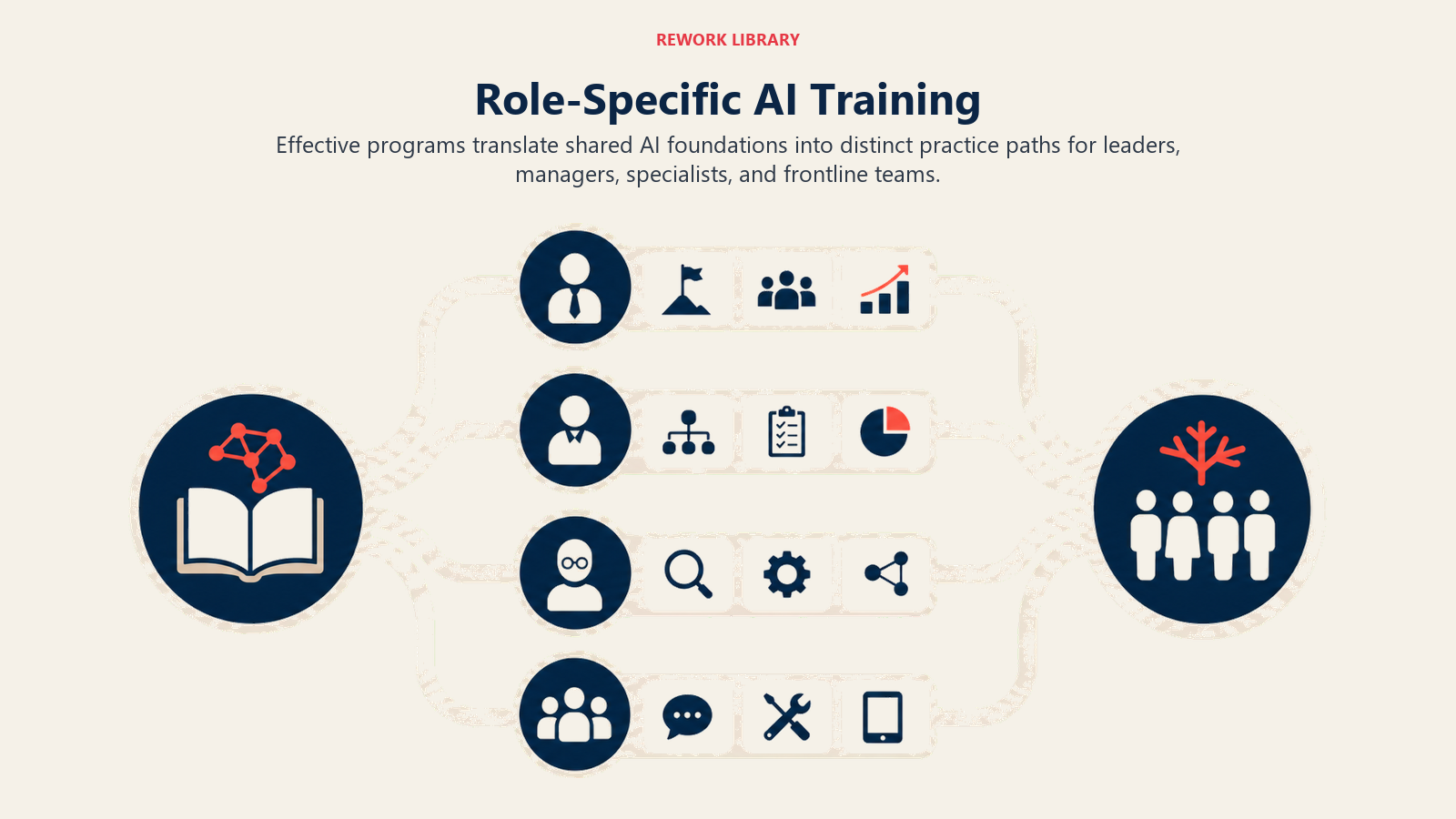
Generic AI training fails because different roles need different AI capabilities. A marketing manager uses AI differently than a financial analyst or customer service rep. Effective programs map AI skills to specific job responsibilities.
Executive and Leadership Track
Strategic AI Leadership builds understanding of AI's business implications, investment evaluation frameworks, and organizational change requirements. Leaders learn to evaluate AI vendor claims, assess AI project proposals, and communicate AI strategy effectively.
AI Governance covers board-level oversight responsibilities, risk management, and ethical considerations. Executives need frameworks for AI accountability and stakeholder communication.
AI-Enabled Decision Making shows how AI can enhance strategic planning, competitive analysis, and resource allocation decisions without replacing executive judgment.
Management Track
AI Team Leadership builds skills for managing AI-augmented teams, setting expectations, and evaluating AI-enhanced work. Managers learn to balance AI efficiency with human development needs.
AI Implementation Management covers project planning for AI rollouts, change management, and adoption measurement. Practical focus on common implementation challenges and solutions.
AI Performance Optimization teaches managers how to identify high-value AI opportunities, measure productivity impact, and scale successful AI applications across their teams.
Knowledge Worker Track
AI Productivity Tools provides deep training on generative AI assistants, research tools, and automation capabilities relevant to analysis, writing, and problem-solving work.
AI-Enhanced Collaboration builds skills for incorporating AI into team workflows, document development, and project coordination without losing human connection.
AI Quality Assurance teaches critical evaluation of AI outputs, error detection, and output refinement skills needed for professional-quality work.
Customer-Facing Track
AI-Assisted Service builds skills for using AI to enhance customer interactions while keeping the personal connection. The focus is on when to rely on AI and when to provide human judgment.
AI Handoff Protocols covers seamless transitions between AI and human support, ensuring customer experience quality throughout mixed interactions.
AI Feedback Collection trains employees to gather customer input on AI interactions that improves both AI performance and human support quality.
Change Management for AI Adoption
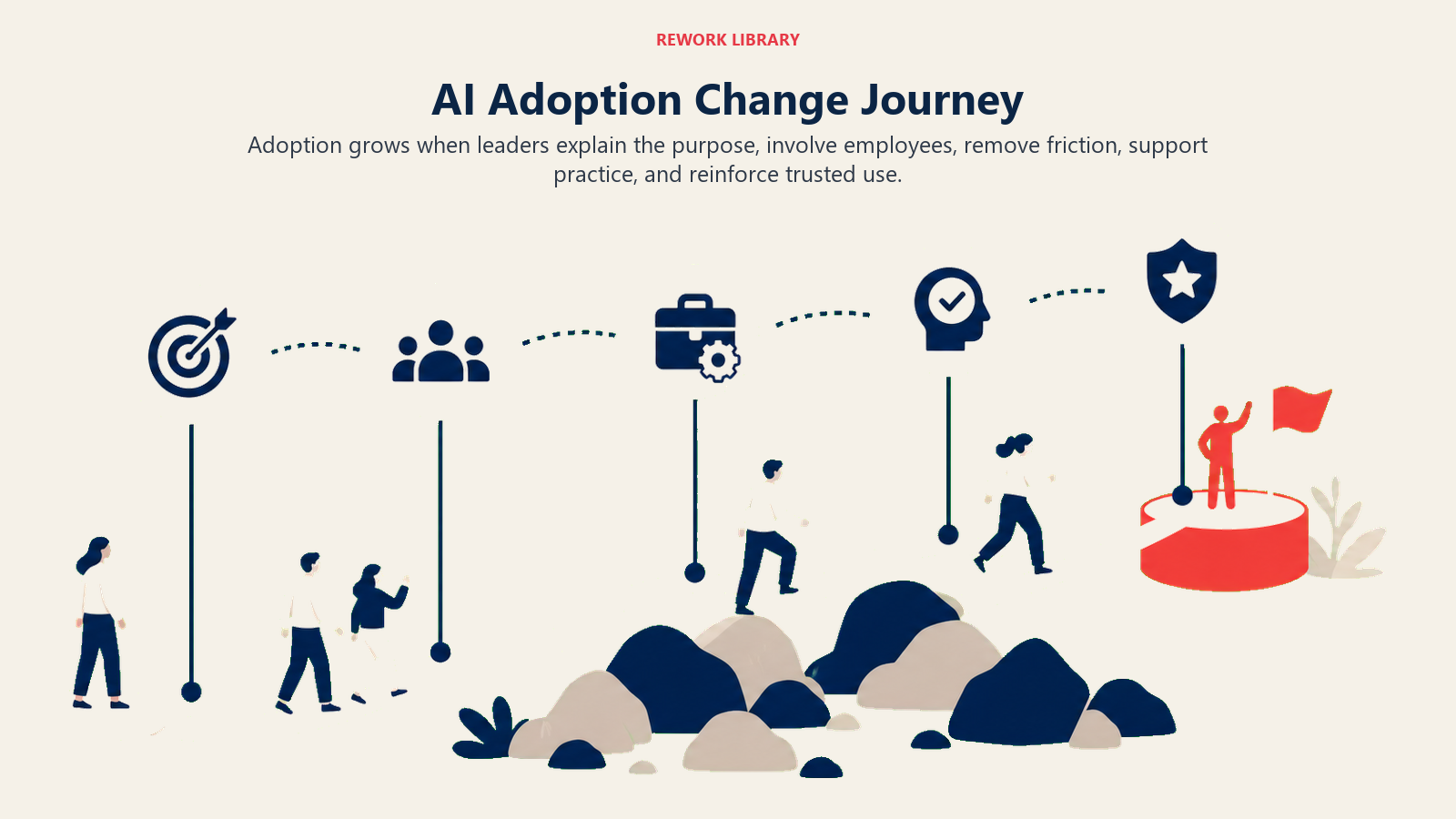
Technical training alone won't drive AI adoption. Workforce AI enablement requires systematic change management that addresses the human side of AI transformation.
Addressing Workforce Concerns
Job displacement fears are the primary barrier to AI adoption. Research shows 64% of employees worry AI will eliminate their jobs, creating resistance that undermines training investments. Effective programs address these concerns directly with honest communication about AI's role as augmentation rather than replacement, plus concrete examples of how AI creates new opportunities.
Skill obsolescence anxiety reflects employees' concerns that their current expertise is becoming irrelevant. Programs that position AI skills as additive (building on what employees already know) rather than replacing existing competencies show higher adoption rates.
Technology intimidation affects employees who've struggled with previous technology changes. Building on emotional intelligence in training design, programs that start with simple wins before advancing to complex capabilities reduce intimidation.
Building Adoption Momentum
Quick wins in the first 30 days build confidence and demonstrate value. Training programs that immediately apply to daily work show 3.4x higher completion rates than abstract capability-building approaches.
Visible leadership modeling speeds up adoption. When executives and managers openly use AI tools and share their learning journeys, employees feel permission to experiment without judgment.
Community recognition for AI innovation creates positive reinforcement. Sharing employee AI success stories through internal communications normalizes adoption and sparks ideas.
Sustaining Change Over Time
Continuous reinforcement maintains momentum after initial training. Monthly AI tips, regular skill updates, and ongoing community engagement prevent skill decay.
Integration into daily operations ensures AI skills become habitual. Workflow redesign that incorporates AI as standard practice sustains adoption better than optional tool availability.
Career connection links AI skills to advancement opportunities. Clear paths from AI capability to promotion and compensation create lasting motivation for skill development.
Measuring Workforce AI Readiness
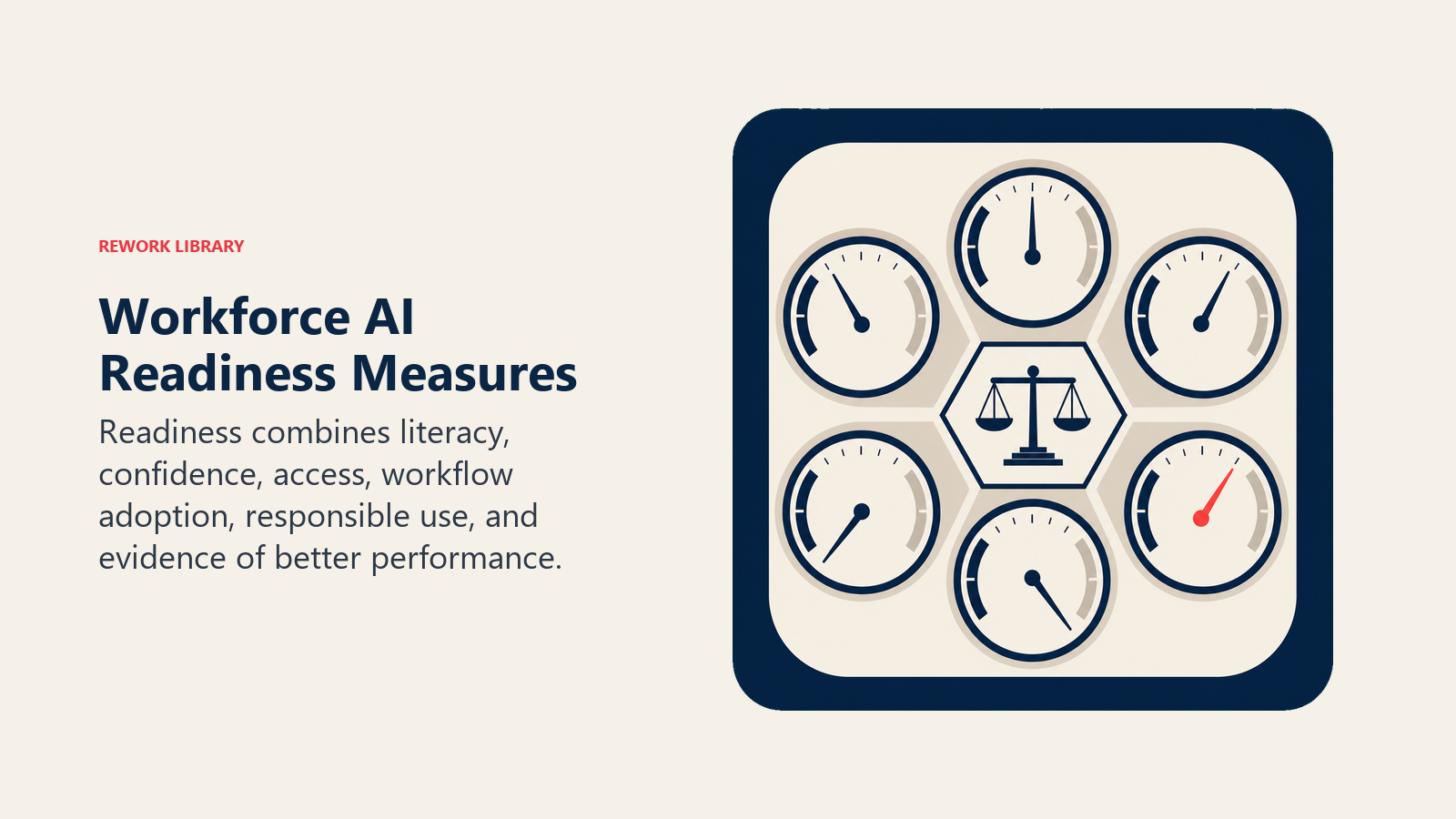
Effective workforce AI enablement needs clear metrics that show progress and justify investment. Organizations need measurement frameworks that capture both capability development and business impact.
Leading Indicators
AI Training Completion Rate measures the percentage of target employees completing AI training programs. Benchmark: 80% completion within 6 months of role-relevant program availability.
AI Tool Adoption Rate tracks active usage of AI tools as percentage of trained employees. Benchmark: 60% weekly active usage within 3 months of training completion.
AI Competency Assessment Scores evaluate skill development through practical assessments. Benchmark: 75% of employees demonstrating proficiency on role-relevant AI competencies.
AI Champion Engagement measures participation in AI communities and knowledge sharing. Benchmark: 10% of workforce actively contributing to AI learning networks.
Business Impact Metrics
AI-Driven Productivity Gain measures output improvement in AI-enabled roles. Benchmark: 20-35% productivity improvement in targeted workflows within 12 months.
AI Initiative Success Rate tracks percentage of AI projects achieving intended outcomes. Benchmark: 75% success rate for organizations with mature enablement programs.
Time-to-Value on AI Investments measures days from AI tool deployment to measurable business impact. Benchmark: 60% reduction in time-to-value compared to pre-enablement baseline.
Employee AI Satisfaction Score evaluates worker confidence and comfort with AI tools. Benchmark: 70% positive sentiment on quarterly AI experience surveys.
Maturity Assessment Approach
Quarterly assessments using the five-level maturity model help organizations track progress and identify gaps. Assessment should evaluate capability across four dimensions:
- Skill Development - Employee AI competency levels across job families
- Adoption Behavior - Actual AI usage patterns in daily work
- Innovation Contribution - Employee-generated AI improvements and ideas
- Culture Integration - AI fluency as organizational value and expectation
Creating AI Champions and Centers of Excellence
Centralized expertise speeds up workforce AI enablement by providing concentrated support, developing best practices, and driving consistent capability development across the enterprise.
AI Champion Network Design
Champion Selection Criteria identify employees who combine AI enthusiasm with credibility in their business areas. Champions should have strong communication skills, a willingness to help peers, and visible respect from colleagues.
Champion Development Program provides advanced AI training, facilitation skills, and community leadership capabilities. Champions learn to teach, coach, and inspire rather than just use AI tools themselves.
Champion Support Structure gives champions dedicated time for AI support activities, access to advanced resources, and connection to central AI expertise. Without this dedicated time and resources, champion programs fail.
Champion Community connects AI champions across the organization for knowledge sharing, problem solving, and mutual support. Regular champion gatherings build network strength and spread best practices.
Center of Excellence Structure
Strategic Function defines AI enablement strategy, sets standards, and measures progress. This function ensures workforce AI development aligns with business priorities and AI investment plans.
Capability Development Function creates training programs, curates learning resources, and develops assessment tools. This function builds the infrastructure for scalable workforce AI enablement.
Advisory Function provides consulting support to business units implementing AI solutions. This function helps teams overcome adoption challenges and optimize AI integration.
Innovation Function explores new AI capabilities and pilots tools before enterprise rollout. This function keeps the organization current with AI developments.
CoE Operating Model
Federated Structure works best for large organizations, with central CoE providing strategy and standards while business unit teams handle local implementation. This balances consistency with flexibility.
Funding Model should combine central investment for infrastructure with business unit funding for role-specific programs. Shared investment creates shared accountability for outcomes.
Success Metrics for CoE include workforce AI readiness scores, training effectiveness, adoption rates, and business impact. Clear metrics justify investment and drive continuous improvement.
Your First 30 Days: Getting Started
Week 1: Workforce AI Readiness Assessment
Conduct comprehensive evaluation of current workforce AI capabilities using the maturity model framework. Survey employees on AI tool usage, confidence levels, and training needs. Benchmark current adoption rates against industry standards. Document baseline AI skill gaps across job families.
Week 2: Leadership AI Alignment
Facilitate executive team sessions to build consensus on workforce AI enablement priorities and investment levels. Present business case for AI training investment including competitive analysis, productivity opportunity assessment, and ROI projections. Secure leadership commitment for systematic workforce AI development.
Week 3: Quick Win Training Implementation
Identify 2-3 high-impact AI training opportunities that can demonstrate value within 60-90 days. Focus on widely-used AI tools with clear productivity benefits. Deploy pilot training to receptive employee groups. Measure immediate adoption and satisfaction outcomes.
Week 4: AI Enablement Foundation Planning
Develop detailed roadmap for advancing to next workforce AI maturity level including timeline, investment requirements, success metrics, and governance structure. Establish AI enablement team, identify learning platform needs, and create communication plan for enterprise-wide AI capability building initiative.
Conclusion: The Workforce AI Enablement Imperative
Workforce AI Enablement is the organizational capability that determines whether AI investments generate returns or become expensive failures. As AI capabilities advance beyond any individual's ability to keep pace, organizations that systematically develop workforce AI fluency create lasting advantages through human capital that competitors can't easily replicate.
The evidence is clear: organizations with mature workforce AI enablement achieve 3.8x higher returns on AI investments, 67% faster AI deployment cycles, and 58% better talent retention. They show 45% higher productivity growth and are 4.2x more likely to achieve AI transformation success through workforce readiness.
The gap between AI potential and workforce capability represents both risk and opportunity. The 75% of workers without formal AI training aren't just missing skills. They're working for organizations that will increasingly fall behind as AI-enabled competitors pull away. Every month of delay makes catching up harder and more expensive.
The investment is substantial but the cost of inaction is higher. Organizations that wait for AI to become "easier" will find themselves competing against workforces that have spent years developing AI fluency, experimentation habits, and innovation cultures that can't be quickly replicated.
The question for leadership teams isn't whether to invest in workforce AI enablement, but how quickly to build capabilities before the AI capability gap becomes insurmountable. In an economy where AI fluency increasingly determines both individual career success and organizational competitiveness, workforce AI enablement becomes the ultimate competitive differentiator.
Learn More
Enhance your understanding of workforce AI enablement and related organizational capabilities:
- Digital Fluency - Build the broader digital capability foundation that supports AI adoption
- Leading Change - Master the change leadership skills needed for AI transformation
- Coaching and Mentoring - Develop peer learning approaches that accelerate AI skill development
- Innovation Management - Create frameworks for capturing employee AI innovations
Related Organizational Competencies

Senior Customer Retention Strategist
On this page
- Strategic Imperative for Organizational Excellence
- The Competitive Advantage Metrics for Workforce AI Enablement
- The 5 Levels of Workforce AI Enablement Maturity
- Level 1: Reactive - Basic AI Awareness (Bottom 25% of Organizations)
- Level 2: Structured - Formal AI Training Programs (25th-50th Percentile)
- Level 3: Proactive - Integrated AI Fluency Culture (50th-75th Percentile)
- Level 4: Anticipatory - AI-Native Workforce and Innovation Leadership (75th-95th Percentile)
- Level 5: Transformational - Global AI Workforce Standards and Industry Leadership (Top 5% of Organizations)
- Your Roadmap: How to Advance Through Each Level
- Level 1 to Level 2: Building AI Training Foundation (6-12 months)
- Level 2 to Level 3: AI Fluency Integration (12-18 months)
- Level 3 to Level 4: AI-Native Workforce Development (18-24 months)
- Level 4 to Level 5: Global AI Workforce Leadership (24-36 months)
- Quick Assessment: What Level Are You?
- Building AI Literacy Across the Organization
- Core AI Literacy Components
- Delivery Approaches That Work
- Role-Specific AI Training Programs
- Executive and Leadership Track
- Management Track
- Knowledge Worker Track
- Customer-Facing Track
- Change Management for AI Adoption
- Addressing Workforce Concerns
- Building Adoption Momentum
- Sustaining Change Over Time
- Measuring Workforce AI Readiness
- Leading Indicators
- Business Impact Metrics
- Maturity Assessment Approach
- Creating AI Champions and Centers of Excellence
- AI Champion Network Design
- Center of Excellence Structure
- CoE Operating Model
- Your First 30 Days: Getting Started
- Week 1: Workforce AI Readiness Assessment
- Week 2: Leadership AI Alignment
- Week 3: Quick Win Training Implementation
- Week 4: AI Enablement Foundation Planning
- Conclusion: The Workforce AI Enablement Imperative
- Learn More
- Related Organizational Competencies