AI Strategy & Governance: Organizational Capability Framework

Turn this article into takeaways for your work.


Each assistant summarizes the article only for you and suggests best practices for your work.
AI strategy and governance is now a core business competency: the organization's ability to align AI investments with business goals, set governance and risk controls, ensure compliance, and measure ROI. Companies with mature AI governance see 2.8x higher returns and 54% fewer AI incidents, which is why boards treat it like finance or cybersecurity, not an IT side project.
What You'll Get From This Guide
- 5-Level Maturity Model: Progressive organizational AI governance capabilities from ad-hoc experimentation to enterprise-wide AI leadership
- Governance Framework: Comprehensive policies, risk management protocols, and compliance guidelines for responsible AI deployment
- Strategic Alignment: Methods to connect AI initiatives with business objectives and measure meaningful ROI
- Tools and Resources: AI governance templates, assessment frameworks, and benchmarking resources for organizational development
Strategic Imperative for Organizational Excellence
By the end of 2026, roughly 80% of enterprises will have deployed generative AI applications in production environments. Yet Gartner research shows that organizations without formal AI governance frameworks are 3.2x more likely to experience AI project failures, compliance violations, or reputational damage from AI-related incidents.
AI is spreading fast across business functions, bringing both big opportunities and real risks. McKinsey's 2025 Global AI Survey reveals that organizations with mature AI governance achieve 2.8x higher returns on AI investments compared to those with ad-hoc approaches. But the benefits go beyond financial returns. Companies with strong AI strategies report 67% faster time-to-value for AI initiatives and 54% fewer AI-related security incidents.
The stakes are high. Microsoft's 2025 Work Trend Index found that 78% of knowledge workers now use AI tools at work, with or without employer approval. This "shadow AI" phenomenon means organizations that don't proactively govern AI usage risk data breaches, compliance violations, and inconsistent customer experiences. And regulatory pressure keeps building. The EU AI Act, proposed US AI legislation, and sector-specific requirements are creating a complex compliance environment.
AI Strategy & Governance as an organizational competency encompasses the enterprise's systematic ability to align AI investments with business objectives, establish governance structures that enable responsible innovation, manage AI-related risks, ensure regulatory compliance, and measure the business impact of AI initiatives.
The Competitive Advantage Metrics for AI Governance
Organizations with mature AI strategy and governance capabilities demonstrate:
- Investment Returns: 2.8x higher ROI on AI initiatives from strategic alignment and effective governance
- Time-to-Value: 67% faster deployment of AI capabilities with streamlined approval and risk management processes
- Risk Reduction: 54% fewer AI-related security incidents and compliance violations from proactive governance
- Innovation Speed: 45% more AI experiments reaching production with structured evaluation frameworks
- Employee Adoption: 73% higher employee confidence in using approved AI tools thanks to clear policies and training
- Regulatory Readiness: 89% faster compliance with new AI regulations when governance foundations are already in place
- Market Position: 156% higher market valuation premium for organizations recognized as responsible AI leaders
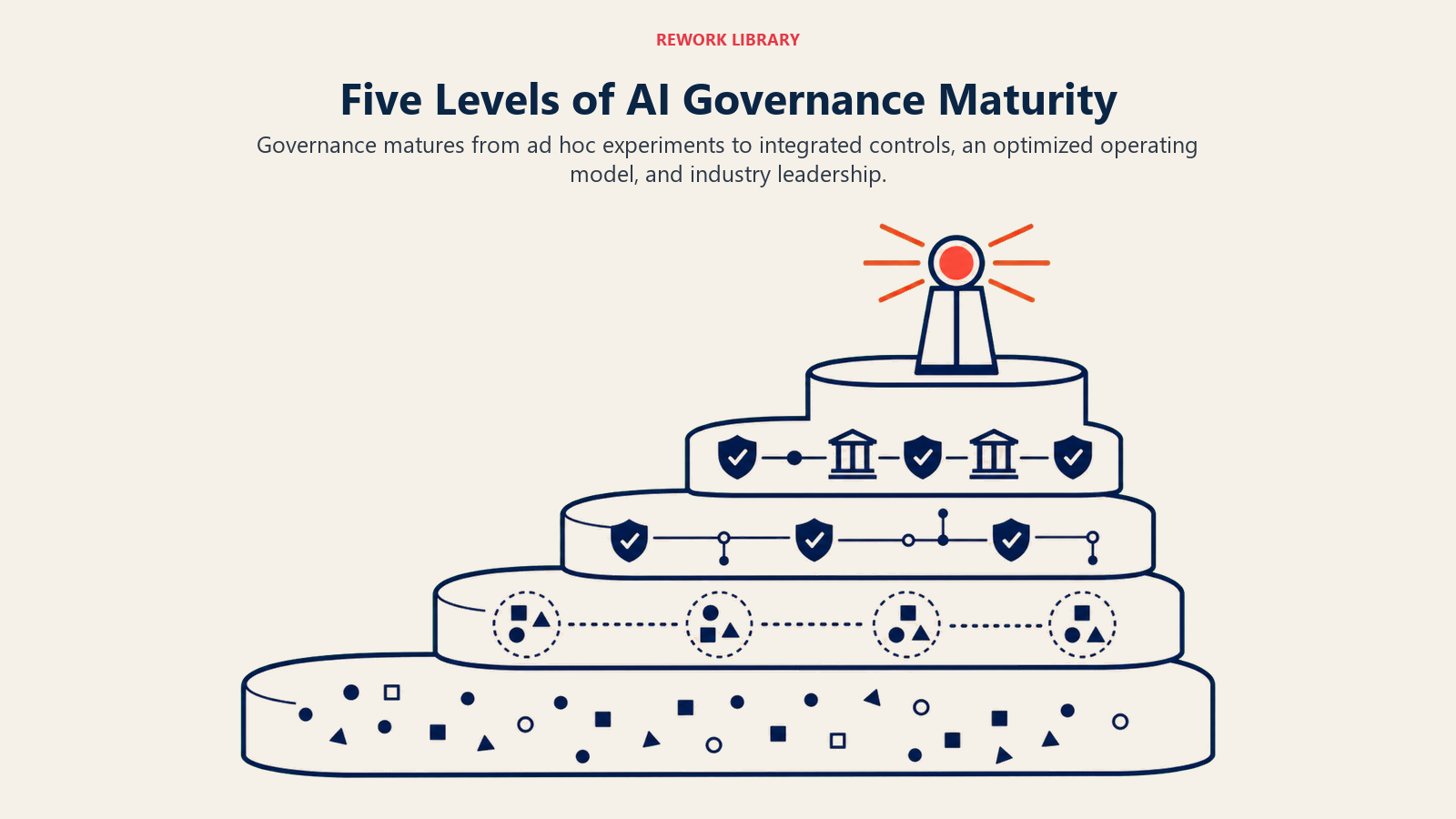
The 5 Levels of Organizational AI Governance Maturity
Governance matures from ad hoc experiments to integrated controls, an optimized operating model, and industry leadership.
Level 1: Ad-Hoc - Uncoordinated AI Experimentation (Bottom 25% of Organizations)
Organizational Characteristics:
- AI adoption occurs through individual department initiatives without enterprise coordination or strategy
- No formal AI policies exist, leading to inconsistent and potentially risky AI usage across the organization
- Leadership lacks understanding of AI capabilities, limitations, and governance requirements
- Employees use consumer AI tools (ChatGPT, Gemini) without guidance on appropriate use cases or data handling
- AI investments are driven by technology curiosity rather than business value creation
Capability Indicators:
- No AI strategy document or dedicated AI governance function exists
- AI projects fail 65-75% of the time due to unclear objectives and lack of organizational support
- Data used for AI training and inference is not systematically managed or protected
- Multiple teams build redundant AI capabilities without knowledge sharing
Business Impact & Costs:
- AI experimentation consumes 2-4% of IT budget with minimal measurable business impact
- Data privacy incidents from uncontrolled AI usage cost an average of $2.1M per incident
- Shadow AI proliferation creates unknown compliance exposure and intellectual property risks
- Employee productivity gains from AI are inconsistent and unsustainable
Real-World Examples:
- Samsung (2023): Employees inadvertently leaked proprietary semiconductor data through ChatGPT, leading to emergency AI bans
- Multiple Law Firms (2023-2024): Attorneys submitted AI-generated briefs with fabricated case citations, resulting in sanctions and reputational damage
Investment vs. Return:
- Minimal structured investment in AI governance (less than 0.5% of IT budget)
- Return deficit of -30% to -50% compared to organizations with mature AI governance
Benchmark: Bottom 25th percentile - Organizations face significant risk exposure with limited AI value realization
Level 2: Foundational - Basic AI Policy Implementation (25th-50th Percentile)
Organizational Characteristics:
- Formal AI acceptable use policies established with basic guidance on approved tools and data handling
- Central AI governance committee formed with representation from IT, legal, compliance, and business units
- Leadership receives foundational AI literacy training and understands key governance requirements
- Approved AI tool list exists with basic security and privacy vetting
- AI investments require business case approval with defined success metrics
Capability Indicators:
- AI project success rate improves to 55-65% through clearer objectives and governance oversight
- Basic AI risk assessment process exists for new AI initiatives
- Employee AI training programs cover acceptable use and data protection requirements
- Regular AI inventory updates track tools in use across the organization
Business Impact & Costs:
- AI governance investment of 1-2% of AI initiative budgets reduces risk exposure by 45%
- Shadow AI usage decreases by 60% through clear policies and approved alternatives
- AI project delivery timelines improve by 35% through standardized approval processes
- Measurable productivity gains emerge in departments with governed AI implementations
Real-World Examples:
- Coca-Cola (2023-2024): Established AI Council and acceptable use policies enabling controlled experimentation with generative AI for marketing
- Verizon (2024): Implemented AI governance framework that balanced innovation speed with risk management across customer service operations
Investment vs. Return:
- Investment of 1-2% of AI budgets in governance capabilities and policy development
- Return of 40-60% improvement in AI project success rates and risk reduction
Benchmark: 25th-50th percentile - Organizations establish governance foundations but lack advanced risk management and strategic alignment
Level 3: Integrated - Strategic AI Alignment and Risk Management (50th-75th Percentile)
Organizational Characteristics:
- AI strategy explicitly linked to business strategy with clear investment priorities and success metrics
- Comprehensive AI risk management framework addresses model risk, data governance, bias, and security
- Cross-functional AI Centers of Excellence enable knowledge sharing and capability reuse
- AI governance integrated into existing enterprise risk management and compliance frameworks
- All employees receive role-appropriate AI training with ongoing skill development
Capability Indicators:
- AI project success rate reaches 70-80% through strategic alignment and systematic risk management
- Model risk management includes validation, monitoring, and incident response procedures
- AI bias assessment and mitigation integrated into development and deployment processes
- Regulatory compliance tracking ensures readiness for current and emerging AI requirements
Business Impact & Costs:
- AI investments generate 150-250% ROI through improved strategic alignment and execution
- Risk incidents decrease by 70% through proactive identification and mitigation
- Time from AI concept to production deployment reduces by 50% through mature governance processes
- AI capabilities contribute 15-25% of operational efficiency improvements
Real-World Examples:
- JPMorgan Chase (2023-2025): AI governance framework enables deployment of over 300 AI/ML applications with systematic risk management and regulatory compliance
- Unilever (2024-2025): Integrated AI ethics review into product development processes, enabling responsible AI deployment across global marketing operations
Investment vs. Return:
- Investment of 3-5% of AI budgets in governance infrastructure and risk management
- Return of 100-150% improvement in AI value realization and risk reduction
Benchmark: 50th-75th percentile - Organizations achieve consistent AI value creation with comprehensive risk management
Level 4: Optimized - Enterprise AI Operating Model (75th-95th Percentile)
Organizational Characteristics:
- AI operating model optimizes resource allocation, capability reuse, and governance efficiency across the enterprise
- Advanced AI monitoring systems provide real-time visibility into model performance, drift, and risk indicators
- AI governance adapts dynamically to regulatory changes, emerging risks, and new technology capabilities
- Strategic partnerships with AI vendors, academic institutions, and industry consortia accelerate capability development
- AI literacy embedded in organizational culture with continuous learning systems
Capability Indicators:
- AI project success rate exceeds 85% with consistent delivery of business value
- Automated monitoring and alerting systems detect model degradation and compliance issues in real-time
- AI governance frameworks enable rapid evaluation and deployment of new AI capabilities
- Organization recognized as AI governance leader by peers and regulators
Business Impact & Costs:
- AI investments generate 300-450% ROI through optimized resource allocation and strategic deployment
- Mean time to detect and resolve AI issues reduces to hours rather than weeks
- New AI capabilities deploy 70% faster through reusable governance patterns and pre-approved components
- AI drives 30-45% of revenue growth and operational efficiency improvements
Real-World Examples:
- Amazon (2020-2025): AI governance at scale enables deployment of AI across operations, customer experience, and new product development while managing complex regulatory requirements
- Salesforce (2023-2025): Einstein AI governance framework enables rapid AI feature deployment across the platform with consistent trust and safety standards
Investment vs. Return:
- Investment of 5-7% of AI budgets in enterprise AI operating model and advanced governance capabilities
- Return of 250-400% improvement in AI business value and competitive positioning
Benchmark: 75th-95th percentile - Organizations achieve AI-driven competitive advantages with optimized governance
Level 5: Transformational - Industry AI Leadership and Standards Setting (Top 5% of Organizations)
Organizational Characteristics:
- Organization shapes industry AI governance standards and best practices through thought leadership and collaboration
- AI governance enables business model innovation and new market creation while managing frontier AI risks
- Governance frameworks address emerging AI capabilities including autonomous systems and multi-agent architectures
- Global AI partnerships influence regulatory development and technology evolution
- AI governance expertise becomes a competitive advantage and potential revenue stream
Capability Indicators:
- AI project success rate approaches 95% with market-defining outcomes
- Organization consulted by regulators, peers, and academic institutions on AI governance
- AI governance innovations are studied and adopted across industries
- Governance enables responsible deployment of cutting-edge AI capabilities ahead of competitors
Business Impact & Costs:
- AI investments generate 500-800% ROI through market leadership and governance-enabled innovation
- AI governance reputation attracts top talent, premium partnerships, and customer trust
- New AI business models contribute 25-40% of enterprise revenue
- Market valuation includes substantial premium for demonstrated AI governance excellence
Real-World Examples:
- Microsoft (2019-2025): Responsible AI Standard and governance framework enables scaled AI deployment across Azure, Copilot, and enterprise products while shaping industry practices
- Google DeepMind (2016-2025): AI safety research and governance frameworks influence global standards while enabling deployment of advanced AI systems
Investment vs. Return:
- Investment of 7-10% of AI budgets in governance excellence and industry leadership
- Return of 450-700% premium in market valuation and competitive positioning
Benchmark: Top 5th percentile - Organizations define AI governance standards and enable industry-wide responsible AI advancement
Your Roadmap: How to Advance Through Each Level
Current State Pain Points: Most organizations struggle with AI initiatives that generate excitement but fail to deliver measurable business value. Common challenges include unclear AI strategy, fragmented governance, inadequate risk management, compliance uncertainty, and the inability to measure AI ROI. These issues compound as AI adoption accelerates, creating governance debt that gets more expensive to address over time.
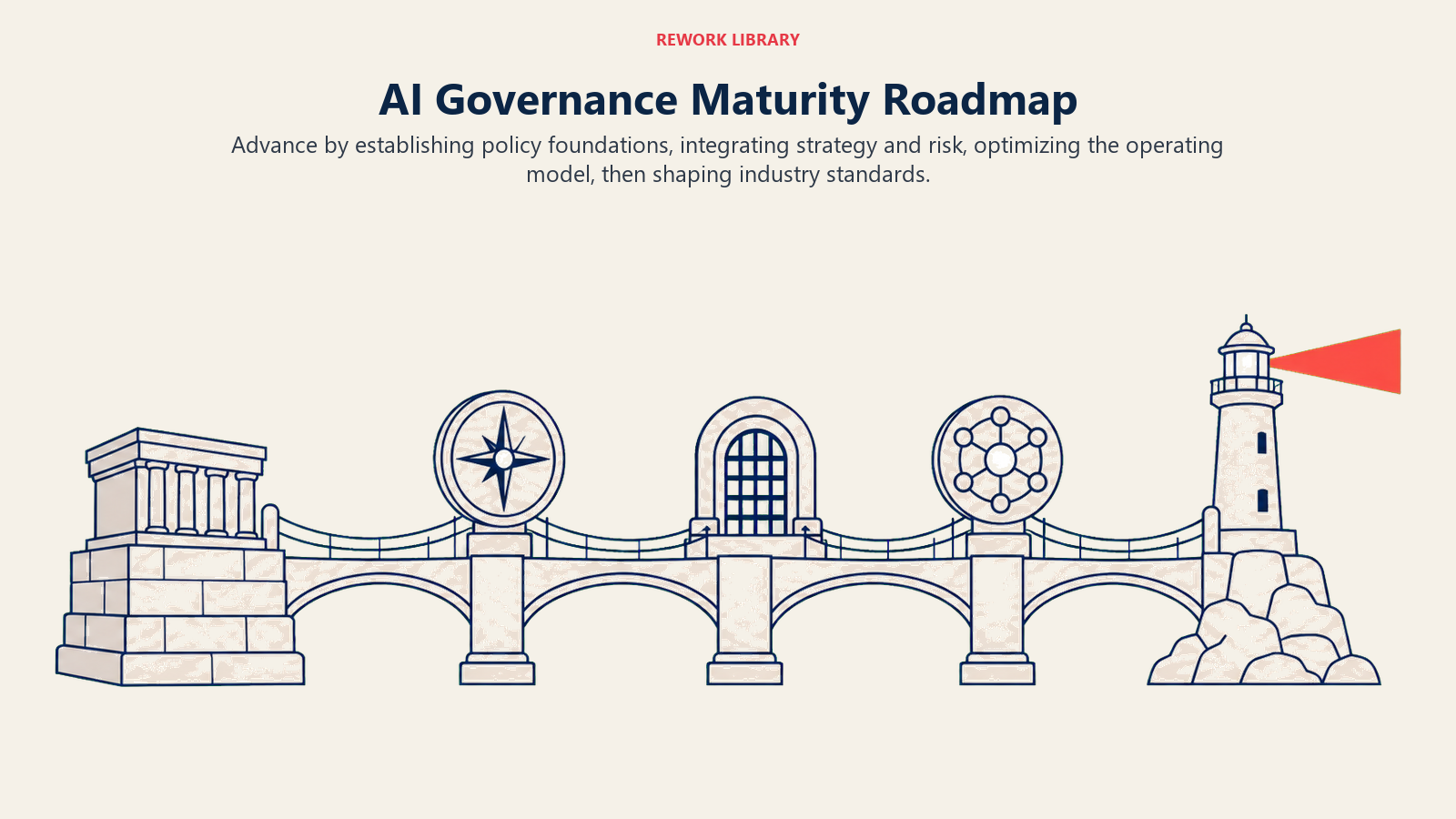
Target Outcomes: Advanced AI governance capabilities help organizations accelerate AI innovation while managing risks, stay compliant as regulations evolve, build stakeholder trust in AI systems, and show clear business value from AI investments. The goal here is governance that enables competitive advantage, not just problem prevention.
Level 1 to Level 2: Establishing Governance Foundations (6-12 months)
Step 1: AI Landscape Assessment (2-3 months) - Inventory current AI usage across the organization, including both approved systems and shadow AI. Identify data flows, risk exposures, and compliance gaps. Assess AI literacy levels and training needs. Budget $100K-250K for this assessment and gap analysis.
Step 2: Policy Development (3-4 months) - Create an AI acceptable use policy, approved tool list, and data handling guidelines. Establish an AI governance committee with a clear charter and decision rights. Develop an initial AI risk assessment framework. Investment: $150K-350K for policy development and stakeholder alignment.
Step 3: Foundation Implementation (4-5 months) - Deploy approved AI tools with appropriate security controls. Launch employee AI literacy training program. Establish AI project approval process with business case requirements. Allocate $200K-500K for tool deployment, training development, and process implementation.
Level 2 to Level 3: Strategic Integration (12-18 months)
Step 1: Strategy Alignment (4-6 months) - Connect AI investments to business strategy with clear priorities and success metrics. Develop an AI opportunity assessment framework for evaluating potential use cases. Create an AI portfolio management process for resource allocation. Investment: $300K-600K for strategy development and alignment.
Step 2: Risk Management Maturation (5-7 months) - Implement a comprehensive AI risk management framework covering model risk, bias, security, and compliance. Establish model validation and monitoring procedures. Integrate AI governance with enterprise risk management. Budget: $400K-800K for risk framework development and tool implementation.
Step 3: Center of Excellence Development (4-6 months) - Create an AI Center of Excellence to enable knowledge sharing, capability reuse, and governance efficiency. Develop reusable AI components, governance templates, and deployment patterns. Investment: $500K-1M for CoE establishment and capability development.
Level 3 to Level 4: Operating Model Optimization (18-24 months)
Step 1: Enterprise AI Platform (8-10 months) - Build or acquire an enterprise AI platform with integrated governance controls, monitoring, and compliance capabilities. Enable self-service AI development within governance guardrails. Investment: $1.5M-3M for platform development and deployment.
Step 2: Advanced Monitoring and Automation (6-8 months) - Implement automated model monitoring, drift detection, and compliance checking. Develop incident response and remediation procedures. Create governance dashboards for executive visibility. Budget: $800K-1.5M for monitoring infrastructure and automation.
Step 3: Partnership and Ecosystem Development (5-7 months) - Establish strategic AI partnerships with vendors, academic institutions, and industry consortia. Participate in governance standards development and best practice sharing. Investment: $600K-1.2M for partnership development and participation.
Level 4 to Level 5: Industry Leadership (24-36 months)
Step 1: Thought Leadership Platform (10-14 months) - Establish AI governance thought leadership through research publication, conference presentations, and industry collaboration. Develop intellectual property around governance innovations. Investment: $1M-2M annually for thought leadership program.
Step 2: Regulatory Engagement (8-12 months) - Engage proactively with regulators to shape AI governance requirements. Participate in standards bodies and industry working groups. Build a reputation as a responsible AI leader. Budget: $500K-1M for regulatory engagement and advocacy.
Step 3: Governance Innovation (10-14 months) - Develop governance capabilities for emerging AI technologies including autonomous systems and advanced generative AI. Create governance frameworks that enable responsible deployment of cutting-edge capabilities. Investment: $2M-4M for governance innovation and capability development.
Quick Assessment: What Level Are You?
Level 1 Indicators:
- No formal AI strategy document or governance function exists in the organization
- Employees use consumer AI tools without clear guidance or approved alternatives
- AI projects are initiated ad-hoc without business case requirements or success metrics
- Data used for AI is not systematically inventoried, classified, or protected
- Leadership cannot articulate AI risks or governance requirements
Level 2 Indicators:
- Formal AI acceptable use policy exists with approved tool list and basic guidance
- AI governance committee established with representation from key functions
- AI projects require business case approval with defined success criteria
- Employee AI training covers acceptable use and data protection basics
- Basic AI risk assessment process exists for new initiatives
Level 3 Indicators:
- AI strategy explicitly linked to business strategy with clear investment priorities
- Comprehensive AI risk management framework addresses model risk, bias, and compliance
- AI Center of Excellence enables knowledge sharing and capability reuse
- All employees receive role-appropriate AI training with ongoing development
- AI governance integrated with enterprise risk management and compliance
Level 4 Indicators:
- Enterprise AI operating model optimizes resource allocation and governance efficiency
- Automated monitoring provides real-time visibility into model performance and risk
- AI governance adapts dynamically to regulatory changes and new capabilities
- Organization recognized as AI governance leader by peers and regulators
- Strategic AI partnerships accelerate capability development and innovation
Level 5 Indicators:
- Organization shapes industry AI governance standards and best practices
- AI governance enables business model innovation and responsible frontier AI deployment
- Governance frameworks address autonomous systems and emerging AI architectures
- Organization consulted by regulators and peers on AI governance approaches
- AI governance excellence contributes to market valuation and competitive advantage
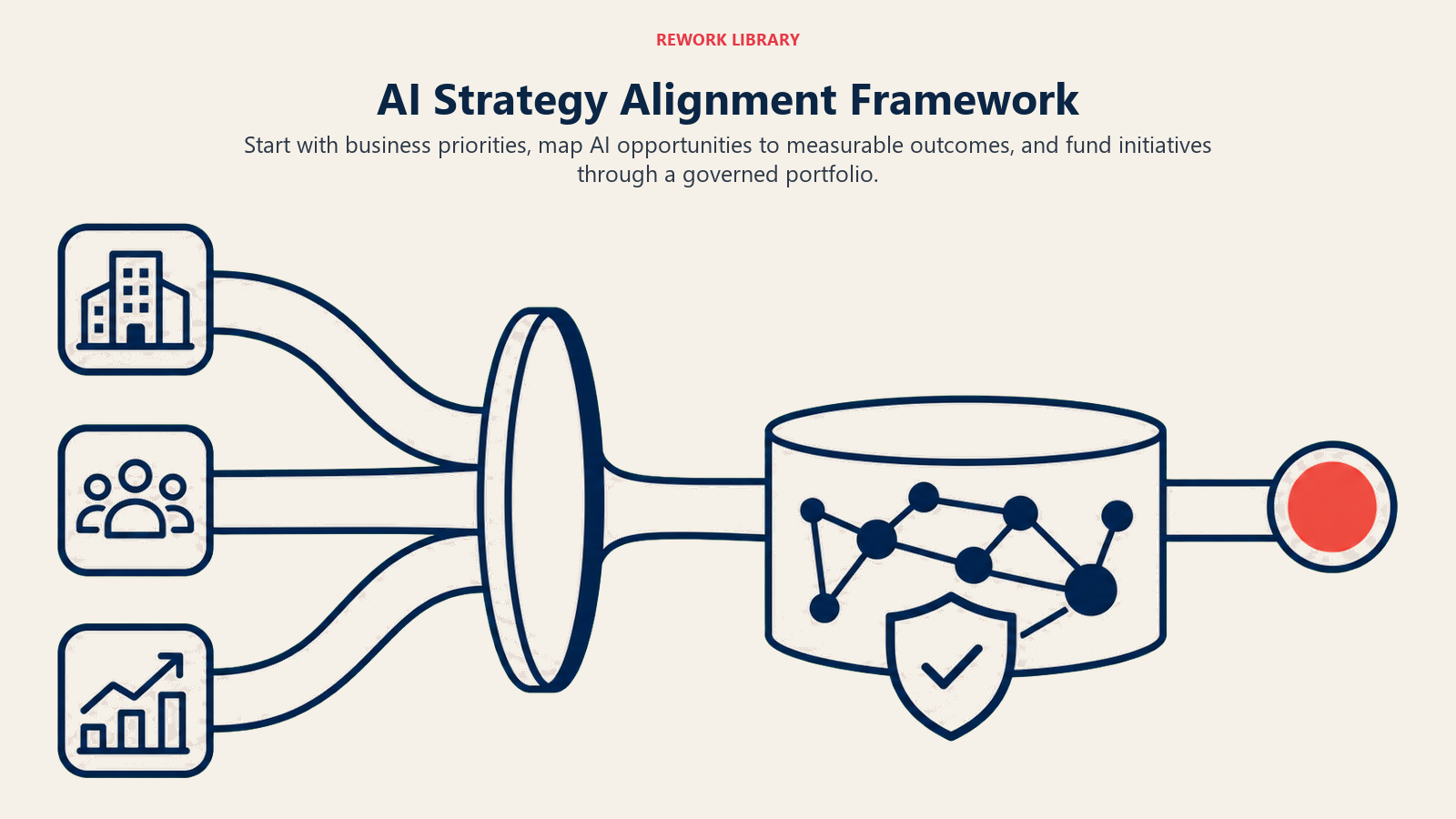
Building an AI Strategy Aligned with Business Objectives
An aligned AI strategy starts with business priorities, maps opportunities to measurable outcomes, and funds initiatives through a governed portfolio.
The Strategy Alignment Framework
Effective AI strategy starts with business strategy. Organizations that treat AI as a technology initiative rather than a business transformation typically achieve 60% lower returns on AI investments.
Step 1: Business Value Mapping Identify the business outcomes that matter most to your organization. These might include revenue growth, cost reduction, customer experience improvement, risk management, or operational efficiency. Then look at how AI capabilities could contribute to each outcome.
Step 2: Capability Assessment Take an honest look at your current AI capabilities. Consider data infrastructure, technical talent, organizational readiness, and governance maturity. Identify the gaps between where you are now and the capabilities you need to achieve priority business outcomes.
Step 3: Investment Prioritization Prioritize AI investments based on business value potential, capability requirements, and risk profile. Create a portfolio that balances quick wins with strategic bets, and operational improvements with transformational opportunities.
Step 4: Success Metrics Definition Define clear metrics for each AI initiative that connect to business outcomes. Skip vanity metrics like model accuracy. Focus on business metrics like revenue impact, cost savings, or customer satisfaction improvement.
Common Strategy Pitfalls
Technology-First Thinking: Starting with AI capabilities rather than business problems leads to solutions looking for problems. Always begin with the business outcome you want to achieve.
Isolated Pilots: Running disconnected AI pilots without a path to scale creates "pilot purgatory," where promising experiments never deliver enterprise value.
Underestimating Change Management: AI adoption requires organizational change. Budget at least 30% of AI initiative costs for change management, training, and adoption support.
Ignoring Data Foundations: AI capabilities depend on data quality and availability. Organizations that skip data governance and infrastructure investments often struggle to scale AI beyond initial pilots.
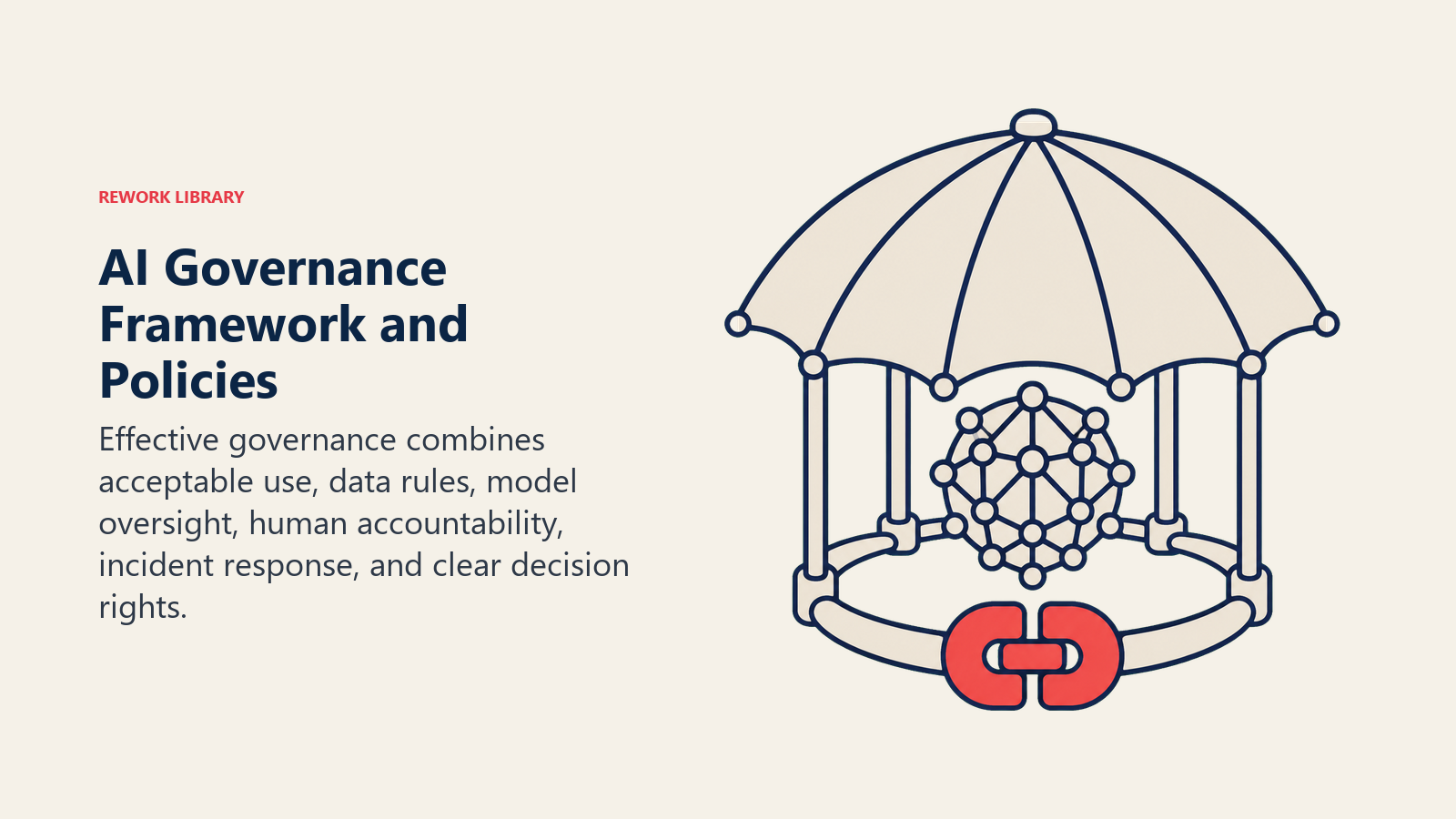
AI Governance Frameworks and Policies
Effective governance combines acceptable use, data rules, model oversight, human accountability, incident response, and clear decision rights.
Essential Policy Components
AI Acceptable Use Policy
- Approved AI tools and platforms with appropriate use cases
- Prohibited uses including sensitive data processing without approval
- Data handling requirements for AI inputs and outputs
- Intellectual property guidelines for AI-generated content
- Disclosure requirements for AI-assisted work products
AI Development Standards
- Model development lifecycle with stage gates and approvals
- Testing requirements including bias assessment and security review
- Documentation standards for model purpose, training data, and limitations
- Version control and change management requirements
- Deployment approval criteria and production readiness checklist
AI Risk Management Framework
- Risk categorization based on use case criticality and data sensitivity
- Assessment requirements scaled to risk level
- Ongoing monitoring requirements for production models
- Incident response procedures for AI-related issues
- Escalation paths and decision authorities
AI Vendor Management
- Evaluation criteria for AI vendor selection
- Contractual requirements for data protection and liability
- Ongoing monitoring of vendor AI capabilities and practices
- Exit planning for vendor transitions
Governance Structure Options
Centralized Model: A single AI governance team owns all policies, approvals, and oversight. Works best for organizations early in AI maturity or with limited AI activity.
Federated Model: Central governance sets standards while business units implement within guardrails. Works well for larger organizations with diverse AI use cases.
Hybrid Model: Tiered governance where the central team handles high-risk AI while business units manage lower-risk applications. Balances control with agility.
Risk Management for AI Adoption
AI risk management joins assessment, controls, monitoring, and incident response across model, data, bias, security, compliance, and operational risks.
AI Risk Categories
Model Risk: Risks from model errors, degradation, or inappropriate application
- Inaccurate predictions leading to poor business decisions
- Model drift reducing performance over time
- Adversarial manipulation of model inputs or outputs
Data Risk: Risks from data quality, security, or compliance issues
- Training data bias leading to discriminatory outputs
- Data privacy violations from AI processing of personal information
- Intellectual property issues from training on copyrighted content
Operational Risk: Risks from AI system failures or misuse
- System availability and performance issues
- Unauthorized access to AI systems or outputs
- Employee misuse of AI capabilities
Strategic Risk: Risks from AI investments or market positioning
- Investment in AI capabilities that don't deliver value
- Competitive disadvantage from slow AI adoption
- Reputational damage from AI-related incidents
Risk Mitigation Approaches
Preventive Controls: Stop risks from materializing
- Pre-deployment testing and validation requirements
- Access controls and authentication for AI systems
- Data quality and governance requirements for AI inputs
Detective Controls: Identify risks quickly when they occur
- Automated model monitoring and alerting
- Regular model performance audits
- Incident detection and reporting processes
Corrective Controls: Address risks after identification
- Model rollback and recovery procedures
- Incident response and remediation processes
- Root cause analysis and continuous improvement
Compliance and Regulatory Considerations
Current Regulatory Landscape
EU AI Act: Comprehensive AI regulation taking effect 2024-2026
- Prohibits certain AI practices (social scoring, manipulation)
- High-risk AI systems require conformity assessment
- Transparency requirements for AI-generated content
- Significant penalties for non-compliance (up to 7% of global revenue)
US Regulatory Environment: Sector-specific and evolving
- NIST AI Risk Management Framework provides voluntary guidance
- State-level AI legislation emerging (Colorado, Connecticut, others)
- Agency-specific requirements in healthcare, financial services, employment
- Executive Order on AI establishing federal agency requirements
Other Jurisdictions: Global patchwork of requirements
- China's AI regulations with algorithmic recommendation requirements
- UK's pro-innovation approach with sector-specific guidance
- Canada, Australia, and others developing AI governance frameworks
Compliance Program Elements
Regulatory Monitoring: Track current and emerging AI requirements across jurisdictions where you operate.
Gap Assessment: Evaluate current AI practices against regulatory requirements and identify needed changes.
Compliance Integration: Build regulatory requirements into AI governance processes rather than treating compliance as separate.
Documentation: Maintain records demonstrating compliance including risk assessments, testing results, and approval decisions.
Training: Ensure relevant personnel understand compliance requirements and their responsibilities.
Measuring AI ROI and Business Impact
AI ROI compares financial returns, productivity gains, risk reduction, adoption, and strategic value against a documented baseline and total cost.
The ROI Measurement Challenge
AI ROI measurement is notoriously tricky. Traditional project ROI methods often fail to capture AI value because:
- AI benefits may be diffuse across multiple business outcomes
- Baseline measurement for comparison is often inadequate
- AI value compounds over time as systems improve with more data
- Indirect benefits like improved decision quality are hard to quantify
A Practical Measurement Framework
Direct Value Metrics: Measurable financial impact
- Revenue generated or protected by AI capabilities
- Cost reduction from AI-driven automation or optimization
- Risk losses avoided through AI-enhanced detection
Operational Metrics: Process and efficiency improvements
- Cycle time reduction for AI-assisted processes
- Quality improvements from AI-enhanced decision making
- Capacity increases from AI augmentation of human work
Strategic Metrics: Long-term competitive positioning
- Speed to market for new capabilities enabled by AI
- Customer experience improvements attributable to AI
- Employee satisfaction and retention impacts from AI tools
Learning Metrics: Organizational capability development
- AI literacy improvement across the workforce
- Governance capability maturation
- Data and infrastructure readiness advancement
Establishing Baselines
Before launching AI initiatives, establish clear baselines for the metrics you'll track. Document:
- Current performance levels for target business outcomes
- Existing process costs and cycle times
- Customer satisfaction and experience metrics
- Employee productivity and satisfaction measures
Without baselines, you'll have a hard time demonstrating AI value regardless of actual impact.
Industry Benchmarks and Best Practices
Technology Sector Benchmarks
- AI Governance Investment: 5-8% of AI program budgets
- AI Project Success Rate: 75-85% with mature governance
- Time to AI Production: 3-6 months for standard use cases
- Leading Organizations: Microsoft, Google, Salesforce (Level 4-5 capabilities)
Financial Services Benchmarks
- AI Governance Investment: 7-12% of AI budgets (higher due to regulatory requirements)
- AI Project Success Rate: 65-75% with mature governance
- Time to AI Production: 6-12 months (extended by compliance requirements)
- Leading Organizations: JPMorgan Chase, Capital One, BlackRock (Level 3-4 capabilities)
Healthcare Benchmarks
- AI Governance Investment: 8-15% of AI budgets (extensive validation requirements)
- AI Project Success Rate: 60-70% with mature governance
- Time to AI Production: 12-24 months (FDA and clinical validation)
- Leading Organizations: Mayo Clinic, Kaiser Permanente, Roche (Level 3-4 capabilities)
Retail and Consumer Benchmarks
- AI Governance Investment: 4-7% of AI budgets
- AI Project Success Rate: 70-80% with mature governance
- Time to AI Production: 4-8 months for standard use cases
- Leading Organizations: Amazon, Walmart, Target (Level 3-5 capabilities)
Resources for Organizational Development
Current Frameworks and Methodologies
- NIST AI Risk Management Framework: Comprehensive voluntary guidance for AI risk management
- ISO/IEC 42001: International standard for AI management systems
- IEEE Standards Association: Technical standards for AI transparency, bias, and safety
- Partnership on AI: Industry collaboration on responsible AI practices
- World Economic Forum AI Governance Alliance: Global multi-stakeholder governance frameworks
Educational Resources
- Universities: Stanford HAI, MIT AI Policy, Carnegie Mellon AI Governance
- Certifications: IAPP AI Governance Professional, ISACA AI Audit, CAIS (Certified AI Specialist)
- Online Learning: Coursera AI Governance, edX AI Ethics, LinkedIn Learning AI Risk Management
- Professional Associations: IAPP, ISACA, Association for Computing Machinery
Consulting and Advisory Services
- Strategy Consulting: McKinsey Digital, BCG GAMMA, Deloitte AI Institute
- Implementation Partners: Accenture, IBM Watson, PwC AI Practice
- Specialized Firms: Anthropic, OpenAI enterprise services, Responsible AI Institute
- Legal and Compliance: Emerging AI specialty practices at major law firms
Technology Platforms
- AI Development Platforms: Azure AI, AWS SageMaker, Google Vertex AI
- AI Governance Tools: IBM AI Factsheets, AWS AI Service Cards, Fiddler AI
- Model Monitoring: Arize AI, WhyLabs, DataRobot MLOps
- Compliance and Documentation: OneTrust AI Governance, Fairly AI, Credo AI
Your First 30 Days: Getting Started
Week 1: AI Landscape Discovery
Run a comprehensive discovery of current AI usage across the organization. Survey department leaders and employees about AI tool usage, including unofficial shadow AI. Inventory data sources being used with AI systems. Assess current governance gaps and risk exposures. Document findings as your baseline for governance development.
Week 2: Stakeholder Alignment
Hold executive sessions to build consensus on AI governance importance and approach. Present the business case for governance investment, including risk exposure analysis, competitive benchmarking, and regulatory requirements. Identify governance champions across business units. Secure leadership commitment for structured AI governance development.
Week 3: Quick Win Implementation
Implement 2-3 high-impact governance improvements that show value within 30-60 days. Options include publishing an AI acceptable use policy, establishing an approved AI tool list, launching foundational AI literacy training, or implementing a basic AI project intake process. Focus on visible improvements that build momentum for comprehensive governance.
Week 4: Governance Foundation Planning
Develop a detailed roadmap for advancing to the right AI governance maturity level based on your organizational context. Define governance structure, policy priorities, and capability requirements. Establish the AI governance committee charter and membership. Create a communication plan for organization-wide AI governance awareness and engagement.
Conclusion: The AI Governance Imperative
AI Strategy and Governance is the organizational capability that separates AI leaders from organizations struggling with AI adoption. As AI becomes embedded in every business function, governance determines whether AI investments create lasting competitive advantage or generate ongoing risk and disappointment.
The evidence is clear. Organizations with mature AI governance achieve 2.8x higher ROI on AI investments, 67% faster time-to-value, and 54% fewer AI-related incidents. They deploy AI capabilities confidently while competitors hesitate, building advantages that compound over time.
Getting to AI governance excellence requires systematic progression through maturity levels, with each level building capabilities that enable more sophisticated AI deployment and risk management. From ad-hoc experimentation to industry leadership, each level represents expanded organizational capability for thriving in an AI-transformed competitive environment.
The investment is meaningful. Leading organizations invest 5-10% of AI budgets in governance capabilities. But the returns are substantial, both in risk avoided and value enabled. AI governance capabilities become lasting competitive advantages that let organizations move faster and more confidently than competitors who treat governance as an afterthought.
The question for leadership teams isn't whether to invest in AI governance, but how quickly to build these capabilities before competitive pressure makes catch-up harder and more expensive. In an environment where 80% of enterprises will deploy generative AI by 2026, governance capability determines which organizations capture AI's benefits while managing its risks. The organizations that get governance right won't just avoid problems. They'll build the foundation for sustained AI-driven competitive advantage.
Learn More
Enhance your understanding of AI strategy and governance and related organizational capabilities:
- Strategic Thinking - Develop the strategic vision you need to align AI investments with business objectives
- Innovation Management - Build organizational capabilities for managing AI innovation portfolios
- Data Analytics - Establish the data foundations that are essential for AI success
- Digital Fluency - Develop broad organizational digital capabilities that enable AI adoption
Related Organizational Competencies

Senior Customer Retention Strategist
On this page
- Strategic Imperative for Organizational Excellence
- The Competitive Advantage Metrics for AI Governance
- The 5 Levels of Organizational AI Governance Maturity
- Level 1: Ad-Hoc - Uncoordinated AI Experimentation (Bottom 25% of Organizations)
- Level 2: Foundational - Basic AI Policy Implementation (25th-50th Percentile)
- Level 3: Integrated - Strategic AI Alignment and Risk Management (50th-75th Percentile)
- Level 4: Optimized - Enterprise AI Operating Model (75th-95th Percentile)
- Level 5: Transformational - Industry AI Leadership and Standards Setting (Top 5% of Organizations)
- Your Roadmap: How to Advance Through Each Level
- Level 1 to Level 2: Establishing Governance Foundations (6-12 months)
- Level 2 to Level 3: Strategic Integration (12-18 months)
- Level 3 to Level 4: Operating Model Optimization (18-24 months)
- Level 4 to Level 5: Industry Leadership (24-36 months)
- Quick Assessment: What Level Are You?
- Building an AI Strategy Aligned with Business Objectives
- The Strategy Alignment Framework
- Common Strategy Pitfalls
- AI Governance Frameworks and Policies
- Essential Policy Components
- Governance Structure Options
- Risk Management for AI Adoption
- AI Risk Categories
- Risk Mitigation Approaches
- Compliance and Regulatory Considerations
- Current Regulatory Landscape
- Compliance Program Elements
- Measuring AI ROI and Business Impact
- The ROI Measurement Challenge
- A Practical Measurement Framework
- Establishing Baselines
- Industry Benchmarks and Best Practices
- Technology Sector Benchmarks
- Financial Services Benchmarks
- Healthcare Benchmarks
- Retail and Consumer Benchmarks
- Resources for Organizational Development
- Current Frameworks and Methodologies
- Educational Resources
- Consulting and Advisory Services
- Technology Platforms
- Your First 30 Days: Getting Started
- Week 1: AI Landscape Discovery
- Week 2: Stakeholder Alignment
- Week 3: Quick Win Implementation
- Week 4: Governance Foundation Planning
- Conclusion: The AI Governance Imperative
- Learn More
- Related Organizational Competencies