Hybrid Team Leadership: Organizational Capability Framework

Turn this article into takeaways for your work.


Each assistant summarizes the article only for you and suggests best practices for your work.
What You'll Get From This Guide
- 5-Level Maturity Model: Progressive hybrid leadership capabilities from basic remote accommodation to distributed-first organizational excellence
- Implementation Roadmap: Clear step-by-step progression through hybrid leadership maturity levels with timelines and technology investments
- Competitive Edge: Organizations with advanced hybrid leadership capabilities retain 67% more top talent and achieve 34% higher productivity than office-centric competitors
- Tools and Resources: Comprehensive frameworks for communication, culture building, performance management, and technology platforms for distributed teams
Strategic Imperative for Organizational Excellence
The hybrid work model has permanently reshaped how organizations operate, compete for talent, and deliver results. Gallup research shows that 53% of employees now work in hybrid arrangements, and this number continues to grow as organizations recognize the strategic advantages of flexible work models. Companies that master hybrid team leadership go beyond simply accommodating remote work. They turn it into a competitive advantage for talent acquisition, productivity, and organizational resilience.
Microsoft's 2025 Work Trend Index reveals that organizations with mature hybrid leadership capabilities outperform their peers by 34% in productivity metrics and 67% in employee retention. The research also shows that 87% of employees report being productive when given work location flexibility, contradicting earlier concerns about remote work effectiveness. But these outcomes require intentional leadership approaches rather than simply allowing remote work.
McKinsey's Global Workforce Study demonstrates that hybrid leadership maturity correlates directly with business outcomes. Organizations in the top quartile of hybrid leadership capability achieve 42% faster innovation cycles, 51% higher employee engagement scores, and 38% lower voluntary turnover compared to organizations still operating with traditional office-centric management approaches.
Hybrid Team Leadership as an organizational competency encompasses the systematic ability to lead distributed teams effectively, build culture across physical boundaries, maintain communication excellence regardless of location, and create equitable experiences for both remote and in-office team members.
The Competitive Advantage Metrics for Hybrid Leadership
Organizations with mature hybrid leadership capabilities demonstrate:
- Talent Acquisition: 78% larger candidate pools through geographic flexibility and employer brand differentiation
- Employee Retention: 67% higher retention rates among high performers who value work flexibility
- Productivity Performance: 34% higher productivity through reduced commute time, focused work environments, and outcome-based management
- Innovation Speed: 42% faster innovation cycles through diverse perspectives and asynchronous collaboration
- Cost Efficiency: 25-40% reduction in real estate costs through optimized office space utilization
- Business Continuity: 89% faster adaptation to disruptions through distributed work infrastructure and practices
- Employee Engagement: 51% higher engagement scores through trust-based leadership and autonomy
The 5 Levels of Hybrid Leadership Maturity
Hybrid leadership maturity develops as organizations replace location-based accommodation with equitable systems for communication, performance, culture, and global talent access.
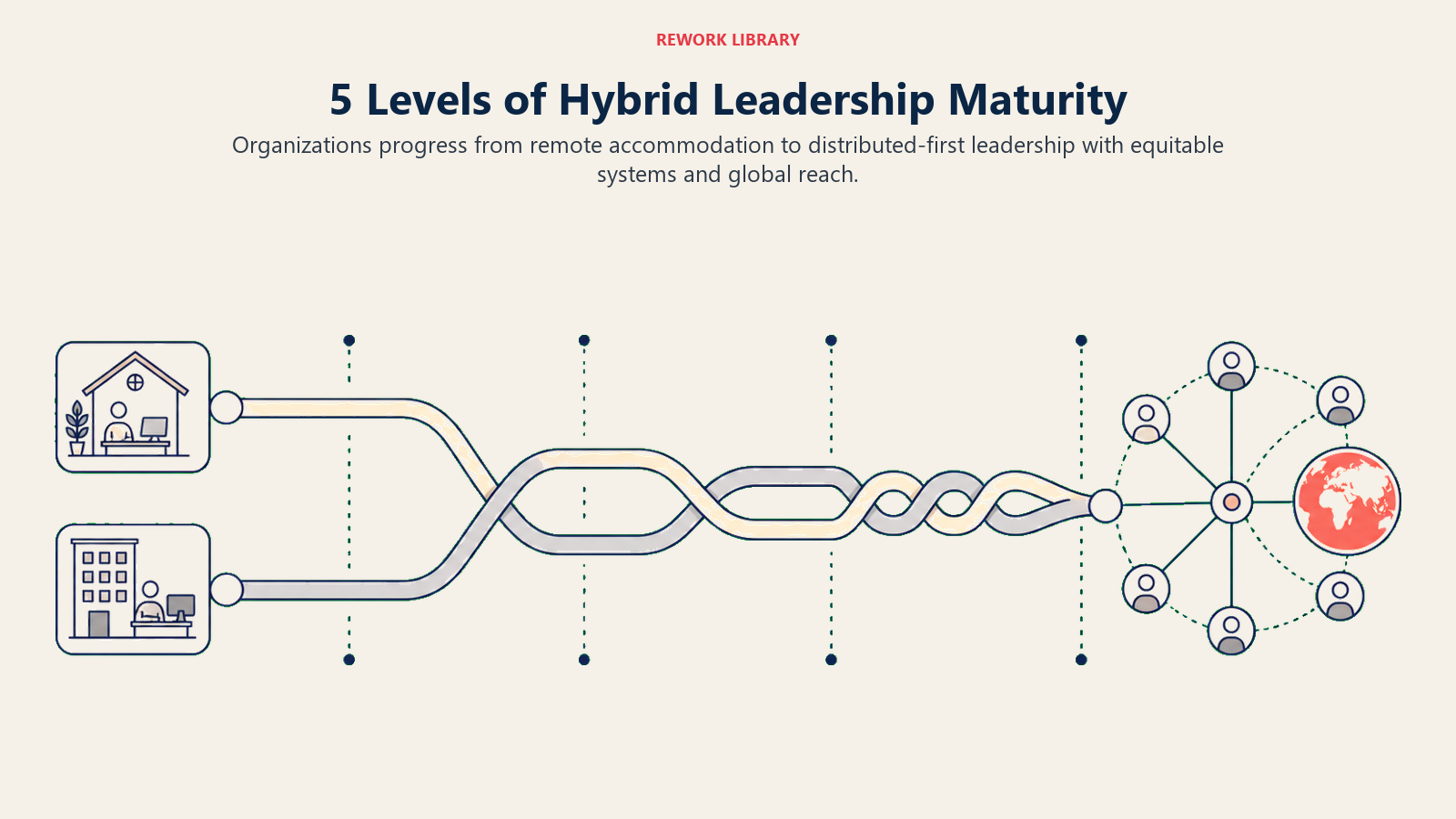
Level 1: Reactive - Remote Work Accommodation (Bottom 25% of Organizations)
Organizational Characteristics:
- Hybrid arrangements exist as exceptions rather than strategic capability
- Leadership views in-person presence as the default and measures effort by visibility
- No formal policies or technology infrastructure designed for distributed work
- Communication patterns favor those physically present in meetings and offices
- Career advancement and high-visibility projects disproportionately flow to in-office employees
Capability Indicators:
- Remote employees report 45% lower inclusion scores compared to in-office peers
- Manager effectiveness ratings drop 35% when leading hybrid versus co-located teams
- No standardized tools or training for hybrid meeting facilitation or asynchronous collaboration
- Performance evaluation criteria emphasize presence-based behaviors over outcome delivery
Business Impact & Costs:
- Voluntary turnover among remote-capable employees is 40% higher than industry benchmarks
- 55% of hybrid arrangements fail within 18 months because of proximity bias and communication breakdowns
- Talent acquisition limited to commutable geographic radius despite stated flexibility policies
- Innovation suffers as diverse perspectives and talent are excluded from hybrid-hostile culture
Real-World Examples:
- Yahoo (2013): Recalled all remote workers, lost significant talent to competitors, and reversed policy within years
- Traditional Financial Services (2020-2022): Many firms struggled with return-to-office mandates, experiencing elevated attrition among high performers
Investment vs. Return:
- Minimal investment in hybrid capabilities (less than 0.5% of people operations budget)
- Return deficit of -25% to -40% in talent retention compared to hybrid-mature competitors
Benchmark: Bottom 25th percentile - Organizations lose talent to more flexible competitors and struggle with post-pandemic workforce expectations
Level 2: Structured - Formal Hybrid Policy Implementation (25th-50th Percentile)
Organizational Characteristics:
- Clear hybrid work policies establish expectations for remote days, core hours, and office requirements
- Technology platforms enable basic video conferencing and document collaboration
- Managers receive foundational training on leading teams in distributed environments
- Standard meeting protocols address hybrid participation and camera-on expectations
- Remote employees have defined equipment and workspace requirements
Capability Indicators:
- Hybrid meeting effectiveness improves to 65% satisfaction rates through standardized practices
- Manager confidence in leading hybrid teams increases by 40% through structured training
- Remote employee inclusion scores improve to within 25% of in-office peer levels
- Clear policies reduce ambiguity and manager discretion variations across the organization
Business Impact & Costs:
- Employee retention improves by 25% compared to reactive hybrid organizations
- Productivity metrics stabilize with 10-15% improvement through defined hybrid work practices
- Real estate costs begin declining through scheduled office utilization and hoteling arrangements
- Talent acquisition expands to regional rather than strictly local candidate pools
Real-World Examples:
- Microsoft (2020-2023): Established structured hybrid policies with manager training and technology investments
- Salesforce (2021-2024): Created "Success from Anywhere" framework with clear hybrid work guidelines
Investment vs. Return:
- Investment of 1-2% of people operations budget in hybrid policies, training, and technology
- Return of 20-35% improvement in retention and productivity metrics
Benchmark: 25th-50th percentile - Organizations maintain stable hybrid operations but lack competitive differentiation
Level 3: Proactive - Integrated Hybrid Excellence (50th-75th Percentile)
Organizational Characteristics:
- Hybrid work integrated into organizational culture with location-agnostic approaches to collaboration
- Advanced technology platforms enable seamless synchronous and asynchronous work patterns
- Leaders model hybrid behaviors and are evaluated on distributed team effectiveness
- Teamwork practices redesigned for hybrid environments with intentional connection rituals
- Performance management systems focus purely on outcomes rather than presence or hours
Capability Indicators:
- Remote and in-office employees report equivalent inclusion and career advancement rates
- Manager hybrid leadership scores reach 80%+ effectiveness ratings from direct reports
- Asynchronous communication reduces meeting overload while improving decision documentation
- Cross-functional collaboration effectiveness matches or exceeds pre-hybrid performance levels
Business Impact & Costs:
- Employee retention reaches top-quartile industry performance with 45% lower voluntary turnover
- Productivity increases 25-30% through optimized hybrid work patterns and reduced meeting burden
- Real estate footprint reduced 30-40% through activity-based workplace design and booking systems
- Talent acquisition extends nationally with employer brand recognition for hybrid excellence
Real-World Examples:
- GitLab: Built all-remote culture with comprehensive async-first communication and documentation practices
- Zapier: Developed sophisticated hybrid culture with intentional virtual bonding and transparent communication norms
Investment vs. Return:
- Investment of 2-4% of people operations budget in advanced hybrid infrastructure and leadership development
- Return of 50-75% improvement in talent metrics and productivity outcomes
Benchmark: 50th-75th percentile - Organizations achieve competitive advantage through hybrid leadership excellence
Level 4: Anticipatory - Distributed-First Leadership Innovation (75th-95th Percentile)
Organizational Characteristics:
- Organization designed as distributed-first with offices as collaboration hubs rather than default workplaces
- AI-powered tools optimize hybrid collaboration, scheduling, and communication patterns
- Leadership development programs systematically build hybrid leadership as a core capability
- Virtual and in-person experiences achieve equivalent engagement and connection quality
- Digital fluency enables seamless work across any location, device, or time zone
Capability Indicators:
- Hybrid leadership becomes employer brand differentiator attracting top talent globally
- Employee experience scores for remote workers exceed in-office peer levels
- Innovation metrics improve 35-45% through diverse global talent and 24-hour collaboration cycles
- Organizational resilience enables seamless operations through any disruption or crisis
Business Impact & Costs:
- Talent acquisition reaches global scale with 10x larger qualified candidate pools
- Productivity performance exceeds industry benchmarks by 40-50% through optimized distributed work
- Real estate strategy shifts to strategic presence model with 50-60% footprint reduction
- Business continuity becomes effortless with distributed infrastructure and practiced remote operations
Real-World Examples:
- Automattic (WordPress): Pioneered distributed-first operations with 2,000+ employees across 100+ countries
- Spotify: Developed "Work From Anywhere" model with sophisticated technology and culture investments
Investment vs. Return:
- Investment of 4-6% of people operations budget in distributed-first infrastructure and innovation
- Return of 150-250% improvement in talent acquisition scope and productivity performance
Benchmark: 75th-95th percentile - Organizations set industry standards for distributed work excellence
Level 5: Transformational - Global Distributed Leadership Standard (Top 5% of Organizations)
Organizational Characteristics:
- Organization sets global benchmarks for hybrid and distributed team leadership practices
- Thought leadership in distributed work influences industry practices and academic research
- Hybrid leadership methodologies become monetizable intellectual property and consulting services
- Global talent network operates as seamlessly integrated workforce regardless of location
- Hybrid work innovations are studied and replicated by competitors and consulting firms
Capability Indicators:
- Organization consulted by governments and industry associations on distributed work policy
- Hybrid leadership practices referenced in business school curricula and management literature
- Employee advocacy and referral rates exceed 90% with employer brand leadership for flexibility
- Talent acquisition achieves near-unlimited geographic reach with global best-in-class reputation
Business Impact & Costs:
- Talent advantage creates sustainable competitive moat through global workforce optimization
- Productivity and innovation leadership generates premium market positioning and valuation
- Real estate strategy achieves optimal balance of physical presence and distributed operations
- Organizational resilience enables industry leadership through any market disruption
Real-World Examples:
- GitLab: Published comprehensive remote work playbook used by thousands of organizations globally
- Shopify (2020-2026): Declared "digital by default" and developed innovative distributed work practices now studied worldwide
Investment vs. Return:
- Investment of 6-10% of people operations budget in transformational distributed work capabilities
- Return of 400-700% premium in talent access and organizational performance metrics
Benchmark: Top 5th percentile - Organizations define the future of work and shape global employment practices
Your Roadmap: How to Advance Through Each Level
Current State Pain Points: Most organizations struggle with hybrid work that creates two-tiered employee experiences, communication breakdowns, eroded culture, proximity bias in performance evaluations, and technology gaps that frustrate distributed collaboration. These challenges get worse when leaders lack training for hybrid environments and organizations try to force pre-pandemic management approaches onto fundamentally different work models.
Target Outcomes: Advanced hybrid leadership capabilities let organizations attract global talent, build strong culture across distances, maintain communication excellence regardless of location, and create equitable experiences that maximize both flexibility and performance. The ultimate goal is building organizational DNA that thrives in distributed environments while keeping the collaboration and connection benefits of in-person work.
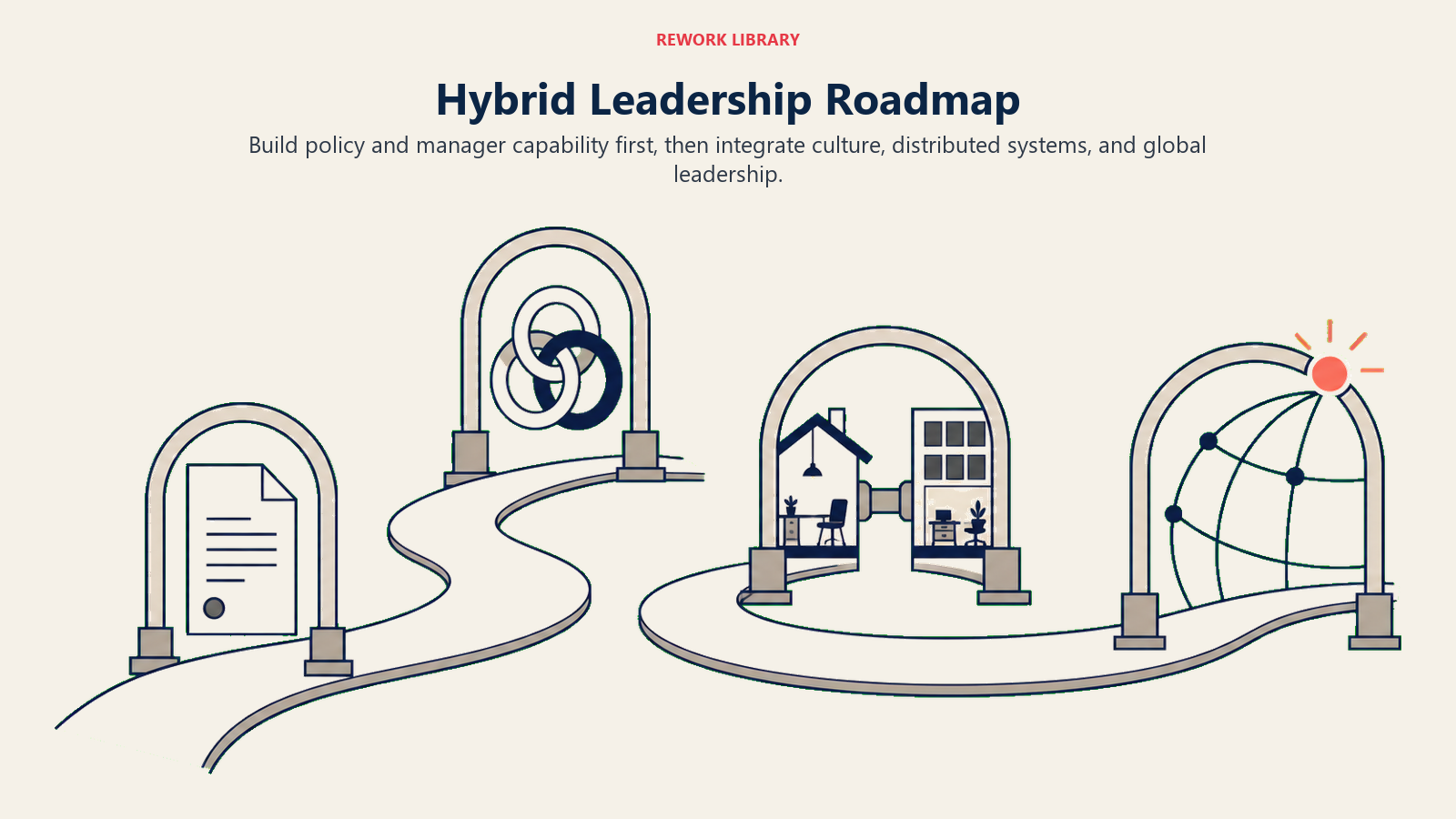
Level 1 to Level 2: Building Hybrid Foundation (6-12 months)
Step 1: Policy and Infrastructure Development (4 months) - Create comprehensive hybrid work policies covering eligibility, schedules, workspace requirements, and expectations. Invest in core technology stack including enterprise video conferencing, collaboration platforms, and document management. Budget $200K-500K for policy development, technology licensing, and workspace equipment.
Step 2: Manager Training Program (3 months) - Develop and deliver foundational hybrid leadership training covering virtual meeting facilitation, distributed team communication, and remote performance management. Ensure all people managers complete certification. Allocate $150K-300K for training development and delivery.
Step 3: Communication Standards (2-3 months) - Establish hybrid meeting protocols, documentation practices, and communication channel guidelines. Create resources for effective hybrid meetings including templates and checklists. Investment of $50K-100K for standards development and communication.
Level 2 to Level 3: Hybrid Culture Integration (12-18 months)
Step 1: Technology Platform Enhancement (6 months) - Implement advanced collaboration tools including asynchronous video, virtual whiteboarding, and AI-powered meeting summaries. Create integrated digital workplace experience across devices and locations. Investment of $500K-1M for platform licensing and integration.
Step 2: Performance System Redesign (6 months) - Transform performance management to outcome-based evaluation that eliminates proximity bias. Train managers on results-oriented goal setting and feedback practices. Budget $300K-600K for system redesign and training.
Step 3: Culture and Connection Programs (6-9 months) - Design intentional programs for virtual team building, hybrid onboarding, and distributed mentoring. Create rituals that build culture regardless of location. Investment of $250K-500K for program development and ongoing activities.
Level 3 to Level 4: Distributed-First Transformation (18-30 months)
Step 1: Distributed-First Redesign (12 months) - Reimagine organizational design for distributed-first operations with offices as optional collaboration spaces. Implement advanced scheduling, space booking, and collaboration analytics. Investment of $1M-2M for redesign and technology.
Step 2: AI-Powered Collaboration (9 months) - Deploy AI tools for meeting optimization, communication analysis, and collaboration insights. Use predictive analytics to identify hybrid work patterns and team dynamics. Budget $600K-1.2M for AI platform implementation.
Step 3: Global Talent Integration (9-15 months) - Expand hybrid capabilities to support global workforce with multi-timezone collaboration and cross-cultural team leadership. Build infrastructure for seamless global operations. Investment of $800K-1.5M for global capability development.
Level 4 to Level 5: Global Hybrid Leadership (24-36 months)
Step 1: Thought Leadership Platform (15 months) - Establish global recognition for hybrid leadership innovation through research publication, conference leadership, and methodology development. Build intellectual property portfolio around distributed work practices. Investment of $1.5M-3M annually.
Step 2: Consulting and Advisory Services (12 months) - Develop hybrid work consulting capabilities that monetize organizational expertise while extending industry influence. Create training and certification programs for external clients. Budget $2M-4M for service development.
Step 3: Industry Standard Definition (12-18 months) - Lead industry associations and policy discussions on distributed work standards. Shape regulatory frameworks and employment practices through demonstrated leadership. Investment of $3M-6M for industry leadership activities.
Quick Assessment: What Level Are You?
Level 1 Indicators:
- Hybrid work treated as exception or accommodation rather than strategic capability
- Remote employees report significantly lower inclusion and career advancement
- No formal training for managers on leading distributed teams
- Communication and meeting practices favor those physically present
- Performance evaluation includes presence-based criteria
Level 2 Indicators:
- Clear hybrid policies establish expectations and guidelines
- Core technology platforms enable video conferencing and collaboration
- Managers receive foundational hybrid leadership training
- Standard meeting protocols address hybrid participation
- Remote employee experience improving but gaps remain
Level 3 Indicators:
- Hybrid work integrated into organizational culture and values
- Performance management focused purely on outcomes
- Remote and in-office employees report equivalent experiences
- Advanced technology enables seamless synchronous and asynchronous work
- Leaders model hybrid behaviors and are evaluated on distributed effectiveness
Level 4 Indicators:
- Organization designed as distributed-first with offices as collaboration options
- AI-powered tools optimize hybrid collaboration and communication
- Global talent network operates seamlessly across locations and time zones
- Hybrid leadership is recognized employer brand differentiator
- Virtual and in-person experiences achieve equivalent engagement quality
Level 5 Indicators:
- Organization sets global standards for distributed work leadership
- Hybrid practices referenced in business school curricula and management literature
- Consulted by governments and industry associations on distributed work policy
- Hybrid work innovations studied and replicated across industries
- Thought leadership influences global employment practices
Communication Strategies for Hybrid Excellence
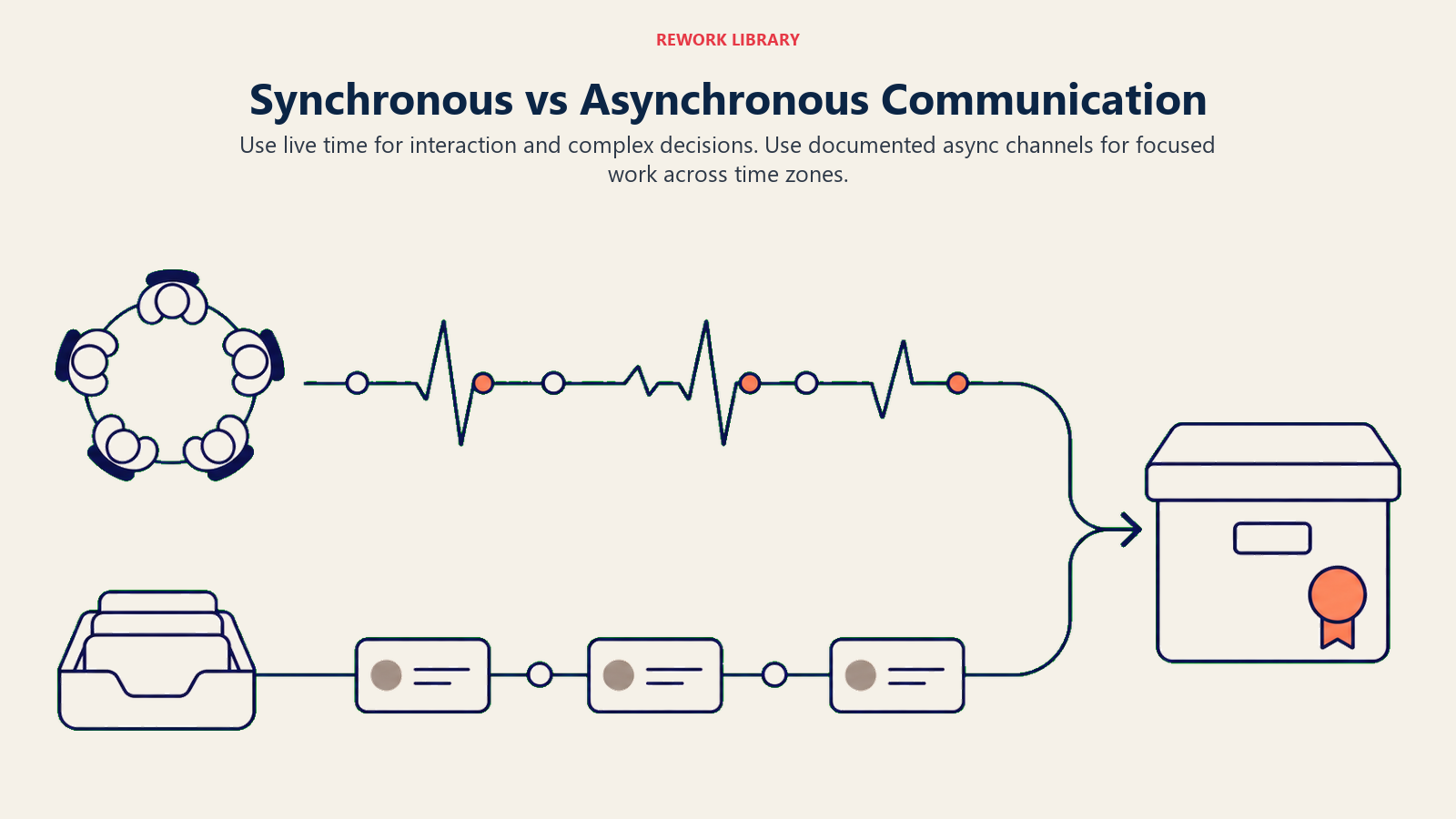
Synchronous Communication Best Practices
Effective hybrid teams master the balance between real-time collaboration and asynchronous work. Save synchronous meetings for discussions requiring immediate input, creative brainstorming, relationship building, and complex problem-solving. Everything else should default to asynchronous channels.
Hybrid Meeting Excellence:
- Camera-on policies that apply equally to all participants regardless of location
- Meeting host rotates between locations to prevent in-office dominance
- Chat and collaboration tools active during meetings for inclusive participation
- Meeting recordings and AI-generated summaries for those unable to attend
- Physical meeting rooms equipped with high-quality video and audio for remote participants
Asynchronous Communication Framework
GitLab and Zapier have proven that asynchronous-first communication actually improves decision quality while respecting time zones and focused work. Document decisions, context, and rationale rather than relying on verbal transmission that excludes remote team members.
Asynchronous Best Practices:
- Written proposals with clear deadlines for feedback rather than meetings for initial input
- Video messages for complex explanations that benefit from tone and expression
- Documented decisions accessible to entire team regardless of meeting attendance
- Response time expectations calibrated to urgency rather than immediate availability
- Weekly written updates that keep teams aligned without requiring synchronous time
Performance Management Without Proximity Bias
Research from Harvard Business School confirms that proximity bias remains the biggest threat to hybrid team equity. Managers unconsciously favor employees they see regularly, creating career advancement gaps for remote workers. Getting rid of this bias requires systematic changes to performance management.
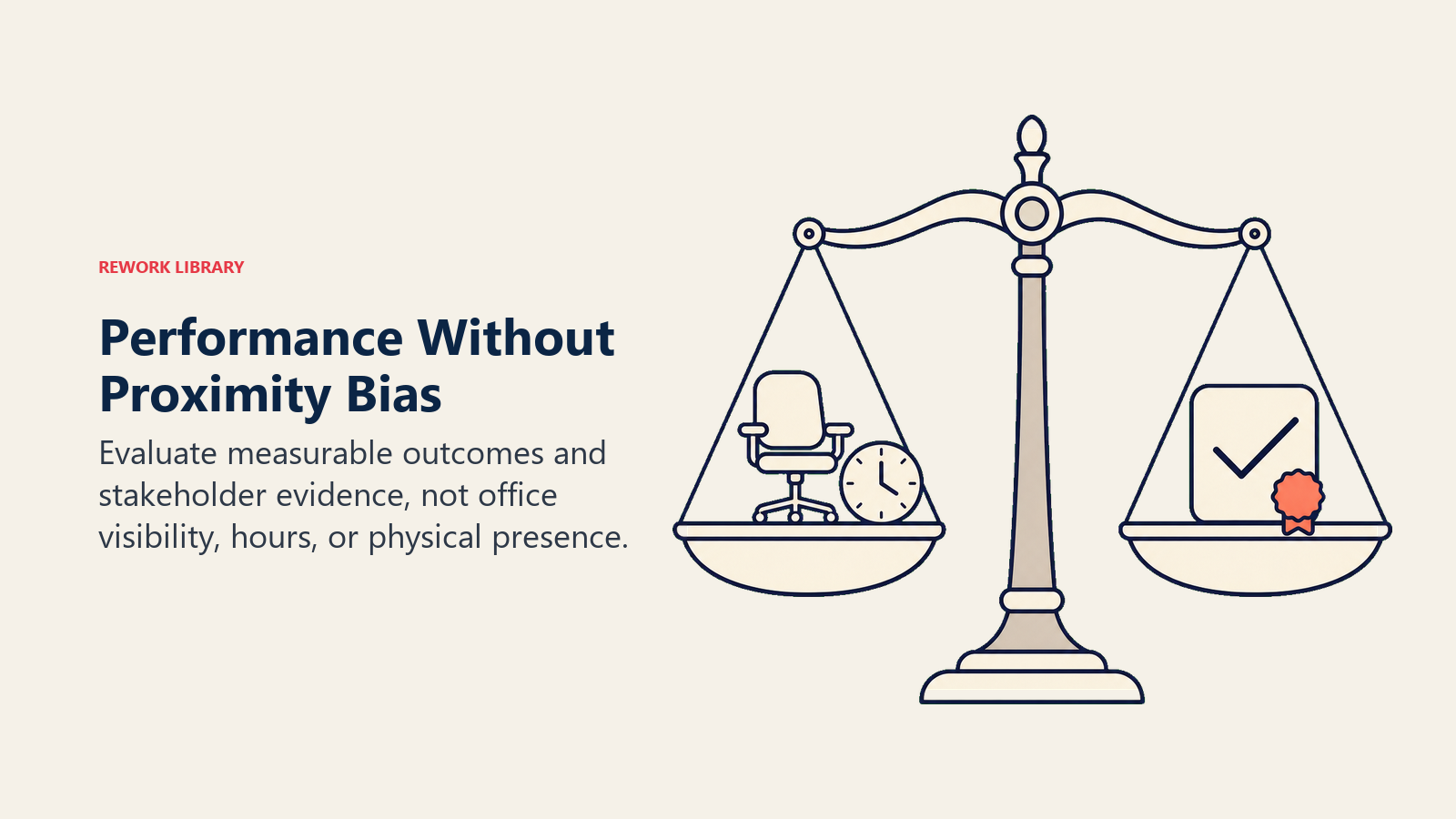
Outcome-Based Evaluation:
- Define clear, measurable objectives at the start of each performance period
- Evaluate results delivered rather than hours worked or office attendance
- Use data from project management and collaboration tools to assess contribution
- Gather feedback from diverse stakeholders including those in different locations
- Calibrate performance ratings across manager groups to identify bias patterns
Career Development Equity:
- Track project assignments by employee location to identify distribution patterns
- Ensure remote employees have equivalent access to mentors and sponsors
- Create visibility opportunities that don't require physical presence
- Include hybrid leadership as a required competency for management promotion
- Audit promotion rates by work location annually to detect systemic bias
Technology Platforms for Hybrid Collaboration
Core Infrastructure Requirements
Effective hybrid work requires technology that creates equivalent experiences regardless of location. This goes beyond basic video conferencing to include comprehensive digital workplace platforms.
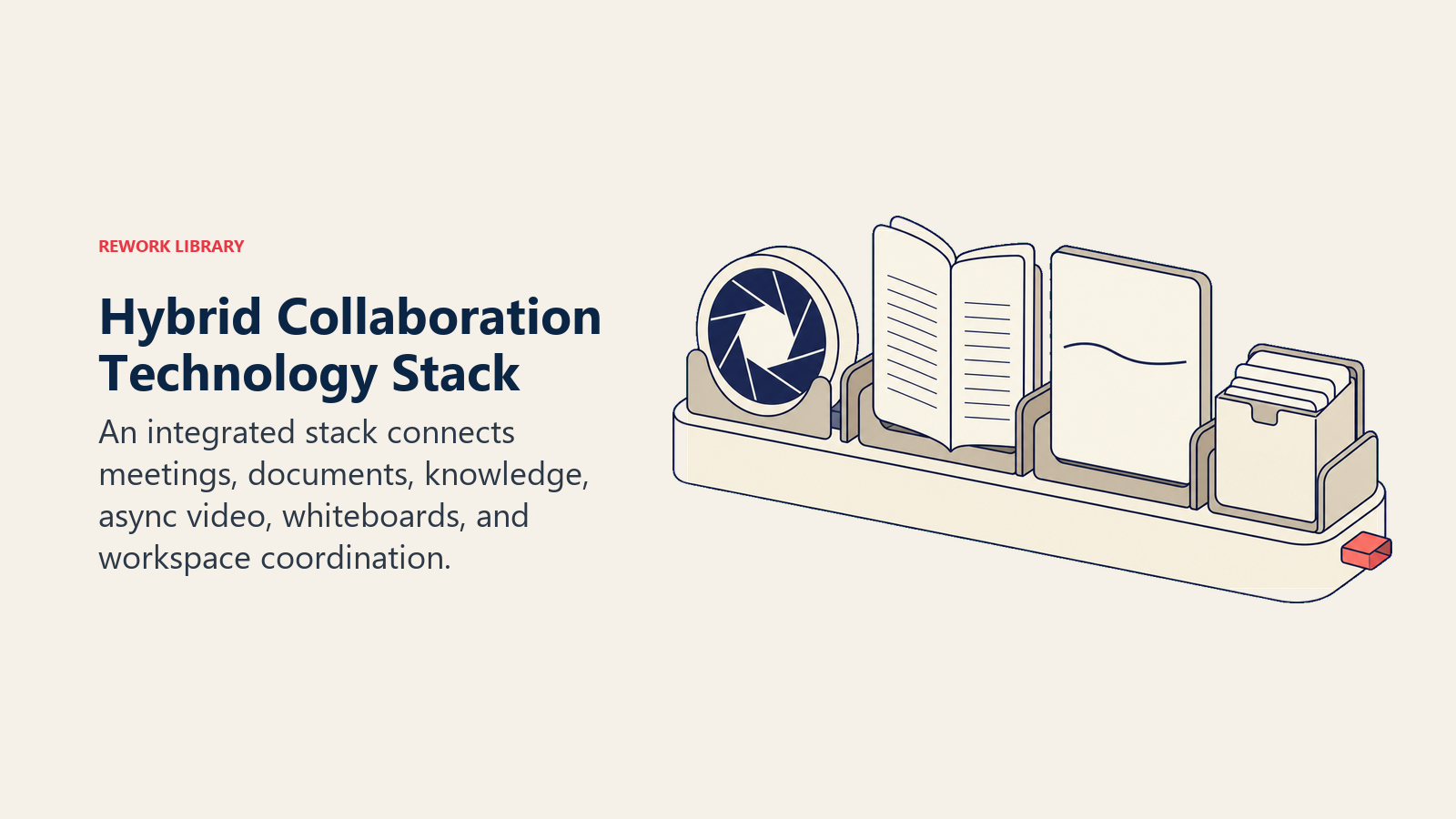
Core Technology Stack:
- Video Conferencing: Enterprise platforms with AI features, recording, and transcription
- Collaboration Suites: Integrated document editing, messaging, and project management
- Virtual Whiteboarding: Digital brainstorming and visualization tools
- Asynchronous Video: Recorded video messaging for complex communication
- Knowledge Management: Searchable documentation and decision archives
- Space Booking: Office hoteling and collaboration space reservation systems
Advanced Technology Investments
Organizations at Level 4 and above invest in AI-powered tools that optimize hybrid collaboration patterns.
Advanced Capabilities:
- AI meeting summaries that capture decisions and action items automatically
- Communication analytics that identify collaboration patterns and potential issues
- Scheduling optimization that coordinates across time zones and preferences
- Virtual reality collaboration spaces for immersive distributed meetings
- Sentiment analysis that monitors team engagement and connection
Building Culture Across Distances
GitLab, Automattic, and Zapier prove that strong organizational culture can thrive without shared physical space. The key is intentionally designing culture-building activities and rituals that work regardless of location.
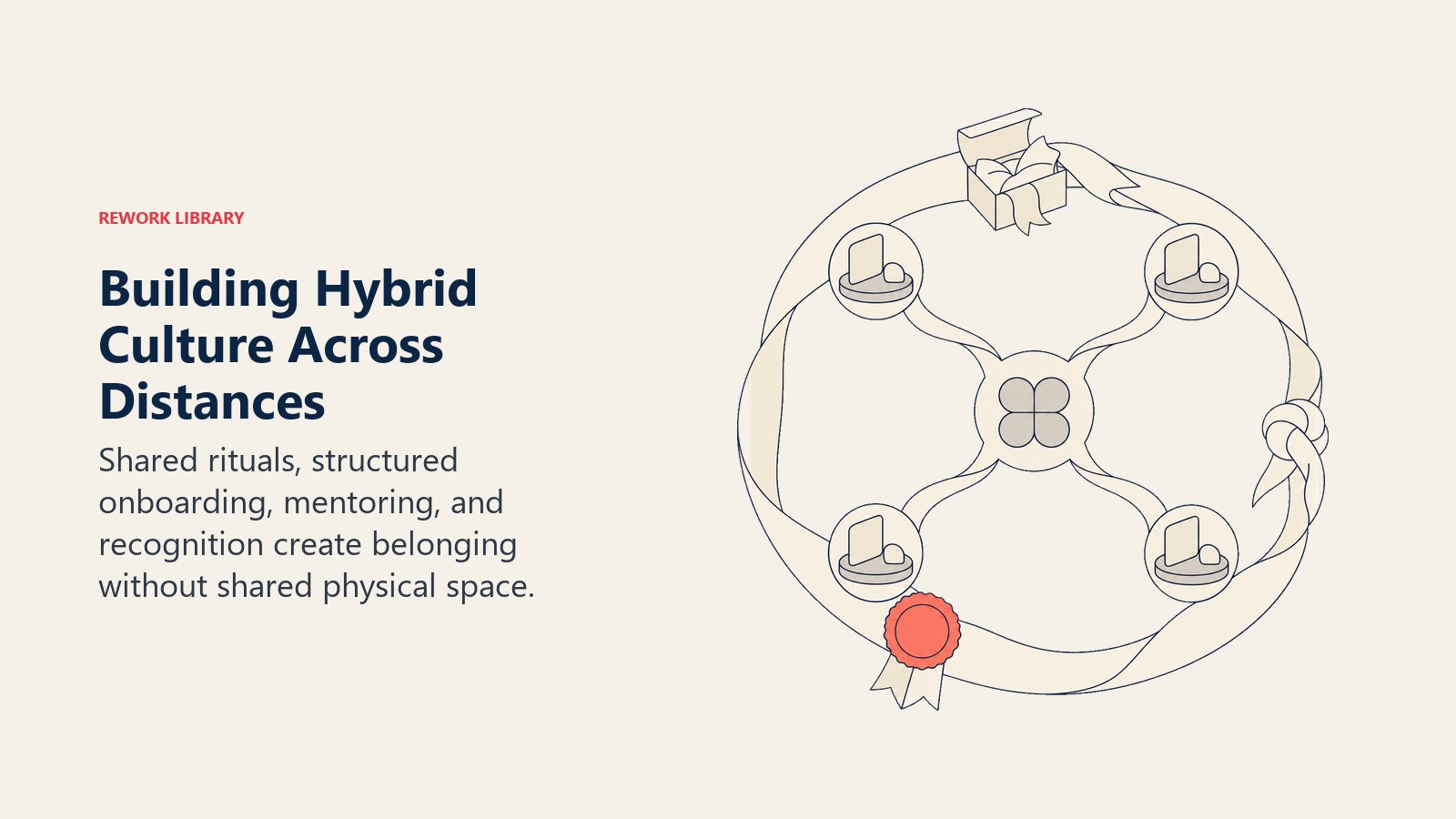
Virtual Connection Rituals:
- Weekly team check-ins that include personal sharing and relationship building
- Monthly virtual social events with creative formats beyond standard video calls
- Quarterly in-person gatherings for teams that operate primarily remotely
- Buddy systems that pair new hires with cultural ambassadors across locations
- Recognition programs that celebrate contributions visible to entire organization
Hybrid Onboarding Excellence:
- Structured 90-day programs with clear milestones and check-ins
- Virtual mentor assignments before day one
- Mix of synchronous welcome sessions and self-paced learning
- Technology setup shipped and tested before start date
- Social integration activities that connect new hires across locations
Industry Benchmarks and Best Practices
Technology Sector Benchmarks
- Hybrid Adoption Rate: 75-85% of workforce in hybrid arrangements
- Remote Employee Inclusion Score: 85%+ equivalent to in-office peers
- Investment Level: 4-8% of people operations budget in hybrid capabilities
- Leading Organizations: GitLab, Automattic, Shopify (Level 4-5 capabilities)
Financial Services Benchmarks
- Hybrid Adoption Rate: 55-70% of workforce eligible for hybrid
- Remote Employee Inclusion Score: 70-80% of in-office peer levels
- Investment Level: 2-4% of people operations budget in hybrid infrastructure
- Leading Organizations: JPMorgan Chase, Goldman Sachs (Level 2-3 capabilities)
Professional Services Benchmarks
- Hybrid Adoption Rate: 80-90% of workforce in flexible arrangements
- Remote Employee Inclusion Score: 80%+ equivalent to in-office peers
- Investment Level: 3-5% of people operations budget in distributed work
- Leading Organizations: Deloitte, Accenture, McKinsey (Level 3-4 capabilities)
Manufacturing and Operations Benchmarks
- Hybrid Adoption Rate: 30-50% of eligible roles in hybrid arrangements
- Remote Employee Inclusion Score: 60-75% of in-office peer levels
- Investment Level: 1-2% of people operations budget in hybrid capabilities
- Leading Organizations: Siemens, GE (Level 2-3 for eligible roles)
Resources for Organizational Development
Current Frameworks and Methodologies
- GitLab Remote Playbook: Comprehensive documentation of all-remote practices
- Microsoft Hybrid Work Framework: Research-based approach to hybrid transformation
- Gallup Hybrid Workplace Model: Evidence-based strategies for hybrid engagement
- SHRM Hybrid Work Guidelines: HR-focused hybrid policy and practice resources
Educational Resources
- Universities: Stanford Work Design, MIT Sloan Future of Work, Harvard Hybrid Leadership
- Certifications: Remote Work Professional, Hybrid Team Leader, Distributed Work Manager
- Online Learning: LinkedIn Learning Remote Leadership, Coursera Future of Work
- Professional Associations: Remote Work Association, Future of Work Institute
Consulting and Advisory Services
- Hybrid Strategy Consulting: McKinsey Organization Practice, BCG People Strategy
- Implementation Partners: Accenture Future Workforce, Deloitte Human Capital
- Specialized Firms: Distribute Consulting, Remote-How, FlexJobs Corporate
- Technology Integration: Microsoft Modern Work, Google Workspace, Slack Enterprise
Strategic Considerations for Leadership
How should the board evaluate the organization's hybrid leadership maturity and prioritize investments in distributed work capabilities?
Boards should assess hybrid leadership through systematic evaluation of employee experience parity between remote and in-office workers, talent acquisition reach and quality, retention rates among remote-capable roles, and productivity metrics across work locations. Key indicators include remote employee inclusion scores, manager effectiveness ratings for distributed teams, and employer brand recognition for workplace flexibility. Boards should require quarterly hybrid workforce reporting and ensure adequate investment in technology, training, and culture programs.
What organizational structure changes are required to advance from basic hybrid accommodation to distributed-first leadership?
Advancing hybrid maturity requires redesigning meeting and communication practices for location-agnostic effectiveness, implementing outcome-based performance management that eliminates proximity bias, creating intentional culture-building programs for distributed teams, and investing in technology that equalizes the experience across locations. Leadership roles must include hybrid effectiveness as a core competency, and career paths must ensure equivalent advancement opportunities regardless of work location.
How can leadership teams measure the ROI of investments in hybrid leadership capabilities?
ROI measurement should cover talent metrics (candidate pool size, offer acceptance rates, retention by work location), productivity indicators (output per employee, project completion rates, innovation metrics), cost efficiency (real estate savings, travel reduction), and engagement measures (inclusion scores, eNPS by location). Establish baseline measurements before hybrid investments and track improvements over 12-24 month periods. Benchmark against industry peers and competitors known for hybrid excellence.
What role should technology investments play in developing organizational hybrid leadership capabilities?
Technology creates the infrastructure for equitable hybrid experiences but can't replace leadership development and culture change. Core investments should focus on collaboration platforms that work seamlessly across locations, AI-powered tools that optimize distributed work patterns, and analytics that identify hybrid effectiveness and potential issues. Technology investments should be paired with training and change management to make sure people actually adopt and use these tools effectively.
How should organizations balance flexibility for employees with operational requirements for in-person collaboration?
Effective balance requires being clear about which activities genuinely benefit from in-person interaction versus those that work equally well distributed. Most organizations find that creative collaboration, relationship building, complex problem-solving, and onboarding benefit from periodic in-person time, while individual work, routine meetings, and asynchronous communication are equally effective remotely. Create activity-based guidelines rather than blanket policies.
What are the critical success factors for eliminating proximity bias in hybrid performance management?
Success factors include outcome-based evaluation criteria that focus on results rather than presence, manager training on cognitive biases affecting distributed team evaluation, calibration processes that compare ratings across work locations, tracking project assignments and career advancement by location, and leaders modeling hybrid work while maintaining high performance expectations.
How should organizations adapt hybrid leadership capabilities during periods of rapid growth or contraction?
Rapid change requires flexible hybrid infrastructure that scales efficiently, clear onboarding and offboarding processes designed for distributed execution, communication practices that maintain alignment through change, and culture programs that keep people connected during disruption. Organizations with mature hybrid capabilities often show greater resilience during market volatility because of their distributed infrastructure and practiced remote operations.
What succession planning considerations matter most for sustaining hybrid leadership capabilities?
Hybrid leadership sustainability requires identifying and developing leaders who demonstrate distributed team effectiveness, creating career paths that include hybrid leadership experience, documenting hybrid practices and cultural norms, and making sure knowledge transfer processes work across locations. Leadership development programs must include hybrid competencies as core requirements rather than optional skills.
How can organizations integrate hybrid leadership with diversity, equity, and inclusion initiatives?
Hybrid work expands talent access to groups previously excluded by geographic constraints, including caregivers, people with disabilities, and those in regions without major employers. However, hybrid models can also create new equity challenges through proximity bias and career advancement gaps. Integrate hybrid leadership with DEI by tracking inclusion metrics by location, making sure opportunities are distributed fairly, and creating visibility for remote employee contributions.
What governance structures are most effective for overseeing enterprise hybrid work capabilities?
Effective governance includes executive sponsorship of hybrid work strategy, cross-functional hybrid work councils with HR, IT, facilities, and business leadership, regular hybrid effectiveness reviews with employee feedback, and clear escalation paths for policy exceptions. Governance should balance standardization for equity with flexibility for business unit and role-specific needs.
Your First 30 Days: Getting Started
Week 1: Hybrid Capability Assessment
Run a comprehensive evaluation of existing hybrid leadership capabilities using the maturity model framework. Survey employees on hybrid work experience, review manager effectiveness ratings for distributed teams, and benchmark current capabilities against industry standards. Document technology infrastructure, policy clarity, and culture-building practices.
Week 2: Leadership Alignment
Facilitate executive team sessions to build consensus on hybrid leadership importance and transformation priorities. Present the business case for hybrid capability investment including talent market analysis, competitor positioning, and productivity research. Get leadership commitment for systematic hybrid development and resource allocation.
Week 3: Quick Win Implementation
Identify 2-3 high-impact improvements that can show hybrid leadership value within 60-90 days. Focus on meeting effectiveness training, communication protocol updates, or technology enhancements that address current pain points while building support for comprehensive hybrid transformation investments.
Week 4: Transformation Planning
Develop detailed roadmap for advancing to next hybrid leadership maturity level including timeline, technology requirements, training needs, and success metrics. Establish hybrid transformation team, identify external partners if needed, and create communication plan for organization-wide hybrid capability building initiative.
Conclusion: The Hybrid Leadership Imperative
Hybrid Team Leadership represents the organizational capability that distinguishes talent magnets from talent losers in our era of flexible work expectations and global talent competition. Organizations that systematically develop hybrid leadership capabilities go beyond just accommodating remote work. They use distributed operations strategically, creating sustainable advantages through broader talent access, higher productivity, and stronger employee engagement.
The evidence is clear: organizations with mature hybrid leadership capabilities achieve 67% higher retention, 34% higher productivity, and access talent pools 10x larger than office-centric competitors. They demonstrate 42% faster innovation cycles and 51% higher engagement scores through systematic hybrid excellence.
Getting to hybrid leadership excellence requires systematic progression through maturity levels, each building capabilities that enable more sophisticated distributed operations and team effectiveness. From reactive accommodation to global distributed leadership, each level represents expanded organizational capability for thriving in the flexible work era.
The investment is substantial. Leading organizations dedicate 6-10% of people operations budgets to hybrid capabilities. But the returns are significant. Hybrid leadership capabilities become sustainable competitive advantages that compound over time, letting organizations attract and retain talent that office-centric competitors simply can't access.
The question for leadership teams isn't whether to invest in hybrid leadership capabilities, but how fast to advance through maturity levels before talent market pressure makes catch-up harder and more expensive. In markets where talent determines competitive success, organizational hybrid leadership becomes the ultimate differentiator.
Learn More
Enhance your understanding of hybrid team leadership and related organizational capabilities:
- Leading Teams - Build the foundational leadership skills needed for any team configuration
- Communication - Master the communication practices that enable distributed team effectiveness
- Teamwork - Build collaborative capabilities that transcend physical boundaries
- Digital Fluency - Develop the technology capabilities that enable hybrid work excellence
Related Organizational Competencies

Senior Customer Retention Strategist
On this page
- Strategic Imperative for Organizational Excellence
- The Competitive Advantage Metrics for Hybrid Leadership
- The 5 Levels of Hybrid Leadership Maturity
- Level 1: Reactive - Remote Work Accommodation (Bottom 25% of Organizations)
- Level 2: Structured - Formal Hybrid Policy Implementation (25th-50th Percentile)
- Level 3: Proactive - Integrated Hybrid Excellence (50th-75th Percentile)
- Level 4: Anticipatory - Distributed-First Leadership Innovation (75th-95th Percentile)
- Level 5: Transformational - Global Distributed Leadership Standard (Top 5% of Organizations)
- Your Roadmap: How to Advance Through Each Level
- Level 1 to Level 2: Building Hybrid Foundation (6-12 months)
- Level 2 to Level 3: Hybrid Culture Integration (12-18 months)
- Level 3 to Level 4: Distributed-First Transformation (18-30 months)
- Level 4 to Level 5: Global Hybrid Leadership (24-36 months)
- Quick Assessment: What Level Are You?
- Communication Strategies for Hybrid Excellence
- Synchronous Communication Best Practices
- Asynchronous Communication Framework
- Performance Management Without Proximity Bias
- Technology Platforms for Hybrid Collaboration
- Core Infrastructure Requirements
- Advanced Technology Investments
- Building Culture Across Distances
- Industry Benchmarks and Best Practices
- Technology Sector Benchmarks
- Financial Services Benchmarks
- Professional Services Benchmarks
- Manufacturing and Operations Benchmarks
- Resources for Organizational Development
- Current Frameworks and Methodologies
- Educational Resources
- Consulting and Advisory Services
- Your First 30 Days: Getting Started
- Week 1: Hybrid Capability Assessment
- Week 2: Leadership Alignment
- Week 3: Quick Win Implementation
- Week 4: Transformation Planning
- Conclusion: The Hybrid Leadership Imperative
- Learn More
- Related Organizational Competencies